

Submitted:
06 August 2026
Posted:
02 September 2026
You are already at the latest version
Abstract
Emotional eating is commonly addressed through nutritional education, dietary modification, and interventions targeting individual self-control. Although these approaches remain important, they pay comparatively little attention to the behavioural environments in which food becomes the most immediately rewarding and accessible behavioural option, particularly among time-constrained workers experiencing chronic stress, cognitive fatigue, and work-related rumination. This paper develops a Behavioural Environmental Theory of Emotional Eating that integrates evidence from behavioural nutrition, reinforcement theory, behavioural neuroscience, occupational health, and health psychology. The proposed framework conceptualises emotional eating as behavioural allocation among competing sources of reinforcement, determined by cue-triggered wanting, the relative reinforcing value of competing rewards, and the behavioural environment. Building on this theory, we introduce Time-adapted Metabolic Social Connection (T-MSC) as one practical strategy for increasing immediately available non-food reinforcement through brief, psychologically safe, reciprocal social interaction that is deliberately separated from eating. Rather than focusing exclusively on reducing food reward or strengthening self-control, the framework shifts the primary intervention target toward redesigning behavioural environments to increase competing reinforcement before eating occurs. The proposed theory provides a conceptual foundation for mechanism-based intervention development, ecological momentary assessment, workplace health promotion, digital health applications, and future behavioural environmental research on obesity prevention.
Keywords:
emotional eating
; obesity prevention
; behavioural environment
; behavioural allocation
; social reward
; alternative reinforcement
; workplace health
; work-related rumination
; ecological momentary assessment
; implementation science
1. Introduction
Obesity and metabolic syndrome remain among the leading public health challenges worldwide, contributing substantially to cardiovascular disease, type 2 diabetes, reduced quality of life, and premature mortality (World Health Organization, 2024; Swinburn et al., 2011). Despite considerable advances in nutritional science, behavioural medicine, and public health, the prevalence of obesity continues to increase in many countries. Consequently, prevention strategies have traditionally focused on improving dietary choices, increasing physical activity, and strengthening individual self-regulation (Swinburn et al., 2011; Hollands et al., 2017). Although these approaches have produced important advances, their effectiveness in everyday life remains limited, particularly among working adults exposed to chronic occupational stress (Proper & van Oostrom, 2019). Many employees understand what constitutes a healthy diet, yet continue to engage in emotional eating, frequent snacking, and consumption of energy-dense foods during or after stressful working days. These observations suggest that unhealthy eating cannot be explained solely by inadequate nutritional knowledge but must also be understood within the behavioural environments in which behaviour is repeatedly selected.
Recent research has increasingly recognised emotional eating as a reward-seeking behaviour rather than simply a failure of self-control (Macht, 2008; Evers et al., 2018). Stress, cognitive fatigue, and work-related rumination generate negative affective states that motivate individuals to seek immediately accessible sources of psychological relief (Cropley & Zijlstra, 2011; Querstret & Cropley, 2012). Contemporary models further suggest that emotional eating is reinforced through repeated relief-learning processes, whereby temporary reductions in negative affect strengthen future stress-induced eating responses. Similarly, research on food cue reactivity has demonstrated that exposure to highly palatable food cues can trigger craving and cue-induced wanting independently of physiological hunger (Boswell & Kober, 2016). Highly palatable food is particularly effective in this regard because it provides rapid hedonic reward while requiring almost no preparation, planning, or cognitive effort (Berridge, 2009; Appelhans, 2009). Repeated experiences of emotional relief therefore strengthen learned associations between stress and eating, progressively increasing the likelihood that food will be selected whenever similar emotional states recur. Emotional eating should therefore be understood not merely as a problem of dietary restraint but as repeated reward-seeking behaviour occurring within everyday behavioural environments.
Behavioural science provides an important framework for understanding this process. Human behaviour is continuously allocated among competing sources of reinforcement rather than determined solely by conscious choice (Herrnstein, 1970). Whether individuals eat, exercise, rest, engage in leisure activities, or seek social interaction depends not only on motivational states but also on the relative availability, accessibility, and reinforcing value of competing behavioural alternatives. Research on the relative reinforcing value (RRV) of food has consistently demonstrated that food motivation depends not simply on the attractiveness of food itself but on its value relative to concurrently available alternatives (Epstein et al., 2009; Epstein et al., 2011). Likewise, cue-triggered wanting increases the motivational value of food in response to environmental food cues, whereas behavioural allocation ultimately reflects competition among immediately available rewards (Berridge, 2009; Boswell & Kober, 2016). Consequently, emotional eating is better understood as behavioural allocation within a broader behavioural environment than as food choice alone.
This behavioural perspective raises an important intervention question. If emotional eating occurs because food frequently represents the most immediately accessible source of reinforcement, could increasing the availability of immediately accessible non-food reinforcement reduce the behavioural dominance of food? Rather than asking only how food can be made less attractive, it becomes equally important to ask how alternative rewarding experiences can be made more immediately available within everyday behavioural environments.
One promising candidate is social interaction. Social relationships have traditionally been investigated within the framework of social support (Uchino, 2009; Holt-Lunstad et al., 2010). More recently, however, behavioural neuroscience has demonstrated that social interaction itself constitutes an intrinsically rewarding experience. Reciprocal communication, shared attention, interpersonal synchrony, humour, acknowledgement, and emotional reassurance activate neural systems associated with reward processing independently of instrumental assistance (Bhanji & Delgado, 2014; Inagaki, 2018). Recent theoretical reviews further argue that social reward represents a distinct category of reward with unique motivational and neurobiological characteristics. Nevertheless, obesity research has continued to conceptualise social relationships primarily as sources of emotional support rather than as immediately accessible non-food reinforcement capable of competing directly with food during everyday behavioural decision-making.
At the same time, existing evidence presents an important paradox. Strong social relationships are consistently associated with better physical and psychological health (Holt-Lunstad et al., 2010), whereas eating with familiar others frequently increases food intake through social facilitation (de Castro, 1994; Herman, 2015). Likewise, interactions centred on body weight, dietary monitoring, or criticism may inadvertently increase stress and emotional eating. Weight stigma has consistently been associated with psychological distress, maladaptive eating, reduced physical activity, and poorer long-term health outcomes (Puhl & Heuer, 2009; Rubino et al., 2020). These findings suggest that the beneficial effects of social connection cannot simply be attributed to eating together or receiving social support. Instead, the rewarding functions of interpersonal interaction should be conceptually separated from the behavioural contexts in which they occur, allowing social reward to be considered independently of communal eating.
Despite substantial advances in behavioural nutrition, behavioural neuroscience, health psychology, and occupational health, these research traditions have largely progressed independently. Behavioural nutrition has focused primarily on food reward, cue reactivity, and dietary behaviour. Behavioural neuroscience has clarified why social interaction constitutes an intrinsically rewarding experience. Health psychology has emphasised emotion regulation and social support, whereas occupational health has demonstrated how chronic stress, cognitive fatigue, and work-related rumination shape employee wellbeing and behaviour. Taken together, these developments suggest that the necessary theoretical components already exist. However, they have rarely been integrated within a common behavioural framework explaining how immediately available social reward competes with food reward during everyday behavioural decision-making. Consequently, obesity interventions continue to focus primarily on changing food itself or strengthening self-regulation rather than redesigning the behavioural environments in which food and non-food rewards compete.
To address this theoretical gap, the present paper develops a behavioural environmental framework of emotional eating and introduces Time-adapted Metabolic Social Connection (T-MSC) as an intervention strategy that increases immediately available non-food reinforcement through brief, psychologically safe social interaction. Rather than conceptualising social connection solely as an interpersonal resource, T-MSC positions it as a modifiable component of the behavioural environment capable of altering behavioural allocation before food becomes the dominant behavioural response. More broadly, this paper argues that obesity prevention may benefit from shifting its primary intervention target from food-centred behaviour change toward behavioural environmental design.
The remainder of this paper is organised as follows. Section 2 reviews evidence concerning emotional eating, food reinforcement, social reward, communal eating, and weight stigma, highlighting the theoretical gap that motivates the proposed framework. Section 3 develops a behavioural environmental theory of emotional eating based on cue-triggered wanting, the relative reinforcing value of competing rewards, and behavioural allocation. Section 4 proposes immediate non-food reinforcement as a novel environmental intervention target. Section 5 introduces T-MSC and identifies its functional active ingredients. Section 6 outlines a research agenda for evaluating the proposed framework through mechanistic, ecological momentary assessment, and workplace intervention studies. Finally, the Discussion considers the theoretical and practical implications of adopting a behavioural environmental perspective for obesity prevention.
2. Existing Evidence and Theoretical Gap
2.1. Emotional Eating as Behavioural Allocation
Emotional eating has traditionally been defined as the tendency to consume food in response to negative emotional states rather than physiological hunger. Early theoretical models primarily interpreted emotional eating as a consequence of impaired dietary restraint or ineffective emotion regulation, suggesting that individuals consume palatable foods to alleviate unpleasant affective experiences (Macht, 2008; Evers et al., 2018). Consequently, many interventions have focused on improving self-control, strengthening coping strategies, or reducing emotional distress.
More recent research, however, has shifted attention from self-control toward reward processing. Contemporary evidence suggests that emotional eating reflects motivated reward-seeking behaviour, in which highly palatable food functions as an immediately available source of positive reinforcement and temporary emotional relief. Stress, anxiety, boredom, fatigue, and frustration all increase the motivational value of rewarding foods, particularly those rich in sugar and fat, because these foods provide rapid hedonic gratification while requiring little behavioural effort to obtain (Appelhans, 2009; Berridge, 2009). Rather than representing irrational behaviour, emotional eating may therefore constitute an adaptive short-term response to aversive psychological states despite its adverse long-term metabolic consequences.
An important implication of this perspective is that eating behaviour reflects not only the rewarding properties of food itself but also the behavioural context in which eating occurs. Experimental research has repeatedly demonstrated that exposure to food-related environmental cues increases craving and cue-triggered wanting independently of physiological hunger (Boswell & Kober, 2016). Furthermore, stress and cognitive fatigue reduce executive resources available for deliberate behavioural regulation, thereby increasing reliance on immediately rewarding behavioural options. Within occupational settings, repeated exposure to time pressure, mental workload, and work-related rumination creates conditions under which highly palatable food often becomes the most behaviourally accessible source of immediate psychological reward.
This interpretation is consistent with research on the relative reinforcing value (RRV) of food. RRV refers to the motivational value of food relative to competing behavioural alternatives and has become one of the most robust behavioural predictors of eating behaviour (Epstein et al., 2009; Epstein et al., 2011). Individuals who are willing to expend greater effort to obtain food relative to alternative activities typically consume more energy, exhibit stronger food motivation, and are at increased risk of obesity. Importantly, RRV is inherently relational. It reflects not only the attractiveness of food but also the availability and reinforcing value of competing non-food activities. Consequently, the same food may exert different behavioural influence depending upon the alternative opportunities available within the surrounding environment.
These findings suggest that emotional eating should not be conceptualised solely as a problem of excessive food reward. Rather, eating behaviour emerges from behavioural selection among competing alternatives. When immediately rewarding non-food activities are unavailable, difficult to initiate, or perceived as insufficiently rewarding, food increasingly dominates behavioural allocation. Conversely, increasing the availability or attractiveness of competing alternatives may reduce the relative behavioural dominance of food even without changing the intrinsic rewarding properties of food itself.
This behavioural allocation perspective has important implications for obesity prevention. Traditional interventions have largely attempted to decrease food consumption directly through nutritional education, dietary restriction, or behavioural self-monitoring. Although these approaches remain valuable, they primarily target food or individual decision-making rather than the broader behavioural environments within which behaviour is repeatedly selected. A complementary approach would instead examine whether modifying the availability, accessibility, and rewarding properties of competing behavioural alternatives can systematically influence behavioural allocation before eating occurs.
Although this possibility follows naturally from reinforcement theory, comparatively little obesity research has explicitly considered immediately available non-food reinforcement as an environmental intervention target. Instead, competing activities have primarily been used as experimental comparison conditions for estimating the reinforcing value of food. This distinction forms the starting point for the present framework and motivates the subsequent sections of this review.
2.2. Immediate Non-Food Reinforcement
The concept of reinforcement has long occupied a central position in behavioural science. Behaviour is maintained not only by its immediate consequences but also by the relative availability of alternative sources of reinforcement. From this perspective, eating represents one of many possible behavioural responses through which individuals obtain psychological reward. Consequently, understanding emotional eating requires consideration not only of food itself but also of the broader reward landscape in which food competes with alternative behavioural options.
Research on the relative reinforcing value (RRV) of food has provided compelling evidence that eating behaviour depends on the attractiveness of food relative to concurrently available alternatives rather than on the rewarding properties of food alone (Epstein et al., 2009; Epstein et al., 2011). Experimental paradigms typically assess RRV by allowing participants to work for food or for an alternative activity, demonstrating that behavioural choice reflects competition between available reinforcers. Individuals exhibiting a higher relative reinforcing value of food consistently consume more energy, display stronger food motivation, and show greater susceptibility to obesity.
Importantly, these findings suggest that the behavioural influence of food is inherently contextual. The reinforcing value of food is not a fixed property but depends upon the availability, accessibility, and attractiveness of competing behavioural alternatives. When rewarding non-food activities are readily available, behavioural allocation may become more evenly distributed across multiple sources of reinforcement. Conversely, when competing alternatives are absent, delayed, or difficult to initiate, food increasingly dominates behavioural choice.
Despite this insight, obesity research has primarily used competing activities as comparison conditions for measuring food reinforcement rather than as modifiable intervention targets. In most RRV studies, non-food alternatives function as experimental controls that enable the reinforcing value of food to be quantified. Comparatively little attention has been devoted to whether deliberately increasing the accessibility, immediacy, and reinforcing quality of non-food alternatives can systematically alter behavioural allocation in everyday life.
This distinction is conceptually important. Measuring competing reinforcement and designing competing reinforcement represent fundamentally different scientific questions. The former seeks to explain why food is behaviourally preferred, whereas the latter asks how behavioural environments may be intentionally modified so that alternative sources of reward become sufficiently attractive to compete with food before eating occurs.
From an intervention perspective, three behavioural characteristics appear particularly important.
First, competing reinforcement must be immediately accessible. Many activities provide substantial psychological reward but require considerable preparation, planning, travel, financial resources, or sustained motivation. Although such activities may ultimately be rewarding, they are unlikely to compete successfully with highly accessible food during periods of acute stress or cognitive fatigue.
Second, competing reinforcement must involve minimal implementation effort. Behavioural choice depends not only on expected reward but also on the effort required to obtain that reward. Food possesses an inherent behavioural advantage because it is typically available within seconds and requires little cognitive or physical effort. Consequently, even highly enjoyable non-food activities may fail to influence behavioural allocation if they cannot be initiated rapidly under everyday conditions.
Third, competing reinforcement must provide meaningful psychological reward. Activities that are immediately available but emotionally neutral are unlikely to compete effectively with highly palatable food. Effective alternatives therefore require sufficient reinforcing value to satisfy immediate motivational needs during periods of elevated stress, fatigue, or cue-induced wanting.
Taken together, these considerations suggest that the behavioural effectiveness of competing reinforcement depends less on the specific activity performed than on its functional properties. Different activities may appear superficially unrelated yet perform equivalent behavioural functions if they provide immediate, accessible, and psychologically rewarding alternatives to eating. This observation shifts attention away from specific intervention content toward the underlying behavioural mechanisms through which competing reinforcement becomes available.
Within this broader perspective, social interaction represents one particularly promising form of immediately available non-food reinforcement. Unlike many leisure activities or structured behavioural programmes, brief interpersonal interaction can often be initiated with minimal preparation while providing immediate psychological reward through reciprocity, acknowledgement, humour, and emotional reassurance. However, whether social interaction possesses unique characteristics that distinguish it from other forms of competing reinforcement requires closer examination. The following section therefore reviews current evidence concerning the rewarding properties of social interaction and its potential role in behavioural allocation.
2.3. Social Interaction as a Source of Immediate Non-Food Reinforcement
Among the various forms of non-food reinforcement, social interaction possesses several characteristics that distinguish it from many other rewarding activities. Exercise, hobbies, and recreational activities can undoubtedly provide substantial psychological reward, yet they often require planning, preparation, travel, equipment, or sustained motivation before reinforcement is experienced. By contrast, brief interpersonal interaction can frequently be initiated within seconds, requires little behavioural effort, and provides immediate psychological reward through reciprocal communication. These characteristics suggest that social interaction may represent one of the most behaviourally accessible forms of competing reinforcement available during everyday life, particularly within occupational settings.
Traditionally, research has examined social relationships primarily through the concept of social support, emphasising the beneficial effects of emotional, informational, and instrumental assistance on physical and psychological health (Uchino, 2009; Holt-Lunstad et al., 2010). Individuals with stronger social relationships generally exhibit lower mortality, better mental health, and greater resilience to stress. Within obesity research, social support has similarly been associated with healthier lifestyles, improved weight-management outcomes, and greater adherence to behavioural interventions.
While this literature has established the importance of interpersonal relationships, it has primarily conceptualised social interaction as a relatively stable social resource. Less attention has been devoted to the immediate motivational properties of interpersonal interaction itself. Recent developments in behavioural neuroscience suggest that this distinction is important. Rather than functioning solely as a source of long-term support, social interaction also constitutes an intrinsically rewarding behavioural experience.
Experimental and neuroimaging studies have demonstrated that reciprocal communication, social acceptance, shared attention, interpersonal synchrony, humour, gratitude, and emotional reassurance activate neural systems involved in reward processing, including regions commonly associated with valuation and motivated behaviour (Bhanji & Delgado, 2014; Inagaki, 2018). These findings indicate that social reward should not be viewed merely as a by-product of supportive relationships but as a primary motivational experience capable of reinforcing behaviour in its own right.
From a behavioural perspective, this distinction is highly significant. Emotional eating frequently occurs during periods of acute stress, fatigue, loneliness, or work-related rumination, when individuals seek immediate relief rather than long-term social support. Under such circumstances, the behavioural value of social interaction may derive less from its enduring relational benefits than from its capacity to provide rapid positive reinforcement through acknowledgement, reciprocity, humour, or emotional connection. These rewarding experiences may temporarily satisfy motivational needs that might otherwise be addressed through food.
Importantly, social reward possesses several behavioural characteristics that make it particularly suitable as an immediately available competing reinforcer.
First, it is often highly accessible. Modern communication technologies allow brief interpersonal interaction to occur almost anywhere through face-to-face conversation, telephone calls, text messaging, or digital communication.
Second, it generally requires minimal implementation effort. Unlike many recreational activities, initiating a brief conversation often requires little preparation, specialised equipment, or behavioural planning.
Third, social interaction provides immediate feedback. Unlike behavioural rewards that are delayed or uncertain, acknowledgement, humour, empathy, and reciprocal conversation typically generate reinforcing experiences within seconds.
Finally, social interaction is highly flexible. Rewarding interpersonal exchanges may occur across a wide variety of durations, settings, and communication formats while maintaining similar behavioural functions.
Taken together, these characteristics suggest that social interaction may occupy a unique position within the behavioural environment. Rather than competing with food because it is inherently more rewarding, social interaction may compete successfully because it combines moderate psychological reward with exceptional behavioural accessibility. This combination distinguishes it from many alternative activities whose rewarding value may be offset by substantial implementation costs.
Nevertheless, social interaction cannot automatically be assumed to improve eating behaviour. A substantial body of evidence demonstrates that eating with familiar others frequently increases food intake through social facilitation, while certain forms of interpersonal interaction—including criticism, monitoring, or weight-related evaluation—may increase psychological distress and maladaptive eating. These findings indicate that the effectiveness of social interaction depends not simply on its presence but on the behavioural functions that it performs. Understanding this apparent contradiction is therefore essential before social interaction can be incorporated into behavioural environmental interventions.
2.4. Why Current Social Approaches Remain Limited
The preceding sections suggest that social interaction possesses many of the characteristics required of an immediately available source of non-food reinforcement. However, existing evidence also demonstrates that simply increasing social interaction does not necessarily improve eating behaviour. Indeed, several well-established findings indicate that social interaction may either reduce or increase unhealthy eating depending on the behavioural context in which it occurs.
One of the most robust observations is the phenomenon of social facilitation of eating. Individuals generally consume more food when eating with family members or friends than when eating alone (de Castro, 1994; Herman, 2015). Several behavioural mechanisms have been proposed to explain this effect, including prolonged meal duration, shared eating norms, increased food availability, and reduced self-monitoring. Although communal meals may strengthen interpersonal relationships and promote psychological wellbeing, they frequently increase overall energy intake. Consequently, recommending that individuals simply “eat together” cannot automatically be regarded as an obesity prevention strategy.
A second limitation concerns the nature of interpersonal interaction itself. Social interaction is often assumed to be inherently beneficial; however, interactions differ markedly in their behavioural consequences. Conversations characterised by criticism, behavioural monitoring, comparison, or unsolicited dietary advice may increase psychological distress rather than reduce it. In particular, interactions focused on body weight or eating behaviour may unintentionally increase self-consciousness, shame, and emotional discomfort.
This observation is consistent with the growing literature on weight stigma. Individuals experiencing weight-related criticism or discrimination frequently report greater psychological distress, lower self-esteem, increased emotional eating, and poorer long-term weight outcomes (Puhl & Heuer, 2009; Rubino et al., 2020). Ironically, interpersonal efforts intended to encourage healthier behaviour may therefore reinforce precisely the emotional states that promote reward-seeking eating.
These findings indicate that the effectiveness of social interaction depends not merely on its presence but on the behavioural functions that it performs. Social interaction characterised by judgement or evaluation differs fundamentally from interaction characterised by acknowledgement, reciprocity, humour, emotional reassurance, or shared attention. Although both involve interpersonal communication, they generate very different motivational consequences.
Accordingly, the present framework argues that social reward should be conceptually separated from communal eating and from evaluative social support. The rewarding properties of interpersonal interaction need not occur during meals, nor do they require discussions about diet, body weight, or health behaviour. Instead, brief psychologically safe interaction occurring independently of eating may preserve the reinforcing benefits of social connection while avoiding the behavioural conditions that frequently increase food intake.
This distinction also helps explain why previous workplace interventions have produced inconsistent findings. Programmes encouraging general social participation often combine multiple behavioural processes, including shared meals, peer monitoring, health education, and organisational support. Because these components are delivered simultaneously, it becomes difficult to identify which behavioural mechanisms are responsible for intervention effectiveness. The present framework therefore proposes that future interventions should focus less on increasing social interaction in general and more on identifying the specific behavioural functions through which social interaction competes with food reward.
Taken together, the available evidence suggests that the critical question is not whether social interaction influences eating behaviour but how it does so. Answering this question requires a behavioural framework capable of distinguishing the rewarding properties of interpersonal interaction from the broader social contexts in which those interactions occur. This unresolved issue forms the theoretical gap addressed in the following section.
2.5. The Missing Behavioural Environmental Framework
Taken together, the preceding evidence points toward a common conclusion. Emotional eating is strongly influenced by reward-seeking processes, environmental food cues, and the relative reinforcing value of competing behavioural alternatives. At the same time, social interaction constitutes an intrinsically rewarding behavioural experience capable of providing immediate psychological reinforcement. However, social interaction also produces undesirable behavioural consequences when embedded within contexts that promote increased food consumption or interpersonal evaluation. These observations indicate that neither food reward nor social interaction can be adequately understood in isolation.
Despite substantial advances across behavioural nutrition, behavioural neuroscience, health psychology, and occupational health, these research traditions have largely progressed independently. Behavioural nutrition has clarified how food cues and food reinforcement influence eating behaviour. Behavioural neuroscience has demonstrated that social interaction possesses intrinsic rewarding properties. Health psychology has established the importance of social relationships and emotion regulation for health, while occupational health research has shown how chronic stress, cognitive fatigue, and work-related rumination shape everyday behaviour. Nevertheless, these findings have rarely been integrated within a common behavioural framework capable of explaining how food reward and non-food reward compete during real-world behavioural decision-making.
Existing obesity interventions similarly reflect this fragmentation. Nutritional approaches primarily modify food itself through education, dietary guidance, or environmental changes that encourage healthier choices. Psychological interventions generally strengthen self-regulation, coping skills, or emotional awareness. Social interventions often focus on increasing support, peer involvement, or family participation. Although each approach addresses an important determinant of eating behaviour, relatively little attention has been devoted to the behavioural environment in which these influences interact. Specifically, few interventions have explicitly considered whether increasing the immediate availability of psychologically rewarding non-food alternatives can systematically modify behavioural allocation before eating occurs.
The present review argues that this omission represents an important conceptual gap. Emotional eating may be better understood not simply as excessive food motivation, inadequate self-control, or insufficient social support, but as the outcome of behavioural allocation among competing sources of reinforcement operating within everyday behavioural environments. From this perspective, the critical intervention target is no longer food alone, nor the individual alone, but the behavioural environment that determines which rewarding alternatives are immediately available when stress, fatigue, or food cues increase motivation to eat.
Addressing this gap requires a theoretical framework that integrates evidence from behavioural nutrition, reinforcement theory, social neuroscience, and occupational health into a common explanatory model. The following section proposes such a framework. Building on concepts of cue-triggered wanting, the relative reinforcing value of competing rewards, and behavioural allocation, we introduce a behavioural environmental theory of emotional eating that provides the conceptual foundation for Time-adapted Metabolic Social Connection (T-MSC) and related environmental intervention strategies.
3. Behavioural Environmental Theory of Emotional Eating
3.1. From Food Choice to Behavioural Environments
The preceding review suggests that emotional eating cannot be adequately explained by food reward, emotional regulation, or social relationships alone. Rather, eating behaviour emerges through dynamic interactions among environmental cues, competing sources of reinforcement, and behavioural selection processes operating within everyday life. Contemporary research has clarified important components of this process—including cue reactivity (van den Akker et al., 2018), food reward (Meule et al., 2018), relative reinforcement (Epstein et al., 2011), and social reward (Stijovic et al., 2024)—yet these components have rarely been integrated within a common explanatory framework.
Traditional obesity interventions have largely conceptualised eating as an individual decision. Consequently, intervention strategies have focused on improving nutritional knowledge, increasing self-control, or modifying dietary behaviour after food has already become the primary behavioural option (Hollands et al., 2017). Although these approaches have generated important advances, they provide only a partial explanation for why emotional eating repeatedly occurs under conditions of chronic stress, cognitive fatigue, and work-related rumination (Konttinen, 2020; Papalini et al., 2024).
The present framework adopts a different perspective. Rather than viewing eating as an isolated behavioural decision, it conceptualises emotional eating as the outcome of behavioural allocation within a behavioural environment. Consistent with behavioural choice theory (Herrnstein, 1970; Epstein et al., 2011), food continuously competes with alternative sources of reinforcement, and behavioural choice reflects the relative motivational value of these competing options at a particular moment rather than food reward alone.
Accordingly, the behavioural environment itself becomes an important target for both explanation and intervention. Rather than asking only how individuals make food choices, the present framework asks how environmental conditions systematically influence the availability and reinforcing value of competing behavioural alternatives before eating behaviour occurs.
3.2. Behavioural Environments Shape Motivational States
Within the proposed framework, the behavioural environment refers to the constellation of external conditions that shape the relative attractiveness of competing behavioural alternatives before behavioural choice occurs. This perspective extends conventional models of obesogenic environments by focusing not only on food availability but also on the behavioural opportunities that compete with food reward.
In occupational settings, particularly relevant environmental characteristics include time pressure, cognitive workload, work-related rumination, environmental food cues, and the accessibility of rewarding alternatives (Cropley & Zijlstra, 2011; Proper & van Oostrom, 2019). These environmental conditions influence behaviour through multiple interacting pathways rather than independent mechanisms.
Time pressure and cognitive fatigue reduce opportunities for deliberate behavioural planning, increasing reliance on immediately available behavioural responses. Work-related rumination prolongs cognitive and emotional activation beyond working hours, maintaining motivation for immediate psychological relief even after work has ended (Querstret & Cropley, 2012). Simultaneously, environmental food cues increase cue-triggered wanting independently of physiological hunger (Boswell & Kober, 2016; van den Akker et al., 2018). Together, these processes create behavioural environments in which highly palatable food acquires exceptional motivational salience.
Importantly, these environmental influences rarely occur in isolation. Employees leaving work after prolonged cognitive effort are often exposed to highly salient food cues precisely when executive resources are depleted and immediately rewarding behavioural alternatives are least accessible. Under these circumstances, the behavioural environment systematically favours food as the most behaviourally efficient source of reinforcement.
Thus, the behavioural environment should not be regarded merely as a background context that indirectly influences eating behaviour. Rather, it actively shapes the motivational landscape within which behavioural allocation occurs by determining which rewarding alternatives are immediately available when reward-seeking behaviour is initiated.
3.3. Cue-Triggered Wanting and the Relative Reinforcing Value of Competing Rewards
Within the proposed framework, behavioural allocation is determined by two closely related motivational processes: cue-triggered wanting and the relative reinforcing value (RRV) of competing rewards.
The first process concerns cue-triggered wanting. According to incentive salience theory, environmental cues associated with previous rewarding experiences acquire motivational significance through learning and subsequently evoke reward-seeking behaviour even in the absence of physiological need (Berridge, 2009). Food-related visual, olfactory, and contextual cues therefore increase motivational salience independently of hunger, thereby explaining why individuals frequently experience craving despite adequate energy intake (Boswell & Kober, 2016; van den Akker et al., 2018). Importantly, cue-triggered wanting reflects motivational activation rather than conscious intention and is therefore particularly influential under conditions of stress or cognitive fatigue.
The second process concerns the relative reinforcing value (RRV) of competing rewards. Experimental research consistently demonstrates that behavioural choice depends not simply on the reinforcing value of food itself but on the relative attractiveness of food compared with alternative behavioural opportunities available at that moment (Epstein et al., 2009; Epstein et al., 2011). Behaviour is therefore fundamentally comparative rather than absolute.
These two processes interact continuously. Environmental food cues increase the motivational value of eating, whereas the behavioural environment determines the availability and attractiveness of competing sources of reinforcement. Whether cue-induced motivation ultimately translates into eating behaviour therefore depends upon the relative accessibility of immediately available alternatives.
This interaction extends existing conceptualisations of food reinforcement. Whereas previous work has primarily examined why food becomes highly rewarding (Meule et al., 2018) or how food reinforcement predicts obesity (Carr & Epstein, 2020), the present framework explicitly incorporates competing non-food reinforcement into the behavioural decision process. Consequently, behavioural allocation is conceptualised as the emergent outcome of interactions among cue-triggered wanting, competing reinforcement, and environmental opportunity.
Accordingly, emotional eating should not be understood as the inevitable consequence of strong food reward. Rather, it reflects the outcome of dynamic competition among available behavioural alternatives within a given behavioural environment. This perspective naturally identifies the behavioural environment—not food alone—as the primary target for intervention.
3.4. Behavioural Allocation as the Immediate Determinant of Eating
The present framework proposes behavioural allocation as the immediate behavioural mechanism linking environmental conditions to eating behaviour. Rather than assuming that eating results directly from food cues or emotional states, the present model argues that behaviour emerges through continuous allocation of behavioural effort among competing sources of reinforcement. This perspective is consistent with the matching law proposed by Herrnstein (1970) and subsequent developments in behavioural choice theory, which suggest that behaviour is distributed according to the relative value of concurrently available reinforcers rather than determined by a single motivational process.
At any given moment, individuals allocate limited behavioural resources toward activities expected to provide the greatest immediate reinforcement relative to the effort required to obtain that reinforcement. Consequently, eating competes continuously with numerous alternative behavioural options, including social interaction, leisure activities, physical activity, resting, and digital engagement. Behavioural allocation therefore reflects the combined influence of motivational value, behavioural accessibility, and implementation effort rather than conscious preference alone.
Under favourable behavioural environments, behavioural allocation may be distributed across multiple rewarding activities. Immediately available opportunities for leisure, social interaction, brief physical activity, or other psychologically rewarding experiences reduce the relative behavioural dominance of food by increasing the availability of competing reinforcement. In contrast, when alternative sources of reinforcement become inaccessible, delayed, or behaviourally costly, allocation progressively shifts toward highly accessible food reward. This interpretation is consistent with research demonstrating that behavioural responding depends on the relative reinforcing value of food compared with competing alternatives (Epstein et al., 2009; Epstein et al., 2011).
Importantly, behavioural allocation represents the proximal behavioural mechanism through which environmental conditions influence eating behaviour. Environmental food cues, stress, cognitive fatigue, and work-related rumination do not directly determine eating. Rather, they reshape the motivational landscape within which behavioural allocation occurs by simultaneously increasing cue-triggered wanting and reducing the behavioural availability of competing sources of reinforcement. Consequently, emotional eating should be understood as the outcome of behavioural allocation occurring within a specific behavioural environment rather than as an isolated dietary decision.
3.5. Repeated Behavioural Allocation and Habit Formation
Single episodes of emotional eating rarely determine long-term metabolic health. Rather, metabolic outcomes emerge through repeated behavioural allocation occurring across everyday life. Each episode of behavioural allocation provides an opportunity for reinforcement learning, gradually strengthening behavioural tendencies that become increasingly likely to recur under similar environmental conditions.
Repeated selection of food during periods of stress, fatigue, or work-related rumination progressively strengthens learned cue–reward associations, increasing the probability that food will again be selected when similar environmental conditions arise. This interpretation is consistent with recent models of relief learning, which propose that temporary reductions in negative affect reinforce subsequent stress-related eating (Papalini et al., 2024). Over time, repeated behavioural allocation therefore contributes to the development of stable behavioural habits that operate with progressively less conscious deliberation.
Importantly, however, habits should not be regarded as fixed behavioural traits. Contemporary theories of habit formation emphasise that habitual behaviour remains sensitive to environmental opportunity structures and repeated behavioural experience rather than reflecting irreversible behavioural programming (Wood & Neal, 2007; Wood, 2017). Consequently, modifying the behavioural environment can gradually reshape behavioural allocation by increasing repeated selection of competing non-food reinforcement. Consistent with the Alternative Reinforcer Hypothesis (Bickel et al., 2021), repeated engagement in rewarding alternative activities may progressively reduce the relative behavioural dominance of food without directly diminishing its intrinsic rewarding properties.
Accordingly, the present framework conceptualises habit formation as an emergent property of repeated behavioural allocation rather than as an independent behavioural process. Behavioural habits are viewed as dynamic consequences of repeated interactions between individuals and their behavioural environments, implying that sustained environmental redesign may gradually redirect habitual behaviour toward healthier behavioural alternatives.
3.6. A Behavioural Environmental Theory of Emotional Eating
Taken together, the proposed framework conceptualises emotional eating as a dynamic behavioural system rather than an isolated dietary behaviour. Behavioural environments shape motivational states by influencing cue-triggered wanting, environmental food cue exposure, and the relative reinforcing value of competing behavioural alternatives. These motivational processes subsequently determine behavioural allocation, which represents the immediate behavioural mechanism through which eating behaviour is selected. Repeated behavioural allocation gradually strengthens reinforcement learning and habit formation, ultimately contributing to long-term metabolic health outcomes.
The proposed theory differs from conventional food-centred models in several important respects. First, it shifts the primary explanatory focus from food itself to the behavioural environment within which food competes continuously with alternative sources of reinforcement. Emotional eating is therefore conceptualised as the product of dynamic interactions between individuals and their behavioural environments rather than solely as a consequence of excessive food reward or inadequate self-regulation.
Second, the framework extends contemporary theories of food reinforcement by explicitly incorporating competing non-food reinforcement into the behavioural decision process. Previous work has demonstrated that food choice is fundamentally relative (Epstein et al., 2011) and that eating behaviour reflects a broader food reinforcement architecture shaped by environmental opportunity structures (Carr & Epstein, 2023). Building on these advances, the present theory argues that behavioural environments can be intentionally redesigned to increase immediately available non-food reinforcement, thereby modifying behavioural allocation before eating behaviour occurs.
Finally, the framework provides a conceptual bridge linking behavioural nutrition, reinforcement theory, social neuroscience, and occupational health. Rather than treating food reward, emotional regulation, social interaction, and workplace stress as independent determinants of eating behaviour, the proposed model integrates these processes within a single explanatory framework centred on behavioural allocation. This integrated perspective provides the theoretical foundation for Time-adapted Metabolic Social Connection (T-MSC) and related behavioural environmental interventions designed to increase immediately available non-food reinforcement.
Accordingly, the following section shifts from theory to intervention. Specifically, it argues that increasing immediately available non-food reinforcement should be regarded as a primary environmental intervention target and introduces T-MSC as one practical implementation strategy derived from the proposed Behavioural Environmental Theory of Emotional Eating.
4. Immediate Non-Food Reinforcement as an Environmental Intervention Target
4.1. From Reducing Food Reward to Increasing Competing Reinforcement
Traditional obesity interventions have primarily sought to reduce unhealthy eating by modifying food itself. Common strategies include improving nutritional knowledge, reducing the availability of energy-dense foods, increasing the accessibility of healthier alternatives, encouraging dietary restraint, and strengthening individual self-regulation (Hollands et al., 2017; World Health Organization, 2024). These approaches have generated important advances in obesity prevention and remain fundamental components of public health policy. Nevertheless, they generally assume that reducing food consumption requires changing food-related behaviour directly.
The Behavioural Environmental Theory proposed in the present paper suggests an additional intervention pathway. If eating behaviour reflects behavioural allocation among competing sources of reinforcement (Herrnstein, 1970; Epstein et al., 2011), interventions may also influence eating behaviour by increasing the availability of rewarding non-food alternatives before food becomes the dominant behavioural response. Rather than asking only how unhealthy food can be made less attractive, this perspective asks how immediately rewarding alternatives can become sufficiently available to compete with food under everyday conditions.
This proposition is consistent with the Alternative Reinforcer Hypothesis, which argues that increasing access to rewarding alternatives represents a promising strategy for modifying reward-driven behaviour (Bickel et al., 2021). Likewise, recent work on food reinforcement architecture emphasises that eating behaviour is shaped not only by food reward itself but also by the environmental availability of competing behavioural opportunities (Carr & Epstein, 2020). Building upon these perspectives, the present framework proposes that increasing immediately available non-food reinforcement should be regarded as a primary environmental intervention target.
Importantly, this perspective does not replace conventional nutritional approaches. Rather, it complements them by modifying the behavioural environment within which eating decisions occur. Nutritional interventions primarily seek to reduce the attractiveness or availability of unhealthy food, whereas behavioural environmental interventions seek to increase the relative attractiveness and accessibility of competing sources of reinforcement. Together, these complementary approaches may influence both sides of the behavioural choice process.
4.2. Immediate Non-Food Reinforcement as a Functional Concept
Within the proposed framework, immediate non-food reinforcement refers to rewarding behavioural experiences that compete with food because they satisfy immediate motivational needs while requiring relatively little behavioural effort. This definition is intentionally functional rather than activity-specific.
The present framework therefore does not prescribe particular activities. Instead, it identifies the behavioural characteristics that determine whether an activity is capable of competing successfully with food under real-world conditions. Activities that appear superficially different may nevertheless perform equivalent behavioural functions if they provide rapid psychological reward while remaining immediately accessible and easy to initiate.
This functional perspective is consistent with contemporary implementation science, which increasingly distinguishes between the active ingredients of interventions and their specific delivery formats. Different intervention components may appear behaviourally dissimilar while producing similar outcomes because they operate through common underlying mechanisms. Accordingly, the present framework focuses on identifying the functional active ingredients of competing reinforcement rather than recommending any single behavioural activity.
From this perspective, the effectiveness of an intervention depends less on what people do than on how that activity functions within the behavioural environment. Conventional intervention frameworks are typically organised around specific behavioural recommendations—for example, exercising more, joining support groups, practising mindfulness, or participating in leisure activities. The present framework instead asks a different question: Does the activity provide immediately available competing reinforcement at the moment when food would otherwise become the dominant behavioural option?
Consequently, immediate non-food reinforcement should be regarded as a behavioural function rather than a behavioural category. Numerous activities may satisfy this function provided that they generate sufficiently rewarding experiences under conditions in which eating would otherwise be selected.
4.3. Behavioural Accessibility Determines Intervention Effectiveness
Many health-promoting behaviours provide substantial long-term psychological and physical benefits but remain behaviourally difficult to initiate during periods of acute stress, fatigue, or cognitive overload. Exercise improves physical and psychological wellbeing, yet typically requires changing clothes, travelling, scheduling time, and sustaining motivation. Leisure activities often require equipment, preparation, financial resources, or uninterrupted time. Mindfulness programmes generally require training and regular practice before meaningful benefits are obtained. Even organised social activities frequently depend upon scheduling and coordination with others.
Although these activities are intrinsically rewarding, their implementation costs substantially reduce their capacity to compete with highly accessible food during moments of acute reward seeking. Under such conditions, behavioural choice depends not only on expected reward but also on the effort required to obtain that reward. Behavioural economics and reinforcement theory consistently demonstrate that increasing response effort decreases the probability that an activity will be selected, even when its expected reward is high (Herrnstein, 1970; Epstein et al., 2011).
Food possesses a substantial behavioural advantage. It is typically available immediately, requires little cognitive or physical effort, and produces rewarding consequences within minutes. Consequently, food frequently dominates behavioural allocation not because it necessarily provides the greatest possible reward, but because it combines high reinforcing value, minimal implementation effort, and exceptional behavioural accessibility. This combination gives food a competitive advantage over many healthier behavioural alternatives.
The present framework therefore proposes that behavioural accessibility should be considered a primary determinant of intervention effectiveness. An activity that is highly rewarding but difficult to initiate may exert less influence on behavioural allocation than a moderately rewarding activity that is immediately available. Accordingly, successful behavioural environmental interventions should seek not only to increase the reinforcing value of alternative activities but also to minimise the behavioural effort required to initiate them.
This perspective represents an important shift in intervention design. Rather than assuming that healthier behaviours fail because they are insufficiently rewarding, the present framework proposes that they often fail because they are behaviourally inaccessible at the critical moment when behavioural allocation occurs. Designing interventions that minimise implementation effort while maximising immediate psychological reward may therefore provide a more effective means of competing with food under everyday environmental conditions.
4.4. Functional Active Ingredients Rather than Intervention Forms
A second implication of the Behavioural Environmental Theory concerns how behavioural interventions should be conceptualised and evaluated. Traditionally, intervention research has classified programmes according to their implementation forms, such as workplace counselling, peer-support groups, health coaching, mindfulness training, digital health applications, or behavioural education. Although these categories are useful for describing intervention delivery, they provide relatively little information about the behavioural mechanisms through which interventions influence behaviour.
Indeed, interventions sharing similar implementation formats may operate through entirely different behavioural mechanisms, whereas interventions that appear superficially unrelated may influence behaviour through remarkably similar processes. For example, a brief conversation, a humorous text message, a short nature break, or listening to music differ substantially in content and delivery, yet each may provide immediate psychological reward while requiring minimal behavioural effort. Conversely, two workplace health programmes delivered through identical digital platforms may influence behaviour through entirely different motivational pathways.
To address this limitation, the present framework distinguishes implementation forms from functional active ingredients. Functional active ingredients refer to the behavioural characteristics through which an intervention modifies behavioural allocation regardless of its specific delivery format. This perspective is consistent with recent developments in implementation science, which increasingly emphasise identifying the mechanisms responsible for intervention effectiveness rather than focusing exclusively on intervention packages or delivery modes.
Within the present framework, functional active ingredients are defined as behavioural properties that increase the likelihood that a rewarding alternative will compete successfully with food during moments of elevated reward seeking. These behavioural properties include immediacy of reinforcement, behavioural accessibility, minimal implementation effort, psychological safety, reciprocity, and temporal proximity to behavioural decision-making. Importantly, these characteristics represent intervention functions rather than intervention activities.
Conceptualising interventions at the level of functional active ingredients offers several advantages. First, it enables theoretically similar interventions to be compared even when their implementation formats differ substantially. Second, it facilitates cumulative intervention development by identifying behavioural mechanisms that can be preserved while delivery methods evolve. Finally, it allows future technological innovations—including mobile applications, conversational artificial intelligence, wearable devices, and digital communication platforms—to be incorporated into the same theoretical framework provided that they preserve the relevant behavioural functions.
Accordingly, the present framework argues that intervention effectiveness should increasingly be evaluated according to behavioural function rather than intervention category.
4.5. Immediate Non-Food Reinforcement as a Common Intervention Mechanism
Viewing interventions from the perspective of functional active ingredients suggests that a wide range of apparently unrelated behavioural interventions may operate through a common behavioural mechanism. Although these interventions differ considerably in appearance, they may all increase immediately available non-food reinforcement, thereby modifying behavioural allocation before food becomes the dominant behavioural response.
Potential examples include brief social interaction, short leisure activities, restorative exposure to natural environments, humour, music, creative micro-activities, brief movement breaks, and future digital interventions capable of delivering psychologically rewarding experiences with minimal behavioural effort. Despite their diversity, these interventions share an important functional characteristic: they increase the immediate availability of rewarding behavioural alternatives during periods in which emotional eating would otherwise be likely to occur.
This functional perspective also provides a conceptual explanation for why interventions originating from different research traditions sometimes produce comparable behavioural outcomes. Nature exposure has been shown to reduce stress and cognitive fatigue, humour and positive social interaction provide immediate positive affect, leisure activities increase alternative reinforcement, and emerging digital interventions may reduce implementation barriers by providing rapid access to rewarding experiences. Although these approaches are rarely discussed within a common theoretical framework, they may influence eating behaviour through the same behavioural pathway by increasing competing non-food reinforcement before behavioural allocation favours food.
Consequently, future intervention research may benefit from shifting its primary evaluation criteria from intervention category to behavioural mechanism. Rather than asking whether social interventions are superior to leisure interventions or digital interventions, researchers may instead ask whether interventions successfully increase the immediacy, accessibility, and reinforcing value of competing behavioural alternatives. This mechanism-oriented perspective also permits intervention strategies to evolve over time without requiring modification of the underlying theoretical framework.
4.6. Positioning Time-Adapted Metabolic Social Connection (T-MSC)
Within the broader Behavioural Environmental Theory of Emotional Eating, Time-adapted Metabolic Social Connection (T-MSC) represents one practical implementation strategy for increasing immediately available non-food reinforcement. It should therefore be understood as an application of the broader theoretical framework rather than as an independent behavioural theory.
T-MSC was specifically developed for time-constrained working adults, who frequently experience emotional eating under conditions of occupational stress, cognitive fatigue, time pressure, and work-related rumination. Consistent with the theoretical principles developed in the preceding sections, the intervention seeks to increase the availability of competing non-food reinforcement before food becomes the dominant behavioural response. Rather than encouraging prolonged social activities or communal eating, T-MSC emphasises brief, psychologically safe interpersonal interaction that can be initiated with minimal behavioural effort immediately before behavioural allocation shifts toward eating.
Importantly, T-MSC represents only one example of how the proposed behavioural environmental framework can be translated into practice. Other interventions—including brief leisure activities, nature-based micro-interventions, humour-based interventions, or future artificial intelligence–assisted behavioural support—may operate through similar behavioural mechanisms provided that they preserve the functional active ingredients identified above. Consequently, the Behavioural Environmental Theory should be regarded as a general explanatory framework, whereas T-MSC represents one specific implementation strategy derived from that framework.
The following section therefore examines the functional active ingredients of T-MSC in greater detail, explaining how brief interpersonal interaction can function as an immediately available source of competing non-food reinforcement capable of modifying behavioural allocation under everyday conditions.
5. Functional Active Ingredients of Time-Adapted Metabolic Social Connection (T-MSC)
5.1. From Intervention Forms to Behavioural Functions
The preceding chapter proposed that increasing immediately available non-food reinforcement represents a promising environmental intervention strategy for reducing the behavioural dominance of food. The next question is therefore not whether social interaction should be promoted, but which behavioural characteristics enable social interaction to function as an effective competing reinforcer.
Behavioural interventions have traditionally been classified according to their implementation forms, including counselling programmes, peer-support groups, workplace health promotion, digital applications, and educational interventions. However, interventions that appear similar may operate through different behavioural mechanisms, whereas interventions that differ substantially in appearance may produce comparable behavioural outcomes because they preserve the same underlying behavioural functions.
Consistent with the Behavioural Environmental Theory developed in the previous chapter, the present framework therefore defines Time-adapted Metabolic Social Connection (T-MSC) in terms of functional active ingredients rather than specific implementation forms. Functional active ingredients refer to behavioural characteristics that increase the capacity of social interaction to compete successfully with food reward during moments of behavioural allocation. This perspective is consistent with contemporary implementation science, which emphasises identifying the mechanisms responsible for intervention effectiveness rather than evaluating intervention formats alone.
Conceptualising T-MSC at the level of behavioural functions offers several advantages. First, it allows the intervention to be adapted across different occupational settings without altering its theoretical foundation. Second, it enables future implementation through diverse delivery platforms, including face-to-face interaction, digital communication, conversational artificial intelligence, and workplace health programmes. Finally, it facilitates cumulative intervention development by preserving behavioural mechanisms while allowing implementation strategies to evolve.
The following sections identify the principal functional active ingredients that characterise T-MSC.
5.2. Core Function 1: Providing Immediate Psychological Reward
The primary behavioural function of T-MSC is to provide immediate psychological reward. Emotional eating frequently occurs during periods of acute stress, cognitive fatigue, loneliness, or work-related rumination, when individuals seek rapid emotional relief rather than delayed long-term benefits (Papalini et al., 2024; Warren & Frame, 2025). Under these circumstances, behavioural alternatives that require substantial preparation or delayed gratification are unlikely to compete successfully with highly accessible food.
Accordingly, effective competing reinforcement must occur in close temporal proximity to behavioural decision-making. Brief interpersonal interaction can satisfy this requirement because rewarding experiences often emerge within seconds through acknowledgement, shared attention, humour, emotional reassurance, gratitude, or reciprocal conversation. Recent work on social reward further suggests that these experiences possess intrinsic motivational value independent of instrumental assistance (Stijovic et al., 2024; Inagaki, 2018).
Importantly, the effectiveness of T-MSC depends less on the duration of interaction than on the immediacy of its reinforcing consequences. A brief but psychologically rewarding exchange immediately before behavioural allocation may exert greater influence on eating behaviour than a much longer social activity occurring several hours earlier. The intervention therefore prioritises temporal proximity over interaction length.
5.3. Core Function 2: Minimising Behavioural Friction
Behavioural allocation depends not only on reward magnitude but also on the effort required to obtain that reward. According to behavioural choice theory, increasing response effort reduces the probability that a behaviour will be selected, even when its expected reward remains unchanged (Herrnstein, 1970; Epstein et al., 2011). Consequently, many healthy behaviours fail to compete successfully with food because they require substantial preparation, planning, scheduling, or sustained motivation before reinforcement is experienced.
Food possesses a considerable behavioural advantage. It is typically available immediately, requires minimal cognitive or physical effort, and produces rewarding consequences within minutes. Consequently, competing reinforcement must minimise behavioural friction if it is to influence behavioural allocation under conditions of acute stress or fatigue.
Within T-MSC, social interaction is intentionally designed to require almost no preparation. Examples include a brief conversation with a colleague, a short telephone call, exchanging several text messages, or engaging in informal conversation during existing workplace routines. Because these interactions require little behavioural effort, they are more likely to compete successfully with highly accessible food than activities requiring greater implementation costs.
This emphasis on behavioural friction extends recent work on alternative reinforcers, which argues that the availability of rewarding alternatives depends not only on their reinforcing value but also on their practical accessibility in everyday life (Bickel et al., 2021). T-MSC therefore seeks to maximise behavioural accessibility while minimising implementation effort.
5.4. Core Function 3: Reciprocal Reinforcement
Unlike many passive behavioural activities, social interaction generates reward through reciprocity. The reinforcing properties of interpersonal interaction emerge from mutual acknowledgement, conversational exchange, emotional responsiveness, humour, shared attention, and interpersonal synchrony rather than from information transfer alone (Stijovic et al., 2024; Bhanji & Delgado, 2014).
This distinction is behaviourally important. Simply receiving health information, reading educational materials, or viewing supportive online content may improve knowledge without necessarily generating immediate reinforcement. By contrast, reciprocal interaction continuously reinforces behaviour because each interpersonal response functions as an additional source of positive feedback. Recent neurobehavioural research further indicates that reciprocal communication activates reward-related neural systems involved in motivation and valuation (Inagaki, 2018), providing a plausible mechanism through which social interaction may compete with food reward.
Consequently, T-MSC prioritises reciprocal engagement rather than one-way communication. The objective is not simply to deliver supportive messages but to create brief interpersonal exchanges in which acknowledgement, responsiveness, and shared attention generate immediate psychological reward. From the perspective of behavioural allocation, reciprocity increases the reinforcing value of social interaction and therefore strengthens its capacity to compete with food during moments of elevated reward seeking.
5.5. Core Function 4: Psychological Safety
Not all social interaction is psychologically rewarding. Although interpersonal relationships are generally associated with better health outcomes (Holt-Lunstad et al., 2010), interactions characterised by criticism, surveillance, social comparison, or unsolicited advice may increase rather than reduce psychological distress. This distinction is particularly important in obesity prevention, where conversations frequently involve body weight, dietary behaviour, self-control, or perceived treatment adherence.
The literature on weight stigma demonstrates that evaluative interpersonal interactions may unintentionally reinforce the very psychological processes that promote emotional eating. In their influential review, Puhl and Heuer (2009) concluded that experiences of weight-related criticism and discrimination are associated with increased psychological distress, emotional eating, reduced self-esteem, and avoidance of health-promoting behaviours. More recently, the international consensus statement by Rubino et al. (2020) argued that weight stigma represents a major public health concern because it undermines both psychological wellbeing and long-term obesity treatment.
Recent work on social reward provides an important complementary perspective. Stijovic et al. (2024) argued that rewarding interpersonal interaction depends on behavioural characteristics such as reciprocity, social acceptance, emotional responsiveness, and shared attention. Interactions dominated by evaluation or criticism are therefore unlikely to function as rewarding social experiences because they activate defensive rather than affiliative motivational processes.
Accordingly, psychological safety constitutes a core functional active ingredient of T-MSC. The objective is not merely to increase interpersonal contact but to create interactions characterised by acceptance rather than judgement, encouragement rather than monitoring, and acknowledgement rather than evaluation. From the perspective of behavioural allocation, psychologically safe interaction preserves the reinforcing properties of social reward while minimising the behavioural risks associated with stigma, self-consciousness, and evaluative communication.
5.6. Core Function 5: Separation from Eating
Perhaps the most distinctive characteristic of T-MSC is the deliberate separation of social reward from food consumption. Conventional health-promotion programmes often assume that strengthening social relationships through shared meals will improve health because communal eating promotes social connectedness and emotional wellbeing. However, the eating behaviour literature presents a more complex picture.
One of the most consistent findings in behavioural nutrition is the phenomenon of social facilitation of eating, whereby individuals consume more food when eating with familiar others than when eating alone (de Castro, 1994; Herman, 2015). Recent evidence, including a systematic review and meta-analysis published in 2025, further confirms that meals shared with family members and friends frequently increase energy intake through prolonged meal duration, social norms, and greater food availability. These findings indicate that social interaction and food consumption should not automatically be coupled within obesity interventions.
T-MSC therefore deliberately relocates rewarding interpersonal interaction away from eating episodes. Brief conversations before meals, following stressful meetings, during work breaks, while commuting home, or immediately after work are intended to provide immediate psychological reinforcement before behavioural allocation shifts toward food. In this way, the intervention seeks to preserve the reinforcing benefits of social interaction while avoiding the behavioural conditions that commonly increase food intake through social facilitation.
Conceptually, this distinction represents one of the principal innovations of the present framework. Social reward is treated as an independent source of reinforcement rather than as a characteristic of communal eating. Consequently, the behavioural objective is not to increase eating together but to increase rewarding interpersonal interaction before eating behaviour becomes the dominant behavioural response.
5.7. Core Function 6: Behavioural Flexibility
The final functional active ingredient concerns behavioural flexibility. Time-constrained workers experience considerable variation in work schedules, cognitive workload, commuting patterns, family responsibilities, and opportunities for social interaction. Consequently, highly standardised intervention protocols are unlikely to remain feasible across diverse occupational settings.
Rather than prescribing fixed activities, T-MSC therefore specifies behavioural functions that can be implemented through multiple forms of interpersonal interaction. Conversations may occur face-to-face, by telephone, through text messaging, video communication, workplace communication platforms, or future artificial intelligence–assisted systems. Likewise, interaction duration may vary from less than one minute to several minutes depending on situational constraints and available opportunities.
Importantly, behavioural flexibility does not imply theoretical inconsistency. What remains constant across implementation formats is not the activity itself but its behavioural function. Regardless of whether interaction occurs through conversation, messaging, or future digital technologies, effective implementation should preserve the six functional active ingredients described in this chapter: immediate psychological reward, minimal behavioural friction, reciprocity, psychological safety, separation from eating, and behavioural flexibility.
Conceptualising T-MSC in terms of behavioural functions rather than implementation forms therefore enables the framework to remain theoretically stable while allowing continuous adaptation to different workplace contexts, technological developments, and cultural environments.
5.8. Functional Active Ingredients and Implementation Forms
The distinction between functional active ingredients and implementation forms has important implications for future intervention development. Traditional behavioural interventions are frequently evaluated according to their delivery format—for example, counselling programmes, peer-support groups, digital applications, or workplace wellness initiatives. Although such classifications are useful for describing interventions, they often obscure the behavioural mechanisms through which interventions influence behaviour.
The present framework proposes an alternative perspective. Intervention effectiveness should be evaluated primarily according to whether an intervention successfully preserves the functional active ingredients responsible for modifying behavioural allocation. Different implementation forms may therefore produce comparable behavioural outcomes when they provide similar levels of immediate psychological reward, behavioural accessibility, reciprocity, psychological safety, separation from eating, and behavioural flexibility.
This distinction also facilitates cumulative scientific development. As new technologies emerge—including conversational artificial intelligence, wearable devices, digital health platforms, and adaptive ecological momentary interventions—implementation strategies may evolve substantially without requiring modification of the underlying theoretical framework. Future interventions should therefore be regarded as different expressions of a common set of behavioural functions rather than as entirely separate intervention categories.
Accordingly, T-MSC should be understood not as a fixed programme but as a function-based implementation framework derived from the Behavioural Environmental Theory of Emotional Eating. This perspective provides a flexible foundation for future intervention development while preserving theoretical coherence across diverse delivery formats and occupational settings.
6. Research Agenda and Future Directions
6.1. From Conceptual Framework to Testable Theory
The primary contribution of the present paper is theoretical. Nevertheless, the scientific value of any conceptual framework ultimately depends on its capacity to generate empirically testable predictions. Rather than proposing a descriptive account of emotional eating, the present framework identifies behavioural mechanisms that can be independently manipulated, experimentally evaluated, and progressively refined through cumulative empirical research.
Importantly, the proposed Behavioural Environmental Theory distinguishes four analytically separable components: behavioural environments, motivational mechanisms, behavioural allocation, and functional active ingredients. This distinction allows future studies to evaluate individual components of the framework rather than treating behavioural interventions as indivisible programmes. Environmental conditions, such as time pressure or food cue exposure, may be manipulated experimentally; motivational processes, including cue-triggered wanting and the relative reinforcing value of competing rewards, may be assessed behaviourally; behavioural allocation may be observed through real-time behavioural choice; and intervention functions may be evaluated independently of specific implementation formats.
This function-oriented perspective also provides a bridge between conceptual theory and implementation science. Rather than asking whether a particular intervention programme is effective, future research can evaluate which behavioural mechanisms are responsible for observed intervention effects, thereby facilitating cumulative theoretical development across different delivery platforms and occupational settings.
Accordingly, the proposed framework should be viewed not merely as a conceptual synthesis but as a research programme capable of generating cumulative empirical evidence through progressively more rigorous mechanistic, ecological, and implementation studies.
6.2. Mechanistic Hypotheses
The Behavioural Environmental Theory generates several specific hypotheses that can be examined experimentally.
First, increasing immediately available non-food reinforcement should reduce the relative reinforcing value of food and consequently decrease behavioural allocation toward eating during periods of elevated stress or negative affect. This prediction follows directly from behavioural choice theory (Herrnstein, 1970) and the literature demonstrating that behavioural responding depends on the relative reinforcing value of competing alternatives (Epstein et al., 2009; Epstein et al., 2011).
Second, intervention effects should be greatest under behavioural environments characterised by elevated cognitive fatigue, work-related rumination, and salient environmental food cues. These conditions simultaneously increase cue-triggered wanting (Boswell & Kober, 2016; van den Akker et al., 2018) and reduce opportunities for deliberate behavioural regulation, thereby increasing the behavioural advantage of immediately available rewards. Accordingly, T-MSC is expected to be particularly effective during periods of acute occupational stress rather than under emotionally neutral conditions.
Third, the timing of reinforcement should exert greater influence than its duration. Drawing on recent theories of relief learning (Papalini et al., 2024), brief rewarding interpersonal interaction occurring immediately before anticipated eating episodes is predicted to exert stronger behavioural effects than substantially longer interaction occurring several hours earlier. This hypothesis directly distinguishes T-MSC from conventional social interventions that primarily increase overall social participation without considering temporal proximity to behavioural decision-making.
Fourth, intervention effectiveness should depend primarily on functional active ingredients rather than implementation formats. Consequently, different delivery strategies—including face-to-face interaction, telephone calls, text messaging, digital communication, or future artificial intelligence–assisted systems—should produce comparable behavioural outcomes provided that they preserve the core behavioural functions proposed in the present framework.
Finally, the framework predicts that repeated increases in immediately available competing reinforcement will gradually reshape behavioural allocation and, over time, weaken habitual emotional eating through reinforcement learning rather than through enhanced dietary restraint alone. This prediction distinguishes the present theory from interventions that rely primarily on self-control or cognitive regulation.
Collectively, these hypotheses transform the proposed framework from a conceptual synthesis into a falsifiable behavioural theory capable of systematic empirical evaluation.
6.3. Ecological Momentary Assessment
Ecological momentary assessment (EMA) provides an especially appropriate methodology for evaluating the proposed framework because emotional eating occurs within rapidly changing behavioural environments and is strongly influenced by situational fluctuations in stress, cognitive fatigue, and environmental opportunity (Shiffman et al., 2008).
Repeated assessments throughout the working day could measure perceived stress, cognitive fatigue, work-related rumination, cue-triggered wanting, food craving, exposure to environmental food cues, opportunities for social interaction, and subsequent eating behaviour. Simultaneously assessing these variables would allow researchers to examine whether immediately available social interaction alters behavioural allocation before eating occurs and whether these effects vary according to changing environmental conditions.
EMA is particularly valuable because it permits direct examination of the temporal ordering proposed by the present framework. Specifically, researchers could test whether occupational stress increases work-related rumination, whether rumination subsequently increases cue-triggered wanting and the relative reinforcing value of food, whether brief social interaction modifies behavioural allocation before eating occurs, and whether repeated exposure to these processes predicts subsequent emotional eating. Such analyses would provide substantially stronger evidence for behavioural mechanisms than retrospective questionnaire studies alone.
Recent advances in smartphone-based EMA, passive sensing technologies, and wearable devices further increase the feasibility of testing these hypotheses under naturalistic conditions. Continuous assessment of location, physical activity, communication patterns, and contextual environmental exposures may eventually enable researchers to characterise behavioural environments with considerably greater precision than has previously been possible.
Accordingly, EMA should represent an essential methodological component of future research evaluating the Behavioural Environmental Theory of Emotional Eating because it allows the dynamic interactions among behavioural environments, motivational states, behavioural allocation, and eating behaviour to be examined as they unfold in everyday life.
6.4. Experimental Studies
Controlled laboratory experiments provide a complementary strategy for evaluating the causal mechanisms proposed by the Behavioural Environmental Theory. Whereas ecological momentary assessment is well suited to examining behavioural processes under naturalistic conditions, laboratory experiments permit precise manipulation of individual components of the framework while controlling for potential confounding variables.
Participants may be randomly assigned to different pre-eating conditions, including brief reciprocal social interaction, passive digital activity, solitary waiting, or other forms of rewarding non-food experiences. Subsequent food craving, cue-triggered wanting, the relative reinforcing value (RRV) of food, food intake, and behavioural allocation may then be compared across experimental conditions (Epstein et al., 2009; Epstein et al., 2011). Such designs would directly test the central prediction that increasing immediately available non-food reinforcement reduces the behavioural dominance of food.
Importantly, experimental studies should distinguish social reward from communal eating by ensuring that interpersonal interaction occurs independently of food consumption. This distinction is essential because shared meals introduce multiple behavioural processes—including social facilitation, prolonged meal duration, and increased food availability—that may obscure the specific contribution of social reward (Herman, 2015).
Experimental manipulation of individual functional active ingredients would further strengthen causal inference. For example, researchers could independently manipulate the immediacy of reinforcement, reciprocity, psychological safety, implementation effort, or temporal proximity to anticipated eating episodes while holding other intervention characteristics constant. Such studies would clarify which functional components are necessary and sufficient for modifying behavioural allocation.
6.5. Workplace Intervention Studies
The workplace represents an especially appropriate setting for evaluating T-MSC because emotional eating frequently occurs under conditions of occupational stress, cognitive fatigue, work-related rumination, and time pressure (Proper & van Oostrom, 2019). Moreover, workplaces provide naturally occurring behavioural environments in which repeated exposure to stress and environmental food cues can be observed over extended periods.
Future intervention studies may compare departments, worksites, or organisations implementing T-MSC with those receiving conventional workplace health-promotion programmes. Because the present framework conceptualises T-MSC as a behavioural environmental intervention rather than an intensive clinical treatment, implementation could be integrated into existing occupational health programmes with relatively modest organisational demands.
Primary behavioural outcomes should include emotional eating, snack consumption, food craving, dietary quality, and the relative reinforcing value of food. Secondary outcomes may include body weight, waist circumference, metabolic risk indicators, work-related rumination, perceived stress, psychological wellbeing, work engagement, sickness absence, and health-related quality of life. Evaluating both behavioural and occupational outcomes would clarify whether modifying behavioural allocation generates broader benefits extending beyond eating behaviour.
Where feasible, cluster-randomised controlled trials should be conducted to minimise contamination between participants and to evaluate intervention effectiveness under routine organisational conditions. Such designs would provide stronger evidence for implementation effectiveness than individually randomised interventions within the same workplace.
6.6. Digital Implementation
Rapid developments in digital health create additional opportunities for implementing the Behavioural Environmental Theory. Smartphones, wearable devices, conversational artificial intelligence, and workplace communication platforms increasingly enable brief interpersonal interaction irrespective of physical location or organisational structure. These technologies substantially expand opportunities to provide immediately available non-food reinforcement during periods of elevated behavioural vulnerability.
Importantly, digital technologies should not be conceptualised primarily as monitoring systems. Rather, their principal contribution lies in increasing behavioural accessibility by reducing the effort required to initiate rewarding interpersonal interaction. For example, future systems could identify prolonged sedentary behaviour, elevated work-related rumination, repeated overtime work, or predictable high-risk periods using ecological momentary assessment, passive sensing, or contextual information. When such conditions are detected, the system could encourage brief reciprocal interaction before behavioural allocation shifts toward eating.
Conversational artificial intelligence may further increase behavioural flexibility by facilitating immediate reciprocal communication when human interaction is temporarily unavailable. Nevertheless, from the perspective of the present framework, digital technology should be regarded as a delivery platform rather than the intervention itself. The underlying behavioural mechanism remains the same: increasing immediately available non-food reinforcement capable of competing with food during moments of elevated reward seeking.
Future digital interventions should therefore be evaluated according to their capacity to preserve the functional active ingredients identified in the present framework rather than according to their technological sophistication alone.
6.7. Beyond T-MSC: A Broader Behavioural Environmental Research Programme
Although the present paper focuses on Time-adapted Metabolic Social Connection (T-MSC), the Behavioural Environmental Theory is intended to extend well beyond social interaction. The central proposition of the framework is that behavioural allocation can be modified by increasing immediately available competing reinforcement or by altering the behavioural environment within which competing rewards are selected.
Accordingly, a wide range of intervention strategies may operate through the same underlying behavioural mechanism. These include brief leisure activities, exposure to restorative natural environments, humour-based interventions, creative micro-activities, behavioural friction that reduces access to unhealthy food, environmental cue reduction, and future digital interventions designed to increase access to rewarding alternatives. Although these interventions differ substantially in content, they may all influence eating behaviour by modifying the availability, accessibility, and reinforcing value of competing behavioural options.
This perspective suggests that future intervention research should increasingly compare interventions according to their behavioural functions rather than their surface characteristics or disciplinary origins. Such an approach would facilitate cumulative theory development across behavioural nutrition, behavioural neuroscience, occupational health, health psychology, implementation science, and digital health. Rather than evaluating isolated intervention categories, researchers could examine whether diverse interventions preserve common functional active ingredients responsible for modifying behavioural allocation.
More broadly, the proposed Behavioural Environmental Theory provides a common conceptual language for understanding how behavioural environments shape repeated health-related behaviour. Although the present paper focuses on emotional eating, the framework may also prove relevant to other reward-driven health behaviours, including physical activity, sedentary behaviour, alcohol consumption, smoking, and digital media use. Future research should therefore investigate the generalisability of the proposed mechanisms across different behavioural domains while identifying intervention strategies capable of increasing immediately available non-food reinforcement in everyday life.
7. Discussion
7.1. Principal Theoretical Contribution
The primary contribution of the present paper is the development of a Behavioural Environmental Theory of Emotional Eating, which reconceptualises emotional eating as behavioural allocation among competing sources of reinforcement operating within everyday behavioural environments. Although previous research has generated substantial knowledge concerning food reward, cue reactivity, emotional regulation, social support, and workplace stress, these research traditions have generally evolved in parallel, resulting in interventions that target individual determinants of eating behaviour without providing an integrated explanation of how eating behaviour emerges under real-world conditions.
The present framework argues that emotional eating is more appropriately understood as behavioural selection rather than simply food choice. Consistent with behavioural choice theory (Herrnstein, 1970) and contemporary work on the relative reinforcing value of food (Epstein et al., 2011), eating behaviour is conceptualised as the outcome of competition among multiple sources of reinforcement. Within this framework, environmental food cues increase cue-triggered wanting (Berridge, 2009; Boswell & Kober, 2016), while the relative reinforcing value of competing rewards determines whether food ultimately becomes the selected behavioural response. Emotional eating therefore reflects not merely excessive food motivation or inadequate self-regulation but the behavioural environments within which food repeatedly becomes the most immediately accessible and rewarding behavioural option.
This perspective shifts the primary intervention target from food itself to the behavioural environment within which food and non-food rewards compete. Conventional obesity interventions have primarily attempted to reduce food consumption by changing dietary behaviour, strengthening self-control, or modifying food environments (Hollands et al., 2017). The present framework instead proposes that interventions may also reduce emotional eating by increasing immediately available non-food reinforcement before behavioural allocation shifts toward food. Rather than asking only how unhealthy food can be made less attractive, the proposed theory asks how competing rewarding experiences can become sufficiently immediate, accessible, and behaviourally efficient to alter behavioural allocation. This represents a fundamental shift in the conceptualisation of obesity prevention.
A second theoretical contribution concerns the distinction between implementation forms and functional active ingredients. Previous intervention research has generally classified programmes according to their delivery formats—for example, counselling, peer-support groups, digital health applications, or workplace wellness programmes. In contrast, the present framework argues that intervention effectiveness depends primarily on behavioural functions, including immediacy of reinforcement, behavioural accessibility, minimal implementation effort, reciprocity, psychological safety, and separation of social reward from eating. This distinction provides a mechanism-oriented perspective that enables theoretically similar interventions to be compared even when their implementation formats differ substantially.
Finally, the present paper positions Time-adapted Metabolic Social Connection (T-MSC) as one practical implementation strategy derived from the broader Behavioural Environmental Theory rather than as an independent intervention model. This distinction increases the generalisability of the proposed framework because the same theoretical principles may also guide future interventions involving leisure activities, restorative nature exposure, behavioural friction, digital health technologies, or other forms of immediately available non-food reinforcement.
7.2. Integrating Previously Independent Research Traditions
A second major contribution of the present paper concerns theoretical integration. Behavioural nutrition has demonstrated the importance of food reward, cue reactivity, and food reinforcement in shaping eating behaviour (Meule et al., 2018; van den Akker et al., 2018). Behavioural neuroscience has established that social interaction itself constitutes an intrinsically rewarding behavioural experience supported by specialised motivational systems (Stijovic et al., 2024; Inagaki, 2018). Health psychology has consistently shown that social relationships, emotional regulation, and psychological wellbeing influence health behaviour (Uchino, 2009; Holt-Lunstad et al., 2010), whereas occupational health research has demonstrated that chronic stress, cognitive fatigue, and work-related rumination profoundly shape everyday behavioural functioning (Cropley & Zijlstra, 2011; Proper & van Oostrom, 2019).
Although each of these disciplines has generated substantial empirical evidence, relatively little attention has been devoted to understanding how these mechanisms interact during real-world behavioural decision-making. Existing conceptual models have generally focused on individual components of the behavioural system—for example, food reward, emotional regulation, social support, or workplace stress—without explaining how these processes jointly determine behavioural allocation under rapidly changing environmental conditions.
The present framework integrates these previously independent research traditions within a common explanatory model centred on cue-triggered wanting, the relative reinforcing value of competing rewards, and behavioural allocation. Rather than treating nutritional, psychological, social, and occupational factors as separate determinants of eating behaviour, the proposed theory conceptualises them as interacting components of a dynamic behavioural system. Environmental conditions shape motivational states, motivational states influence the relative reinforcing value of competing rewards, behavioural allocation determines immediate behavioural responses, and repeated behavioural allocation contributes to habit formation and long-term metabolic health.
This integrated perspective also suggests that emotional eating should not be understood exclusively as either a nutritional problem or a psychological problem. Instead, it represents a behavioural phenomenon emerging from continuous interactions between individuals and their behavioural environments. Accordingly, effective obesity prevention may require greater integration across behavioural nutrition, behavioural neuroscience, health psychology, occupational health, implementation science, and digital health than has traditionally occurred.
More broadly, the Behavioural Environmental Theory provides a common conceptual language through which these previously independent disciplines can communicate. By focusing on shared behavioural mechanisms rather than discipline-specific intervention approaches, the framework may facilitate cumulative theory development and encourage collaboration among researchers investigating different aspects of reward-driven health behaviour.
7.3. Reframing Social Connection
Perhaps the most distinctive contribution of the present framework concerns the reconceptualisation of social connection. Existing obesity interventions have generally regarded social relationships as sources of emotional support, accountability, behavioural encouragement, or treatment adherence. Within these approaches, the value of social interaction lies primarily in its capacity to strengthen motivation for healthy behaviour or to facilitate long-term behavioural maintenance.
The present paper proposes a different interpretation. Building on recent advances in social reward research (Stijovic et al., 2024), social interaction is conceptualised not primarily as social support, but as an immediately available source of non-food reinforcement capable of competing directly with food during periods of elevated stress, work-related rumination, cognitive fatigue, or cue-triggered wanting. From this perspective, the behavioural significance of social interaction derives not only from its long-term relational benefits but also from its capacity to provide rapid psychological reward at precisely the moment when behavioural allocation occurs.
This perspective also helps resolve a longstanding apparent contradiction within the literature. Strong social relationships are consistently associated with better physical and psychological health (Holt-Lunstad et al., 2010), whereas eating with familiar others frequently increases food intake through social facilitation (de Castro, 1994; Herman, 2015). Rather than treating these findings as inconsistent, the Behavioural Environmental Theory distinguishes the rewarding functions of interpersonal interaction from the behavioural context in which those interactions occur. The same social relationship may therefore generate beneficial psychological reinforcement while simultaneously increasing food intake if social reward and eating are tightly coupled.
Accordingly, the present framework argues that the critical therapeutic component is social reward rather than communal eating. Rewarding interpersonal interaction need not occur during meals and need not involve discussion of food, body weight, or health behaviour. Instead, brief psychologically safe interaction occurring before, between, or independently of eating episodes may preserve the reinforcing benefits of social connection while avoiding the behavioural conditions that promote increased food intake through social facilitation.
This distinction represents a conceptual shift from using social relationships to support eating behaviour toward using social reward to modify behavioural allocation before eating behaviour occurs. In doing so, the framework positions social interaction as part of the behavioural environment rather than merely as an interpersonal resource.
7.4. Practical Implications
The Behavioural Environmental Theory also has several important practical implications for obesity prevention, workplace health promotion, and behavioural intervention design.
First, workplace obesity prevention may benefit from moving beyond educational approaches that primarily emphasise nutritional knowledge or individual self-regulation. Behavioural environments characterised by chronic time pressure, cognitive fatigue, work-related rumination, and easy access to highly palatable food systematically increase the behavioural advantage of food. Under such conditions, interventions that increase immediately available alternative reinforcement may complement conventional nutritional approaches by modifying behavioural allocation before eating occurs rather than relying exclusively on self-control.
Second, the proposed framework supports substantially greater flexibility in intervention development. Because behavioural functions are distinguished from implementation forms, theoretically equivalent interventions may be delivered through face-to-face conversation, telephone communication, digital messaging, workplace communication platforms, conversational artificial intelligence, or future digital health technologies. What determines effectiveness is not the delivery format itself but the preservation of the functional active ingredients responsible for modifying behavioural allocation.
Third, the present framework provides a potentially useful conceptual foundation for implementation science. Rather than evaluating complex intervention packages as indivisible programmes, future research can identify which behavioural functions are responsible for intervention effectiveness. This mechanism-oriented approach may facilitate cumulative evidence synthesis, improve reproducibility across studies, and accelerate the development of adaptable interventions capable of operating across different organisational and cultural contexts.
Finally, the proposed theory aligns naturally with emerging developments in precision behavioural health and digital health. By identifying the environmental conditions under which emotional eating becomes most likely, future interventions may eventually deliver context-sensitive behavioural support precisely when competing reinforcement is most needed. Such adaptive interventions may prove particularly valuable for working adults whose behavioural environments fluctuate considerably throughout the day.
7.5. Toward a Broader Behavioural Environmental Framework
Although the present paper focuses on Time-adapted Metabolic Social Connection (T-MSC), the Behavioural Environmental Theory is intentionally broader than any single intervention. The central proposition of the framework is that emotional eating is influenced by behavioural allocation among competing sources of reinforcement within everyday behavioural environments. Consequently, the theory is applicable wherever behavioural environments can be modified to alter the relative reinforcing value of competing behavioural alternatives.
From this perspective, many apparently unrelated interventions may operate through common behavioural mechanisms. Brief leisure activities, exposure to restorative natural environments, humour-based interventions, creative micro-activities, behavioural friction that reduces immediate access to unhealthy food, environmental cue reduction, and future digital health interventions may all influence eating behaviour by changing the availability, accessibility, or reinforcing value of competing non-food alternatives. Although these interventions originate from different research traditions, they may represent different practical expressions of the same underlying behavioural principles.
Accordingly, T-MSC should be viewed as one implementation strategy derived from a broader Behavioural Environmental Theory rather than as a stand-alone intervention model. This distinction substantially expands the scope of the proposed framework by allowing multiple intervention approaches to coexist within a common theoretical architecture. Future behavioural environmental interventions may therefore differ considerably in content while remaining theoretically coherent because they preserve the same functional active ingredients and modify behavioural allocation through similar mechanisms.
More broadly, the present framework may provide a common conceptual language linking behavioural nutrition, behavioural neuroscience, occupational health, health psychology, implementation science, and digital health. By shifting attention from specific intervention categories to shared behavioural mechanisms, it creates opportunities for cumulative theory development across disciplines that have traditionally progressed independently.
Ultimately, the Behavioural Environmental Theory suggests that the future of obesity prevention may lie not only in changing what people eat, but also in redesigning the behavioural environments within which eating repeatedly becomes the selected behavioural response. This broader perspective extends beyond T-MSC itself and provides a theoretical foundation for developing an integrated family of behavioural environmental interventions aimed at promoting long-term metabolic health.
8. Limitations and Future Directions
Several limitations of the present paper should be acknowledged.
First, the proposed Behavioural Environmental Theory is conceptual and therefore does not provide direct empirical evidence for the integrated framework. Although each theoretical component—including cue-triggered wanting, the relative reinforcing value of competing rewards, social reward, behavioural allocation, and workplace behavioural environments—is supported by existing empirical literature, the integrated model itself remains to be systematically evaluated. Future research should therefore examine the proposed mechanisms using ecological momentary assessment, controlled laboratory experiments, workplace intervention studies, cluster-randomised controlled trials, and long-term implementation research.
Second, the present framework focuses primarily on emotional eating among time-constrained working adults. This emphasis reflects the occupational conditions under which chronic stress, cognitive fatigue, work-related rumination, and highly accessible food frequently converge. Other forms of eating behaviour—including physiological hunger, cultural eating practices, family mealtime traditions, food insecurity, eating disorders, and childhood eating behaviour—are likely to involve additional motivational and environmental processes that are not explicitly addressed by the present theory. The generalisability of the framework should therefore be evaluated across diverse populations, age groups, occupations, and cultural contexts.
Third, the proposed framework intentionally focuses on proximal behavioural mechanisms rather than the full range of determinants of obesity. Obesity is a multifactorial condition influenced by genetic susceptibility, socioeconomic inequality, food systems, commercial food environments, urban design, sleep, physical activity, healthcare access, and public policy. The Behavioural Environmental Theory is therefore intended to complement, rather than replace, broader ecological and public health models by providing a more detailed account of how behavioural environments influence emotional eating at the level of everyday behavioural decision-making.
Fourth, although the present paper focuses on Time-adapted Metabolic Social Connection (T-MSC), social interaction represents only one possible source of immediately available non-food reinforcement. Future comparative studies should evaluate whether alternative interventions—including brief leisure activities, restorative nature exposure, humour-based interventions, creative micro-activities, behavioural friction that limits access to unhealthy food, and emerging digital health technologies—modify behavioural allocation through similar functional mechanisms. Such comparisons will clarify which functional active ingredients are generalisable across interventions and which are specific to particular implementation strategies.
Finally, the present framework assumes that increasing immediately available competing reinforcement will modify behavioural allocation under naturalistic conditions. However, the magnitude, durability, and individual variability of these effects remain unknown. Future studies should therefore identify the behavioural and contextual conditions under which competing reinforcement is most effective, as well as the individual characteristics that moderate intervention responsiveness.
Despite these limitations, the present paper provides a theoretically integrated framework that generates explicit, falsifiable hypotheses and a structured research programme for future investigation. The framework should therefore be viewed as a starting point for cumulative theory development rather than as a definitive account of emotional eating.
9. Conclusions
Traditional obesity interventions have primarily attempted to reduce unhealthy eating by modifying food environments, improving nutritional knowledge, strengthening individual self-regulation, or encouraging healthier dietary choices. Although these approaches remain indispensable, they provide only a partial explanation for why emotional eating repeatedly occurs within everyday behavioural environments characterised by chronic stress, cognitive fatigue, work-related rumination, environmental food cues, and limited access to rewarding behavioural alternatives.
The present paper proposes a Behavioural Environmental Theory of Emotional Eating, in which emotional eating is conceptualised as behavioural allocation among competing sources of reinforcement rather than as food choice alone. Within this framework, environmental conditions shape cue-triggered wanting and the relative reinforcing value of competing rewards, behavioural allocation determines immediate behavioural responses, and repeated behavioural allocation contributes to habit formation and long-term metabolic health. This perspective shifts the primary intervention target from food itself to the behavioural environments within which food repeatedly becomes the most immediately rewarding and behaviourally accessible option.
Building on this theoretical foundation, the paper introduces Time-adapted Metabolic Social Connection (T-MSC) as one practical implementation strategy designed to increase immediately available non-food reinforcement through brief, psychologically safe, reciprocal social interaction. Importantly, T-MSC is not presented as an independent behavioural theory but as one implementation strategy derived from the broader Behavioural Environmental Theory. The same theoretical principles may also inform interventions based on leisure activities, restorative nature exposure, behavioural friction, digital health technologies, and other approaches that modify behavioural allocation by increasing competing sources of reinforcement.
More broadly, the present paper argues that obesity prevention may benefit from a fundamental shift in perspective—from changing food to redesigning behavioural environments. Rather than focusing exclusively on reducing the rewarding properties of unhealthy food, future interventions may also increase the availability, accessibility, and immediacy of competing non-food reinforcement before eating behaviour occurs.
By integrating evidence from behavioural nutrition, reinforcement science, behavioural neuroscience, health psychology, occupational health, implementation science, and digital health, the proposed Behavioural Environmental Theory provides a common conceptual framework for understanding how behavioural environments shape emotional eating. More importantly, it offers a coherent research agenda through which future studies can progressively identify, evaluate, and implement behavioural environmental interventions capable of improving long-term metabolic health.
Figure 1.
Behavioural Environmental Theory of Emotional Eating.
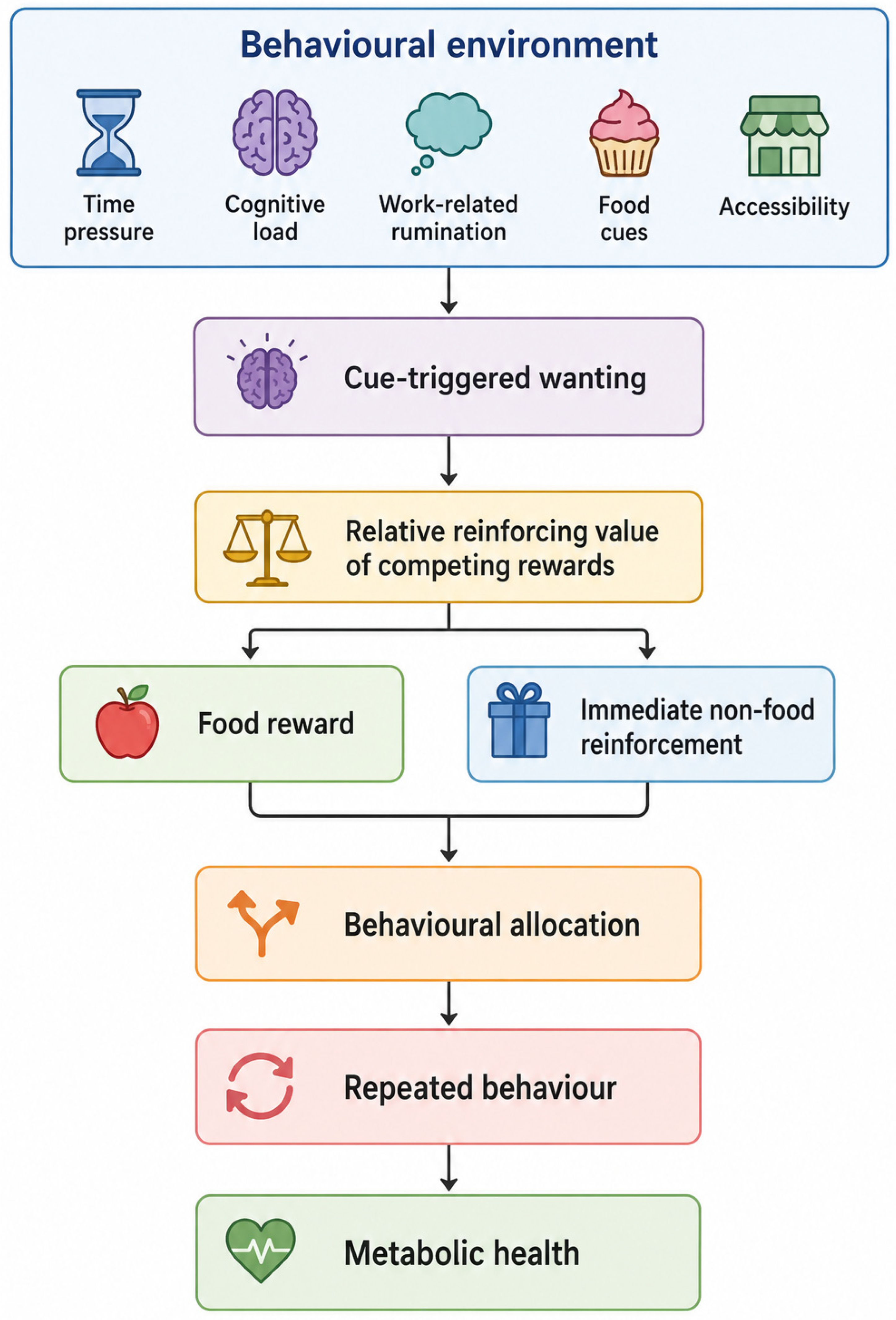
Figure 2.
Immediate Non-food Reinforcement as an Intervention Target.
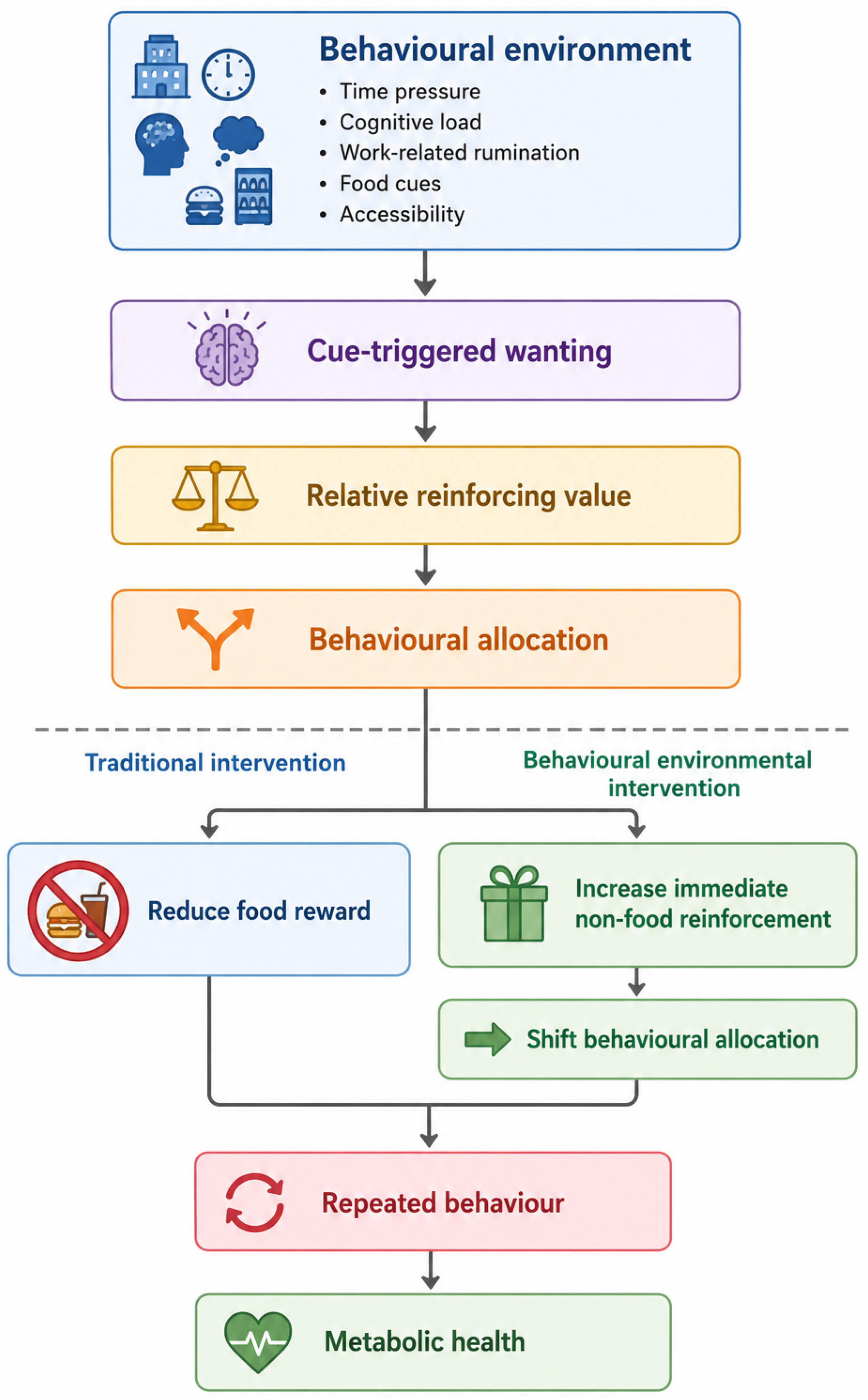
Figure 3.
Functional Framework of Time-adapted Metabolic Social Connection (T-MSC).
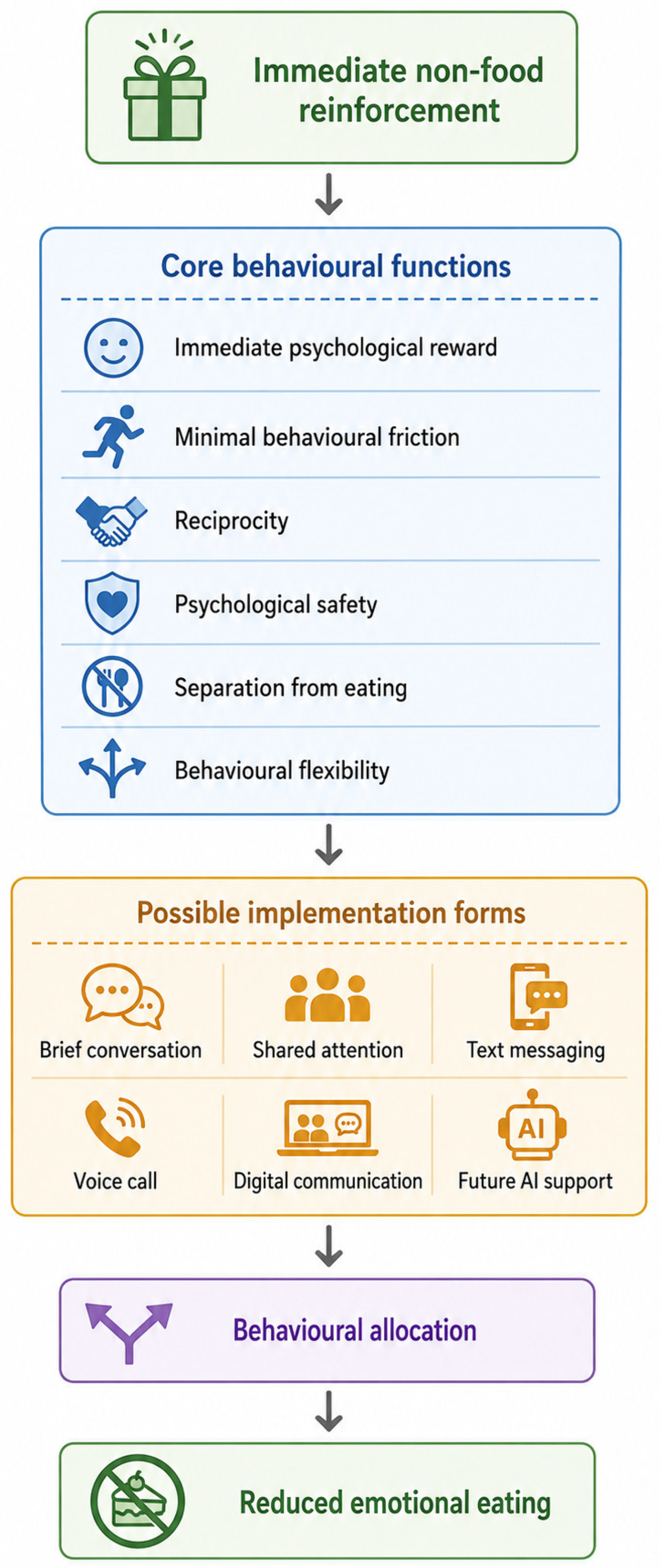
Figure 4.
Research Programme Generated by the Behavioural Environmental Framework.
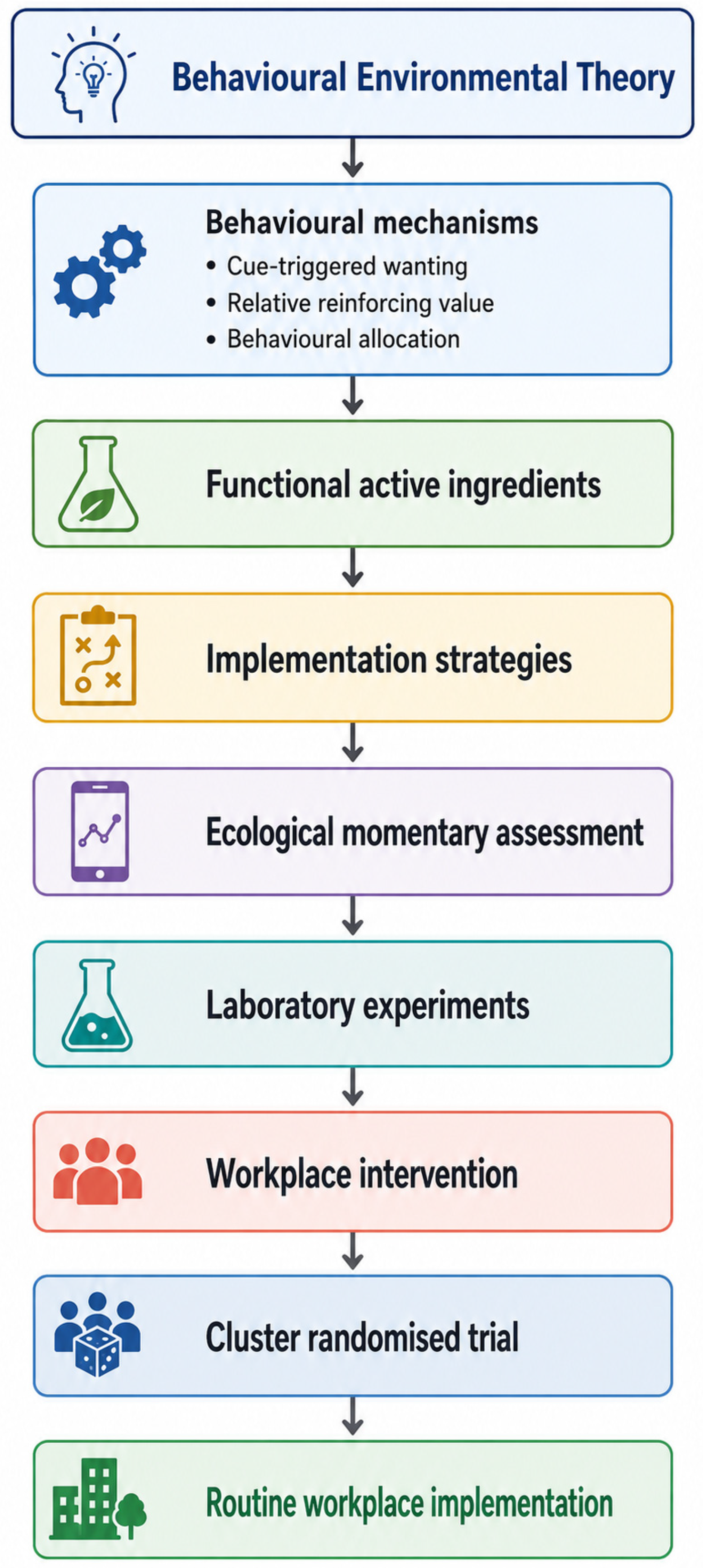
Figure 5.
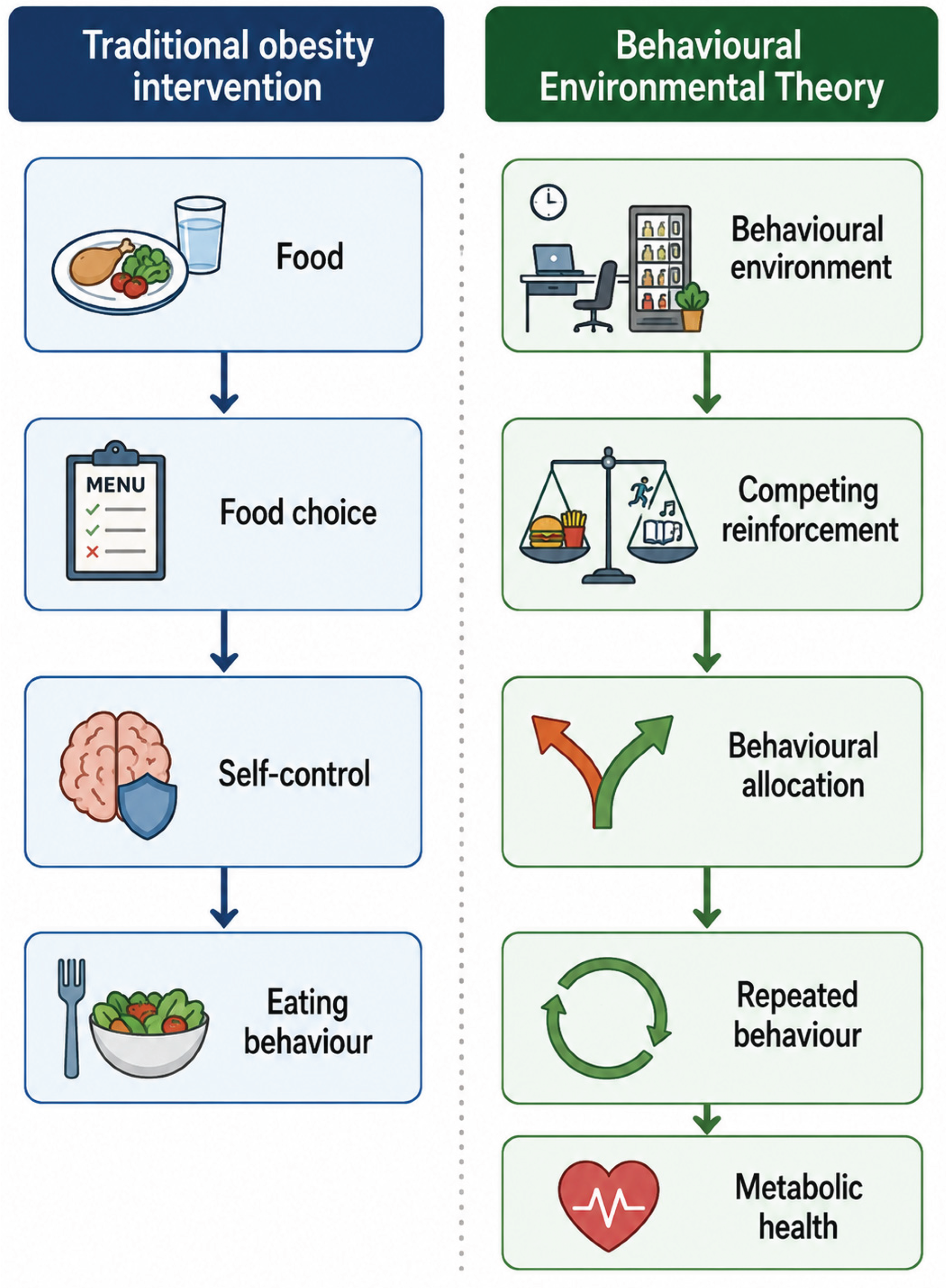

Table 1.
summarises the relationship between the proposed functional active ingredients and possible implementation examples.
Table 1.
summarises the relationship between the proposed functional active ingredients and possible implementation examples.
| Functional active ingredient | Behavioural function | Possible implementation examples |
| Immediate psychological reward | Provides rapid competing reinforcement | Humour, gratitude, acknowledgement |
| Minimal behavioural friction | Maximises accessibility | Brief conversation, text message, phone call |
| Reciprocity | Reinforces through interpersonal exchange | Two-way conversation, interactive messaging |
| Psychological safety | Prevents evaluative stress | Non-judgemental communication |
| Separation from eating | Avoids social facilitation | Conversation before or after meals |
| Behavioural flexibility | Maintains feasibility | Face-to-face, phone, chat, digital platforms |
Importantly, the examples shown in Table 1 should not be interpreted as prescribed intervention components. Rather, they illustrate multiple implementation forms capable of expressing the same underlying behavioural functions. This functional perspective allows T-MSC to remain theoretically stable while supporting adaptation across workplaces, cultures, organisational contexts, and emerging technologies.
References
- Appelhans, B. M. Neurobehavioral inhibition of reward-driven feeding: Implications for dieting and obesity. Obesity 2009, 17(4), 640–647. [Google Scholar] [CrossRef]
- Berridge, K. C. ‘Liking’ and ‘wanting’ food rewards: Brain substrates and roles in eating disorders. Physiology & Behavior 2009, 97(5), 537–550. [Google Scholar] [CrossRef]
- Bhanji, J. P.; Delgado, M. R. The social brain and reward: social information processing in the human striatum. Wiley Interdisciplinary Reviews: Cognitive Science 2014, 5(1), 61–73. [Google Scholar] [CrossRef]
- Bickel, W. K.; Tegge, A. N.; Carr, K. A.; Epstein, L. H. Reinforcer pathology’s alternative reinforcer hypothesis: A preliminary examination. Health Psychology 2021, 40(12), 881–886. [Google Scholar] [CrossRef]
- Boswell, R. G.; Kober, H. Food cue reactivity and craving predict eating and weight gain: A meta-analytic review. Obesity Reviews 2016, 17(2), 159–177. [Google Scholar] [CrossRef]
- Carr, K. A.; Epstein, L. H. Choice is relative: Reinforcing value of food and activity in obesity treatment. American Psychologist 2020, 75(2), 139–151. [Google Scholar] [CrossRef]
- Cropley, M.; Zijlstra, F. R. H. Work and rumination. In Handbook of stress in the occupations; Langan-Fox, J., Cooper, C. L., Eds.; Edward Elgar Publishing, 2011; pp. 487–501. [Google Scholar] [CrossRef]
- de Castro, J. M. Family and friends produce greater social facilitation of food intake than other companions. Physiology & Behavior 1994, 56(3), 445–455. [Google Scholar] [CrossRef]
- Epstein, L. H.; Carr, K. A.; Lin, H.; Fletcher, K. D. Food reinforcement, energy intake, and macronutrient choice. The American journal of clinical nutrition 2011, 94(1), 12–18. [Google Scholar] [CrossRef]
- Epstein, L. H.; Temple, J. L.; Roemmich, J. N.; Bouton, M. E. Habituation as a determinant of human food intake. Psychological Review 2009, 116(2), 384–407. [Google Scholar] [CrossRef]
- Evers, C.; Dingemans, A.; Junghans, A. F.; Boevé, A. Feeling bad or feeling good, does emotion affect your consumption of food? A meta-analysis of the experimental evidence. Neuroscience and Biobehavioral Reviews 2018, 92, 195–208. [Google Scholar] [CrossRef]
- Herman, C. P. The social facilitation of eating. Appetite 86 2015, 61–73. [Google Scholar] [CrossRef]
- Herrnstein, R. J. On the law of effect. Journal of the Experimental Analysis of Behavior 1970, 13(2), 243–266. [Google Scholar] [CrossRef]
- Hollands, G. J.; Bignardi, G.; Johnston, M.; Kelly, M. P.; Ogilvie, D.; Petticrew, M.; ...; Marteau, T. M. The TIPPME intervention typology for changing environments to change behaviour. Nature Human Behaviour 2017, 1(8), 0140. [Google Scholar] [CrossRef]
- Holt-Lunstad, J.; Smith, T. B.; Layton, J. B. Social relationships and mortality risk: a meta-analytic review. PLoS medicine 2010, 7(7), e1000316. [Google Scholar] [CrossRef]
- Inagaki, T. K. Neural mechanisms of the link between giving social support and health. Annals of the New York Academy of Sciences 1428 2018, 33–50. [Google Scholar] [CrossRef]
- Konttinen, H. Emotional eating and obesity in adults: The role of depression, sleep and genes. Proceedings of the Nutrition Society 2020, 79(3), 283–289. [Google Scholar] [CrossRef]
- Macht, M. How emotions affect eating: A five-way model. Appetite 2008, 50(1), 1–11. [Google Scholar] [CrossRef]
- Meule, A.; Reichenberger, J.; Blechert, J. Development and preliminary validation of the Salzburg Stress Eating Scale. Appetite 2018, 120, 442–448. [Google Scholar] [CrossRef]
- Papalini, S. Stress-induced overeating behaviors explained from a (transitory) relief-learning perspective. Physiology & behavior 2024, 287, 114707. [Google Scholar] [CrossRef]
- Proper, K. I.; van Oostrom, S. H. The effectiveness of workplace health promotion interventions on physical and mental health outcomes—A systematic review of reviews. Scandinavian Journal of Work, Environment & Health 2019, 45(6), 546–559. [Google Scholar] [CrossRef]
- Puhl, R. M.; Heuer, C. A. The stigma of obesity: A review and update. Obesity 2009, 17(5), 941–964. [Google Scholar] [CrossRef]
- Querstret, D.; Cropley, M. Exploring the relationship between work-related rumination, sleep quality, and work-related fatigue. Journal of occupational health psychology 2012, 17(3), 341–353. [Google Scholar] [CrossRef]
- Rubino, F.; Puhl, R. M.; Cummings, D. E.; Eckel, R. H.; Ryan, D. H.; Mechanick, J. I.; ...; Dixon, J. B. Joint international consensus statement for ending stigma of obesity. Nature medicine 2020, 26(4), 485–497. [Google Scholar] [CrossRef]
- Shiffman, S.; Stone, A. A.; Hufford, M. R. Ecological momentary assessment. Annual Review of Clinical Psychology 2008, 4, 1–32. [Google Scholar] [CrossRef]
- Stijovic, A.; Siegel, M.; Kocan, A. U.; Bojkovska, I.; Korb, S.; Silani, G. Defining social reward: A systematic review of human and animal studies. Psychological Bulletin 2024, 150(12), 1472–1509. [Google Scholar] [CrossRef]
- Swinburn, B. A.; Sacks, G.; Hall, K. D.; et al. The global obesity pandemic: Shaped by global drivers and local environments. The Lancet 2011, 378(9793), 804–814. [Google Scholar] [CrossRef]
- Uchino, B. N. Understanding the links between social support and physical health. Perspectives on Psychological Science 2009, 4(3), 236–255. [Google Scholar] [CrossRef]
- van den Akker, K.; Schyns, G.; Jansen, A. Learned overeating: applying principles of Pavlovian conditioning to explain and treat overeating. Current Addiction Reports 2018, 5(2), 223–231. [Google Scholar] [CrossRef]
- Warren, A.; Frame, L. A. Restoring a healthy relationship with food by decoupling stress and eating: a translational review of nutrition and mental health. Nutrients 2025, 17(15), 2466. [Google Scholar] [CrossRef]
- Wood, W. Habit in personality and social psychology. Personality and Social Psychology Review 2017, 21(4), 389–403. [Google Scholar] [CrossRef]
- Wood, W.; Neal, D. T. A new look at habits and the habit-goal interface. Psychological Review 2007, 114(4), 843–863. [Google Scholar] [CrossRef]
- World Health Organization. Obesity and overweight; World Health Organization, 2024. [Google Scholar]
Disclaimer/Publisher’s Note: The statements, opinions and data contained in all publications are solely those of the individual author(s) and contributor(s) and not of MDPI and/or the editor(s). MDPI and/or the editor(s) disclaim responsibility for any injury to people or property resulting from any ideas, methods, instructions or products referred to in the content. |
© 2026 by the authors. Licensee MDPI, Basel, Switzerland. This article is an open access article distributed under the terms and conditions of the Creative Commons Attribution (CC BY) license (http://creativecommons.org/licenses/by/4.0/).
Copyright: This open access article is published under a Creative Commons CC BY 4.0 license, which permit the free download, distribution, and reuse, provided that the author and preprint are cited in any reuse.