

Submitted:
06 August 2026
Posted:
02 September 2026
You are already at the latest version
Abstract
Workplace interventions for metabolic syndrome prevention commonly emphasize nutritional education, counselling, self-monitoring, or modifications of food availability. Although these approaches can improve dietary and cardiometabolic outcomes, they provide limited explanation of how workplace environments shape eating behaviour under severe time constraints. We propose Time-Adapted Metabolic Environmental Engineering (T-MEE), an integrative behavioural framework explaining how environmental redesign may influence opportunistic eating among time-constrained workers. T-MEE synthesizes food-cue reactivity, incentive salience theory, the relative reinforcing value of food, choice architecture, environmental psychology, and workplace health promotion. It conceptualizes eating not simply as a nutritional decision but as behavioural allocation among competing sources of reinforcement. The framework identifies four complementary functions: reducing cue-triggered wanting, introducing modest friction into automatic food access, increasing immediately available non-food reinforcement, and supporting psychological recovery. By distinguishing behavioural mechanisms from implementation strategies, T-MEE enables locally adaptable environmental interventions while preserving theoretical consistency. It also emphasizes minimal, universal, autonomy-preserving, and weight-inclusive implementation. Although direct evidence that environmental redesign modifies the relative reinforcing value of food remains limited, T-MEE provides a translational framework for developing and evaluating mechanism-based workplace interventions that target behaviour at the moment of reward seeking rather than relying primarily on sustained motivation or self-control.
Keywords:
metabolic syndrome
; food-cue reactivity
; relative reinforcing value of food
; behavioural allocation
; choice architecture
; workplace health promotion
1. Introduction
Metabolic syndrome has become one of the most pressing public health challenges worldwide, substantially increasing the risk of cardiovascular disease, type 2 diabetes, and premature mortality. Although excessive energy intake is a major behavioural determinant of metabolic syndrome, achieving sustained dietary improvement remains difficult, particularly among working adults. Contemporary workplaces are increasingly characterized by chronic time pressure, cognitive overload, frequent interruptions, and persistent psychological demands. Under these conditions, eating often occurs not through deliberate nutritional decision-making but as a rapid behavioural response to immediately available environmental opportunities.
Existing workplace interventions have demonstrated that environmental modification can improve dietary behaviour. Nutritional education, behavioural counselling, healthier food provision, workplace wellness programmes, and choice-architecture interventions have produced modest improvements in dietary intake, body weight, waist circumference, and cardiometabolic risk by altering food visibility, proximity, availability, convenience, and presentation (Peñalvo et al., 2021; Gea Cabrera et al., 2021; Bucher et al., 2016; Hollands et al., 2019; Cadario & Chandon, 2020; Lindstrom et al., 2023). However, these interventions have focused primarily on changing food environments rather than explaining why environmental modifications influence eating behaviour. Because workplace programmes typically combine multiple intervention components, including education, counselling, self-monitoring, physical activity, and environmental redesign, the mechanisms responsible for behavioural change remain difficult to isolate (Peñalvo et al., 2021; Morrow et al., 2022; Turon et al., 2024).
This theoretical limitation is particularly important in contemporary workplaces, where employees often make eating decisions while managing multiple tasks, recovering from demanding cognitive activity, or coping with persistent work-related stress. Behavioural-economic and reinforcement perspectives suggest that behaviour is shaped by the immediate configuration of rewards, effort, delay, and competing alternatives rather than by health intentions alone (Carr & Epstein, 2020; de Araujo et al., 2020; Smith et al., 2022). Consequently, dietary behaviour may depend more strongly on the surrounding behavioural environment than on conscious nutritional intentions.
Research on food-cue reactivity provides an important starting point for understanding this process. Experimental and meta-analytic evidence demonstrates that visual, olfactory, spatial, and contextual food cues elicit craving and predict subsequent food consumption and weight-related outcomes (Boswell & Kober, 2016). More recent neuroimaging reviews further indicate that responsivity to visual food cues varies according to weight and hunger state, supporting the view that food cues repeatedly activate motivational processes that increase the probability of eating (Vartanian et al., 2025).
The incentive salience framework complements this perspective by distinguishing between liking, the hedonic pleasure associated with food consumption, and wanting, the motivational process that drives food seeking. Contemporary models emphasize that cue-triggered wanting can guide food-seeking behaviour independently of experienced pleasure or explicit food preference (de Araujo et al., 2020; Stubbs et al., 2023; Nelson & Stice, 2023).
A further theoretical perspective is provided by research on the relative reinforcing value (RRV) of food. Rather than reflecting food preference alone, eating emerges from competition among alternative sources of reinforcement. The reinforcing value of food depends on the value, availability, accessibility, delay, and effort associated with competing alternatives (Carr & Epstein, 2020). Experimental evidence further demonstrates that individuals with higher food reinforcement consume more energy and may be at greater risk of excess weight gain (Temple et al., 2008; Epstein et al., 2011), while recent frameworks emphasize the importance of alternative reinforcement and response effort in shaping food reinforcement (Epstein & Carr, 2021; Burger et al., 2023).
Although these behavioural traditions have substantially advanced understanding of eating behaviour, they have developed largely independently from environmental intervention research. Choice-architecture studies have primarily examined how food environments can be modified, whereas workplace health-promotion research has focused on programme implementation and effectiveness. Conversely, food-cue reactivity, incentive salience, and food-reinforcement research have concentrated on the mechanisms underlying eating behaviour. Consequently, existing research explains either how environments are modified or how eating behaviour is generated, but rarely integrates these perspectives within a common conceptual framework.
This omission becomes particularly important under severe time constraints. Employees frequently experience irregular breaks, persistent workload, work-related rumination, and limited opportunities for psychological recovery, all of which increase reliance on immediately accessible food for affect regulation (Karabinski et al., 2021; Agolli & Holtz, 2023; Weigelt et al., 2023; McSweeney et al., 2025). Environmental intervention therefore requires a broader conceptual perspective that simultaneously considers cue-triggered wanting, food reinforcement, competing reinforcement, behavioural accessibility, and opportunities for psychological recovery.
To address this theoretical gap, we propose Time-Adapted Metabolic Environmental Engineering (T-MEE), an integrative framework explaining how environmental conditions influence eating behaviour under severe time constraints. Rather than conceptualizing workplace eating solely as a nutritional decision, T-MEE conceptualizes eating as behavioural allocation within an environment of competing reinforcing opportunities. Integrating food-cue reactivity, incentive salience theory, research on the relative reinforcing value of food, choice architecture, environmental psychology, and workplace health promotion, the framework proposes that environmental redesign influences eating by altering the relative reinforcing value of food in relation to immediately available non-food alternatives.
T-MEE proposes two complementary intervention strategies. The first reduces cue-triggered wanting and the immediate behavioural advantage of food by modifying cue salience, accessibility, and response effort. The second increases the immediate availability of competing non-food opportunities for reinforcement and psychological recovery. Rather than relying primarily on self-control or food restriction, T-MEE seeks to redesign behavioural environments so that food is less likely to become the dominant behavioural response.
Accordingly, this paper makes three theoretical contributions. First, it integrates previously separate research traditions within a unified explanatory framework. Second, it reconceptualizes workplace eating as behavioural allocation within environments containing competing reinforcing opportunities rather than as isolated nutritional decision-making. Third, it distinguishes behavioural mechanisms from implementation strategies, providing a common conceptual foundation for designing, comparing, and evaluating workplace environmental interventions. Figure 1 summarizes the overall conceptual framework, and the remainder of the paper reviews the behavioural mechanisms underlying T-MEE, presents the proposed framework, discusses its theoretical and practical implications, and outlines priorities for empirical validation and workplace implementation.
2. Behavioural Mechanisms Underlying T-MEE
2.1. Environmental Food Cues Initiate Eating Behaviour
Environmental influences on eating have traditionally been discussed in terms of food availability or nutritional choice. Contemporary behavioural research, however, increasingly conceptualizes food environments as active determinants of eating rather than passive contextual backgrounds. Visual exposure to highly palatable foods, repeated encounters with snack locations, olfactory stimulation, and learned contextual associations can elicit craving and increase subsequent food consumption. Meta-analytic evidence indicates that food-cue reactivity predicts both eating behaviour and weight-related outcomes (Boswell & Kober, 2016), while recent neuroimaging reviews show that neural responses to visual food cues vary according to weight status and hunger state (Vartanian et al., 2025).
Food cues do more than signal food availability. Through associative learning, environmental stimuli acquire motivational significance and can trigger approach tendencies even in the absence of physiological hunger (Nelson & Stice, 2023). Consistent with this view, attentional-bias research suggests that food cues capture attention and become disproportionately represented within the immediate choice environment, although interventions targeting attentional bias have produced mixed results (Seage et al., 2024). Eating therefore often begins with environmental activation of food-related motivation rather than deliberate dietary intention.
This mechanism is particularly relevant in workplaces, where employees are repeatedly exposed to visible snacks, beverage stations, food-delivery applications, digital food advertising, and locations associated with previous eating. Even incidental snack placement near beverage stations has been shown to increase consumption (Baskin et al., 2016).
Accordingly, T-MEE conceptualizes food-cue exposure as the earliest environmental event leading to opportunistic eating. Environmental redesign therefore begins by reducing unnecessary opportunities for repeated cue-triggered activation rather than regulating eating directly.
2.2. Cue-Triggered Wanting Translates Environmental Exposure Into Behavioural Readiness
Although food cues initiate motivational activation, their behavioural influence depends on how environmental stimuli acquire motivational significance.
The incentive salience framework distinguishes among liking, wanting, and learning. Liking refers to the hedonic pleasure experienced during consumption, wanting to the motivational process driving food seeking, and learning to the associative processes linking environmental stimuli with rewarding experiences. Contemporary reviews similarly emphasize that pleasure, motivation, reinforcement, and nutrient-related learning represent distinct components of food reward (de Araujo et al., 2020; Stubbs et al., 2023).
Importantly, cue-triggered wanting can increase independently of hedonic liking. Environmental cues may therefore promote food seeking without increasing the intrinsic pleasantness of food (Stubbs et al., 2023; Nelson & Stice, 2023). This distinction suggests that environmental interventions need not reduce food pleasure itself but may instead reduce the frequency with which cue-triggered motivational readiness is activated.
Such processes are likely to become particularly influential under severe time constraints. Persistent workload, cognitive fatigue, and frequent interruptions reduce opportunities for deliberative self-regulation, allowing highly learned cue–reward associations to exert greater influence on behavioural selection (Nelson & Stice, 2023; Pasquale et al., 2024).
Accordingly, T-MEE identifies cue-triggered wanting as the first modifiable motivational mechanism linking environmental redesign with eating behaviour.
2.3. Relative Reinforcing Value Determines Behavioural Allocation
Cue-triggered wanting explains why food becomes motivationally salient but not why eating is selected over competing behaviours. Behavioural selection depends on competition among reinforcing opportunities within the immediate environment.
The relative reinforcing value (RRV) framework proposes that behaviour is allocated toward options providing greater relative reinforcement. The reinforcing value of food therefore depends not only on food itself but also on the value, accessibility, delay, and effort associated with competing alternatives (Carr & Epstein, 2020).
Food frequently enjoys a behavioural advantage because it offers immediate reward with minimal effort and predictable outcomes. Experimental studies show that stronger food reinforcement predicts greater energy intake and obesity-related outcomes (Temple et al., 2008; Epstein et al., 2011). Recent models further conceptualize food reinforcement as an architecture involving reward value, impulsivity, effort, learning, habitual responding, and alternative reinforcement (Burger et al., 2023).
T-MEE extends this perspective by proposing that environmental conditions continuously shape the relative reinforcing value of food. Cue salience, proximity, convenience, response effort, and the availability of competing non-food alternatives jointly determine whether food possesses an immediate behavioural advantage. This interpretation is consistent with evidence that relatively small changes in accessibility and distance alter snack selection and consumption (Maas et al., 2012; Hunter et al., 2018; Hollands et al., 2019).
This mechanism becomes especially important under severe time pressure. During brief intervals between demanding tasks, food often dominates because it provides immediate reinforcement with virtually no preparation, whereas exercise, leisure activities, or relaxation frequently require greater initiation effort. Accordingly, T-MEE proposes that effective environmental intervention should both reduce the behavioural advantage of food and increase the immediacy and accessibility of competing non-food reinforcement.
2.4. Theoretical Integration
The preceding perspectives describe complementary stages within a common behavioural sequence rather than competing explanations. Food-cue reactivity explains how environmental stimuli initiate motivational activation (Boswell & Kober, 2016), incentive salience theory explains how learned cues generate cue-triggered wanting (Nelson & Stice, 2023), and RRV theory explains how behaviour is allocated among competing sources of reinforcement (Carr & Epstein, 2020). Choice-architecture research demonstrates that accessibility, proximity, availability, and response effort can be systematically modified through environmental design (Hollands et al., 2019; Lindstrom et al., 2023).
Taken together, these perspectives suggest that environmental influences on eating can be understood as a sequential behavioural pathway. Within T-MEE, environmental food cues initiate motivational activation through cue-triggered wanting, which alters the relative reinforcing value of competing alternatives. Behaviour is subsequently allocated toward the option providing the greatest immediate reinforcement, and repeated behavioural allocation contributes to habit formation over time.
This sequence does not imply that environmental conditions fully determine eating. Physiological hunger, metabolic regulation, personal preferences, socioeconomic circumstances, and social norms remain important influences. Rather, T-MEE proposes that environmental conditions systematically alter the probability that eating will be selected under limited cognitive resources and severe time pressure.
Figure 2 summarizes this behavioural sequence and the corresponding intervention points. Cue reduction targets motivational activation, micro-friction reduces the behavioural advantage of food, competing reinforcement increases the accessibility of non-food alternatives, and recovery-oriented environmental design reduces the need for compensatory immediate reward. Together, these mechanisms provide the theoretical foundation for the environmental intervention framework developed in the following section.
3. Time-Adapted Metabolic Environmental Engineering (T-MEE)
3.1. From Environmental Modification to Behavioural Mechanisms
The preceding review demonstrates that a wide variety of environmental interventions can influence eating behaviour. Existing approaches include reducing food visibility, increasing physical distance to snacks, modifying product availability, changing food placement, introducing healthier alternatives, and redesigning workplace food environments. Systematic reviews indicate that food choice and consumption can be altered by changes in product availability, position, proximity, convenience, and presentation, although effect sizes and the certainty of evidence vary considerably across intervention types and settings (Bucher et al., 2016; Hollands et al., 2019; Cadario & Chandon, 2020; Lindstrom et al., 2023).
Workplace-specific reviews similarly suggest that organizational food environments influence dietary behaviour through product availability, pricing, placement, labelling, and accessibility, but their multicomponent designs frequently make it difficult to isolate the mechanisms responsible for behavioural change (Navarro Fernández and Vio del Río, 2022; Al-Tamimi et al., 2025). Although these interventions differ substantially in practical form, they often influence similar proximal outcomes.
This apparent convergence raises an important theoretical question: why do interventions that appear operationally different often influence eating behaviour in similar ways?
We argue that existing environmental interventions share a common behavioural objective that has remained largely implicit. Regardless of whether interventions manipulate visibility, proximity, convenience, or food placement, each changes the balance of reinforcement within the immediate behavioural environment. Rather than merely modifying food environments, these interventions alter the relative attractiveness, accessibility, and effort associated with competing behavioural opportunities.
From this perspective, environmental intervention should be conceptualized not primarily as changing food environments but as reconfiguring the distribution of reinforcing opportunities within everyday environments. Environmental redesign influences behaviour by changing the conditions under which food competes with alternative sources of immediate reinforcement.
This conceptual shift extends existing environmental intervention research in two respects. First, it explains why diverse intervention strategies may produce similar effects despite differing considerably in implementation. Second, it provides a common theoretical framework for organizing apparently unrelated environmental modifications according to shared behavioural functions rather than their observable forms.
Accordingly, T-MEE conceptualizes workplace eating not simply as food choice but as behavioural allocation within an environment of competing reinforcing opportunities. Table 1 places this reconceptualization within the context of the behavioural traditions underpinning T-MEE.
3.2. The Behavioural Pathway Underlying Environmental Intervention
Figure 2 summarizes the behavioural pathway proposed by T-MEE. Rather than treating food-cue reactivity, incentive salience, relative reinforcing value (RRV), and environmental design as separate explanations, T-MEE integrates them into a single behavioural process linking environmental conditions with repeated eating behaviour.
Environmental food cues activate cue-triggered wanting through learned cue–reward associations, particularly under conditions of cognitive fatigue, stress, and time pressure (Boswell & Kober, 2016; Nelson & Stice, 2023). However, motivational activation alone does not determine behaviour. Whether eating occurs depends on the relative reinforcing value of food compared with other immediately available alternatives (Carr & Epstein, 2020; Burger et al., 2023). Environmental conditions therefore influence behavioural allocation by altering both the behavioural advantage of food and the availability of competing non-food reinforcement.
Repeated behavioural allocation strengthens context-dependent habits, increasing the likelihood that similar environmental cues will elicit the same response in the future. Rather than regulating eating directly, T-MEE therefore seeks to modify the environmental conditions that repeatedly make eating the easiest and most rewarding behavioural option.
3.3. Functional Active Ingredients
The behavioural pathway described above is translated into four functional active ingredients (Table 2). Rather than prescribing specific environmental modifications, T-MEE identifies behavioural functions that can be implemented in multiple ways depending on workplace context.
3.3.1. Reducing Cue-Triggered Wanting
The first functional objective is to reduce repeated activation of cue-triggered wanting.
Environmental redesign seeks to decrease unnecessary exposure to salient food cues by reducing food visibility, interrupting learned cue–response sequences, and minimizing repeated encounters with highly palatable foods. The objective is not to prohibit eating but to reduce the frequency with which environmental cues automatically return food to the active choice set.
3.3.2. Increasing Immediately Available Competing Reinforcement
The second objective is to increase the availability of immediately rewarding non-food alternatives.
Because reinforcement is relative, food is more likely to dominate behaviour when alternative activities require greater effort, preparation, or delay (Carr & Epstein, 2020). T-MEE therefore emphasizes readily accessible alternatives such as brief movement, social interaction, exposure to nature, or other personally rewarding activities that can be initiated with minimal effort. Unlike conventional food choice architecture, which primarily redistributes choices among foods, T-MEE broadens the immediate choice set by introducing competing non-food sources of reinforcement.
3.3.3. Modifying the Relative Reinforcing Value of Food
The third objective is to reduce the behavioural advantage of food by introducing small amounts of response effort.
Laboratory and field studies indicate that modest increases in physical distance or accessibility can influence snack selection and consumption (Maas et al., 2012; Baskin et al., 2016; Hunter et al., 2018; Hollands et al., 2019). T-MEE conceptualizes these small increases in effort as micro-friction. Rather than restricting food access, micro-friction briefly interrupts automatic eating by making food slightly less convenient while preserving individual choice.
3.3.4. Supporting Psychological Recovery
The final objective is to reduce reliance on food as an immediately available source of affect regulation.
Work-related rumination, sustained cognitive demands, and psychological fatigue can impair recovery and increase the appeal of immediately rewarding behaviours (Karabinski et al., 2021; Agolli & Holtz, 2023). Evidence suggests that brief work breaks and restorative environments can reduce stress and improve recovery, although direct effects on eating remain to be established (Albulescu et al., 2022; de Castro et al., 2025). Accordingly, T-MEE proposes recovery-oriented environmental design as a theoretically plausible mechanism for reducing food reinforcement rather than as an established pathway.
3.4. Why Existing Environmental Interventions Produce Similar Outcomes
Many workplace interventions differ in appearance yet influence common behavioural processes. T-MEE therefore classifies interventions according to behavioural function rather than implementation technique.
Specifically, environmental interventions may reduce eating by:
- reducing cue-triggered wanting;
- increasing competing non-food reinforcement;
- introducing micro-friction;
- supporting psychological recovery; and
- reducing implementation burden.
This functional perspective explains why operationally different interventions can produce similar outcomes and provides a common framework for cumulative theory development. Table 4 summarizes how this mechanism-based classification differs from conventional food-environment approaches.

Table 3.
Future Research Agenda.
| Research priority | Key research question | Suggested design | Primary outcome |
|---|---|---|---|
| Environmental modulation of RRV | Can environmental redesign modify the relative reinforcing value of food? | Laboratory experiment | Relative reinforcing value |
| Active ingredient evaluation | Which behavioural mechanism produces the greatest effect? | Factorial experiment | Snacking behaviour |
| Mechanistic validation | Are behavioural mechanisms additive or synergistic? | Mediation analysis | Behavioural allocation |
| Workplace implementation | Can T-MEE be implemented sustainably? | Cluster randomized trial | Implementation fidelity |
| Generalizability | Does T-MEE extend beyond eating behaviour? | Multi-domain intervention studies | Smoking, sedentary behaviour, smartphone use, sleep |
Table 4.
Comparison Between Conventional Environmental Intervention and T-MEE.
| Conventional environmental intervention | T-MEE |
|---|---|
| Primary target: Food environment | Primary target: Behavioural environment |
| Focus: Food choice | Focus: Behavioural allocation |
| Mechanism: Availability and placement | Mechanism: Cue-triggered wanting + RRV + competing reinforcement |
| Unit of intervention: Food | Unit of intervention: Reinforcing opportunities |
| Main outcome: Food selection | Main outcome: Behavioural allocation |
| Implementation: Food modification | Implementation: Functional environmental redesign |
3.5. From Behavioural Mechanisms to Environmental Design
T-MEE specifies behavioural functions rather than fixed intervention protocols. This distinction allows organizations to adapt environmental redesign to local contexts while maintaining theoretical consistency. Figure 3 illustrates how behavioural theory is translated into behavioural mechanisms, functional active ingredients, implementation principles, and context-specific environmental redesign.
Taken together, T-MEE conceptualizes workplace eating as behavioural allocation within an environment of competing reinforcing opportunities. Environmental redesign therefore targets the mechanisms that repeatedly favour eating under conditions of time pressure rather than food choice alone.
4. Discussion
4.1. Reframing Environmental Intervention
The principal contribution of T-MEE is not the proposal of a new environmental technique but a reconceptualization of the target of environmental intervention. Existing research has demonstrated that modifying food availability, visibility, proximity, portion size, placement, and presentation can influence dietary behaviour (Bucher et al., 2016; Hollands et al., 2019; Cadario & Chandon, 2020; Lindstrom et al., 2023). However, these interventions have generally been interpreted as techniques for changing food choice.
T-MEE instead proposes that the primary target of intervention is the broader behavioural environment within which food competes with alternative sources of reinforcement. From this perspective, workplace eating is not simply a nutritional decision but the outcome of behavioural competition under conditions of time pressure, cognitive load, and readily available food. Environmental redesign therefore changes behaviour not only by modifying food environments but also by reshaping the distribution of reinforcing opportunities.
4.2. Integrating Behavioural Traditions
T-MEE integrates previously separate behavioural traditions into a common explanatory framework linking environmental exposure with behavioural allocation. Food-cue reactivity explains how environmental stimuli initiate motivational activation; incentive salience theory explains how cues acquire motivational significance; RRV theory explains behavioural selection among competing alternatives; choice architecture identifies mechanisms for modifying accessibility and effort; and work-recovery research highlights how stress, fatigue, and recovery opportunities shape reward seeking.
Rather than replacing these theories, T-MEE connects them within a framework designed for contemporary workplaces characterized by repeated cue exposure, limited time, and cognitive demands. This integration provides a more comprehensive account of environmental influences on eating than any single theoretical tradition alone.
4.3. Relative Reinforcing Value as an Environmentally Responsive Construct
Perhaps the central theoretical proposition advanced by T-MEE concerns the interpretation of the relative reinforcing value (RRV) of food. Existing RRV research has primarily conceptualized reinforcement as an individual motivational characteristic associated with food seeking and obesity-related outcomes (Temple et al., 2008; Epstein et al., 2011). T-MEE extends this perspective by proposing that the behavioural expression of food reinforcement is continuously shaped by environmental conditions.
This proposition follows from the principle that reinforcement is inherently relative. Changes in food accessibility, response effort, delay, and the availability of competing alternatives alter the context in which food reinforcement is expressed without necessarily changing the intrinsic pleasure associated with eating (Carr & Epstein, 2020). Food that is visible, nearby, and immediately obtainable may possess greater behavioural value than identical food requiring additional effort or movement. Conversely, readily available non-food rewards may reduce food’s relative behavioural advantage even when food remains equally palatable.
At present, however, this proposition remains theoretical. Although environmental manipulations consistently influence food selection and consumption, few studies have examined whether they directly modify experimentally measured RRV. Testing this prediction therefore represents an important priority for future research.
4.4. Beyond Food Environments
T-MEE broadens the conceptual scope of environmental intervention beyond food itself. Traditional workplace interventions have focused primarily on food availability, pricing, labelling, portion size, and placement. These approaches remain valuable and provide the empirical foundation on which T-MEE builds.
However, food environments represent only one component of broader behavioural environments. T-MEE additionally considers the availability of rewarding non-food alternatives, opportunities for psychological recovery, implementation effort, and the relative convenience of competing behaviours. Choice architecture therefore becomes one implementation strategy within a broader reinforcement framework rather than an alternative theoretical approach.
This distinction may be particularly important when eating serves as an immediately accessible source of reward or affect regulation. Under such circumstances, improving healthy food availability alone may be insufficient if alternative rewarding activities remain difficult to initiate.
4.5. Implications for Workplace Health Promotion
Systematic reviews indicate that workplace nutrition and wellness programmes can improve dietary behaviour and cardiometabolic outcomes, although average effects are generally modest and multicomponent interventions often make active mechanisms difficult to identify (Peñalvo et al., 2021; Morrow et al., 2022; Turon et al., 2024).
T-MEE targets a different stage of the behavioural process. Rather than relying primarily on education, goal setting, or sustained self-regulation, it modifies the immediate behavioural environment in which everyday food decisions occur. Environmental redesign may therefore complement existing workplace wellness programmes by supporting healthy behaviour at the moment reward-seeking behaviour emerges.
A further implication concerns weight stigma. Weight-focused interventions may unintentionally reinforce personal responsibility narratives that undermine psychological well-being and engagement with health programmes (Rubino et al., 2020; Brown et al., 2022; Westbury et al., 2023). T-MEE instead emphasizes universal environmental redesign that modifies shared workplace conditions without identifying, monitoring, or targeting employees according to body weight (Kokubun, 2025).
4.6. Future Research
Future research should evaluate whether environmental redesign alters experimentally measured RRV, identify the independent and combined effects of cue reduction, competing reinforcement, micro-friction, and recovery support, and examine the behavioural mechanisms linking environmental modification to dietary outcomes. Cluster-randomized workplace trials incorporating both effectiveness and implementation outcomes will be particularly important for evaluating the practical value of the framework. Research should also investigate heterogeneity across occupational settings and examine whether the framework generalizes to other forms of reward-seeking behaviour.
4.7. Theoretical Boundaries
T-MEE is not intended as a comprehensive theory of eating behaviour. Physiological hunger, metabolic regulation, socioeconomic conditions, cultural practices, sleep, medication, and individual preferences remain important determinants of food intake. Rather, the framework specifies how environmental conditions influence opportunistic eating under contemporary workplace constraints characterized by repeated cue exposure, limited time, and cognitive demands.
The proposed mechanisms also differ in their empirical support. Food-cue reactivity, proximity effects, and food reinforcement are supported by substantial evidence, whereas environmentally responsive RRV and recovery-related reductions in food reinforcement remain theoretical propositions requiring direct empirical evaluation. Likewise, micro-friction should be understood as a functional implementation concept derived from research on accessibility, proximity, convenience, and response effort rather than as an established behavioural construct.
Taken together, T-MEE provides a mechanism-based framework for understanding how environmental redesign may alter eating behaviour by changing the balance of reinforcing opportunities available in everyday workplace settings.
5. Translating T-MEE Into Practice
5.1. From Behavioural Theory to Environmental Design
The principal objective of T-MEE is to translate behavioural theory into practical environmental intervention. Although behavioural research has identified multiple mechanisms underlying food seeking and consumption, relatively few frameworks explicitly describe how these mechanisms can guide environmental redesign in workplace settings. Conversely, many workplace health-promotion programmes recommend practical strategies without clearly specifying the behavioural mechanisms through which they are expected to operate. Systematic reviews indicate that multicomponent workplace interventions can improve dietary and cardiometabolic outcomes, but their complexity frequently obscures the active ingredients responsible for behavioural change (Peñalvo et al., 2021; Morrow et al., 2022; Turon et al., 2024).
T-MEE addresses this translational gap by first identifying behavioural mechanisms and subsequently translating them into functional environmental objectives. Intervention strategies may therefore differ across organizations provided that they target the same underlying behavioural functions. This distinction between behavioural mechanisms and implementation strategies enables theoretical consistency while allowing practical flexibility across workplace contexts. Figure 3 illustrates this translational process.
5.2. Functional Translation
T-MEE proposes four principal functional objectives for workplace environmental redesign.
First, interventions should reduce repeated activation of cue-triggered wanting by minimizing unnecessary food-cue exposure. Second, they should reduce the immediate behavioural advantage of food by modifying accessibility, convenience, response effort, and proximity. Third, they should increase immediately available competing sources of non-food reinforcement, thereby improving the relative attractiveness of alternative behaviours. Finally, environmental redesign should support psychological recovery by reducing fatigue, stress, and persistent work-related cognition through restorative workplace features and brief recovery opportunities.
These functional objectives provide a common behavioural language through which diverse workplace interventions can be designed, compared, and evaluated. Table 2 summarizes their theoretical mechanisms, intervention targets, representative implementation strategies, and expected behavioural outcomes.
5.3. Minimal Environmental Redesign
An important implementation principle proposed by T-MEE is minimal environmental redesign.
Many workplace health programmes require extensive organizational restructuring, repeated education, behavioural monitoring, or sustained employee participation. Although such approaches may be effective, they often impose considerable implementation burden and can be difficult to sustain. Reviews consistently identify intervention heterogeneity, incomplete reporting, and difficulty isolating active components as important limitations of the existing evidence base (Morrow et al., 2022; Turon et al., 2024).
T-MEE therefore recommends beginning with the smallest environmental modification capable of influencing a clearly specified behavioural mechanism. Organizations may first identify a location where opportunistic eating frequently occurs—such as an office desk, beverage station, meeting room, or home-working space—and then modify a single environmental feature, for example by reducing food visibility, increasing response effort, introducing a competing non-food reward, or adding a recovery cue.
This incremental strategy minimizes disruption, facilitates evaluation of individual mechanisms, and allows interventions to evolve according to behavioural responses and organizational feedback. Rather than assuming that small changes are sufficient in themselves, minimal redesign provides a practical starting point for cumulative environmental improvement.
5.4. Mechanism-Based Intervention Planning
Supplementary Table S1 illustrates how common workplace eating problems can be translated into behavioural mechanisms, environmental targets, and corresponding intervention strategies.
The examples are intended to demonstrate a mechanism-based approach rather than prescribe standardized solutions. Different environmental modifications may target the same behavioural mechanism, whereas identical environmental changes may operate through different mechanisms depending on the workplace context. Accordingly, implementation fidelity should be evaluated not only according to whether a specific environmental modification has been introduced but also according to whether the intended behavioural function has been successfully altered.
5.5. Adaptive Implementation and Evaluation
Environmental redesign should be regarded as an adaptive rather than fixed process.
Initial evaluation should focus on proximal behavioural mechanisms before assessing distal health outcomes. Relevant process indicators include cue-triggered craving, automatic snack retrieval, perceived effort required to obtain food, accessibility of alternative rewarding activities, psychological recovery, work-related rumination, intervention acceptability, and perceived autonomy. Behavioural outcomes may subsequently include snack consumption, food purchasing, energy intake, and behavioural allocation toward non-food alternatives, whereas body weight, waist circumference, and cardiometabolic indicators require longer-term follow-up.
This staged evaluation acknowledges that interventions may fail because they do not modify the intended mechanism, because mechanistic change does not translate into behavioural change, or because behavioural change has not yet produced measurable health benefits. Separating these stages facilitates iterative refinement of workplace interventions while accommodating differences in organizational environments and employee needs.
5.6. Ethical and Weight-Inclusive Implementation
Environmental redesign should not become a mechanism for identifying or correcting employees according to body size.
Weight stigma is associated with psychological distress, disengagement from health programmes, and adverse behavioural outcomes, and experimental evidence suggests that stigmatizing experiences may even increase food intake (Rubino et al., 2020; Brown et al., 2022; Westbury et al., 2023). T-MEE therefore recommends universal rather than weight-targeted environmental modification, preservation of voluntary food choice, avoidance of public weight monitoring or weight-loss competitions, and active employee participation when shared environments are redesigned.
The objective is to improve shared workplace environments rather than to regulate individual employees. A weight-inclusive approach should therefore be regarded as a core implementation principle rather than an optional ethical consideration.
5.7. Future Research and Translation
Figure 4 summarizes the proposed evidence-development pathway for T-MEE. Behavioural theory should first be evaluated through mechanistic studies before progressing to environmental experiments, implementation research, cluster-randomized workplace trials, and ultimately routine organizational application. This staged approach separates theoretical validation from intervention evaluation, allowing individual behavioural mechanisms to be tested before more complex multicomponent workplace programmes are developed. Such an evidence pathway may facilitate cumulative scientific progress while supporting adaptation across diverse organizational settings.
6. Conclusions
The central argument of this review is that workplace eating should not be understood solely as a nutritional decision. Under severe time constraints, eating also reflects behavioural allocation within an environment of competing sources of reinforcement. Food frequently becomes behaviourally dominant because it is visible, immediately accessible, predictable, and requires little effort, whereas alternative sources of reward or recovery often involve greater initiation costs.
To explain this process, we proposed Time-Adapted Metabolic Environmental Engineering (T-MEE). The framework integrates food-cue reactivity, incentive salience theory, the relative reinforcing value of food, choice architecture, environmental psychology, and workplace health promotion into a unified behavioural model linking environmental exposure to repeated eating. Rather than focusing exclusively on food availability, T-MEE emphasizes how workplace environments shape the competition between food and alternative sources of reinforcement.
Accordingly, the framework identifies four complementary behavioural functions: reducing cue-triggered wanting, decreasing the behavioural advantage of food through modest changes in accessibility and response effort, increasing immediately available non-food reinforcement, and supporting psychological recovery. By distinguishing behavioural functions from implementation strategies, T-MEE provides a flexible framework that can be adapted across diverse workplace settings while maintaining theoretical coherence.
T-MEE is intended to complement, rather than replace, nutritional education and existing workplace wellness programmes by targeting the behavioural processes operating at the moment when stress, fatigue, rumination, or environmental food cues create demand for immediate reward. Its emphasis on minimal, universal, autonomy-preserving, and weight-inclusive environmental modification may also reduce the practical and motivational burdens associated with conventional interventions.
Several propositions remain to be tested. Future research should determine whether environmental redesign modifies cue-triggered wanting and the relative reinforcing value of food, evaluate the independent and combined effects of the proposed behavioural functions, and establish whether mechanistic changes translate into sustained improvements in eating behaviour and metabolic health. More broadly, T-MEE provides a conceptual framework for developing mechanism-based workplace interventions that can be progressively refined through experimental, implementation, and clinical research.
Supplementary Materials
The following supporting information can be downloaded at the website of this paper posted on Preprints.org.
References
- Agolli, A., & Holtz, B. C. (2023). Facilitating detachment from work: A systematic review, evidence-based recommendations, and guide for future research. Journal of Occupational Health Psychology, 28(3), 129–159. [CrossRef]
- Al-Tamimi, K., van Herwerden, L., Abdul, M., & Utter, J. (2025). Hospital-based food environment interventions to improve workforce dietary behaviour: a systematic literature review. American Journal of Lifestyle Medicine, 19(4), 616-625. [CrossRef]
- Albulescu, P., Macsinga, I., Rusu, A., Sulea, C., Bodnaru, A., & Tulbure, B. T. (2022). “Give me a break!” A systematic review and meta-analysis on the efficacy of micro-breaks for increasing well-being and performance. PLOS ONE, 17(8), e0272460. [CrossRef]
- Alonso-Alonso, M., Woods, S. C., & Pelchat, M. (2015). Food reward system: Current perspectives and future research needs. Nutrition Reviews, 73(5), 296–307. [CrossRef]
- Baskin, E., Gorlin, M., Chance, Z., Novemsky, N., Dhar, R., Huskey, K., & Hatzis, M. (2016). Proximity of snacks to beverages increases food consumption in the workplace: A field study. Appetite, 103, 244–248. [CrossRef]
- Bell, J. A., Richardson, T. G., Wang, Q., Sanderson, E., Palmer, T., Walker, V.,... & Smith, G. D. (2022). Effects of general and central adiposity on circulating lipoprotein, lipid, and metabolite levels in UK Biobank: a multivariable Mendelian randomization study. The Lancet Regional Health–Europe, 21. [CrossRef]
- Boswell, R. G., & Kober, H. (2016). Food cue reactivity and craving predict eating and weight gain: A meta-analytic review. Obesity Reviews, 17(2), 159–177. [CrossRef]
- Bratman, G. N., Hamilton, J. P., Hahn, K. S., Daily, G. C., & Gross, J. J. (2015). Nature experience reduces rumination and subgenual prefrontal cortex activation. Proceedings of the National Academy of Sciences of the United States of America, 112(28), 8567–8572. [CrossRef]
- Brown, A., Flint, S. W., & Batterham, R. L. (2022). Pervasiveness, impact and implications of weight stigma. eClinicalMedicine, 47, 101408. [CrossRef]
- Bucher, T., Collins, C., Rollo, M. E., McCaffrey, T. A., De Vlieger, N., Van der Bend, D., Truby, H., & Perez-Cueto, F. J. A. (2016). Nudging consumers towards healthier choices: A systematic review of positional influences on food choice. British Journal of Nutrition, 115(12), 2252–2263. [CrossRef]
- Burger, K. S. (2023). Food reinforcement architecture: A framework for impulsive and compulsive overeating and food abuse. Obesity, 31(7), 1734–1744. [CrossRef]
- Cadario, R., & Chandon, P. (2020). Which healthy eating nudges work best? A meta-analysis of field experiments. Marketing Science, 39(3), 465–486. [CrossRef]
- Carr, K. A., & Epstein, L. H. (2020). Choice is relative: Reinforcing value of food and activity in obesity treatment. American Psychologist, 75(2), 139–151. [CrossRef]
- Epstein, L. H. & Carr, K. A. (2021). Food reinforcement and habituation to food are processes related to initiation and cessation of eating. Physiology & Behavior, 239, 113512. [CrossRef]
- Epstein, L. H., Carr, K. A., Lin, H., & Fletcher, K. D. (2011). Food reinforcement, energy intake, and macronutrient choice. American Journal of Clinical Nutrition, 94(1), 12–18. [CrossRef]
- Gea Cabrera, A., Caballero, P., Wanden-Berghe, C., Sanz-Lorente, M., & López-Pintor, E. (2021). Effectiveness of workplace-based diet and lifestyle interventions on risk factors in workers with metabolic syndrome: A systematic review, meta-analysis and meta-regression. Nutrients, 13(12), 4560. [CrossRef]
- Han, K.-T., Ruan, L.-W., & Liao, L.-S. (2022). Effects of indoor plants on human functions: A systematic review with meta-analyses. International Journal of Environmental Research and Public Health, 19(12), 7454. [CrossRef]
- Hollands, G. J., Carter, P., Anwer, S., King, S. E., Jebb, S. A., Ogilvie, D., Shemilt, I., Higgins, J. P. T., & Marteau, T. M. (2019). Altering the availability or proximity of food, alcohol, and tobacco products to change their selection and consumption. Cochrane Database of Systematic Reviews, 2019(9), CD012573. [CrossRef]
- Hunter, J. A., Hollands, G. J., Couturier, D. L., & Marteau, T. M. (2018). Effect of snack-food proximity on intake in general population samples with higher and lower cognitive resource. Appetite, 121, 337–347. [CrossRef]
- Jimenez-Merida, M. R., Vaquero-Abellan, M., Alcaide-Leyva, J. M., Canton-Habas, V., Raya-Cano, E., & Romero-Saldana, M. (2023). Effectiveness of multicomponent interventions and physical activity in the workplace to reduce obesity: a systematic review and meta-analysis. Healthcare, 11(8), 1160. [CrossRef]
- Karabinski, T., Haun, V. C., Nübold, A., Wendsche, J., & Wegge, J. (2021). Interventions for improving psychological detachment from work: A meta-analysis. Journal of Occupational Health Psychology, 26(3), 224–242. [CrossRef]
- Kokubun, K. (2025). Obesity and discrimination in the workplace: A narrative review and new perspectives for breaking out of the negative spiral. Obesities, 5(1), Article 8. [CrossRef]
- Lindstrom, K. N., Tucker, J. A., & McVay, M. A. (2023). Nudges and choice architecture to promote healthy food purchases in adults: A systematized review. Psychology of Addictive Behaviors, 37(1), 87–103. [CrossRef]
- Maas, J., de Ridder, D. T. D., de Vet, E., & de Wit, J. B. F. (2012). Do distant foods decrease intake? The effect of food accessibility on consumption. Psychology & Health, 27(Suppl. 2), 59–73. [CrossRef]
- Major, B., Hunger, J. M., Bunyan, D. P., & Miller, C. T. (2014). The ironic effects of weight stigma. Journal of Experimental Social Psychology, 51, 74–80. [CrossRef]
- McSweeney, L., Buczkowska, M., Denning, L., Elcock, M., & Spence, S. (2025). Healthcare staff perceptions of the hospital food environment: a narrative systematic review. Public Health Nutrition, 28(1), e66. [CrossRef]
- Morrow, A., Walker, K., Calder-MacPhee, N., & Ozakinci, G. (2022). The active ingredients of physical activity and/or dietary workplace-based interventions to achieve weight loss in overweight and obese healthcare staff: a systematic review. Journal of Behavioral Medicine, 45(3), 331-349. [CrossRef]
- Navarro Fernández, V. and Vio del Río, F. (2022). Systematic review with analysis of bias and quality of interventions in the food environment of the workplace and their impact on the nutritional status of workers. Nutrición Hospitalaria, 39(5), 1153–1165. [CrossRef]
- Nelson, T. D., & Stice, E. (2023). Contextualizing the neural vulnerabilities model of obesity. Nutrients, 15(13), 2988. [CrossRef]
- Pasquale, E. K., Boyar, A. M., & Boutelle, K. N. (2024). Reward and inhibitory control as mechanisms and treatment targets for binge eating disorder. Current psychiatry reports, 26(11), 616-625. [CrossRef]
- Peñalvo, J. L., Sagastume, D., Mertens, E., Uzhova, I., Smith, J., Wu, J. H. Y., Bishop, E., Onopa, J., Shi, P., Micha, R., & Mozaffarian, D. (2021). Effectiveness of workplace wellness programmes for dietary habits, overweight, and cardiometabolic health: A systematic review and meta-analysis. The Lancet Public Health, 6(9), e648–e660. [CrossRef]
- Prowse, R., Lawlor, N., Powell, R., & Neumann, E. M. (2023). Creating healthy food environments in recreation and sport settings using choice architecture: a scoping review. Health Promotion International, 38(5), daad098. [CrossRef]
- Rubino, F., Puhl, R. M., Cummings, D. E., et al. (2020). Joint international consensus statement for ending stigma of obesity. Nature Medicine, 26(4), 485–497. [CrossRef]
- Schvey, N. A., Puhl, R. M., & Brownell, K. D. (2012). The impact of weight stigma on caloric consumption. Obesity, 19(10), 1957–1962. [CrossRef]
- Seage, C. H. (2024). A systematic review of the effectiveness of attentional bias modification to support weight management in individuals who are overweight or obese. Obesity Reviews, 25(7), e13745. [CrossRef]
- de Araujo, I. E., Schatzker, M., & Small, D. M. (2020). Rethinking food reward. Annual review of psychology, 71(1), 139-164. [CrossRef]
- Stubbs, R. J., Horgan, G., Robinson, E., Hopkins, M., Dakin, C., & Finlayson, G. (2023). Diet composition and energy intake in humans. Philosophical Transactions of the Royal Society B: Biological Sciences, 378(1888), 20220449. [CrossRef]
- Temple, J. L., Legierski, C. M., Giacomelli, A. M., Salvy, S.-J., & Epstein, L. H. (2008). Overweight children find food more reinforcing and consume more energy than do nonoverweight children. American Journal of Clinical Nutrition, 87(5), 1121–1127. [CrossRef]
- Turon, H., Bezzina, A., Lamont, H., Barnes, C., Lum, M., Hodder, R. K.,... & Yoong, S. (2024). Interventions in the workplace to reduce risk factors for noncommunicable diseases: an umbrella review of systematic reviews of effectiveness. Journal of occupational health, 66(1), uiae044. [CrossRef]
- Vartanian, M., Jahanitabesh, A., Christensen, J. F., Staub, H., Villringer, A., & Witte, A. V. (2025). Neuronal responses to visual food cues according to weight and hunger status: A systematic review and meta-analysis, Neuroscience & Biobehavioral Reviews, 177, 106301. [CrossRef]
- Weigelt, O., Seidel, J. C., Erber, L., Wendsche, J., Varol, Y. Z., Weiher, G. M.,... & Syrek, C. J. (2023). Too committed to switch off—Capturing and organizing the full range of work-related rumination from detachment to overcommitment. International journal of environmental research and public health, 20(4), 3573. [CrossRef]
- Westbury, S., Oyebode, O., van Rens, T., & Barber, T. M. (2023). Obesity stigma: Causes, consequences, and potential solutions. Current Obesity Reports, 12(1), 10–23. [CrossRef]
- de Castro, M. V., Negri, R. G., Fiore, F. A., & Bressane, A. (2025). Nature-Based Solutions in Workplace Settings: A Scoping Review on Pathways for Integrated Quality, Environmental, Health, and Safety Management. International Journal of Environmental Research and Public Health, 22(9), 1455. [CrossRef]
Figure 1.
Graphical Abstract. Traditional workplace environmental interventions primarily modify food environments by changing food availability, placement, or presentation. T-MEE extends this perspective by conceptualizing eating as behavioural allocation within an environment of competing reinforcing opportunities. Environmental redesign is proposed to influence eating behaviour by reducing cue-triggered wanting, modifying the relative reinforcing value of food, increasing immediately available competing non-food reinforcement, and supporting psychologically sustainable implementation under conditions of severe time constraints.
Figure 1.
Graphical Abstract. Traditional workplace environmental interventions primarily modify food environments by changing food availability, placement, or presentation. T-MEE extends this perspective by conceptualizing eating as behavioural allocation within an environment of competing reinforcing opportunities. Environmental redesign is proposed to influence eating behaviour by reducing cue-triggered wanting, modifying the relative reinforcing value of food, increasing immediately available competing non-food reinforcement, and supporting psychologically sustainable implementation under conditions of severe time constraints.
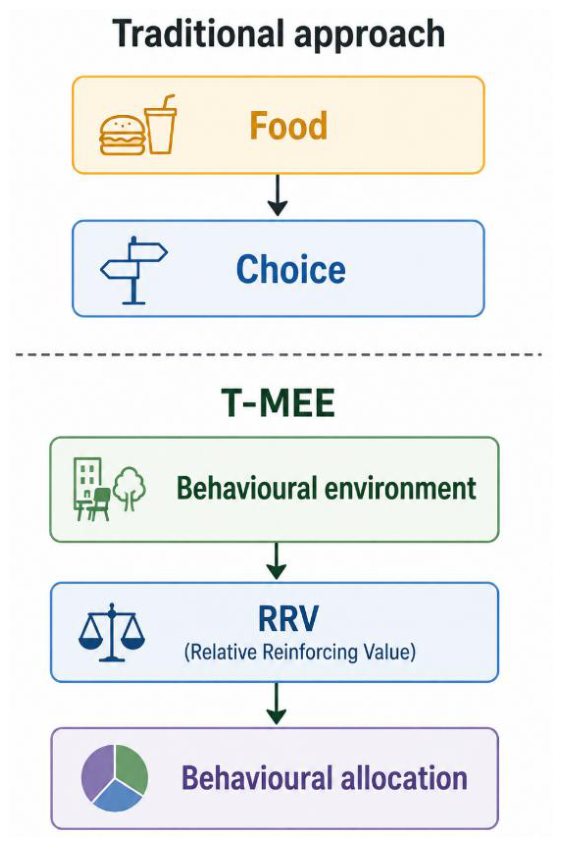
Figure 2.
summarizes the behavioural pathway proposed by T-MEE. Rather than conceptualizing food-cue reactivity, incentive salience, and the relative reinforcing value of food as independent theories, the present framework proposes that they represent complementary stages of a common behavioural sequence. Environmental food cues repeatedly activate cue-triggered wanting. Cue-triggered wanting increases the motivational salience of food. Behavioural selection subsequently depends upon the relative reinforcing value of food compared with immediately available competing alternatives. Environmental redesign therefore influences eating behaviour by modifying one or more stages of this behavioural sequence.
Figure 2.
summarizes the behavioural pathway proposed by T-MEE. Rather than conceptualizing food-cue reactivity, incentive salience, and the relative reinforcing value of food as independent theories, the present framework proposes that they represent complementary stages of a common behavioural sequence. Environmental food cues repeatedly activate cue-triggered wanting. Cue-triggered wanting increases the motivational salience of food. Behavioural selection subsequently depends upon the relative reinforcing value of food compared with immediately available competing alternatives. Environmental redesign therefore influences eating behaviour by modifying one or more stages of this behavioural sequence.
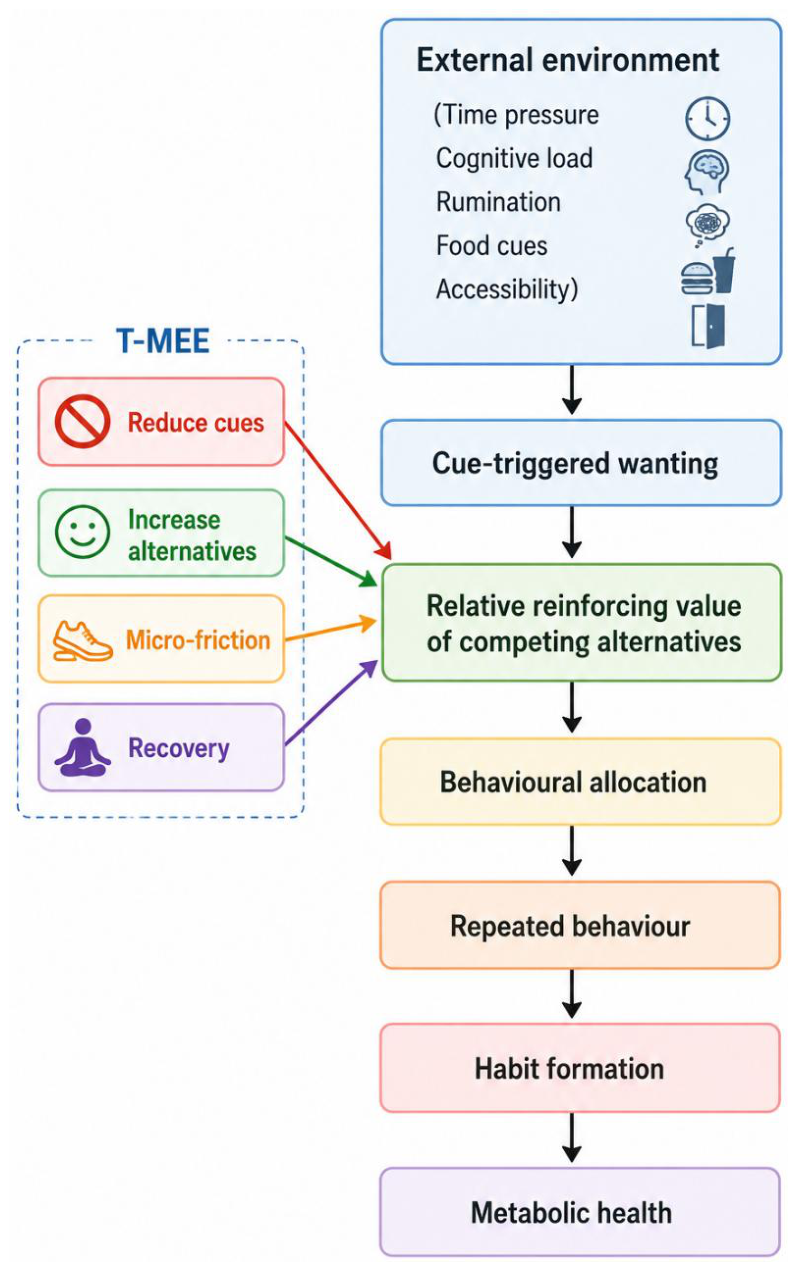
Figure 3.
Translation of behavioural theory into workplace environmental intervention. T-MEE distinguishes behavioural theory from the practical forms through which it is implemented. Established behavioural theories are first translated into specific mechanisms, which are then organized as functional active ingredients and implementation principles. These elements guide locally adaptable environmental redesign and workplace intervention while preserving theoretical consistency across different organizational settings.
Figure 3.
Translation of behavioural theory into workplace environmental intervention. T-MEE distinguishes behavioural theory from the practical forms through which it is implemented. Established behavioural theories are first translated into specific mechanisms, which are then organized as functional active ingredients and implementation principles. These elements guide locally adaptable environmental redesign and workplace intervention while preserving theoretical consistency across different organizational settings.
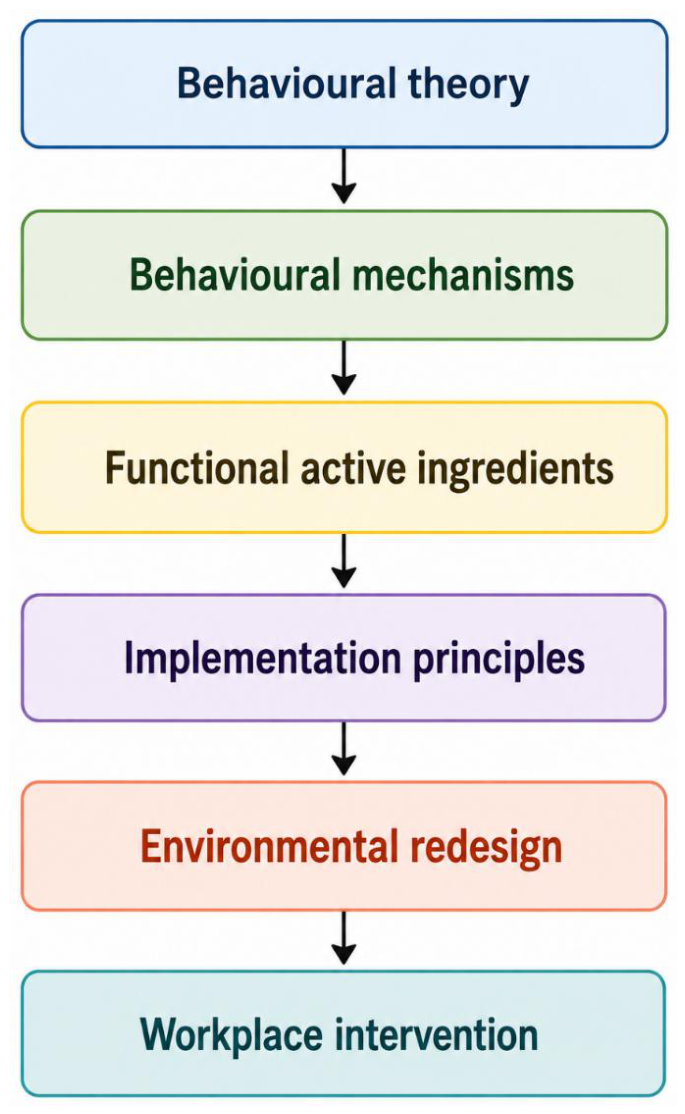
Figure 4.
Proposed evidence-development pathway for T-MEE. The empirical development of T-MEE is proposed to progress from behavioural theory and mechanistic validation to controlled environmental experiments, implementation studies, cluster-randomized workplace trials, and routine workplace implementation. This staged pathway allows the behavioural mechanisms, feasibility, effectiveness, and scalability of the framework to be evaluated before widespread organizational adoption.
Figure 4.
Proposed evidence-development pathway for T-MEE. The empirical development of T-MEE is proposed to progress from behavioural theory and mechanistic validation to controlled environmental experiments, implementation studies, cluster-randomized workplace trials, and routine workplace implementation. This staged pathway allows the behavioural mechanisms, feasibility, effectiveness, and scalability of the framework to be evaluated before widespread organizational adoption.
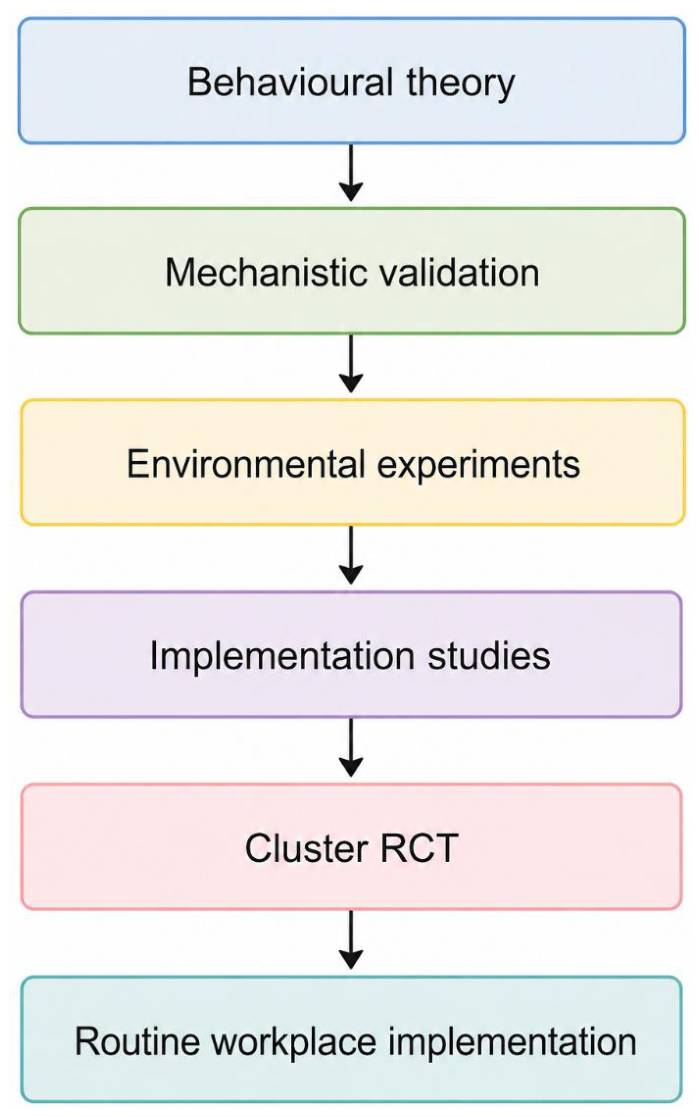
Table 1.
Behavioural Theories Underpinning T-MEE.
| Theoretical perspective | Core proposition | Primary behavioural mechanism | Limitation | Contribution to T-MEE |
|---|---|---|---|---|
| Food-cue reactivity | Environmental food cues repeatedly elicit craving and eating | Cue-triggered motivational activation | Explains cue effects but not behavioural selection | Identifies the environmental starting point of eating behaviour |
| Incentive salience theory | Cue-triggered wanting drives food seeking independently of liking | Motivational salience (“ wanting”) |
Does not explain competition among behavioural alternatives | Explains how environmental cues become behaviourally significant |
| Relative reinforcing value (RRV) | Behaviour is allocated toward relatively more reinforcing alternatives | Behavioural competition | Primarily emphasizes individual differences | Extended to environmentally responsive reinforcement |
| Choice architecture | Small environmental modifications influence food choice | Behavioural accessibility | Focuses on implementation rather than behavioural theory | Provides practical intervention strategies |
| Environmental psychology | Restorative environments influence stress and recovery | Psychological recovery | Limited integration with eating behaviour | Introduces recovery as an indirect pathway |
| Workplace health promotion | Organizational environments shape health behaviour | Implementation | Limited behavioural integration | Provides organizational implementation context |
Table 2.
Functional Active Ingredients of T-MEE.
| Functional objective | Behavioural mechanism | Environmental target | Representative implementation | Expected behavioural outcome |
|---|---|---|---|---|
| Reduce cue-triggered wanting | Reduce repeated motivational activation | Food-cue salience | Remove visible snacks, opaque containers, reduce food notifications | Fewer cue-triggered eating episodes |
| Reduce the behavioural advantage of food | Lower relative reinforcing value | Accessibility and effort | Increase distance, relocation, micro-friction | Reduced behavioural dominance of food |
| Increase competing non-food reinforcement | Increase alternative reward availability | Competing behavioural opportunities | Plants, natural views, music, social interaction, brief walking | Greater behavioural allocation toward non-food activities |
| Support psychological recovery | Reduce dependence on immediate reward | Recovery opportunities | Restorative environments, recovery spaces, transitions | Reduced stress-related eating |
| Support sustainable implementation | Maintain organizational feasibility | Implementation burden | Universal design, voluntary participation, low-cost redesign | Higher long-term adherence |
Disclaimer/Publisher’s Note: The statements, opinions and data contained in all publications are solely those of the individual author(s) and contributor(s) and not of MDPI and/or the editor(s). MDPI and/or the editor(s) disclaim responsibility for any injury to people or property resulting from any ideas, methods, instructions or products referred to in the content. |
© 2026 by the authors. Licensee MDPI, Basel, Switzerland. This article is an open access article distributed under the terms and conditions of the Creative Commons Attribution (CC BY) license (http://creativecommons.org/licenses/by/4.0/).
Copyright: This open access article is published under a Creative Commons CC BY 4.0 license, which permit the free download, distribution, and reuse, provided that the author and preprint are cited in any reuse.