

Submitted:
06 August 2026
Posted:
02 September 2026
You are already at the latest version
Abstract
Metabolic syndrome prevention has traditionally emphasized physical activity, healthy diet, weight management, and adequate sleep. However, recommending physically demanding hobbies to time-constrained working adults is often impractical because many leisure activities require dedicated time, travel, preparation, and sustained effort. This paper proposes the Time-adapted Learning and Leisure Activities (T-LHA) framework, which reconceptualizes brief learning and leisure activities as immediately accessible sources of alternative non-food reinforcement. Drawing on behavioural economics, the matching law, and alternative reinforcement theory, the framework conceptualizes emotional eating as behavioural allocation toward the most immediately accessible source of reinforcement under conditions of stress, fatigue, work-related rumination, and negative affect. Rather than strengthening dietary restraint alone, T-LHA seeks to expand behavioural options by increasing access to rewarding non-food activities before food becomes the default behavioural response. The framework identifies six functional core components: (1) immediately accessible alternative non-food reinforcement; (2) attentional engagement that interrupts work-related rumination; (3) small experiences of accomplishment; (4) restoration of a non-evaluative sense of self; (5) optional social connectedness; and (6) implementation feasibility. These functions can be delivered through diverse activities, including music, reading, creative expression, puzzles, language learning, and nature observation, while allowing flexible adaptation to individual preferences and everyday circumstances. Rather than proposing a new theory of reward, T-LHA translates established behavioural principles into an implementation framework designed for time-constrained working adults. Future research should evaluate whether increasing immediately accessible alternative non-food reinforcement shifts behavioural allocation away from food reward, reduces emotional eating, and ultimately contributes to metabolic health.
Keywords:
metabolic syndrome
; learning
; hobby activities
; leisure activities
; arts and cultural activities
; implementation adaptation
; business professionals
1. Introduction
Metabolic syndrome, characterized by the clustering of abdominal obesity, hypertension, impaired glucose metabolism, and dyslipidemia, is a major risk factor for type 2 diabetes and cardiovascular disease. Current prevention strategies consistently emphasize physical activity, healthy diet, weight management, and adequate sleep. Although these lifestyle behaviours remain the cornerstone of prevention, successful implementation in everyday life remains challenging, particularly for time-constrained working adults.
Recent research has increasingly emphasized that eating behaviour is influenced not only by physiological energy balance but also by reward processes. Hanßen et al. (2022) argue that food intake emerges from interactions among metabolic signals, dopaminergic reward processing, and cognitive control. Similarly, Dan et al. (2022) describe obesity from a neuroeconomic perspective in which food competes with alternative behavioural options according to their subjective value, while Lopez and Heatherton (2022) highlight dynamic interactions among reward, executive control, and valuation systems. Collectively, these perspectives suggest that unhealthy eating reflects behavioural allocation toward the most rewarding and immediately available option rather than simply a failure of self-control.
For many working adults, long working hours, commuting, family responsibilities, and cognitive fatigue reduce opportunities to engage in health-promoting activities. Although exercise and active leisure provide substantial health benefits, they often require dedicated time, preparation, equipment, or travel. Consequently, stressful everyday situations frequently promote behavioural allocation toward immediately rewarding foods, snacks, or alcohol. At the same time, leisure is increasingly dominated by passive digital activities that provide distraction but not necessarily psychological recovery, accomplishment, or meaningful engagement.
This behavioural allocation perspective is closely aligned with behavioural economics. Herrnstein’s (1974) matching law proposes that behaviour is allocated among competing sources of reinforcement according to their relative value and availability. Building on this framework, Acuff et al. (2019) reviewed evidence showing that increasing engagement in alternative (substance-free) reinforcement consistently reduces reliance on addictive behaviours. Although this literature has focused primarily on alcohol and substance use, it illustrates a broader principle: increasing meaningful alternative reinforcement shifts behavioural allocation away from maladaptive but highly reinforcing options. The same principle may therefore help explain emotional eating, in which food competes with alternative sources of reinforcement under conditions of stress, fatigue, and limited self-regulatory resources.
Emerging evidence further suggests that music, artistic activities, and social interaction may function as alternative non-food rewards (Cummings et al., 2019), while arts and leisure engagement influence health through interacting psychological, biological, behavioural, and social pathways (Fancourt et al., 2021). However, simply recommending enjoyable activities is unlikely to change behaviour unless they are immediately accessible when reward seeking occurs.
Accordingly, this paper proposes the Time-adapted Learning and Leisure Activities (T-LHA) framework. Rather than introducing a new theory of reward, T-LHA translates principles from behavioural economics, alternative reinforcement, occupational recovery, leisure and arts engagement, and implementation science into a practical implementation framework for time-constrained working adults. The framework identifies six functional core components—immediately accessible alternative non-food reinforcement, attentional engagement that interrupts work-related rumination, small experiences of accomplishment, restoration of a non-evaluative sense of self, optional social connectedness, and implementation feasibility—while distinguishing these core functions from the specific activities used to deliver them.
T-LHA is intended to complement rather than replace established lifestyle interventions. Specifically, we reinterpret emotional eating as behavioural allocation toward the most immediately accessible source of reinforcement and propose that increasing immediately accessible alternative non-food reinforcement may shift behavioural allocation away from food reward during predictable reward-seeking situations. Future research should examine whether this implementation-oriented framework reduces emotional eating, work-related rumination, and ultimately improves metabolic health.
2. Theoretical foundations linking alternative reinforcement, rumination, and eating behaviour
2.1. Food reward and behavioural allocation
Food consumption is regulated not only by physiological energy requirements but also by reward-related processes. Contemporary reviews emphasize that eating behaviour emerges through dynamic interactions among metabolic signals, reward processing, executive control, and value computation rather than through physiological hunger alone (Hanßen et al., 2022; Lopez & Heatherton, 2022). From a neuroeconomic perspective, food choices represent value-based decisions in which highly palatable foods compete with alternative behavioural options according to their subjective value (Dan et al., 2022).
One influential account of behavioural choice is Herrnstein’s (1974) matching law, which proposes that behaviour is allocated among competing sources of reinforcement according to their relative value and availability. Rather than selecting behaviours independently, individuals continuously distribute behaviour toward the alternatives providing the greatest overall reinforcement. From this perspective, unhealthy eating reflects not only the rewarding properties of food itself but also the relative availability of competing sources of reinforcement within the surrounding environment.
The reward value of food has been extensively investigated through the distinction between wanting—the motivational drive to obtain food—and liking—the hedonic pleasure experienced during consumption (Berridge, 2009). Both processes are influenced not only by physiological hunger but also by environmental cues, emotional states, previous learning, and habitual behavioural responses (Alonso-Alonso et al., 2015). Consequently, repeated selection of highly rewarding foods should be understood as behavioural allocation within reward-rich environments rather than simply as a failure of self-control.
2.2. Alternative reinforcement through learning and leisure activities
If behaviour reflects allocation among competing sources of reinforcement, an important question is how healthier behavioural alternatives can become sufficiently competitive with highly rewarding foods. Behavioural economics has addressed this question through the concept of alternative reinforcement.
Building on Herrnstein’s behavioural allocation framework, Acuff et al. (2019) reviewed evidence from addiction research and concluded that increasing engagement in rewarding substance-free activities consistently reduces reliance on addictive behaviours. Importantly, their review argues that behaviour is determined not only by the reinforcing efficacy of addictive rewards themselves but also by the availability of meaningful alternative sources of reinforcement within the surrounding environment. Although this literature has focused primarily on alcohol and substance use disorders, its theoretical principles provide a useful conceptual framework for understanding emotional eating because both involve repeated selection of immediately rewarding behaviours under conditions of stress, fatigue, and limited self-regulatory resources.
Experimental work in behaviour analysis further supports this perspective. Shahan (2025) argues that alternative reinforcement creates behavioural competition with previously reinforced responses rather than merely suppressing behaviour directly. Consistent with this interpretation, subsequent experimental studies demonstrate that weakening or removing alternative reinforcement increases resurgence of the original behaviour (Greer et al., 2024; Helvey et al., 2023). Collectively, these findings suggest that behavioural allocation shifts toward healthier alternatives only when alternative reinforcement remains sufficiently accessible, immediately available, and rewarding.
Figure 1.
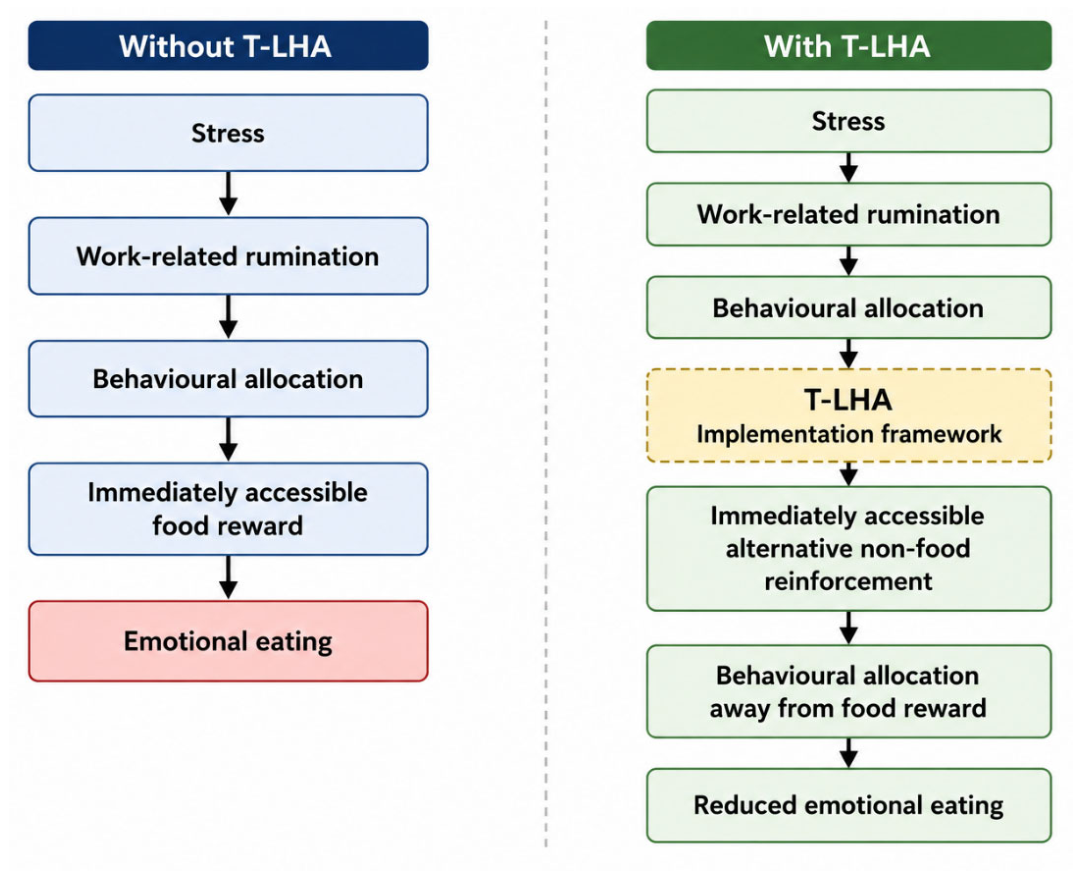
Conceptual framework of the Time-adapted Learning and Leisure Activities (T-LHA) framework. Without T-LHA, stress and work-related rumination increase the likelihood that behavioural allocation shifts toward immediately accessible food rewards, thereby contributing to emotional eating. T-LHA functions as an implementation framework that increases the availability of immediately accessible alternative non-food reinforcement during predictable reward-seeking situations. By reducing the implementation cost of rewarding learning and leisure activities, the framework is intended to shift behavioural allocation away from immediately accessible food rewards and toward alternative sources of reinforcement. The figure illustrates the proposed conceptual mechanisms and should not be interpreted as representing established causal pathways.
Figure 1.
Conceptual framework of the Time-adapted Learning and Leisure Activities (T-LHA) framework. Without T-LHA, stress and work-related rumination increase the likelihood that behavioural allocation shifts toward immediately accessible food rewards, thereby contributing to emotional eating. T-LHA functions as an implementation framework that increases the availability of immediately accessible alternative non-food reinforcement during predictable reward-seeking situations. By reducing the implementation cost of rewarding learning and leisure activities, the framework is intended to shift behavioural allocation away from immediately accessible food rewards and toward alternative sources of reinforcement. The figure illustrates the proposed conceptual mechanisms and should not be interpreted as representing established causal pathways.
Learning and leisure activities represent natural candidates for alternative non-food reinforcement. Music, artistic activities, reading, creative expression, intellectual challenges, games, and meaningful social interaction can all provide enjoyment, curiosity, attentional engagement, and experiences of accomplishment without caloric intake. Rather than functioning merely as recreational activities, these activities may expand the range of immediately available behavioural alternatives.
However, simply increasing pleasant experiences appears to be insufficient. Cummings et al. (2019) reported that enjoyable non-food experiences did not consistently reduce subsequent consumption of highly processed foods. These findings indicate that the effectiveness of alternative reinforcement depends not only on its rewarding properties but also on its timing, accessibility, and implementation.
From a behavioural allocation perspective, when meaningful alternative reinforcement is unavailable, difficult to access, or delayed, behaviour is more likely to be allocated toward immediately rewarding foods. Emotional eating may therefore reflect not only emotional coping but also behavioural allocation toward the most immediately available source of reinforcement at a particular moment. Accordingly, we argue that alternative non-food reinforcement should be introduced immediately before predictable episodes of food reward seeking. If an activity requires extensive preparation, specialised equipment, travel, or prolonged uninterrupted leisure time, it is unlikely to compete successfully with the immediate accessibility of snacks or alcohol. The T-LHA framework therefore decomposes learning and leisure activities into brief units lasting approximately 3–10 minutes, enabling alternative reinforcement to become behaviourally competitive within everyday routines.
Figure 2.
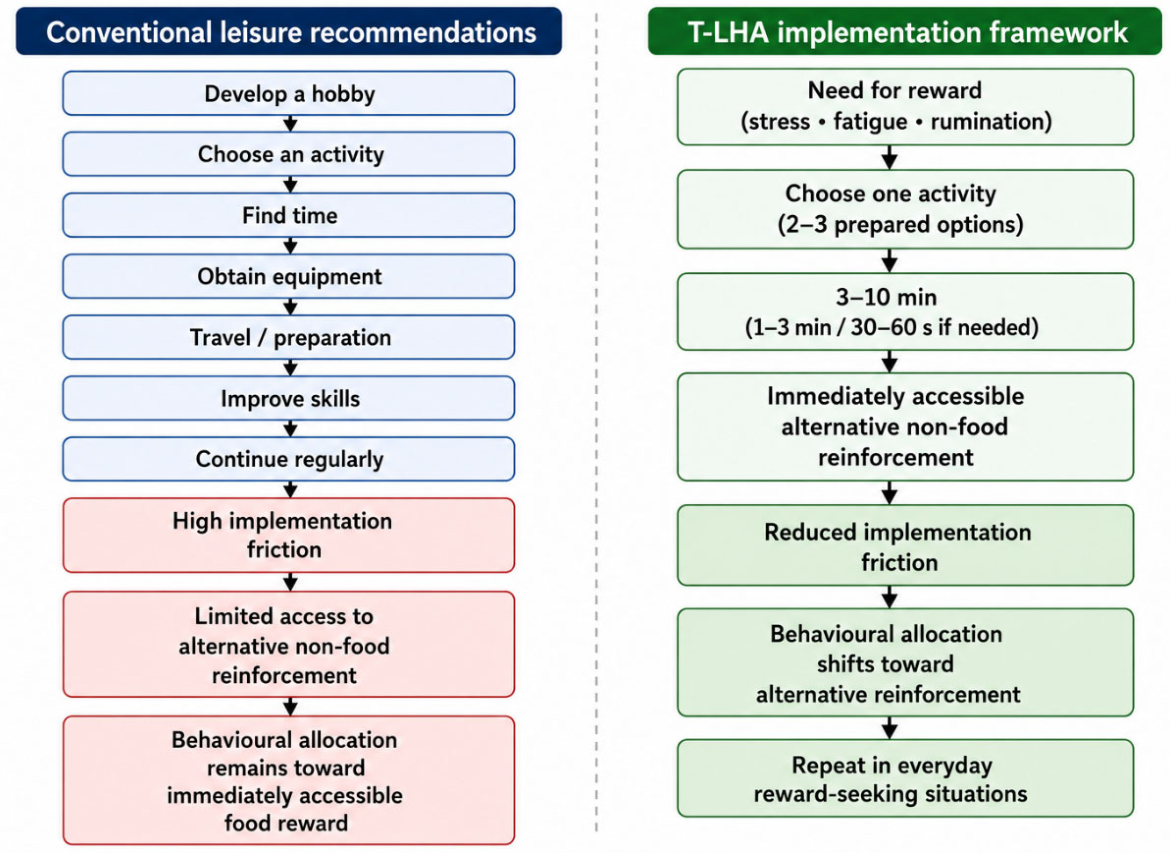
Comparison between conventional leisure recommendations and the Time-adapted Learning and Leisure Activities (T-LHA) framework. Conventional leisure recommendations often require substantial preparation, time, equipment, skill development, and long-term commitment, creating high implementation friction that limits access to alternative non-food reinforcement. In contrast, T-LHA reduces implementation burden by encouraging individuals to prepare a small number of personally meaningful activities that can be initiated within 3–10 minutes (or shorter when necessary). By increasing the immediate accessibility of alternative non-food reinforcement during predictable reward-seeking situations, the framework is intended to shift behavioural allocation away from immediately rewarding food.
Figure 2.
Comparison between conventional leisure recommendations and the Time-adapted Learning and Leisure Activities (T-LHA) framework. Conventional leisure recommendations often require substantial preparation, time, equipment, skill development, and long-term commitment, creating high implementation friction that limits access to alternative non-food reinforcement. In contrast, T-LHA reduces implementation burden by encouraging individuals to prepare a small number of personally meaningful activities that can be initiated within 3–10 minutes (or shorter when necessary). By increasing the immediate accessibility of alternative non-food reinforcement during predictable reward-seeking situations, the framework is intended to shift behavioural allocation away from immediately rewarding food.
2.3. Rumination, emotional eating, and weight stigma
Behavioural allocation is influenced not only by the availability of reinforcement but also by psychological states that alter the subjective value of competing behavioural options. Work-related rumination represents one important pathway linking occupational stress to unhealthy eating. Persistent thinking about unfinished tasks, mistakes, or work-related concerns prolongs negative emotional states and interferes with psychological recovery following work. Reviews consistently identify psychological detachment from work as an important determinant of recovery, well-being, and subsequent functioning (Türktorun et al., 2020).
Brief learning and leisure activities may interrupt this process by functioning as competing cognitive tasks. Reading, solving puzzles, attentive music listening, sketching, or creative writing require sufficient attentional engagement to redirect cognitive resources away from repetitive work-related thoughts. Rather than serving merely as entertainment, these activities may facilitate psychological detachment by replacing maladaptive cognitive repetition with purposeful engagement.
Negative affect further increases behavioural allocation toward highly rewarding foods. Stress, cognitive depletion, and emotional distress increase cravings for highly palatable foods and promote consumption of energy-dense snacks (Brytek-Matera, 2021; Ackermans et al., 2024). From this perspective, learning and leisure activities should not be viewed primarily as techniques for strengthening willpower. Instead, they provide alternative non-food reinforcement capable of shifting behavioural allocation before food becomes the default coping response.
Weight stigma may further strengthen this process. Experimental studies demonstrate that exposure to weight stigma increases caloric intake among individuals with overweight while simultaneously reducing perceived self-control over eating (Schvey et al., 2011; Major et al., 2014). Rather than motivating healthier behaviour, stigma intensifies negative emotions and increases behavioural allocation toward immediately rewarding foods. Kokubun (2025) further argues that similar processes may operate within occupational settings, where body weight can become an additional source of workplace evaluation.
Within this context, self-selected learning and leisure activities may provide benefits extending beyond alternative reinforcement alone. Activities that are intrinsically enjoyable, free from external evaluation, and capable of generating small but meaningful accomplishments may restore autonomy, self-efficacy, and a non-evaluative sense of self. Although such activities cannot eliminate stigma itself, they may interrupt the behavioural pathway linking negative emotional states to immediate food reward.
2.4. Functional mechanisms supporting the T-LHA framework
Among potential forms of alternative reinforcement, music and artistic activities are particularly attractive because they can be initiated almost immediately and require minimal preparation. Meta-analyses have reported beneficial effects of music interventions on blood pressure among individuals with hypertension (do Amaral et al., 2016; Kühlmann et al., 2016; Cao et al., 2023). More broadly, Fancourt and Finn (2019) and Fancourt et al. (2021) argue that arts and cultural engagement influence health through interacting psychological, behavioural, biological, and social pathways, including improvements in emotional regulation, psychological recovery, social connectedness, autonomic regulation, and inflammatory processes.
Collectively, these findings suggest that brief learning and leisure activities may influence eating behaviour and metabolic health through six complementary functional mechanisms: (1) providing immediately accessible alternative non-food reinforcement; (2) interrupting work-related rumination through attentional engagement; (3) promoting positive affect and psychological recovery; (4) expanding behavioural options and thereby reducing reliance on effortful self-control; (5) restoring autonomy and a non-evaluative sense of self following experiences of stigma or self-criticism; and (6) facilitating optional social connectedness through the sharing of personally meaningful experiences.
Importantly, these mechanisms represent functional targets rather than activity-specific effects. Different learning and leisure activities may activate the same underlying psychological processes despite differing substantially in their specific content. Consequently, intervention effectiveness depends less on the particular activity performed than on whether it successfully delivers these functional mechanisms when behavioural allocation toward food is most likely to occur.
Accordingly, the T-LHA framework distinguishes functional core components from implementation forms. Specific activities may therefore be adapted to individual preferences, cultural contexts, and everyday circumstances while preserving the behavioural mechanisms identified above. In this sense, T-LHA should be understood not as a programme promoting particular hobbies but as an implementation framework for modifying behavioural allocation through the strategic provision of immediately accessible alternative non-food reinforcement under everyday time constraints.
3. Implementation challenges of conventional leisure recommendations
Although learning and leisure activities represent promising sources of alternative non-food reinforcement, translating this theoretical potential into everyday behaviour remains challenging. Behavioural economics suggests that behavioural allocation depends not only on the reinforcing value of an activity but also on its accessibility and implementation cost. Consequently, even highly rewarding leisure activities may fail to compete with immediately available food rewards if they are difficult to initiate. The challenge is therefore not simply identifying rewarding activities but ensuring that they are readily available when reward seeking occurs.
One major obstacle is implementation friction. Before engaging in many leisure activities, individuals must choose an activity, obtain equipment, identify an appropriate location, allocate time, and often commit to long-term skill development. These preparatory demands increase the behavioural cost of initiation, making an immediately available snack or alcoholic beverage a more competitive option despite its lower long-term value.
Many conventional leisure activities also assume uninterrupted free time after work. Attending classes, participating in clubs, visiting concerts, or engaging in sports provides substantial benefits but typically requires fixed schedules, travel, preparation, and physical energy. During periods of heavy workload or family demands, these activities are often abandoned, and resuming them may require considerable motivational and logistical effort.
Learning activities present similar challenges when they become extensions of work. Pursuing professional qualifications or job-related knowledge frequently introduces deadlines, performance pressure, and external evaluation, reducing the autonomy and intrinsic enjoyment that characterize effective alternative reinforcement.
Digital technologies illustrate a related paradox. Smartphones and tablets minimize initiation costs, yet many digital activities—including endless social media scrolling and algorithmically recommended videos—promote passive consumption rather than active engagement. Because they often lack clear stopping points, they may become prolonged behaviours rather than effective alternative reinforcement.
Another barrier is the tendency to evaluate leisure activities according to an all-or-nothing standard. People often abandon reading, creative activities, or hobbies because they cannot devote sufficient uninterrupted time. However, habit research suggests that maintaining behavioural repetition is often more important than achieving an ideal implementation dose during the early stages of behaviour change (Carden & Wood, 2018). Even brief engagement may therefore provide sufficient alternative reinforcement at critical moments.
Conventional leisure recommendations also emphasize improvement, productivity, or completed outcomes rather than the immediate behavioural function of an activity. From the perspective of alternative reinforcement, however, the value of an activity lies less in its long-term product than in its ability to provide an immediately accessible competing source of reinforcement before food becomes the default response to stress or fatigue.
Taken together, these observations suggest that the principal barrier to leisure-based health promotion is not the absence of beneficial activities but the absence of an implementation framework that minimizes behavioural cost while preserving rewarding value. The Time-adapted Learning and Leisure Activities (T-LHA) framework therefore focuses on reducing implementation friction so that alternative non-food reinforcement becomes sufficiently accessible to compete with immediately rewarding foods in everyday life.
4. The Time-adapted Learning and Leisure Activities (T-LHA) framework
4.1. Functional core components
The central proposition of the Time-adapted Learning and Leisure Activities (T-LHA) framework is that the health benefits of learning and leisure activities arise from the functional mechanisms they deliver rather than from any specific activity. Consistent with implementation science, T-LHA distinguishes core intervention functions from the specific forms used to deliver them. Learning and leisure activities are therefore regarded as alternative implementation forms that promote behavioural allocation toward non-food reinforcement during reward-seeking situations.
Accordingly, T-LHA identifies six functional core components.
Immediately accessible alternative non-food reinforcement. Activities should rapidly provide enjoyment, curiosity, interest, relief, or intrinsic satisfaction before snacks, sweets, or alcohol become the default response.
Attentional engagement that interrupts rumination. Activities should redirect attention away from repetitive work-related thoughts through purposeful cognitive engagement.
Small experiences of accomplishment. Activities should generate attainable experiences of completion without emphasizing performance or long-term mastery.
Restoration of a non-evaluative sense of self. Activities should shift attention away from occupational performance, body weight, or productivity and reconnect individuals with personally meaningful interests.
Optional social connectedness. Sharing enjoyable experiences with others may strengthen alternative reinforcement but should remain optional.
Immediate implementation feasibility. Activities should require minimal preparation, equipment, and time so that they remain competitive with immediately available food rewards.
These six components represent the active ingredients of the framework, whereas the specific activities remain flexible.
4.2. Implementation principles
Because the primary objective of T-LHA is to increase the availability of alternative reinforcement, the framework emphasizes implementation design rather than prescribing particular hobbies.
The main implementation principles are:
- Brief activity units: standard implementation lasts approximately 3–10 minutes, with reduced (1–3 min) and minimum (30–60 s) versions available when necessary.
- Anchoring to existing routines: activities are linked to natural transition points such as after meetings, lunch, commuting, or arriving home.
- Restricted choice architecture: preparing two or three preferred activities minimizes decision fatigue.
- Clearly defined stopping points: one song, one page, one puzzle, or one sketch prevents leisure activities from becoming additional burdens.
- Minimal evaluation burden: rankings, streaks, and social comparison should be avoided.
- Avoiding prolonged sedentary behaviour: activities should ideally coincide with existing breaks.
Together, these principles reduce implementation cost while preserving rewarding value.
4.3. Flexible implementation forms
T-LHA deliberately avoids prescribing specific hobbies. Listening to music, reading, language learning, puzzles, sketching, photography, nature observation, handicrafts, or brief social sharing may all serve as implementation forms provided that they preserve the framework’s functional core components.
This distinction between core functions and implementation forms allows interventions to be adapted across individuals, cultures, occupations, and available resources while maintaining theoretical consistency.
4.4. Graded implementation
Rather than prescribing a fixed intervention dose, T-LHA proposes three implementation levels:
- Standard: 3–10 minutes.
- Reduced: 1–3 minutes.
- Minimum: 30–60 seconds.
Even minimum implementation is considered behaviourally meaningful because maintaining access to alternative reinforcement and behavioural continuity may be more important than maintaining duration.
4.5. Activities outside the framework
Activities generally inconsistent with T-LHA include mandatory health tasks, work-related training, endless social-media scrolling, activities that prolong sedentary behaviour, highly competitive activities emphasizing social comparison, activities that reduce sleep opportunity, and those requiring substantial financial investment or travel. These activities either increase implementation burden or fail to deliver the intended functional mechanisms.
4.6. Adaptive implementation
Implementation should be adapted according to individual abilities, preferences, family circumstances, financial resources, and the risk of problematic digital use. Activities should be modified or discontinued if they consistently increase psychological distress or interfere with work, family life, or sleep.
Importantly, adaptation should preserve the framework’s functional core components while allowing flexibility in the specific activities selected. T-LHA should therefore be understood as an implementation framework rather than a prescriptive programme.
5. Implementation strategy: expanding alternative non-food reinforcement in everyday life
The primary objective of the Time-adapted Learning and Leisure Activities (T-LHA) framework is not to eliminate food rewards but to increase the availability of immediately accessible alternative non-food reinforcement during situations in which highly rewarding foods are most likely to dominate behavioural allocation. From a behavioural economic perspective, unhealthy eating reflects not only the rewarding value of food but also the relative accessibility of competing sources of reinforcement. T-LHA therefore seeks to modify behavioural allocation by reducing the implementation cost of alternative non-food reinforcement rather than by suppressing food reward itself.
This implementation strategy extends the concept of alternative reinforcement from substance use (Acuff et al., 2019) to emotional eating by increasing the immediate availability of brief learning and leisure activities during predictable reward-seeking situations.
5.1. Targeting moments of behavioural allocation
Rather than inserting leisure activities arbitrarily into daily life, T-LHA targets predictable situations in which behavioural allocation is likely to shift toward immediately rewarding foods, including after demanding work, prolonged meetings, returning home, experiences of criticism or failure, and periods of evening rumination accompanied by snack cravings.
These situations combine increased psychological vulnerability with immediate access to highly rewarding foods or alcohol. Positioning brief learning and leisure activities immediately beforehand allows alternative non-food reinforcement to compete at the point of behavioural choice.
5.2. Expanding behavioural options rather than restricting eating
Unlike conventional dietary interventions that emphasize restraint, T-LHA adopts an additive strategy. Individuals are encouraged to engage in a brief learning or leisure activity (approximately three minutes) before deciding whether to eat. Eating is not prohibited. Instead, the objective is to expand the range of immediately available behavioural alternatives before food becomes the default response.
From this perspective, intervention success is defined by introducing alternative non-food reinforcement rather than by complete avoidance of eating.
5.3. Maintaining behavioural competition
Behaviour analysis suggests that alternative reinforcement is effective because competing behaviours remain available when previously reinforced behaviours occur. Shahan (2025) argues that alternative reinforcement maintains behavioural competition rather than permanently suppressing existing behaviour, while reductions in alternative reinforcement increase resurgence of previously reinforced responses (Greer et al., 2024; Helvey et al., 2023).
Accordingly, T-LHA emphasizes frequent, low-cost implementation embedded within everyday routines. Maintaining repeated access to alternative reinforcement may be more important than maximizing the duration of individual leisure activities.
5.4. Matching activities to psychological state
Activities should be matched to current psychological resources. During periods of intense work-related rumination, moderately demanding activities such as attentive reading, puzzles, sketching, creative writing, or active music listening may better redirect attention. Conversely, during cognitive fatigue, less demanding activities—including familiar music, nature observation, or viewing photographs—may provide sufficient alternative reinforcement with minimal cognitive effort.
5.5. Restoring autonomy following stigma
Experiences of weight stigma, workplace criticism, or self-critical thinking may increase the attractiveness of immediately rewarding foods. Leisure activities implemented after such experiences should therefore emphasize personal choice, intrinsic enjoyment, and autonomy rather than evaluation or achievement. Freely chosen activities performed without external standards may help restore a non-evaluative sense of self before individuals re-engage with everyday demands.
5.6. Behavioural adaptation rather than behavioural perfection
A distinguishing characteristic of T-LHA is its emphasis on adaptation rather than perfection. When standard implementation is not feasible, individuals are encouraged to shorten an activity rather than omit it entirely. Even minimum implementation (30–60 seconds) preserves behavioural continuity and access to alternative reinforcement.
Accordingly, intervention success should be judged by whether individuals expand their behavioural options during reward-seeking situations rather than by complete avoidance of snacks or perfect adherence (Table 1).
6. Implications for research, practice, and policy
6.1. A staged research agenda
Because the Time-adapted Learning and Leisure Activities (T-LHA) framework is proposed as an implementation framework rather than a clinically validated intervention, empirical evaluation should proceed in stages, beginning with its proposed behavioural mechanisms before examining longer-term metabolic outcomes.
Initial studies should consist of randomized crossover experiments conducted during situations in which behavioural allocation is likely to shift toward highly rewarding foods, such as after demanding work, prolonged meetings, or episodes of work-related rumination. Brief learning and leisure activities should be compared with conventional rest periods, passive smartphone use, or other common post-work behaviours.
Primary outcomes should focus on proximal mechanisms, including behavioural allocation toward food versus alternative non-food reinforcement, food craving, snack selection, work-related rumination, positive affect, psychological recovery, perceived autonomy, self-efficacy, and implementation success. Subsequent feasibility studies should evaluate acceptability, adherence, implementation burden, safety, and possible unintended consequences before longer-term randomized controlled trials examine emotional eating, snack frequency, alcohol consumption, waist circumference, blood pressure, and other metabolic outcomes.
Accordingly, T-LHA should be viewed primarily as a framework for modifying everyday behavioural allocation rather than as a direct treatment for metabolic syndrome.
6.2. Evaluating functional mechanisms rather than specific activities
A central implication of T-LHA is that evaluation should focus on functional mechanisms rather than particular leisure activities.
The key question is therefore not whether music, reading, puzzles, or nature observation are inherently superior, but whether they deliver the proposed functional components, including alternative non-food reinforcement, interruption of work-related rumination, psychological recovery, small experiences of accomplishment, restoration of a non-evaluative sense of self, optional social connectedness, and implementation feasibility.
Future studies should manipulate implementation characteristics while holding activity type constant. Examples include self-selected versus assigned activities, active versus passive engagement, solitary versus shared participation, different activity durations, levels of attentional demand, behavioural timing, and implementation friction. Such component-based studies would help identify the active ingredients while preserving flexibility across activities, occupations, and cultural settings.
6.3. Implications for occupational health and digital implementation
The framework has several implications for workplace health promotion.
Rather than simply encouraging employees to “develop hobbies,” organizations should support implementation by encouraging a small number of personally meaningful activities linked to existing transition points, with brief durations and clearly defined stopping points. These principles reduce implementation burden while increasing access to alternative non-food reinforcement during periods of heightened vulnerability.
Because restoration of autonomy is one of the proposed mechanisms, participation should remain voluntary, and organizations should avoid monitoring or evaluating employees’ leisure activities.
Digital technologies may further support implementation through reminders, simple timers, implementation records, and optional social sharing. However, digital systems should avoid excessive notifications, compulsive streak tracking, and recommendation algorithms designed to maximize engagement. Successful digital implementation should be judged by whether users can complete a brief satisfying activity and disengage easily rather than by total screen time.
6.4. Conceptual contribution and future directions
The principal contribution of this paper is not the proposal of a new theory of reward but the translation of established principles of behavioural allocation and alternative reinforcement into an implementation framework for everyday metabolic health promotion.
Building on Herrnstein’s (1974) matching law and subsequent work on alternative reinforcement (Acuff et al., 2019), the framework extends these principles from substance use to emotional eating by proposing that unhealthy food choices reflect behavioural allocation toward the most immediately accessible source of reinforcement rather than solely impaired self-control or emotional dysregulation.
By distinguishing functional core components from implementation forms, T-LHA shifts attention away from identifying the “best” hobby and toward understanding how alternative non-food reinforcement can be delivered efficiently under severe everyday time constraints. This distinction also allows interventions to be adapted across individuals, occupations, cultures, and technological platforms while preserving their underlying behavioural mechanisms.
Future research should determine which leisure activities provide sufficiently rewarding experiences for different individuals, the level of attentional engagement required to interrupt work-related rumination, and whether increasing immediately accessible alternative non-food reinforcement changes subsequent food choice, energy intake, and longer-term behavioural allocation. Additional work should also examine moderators such as personal preferences, activity novelty, perceived accomplishment, opportunities for social sharing, weight stigma, occupational demands, and individual differences.
Addressing these questions will facilitate increasingly personalized implementation strategies while preserving the functional principles underlying the T-LHA framework.
The principal contribution of this paper is not the proposal of a new theory of reward. Rather, it translates evidence from behavioural economics, alternative reinforcement, leisure and arts engagement, occupational recovery, and implementation science into a practical framework for metabolic health promotion. By distinguishing functional core components from implementation forms, T-LHA provides a flexible model that can be adapted across leisure activities, individuals, occupational settings, cultural contexts, and future digital health applications while preserving its underlying behavioural mechanisms.
T-LHA is intended to complement rather than replace established lifestyle interventions. Physical activity, healthy dietary habits, weight management, and adequate sleep remain the primary evidence-based strategies for preventing metabolic syndrome. The framework seeks to strengthen these interventions by increasing the availability of immediately accessible alternative non-food reinforcement during situations in which emotional eating is most likely to occur.
Future research should evaluate whether increasing access to immediately accessible alternative non-food reinforcement changes behavioural allocation, reduces emotional eating and work-related rumination, and ultimately improves metabolic health. Ultimately, the challenge is not simply to encourage healthier choices, but to design everyday environments in which healthier behavioural allocation becomes the easier option.
References
- Ackermans, M.; Jonker, N.; de Jong, P. Adaptive and maladaptive emotion regulation skills are associated with food intake following a hunger-induced increase in negative emotions. Appet. 193 2024, 107148. [Google Scholar] [CrossRef] [PubMed]
- Acuff, S. F.; Soltis, K. E.; Dennhardt, A. A.; Berlin, K. S.; Murphy, J. G. What is the role of alternative, substance-free reinforcement in addiction? A review of the behavioral economic literature. Clin. Psychol. Rev. 70 2019, 81–90. [Google Scholar]
- Alonso-Alonso, M.; Woods, S. C.; Pelchat, M. Food reward system: Current perspectives and future research needs. Nutr. Rev. 2015, 73(5), 296–307. [Google Scholar] [CrossRef] [PubMed]
- Amaral, M. A. S.; Neto, M. G.; de Queiroz, J. G.; et al. Effect of music therapy on blood pressure of individuals with hypertension: A systematic review and meta-analysis. Int. J. Cardiol. 214 2016, 461–464. [Google Scholar] [CrossRef] [PubMed]
- Berridge, K. C. “Liking” and “wanting” food rewards: Brain substrates and roles in eating disorders. Physiol. Behav. 2009, 97(5), 537–550. [Google Scholar] [CrossRef] [PubMed]
- Bone, J. K.; Bu, F.; Fluharty, M. E.; Paul, E.; Sonke, J. K.; Fancourt, D. Leisure engagement in older age is related to objective and subjective experiences of aging. Nat. Commun. 15 2024, 1499. [Google Scholar] [CrossRef] [PubMed]
- Brytek-Matera, A. Negative affect and maladaptive eating behavior as a regulation strategy in normal-weight individuals: A narrative review. Sustain. 13 2021, 13704. [Google Scholar] [CrossRef]
- Cao, M.; Zhang, Z.; Adhikari, B.; Zeng, H. Adjuvant music therapy for patients with hypertension: A meta-analysis and systematic review. BMC Complement. Med. Ther. 23 2023, 110. [Google Scholar]
- Cummings, J. R.; Mamtora, T.; Tomiyama, A. J. Non-food rewards and highly processed food intake in everyday life. Appet. 142 2019, 104355. [Google Scholar] [CrossRef] [PubMed]
- Dan, A.; et al. A neuroeconomics approach to obesity. Biol. Psychiatry 2022, 91(10), 860–868. [Google Scholar] [CrossRef] [PubMed]
- Fancourt, D.; Finn, S. What is the evidence on the role of the arts in improving health and well-being? World Health Organization Regional Office for Europe, 2019. [Google Scholar]
- Fancourt, D.; Aughterson, H.; Finn, S.; Walker, E.; Steptoe, A. How leisure activities affect health: A narrative review and multi-level theoretical framework of mechanisms of action. Lancet Psychiatry 2021, 8(4), 329–339. [Google Scholar] [CrossRef] [PubMed]
- Greer, B. D.; et al. Resurgence of destructive behavior following decreases in alternative reinforcement. J. Appl. Behav. Anal. 2024, 57(3), 599–614. [Google Scholar] [CrossRef] [PubMed]
- Hanßen, R.; Schiweck, C.; Aichholzer, M.; Reif, A.; Thanarajah, S. E. Food reward and its aberrations in obesity. Curr. Opin. Behav. Sci. 48 2022, 101224. [Google Scholar] [CrossRef]
- Helvey, C. I.; et al. Resurgence of destructive behavior following differential rates of alternative reinforcement. J. Appl. Behav. Anal. 2023, 56(4), 804–815. [Google Scholar] [CrossRef] [PubMed]
- Herrnstein, R. J. Formal properties of the matching law. J. Exp. Anal. Behav. 1974, 21(1), 159–164. [Google Scholar] [CrossRef] [PubMed]
- Kokubun, K. Obesity and discrimination in the workplace: A narrative review and new perspectives for breaking out of the negative spiral. Obesities 2025, 5, 8. [Google Scholar] [CrossRef]
- Kühlmann, A. Y. R.; Etnel, J. R. G.; Roos-Hesselink, J. W.; et al. Systematic review and meta-analysis of music interventions in hypertension treatment. BMC Cardiovasc. Disord. 16 2016, 69. [Google Scholar] [CrossRef] [PubMed]
- Lopez, R. B.; Heatherton, T. F. The brain bases of regulation of eating behaviors: The role of reward, executive control, and valuation processes, and new paths to propel the field forward. Curr. Opin. Behav. Sci. 48 2022, 101214. [Google Scholar] [CrossRef]
- Major, B.; Hunger, J. M.; Bunyan, D. P.; Miller, C. T. The ironic effects of weight stigma. J. Exp. Soc. Psychol. 51 2014, 74–80. [Google Scholar] [CrossRef]
- Ministry of Health; Labour and Welfare. Guide to Physical Activity and Exercise for Health Promotion 2023; Ministry of Health, Labour and Welfare: Tokyo, 2023. [Google Scholar]
- Pressman, S. D.; Matthews, K. A.; Cohen, S.; et al. Association of enjoyable leisure activities with psychological and physical well-being. Psychosom. Med. 2009, 71(7), 725–732. [Google Scholar] [CrossRef] [PubMed]
- Schvey, N. A.; Puhl, R. M.; Brownell, K. D. The impact of weight stigma on caloric consumption. Obesity 2011, 19(10), 1957–1962. [Google Scholar] [CrossRef] [PubMed]
- Shahan, T. A. The extinction burst: Effects of alternative reinforcement magnitude. J. Exp. Anal. Behav. 2025, 124(2), e70045. [Google Scholar] [CrossRef] [PubMed]
- Türktorun, Y. Z.; Weißenfels, M.; Kauffeld, S.; Brauchli, R. Psychological detachment and work-related rumination in teachers: A systematic review. Educ. Res. Rev. 31 2020, 100354. [Google Scholar] [CrossRef]
- Weziak-Bialowolska, D.; Bialowolski, P.; McNeely, E. Mind-stimulating leisure activities: Prospective associations with health and well-being. Front. Public Health 11 2023, 1117822. [Google Scholar] [CrossRef] [PubMed]
- World Health Organization. WHO guidelines on physical activity and sedentary behaviour; World Health Organization, 2020. [Google Scholar]

Table 1.
Illustrative implementation examples.
| Trigger | Immediately accessible alternative non-food reinforcement (~3 min) | Primary functional mechanism |
|---|---|---|
| Completion of demanding work | Listen attentively to one favourite song | Provide alternative non-food reinforcement before food becomes the default response |
| Work-related rumination after meetings | Complete one puzzle or write one short reflection | Redirect attention away from repetitive work-related thoughts |
| Returning home after work | Observe plants or select one meaningful photograph | Facilitate psychological transition from work to home |
| Negative evaluation or experiences of stigma | Free sketching or attentive music listening | Restore a non-evaluative sense of self |
| Evening snack cravings | Three minutes of reading aloud or handicrafts | Introduce alternative non-food reinforcement before eating |
Disclaimer/Publisher’s Note: The statements, opinions and data contained in all publications are solely those of the individual author(s) and contributor(s) and not of MDPI and/or the editor(s). MDPI and/or the editor(s) disclaim responsibility for any injury to people or property resulting from any ideas, methods, instructions or products referred to in the content. |
© 2026 by the authors. Licensee MDPI, Basel, Switzerland. This article is an open access article distributed under the terms and conditions of the Creative Commons Attribution (CC BY) license (http://creativecommons.org/licenses/by/4.0/).
Copyright: This open access article is published under a Creative Commons CC BY 4.0 license, which permit the free download, distribution, and reuse, provided that the author and preprint are cited in any reuse.