

Submitted:
06 August 2026
Posted:
02 September 2026
You are already at the latest version
Abstract
Metabolic syndrome is a major public health concern because it substantially increases the risk of type 2 diabetes and cardiovascular disease. Regular physical activity is a cornerstone of its prevention and management, yet current guidelines often assume that individuals have sufficient time, planning capacity, and motivation to complete structured exercise and maintain recommended activity levels. For many working adults, long working hours, commuting, business travel, desk-based work, and family responsibilities create substantial barriers to implementation. Consequently, interventions that are physiologically effective may fail because they impose excessive implementation burden. This article proposes a conceptual reconfiguration of evidence-based physical activity by distinguishing core active ingredients, which should be preserved, from delivery features that can be adapted under conditions of time constraint. The proposed framework retains four core active ingredients: (1) repeated interruption of prolonged sitting, (2) repeated activation of large lower-limb muscle groups, (3) accumulation of aerobic activity through multiple brief episodes, and (4) sustained exposure to physical activity over time. Rather than reducing activity, the framework redistributes movement throughout existing daily routines while reducing reliance on prolonged exercise sessions, complex planning, rigid target management, and sustained self-regulation. The framework reframes physical inactivity among working adults as a mismatch between conventional intervention design and the realities of everyday life rather than as a consequence of inadequate knowledge or motivation. It provides an implementation-oriented framework for occupational health practice, workplace health promotion, digital health interventions, and preventive health services. Future studies should evaluate its effects on implementation outcomes, physical activity behavior, and metabolic health relative to conventional physical activity guidance.
Keywords:
metabolic syndrome
; physical activity
; sedentary behavior
; exercise intervention
; working adults
; adherence
; implementation adaptation
1. Introduction
Metabolic syndrome is a major public health concern because it substantially increases the risk of type 2 diabetes, cardiovascular disease, and premature mortality. Regular physical activity is a cornerstone of its prevention and management, improving insulin sensitivity, blood pressure, lipid metabolism, cardiorespiratory fitness, and overall metabolic health. Systematic reviews consistently show that higher levels of physical activity are associated with a lower prevalence of metabolic syndrome, whereas prolonged sedentary behavior is associated with increased risk (Amirfaiz & Shahril, 2019).
Current physical activity guidelines recommend regular aerobic activity, muscle-strengthening exercise, and reduced sedentary behavior, recognizing that even brief episodes of activity contribute to health when accumulated over time (Piercy et al., 2018; Bull et al., 2020; World Health Organization, 2020). Despite these recommendations, maintaining sufficient physical activity remains challenging for many working adults. Long working hours, prolonged desk-based work, commuting, business travel, and family responsibilities often leave little uninterrupted time for planned exercise.
Consequently, the central challenge is often not the lack of evidence regarding effective exercise, but the difficulty of implementing evidence-based recommendations within everyday working life. Conventional exercise prescriptions commonly specify weekly activity targets, daily step counts, or exercise frequency. Although appropriate as public health goals, these recommendations may impose substantial implementation burden on individuals facing severe time constraints. In this article, implementation burden refers to the time, planning, cognitive effort, and logistical demands required to initiate and sustain physical activity. Repeated failure to achieve prescribed targets may also encourage an all-or-nothing mindset in which brief or incomplete activity is perceived as having little value.
Implementation science suggests that intervention effectiveness depends not only on physiological efficacy but also on whether an intervention can be successfully integrated into everyday routines. Rather than simply recommending lower activity targets, a more useful approach may be to identify the core active ingredients responsible for metabolic benefits and redesign their delivery so that they fit the realities of working life.
The purpose of this article is to propose an implementation-adapted framework for physical activity interventions aimed at preventing metabolic syndrome among time-constrained working adults. Rather than introducing a new intervention, this article reinterprets existing evidence and physical activity guidelines through an implementation science perspective to identify which intervention components should be preserved, which can be modified, and how they can be reconfigured into practical, sustainable activities embedded within daily routines. Figure 1 provides an overview of the proposed implementation-adapted framework.
2. Review Approach
This article presents a conceptual reconfiguration of evidence-based physical activity for metabolic syndrome prevention among time-constrained working adults. Rather than conducting a systematic review or meta-analysis, we synthesized evidence from current physical activity guidelines, systematic reviews, meta-analyses, and key implementation science literature to identify the physiological mechanisms that consistently underpin effective physical activity interventions.
The review focused on four areas relevant to intervention design: (1) aerobic physical activity and metabolic syndrome prevention, (2) interruption of prolonged sedentary behavior, (3) muscle-strengthening activity and functional movement, and (4) implementation strategies supporting long-term participation, including habit formation, behavioral cues, adherence, and implementation science.
Evidence was selected from international physical activity guidelines, major professional society recommendations, systematic reviews, meta-analyses, and influential conceptual papers published primarily during the past two decades. The objective was not to estimate pooled intervention effects but to distinguish core active ingredients, which should be preserved across intervention contexts, from implementation features that may unnecessarily increase burden under conditions of time constraint.
Because the objective of this article was conceptual synthesis and intervention redesign rather than quantitative estimation of intervention effects, a narrative review approach was considered most appropriate. The purpose was not to provide an exhaustive review of every physical activity intervention or to compare the effectiveness of individual exercise programs. Instead, evidence was integrated to distinguish core active ingredients from delivery features that could be adapted while preserving the intervention’s theoretical mechanisms. Accordingly, the proposed framework should be regarded as a theory-informed implementation model intended to facilitate translation of existing evidence into occupational health practice and workplace health promotion rather than as a new clinical exercise guideline.
3. Evidence Base for Physical Activity in Metabolic Syndrome Prevention
3.1. Physical Activity and Metabolic Syndrome
Physical activity encompasses any bodily movement produced by skeletal muscles that increases energy expenditure above resting levels. It includes not only planned exercise, such as walking or resistance training, but also movement accumulated through commuting, stair use, household activities, shopping, and work-related mobility. This distinction is important because metabolic benefits are not limited to formal exercise sessions; they may also arise from activity embedded throughout daily life.
Physical activity influences metabolic risk through several complementary pathways. Skeletal muscle contraction increases glucose uptake and contributes to the maintenance of insulin sensitivity and glycemic regulation. Regular activity also increases total daily energy expenditure and may help limit weight gain and visceral fat accumulation, even when exercise alone does not produce substantial weight loss. Aerobic activity improves cardiorespiratory fitness and is associated with favorable changes in blood pressure, lipid metabolism, and vascular function. Among individuals with diabetes or prediabetes, regular exercise is likewise an important component of glycemic management and cardiovascular risk reduction (Colberg et al., 2016).
Resistance exercise provides an additional pathway by preserving or increasing muscle strength and metabolically active tissue. Its relevance therefore extends beyond physical functioning to the maintenance of glucose disposal and broader metabolic capacity. Current guidelines generally recommend combining aerobic and muscle-strengthening activity because the two forms of activity provide overlapping but complementary health benefits.
From this perspective, physical activity should not be understood merely as a means of increasing caloric expenditure during an exercise session. Its preventive value lies in repeatedly activating skeletal muscle, maintaining the physiological capacity to regulate glucose and lipid metabolism, and counteracting the progressive decline in activity associated with sedentary lifestyles.
Importantly, these benefits do not necessarily require activity to be completed in a single continuous session. Contemporary evidence indicates that short episodes of physical activity accumulated across the day can improve multiple metabolic and health-related outcomes. A systematic review comparing accumulated and continuous exercise found that shorter bouts distributed over time can produce benefits comparable to those achieved through a single longer session for several health outcomes (Murphy et al., 2019). This evidence supports a delivery model in which movement is distributed across the working day rather than reserved exclusively for a separate exercise period.
For time-constrained workers, this distinction has practical significance. The relevant question is not only whether individuals can complete a conventional workout, but also whether sufficient muscular activity, aerobic movement, and energy expenditure can be accumulated through repeated opportunities embedded in ordinary routines.
3.2. Sedentary Behavior as a Distinct Intervention Target
For many working adults, the metabolic challenge involves not only insufficient physical activity but also prolonged sedentary behavior. Sedentary behavior refers to waking activities performed while sitting, reclining, or lying with low energy expenditure. Common examples include desk work, online meetings, motorized travel, television viewing, and smartphone use.
Sedentary time should not be treated simply as the inverse of exercise. An individual may meet recommended levels of moderate-to-vigorous physical activity while still spending most of the day seated. Evidence from systematic reviews and meta-analyses indicates that greater sedentary time is associated with a higher likelihood of metabolic syndrome and related cardiometabolic risk (Wu et al., 2022). This suggests that reducing prolonged inactivity may provide benefits beyond those achieved by adding a single exercise session before or after work.
3.3. Core Active Ingredients of Physical Activity Interventions
Physical activity guidelines commonly describe specific forms of exercise, such as walking, jogging, cycling, or resistance training. From an intervention-design perspective, however, the critical issue is not the named activity itself but the physiological stimulus it delivers. These underlying mechanisms can be understood as the core active ingredients of the intervention. When such ingredients are preserved, the mode of delivery may be adapted to the circumstances, preferences, and daily routines of the target population.
Walking, cycling, stair climbing, squatting, repeated sit-to-stand movements, and physically demanding household activities differ in form, but they may engage a relatively small set of shared mechanisms relevant to metabolic health. On the basis of the evidence reviewed above, the present framework identifies four core active ingredients for physical activity interventions aimed at metabolic syndrome prevention.
Repeated Activation of Large Muscle Groups
Repeated use of the muscles of the lower limbs, hips, and trunk supports glucose uptake, energy expenditure, muscle function, and metabolic regulation. The relevant stimulus can be delivered through conventional resistance exercise, but also through walking, stair climbing, sit-to-stand movements, or other functional activities involving substantial muscle mass.
Interruption of Prolonged Sitting
Extended periods of lower-limb muscular inactivity should be broken up repeatedly across the day. Although standing may represent a feasible first step, interruptions involving walking or light resistance activity are more likely to provide a meaningful contractile stimulus.
Accumulation of Aerobic Activity
Activities that increase energy expenditure and cardiovascular demand, particularly walking and other ambulatory movement, can be accumulated in short episodes across the day. Evidence that accumulated activity can produce benefits comparable to continuous exercise for several health outcomes supports distributing aerobic activity across the working day rather than requiring it to be completed in a single session (Murphy et al., 2019).
Repeated Exposure over Time
The metabolic benefits of physical activity do not depend on a single intensive exercise session. They require repeated exposure to muscular activity, interruptions of sedentary time, and accumulated aerobic movement over days and weeks. Continuity therefore represents an active component of the intervention rather than merely an indicator of participant compliance.
From this perspective, completing 30 continuous minutes of exercise, attending a gym, or reaching 10,000 steps should be understood as delivery formats or monitoring targets rather than active ingredients in themselves. The more fundamental questions are whether large muscle groups were repeatedly activated, prolonged inactivity was interrupted, sufficient activity accumulated over time, and exposure was sustained.
This distinction between intervention form and intervention function creates scope for adaptation. The objective is not to preserve every visible feature of a conventional exercise prescription, but to retain the mechanisms through which it is expected to influence metabolic health.
3.4. Implications for Adaptation to Time-Constrained Workers
Separating core active ingredients from specific exercise formats makes it possible to design alternative delivery pathways for workers who cannot consistently follow conventional exercise prescriptions.
For example, an individual who cannot complete a continuous 30-minute walk may accumulate activity through several shorter episodes: a brief walk during the morning commute, movement after lunch, walking between meetings, and an additional period during the return journey. The precise distribution may vary, but the intervention continues to deliver repeated ambulatory activity and cumulative energy expenditure.
Similarly, access to a gym is not necessary for activating major muscle groups. Repeated sit-to-stand movements, stair climbing, calf raises, wall push-ups, and other functional exercises can provide brief resistance stimuli within ordinary settings. These activities may not reproduce the full training stimulus of a structured resistance program, but they can maintain exposure to muscle activation when conventional training is not feasible.
Prolonged sitting can also be interrupted without creating a separate exercise session. Workers may stand and move after meetings, walk while making telephone calls, take a brief walk after lunch, or use routine trips to shared facilities as prompts for movement. Such strategies convert existing transitions and tasks into opportunities for physical activity.
The central implementation problem is therefore not simply whether a worker exercises. It is how the core active ingredients of physical activity can be delivered without depending entirely on protected exercise time. The present framework accordingly emphasizes the redistribution of activity across the working day while preserving four functions: repeated activation of large muscle groups, interruption of prolonged sitting, accumulation of aerobic activity, and sustained exposure over time.
This approach does not merely shorten conventional exercise sessions. It changes the delivery architecture of the intervention. Instead of concentrating physical activity within a separate block of leisure time, it embeds repeated physiological stimuli within commuting, work transitions, breaks, and other recurring elements of daily life. Conventional exercise remains desirable when feasible, but it is supplemented by lower-burden pathways that reduce dependence on uninterrupted time, specialized facilities, and repeated motivational effort.
For workplace health promotion, this shift has an important practical implication. Intervention fidelity should not be judged solely by whether every participant performs the same named exercise or completes an identical session. Fidelity may instead be assessed by whether the intended core ingredients are delivered with sufficient frequency, intensity, and continuity, while the specific activities used to deliver them are adapted to local working conditions.
4. Implementation Challenges of Conventional Exercise Guidance Under Time Constraints
4.1. Time Constraints and Schedule Instability
Many conventional exercise programs assume that participants can reserve time in advance and complete planned sessions as scheduled. For working adults, however, the structure of the working day is often unpredictable. Unplanned meetings, overtime, client demands, business travel, commuting delays, family responsibilities, fatigue, and insufficient sleep can easily displace intended exercise.
Exercise is especially vulnerable when it is added as a separate task outside work and family life. A planned 30-minute walk after work may be feasible on an ordinary day but abandoned when overtime or a business dinner arises. Morning exercise may be disrupted by sleep loss or an early meeting, while weekend exercise may be displaced by family commitments or accumulated fatigue.
Accordingly, physiological efficacy alone is insufficient when designing interventions for time-constrained workers. Interventions must also be resilient to schedule disruption. Rather than assuming that activity will always be completed in its originally prescribed form, an implementation-adapted intervention should allow its duration, timing, and mode to change while maintaining exposure to the intended core active ingredients.
4.2. The Burden of Adding Exercise as a Separate Task
The implementation cost of exercise extends beyond the duration of the activity itself. Use of a gym or other exercise facility may require travel, changing clothes, preparing equipment, showering, making reservations, and recording performance. A nominal 30-minute exercise session may therefore consume an hour or more in practice.
These associated demands increase the activation effort required to begin. Particularly after a demanding workday, the physiological capacity to exercise may still be present, but multiple preparatory steps—changing clothes, leaving the home or workplace, choosing an activity, and locating an appropriate setting—may prevent initiation.
Conventional exercise programs may therefore fail not because participants are incapable of performing the exercise, but because the burden of reaching the exercise is too high. Intervention design should consequently address not only exercise duration and intensity but also implementation burden, defined here as the time, planning, preparation, cognitive effort, and logistical coordination required before and around the activity.
Reducing implementation burden does not mean weakening the physiological target. It means simplifying the route through which the target is delivered. Activities that can be initiated immediately, performed in ordinary clothing, completed in familiar environments, and attached to existing routines may be more likely to occur repeatedly than activities requiring separate facilities or extensive preparation.
4.3. When High Targets Encourage All-or-Nothing Decisions
Targets such as 8,000 steps per day, 150 minutes of weekly activity, or three 30-minute exercise sessions can make recommendations concrete and facilitate evaluation. However, when these targets are presented as the sole criteria for success, shorter episodes of activity on difficult days may appear worthless.
Consider a worker who planned to walk for 30 minutes but has only 5 minutes available. The individual can either walk for 5 minutes or conclude that exercise is no longer possible and remain inactive. From a metabolic perspective, 5 minutes of movement is preferable to complete inactivity. Yet if 30 minutes is perceived as the minimum amount that “counts,” the shorter opportunity may be rejected.
Repeated all-or-nothing decisions can create a paradox in which a physiologically sound exercise plan produces more days with no activity at all. Contemporary physical activity guidelines have removed the former requirement that activity must occur in bouts of at least 10 minutes, recognizing that shorter episodes accumulated throughout the day also contribute to health (Piercy et al., 2018; Bull et al., 2020). For implementation, the relevant principle is not that every amount of movement is equivalent, but that incomplete activity should not automatically become zero activity.
This distinction supports a graded rather than binary definition of success. Full completion remains desirable, but shortened or substituted activity can preserve at least part of the intended exposure when the original plan becomes infeasible.
4.4. Excessive Dependence on Self-Management
Conventional exercise interventions often require participants to set goals, select activities, reserve time, monitor performance, evaluate progress, and adjust subsequent targets. These strategies can support behavior change. A systematic review of adults with metabolic syndrome, for example, suggested that goal setting, self-monitoring, and feedback may improve adherence, although the number of included trials was small and the certainty of evidence was limited (Peiris et al., 2023).
For some individuals, however, self-management procedures become an additional burden. Tracking steps, body weight, activity duration, intensity, and diet on a daily basis may resemble another work task, particularly for people already experiencing high cognitive demands.
Self-monitoring and goal setting should therefore be available tools rather than prerequisites for intervention success. The intervention should remain viable even when participants do not consistently record multiple indicators or make repeated planning decisions.
Habit formation research offers an alternative emphasis. Behaviors repeated in stable contexts can gradually become more automatic and less dependent on deliberate motivation and self-control (Lally et al., 2010; Lally & Gardner, 2013). Rather than requiring a new decision about exercise each day, physical activity can be linked to recurring contextual cues, such as commuting, finishing a meeting, completing lunch, or making a telephone call.
This approach shifts part of the intervention burden from the individual to the design of the routine. The objective is not simply to strengthen motivation, but to reduce the number of decisions required before movement occurs.
4.5. Adherence as a Central Mechanism of Effect
Exercise intensity, duration, and modality are commonly treated as the main active components of an intervention, whereas adherence is often regarded as a secondary measure indicating whether the intervention was followed. In practice, however, no physiological stimulus is delivered when the prescribed activity is not performed.
A theoretically optimal program scheduled three times per week may produce little cumulative exposure if it is completed only once per month. Conversely, an intervention with a smaller dose per occasion may generate substantial cumulative exposure when performed repeatedly throughout the working week.
Adherence should therefore not be treated merely as a peripheral factor that strengthens or weakens intervention effects. It is a central mechanism determining how much of the intended active ingredient reaches the participant over time. The realized dose of an intervention can be understood as a function of both the physiological stimulus provided on each occasion and the frequency with which that stimulus is actually delivered.
For time-constrained workers, intervention design should therefore prioritize features that make activity easy to initiate, resilient to schedule changes, reducible when time is limited, and easy to resume after interruption. Maximizing the prescribed dose on an ideal day may be less important than preserving repeated exposure across ordinary and disrupted days.
This perspective also changes how fidelity should be assessed. Fidelity should include not only whether the original exercise session was completed exactly as planned, but also whether the intervention preserved its intended function through shortened, substituted, or redistributed activity.
4.6. Reframing Failure as a Mismatch Between Intervention and Context
When conventional exercise guidance produces limited results among working adults, failure should not automatically be attributed to insufficient knowledge, motivation, or self-discipline. The intervention itself may be poorly matched to the conditions in which it must operate.
These conditions include long working hours, sedentary job design, unpredictable schedules, fluctuating fatigue, family responsibilities, and uneven access to exercise facilities. A program that requires stable leisure time, repeated planning, and separate exercise environments may be difficult to sustain even when participants understand its benefits and intend to follow it.
The central question should therefore shift from:
How can individuals be made to comply with a conventional exercise plan?
to:
How can the active ingredients of effective exercise be delivered in forms that remain workable during the working day?
This reframing is consistent with the Capability, Opportunity, Motivation–Behavior model, which proposes that behavior depends not only on individual capability and motivation but also on the opportunity provided by the surrounding environment (Michie et al., 2011). The present framework focuses particularly on opportunity by redesigning when, where, and how physical activity can occur within work and daily life.
Embedding movement into existing routines does not eliminate the role of motivation or capability. Rather, it reduces the extent to which physical activity depends on them at every occasion. By creating more frequent, lower-burden opportunities for action, implementation design can make the desired behavior easier to initiate, adapt, and sustain.
5. An Implementation-Adapted Framework for Time-Constrained Workers
The preceding sections suggest that the central challenge for many working adults is not the absence of effective physical activity recommendations, but the difficulty of implementing them within unstable and demanding daily routines. Behavior change depends not only on individual capability and motivation but also on whether the surrounding environment provides realistic opportunities for action (Michie et al., 2011). The present framework therefore focuses on redesigning ordinary work and daily-life contexts as opportunities for physical activity.
The framework does not weaken established physical activity guidelines or abandon recommended activity levels. Rather, it seeks to preserve the physiological active ingredients relevant to metabolic health while reducing dependence on several assumptions that are often implicit in conventional exercise delivery: protected blocks of exercise time, predictable schedules, repeated self-initiation, and sustained self-management.
The framework distinguishes between three core activity domains and one overarching implementation layer. The three activity domains are: (1) interruption of prolonged sitting, (2) accumulation of brief aerobic activity, and (3) repeated functional activation of large muscle groups. These activities are supported by cross-cutting implementation principles intended to reduce the time, logistical, and cognitive burden involved in initiating and maintaining physical activity.
Low-burden implementation is therefore not a separate type of exercise. It is the delivery architecture through which the three activity domains can be embedded within working life. The objective is to make repeated exposure to physical activity possible even when conventional exercise sessions cannot be completed as planned.
5.1. Design Principles
Principle 1: Integrate Activity into Existing Routines
Physical activity should not depend exclusively on time reserved for exercise. Instead, movement can be attached to recurring activities that already occur during the day, including commuting, finishing meetings, meal breaks, telephone calls, household tasks, shopping, and routine travel.
This principle serves both practical and behavioral functions. It reduces the need to create additional time while also providing stable contextual cues for action. Habit formation research suggests that behaviors repeatedly performed in consistent contexts can become increasingly automatic, thereby reducing reliance on deliberate motivation and self-control (Lally et al., 2010; Lally & Gardner, 2013).
Accordingly, implementation should emphasize cue-based plans such as walking after lunch, standing and moving after meetings, or using routine transitions as prompts for physical activity. The aim is to shift physical activity from an optional task performed when time becomes available to a behavior linked with events that already structure the day.
Principle 2: Treat Interruption of Prolonged Sitting as a Core Intervention
Physical activity interventions for desk-based workers should address not only exercise outside working hours but also extended periods of muscular inactivity during the working day. Prolonged sitting should therefore be interrupted repeatedly at natural transition points, such as the end of a meeting, completion of a task, or movement between work locations.
The goal is not simply to maintain an upright posture. Where feasible, interruptions should involve lower-limb muscular activity through brief walking, repeated sit-to-stand movements, stair use, or calf raises. Passive standing may serve as a low-burden option when other movement is impractical, but ambulatory or light resistance activity is preferable when circumstances allow.
Principle 3: Allow Physical Activity to Be Divided and Accumulated
Physical activity should not be regarded as meaningful only when completed in a continuous session. Brief episodes can be distributed across the day and accumulated over daily and weekly periods.
Dividing activity into shorter episodes does not imply that continuous exercise lacks physiological value. Longer sessions remain desirable when they are feasible. Accumulation instead provides an alternative delivery route that preserves exposure on days when uninterrupted exercise time is unavailable.
This principle allows activity duration to expand or contract according to circumstances. A longer walk may be performed on a relatively predictable day, whereas several shorter periods of walking may serve the same implementation function on a disrupted day. The essential aim is to avoid losing all activity when the preferred format cannot be completed.
Principle 4: Establish an Implementation Floor
Participants should identify an implementation floor: a minimal action that can be completed on days when the planned activity is no longer feasible. Illustrative options may include standing and moving briefly, walking for several minutes, or completing a small number of sit-to-stand repetitions.
The implementation floor should not be interpreted as a minimum effective physiological dose or as equivalent to established physical activity recommendations. Its purpose is behavioral rather than dose-equivalent. It prevents a disrupted plan from becoming complete inactivity, preserves the association between daily cues and physical activity, and facilitates return to the usual activity pattern.
The implementation floor therefore functions as a continuity strategy. It is intended for constrained days, not as the preferred long-term ceiling of the intervention.
Principle 5: Prioritize Persistence over Progression
Conventional exercise programs often emphasize progressive increases in duration, intensity, repetitions, or weekly volume. Progression remains desirable when it is feasible and can be achieved without undermining participation. However, progression should not be treated as a requirement for intervention success.
For time-constrained workers, maintaining a modest activity pattern over an extended period may be more valuable than repeatedly attempting a larger dose that cannot be sustained. Continued performance of a low-burden activity should therefore not automatically be classified as failure.
This principle does not recommend avoiding progression. Rather, it rejects progression that sacrifices continuity. Participants may increase activity toward guideline-recommended levels when circumstances permit, while retaining the ability to reduce the activity temporarily during periods of greater constraint.
5.2. Overall Program Structure
The framework comprises three overlapping activity domains:
- interruption of prolonged sitting;
- accumulation of brief aerobic activity; and
- functional muscle activity involving large muscle groups.
Moderate-intensity aerobic exercise may be added whenever feasible. It should be considered an extension of the program rather than a replacement for the three core domains. A worker who completes structured exercise outside working hours may still benefit from interrupting prolonged sitting and maintaining movement throughout the working day.
The three domains are not mutually exclusive. A brief walk after lunch may simultaneously interrupt sedentary time and contribute to accumulated aerobic activity. Stair climbing may provide both ambulatory movement and functional loading of the lower limbs. Repeated sit-to-stand movements may interrupt sitting while also delivering a light resistance stimulus.
The framework therefore does not require activities to be classified rigidly. Its purpose is to increase the number of feasible opportunities through which one or more active ingredients can be delivered with minimal implementation burden (Table 1).
As an introductory implementation standard, activities may be completed in brief episodes and accumulated throughout the day and week. Sedentary interruptions and brief walking opportunities may be incorporated on most working days, while functional muscle activity may be performed on approximately 2 or 3 days per week. Moderate-intensity exercise can be added according to individual capacity, opportunity, and current activity level.
These frequencies should not be interpreted as universal final targets. They represent practical starting points for individuals with low activity levels or substantial implementation constraints. Activity can subsequently be increased toward established public health recommendations without removing the lower-burden options that support continuity during difficult periods.
The framework is intended for use across ordinary environments, including workplaces, homes, commuting routes, hotels, stations, airports, and commercial settings. It does not assume access to specialized exercise facilities, equipment, or clothing. This environmental flexibility is central to the intervention rather than incidental, because it allows activity to continue when work location, schedule, or travel demands change.
5.3. Core Activity Domain 1: Interrupting Prolonged Sitting
Prolonged sitting should be interrupted with brief periods of standing or light movement, ideally after approximately 30 to 60 minutes of continuous sitting. Where feasible, the interruption should involve lower-limb muscle contractions rather than passive standing alone. Suitable activities include brief walking, repeated sit-to-stand movements, and calf raises.
Illustrative opportunities include walking to obtain water or collect printed materials, standing or walking during telephone calls, walking briefly after meetings, moving around the home during remote work, completing several sit-to-stand repetitions, or performing calf raises beside a desk.
These activities are intended to preserve several active ingredients: interruption of prolonged muscular inactivity, repeated activation of the lower limbs, acute stimulation of postprandial glucose and lipid metabolism, and reduction of uninterrupted sedentary time.
Sedentary interruptions should not depend entirely on memory or spontaneous motivation. Existing events such as the end of a meeting, a telephone call, drinking water, using the restroom, printing a document, or finishing lunch can serve as contextual cues. Linking movement to recurring events reduces the need for repeated decision-making and strengthens the association between a stable daily context and physical activity.
The proposed interval and duration should be interpreted as practical implementation guides rather than universal prescriptions. Work demands may make regular interruption impossible in some settings, and even less frequent breaks remain preferable to uninterrupted sitting. Conversely, when circumstances allow, interruptions involving walking or light resistance activity can be extended beyond the minimum duration.
5.4. Core Activity Domain 2: Accumulating Brief Walking Activity
Brief walking episodes can be distributed across the working day and accumulated toward an introductory total of approximately 10 to 30 minutes per day. Possible distributions include two 5-minute walks, two 10-minute walks, several 3-minute walks, or a combination such as 5 minutes after lunch and 10 minutes during the journey home.
Walking opportunities may be created by extending part of the commuting route, walking after meals, leaving public transportation one stop earlier, using stairs, parking farther from an entrance, walking during telephone calls, or taking brief walks during business travel.
Brief walking preserves several relevant active ingredients: repeated use of large lower-limb muscles, increased daily energy expenditure, accumulation of aerobic activity, postprandial metabolic stimulation, and support for cardiorespiratory fitness.
The proposed 10- to 30-minute daily range is not intended as a final public health target. It is an introductory implementation range for individuals with low activity levels or substantial time constraints. Its purpose is to create feasible entry points and reduce the number of completely inactive days.
Participants should therefore not treat 30 minutes as an upper limit. When time, physical capacity, and recovery permit, walking duration, frequency, or intensity may be increased toward established physical activity recommendations. The lower-burden format should nevertheless remain available for disrupted days so that progression does not create a new all-or-nothing threshold.
5.5. Core Activity Domain 3: Functional Muscle Activity
Brief functional muscle activities should emphasize the lower limbs and trunk and may be performed on approximately 2 or 3 days per week. Three illustrative activities are repeated sit-to-stand movements, calf raises, and stair climbing or supported squats.
For sit-to-stand activity, the participant rises from a stable chair and returns to sitting in a controlled manner. An introductory amount may consist of 5 to 10 repetitions for 1 or 2 sets. Calf raises may be performed while holding a desk, wall, or other stable support, beginning with approximately 10 to 20 repetitions for 1 or 2 sets. Stair use may involve climbing 1 or 2 floors, while supported squats may begin with approximately 5 to 10 repetitions.
These examples are not intended to replace progressive resistance training designed to maximize muscular strength or hypertrophy. Rather, they provide accessible ways to introduce repeated large-muscle activation into the working day without requiring equipment, specialized clothing, travel, or a dedicated exercise setting.
The intended active ingredients include repeated activation of the thigh, hip, and lower-leg muscles; maintenance of muscle strength and functional capacity; stimulation of skeletal muscle involved in glucose disposal; and preservation of the physical capacity required for walking, stair use, and everyday mobility.
Functional muscle activity can be linked to recurring routines such as toothbrushing, waiting for food to heat, lunch breaks, preparing to bathe, or intervals between meetings. Repetition around the same daily event allows the existing routine to function as a cue for action.
The listed repetitions and sets should be adapted to individual capacity. For previously inactive participants, older workers, or individuals with musculoskeletal limitations, a smaller initial amount or greater external support may be appropriate. Participants who can perform the activities comfortably may gradually increase repetitions, sets, range of motion, or resistance.
5.6. Role of Moderate-Intensity Aerobic Activity
When feasible, moderate-intensity aerobic activity should be added through brisk walking, cycling, swimming, light jogging, or other activities that produce a noticeable but manageable increase in breathing and heart rate.
An introductory approach may begin with approximately 10 minutes per session on 2 days per week. Duration and weekly frequency can subsequently be increased toward guideline-recommended levels when the activity remains safe and sustainable.
Failure to complete moderate-intensity exercise should not lead participants to abandon sedentary interruptions, brief walking, or functional muscle activity. Conversely, completing moderate-intensity exercise does not remove the need to address prolonged sitting during the rest of the day.
Moderate-intensity exercise and sedentary interruption operate across different time scales and through partly distinct pathways. They should therefore be treated as complementary rather than interchangeable components. A structured exercise session can increase overall aerobic dose and cardiorespiratory stimulus, while repeated interruptions reduce extended periods of muscular inactivity during working hours.
5.7. Adaptive Progression
The framework does not require progression according to a fixed timetable. Increases in activity are encouraged when they can be achieved without undermining safety, recovery, or continued participation.
Progression should be considered when the current activity can be completed comfortably, does not produce substantial pain or fatigue on the following day, does not interfere with work or family responsibilities, and the participant is willing to increase the dose.
Only one dimension should generally be increased at a time. For example, walking duration may increase from 5 to 10 minutes, sit-to-stand repetitions may increase from 5 to 10, or weekly frequency may increase from 1 to 2 days. Simultaneously increasing duration, frequency, and intensity may create unnecessary implementation and recovery demands.
During periods of heavy workload, travel, poor sleep, illness, or greater fatigue, participants may temporarily return to a previous activity level. Such reduction should not be classified as dropout or intervention failure. It represents adaptive dose regulation in response to changing life conditions.
Progression is therefore reversible rather than strictly linear. The program permits expansion when circumstances are favorable and temporary contraction when constraints increase, while maintaining a pathway back to the usual activity pattern.
5.8. The Implementation Floor
On highly constrained days, participants may use a predefined implementation floor. Illustrative options include standing and moving for 1 minute, walking for 3 minutes, completing 5 sit-to-stand repetitions, using one flight of stairs, or walking briefly within the building after lunch.
The implementation floor is not sufficient to guarantee meaningful metabolic improvement on its own, nor should it be regarded as equivalent to completing the usual activity plan or meeting public health recommendations. Its purposes are to prevent complete inactivity, preserve behavioral continuity, and make return to the usual activity pattern easier on the following day or when circumstances improve.
The implementation floor is therefore a temporary reduced form of the intervention rather than its intended endpoint. Participants should resume their usual dose when workload, fatigue, sleep, health, or environmental conditions permit.
This approach replaces a binary distinction between intervention completion and noncompletion with an adaptive continuum. Activity can be reduced, substituted, and subsequently restored without requiring the participant to restart the program after every disruption. This flexibility is a central source of resilience under unstable working conditions.
Importantly, the implementation floor should remain simple. Requiring participants to select among too many options or record detailed performance may recreate the self-management burden that the framework is intended to reduce. A small number of predetermined fallback activities is therefore preferable.
5.9. Safety and Individual Adaptation
Although the framework primarily emphasizes low- to moderate-intensity activity, implementation should be adapted to each participant’s health status, functional capacity, medication use, and exercise history.
Medical consultation may be appropriate before initiating or substantially increasing activity for individuals with chest pain or pressure, marked shortness of breath during light activity, dizziness, fainting, severe palpitations, unstable cardiovascular disease, substantially uncontrolled blood glucose or blood pressure, serious diabetes-related complications, severe joint pain or musculoskeletal disease, or an existing medical restriction on physical activity.
Activity should be stopped if chest pain, cold sweating, severe breathlessness, dizziness, faintness, or unusual palpitations occur during exercise. Appropriate medical assessment should then be sought according to the severity and persistence of symptoms.
Additional individual adjustment may be required for people using insulin, glucose-lowering medications associated with hypoglycemia, or antihypertensive medication, as well as for those with neuropathy, impaired balance, joint disease, or other mobility limitations. Relevant considerations may include the timing of activity, risk of hypoglycemia, footwear, hydration, environmental conditions, external support, and fall risk.
The examples and introductory doses described in this framework are not individualized medical prescriptions. They are implementation options intended for adaptation within workplace health promotion, preventive health services, or clinical guidance. Where substantial medical risk or functional limitation is present, qualified health professionals should determine the appropriate mode, dose, and progression of activity.
An illustrative implementation manual is provided in the Appendix to demonstrate one possible operationalization of the proposed framework. The Appendix is intended as an example of implementation rather than a required intervention protocol.
6. Alignment With Standard Physical Activity Guidelines
6.1. Why Alignment Matters
An implementation-adapted intervention for time-constrained workers could be misinterpreted as a simplified version of standard physical activity guidance in which recommended duration or intensity has merely been reduced. That is not the purpose of the present framework.
The framework does not reject established physical activity guidelines or imply that their recommended levels are unnecessary. Rather, it seeks to preserve the physiological targets and active ingredients underlying those recommendations while delivering them in forms that remain feasible for individuals facing substantial time and scheduling constraints.
Evaluation of the framework therefore requires a distinction among four elements: the active ingredients retained from standard guidance, the delivery formats adapted to everyday circumstances, the implementation demands reduced because they may impede participation, and the continuing relationship between introductory activity and guideline-recommended levels.
The primary modification concerns how physical activity is delivered and implemented, not the metabolic and functional benefits it is intended to produce.
6.2. Active Ingredients Retained
First, the framework retains exposure to aerobic physical activity. Rather than relying exclusively on continuous exercise sessions, brief walking episodes can be distributed across the day and accumulated over daily and weekly periods. When circumstances permit, these activities can be extended into longer sessions or performed at moderate intensity.
Second, the framework retains repeated activation of large muscle groups. Muscle activity is embedded within functional movements such as sit-to-stand repetitions, stair climbing, supported squats, and calf raises rather than depending exclusively on separate gym-based resistance sessions. These lower-burden activities should not, however, be assumed to provide a training stimulus equivalent to comprehensive progressive resistance exercise.
Third, the framework retains interruption of prolonged sitting. It addresses not only total sedentary time but also the accumulation of uninterrupted sitting by linking movement to recurring events such as the end of meetings, telephone calls, meal breaks, drinking water, and other workday transitions.
Fourth, the framework retains repeated exposure over time. Physical activity is implemented as a recurring component of work and daily life rather than as an occasional event. This supports continued exposure to muscular activity, sedentary interruption, and accumulated aerobic movement across days and weeks.
What is preserved, therefore, is not a specific exercise label, facility, or delivery setting. It is the physiological stimulus relevant to metabolic health and the repeated delivery of that stimulus over time.
6.3. Reconfiguring Delivery: From Separate Sessions to Daily-Life Integration
Conventional exercise guidance is often implemented through dedicated sessions that must be scheduled separately from work and other daily responsibilities. In the present framework, the active ingredients of physical activity are redistributed across activities that already occur, including commuting, workplace movement, meetings, meal breaks, telephone calls, household tasks, shopping, and routine travel.
Physical activity is not removed. Its delivery format changes from exercise that requires protected time outside ordinary life to movement that is embedded and repeated within work and daily routines.
This reconfiguration can reduce ancillary demands associated with travel, changing clothes, facility access, preparation, scheduling, and recording. It also allows recurring routines and environmental events to function as cues for activity initiation. Daily-life integration is therefore not simply a strategy for shortening exercise. It is an implementation strategy intended to increase opportunities for action and reduce the number of deliberate decisions required before movement occurs.
Dedicated exercise sessions remain valuable when they are feasible. The framework does not replace them with incidental activity in all circumstances. Instead, it adds implementation pathways that remain available when separate sessions cannot be completed.
6.4. Implementation Demands Reduced and Alternative Pathways Provided
The framework reduces dependence on several features that may interfere with participation among individuals with substantial time constraints:
- prolonged, separate exercise sessions;
- demanding duration or step-count targets at initiation;
- continuous self-recording across multiple indicators;
- progression according to a uniform schedule; and
- sustained reliance on high motivation and repeated self-initiation.
These features are not prohibited. Longer exercise sessions, numerical targets, self-monitoring, and progressive overload may be useful when they are acceptable, feasible, and clinically appropriate. The framework instead avoids making them prerequisites for participation.
Alternative implementation pathways are used to reduce each source of burden. Dependence on long, separate sessions is reduced through the repetition and accumulation of brief activities. Dependence on high initial targets is reduced through feasible starting doses and an implementation floor. Dependence on continuous self-recording is reduced by linking activity to routines, environmental cues, and recurring workday events. Dependence on fixed progression is reduced through adaptive increases and decreases based on sustainability. Dependence on intrinsic motivation is reduced by designing environments and routines in which movement can begin with less deliberation.
These strategies do not fully compensate physiologically for an insufficient activity dose. They cannot make 3 minutes of walking equivalent to meeting aerobic activity recommendations, nor can brief functional movements necessarily replace progressive resistance training. Their purpose is implementation-related: to prevent exposure from falling to zero when recommended levels are temporarily unattainable and to preserve a pathway toward continued participation and later expansion.
6.5. The Principal Difference Is the Delivery Architecture
The principal distinction between standard physical activity guidelines and the present framework lies not in the physiological outcomes being pursued but in the conditions under which activity is initiated, delivered, and sustained.
Public health guidelines identify population-level targets for the amount, intensity, and frequency of physical activity associated with health benefits. The present framework addresses a different question: how individuals who struggle to reach those targets can begin, repeat, adapt, and gradually expand activity within demanding and unstable daily routines.
The two approaches are therefore complementary rather than competing. Guidelines define the destination; the implementation-adapted framework provides a lower-burden entry and continuation pathway toward that destination (Table 2).
An important implication is that success should be defined differently at the initiation and long-term stages. During initiation, success may consist of establishing repeated exposure, increasing the frequency of activity initiation, and reducing the number of completely inactive days. These outcomes indicate that a workable delivery pathway has been established, even when the participant has not yet reached guideline-recommended activity levels.
Over the longer term, however, the objective remains to increase the amount, intensity, and frequency of aerobic and muscle-strengthening activity toward established recommendations whenever this can be accomplished safely and sustainably. Implementation success should therefore not be confused with completion of the full public health target. It is a necessary pathway toward that target.
6.6. Minimum Implementation Is Not a Minimum Effective Dose
Brief actions such as a 1-minute interruption of sitting, a 3-minute walk, or a small number of sit-to-stand repetitions are not presented as minimum effective doses that independently guarantee prevention of metabolic syndrome.
They are minimum implementation options intended for days on which workload, fatigue, travel, sleep loss, or schedule disruption makes the usual activity pattern infeasible. Their purposes are to lower the immediate barrier to action, preserve the association between recurring cues and movement, facilitate resumption after disruption, and prevent repeated exposure to physical activity from being lost entirely.
Minimum implementation should therefore not be treated as a substitute for standard physical activity recommendations. When circumstances permit, brief activity should be accumulated across the day, extended in duration or intensity, and supplemented with moderate-intensity aerobic and muscle-strengthening activity.
The distinction between a minimum implementation option and a minimum effective physiological dose is central to the framework. The former is defined by feasibility and behavioral continuity; the latter would need to be established through empirical dose-response research. The present framework makes claims about implementation, not about a newly identified threshold for metabolic benefit.
In practical terms, the implementation floor is intended to preserve participation during constrained periods while maintaining an explicit expectation of returning to the usual activity pattern and, where possible, progressing toward guideline-recommended levels.
7. Implications for Research, Practice, and Policy
7.1. Implications for Research Design
Evaluations of implementation-adapted physical activity interventions should not rely exclusively on distal health outcomes such as body weight or waist circumference. Such outcomes are important, but they may not adequately capture the implementation value of an intervention, particularly during its early stages.
The present framework assumes a multistage pathway. The intervention first changes implementation burden, initiation, continuation, sedentary interruption, and physical activity behavior. Repeated exposure to these behavioral changes may subsequently influence metabolic and functional outcomes. Evaluation should therefore distinguish among implementation, behavioral, and metabolic or physical outcomes.
Relevant implementation outcomes include intervention uptake, number of active days, completion of sedentary interruptions, proportion of days with no activity, continuation at 3 and 6 months, perceived implementation burden, acceptability, feasibility, compatibility with work and daily life, and resumption after disruption.
Behavioral outcomes may include step count, walking duration, total sedentary time, the frequency and duration of prolonged sitting episodes, number of sedentary interruptions, frequency of muscle-strengthening activity, time spent in moderate-intensity physical activity, and the extent to which activity has been integrated into the working day.
Metabolic and functional outcomes may include waist circumference, body weight, blood pressure, fasting glucose, glycated hemoglobin, triglycerides, high-density lipoprotein cholesterol, cardiorespiratory fitness, lower-limb strength, and sit-to-stand performance.
During the early phase of an intervention, changes in sedentary time, break frequency, or number of active days may precede measurable changes in weight, waist circumference, or glycemic markers. Judging intervention success solely by distal metabolic outcomes may therefore overlook meaningful progress in implementation and behavior.
Future studies should test the pathways through which implementation outcomes lead to behavioral and health outcomes. For example, lower implementation burden may improve continuation; improved continuation may increase cumulative walking and sedentary interruptions; and greater cumulative exposure may subsequently improve metabolic indicators. Such mediation models would provide a more informative test of the framework than a simple comparison of final health outcomes.
Intervention fidelity also requires reconsideration. Fidelity should not be defined only by whether every participant completes the same activity for the same duration and number of repetitions. Adaptation to changing life conditions is an intended feature of this framework rather than a deviation from protocol.
Fidelity should therefore be assessed in relation to preservation of function. Relevant questions include whether prolonged sitting was repeatedly interrupted, whether large lower-limb muscle groups were activated, whether aerobic activity accumulated over time, whether movement was embedded within work and daily routines, and whether participants were able to reduce and subsequently resume activity when circumstances changed.
In this framework, fidelity does not require identical behavior across participants. It requires delivery of common active ingredients through potentially different forms of activity.
Future trials should compare the framework not only with no-intervention control conditions but also with conventional exercise guidance. Hybrid effectiveness–implementation designs may be particularly appropriate because they allow simultaneous evaluation of health effects, feasibility, acceptability, implementation burden, and sustainability. Research should also examine whether effects differ according to occupation, work schedule, remote-working frequency, managerial status, caregiving responsibilities, and baseline activity level.
7.2. Implications for Occupational Health and Preventive Health Guidance
Occupational health services and preventive counseling programs should assess not only whether an individual meets physical activity recommendations but also how work structure, daily routines, and schedule instability shape opportunities for movement.
Relevant assessment questions include when prolonged sitting occurs, which tasks produce uninterrupted sedentary periods, whether transitions between meetings create opportunities for movement, whether walking can be added to the commute, whether a short postlunch walk is feasible, whether remote work reduces activity, whether business travel disrupts activity completely, and what remains feasible on days characterized by fatigue or insufficient sleep.
The practitioner’s role is therefore not limited to recommending a gym frequency or daily step target. Practitioners can work with participants to identify where a specific activity can be attached to an existing routine.
Examples include walking briefly after lunch, standing and moving after meetings, walking during telephone calls when feasible, using one flight of stairs at a station, completing sit-to-stand movements before changing clothes after work, or performing calf raises while brushing teeth.
Plans should specify when, where, after which routine event, and what activity will occur. A vague intention to exercise “when there is time” is more vulnerable to disruption than an activity linked to a recurring cue. Using an existing routine as the trigger may reduce the cognitive burden of making a new exercise decision each day.
Counseling should also establish both a usual activity plan and a reduced option for constrained days. For example, a participant might walk for 10 minutes after lunch on an ordinary day, walk for 3 minutes on a busy day, and use a brief sedentary interruption as the implementation floor when even the reduced walk is not feasible.
This graded approach allows activity to be adjusted without treating every incomplete day as failure. The purpose is to preserve continuity while maintaining an explicit pathway back to the usual dose.
7.3. Implications for Workplace Design
When physical activity is left entirely to individual effort, the workplace structures that generate prolonged sitting remain unchanged. Behavior depends not only on knowledge, capability, and motivation but also on whether the environment provides realistic opportunities for action. This emphasis on opportunity is consistent with the COM-B model (Michie et al., 2011).
Employers should therefore do more than encourage employees to exercise outside working hours. They should create conditions in which brief movement can occur during the working day without social or occupational penalty.
Potential strategies include allowing short standing or movement breaks, incorporating brief activity breaks into long meetings, permitting walking meetings where appropriate, making stairways visible and accessible, distributing shared facilities in ways that encourage light movement, supporting brief walking during lunch breaks, allowing some telephone or online meetings to be conducted while standing, promoting sedentary interruption during remote work, and ensuring that managers visibly support short activity breaks.
Reviews of workplace interventions suggest that education and individual advice alone may have limited effects on sustained reductions in sedentary time. Multicomponent approaches that combine individual support with changes to the physical environment, work procedures, and organizational norms may be more effective (Shrestha et al.).
Physical activity should therefore not be treated only as an optional employee-wellness event. After-hours exercise classes and short-term step challenges may be useful, but they do not necessarily alter the work processes that generate prolonged sitting every day.
A stronger approach is to incorporate movement into the design of meetings, transitions, breaks, shared facilities, remote work, and routine work practices. In other words, physical activity should be embedded within work organization rather than added only outside it.
Workplace initiatives must also avoid turning activity support into a new obligation or form of surveillance. Uniform requirements for step counts or break frequency may increase burden, stigmatize workers with health limitations, or create pressure to perform activity despite competing demands.
Accordingly, workplace policy should prioritize expanding available options, ensuring that employees are not disadvantaged for taking brief movement breaks, encouraging managerial support, and allowing alternative activities for workers with different physical capacities. The objective is to create opportunity, not to impose another performance metric.
7.4. Implications for Health Support Services and Digital Interventions
Health applications and coaching services should not repeatedly present only the ideal target. They should also provide structured alternatives for situations in which that target cannot be achieved.
For example, an individual who cannot walk for 30 minutes may be prompted to walk for 5 minutes. When even that is not feasible, the service may suggest a brief sedentary interruption. During business travel, movement may be accumulated within airports or stations. On meeting-heavy days, the prompt may be linked to the end of a meeting. During poor weather, sit-to-stand activity may replace outdoor walking. When fatigue is high, level walking may be preferable to stair climbing.
The intervention should therefore adapt recommendations to available time, fatigue, location, schedule, and health status while preserving at least some exposure to the intended active ingredients.
A useful design is to organize recommendations hierarchically. A service might present a usual action, a reduced action, and an implementation-floor option. For example:
- usual action: walk for 10 minutes after lunch;
- reduced action: walk for 3 minutes after lunch;
- implementation-floor action: stand and move briefly after eating.
This structure allows noncompletion of the ideal behavior to be treated as adaptation rather than total failure.
Prompts should also be linked to meaningful contexts rather than delivered only at fixed intervals. Potential triggers include the end of a meeting, lunch, an extended period of sitting, commuting, arriving home, or business travel. Context-sensitive delivery may improve relevance and reduce unnecessary prompting.
At the same time, excessive notifications can themselves become an implementation burden and may lead to disengagement. Frequency, timing, and content should therefore be adjusted according to user preference, response patterns, feasible periods, and previous uptake.
Evaluation of digital or coaching services should extend beyond step counts and body weight. Relevant outcomes include completion of recommended activities, switching from usual to reduced options, reduction in days with no activity, perceived notification burden, service retention, and perceived fit between recommendations and daily circumstances.
Such measures would clarify whether the service is successfully supporting adaptive continuation rather than simply generating repeated reminders.
7.5. Implications for Policy
The framework does not call for lowering population-level physical activity recommendations. It does, however, suggest that public communication should describe not only the recommended destination but also feasible pathways by which people with low activity levels and substantial time constraints can move toward it.
Targets such as 60 minutes of daily physical activity, 150 minutes of weekly moderate-intensity activity, or muscle-strengthening activity on 2 or more days per week remain important public health goals. When these targets are communicated without implementation guidance, however, some individuals may perceive them as unattainable and conclude that shorter activity is not worthwhile.
Public messaging should therefore distinguish among the final recommended level, feasible starting actions, accumulation of brief activities, interruption of prolonged sitting, fallback options for constrained days, and gradual progression toward recommended levels.
Policy communication should avoid implying that activity has value only after a threshold has been fully achieved. A more useful message is to begin with feasible activity, interrupt sitting, accumulate movement, and progress toward recommendations when circumstances permit. This does not dilute the guideline target; it provides a practical route toward it.
Physical activity policy should also extend beyond individual lifestyle education. Long working hours, limited control over breaks, sedentary work design, commuting conditions, neighborhood walkability, and access to safe spaces for movement all shape the opportunity to be active.
Potential policy measures include recommendations for sedentary interruption in workplaces, activity breaks during long meetings, integration of brief-activity protocols into occupational health services, provision of low-cost strategies suitable for small and medium-sized organizations, support for remote workers, promotion of stair use in public buildings and transportation facilities, and work-pattern-specific physical activity planning within preventive health counseling.
Policy evaluation should similarly extend beyond mean step counts or the proportion of adults meeting full recommendations. Additional indicators may include reductions in prolonged uninterrupted sitting, decreases in the number of completely inactive days, intervention reach, continuation, and inequalities in participation.
Equity is particularly important. When conventional exercise programs require specialized facilities, equipment, travel time, schedule control, or substantial financial resources, they may be more accessible to people who already have greater control over their time and environment. Reliance on such programs alone may therefore widen existing inequalities in physical activity and metabolic health.
Disseminating forms of activity that require little equipment, no specialized setting, and minimal additional travel may improve access among workers with fewer resources or less schedule flexibility. Nevertheless, low-burden individual options should not be used to shift responsibility away from organizations and policymakers. Individual adaptation and structural change should be pursued together.
7.6. Summary of Implications
The framework has different implications across research, practice, organizations, digital services, and policy, but the underlying principle is consistent: physical activity should be evaluated and supported as a process of repeated delivery rather than as a single prescribed session.
For research, this requires measurement of implementation, behavior, and health outcomes across time. For practitioners, it requires designing activity around actual work and life patterns. For employers, it requires creating legitimate opportunities for movement during the working day. For digital services, it requires adaptive recommendations that contract and expand with changing circumstances. For policymakers, it requires communicating both the recommended destination and feasible pathways toward it.
Across all levels, the central objective is not to redefine a small amount of activity as sufficient. It is to prevent temporary constraints from repeatedly converting intended activity into no activity at all.
8. Limitations
Several limitations should be acknowledged.
First, this article presents a conceptual framework rather than a systematic review or meta-analysis. Although the proposed framework was informed by current physical activity guidelines, systematic reviews, meta-analyses, and implementation science, it has not yet been evaluated empirically.
Second, the framework should not be interpreted as proposing new physiological mechanisms or a new clinical exercise prescription. Rather, it reorganizes existing evidence by distinguishing core active ingredients from delivery features and redesigning intervention delivery to reduce implementation burden under conditions of time constraint.
Third, the framework is intended as a general implementation model for working adults and should therefore be adapted according to individual health status, occupational demands, physical capacity, and environmental context. Disease-specific exercise therapy and individualized medical exercise prescriptions remain outside its scope.
Finally, although the proposed implementation strategies are theoretically informed, their effectiveness relative to conventional physical activity guidance remains unknown. Future comparative implementation studies are needed to evaluate whether the framework improves implementation outcomes, behavioral exposure to the core active ingredients, and subsequent metabolic health.
9. Conclusion
Physical inactivity and prolonged sedentary behavior are important modifiable contributors to the development and progression of metabolic syndrome. Established physical activity guidelines recommend aerobic activity, muscle-strengthening activity, and reductions in sedentary time, and the scientific basis for these recommendations is well supported.
For time-constrained workers, however, direct implementation of conventional guidance may be hindered by its practical dependence on protected exercise time, predictable schedules, repeated self-initiation, sustained self-management, and continued motivation. As a result, even a physiologically sound exercise prescription may be performed too inconsistently to generate sufficient cumulative exposure to its intended active ingredients.
This article reframed that problem not as evidence that exercise is ineffective, nor simply as a failure of individual motivation or self-discipline, but as a mismatch between conventional exercise delivery and the structure of working life.
The proposed implementation-adapted framework identifies four active ingredients relevant to metabolic health: repeated interruption of prolonged sitting, repeated activation of large muscle groups, accumulation of aerobic activity including brief episodes, and sustained exposure over time. It then redistributes these ingredients across feasible opportunities within the working day and daily life.
The framework does not require long, separate exercise sessions, demanding time or step targets at initiation, complex continuous self-monitoring, progression according to a uniform schedule, or sustained reliance on willpower as prerequisites for participation. Instead, it uses recurring activities such as commuting, workplace movement, meetings, meals, telephone calls, household tasks, and routine transitions as both opportunities and contextual cues for physical activity.
Exercise has therefore not been removed from the intervention. Its delivery architecture has been reconfigured—from activity that must be scheduled separately from work and daily life to activity that can be embedded, divided, repeated, and accumulated within them.
The very brief actions described in the framework, such as interrupting sitting for 1 minute, walking for 3 minutes, or completing a small number of sit-to-stand repetitions, should not be interpreted as minimum effective physiological doses that independently guarantee prevention of metabolic syndrome. They represent implementation-floor options for days when workload, fatigue, travel, sleep loss, or schedule disruption makes the usual activity pattern infeasible. Their purpose is to prevent a temporary constraint from becoming complete inactivity, preserve behavioral continuity, facilitate resumption, and avoid losing exposure to physical activity entirely.
The framework is therefore not an alternative to standard physical activity recommendations. It is an entry, continuation, and recovery pathway through which individuals with low activity levels or substantial time constraints may begin moving, sustain participation, and progress toward recommended levels when circumstances allow.
The central message can be stated simply: increasing activity on favorable days matters, but so does preventing activity from falling to zero on difficult days. The objective is not only to maximize the amount of exercise completed on a single occasion, but to preserve repeated and cumulative exposure to the active ingredients of physical activity under real working and living conditions.
Empirical evaluation is now required. Future studies should assess not only physical activity, sedentary time, waist circumference, glycemic indicators, lipid profiles, and functional outcomes, but also intervention uptake, adherence, acceptability, feasibility, implementation burden, interruption of prolonged sitting, reduction in days with no activity, and resumption after disruption. Comparisons with conventional exercise guidance should examine whether lower-burden delivery increases participation and cumulative exposure, and whether those changes subsequently translate into clinically meaningful metabolic benefits.
By translating established physical activity evidence into forms that are more compatible with time-constrained working life, the framework offers a basis for designing interventions that rely less exclusively on individual effort and more deliberately on the structure of daily opportunities. Its contribution is not to redefine how much activity is ultimately desirable, but to clarify how effective activity may be initiated, delivered, and sustained when conventional exercise formats are difficult to maintain.
References
- Amirfaiz, S.; Shahril, M. R. Objectively measured physical activity, sedentary behavior, and metabolic syndrome in adults: systematic review of observational evidence. Metab. Syndr. Relat. Disord. 2019, 17(1), 1–21. [Google Scholar] [CrossRef]
- Buffey, A. J.; Herring, M. P.; Langley, C. K.; Donnelly, A. E.; Carson, B. P. The acute effects of interrupting prolonged sitting time in adults with standing and light-intensity walking on biomarkers of cardiometabolic health in adults: a systematic review and meta-analysis. Sports Med. 2022, 52(8), 1765–1787. [Google Scholar] [CrossRef]
- Bull, F. C.; Al-Ansari, S. S.; Biddle, S.; Borodulin, K.; Buman, M. P.; Cardon, G.; Willumsen, J. F. World Health Organization 2020 guidelines on physical activity and sedentary behaviour. Br. J. Sports Med. 2020, 54(24), 1451–1462. [Google Scholar] [CrossRef]
- Colberg, S. R.; Sigal, R. J.; Yardley, J. E.; Riddell, M. C.; Dunstan, D. W.; Dempsey, P. C.; Tate, D. F. Physical activity/exercise and diabetes: a position statement of the American Diabetes Association. Diabetes Care 2016, 39(11), 2065–2079. [Google Scholar] [CrossRef]
- Dempsey, P. C.; Larsen, R. N.; Sethi, P.; Sacre, J. W.; Straznicky, N. E.; Cohen, N. D.; Dunstan, D. W. Benefits for type 2 diabetes of interrupting prolonged sitting with brief bouts of light walking or simple resistance activities. Diabetes Care 2016, 39(6), 964–972. [Google Scholar] [CrossRef]
- Dunstan, D. W.; Kingwell, B. A.; Larsen, R.; Healy, G. N.; Cerin, E.; Hamilton, M. T.; Owen, N. Breaking up prolonged sitting reduces postprandial glucose and insulin responses. Diabetes Care 2012, 35(5), 976–983. [Google Scholar] [CrossRef]
- Lally, P.; Gardner, B. Promoting habit formation. Health Psychol. Rev. 2013, 7(sup1), S137–S158. [Google Scholar] [CrossRef]
- Lally, P.; Van Jaarsveld, C. H.; Potts, H. W.; Wardle, J. How are habits formed: Modelling habit formation in the real world. Eur. J. Soc. Psychol. 2010, 40(6), 998–1009. [Google Scholar] [CrossRef]
- Loh, R.; Stamatakis, E.; Folkerts, D.; Allgrove, J. E.; Moir, H. J. Effects of interrupting prolonged sitting with physical activity breaks on blood glucose, insulin and triacylglycerol measures: a systematic review and meta-analysis. Sports Med. 2019, 50(2), 295–330. [Google Scholar] [CrossRef]
- Ministry of Health; Labour and Welfare. Guide to Physical Activity and Exercise for Health Promotion 2023. Ministry of Health, Labour and Welfare; Tokyo, 2023. Available online: https://www.mhlw.go.jp/stf/seisakunitsuite/bunya/kenkou_iryou/kenkou/undou/.
- Michie, S.; Van Stralen, M. M.; West, R. The behaviour change wheel: a new method for characterising and designing behaviour change interventions. Implement. Sci. 2011, 6(1), 42. [Google Scholar] [CrossRef]
- Murphy, M. H.; Lahart, I.; Carlin, A.; Murtagh, E. The effects of continuous compared to accumulated exercise on health: a meta-analytic review. Sports Med. 2019, 49(10), 1585. [Google Scholar] [CrossRef]
- Peiris, C. L.; Gallagher, A.; Taylor, N. F.; McLean, S. Behavior change techniques improve adherence to physical activity recommendations for adults with metabolic syndrome: a systematic review. Patient Prefer. Adherence 2023, 689–697. [Google Scholar] [CrossRef]
- Piercy, K. L.; Troiano, R. P.; Ballard, R. M.; Carlson, S. A.; Fulton, J. E.; Galuska, D. A.; Olson, R. D. The physical activity guidelines for Americans. Jama 2018, 320(19), 2020–2028. [Google Scholar] [CrossRef]
- Shrestha, N.; Kukkonen-Harjula, K. T.; Verbeek, J. H.; Ijaz, S.; Hermans, V.; Pedisic, Z. Workplace interventions for reducing sitting at work. Cochrane Database Syst. Rev. 2018, (6), CD010912. [Google Scholar] [CrossRef]
- World Health Organization. WHO guidelines on physical activity and sedentary behaviour. 2020. Available online: https://www.who.int/publications/i/item/9789240015128.
- Wu, J.; Zhang, H.; Yang, L.; Shao, J.; Chen, D.; Cui, N.; Ye, Z. Sedentary time and the risk of metabolic syndrome: A systematic review and dose–response meta-analysis. Obes. Rev. 2022, 23(12), e13510. [Google Scholar] [CrossRef]
Figure 1.
Conceptual comparison between standard physical activity recommendations and the Time-Constrained Physical Activity (T-PA) Program. Standard physical activity recommendations typically emphasize weekly aerobic activity targets, muscle-strengthening exercise, reduced sedentary behavior, and self-directed planning delivered through dedicated exercise sessions. The proposed T-PA Program separates these delivery features from the underlying physiological mechanisms, preserving the core active ingredients while reducing implementation burden under conditions of time constraint. Specifically, repeated interruption of prolonged sitting, repeated activation of large muscle groups, accumulated aerobic activity, muscle stimulation, and sustained exposure over time are retained, whereas movement is redistributed into existing daily routines—including commuting, meetings, lunch breaks, telephone calls, workplace transitions, and household tasks—through multiple brief activity episodes. The figure illustrates that the proposed framework is not a simplified or diluted version of existing recommendations but an implementation-adapted reconfiguration that preserves the core active ingredients while redesigning how they are delivered under real-world conditions.
Figure 1.
Conceptual comparison between standard physical activity recommendations and the Time-Constrained Physical Activity (T-PA) Program. Standard physical activity recommendations typically emphasize weekly aerobic activity targets, muscle-strengthening exercise, reduced sedentary behavior, and self-directed planning delivered through dedicated exercise sessions. The proposed T-PA Program separates these delivery features from the underlying physiological mechanisms, preserving the core active ingredients while reducing implementation burden under conditions of time constraint. Specifically, repeated interruption of prolonged sitting, repeated activation of large muscle groups, accumulated aerobic activity, muscle stimulation, and sustained exposure over time are retained, whereas movement is redistributed into existing daily routines—including commuting, meetings, lunch breaks, telephone calls, workplace transitions, and household tasks—through multiple brief activity episodes. The figure illustrates that the proposed framework is not a simplified or diluted version of existing recommendations but an implementation-adapted reconfiguration that preserves the core active ingredients while redesigning how they are delivered under real-world conditions.
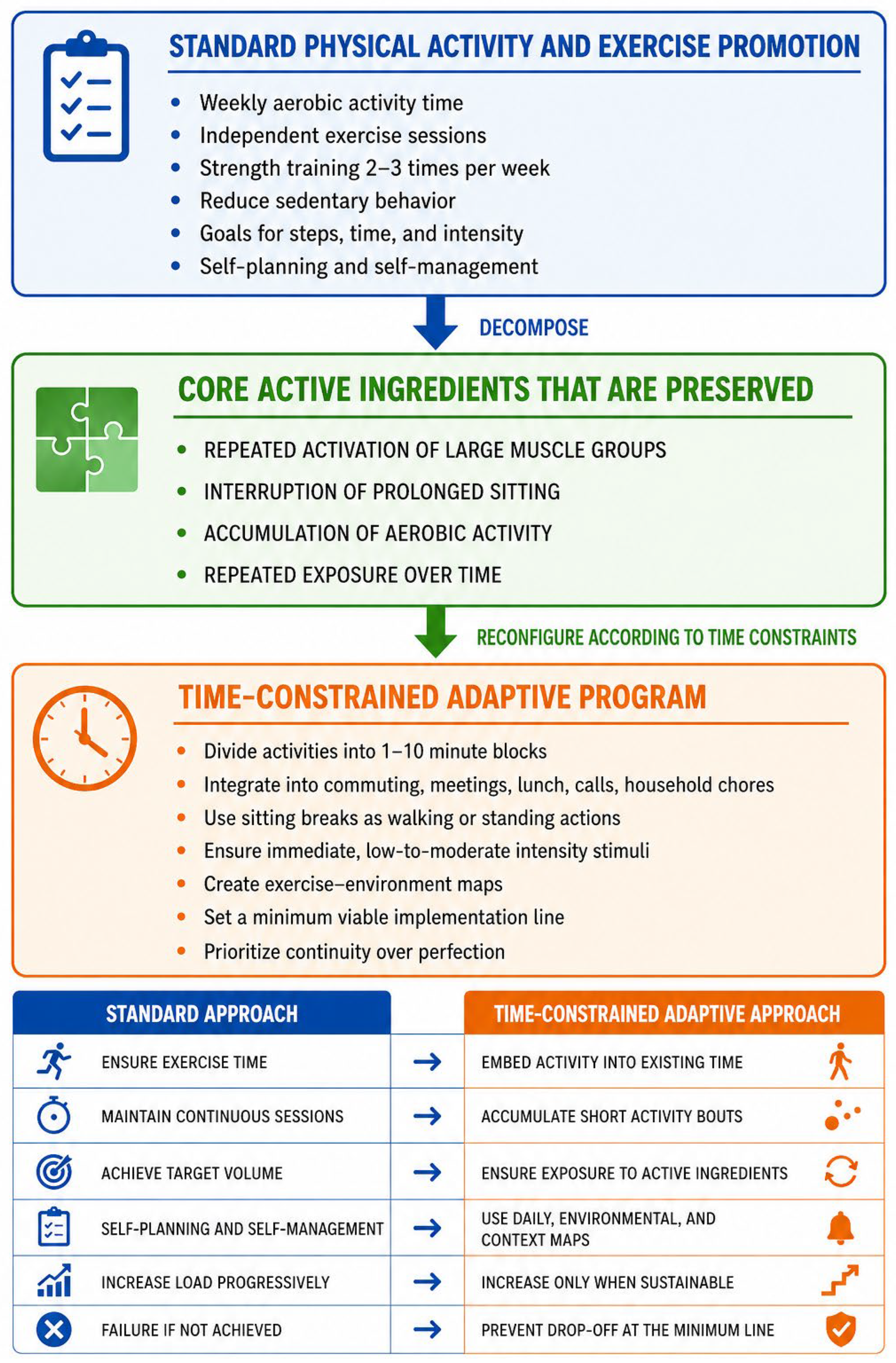

Table 1.
Core Activity Domains in the Implementation-Adapted Framework.
| Activity domain | Primary objective | Illustrative activities | Intended active ingredients |
|---|---|---|---|
| Interruption of prolonged sitting | Reduce extended periods of lower-limb muscular inactivity | Brief walking, standing with movement, sit-to-stand repetitions, calf raises | Sedentary interruption and repeated muscle activation |
| Brief aerobic activity | Accumulate ambulatory and cardiovascular activity across the day | Walking during commuting, after meals, between meetings, or during routine travel | Accumulated aerobic activity and energy expenditure |
| Functional muscle activity | Repeatedly activate large muscle groups without requiring a gym | Stair climbing, sit-to-stand movements, wall push-ups, calf raises | Large-muscle activation and preservation of functional capacity |
| Additional moderate-intensity activity | Progress toward broader guideline targets when feasible | Brisk walking, cycling, jogging, structured exercise | Greater aerobic volume and cardiorespiratory stimulus |
Table 2.
Comparison of Standard Physical Activity Guidance and the Implementation-Adapted Framework.
Table 2.
Comparison of Standard Physical Activity Guidance and the Implementation-Adapted Framework.
| Dimension | Standard physical activity guidance | Implementation-adapted framework |
|---|---|---|
| Aerobic activity | Progress toward recommended weekly volume and intensity | Divide activity into brief episodes and accumulate it within daily routines |
| Muscle-strengthening activity | Perform structured muscle-strengthening activity on at least 2 days per week | Embed functional muscle activity, such as sit-to-stand movements, stair use, and calf raises, within work and daily life |
| Sedentary behavior | Reduce prolonged sitting and overall sedentary time | Use meetings, telephone calls, meal breaks, and other recurring events as cues for repeated interruption |
| Time allocation | Reserve time specifically for exercise | Use existing work and daily-life periods as opportunities for movement |
| Unit of activity | Emphasize total weekly volume, with continuous sessions often used in practice | Accumulate brief episodes across the day and week |
| Progression | Increase duration, frequency, intensity, or load as appropriate | Increase one dimension at a time only when the current level remains sustainable |
| Initial success criterion | Degree of progress toward guideline-recommended activity | Repeated delivery of active ingredients, successful initiation, and fewer completely inactive days |
| Long-term objective | Achieve recommended levels of aerobic and muscle-strengthening activity | Progress toward standard recommendations to the extent safely and practically possible |
| Self-management | Use planning, goal setting, tracking, and feedback when appropriate | Use routines, environmental cues, and workday transitions to reduce repeated decision-making |
| Response to disruption | Reschedule the planned exercise session | Shorten, divide, substitute, or temporarily shift to the implementation floor |
Disclaimer/Publisher’s Note: The statements, opinions and data contained in all publications are solely those of the individual author(s) and contributor(s) and not of MDPI and/or the editor(s). MDPI and/or the editor(s) disclaim responsibility for any injury to people or property resulting from any ideas, methods, instructions or products referred to in the content. |
© 2026 by the authors. Licensee MDPI, Basel, Switzerland. This article is an open access article distributed under the terms and conditions of the Creative Commons Attribution (CC BY) license (http://creativecommons.org/licenses/by/4.0/).
Copyright: This open access article is published under a Creative Commons CC BY 4.0 license, which permit the free download, distribution, and reuse, provided that the author and preprint are cited in any reuse.