

Submitted:
06 August 2026
Posted:
02 September 2026
You are already at the latest version
Abstract
Evidence-based dietary patterns are effective for preventing and managing metabolic syndrome (MetS). However, they often assume that individuals have sufficient time, cognitive resources, and stable daily routines to prepare healthy meals, monitor dietary intake, and make repeated food-related decisions. For many business professionals, these assumptions are unrealistic, creating an implementation gap between nutritional evidence and everyday practice. To address this gap, this paper proposes Meal Architecture, a conceptual implementation framework that reconfigures evidence-based dietary interventions into forms that remain feasible under real-world time constraints. Rather than introducing another dietary pattern, Meal Architecture distinguishes the core metabolic functions that should be preserved from the implementation forms that can be adapted to different food environments while maintaining their intended physiological effects. The framework preserves four core metabolic functions: attenuation of postprandial glycemic excursions, prevention of excessive energy intake, provision of dietary fiber and high-quality carbohydrates, and provision of appropriate protein sources. Implementation components such as detailed calorie counting, routine home cooking, complex meal planning, continuous food logging, and sustained reliance on motivation are treated as adaptable rather than indispensable. These functions are operationalized through context-sensitive implementation strategies, including substitution, addition, sequencing, portion adjustment, and routine selection. Meal Architecture emphasizes repeated effective exposure to core metabolic functions through feasible, sustainable behaviors rather than perfect adherence to ideal meal plans. Meal Architecture reframes unhealthy dietary behavior among business professionals not as a consequence of inadequate knowledge or poor self-control, but as a design mismatch between evidence-based dietary interventions and the realities of everyday life. By integrating nutrition science with implementation science, the framework provides a theoretical foundation for designing low-burden dietary interventions applicable to health promotion, occupational health, workplace wellness, and AI-assisted personalized health support.
Keywords:
meal architecture
; metabolic syndrome
; dietary intervention
; implementation science
; health promotion
; occupational health
; adherence
; business professionals
1. Introduction
Metabolic syndrome (MetS) is a major risk factor for type 2 diabetes, cardiovascular disease, and premature mortality, making dietary modification one of the cornerstones of its prevention and management (Alberti et al., 2009). International clinical and public health guidelines consistently recommend maintaining energy balance, increasing dietary fiber intake through vegetables, fruits, legumes, and whole grains, consuming appropriate protein sources, and limiting saturated fat, free sugars, sugar-sweetened beverages, and sodium (World Health Organization [WHO], 2026; American Diabetes Association Professional Practice Committee, 2026). Together with regular physical activity, these recommendations form the foundation of contemporary lifestyle interventions for MetS and other non-communicable diseases.
A substantial body of evidence supports the effectiveness of these dietary approaches. Randomized controlled trials and meta-analyses have demonstrated that the Mediterranean diet improves body weight, waist circumference, blood pressure, glycemic control, and lipid metabolism (Kastorini et al., 2011; Papadaki et al., 2020). Similarly, the Dietary Approaches to Stop Hypertension (DASH) diet has been associated with reductions in blood pressure, waist circumference, triglycerides, and insulin resistance (Valenzuela-Fuenzalida et al., 2024; Zhao et al., 2026). Higher consumption of dietary fiber and whole grains has consistently been linked to lower risks of cardiovascular disease, type 2 diabetes, and weight gain, underscoring the importance of carbohydrate quality rather than quantity alone (Reynolds et al., 2019). In addition, a tightly controlled randomized feeding trial demonstrated that ultra-processed foods increase ad libitum energy intake and promote weight gain compared with minimally processed foods (Hall et al., 2019). Collectively, these findings indicate broad scientific consensus regarding the dietary principles required for the prevention and management of MetS.
However, knowing what constitutes a healthy diet is not the same as being able to follow one consistently in everyday life. Although evidence-based dietary recommendations are scientifically robust, they often assume that individuals have sufficient time, cognitive resources, and stable daily routines to plan meals, prepare food, evaluate nutritional information, and monitor dietary intake. For many business professionals, these assumptions are unrealistic. Consequently, an important gap remains between the proven efficacy of evidence-based dietary interventions and their implementation under the constraints of everyday working life.
Despite this strong evidence base, considerably less attention has been paid to how healthy dietary practices can be sustained in everyday life, particularly under conditions of limited time and cognitive resources. Conventional dietary counseling specifies clear nutritional targets, including appropriate energy intake, balanced nutrient composition, reduced sodium consumption, and increased intake of vegetables and dietary fiber. Although these recommendations are scientifically well established, they implicitly assume that individuals can consistently plan meals, select appropriate foods, prepare meals when necessary, and maintain dietary self-monitoring.
Knowing what constitutes a healthy diet, however, is not equivalent to being able to follow one consistently. The literature on treatment burden and minimally disruptive medicine suggests that adherence declines when the workload imposed by health management exceeds an individual's available time, attention, capabilities, and resources (May et al., 2009). From this perspective, the central challenge is no longer to determine what people should eat, but to translate existing nutritional evidence into implementation strategies that remain feasible under real-world constraints, including limited time, cognitive resources, planning capacity, and diverse food environments.
This implementation challenge is particularly evident among business professionals facing substantial time constraints. Time scarcity has consistently been identified as one of the major barriers to healthy eating and physical activity. Individuals with limited discretionary time consume fewer fruits and vegetables, rely more heavily on meals prepared outside the home, and are more likely to consume discretionary foods high in salt, sugar, and fat (Venn & Strazdins, 2017). Longer working hours and commuting times have likewise been associated with more frequent consumption of restaurant and take-away meals and reduced fruit and vegetable intake (Oostenbach et al., 2022). Furthermore, young adults working more than 40 hours per week are significantly more likely to perceive time as a major barrier to maintaining a healthy diet (Escoto et al., 2012).
For business professionals facing long working hours, frequent meetings, business travel, irregular schedules, lengthy commutes, or caregiving responsibilities, preparing every meal from scratch and maintaining an ideal diet through detailed planning and nutritional monitoring may simply be unrealistic. Meals are often consumed under severe time constraints, dinners may be delayed until late evening, and restaurants, workplace cafeterias, take-away meals, and convenience stores become routine sources of food. Under these circumstances, dietary interventions that depend on home cooking, detailed meal planning, precise nutritional calculations, or continuous food logging impose substantial temporal and cognitive demands, potentially undermining long-term adherence. Moreover, when individuals equate imperfect adherence with failure, even achievable incremental improvements may be abandoned.
This does not imply that evidence-based dietary therapy is ineffective. Rather, it points to a design mismatch between the implementation demands of dietary interventions and the time, attention, capabilities, and resources available in everyday working life. For example, meal plans centered on home cooking may have limited relevance for individuals who routinely obtain meals from convenience stores, workplace cafeterias, or restaurants. Likewise, even scientifically effective self-management strategies may fail when the burden of implementation exceeds what individuals can realistically sustain (May et al., 2009). The challenge, therefore, is not to prescribe increasingly ideal diets, but to redesign evidence-based dietary interventions so that healthier choices become feasible within existing living and working environments.
Implementation science emphasizes that intervention effectiveness depends not only on scientific efficacy but also on how interventions are delivered, adopted, implemented, and sustained in real-world settings. Research on complex interventions has argued that intervention developers should standardize the essential functions of an intervention while allowing the specific activities used to achieve those functions to vary according to context (Hawe et al., 2004). This principle has subsequently been formalized as the distinction between core functions, representing the fundamental purposes of an intervention, and forms, representing the context-specific activities or strategies through which those purposes are achieved (Perez Jolles et al., 2019).
This perspective is consistent with broader evidence from behavioral science. Habit formation research demonstrates that repeatedly performing behaviors in stable contexts gradually increases behavioral automaticity (Lally et al., 2010), while meta-analyses show that implementation intentions—predefined if–then plans linking situations to actions—facilitate healthier eating behaviors (Adriaanse et al., 2011; Carrero et al., 2019). Together, these findings suggest that improving dietary interventions does not necessarily require redefining the principles of healthy eating; rather, it requires designing implementation strategies that fit individuals' everyday environments, recurring eating situations, and available food options.
Against this background, we propose Meal Architecture, a conceptual implementation framework for dietary intervention. Rather than introducing another dietary pattern, the framework distinguishes core metabolic functions, which should be preserved across contexts, from implementation forms, which can be adapted according to situational constraints. This distinction makes it possible to translate evidence-based nutritional principles into feasible dietary practices for business professionals experiencing substantial time and cognitive constraints.
Specifically, Meal Architecture seeks to preserve four essential metabolic functions: attenuation of postprandial glycemic excursions, prevention of excessive energy intake, provision of dietary fiber and high-quality carbohydrates, and provision of appropriate protein sources. At the same time, implementation components such as home cooking, meal planning, food selection, meal sequencing, and routine choice are treated as flexible rather than indispensable, allowing interventions to be adapted to convenience stores, workplace cafeterias, restaurants, business travel, overtime work, and simple meals prepared at home.
This paper does not evaluate a new intervention empirically. Instead, it reinterprets existing evidence from nutrition science through the lens of implementation science to develop a conceptual framework for designing low-burden dietary interventions under real-world time constraints. By integrating nutritional effectiveness with implementation feasibility, Meal Architecture provides a theoretical foundation for occupational health, workplace wellness, national health promotion programs, and AI-assisted personalized dietary support.
2. Review Approach
This article presents a conceptual reconfiguration of evidence-based dietary interventions for the prevention of metabolic syndrome among time-constrained working adults. Rather than conducting a systematic review or meta-analysis, we synthesized evidence from international dietary guidelines, systematic reviews, meta-analyses, and key implementation science literature to identify the physiological mechanisms and implementation principles that consistently underpin effective dietary interventions.
The review focused on four areas relevant to intervention design: (1) evidence-based dietary patterns for metabolic syndrome prevention, (2) physiological mechanisms shared across effective dietary interventions, (3) implementation barriers associated with dietary adherence under conditions of limited time and cognitive resources, and (4) implementation strategies that support sustainable dietary behavior, including treatment burden, implementation science, habit formation, implementation intentions, and choice architecture.
Evidence was drawn from international dietary guidelines, major professional society recommendations, systematic reviews, meta-analyses, and influential conceptual papers published primarily during the past two decades. The objective was not to estimate pooled intervention effects but to distinguish core metabolic functions that should be preserved across implementation contexts from implementation forms that may be adapted to reduce burden while maintaining their intended physiological effects.
Because the purpose of this article was conceptual synthesis and intervention redesign rather than quantitative estimation of intervention effectiveness, a narrative review approach was considered most appropriate. The aim was not to review every dietary intervention or compare individual dietary patterns exhaustively, but to integrate evidence from nutrition science and implementation science into a unified framework for intervention design. Accordingly, Meal Architecture should be regarded as a theory-informed implementation framework intended to facilitate translation of established dietary evidence into occupational health practice, workplace health promotion, and other real-world settings rather than as a new clinical dietary guideline.
3. Dietary Evidence and Core Metabolic Functions in the Prevention of Metabolic Syndrome
3.1. Dietary Therapy and Metabolic Syndrome
Metabolic syndrome (MetS) is characterized by the clustering of metabolic abnormalities, including hypertension, dyslipidemia, and impaired glucose metabolism, often in the context of visceral fat accumulation. It is widely recognized as a major risk factor for type 2 diabetes and cardiovascular disease. Dietary therapy is therefore broadly recommended, alongside physical activity, as one of the most important lifestyle interventions for the prevention and management of MetS. The World Health Organization (WHO), the American Diabetes Association (ADA), the European Association for the Study of Diabetes (EASD), and the Japan Society for the Study of Obesity all recommend diets centered on plant-based foods, including vegetables, fruits, legumes, and whole grains, while emphasizing the restriction of free sugars, sodium, saturated fat, and excessive energy intake. Recent guidelines have also moved away from prescribing a single ideal diet and instead emphasize the selection of flexible dietary patterns that take account of individual cultural backgrounds, preferences, food availability, and feasibility.
A substantial body of evidence from randomized controlled trials and meta-analyses supports these recommendations at the level of overall dietary patterns. The Mediterranean diet, one of the most extensively studied examples, has been shown to improve several risk factors associated with MetS, including waist circumference, blood pressure, glycemic control, and lipid abnormalities. Greater adherence to the Mediterranean diet has also been associated with a lower risk of developing MetS (Kastorini et al., 2011). In the PREDIMED trial, the Mediterranean diet did not significantly reduce the incidence of newly developed MetS, but it was associated with a greater likelihood of reversal among participants with existing MetS. More recent systematic reviews have likewise supported its cardiometabolic benefits.
The Dietary Approaches to Stop Hypertension (DASH) diet has demonstrated its strongest effects on blood pressure, while also producing modest improvements in body weight, insulin resistance, and lipid metabolism. Recent meta-analyses focusing specifically on individuals with MetS have further reported improvements in abdominal obesity, triglyceride levels, and insulin resistance.
Increasing attention has also been directed toward overall food quality and the degree of food processing. Higher intakes of dietary fiber and whole grains, for example, have been associated with lower risks of cardiovascular disease and type 2 diabetes (Reynolds et al., 2019). In contrast, ultra-processed foods have been shown to increase ad libitum energy intake and promote weight gain (Hall et al., 2019).
Taken together, international guidelines and numerous meta-analyses have generated a relatively strong scientific consensus regarding the types of dietary patterns that are beneficial for the prevention of MetS. However, the specific food compositions recommended by the Mediterranean, DASH, Japanese, and other dietary patterns are not identical. The fact that these distinct dietary patterns can nevertheless produce similar metabolic benefits suggests that their health effects may arise not from particular foods themselves, but from the physiological functions they achieve in common. In this paper, we conceptualize these shared effects as core metabolic functions and propose a framework in which implementation forms can be flexibly adapted while these underlying functions are preserved.
3.2. Core Metabolic Functions Underlying Dietary Interventions
Although dietary patterns such as the Mediterranean diet, the DASH diet, low-glycemic index diets, and predominantly plant-based diets differ in their specific food composition and cultural origins, they produce broadly similar improvements in waist circumference, blood pressure, glycemic control, and lipid metabolism. This suggests that the effectiveness of dietary interventions may derive not from particular foods or dishes themselves, but from the physiological effects that these dietary patterns achieve in common. In this paper, we refer to these shared effects as core metabolic functions.
Different foods may serve the same function, while a single food may contribute to several functions simultaneously. Vegetables, legumes, whole grains, seaweed, and mushrooms, for example, can all increase dietary fiber intake, reduce dietary energy density, and enhance satiety. Fish, eggs, legumes, dairy products, and poultry can all serve as appropriate sources of protein. Conceptualizing dietary interventions not as fixed collections of foods but as combinations of functions required for metabolic improvement therefore makes it possible to construct a framework that can be adapted across different cultural settings and food environments.
3.2.1. Attenuation of Postprandial Glycemic Excursions
The first core metabolic function is the attenuation of postprandial increases in blood glucose. Postprandial hyperglycemia may impose a metabolic burden that is not fully captured by average glucose levels and may influence insulin secretion, oxidative stress, and vascular function. This function can be achieved through several approaches, including reducing carbohydrate intake, improving carbohydrate quality, modifying meal sequence, increasing dietary fiber, and combining carbohydrates with protein or fat.
Shukla et al. (2015) and Kuwata et al. (2016) showed that consuming vegetables or protein before carbohydrates improved postprandial glycemic responses. Chiavaroli et al. (2021) further reported that low-glycemic index and low-glycemic load dietary patterns improved HbA1c, fasting blood glucose, body weight, and lipid-related outcomes. Together, these findings indicate that postprandial glycemic excursions can be attenuated through multiple strategies, including meal sequencing, carbohydrate quality, and food combinations.
However, evidence regarding meal sequencing is derived primarily from studies of acute glycemic responses, and its independent effects on long-term outcomes have not been firmly established. In the present framework, meal sequencing is therefore treated not as an intervention that independently prevents MetS, but as one possible implementation form for reducing postprandial glycemic load.
3.2.2. Prevention of Excessive Energy Intake
The second core metabolic function is the prevention of excessive energy intake without requiring detailed calorie counting. Although regulation of energy balance is essential for the prevention of MetS, weighing and recording every meal can impose a substantial implementation burden. Strategies that reduce spontaneous energy intake through changes in portion size, energy density, degree of processing, and beverage choice are therefore particularly important.
Reducing portion sizes and selecting foods with a lower energy density have been shown to decrease energy intake (Klos et al., 2023). Hall et al. (2019) demonstrated that ultra-processed diets resulted in greater ad libitum energy intake and weight gain than diets based on unprocessed foods. At the same time, it is neither necessary nor realistic to avoid all processed foods. Frozen vegetables, canned legumes, unsweetened yogurt, and whole-grain bread, for example, may facilitate implementation by offering convenient and nutritionally useful options.
Replacing sugar-sweetened beverages with water or low- or no-calorie alternatives has also been associated with improvements in body weight and cardiometabolic outcomes (McGlynn et al., 2022; Tobiassen et al., 2024). Food and beverage substitution can therefore serve as an implementation form for limiting excessive energy intake without requiring a complete redesign of the diet.
3.2.3. Provision of Dietary Fiber and High-Quality Carbohydrates
The third core metabolic function is the provision of high-quality carbohydrate sources rich in dietary fiber. Dietary fiber contributes to metabolic health through several pathways, including attenuation of postprandial glycemic responses, increased satiety, reduced dietary energy density, and improvements in lipid metabolism and the gut environment.
Reynolds et al. (2019) showed that higher intakes of dietary fiber and whole grains were associated with lower risks of cardiovascular disease, type 2 diabetes, and all-cause mortality, while Chen et al. (2018) reported an inverse association with the risk of MetS. Soluble dietary fiber may also improve HbA1c, fasting blood glucose, and insulin resistance.
These findings suggest that incorporating vegetables, legumes, whole grains, seaweed, mushrooms, and oats may simultaneously improve postprandial glycemia, satiety, dietary energy density, and lipid metabolism. Dietary fiber alone, however, cannot address all limitations of an overall dietary pattern and should therefore be implemented in combination with the other core metabolic functions.
3.2.4. Provision of Appropriate Protein Sources
The fourth core metabolic function is the inclusion of an appropriate protein source in each meal. Protein may support weight management by promoting satiety, regulating appetite, and helping to preserve lean body mass.
Higher-protein diets have been reported to offer some benefits for satiety and weight management (Leidy et al., 2015; Wycherley et al., 2012), while Morton et al. (2018) found modest additional benefits for muscle mass and strength.
The present framework does not, however, advocate increasing protein intake as an end in itself. Rather, it emphasizes improving meal structure by adding a protein source, such as eggs, fish, legumes, poultry, or unsweetened dairy products, to meals otherwise composed primarily of rice, noodles, or bread. Protein intake should also be individually adjusted for people with conditions such as diabetes, hypertension, or chronic kidney disease.
3.2.5. Preserving Functions Rather Than Specific Foods
Taken together, the evidence suggests that dietary interventions for the prevention of MetS can be organized around four core metabolic functions: (1) attenuation of postprandial glycemic excursions, (2) prevention of excessive energy intake, (3) provision of dietary fiber and high-quality carbohydrates, and (4) provision of appropriate protein sources. A single food or dietary modification may contribute to multiple functions, while the same function may be achieved through different strategies.
What matters in dietary intervention design, therefore, is not the replication of specific foods or fixed meal plans, but the preservation of these four functions. The next section applies an implementation-science perspective to explain how implementation forms can be flexibly adapted to time constraints and food environments while these core metabolic functions are maintained.
3.3. Core Metabolic Functions and Adaptable Implementation Forms
The preceding section organized dietary interventions for the prevention of metabolic syndrome (MetS) around four core metabolic functions: (1) attenuation of postprandial glycemic excursions, (2) prevention of excessive energy intake, (3) provision of dietary fiber and high-quality carbohydrates, and (4) provision of appropriate protein sources. Identifying the functions that should be preserved, however, does not in itself ensure that an intervention will be implemented in daily life. The effectiveness of a dietary intervention depends not only on whether its content is physiologically desirable, but also on whether that content can be translated into forms that fit real-world constraints, including limited time, fatigue, attentional resources, working conditions, eating out, business travel, family circumstances, and food availability.
Guidelines issued by organizations such as the WHO, ADA, and EASD likewise emphasize adapting dietary recommendations to individual preferences, cultural contexts, and practical feasibility. Nevertheless, they do not always clearly specify which elements of an intervention must be preserved and which can be modified. The distinction between function and form in complex interventions provides a useful way to address this issue.
Hawe et al. (2004) argued that when complex interventions are transferred across populations and settings, their superficial activities and procedures should not necessarily be standardized uniformly. Instead, standardization should focus on the functions that the intervention is intended to achieve. Similarly, Perez Jolles et al. (2019) distinguished between non-modifiable core functions, which generate an intervention’s effects, and adaptable forms, which may vary according to the target population and context. From this perspective, fidelity does not mean reproducing the same activities in exactly the same way. Rather, it means preserving the intended functions through potentially different modes of delivery.
Applied to dietary interventions, this distinction implies that functions such as attenuating postprandial glycemic excursions, preventing excessive energy intake, ensuring adequate intake of dietary fiber and high-quality carbohydrates, and including appropriate protein sources should be preserved. In contrast, the foods, preparation methods, meal sequence, portion sizes, purchasing methods, and eating locations through which these functions are achieved may vary according to culture, preferences, cost, time, and availability. Attenuation of postprandial glycemic excursions, for example, may be achieved by consuming vegetables or protein before carbohydrates, replacing refined grains with whole grains, reducing the quantity of staple foods, or adding a side dish. Similarly, adequate protein intake may be achieved through fish, eggs, legumes, poultry, or dairy products, depending on the situation.
Accordingly, what should be standardized in Meal Architecture is not a specific meal plan or food list, but the design principle of securing the necessary metabolic functions within each eating occasion. In this paper, the corresponding implementation forms are organized into five operations: addition, substitution, sequencing, portion adjustment, and routine selection.
The first operation is addition. Adding vegetables, legumes, eggs, fish, poultry, or unsweetened dairy products to a carbohydrate-dominant meal can compensate for insufficient dietary fiber, protein, satiety, or attenuation of postprandial glycemia. Examples include adding an egg or tofu to a noodle dish, unsweetened yogurt to a bread-based breakfast, or a salad or soup to a rice-bowl meal. However, if addition simply increases the total amount of food consumed, it may also raise total energy intake. Added items should therefore preferably have a low energy density, or their inclusion should be accompanied by an adjustment in the amount of staple foods or other energy-dense items.
The second operation is substitution. Examples include replacing sugar-sweetened beverages with water or unsweetened tea, refined grains with whole-grain or legume-containing alternatives, energy-dense side dishes with vegetables or soup, and large portions with smaller ones. Substitution modifies only part of an existing eating pattern, allowing the intended function to be achieved while reducing unnecessary components. Replacing sugar-sweetened beverages with water or unsweetened alternatives is particularly suitable as a high-priority operation because it is supported by relatively direct evidence.
The third operation is sequencing. Consuming vegetables or protein before carbohydrates may improve postprandial glycemic responses without substantially changing the foods included in the meal. This strategy may be especially practical in restaurants or social dining situations where food choices are limited. However, the evidence relates primarily to acute glycemic responses. Sequencing should therefore be treated not as a stand-alone intervention that guarantees long-term improvement in MetS, but as a supportive implementation form for reducing postprandial glycemic load.
The fourth operation is portion adjustment. This includes ordering a smaller serving of staple food, replacing a large portion with a smaller one, or balancing an energy-dense dish with lower-energy-density items elsewhere in the meal. The purpose is to reduce excessive energy intake without requiring detailed calorie calculation. Because serving size and food structure influence spontaneous energy intake, portion adjustment should not be viewed solely as an act of individual self-control. Rather, it should be understood as a design operation that also involves the food environment.
The fifth operation is routine selection. Instead of determining the optimal meal from the beginning on every occasion, individuals establish a small number of decision rules for recurring eating situations. Examples include: “At a convenience store, select a staple food, a protein source, and a vegetable item”; “When ordering noodles alone, add one vegetable or protein item”; “Replace sweetened beverages with unsweetened drinks”; and “When choosing a rice-bowl meal, order a smaller portion of rice and add soup or salad.” This approach differs from meal planning, in which complete menus are determined in advance. Routine selection reduces decision-making burden by relying on reusable rules that can be applied across multiple situations.
Routine selection is also consistent with the concepts of choice architecture and implementation intentions. In their meta-analysis, Cadario and Chandon (2020) found that interventions targeting the food environment closer to the point of action—such as product placement, convenience, portion size, and defaults—tended to exert larger effects on food choice than the provision of nutritional information alone. Similarly, implementation intentions formulated as “if situation X occurs, then I will perform action Y” have shown some effectiveness in promoting healthier eating. Under conditions of limited time and cognitive resources, making the desirable choice the standard and shortest behavioral pathway may be more feasible than requiring individuals to recall health knowledge and deliberate anew at every eating occasion.
These five operations should not be viewed as separate dietary techniques of equal and independent status. Each must be linked to one or more core metabolic functions. Addition and substitution are not ends in themselves; they are forms through which functions such as adequate fiber and protein intake, lower dietary energy density, or reduced added-sugar intake can be achieved. Likewise, sequencing is not a general norm of healthy eating, but an implementation form specifically directed toward attenuating postprandial glycemic excursions. Distinguishing functions from forms allows the same metabolic functions to be achieved through locally available options without requiring all individuals to consume identical foods or perform identical behaviors.
Such adaptability does not reduce intervention fidelity. Rather, it shifts the criterion of fidelity from adherence to a specific meal plan toward fidelity to metabolic function. Even in settings where the Mediterranean diet cannot be reproduced in its original form, its core functions may be preserved if vegetables, legumes, whole grains, unsaturated fats, and minimally processed foods can be secured through local dishes and available foods. Although the specific foods included in Mediterranean, DASH, Japanese, and predominantly plant-based dietary patterns differ, overlapping metabolic effects may still be expected when they share functions such as increasing dietary fiber, limiting excessive energy intake, and reducing added sugars.
Adaptability, however, does not imply that all modifications are acceptable without qualification. It remains necessary to determine whether the adapted form actually preserves the intended function. Replacing a food with a low-fat alternative, for example, does not preserve the function of preventing excessive energy intake if the substitute contains more added sugar or provides more total energy. Similarly, adding vegetables may offer limited benefit if it substantially increases the overall quantity of food consumed. Implementation forms should therefore be evaluated according to the extent to which they achieve the corresponding metabolic function, rather than according to a superficial image of healthfulness.
Meal Architecture should thus be understood not as a newly simplified diet derived from existing healthy eating patterns, but as an intervention design principle that extracts the core metabolic functions embedded in established dietary guidelines and translates them into five practical operations: addition, substitution, sequencing, portion adjustment, and routine selection. The central question is not whether an individual’s meal perfectly matches an ideal menu, but whether metabolically meaningful functions are preserved under varying conditions of daily life.
Even an intervention translated into feasible forms, however, is unlikely to produce the expected metabolic effects unless it is repeated with sufficient frequency and sustained over time. The next section therefore conceptualizes dietary intervention effectiveness not only in terms of the physiological effect of each eating occasion, but also as effective exposure, incorporating implementation frequency and duration. It further examines adherence, the minimum implementation threshold, and recovery following lapses.
3.4. Effective Exposure, the Minimum Implementation Threshold, and Recovery Following Lapses
The effectiveness of a dietary intervention depends not only on the physiological effects of individual meals but also on how frequently and consistently metabolically meaningful behaviors are repeated. Even highly effective dietary patterns are unlikely to improve body weight, glycemic control, or other cardiometabolic outcomes if implemented only sporadically. Conversely, modest but sustainable behaviors may generate substantial cumulative benefits through repeated implementation.
Studies of the Mediterranean diet similarly indicate that favorable outcomes are associated with higher adherence (Kastorini et al., 2011; Babio et al., 2014). Although adherence is influenced by many factors beyond the intervention itself, these findings highlight the importance of distinguishing intervention delivery from actual metabolically meaningful exposure.
To capture this distinction, the present paper introduces the following conceptual model:
Effective exposure = physiological effect per implementation × implementation frequency × duration of implementation
This equation is not intended as a clinical prediction model but as a framework for intervention design. A highly efficacious intervention implemented infrequently may generate less cumulative exposure than a lower-burden intervention that is repeated consistently over time. From this perspective, the intervention with the greatest theoretical efficacy is not necessarily the one that will be most effective in everyday life.
3.4.1. Adherence as an Intervention Mechanism
Adherence is commonly treated as an implementation outcome. Among individuals facing substantial time and cognitive constraints, however, it may also function as a key mechanism through which dietary interventions achieve their effects.
According to the principle of minimally disruptive medicine (May et al., 2009), adherence declines when the workload imposed by treatment exceeds an individual's available time, attention, and resources. Applied to dietary interventions, detailed calorie tracking, extensive meal planning, and continuous self-monitoring may themselves become barriers to sustained implementation.
Meal Architecture therefore treats adherence not primarily as a matter of motivation or willpower, but as something that can be improved through intervention design. By reducing implementation burden through reusable decision rules and context-sensitive implementation forms, the framework seeks to increase both feasibility and repetition.
3.4.2. The Potential and Limitations of Small Changes
Meal Architecture shares with the small-changes approach the goal of promoting sustainable behavioral change through low-burden actions. Hill et al. (2009) suggested that small changes may help prevent gradual weight gain.
However, evidence indicates that their effects are modest. A meta-analysis by Graham et al. (2022) found that although small-change interventions contributed to weight-gain prevention, they produced limited evidence of clinically meaningful weight loss.
Accordingly, Meal Architecture does not assume that small changes alone are sufficient for all individuals. Rather, it proposes maintaining at least a minimum level of metabolically meaningful behavior when ideal implementation is not feasible, thereby preventing complete interruption of the intervention and preserving long-term effective exposure.
3.4.3. The Minimum Implementation Threshold
Building on this perspective, we propose the concept of a minimum implementation threshold, defined as the smallest feasible dietary modification that preserves at least one meaningful core metabolic function under constraints such as limited time, fatigue, attention, or restricted food environments.
When time and food options permit, meals should ideally be optimized across multiple components. Under conditions such as overtime work, business travel, or brief meal breaks, however, maintaining the same level of implementation may be unrealistic. In such situations, individuals may instead perform one minimum action, for example:
- replacing a sugar-sweetened beverage with water or unsweetened tea;
- adding a protein source, such as an egg, legumes, or yogurt, to a carbohydrate-based meal;
- selecting a smaller portion size;
- adding vegetables or soup to an energy-dense meal; or
- consuming vegetables or protein before carbohydrates when the meal itself cannot be modified.
These actions do not constitute an ideal diet or an adequate therapeutic dose. Their purpose is to prevent complete non-implementation by maintaining continued exposure to at least one core metabolic function.
Although related to concepts such as graded tasks, shaping, harm reduction, adaptive interventions, and the small-changes approach, the minimum implementation threshold is distinguished by explicitly preserving core metabolic functions while adapting intervention intensity to an individual's implementation capacity.
3.4.4. Context-Dependent Adjustment of Intervention Intensity
The minimum implementation threshold allows dietary intervention to be conceptualized as an adaptive rather than all-or-none process. Because available time, fatigue, hunger, and food environments fluctuate from day to day, intervention intensity should also be adjusted according to circumstances.
This perspective is consistent with just-in-time adaptive interventions (JITAIs), which modify intervention options according to changing individual states (Nahum-Shani et al., 2017). Within Meal Architecture, decision points may include entering a convenience store, ordering a meal, or eating during overtime work, while tailoring variables include available time, fatigue, hunger, location, and food availability.
When implementation capacity is high, multiple core metabolic functions can be targeted simultaneously. When capacity is limited, intervention intensity can be reduced to a minimum action targeting a single function. Such adaptation should be regarded not as intervention failure but as a deliberate strategy for maintaining long-term effective exposure.
Although JITAI principles provide a useful conceptual foundation, their application to Meal Architecture has not yet been evaluated empirically and remains an important direction for future research.
3.4.5. Recovery Following Lapses
Long-term dietary interventions inevitably include lapses caused by social events, travel, illness, overtime work, or other disruptions. Sustainable interventions therefore require not only strategies for preventing lapses but also mechanisms for facilitating recovery.
Self-compassion following dietary lapses has been associated with lower negative affect, greater self-efficacy, and stronger intentions to resume healthy eating (Thøgersen-Ntoumani et al., 2021; Hagerman et al., 2023). These findings suggest that a single lapse should be viewed as a temporary interruption rather than failure of the entire intervention.
Accordingly, Meal Architecture incorporates recovery following lapses as a formal intervention component. Rather than attempting excessive compensation, individuals are encouraged to return to the minimum implementation threshold at the next available eating occasion. The focus therefore shifts from perfect adherence at every meal to repeated return to metabolically meaningful behavior over time.
3.4.6. Maximizing Long-Term Effective Exposure
Taken together, Meal Architecture defines adherence not as perfect reproduction of an ideal diet but as the repeated preservation of one or more core metabolic functions under changing circumstances. The objective is therefore not to maximize the quality of every individual meal, but to maximize cumulative effective exposure through feasible and sustainable implementation.
For individuals facing substantial constraints on time, attention, and planning capacity, reducing implementation burden, adapting intervention intensity, and supporting recovery following lapses may increase long-term adherence without compromising the fundamental metabolic objectives of dietary intervention.
Meal Architecture should therefore be understood not as a proposal for convenient meals, but as an adaptive implementation framework that preserves core metabolic functions while accommodating the realities of everyday life.
4. Implementation Gap
The preceding sections argued that dietary interventions for metabolic syndrome (MetS) can be organized around four core metabolic functions: attenuation of postprandial glycemic excursions, prevention of excessive energy intake, provision of dietary fiber and high-quality carbohydrates, and provision of appropriate protein sources. These functions can be achieved through multiple implementation forms, including addition, substitution, sequencing, portion adjustment, and routine selection.
However, identifying scientifically effective dietary content does not ensure its consistent implementation in everyday life. Standard dietary guidance often assumes that individuals can plan meals, prepare food, make informed food choices, and regulate intake under relatively stable conditions. For many business professionals, whose schedules and food environments fluctuate substantially, these assumptions may not hold.
Dietary interventions should therefore be evaluated not only by what people should eat, but also by whether recommended behaviors remain feasible during working days, business travel, eating out, and periods of fatigue. This section examines four sources of the implementation gap: time and food-environment constraints, decision-making burden, self-regulatory burden, and design mismatch.
4.1. Time Constraints and Uncertainty in the Food Environment
Standard dietary guidance often assumes predictable meal timing and adequate opportunities to prepare or obtain appropriate foods. In reality, business professionals frequently encounter unexpected meetings, overtime work, business travel, commuting, and caregiving responsibilities that disrupt planned eating occasions.
Food availability is also highly context dependent. During travel or busy workdays, choices may be limited to workplace cafeterias, convenience stores, boxed meals, or restaurants. Under these conditions, interventions requiring specific meal plans, cooking methods, or meal timing become difficult to implement.
Consistent with the COM-B model (Michie et al., 2011), dietary behavior depends not only on knowledge and motivation but also on physical opportunities provided by the environment. Dietary interventions should therefore prioritize preserving core metabolic functions within available food environments rather than requiring strict adherence to predetermined meal plans.
4.2. Decision-Making Burden Before Eating
Healthy eating requires more than preparing and consuming food. Individuals must repeatedly decide what to eat, compare available options, judge nutritional quality, and determine appropriate combinations and portion sizes. Whether meals are prepared at home or purchased outside, these decisions impose a substantial cognitive workload.
In this paper, the cumulative time and cognitive effort required to perform these tasks is termed dietary implementation burden. Under substantial work-related demands, repeatedly evaluating multiple food options and calculating nutritional balance may become impractical. Consequently, healthier options that require more deliberation are often bypassed in favor of more immediate alternatives. Consistent with this view, interventions that simplify behavioral pathways—through changes in convenience, defaults, placement, or portion size—have generally been more effective than providing nutritional information alone (Cadario & Chandon, 2020).
Rather than increasing the number of decisions required, dietary interventions for time-constrained populations should reduce cognitive workload by providing reusable decision rules and context-specific default options.
4.3. The Problem of Assuming Complete Implementation
Standard dietary guidance often combines multiple goals, including increasing vegetable intake, reducing sodium, controlling energy intake, and improving overall dietary quality. Although these goals are nutritionally appropriate, expecting them to be achieved simultaneously under everyday constraints may encourage an all-or-nothing view of adherence.
When lunch breaks are brief, food choices are limited, or meals are determined by work or social obligations, reproducing an ideal meal may be impossible. If healthy eating is consequently perceived as unattainable, even feasible improvements may be abandoned.
Meal quality, however, is not simply a matter of complete success or failure. Adding vegetables to a boxed meal, reducing portion size, or combining a carbohydrate-based meal with a protein source may not produce an ideal diet, but can still preserve one or more core metabolic functions. Consistent with the concepts of graded tasks and shaping (Michie et al., 2013), dietary interventions should therefore recognize partial implementation as meaningful rather than evaluating success solely by perfect adherence.
4.4. Excessive Reliance on Self-Regulatory Work
Many dietary interventions rely heavily on self-regulation, requiring individuals to plan meals, evaluate nutritional information, record intake, and continually adjust their behavior. Although self-monitoring and feedback are established behavior-change techniques (Michie et al., 2013), they also require considerable time and cognitive effort.
May et al. (2009) argued that health interventions become difficult to sustain when the workload imposed by treatment exceeds an individual's available capacity. From this perspective, the burden created by the intervention itself becomes an important determinant of long-term adherence.
Applied to dietary interventions, this suggests that increasing planning, recording, and nutritional monitoring is not always desirable. Rather than eliminating self-management, Meal Architecture minimizes it by emphasizing reusable decision rules, predefined choices, and simple evaluation based on whether core metabolic functions have been achieved at each eating occasion.
4.5. Non-Implementation as a Design Mismatch
Taken together, the preceding discussion suggests that failure to implement healthy eating should not be attributed solely to insufficient knowledge, weak motivation, or poor self-control. Instead, non-implementation often reflects a design mismatch between the assumptions embedded in dietary interventions and the realities of everyday working life.
Many dietary recommendations implicitly assume predictable schedules, adequate preparation time, unrestricted food choice, regular cooking, and continuous self-monitoring. Business professionals, however, frequently encounter time pressure, business travel, eating out, irregular schedules, and fluctuating food environments. Under such conditions, non-adherence may arise because the implementation demands of the intervention exceed the individual's available time, attention, and resources.
The central question is therefore not how to increase adherence to an ideal diet, but how to redesign evidence-based dietary interventions so that their core metabolic functions can be implemented under real-world constraints. This requires distinguishing the functions that must be preserved from the implementation forms that can be adapted according to context.
Meal Architecture is proposed as an intervention design framework for achieving this objective. Rather than prescribing another dietary pattern, it extracts core metabolic functions from existing nutritional evidence and translates them into flexible implementation operations—including addition, substitution, sequencing, portion adjustment, and routine selection—that can be adapted to diverse food environments while preserving their intended physiological functions.
The following section describes the structure, components, and mechanisms of Meal Architecture in greater detail.
5. Meal Architecture
The preceding discussion identified two distinct challenges in dietary interventions for the prevention of metabolic syndrome (MetS). The first is nutritional: determining which dietary characteristics improve metabolic health. The second is implementational: translating those characteristics into repeatable behaviors that remain feasible under fluctuating constraints on time, attention, food access, and working conditions.
Although dietary patterns such as the Mediterranean diet, the DASH diet, low-glycemic index diets, and predominantly plant-based diets differ in food composition and cultural context, they share common metabolic functions: attenuation of postprandial glycemic excursions, prevention of excessive energy intake, provision of dietary fiber and high-quality carbohydrates, and provision of appropriate protein sources. Under time constraints, preserving these functions may be more important than reproducing a specific meal pattern with complete fidelity.
On this basis, the present paper proposes Meal Architecture as an adaptive dietary intervention framework for time-constrained business professionals. Figure 1 summarizes the framework, illustrating the progression from core metabolic functions to implementation operations, contextual adaptation, routinization, and the minimum implementation threshold.
5.1. Basic Principles
Meal Architecture does not modify the scientific evidence underlying established healthy dietary patterns. Rather, it preserves the core metabolic functions embedded in that evidence while adapting their implementation forms to temporal, cognitive, and environmental constraints.
The elements to be preserved are not specific foods or fixed meal plans, but the following functions:
- attenuation of postprandial glycemic excursions;
- prevention of excessive energy intake;
- provision of dietary fiber and high-quality carbohydrates;
- provision of appropriate protein sources; and
- sustained effective exposure to behaviors incorporating these functions.
The same metabolic function may be achieved through multiple implementation forms. Accordingly, Meal Architecture shifts intervention fidelity from reproducing predefined meal patterns toward preserving core metabolic functions across diverse food environments and everyday circumstances.
The objective is therefore not perfect adherence to an ideal diet, but preservation of essential metabolic functions within an individual's available time, food environment, and implementation capacity. Figure 2 illustrates this conceptual shift from fidelity to specific meals toward fidelity to metabolic function.
5.2. Components of Meal Architecture
Meal Architecture consists of five interrelated components that translate evidence-based dietary principles into sustainable implementation under everyday constraints.
5.2.1. Identification of Missing Core Functions
The first component is to identify which core metabolic functions are insufficiently represented in the current eating occasion. The focus is therefore not on whether particular foods are consumed, but on which metabolic functions remain unmet.
5.2.2. Translation Into Implementation Operations
The second component is to translate missing core metabolic functions into implementation operations, including addition, substitution, combination, sequencing, portion adjustment, and routine selection. These operations represent implementation forms rather than therapeutic goals and should be evaluated according to whether they preserve the intended metabolic function.
5.2.3. Adaptation to Context
The third component is to adapt implementation forms to the individual's current circumstances, including available time, fatigue, food access, and other environmental constraints. This does not imply that all foods are nutritionally equivalent. Rather, different implementation forms may preserve the same core metabolic function under different conditions.
This principle is consistent with the distinction between core functions and forms in complex interventions (Hawe et al., 2004; Perez Jolles et al., 2019). Within Meal Architecture, core metabolic functions remain constant, whereas foods, preparation methods, purchasing locations, meal timing, and other implementation forms are adapted according to context.
5.2.4. Sustaining Implementation Through the Minimum Implementation Threshold
The fourth component is to sustain implementation by reducing intervention intensity to the minimum implementation threshold when standard implementation is not feasible. This threshold represents the smallest feasible dietary modification that preserves at least one core metabolic function and maintains continued exposure to the intervention.
Rather than indicating intervention failure, temporary reduction in intervention intensity is treated as an adaptive strategy for maintaining implementation when temporal, cognitive, or environmental constraints exceed an individual's implementation capacity.
5.2.5. Repetition and Recovery
The fifth component emphasizes repeated implementation and timely recovery following lapses rather than perfect adherence at every meal. Intervention success is therefore defined by the preservation of core metabolic functions across repeated eating occasions rather than by complete implementation at every meal.
Accordingly, the objective of Meal Architecture is not to maximize the quality of individual meals, but to maximize long-term effective exposure through sustained implementation, adaptive adjustment, and recovery following lapses.
5.3. Routinization and Integration Into Existing Life
The preceding components specify what should be preserved in dietary intervention and how implementation may be adapted under changing circumstances. The remaining challenge is to ensure that these principles can be sustained in everyday life. Meal Architecture addresses this challenge through routinization and integration into existing food environments.
Reducing the cognitive workload associated with food choice is therefore a central design objective of Meal Architecture. Rather than constructing an optimal meal at every eating occasion, individuals establish a limited set of reusable decision rules for recurring situations. Routinization reduces decision-making burden while preserving flexibility across different food environments.
This approach differs from conventional meal planning, which emphasizes predetermined menus. Instead, Meal Architecture relies on adaptable decision rules that preserve core metabolic functions without requiring identical meals. Such routinization is consistent with implementation intentions (Gollwitzer, 1999) and with evidence that interventions targeting the behavioral pathway—including defaults, convenience, placement, and portion size—are generally more effective than information provision alone (Cadario & Chandon, 2020).
Meal Architecture further assumes that healthy eating should be integrated into everyday life rather than treated as a separate activity. Rather than requiring individuals to create new eating routines, the framework embeds core metabolic functions within existing food environments and daily practices, allowing implementation under ordinary living and working conditions.
This perspective is also consistent with the principles of minimally disruptive medicine (May et al., 2009), which emphasize minimizing the workload imposed by health interventions. From this viewpoint, intervention success depends not only on nutritional effectiveness but also on whether recommended behaviors can be sustained without imposing excessive cognitive or practical burden. Because many implementation barriers arise from organizational and environmental conditions rather than individual choice, sustainable dietary interventions are likely to require both individual decision rules and supportive food environments.
5.4. An Integrated Definition of Meal Architecture
On the basis of the preceding discussion, Meal Architecture is defined as follows:
Meal Architecture is an adaptive dietary intervention framework that preserves core metabolic functions derived from established dietary evidence while allowing implementation forms and intervention intensity to be modified according to an individual's temporal, cognitive, and environmental constraints.
This definition highlights five defining characteristics. Meal Architecture is not a new dietary pattern but a framework for translating established dietary evidence into implementable forms. It standardizes core metabolic functions rather than specific foods or meal plans, allows implementation forms to be adapted across changing contexts, permits intervention intensity to be reduced to the minimum implementation threshold when implementation capacity is limited, and emphasizes sustained effective exposure through repeated implementation and recovery following lapses rather than perfect adherence at every meal.
Accordingly, Meal Architecture shifts the focus of dietary intervention evaluation from conformity to predefined meal patterns toward the preservation of core metabolic functions across repeated eating occasions. Future research should examine how implementation frequency, context-specific feasibility, implementation burden, use of the minimum implementation threshold, and recovery following lapses influence metabolic outcomes.
The principal theoretical contribution of Meal Architecture is to reconceptualize dietary intervention as an implementation-design problem in which nutritional efficacy and real-world feasibility must be optimized simultaneously. Rather than simplifying dietary recommendations, the framework distinguishes the core functions that should remain constant from the implementation forms that may be adapted to everyday circumstances. This distinction enables evidence-based dietary recommendations to be translated into interventions that remain feasible under real-world constraints while preserving their intended physiological effects.
In this sense, Meal Architecture is intended to resolve the design mismatch between evidence-based dietary interventions and the practical realities of everyday working life.
6. Alignment with Guidelines
Meal Architecture does not propose nutritional targets that differ from those presented in existing dietary guidelines. Major guidelines issued by organizations such as the World Health Organization, the American Diabetes Association, the European Association for the Study of Diabetes, and the Japan Society for the Study of Obesity emphasize dietary patterns that include vegetables, fruits, legumes, whole grains, and appropriate protein sources; limit added sugars and excessive energy intake; and are individualized according to culture, preferences, health status, and feasibility.
Meal Architecture does not question the validity of these recommendations. Rather, it addresses how they can be translated into feasible actions when time, cognitive capacity, and food options are limited. This section clarifies the complementary relationship between standard dietary guidelines and Meal Architecture and describes how food-based recommendations can be translated into function-centered implementation.
6.1. A Complementary Relationship With Dietary Guidelines
Meal Architecture is not intended to replace existing dietary guidelines or established nutritional evidence. Its purpose is to reconfigure guideline-concordant healthy eating into forms that time-constrained business professionals can repeat in everyday life.
Major dietary guidelines emphasize the overall quality of dietary patterns. They generally encourage greater consumption of plant-based foods, whole grains, fish, legumes, and nuts, while discouraging excessive intake of added sugars, refined grains, sodium, saturated fat, and heavily processed foods. They also emphasize personalization rather than applying a single dietary pattern uniformly to all individuals, taking into account culture, preferences, economic circumstances, comorbidities, and feasibility.
However, even when guidelines specify the desired nutritional target, responsibility for determining how to achieve that target during a brief lunch break, business trip, overtime work, restaurant meal, or convenience-store visit is often left to the individual. Understanding the direction of healthy eating does not necessarily make it easy to act when both available foods and decision time are limited.
The relationship between dietary guidelines and Meal Architecture should therefore be understood as complementary rather than substitutive. Dietary guidelines specify nutritional goals, whereas Meal Architecture provides a design principle for translating those goals into real-world eating situations.
What Meal Architecture changes is not the target itself, but the pathway through which it is implemented. Its role is not to weaken nutritional goals, but to diversify the routes through which those goals can be achieved and to adapt those routes to the individual’s temporal, cognitive, and environmental conditions.
6.2. Mapping Guideline Recommendations Onto Core Metabolic Functions
Table 1 maps representative recommendations contained in standard dietary guidelines onto their principal core metabolic functions and examples of implementation forms that may be used under time constraints.
What is important is not merely preserving the names of recommended foods, but understanding the metabolic functions they serve and maintaining those functions within the realities of the food environment.
For example, even when sufficient raw vegetables are unavailable, the function of providing dietary fiber may be partially preserved through legumes, seaweed, mushrooms, vegetable-containing soups, or whole grains. Similarly, when fish is unavailable, a protein source may still be included in the meal through eggs, tofu, natto, poultry, or unsweetened dairy products.
Shared functions do not, however, imply complete nutritional equivalence across foods. Fish, eggs, legumes, and dairy products differ in fatty-acid profiles, micronutrients, and dietary fiber content. Likewise, vegetables, fruits, whole grains, and seaweed each have distinct nutritional properties.
The substitutions permitted within Meal Architecture are therefore functional substitutions intended to compensate for a missing function in a particular eating situation. They do not negate the importance of long-term dietary variety. Core functions may be secured with the foods available at an individual meal, while a diverse range of food groups should be incorporated over longer periods such as weeks or months.
6.3. From Food-Centered Recommendations to Function-Centered Implementation
Conventional dietary guidance often specifies food-based goals, such as consuming a certain amount of vegetables, eating fish a specified number of times per week, or choosing whole grains. These goals are clear, easy to understand, and important for public health communication. There is therefore no need to abandon food-based recommendations themselves.
The availability of particular foods, however, varies according to region, culture, price, season, religion, working arrangements, storage facilities, cooking environments, and individual preferences. When a specific food is designated as the only acceptable implementation form, the intended function may also be lost whenever that food is unavailable.
Meal Architecture first translates a food-based recommendation into the core metabolic functions served by that food and then retranslates those functions into implementation forms available within the individual’s living environment:
Guideline recommendation
→ Core metabolic function
→ Implementation form suited to the living environment
For example, the recommendation to consume whole grains includes functions such as increasing dietary fiber, reducing reliance on refined carbohydrates, and attenuating postprandial glycemic load. When whole grains are unavailable, some of these functions may be partially preserved by combining legumes or other fiber sources with the meal and adjusting the amount of staple food. Such substitutions do not, however, reproduce all the nutritional properties of whole grains.
Similarly, the Mediterranean diet and the traditional Japanese diet differ in their dishes, ingredients, seasoning practices, and food cultures. When appropriately composed, however, both may provide overlapping functions through plant-based foods, dietary fiber, protein sources such as fish or legumes, and limitation of excessive energy intake. At the same time, the traditional Japanese diet may present a distinct risk of high sodium intake, and no cultural dietary pattern should therefore be regarded as unconditionally healthy in its entirety.
Function-centered implementation does not eliminate cultural differences. Rather, it provides a means of preserving culturally familiar dietary forms while distinguishing between functions that should be maintained and functions that require improvement. The cross-cultural applicability of Meal Architecture derives not from selecting the same foods in every setting, but from preserving common metabolic functions through different foods and dishes.
6.4. Flexibility at the Meal Level and Long-Term Dietary Quality
Standard dietary guidance often describes the composition of an individual meal in terms of staple foods, main dishes, side dishes, or combinations of food groups. Such ideal forms provide useful reference points for understanding dietary quality. Long-term metabolic outcomes, however, are shaped not only by the completeness of any single meal, but also by repeated exposure to desirable foods and metabolic functions.
Consuming an ideal meal once a week is unlikely to produce substantial metabolic improvement if most other meals are characterized by excessive energy intake, added sugars, refined carbohydrates, and low dietary fiber. Conversely, even when not every meal is ideal, cumulative exposure to desirable functions may increase if behaviors such as choosing unsweetened beverages, adjusting staple-food portions, and securing dietary fiber and protein sources are repeated frequently.
Findings from Kastorini et al. (2011), who reported associations between adherence to the Mediterranean diet and MetS and its components, and Babio et al. (2014), who reported an association between a Mediterranean diet intervention and reversal of MetS, likewise suggest the importance of sustained exposure to a dietary pattern.
Meal Architecture therefore combines flexibility at the level of the individual meal with maintenance of overall dietary quality over time. In situations where time or food access is limited, priority is given to preserving at least one core metabolic function. Over longer periods, the dietary pattern is expanded to include greater food variety and a broader combination of core functions.
This approach is not intended to stabilize dietary quality at a low level. It assumes that individuals begin with feasible actions and, through repetition, move progressively toward meals that incorporate a larger number of core functions as time, capacity, and environmental conditions permit.
6.5. Bridging Nutritional Guidelines and Implementation
Dietary guidelines and Meal Architecture answer different questions.
Dietary guidelines primarily ask:
“What type of diet is desirable for health?”
Meal Architecture asks:
“How can the core functions contained in that diet be preserved when time, cognitive resources, and food options are limited?”
This relationship can be understood as a division of labor between nutrition science and implementation science. Nutrition science identifies the metabolic outcomes that should be improved and the foods, nutrients, and dietary patterns that contribute to those improvements. Implementation science addresses how effective interventions can be delivered and sustained while being adapted to individuals, organizations, cultures, and environments.
Meal Architecture connects these two domains. It preserves core metabolic functions while adapting the foods, purchasing locations, quantities, combinations, eating sequence, and decision rules through which those functions are achieved to the individual’s living environment.
This translation differs from simply simplifying dietary guidelines. Merely reducing the number of recommendations may eliminate metabolically important functions. Meal Architecture instead first identifies the functions that must be preserved and then modifies implementation forms and intervention burden only to the extent that those functions remain intact.
Meal Architecture should therefore be positioned not as a theory that revises nutrition science, but as a dietary intervention design principle that translates nutritional evidence into feasible actions in everyday life.
Future research should empirically examine whether this translation reduces dietary implementation burden, increases adherence and effective exposure, and improves metabolic outcomes such as body weight, waist circumference, blood pressure, glycemic control, and lipid profiles.
7. Discussion
This paper identified the core metabolic functions shared by established dietary patterns effective in preventing metabolic syndrome (MetS) and proposed Meal Architecture as a framework for translating those functions into everyday life under temporal, cognitive, and environmental constraints.
The contribution of this paper does not lie in proposing new food groups or nutritional standards. Rather, it places at the center of dietary intervention theory the implementation problem of how existing nutritional evidence can be translated into feasible forms and sustained as repeated effective exposure.
The following sections discuss the theoretical implications of Meal Architecture, the repositioning of adherence, applications to occupational health, its potential integration with artificial intelligence and digital health, and priorities for future research.
7.1. Integrating Nutritional Efficacy and Implementation Feasibility
Nutrition research has established which foods, nutrients, and dietary patterns are associated with favorable health outcomes. The effects of Mediterranean, DASH, low-glycemic index, and high-fiber diets have been examined through randomized controlled trials, prospective studies, systematic reviews, and meta-analyses.
Kastorini et al. (2011) reported that adherence to the Mediterranean diet was associated with improvements in MetS and its components. Babio et al. (2014) found in the PREDIMED study that a Mediterranean diet intervention was associated with reversal of MetS. Reynolds et al. (2019), through a large systematic review and meta-analysis, demonstrated associations of dietary fiber and whole-grain intake with cardiovascular disease, diabetes, body weight, and related outcomes.
These studies have created a robust knowledge base regarding what people should eat. In comparison, less theoretical attention has been devoted to how such evidence can be translated into repeatable behaviors within lives characterized by brief lunch breaks, unplanned overtime, eating out, business travel, and family responsibilities.
Implementation science assumes that even interventions with demonstrated efficacy will not be delivered or sustained adequately if they do not fit the real-world context. Hawe et al. (2004) argued that when complex interventions are adapted across settings, the functions performed by the intervention should be standardized rather than the outward form of its activities. Perez Jolles et al. (2019) similarly distinguished between core functions, which should not be altered, and forms, which may be adapted according to context.
Meal Architecture applies this distinction to dietary intervention. Attenuation of postprandial glycemic excursions, prevention of excessive energy intake, provision of dietary fiber and high-quality carbohydrates, and provision of appropriate protein sources are treated as the functions to be preserved. The foods, preparation methods, purchasing locations, combinations, eating sequence, and portion sizes through which these functions are achieved are treated as adaptable forms.
This expands the central question of dietary intervention from:
What should people eat?
to:
How can evidence-based nutrition be implemented under real-world constraints?
The first question concerns nutritional efficacy. The second concerns feasibility, adaptability, and sustainability. These are not competing concerns, but jointly necessary conditions for dietary interventions to produce meaningful health effects.
The first theoretical implication of this paper is therefore that dietary interventions should be evaluated not only according to their nutritional content, but also according to how well that content fits the structure of everyday life and is implemented as repeated effective exposure.
7.2. Repositioning Meal Architecture and Adherence
The second theoretical implication is that healthy eating can be conceptualized not as a collection of individual foods or a completed ideal meal, but as a design problem involving the arrangement of core metabolic functions.
Meal Architecture has four defining features.
First, it recognizes functional substitutability. Functions such as the provision of dietary fiber or protein may be achieved to some extent through multiple foods. This does not imply complete nutritional equivalence between foods. Rather, it permits multiple implementation forms to compensate for a function that is missing in a particular eating situation.
Second, it begins with existing routines. Instead of requiring individuals to abandon their current diets completely, Meal Architecture modifies foods, stores, and eating practices already embedded in daily life through addition, substitution, combination, sequencing, and portion adjustment. Healthy behavior is incorporated into existing life rather than added as a separate activity outside it.
Third, cognitive burden is treated as an intervention design variable. The burden associated with menu planning, food searching, comparison, nutritional-label interpretation, and dietary recording is not regarded solely as a problem that individuals must overcome. It is treated as a burden that the intervention itself should reduce. The concepts of implementation intentions described by Gollwitzer (1999) and choice architecture examined by Cadario and Chandon (2020) support the use of a small number of routine rules and default options to facilitate the translation of intentions into behavior.
Fourth, Meal Architecture allows intervention intensity to vary. When time and food options are sufficient, a meal can incorporate several core functions. When implementation capacity is limited, the intervention can be reduced to the minimum implementation threshold, preserving only one core function. This resembles the logic of just-in-time adaptive interventions described by Nahum-Shani et al. (2017), in which intervention content and intensity are adapted to the individual’s current circumstances.
This design perspective also changes the role of adherence. Adherence has often been treated as an outcome measured after intervention delivery, a manipulation check, or an indicator of intervention fidelity. The metabolic effects of diet, however, accumulate only when recommended behaviors are repeated.
In this paper, effective exposure to dietary intervention was conceptualized as:
Metabolic effect per implementation × implementation frequency × duration of implementation
From this perspective, maximizing the theoretical effect of a single eating occasion is insufficient. When intervention burden is high and implementation frequency or duration declines, cumulative effective exposure will remain limited. Conversely, even relatively modest changes may generate substantial effective exposure when metabolically meaningful behaviors are repeated over long periods.
Meal Architecture therefore seeks to design neither the healthiest possible meal in isolation nor merely the easiest meal to perform. Its aim is to design meals that preserve core metabolic functions while remaining repeatable over time.
Adherence should also not be reduced to individual willpower or personality. As May, Montori, and Mair (2009) argued in relation to treatment burden, non-implementation and discontinuation may arise structurally when the workload imposed by an intervention exceeds the individual’s available time, attention, capacity, and resources.
When adherence is low, attention should therefore be directed not only toward participant motivation, but also toward the amount of decision-making, preparation, recording, and cooking required by the intervention; whether it could be reduced on demanding days; and whether resumption after a lapse was straightforward. Ease of choice, low preparation burden, contextual adaptability, the minimum implementation threshold, and recovery following lapses are not merely conveniences. They are intervention components through which adherence may generate metabolic effects.
7.3. Applications to Occupational Health and Workplace Health Management
Meal Architecture is well suited to occupational health, corporate health management, and Japan’s Specific Health Guidance programs. The eating behavior of business professionals is shaped not only by individual knowledge and preferences, but also by working hours, break schedules, workplace cafeterias, surrounding food outlets, meetings, travel, overtime work, and workplace culture.
Workplace dietary interventions should therefore do more than educate employees about ideal meals. They should make core metabolic functions easier to implement within the workplace environment.
In workplace cafeterias, rather than offering a single designated “healthy set meal,” organizations could provide several standard combinations incorporating a main protein source, vegetable side dish, and smaller portion of staple food. Labels could also describe functions directly, such as “contains a dietary fiber source,” “contains a protein source,” or “staple-food portion can be adjusted,” rather than relying only on broad labels such as “low calorie.”
In settings where employees frequently use convenience stores or workplace shops, reusable rules may be more adaptable than lists of specific products, particularly because inventory and available products change over time. Examples include combining a staple food with a protein and fiber source, replacing sugar-sweetened beverages with unsweetened alternatives, and avoiding noodle-only meals.
Within Specific Health Guidance, it may be preferable to begin with one or two feasible core functions selected according to the individual’s working arrangements and food environment, rather than assigning numerous goals at the outset. Additional functions can be introduced once initial behaviors become established. This does not mean fixing the intervention at a minimal level, but progressively increasing implementation intensity while controlling intervention burden.
Organizations can also introduce choice architecture at the environmental level. Examples include making unsweetened beverages the default option, adjusting standard portion sizes in workplace cafeterias, placing vegetable side dishes and protein sources in more accessible locations, and ensuring that meals provided at meetings incorporate multiple core functions. Such environmental interventions may increase the feasibility of healthy choices without requiring additional employee effort.
However, workplace implementation of Meal Architecture should not link employees’ dietary behavior to performance appraisal or surveillance. Food choices are influenced by health status, income, religion, allergies, culture, and family circumstances. Interventions should therefore expand available options and feasibility rather than impose compulsory behavioral standards.
7.4. Integration With Artificial Intelligence and Digital Health
Meal Architecture may also be integrated with adaptive dietary support delivered through artificial intelligence and digital health technologies.
Conventional dietary support applications often require users to record meal photographs, calorie intake, nutrient quantities, and body weight, and then provide feedback on deviations from predefined targets. Although self-monitoring can be useful, entering every meal, searching for foods, and estimating portions may create additional temporal and cognitive burden.
The role of digital support based on Meal Architecture would not primarily be to recommend the nutritionally optimal meal on every occasion. Instead, it would identify one or two feasible and metabolically meaningful actions based on the individual’s current time, location, fatigue, hunger, available stores, and schedule.
For situations such as “only a convenience store is available,” “the lunch break is brief,” “I cannot cook after overtime work,” or “I have a social dinner planned,” a system might recommend adding a protein source, replacing a sweetened beverage, adjusting the amount of staple food, combining foods requiring no preparation, or using the minimum implementation threshold.
Within the JITAI framework proposed by Nahum-Shani et al. (2017), decision points might include the period immediately before eating, entering a food outlet, the decision to work overtime, or the beginning of a business trip. Tailoring variables could include time, fatigue, hunger, location, food access, and previous implementation. The role of AI would be not to present large quantities of information, but to narrow the available options to one or two actions with a high probability of implementation at that moment.
AI may also be able to adjust intervention intensity to maximize long-term effective exposure rather than the completeness of a single meal. Requiring complex actions on days of severe fatigue may result not only in non-implementation on that day, but also in disengagement from the intervention as a whole. Reducing the intervention to the minimum implementation threshold and returning to a multi-function recommendation after recovery may therefore be more favorable for long-term adherence.
These possibilities remain hypothetical, however, and their clinical effectiveness has not been established. General dietary substitution or the addition of protein sources may be inappropriate in cases involving kidney disease, treated diabetes, eating disorders, food allergies, pregnancy, or specific medications. Generative AI-based nutritional advice also raises concerns regarding misinformation, oversimplification, privacy, explainability, and accountability.
AI should therefore not replace physicians or registered dietitians. It should be positioned as an implementation-support tool that adapts Meal Architecture to the individual’s circumstances within clinically safe boundaries established by healthcare professionals.
7.5. Priorities for Future Research
Meal Architecture is a conceptual framework, and its effectiveness must be tested empirically.
First, research should examine whether Meal Architecture-based interventions improve dietary implementation burden, decision-making burden, adherence, and intervention retention compared with conventional nutrition education.
Second, studies should determine whether the minimum implementation threshold reduces complete non-implementation and facilitates recovery following lapses. In particular, it is necessary to examine whether permitting minimum actions improves long-term continuity or instead leads to persistent reliance on low-intensity behaviors.
Third, measures of core metabolic function implementation should be developed. Conventional dietary scores frequently assess food-group intake or conformity to a specified dietary pattern. Evaluation of Meal Architecture will require measures of the extent to which functions related to dietary fiber, protein sources, beverages, portions, and eating sequence are secured at the meal or daily level.
Fourth, the trade-off between intervention burden and metabolic effect should be examined. Excessive simplification may produce high implementation rates but insufficient metabolic effects. Excessive complexity may increase theoretical efficacy while reducing sustainability. Research should therefore identify the intervention intensity that maximizes effective exposure by integrating the metabolic effect per implementation, implementation frequency, and duration.
Fifth, heterogeneity across populations and contexts should be investigated. Meal Architecture may be particularly useful for people with irregular working hours, frequent business travel, single-person households, childcare or caregiving responsibilities, and night-shift work. Different intervention designs may be required for individuals who already have stable healthy eating patterns or who require intensive medical nutrition therapy.
Sixth, research should examine interactions between individual-level and organizational or environmental interventions. Adherence and metabolic outcomes may differ when individual decision rules are provided alone versus when they are combined with changes to workplace cafeterias, shops, vending machines, and food provided at meetings.
Future research should use not only randomized controlled trials, but also implementation studies, process evaluations, mixed-methods research, single-case designs, and micro-randomized trials to determine which implementation forms are effective, for whom, and under which circumstances.
7.6. Summary
The theoretical significance of this paper lies in redefining dietary intervention for MetS prevention not as a new dietary pattern, but as an implementation design problem involving the translation of existing nutritional evidence into everyday life.
Meal Architecture distinguishes between core metabolic functions and adaptable implementation forms and uses addition, substitution, combination, sequencing, portion adjustment, routine selection, and the minimum implementation threshold to design dietary behaviors that can be repeated under time constraints.
Central to this framework is the repositioning of adherence from an outcome measured after intervention delivery to a mechanism that should be designed before implementation begins.
In practice, Meal Architecture may be applicable to workplace cafeterias, workplace shops, convenience stores, Specific Health Guidance, workplace food environments, and AI- or digital health-based support. Its value, however, will not be determined by conceptual simplicity alone. Future research must establish whether the framework actually reduces intervention burden, increases effective exposure to core metabolic functions, and improves metabolic outcomes.
8. Limitations and Future Directions
This paper has several limitations.
First, this is a conceptual study and does not directly test the effectiveness of an intervention based on Meal Architecture. The concepts proposed here—including core metabolic functions, adaptable implementation forms, the minimum implementation threshold, routinization, and effective exposure—were derived by integrating evidence from nutrition science, behavioral science, and implementation science. It remains unknown, however, whether combining these elements within a single intervention would improve adherence, intervention burden, dietary quality, or metabolic outcomes compared with standard nutrition education or fixed meal-plan guidance.
Future studies should compare Meal Architecture-based interventions with conventional dietary guidance. In addition to body weight, waist circumference, blood pressure, glycemic control, and lipid profiles, such studies should assess implementation frequency, duration, dropout, time required for food selection, cognitive burden, and intervention acceptability. Process evaluations will also be important for determining whether any observed effects arise through reduced implementation burden, improved adherence, or other proposed mechanisms.
Second, the framework was developed primarily with business professionals whose working hours and food environments are variable in mind. Its generalizability to populations with different living conditions—including older adults, students, shift workers, people with childcare or caregiving responsibilities, low-income households, individuals living alone, and patients with chronic disease—has not been established.
The basic principles of Meal Architecture may be applicable to other populations, but the dominant constraints are likely to differ. Among older adults, cooking ability, chewing capacity, appetite, and mobility may be particularly important. Among low-income households, food price and access may be more salient. Among night-shift workers, meal timing, sleep, and circadian disruption may play central roles. The core functions to be preserved, the principal implementation barriers, and the adaptable implementation forms should therefore be reconsidered for each target population.
Third, the functional substitutions permitted within Meal Architecture do not imply complete nutritional equivalence across foods. Fish, eggs, legumes, and dairy products can all serve as protein sources, but they differ in fatty-acid composition, micronutrients, dietary fiber, and degree of processing. Similarly, vegetables, legumes, whole grains, and seaweed all provide dietary fiber, but each has distinct nutritional characteristics.
Functional substitution at the level of an individual meal therefore cannot replace long-term dietary variety or overall dietary quality. If Meal Architecture is oversimplified, it may encourage misunderstandings such as assuming that adding any single protein source is sufficient or that selecting one fiber-containing item allows other nutritional problems to be ignored. Future work should clarify how flexibility at the meal level can be combined with adequate dietary variety and nutrient sufficiency over weekly or monthly periods.
Fourth, the appropriate level of the minimum implementation threshold has not been established. If the threshold is set too high, it may remain infeasible under time constraints and reproduce the burden of conventional dietary guidance. If it is set too low, implementation rates may be high while metabolic effects remain insufficient.
Allowing minimum actions may also create a risk that participants remain at a low level of intervention intensity and do not progress toward more comprehensive improvements. The minimum implementation threshold should therefore not be treated as a permanent final target, but as a reduced form of the intervention intended to maintain effective exposure under severe constraints. Future studies should determine when intervention intensity should be reduced and when individuals should return to standard or higher-intensity implementation.
Fifth, there are unresolved questions regarding the measurement of Meal Architecture constructs. Existing dietary assessment methods commonly measure food groups, nutrients, energy intake, or conformity to a specified dietary pattern. Evaluation of Meal Architecture, however, requires assessment of which core functions were secured at each meal, which implementation operations were used, how often the minimum implementation threshold was employed, and how rapidly individuals returned to the intervention following a lapse.
Measures or scoring systems are therefore needed to assess the number and types of core functions implemented, implementation frequency, implementation burden, contextual fit, and time to recovery. Requiring detailed dietary records for measurement purposes, however, would conflict with the framework’s aim of reducing burden. Brief self-reports, meal photographs, purchasing data, digital logs, and simple biomarkers may need to be combined to limit measurement burden while preserving validity.
Sixth, although this paper emphasizes time constraints and cognitive burden as major implementation barriers, eating behavior is shaped by a broader range of factors, including price, income, household composition, food access, workplace conditions, social norms, religion, food culture, preferences, stress, sleep, and mental health. Even when individuals understand a healthy substitution, they may be unable to implement it because the alternative is more expensive, unavailable, or unacceptable to other household members.
If Meal Architecture is restricted to individual decision-making strategies, there is a risk that structural constraints will be reframed as individual responsibility. Future interventions should therefore combine individual decision rules with organizational- and environmental-level changes involving workplace cafeterias, shops, vending machines, food provided at meetings, food prices, and break schedules. Frameworks such as COM-B, RE-AIM, and the Consolidated Framework for Implementation Research may be useful for examining implementation conditions across individual, organizational, and institutional levels.
Seventh, individualized support delivered through artificial intelligence or digital health raises concerns related to safety, accuracy, privacy, explainability, and the digital divide. Context-sensitive dietary recommendations may improve feasibility, but recommendations that fail to account adequately for underlying disease, medication use, food allergies, eating disorders, pregnancy, or other clinical conditions may create health risks.
When AI is used, clinically defined safety boundaries, contraindications, and criteria for referral to healthcare professionals should be specified in advance. The rationale for recommendations should be understandable to users, and AI-generated guidance should support rather than replace decision-making by users and health professionals.
Taken together, these limitations indicate the need for a staged research program. Initial studies should use interviews, behavioral observation, and assessments of food environments to identify common eating situations, implementation barriers, acceptable intervention burden, and feasible minimum actions. Feasibility studies should then evaluate acceptability, safety, implementation burden, and measurement procedures. This should be followed by randomized controlled trials comparing Meal Architecture with conventional dietary guidance in terms of adherence and metabolic outcomes.
Micro-randomized trials and adaptive intervention designs may further clarify which implementation suggestion should be delivered, at what time, and to which individual. Through such studies, Meal Architecture should be developed from a conceptual intervention design principle into a measurable, testable, and reproducible model of dietary intervention.
9. Conclusion
A substantial body of scientific evidence has already accumulated regarding dietary approaches that are effective for preventing and improving metabolic syndrome (MetS). Dietary patterns such as the Mediterranean diet, the DASH diet, low-glycemic index diets, and high-fiber diets have consistently indicated beneficial directions for postprandial glycemia, body weight, waist circumference, blood pressure, and lipid profiles.
However, identifying a scientifically desirable diet is not equivalent to ensuring that it can be implemented consistently in everyday life. For business professionals facing irregular work schedules, eating out, business travel, overtime work, brief lunch breaks, and family responsibilities, reproducing an ideal meal at every eating occasion may impose substantial temporal and cognitive burden.
This paper conceptualized the problem not as a simple lack of knowledge or willpower, but as a design mismatch between the living conditions implicitly assumed by dietary guidance and the actual structure of individuals’ daily lives. It then organized the shared elements of established healthy dietary patterns into four core metabolic functions: attenuation of postprandial glycemic excursions, prevention of excessive energy intake, provision of dietary fiber and high-quality carbohydrates, and provision of appropriate protein sources. On this basis, Meal Architecture was proposed as an intervention design principle for translating these functions into real-world eating behavior.
Meal Architecture is neither a new dietary regimen nor a fixed meal plan. It distinguishes between the core metabolic functions that should be preserved and the implementation forms that may be modified according to context. These functions are incorporated into everyday meals through addition, substitution, combination, sequencing, portion adjustment, and routine selection. When standard implementation is not feasible, the intervention can be reduced to the minimum implementation threshold, which preserves at least one core metabolic function and is intended to prevent complete non-implementation and prolonged disengagement.
A central feature of the framework is its repositioning of adherence. Rather than treating adherence as a secondary outcome measured after intervention delivery, Meal Architecture regards it as both a mechanism of action and a design variable through which core metabolic functions are delivered repeatedly to the body. The real-world value of a dietary intervention depends not only on the completeness of an individual meal, but also on how frequently and for how long metabolically meaningful behaviors are repeated.
Meal Architecture is therefore not intended to replace existing dietary guidelines. Instead, it connects the nutritional question of what people should eat with the implementation-science question of how effective dietary behaviors can be performed and sustained in everyday life.
In practice, the framework may be applicable to workplace cafeterias, workplace shops, convenience stores, restaurants, Specific Health Guidance, workplace food-environment interventions, and context-sensitive support delivered through artificial intelligence and digital health technologies. Meal Architecture remains a conceptual proposal, however, and its effectiveness has not yet been established. Future research should determine whether, compared with conventional dietary guidance, it reduces dietary implementation burden, improves adherence and effective exposure, and ultimately produces favorable changes in MetS-related outcomes.
Providing scientifically desirable dietary advice alone is insufficient to improve health under real-world conditions. What is required is an intervention design that preserves nutritional efficacy while making desirable behaviors repeatable across fluctuating living conditions. Meal Architecture offers an implementation-science–informed dietary intervention design principle for linking nutritional effectiveness with feasibility in everyday life.
References
- Adriaanse, M. A., Vinkers, C. D. W., De Ridder, D. T. D., Hox, J. J., & De Wit, J. B. F. (2011). Do implementation intentions help to eat a healthy diet? A systematic review and meta-analysis of the empirical evidence. Appetite, 56(1), 183–193. [CrossRef]
- Alberti, K. G. M. M., Eckel, R. H., Grundy, S. M., Zimmet, P. Z., Cleeman, J. I., Donato, K. A., Fruchart, J. C., James, W. P. T., Loria, C. M., & Smith, S. C. (2009). Harmonizing the metabolic syndrome: A joint interim statement of the International Diabetes Federation Task Force on Epidemiology and Prevention; National Heart, Lung, and Blood Institute; American Heart Association; World Heart Federation; International Atherosclerosis Society; and International Association for the Study of Obesity. Circulation, 120(16), 1640–1645. [CrossRef]
- American Diabetes Association Professional Practice Committee. (2026). Standards of care in diabetes—2026. Diabetes Care, 49(Supplement 1).
- Babio, N., Toledo, E., Estruch, R., Ros, E., Martínez-González, M. A., Castañer, O., ... & Salas-Salvadó, J. (2014). Mediterranean diets and metabolic syndrome status in the PREDIMED randomized trial. Cmaj, 186(17), E649-E657. [CrossRef]
- Cadario, R., & Chandon, P. (2020). Which healthy eating nudges work best? A meta-analysis of field experiments. Marketing Science, 39(3), 465-486. [CrossRef]
- Carrero, I., Vilà, I., & Redondo, R. (2019). What makes implementation intention interventions effective for promoting healthy eating behaviours? A meta-regression. Appetite, 140, 239–247. [CrossRef]
- Chen, J. P., Chen, G. C., Wang, X. P., Qin, L., & Bai, Y. (2017). Dietary fiber and metabolic syndrome: A meta-analysis and review of related mechanisms. Nutrients, 10(1), 24. [CrossRef]
- Chiavaroli, L., Lee, D., Ahmed, A., Cheung, A., Khan, T. A., Blanco, S., ... & Sievenpiper, J. L. (2021). Effect of low glycaemic index or load dietary patterns on glycaemic control and cardiometabolic risk factors in diabetes: Systematic review and meta-analysis of randomised controlled trials. Bmj, 374. [CrossRef]
- Escoto, K. H., Laska, M. N., Larson, N., Neumark-Sztainer, D., & Hannan, P. J. (2012). Work hours and perceived time barriers to healthful eating among young adults. American Journal of Health Behavior, 36(6), 786–796. [CrossRef]
- Gollwitzer, P. M. (1999). Implementation intentions: Strong effects of simple plans. American psychologist, 54(7), 493–503. [CrossRef]
- Graham, H. E., Madigan, C. D., & Daley, A. J. (2022). Is a small change approach for weight management effective? A systematic review and meta-analysis of randomized controlled trials. Obesity Reviews, 23(2), e13357. [CrossRef]
- Hall, K. D., Ayuketah, A., Brychta, R.; et al. (2019). Ultra-processed diets cause excess calorie intake and weight gain: An inpatient randomized controlled trial of ad libitum food intake. Cell Metabolism, 30(1), 67–77.e3. [CrossRef]
- Hawe, P., Shiell, A., & Riley, T. (2004). Complex interventions: How “out of control” can a randomised controlled trial be? BMJ, 328(7455), 1561–1563. [CrossRef]
- Hill, J. O. (2009). Can a small-changes approach help address the obesity epidemic? A report of the Joint Task Force of the American Society for Nutrition, Institute of Food Technologists, and International Food Information Council. The American journal of clinical nutrition, 89(2), 477-484. [CrossRef]
- Kastorini, C. M., Milionis, H. J., Esposito, K., Giugliano, D., Goudevenos, J. A., & Panagiotakos, D. B. (2011). The effect of Mediterranean diet on metabolic syndrome and its components: A meta-analysis of 50 studies and 534,906 individuals. Journal of the American College of Cardiology, 57(11), 1299–1313. [CrossRef]
- Klos, B., Cook, J., Crepaz, L., Weiland, A., Zipfel, S., & Mack, I. (2023). Impact of energy density on energy intake in children and adults: A systematic review and meta-analysis of randomized controlled trials. European Journal of Nutrition, 62(3), 1059-1076. [CrossRef]
- Kuwata, H., Iwasaki, M., Shimizu, S., Minami, K., Maeda, H., Seino, S., ... & Yabe, D. (2016). Meal sequence and glucose excursion, gastric emptying and incretin secretion in type 2 diabetes: A randomised, controlled crossover, exploratory trial. Diabetologia, 59(3), 453-461. [CrossRef]
- Lally, P., van Jaarsveld, C. H. M., Potts, H. W. W., & Wardle, J. (2010). How are habits formed: Modelling habit formation in the real world. European Journal of Social Psychology, 40(6), 998–1009. [CrossRef]
- Leidy, H. J., Clifton, P. M., Astrup, A., Wycherley, T. P., Westerterp-Plantenga, M. S., Luscombe-Marsh, N. D., ... & Mattes, R. D. (2015). The role of protein in weight loss and maintenance. The American journal of clinical nutrition, 101(6), 1320S-1329S. [CrossRef]
- May, C., Montori, V. M., & Mair, F. S. (2009). We need minimally disruptive medicine. BMJ, 339, b2803. [CrossRef]
- McGlynn, N. D., Khan, T. A., Wang, L., Zhang, R., Chiavaroli, L., Au-Yeung, F., ... & Sievenpiper, J. L. (2022). Association of low-and no-calorie sweetened beverages as a replacement for sugar-sweetened beverages with body weight and cardiometabolic risk: A systematic review and meta-analysis. JAMA network open, 5(3), e222092. [CrossRef]
- Michie, S., Richardson, M., Johnston, M., Abraham, C., Francis, J., Hardeman, W., ... & Wood, C. E. (2013). The behavior change technique taxonomy (v1) of 93 hierarchically clustered techniques: Building an international consensus for the reporting of behavior change interventions. Annals of behavioral medicine, 46(1), 81-95. [CrossRef]
- Michie, S., Van Stralen, M. M., & West, R. (2011). The behaviour change wheel: A new method for characterising and designing behaviour change interventions. Implementation science, 6(1), 42. [CrossRef]
- Morton, R. W., Murphy, K. T., McKellar, S. R., Schoenfeld, B. J., Henselmans, M., Helms, E., ... & Phillips, S. M. (2018). A systematic review, meta-analysis and meta-regression of the effect of protein supplementation on resistance training-induced gains in muscle mass and strength in healthy adults. British journal of sports medicine, 52(6), 376-384. [CrossRef]
- Nahum-Shani, I., Smith, S. N., Spring, B. J., Collins, L. M., Witkiewitz, K., Tewari, A., & Murphy, S. A. (2017). Just-in-time adaptive interventions (JITAIs) in mobile health: Key components and design principles for ongoing health behavior support. Annals of behavioral medicine, 52(6), 446–462. [CrossRef]
- Oostenbach, L. H., Lamb, K. E., Crawford, D., & Thornton, L. (2022). Influence of work hours and commute time on food practices: A longitudinal analysis of the Household, Income and Labour Dynamics in Australia Survey. BMJ open, 12(5), e056212. [CrossRef]
- Papadaki, A., Nolen-Doerr, E., & Mantzoros, C. S. (2020). The effect of the Mediterranean diet on metabolic health: A systematic review and meta-analysis of controlled trials in adults. Nutrients, 12(11), 3342. [CrossRef]
- Perez Jolles, M., Lengnick-Hall, R., & Mittman, B. S. (2019). Core functions and forms of complex health interventions: A patient-centered medical home illustration. Journal of General Internal Medicine, 34(6), 1032–1038. [CrossRef]
- Reynolds, A., Mann, J., Cummings, J., Winter, N., Mete, E., & Te Morenga, L. (2019). Carbohydrate quality and human health: A series of systematic reviews and meta-analyses. The Lancet, 393(10170), 434–445. [CrossRef]
- Shukla, A. P., Iliescu, R. G., Thomas, C. E., & Aronne, L. J. (2015). Food order has a significant impact on postprandial glucose and insulin levels. Diabetes Care, 38(7), e98–e99. [CrossRef]
- Thøgersen-Ntoumani, C., Dodos, L. A., Stenling, A., & Ntoumanis, N. (2021). Does self-compassion help to deal with dietary lapses among overweight and obese adults who pursue weight-loss goals? British Journal of Health Psychology, 26(3), 767-788. [CrossRef]
- Tobiassen, P. A. S., & Køster-Rasmussen, R. (2024). Substitution of sugar-sweetened beverages with non-caloric alternatives and weight change: A systematic review of randomized trials and meta-analysis. Obesity Reviews, 25(2), e13652. [CrossRef]
- Valenzuela-Fuenzalida, J. J., Silva Bravo, V., Moyano Valarezo, L.; et al. (2024). Effectiveness of DASH diet versus other diet modalities in patients with metabolic syndrome: A systematic review and meta-analysis. Nutrients, 16(18), 3054. [CrossRef]
- Venn, D., & Strazdins, L. (2017). Your money or your time? How both types of scarcity matter to physical activity and healthy eating. Social Science & Medicine, 172, 98–106.
- World Health Organization. (2026). Healthy diet.
- Wycherley, T. P., Moran, L. J., Clifton, P. M., Noakes, M., & Brinkworth, G. D. (2012). Effects of energy-restricted high-protein, low-fat compared with standard-protein, low-fat diets: A meta-analysis of randomized controlled trials. The American journal of clinical nutrition, 96(6), 1281-1298. [CrossRef]
- Zhao, P., Fu, W., Cui, L., & Lin, L. (2026). The effect of DASH diet on components of metabolic syndrome: A systematic review and meta-analysis of randomized controlled trials. Frontiers in Nutrition, 13, 1738410. [CrossRef]
Figure 1.
Overall Conceptual Model of Meal Architecture.
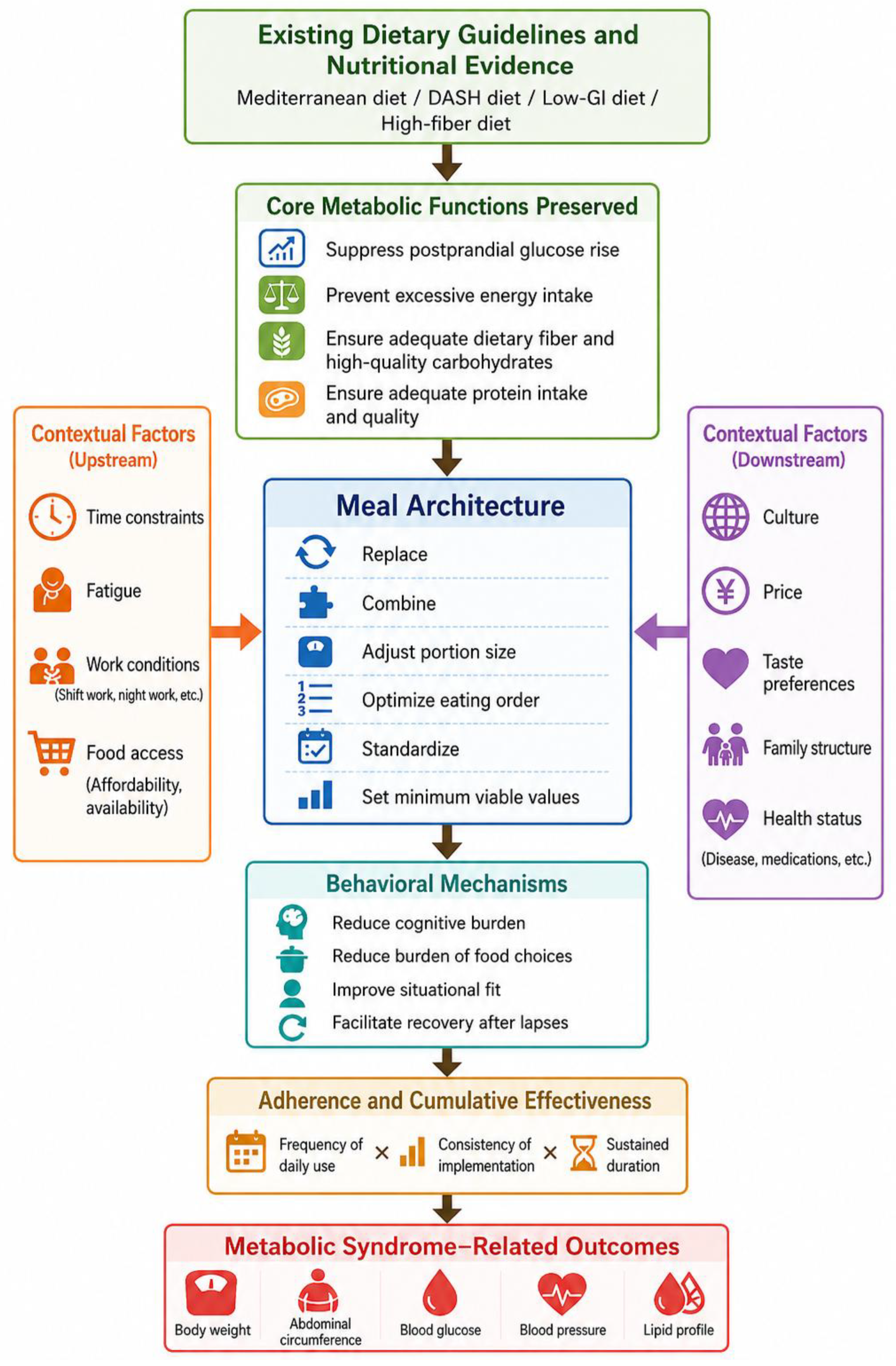
Figure 2.
Transition From Food- and Meal-Centered Guidance to Function-Centered Implementation.


Table 1.
Alignment Between Standard Dietary Guidelines and Meal Architecture.
| Standard dietary recommendation | Principal core metabolic functions preserved | Examples of implementation under time constraints |
|---|---|---|
| Consume vegetables, legumes, seaweed, mushrooms, and related foods | Provision of dietary fiber, reduction in dietary energy density, attenuation of postprandial glycemic excursions, and enhanced satiety | Select one salad, vegetable soup, legume dish, or side dish containing seaweed |
| Choose whole grains and other high-quality carbohydrate sources | Provision of dietary fiber, reduction in postprandial glycemic load, and improvement in carbohydrate quality | Replace part of a refined-grain food with whole-grain bread, oats, mixed grains, or a legume-containing alternative |
| Include appropriate protein sources such as fish, eggs, legumes, dairy products, and lean meat | Maintenance of satiety, lean body mass, and muscle function, and avoidance of carbohydrate-only meals | Combine noodles or bread with eggs, tofu, natto, poultry, fish, or unsweetened yogurt |
| Reduce sugar-sweetened beverages and added sugars | Prevention of unnecessary energy intake and reduction in postprandial glycemic load | Replace soft drinks, sweetened coffee, or sweetened tea with water or unsweetened beverages |
| Manage portion size and total energy intake | Prevention of excessive energy intake and support for body-weight and waist-circumference management | Change a large serving to a regular or small serving and combine it with a low-energy-density side dish |
| Reduce reliance on fried foods, processed meat, and ultra-processed foods | Reduction in energy density, saturated fat, sodium, and excessive intake | Within the same outlet, choose grilled, steamed, or simmered options and avoid meals composed entirely of ultra-processed foods |
| Sustain a balanced dietary pattern | Repeated and cumulative exposure to multiple core metabolic functions | Use a small number of routine meal patterns, rules for addition, substitution, and combination, and the minimum implementation threshold |
Disclaimer/Publisher’s Note: The statements, opinions and data contained in all publications are solely those of the individual author(s) and contributor(s) and not of MDPI and/or the editor(s). MDPI and/or the editor(s) disclaim responsibility for any injury to people or property resulting from any ideas, methods, instructions or products referred to in the content. |
© 2026 by the authors. Licensee MDPI, Basel, Switzerland. This article is an open access article distributed under the terms and conditions of the Creative Commons Attribution (CC BY) license (http://creativecommons.org/licenses/by/4.0/).
Copyright: This open access article is published under a Creative Commons CC BY 4.0 license, which permit the free download, distribution, and reuse, provided that the author and preprint are cited in any reuse.