

Submitted:
01 September 2026
Posted:
02 September 2026
You are already at the latest version
Abstract
Background: Essential tremor (ET) is one of the most common movement disorders and remains a clinical diagnosis. Over the past century, evolving knowledge of tremor phenomenology and disease heterogeneity has led to multiple diagnostic and classification frameworks aimed at improving diagnostic consistency and research comparability. Methods: A narrative review of the literature was conducted using PubMed/Medline, Embase, Scopus, and Google Scholar. Publications addressing the development, validation, modification, and clinical application of ET diagnostic criteria and classification systems were reviewed and synthesized chronologically. Results: The concept of ET evolved from early descriptions of hereditary tremor by Burresi and the classical clinical characterization proposed by Critchley to increasingly standardized diagnostic frameworks. Major milestones included the WHIGET criteria, the 1998 Movement Disorder Society (MDS) Consensus Statement, the 2000 MDS diagnostic criteria, and the 2018 International Parkinson and Movement Disorder Society (IPMDS) classification. These frameworks progressively improved diagnostic standardization while reflecting changes in the understanding of ET. Recognition of substantial clinical heterogeneity, including motor and non-motor manifestations, culminated in the 2018 IPMDS two-axis classification system and the introduction of essential tremor plus (ET-plus). Conclusions: The evolution of ET diagnostic criteria reflects a transition from descriptive clinical observations to structured syndrome-based classification systems. Although the 2018 IPMDS framework currently represents the most comprehensive classification approach, important controversies remain regarding ET heterogeneity, the biological validity of ET-plus, and the absence of objective biomarkers. Future diagnostic frameworks will likely integrate clinical phenotyping with neurophysiological, imaging, genetic, and digital biomarkers to enable more precise disease classification.
Keywords:
essential tremor
; ET-plus
; diagnostic criteria
; tremor classification
; WHIGET
; Movement Disorder Society
; International Parkinson and Movement Disorder Society
; tremor syndromes
; diagnostic evolution
; movement disorders
1. Introduction
Essential tremor (ET) is among the most prevalent movement disorders and has traditionally been defined as a disorder characterized predominantly by bilateral action tremor involving the upper limbs. Although ET is frequently encountered in neurological practice, its diagnosis remains challenging because no definitive biomarker, imaging finding, genetic test, or pathological feature is currently available for routine clinical use. Consequently, diagnosis continues to rely primarily on clinical assessment and the application of standardized diagnostic criteria [1].
The understanding of ET has changed substantially over the last century. Early descriptions by Burresi in 1874 [2] and later by Critchley in 1949 [3] emphasized the hereditary nature of the disorder and its distinction from other tremulous conditions. These foundational observations established the basis for recognizing ET as a distinct clinical entity but did not provide formal diagnostic standards. As epidemiological, genetic, and clinical research expanded during the twentieth century, the absence of uniform diagnostic definitions became increasingly apparent, contributing to considerable variability among prevalence studies and research cohorts.
Efforts to improve diagnostic consistency led to the development of several influential frameworks, including the WHIGET criteria [4], the 1998 MDS Consensus Statement on Tremor [5], and the 2000 MDS diagnostic criteria for ET [6]. These criteria attempted to standardize case ascertainment by defining specific clinical features, exclusion criteria, and diagnostic thresholds, thereby facilitating more reliable comparisons across clinical and research studies.
Despite these advances, increasing recognition of clinical heterogeneity challenged the traditional view of ET as a purely monosymptomatic tremor disorder. Numerous studies documented the presence of additional motor and nonmotor manifestations, including gait impairment, cognitive changes, rest tremor, and subtle dystonic features [7]. These observations raised questions regarding the boundaries of ET and suggested that the disorder might represent a broader clinical spectrum rather than a single homogeneous disease entity.
To address these limitations, the IPMDS published a revised tremor classification in 2018 [8]. This framework introduced a biaxial classification system based on clinical phenomenology (Axis 1) and etiology (Axis 2), redefining ET as an isolated tremor syndrome and introducing the concept of ET-plus for patients with additional neurological signs of uncertain significance. Although this classification has improved the characterization of tremor syndromes, the validity and clinical utility of the ET-plus category remain subjects of considerable debate. Concerns include the subjective interpretation of “soft neurological signs,” substantial interrater variability, and the absence of consistent pathological or genetic differences between ET and ET-plus.
Given these ongoing controversies, understanding the historical development of ET diagnostic criteria is essential for interpreting prior research, evaluating current classification systems, and identifying future directions in ET nosology. Therefore, this review aims to provide a comprehensive overview of the evolution of ET diagnostic frameworks, compare major diagnostic and classification criteria, and discuss the implications of recent developments for clinical practice and future research.
2. Methods
A narrative literature review was conducted to evaluate the historical evolution of diagnostic criteria and classification systems for ET. PubMed/Medline, Embase, Scopus, and Google Scholar were searched from database inception through September 1, 2026. Search terms included combinations of “essential tremor,” “diagnostic criteria,” “classification,” “diagnosis,” “WHIGET,” “Movement Disorder Society,” “MDS,” “IPMDS,” “essential tremor plus,” “ET-plus,” “consensus statement,” and “tremor classification.” No language restrictions were applied. Additional relevant studies were identified through manual review of reference lists from seminal articles and consensus statements. Original studies, reviews, historical reports, consensus documents, and position papers addressing the development, validation, modification, or clinical application of ET diagnostic criteria were considered eligible. Data were extracted regarding publication year, diagnostic framework, core diagnostic requirements, exclusion criteria, major conceptual advances, and reported limitations. The findings were synthesized narratively, with emphasis on the chronological development of ET diagnostic concepts from early clinical descriptions to contemporary syndrome-based classification systems.
3. Results
The literature review identified a progressive evolution in the conceptualization and diagnosis of ET, from early descriptive observations of hereditary tremor in the nineteenth century to contemporary syndrome-based classification systems (Table 1) [2,3,5,6,7,8,9]. Initial reports by Burresi et al. [2] and Critchley et al. [3] established ET as a distinct clinical entity characterized primarily by action tremor and familial aggregation. Subsequent efforts focused on improving diagnostic consistency through the development of structured clinical and research criteria, including the early clinical framework proposed by Findley et al. [9] and the WHIGET criteria [4]. The publication of the MDS Consensus Statement in 1998 [5] represented the first internationally accepted classification of tremor syndromes, followed by the 2000 MDS diagnostic criteria [6], which formalized core, secondary, and exclusion criteria for ET. Growing recognition of phenotypic heterogeneity, including the presence of additional motor and nonmotor features, ultimately led to the 2018 IPMDS Consensus Statement [8], which redefined ET as an isolated tremor syndrome within a biaxial classification system and introduced the concept of ET-plus.
4. Historical Evolution of the ET Concept
4.1. Burresi’s Description of Hereditary Tremor (1874)
The modern history of ET can be traced to the report by Burresi in 1874, who described a patient with hereditary tremor and recognized familial transmission as a defining characteristic of the condition [2]. Although no formal diagnostic criteria were proposed, Burresi’s observations represented one of the first attempts to distinguish hereditary tremor from other movement disorders and laid the foundation for subsequent conceptualization of ET as a unique clinical entity rather than a manifestation of paralysis agitans or generalized neurological disease. The report emphasized the chronic nature of the tremor and its occurrence within affected families, anticipating concepts that would later become central to ET diagnosis, including familial aggregation, long disease duration, and relative absence of other neurological abnormalities.
4.2. Critchley’s Classical Description (1949)
In his landmark 1949 monograph “Observations on essential (heredofamial) tremor”, Critchley provided the first comprehensive clinical synthesis of ET, consolidating more than a century of scattered observations into a coherent nosological framework [3]. Critchley described ET as a predominantly monosymptomatic disorder characterized by action and postural tremor, frequent familial occurrence, variable age at onset, and the absence of major neurological deficits such as rigidity, bradykinesia, ataxia, sensory loss, or pyramidal signs. He documented the broad anatomical distribution of tremor, including involvement of the hands, head, voice, jaw, tongue, and, less commonly, the lower limbs, while also recognizing that tremor severity could fluctuate with emotional stress, fatigue, alcohol consumption, and environmental factors. Importantly, Critchley debated the relationship between ET and PD, noting rare transitional cases while maintaining that ET constituted a distinct clinical disorder. He also highlighted the remarkable genetic component of ET, reporting large multigenerational pedigrees and suggesting predominantly autosomal dominant inheritance. Although still descriptive rather than criteria based, Critchley’s definition remained the dominant clinical paradigm for several decades and strongly influenced all subsequent diagnostic frameworks.
4.3. Early Modern Clinical Concepts (1980s)
During the 1980s, ET evolved from a largely descriptive clinical diagnosis to a more systematically defined disorder as researchers sought greater diagnostic consistency for epidemiological and therapeutic studies. Growing recognition of overlap with Parkinsonian, cerebellar, and psychogenic tremors highlighted the need for reproducible clinical definitions and standardized examination methods. Findley et al. helped establish ET as a distinct clinical entity characterized predominantly by postural and kinetic tremor in the absence of other explanatory neurological disorders [9]. Their work emphasized careful clinical phenotyping, differentiation from PD, and objective assessment of tremor distribution and severity, providing an important bridge between early descriptive accounts and later consensus-based criteria. Nevertheless, substantial heterogeneity persisted among epidemiological studies, with considerable variation in the required tremor phenomenology, anatomical distribution, duration of symptoms, functional impairment, and family history, underscoring the need for more standardized diagnostic frameworks (Table 2) [10,11,12,13,14,15,16,17,18].
5. Development of Formal Diagnostic Criteria
5.1. WHIGET Criteria (1998)
In contrast to earlier descriptive definitions, the WHIGET criteria incorporated standardized clinical examination, quantitative tremor ratings (Table 3) [4], and explicit diagnostic thresholds [4]. Definite ET required moderate postural tremor in at least one arm, significant kinetic tremor during multiple tasks, functional impairment attributable to tremor, and exclusion of alternative causes such as parkinsonism, dystonia, hyperthyroidism, medication-induced tremor, or psychogenic tremor (Figure 1)(Table 4) [4]. The framework also defined probable and possible ET categories according to tremor severity and distribution. Importantly, WHIGET emphasized tremor phenomenology and severity rather than family history, demonstrating that different diagnostic definitions could substantially alter ET prevalence estimates and highlighting the need for standardized criteria in research settings.
5.2. MDS Consensus Criteria (1998)
The 1998 MDS Consensus Statement represented the first internationally accepted clinical classification framework for tremor disorders and established a standardized definition of classical ET (Table 5) [5]. Unlike previous epidemiological definitions, the MDS criteria emphasized ET as a clinical syndrome characterized by visible, persistent, bilateral postural and/or kinetic tremor predominantly affecting the hands and forearms, with or without associated head tremor in the absence of abnormal posturing. The framework explicitly excluded patients with other neurological signs, particularly dystonia, as well as tremor attributable to enhanced physiological tremor, psychogenic tremor, drug exposure, withdrawal states, primary orthostatic tremor, isolated voice tremor, isolated task-specific tremors, isolated tongue or chin tremor, and isolated leg tremor. In addition to defining classical ET, the consensus statement introduced a comprehensive syndromic classification of tremor based on phenomenology and activation conditions, distinguishing rest, postural, kinetic, intention, task-specific, and isometric tremors, and categorizing tremor syndromes such as ET, dystonic tremor, parkinsonian tremor, cerebellar tremor, Holmes tremor, palatal tremor, neuropathic tremor, and psychogenic tremor.
5.3. MDS Diagnostic Criteria for ET (2000)
The 2000 MDS diagnostic criteria represented a refinement of the 1998 consensus framework by introducing a structured approach based on core, secondary, and exclusion criteria for the diagnosis of essential tremor ET (Table 6) [6]. The core criteria required the presence of bilateral action tremor involving the hands and forearms in the absence of resting tremor, with no abnormal neurological findings other than Froment’s sign. Secondary criteria included tremor duration exceeding three years, a positive family history of ET, and improvement with alcohol consumption, which were considered supportive but not mandatory for diagnosis. Exclusion criteria encompassed isolated focal tremors (e.g., isolated voice or head tremor), primary orthostatic tremor, task- or position-specific tremors, psychogenic tremor, and conditions characterized by sudden onset or stepwise progression.
6. Paradigm Shift Toward Syndrome-Based Classification
6.1. Growing Recognition of ET Heterogeneity
As clinical experience with ET expanded, it became increasingly evident that many patients exhibited features extending beyond the classical phenotype of isolated bilateral action tremor. In addition to upper-limb tremor, patients frequently presented with head, voice, jaw, and lower-limb tremor, while a subset developed resting tremor, impaired tandem gait, mild cerebellar signs, and balance disturbances. Furthermore, epidemiological and clinical studies increasingly documented non-motor manifestations, including cognitive impairment, anxiety, depression, and sleep abnormalities, challenging the long-held concept of ET as a purely monosymptomatic movement disorder. Longitudinal observations also revealed substantial variability in age at onset, disease progression, anatomical distribution, familial aggregation, and therapeutic response. Therefore, these findings suggested that ET likely represented a heterogeneous clinical spectrum rather than a single uniform disease entity, prompting renewed interest in defining distinct phenotypic subgroups and refining existing classification systems.
6.2. Why Earlier Criteria Became Insufficient
The WHIGET, MDS 1998, and MDS 2000 frameworks were developed primarily to identify patients with the classical ET phenotype and therefore relied heavily on the presence of isolated action tremor and the absence of additional neurological abnormalities. However, these criteria proved increasingly difficult to apply as growing numbers of patients demonstrated features that occupied a diagnostic “gray zone,” including questionable dystonic posturing, subtle cerebellar signs, impaired tandem gait, mild cognitive deficits, and resting tremor. Such patients often fulfilled ET criteria early in their disease course but no longer met strict definitions as additional manifestations emerged. Moreover, the overlap between ET, dystonic tremor, Parkinsonian tremor, and other tremor syndromes frequently resulted in inconsistent classification across clinicians and studies. The lack of objective biomarkers further compounded these challenges, forcing diagnoses to rely exclusively on clinical phenomenology. Consequently, the existing criteria were increasingly viewed as inadequate for capturing the full clinical spectrum of ET, creating the need for a more flexible, syndrome-based classification system that ultimately culminated in the 2018 IPMDS Consensus Statement.
7. The 2018 IPMDS Consensus Classification
7.1. Development of the IPMDS Framework
By the mid-2010s, substantial advances in the clinical characterization of tremor disorders had exposed important limitations of the 1998 MDS classification. Growing evidence demonstrated that ET frequently coexisted with additional motor and nonmotor manifestations that could not be adequately accommodated within previous diagnostic frameworks. Furthermore, the 1998 classification inconsistently defined tremor syndromes according to clinical phenomenology, presumed anatomical origin, or underlying etiology, creating ambiguity in both clinical practice and research. To address these issues, the IPMDS convened an international task force that performed extensive literature reviews, expert discussions, and consensus development meetings, ultimately producing a revised classification system published in 2018. The primary objective was to establish a more consistent, clinically useful, and etiologically neutral framework that could facilitate deeper phenotyping of tremor syndromes and support future biomarker and genetic research.
7.2. The Two-Axis Classification System
A major innovation of the 2018 IPMDS classification was the introduction of a two-axis system. Axis 1 focuses on clinical features and includes age at onset, family history, temporal evolution, tremor characteristics, body distribution, activation condition, associated neurological or systemic signs, and relevant laboratory findings. Axis 2 focuses on etiology and categorizes tremors as acquired, genetic, idiopathic, or resulting from identifiable neurodegenerative, metabolic, toxic, infectious, or structural causes. This approach acknowledges that a single clinical syndrome may arise from multiple etiologies and that a single etiology may produce different clinical phenotypes. Consequently, tremor syndromes are first classified on clinical grounds before an etiological diagnosis is assigned, thereby separating phenotypic description from pathogenic interpretation.
7.3. Diagnostic Definition of ET
The 2018 consensus redefined ET as an isolated tremor syndrome characterized by bilateral upper-limb action tremor of at least three years’ duration, with or without tremor involving other body regions such as the head, voice, or lower limbs. Crucially, no additional neurological signs may be present, including dystonia, cerebellar ataxia, or parkinsonism. The requirement for a minimum tremor duration of three years was introduced to reduce diagnostic instability and minimize inclusion of patients who might later develop other movement disorders. The revised definition also excluded isolated head tremor, isolated voice tremor, orthostatic tremor with frequencies greater than 12 Hz, task- or position-specific tremors, and tremors characterized by sudden onset or stepwise progression. By emphasizing an isolated tremor phenotype, the IPMDS aimed to improve diagnostic consistency and reduce clinical heterogeneity within the ET category.
7.4. Introduction of ET-Plus
Perhaps the most controversial aspect of the 2018 classification was the introduction of ET-plus (Table 7) [8]. This new category was created for patients who fulfill the diagnostic criteria for ET but also exhibit additional neurological signs of uncertain clinical significance that are insufficient to warrant an alternative diagnosis. Examples include impaired tandem gait, questionable dystonic posturing, mild memory impairment, subtle Parkinsonian features, or resting tremor. The task force emphasized that these findings should not automatically exclude ET but should instead be explicitly recognized because they may contribute to clinical heterogeneity and potentially reflect distinct biological subtypes. ET-plus was therefore conceived as a syndromic descriptor rather than a separate disease entity. However, the construct generated considerable debate because of concerns regarding the subjective interpretation of “soft neurological signs,” limited inter-rater reliability, and the absence of established pathological, genetic, or biomarker differences separating ET from ET-plus. Despite these criticisms, ET-plus remains a central feature of the current IPMDS classification and reflects the growing recognition that ET exists along a broader clinical spectrum than previously appreciated.
8. Controversies and Ongoing Debates
8.1. Is ET a Single Disease or a Family of Disorders?
One of the most enduring controversies in ET research concerns whether ET represents a single disease entity or a heterogeneous family of disorders sharing a common tremor phenotype. Historically, ET was viewed as a monosymptomatic hereditary action tremor, but subsequent studies have demonstrated substantial variability in age at onset, rate of progression, anatomical distribution, non-motor manifestations, pathological findings, and genetic associations. Patients with ET may present with markedly different clinical profiles, ranging from isolated upper-limb action tremor to more complex syndromes involving cognitive impairment, gait dysfunction, head tremor, voice tremor, and resting tremor. Furthermore, genetic studies have failed to identify a single causative mechanism, suggesting that ET may represent a syndrome with multiple underlying etiologies rather than a single nosological entity. This concept was formally acknowledged in the 2018 IPMDS classification, which emphasized syndromic characterization rather than disease-specific diagnosis. The ongoing debate has important implications for biomarker discovery, clinical trial design, and the interpretation of epidemiological studies.
8.2. The Validity of the ET-Plus Construct
The introduction of ET-plus in the 2018 IPMDS Consensus Statement remains one of the most debated developments in the history of ET classification. ET-plus was defined as ET accompanied by neurological signs of uncertain significance, including impaired tandem gait, questionable dystonic posturing, mild cognitive impairment, resting tremor, or other subtle abnormalities that do not justify assignment to another neurological syndrome. Proponents argue that ET-plus acknowledges the clinical heterogeneity observed in daily practice and facilitates more precise phenotyping of patients who do not fit the traditional concept of isolated ET. Critics, however, have questioned whether ET-plus represents a distinct biological entity, noting the absence of consistent pathological, neurophysiological, imaging, or genetic differences separating ET from ET-plus. Additional concerns relate to the subjective interpretation of “soft neurological signs,” which may vary substantially among examiners. Consequently, some investigators consider ET-plus to be a useful descriptive category, whereas others regard it as a temporary label reflecting current uncertainty about the boundaries of ET.
8.3. Inter-Rater Reliability of Current Criteria
Diagnostic agreement among clinicians remains a significant challenge in ET classification. Even before the 2018 revision, studies demonstrated substantial variability among movement-disorder specialists regarding the diagnosis of ET, reflecting differences in interpretation of tremor phenomenology and associated neurological findings. The introduction of ET-plus has potentially increased this diagnostic variability because many of its defining features, such as questionable dystonia, mild gait impairment, or subtle cognitive changes, lack universally accepted operational definitions. As a result, identical patients may be classified as ET, ET-plus, dystonic tremor, or even early Parkinsonian syndromes depending on the examiner and clinical setting. This limitation is particularly important for epidemiological studies, biomarker investigations, and clinical trials, where inconsistent classification may contribute to heterogeneous study populations and conflicting results. The development of objective biomarkers and standardized assessment methods is therefore considered a major priority for future ET research.
8.4. Diagnostic Overlap With Other Tremor Syndromes
Another major challenge is the substantial diagnostic overlap between ET and other tremor syndromes. Differentiation from dystonic tremor is particularly difficult because subtle dystonic posturing may be overlooked or interpreted differently by individual clinicians. Similarly, patients with ET may exhibit resting tremor, while patients with early Parkinson’s disease may initially present with predominant action tremor, blurring traditional diagnostic boundaries. Additional overlap exists with enhanced physiological tremor, primary writing tremor, isolated voice tremor, orthostatic tremor, cerebellar tremor, and functional tremor syndromes. The 2018 IPMDS framework attempted to address these challenges by defining tremor syndromes according to detailed clinical phenomenology and separating clinical classification (Axis 1) from etiology (Axis 2). Nevertheless, the absence of validated disease-specific biomarkers continues to make differential diagnosis dependent largely on expert clinical judgment, particularly in early-stage or atypical cases.
9. Comparative Analysis of ET Diagnostic Frameworks
9.1. Comparison of Diagnostic Components
The diagnostic definition of ET has evolved substantially over time, reflecting changing views regarding disease boundaries, clinical heterogeneity, and the role of associated neurological signs (Table 8) [4,5,6,8]. Early criteria, including the WHIGET framework, emphasized standardized identification of postural and kinetic tremor while excluding alternative neurological disorders. The 1998 MDS Consensus Statement expanded this approach by introducing a syndromic classification system and separating definite, probable, and possible ET phenotypes. The 2000 MDS criteria subsequently adopted a more pragmatic diagnostic structure based on core, secondary, and exclusion criteria. Finally, the 2018 IPMDS classification redefined ET as an isolated tremor syndrome and introduced ET-plus to account for patients with additional neurological signs of uncertain significance. Collectively, these frameworks demonstrate a progressive shift from narrowly defined action tremor syndromes toward a broader recognition of phenotypic diversity within ET.
9.2. Strengths and Weaknesses of Each Framework
Each diagnostic framework addressed specific limitations of preceding criteria but also introduced new challenges (Table 9) [4,5,6,8]. The WHIGET criteria provided one of the first rigorously operationalized definitions of ET and improved consistency in genetic and epidemiological research; however, its complexity limited routine clinical applicability. The 1998 MDS Consensus Statement established a universal tremor terminology and broadened recognition of ET within a syndromic framework, although the distinction between definite, probable, and possible ET categories remained difficult to apply consistently in clinical practice. The 2000 MDS criteria simplified diagnosis through the use of core, secondary, and exclusion criteria, facilitating widespread adoption by clinicians and researchers but continuing to treat ET largely as a homogeneous entity. In contrast, the 2018 IPMDS classification acknowledged the substantial heterogeneity observed in ET populations and introduced ET-plus, thereby improving phenotypic characterization. However, the ET-plus construct remains controversial because the interpretation of soft neurological signs is subjective and because pathological, imaging, and genetic evidence supporting ET-plus as a distinct biological entity remains limited. Consequently, although the 2018 framework currently represents the most comprehensive classification system, significant uncertainty persists regarding the boundaries between ET, ET-plus, dystonic tremor, and Parkinsonian tremor syndromes.
10. Future Directions in ET Diagnosis
10.1. Biomarker Development
A major limitation of all existing ET diagnostic frameworks is their reliance on clinical phenomenology in the absence of validated disease-specific biomarkers. Current diagnostic criteria remain unable to distinguish ET from ET-plus, dystonic tremor, early PD, or other tremor syndromes with sufficient biological precision. Consequently, considerable research efforts are focused on identifying objective biomarkers that could improve diagnostic accuracy and facilitate patient stratification. Candidate biomarkers include electrophysiological measures such as tremor frequency analysis, coherence studies, and central neurogenic oscillation patterns; neuroimaging techniques including diffusion tensor imaging, functional MRI, and dopamine transporter imaging; genetic markers associated with familial ET; and pathological markers related to cerebellar degeneration [19]. In addition, emerging digital biomarkers derived from wearable sensors, accelerometry, smartphone-based monitoring, and computerized handwriting analysis offer promising opportunities for continuous and objective quantification of tremor characteristics [20]. Although none of these approaches currently possess sufficient sensitivity and specificity for routine clinical use, they represent important steps toward biologically informed diagnosis and classification of ET.
10.2. Toward Precision Medicine-Based Classification
The growing recognition of clinical, pathological, and genetic heterogeneity has shifted attention toward precision medicine approaches to ET classification. Rather than treating ET as a single disorder, future frameworks may stratify patients according to underlying biological mechanisms, genetic predisposition, neurophysiological profiles, imaging signatures, and disease trajectories. Such an approach would acknowledge that patients currently classified under the umbrella of ET may represent multiple distinct disease processes sharing a common tremor phenotype. Integration of multimodal biomarkers with detailed clinical phenotyping could enable identification of biologically meaningful subgroups, improve prognostic prediction, and facilitate individualized therapeutic strategies. Furthermore, precision medicine-based classification may enhance clinical trial design by reducing diagnostic heterogeneity and allowing recruitment of more homogeneous patient populations, thereby improving the likelihood of detecting disease-modifying therapeutic effects.
10.3. Potential Revisions of the 2018 IPMDS Criteria
Although the 2018 IPMDS Consensus Statement currently represents the most widely accepted framework for ET classification, several aspects remain controversial and may require future revision. In particular, the ET-plus construct continues to generate debate because of the subjective interpretation of soft neurological signs, uncertain inter-rater reliability, and the lack of definitive pathological or genetic evidence supporting ET-plus as a distinct biological entity. Future revisions may provide more operational definitions of questionable dystonia, impaired tandem gait, cognitive abnormalities, and resting tremor to improve diagnostic consistency. Longitudinal studies may also clarify whether ET-plus represents a separate subtype of ET, a transitional stage in disease progression, or a collection of biologically distinct disorders. In parallel, incorporation of validated biomarkers and digital assessment tools into future diagnostic frameworks may reduce reliance on purely clinical criteria and facilitate a transition from phenomenology-based classification toward biologically grounded disease definitions. As understanding of ET pathophysiology advances, future revisions will likely focus on integrating clinical, genetic, neurophysiological, imaging, and pathological data into a unified classification system.
11. Conclusions
The diagnostic framework for essential tremor has evolved from early descriptive observations of hereditary tremor to increasingly standardized and sophisticated classification systems. WHIGET, the 1998 MDS Consensus Statement, the 2000 MDS diagnostic criteria, and the 2018 IPMDS classification each contributed to improving diagnostic consistency while reflecting contemporary understanding of the disorder. Growing recognition of clinical heterogeneity challenged the traditional view of ET as a purely isolated action tremor syndrome and ultimately led to the introduction of ET-plus and a syndrome-based classification approach. Despite these advances, important challenges remain, particularly regarding the biological validity of ET-plus, diagnostic overlap with other tremor syndromes, and the lack of objective biomarkers. Future diagnostic frameworks will likely integrate clinical phenotyping with neurophysiological, imaging, genetic, and digital biomarkers to enable more precise and biologically informed classification of ET and related tremor disorders.
Author Contributions
Conceptualization, J.P.R. and A.L.F.C.; methodology, J.P.R. and A.L.F.C.; investigation, J.P.R.; literature search, J.P.R.; data curation, J.P.R.; writing—original draft preparation, J.P.R.; writing—review and editing, J.P.R. and A.L.F.C.; visualization, J.P.R.; supervision, A.L.F.C. All authors have read and agreed to the published version of the manuscript.
Funding
This research received no external funding.
Institutional Review Board Statement
Not applicable.
Informed Consent Statement
Not applicable.
Data Availability Statement
The data supporting the findings discussed in this review are available in the cited references. No new datasets were generated or analyzed during the preparation of this manuscript.
Acknowledgments
None.
Conflicts of Interest
The authors declare no conflicts of interest.
Abbreviations
The following abbreviations are used in this manuscript:
| ET | Essential tremor |
| ET-plus | Essential tremor plus |
| IPMDS | International Parkinson and Movement Disorder Society |
| MDS | Movement Disorder Society |
| PD | Parkinson’s disease |
| WHIGET | Washington Heights-Inwood Genetic Study of Essential Tremor |
References
- Wagle Shukla, A. Diagnosis and Treatment of Essential Tremor. Continuum (Minneap Minn) 2022, 28, 1333–1349. [CrossRef]
- Burresi, P. Sopra Un Caso Di Tremore Essenziale. Memore Originali. Conferenza Raccolta Dallo Studente Alfredo Rubini (22 Febbraio 1874, Siena). Lo Sperimentale 1874, 33, 475–481.
- CRITCHLEY, M. Observations on Essential (Heredofamial) Tremor. Brain 1949, 72, 113–139. [CrossRef]
- Louis, E.D.; Ford, B.; Lee, H.; Andrews, H.; Cameron, G. Diagnostic Criteria for Essential Tremor: A Population Perspective. Arch Neurol 1998, 55, 823–828. [CrossRef]
- Deuschl, G.; Bain, P.; Brin, M. Consensus Statement of the Movement Disorder Society on Tremor. Ad Hoc Scientific Committee. Mov Disord 1998, 13 Suppl 3, 2–23. [CrossRef]
- Bain, P.; Brin, M.; Deuschl, G.; Elble, R.; Jankovic, J.; Findley, L.; Koller, W.C.; Pahwa, R. Criteria for the Diagnosis of Essential Tremor. Neurology 2000, 54, S7.
- Louis, E.D. Essential Tremor as a Neuropsychiatric Disorder. J Neurol Sci 2010, 289, 144–148. [CrossRef]
- Bhatia, K.P.; Bain, P.; Bajaj, N.; Elble, R.J.; Hallett, M.; Louis, E.D.; Raethjen, J.; Stamelou, M.; Testa, C.M.; Deuschl, G. Consensus Statement on the Classification of Tremors. from the Task Force on Tremor of the International Parkinson and Movement Disorder Society. Mov Disord 2018, 33, 75–87. [CrossRef]
- Findley, L. Essential Tremor: Introductory Remarks. In Movement Disorders: Tremor; Springer, 1984; pp. 207–209.
- LARSSON, T.; SJOGREN, T. Essential Tremor: A Clinical and Genetic Population Study. Acta Psychiatr Scand Suppl 1960, 36, 1–176.
- Rautakorpi, I.; Takala, J.; Marttila, R.J.; Sievers, K.; Rinne, U.K. Essential Tremor in a Finnish Population. Acta Neurol Scand 1982, 66, 58–67. [CrossRef]
- Rajput, A.H.; Offord, K.P.; Beard, C.M.; Kurland, L.T. Essential Tremor in Rochester, Minnesota: A 45-Year Study. J Neurol Neurosurg Psychiatry 1984, 47, 466–470. [CrossRef]
- Bharucha, N.E.; Bharucha, E.P.; Bharucha, A.E.; Bhise, A.V.; Schoenberg, B.S. Prevalence of Essential Tremor in the Parsi Community of Bombay, India. Arch Neurol 1988, 45, 907–908. [CrossRef]
- Snow, B.; Wiens, M.; Hertzman, C.; Calne, D. A Community Survey of Parkinson’s Disease. CMAJ 1989, 141, 418–422.
- Haerer, A.F.; Anderson, D.W.; Schoenberg, B.S. Prevalence of Essential Tremor. Results from the Copiah County Study. Arch Neurol 1982, 39, 750–751. [CrossRef]
- Salemi, G.; Savettieri, G.; Rocca, W.A.; Meneghini, F.; Saporito, V.; Morgante, L.; Reggio, A.; Grigoletto, F.; Di Perri, R. Prevalence of Essential Tremor: A Door-to-Door Survey in Terrasini, Sicily. Sicilian Neuro-Epidemiologic Study Group. Neurology 1994, 44, 61–64. [CrossRef]
- Moghal, S.; Rajput, A.H.; D’Arcy, C.; Rajput, R. Prevalence of Movement Disorders in Elderly Community Residents. Neuroepidemiology 1994, 13, 175–178. [CrossRef]
- Khatter, A.S.; Kurth, M.C.; Brewer, M.A.; Crinnian, C.T.; Drazkowski, J.F.; Flitman, S.S.; Imke, S.; Spector, S.A.; Wood, K.L.; Lieberman, A.N. Prevalence of Tremor and Parkinson’s Disease. Parkinsonism Relat Disord 1996, 2, 205–208. [CrossRef]
- Angelini, L.; Terranova, R.; Lazzeri, G.; van den Berg, K.R.E.; Dirkx, M.F.; Paparella, G. The Role of Laboratory Investigations in the Classification of Tremors. Neurol Sci 2023, 44, 4183–4192. [CrossRef]
- Ledingham, D.; Macerollo, A.; Pavese, N. Essential Tremor and Digital Biomarkers: A Scoping Review Using the TRACE Framework to Map Readiness for Clinical Trials and Routine Practice. Tremor Other Hyperkinet Mov (N Y) 2026, 16, 39. [CrossRef]
Figure 1.
Simplified diagnostic pathway based on the WHIGET criteria for definite, probable, and possible ET.
Figure 1.
Simplified diagnostic pathway based on the WHIGET criteria for definite, probable, and possible ET.
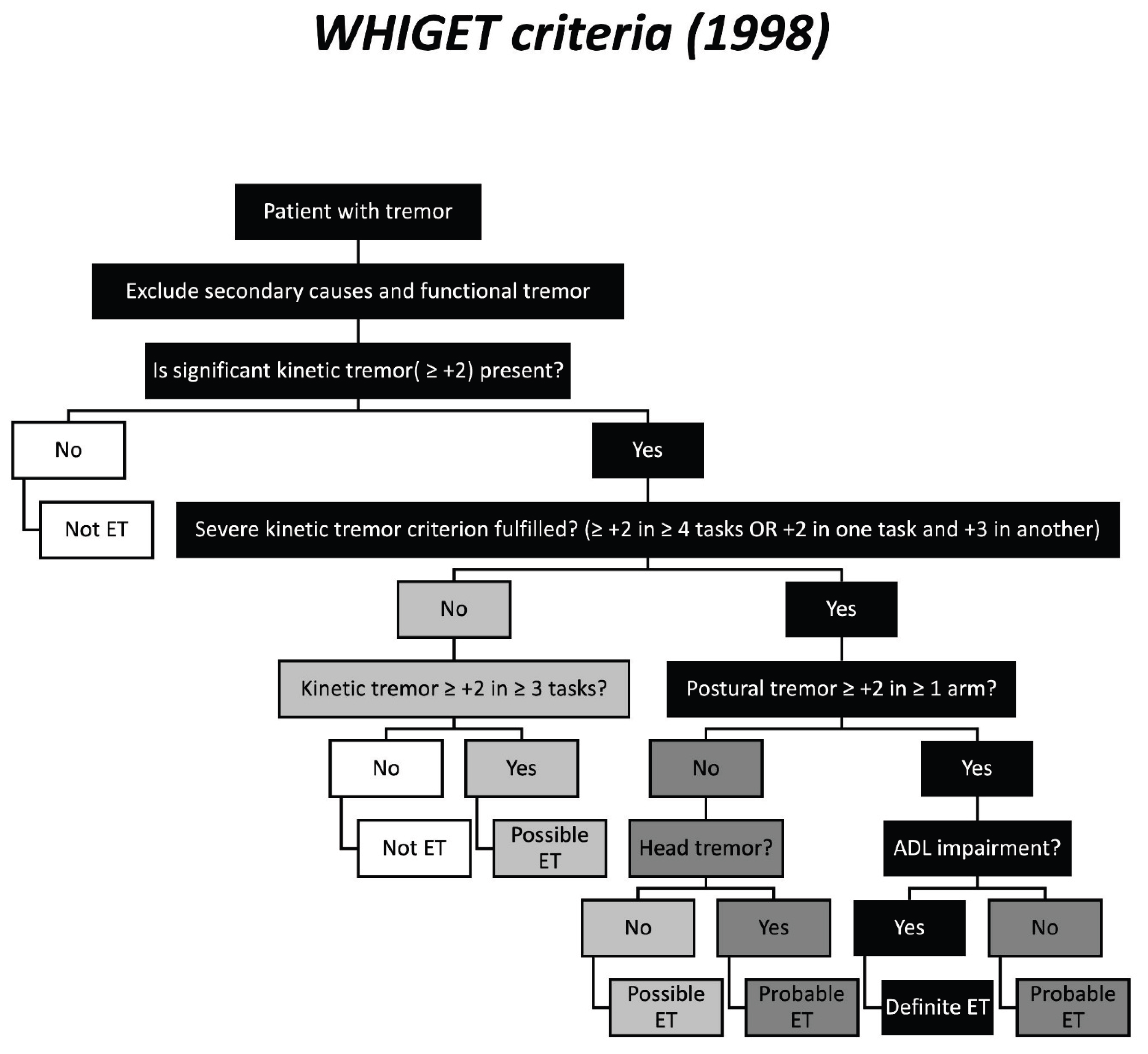

Table 1.
Historical evolution of diagnostic frameworks for ET.
| Year | Criteria name | Other names | Reference |
|---|---|---|---|
| 1874 | Burresi | Hereditary tremor description | Burresi et al., 1874 [2] |
| 1949 | Critchley clinical description | Classical ET description | Critchley et al., 1949 [3] |
| 1984 | Findley clinical criteria | Early clinical ET criteria | Findley et al., 1984 [9] |
| 1998 | WHIGET criteria | Washington Heights-Inwood Genetic Study of ET criteria | Louis et al., 1998 [4] |
| 1998 | MDS Consensus Criteria | Movement Disorder Society Tremor Consensus; Classical ET criteria; TRIG classification | Deuschl et al., 1998 [5] |
| 2000 | MDS Diagnostic Criteria for ET | Bain-Brin-Deuschl criteria | Bain et al., 2000 [6] |
| 2018 | IPMDS Consensus Statement | International Parkinson and Movement Disorder Society Tremor Classification | Bhatia et al., 2018 [8] |
| ET-plus framework | Essential Tremor Plus |
Table 2.
Variability among pre-WHIGET epidemiological diagnostic criteria for ET.
| Reference | Tremor type required | Tremor distribution | Additional requirements | Major limitation |
|---|---|---|---|---|
| Larsson et al., 1960 [10] | Postural and kinetic | Not specified | None specified | Very restrictive tremor definition |
| Rautakorpi et al., 1982 [11] | Postural or action | Head or limbs | None specified | Limited diagnostic specificity |
| Rajput et al., 1984 [12] | Postural and/or action | Not specified | Bilateral tremor required | Distribution poorly defined |
| Bharucha et al., 1988 [13] | Action tremor | Head, limbs, or voice | Tremor of any severity; duration ≥1 year | Mild physiological tremor may be included |
| Snow et al., 1989 [14] | Postural tremor | Not specified | Long-standing tremor | May exclude early ET cases |
| Haerer et al., 1992 [15] | Action tremor | Head or limbs | Functional impairment, duration ≥10 years, or family history | Highly restrictive criteria |
| Salemi et al., 1994 [16] | Action tremor | Head, limbs, or voice | Duration ≥1 year or positive family history | May exclude sporadic ET |
| Moghal et al., 1994 [17] | Postural or kinetic | Head or limbs | Long duration required | Underestimation of mild disease |
| Khatter et al., 1996 [18] | Postural or kinetic | Not specified | None specified | Broad diagnostic definition |
Table 3.
WHIGET tremor rating scale.
| Score | Definition |
|---|---|
| 0 | No visible tremor |
| +1 | Low-amplitude, barely perceptible or intermittent tremor |
| +2 | Moderate-amplitude (1-2 cm), clearly oscillatory tremor |
| +3 | Large-amplitude (>2 cm), severe tremor interfering with task performance |
Table 4.
Diagnostic categories according to the WHIGET criteria.
| Feature | Definite ET | Probable ET | Possible ET |
|---|---|---|---|
| Postural tremor | ≥+2 in at least one arm | Not required if head tremor present | Not required |
| Kinetic tremor | ≥+2 during ≥4 tasks, or ≥+2 during 1 task and ≥+3 during another task | Same kinetic tremor criteria as definite ET | ≥+2 during at least 3 tasks |
| Head tremor | May be present, but insufficient alone for diagnosis | Can satisfy diagnostic criteria | Not part of diagnostic requirement |
| Activities of daily living | Tremor in dominant hand must interfere with ≥1 ADL (eating, drinking, writing, hand use) | Not required | Not required |
| Exclusion of secondary causes | Required | Required | Required |
Table 5.
ET categories in the 1998 MDS Consensus Statement (TRIG classification).
| Category | Clinical phenotype | Duration criterion | Additional neurological signs | Exclusions |
|---|---|---|---|---|
| Definite ET | Bilateral visible, persistent postural tremor with or without kinetic tremor involving the hands and forearms; tremor in other body regions may be present | >5 years | Absent (except tremor and Froment’s sign) | Secondary causes of tremor, psychogenic tremor, recent trauma, sudden onset, stepwise deterioration |
| Probable ET | Similar to definite ET; tremor may be confined to body regions other than the hands, including head tremor | >3 years | Absent | Same as definite ET; additionally excludes primary orthostatic tremor, isolated voice tremor, isolated task-specific tremors, and isolated tongue/chin tremor |
| Possible ET Type I | Meets criteria for definite or probable ET | Variable | Presence of another neurological disorder (e.g., parkinsonism, dystonia, neuropathy, myoclonus) or soft neurological signs of uncertain significance | Same as definite ET |
| Possible ET Type II | Monosymptomatic or isolated tremors of uncertain relationship to ET | Variable | Not required | Includes primary writing tremor, occupational tremor, isolated voice tremor, isolated postural leg tremor, unilateral postural hand tremor, and primary orthostatic tremor |
Table 6.
Comparison of the 1998 MDS Consensus Statement and the 2000 MDS Diagnostic Criteria for ET.
Table 6.
Comparison of the 1998 MDS Consensus Statement and the 2000 MDS Diagnostic Criteria for ET.
| Aspect | MDS Consensus Statement (1998) | MDS Diagnostic Criteria for ET (2000) |
|---|---|---|
| Primary goal | Tremor classification | ET diagnosis |
| Scope | All tremor syndromes | ET only |
| Main contribution | Introduced a syndromic framework for tremor (ET, dystonic tremor, parkinsonian tremor, cerebellar tremor, Holmes tremor, psychogenic tremor, etc.) | Established practical diagnostic criteria using core, secondary, and exclusion criteria |
| ET categories | Definite ET, Probable ET, Possible ET Type I, Possible ET Type II | Single ET diagnosis supported by core, secondary, and exclusion criteria |
| Core diagnostic emphasis | Clinical phenotype and syndromic classification | Bilateral action tremor of the hands/forearms and absence of other neurological signs |
| Duration requirement | Definite ET: >5 years; Probable ET: >3 years | Duration >3 years considered a supportive (secondary) criterion |
| Family history | Used mainly for classification; not required | Supportive (secondary) criterion |
| Alcohol responsiveness | Not included in the diagnostic definition | Supportive (secondary) criterion |
| Exclusion framework | Extensive exclusion of alternative tremor syndromes | Formal exclusion criteria integrated into the diagnostic framework |
Table 7.
Diagnostic criteria for ET and ET-plus according to the 2018 IPMDS Consensus Statement.
| Feature | ET | ET-plus |
|---|---|---|
| Core definition | Isolated tremor syndrome | ET phenotype with additional neurological signs of uncertain significance |
| Upper-limb tremor | Bilateral upper-limb action tremor required | Bilateral upper-limb action tremor required |
| Duration | At least 3 years | At least 3 years |
| Tremor in other body regions | May involve head, voice, or lower limbs | May involve head, voice, or lower limbs |
| Additional neurological signs | Absent | Present, but insufficient for another neurological diagnosis |
| Examples of additional signs | None | Impaired tandem gait, questionable dystonic posturing, mild cognitive impairment, subtle parkinsonian features, rest tremor, or other soft neurological signs |
| Dystonia, ataxia, or parkinsonism | Excluded | Definite dystonia, ataxia, or parkinsonism remain exclusionary diagnoses |
| Clinical category | Isolated tremor syndrome | Combined tremor syndrome with soft neurological signs |
Table 8.
Comparison of major diagnostic frameworks for ET.
| Component | WHIGET (1998) | MDS Consensus (1998) | MDS Diagnostic Criteria (2000) | IPMDS Consensus (2018) |
|---|---|---|---|---|
| Primary purpose | Research diagnosis | Tremor classification | Clinical diagnosis | Syndrome-based classification |
| Tremor type | Postural and kinetic tremor emphasized | Postural or kinetic tremor | Bilateral action tremor | Bilateral upper-limb action tremor |
| Tremor severity threshold | Explicit (+1 to +3 scale) | Not specified | Not specified | Not specified |
| Disease duration | Not required | >5 years (definite), >3 years (probable) | >3 years (secondary criterion) | ≥3 years (mandatory criterion) |
| Family history | Not required | Not required | Secondary criterion | Not included |
| Alcohol responsiveness | Not included | Not included | Secondary criterion | Not included |
| Additional neurological signs | Excluded | Generally excluded | Excluded | ET: excluded; ET-plus: permitted if of uncertain significance |
| Head tremor | Permitted | Permitted | Permitted | Permitted in ET syndrome |
| ET subcategories | Definite, Probable, Possible | Definite, Probable, Possible I/II | Single diagnostic framework | ET and ET-plus |
| Conceptual model | Research-focused | Syndromic classification | Diagnostic criteria | Axis 1 (syndrome) + Axis 2 (etiology) |
Table 9.
Strengths and limitations of major ET diagnostic frameworks.
| Framework | Major strengths | Major limitations |
|---|---|---|
| WHIGET (1998) | Standardized examination; explicit tremor severity thresholds; excellent research utility | Complex; limited practicality for routine clinical diagnosis |
| MDS Consensus (1998) | Universal tremor terminology; comprehensive syndromic classification | Difficult application of definite/probable/possible categories; limited diagnostic specificity |
| MDS Diagnostic Criteria (2000) | Simple and clinically practical; widely adopted in research and practice | Continued assumption of ET as a relatively homogeneous disorder |
| IPMDS Consensus (2018) | Recognizes clinical heterogeneity; introduces Axis 1/Axis 2 approach; incorporates ET-plus | Subjective interpretation of soft signs; limited biological validation of ET-plus; ongoing inter-rater variability |
Disclaimer/Publisher’s Note: The statements, opinions and data contained in all publications are solely those of the individual author(s) and contributor(s) and not of MDPI and/or the editor(s). MDPI and/or the editor(s) disclaim responsibility for any injury to people or property resulting from any ideas, methods, instructions or products referred to in the content. |
© 2026 by the authors. Licensee MDPI, Basel, Switzerland. This article is an open access article distributed under the terms and conditions of the Creative Commons Attribution (CC BY) license.
Copyright: This open access article is published under a Creative Commons CC BY 4.0 license, which permit the free download, distribution, and reuse, provided that the author and preprint are cited in any reuse.