

Submitted:
01 September 2026
Posted:
02 September 2026
You are already at the latest version
Abstract
Synthetic data are increasing their popularity in different disciplines. Indeed, in addition to their affordability, synthetic data may play an effective protective role to address privacy issues, which are extremely critical in certain application domains such as healthcare, as well as they represent a relatively simple solution to overcome access restrictions. However, despite synthetic data are not a novelty and their potentialities in the different domains have been largely discussed, their operationalization and utility are still object of research. More recently, the unprecedented AI capabilities have naturally enabled and quickly consolidated a feedback loop, where synthetic data is, at the same time, a valuable resource to further develop and refine technology, as well as an added, often critical, value within the different application domains. By combining hybrid retrieval and analysis techniques, 250+ relevant papers have been selected, classified and analyzed. In a context of discussion about legal, ethical and political implications amid opportunities and challenges, the review has clearly pointed out a need for a more consolidated engineering approach to synthetic data as a response to the intrinsic complexity of applications in the current technological climate.
Keywords:
synthetic data
; machine learning
; LLMs
; data engineering
; requirement modeling
; data governance
1. Introduction
In a context of increasing digitalisation and of a consequent data proliferation, synthetic data [1] is increasing in popularity in different disciplines and applications. This is only an apparent contradiction, which actually reflects established technological trends relying on huge amounts of data. Indeed, synthetic data are often adopted for different reasons.
Primarily, synthetic data may play an effective protective role [2] in presence of privacy issues as a response to actual societal needs. For instance, re-identification of data is not that uncommon, as in a recent case in South Korea [3]. Some disclosure strategies are based on multiple synthetic datasets [4]. In addition, synthetic data are extensively adopted in presence of restrictions to access real data, to deal with a lack of specific data (e.g. simulation of rare events), as well as to establish data augmentation and hybrid solutions [5].
Multiple synthetic data generators have been developed in the past two decades, aiming at the translation and operationalization of the "look like real" concept [6]. In the last years, the different techniques have often been object of study and comparative analysis (e.g. [7,8]). Such consolidated methods are still evolving to scale [9] and, more recently, have been further enhanced by LLMs [10] and GenAI [11].
Despite their relative popularity and largely discussed potentiality, the utility of synthetic data is still a subject of research. The inherent complexity of requirements needs to be approached at different levels, including general and specific utility [12].
This work explicitly addresses an application perspective of synthetic data by providing an inductive overview of the state of the art from the different application domains. Indeed, by selecting recent research papers with an application focus, this review provides a specific view, which is complementary, rather than overlapping, to the more consolidated analysis of techniques/methods to produce syntetic data. While holistically addressing issues and solutions in a cross-domain context, the fine grained analysis within the specific application domains contributes to consider specific characteristics and peculiarities in context.
- Structure of the paper
The paper is structured in a relatively traditional way, with methodological aspects preliminarily discussed (Section 2), followed by the core part of the paper. The latter is composed of 3 different sections, dealing respectively with a holistic analysis (Section 3), an AI-driven topic modeling (Section 4), and a discussion part (Section 5), including implications at different levels, research gaps and current limitations. Finally, the selected papers arranged by category are reported in the appendix.
2. Methodology and Approach
Synthetic data and their application have been object of significant research in the last few years. However, a fine-grained cross-domain identification of the different contributions may be challenging, given the variety of situations, domain peculiarities and the fragmented nature of pertinent literature.
In order to maximize the value of this review, we have adopted hybrid methods for the retrieval/selection as well as for the analysis. Details are addressed in the following subsections.
2.1. Paper Selection
The extent and intent of this research have suggested the combination of a systematic approach adopting a more traditional keyword-based search with snowballing from retrieved papers (Figure 1).
In such a context, selection criteria are a determinant for a proper and effective operationalization of the aimed application perspective.
- Retrieval process
The retrieval process is structured in three sequential phases (Figure 1). The main process assumes a keyword-based basic search, where a given keyword . The latter set is understood as a very generic collection of terms that aims at (i) retrieving a first corpus of relevant papers in scope, and (ii) identifying the main application domains and their specific keywords. Our heuristic experimentation has proven an approach based on a very reduced set of root keywords () to be more effective than extended ones (e.g. including keywords like "application").
The second phase aims at a consolidation in the different domains by performing an additional search, where keywords include domain specific generic terminology. More formally, a domain j is approached by querying on heterogeneous keywords, including also domain-specific terms as in eq. 1, while domain keywords are reported in Table 1.
As mentioned previously and represented in Figure 1, a last consolidation step is a snowball search, which relies on the following citation trails.
- Selection Criteria
A second methodological pillar for effectively identifying a body of knowledge is the definition of selection criteria which consistently apply throughout the process (Figure 1).
In this specific case, selection criteria are crucial in constructing an application perspective for the target review. A retrieved paper is finally selected if it falls at least into one of the following categories:
- Discussion or review of specific applications of synthetic data.
- Synthetic data (including also hybrid) solution for a specific domain or application.
- Description of a development or of an empirical work in the context of a specified application domain.
- Any other application-related contribution, for instance papers discussing issues, challenges or potentialities related to the application of synthetic data.
The mentioned criteria clearly exclude generic contributions on synthetic data not explicitly related to applications as they do not contribute to an application-driven analysis, which is the main object of this paper.
2.2. Analysis Framework
Also the conducted analysis relies on a hybrid approach, which integrates a human-performed critical analysis with an AI-driven thematic structure. While intrinsically independent in concept, the two methods naturally converge to provide a consolidated synthesis from a significant and heterogeneous corpus of papers.
- Classification and Characterization
The primary analysis dimension considered in this work is the application domain. An overview of the conducted analysis is proposed in Section 3.
Seven main domains have been identified as a result of an iterative human-performed analysis of the retrieved papers: (i) Sciences, (ii) Healthcare (including also Health Economics), (iii) Economics, (iv) Engineering and Architecture, (v) Energy, (vi) Cybersecurity, and (vii) Technology (Computer Vision/Machine Learning/AI). In the way it is defined, the latter category is probably not a formal application domain. However, it reflects the contribution of synthetic data to the development of the technology itself, as well as it contributes to better understand relevant trends in computation, where a significant portion of research is conducted in a relatively generic context with potential applications in multiple domains.
Regardless of the associated domain, for each selected paper a type and a number of characterizing keywords are specified. The paper type is defined according to a simplified binary classification, where conceptual papers focus on review or discussion, while application papers present a specific solution or more empirical works beyond conceptualization. A very limited set of keywords (between 1 and 3) pretend to semantically characterize a given paper in a generic, yet specific, way. In order to prioritize conciseness and effective conceptualization, such labeling is human performed.
- AI-driven Topic Modeling
Topic modeling is a popular and sophisticated unsupervised machine learning technique that enables efficient exploration of unstructured data, contextual trend discovery and thematic structure modeling.
This study adopted BERTopic [13], with the title and abstract of the selected articles as input. The results are presented and discussed in Section 4. Although topic modeling is rapidly emerging as a primary analysis technique given its proven ability to provide insight, in this specific context its role is mainly integrative to further consolidate the analysis and mitigate bias towards a more exhaustive and consistent overview of the existing body of knowledge.
3. Application of Synthetic Data
Overall, 255 papers have been included in this review. In addition to the expected focus on the development of the technology itself ( of the selected articles), healthcare is the most represented domain (), followed by three emerging domains (Engineering, Economics and Energy), which contributes around 11-12% each; finally, applications in sciences is the topic of about the 9% of the considered papers, while the remaining part () is related to cybersecurity (clearly emergent domain).
A very first analysis can be deducted from a simple longitudinal analysis of such a distribution (Figure 2a). With some approximation, very recent contributions (2024-2026) leverage on the huge (and still partially unexplored) capability of LLMs, while a previous time segment (2021-2023) seems more related to the last generation of Machine Learning techniques; older contributions, ideally published before 2020, reflect a more traditional approach to synthetic data with a significant component in the broad context of Computer Vision or of consolidated applications, primarily in Healthcare and Sciences.
Such a simple overview clearly demonstrates a strong and increasing interest in synthetic data across all domains, mostly powered by the continuously growing AI capabilities. The relationship between synthetic data and AI should be considered according to a double perspective. Indeed, on one side, synthetic data are actively and consistently contributing to model training and, therefore, to the development and consolidation of AI technology; at the same time, AI technology is providing enhanced and unprecedented capabilities for synthetic data generation, enabling de facto new opportunities through a novel generation of techniques.
Last but not least, always as a response to recent technological advances in AI, an effective application of synthetic data is rising also in domains where the application of synthetic data was definitely less usual, such as economics, engineering and energy.
Looking at the type of the selected papers (Figure 2b), healthcare, a domain with a well-known historical interest in synthetic data, presents a fundamental balance between conceptual and empirical/methodological works. With a minor incidence, conceptual works characterize also economics, cybersecurity and sciences (38%, 31% and 23% of the papers respectively), while they are less popular in the other domains (in a range 6-11%).
3.1. Science
Because of the very broad scope of this category, which can potentially include all fields of science in their diversity, we have not aimed at exhaustiveness or fine-grained classification but, rather, at the identification of main trends and their recent evolution. The list of selected papers is reported in Table A1.
A simplified interpretation of the conducted analysis has identified a predominant corpus of papers directly related to Social Sciences, as well as evidence of application in other field of science.
-
Social Sciences and Humanities. On one hand, this review confirms the historical interest of social sciences in synthetic data, especially looking at human behavior and related fields. That is mostly due to privacy concerns, which naturally establish critical trade-offs and a consequent scarcity of data. Such an interest is further highlighted by more recent contributions in the field (e.g. [14,15]), which leverage on LLMs and enhanced semantic capabilities.Another clear pattern in the specific field of Social Sciences points out a broader use of synthetic data, above all in the broad context of politics (e.g. [16,17,18,19]) and urban data (e.g. [20]). Once again, LLMs is enabling unprecedented capabilities and opportunities in a privacy sensitive space.
-
Other fields of Science. Looking more holistically at the use of synthetic data in Sciences, the mainstream perception points out an increasing general interest amid opportunities and challenges [21].There is currently evidence of application in multiple fields beyond the social sciences, for instance in physics [22], chemistry [23,24], and astronomy [25]. Additionally, a significant amount of work in terms of mathematics/statistics is directly related to data science and its applications, mostly AI technology. The latter is partially reported in Table A7 as part of applications in technology development.
3.2. Healthcare
Healthcare is an intrinsically privacy-sensitive domain, characterized by a huge demand for data in contrast to accessibility constraints. In principle, healthcare presents an inherent complexity, with a core in medical aspects, health data and domain specific technology, in addition to the intersections with other dimensions, including social aspects and health economics. According to a previous analysis (Figure 2a), in general terms the domain can be considered somehow mature from a perspective of synthetic data adoption [26,27], with a further huge potential, mainly generated by recent advances in AI technology [18,28,29,30,31].
From a conceptual perspective, as probably expected, the review has confirmed a strong focus on privacy matters [32,33], legal/ethical implications [34], evaluation/validation [35,36,37,38], and governance [39].
The papers in the domain included in this review are reported in Table A2. From a strictly application-focused perspective, they may be classified as follows:
- Health Data. It includes clinical data [35,38], Health Record [40,41,42], data for education and training [43], behavioral data [18], profiling [34], as well as more specific aspects, including data sharing [44], metadata [45], bias [46], fairness [47], utility [48], access and augmentation [49], and Open Data [50].
- Medicine. Applications directly or indirectly related to medicine [51] are the most significant in quantitative terms. They range in a broad spectrum, including, among others, applications in Machine Learning [52] and Advanced Analytics [53], pharmaceutics [48], cancer research and clinical trials [54], drug development [55], sport medicine [56], hematology [57], early diagnosis and classification [58,59], and epidemiology [60].
- Specialized technology. Technology plays a primary role in modern healthcare. Such a relevance is reflected also in the adoption of synthetic data, for instance in the broad context of health informatics [67] and software [68], as well as in technology for medical imaging [59,63,69,70,71]. Synthetic data is also seen as an enabler for Machine Learning applications in medicine [72].
3.3. Economics and Business
The contributions related to the broad fields of economics are reported in Table A3. In quantitative terms, the review shows a significant amount of very recent work (Figure 2a) to confirm the rising interest for synthetic data in the domain. More qualitatively, it is possible to distinguish few main patterns with a certain degree of overlapping as follows:
- Financial Data. A consistent, yet diverse, corpus of works refers directly to financial data in a privacy-sensitive context. Concrete applications in addition to the previously mentioned are related to different aspects, including fraud [83,84,85,86], financial models (e.g. sequential [87] and decentralized [88]), Federated Learning [89], Governance [39], Risk Modeling [90], Predictive Models [91], Banking [92], and Trading [93,94].
3.4. Engineering and Architecture
Synthetic data are also emerging in the broad field of engineering (Table A4). Our analysis has pointed out the following main trends/patterns:
3.5. Energy
Contributions related to energy systems are reported in Table A5 and evidently show an emerging interest in synthetic data. The retrieval process, which assumes just very generic keywords as an input, has allowed a domain breakdown as follows:
- Green Technology. As probably expected, sustainability and green energy are extremely relevant, if not central, when dealing with energy systems. Such a research popularity is proportionally reflected also in the application of synthetic data, for instance in the field of wind [140,143,144,145,146,147] and photovoltaic [148,149,150,151] power.
3.6. Cybersecurity
While quantitatively still less relevant than other domains (Fig 2a), the application in cybersecurity has tangibly gained relevance in the last few years (Table A6). That is probably an indirect consequence of the strong and complex relationship between cybersecurity and AI.
Our analysis points out a diversified application, from big contexts (such as Smart City [155], Social Networks [156], IoT [157] and VANET [157]) to more specific aspects (for instance human factors [158]), along a number of more generalized contributions (e.g. Open Data [159] and Simulation [160]). Current research suggests future increasing trends in the field.
3.7. Technology: Computer Vision, Machine Learning and AI
Technology development became extremely data-voracious, in terms of both scale and complexity. Synthetic data has gained relevance in the field consequently. In general terms, the related work, reported in Table A7, can be summarized as follows:
- Conceptual & Methodological Foundations. A minor, yet significant, number of works provides a conceptual ground, in terms of systematic reviews/surveys, theoretical guidelines and discussion papers. More concretely, there are several papers providing a relatively generic value in the field, such as a broad survey on challenges and ethics [161], a data augmentation taxonomy [162], as well as more specific contributions (e.g. process modeling for industrial vision [163], deep learning fundamentals [164,165], and feature selection methodologies [166]).
-
Machine Learning & LLMs. Research on synthetic data has evolved from early applications in specific tasks to a more comprehensive technological approach to address the gap between reality and synthesis [167,168]. Overall, such a trend resulted in more sophisticated solutions aimed, among others, at eliminating dataset bias [169], improving model fairness [170], and defining more dynamic learning pipelines [171,172].The impact of synthetic data is tangible in the evolution of Deep Learning systems [162,164,165] and, similarly, in LLMs [173,174,175]. Key sub-topics include mathematical and long-context reasoning [176,177,178,179,180,181], specialized fine-tuning [182], instruction tuning [183,184], information retrieval [185], low-resource translation [186], and reducing model sycophancy [187].
-
Computer Vision. Synthetic data have been and are extensively used in the different applications within the widely diverse Computer Vision domain [188].A primary application area leverages synthetic imagery to overcome the scarcity gap, as well as to extend or enrich existing datasets. Research in this category spans general object detection [189,190], indoor scene[191], 3D workflow integration [172], semantic segmentation [192,193,194,195], as well as scene text recognition [191,196,197].
4. AI-Driven Topic Modeling
By processing with BERTopic the titles and abstracts of the selected papers (Table A1, Table A2, Table A3, Table A4, Table A5, Table A6 and Table A7), 8 main different topics have been identified (Figure 3).
The composition in terms of tokens (Figure 3) allows a clear characterization of the topics, which is clearly consistent with the human analysis previously proposed. Topic 0 can be clearly associated with applications in the health domain and its critical privacy requirements. Also Topic 2, Topic 3 and Topic 5 present similar generic patterns, with a focus on finance, energy and cybersecurity respectively. All mentioned topics reflect broad application fields, matching some of the application domains identified by human analysis.
The remaining topics presents a more narrowed focus. Topic 4 and Topic 6 are semantically correlated, by proposing a common technology-oriented character (mainly machine learning for the first topic and LLMs for the second one). Topic 1 and Topic 7 are in a strict symbiosis, as the former results from applications involving images, while the latter seems to be even more specific with a focus on face recognition.
From a strictly quantitative perspective, the identified topics may be arranged as a function of the size of the corresponding clusters (Figure 4a). According to such a metric (Figure 4b), Healthcare is the most relevant topic, followed image-related applications and finance.
The similarity matrix (Figure 5) highlights a conceptual similarity between healthcare (Topic 0) and finance (Topic 2), which share privacy concerns as per previous token analysis (Figure 4), and between applications involving images (Topic 1) and faces (Topic 7), reflecting a hierarchical relationship from generic to specific .
5. Discussion
The application of synthetic data is still object of discussion across the different domains, as a significant corpus of papers with a conceptual/critical focus confirm. This section aims at concisely addressing three main discussion points, including (i) implications at different levels (e.g. legal, ethical and political), (ii) key research gaps, and (iii) limitations of this research.
5.1. Legal, Ethical and Political implications amid Opportunities and Challenges
Unprecedented opportunities (and expectations) fostered by constantly increasing technical capabilities are clearly recognized, in general terms as well as in more specific contexts across the different application domains. Such opportunities are often, if not always, organically discussed looking at related challenges and rising trade-offs.
The affordability is clearly acknowledged in most analyses. However, it is not often considered a determinant for the adoption of synthetic data, which seems primarily aimed at overcoming the typical limitations and concerns associated with potentially sensitive data, and, secondarily, at bridging availability gaps.
Recent contributions (e.g. [206,207,208], among others) have explicitly focused on legal, ethical and political implications, as well as on key concepts in the field (e.g. Fairness [209]). Such a conceptual body has intrinsically enabled a more abstracted level of analysis and set the basis for a more holistic perspective. Resulting principled frameworks and guidelines are considered to have tangible practical implications and to be critical for operationalization.
5.2. Research Gaps: A Call for Synthetic Data Engineering
In holistic terms, the most significant limitations emerged from our analysis is a fundamental lack of an engineering approach to synthetic data beyond "guidelines" (e.g. [210]) and extensive considerations on the relevance of evaluation/validation (e.g. [211]).
A more fine-grained analysis has led to the identification of the interrelated gaps reported in Table 2.
5.3. Current Limitations
The review addresses a broad topic in constant and dynamic evolution as a response to actual needs and technological evolution in the different domains. Such a process is fundamentally led by advances in data science and its applications.
Despite the structured paper retrieval process, the proposed data-driven analysis intrinsically presents some limitations, specifically in terms of exhaustiveness, as the actual application of synthetic data is extremely ramified. Overall, we believe that our approach is effective enough to synthesize the current state of the art and body of knowledge, with a focus on recent technology-driven evolving trends.
The classification schema has been dynamically developed as part of the retrieval process. This pragmatic approach resulted to be very effective in fact, but questionable from a formal perspective. As a possible alternative, an input taxonomy could have facilitated the identification of some peculiar applications. However, by constraining the search strategy,it would have probably also limited the capability to effectively capture the actual trends in the current technological climate. Additionally, a formal taxonomy would have not properly addressed domain overlapping, as well as inter and cross-domain contributions.
The most significant simplification is probably related to the characterization of the selected papers. It relies on a binary approach for the type (conceptual/application) and on a limited number of generic and abstracted keywords. This simplified approach is critical to foster a focused analysis beyond quantitative considerations. However, it inevitably limits the capability to establish fine-grained analysis. In the specific broad context of this work, we believe that the former factor is a determinant to enable an effective re-elaboration and analysis of the content in the literature, while the latter is not a determinant for the quality of the analysis.
Finally, topic modeling has been performed on the title and abstract only. Although this approach does not fully exploit the scalability of AI-powered analysis of large documents, it provides a focused consolidation step to sustain a semi-qualitative analysis in a broad and diverse context across multiple disciplines.
6. Conclusions and Future Work
The application of synthetic data has been recently reviewed in a few specific domains, or it has been indirectly discussed in a more fragmented way. The unprecedented AI capabilities have naturally enabled and quickly consolidated a feedback loop, where synthetic data is, at the same time, a valuable resource to further develop and refine technology, as well as an added, often critical, value within the different application domains.
Addressing such a broad topic required hybrid methods and abstractions. Decisions have been transparently reported in the paper, and results considered in the context of potential limitations.
In this evolving context, this review provides a unified view, where opportunities, trends and current challenges are considered organically. In quantitative terms, the application of synthetic data is definitely in an ascending phase, in domains where the adoption is somehow considered to be usual, as well as in domains where their use was not very common. Depending on the context, there is still some gap between expectations and actual benefits, and, in some cases, largely unexplored opportunities. The analysis has facilitated the identification of research gaps along multiple dimensions, which, overall, seems converging towards a need for a more consistent engineering approach to synthetic data.
Future work might adopt ontology-driven classification with enhanced analysis support [212], and might be aimed at tracking the evolution of the application scenario, including also the establishment of regulatory frameworks and synthetic data engineering.
Author Contributions
Conceptualization, S.F.P.; methodology, S.F.P.; formal analysis, S.F.P; investigation, S.F.P.; data curation, S.L.; writing—original draft preparation, S.F.P.; writing—review and editing, S.F.P.; visualization, S.F.P. and S.L..; supervision, S.F.P.; All authors have read and agreed to the published version of the manuscript.
Funding
This research received no external funding.
Data Availability Statement
The selected papers are reported in the appendix.
Conflicts of Interest
The authors declare no conflicts of interest.
Appendix A. Selected Papers by Category

Table A1.
Contributions in Sciences and related characterization.
| Ref. | Title | Type | Keyword(s) | Year |
|---|---|---|---|---|
| [22] | Development of radiation-tolerant beam imaging via multimode fiber and synthetic data-driven machine learning | Application | Physics, Machine Learning | 2026 |
| [18] | Synthetic Data Generation Using Llms For Hate Speech Detection In Political Posts | Application | Politics, LLMs, Natural Language Processing | 2026 |
| [20] | Synthetic geospatial data and fake geography: A case study on the implications of AI-derived data in a data-intensive society | Application | Geo-spatial data, Real vs Synthetic, Urban Data | 2025 |
| [213] | Thermal-property profiles from well-logs in sedimentary rocks: a novel machine-learning-based prediction tool trained on physically modelled synthetic data | Application | Machine Learning, Science | 2025 |
| [21] | GenAI synthetic data create ethical challenges for scientists. Here’s how to address them | Conceptual | LLMs, Ethical implications, Opportunities and Challenges | 2025 |
| [14] | Synthetic data in human analysis: A survey | Conceptual | Human Behavior | 2024 |
| [214] | Toward a political economy of synthetic data: A data-intensive capitalism that is not a surveillance capitalism? | Conceptual | Ethic-political implications, Privacy | 2024 |
| [17] | Sqbc: Active learning using llm-generated synthetic data for stance detection in online political discussions | Application | Politics, LLMs, Natural Language Processing | 2024 |
| [16] | The power of llm-generated synthetic data for stance detection in online political discussions | Application | Politics, LLMs, Natural Language Processing | 2024 |
| [15] | Exploring the impact of synthetic data on human activity recognition tasks | Application | Human Behavior, Machine Learning | 2023 |
| [19] | Synthetic data and public policy: Supporting real-world policymakers with algorithmically generated data | Conceptual | Public Policy | 2023 |
| [215] | MT-EmotiEffNet for multi-task human affective behavior analysis and learning from synthetic data | Application | Human Behavior, Machine Learning | 2022 |
| [23] | Machine learning with enormous “synthetic” data sets: predicting glass transition temperature of polyimides using graph convolutional neural networks | Application | Chemistry, Machine Learning, Large Dataset | 2022 |
| [216] | Abaw: learning from synthetic data and multi-task learning challenges | Application | Human Behavior, Machine Learning | 2022 |
| [217] | Introducing synthetic pseudo panels: application to transport behaviour dynamics | Application | Human Behavior, Machine Learning | 2021 |
| [218] | Prediction of human behavior with synthetic data | Application | Human Behavior, Simulation | 2021 |
| [25] | SYMBA: An end-to-end VLBI synthetic data generation pipeline-Simulating Event Horizon Telescope observations of M 87 | Application | Astronomy, Simulation | 2020 |
| [219] | Learning how to analyse crowd behaviour using synthetic data | Application | Human Behavior, Simulation | 2019 |
| [220] | Architectural challenges on the analysis of human behaviour in synthetic environments | Conceptual | Human Behavior, Virtual Reality | 2018 |
| [221] | Learning decision trees from synthetic data models for human security behaviour | Application | Human Behavior, Machine Learning | 2017 |
| [24] | Use of synthetic data to evaluate positive matrix factorization as a source apportionment tool for PM2. 5 exposure data | Application | Chemistry | 2006 |
| [222] | Defining locality boundaries with synthetic data | Application | Community Definition, Locality Boundaries | 2000 |
Table A2.
Contributions in Healthcare and related characterization.
| Ref. | Title | Type | Keyword(s) | Year |
|---|---|---|---|---|
| [32] | Socially Grounded Exemplars Improve Synthetic Conversations for Health-Related Social Needs Navigation | Application | LLMs, Privacy | 2026 |
| [29] | Review of generative AI for synthetic data generation: a healthcare perspective | Conceptual | LLMs | 2026 |
| [53] | Improving the generation and evaluation of synthetic data for downstream medical causal inference | Application | Medicine, LLMs | 2026 |
| [49] | SynthCraft: An AI partner for synthetic data generation to support data access and augmentation in healthcare | Application | Hybrid Data, LLMs | 2026 |
| [54] | Artificial intelligence-generated synthetic data for cancer research and clinical trials | Conceptual | Medicine, AI, Validation | 2026 |
| [33] | Preserving privacy in healthcare: A systematic review of deep learning approaches for synthetic data generation | Conceptual | Privacy, Machine Learning | 2025 |
| [55] | Synthetic data in healthcare and drug development: definitions, regulatory frameworks, issues | Conceptual | Drug Development | 2025 |
| [30] | Exploring the role of synthetic data in the future of ai in healthcare: A scoping review of frameworks, challenges, and implications | Conceptual | Opportunities and Challenges, AI | 2025 |
| [223] | Synthetic data generation in healthcare: A scoping review of reviews on domains, motivations, and future applications | Conceptual | Opportunities and Challenges | 2025 |
| [39] | Governing synthetic data in medical research: the time is now | Conceptual | Governance, Medicine | 2025 |
| [31] | Application of genai in synthetic data generation in the healthcare system | Conceptual | Opportunities and Challenges, LLMs | 2025 |
| [224] | Synthetic data generation for healthcare: exploring generative adversarial networks variants for medical tabular data | Application | Medicine, Machine Learning, Evaluation and Testing | 2025 |
| [34] | Synthetic data in medicine: Legal and ethical considerations for patient profiling | Conceptual | Medicine, Ethical and Legal implications | 2025 |
| [64] | Roles of AI-Based Synthetic Data in Health Economics and Outcomes Research | Conceptual | Health Economics, Decision Making | 2025 |
| [65] | Who Needs Real Data Anyway? Exploring the Use of Synthetic Data in Economic Evaluations of Health Interventions | Conceptual | Health Economics | 2025 |
| [61] | Synthetic data production for biomedical research | Application | Biomedical Research | 2025 |
| [56] | Synthetic Data for Sharing and Exploration in High-Performance Sport: Considerations for Application | Application | Sport Medicine | 2025 |
| [69] | Generating synthetic data for medical imaging | Conceptual | Medical Imaging | 2024 |
| [46] | Identifying and handling data bias within primary healthcare data using synthetic data generators | Application | Data Bias, Machine Learning | 2024 |
| [66] | Impact of ai in healthcare services: Analysis using medical synthetic data | Application | Evaluation and Testing, AI, Healthcare Services | 2024 |
| [43] | Enriching data science and health care education: Application and impact of synthetic data sets through the health gym project | Application | Education and Training | 2024 |
| [70] | Synthetic data generation via generative adversarial networks in healthcare: a systematic review of image-and signal-based studies | Conceptual | Machine Learning, Image Analysis | 2024 |
| [45] | Comparative assessment of synthetic time series generation approaches in healthcare: leveraging patient metadata for accurate data synthesis | Application | Metadata, Evaluation and Testing, Privacy | 2024 |
| [37] | Evaluating the Usefulness of Synthetic Data in Healthcare: Applications in Predictive Modeling and Privacy Protection | Application | Privacy, Machine Learning, Evaluation and Testing | 2024 |
| [62] | Synthetic data in biomedicine via generative artificial intelligence | Conceptual | Biomedical Research | 2024 |
| [225] | Generating and evaluating synthetic data in digital pathology through diffusion models | Application | Medicine, Evaluation and Validation | 2024 |
| [226] | Synthetic Data Generation for Rare Health-Financial Shock Scenarios | Conceptual | Health Economics, Simulation | 2024 |
| [227] | Cybersecurity framework for synthetic data in training medical AI | Application | Medicine, AI, Privacy | 2024 |
| [67] | Synthetic data generation: State of the art in health care domain | Application | Health Informatics | 2023 |
| [26] | Synthetic data in healthcare | Conceptual | Survey (generic) | 2023 |
| [28] | Harnessing the power of synthetic data in healthcare: innovation, application, and privacy | Conceptual | Potentialities, Opportunities, Privacy | 2023 |
| [27] | Synthetic data in health care: A narrative review | Conceptual | Survey (generic), Narrative Review | 2023 |
| [57] | Synthetic data generation by artificial intelligence to accelerate research and precision medicine in hematology | Application | Medicine, LLMs | 2023 |
| [58] | Early diagnosis and personalised treatment focusing on synthetic data modelling: Novel visual learning approach in healthcare | Application | Medicine | 2023 |
| [71] | Synthetic data accelerates the development of generalizable learning-based algorithms for X-ray image analysis | Application | Medical Imaging | 2023 |
| [42] | Leveraging generative AI models for synthetic data generation in healthcare: Balancing research and privacy | Conceptual | Privacy, Health Record, Opportunities and Challenges | 2023 |
| [50] | Synthetic data: the future of open-access health-care datasets? | Conceptual | Open Data | 2023 |
| [51] | Synthetic data in medical research | Conceptual | Medicine | 2022 |
| [72] | Synthetic data as an enabler for machine learning applications in medicine | Conceptual | Medicine, Machine Learning | 2022 |
| [40] | Synthetic data generation for tabular health records: A systematic review | Conceptual | Health Record | 2022 |
| [63] | Physics-Driven Synthetic Data Learning for Biomedical Magnetic Resonance: The imaging physics-based data synthesis paradigm for artificial intelligence | Application | Biomedical Research, Image Processing | 2022 |
| [52] | Synthetic data in machine learning for medicine and healthcare | Conceptual | Medicine, Machine Learning | 2021 |
| [35] | Can synthetic data be a proxy for real clinical trial data? a validation study | Application | Clinical Data, Validation | 2021 |
| [48] | Synthetic data use: exploring use cases to optimise data utility | Conceptual | Pharmaceutical Applications, Use Cases | 2021 |
| [47] | The problem of fairness in synthetic healthcare data | Conceptual | Fairness | 2021 |
| [41] | Generating and evaluating cross-sectional synthetic electronic healthcare data: preserving data utility and patient privacy | Application | Health Record, Privacy, Evaluation and Testing | 2021 |
| [36] | Analyzing medical research results based on synthetic data and their relation to real data results: systematic comparison from five observational studies | Appplication | Medical, Real vs Synthetic | 2020 |
| [44] | Reliability of supervised machine learning using synthetic data in health care: Model to preserve privacy for data sharing | Application | Privacy, Machine Learning, Real vs Synthetic | 2020 |
| [68] | Generating high-fidelity synthetic patient data for assessing machine learning healthcare software | Application | Machine Learning | 2020 |
| [228] | SynSys: A Synthetic Data Generation System for Healthcare Applications | Application | Human Behavior, Activity Recognition | 2019 |
| [38] | The validity of synthetic clinical data: a validation study of a leading synthetic data generator (Synthea) using clinical quality measures | Application | Clinical Data, Validation | 2019 |
| [59] | Synthetic data augmentation using GAN for improved liver lesion classification | Application | Medicine, Hybrid Data | 2018 |
| [60] | Evaluating large-scale propensity score performance through real-world and synthetic data experiments | Application | Hybrid Data, Epidemiology | 2018 |
Table A3.
Contributions in Economics, Finance, Business and related characterization.
| Ref. | Title | Type | Keyword(s) | Year |
|---|---|---|---|---|
| [79] | Measuring Privacy Risks and Tradeoffs in Financial Synthetic Data Generation | Application | Finance, Privacy | 2026 |
| [95] | Synthetic Data for Predictive Maintenance: A Systematic Review and Framework for Industry 4.0 Applications | Conceptual | Industry 4.0 | 2026 |
| [83] | Validating SFinDSet: A High-Quality Synthetic Dataset for Financial Fraud Detection | Application | Finance, Machine Learning | 2026 |
| [76] | Synthetic digital data in global finance: great expectations, what realizations? | Conceptual | Finance, Opportunities and Challenges | 2026 |
| [80] | Synthetic Data Meets Finance: Generative Models for Privacy Preserving Analytics | Application | Finance, Privacy, Analytics | 2026 |
| [84] | Synthetic data generation using generative AI to combat identity fraud and enhance global financial cybersecurity frameworks | Conceptual | Finance, Cybersecurity | 2025 |
| [81] | AI Agents for Synthetic Data Generation in Finance: Enhancing Security, Privacy, and Predictive Analytics | Conceptual | AI, Finance | 2025 |
| [97] | Synthetic Data for Business Intelligence: A New Paradigm for Privacy-Preserving Machine Learning in Enterprise Environments | Application | Business, Privacy, Machine Learning | 2025 |
| [98] | Synthetic Data for Robust AI Model Development in Regulated Enterprises | Conceptual | Ethic and political implications, Privacy | 2025 |
| [229] | New Money: A Systematic Review of Synthetic Data Generation for Finance | Conceptual | Finance | 2025 |
| [87] | Robust synthetic data generation for sequential financial models using hybrid variational autoencoder–markov chain monte carlo architectures | Application | Finance | 2025 |
| [99] | Synthetic Data Generation for Computer Vision Based Autonomous Landing for Small UAS Package Delivery | Application | Computer Vision, Commercial Delivery | 2025 |
| [89] | Synthetic Data Generation and Federated Learning as Innovative Solutions for Data Privacy in Finance. | Application | Finance, Privacy, Machine Learning | 2025 |
| [88] | The decentralised finance of synthetic data: assets, infrastructures, subjectivities | Conceptual | Finance, Ethic-political implications | 2025 |
| [230] | Governing synthetic data in the financial sector | Application | Governance, Finance | 2025 |
| [90] | Applications of synthetic financial data in portfolio and risk modeling | Application | Finance, Risk Analysis | 2025 |
| [91] | Enhancing Financial Predictive Modeling with Synthetic Data Using Generative Approach | Application | Finance | 2025 |
| [82] | Optimizing the Privacy-Utility Balance using Synthetic Data and Configurable Perturbation Pipelines | Application | Finance, Privacy | 2025 |
| [78] | Six Levels of Privacy: A Framework for Financial Synthetic Data | Conceptual | Finance, Privacy | 2024 |
| [85] | FinDEx: A Synthetic Data Sharing Platform for Financial Fraud Detection | Application | Finance, Security, Privacy | 2024 |
| [92] | Generative AI for Banks: Benchmarks and Algorithms for Synthetic Financial Transaction Data | Conceptual | Finance, Security | 2024 |
| [74] | Opportunities for synthetic data in nature and climate finance | Conceptual | Finance, Sustainability, Opportunities and Challenges | 2024 |
| [231] | Reinforcement prompting for financial synthetic data generation | Application | Finance, Prompt Engineering, LLMs | 2024 |
| [232] | Generative adversarial networks for synthetic data generation in finance: Evaluating statistical similarities and quality assessment | Application | Finance, Machine Learning, Validation | 2024 |
| [77] | Packing Peanuts: The Role Synthetic Data Can Play in Enhancing Conventional Economic Prediction Models | Application | Economic Data, Hybrid Data | 2024 |
| [86] | Downstream Task-Oriented Generative Model Selections on Synthetic Data Training for Fraud Detection Models | Application | Fraud Detection, Machine Learning | 2024 |
| [75] | Synthetic Data Applications in Finance | Conceptual | Finance | 2023 |
| [100] | A note on synthetic data for replication purposes in agricultural economics | Application | Agriculture | 2022 |
| [93] | Synthetic data augmentation for deep reinforcement learning in financial trading | Application | Finance, Machine Learning | 2022 |
| [73] | Generating synthetic data in finance: opportunities, challenges and pitfalls | Conceptual | Opportunities and Challenges, Finance | 2020 |
| [94] | Generating virtual scenarios of multivariate financial data for quantitative trading applications | Application | Finance, Simulation | 2019 |
| [96] | On Regression-Tree-Based Synthetic Data Methods for Business Data | Application | Finance, Privacy | 2013 |
Table A4.
Contributions in Engineering and related characterization.
| Ref. | Title | Type | Keyword(s) | Year |
|---|---|---|---|---|
| [112] | Assessment of Soil Liquefaction Potential Prediction Using Synthetic Data and Soft Computing Techniques | Application | Geo-technical Engineering, Machine Learning | 2026 |
| [118] | A deep learning based visual inspection of small-batch electronic assembly using few-shot-driven synthetic data | Application | Machine Learning, Advanced Manufacturing | 2026 |
| [101] | Multi-LLM-based augmentation and synthetic data generation of construction schedules and task descriptions with SLM-as-a-judge assessment | Application | Engineering, LLMs, Hybrid Data | 2026 |
| [113] | Application of generative AI to automate numerical analysis and synthetic data generation in geotechnical engineering | Application | Geo-technical Engineering, LLMs | 2025 |
| [102] | Synthetic Data Generation Methodology for Construction Machinery Assembly Optimization | Application | Construction, Machine Learning | 2025 |
| [103] | Post-fire axial ultimate strength prediction of CFST columns using machine learning models augmented by multiple synthetic data | Application | Machine Learning, Hybrid Data, Engineering | 2025 |
| [104] | Machine learning for ULCF life prediction of structural steels with synthetic data | Application | Machine Learning, Engineering | 2025 |
| [105] | An interpretable machine learning-based model for shear resistance prediction of CFRP-strengthened RC beams using experimental and synthetic dataset | Application | Machine Learning, Hybrid Data, Engineering/Materials | 2025 |
| [123] | SYNBUILD-3D: A large, multi-modal, and semantically rich synthetic dataset of 3D building models at Level of Detail 4 | Application | Architecture, Multi-modal Data | 2025 |
| [115] | Using synthetic data for pretraining partial discharge detection in overhead transmission lines | Application | Simulation, Hybrid Data | 2025 |
| [111] | Enhancing data-driven design for offshore jacket substructures through synthetic data | Application | Engineering | 2025 |
| [233] | Using synthetic data to develop machine learning models to predict the performance of fiber-reinforced concrete | Application | Machine Learning, Construction Materials | 2025 |
| [106] | Synthetic data generation techniques for enhancing crack detection in railway concrete sleepers | Application | Civil Engineering, Evaluation and Validation | 2025 |
| [109] | Symbol detection in mechanical engineering sketches: Experimental study on principle sketches with synthetic data generation and deep learning | Application | Mechanical Engineering, Machine Learning | 2024 |
| [110] | Prediction of mechanical properties of austenitic stainless steels with the use of synthetic data via generative adversarial networks | Application | Mechanical Engineering, Machine Learning | 2024 |
| [119] | Enhancing manufacturing operations with synthetic data: a systematic framework for data generation, accuracy, and utility | Conceptual | Manufacture | 2024 |
| [107] | Requirements for Parametric Design of Physics-Based Synthetic Data Generation for Learning and Inference of Defect Conditions | Application | BIM, Structural Defect, Machine Learning | 2024 |
| [121] | Enhancing point cloud semantic segmentation in the data-scarce domain of industrial plants through synthetic data | Application | Industrial Engineering | 2024 |
| [127] | Synthetic images generation for semantic understanding in facility management | Application | BIM, Facility Management | 2024 |
| [122] | A Big Data Architecture for Digital Twin Creation of Railway Signals Based on Synthetic Data | Application | Industry 5.0, Transportation Systems, Big Data | 2024 |
| [114] | Synthetic data for semantic segmentation: a path to reverse engineering in printed circuit boards | Application | Microelectronics | 2024 |
| [116] | From scans to parametric BIM: an enhanced framework using synthetic data augmentation and parametric modeling for highway bridges | Application | BIM, Hybrid Data | 2024 |
| [234] | Explainable artificial intelligence in mechanical engineering: a synthetic dataset for comprehensive failure mode analysis | Application | Mechanical Engineering, AI, Failure Analysis | 2023 |
| [235] | DATED: Guidelines for Creating Synthetic Datasets for Engineering Design Applications | Conceptual | Engineering, Framework | 2023 |
| [117] | Innovative synthetic data augmentation for dam crack detection, segmentation, and quantification | Application | Hybrid Data, Simulation, Structural Analysis | 2023 |
| [108] | Synthetic data generation for the enrichment of civil engineering machine data | Application | Civil Engineering | 2023 |
| [120] | Synthetic data generation for the continuous development and testing of autonomous construction machinery | Application | Engineering, Autonomous Systems | 2023 |
| [128] | Synthetic data generation and building information model (bim) element extraction from floor plan drawings using machine learning | Application | BIM | 2023 |
| [236] | Generation of synthetic data for the analysis of the physical stability of tailing dams through artificial intelligence | Application | Civil Engineering, Structural Analysis | 2022 |
| [237] | Synthetic data generation using building information models | Application | Engineering, Building Information Model | 2021 |
| [125] | Synthetic 3D Data Generation Pipeline for Geometric Deep Learning in Architecture | Application | Architecture, Machine Learning | 2021 |
| [124] | Training deep convolution network with synthetic data for architectural morphological prototype classification | Application | Machine Learning, Architecture | 2020 |
| [238] | Electrical equipment identification method with synthetic data using edge-oriented generative adversarial network | Application | Electrical Engineering, Industry 4.0 | 2020 |
Table A5.
Contributions in Energy and related characterization.
| Ref. | Title | Type | Keyword(s) | Year |
|---|---|---|---|---|
| [130] | Mean-deviation-driven synthetic data generation under data scarcity for energy demand time series | Application | Energy Management, Machine Learning, Evaluation, Bayesian sampling | 2026 |
| [135] | Fréchet Power-Scenario Distance: A Measure for Evaluating Synthetic Data Across Multiple Time-Scales in Smart Grids | Application | Smart Grids | 2026 |
| [139] | AI-based synthetic data generation techniques for improved fault classification in power systems | Application | Power Systems, Fault Detection, AI | 2025 |
| [149] | Use of Optimised LSTM Neural Networks Pre-Trained With Synthetic Data to Estimate PV Generation | Application | Photovoltaic Energy, Machine Learning | 2025 |
| [239] | A large synthetic dataset for machine learning applications in power transmission grids | Application | Machine Learning, Energy, Power Grids | 2025 |
| [153] | Synthetic Data for Radioactive Waste Management: A Comparative Study for Disused Sealed Radioactive Sources in Indonesia | Conceptual | Nucler Energy, Radioactive Waste, Opportunities and Challenges | 2025 |
| [148] | Impact of Synthetic Data on Deep Learning Models for Earth Observation: Photovoltaic Panel Detection Case Study | Application | Green Technology, Remote Sensing, Real vs Synthetic | 2025 |
| [131] | Transformer-based forecasting with synthetic input data generation for day-ahead electricity markets | Application | Energy Data, Machine Learning | 2025 |
| [152] | Unlocking the potential of large language models in the nuclear industry with synthetic data | Conceptual | Nuclear Energy, LLMs, Machine Learning | 2025 |
| [154] | Simulating nuclear fuel inspections: Enhancing reliability through synthetic data | Application | Nuclear Energy, Simulation | 2025 |
| [144] | Synthetic Data Generation for Wind Energy Forecasting: Comparison Between Statistical and Deep Learning Models | Application | Wind Power, Machine Learning | 2025 |
| [145] | Transfer-Learning-Based BiLSTM-WGAN Approach for Synthetic Data Generation of Sub-Synchronous Oscillations in Wind Farms | Application | Wind Farms, Machine Learning | 2025 |
| [143] | Advancing harmonic prediction for offshore wind farms using synthetic data and machine learning | Application | Wind Farms, Machine Learning | 2025 |
| [140] | Synthetic Data Generation for AI-Driven Fault Detection in Wind Turbines | Application | Wind Power, AI | 2025 |
| [240] | Creation Synthetic Data to Train a Digital Twin to Predict Reactor Operations | Application | Simulation, Machine Learning, Nuclear Energy | 2024 |
| [150] | Leveraging Synthetic Data to Empower AI Models to Predict Photovoltaic Energy Production to Aid in the Decarbonization of Buildings | Application | Green Technology, Photovoltaic Power | 2024 |
| [132] | Synthetic Data Generation for Residential Load Patterns via Recurrent GAN and Ensemble Method | Application | Energy Data, Human Behavior | 2024 |
| [241] | A survey on the use of synthetic data for enhancing key aspects of trustworthy AI in the energy domain: Challenges and opportunities | Conceptual | Energy, AI, Opportunities and Challenges | 2024 |
| [136] | Fgsm-based synthetic data generation technique and application to anomaly detection in smart grid | Application | Smart Grids | 2024 |
| [146] | Wind Turbine damage equivalent load assessment using Gaussian process regression combining measurement and synthetic data | Application | Wind Power, Hybrid Data | 2024 |
| [138] | Smart home energy management: VAE-GAN synthetic dataset generator and Q-learning | Application | Energy Management, Smart Home | 2023 |
| [141] | Improved fault classification and localization in power transmission networks using VAE-generated synthetic data and machine learning algorithms | Application | Machine Learning, Fault Detection | 2023 |
| [151] | Synthetic Dataset of Electroluminescence Images of Photovoltaic Cells by Deep Convolutional Generative Adversarial Networks | Application | Green Technology | 2023 |
| [147] | Hybrid-model-based digital twin of the drivetrain of a wind turbine and its application for failure synthetic data generation | Application | Wind Turbine, Simulation | 2023 |
| [133] | Synthetic demand data generation for individual electricity consumers : Generative Adversarial Networks (GANs) | Application | Energy Data, Human Behavior, Machine Learning | 2022 |
| [134] | Synthetic energy data generation using time variant generative adversarial network | Application | Energy data, Machine Learning | 2022 |
| [142] | Synthetic data in DC microgrids: Label creation for ensemble learning for fault isolation | Application | Power Grids | 2021 |
| [137] | Synthetic data generator for electric vehicle charging sessions: modeling and evaluation using real-world data | Application | Smart Grid, Electric Vehicle, Real vs Synthetic | 2020 |
Table A6.
Contributions in Cybersecurity and related characterization.
| Ref. | Title | Type | Keyword(s) | Year |
|---|---|---|---|---|
| [155] | Bridging the Smart City Cybersecurity Data Gap Through AI-Driven Synthetic Dataset Generation | Conceptual | Smart cities, Cyber-physical systems | 2026 |
| [158] | Validating the Cybersecurity Psychology Framework: A Synthetic Data Approach for Predictive Security Assessment | Application | Behavioral Risk Assessment, Human Factors, Organizational Vulnerability | 2025 |
| [242] | Fuzzy Logic for Cybersecurity: Intrusion Detection and Privacy Preservation with Synthetic Data | Application | Fuzzy Logic, Intrusion Detection | 2025 |
| [160] | AI-enabled cybersecurity using synthetic data | Application | AI, Simulation, ICT infrastructure | 2025 |
| [243] | Leveraging GANs for synthetic data generation to improve intrusion detection systems | Application | Simulation, Machine Learning | 2025 |
| [156] | Large language models for synthetic dataset generation of cybersecurity indicators of compromise | Application | LLMs, Social Networks | 2025 |
| [244] | Employing generative adversarial networks for secure and reliable synthetic data generation in cyber security applications | Application | Machine Learning | 2025 |
| [245] | A review of generative models in generating synthetic attack data for cybersecurity | Conceptual | LLMs, Opportunities and Challenges | 2024 |
| [246] | Synthetic data generation in cybersecurity: A comparative analysis | Conceptual | Evaluation, LLMs, Machine Learning | 2024 |
| [247] | Quantum Generative Adversarial Networks (QGAN): A Comparative Analysis with Classical GANs for Synthetic Data Generation and Cybersecurity | Application | Quantum Computing, Machine Learning | 2024 |
| [157] | SYN-GAN: A robust intrusion detection system using GAN-based synthetic data for IoT security | Application | Internet of Things, Intrusion Detection, Machine Learning | 2024 |
| [159] | Forging new paths in cybersecurity doctoral research with open datasets and synthetic data generation | Application | Open Data, Machine Learning | 2024 |
| [248] | Assessing the effectiveness of synthetic data generation for Multi-Class Cyber-Attacks detection using generative adversarial networks | Application | Evaluation, Intrusion Detection, Machine Learning | 2024 |
| [249] | Using GenAI for Synthetic Data Generation in Cybersecurity and Compliance | Conceptual | Privacy, LLMs | 2024 |
| [250] | Towards synthetic data generation of VANET attacks for efficient testing | Application | VANET, Simulation | 2023 |
| [251] | Application of generative adversarial networks (GANs) for generating synthetic data and in cybersecurity | Conceptual | Machine Learning, Intrusion Detection | 2022 |
Table A7.
Contributions in Computer Vision/Machine Learning/AI and related characterization.
| Ref. | Title | Type | Keyword(s) | Year |
|---|---|---|---|---|
| [252] | Domain Knowledge-Infused Synthetic Data Generation for LLM-Based ICS Intrusion Detection: Mitigating Data Scarcity and Imbalance | Application | LLMs, Intrusion Detection | 2026 |
| [170] | A Bilevel Optimization Approach for Computing Synthetic Data to Mitigate Unfairness in Collaborative Machine Learning | Application | Fairness, Machine Learning | 2026 |
| [173] | The LLM Data Auditor: A Metric-oriented Survey on Quality and Trustworthiness in Evaluating Synthetic Data | Application | LLMs, Evaluation and Testing, Validation | 2026 |
| [189] | PCGOD: Enhancing Object Detection With Synthetic Data for Scarce and Sensitive Computer Vision Tasks | Application | Computer Vision, Object detection | 2025 |
| [172] | ImaginSynth: Bridging the gap between 3D workflow and machine learning with open source synthetic data | Application | Workflow, Machine Learning | 2025 |
| [182] | Synthet2c: Generating synthetic data for fine-tuning large language models on the text2cypher task | Application | LLMs | 2025 |
| [183] | Enhancing vision-language compositional understanding with multimodal synthetic data | Application | Multimodal Data, Computer Vision | 2025 |
| [186] | Scaling low-resource mt via synthetic data generation with llms | Application | LLMs | 2025 |
| [176] | Longfaith: Enhancing long-context reasoning in llms with faithful synthetic data | Application | LLMs, Reasoning | 2025 |
| [174] | An llm-based framework for synthetic data generation | Application | LLMs | 2025 |
| [185] | Syntriever: How to train your retriever with synthetic data from llms | Application | LLMs, Retrieval Systems | 2025 |
| [190] | Automated Synthetic Data for Computer Vision: Blender-COCO Pipeline Enhancing Yolov8 | Application | Computer Vision | 2025 |
| [253] | Synthetic Data Matters: Retraining With Geo-Typical Synthetic Labels for Building Detection | Application | Machine Learning, Remote Sensing, Urban Data | 2025 |
| [175] | Scaling laws of synthetic data for language models | Application | LLMs | 2025 |
| [177] | Mind: Math informed synthetic dialogues for pretraining llms | Application | LLMs | 2025 |
| [178] | Vcr: A “cone of experience” driven synthetic data generation framework for mathematical reasoning | Application | LLMs | 2025 |
| [179] | Exploring mathematical extrapolation of large language models with synthetic data | Application | LLMs | 2024 |
| [161] | Synthetic data in ai: Challenges, applications, and ethical implications | Conceptual | AI, Ethical Implications, Opportunities and Challenges | 2024 |
| [162] | A Survey of Synthetic Data Augmentation Methods in Machine Vision | Conceptual | Data Augmentation, Computer Vision | 2024 |
| [180] | Mathgenie: Generating synthetic data with question back-translation for enhancing mathematical reasoning of llms | Application | LLMs, Reasoning | 2024 |
| [181] | Rl on incorrect synthetic data scales the efficiency of llm math reasoning by eight-fold | Application | LLMs | 2024 |
| [163] | Towards a process for the creation of synthetic training data for AI-computer vision models utilizing engineering data | Conceptual | Computer Vision | 2024 |
| [198] | Synthetic data for face recognition: Current state and future prospects | Conceptual | Face Recognition, Opportunities and Challenges | 2023 |
| [205] | Dreamsim: Learning new dimensions of human visual similarity using synthetic data | Application | Face Recognition, Machine Learning | 2023 |
| [187] | Simple synthetic data reduces sycophancy in large language models | Application | Sycophancy, LLMs | 2023 |
| [254] | Synthetic Data from Diffusion Models Improves ImageNet Classification | Application | Classification | 2023 |
| [166] | A review of feature selection methods on synthetic data | Conceptual | Feature Selection | 2022 |
| [164] | Next-generation deep learning based on simulators and synthetic data | Conceptual | Machine Learning, Simulation | 2022 |
| [255] | Is synthetic data from generative models ready for image recognition? | Application | Image Recognition, LLMs | 2022 |
| [256] | Dataset condensation via efficient synthetic-data parameterization | Application | Data Condensation | 2022 |
| [168] | MLReal: Bridging the gap between training on synthetic data and real data applications in machine learning | Application | Machine Learning, Real vs Synthetic | 2022 |
| [257] | Synthetic seismic data generation for automated AI-based procedures with an example application to high-resolution interpretation | Application | Seismic Data, Machine Learning, Simulation | 2022 |
| [199] | Sface: Privacy-friendly and accurate face recognition using synthetic data | Application | Face Recognition, Privacy | 2022 |
| [258] | Leveraging Synthetic Data in Object Detection on Unmanned Aerial Vehicles | Application | Autonomous Systems | 2022 |
| [259] | Variational autoencoder generative adversarial network for synthetic data generation in smart home | Application | Communication Systems, Machine Learning | 2022 |
| [260] | Rareplanes: Synthetic data takes flight | Application | Hybrid Data, Satellite Imaging | 2021 |
| [165] | Synthetic data for deep learning | Conceptual | Machine Learning | 2021 |
| [200] | Synface: Face recognition with synthetic data | Application | Face Recognition, Real vs Synthetic | 2021 |
| [261] | Real-ESRGAN: Training Real-World Blind Super-Resolution with Pure Synthetic Data | Application | Image Recognition | 2021 |
| [188] | Unity perception: generate synthetic data for computer vision | Application | Object Detection, Machine Learning, Real vs Synthetic | 2021 |
| [201] | Fake it till you make it: face analysis in the wild using synthetic data alone | Application | Face Analysis | 2021 |
| [262] | Motsynth: How can synthetic data help pedestrian detection and tracking? | Application | Machine Learning, Scene Recognition | 2021 |
| [263] | Pixel-wise crowd understanding via synthetic data | Application | Crowd Analysis | 2021 |
| [169] | Deflating dataset bias using synthetic data augmentation | Application | Autonomous Vehicles, Data Augmentation, Machine Learning | 2020 |
| [171] | Federated Learning via Synthetic Data | Application | Machine Learning | 2020 |
| [264] | One method of generating synthetic data to assess the upper limit of machine learning algorithms performance | Application | Machine Learning, Evaluation and Testing | 2020 |
| [265] | ATD: A Mathematical Framework for Generating Synthetic Data | Application | Security | 2020 |
| [266] | Collaborative Research: A Mathematical Framework for Generating Synthetic Data | Application | Security | 2020 |
| [267] | On the utility of synthetic data: An empirical evaluation on machine learning tasks | Application | Machine Learning | 2019 |
| [268] | Learning from synthetic data for crowd counting in the wild | Application | Crowd Counting, Machine Learning | 2019 |
| [202] | Analyzing and Reducing the Damage of Dataset Bias to Face Recognition With Synthetic Data | Application | Bias, Face Recognition | 2019 |
| [192] | Learning semantic segmentation from synthetic data: A geometrically guided input-output adaptation approach | Application | Semantic Segmentation, Machine Learning | 2019 |
| [269] | Dp-cgan: Differentially private synthetic data and label generation | Application | Privacy, Label Generation | 2019 |
| [270] | Sports camera calibration via synthetic data | Application | Machine Learning | 2019 |
| [193] | Learning from synthetic data: Addressing domain shift for semantic segmentation | Application | Semantic Segmentation, Machine Learning | 2018 |
| [194] | Effective use of synthetic data for urban scene semantic segmentation | Application | Urban Scene, Semantic Segmentation | 2018 |
| [195] | Semantic Foggy Scene Understanding with Synthetic Data | Application | Scene Recognition | 2018 |
| [167] | Training Deep Networks With Synthetic Data: Bridging the Reality Gap by Domain Randomization | Application | Machine Learning | 2018 |
| [271] | Synthetic data generation for end-to-end thermal infrared tracking | Application | Machine Learning, Infrared Tracking | 2018 |
| [203] | Training deep face recognition systems with synthetic data | Application | Face recognition, Machine Learning | 2018 |
| [272] | Synthetic data generation for statistical testing | Application | Statistical Testing | 2017 |
| [273] | Using synthetic data to train neural networks is model-based reasoning | Application | Machine Learning | 2017 |
| [274] | The synthetic data vault | Application | Data Science | 2016 |
| [196] | Synthetic data for text localisation in natural image | Application | Scene Recognition, Machine Learning | 2016 |
| [204] | 3D Face Reconstruction by Learning from Synthetic Data | Application | Face Recognition, Machine Learning | 2016 |
| [191] | Understanding real world indoor scenes with synthetic data | Application | Scene Recognition, Machine Learning | 2016 |
| [197] | Synthetic data and artificial neural networks for natural scene text recognition | Application | Scene Recognition, Machine Learning | 2014 |
| [275] | Synthetic data generation for the internet of things | Application | IoT | 2014 |
| [184] | Llava-video: Video instruction tuning with synthetic data | Application | LMMs | 2014 |
| [276] | Generating synthetic data to match data mining patterns | Application | Data Mining | 2008 |
| [5] | Estimating Risks of Identification Disclosure in Partially Synthetic Data | Application | Risk Analysis, Privacy, Hybrid Data | 2008 |
References
- Raghunathan, T.E. Synthetic data. Annual review of statistics and its application 2021, 8, 129–140.
- Abowd, J.M.; Vilhuber, L. How protective are synthetic data? In Proceedings of the International Conference on Privacy in Statistical Databases. Springer, 2008, pp. 239–246.
- El Emam, K. Seven ways to evaluate the utility of synthetic data. IEEE Security & Privacy 2020, 18, 56–59.
- Reiter, J.P. Satisfying disclosure restrictions with synthetic data sets. Journal of Official Statistics 2002, 18, 531.
- Reiter, J.P.; Mitra, R. Estimating risks of identification disclosure in partially synthetic data. Journal of Privacy and Confidentiality 2009, 1.
- Mannino, M.; Abouzied, A. Is this real? generating synthetic data that looks real. In Proceedings of the Proceedings of the 32nd Annual ACM Symposium on User Interface Software and Technology, 2019, pp. 549–561.
- Endres, M.; Mannarapotta Venugopal, A.; Tran, T.S. Synthetic data generation: A comparative study. In Proceedings of the Proceedings of the 26th international database engineered applications symposium, 2022, pp. 94–102.
- Figueira, A.; Vaz, B. Survey on synthetic data generation, evaluation methods and GANs. Mathematics 2022, 10, 2733.
- Ge, T.; Chan, X.; Wang, X.; Yu, D.; Mi, H.; Yu, D. Scaling synthetic data creation with 1,000,000,000 personas. arXiv preprint arXiv:2406.20094 2024.
- Long, L.; Wang, R.; Xiao, R.; Zhao, J.; Ding, X.; Chen, G.; Wang, H. On LLMs-driven synthetic data generation, curation, and evaluation: A survey. In Proceedings of the Findings of the Association for Computational Linguistics: ACL 2024, 2024, pp. 11065–11082.
- Guo, X.; Chen, Y. Generative ai for synthetic data generation: Methods, challenges and the future. arXiv preprint arXiv:2403.04190 2024.
- Snoke, J.; Raab, G.M.; Nowok, B.; Dibben, C.; Slavkovic, A. General and specific utility measures for synthetic data. Journal of the Royal Statistical Society Series A: Statistics in Society 2018, 181, 663–688.
- Grootendorst, M. BERTopic: Neural topic modeling with a class-based TF-IDF procedure. arXiv preprint arXiv:2203.05794 2022.
- Joshi, I.; Grimmer, M.; Rathgeb, C.; Busch, C.; Bremond, F.; Dantcheva, A. Synthetic data in human analysis: A survey. IEEE Transactions on Pattern Analysis and Machine Intelligence 2024, 46, 4957–4976.
- de Souza, M.D.; Junior, C.R.S.; Quintino, J.; Santos, A.L.; da Silva, F.Q.; Zanchettin, C. Exploring the impact of synthetic data on human activity recognition tasks. Procedia Computer Science 2023, 222, 656–665.
- Wagner, S.S.; Behrendt, M.; Ziegele, M.; Harmeling, S. The power of llm-generated synthetic data for stance detection in online political discussions. arXiv preprint arXiv:2406.12480 2024.
- Wagner, S.S.; Behrendt, M.; Ziegele, M.; Harmeling, S. Sqbc: Active learning using llm-generated synthetic data for stance detection in online political discussions. arXiv preprint arXiv:2404.08078 2024.
- Thankom Koshy, T.; Ahmed, O.; Ghenai, A.; et al. Synthetic Data Generation Using Llms For Hate Speech Detection In Political Posts 2026.
- Jenkins, K. Synthetic data and public policy: Supporting real-world policymakers with algorithmically generated data. Policy Quarterly 2023, 19, 29–39.
- Romano, A. Synthetic geospatial data and fake geography: A case study on the implications of AI-derived data in a data-intensive society. Digital Geography and Society 2025. [CrossRef]
- Resnik, D.B.; Hosseini, M.; Kim, J.J.; Epiphaniou, G.; Maple, C. GenAI synthetic data create ethical challenges for scientists. Here’s how to address them. Proceedings of the National Academy of Sciences 2025, 122, e2409182122.
- Xu, Q.; Zhang, H.; Trad, G.; Hill, A.; Roncarolo, F.; Welsch, C. Development of radiation-tolerant beam imaging via multimode fiber and synthetic data-driven machine learning. Physical Review Accelerators and Beams 2026, 29, 032801.
- Volgin, I.V.; Batyr, P.A.; Matseevich, A.V.; Dobrovskiy, A.Y.; Andreeva, M.V.; Nazarychev, V.M.; Larin, S.V.; Goikhman, M.Y.; Vizilter, Y.V.; Askadskii, A.A.; et al. Machine learning with enormous “synthetic” data sets: predicting glass transition temperature of polyimides using graph convolutional neural networks. ACS omega 2022, 7, 43678–43691.
- Brinkman, G.; Vance, G.; Hannigan, M.P.; Milford, J.B. Use of synthetic data to evaluate positive matrix factorization as a source apportionment tool for PM2. 5 exposure data. Environmental science & technology 2006, 40, 1892–1901.
- Roelofs, F.; Janssen, M.; Natarajan, I.; Deane, R.; Davelaar, J.; Olivares, H.; Porth, O.; Paine, S.; Bouman, K.L.; Tilanus, R.; et al. SYMBA: An end-to-end VLBI synthetic data generation pipeline-Simulating Event Horizon Telescope observations of M 87. Astronomy & Astrophysics 2020, 636, A5.
- McDuff, D.; Curran, T.; Kadambi, A. Synthetic data in healthcare. arXiv preprint arXiv:2304.03243 2023.
- Gonzales, A.; Guruswamy, G.; Smith, S.R. Synthetic data in health care: A narrative review. PLOS Digital Health 2023, 2, e0000082.
- Giuffrè, M.; Shung, D.L. Harnessing the power of synthetic data in healthcare: innovation, application, and privacy. NPJ digital medicine 2023, 6, 186.
- Waseem, H.M.; Islam, S.U.; Matragkas, N.; Epiphaniou, G.; Arvanitis, T.N.; Maple, C. Review of generative AI for synthetic data generation: a healthcare perspective. Artificial Intelligence Review 2026, 59, 55.
- Rahman, M.I.; Hossain, M.R.; Sayem, S.; Emdad, F.B. Exploring the role of synthetic data in the future of ai in healthcare: A scoping review of frameworks, challenges, and implications. Intelligence-Based Medicine 2025, p. 100342.
- Farhadi, A.; Taheri, A. Application of genai in synthetic data generation in the healthcare system. In Application of Generative AI in Healthcare Systems; Springer, 2025; pp. 67–89.
- Hussain, S.A.; Jackson, D.I.; Thotapalli, S.; McClellan, M.B.; Stanco, M.; Varney, G.; Gleeson, S.; Nugroho, F.; Leever, W.; Fosler-Lussier, E.; et al. Socially Grounded Exemplars Improve Synthetic Conversations for Health-Related Social Needs Navigation. medRxiv 2026, pp. 2026–01.
- Liu, Y.; Acharya, U.R.; Tan, J.H. Preserving privacy in healthcare: A systematic review of deep learning approaches for synthetic data generation. Computer Methods and Programs in Biomedicine 2025, 260, 108571.
- Nisevic, M.; Milojevic, D.; Spajic, D. Synthetic data in medicine: Legal and ethical considerations for patient profiling. Computational and Structural Biotechnology Journal 2025, 28, 190–198.
- Azizi, Z.; Zheng, C.; Mosquera, L.; Pilote, L.; El Emam, K. Can synthetic data be a proxy for real clinical trial data? A validation study. BMJ open 2021, 11, e043497.
- Reiner Benaim, A.; Almog, R.; Gorelik, Y.; Hochberg, I.; Nassar, L.; Mashiach, T.; Khamaisi, M.; Lurie, Y.; Azzam, Z.S.; Khoury, J.; et al. Analyzing medical research results based on synthetic data and their relation to real data results: systematic comparison from five observational studies. JMIR medical informatics 2020, 8, e16492.
- Basri, M.A. Evaluating the Usefulness of Synthetic Data in Healthcare: Applications in Predictive Modeling and Privacy Protection 2024.
- Chen, J.; Chun, D.; Patel, M.; Chiang, E.; James, J. The validity of synthetic clinical data: a validation study of a leading synthetic data generator (Synthea) using clinical quality measures. BMC medical informatics and decision making 2019, 19, 44.
- Boraschi, D.; van der Schaar, M.; Costa, A.; Milne, R. Governing synthetic data in medical research: the time is now. The Lancet Digital Health 2025, 7, e233–e234.
- Hernandez, M.; Epelde, G.; Alberdi, A.; Cilla, R.; Rankin, D. Synthetic data generation for tabular health records: A systematic review. Neurocomputing 2022, 493, 28–45.
- Wang, Z.; Myles, P.; Tucker, A. Generating and evaluating cross-sectional synthetic electronic healthcare data: preserving data utility and patient privacy. Computational Intelligence 2021, 37, 819–851.
- Jadon, A.; Kumar, S. Leveraging generative AI models for synthetic data generation in healthcare: Balancing research and privacy. In Proceedings of the 2023 International Conference on Smart Applications, Communications and Networking (SmartNets). IEEE, 2023, pp. 1–4.
- Nicholas, I.; Kuo, H.; Perez-Concha, O.; Hanly, M.; Mnatzaganian, E.; Hao, B.; Di Sipio, M.; Yu, G.; Vanjara, J.; Valerie, I.C.; et al. Enriching data science and health care education: Application and impact of synthetic data sets through the health gym project. JMIR Medical Education 2024, 10, e51388.
- Rankin, D.; Black, M.; Bond, R.; Wallace, J.; Mulvenna, M.; Epelde, G. Reliability of supervised machine learning using synthetic data in health care: Model to preserve privacy for data sharing. JMIR medical informatics 2020, 8, e18910.
- Isasa, I.; Hernandez, M.; Epelde, G.; Londoño, F.; Beristain, A.; Larrea, X.; Alberdi, A.; Bamidis, P.; Konstantinidis, E. Comparative assessment of synthetic time series generation approaches in healthcare: leveraging patient metadata for accurate data synthesis. BMC medical informatics and decision making 2024, 24, 27.
- Draghi, B.; Wang, Z.; Myles, P.; Tucker, A. Identifying and handling data bias within primary healthcare data using synthetic data generators. Heliyon 2024, 10.
- Bhanot, K.; Qi, M.; Erickson, J.S.; Guyon, I.; Bennett, K.P. The problem of fairness in synthetic healthcare data. Entropy 2021, 23, 1165.
- James, S.; Harbron, C.; Branson, J.; Sundler, M. Synthetic data use: exploring use cases to optimise data utility. Discover Artificial Intelligence 2021, 1, 15.
- Callender, T.; Boyd, A.; Davis, R.; Ruhrberg Estevez, S.; Lavista Ferres, J.M.; van der Schaar, M. SynthCraft: An AI partner for synthetic data generation to support data access and augmentation in healthcare. PLOS Digital Health 2026, 5, e0001290.
- Arora, A. Synthetic data: the future of open-access health-care datasets? The Lancet 2023, 401, 997.
- Kokosi, T.; Harron, K. Synthetic data in medical research. BMJ medicine 2022, 1, e000167.
- Chen, R.J.; Lu, M.Y.; Chen, T.Y.; Williamson, D.F.; Mahmood, F. Synthetic data in machine learning for medicine and healthcare. Nature Biomedical Engineering 2021, 5, 493–497.
- Amad, H.; Qian, Z.; Frauen, D.; Piskorz, J.; Feuerriegel, S.; van der Schaar, M. Improving the generation and evaluation of synthetic data for downstream medical causal inference. Advances in Neural Information Processing Systems 2026, 38, 30435–30478.
- Eckardt, J.N.; Hahn, W.; Prelaj, A.; Bornhäuser, M.; Middeke, J.M.; Kather, J.N. Artificial intelligence-generated synthetic data for cancer research and clinical trials. Nature Reviews Cancer 2026, 26, 351–363.
- Pasculli, G.; Virgolin, M.; Myles, P.; Vidovszky, A.; Fisher, C.; Biasin, E.; Mourby, M.; Pappalardo, F.; D’Amico, S.; Torchia, M.; et al. Synthetic data in healthcare and drug development: definitions, regulatory frameworks, issues. CPT: Pharmacometrics & Systems Pharmacology 2025, 14, 840–852.
- Warmenhoven, J.; Impellizzeri, F.; Shrier, I.; Vigotsky, A.D.; Lolli, L.; Menaspà, P.; Coutts, A.; Fanchini, M.; Hooker, G. Synthetic Data for Sharing and Exploration in High-Performance Sport: Considerations for Application. Sports Medicine (Auckland, N.z.) 2025, 55, 2019 – 2037. [CrossRef]
- D’amico, S.; Dall’Olio, D.; Sala, C.; Dall’Olio, L.; Sauta, E.; Zampini, M.; Asti, G.; Lanino, L.; Maggioni, G.; Campagna, A.; et al. Synthetic data generation by artificial intelligence to accelerate research and precision medicine in hematology. JCO Clinical Cancer Informatics 2023, 7, e2300021.
- Mahmoud, A.Y.; Neagu, D.; Scrimieri, D.; Abdullatif, A.R.A. Early diagnosis and personalised treatment focusing on synthetic data modelling: Novel visual learning approach in healthcare. Computers in Biology and Medicine 2023, 164, 107295.
- Frid-Adar, M.; Klang, E.; Amitai, M.; Goldberger, J.; Greenspan, H. Synthetic data augmentation using GAN for improved liver lesion classification. In Proceedings of the 2018 IEEE 15th international symposium on biomedical imaging (ISBI 2018). IEEE, 2018, pp. 289–293.
- Tian, Y.; Schuemie, M.J.; Suchard, M.A. Evaluating large-scale propensity score performance through real-world and synthetic data experiments. International journal of epidemiology 2018, 47, 2005–2014.
- Lee, Y.G.; Kwak, M.; Kim, J.; Kim, M.S.; No, D.U.; Chai, H. Synthetic data production for biomedical research. Osong Public Health and Research Perspectives 2025, 16, 94 – 99. [CrossRef]
- van Breugel, B.; Liu, T.; Oglic, D.; van der Schaar, M. Synthetic data in biomedicine via generative artificial intelligence. Nature Reviews Bioengineering 2024, 2, 991 – 1004. [CrossRef]
- Yang, Q.; Wang, Z.; Guo, K.; Cai, C.; Qu, X. Physics-Driven Synthetic Data Learning for Biomedical Magnetic Resonance: The imaging physics-based data synthesis paradigm for artificial intelligence. IEEE Signal Processing Magazine 2022, 40, 129–140. [CrossRef]
- Lai, T.C.; Ngorsuraches, S. Roles of AI-Based Synthetic Data in Health Economics and Outcomes Research. Value in health : the journal of the International Society for Pharmacoeconomics and Outcomes Research 2025. [CrossRef]
- van der Linden, N.; Pouwels, X.; Jahn, B.; Siebert, U.; Koffijberg, H. Who Needs Real Data Anyway? Exploring the Use of Synthetic Data in Economic Evaluations of Health Interventions. Value in health : the journal of the International Society for Pharmacoeconomics and Outcomes Research 2025. [CrossRef]
- Gani, R.; Isty, M.N.; Rimi, R.A.; Parsub, W.R.; Islam, M.S.; Priyanka, M.M.; Rashid, M.R.A.; Hasan, M.; Mansoor, N.; Adnan, M.N. Impact of ai in healthcare services: Analysis using medical synthetic data. In Proceedings of the 2024 International Conference on Advances in Computing, Communication, Electrical, and Smart Systems (iCACCESS). IEEE, 2024, pp. 01–06.
- Murtaza, H.; Ahmed, M.; Khan, N.F.; Murtaza, G.; Zafar, S.; Bano, A. Synthetic data generation: State of the art in health care domain. Computer Science Review 2023, 48, 100546.
- Tucker, A.; Wang, Z.; Rotalinti, Y.; Myles, P. Generating high-fidelity synthetic patient data for assessing machine learning healthcare software. NPJ digital medicine 2020, 3, 147.
- Koetzier, L.R.; Wu, J.; Mastrodicasa, D.; Lutz, A.; Chung, M.; Koszek, W.A.; Pratap, J.; Chaudhari, A.S.; Rajpurkar, P.; Lungren, M.P.; et al. Generating synthetic data for medical imaging. Radiology 2024, 312, e232471.
- Akpinar, M.H.; Sengur, A.; Salvi, M.; Seoni, S.; Faust, O.; Mir, H.; Molinari, F.; Acharya, U.R. Synthetic data generation via generative adversarial networks in healthcare: a systematic review of image-and signal-based studies. IEEE Open Journal of Engineering in Medicine and Biology 2024, 6, 183–192.
- Gao, C.; Killeen, B.D.; Hu, Y.; Grupp, R.B.; Taylor, R.H.; Armand, M.; Unberath, M. Synthetic data accelerates the development of generalizable learning-based algorithms for X-ray image analysis. Nature Machine Intelligence 2023, 5, 294–308.
- Rajotte, J.F.; Bergen, R.; Buckeridge, D.L.; El Emam, K.; Ng, R.; Strome, E. Synthetic data as an enabler for machine learning applications in medicine. Iscience 2022, 25.
- Assefa, S.A.; Dervovic, D.; Mahfouz, M.; Tillman, R.E.; Reddy, P.; Veloso, M. Generating synthetic data in finance: opportunities, challenges and pitfalls. In Proceedings of the Proceedings of the first ACM international conference on AI in finance, 2020, pp. 1–8.
- Tkachenko, N. Opportunities for synthetic data in nature and climate finance. Frontiers in Artificial Intelligence 2024, 6, 1168749.
- Potluru, V.K.; Borrajo, D.; Coletta, A.; Dalmasso, N.; El-Laham, Y.; Fons, E.; Ghassemi, M.; Gopalakrishnan, S.; Gosai, V.; Kreavci’c, E.; et al. Synthetic Data Applications in Finance. ArXiv 2023, abs/2401.00081. [CrossRef]
- Aguerre, C.; Campbell-Verduyn, M.; Lenglet, M.; Paraná, E. Synthetic digital data in global finance: great expectations, what realizations? In Research Handbook on Digital Data; Edward Elgar Publishing, 2026; pp. 310–323.
- Kalia, V.M. Packing Peanuts: The Role Synthetic Data Can Play in Enhancing Conventional Economic Prediction Models. arXiv preprint arXiv:2405.07431 2024.
- Balch, T.; Potluru, V.K.; Paramanand, D.; Veloso, M. Six Levels of Privacy: A Framework for Financial Synthetic Data. ArXiv 2024, abs/2403.14724. [CrossRef]
- Zuo, M.; Kang, I.; Patterson, S.; Seneviratne, O. Measuring Privacy Risks and Tradeoffs in Financial Synthetic Data Generation. In Proceedings of the Companion Proceedings of the ACM Web Conference 2026, 2026, pp. 1339–1349.
- Yang, Y.; Yang, J. Synthetic Data Meets Finance: Generative Models for Privacy Preserving Analytics. Journal of Banking and Financial Dynamics 2026, 10, 1–8.
- Janakiraman, A. AI Agents for Synthetic Data Generation in Finance: Enhancing Security, Privacy, and Predictive Analytics. In The Impact of Artificial Intelligence on Finance: Transforming Financial Technologies; Springer, 2025; pp. 33–51.
- Sharma, A.; Devabhaktuni, S.; Mohan, E. Optimizing the Privacy-Utility Balance using Synthetic Data and Configurable Perturbation Pipelines. arXiv preprint arXiv:2504.18596 2025.
- Ado, M.N.; Abdulhamid, S.; Ismaila, I. Validating SFinDSet: A High-Quality Synthetic Dataset for Financial Fraud Detection. International Journal of Innovative Science and Research Technology 2026. [CrossRef]
- Igba, E.; Olarinoye, H.S.; Nwakaego, V.E.; Sehemba, D.B.; Oluhaiyero, Y.S.; Okika, N. Synthetic data generation using generative AI to combat identity fraud and enhance global financial cybersecurity frameworks. International Journal of Scientific Research and Modern Technology (IJSRMT) 2025, 4, 1–19.
- Karst, F.; Li, M.M.; Leimeister, J. FinDEx: A Synthetic Data Sharing Platform for Financial Fraud Detection 2024. pp. 4258–4267. [CrossRef]
- Cheng, Y.; Wang, C.H.; Potluru, V.K.; Balch, T.; Cheng, G. Downstream task-oriented generative model selections on synthetic data training for fraud detection models. arXiv preprint arXiv:2401.00974 2024.
- Bruni Prenestino, F.; Barbierato, E.; Gatti, A. Robust synthetic data generation for sequential financial models using hybrid variational autoencoder–markov chain monte carlo architectures. Future Internet 2025, 17, 95.
- Rella, L. The decentralised finance of synthetic data: assets, infrastructures, subjectivities. Finance and Space 2025, 2, 396–410.
- Özcan, E.; Halepmollasi, R.; Yaslan, Y. Synthetic Data Generation and Federated Learning as Innovative Solutions for Data Privacy in Finance. In Proceedings of the FEMIB, 2025, pp. 78–89.
- Hounwanou, C.D.; Gaba, Y.U. Applications of synthetic financial data in portfolio and risk modeling. arXiv preprint arXiv:2512.21798 2025.
- Mahajan, R.A.; Dey, R.; Khan, M. Enhancing Financial Predictive Modeling with Synthetic Data Using Generative Approach 2025.
- Karst, F.; Chong, S.Y.; Antenor, A.A.; Lin, E.; Li, M.; Leimeister, J. Generative AI for Banks: Benchmarks and Algorithms for Synthetic Financial Transaction Data. ArXiv 2024, abs/2412.14730. [CrossRef]
- Liu, C.; Ventre, C.; Polukarov, M. Synthetic data augmentation for deep reinforcement learning in financial trading. In Proceedings of the Proceedings of the third ACM international conference on AI in finance, 2022, pp. 343–351.
- Franco-Pedroso, J.; Gonzalez-Rodriguez, J.; Cubero, J.; Planas, M.; Cobo, R.; Pablos, F. Generating virtual scenarios of multivariate financial data for quantitative trading applications. The Journal of Financial Data Science 2019.
- Nieminen, W.; Gebreweld, H.; Liuha, A.; Nissinen, M.T.; Verdugo, M.; Mikkola, A.; Kutvonen, A. Synthetic Data for Predictive Maintenance: A Systematic Review and Framework for Industry 4.0 Applications. Journal of Intelligent Manufacturing 2026. [CrossRef]
- Lee, J.H.; Kim, I.Y.; O’Keefe, C.M. On regression-tree-based synthetic data methods for business data. Journal of Privacy and Confidentiality 2013, 5.
- Barot, D.; Shaik, K.M.N.; Mukit, M.M.H.; Melath, V.; Nair, R. Synthetic Data for Business Intelligence: A New Paradigm for Privacy-Preserving Machine Learning in Enterprise Environments. International Journal of Engineering, Science and Information Technology 2025. [CrossRef]
- Godbole, A. Synthetic Data for Robust AI Model Development in Regulated Enterprises. ArXiv 2025, abs/2503.12353. [CrossRef]
- Ding, D.; Vu, C.X.; Taye, A.; Tabrizian, A.; Wei, P.; Zhao, Z. Synthetic Data Generation for Computer Vision Based Autonomous Landing for Small UAS Package Delivery. In Proceedings of the AIAA AVIATION FORUM AND ASCEND 2025, 2025, p. 3713.
- Wimmer, S.; Finger, R. A note on synthetic data for replication purposes in agricultural economics. Journal of Agricultural Economics 2022. [CrossRef]
- Singh, A.K.; Hsieh, S.H. Multi-LLM-based augmentation and synthetic data generation of construction schedules and task descriptions with SLM-as-a-judge assessment. Advanced Engineering Informatics 2026, 69, 103825.
- Usmanov, V. Synthetic Data Generation Methodology for Construction Machinery Assembly Optimization. Buildings 2025, 15, 4176.
- Zhang, W.H.; Hou, C.; Zhou, X.G.; Yang, H. Post-fire axial ultimate strength prediction of CFST columns using machine learning models augmented by multiple synthetic data. Engineering Structures 2025, 340, 120756.
- Yu, M.; Li, S.; Xie, X. Machine learning for ULCF life prediction of structural steels with synthetic data. Journal of Constructional Steel Research 2025, 224, 109152.
- Mohammadi, A.; Barros, J.A.; Sena-Cruz, J. An interpretable machine learning-based model for shear resistance prediction of CFRP-strengthened RC beams using experimental and synthetic dataset. Composite Structures 2025, 351, 118632.
- Aldao, E.; Fernández-Pardo, L.; Veiga-López, F.; González-deSantos, L.; González-Jorge, H. Synthetic data generation techniques for enhancing crack detection in railway concrete sleepers. Journal of Computing in Civil Engineering 2025, 39, 04025032.
- Hsu, S.H.; Golparvar-Fard, M. Requirements for Parametric Design of Physics-Based Synthetic Data Generation for Learning and Inference of Defect Conditions. In Proceedings of the Construction Research Congress 2024, 2024, pp. 436–445.
- Krüger, M.; Vogel-Heuser, B.; Hujo, D.; Walch, J.; Prinz, T.; Pohl, D.; Cha, S.; Kerausch, C. Synthetic data generation for the enrichment of civil engineering machine data. In Proceedings of the International Conference on Construction Logistics, Equipment, and Robotics. Springer, 2023, pp. 166–175.
- Bickel, S.; Goetz, S.; Wartzack, S. Symbol detection in mechanical engineering sketches: Experimental study on principle sketches with synthetic data generation and deep learning. Applied Sciences 2024, 14, 6106.
- Leni, D.; Kesuma, D.S.; Maimuzar.; Haris.; Afriyani, S. Prediction of mechanical properties of austenitic stainless steels with the use of synthetic data via generative adversarial networks. Engineering Proceedings 2024, 63, 4.
- Qian, H.; Chen, S.; Marx, S. Enhancing data-driven design for offshore jacket substructures through synthetic data. In Proceedings of the EG-ICE 2025: International Workshop on Intelligent Computing in Engineering, 2025.
- Naik, J.K.; Muduli, P.K.; Behera, G.C. Assessment of Soil Liquefaction Potential Prediction Using Synthetic Data and Soft Computing Techniques. Transportation Infrastructure Geotechnology 2026, 13, 38.
- Parsa-Pajouh, A. Application of generative AI to automate numerical analysis and synthetic data generation in geotechnical engineering. Machine Learning and Data Science in Geotechnics 2025, 1, 46–55.
- Phoulady, A.; Choi, H.; Suleiman, Y.; May, N.; Shahbazmohamadi, S.; Tavousi, P. Synthetic data for semantic segmentation: a path to reverse engineering in printed circuit boards. Electronics 2024, 13, 2353.
- Klein, L.; Fulneček, J.; Kabot, O.; Dvorskỳ, J.; Prokop, L. Using synthetic data for pretraining partial discharge detection in overhead transmission lines. Scientific Reports 2025.
- Yang, L.; Lin, Y.C.; Cai, H.; Habib, A. From scans to parametric BIM: an enhanced framework using synthetic data augmentation and parametric modeling for highway bridges. Journal of Computing in Civil Engineering 2024, 38, 04024008.
- Xu, J.; Yuan, C.; Gu, J.; Liu, J.; An, J.; Kong, Q. Innovative synthetic data augmentation for dam crack detection, segmentation, and quantification. Structural Health Monitoring 2023, 22, 2402–2426.
- Jiang, M.; Liu, T.; Li, S.; Lai, X.; Jiao, L.; Ni, Z. A deep learning based visual inspection of small-batch electronic assembly using few-shot-driven synthetic data. Journal of Intelligent Manufacturing 2026, 37, 1571–1590.
- Buggineni, V.; Chen, C.; Camelio, J. Enhancing manufacturing operations with synthetic data: a systematic framework for data generation, accuracy, and utility. Frontiers in Manufacturing Technology 2024. [CrossRef]
- Schuster, A.; Hagmanns, R.; Sonji, I.; Löcklin, A.; Petereit, J.; Ebert, C.; Weyrich, M. Synthetic data generation for the continuous development and testing of autonomous construction machinery. at - Automatisierungstechnik 2023, 71, 953 – 968. [CrossRef]
- Noichl, F.; Collins, F.C.; Braun, A.; Borrmann, A. Enhancing point cloud semantic segmentation in the data-scarce domain of industrial plants through synthetic data. Computer-Aided Civil and Infrastructure Engineering 2024, 39, 1530–1549.
- Salierno, G.; Leonardi, L.; Cabri, G. A big data architecture for digital twin creation of railway signals based on synthetic data. IEEE Open Journal of Intelligent Transportation Systems 2024, 5, 342–359.
- Mayer, K.; Vesel, A.; Zhao, X.; Fischer, M. SYNBUILD-3D: A large, multi-modal, and semantically rich synthetic dataset of 3D building models at Level of Detail 4. arXiv preprint arXiv:2508.21169 2025.
- Cai, C.; Li, B. Training deep convolution network with synthetic data for architectural morphological prototype classification. Frontiers of Architectural Research 2020. [CrossRef]
- Fedorova, S.; Tono, A.; Nigam, M.S.; Zhang, J.; Ahmadnia, A.; Bolognesi, C.; Michels, D. Synthetic 3D Data Generation Pipeline for Geometric Deep Learning in Architecture. ArXiv 2021, abs/2104.12564. [CrossRef]
- Jung, Y.; Joo, M. Building information modelling (BIM) framework for practical implementation. Automation in construction 2011, 20, 126–133.
- Rampini, L.; Re Cecconi, F. Synthetic images generation for semantic understanding in facility management. Construction Innovation 2024, 24, 33–48.
- Gallo, E.; Fu, Y.; Alfaro, K.; Alonso, M.M.; Kohli, S.S.; Amour, G.R. Building information model (BIM) element extraction from floor plan drawings using machine learning, 2023. US Patent 11,768,974.
- Wong, K.d.; Fan, Q. Building information modelling (BIM) for sustainable building design. Facilities 2013, 31, 138–157.
- Gögelein, D.; von Schwerin, M. Mean-deviation-driven synthetic data generation under data scarcity for energy demand time series. Energy Reports 2026, 15, 109296.
- Bâra, A.; Oprea, S. Transformer-based forecasting with synthetic input data generation for day-ahead electricity markets. Journal of King Saud University Computer and Information Sciences 2025, 37. [CrossRef]
- Liang, X.; Wang, Z.; Wang, H. Synthetic Data Generation for Residential Load Patterns via Recurrent GAN and Ensemble Method. IEEE Transactions on Instrumentation and Measurement 2024, 73, 1–12. [CrossRef]
- Yilmaz, B.; Korn, R. Synthetic demand data generation for individual electricity consumers : Generative Adversarial Networks (GANs). Energy and AI 2022. [CrossRef]
- Asre, S.; Anwar, A. Synthetic energy data generation using time variant generative adversarial network. Electronics 2022, 11, 355.
- Cai, Y.; Liu, S.; Tian, C.; Xie, L. Fréchet Power-Scenario Distance: A Measure for Evaluating Synthetic Data Across Multiple Time-Scales in Smart Grids. IEEE Transactions on Smart Grid 2026.
- Wang, K.; Govindarasu, M. Fgsm-based synthetic data generation technique and application to anomaly detection in smart grid. In Proceedings of the 2024 IEEE Power & Energy Society General Meeting (PESGM). IEEE, 2024, pp. 1–5.
- Lahariya, M.; Benoit, D.F.; Develder, C. Synthetic data generator for electric vehicle charging sessions: modeling and evaluation using real-world data. Energies 2020, 13, 4211.
- Razghandi, M.; Zhou, H.; Erol-Kantarci, M.; Turgut, D. Smart home energy management: VAE-GAN synthetic dataset generator and Q-learning. IEEE Transactions on Smart Grid 2023, 15, 1562–1573.
- Shukla, P.K.; Deepa, K. AI-based synthetic data generation techniques for improved fault classification in power systems. Ain Shams Engineering Journal 2025, 16, 103485.
- Gracia-Sosa, E.R.; Rodríguez-Sánchez, F.J.; Jiménez-Calvo, J.A.; Martín-Sánchez, P.; Tradacete-Ágreda, M.; Hueros-Barrios, P.J. Synthetic Data Generation for AI-Driven Fault Detection in Wind Turbines. In Proceedings of the IECON 2025–51st Annual Conference of the IEEE Industrial Electronics Society. IEEE, 2025, pp. 1–6.
- Khan, M.A.; Asad, B.; Vaimann, T.; Kallaste, A.; Pomarnacki, R.; Hyunh, V.K. Improved fault classification and localization in power transmission networks using VAE-generated synthetic data and machine learning algorithms. Machines 2023, 11, 963.
- Wang, T.; Tan, Y.; Wang, Y.; Jin, B.; Monti, A.; Sangiovanni-Vincentelli, A.L. Synthetic data in DC microgrids: Label creation for ensemble learning for fault isolation. IEEE Transactions on Power Delivery 2021, 37, 2301–2313.
- Karadeniz, A. Advancing harmonic prediction for offshore wind farms using synthetic data and machine learning. Computers and Electrical Engineering 2025, 127, 110613.
- Klyagina, O.; Xia, W.; Andrade, J.R.; Vergara, P.P.; Bessa, R.J. Synthetic Data Generation for Wind Energy Forecasting: Comparison Between Statistical and Deep Learning Models. In Proceedings of the 2025 IEEE International Conference on Systems, Man, and Cybernetics (SMC). IEEE, 2025, pp. 6544–6549.
- Feng, S.; Zhang, Z.; Zheng, Y.; Lei, J.; Tang, Y. Transfer-Learning-Based BiLSTM-WGAN Approach for Synthetic Data Generation of Sub-Synchronous Oscillations in Wind Farms. Journal Of Modern Power Systems And Clean Energy 2025, 13, 1199–1210.
- Haghi, R.; Stagg, C.; Crawford, C. Wind Turbine damage equivalent load assessment using Gaussian process regression combining measurement and synthetic data. Energies 2024, 17, 346.
- Pujana, A.; Esteras, M.; Perea, E.; Maqueda, E.; Calvez, P. Hybrid-model-based digital twin of the drivetrain of a wind turbine and its application for failure synthetic data generation. Energies 2023, 16, 861.
- Hisam, E.; Gimeno, J.; Miraut, D.; Pérez-Aixendri, M.; Fernández, M.; Gini, R.; Rodríguez-Rodríguez, R.; Meoni, G.; Seker, D. Impact of Synthetic Data on Deep Learning Models for Earth Observation: Photovoltaic Panel Detection Case Study. ISPRS Int. J. Geo Inf. 2025, 14, 481. [CrossRef]
- Comesaña, M.M.; Torres, J.M.; Oller, P.E.; Gómez, J.L. Use of Optimised LSTM Neural Networks Pre-Trained With Synthetic Data to Estimate PV Generation. International Journal of Interactive Multimedia and Artificial Intelligence 2025, 9, 61–70.
- Youssef, J.; Imad, S.; Mame, S.C.; Ilyass, A.; Rolling-Nathalie.; Franck, L. Leveraging Synthetic Data to Empower AI Models to Predict Photovoltaic Energy Production to Aid in the Decarbonization of Buildings. 2024 13th International Conference on Renewable Energy Research and Applications (ICRERA) 2024, pp. 156–160. [CrossRef]
- Mateo-Romero, H.F.; Rebollo, M.A.G.; Cardeñoso-Payo, V.; Alonso-Gómez, V.; Bello, H.J.; Plaza, A.R.; Hernández-Callejo, L. Synthetic Dataset of Electroluminescence Images of Photovoltaic Cells by Deep Convolutional Generative Adversarial Networks 2023. pp. 3–16. [CrossRef]
- Anwar, M.; Lau, D.; de Costa, M.; Hammad, I. Unlocking the potential of large language models in the nuclear industry with synthetic data. arXiv preprint arXiv:2506.08750 2025.
- Rusadi, P.; Putra, Z.P.; Setyawan, A.; Romli, M.; Yusuf, M.; Pratama, H.A.; Sumarbagiono, R. Synthetic Data for Radioactive Waste Management: A Comparative Study for Disused Sealed Radioactive Sources in Indonesia. Nuclear Engineering and Technology 2025. [CrossRef]
- Knotek, J.; Blažek, J.; Kopeć, M. Simulating nuclear fuel inspections: Enhancing reliability through synthetic data. Nuclear Engineering and Technology 2025, 57, 103571.
- Polczynski, S.; Hastings, J.D.; Vaidyan, V.; Korman, K. Bridging the Smart City Cybersecurity Data Gap Through AI-Driven Synthetic Dataset Generation. arXiv preprint arXiv:2606.12225 2026.
- Almorjan, A.; Basheri, M.; Almasre, M. Large language models for synthetic dataset generation of cybersecurity indicators of compromise. Sensors 2025, 25, 2825.
- Rahman, S.; Pal, S.; Mittal, S.; Chawla, T.; Karmakar, C. SYN-GAN: A robust intrusion detection system using GAN-based synthetic data for IoT security. Internet of Things 2024, 26, 101212.
- Canale, G. Validating the Cybersecurity Psychology Framework: A Synthetic Data Approach for Predictive Security Assessment. Available at SSRN 5468490 2025.
- Liu, M.; Green, N.; Murphy, D.; Schaeffer, D. Forging new paths in cybersecurity doctoral research with open datasets and synthetic data generation. In Proceedings of the 2024 IEEE Frontiers in Education Conference (FIE). IEEE, 2024, pp. 1–8.
- Baiardi, F.; Ruggieri, S.; Sammartino, V. Ai-enabled cybersecurity using synthetic data. In Proceedings of the 2025 IEEE International Conference on Pervasive Computing and Communications Workshops and other Affiliated Events (PerCom Workshops). IEEE, 2025, pp. 140–145.
- Hao, S.; Han, W.; Jiang, T.; Li, Y.; Wu, H.; Zhong, C.; Zhou, Z.; Tang, H. Synthetic data in AI: Challenges, applications, and ethical implications. arXiv preprint arXiv:2401.01629 2024.
- Mumuni, A.; Mumuni, F.; Gerrar, N.K. A Survey of Synthetic Data Augmentation Methods in Machine Vision. Machine Intelligence Research 2024, 21, 831 – 869. [CrossRef]
- Schwoch, S.; Dammann, M.P.; Bartl, J.G.; Kretzschmar, M.; Saske, B.; Paetzold-Byhain, K. Towards a process for the creation of synthetic training data for AI-computer vision models utilizing engineering data. Proceedings of the design society 2024, 4, 2237–2246.
- De Melo, C.M.; Torralba, A.; Guibas, L.; DiCarlo, J.; Chellappa, R.; Hodgins, J. Next-generation deep learning based on simulators and synthetic data. Trends in cognitive sciences 2022, 26, 174–187.
- Nikolenko, S.I.; et al. Synthetic data for deep learning; Vol. 174, Springer, 2021.
- Bolón-Canedo, V.; Sánchez-Maroño, N.; Alonso-Betanzos, A. A review of feature selection methods on synthetic data. Knowledge and information systems 2013, 34, 483–519.
- Tremblay, J.; Prakash, A.; Acuna, D.; Brophy, M.; Jampani, V.; Anil, C.; To, T.; Cameracci, E.; Boochoon, S.; Birchfield, S. Training deep networks with synthetic data: Bridging the reality gap by domain randomization. In Proceedings of the Proceedings of the IEEE conference on computer vision and pattern recognition workshops, 2018, pp. 969–977.
- Alkhalifah, T.; Wang, H.; Ovcharenko, O. MLReal: Bridging the gap between training on synthetic data and real data applications in machine learning. Artificial Intelligence in Geosciences 2022, 3, 101–114.
- Jaipuria, N.; Zhang, X.; Bhasin, R.; Arafa, M.; Chakravarty, P.; Shrivastava, S.; Manglani, S.; Murali, V.N. Deflating dataset bias using synthetic data augmentation. In Proceedings of the Proceedings of the IEEE/CVF conference on computer vision and pattern recognition workshops, 2020, pp. 772–773.
- Wu, C.Y.; Curtis, F.E.; Robinson, D.P. A Bilevel Optimization Approach for Computing Synthetic Data to Mitigate Unfairness in Collaborative Machine Learning. INFORMS Journal on Optimization 2026.
- Goetz, J.; Tewari, A. Federated learning via synthetic data. arXiv preprint arXiv:2008.04489 2020.
- Patel, T.P.; Shivam, S.; Padhy, A.K.; Vulugunda, B.; Kulkarni, C.; Medicherla, C. ImaginSynth: Bridging the gap between 3D workflow and machine learning with open source synthetic data. In Proceedings of the 2025 International Conference on Computer and Applications (ICCA). IEEE, 2025, pp. 1–9.
- Zhang, K.; Hu, M.; Le, H.A.D.; Torsha, F.K.; Jiang, Z.; Bui, M.K.; Chang, C.Y.; Chuang, Y.N.; Xiong, Z.; Lin, Y.; et al. The LLM Data Auditor: A Metric-oriented Survey on Quality and Trustworthiness in Evaluating Synthetic Data. arXiv preprint arXiv:2601.17717 2026.
- Goyal, M.; Mahmoud, Q.H. An llm-based framework for synthetic data generation. In Proceedings of the 2025 IEEE 15th Annual Computing and Communication Workshop and Conference (CCWC). IEEE, 2025, pp. 00340–00346.
- Qin, Z.; Dong, Q.; Zhang, X.; Dong, L.; Huang, X.; Yang, Z.; Khademi, M.; Zhang, D.; Awadalla, H.H.; Fung, Y.R.; et al. Scaling laws of synthetic data for language models. arXiv preprint arXiv:2503.19551 2025.
- Yang, C.; Lin, X.; Xu, C.; Jiang, X.; Ma, S.; Liu, A.; Xiong, H.; Guo, J. Longfaith: Enhancing long-context reasoning in llms with faithful synthetic data. In Proceedings of the Findings of the Association for Computational Linguistics: ACL 2025, 2025, pp. 3236–3256.
- Akter, S.N.; Prabhumoye, S.; Kamalu, J.; Satheesh, S.; Nyberg, E.; Patwary, M.; Shoeybi, M.; Catanzaro, B. Mind: Math informed synthetic dialogues for pretraining llms. In Proceedings of the International Conference on Learning Representations, 2025, Vol. 2025, pp. 68595–68627.
- Liu, S.; Feng, J.; Shen, X.; Liu, S.; Wan, Q.; Sun, J. Vcr: A “cone of experience” driven synthetic data generation framework for mathematical reasoning. In Proceedings of the Proceedings of the AAAI Conference on Artificial Intelligence, 2025, Vol. 39, pp. 24650–24658.
- Li, H.; Ma, Y.; Zhang, Y.; Ye, C.; Chen, J. Exploring mathematical extrapolation of large language models with synthetic data. In Proceedings of the Findings of the Association for Computational Linguistics: ACL 2024, 2024, pp. 936–946.
- Lu, Z.; Zhou, A.; Ren, H.; Wang, K.; Shi, W.; Pan, J.; Zhan, M.; Li, H. Mathgenie: Generating synthetic data with question back-translation for enhancing mathematical reasoning of llms. In Proceedings of the Proceedings of the 62nd Annual Meeting of the Association for Computational Linguistics (Volume 1: Long Papers), 2024, pp. 2732–2747.
- Setlur, A.; Garg, S.; Geng, X.; Garg, N.; Smith, V.; Kumar, A. Rl on incorrect synthetic data scales the efficiency of llm math reasoning by eight-fold. Advances in Neural Information Processing Systems 2024, 37, 43000–43031.
- Zhong, Z.; Zhong, L.; Sun, Z.; Jin, Q.; Qin, Z.; Zhang, X. Synthet2c: Generating synthetic data for fine-tuning large language models on the text2cypher task. In Proceedings of the Proceedings of the 31st international conference on computational linguistics, 2025, pp. 672–692.
- Li, H.; Li, B. Enhancing vision-language compositional understanding with multimodal synthetic data. In Proceedings of the Proceedings of the Computer Vision and Pattern Recognition Conference, 2025, pp. 24849–24861.
- Zhang, Y.; Wu, J.; Li, W.; Li, B.; Ma, Z.; Liu, Z.; Li, C. Llava-video: Video instruction tuning with synthetic data. arXiv preprint arXiv:2410.02713 2024.
- Kim, M.; Baek, S.J. Syntriever: How to train your retriever with synthetic data from llms. In Proceedings of the Findings of the Association for Computational Linguistics: NAACL 2025, 2025, pp. 2523–2539.
- de Gibert, O.; Attieh, J.; Vahtola, T.; Aulamo, M.; Li, Z.; Vázquez, R.; Hu, T.; Tiedemann, J. Scaling low-resource mt via synthetic data generation with llms. In Proceedings of the Proceedings of the 2025 Conference on Empirical Methods in Natural Language Processing, 2025, pp. 27662–27680.
- Wei, J.; Huang, D.; Lu, Y.; Zhou, D.; Le, Q.V. Simple synthetic data reduces sycophancy in large language models. arXiv preprint arXiv:2308.03958 2023.
- Borkman, S.; Crespi, A.; Dhakad, S.; Ganguly, S.; Hogins, J.; Jhang, Y.C.; Kamalzadeh, M.; Li, B.; Leal, S.; Parisi, P.; et al. Unity perception: generate synthetic data for computer vision. arXiv preprint arXiv:2107.04259 2021.
- Remmas, W.; Lints, M.; Uudmäe, J.J. PCGOD: Enhancing Object Detection With Synthetic Data for Scarce and Sensitive Computer Vision Tasks. IEEE Access 2025.
- Souza, V.R.; Christ, D.C.F.; Wiese, I.S.; Naves, T.F.; de Lima Soares, T.W.; da Silva Soares, A.; de Oliverira Berretta, L. Automated Synthetic Data for Computer Vision: Blender-COCO Pipeline Enhancing Yolov8. In Proceedings of the 2025 38th SIBGRAPI Conference on Graphics, Patterns and Images (SIBGRAPI). IEEE, 2025, pp. 1–6.
- Handa, A.; Patraucean, V.; Badrinarayanan, V.; Stent, S.; Cipolla, R. Understanding real world indoor scenes with synthetic data. In Proceedings of the Proceedings of the IEEE conference on computer vision and pattern recognition, 2016, pp. 4077–4085.
- Chen, Y.; Li, W.; Chen, X.; Gool, L.V. Learning semantic segmentation from synthetic data: A geometrically guided input-output adaptation approach. In Proceedings of the Proceedings of the IEEE/CVF conference on computer vision and pattern recognition, 2019, pp. 1841–1850.
- Sankaranarayanan, S.; Balaji, Y.; Jain, A.; Lim, S.N.; Chellappa, R. Learning from synthetic data: Addressing domain shift for semantic segmentation. In Proceedings of the Proceedings of the IEEE conference on computer vision and pattern recognition, 2018, pp. 3752–3761.
- Saleh, F.S.; Aliakbarian, M.S.; Salzmann, M.; Petersson, L.; Alvarez, J.M. Effective use of synthetic data for urban scene semantic segmentation. In Proceedings of the Proceedings of the European Conference on Computer Vision (ECCV), 2018, pp. 84–100.
- Sakaridis, C.; Dai, D.; Van Gool, L. Semantic foggy scene understanding with synthetic data. International Journal of Computer Vision 2018, 126, 973–992.
- Gupta, A.; Vedaldi, A.; Zisserman, A. Synthetic data for text localisation in natural images. In Proceedings of the Proceedings of the IEEE conference on computer vision and pattern recognition, 2016, pp. 2315–2324.
- Jaderberg, M.; Simonyan, K.; Vedaldi, A.; Zisserman, A. Synthetic data and artificial neural networks for natural scene text recognition. arXiv preprint arXiv:1406.2227 2014.
- Boutros, F.; Struc, V.; Fierrez, J.; Damer, N. Synthetic data for face recognition: Current state and future prospects. Image and Vision Computing 2023, 135, 104688.
- Boutros, F.; Huber, M.; Siebke, P.; Rieber, T.; Damer, N. Sface: Privacy-friendly and accurate face recognition using synthetic data. In Proceedings of the 2022 IEEE International Joint Conference on Biometrics (IJCB). IEEE, 2022, pp. 1–11.
- Qiu, H.; Yu, B.; Gong, D.; Li, Z.; Liu, W.; Tao, D. Synface: Face recognition with synthetic data. In Proceedings of the Proceedings of the IEEE/CVF international conference on computer vision, 2021, pp. 10880–10890.
- Wood, E.; Baltrušaitis, T.; Hewitt, C.; Dziadzio, S.; Cashman, T.J.; Shotton, J. Fake it till you make it: face analysis in the wild using synthetic data alone. In Proceedings of the Proceedings of the IEEE/CVF international conference on computer vision, 2021, pp. 3681–3691.
- Kortylewski, A.; Egger, B.; Schneider, A.; Gerig, T.; Morel-Forster, A.; Vetter, T. Analyzing and reducing the damage of dataset bias to face recognition with synthetic data. In Proceedings of the Proceedings of the IEEE/CVF conference on computer vision and pattern recognition workshops, 2019, pp. 0–0.
- Kortylewski, A.; Schneider, A.; Gerig, T.; Egger, B.; Morel-Forster, A.; Vetter, T. Training deep face recognition systems with synthetic data. arXiv preprint arXiv:1802.05891 2018.
- Richardson, E.; Sela, M.; Kimmel, R. 3D face reconstruction by learning from synthetic data. In Proceedings of the 2016 fourth international conference on 3D vision (3DV). IEEE, 2016, pp. 460–469.
- Fu, S.; Tamir, N.; Sundaram, S.; Chai, L.; Zhang, R.; Dekel, T.; Isola, P. Dreamsim: Learning new dimensions of human visual similarity using synthetic data. arXiv preprint arXiv:2306.09344 2023.
- Ravn, L.; Galanos, V.; Archer, M.; Shanley, D. Unraveling the Regimes of Synthetic Data Metrics: Expectations, Ethics, and Politics. Digital Society 2025, 4, 44.
- Jacobsen, B.N. Machine learning, synthetic data, and the politics of difference. Theory, Culture & Society 2025, 42, 41–57.
- Lee, F.; Hajisharif, S.; Johnson, E. The ontological politics of synthetic data: Normalities, outliers, and intersectional hallucinations. Big Data & Society 2025, 12, 20539517251318289.
- Zhang, H.; Wang, L.; Liu, Y.; Chen, Z.; Li, X.; Wu, J. Legal and Ethical Considerations in the Fair Use of Synthetic Data. ResearchGate.
- Dankar, F.K.; Ibrahim, M. Fake it till you make it: Guidelines for effective synthetic data generation. Applied Sciences 2021, 11, 2158.
- Dankar, F.K.; Ibrahim, M.K.; Ismail, L. A multi-dimensional evaluation of synthetic data generators. IEEE Access 2022, 10, 11147–11158.
- Pileggi, S.F. Getting formal Ontologies closer to final users through Knowledge Graph Visualization: interpretation and misinterpretation. In Proceedings of the International Conference on Computational Science. Springer, 2022, pp. 611–622.
- Hosseini-Nasab, S.M.; Mousavi, S.H.R.; Fuchs, S. Thermal-property profiles from well-logs in sedimentary rocks: a novel machine-learning-based prediction tool trained on physically modelled synthetic data. Geophysical Journal International 2025, 243, ggaf260.
- Steinhoff, J. Toward a political economy of synthetic data: A data-intensive capitalism that is not a surveillance capitalism? New Media & Society 2024, 26, 3290–3306.
- Savchenko, A.V. MT-EmotiEffNet for multi-task human affective behavior analysis and learning from synthetic data. In Proceedings of the European Conference on Computer Vision. Springer, 2022, pp. 45–59.
- Kollias, D. Abaw: learning from synthetic data & multi-task learning challenges. In Proceedings of the European Conference on Computer Vision. Springer, 2022, pp. 157–172.
- Borysov, S.S.; Rich, J. Introducing synthetic pseudo panels: application to transport behaviour dynamics. Transportation 2021, 48, 2493–2520.
- Zherdeva, L.; Zherdev, D.; Nikonorov, A. Prediction of human behavior with synthetic data. In Proceedings of the 2021 International Conference on Information Technology and Nanotechnology (ITNT). IEEE, 2021, pp. 1–6.
- Khadka, A.R.; Oghaz, M.; Matta, W.; Cosentino, M.; Remagnino, P.; Argyriou, V. Learning how to analyse crowd behaviour using synthetic data. In Proceedings of the Proceedings of the 32nd International Conference on Computer Animation and Social Agents, 2019, pp. 11–14.
- Jerónimo, J.; de Antonio, A.; Moral, C. Architectural challenges on the analysis of human behaviour in synthetic environments. In Proceedings of the Proceedings of the 12th European Conference on Software Architecture: Companion Proceedings, 2018, pp. 1–7.
- Carmichael, P.; Morisset, C. Learning decision trees from synthetic data models for human security behaviour. In Proceedings of the International Conference on Software Engineering and Formal Methods. Springer, 2017, pp. 56–71.
- Coombes, M. Defining locality boundaries with synthetic data. Environment and planning A 2000, 32, 1499–1518.
- Rujas, M.; del Moral Herranz, R.M.G.; Fico, G.; Merino-Barbancho, B. Synthetic data generation in healthcare: A scoping review of reviews on domains, motivations, and future applications. International Journal of Medical Informatics 2025, 195, 105763.
- Ahmed, H.A.; Nepomuceno, J.A.; Vega-Márquez, B.; Nepomuceno-Chamorro, I.A. Synthetic data generation for healthcare: exploring generative adversarial networks variants for medical tabular data. International Journal of Data Science and Analytics 2025, 20, 5739–5754.
- Pozzi, M.; Noei, S.; Robbi, E.; Cima, L.; Moroni, M.; Munari, E.; Torresani, E.; Jurman, G. Generating and evaluating synthetic data in digital pathology through diffusion models. Scientific Reports 2024, 14, 28435.
- Olivia, A. Synthetic Data Generation for Rare Health-Financial Shock Scenarios 2024.
- Greser, J. Cybersecurity framework for synthetic data in training medical AI. European Journal of Risk Regulation 2024, 15, 903–911.
- Dahmen, J.; Cook, D. SynSys: A synthetic data generation system for healthcare applications. Sensors 2019, 19, 1181.
- Suleiman, B.; Rabhi, F.; Alibasa, M.J. New Money: A Systematic Review of Synthetic Data Generation for Finance. ArXiv 2025, abs/2510.26076. [CrossRef]
- Spears, T.; Hansen, K.B.; Xu, R.; Millo, Y. Governing synthetic data in the financial sector. Finance and Society 2025, pp. 1–17.
- Zuo, X.; Jiang, A.A.; Zhou, K. Reinforcement prompting for financial synthetic data generation. The Journal of Finance and Data Science 2024, 10, 100137.
- Ramzan, F.; Sartori, C.; Consoli, S.; Reforgiato Recupero, D. Generative adversarial networks for synthetic data generation in finance: Evaluating statistical similarities and quality assessment. Ai 2024, 5, 667–685.
- Silva, V.H.P.; Pessoa, C.L.E.; Sousa, D.d.S.; Stefani, R. Using synthetic data to develop machine learning models to predict the performance of fiber-reinforced concrete. Asian Journal of Civil Engineering 2025, 26, 2209–2221.
- Wallsberger, R.; Knauer, R.; Matzka, S. Explainable artificial intelligence in mechanical engineering: a synthetic dataset for comprehensive failure mode analysis. In Proceedings of the 2023 Fifth International Conference on Transdisciplinary AI (TransAI). IEEE, 2023, pp. 249–252.
- Picard, C.; Schiffmann, J.; Ahmed, F. DATED: Guidelines for Creating Synthetic Datasets for Engineering Design Applications. ArXiv 2023, abs/2305.09018. [CrossRef]
- Pacheco, F.; Hermosilla, G.; Piña, O.; Villavicencio, G.; Allende-Cid, H.; Palma, J.; Valenzuela, P.; García, J.; Carpanetti, A.; Minatogawa, V.; et al. Generation of synthetic data for the analysis of the physical stability of tailing dams through artificial intelligence. Mathematics 2022, 10, 4396.
- Hong, Y.; Park, S.; Kim, H.; Kim, H. Synthetic data generation using building information models. Automation in Construction 2021, 130, 103871.
- Niu, Z.; Reformat, M.Z.; Tang, W.; Zhao, B. Electrical equipment identification method with synthetic data using edge-oriented generative adversarial network. IEEE Access 2020, 8, 136487–136497.
- Gillioz, M.; Dubuis, G.; Jacquod, P. A large synthetic dataset for machine learning applications in power transmission grids. Scientific Data 2025, 12, 168.
- Palmer, J.; Ritter, C.; Stewart, R.; Shields, A.B.; oni Vainqueur, B. Creation Synthetic Data to Train a Digital Twin to Predict Reactor Operations 2024. [CrossRef]
- Meiser, M.; Zinnikus, I. A survey on the use of synthetic data for enhancing key aspects of trustworthy AI in the energy domain: Challenges and opportunities. Energies 2024, 17, 1992.
- Iantorno, M.S.; Beladda, K. Fuzzy Logic for Cybersecurity: Intrusion Detection and Privacy Preservation with Synthetic Data. In Proceedings of the ICAART (3), 2025, pp. 376–382.
- Rahman, M.A.; Francia, G.A.; Shahriar, H. Leveraging GANs for synthetic data generation to improve intrusion detection systems. Journal of Future Artificial Intelligence and Technologies 2025, 1, 429–439.
- Krishnan, V.U.; Dhumpati, R.; Salis, V.E.; BK, M.; Sutaria, K.; Abhyankar, G. Employing generative adversarial networks for secure and reliable synthetic data generation in cyber security applications. In Proceedings of the 2025 4th International Conference on Distributed Computing and Electrical Circuits and Electronics (ICDCECE). IEEE, 2025, pp. 1–5.
- Agrawal, G.; Kaur, A.; Myneni, S. A review of generative models in generating synthetic attack data for cybersecurity. Electronics 2024, 13, 322.
- Ammara, D.A.; Ding, J.; Tutschku, K. Synthetic data generation in cybersecurity: A comparative analysis. arXiv preprint arXiv:2410.16326 2024.
- Arshiya Mobeen, M.; Safia Naveed, S. Quantum Generative Adversarial Networks (QGAN): A Comparative Analysis with Classical GANs for Synthetic Data Generation and Cybersecurity. In Proceedings of the International Conference On Data Mining And Information Security. Springer, 2024, pp. 515–533.
- Zouhri, H.; Idri, A. Assessing the effectiveness of synthetic data generation for Multi-Class Cyber-Attacks detection using generative adversarial networks. In Proceedings of the 2024 World Conference on Complex Systems (WCCS). IEEE, 2024, pp. 1–6.
- Pahuja, P. Using Genai for Synthetic Data Generation in Cybersecurity and Compliance 2024.
- Rosenstatter, T.; Melnyk, K. Towards synthetic data generation of vanet attacks for efficient testing. In Proceedings of the 2023 IEEE Intelligent Vehicles Symposium (IV). IEEE, 2023, pp. 1–7.
- Chenna, S. Application of generative adversarial networks (gans) for generating synthetic data and in cybersecurity. Available at SSRN 4305711 2022.
- Ann, S.; Kim, H.; Park, S.; Cho, S.j.; Kim, J.; Cho, H. Domain Knowledge-Infused Synthetic Data Generation for LLM-Based ICS Intrusion Detection: Mitigating Data Scarcity and Imbalance. Electronics 2026, 15, 371.
- Song, S.; Tang, Y.; Qin, R. Synthetic Data Matters: Retraining With Geo-Typical Synthetic Labels for Building Detection. IEEE Transactions on Geoscience and Remote Sensing 2025, 63, 1–13. [CrossRef]
- Azizi, S.; Kornblith, S.; Saharia, C.; Norouzi, M.; Fleet, D.J. Synthetic data from diffusion models improves imagenet classification. arXiv preprint arXiv:2304.08466 2023.
- He, R.; Sun, S.; Yu, X.; Xue, C.; Zhang, W.; Torr, P.; Bai, S.; Qi, X. Is synthetic data from generative models ready for image recognition? arXiv preprint arXiv:2210.07574 2022.
- Kim, J.H.; Kim, J.; Oh, S.J.; Yun, S.; Song, H.; Jeong, J.; Ha, J.W.; Song, H.O. Dataset condensation via efficient synthetic-data parameterization. In Proceedings of the International Conference on Machine Learning. PMLR, 2022, pp. 11102–11118.
- Vizeu, F.; Zambrini, J.; Tertois, A.; de Albuquerque da Graça e Costa, B.; Fernandes, A.Q.; Canning, A. Synthetic seismic data generation for automated AI-based procedures with an example application to high-resolution interpretation. The Leading Edge 2022. [CrossRef]
- Kiefer, B.; Ott, D.; Zell, A. Leveraging synthetic data in object detection on unmanned aerial vehicles. In Proceedings of the 2022 26th international conference on pattern recognition (ICPR). IEEE, 2022, pp. 3564–3571.
- Razghandi, M.; Zhou, H.; Erol-Kantarci, M.; Turgut, D. Variational autoencoder generative adversarial network for synthetic data generation in smart home. In Proceedings of the ICC 2022-IEEE international conference on communications. IEEE, 2022, pp. 4781–4786.
- Shermeyer, J.; Hossler, T.; Van Etten, A.; Hogan, D.; Lewis, R.; Kim, D. Rareplanes: Synthetic data takes flight. In Proceedings of the Proceedings of the IEEE/CVF Winter Conference on Applications of Computer Vision, 2021, pp. 207–217.
- Wang, X.; Xie, L.; Dong, C.; Shan, Y. Real-esrgan: Training real-world blind super-resolution with pure synthetic data. In Proceedings of the Proceedings of the IEEE/CVF international conference on computer vision, 2021, pp. 1905–1914.
- Fabbri, M.; Brasó, G.; Maugeri, G.; Cetintas, O.; Gasparini, R.; Ošep, A.; Calderara, S.; Leal-Taixé, L.; Cucchiara, R. Motsynth: How can synthetic data help pedestrian detection and tracking? In Proceedings of the Proceedings of the IEEE/CVF international conference on computer vision, 2021, pp. 10849–10859.
- Wang, Q.; Gao, J.; Lin, W.; Yuan, Y. Pixel-wise crowd understanding via synthetic data. International Journal of Computer Vision 2021, 129, 225–245.
- Kuchin, Y.I.; Mukhamediev, R.I.; Yakunin, K.O. One method of generating synthetic data to assess the upper limit of machine learning algorithms performance. Cogent Engineering 2020, 7, 1718821.
- Strohmer, T. ATD: A Mathematical Framework for Generating Synthetic Data. NSF Award Number 2027248. Directorate for Mathematical and Physical Sciences 2020, 20, 27248.
- Vershynin, R. Collaborative Research: A Mathematical Framework for Generating Synthetic Data. NSF Award Number 2027299. Directorate for Mathematical and Physical Sciences 2020, 20, 27299.
- Hittmeir, M.; Ekelhart, A.; Mayer, R. On the utility of synthetic data: An empirical evaluation on machine learning tasks. In Proceedings of the Proceedings of the 14th international conference on availability, reliability and security, 2019, pp. 1–6.
- Wang, Q.; Gao, J.; Lin, W.; Yuan, Y. Learning from synthetic data for crowd counting in the wild. In Proceedings of the Proceedings of the IEEE/CVF conference on computer vision and pattern recognition, 2019, pp. 8198–8207.
- Torkzadehmahani, R.; Kairouz, P.; Paten, B. Dp-cgan: Differentially private synthetic data and label generation. In Proceedings of the Proceedings of the IEEE/CVF conference on computer vision and pattern recognition workshops, 2019, pp. 0–0.
- Chen, J.; Little, J.J. Sports camera calibration via synthetic data. In Proceedings of the Proceedings of the IEEE/CVF conference on computer vision and pattern recognition workshops, 2019, pp. 0–0.
- Zhang, L.; Gonzalez-Garcia, A.; Van De Weijer, J.; Danelljan, M.; Khan, F.S. Synthetic data generation for end-to-end thermal infrared tracking. IEEE Transactions on Image Processing 2018, 28, 1837–1850.
- Soltana, G.; Sabetzadeh, M.; Briand, L.C. Synthetic data generation for statistical testing. In Proceedings of the 2017 32nd IEEE/ACM International Conference on Automated Software Engineering (ASE). IEEE, 2017, pp. 872–882.
- Le, T.A.; Baydin, A.G.; Zinkov, R.; Wood, F. Using synthetic data to train neural networks is model-based reasoning. In Proceedings of the 2017 international joint conference on neural networks (IJCNN). IEEE, 2017, pp. 3514–3521.
- Patki, N.; Wedge, R.; Veeramachaneni, K. The synthetic data vault. In Proceedings of the 2016 IEEE international conference on data science and advanced analytics (DSAA). IEEE, 2016, pp. 399–410.
- Anderson, J.W.; Kennedy, K.E.; Ngo, L.B.; Luckow, A.; Apon, A.W. Synthetic data generation for the internet of things. In Proceedings of the 2014 IEEE International Conference on Big Data (Big Data). IEEE, 2014, pp. 171–176.
- Eno, J.; Thompson, C.W. Generating synthetic data to match data mining patterns. IEEE Internet Computing 2008, 12, 78–82.
Figure 1.
Overview of the retrieval process. It includes a main process from generic root keywords and reinforcement steps based on domain keywords and snowballing.
Figure 1.
Overview of the retrieval process. It includes a main process from generic root keywords and reinforcement steps based on domain keywords and snowballing.
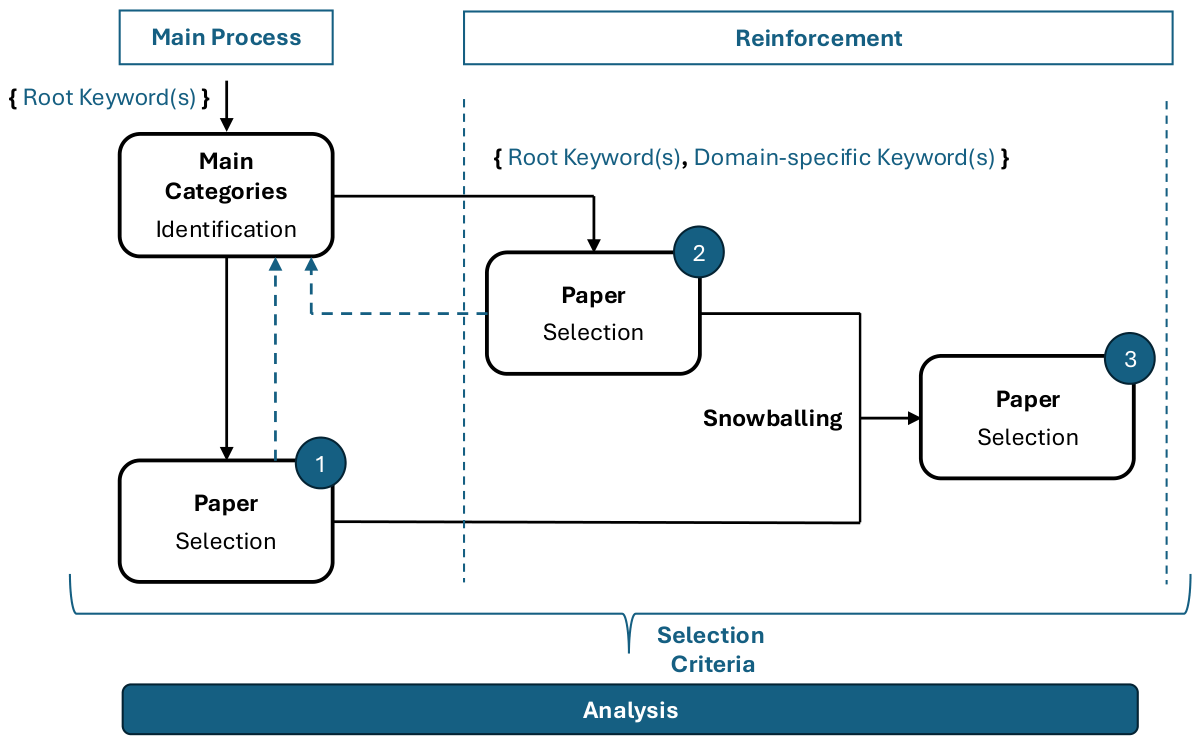
Figure 2.
Main statistics.
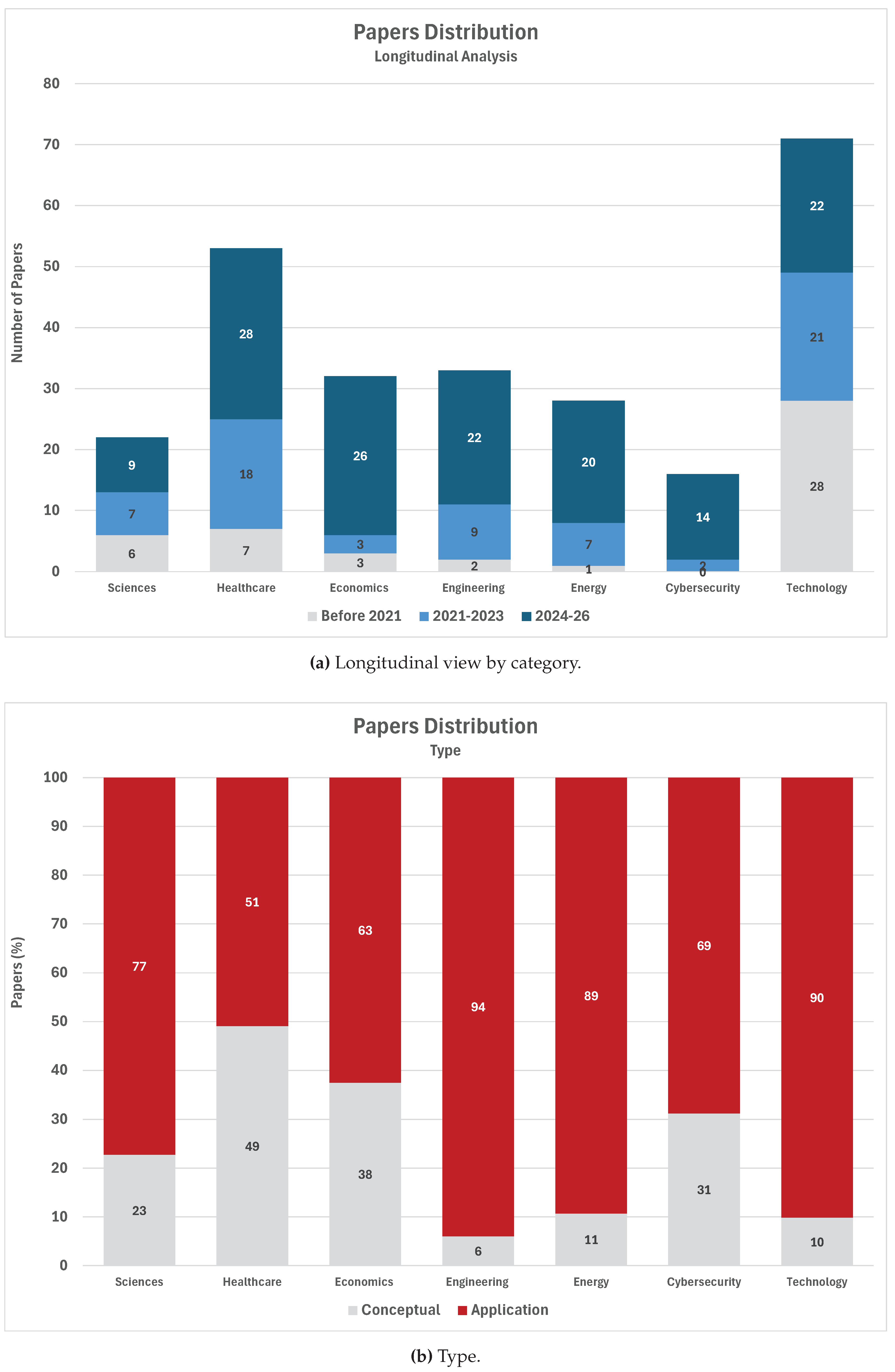
Figure 3.
Topic composition by keyword (token) and related score.
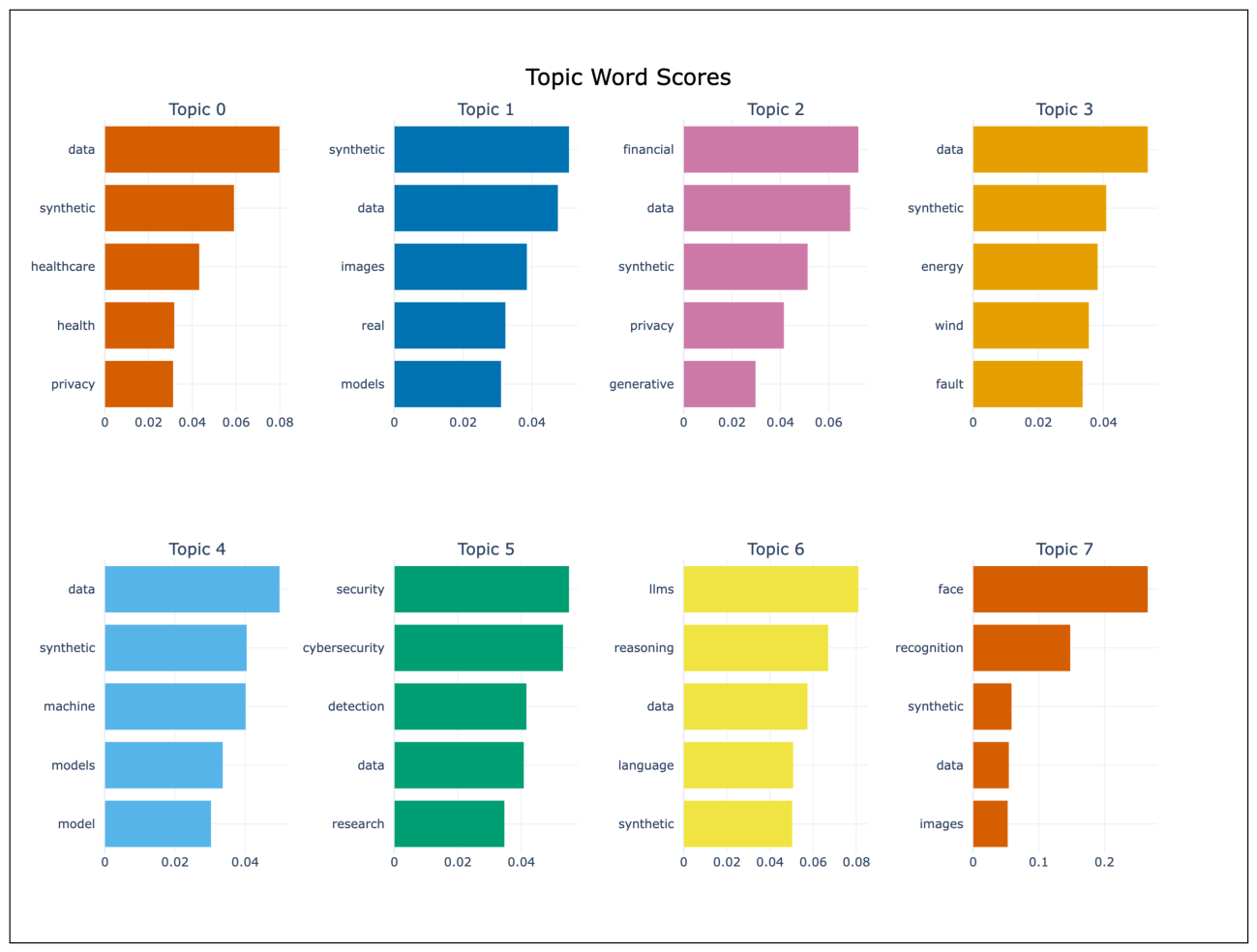
Figure 4.
Quantitative overview.
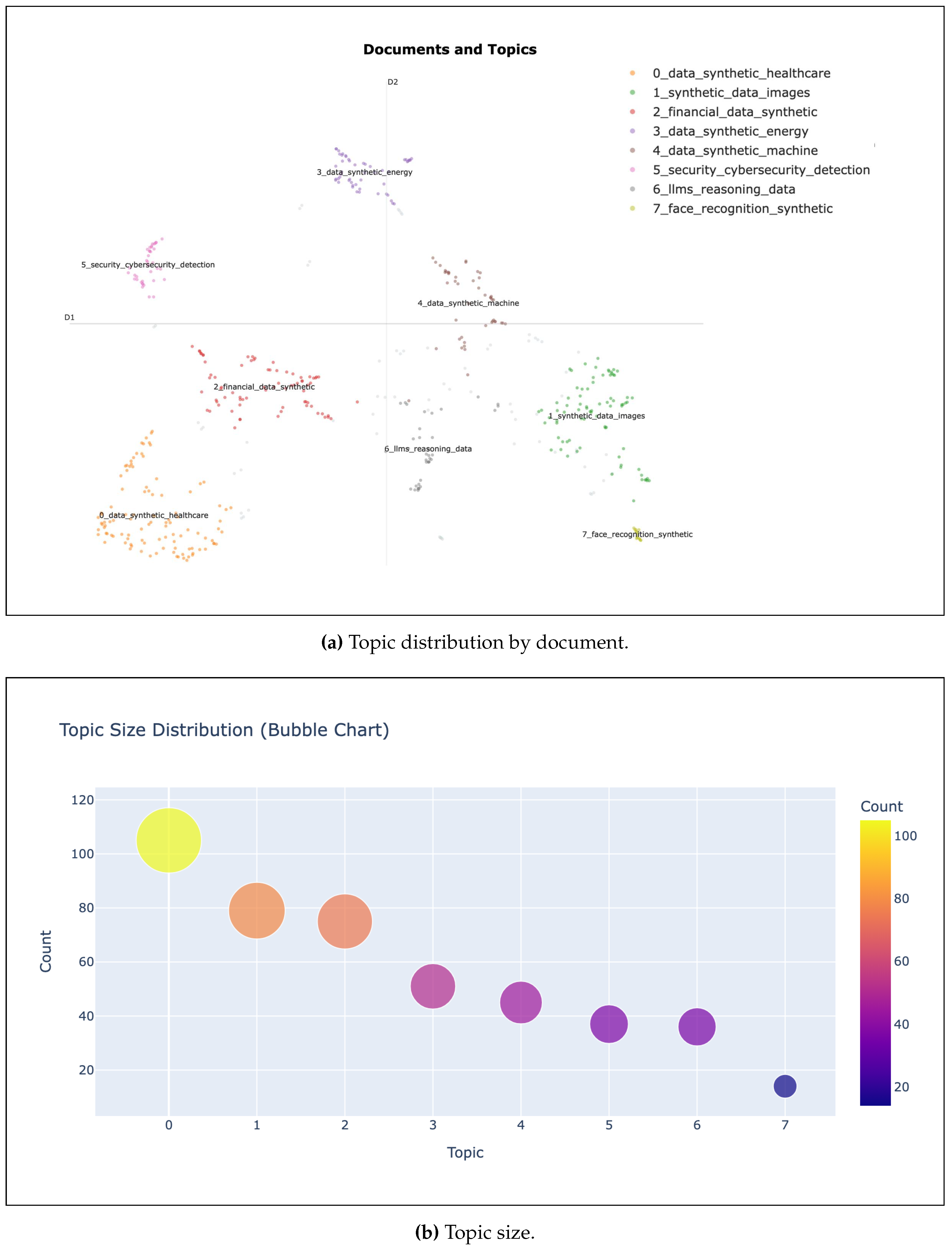
Figure 5.
Topic Similarity Matrix.
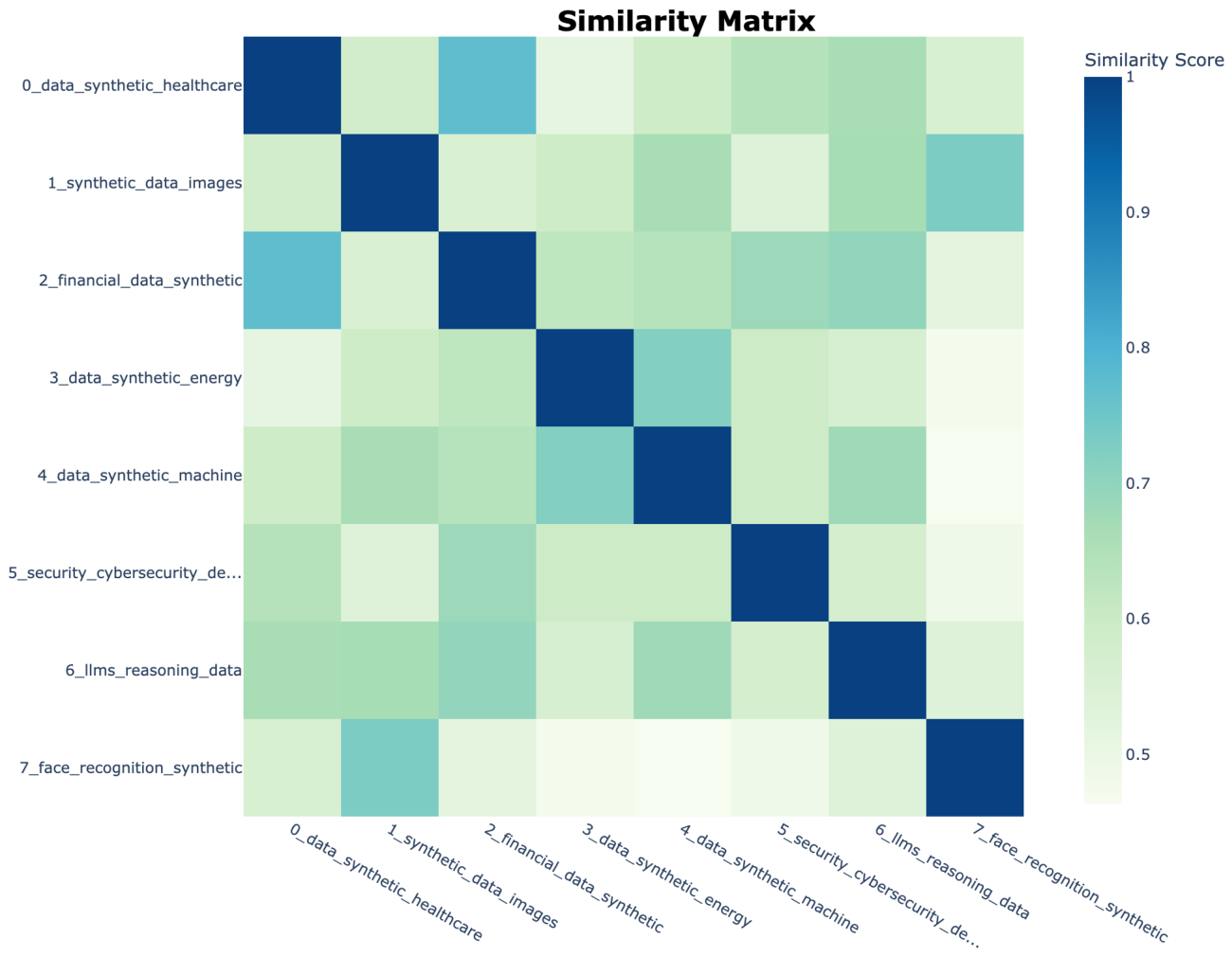
Table 1.
Domain keywords as identified in the initial screening.
| Domain | Keyword |
|---|---|
| Sciences | Social Science, Mathematics, Physics, Chemistry, Biology, Astronomy |
| Healthcare | Healthcare, Medicine, Health Economics |
| Economics | Economy, Finance, Business |
| Engineering | Engineering, Civil Engineering, Mechanical Engineering, Electrical Engineering, Architecture |
| Energy | Energy, Energy systems |
| Cybersecurity | Cybersecurity |
| Technology | Computer Vision, Machine Learning, LLMs |
Table 2.
Summary of Research Gaps.
| Gap | |
|---|---|
| Complex requirements | A very first evidence of limited engineering approach is related to requirements that are rarely approached organically beyond the specific case. This ad-hoc focus is unlikely to effectively address the complexity of the actual requirements, which is often proportional to the complexity of the application domain. |
| Lack of regulations | In continuity with the previous considerations, certain applications may suggest some form of formal regulation to fully exploit the potentialities of synthetic data in a transparent and risk-aware context, acknowledged within a given community or professional body. |
| Application-specific vs generic | Another direct consequence of the ad-hoc approach is a lack of consolidation of generic principles, eventually integrated by more specific ones in the different application contexts. |
| Governance frameworks | They are needed to clearly reflect policies related to synthetic data. Their absence reflects an associated lack of governance models. |
| Methodological aspects | They are often missing or overlooked because considered of minor importance. It also reflects an absence of integrated approach. This gap should be filled as part of the consolidation of an engineering approach. |
| Evaluation/validation | Despite they are often central in the discussion, there is no principled approach for evaluation, validation criteria, and quality assurance. |
| Expectations vs application | Significant gap between expectations (normally high) and actual applications in certain domains (e.g. finance). |
| Unexplored opportunities | Despite evident opportunities, the adoption of synthetic data seems still largely unexplored in certain domains. However, current trends show a natural progressive bridging, mainly driven by the increasing capabilities of AI technology. |
| Operationalization/usability | Tools and, more in general, support to the adoption of synthetic data may be considered relatively limited and, in general terms, may require specific skills. This is a serious limitation to usability and effective operationalization. |
Disclaimer/Publisher’s Note: The statements, opinions and data contained in all publications are solely those of the individual author(s) and contributor(s) and not of MDPI and/or the editor(s). MDPI and/or the editor(s) disclaim responsibility for any injury to people or property resulting from any ideas, methods, instructions or products referred to in the content. |
© 2026 by the authors. Licensee MDPI, Basel, Switzerland. This article is an open access article distributed under the terms and conditions of the Creative Commons Attribution (CC BY) license (http://creativecommons.org/licenses/by/4.0/).
Copyright: This open access article is published under a Creative Commons CC BY 4.0 license, which permit the free download, distribution, and reuse, provided that the author and preprint are cited in any reuse.