
Submitted:
01 September 2026
Posted:
02 September 2026
You are already at the latest version
Abstract
Poly(lactic acid) (PLA) and polyhydroxyalkanoates (PHAs) are leading bio-based and biodegradable polyesters, but brittleness, narrow processing windows, and morphology-sensitive performance limit many durable applications. Polyhydroxyurethanes (PHUs), formed mainly by cyclic carbonate–amine polyaddition without isocyanates, combine urethane groups with pendant hydroxyls and can be designed as thermoplastics or exchangeable networks. These features make PHUs plausible tougheners and interfacial modifiers for PLA/PHA blends, yet direct evidence for ternary PLA/PHA/PHU systems remains scarce. This critical narrative review therefore separates direct polyester/PHU evidence from transferable results in PLA/PHA, PLA/thermoplastic-polyurethane, and dynamic-PHU systems. It connects monomer functionality, diamine structure, hydroxyl density, molar mass, and reversible chemistry to phase localization, interfacial adhesion, stress dissipation, melt processing, and repeated-use behavior. Published results show that polyurethane-like modifiers can provide large toughness gains when domain size and continuity are controlled, while thermoplastic PHUs can be melt blended and interact with PLA. However, hydrogen bonding does not by itself prove compatibility, dynamicity, recyclability, or biodegradability. A safe processing-relaxation window and a staged end-of-life assessment are proposed. The resulting design rules define the experiments needed to establish whether PHUs can deliver toughness, reprocessability, and credible environmental performance simultaneously.
Keywords:
poly(lactic acid)
; polyhydroxyalkanoate
; polyhydroxyurethane
; non-isocyanate polyurethane
; toughening
; polymer blends
; reprocessing
; biodegradation
1. Introduction and Scope
Poly(lactic acid) (PLA) has become a reference bio-based thermoplastic because it combines renewable feedstock options, useful stiffness and strength, transparency, and compatibility with extrusion, injection molding, thermoforming, fibers, and additive manufacturing. Its limitations are equally familiar: conventional grades are glassy and brittle near room temperature, display limited crack-tip plasticity, and are susceptible to hydrolytic and thermomechanical chain scission when moisture, temperature, and residence time are not controlled [1,2]. Polyhydroxyalkanoates (PHAs) are microbial polyesters whose properties vary from stiff and crystalline to flexible and elastomeric as monomer composition changes [3,4]. Their biological origin and environment-dependent biodegradation are attractive, but PHB-rich grades can be brittle, age rapidly, and possess a narrow processing window. Accordingly, blending PLA with a selected PHA can broaden the property envelope, but it does not automatically create a compatible or tough material [5].
The established literature on PLA toughening shows that ductility is not a simple function of adding a soft component. A useful modifier must disperse at an appropriate length scale, adhere sufficiently to transfer stress, cavitate or deform without premature debonding, and trigger extensive shear yielding in the surrounding matrix. Its viscosity, interfacial tension, crystallization effects, and processing history all help determine whether the final morphology is finely dispersed, core-shell, fibrillar, co-continuous, or coarsened. These variables explain why nominally similar formulations can show very different impact results and why a high elongation at break does not necessarily translate to high notched impact strength [6].
PLA/PHA blends are particularly demanding because both phases can crystallize and both are sensitive to processing history. Process engineering altered phase morphology and performance in PLA/PHBV blends even at fixed composition [7], while P(3HB-co-4HB) grade and blend morphology strongly influenced properties in biosourced PLA/PHA systems [8]. Bio-based PHA grades can act as impact modifiers for PLA, but the magnitude of the benefit depends on PHA composition, concentration, and thermal history [9]. A recent additive-manufacturing study, for example, found that an 88/12 PLA/PHA filament was only partially miscible yet showed approximately 50% higher toughness and 33% higher strain at break, with a modest loss in tensile strength [10]. These studies establish both the opportunity and the central problem: the interface and the process-created morphology, rather than the renewable origin of the components alone, govern performance.
Polyhydroxyurethanes (PHUs) offer a conceptually attractive way to address that problem. PHUs are a major class of non-isocyanate polyurethanes (NIPUs), most often synthesized through step-growth ring-opening polyaddition of multifunctional cyclic carbonates with primary amines. The reaction produces hydroxyurethane linkages without a small-molecule by-product and introduces pendant hydroxyl groups along the chain. Depending on monomer functionality and architecture, the product can be a linear melt-processable polymer, a branched material, or a covalent network. Urethane and hydroxyl groups provide cohesive hydrogen bonding and potential interaction with polyester carbonyls, while flexible diamines or soft segments can supply rubbery energy dissipation. Selected PHUs also contain covalent exchange reactions that allow network rearrangement under heat and pressure [11,12,13,14,15,16].
None of those structural features is a guarantee. PHU self-association can be stronger than PHU-polyester association; excessive hydroxyl density can raise viscosity and water uptake; low cyclic-carbonate reactivity can limit molar mass; and a network may relax only at temperatures or times that degrade PLA or PHA. Recent structure-property and life-cycle studies emphasize that improved mechanics, lower water uptake, and lower environmental burden must each be demonstrated rather than inferred from the absence of isocyanates [17,18]. Similarly, the labels bio-based, biodegradable, reprocessable, and dynamic describe different attributes. A PHU prepared partly from renewable monomers may be bio-based but not biodegradable. A linear PHU may be mechanically recyclable because it flows on heating without any dynamic covalent chemistry. A vitrimeric PHU may be reprocessable through exchange reactions but persist under composting conditions. Hydrogen bonds are reversible physical interactions, but their presence alone does not establish macroscopic healing or recycling.
This article is therefore organized as a critical narrative review with an explicit evidence hierarchy. Literature was selected for its ability to answer one of four linked questions: (i) what controls toughness and morphology in PLA/PHA and PLA/polyurethane blends; (ii) how cyclic carbonate–amine chemistry controls PHU architecture and processability; (iii) which reversible mechanisms have actually enabled PHU stress relaxation or reprocessing; and (iv) how mechanical recycling and biological end-of-life should be evaluated without conflating mass loss, disintegration, hydrolysis, and mineralization.
Peer-reviewed sources were identified through Scopus, Web of Science Core Collection, and Google Scholar using combinations of the terms polyhydroxyurethane, non-isocyanate polyurethane, PLA, PHA, polymer blend, toughening, dynamic covalent, reprocessing, and biodegradation. Literature published primarily from 2010 to 2026 was prioritized, while foundational earlier studies were retained when required to establish mechanisms, standards, or historical context.
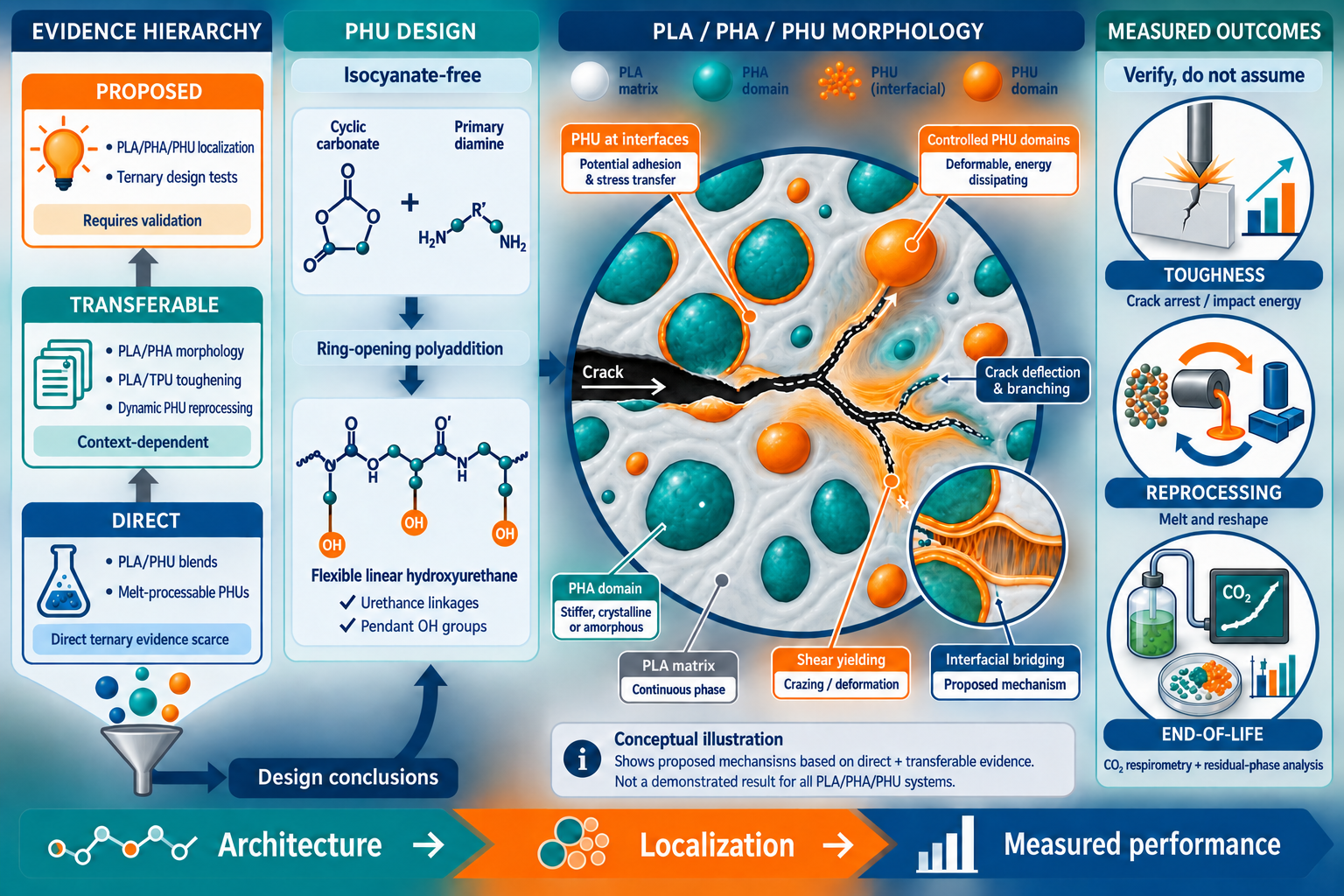
Three evidence levels are maintained throughout. Level I comprises direct results from PLA/PHU or related melt-blended thermoplastic-PHU systems. Level II comprises transferable results from PLA/PHA, PLA/thermoplastic-polyurethane (TPU), polyurethane-toughened PLA, and dynamic PHU networks. Level III comprises proposed design rules for ternary PLA/PHA/PHU systems that require experimental validation. To the best of the literature assessed here, a systematic body of direct ternary PLA/PHA/PHU studies is not yet available. This gap is scientifically valuable only if it is stated plainly: the novelty lies in connecting separate evidence streams into falsifiable design and testing rules, not in presenting anticipated ternary-blend mechanisms as established facts. Figure 1 summarizes this evidence flow, and Table 1 defines what may and may not be concluded at each level.
2. PLA/PHA Matrices and the Toughening Benchmark
2.1. Matrix Selection Is a Materials-Design Decision
PLA is often described as biodegradable without specifying the environment, geometry, crystallinity, or time scale. In practice, many PLA articles require elevated temperature and moisture for rapid hydrolysis and subsequent biological assimilation. PHA behavior is also grade-dependent. PHB and PHBV can be stiff and crystalline, whereas P(3HB-co-4HB) and PHBHHx become more flexible as comonomer content increases. The first design decision is therefore not simply “PLA plus PHA,” but which PLA stereochemistry and molar mass, which PHA chemistry and comonomer fraction, and which targeted processing and disposal conditions are relevant [1,2,3,4,5,94,95,96,97].
For toughening, an amorphous or low-glass-transition PHA can behave as a deformable dispersed phase, while a highly crystalline PHB-rich phase may increase stiffness or nucleate PLA but can also form brittle domains. The same PHA may appear beneficial or detrimental depending on particle size, continuity, crystallization, and physical aging. In PLA/PHBV, changes in mixing protocol and process conditions produced substantial differences in morphology and elongation [7]. In PLA/P(3HB-co-4HB), morphological refinement and composition determined whether the PHA behaved as an effective toughening component [8]. Burzic et al. further showed that amorphous PHA copolymers could improve PLA impact response, with grade, loading, and annealing all affecting the result [9].
Several additional blend studies clarify the available property space. Fully biodegradable PLA/PHBV/PBS ternary blends provided a route to balance stiffness, ductility, and toughness, but the outcome depended on the three-phase morphology [19]. Processing and crystallization affected the impact strength of PLA/PHA parts produced by fused-layer modeling and injection molding [20]. Plasticized PLA/PHB blends demonstrated that a low-molar-mass plasticizer can improve deformability while simultaneously changing thermal transitions and morphology [21]. PLA/PHBHHx blends coupled phase morphology to mechanical and biodegradation behavior [22], and PLA/PHB studies linked blend composition to thermal, mechanical, and degradation outcomes [23]. Composition-dependent PLA/PHBHHx studies and processing comparisons for PLA/PHB and PLA/PHBV further show that crystallinity, phase scale, and manufacturing route can change the interpretation of the same nominal blend [24,25,26,27]. Collectively, these papers argue against treating “PHA” as a single interchangeable toughener.
For a future PHU-modified system, a flexible PHA grade is generally the more informative starting point if the objective is impact resistance at modest modifier loading. A PHB-rich grade may still be scientifically valuable when stiffness, nucleation, or controlled disintegration is prioritized, but its brittleness and aging must be treated as independent variables. Binary PLA/PHA controls are essential at every composition; otherwise, any improvement attributed to PHU cannot be separated from the intrinsic PHA effect.
2.2. Morphology Determines Whether Softness Becomes Toughness
Rubber toughening requires a coordinated sequence: stress concentration around dispersed domains, controlled cavitation or interfacial debonding, plastic-zone growth, and matrix shear yielding. If adhesion is too weak, particles detach and act as defects. If adhesion or crosslink density is too high, the domains may not cavitate or deform. If domains are too large or too widely spaced, local plastic zones do not overlap. Classical rubber-toughening studies established the importance of critical particle size and interparticle ligament thickness, while later PLA work confirmed that morphology and interface must be optimized together [28,29]. If the modifier is molecularly miscible, it may plasticize the matrix but fail to provide the multiphase mechanisms needed for high notched-impact energy.
The ternary PLA/P(3HB-co-4HB)/renewable elastomer study by Hu et al. is illustrative. Changing component ratios generated core-shell and phase-separated morphologies; a 70/20/10 composition reached 270% elongation at break, while other morphologies favored impact response [30]. The study is valuable not because one formulation can be transplanted directly to PHU, but because it demonstrates that phase sequence and localization can decouple tensile ductility from impact resistance. Comparable lessons emerge from compatibilized PLA/PCL, renewable PLA multiphase blends, PLA/PBS/PBAT, and PLA/polyether-block-amide systems: large toughness gains appear only within particular composition and morphology windows, and a chemically reactive additive is useful only if it creates the required phase structure [31,32,33,34]. A PHU added to PLA/PHA could reside in PLA, in PHA, at the PLA/PHA interface, or as a third dispersed phase. Those four states are not equivalent and must be established by selective extraction, microscopy with chemical contrast, spectroscopy, or interfacial-tension analysis rather than assumed from bulk FTIR shifts.
2.3. Conventional Polyurethane Systems Define a Demanding Performance Benchmark
Conventional polyurethane and TPU modifiers provide the closest mechanical benchmark because their segmented structure combines deformable soft segments with cohesive urethane-rich hard segments. Li and Shimizu showed that a biodegradable poly(ether)urethane elastomer could form submicrometric domains in PLA and promote shear yielding [35]. Feng and Ye reported that 20 wt% TPU produced approximately 350% elongation and 25 kJ m−2 impact strength in PLA/TPU blends [36]. Shape-memory PLA/TPU blends likewise demonstrated that phase morphology and thermomechanical transitions are strongly coupled [37].
Hard-segment content is a critical variable rather than merely a formulation detail. Increasing TPU hard-segment content can strengthen intermolecular association and improve compatibility or dispersion, whereas a softer TPU may deliver greater deformability and impact dissipation [38]. A thermoplastic silicone polyurethane at 15 wt% raised PLA elongation to 22.3% and impact strength to 19.3 kJ m−2, although the system remained thermodynamically poorly compatible and showed no evidence of chemical reaction [39]. Reactive morphology control can produce still larger values: a PLA/TPU 70/30 blend compatibilized with ethylene-methyl acrylate-glycidyl methacrylate reached 615% elongation and 53.6 kJ m−2 impact strength through a cocontinuous-like morphology [40]. Broader PLA/thermoplastic-elastomer studies likewise identify elastomer flexibility and interfacial adhesion as coupled requirements, while castor-oil-derived TPU studies illustrate that renewable content does not eliminate the need to measure thermomechanical and degradation responses directly [41,42]. These values are formulation- and method-specific and should not be compared as a single ranking, but they define the scale of improvement a PHU approach must achieve to justify added synthetic complexity.
Dynamic vulcanization of bio-based polyurethane in PLA has produced 59.01 kJ m−2 notched impact strength while retaining 43.97 MPa tensile strength [43]. Here “dynamic” describes crosslinking under melt mixing and morphology generation; it does not mean that the final polyurethane contains reversible dynamic covalent bonds. This distinction is important because dynamic vulcanization can improve toughness without enabling subsequent bond exchange or closed-loop reprocessing. A recent PLA-PU-poly(dimethyl acrylate) study from the present authors similarly found that kinetic mixing and extrusion generated different morphologies and impact responses at identical 60/30/10 composition; the finer kinetic-mixed morphology reached 27.6 kJ m−2, more than twice the extruded counterpart [44]. This adjacent evidence reinforces a central premise of the present review: processing route is a design variable, not a neutral manufacturing step. Table 2 places the most relevant quantitative benchmarks beside their mechanistic limitations so that these heterogeneous tests are not mistaken for a direct ranking.
3. PHU Chemistry and Molecular Design
3.1. What PHU Synthesis Does—And Does Not—Change
Conventional polyurethanes are commonly produced by reactions between polyols and di- or polyisocyanates. PHU chemistry avoids the direct use of isocyanate monomers, most prominently through cyclic carbonate aminolysis [11,12,13,14]. Renewable routes have converted soybean and other vegetable oils, limonene, glycerol derivatives, lignin, and sugar alcohols into cyclic-carbonate precursors, demonstrating substantial chemical breadth [45,46,47,48,49,50]. This removes an important hazard class from the polymer-forming step and creates pendant hydroxyl groups not present at the same density in conventional polyurethane backbones. It does not, by itself, prove lower total environmental impact. Cyclic-carbonate synthesis, amine origin, solvent, catalyst, purification, temperature, yield, and final material lifetime all contribute to the assessment; recent analyses of five-membered-carbonate synthesis make this upstream burden explicit [51]. The scientifically defensible term is therefore non-isocyanate, followed by a separate and quantified description of bio-based carbon content and process conditions.
The adhesive and mechanical performance reported for isocyanate-free PHUs confirms that the chemistry can produce cohesive engineering materials [52]. Catechol-containing PHUs and catalyzed bio-based poly(cyclic-carbonate) coatings further show how hydroxyl-rich networks can provide adhesion and mechanical integrity [53,54]. Reviews of bio-based precursor routes and PHU coatings also identify the same persistent translation barriers: slow aminolysis, limited molar mass, moisture sensitivity, and formulation-dependent curing [15,55]. However, many early PHUs were thermosets or high-viscosity materials developed for coatings and adhesives. Toughening a melt-processed polyester blend imposes additional constraints: the PHU must be available at sufficient molar mass, possess a suitable softening or relaxation window, survive drying and compounding, and generate the desired morphology within a short residence time.
3.2. Cyclic Carbonate–Amine RING Opening
The core reaction is nucleophilic attack of a primary amine on the carbonyl carbon of a five-membered cyclic carbonate, followed by ring opening and proton transfer to form a β-hydroxyurethane. With a bis(cyclic carbonate) and a diamine, repeated reaction of two carbonate groups with two amine groups produces a linear PHU when average functionality remains close to two and stoichiometry is balanced. Two principal regioisomeric linkages form because ring opening can place a primary or secondary hydroxyl adjacent to the urethane group [56]. The polymerization is a step-growth polyaddition: high conversion and close equivalence of amine and cyclic-carbonate functional groups are required for high molar mass. Figure 2 presents the reaction at the functional-group level and deliberately excludes a leaving small molecule, because none is generated in this polyaddition.
Five-membered cyclic carbonates are accessible and widely used but can react slowly with amines. Six-membered analogues are more strained and more reactive: in a model comparison, a six-membered carbonate reacted quantitatively with an amine at 30 °C over 24 h, whereas the corresponding conversion for the five-membered carbonate was 34%; the reported activation energies were 10.1 and 24.6 kcal mol−1, respectively [57]. Substituents also alter rate and ring-opening selectivity [58]. Activated monomer design has recently enabled linear PHUs with reported number-average molar masses up to approximately 105 kg mol−1 at 50 °C, illustrating that low molar mass is a major but not immutable limitation [59]. These kinetic differences matter because slow conversion increases exposure to solvent, heat, and possible side reactions, while insufficient conversion limits molar mass.
Hydrogen bonding creates a characteristic kinetic complication. As hydroxyurethane groups accumulate, growing chains can self-associate, increasing viscosity and restricting diffusion of residual functional groups. Solvent choice can therefore affect more than solubility: protic media can compete for hydrogen bonding and, in selected systems, reduce immobilization during aminolysis [60]. Catalysis is another lever. Bicyclic guanidine TBD dramatically accelerated five-membered cyclic carbonate polymerization in N-methyl-2-pyrrolidone, enabling near-complete conversion at room temperature within four hours in the reported system [61]. Independent coating and design-of-experiments studies confirm that reaction temperature, time, functional ratio, and catalyst choice are strongly coupled rather than individually transferable optimization variables [54,62]. Such results are not universal recipes; catalyst concentration, monomer structure, solvent, moisture, purification, and downstream toxicity must be optimized for the intended material.
3.3. Functionality, Stoichiometry, and Architecture
Difunctional carbonate plus diamine is the clearest route to a linear thermoplastic PHU. Carbonate or amine functionality above two introduces branching and eventually gelation. A lightly branched architecture may increase melt strength and suppress coalescence during blending, but excessive branching can impede ordinary melt flow. Off-stoichiometric formulations limit molar mass and leave terminal carbonate or amine groups. Those end groups can be useful for subsequent coupling, yet residual amines may catalyze polyester degradation or change color and odor, while low-molar-mass PHU may migrate or behave primarily as a plasticizer. Solvent-free erythritol-dicarbonate polyaddition demonstrates that carefully selected difunctional monomers can span hard thermoplastics to elastomeric PHUs without introducing a network [63].
For step-growth polymerization, functional-group equivalence should be discussed explicitly. “1:1 monomer ratio” can be misleading if the two monomers have different functionalities or purities. The relevant quantity is cyclic-carbonate equivalents to reactive primary-amine equivalents. A small deliberate excess can create defined end groups, but high molar mass requires a ratio close to unity and very high conversion. Diamine purity, water content, carbonate conversion, and any mono-functional impurity should therefore be included in the stoichiometric calculation. The strong molar-mass response to monomer structure and near-quantitative conversion reported in recent PHU syntheses reinforces the need to report conversion, end-group balance, and the SEC calibration method together [59].
3.4. Hard/Soft Balance and Diamine Selection
PHU design resembles segmented-polyurethane design in that flexible and rigid segments can be combined, but the hydrogen-bond density and hydroxyl topology are different. Long aliphatic, fatty-derived, polyether, or polysiloxane diamines lower glass transition and promote deformability. Short aliphatic or rigid diamines increase urethane-group density, modulus, and often glass transition. Segmented-PHU studies show that carbonate and soft-segment structures jointly control hydrogen bonding, nanophase separation, hysteresis, and tensile response [64]. For a toughener, neither extreme is ideal: an overly soft, low-cohesion PHU can phase separate coarsely or migrate, whereas an overly rigid PHU behaves as a glassy inclusion and cannot cavitate or dissipate energy.
Terpolymerization of a dicarbonate with two diamines offers a practical way to tune this balance. Bio-based thermoplastic PHUs prepared from a dicarbonate, a long-chain Priamine-type diamine, and a second diamine showed tunable rheology and nanoscale organization and were processed by melt blending [65]. Sugar-derived dicarbonates based on sorbitol or mannitol produced semicrystalline thermoplastic PHUs whose crystal structure and melt behavior depended on stereochemistry; the polymers were blended with PLA at 80/20 [66]. Lignin-derivable thermoplastic NIPUs further demonstrated that increasing hydrogen-bonding content can raise toughness while retaining favorable melt rheology [67]. Erythritol-derived PHU elastomers and dimer-diamine NIPUs independently confirm that carbohydrate-derived hard units and long fatty-derived segments can be used to widen the thermoplastic property window [63,68]. These results establish that PHU can be designed as a thermoplastic rather than only as a network.
For a long/short diamine combination, the ratio is therefore a structure-property variable, not a fixed literature rule. A sensible screening design holds total amine equivalents equal to cyclic-carbonate equivalents and varies the fraction of short diamine within the diamine pool, for example, 0, 10, 25, and 40 mol% of amine equivalents. The long diamine provides low glass transition and extensibility; the short diamine raises urethane density, cohesion, and often molar mass or crystallizability. The selected optimum should have a glass transition below the intended use temperature, no uncontrolled crystallization in the processing window, sufficient melt viscosity for dispersion, and tensile deformation compatible with a toughener. These are proposed screening levels, not a universal optimum [63,64,65,66,67,68].
Priamine-type long-chain diamines are commonly obtained from dimerized fatty-acid feedstocks and can have renewable origin [65,68], whereas 1,10-diaminodecane may be petrochemical or bio-derived depending on its manufacturing route and supplier documentation. Vegetable-oil, sugar-alcohol, lignin, and glycerol routes establish the availability of renewable PHU building blocks, but none converts feedstock origin into a material-level biodegradation result [46,49,50,69]. Neither diamine name proves bio-based carbon content, and neither molecule is automatically biodegradable. For funding or publication claims, the renewable fraction should be supported by supplier traceability or measured according to a bio-based carbon method; biodegradability must be determined on the final PHU and blend under a defined standard. The claim “bio-based and biodegradable diamine” should not be used as a shortcut for material-level performance. Table 3 consolidates these chemistry-to-processing variables and the experimental control required for each.
3.5. What “Compatibility” Must Mean Experimentally
Hydrogen bonding between PHU hydroxyl/urethane groups and polyester carbonyls is chemically plausible. It may shift carbonyl or N–H bands, change glass transitions, alter interfacial tension, or slow coalescence. Yet an FTIR shift alone cannot establish macroscopic compatibility. Even in PLA/TPU systems, reactive compatibilization can simultaneously alter morphology, shape-memory response, and enzymatic degradation, so a single spectroscopic change cannot isolate the mechanism [70]. A rigorous claim should combine at least two independent forms of evidence: composition-dependent glass transitions or relaxation behavior; nanoscale or microscale morphology; rheological signatures; interfacial-tension or wetting measurements; selective extraction; and retention of properties after aging or repeated processing.
Direct evidence remains limited but encouraging. A PDMS-containing PHU used as a PLA/PDMS compatibilizing additive at 5 wt% produced a nine-fold rise in PLA-blend elongation and an 18° increase in contact angle, accompanied by spectroscopic and thermal evidence of interaction and partial miscibility [71]. The system also exhibited accelerated hydrolytic change, but hydrolysis is not equivalent to microbial mineralization. Amine-terminated thermoplastic PHUs have also been used as crosslinkers in hybrid thermosets with high reported renewable carbon content [72], while bio-based PHU vitrimers demonstrate that thermally reprocessable networks can be engineered [73]. These papers support functional diversity; they do not yet demonstrate a universally compatible, biodegradable PLA/PHA/PHU blend.
4. Dynamic Behavior and Reprocessability
4.1. A Hierarchy of Reversibility
The word dynamic is useful only when the moving element and the experimental consequence are specified. Four levels should be distinguished. First, an ordinary linear thermoplastic flows because chains translate and disentangle above their softening range; no reversible covalent chemistry is required. Second, hydrogen bonds or other supramolecular associations break and reform, influencing relaxation and toughness. Third, associative covalent exchange changes network topology while maintaining average crosslink density. Fourth, dissociative chemistry temporarily reduces crosslink density by bond cleavage and reformation. All four can contribute to processability, but they have different kinetics, stability, and characterization requirements. Figure 3 separates these mechanisms and also distinguishes them from dynamic vulcanization, which describes reactive morphology generation during mixing [43,74,75,76,77,78,79,80,81,82].
PHU hydroxyl and urethane groups form extensive hydrogen-bond networks. These interactions are dynamic at the molecular level and can increase cohesive strength while also dissipating energy. They can also raise melt viscosity, broaden relaxation, or immobilize reactive groups. Multi-site self-healing NIPU coatings demonstrate that supramolecular interactions can contribute to recovery when supported by macroscopic healing tests, but such results remain architecture- and time-dependent [74]. Evidence for hydrogen bonding should therefore be connected to a macroscopic response-temperature-dependent rheology, stress relaxation, creep, cyclic loading, or healing before being used to claim dynamic material behavior. A material that contains hydrogen bonds but fractures irreversibly and cannot be reshaped should not be called reprocessable on that basis alone.
Covalent PHU networks can undergo transcarbamoylation, in which hydroxyl and carbamate groups exchange under heat. Fortman et al. demonstrated catalyst-free PHU vitrimers whose topology rearranged under mechanical activation, reporting an apparent activation energy of 111 ± 10 kJ mol−1 and approximately 75% property recovery under the studied conditions; reprocessing involved about 160 °C, pressure, and extended time [75]. Chen et al. demonstrated PHU networks with full property recovery over three reprocessing cycles at 140 °C for 1–2 h and attributed the behavior to concurrent transcarbamoylation and reversible cyclic-carbonate aminolysis [76]. Six-membered-carbonate networks have also been designed for chemical recyclability, showing that reprocessing and monomer recovery are distinct but potentially complementary routes [77]. These are strong demonstrations of network reprocessability, but the time scales are far longer than a typical extrusion residence time.
Structure-property work on PHU thermosets confirms that functionality, crosslink density, and segment flexibility control both mechanical performance and relaxation, with some reprocessing protocols requiring temperatures above 150 °C and applied pressure [78]. Disulfide exchange provides an additional route. The first rapidly reprocessable cystamine-containing PHU networks reached characteristic relaxation times as low as approximately 30 s at 150 °C and recovered crosslink density after 30 min of compression molding [79]. Cystamine-derived lignin-derivable NIPU covalent adaptable networks later showed three- to five-fold faster stress relaxation than a petroleum-derived analogue and complete recovery of thermomechanical properties over four cycles after reprocessing at 130 °C for 45 min [80]. Comparative non-isocyanate polythiourethane/PHU work confirms that the exchange motif and network backbone jointly determine relaxation and recovery [81]. Disulfide incorporation can therefore lower the useful relaxation temperature, but it adds oxidation sensitivity, odor/impurity considerations, and its own stability questions. It also does not confer biodegradability.
4.2. The Safe Processing–Relaxation Window
For a PHU network to be useful in PLA/PHA processing, its relaxation must be fast enough at a temperature that does not cause unacceptable polyester degradation. This creates a safe processing-relaxation window bounded below by insufficient PHU mobility and above by PLA/PHA chain scission, PHA thermal degradation, discoloration, or volatilization. Dioxaborolane/dioxazaborocane PHU vitrimers illustrate the trade-off: suppressing moisture sensitivity and increasing strength changes glass transition and the temperature/time required for exchange [17]. Catalyst screening in six-membered-carbonate PHUs similarly shows that faster exchange cannot be assumed from catalyst presence alone and must be evaluated alongside mechanical retention [82]. The window is multidimensional: temperature, time, moisture, shear, catalyst, oxygen, and prior processing all matter.
A stress-relaxation time measured for a neat PHU network cannot be transferred directly to a dilute dispersed phase. Confinement, domain size, matrix viscosity, and interface all alter the effective deformation rate. Conversely, a linear PHU may not need covalent exchange at all if it flows and redistributes during remelting. The initial experimental question should therefore be architectural: is the proposed modifier a true thermoplastic, a lightly crosslinked gel, or a permanent network? Sol/gel analysis, oscillatory rheology, dynamic mechanical analysis, and swelling should establish this before the material is labeled vitrimeric or recyclable [65,66,67,75,76,77,78,79,80,81,82].
For typical PLA processing near 170–200 °C, long relaxation times are problematic. A network that requires eight hours at 160 °C may be reprocessable as a neat molded article but cannot equilibrate during a two-minute compounding step. A network that relaxes within minutes at 130–150 °C is more promising, yet it must still disperse during the higher-temperature blend step and retain bond-exchange functionality after repeated cycles. An experimentally defensible criterion is to compare PHU relaxation time with actual melt residence time and to measure polyester molar-mass retention simultaneously [2,75,76,77,78,79,80,81,82,86,87,88].
4.3. Reprocessing Metrics Must Include Molecular and Morphological Retention
Mechanical recycling is often assessed only by tensile strength after remolding. That can conceal significant molar-mass loss compensated by increased crystallinity, orientation, or morphology refinement. PLA undergoes thermomechanical chain scission over repeated processing [83,84,85,86], while PHB can lose mechanical performance rapidly during successive extrusion cycles [87]. Repeated mechanical recycling of TPU also changes its thermomechanical response, demonstrating that the modifier cannot be treated as invariant while only the polyester matrix is monitored [88]. Physical aging adds another time-dependent variable for PHB-rich materials [89,90]. A credible PLA/PHA/PHU reprocessing study should therefore report, at minimum, molar mass or intrinsic viscosity, melt viscosity or mass-flow rate, thermal transitions/crystallinity, domain-size distribution, tensile behavior, notched impact, and mass balance after each cycle.
Binary and neat controls are indispensable. If the ternary blend retains impact strength better than PLA/PHA but both lose similar molar mass, PHU may be stabilizing morphology rather than preventing chain scission. If molar mass is preserved but impact collapses, domain coalescence or interfacial damage may dominate. If apparent properties improve while flow becomes much easier, crystallinity may be masking degradation. Chemical recycling studies add a separate endpoint: acid-promoted PHU depolymerization can regenerate five-membered cyclic carbonates, whereas divergent aminolysis has produced recyclable self-blown NIPU foams [91,92]. These routes should not be called mechanical reprocessing, and their reagents, yields, and purification burdens require separate assessment. Table 4 therefore links each reversible mechanism to the evidence it actually supports.
5. From PHU Structure to Ternary-Blend Morphology
5.1. Four Localization Scenarios
At low loading, PHU could dissolve partly in PLA, dissolve partly in PHA, segregate to the PLA/PHA interface, or form separate droplets. At higher loading, these states can evolve toward shell structures, fibrils, or continuity. Interfacial localization is often the desired narrative because the modifier contains polar groups, but it is not guaranteed. The equilibrium tendency depends on three pairwise interfacial tensions; the realized structure also depends on viscosity ratio, mixing sequence, reaction, crystallization, and kinetic trapping. Figure 4 shows the four limiting localization states used in the discussion; real blends may contain more than one state simultaneously [30,31,32,33,34,93].
A PHU rich in long aliphatic or polysiloxane segments may prefer a less polar, flexible PHA phase or form separate domains despite its hydroxyl groups. A more urethane-rich PHU may interact with both polyesters but self-associate strongly. A low-molar-mass PHU may partition molecularly and reduce glass transition, whereas a higher-molar-mass PHU may form discrete domains. The same nominal chemistry can therefore change role with molar mass and short-diamine fraction [63,64,65,66,67,68,69,70,71].
5.2. Mixing Sequence Is a Localization Tool
One-step compounding exposes all components to the same shear and temperature but may not allow the desired interface to form. Preblending PHU with PLA can place the modifier initially in the PLA-rich phase; preblending with PHA favors the opposite route. Preparing a PLA/PHU masterbatch followed by PHA addition may generate PHU-coated PHA droplets if interfacial migration is favorable and residence time is sufficient. Conversely, a preformed PHA/PHU phase dispersed into PLA may create core-shell particles. These hypotheses should be tested under matched total thermal histories because sequential processing otherwise adds an extra degradation cycle [7,30,44,93].
Kinetic mixing can produce intense short-duration shear and finer dispersion, as demonstrated in the adjacent PLA/PU/DMA system [44], whereas twin-screw extrusion offers continuous processing and better control of residence-time distribution. The better laboratory morphology is not automatically the more scalable one. A robust PHU design should tolerate the shear and residence-time variation expected during extrusion rather than depend on a narrowly tuned batch-mixing event.
5.3. Reactive Processing: Plausible but High Risk
Residual amines, cyclic carbonates, hydroxyls, or deliberately installed epoxides can react during melt blending. Reactive coupling may increase interfacial adhesion and suppress coalescence, as transferable PLA/TPU and PLA/PCL compatibilization studies suggest [31,40]. However, residual primary amines can also promote polyester aminolysis or catalyze side reactions, and high catalyst loading can accelerate degradation. A rise in torque or complex viscosity is not sufficient evidence of beneficial interfacial reaction; it may reflect branching, degradation followed by association, or gel formation.
Reactive processing should therefore be treated as a controlled secondary strategy after a stable thermoplastic PHU is established. The material balance should include residual functional groups before blending, torque and temperature histories, soluble fraction, molar mass of extractable polyester, and spectroscopic or chromatographic evidence of new linkages. If the scientific objective is primarily toughening, a nonreactive but associating interface may be easier to interpret and scale [31,40].
5.4. Crystallization and Aging Are COUPLED to Morphology
PLA and PHA crystallization can reject PHU from growing lamellae, concentrate it at amorphous interlamellar regions, or alter nucleation. A modifier that appears miscible in the melt may phase separate during cooling. Conversely, a PHU particle surface may nucleate one polyester and change spherulite size. These effects influence modulus, yield, impact, permeability, and hydrolysis. DSC alone cannot resolve this coupling; polarized optical microscopy, wide-angle X-ray scattering, small-angle scattering, and time-resolved rheology or microscopy are useful complements [7,8,9,19,20,21,22,23,24,25,26,27,89,90].
Conditioning history must be standardized. PHB-rich systems can embrittle through secondary crystallization and physical aging [89,90], and PLA properties depend on thermal history. Mechanical testing at one day and after several weeks can lead to different conclusions. The PHU may slow aging by disrupting crystallization or accelerate it by nucleation. A claimed toughening effect should therefore survive a defined conditioning interval relevant to storage and use.
5.5. A Practical Composition Screen
A compact first study should avoid a full factorial design with dozens of formulations. One PLA grade and one well-defined flexible PHA grade can be selected; the binary PLA/PHA ratio can be fixed after a short screen, for example 80/20 and 70/30. A thermoplastic PHU can then be introduced at 2.5, 5, 10, and 15 wt% by replacing part of the PLA-rich phase while total composition is normalized. The PHU itself can be screened at four long/short diamine ratios using small-scale synthesis and neat-PHU characterization before only two architectures proceed to blend trials.
6. Processing–Morphology–Mechanical Relationships
6.1. Drying and Residence Time Are Chemical Controls
Moisture is not merely a processing nuisance in aliphatic polyesters. At melt temperature, it accelerates hydrolysis, lowers molar mass, changes viscosity ratio, and can alter morphology during the same experiment. PHUs with abundant hydroxyls can absorb moisture and may require drying conditions different from PLA or PHA. Each component should therefore be dried separately to a controlled moisture level, stored in sealed containers, and transferred with minimal atmospheric exposure. A dry inert atmosphere can limit oxidation and moisture uptake during PHU synthesis, but the required level of exclusion should be matched to the sensitivity of the selected monomers and catalyst [2,60,61,62,63,64,65,66,83,84,85,86,87,88].
Published PHU conditions span room temperature with organobase catalysis [61] to solvent-based polymerizations near 100 °C for approximately 24 h in sugar-derived thermoplastic PHUs [66]. These examples are starting points, not universal protocols. A staged development sequence should confirm carbonate conversion in a model reaction before small-scale polymerization and scale-up, while monitoring conversion by FTIR or NMR. Stoichiometry and reagent purity should be assessed before changing temperature, solvent, catalyst, or monomer architecture.
6.2. Viscosity Ratio and Interfacial Tension Control Breakup and Coalescence
Droplet size during melt blending reflects competition among shear stress, interfacial tension, breakup, and coalescence. Classical melt-blend experiments showed that dispersed-domain size decreases as interfacial tension falls and as the viscosity ratio approaches a favorable range [93]. A modifier with much lower viscosity than the matrix may smear, migrate, or form unstable fine droplets; one with much higher viscosity may resist breakup. Oscillatory rheology of each component at the actual mixing temperature and frequency range provides a more useful comparison than melt-flow index alone. Interfacial-tension estimates and wetting coefficients can then guide, but not replace, microscopy.
PHU hydrogen bonding makes rheology particularly temperature- and history-dependent. Long preheating can increase association, promote exchange, or cause degradation; test protocols should specify drying, preheat time, strain amplitude, atmosphere, and thermal history. If the PHU is lightly networked, a low-frequency elastic plateau may indicate gel content rather than simply strong association. Such a material may still function as a dispersed particle, but it should not be described as a conventional thermoplastic [60,64,65,66,67,75,76,77,78,79,80,81,82].
6.3. Mechanical Evidence Requires Matched Tests and Fracture Analysis
Tensile strength, elongation, and notched impact probe different failure modes. High tensile elongation can arise from necking in an unnotched specimen even when a notch triggers brittle fracture. Notched Izod or Charpy values should therefore be reported with the specific standard, notch geometry, specimen dimensions, conditioning, and break type. Direct comparison across publications is unsafe when these differ, which is why Table 2 presents benchmarks as contextual rather than rank-ordered data [6,28,29,35,36,37,38,39,40,41,42,43,44].
A convincing toughening mechanism combines bulk mechanics with fracture morphology. Whitening and rough fracture surfaces can suggest plastic deformation but are not quantitative. SEM should identify particle size, cavities, debonding, fibrillation, and matrix shear bands across representative regions. Transmission electron microscopy or atomic-force microscopy can resolve smaller domains and interphases. A domain-size distribution from multiple fields is more defensible than one attractive micrograph. If interfacial localization is central to the claim, chemical mapping by Raman, AFM-IR, XPS after selective fracture, or labeled components may be needed [6,28,29,35,36,37,38,39,40,41,42,43,44].
Cyclic tensile loading can distinguish recoverable elastic deformation from permanent damage and quantify hysteretic energy dissipation. DMA reveals whether the modifier is rubbery at service temperature and whether relaxations shift or broaden with blending. Fracture-toughness testing provides a more mechanistically stable metric than impact alone when specimen preparation permits. Together, these tests can show whether PHU acts as a plasticizer, elastomeric particle, interfacial modifier, or rigid hydrogen-bonded phase [6,29,35,36,37,38,39,40,41,42,43,44,64,74].
6.4. Minimum Evidence for a Compatibilizing Toughener
The strongest claim, “PHU is a compatibilizing toughener for PLA/PHA”, requires all three words to be demonstrated. PHU presence and location must be verified. Compatibilization should be supported by smaller or more stable domains, stronger interfacial stress transfer, suppressed coalescence, or relevant thermodynamic/rheological evidence. Toughening should be shown by increased impact or fracture energy with a mechanistic link to plastic deformation. If only elongation increases and Tg decreases, the safer interpretation is plasticization. If domain size decreases but impact does not improve, PHU may be a compatibilizer but not an effective toughener [6,28,29,30,31,32,33,34,35,36,37,38,39,40,41,42,43,44,70,71,93].
The optimal formulation is unlikely to maximize every property. A proposed application-specific target might require a several-fold impact increase while retaining at least 70–80% of neat-PLA tensile strength and modulus, stable morphology after one or more reprocessing cycles, and no premature loss during humid service conditioning. Exact thresholds should be application-specific and declared before optimization. This avoids selecting a formulation solely because it gives the largest single metric [6,29,43,44,83,84,85,86,87,88,89,90].
7. End-of-Life: Recycling, Disintegration, and Biodegradation
7.1. End-of-Life Terms Are Not Interchangeable
Mechanical recycling means recovering and remelting material into a new article. Hydrolytic degradation means ester-bond cleavage and molar-mass reduction in water; it can occur abiotically. Disintegration describes physical fragmentation and loss of specimen integrity. Biodegradation requires microbial conversion of organic carbon, ideally quantified as carbon dioxide under aerobic conditions or methane/carbon dioxide anaerobically. Compostability adds requirements for time, disintegration, biodegradation, ecotoxicity, and material quality under a specified composting regime. Reviews of PLA and PHA degradation consistently show that polymer identity alone does not determine rate: temperature, moisture, crystallinity, geometry, microorganisms, and additives all matter [94,95,96,97]. A material can pass one category and fail another.
PLA/PHA blend studies show why the distinction matters. Composition and morphology influence degradation behavior in PLA/PHBHHx [22] and PLA/PHB [23]. Plasticized PLA-PHB blends can disintegrate under composting conditions [98], but disintegration alone does not quantify mineralization. Direct carbon dioxide measurements of PLA, PHBV, and PLA/PHBV found markedly different conversion in compost and soil, confirming that the disposal environment can reverse an apparently simple material ranking [99]. PLA/TPU studies also show that blend morphology and compatibilization alter biodegradation or enzymatic degradation profiles [70,100]. A PHU that increases water uptake may accelerate hydrolytic molar-mass loss while leaving a persistent PHU-rich residue. Conversely, a hydrophobic PHU may slow water transport and delay PLA/PHA breakdown. Neither outcome can be inferred reliably from contact angle or short soil burial.
7.2. Standards Provide Different Answers
ISO 14855-1 quantifies ultimate aerobic biodegradability under controlled composting through evolved carbon dioxide [101]. ISO 17556 addresses ultimate aerobic biodegradation in soil by oxygen demand or carbon dioxide evolution [102]. ISO 20200 evaluates disintegration under simulated composting and explicitly does not, by itself, establish ultimate biodegradation [103]. Experimental assessments of ISO 14855-based methods and comparative respirometric studies show that blank correction, inoculum activity, specimen size, theoretical carbon content, and positive-control performance are essential to reproducibility [104,105]. A well-designed study can use disintegration as an initial screen, but any final biodegradability claim should be based on respirometric carbon conversion and an appropriate reference material.
Mass loss during soil burial is particularly ambiguous. Soil can detach fragments, leach additives, or adhere to the sample. The recent PLA/PU/DMA study found no significant mass loss after three months of soil burial even though thermal and mechanical changes indicated early-stage sensitivity [44]. This is a useful example of careful interpretation: absence of mass loss does not mean molecular stability, while mechanical deterioration does not prove mineralization. Gel permeation chromatography, thermal analysis, microscopy, and respirometry answer different parts of the process.
7.3. The PHU Fraction Requires a Carbon Balance
For a ternary blend, carbon dioxide evolution should be compared with the theoretical carbon content of the whole formulation. If PLA and PHA mineralize but PHU remains, the maximum apparent conversion depends on PHU loading and carbon composition. Reactive PLA/starch blends tested by direct respirometry illustrate why carbon evolution and molar-mass loss should be followed together: an additive can shorten the hydrolytic lag phase while also contributing its own rapidly mineralized carbon [106]. The residual solid should be recovered, dried, weighed, and characterized for chemical enrichment. A result reported only as percent mass loss can hide selective degradation of one phase and accumulation of another.
Stable-isotope labeling is not essential for an initial study, but phase-selective analysis is. FTIR, NMR of extracts, elemental analysis, or chromatographic analysis of degradation products can indicate which component persists. Positive and negative controls should include neat PLA, neat PHA, neat PHU, the binary PLA/PHA blend, cellulose or another standard reference, and an abiotic blank. Specimen thickness and surface area must be matched because geometry can dominate apparent rate [101,102,103,104,105,106].
7.4. A Circularity Hierarchy for the Proposed Material
If the intended application permits collection, mechanical reprocessing should be tested before biological disposal because it retains more material value. The sequence can be: initial use, one to three controlled remelting cycles, property and molar-mass evaluation, and finally standardized compost or soil testing of material that no longer meets mechanical requirements. This cascading approach does not claim closed-loop recycling; it tests whether useful lifetime can be extended before biological end-of-life. For PHUs, techno-economic/life-cycle analysis and recent monomer-recovery chemistry provide useful boundaries for comparing reprocessing, chemical recycling, and disposal rather than treating them as interchangeable circularity claims [18,91].
Dynamic covalent chemistry may improve shape recovery or network reprocessing, but it can also slow biodegradation by maintaining connectivity. Similarly, increasing bio-based carbon does not guarantee mineralization. The most credible sustainability statement may therefore be narrower: “an isocyanate-free, partially bio-based toughener designed for mechanical reprocessability and evaluated for its effect on the standardized biodegradation of a PLA/PHA matrix.” That language is stronger scientifically than an unsupported claim of a fully biodegradable dynamic composite. Table 5 converts each end-of-life claim into a minimum measurement and control set [18,51,75,76,77,78,79,80,81,82,91,94,95,96,97,98,99,100,101,102,103,104,105].
8. Design Rules and Research Agenda
8.1. Design Rule 1: Start with a Thermoplastic PHU, Then Add Exchange Only if Needed
The first generation of a PLA/PHA/PHU toughener should favor a linear, high-conversion PHU whose melt behavior can be measured directly. This minimizes the number of uncertain mechanisms. If the material disperses, toughens, and survives repeated melting, thermoplastic flow may already provide adequate reprocessability. A covalent exchange motif should be added only when morphology stability, creep resistance, or recovery cannot be achieved with a linear architecture. This sequence avoids creating a slowly relaxing network before basic compatibility is known [65,66,67,75,76,77,78,79,80,81,82].
8.2. Design Rule 2: Tune COHESION Independently from SOFTNESS
Long flexible diamines lower glass transition and provide deformability; short diamines raise urethane density and cohesion. The useful region is where the PHU remains rubbery during service but has sufficient melt viscosity and cohesive strength to form stable domains. Neat-PHU tensile testing, DMA, rheology, and thermal stability should be used to choose two candidate long/short ratios before ternary blending. A ratio should not be selected simply because its calculated renewable fraction is highest; performance and processability are functional requirements [63,64,65,66,67,68].
8.3. Design Rule 3: Treat Localization as a Measured Response
Interfacial localization should be a result, not a premise. One-step and sequential mixing routes can be compared at matched thermal exposure. Morphology must be quantified before and after annealing and reprocessing. If PHU remains as a separate third phase yet improves impact, that outcome is still useful and should be described honestly. If it enters the PHA phase rather than the PLA/PHA interface, its role may be to modify the dispersed-phase viscosity or cavitation behavior [30,44,93].
8.4. Design Rule 4: Optimize a Property Vector, Not One Maximum
A funding-relevant and application-relevant result should balance impact strength, tensile strength, modulus, processability, aging stability, and end-of-life evidence. Large elongation with severe modulus loss may be unsuitable; high impact with a persistent nondegradable fraction may require a recycling-first end-of-life strategy. Multi-objective selection can use normalized retention or desirability rather than a single response. Reporting all formulations, including failed ones, will be especially valuable in this emerging area because it reveals the boundaries of the design window [6,29,43,44,83,84,85,86,87,88,89,90,94,95,96,97,98,99,100].
8.5. Design Rule 5: Connect Every Sustainability Adjective to a Measurement
“Non-isocyanate” should follow from the polymerization route. “Bio-based” should follow from documented feedstock origin or bio-based carbon analysis. “Mechanically reprocessable” should follow from repeated cycles with property and molar-mass retention. “Dynamic covalent” should follow from exchange-aware stress relaxation and network reprocessing. “Biodegradable” should follow from standardized mineralization. “Compostable” requires the broader relevant standard and cannot be inferred from hydrolysis. This claim-to-test discipline is likely to strengthen both peer review and future funding applications [18,51,75,76,77,78,79,80,81,82,94,95,96,97,98,99,100,101,102,103,104,105].
8.6. A Decisive Experimental Matrix
The most informative program is organized into gates rather than parallel trial-and-error. Gate 1 establishes monomer identity, functional-group stoichiometry, conversion, PHU molar mass, Tg, thermal stability, and melt rheology. Gate 2 determines phase localization and morphology at low PHU loadings. Gate 3 tests impact, tensile behavior, fracture morphology, and aging. Gate 4 performs repeated processing with molecular and morphological tracking. Gate 5 evaluates standardized end-of-life behavior only for the best-performing formulation and its controls. Each gate has a stop criterion so that synthetic effort is not spent on architectures that cannot be processed or toughen; the complete decision sequence is summarized in Table 6 [101,102,103].
Several results would be genuinely novel. Direct proof that a linear PHU preferentially localizes at a PLA/PHA interface and suppresses coalescence would establish a new compatibilization mechanism. Demonstrating a toughness increase at low PHU loading with retained polyester molar mass would show that the effect is not simply plasticization or degradation. Showing that a disulfide- or transcarbamoylation-containing PHU domain relaxes within the safe polyester-processing window and improves property retention over repeated cycles would link dynamic chemistry to practical blend recycling. Finally, a full carbon balance demonstrating how PHU changes mineralization and residue composition would move the field beyond visual soil-burial claims.
The highest-value negative results are also clear. If hydrogen-bond-rich PHU self-associates into rigid droplets, the work would identify an upper limit in short-diamine or hydroxyl content. If faster network relaxation requires a catalyst that accelerates PLA/PHA degradation, the result would define an incompatibility between dynamic chemistry and matrix stability. If a formulation toughens well but leaves a persistent PHU-rich residue, the appropriate conclusion may be a durable, recycling-first material rather than a compostable one. Such boundaries make the field more credible and prevent sustainability claims from outrunning the chemistry.
9. Conclusions
PHUs are credible emerging modifiers for PLA/PHA blends because cyclic carbonate–amine chemistry can provide thermoplastic or network architectures with tunable soft segments, cohesive urethane groups, and pendant hydroxyls. The strongest current evidence shows that thermoplastic PHUs can be melt-processed, selected PHUs interact with PLA-containing systems, conventional polyurethane modifiers can produce very large toughness gains when morphology is controlled, and exchangeable PHU networks can be reprocessed under defined heat-and-pressure conditions. These findings create a sound design basis, but they do not yet constitute direct proof of a tough, reprocessable, biodegradable PLA/PHA/PHU ternary blend.
The decisive variables are PHU functionality and molar mass, long/short diamine balance, hydroxyl accessibility, viscosity ratio, mixing sequence, and the relation between PHU relaxation time and polyester stability. Hydrogen bonding should be treated as a tunable interaction rather than automatic compatibilization. Dynamic vulcanization, thermoplastic flow, supramolecular rearrangement, transcarbamoylation, and disulfide exchange should be named separately. Likewise, bio-based content, mechanical recycling, hydrolysis, disintegration, biodegradation, and compostability require different evidence.
The practical route is staged: synthesize and fully characterize a linear thermoplastic PHU; determine its localization and morphology in one well-defined PLA/PHA pair; establish impact toughening and fracture mechanisms; quantify retention over repeated melt cycles; and then perform standardized mineralization with residual-phase analysis. This approach converts a broad sustainability concept into testable chemistry–processing–morphology relationships. If the proposed safe processing–relaxation window and claim-to-test framework are followed, PHU modifiers can be evaluated rigorously as multifunctional tougheners rather than assumed to be sustainable by molecular design alone.
Author Contributions
Conceptualization, R.A.N. and Y.Z.M.; methodology, R.A.N.; literature curation and analysis, R.A.N.; writing—original draft preparation, R.A.N.; writing—review and editing, R.A.N. and Y.Z.M.; visualization, R.A.N.; supervision, Y.Z.M. All authors have read and agreed to the published version of the manuscript.
Funding
This research received no external funding.
Institutional Review Board Statement
Not applicable.
Informed Consent Statement
Not applicable.
Data Availability Statement
No new data were created or analyzed in this study. Data sharing does not apply to this article.
Acknowledgments
During the preparation of this manuscript, OpenAI ChatGPT (GPT-5) was used for language refinement, reference-list organization, and preparation of original schematic figures. The authors reviewed and edited all outputs, verified the cited sources, and take full responsibility for the content of the publication.
Conflicts of Interest
The authors declare no conflict of interest.
References
- Farah, S.; Anderson, D.G.; Langer, R. Physical and mechanical properties of PLA, and their functions in widespread applications—A comprehensive review. Adv. Drug Deliv. Rev. 2016, 107, 367–392. [Google Scholar] [CrossRef] [PubMed]
- Lim, L.-T.; Auras, R.; Rubino, M. Processing technologies for poly(lactic acid). Prog. Polym. Sci. 2008, 33, 820–852. [Google Scholar] [CrossRef]
- Sudesh, K.; Abe, H.; Doi, Y. Synthesis, structure and properties of polyhydroxyalkanoates: Biological polyesters. Prog. Polym. Sci. 2000, 25, 1503–1555. [Google Scholar] [CrossRef]
- Chen, G.-Q. A microbial polyhydroxyalkanoates (PHA) based bio- and materials industry. Chem. Soc. Rev. 2009, 38, 2434–2446. [Google Scholar] [CrossRef] [PubMed]
- Naser, A.Z.; Deiab, I.; Defersha, F.; Yang, S. Expanding poly(lactic acid) (PLA) and polyhydroxyalkanoates (PHAs) applications: A review on modifications and effects. Polymers 2021, 13, 4271. [Google Scholar] [CrossRef] [PubMed]
- Zhao, X.; Hu, H.; Wang, X.; Yu, X.; Zhou, W.; Peng, S. Super tough poly(lactic acid) blends: A comprehensive review. RSC Adv. 2020, 10, 13316–13368. [Google Scholar] [CrossRef] [PubMed]
- Nanda, M.R.; Misra, M.; Mohanty, A.K. The effects of process engineering on the performance of PLA and PHBV blends. Macromol. Mater. Eng. 2011, 296, 719–728. [Google Scholar] [CrossRef]
- Han, L.; Han, C.; Zhang, H.; Chen, S.; Dong, L. Morphology and properties of biodegradable and biosourced polylactide blends with poly(3-hydroxybutyrate-co-4-hydroxybutyrate). Polym. Compos. 2012, 33, 850–859. [Google Scholar] [CrossRef]
- Burzic, I.; Pretschuh, C.; Kaineder, D.; Eder, G.; Smilek, J.; Másilko, J.; Wöss, K. Impact modification of PLA using biobased biodegradable PHA biopolymers. Eur. Polym. J. 2019, 114, 32–38. [Google Scholar] [CrossRef]
- Mondragón-Herrera, L.I.; Vargas-Coronado, R.F.; Carrillo-Escalante, H.; Cauich-Rodríguez, J.V.; Hernández-Sánchez, F.; Velasco-Santos, C.; Avilés, F. Mechanical, thermal, and physicochemical properties of filaments of poly(lactic acid), polyhydroxyalkanoates and their blend for additive manufacturing. Polymers 2024, 16, 1062. [Google Scholar] [CrossRef] [PubMed]
- Cornille, A.; Auvergne, R.; Figovsky, O.; Boutevin, B.; Caillol, S. A perspective approach to sustainable routes for non-isocyanate polyurethanes. Eur. Polym. J. 2017, 87, 535–552. [Google Scholar] [CrossRef]
- Nohra, B.; Candy, L.; Blanco, J.-F.; Guerin, C.; Raoul, Y.; Mouloungui, Z. From petrochemical polyurethanes to biobased polyhydroxyurethanes. Macromolecules 2013, 46, 3771–3792. [Google Scholar] [CrossRef]
- Carré, C.; Ecochard, Y.; Caillol, S.; Avérous, L. From the synthesis of biobased cyclic carbonate to polyhydroxyurethanes: A promising route towards renewable non-isocyanate polyurethanes. ChemSusChem 2019, 12, 3410–3430. [Google Scholar] [CrossRef] [PubMed]
- Gomez-Lopez, A.; Elizalde, F.; Calvo, I.; Sardon, H. Trends in non-isocyanate polyurethane (NIPU) development. Chem. Commun. 2021, 57, 12254–12265. [Google Scholar] [CrossRef] [PubMed]
- Ghasemlou, M.; Daver, F.; Ivanova, E.P.; Adhikari, B. Bio-based routes to synthesize cyclic carbonates and polyamines precursors of non-isocyanate polyurethanes: A review. Eur. Polym. J. 2019, 118, 668–684. [Google Scholar] [CrossRef]
- Blattmann, H.; Fleischer, M.; Bähr, M.; Mülhaupt, R. Isocyanate- and Phosgene-Free Routes to Polyfunctional Cyclic Carbonates and Green Polyurethanes by Fixation of Carbon Dioxide. Macromol. Rapid Commun. 2014, 35, 1238–1254. [Google Scholar] [CrossRef] [PubMed]
- Zubkevich, S.V.; Sarma, A.D.; Antzutkin, O.N.; Dieden, R.; Berthe, V.; Westermann, S.; Shaplov, A.S.; Schmidt, D.F. Enhancing Polyhydroxyurethane Properties via the Formation of Dioxaborolane- and Dioxazaborocane Vitrimers. Chem. Mater. 2025, 37, 7049–7063. [Google Scholar] [CrossRef] [PubMed]
- Liang, C.; Jadidi, Y.; Chen, Y.; Gracida-Alvarez, U.; Torkelson, J.M.; Hawkins, T.R.; Dunn, J.B. Techno-economic Analysis and Life Cycle Assessment of Biomass-Derived Polyhydroxyurethane and Nonisocyanate Polythiourethane Production and Reprocessing. ACS Sustain. Chem. Eng. 2024, 12, 12161–12170. [Google Scholar] [CrossRef] [PubMed]
- Zhang, K.; Mohanty, A.K.; Misra, M. Fully biodegradable and biorenewable ternary blends from polylactide, poly(3-hydroxybutyrate-co-hydroxyvalerate) and poly(butylene succinate) with balanced properties. ACS Appl. Mater. Interfaces 2012, 4, 3091–3101. [Google Scholar] [CrossRef] [PubMed]
- Ecker, J.V.; Burzic, I.; Haider, A.; Hild, S.; Rennhofer, H. Improving the impact strength of PLA and its blends with PHA in fused layer modelling. Polym. Test. 2019, 78, 105929. [Google Scholar] [CrossRef]
- Abdelwahab, M.A.; Flynn, A.; Chiou, B.-S.; Imam, S.; Orts, W.; Chiellini, E. Thermal, mechanical and morphological characterization of plasticized PLA–PHB blends. Polym. Degrad. Stab. 2012, 97, 1822–1828. [Google Scholar] [CrossRef]
- Zhao, Q.; Wang, S.; Kong, M.; Geng, W.; Li, R.K.Y.; Song, C.; Kong, D. Phase morphology, physical properties, and biodegradation behavior of novel PLA/PHBHHx blends. J. Biomed. Mater. Res. Part B Appl. Biomater. 2012, 100B, 23–31. [Google Scholar] [CrossRef] [PubMed]
- Zhang, M.; Thomas, N.L. Blending polylactic acid with polyhydroxybutyrate: The effect on thermal, mechanical, and biodegradation properties. Adv. Polym. Technol. 2011, 30, 67–79. [Google Scholar] [CrossRef]
- Lim, J.S.; Park, K.I.; Chung, G.S.; Kim, J.H. Effect of composition ratio on the thermal and physical properties of semicrystalline PLA/PHB-HHx composites. Mater. Sci. Eng. C 2013, 33, 2131–2137. [Google Scholar] [CrossRef] [PubMed]
- Olejnik, O.; Masek, A.; Zawadziłło, J. Processability and Mechanical Properties of Thermoplastic Polylactide/Polyhydroxybutyrate (PLA/PHB) Bioblends. Materials 2021, 14, 898. [Google Scholar] [CrossRef] [PubMed]
- Zhao, H.; Cui, Z.; Wang, X.; Turng, L.S.; Peng, X. Processing and characterization of solid and microcellular poly(lactic acid)/polyhydroxybutyrate-valerate (PLA/PHBV) blends and PLA/PHBV/Clay nanocomposites. Compos. Part B Eng. 2013, 51, 79–91. [Google Scholar] [CrossRef]
- Frone, A.N.; Batalu, D.; Chiulan, I.; Oprea, M.; Gabor, A.R.; Nicolae, C.A.; Raditoiu, V.; Trusca, R.; Panaitescu, D.M. Morpho-Structural, Thermal and Mechanical Properties of PLA/PHB/Cellulose Biodegradable Nanocomposites Obtained by Compression Molding, Extrusion, and 3D Printing. Nanomaterials 2020, 10, 51. [Google Scholar] [CrossRef] [PubMed]
- Borggreve, R.J.M.; Gaymans, R.J.; Schuijer, J.; Housz, J.F.I. Brittle-tough transition in nylon-rubber blends: effect of rubber concentration and particle size. Polymer 1987, 28, 1489–1496. [Google Scholar] [CrossRef]
- Nagarajan, V.; Mohanty, A.K.; Misra, M. Perspective on Polylactic Acid (PLA) based Sustainable Materials for Durable Applications: Focus on Toughness and Heat Resistance. ACS Sustain. Chem. Eng. 2016, 4, 2899–2916. [Google Scholar] [CrossRef]
- Hu, K.; Huang, D.; Jiang, H.; Sun, S.; Ma, Z.; Zhang, K.; Pan, L.; Li, Y. Toughening biosourced poly(lactic acid) and poly(3-hydroxybutyrate-co-4-hydroxybutyrate) blends by a renewable poly(epichlorohydrin-co-ethylene oxide) elastomer. ACS Omega 2019, 4, 19777–19786. [Google Scholar] [CrossRef] [PubMed]
- Fernández-Tena, A.; Otaegi, I.; Irusta, L.; Sebastián, V.; Guerrica-Echevarria, G.; Müller, A.J.; Aranburu, N. High-Impact PLA in Compatibilized PLA/PCL Blends: Optimization of Blend Composition and Type and Content of Compatibilizer. Macromol. Mater. Eng. 2023, 308, 2300213. [Google Scholar] [CrossRef]
- Zhang, K.; Nagarajan, V.; Misra, M.; Mohanty, A.K. Supertoughened Renewable PLA Reactive Multiphase Blends System: Phase Morphology and Performance. ACS Appl. Mater. Interfaces 2014, 6, 12436–12448. [Google Scholar] [CrossRef] [PubMed]
- Wu, F.; Misra, M.; Mohanty, A.K. Super Toughened Poly(lactic acid)-Based Ternary Blends via Enhancing Interfacial Compatibility. ACS Omega 2019, 4, 1955–1968. [Google Scholar] [CrossRef] [PubMed]
- Han, L.; Han, C.; Dong, L. Morphology and properties of the biosourced poly(lactic acid)/poly(ethylene oxide-b-amide-12) blends. Polym. Compos. 2013, 34, 122–130. [Google Scholar] [CrossRef]
- Li, Y.; Shimizu, H. Toughening of polylactide by melt blending with a biodegradable poly(ether)urethane elastomer. Macromol. Biosci. 2007, 7, 921–928. [Google Scholar] [CrossRef] [PubMed]
- Feng, F.; Ye, L. Morphologies and mechanical properties of polylactide/thermoplastic polyurethane elastomer blends. J. Appl. Polym. Sci. 2011, 119, 2778–2783. [Google Scholar] [CrossRef]
- Jing, X.; Mi, H.-Y.; Peng, X.-F.; Turng, L.-S. The morphology, properties, and shape memory behavior of polylactic acid/thermoplastic polyurethane blends. Polym. Eng. Sci. 2015, 55, 70–80. [Google Scholar] [CrossRef]
- Nofar, M.; Mohammadi, M.; Carreau, P.J. Effect of TPU hard segment content on the rheological and mechanical properties of PLA/TPU blends. J. Appl. Polym. Sci. 2020, 137, 49387. [Google Scholar] [CrossRef]
- Sun, M.; Huang, S.; Yu, M.; Han, K. Toughening modification of polylactic acid by thermoplastic silicone polyurethane elastomer. Polymers 2021, 13, 1953. [Google Scholar] [CrossRef] [PubMed]
- Lin, W.; Qu, J.-P. Enhancing impact toughness of renewable poly(lactic acid)/thermoplastic polyurethane blends via constructing cocontinuous-like phase morphology assisted by ethylene–methyl acrylate–glycidyl methacrylate copolymer. Ind. Eng. Chem. Res. 2019, 58, 10894–10907. [Google Scholar] [CrossRef]
- Vuillaume, P.Y.; Vachon, A.; Grey, W.; Pépin, K.; Zhang, C.J. Compatibilisation of various PLA/thermoplastic elastomer blends with diisocyanate coupling agent. Plast. Rubber Compos. 2018, 47, 95–105. [Google Scholar] [CrossRef]
- Ghosh, K.; Kumar, V.; Mishra, D.; Patil, H.B.; Kumavat, D.J.; Ebenezer, K.; Rao, A.R. Effect of renewable castor-oil based thermoplastic polyurethane elastomer on the thermomechanical and biodegradation properties of poly (lactic acid). Mater. Today Commun. 2025, 43, 111738. [Google Scholar] [CrossRef]
- Shou, T.; Dong, Q.; Yin, D.; Hu, S.; Zhao, X.; Zhang, L. Super-tough polylactic acid blends via tunable dynamic vulcanization of biobased polyurethanes. Compos. Part B Eng. 2024, 276, 111363. [Google Scholar] [CrossRef]
- Al Nakib, R.; Arıtürk, G.; Aslan, Y.; Menceloğlu, Y.Z. Processing-controlled impact toughening and degradation response of PLA–PU–DMA blends: Morphology–property relationships under kinetic mixing and extrusion. J. Appl. Polym. Sci. 2026, 143, e70959. [Google Scholar] [CrossRef]
- Tamami, B.; Sohn, S.; Wilkes, G.L. Incorporation of carbon dioxide into soybean oil and subsequent preparation and studies of nonisocyanate polyurethane networks. J. Appl. Polym. Sci. 2004, 92, 883–891. [Google Scholar] [CrossRef]
- Bähr, M.; Mülhaupt, R. Linseed and soybean oil-based polyurethanes prepared via the non-isocyanate route and catalytic carbon dioxide conversion. Green Chem. 2012, 14, 483. [Google Scholar] [CrossRef]
- Bähr, M.; Bitto, A.; Mülhaupt, R. Cyclic limonene dicarbonate as a new monomer for non-isocyanate oligo- and polyurethanes (NIPU) based upon terpenes. Green Chem. 2012, 14, 1447. [Google Scholar] [CrossRef]
- Fleischer, M.; Blattmann, H.; Mülhaupt, R. Glycerol-, pentaerythritol- and trimethylolpropane-based polyurethanes and their cellulose carbonate composites prepared via the non-isocyanate route with catalytic carbon dioxide fixation. Green Chem. 2013, 15, 934. [Google Scholar] [CrossRef]
- Chen, Q.; Gao, K.; Peng, C.; Xie, H.; Zhao, Z.K.; Bao, M. Preparation of lignin/glycerol-based bis(cyclic carbonate) for the synthesis of polyurethanes. Green Chem. 2015, 17, 4546–4551. [Google Scholar] [CrossRef]
- Mazurek-Budzyńska, M.M.; Rokicki, G.; Drzewicz, M.; Guńka, P.A.; Zachara, J. Bis(cyclic carbonate) based on d-mannitol, d-sorbitol and di(trimethylolpropane) in the synthesis of non-isocyanate poly(carbonate-urethane)s. Eur. Polym. J. 2016, 84, 799–811. [Google Scholar] [CrossRef]
- Mundo, F.; Caillol, S.; Ladmiral, V.; Meier, M.A.R. On Sustainability Aspects of the Synthesis of Five-Membered Cyclic Carbonates. ACS Sustain. Chem. Eng. 2024, 12, 6452–6466. [Google Scholar] [CrossRef]
- Cornille, A.; Michaud, G.; Simon, F.; Fouquay, S.; Auvergne, R.; Boutevin, B.; Caillol, S. Promising mechanical and adhesive properties of isocyanate-free poly(hydroxyurethane). Eur. Polym. J. 2016, 84, 404–420. [Google Scholar] [CrossRef]
- Panchireddy, S.; Grignard, B.; Thomassin, J.M.; Jerome, C.; Detrembleur, C. Catechol Containing Polyhydroxyurethanes as High-Performance Coatings and Adhesives. ACS Sustain. Chem. Eng. 2018, 6, 14936–14944. [Google Scholar] [CrossRef]
- Yu, A.Z.; Setien, R.A.; Sahouani, J.M.; Docken, J.; Webster, D.C. Catalyzed non-isocyanate polyurethane (NIPU) coatings from bio-based poly(cyclic carbonates). J. Coat. Technol. Res. 2019, 16, 41–57. [Google Scholar] [CrossRef]
- Gomez-Lopez, A.; Panchireddy, S.; Grignard, B.; Calvo, I.; Jerome, C.; Detrembleur, C.; Sardon, H. Poly(hydroxyurethane) Adhesives and Coatings: State-of-the-Art and Future Directions. ACS Sustain. Chem. Eng. 2021, 9, 9541–9562. [Google Scholar] [CrossRef] [PubMed]
- Tomita, H.; Sanda, F.; Endo, T. Structural analysis of polyhydroxyurethane obtained by polyaddition of bifunctional five-membered cyclic carbonate and diamine based on the model reaction. J. Polym. Sci. Part A Polym. Chem. 2001, 39, 851–859. [Google Scholar] [CrossRef]
- Tomita, H.; Sanda, F.; Endo, T. Reactivity comparison of five- and six-membered cyclic carbonates with amines: Basic evaluation for synthesis of poly(hydroxyurethane). J. Polym. Sci. Part A Polym. Chem. 2001, 39, 162–168. [Google Scholar] [CrossRef]
- Tomita, H.; Sanda, F.; Endo, T. Model reaction for the synthesis of polyhydroxyurethanes from cyclic carbonates with amines: Substituent effect on the reactivity and selectivity of ring-opening direction in the reaction of five-membered cyclic carbonates with amine. J. Polym. Sci. Part A Polym. Chem. 2001, 39, 3678–3685. [Google Scholar] [CrossRef]
- Zubkevich, S.V.; Beter, A.; Sarma, A.D.; Dieden, R.; Berthé, V.; Shaplov, A.S.; Schmidt, D.F. Highly Efficient Approach to High-Molecular Weight Polyhydroxyurethanes. Macromolecules 2026, 59, 5140–5150. [Google Scholar] [CrossRef] [PubMed]
- Cornille, A.; Blain, M.; Auvergne, R.; Andrioletti, B.; Boutevin, B.; Caillol, S. A study of cyclic carbonate aminolysis at room temperature: Effect of cyclic carbonate structures and solvents on polyhydroxyurethane synthesis. Polym. Chem. 2017, 8, 592–604. [Google Scholar] [CrossRef]
- Dong, W.; Yoshida, Y.; Endo, T. Synthesis of poly(hydroxyurethane) from 5-membered cyclic carbonate under mild conditions in the presence of bicyclic guanidine and their reaction process. J. Polym. Sci. 2021, 59, 502–509. [Google Scholar] [CrossRef]
- Zalewski, M.J.; Mamiński, M.; Parzuchowski, P.G. Synthesis of Polyhydroxyurethanes—Experimental Verification of the Box–Behnken Optimization Model. Polymers 2022, 14, 4510. [Google Scholar] [CrossRef] [PubMed]
- Schmidt, S.; Gatti, F.J.; Luitz, M.; Ritter, B.S.; Bruchmann, B.; Mülhaupt, R. Erythritol Dicarbonate as Intermediate for Solvent- and Isocyanate-Free Tailoring of Bio-Based Polyhydroxyurethane Thermoplastics and Thermoplastic Elastomers. Macromolecules 2017, 50, 2296–2303. [Google Scholar] [CrossRef]
- Beniah, G.; Chen, X.; Uno, B.E.; Liu, K.; Leitsch, E.K.; Jeon, J.; Heath, W.H.; Scheidt, K.A.; Torkelson, J.M. Combined Effects of Carbonate and Soft-Segment Molecular Structures on the Nanophase Separation and Properties of Segmented Polyhydroxyurethane. Macromolecules 2017, 50, 3193–3203. [Google Scholar] [CrossRef]
- Younes, G.R.; Marić, M. Bio-based thermoplastic polyhydroxyurethanes synthesized from the terpolymerization of a dicarbonate and two diamines: Design, rheology, and application in melt blending. Macromolecules 2021, 54, 10189–10202. [Google Scholar] [CrossRef]
- Younes, G.R.; Kamel, M.; Titi, H.M.; Farkhondehnia, M.; Marić, M. Sugar-based thermoplastic polyhydroxyurethanes: Effects of sorbitol and mannitol diastereomers on polymer properties and applications in melt blending. ACS Appl. Polym. Mater. 2022, 4, 5161–5172. [Google Scholar] [CrossRef]
- Mahajan, J.S.; Hinton, Z.R.; Nombera Bueno, E.; Epps, T.H., III; Korley, L.T.J. Lignin-derivable, thermoplastic, non-isocyanate polyurethanes with increased hydrogen-bonding content and toughness vs. petroleum-derived analogues. Mater. Adv. 2024, 5, 3950–3964. [Google Scholar] [CrossRef] [PubMed]
- Mao, H.I.; Chen, C.W.; Yan, H.C.; Rwei, S.P. Synthesis and characteristics of nonisocyanate polyurethane composed of bio-based dimer diamine for supercritical CO2 foaming applications. J. Appl. Polym. Sci. 2022, 139, e52841. [Google Scholar] [CrossRef]
- Catalá, J.; Guerra, I.; García-Vargas, J.M.; Ramos, M.J.; García, M.T.; Rodríguez, J.F. Tailor-Made Bio-Based Non-Isocyanate Polyurethanes (NIPUs). Polymers 2023, 15, 1589. [Google Scholar] [CrossRef] [PubMed]
- Dogan, S.K.; Boyacioglu, S.; Kodal, M.; Gokce, O.; Ozkoc, G. Thermally induced shape memory behavior, enzymatic degradation and biocompatibility of PLA/TPU blends: “Effects of compatibilization”. J. Mech. Behav. Biomed. Mater. 2017, 71, 349–361. [Google Scholar] [CrossRef] [PubMed]
- Younes, G.R.; Heli, B.; Ajji, A. Blending poly(dimethylsiloxane) with poly(lactic acid) using polyhydroxyurethane additives. ACS Appl. Eng. Mater. 2026, 4, 822–835. [Google Scholar] [CrossRef] [PubMed]
- Farkhondehnia, M.; Marić, M. Utilizing bio-derived amine-terminated thermoplastic polyhydroxyurethanes as crosslinkers for hybrid thermosets. J. Polym. Sci. 2023, 61, 3228–3243. [Google Scholar] [CrossRef]
- Farkhondehnia, M.; Marić, M. Thermally reprocessable bio-based polyhydroxyurethane vitrimers. Polymer 2024, 290, 126578. [Google Scholar] [CrossRef]
- Choong, P.S.; Chong, N.X.; Tam, E.K.W.; Seayad, A.M.; Seayad, J.; Jana, S. Biobased Nonisocyanate Polyurethanes as Recyclable and Intrinsic Self-Healing Coating with Triple Healing Sites. ACS Macro Lett. 2021, 10, 635–641. [Google Scholar] [CrossRef] [PubMed]
- Fortman, D.J.; Brutman, J.P.; Cramer, C.J.; Hillmyer, M.A.; Dichtel, W.R. Mechanically activated, catalyst-free polyhydroxyurethane vitrimers. J. Am. Chem. Soc. 2015, 137, 14019–14022. [Google Scholar] [CrossRef] [PubMed]
- Chen, X.; Li, L.; Jin, K.; Torkelson, J.M. Reprocessable polyhydroxyurethane networks exhibiting full property recovery and concurrent associative and dissociative dynamic chemistry via transcarbamoylation and reversible cyclic carbonate aminolysis. Polym. Chem. 2017, 8, 6349–6355. [Google Scholar] [CrossRef]
- Liu, J.; Miao, P.; Leng, X.; Che, J.; Wei, Z.; Li, Y. Chemically Recyclable Biobased Non-Isocyanate Polyurethane Networks from CO2-Derived Six-membered Cyclic Carbonates. Macromol. Rapid Commun. 2023, 44, e2300263. [Google Scholar] [CrossRef] [PubMed]
- Seychal, G.; Ocando, C.; Bonnaud, L.; De Winter, J.; Grignard, B.; Detrembleur, C.; Sardon, H.; Aramburu, N.; Raquez, J.-M. Emerging polyhydroxyurethanes as sustainable thermosets: A structure–property relationship. ACS Appl. Polym. Mater. 2023, 5, 5567–5581. [Google Scholar] [CrossRef]
- Fortman, D.J.; Snyder, R.L.; Sheppard, D.T.; Dichtel, W.R. Rapidly Reprocessable Cross-Linked Polyhydroxyurethanes Based on Disulfide Exchange. ACS Macro Lett. 2018, 7, 1226–1231. [Google Scholar] [CrossRef] [PubMed]
- Mhatre, S.V.; Epps, T.H., III; Korley, L.T.J. Reprocessable, lignin-derivable, non-isocyanate polyurethane covalent adaptable networks with complete recovery of (thermo)mechanical properties. Macromol. Chem. Phys. 2025, 226, e00230. [Google Scholar] [CrossRef]
- Chen, Y.; Chen, B.; Torkelson, J.M. Biobased, Reprocessable Non-isocyanate Polythiourethane Networks with Thionourethane and Disulfide Cross-Links: Comparison with Polyhydroxyurethane Network Analogues. Macromolecules 2023, 56, 3687–3702. [Google Scholar] [CrossRef]
- Bron, P.; Arnould, N.; Soares, L.; Wolosz, D.; González, A.; Irusta, L.; Sardon, H.; Caillol, S.; Ladmiral, V.; Bakkali-Hassani, C. Catalyst-Controlled Dual Dynamic Networks in Polyhydroxyurethanes from Six-Membered Cyclic Carbonates. Macromol. Chem. Phys. 2026, 227, e00498. [Google Scholar] [CrossRef]
- Plavec, R.; Hlaváčiková, S.; Omaníková, L.; Feranc, J.; Vanovčanová, Z.; Tomanová, K.; Bočkaj, J.; Kruželák, J.; Medlenová, E.; Gálisová, I.; Danišová, L.; Přikryl, R.; Figalla, S.; Melčová, V.; Alexy, P. Recycling possibilities of bioplastics based on PLA/PHB blends. Polym. Test. 2020, 92, 106880. [Google Scholar] [CrossRef]
- Pillin, I.; Montrelay, N.; Bourmaud, A.; Grohens, Y. Effect of thermo-mechanical cycles on the physico-chemical properties of poly(lactic acid). Polym. Degrad. Stab. 2008, 93, 321–328. [Google Scholar] [CrossRef]
- Agüero, A.; Morcillo, M.C.; Quiles-Carrillo, L.; Balart, R.; Boronat, T.; Lascano, D.; Torres-Giner, S.; Fenollar, O. Study of the influence of the reprocessing cycles on the final properties of polylactide pieces obtained by injection molding. Polymers 2019, 11, 1908. [Google Scholar] [CrossRef] [PubMed]
- Velghe, I.; Buffel, B.; Vandeginste, V.; Thielemans, W.; Desplentere, F. Review on the Degradation of Poly(lactic acid) during Melt Processing. Polymers 2023, 15, 2047. [Google Scholar] [CrossRef] [PubMed]
- Rivas, L.F.; Casarin, S.A.; Nepomuceno, N.C.; Alencar, M.I.; Agnelli, J.A.M.; Medeiros, E.S.; Wanderley Neto, A.O.; Oliveira, M.P.; Medeiros, A.M.; Santos, A.S.F. Reprocessability of PHB in extrusion: ATR-FTIR, tensile tests and thermal studies. Polímeros 2017, 27, 122–128. [Google Scholar] [CrossRef]
- Vidakis, N.; Petousis, M.; Mountakis, N.; David, C.N.; Sagris, D.; Das, S.C. Thermomechanical response of thermoplastic polyurethane used in MEX additive manufacturing over repetitive mechanical recycling courses. Polym. Degrad. Stab. 2022, 207, 110232. [Google Scholar] [CrossRef]
- Biddlestone, F.; Harris, A.; Hay, J.N.; Hammond, T. The physical ageing of amorphous poly(hydroxybutyrate). Polym. Int. 1996, 39, 221–229. [Google Scholar] [CrossRef]
- Srubar, W.V., III; Wright, Z.C.; Tsui, A.; Michel, A.T.; Billington, S.L.; Frank, C.W. Characterizing the effects of ambient aging on the mechanical and physical properties of two commercially available bacterial thermoplastics. Polym. Degrad. Stab. 2012, 97, 1922–1929. [Google Scholar] [CrossRef]
- Morinaga, S.; Mori, Y.; Tada, R.; Furusho, Y.; Kawauchi, T.; Endo, T. Acid-Promoted Depolymerization of Poly(hydroxyurethane)s to Five-Membered Cyclic Carbonates Toward Chemical Recycling. ChemSusChem 2025, 18, e202500206. [Google Scholar] [CrossRef] [PubMed]
- Monie, F.; Grignard, B.; Detrembleur, C. Divergent Aminolysis Approach for Constructing Recyclable Self-Blown Nonisocyanate Polyurethane Foams. ACS Macro Lett. 2022, 11, 236–242. [Google Scholar] [CrossRef] [PubMed]
- Wu, S. Formation of dispersed phase in incompatible polymer blends: Interfacial and rheological effects. Polym. Eng. Sci. 1987, 27, 335–343. [Google Scholar] [CrossRef]
- Tokiwa, Y.; Calabia, B.P. Biodegradability and biodegradation of poly(lactide). Appl. Microbiol. Biotechnol. 2006, 72, 244–251. [Google Scholar] [CrossRef] [PubMed]
- Karamanlioglu, M.; Preziosi, R.; Robson, G.D. Abiotic and biotic environmental degradation of the bioplastic polymer poly(lactic acid): A review. Polym. Degrad. Stab. 2017, 137, 122–130. [Google Scholar] [CrossRef]
- Meereboer, K.W.; Misra, M.; Mohanty, A.K. Review of recent advances in the biodegradability of polyhydroxyalkanoate (PHA) bioplastics and their composites. Green Chem. 2020, 22, 5519–5558. [Google Scholar] [CrossRef]
- Haider, T.P.; Völker, C.; Kramm, J.; Landfester, K.; Wurm, F.R. Plastics of the Future? The Impact of Biodegradable Polymers on the Environment and on Society. Angew. Chem. Int. Ed. 2019, 58, 50–62. [Google Scholar] [CrossRef] [PubMed]
- Arrieta, M.P.; López, J.; Rayón, E.; Jiménez, A. Disintegrability under composting conditions of plasticized PLA–PHB blends. Polym. Degrad. Stab. 2014, 108, 307–318. [Google Scholar] [CrossRef]
- Muniyasamy, S.; Ofosu, O.; John, M.J.; Anandjiwala, R.D. Mineralization of Poly(lactic acid) (PLA), Poly(3-hydroxybutyrate-co-valerate) (PHBV) and PLA/PHBV Blend in Compost and Soil Environments. J. Renew. Mater. 2016, 4, 133–145. [Google Scholar] [CrossRef]
- Jašo, V.; Glenn, G.; Klamczynski, A.; Petrović, Z.S. Biodegradability study of polylactic acid/ thermoplastic polyurethane blends. Polym. Test. 2015, 47, 1–3. [Google Scholar] [CrossRef]
- International Organization for Standardization. ISO 14855-1; Determination of the ultimate aerobic biodegradability of plastic materials under controlled composting conditions—Method by analysis of evolved carbon dioxide—Part 1: General method. ISO: Geneva, Switzerland, 2012.
- International Organization for Standardization. ISO 17556; Plastics—Determination of the ultimate aerobic biodegradability of plastic materials in soil by measuring the oxygen demand in a respirometer or the amount of carbon dioxide evolved. ISO: Geneva, Switzerland, 2019.
- International Organization for Standardization. ISO 20200; Plastics—Determination of the degree of disintegration of plastic materials under composting conditions in a laboratory-scale test. ISO: Geneva, Switzerland, 2023.
- Funabashi, M.; Ninomiya, F.; Kunioka, M. Biodegradability Evaluation of Polymers by ISO 14855. Int. J. Mol. Sci. 2009, 10, 3635–3654. [Google Scholar] [CrossRef] [PubMed]
- Castro-Aguirre, E.; Auras, R.; Selke, S.; Rubino, M.; Marsh, T. Insights on the aerobic biodegradation of polymers by analysis of evolved carbon dioxide in simulated composting conditions. Polym. Degrad. Stab. 2017, 137, 251–271. [Google Scholar] [CrossRef]
- Mayekar, P.C.; Limsukon, W.; Bher, A.; Auras, R. Breaking It Down: How Thermoplastic Starch Enhances Poly(lactic acid) Biodegradation in Compost—A Comparative Analysis of Reactive Blends. ACS Sustain. Chem. Eng. 2023, 11, 9729–9737. [Google Scholar] [CrossRef]
Figure 1.
Evidence-based design pathway for PLA/PHA/PHU blends. Direct evidence is currently concentrated in PLA/PHU and melt-processable PHU systems; PLA/PHA, PLA/TPU, and dynamic-PHU studies provide transferable mechanisms. Proposed ternary-blend outcomes remain hypotheses until localization, morphology, mechanics, reprocessing, and end-of-life are measured in the same formulation.
Figure 1.
Evidence-based design pathway for PLA/PHA/PHU blends. Direct evidence is currently concentrated in PLA/PHU and melt-processable PHU systems; PLA/PHA, PLA/TPU, and dynamic-PHU studies provide transferable mechanisms. Proposed ternary-blend outcomes remain hypotheses until localization, morphology, mechanics, reprocessing, and end-of-life are measured in the same formulation.
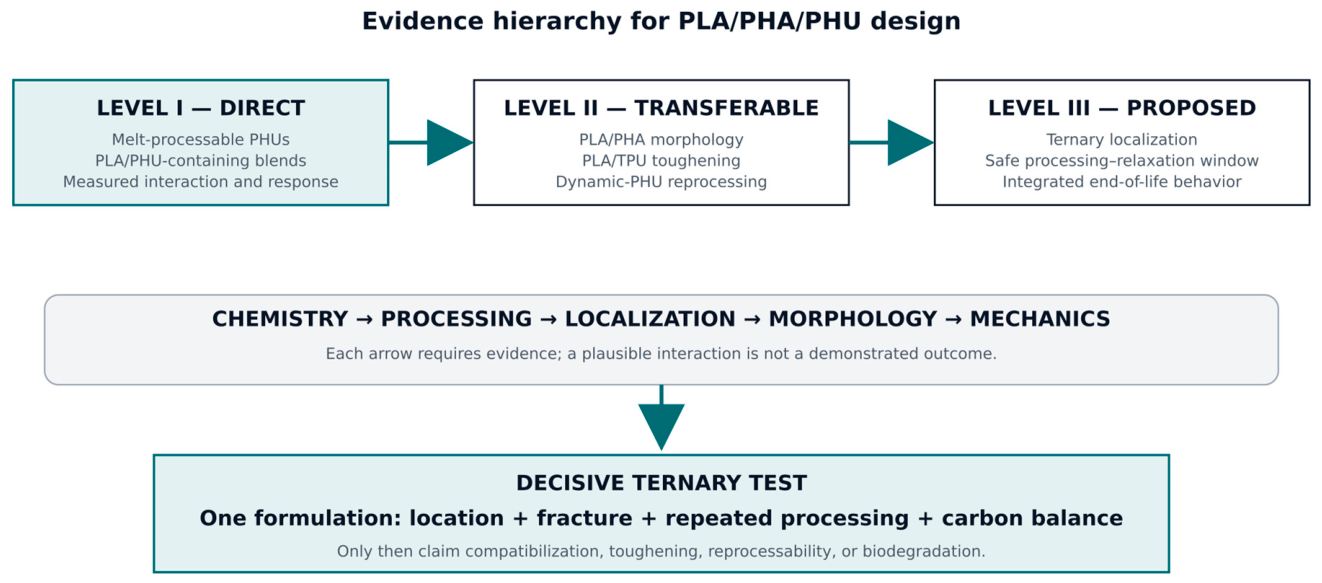
Figure 2.
Reaction scheme for linear PHU formation. A bis(five-membered cyclic carbonate) reacts with a diamine by ring-opening polyaddition to produce hydroxyurethane repeat units containing primary- and secondary-hydroxyl regioisomers. No small molecule is eliminated in the polymer-forming step. R and R′ represent the carbonate-derived and diamine-derived segments, respectively.
Figure 2.
Reaction scheme for linear PHU formation. A bis(five-membered cyclic carbonate) reacts with a diamine by ring-opening polyaddition to produce hydroxyurethane repeat units containing primary- and secondary-hydroxyl regioisomers. No small molecule is eliminated in the polymer-forming step. R and R′ represent the carbonate-derived and diamine-derived segments, respectively.
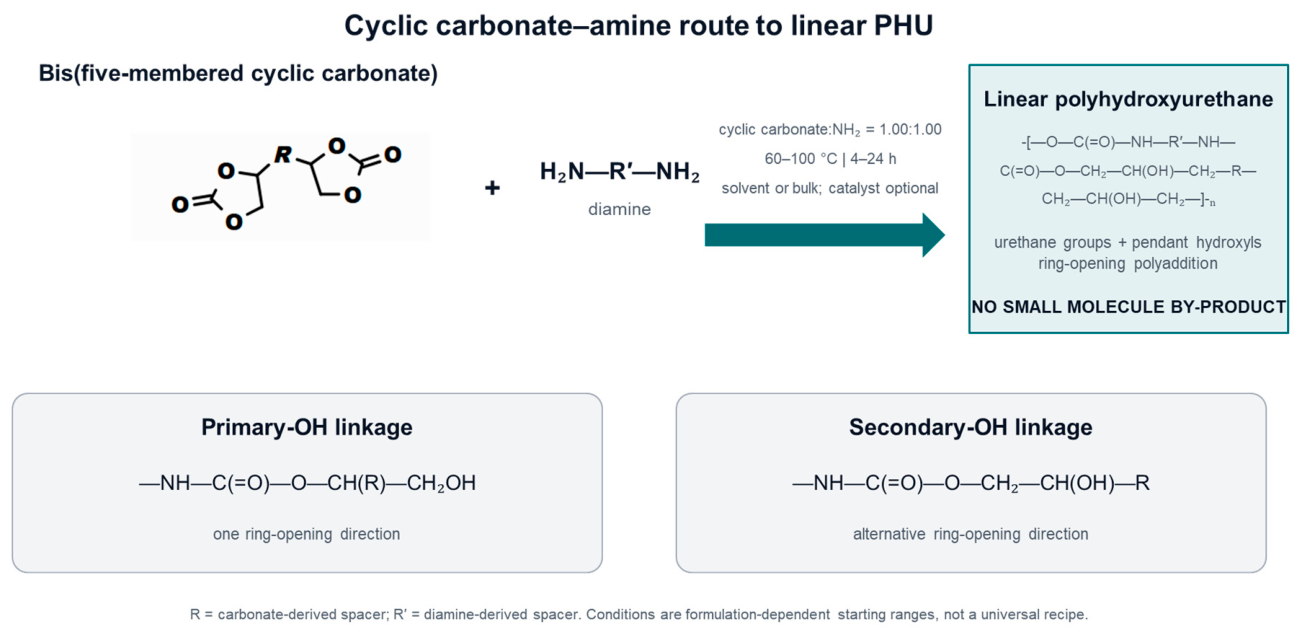
Figure 3.
Hierarchy of reversible behavior in PHU-containing materials. Ordinary thermoplastic flow and reversible hydrogen bonding do not require covalent exchange. Transcarbamoylation and disulfide metathesis can rearrange networks when demonstrated by stress relaxation and reprocessing. “Dynamic vulcanization” denotes morphology generation during reactive mixing and should not be interpreted as proof of reversible bonds. None of these mechanisms establishes biodegradation.
Figure 3.
Hierarchy of reversible behavior in PHU-containing materials. Ordinary thermoplastic flow and reversible hydrogen bonding do not require covalent exchange. Transcarbamoylation and disulfide metathesis can rearrange networks when demonstrated by stress relaxation and reprocessing. “Dynamic vulcanization” denotes morphology generation during reactive mixing and should not be interpreted as proof of reversible bonds. None of these mechanisms establishes biodegradation.
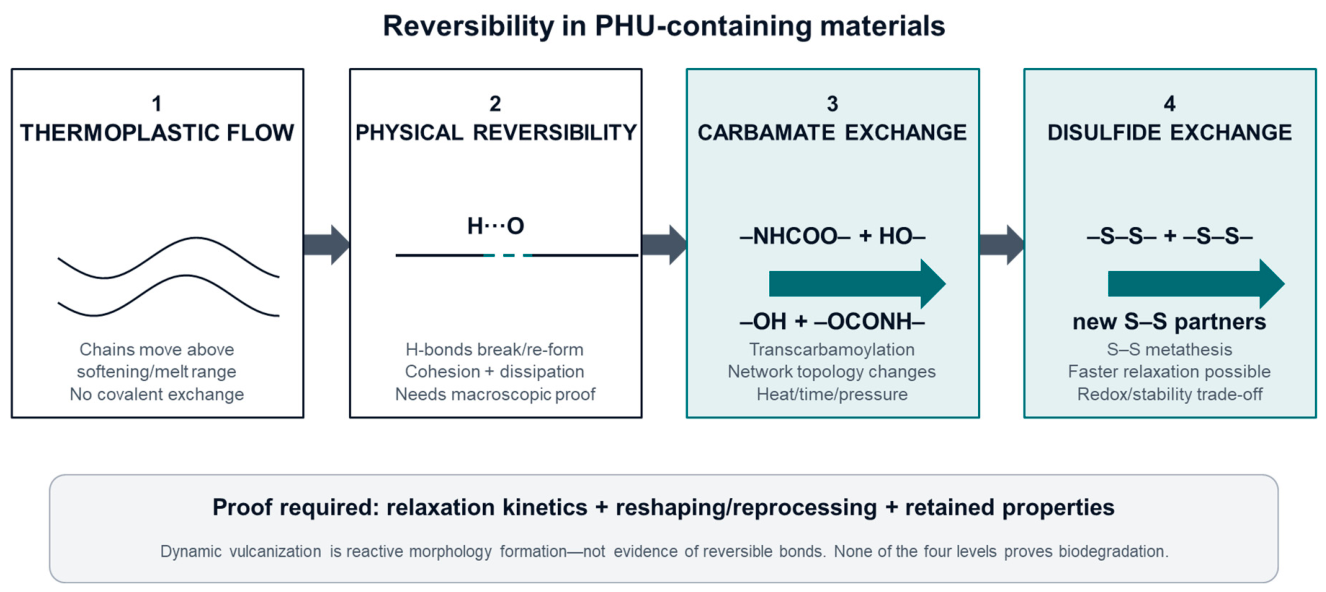
Figure 4.
Possible PHU localization states in a PLA/PHA blend. PHU dissolved in PLA can plasticize or toughen the PLA-rich phase; PHU dissolved in PHA alters the PHA phase; interfacial PHU can suppress coalescence and improve stress transfer; separate PHU droplets create a three-phase morphology. Processing sequence and viscosity can kinetically trap any of these states. The desired outcome must be verified experimentally.
Figure 4.
Possible PHU localization states in a PLA/PHA blend. PHU dissolved in PLA can plasticize or toughen the PLA-rich phase; PHU dissolved in PHA alters the PHA phase; interfacial PHU can suppress coalescence and improve stress transfer; separate PHU droplets create a three-phase morphology. Processing sequence and viscosity can kinetically trap any of these states. The desired outcome must be verified experimentally.
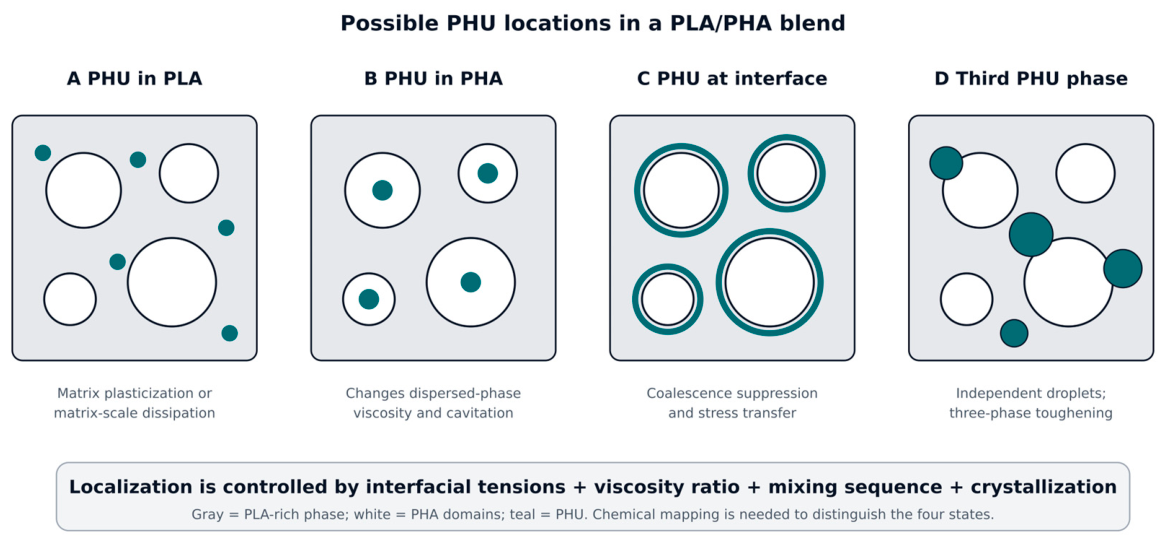

Table 1.
Evidence hierarchy used in this review.
| Evidence level | What is established | What can be inferred | What must not yet be claimed |
|---|---|---|---|
| I: Direct polyester/PHU evidence | Some thermoplastic PHUs can be melt processed; selected PHUs interact with and modify PLA-containing blends. | PHU architecture and hydrogen bonding can influence dispersion and PLA response. | That any PHU will compatibilize or toughen a specific PLA/PHA pair. |
| II: Transferable adjacent evidence | PLA/PHA and PLA/TPU studies identify morphology, interface, viscosity ratio, and crystallization as decisive variables; dynamic PHUs can relax and be reprocessed under defined conditions. | Similar mechanisms may guide PHU localization and energy dissipation in ternary blends. | That TPU results quantitatively predict PHU performance or that PHU-network reprocessing proves blend recyclability. |
| III: Proposed ternary design | A PHU may localize in one phase or at the interface and may stabilize morphology. | Tunable hard/soft balance and exchange chemistry could combine toughness with reprocessing. | Direct PLA/PHA/PHU compatibility, durability, repeated-cycle retention, or biodegradation without experiments. |
Table 2.
Selected quantitative benchmarks from direct PLA/PHA and transferable PLA/polyurethane literature. Values are not directly rankable because test standards, specimen geometry, conditioning, and processing differ.
Table 2.
Selected quantitative benchmarks from direct PLA/PHA and transferable PLA/polyurethane literature. Values are not directly rankable because test standards, specimen geometry, conditioning, and processing differ.
| System | Key formulation or variable | Reported response | Mechanistic lesson | Evidence for PHU design |
|---|---|---|---|---|
| PLA/PHA | 88/12 PLA/PHA filament | ≈50% higher toughness and ≈33% higher strain; ≈6% lower strength [10] | Partial miscibility can still yield useful property gains. | Binary controls are needed; “miscible” is not a prerequisite for improvement. |
| PLA/P(3HB-co-4HB)/ECO | 70/20/10 core–shell formulation | 270% elongation at break [30] | Localization and phase sequence control energy dissipation. | Map PHU location rather than assuming interfacial residence. |
| PLA/poly(ether)urethane | Melt-blended biodegradable elastomer | Fine domains and matrix shear yielding [35] | Domain deformation can activate PLA plasticity. | A soft PHU must disperse finely and remain deformable. |
| PLA/TPU | 80/20 | 350% elongation; 25 kJ m−2 impact strength [36] | Segmented polyurethane can strongly toughen PLA. | Defines a practical benchmark at comparable modifier loading. |
| PLA/TPSiU | 85/15 | 22.3% elongation; 19.3 kJ m−2 impact strength [39] | Toughening may occur despite poor thermodynamic compatibility. | Mechanical improvement must be separated from claims of compatibilization. |
| PLA/TPU/E–MA–GMA | PLA/TPU 70/30 with reactive modifier | 615% elongation; 53.6 kJ m−2 impact strength [40] | Cocontinuous-like morphology and interface control are decisive. | PHU functionality could aid interface control, but reaction must be demonstrated. |
| PLA/bio-PU | Dynamic vulcanization during melt mixing | 59.01 kJ m−2 impact; 43.97 MPa tensile strength [43] | Crosslinking and processing can stabilize highly tough morphologies. | Do not equate dynamic vulcanization with reversible exchange. |
| PLA/PU/DMA | 60/30/10; kinetic mixing versus extrusion | 27.6 kJ m−2 after kinetic mixing; >2× extruded value [44] | Mixing history can dominate composition. | Compare PHU formulations under matched thermal and shear histories. |
Table 3.
PHU synthesis and molecular-design variables relevant to thermoplastic polyester toughening.
Table 3.
PHU synthesis and molecular-design variables relevant to thermoplastic polyester toughening.
| Design variable | Practical options | Expected PHU effect | Blend-design implication | Main risk/control |
|---|---|---|---|---|
| Carbonate ring and substitution | Five-membered; more reactive six-membered; electron-withdrawing substituents | Controls aminolysis rate and regioselectivity [57,58] | Faster polymer formation may reduce thermal exposure. | Accessibility and monomer-synthesis burden; verify conversion. |
| Functional-group ratio | Carbonate:primary amine equivalents near 1:1 | Controls step-growth molar mass and end groups | High molar mass improves entanglement and migration resistance. | Account for purity/functionality; monitor residual amine. |
| Carbonate/amine functionality | ≈2 for linear; >2 for branched/network | Controls flow, gelation, cohesion | Linear PHUs are simplest melt tougheners; slight branching may stabilize morphology. | Gel fraction and loss of melt processability. |
| Long/short diamine ratio | Long flexible diamine with 0–40 mol% short diamine screening | Tunes Tg, H-bond density, modulus, crystallinity, viscosity | Seek a rubbery but cohesive PHU at service temperature. | Short diamine can make PHU too rigid or crystalline. |
| Pendant hydroxyl density/accessibility | Regioisomer distribution; monomer structure | Raises cohesion, polarity, adhesion, water uptake | May strengthen interaction with PLA/PHA carbonyls. | Self-association may dominate interfacial association. |
| Catalyst/solvent | Catalyst-free heat; polar solvent; TBD-assisted conditions | Alters rate, conversion, color, and purification [60,61] | High conversion is needed before melt blending. | Solvent/catalyst residue and sustainability burden. |
| Reversible bond design | None; transcarbamoylation; added disulfide | Controls relaxation/reprocessing of networks | Must operate within polyester-safe time/temperature window. | Exchange too slow at safe temperature or too fast in service. |
Table 4.
Reversible mechanisms in PHU materials and their limits as evidence for blend reprocessability.
Table 4.
Reversible mechanisms in PHU materials and their limits as evidence for blend reprocessability.
| Reversible mechanism | Material state | Demonstrated condition/response | What it can support | Critical caveat for PLA/PHA blends |
|---|---|---|---|---|
| Thermoplastic chain flow | Linear or sufficiently branched PHU | Melt flow/rheology and remolding in thermoplastic PHUs [65,66,67] | Conventional mechanical recycling and redispersion | No dynamic covalent bond is required; repeated heat may still degrade all components. |
| Hydrogen-bond rearrangement | Linear or networked PHU | Spectroscopic association plus temperature-dependent relaxation or mechanics | Reversible cohesion and energy dissipation | Hydrogen bonding alone does not prove healing, compatibility, or recyclability. |
| Transcarbamoylation | Covalent PHU network | ≈160 °C, pressure, extended time; partial recovery [75] | Network topology rearrangement | Relaxation may be too slow relative to extrusion and polyester stability. |
| Concurrent transcarbamoylation/aminolysis | PHU network | 140 °C, 1–2 h; full recovery over three cycles [76] | Reprocessing with strong property recovery | Neat-network evidence does not prove dispersed-phase exchange in a blend. |
| Architecture-dependent PHU exchange | PHU thermoset | Often >150 °C under pressure; catalyst-dependent response [78,82] | Reprocessing of selected formulations | Crosslink density, catalyst, and soft segment control both rate and final mechanics. |
| Disulfide exchange | Cystamine-containing NIPU network | Relaxation as short as ≈30 s at 150 °C; reprocessing at 130–150 °C [79,80] | Faster stress relaxation at lower temperature | Sulfur chemistry does not establish biodegradation and may change oxidation stability. |
Table 5.
Minimum evidence needed for reprocessing and end-of-life claims.
| Question | Minimum measurement | Necessary controls | Defensible conclusion | Common overclaim avoided |
|---|---|---|---|---|
| Does the blend survive reprocessing? | Molar mass/viscosity, morphology, thermal transitions, tensile and impact after each cycle | Neat PLA, neat PHA, binary PLA/PHA; identical drying and residence time | Property and morphology retention over defined cycles | “Recyclable” from one remolding experiment. |
| Does the PHU exchange or only flow? | Sol/gel fraction, rheology, stress relaxation, reprocessing under stated T/time/pressure | Linear PHU and nonexchangeable network controls | Specific mechanism and rate of relaxation | “Dynamic” from hydrogen bonds or dynamic vulcanization alone. |
| Does the specimen disintegrate? | Size/mass distribution and visual disintegration under ISO 20200-type conditions | Reference material, thickness-matched controls | Disintegration under specified simulated composting | “Biodegradable” from fragmentation. |
| Does the formulation biodegrade in compost? | CO2 evolution and theoretical-carbon conversion under ISO 14855-1 | Blank, cellulose/reference, neat components | Ultimate aerobic biodegradation under controlled composting | “Compostable” without mineralization/ecotoxicity evidence. |
| Does it biodegrade in soil? | O2 demand or CO2 evolution under ISO 17556 plus residual analysis | Abiotic blank, reference, neat components | Ultimate aerobic soil biodegradation under test conditions | “Soil biodegradable” from mass loss or strength loss. |
| Which phase remains? | Residual mass and chemical composition; extract/degradation-product analysis | Neat PHU/PLA/PHA signatures | Phase-selective persistence or conversion | Assuming the PHU follows PLA/PHA behavior. |
Table 6.
Proposed gated research program for PLA/PHA/PHU materials.
| Gate | Core question | Minimum experiments | Decision criterion | Principal risk and mitigation |
|---|---|---|---|---|
| 1. PHU chemistry | Is the modifier a dry, high-conversion thermoplastic with suitable Tg and viscosity? | NMR/FTIR conversion, SEC, DSC, TGA, DMA, rheology, sol/gel fraction | Reproducible synthesis; Tg below use temperature; no gel unless intended; stable in blend window | Slow/low conversion: verify equivalents and dryness, then optimize solvent/T/catalyst in model scale. |
| 2. Localization | Where does PHU reside, and is morphology stable? | SEM/TEM or AFM, selective extraction/chemical mapping, rheology; one-step vs sequential mixing | Reproducible domain refinement or useful localization without major polyester molar-mass loss | Coarse third phase: adjust PHU molar mass/diamine ratio, loading, viscosity ratio, or sequence. |
| 3. Toughening | Does morphology activate energy dissipation? | Notched impact, tensile, cyclic loading, DMA, fracture microscopy | Strong impact gain with declared strength/modulus retention and stable conditioning response | Plasticization without impact benefit: increase cohesion or create discrete deformable domains. |
| 4. Reprocessing | Are mechanics, molar mass, and morphology retained? | Three controlled cycles; SEC/viscosity, MFR/rheology, DSC, microscopy, tensile/impact | Predefined retention over cycles relative to binary controls | Chain scission: improve drying, reduce residence time/T, remove residual amine/catalyst, consider stabilizer. |
| 5. End-of-life | What mineralizes and what remains? | ISO 14855-1 or ISO 17556 respirometry, ISO 20200 disintegration as separate test, residual analysis | Carbon balance and phase-specific conclusion | PHU residue: narrow claim, reduce loading/redesign chemistry, or prioritize recycling-first route. |
Disclaimer/Publisher’s Note: The statements, opinions and data contained in all publications are solely those of the individual author(s) and contributor(s) and not of MDPI and/or the editor(s). MDPI and/or the editor(s) disclaim responsibility for any injury to people or property resulting from any ideas, methods, instructions or products referred to in the content. |
© 2026 by the authors. Licensee MDPI, Basel, Switzerland. This article is an open access article distributed under the terms and conditions of the Creative Commons Attribution (CC BY) license.
Copyright: This open access article is published under a Creative Commons CC BY 4.0 license, which permit the free download, distribution, and reuse, provided that the author and preprint are cited in any reuse.