

Submitted:
01 September 2026
Posted:
02 September 2026
You are already at the latest version
Abstract
Background/Objectives: Person-centered plans are a cornerstone of Medicaid Home and Community-Based Services (HCBS); however, PCP practices and documentation formats vary across states and service systems. Translating PCP principles into documents that individuals with intellectual and/or developmental disabilities can readily access, understand, use, and share in everyday life remains challenging. Methods: Guided by Inclusive Arts Practice and Universal Design for Learning frameworks, we developed the Creative Café, a flexible, arts-based story gathering model for eliciting and documenting personal narratives in formats that are person-centered, inclusive, and responsive to diverse communication needs. The Creative Café uses a three-step process: (1) foundation building, (2) idea exploration, and (3) creative synthesis, to support the development of individualized visual books. Creative Café: My Essence of Community Living communicates essential health, personal, and cultural information to support community living. This proof-of-concept study evaluated the feasibility and preliminary outcomes, using workshop implementation records, participant feedback, and facilitator reflections (n = 20), complemented by a qualitative case study with pre- and post-workshop interviews (n = 7). Narrative analyses examined changes in participants' ability to express, organize, and advocate for their personal stories. Results: The evaluation showed that the Creative Café provided a flexible format through which participants can communicate personally meaningful information using multiple forms of expression. Participants’ narrative analysis showed descriptive increases in both content and thematic elaboration across several community-living domains. Conclusions: These suggest that the Creative Café is a promising approach for supporting communication, self-expression, and self-advocacy within person-centered planning.
Keywords:
intellectual and/or developmental disabilities (IDD)
; person-centered planning
; inclusive arts practice
; universal design for learning (UDL)
; home and community-based services (HCBS)
1. Introduction
Person-Centered Planning (PCP) is a foundational approach for supporting individuals with intellectual and/or developmental disabilities (IDD) in identifying their preferences, strengths, goals, relationships, and support needs. PCP documents are required for individuals with IDD who receive Home and Community-Based Services (HCBS) funded through state Medicaid plans and other waiver programs [1]. These documents are intended to guide individualized support for promoting choice, community participation, and quality of life. Federal guidance, including the National Center on Advancing Person-Centered Practices and Systems (NCAPPS) recommendations, emphasizes strengths-based, whole-person approaches that recognize individuals' culture, identity, relationships, preferences, and right to choice and control [2]. However, PCP practices and documentation formats vary across states and service systems. Translating person-centered principles into documents that individuals can readily access, understand, use, and share in everyday life remains challenging.
This challenge is particularly important as adults with IDD live longer and increasingly experience transitions in health, relationships, living arrangements, and support networks [3]. Many adults with IDD experience premature or accelerated aging and higher rates of chronic and comorbid health conditions, while also encountering barriers to healthcare access and communication [4,5,6,7]. Changes in residential settings or support teams may further increase the need to communicate personal preferences, routines, health information, relationships, and support needs to new caregivers and service providers. Historically, family members and other long-term supporters have often held much of this personal knowledge. However, as individuals outlive or transition away from these lifelong support relationships in their adulthood, there is a growing need for accessible approaches that enable the individual to communicate information that is important to adjust and maintain their health. Individualized, person-centered planning for health care needs and supports as they age builds upon personal and cultural identities, historical health records, and preferences in community living.
Although PCP documents can help coordinate support and promote individual choice and community integration [8,9,10], conventional documentation is frequently text-based and developed primarily for use by service systems and professional care teams. Written formats may not adequately accommodate the diverse communication, learning, cognitive, sensory, and expressive preferences of individuals with IDD. Consequently, information that is important to the person may remain difficult for the person to access, update, interpret, or communicate with others. An accessible PCP approach can extend beyond documenting service needs to support individuals as active authors, owners, and users of their stories.
1.1. Person-Centered Planning
PCP emerged in the United States during the 1980s as an approach to improving the quality of life and community participation of individuals with IDD [6,7,8]. Rather than beginning with available services or deficits, PCP places the person at the center and seeks to identify the life the person wants, the relationships and activities that are meaningful to them, and the supports needed to pursue those goals. Contemporary person-centered practice emphasizes several interconnected principles, including a strengths-based and whole-person perspective; attention to culture and identity; cultivation of natural and professional community connections; respect for rights, choice, and control; and collaborative development and ongoing monitoring of the person's plan [2].
These principles suggest that the process of developing a PCP document may be as important as the document itself. Meaningful person-centered documentation requires opportunities for individuals to explore their experiences, identify what matters to them, and communicate those experiences in ways that reflect their preferred forms of expression. Many PCP approaches and systems promote collaborative development with the person and their support network. However, these approaches still rely heavily on traditional written and spoken literacy skills. The final output, the PCP plan document, may not be accessible for day-to-day use as the person navigates community life. For individuals with diverse communication and learning needs, providing multiple pathways for expression makes information that is difficult to capture through conventional interviews or written formats more visible and usable.
1.2. Inclusive Arts Practice
Inclusive Arts Practice provides a conceptual foundation for creating such opportunities. Fox and Macpherson describe Inclusive Arts Practice as a reciprocal creative collaboration between people with and without intellectual disability in which all participants contribute to and learn from the creative process [11]. Rather than positioning people with intellectual disability primarily in terms of their needs or limitations, the approach recognizes them as contributors whose lived experiences, ideas, and forms of expression can shape the collaborative process and its products.
Several principles of Inclusive Arts Practice are particularly relevant to person-centered story gathering: establishing supportive foundations; approaching the process as a shared journey; allowing sufficient time; providing choices and freedom; building trusting relationships; remaining open to multiple forms of communication and expression; and reflecting throughout the process [9]. These principles create opportunities for participants to communicate through drawings, photographs, symbols, gestures, words, and other creative forms. Applied to PCP, an inclusive arts approach allows us to imagine how the PCP process and document may look [9]. Therefore, it may help shift documentation from a professionally produced record about a person more toward a collaboratively created representation authored and curated with and by the person.
1.3. Universal Design for Learning
Universal Design for Learning [UDL: 12] provides a complementary framework for structuring the learning and communication environment in which story gathering occurs. UDL emphasizes flexible approaches that anticipate variability among learners and provide multiple means of engagement, representation, and action & expression [12]. Although originally developed in the educational field, these principles apply to collaborative health and social service contexts in which individuals with different communication, cognitive, sensory, and learning preferences participate and work toward shared goals.
In the Creative Café, UDL principles were applied to both the process and the products of story gathering. Participants were offered multiple ways to engage with topics, receive and represent information, and communicate their responses. Individuals with and without IDD were positioned as partners in a shared process of exploring, documenting, and organizing information about the centered person. This approach recognizes that accessibility is not solely a characteristic of physical space and materials; it is also a characteristic of the social and cultural environment, interactions, and formats through which information is exchanged.
1.4. The Creative Café
Drawing on Inclusive Arts Practice and UDL, we developed the Creative Café as a flexible, adaptive, arts-based story-gathering model for creating accessible person-centered documentation. The model uses a streamlined process of establishing foundations, exploring and expanding ideas, and creatively synthesizing information into a tangible product. During this process, rather than relying exclusively on conventional written responses, the Creative Café incorporates multiple forms of engagement, communication, and creative expression opportunities and mediums, including photographs, drawings, symbols, logos, and gestures. These ensure acknowledgement and documentation of their expressions used in their creative synthesis.
The resulting product, Creative Café: My Essence of Community Living, is an individualized visual story book designed to communicate information that is important to the person's health, identity, relationships, preferences, routines, culture, safety, and community participation. The model is not intended to replace formal Medicaid PCP documentation but to provide an accessible, person-centered complement that can help individuals communicate information about themselves to family members, caregivers, service providers, healthcare professionals, and others involved in their lives. The benefits are to promote and maintain healthy and meaningful community living.
1.5. Purpose of the Present Study
This proof-of-concept study evaluated the feasibility and preliminary outcomes of the Creative Café as an arts-based approach to accessible, person-centered story gathering for adults with IDD. The evaluation used a two-phase developmental design. Phase 1 focused on feasibility, applicability, acceptability, and iterative refinement of the curriculum and materials across community-based implementation settings, including adaptation for Spanish-speaking participants. Phase 2 piloted the refined eight-module curriculum and examined preliminary changes in participants' ability to express, organize, and communicate meaningful information about their lives, relationships, health, safety, and support needs through pre- and post-workshop interviews.
2. Materials and Methods
2.1. Study Design
We conducted a two-phase proof-of-concept evaluation of Creative Café: My Essence of Community Living. Phase 1 (n = 20) focused on feasibility, applicability, acceptability, and iterative refinement of the curriculum and materials across two community-based settings. Findings from Phase 1 informed modifications to the curriculum, facilitation strategies, and materials before the Phase 2 pilot. Phase 2 (n = 7) piloted the refined eight-module curriculum and examined preliminary outcomes using pre- and post-workshop interviews.
2.2. Research and Implementation Team
The research and implementation team included a community-based social and behavioral scientist with mixed-methods research expertise, a program evaluation and mixed-methods researcher with a social work background, a graduate student with arts-based research expertise, two undergraduate research assistants, and an art professional with intensive community-based service experience. Team members collaborated on curriculum development and refinement, workshop implementation, collection of feasibility and participant feedback, and interpretation of findings. Three team members conducted the narrative analysis for the Phase 2 pilot.
2.3. Ethical Considerations
The study protocol and materials were reviewed and approved by the University Institutional Review Board as a minimal-risk human subjects study (STUDY00002331). Consent and assent procedures were designed to support accessible decision-making via application of plain language and teach-back technique to ensure maximum opportunities for potential participants to understand the nature of the study before they decided to participate. When a legal representative was involved, guardian consent was obtained before participant assent and study procedures.
2.4. Creative Café Intervention
The Creative Café curriculum was designed as an eight-module workshop series, with each module lasting approximately 90 min. The modules addressed domains of information relevant to person-centered community living:
- Communication and Learning
- Communities and Connections
- Roles and Leadership Styles
- Strengths and Challenges
- Good Days and Bad Days
- Safety Plan
- Routines
- Culture and Celebrations
Each module incorporated a brief slide-based introduction, plain-language prompts, visual supports, and structured worksheets designed to accommodate multiple modes of communication and expression. Participants could use photographs, drawings, symbols or logos, gestures, and short written phrases to communicate their ideas.
Each session followed the Creative Café's three-step process: (1) foundation building, (2) idea exploration, and (3) creative synthesis. First, facilitators introduced the topic and established shared vocabulary using visual support and accessible prompts. Second, participants explored and expanded their ideas through worksheets, creative media, and facilitated group dialogue. Activities and materials were adapted to participants' communication and learning preferences. Third, participants, often with a supporter, synthesized selected information into tangible storybook pages. These pages were assembled into Creative Café: My Essence of Community Living, an individualized visual book designed to help participants communicate who they are, what is important to them, and what supports they need to maintain health, quality of life, and community participation.
2.5. Procedures and Iterative Curriculum Development
2.5.1. Phase 1: Feasibility, Applicability, Acceptability, and Curriculum Refinement
Phase 1 included 20 adults with IDD who participated in two community-based programs. The first collaboration was with a local therapeutic recreation program. The project team implemented the initial four modules, modules 1, 2, 4, and 5 (60 minutes per session), over eight weeks during summer 2022. Program instructors and assistants (n = 4) and program leaders (n = 2) provided feedback regarding content appropriateness, delivery strategies, group discussion, and the creative synthesis process. Facilitator observations and partner feedback were documented and used to iteratively modify activities, supporting materials, and curriculum flow. The Phase 1 process ultimately informed the Creative Café's three-step process (1) foundation building, 2) idea exploration, and 3) creative synthesis) and the development of the eight-module curriculum used in Phase 2. Three modules, Communication and Learning, Personal Safety Plan, and Culture and Celebrations, were added based on Phase 1 feedback and identified needs, resulting in the final eight-module curriculum.
The second collaboration was with DISCAPAZ, a Spanish-speaking borderland digital story-gathering program serving adults with disabilities. This collaboration provided an opportunity to examine the feasibility and cultural and linguistic adaptability of the Creative Café curriculum and materials in a Spanish-speaking, US/Mexico borderland community. Selected modules, modules 1-5 and 8 (two modules per 90-minute session, over three 90-minute sessions, over two months in 2023), were translated and adapted collaboratively with program leadership. Attention was paid to accessible language, cultural relevance, and the usability of visual and creative materials. Feedback from this implementation informed subsequent refinement of the curriculum and supporting materials.
2.5.2. Phase 2: Pilot Implementation and Preliminary Outcomes
Phase 2 included seven participants recruited through two community-based day-program sites, implemented between 2023 and 2024. Participants participated in separate group cohorts using the refined eight-module Creative Café curriculum. Pre- and post-workshop interviews were conducted to examine preliminary changes in participants' ability to communicate personally meaningful information. Interview questions addressed participants' identities, important relationships, meaningful places and activities, health and safety, and everyday support needs through six structured questions.
2.6. Recruitment and Enrollment
Phase 1 participants were recruited through the partnering community programs (a local parks and recreation summer camp and DISCAPAZ hosted by the local University Center for Excellence in Disabilities), which introduced the Creative Café as an opportunity to support social connection, engagement, and community participation.
For Phase 2, partner community day-program staff distributed recruitment materials and consent documents to eligible participants and caregivers or legal representatives, as appropriate. Interested individuals completed a web-based interest survey to facilitate scheduling. A group Zoom meeting was conducted to introduce the study, review consent materials, and provide opportunities for questions.
To support accessible decision-making, teach-back questions were used throughout the consent process. Following the group meeting, individual Zoom appointments were scheduled for intake, consent/assent, and pre-workshop evaluation activities. Consent materials were provided in advance to participants and guardians or family members, when appropriate. If an individual was unable to demonstrate sufficient understanding of the study after accessible explanations and repeated teach-back opportunities, the individual was not enrolled in the study. These individuals could participate in the Creative Café workshop without being involved in the data collection (pre- and post-workshop interviews).
2.7. Data Sources
Data sources for the proof-of-concept evaluation included:
- Partner and program staff feedback regarding curriculum appropriateness, delivery, and adaptations;
- Workshop implementation records, including attendance and engagement documentation;
- Participant workshop products, including completed worksheets and individualized story-book pages;
- Facilitator observation notes and reflections; and
- Pre- and post-workshop interviews conducted with Phase 2 participants.
The interviews included six structured questions addressing participants' identities, important relationships, meaningful places, meaningful activities and things, health and safety, and everyday support needs. Questions were intentionally broad and allowed participants to respond using their preferred communication modes, with facilitator support as needed.
2.8. Data Analysis
2.8.1. Phase 1 Feasibility Analysis
Feasibility, applicability, and acceptability were examined descriptively using implementation records, partner and staff feedback, workshop products, and facilitator observations and reflections. The analysis focused on the appropriateness of curriculum content, accessibility of activities and materials, participant engagement, feasibility of group facilitation, and the usefulness of the creative synthesis process. Feedback and observations were incorporated iteratively into subsequent sessions and curriculum revisions. Particular attention was given to the feasibility of adapting materials and activities for Spanish-language implementation.
2.8.2. Phase 2 Narrative Analysis
For the Phase 2 pilot evaluation, we adapted a narrative quality-elements approach to examine preliminary changes in participants' ability to express, organize, and communicate meaningful stories from pre- to post-workshop interviews. Interviews were audio-recorded, transcribed, and analyzed using an adapted chart and instructions based on the Narrative Coherence Coding Scheme [NaCCS: 13].
Responses to matched pre- and post-workshop interview prompts were treated as participant-level narrative units. The excerpted appropriate narrative transcripts were compared and coded side-by-side. Two dimensions of narrative expression were examined: contextual specificity and thematic elaboration. Contextual specificity reflected the number and variety of contextual items provided in a response, such as people, places, activities, or situational information. Thematic elaboration reflected the extent to which participants developed or expanded the meaning of their responses and was rated on a four-point scale from 0 (no identifiable content) to 3 (substantially elaborated response). The adapted coding scheme and instructions are presented in Table 1.
Pre- and post-workshop scores were compared within participants to examine changes in narrative expression. Two researchers extracted appropriate narrative transcripts in the coding forms and confirmed the accuracy for all 7 interviews together. Two coders independently rated the transcripts, met regularly to compare their ratings and refine coding instructions to improve the inter-rater agreement. Through this iterative process, we achieved an inter-rater agreement of 100%. Quantitative changes in scores were interpreted descriptively to illustrate changes in participants' ability to communicate personally meaningful information.
3. Results
3.1. Phase 1: Feasibility and Iterative Curriculum Development
Ten participants engaged in workshop activities and completed worksheets and scrapbook materials. Participants generally completed activities within the planned eight weekly, 60-minute sessions. Two participants missed one session each during the eight-session sequence and subsequently completed the missed materials before the following session with the program support staff's assistance.
Implementation feedback and facilitator reflections identified three adaptations that supported feasibility. First, pacing needed to be responsive to participants’ literacy, communication, attention, and support needs, and this should be reflected in session pacing and scheduling. Each module can be divided into multiple sessions if needed, with foundation-building and idea development completed first and creative synthesis completed in a subsequent session. Some topics may require more time than others. Second, module selection was most effective when determined collaboratively based on program goals and the priorities and interests of the participant group. Third, worksheet completion and scrapbook development required substantial support from family members, volunteers, or program staff. For some participants, gathering information from supporters before the session enhanced engagement by incorporating relevant visual representations and items (e.g., photographs, pictures, and magazines) related to the topic. Lastly, providing supporters with basic information about participants’ communication styles, behavioral preferences, and effective engagement strategies facilitated their participation in the story-gathering and creative-synthesis processes.
The Creative Café was also implemented with 10 participants through DISCAPAZ, a Spanish-speaking borderland digital story-gathering program. This implementation supported the feasibility of translating and adapting the curriculum and materials for a Spanish-speaking community.. Eight participants were from Nogales, Sonora, and two were from Nogales, Arizona. The adapted program used three 90-minute sessions by combining two modules per session, providing group-selected topics: modules1-5 and 8. Two participants missed one session each but independently completed the missed materials before the subsequent session. Six participants also used the Creative Café process to contribute to additional digital-story development as they collected, organized, and expanded their personal stories as a sequential project.
Drawing on facilitator observation and reflection notes, workshop participation records and developed products (worksheets and scrapbook pages), we found that iterative refinement across both implementation settings improved the Creative Café’s feasibility and acceptability. Participants engaged actively through group learning, dialogue, and creative expression, and all completed an individual PCP storybook. Participants across cohorts often personalized their books independently and shared these additions in subsequent sessions. Overall, these findings indicate that the Creative Café can be delivered in community-based group settings while remaining flexible These adaptations informed the final curriculum and materials used in Phase 2.
3.2. Creative Café Curriculum and My Essence of Community Living
The Phase 1 Creative Café Curriculum refinement process identified several practices that strengthened the Creative Café process.
During the foundation-building step, each module was supported by a brief slide deck of approximately four to six slides presenting key concepts, images, and terms. The slide presentations were most useful when used to initiate dialogue rather than as didactic instruction. Facilitators assessed participants’ existing knowledge, introduced relevant examples, and used interactive activities to expand understanding.
During the idea-development step, plain-language worksheets containing approximately two to six topic-specific questions helped focus discussion while allowing participants to expand on their meaningful experiences. The worksheets also provided a concrete means of documenting and reviewing participants’ ideas with supporters. Group discussion further enhanced story gathering, as peers sometimes helped one another recall preferences, experiences, relationships, and meaningful details.
The creative-synthesis step was more individualized. After reviewing information gathered through the worksheets and group discussions, participants selected the information they considered most important and determined how they wanted to represent it. A scrapbook format using clear section titles was retained as the primary format because it supported usability for both the creator and the viewer. Based on Phase 1 experience, a table of contents with identifiable section tags was added to improve navigation of the completed book.
Iterative implementation also resulted in expansion of the curriculum. Three additional modules were incorporated into the final curriculum(Roles and Leadership Styles, Personal Safety Plan, and Traditions and Celebrations). The Roles and Leadership Styles module broadened the representation of participants’ strengths beyond functional abilities by highlighting how participants contributed to their communities and relationships. The Personal Safety Plan module extended the Good Days and Bad Days content by providing a practical approach to identifying and responding to distress or crisis. Traditions and Celebrations was added because cultural practices, personal traditions, and routines emerged repeatedly during story gathering. This dedicated module allowed the scrapbook to represent participants’ identities and community lives beyond a medical or service-oriented perspective.
3.3. Phase 2: Pilot Implementation and Preliminary Outcomes
Phase 2 was implemented with seven participants. Pre- and post-workshop semi-structured interviews were used to examine preliminary outcomes in two areas: (1) development of an individualized person-centered scrapbook representing each participant’s essence of community living and (2) changes in participants’ ability to describe people, places, activities, health and safety priorities, and everyday supports that were important to them.
3.3.1. Individualized My Essence of Community Living Scrapbooks
All Phase 2 participants completed an individualized person-centered scrapbook. The books were assembled in three-ring binders with clear sleeves, allowing pages to be added as participants completed each module. The length, content, and format of the books varied according to participants’ preferences and communication styles. Some participants provided extended written responses, whereas others communicated through key phrases, worksheet excerpts, photographs, magazine cutouts, stickers, and personal drawings.
The individualized format allowed participants to emphasize different aspects of their lives and select the information they considered most important to communicate. A table of contents was added to each scrapbook based on Phase 1 findings to improve navigation and usability. To see case examples, please see our visual essay: Amplifying the Voices of Individuals with Intellectual and/or Developmental Disabilities Through Scrapbook Narrative [14].
3.3.2. Changes in Participants’ Narrative Expression
Descriptive analysis of coded pre- and post-workshop interview transcripts showed an increase in the number of distinct items mentioned in five of the six community living domains. There was an increase in the degree of thematic elaboration for four domains (1 to 3 rating scale), with higher scores indicating more detailed responses conveying or implying personal meaning. See Table 2 and Figure 1 and Figure 2 for mean-level changes in content and thematic elaboration of participants’ narratives across community-living domains.
The largest increases in the narrative content were observed for everyday support needs and meaningful places, followed by health and safety, identity, and important relationships. The greatest increases in the thematic elaboration were observed for meaningful places and everyday support needs, while smaller increases were observed for important relationships and identity.
Taken together, these descriptive findings indicate that participants provided broader and more elaborated responses following participation in the Creative Café.
4. Discussion
4.1. Principal Findings
Across the Phase 1 and the Phase 2 pilot, the Creative Café demonstrated feasibility and adaptability across community-based settings, including a therapeutic recreation program, day-program settings, and a Spanish-speaking U.S.–Mexico border community digital story-gathering program. The Creative Café’s three-step structure: (1) foundation building, (2) idea exploration, and (3) creative synthesis, provided a framework for facilitators. Activities, pacing, and communication support can be adapted to meet participants’ needs and program priorities. Facilitator and partner feedback and reflections further indicated that individualized, responsive facilitation, informed by Inclusive Arts Practice and Universal Design for Learning (UDL), was important for maintaining a person- and group-centered process. Module selection, session pacing, and facilitation strategies were most effective when aligned with participants’ interests and communication needs and with the goals of participating organizations/programs.
In the Phase 2 pilot, descriptive analyses showed increases in both the breadth and thematic elaboration of participants’ narratives across several community-living domains. The increase in the number of items for meaningful places and everyday support needs is particularly important for adults with IDD, who often experience changes in primary caregivers, advocates, residential settings, and support networks across adulthood. The thematic elaboration of these two domains can help individuals and their supporters maintain continuity in community living and recognize changes that may require additional support.
Important relationships and meaningful activities/ things had relatively higher levels of content at baseline, which may have contributed to the smaller observed changes in these domains. Content related to health and safety also increased following participation, although thematic elaboration in this domain did not show a corresponding increase. This finding suggests an opportunity for further refinement of the curriculum, which may include a more detailed discussion of health and safety information. Such attention may be especially important as primary caregivers age and take on responsibility for supporting transitions of support among siblings, paid caregivers, community providers, or other designated decision-makers.
4.2. Integrating Inclusive Arts Practice and Universal Design for Learning
The Creative Café integrates Inclusive Arts Practice and UDL to reframe person-centered planning as a process of collaborative story gathering and creation. Inclusive Arts Practice emphasizes reciprocal participation, choice, multiple forms of expression, and recognition of people with intellectual disability as active contributors to creative processes [9].
This approach shifts attention from simply obtaining information about a person to creating conditions in which individuals can explore, organize, and communicate information about themselves. The resulting scrapbook is therefore not simply a record produced by a service provider; it is a tangible representation shaped through the participant’s choices, communication style, experiences, and priorities.
Together, Inclusive Arts Practice and UDL provided complementary principles for designing both the process and the product of person-centered story gathering. Inclusive Arts Practice emphasized participation, choice, collaboration, and creative expression, whereas UDL supported flexibility and accessibility in how participants engaged with information and communicated their ideas. Their integration may be particularly useful for person-centered approaches involving individuals with diverse communication and learning preferences.
4.3. Implications for Person-Centered Planning and Community-Based Support
Creative Café: My Essence of Community Living is not intended to replace formal person-centered plans required within Medicaid-supported services but serves as a complementary tool that expands the information available for person-centered planning and support. Conventional service documentation necessarily focuses on goals, services, support, and health or safety considerations. The Creative Café provides an additional opportunity to capture information that may be less visible in conventional service documentation.
This broader view may be particularly relevant for individuals with IDD who are supported by teams that include both clinically trained and non-clinically trained individuals. Family members, direct support professionals, residential staff, community program staff, healthcare professionals, volunteers, and other supporters may each hold different pieces of knowledge about the person. A shared, accessible representation of what is important to the person may help establish a more comprehensive understanding of their usual routines, relationships, preferences, communication patterns, and support needs. Establishing this baseline may also help supporters recognize changes over time that warrant further attention, including changes in physical health, emotional well-being, behavior, relationships, routines, or environmental circumstances.
The Creative Café may therefore have applications beyond the creation of an individualized visual book. Potential applications include supporting HCBS person-centered planning, facilitating communication between individuals and support providers, preparing information for healthcare encounters, supporting transitions between caregivers or service settings, and promoting community participation and social connection. The model may also provide a structured framework for volunteers, students, and community partners to learn about and support individuals in ways that are grounded in the person's own priorities and forms of expression.
The Spanish-language implementation with DISCAPAZ further suggests potential for linguistic and cultural adaptation. Although this implementation was primarily used to examine feasibility and adaptation rather than to evaluate comparative outcomes, the experience demonstrated the value of translating and adapting both curriculum content and supporting materials for a Spanish-speaking community context. Future work should examine how the model can be adapted for other linguistic, cultural, and community contexts while maintaining its core principles of person-centeredness, accessibility, and participant choice.
4.4. Limitations and Future Research
This proof-of-concept study has several limitations. First, the Phase 2 pilot included only seven participants and did not include a comparison group. The observed pre- to post-workshop changes should therefore be interpreted as descriptive and preliminary rather than as evidence of intervention effectiveness. The small sample also limits generalizability to the broader population of adults with IDD.
Second, the study involved a small research and facilitation team, and facilitators were closely involved in curriculum implementation, observation, and reflection. Facilitator influence may therefore have contributed to participants’ engagement or to the observed changes in narrative expression. Future studies could incorporate independent evaluators or additional analytic perspectives to reduce potential researcher effects.
Third, participants varied in their communication styles and support needs, and the Creative Café intentionally allowed substantial flexibility in facilitation and modes of expression. Although this flexibility is central to the model, it also introduces variability in implementation that may make standardized evaluation challenging. Future research should identify which elements of the Creative Café are essential to the intervention and which can be flexibly adapted to individual and program needs.
Fourth, the Phase 2 evaluation focused on immediate changes in narrative expression and development of the individualized scrapbook. It did not examine whether participants continued to use the books over time, whether supporters incorporated the information into formal person-centered planning or healthcare encounters. It is unknown if the intervention resulted in changes in health outcomes, community participation, self-advocacy, or quality of life. Longitudinal research is needed to determine whether the Creative Café produces sustained benefits and how the resulting documentation is used in real-world support systems.
Future studies should evaluate the Creative Café with larger and more diverse samples and, where appropriate, comparison or controlled designs. Research should also examine implementation across HCBS and healthcare settings, the usability of the visual books by participants and support teams, sustainability of the approach, and outcomes related to communication, self-advocacy, healthcare engagement, community participation, and quality of life. Additional research should examine Spanish-language and other linguistic and cultural adaptations to determine how the model can be implemented across diverse communities.
5. Conclusions
The Creative Café demonstrated feasibility as an arts-based, person-centered approach for gathering and documenting information that is meaningful to adults with IDD. Informed by Inclusive Arts Practice and UDL, its three-step process extends person-centered planning beyond documentation of health and service needs to include narratives of identity, relationships, preferences, meaningful places and activities, health and safety, and everyday support needs.
The individualized My Essence of Community Living books provided a flexible format through which participants could communicate personally meaningful information using multiple forms of expression. These preliminary findings suggest that the Creative Café is a promising approach for supporting communication, self-expression, and self-advocacy within person-centered planning. Larger and more diverse studies are warranted to determine its effectiveness, sustainability, and potential integration into HCBS, healthcare, and other community-based support settings.
Supplementary Materials
The following supporting information can be downloaded at https://www.mdpi.com/article/doi/XX, Table 1: Adapted Narrative Coherence Coding Scheme Coding Table; Table 2: Changes in Content and Thematic Elaboration of Participants’ Narratives Across Community-Living Domains; Figure 1: Average Change in Narrative Content Across Participants (n=7); Figure 2: Average Change in Narrative Elaboration Across Participants (n=7).
Author Contributions
Conceptualization, Y.S.; methodology, Y.S. and L.T; formal analysis and reliability, Y.S. and L.T., and R.L; resources, Y.S.; data curation, Y.S., L.M. and R.L.; writing—original draft preparation, Y.S. and L.M.; writing—review and editing, Y.S. and L.T.; visualization, Y.S.; supervision, Y.S.; project administration, Y.S. & E.V.; workshop material development; Y.S. and M.R.; workshop implementation: Y.S., E.V., and M.R.; funding acquisition, Y.S. All authors have read and agreed to the published version of the manuscript.
Funding
This research was funded by the University of Arizona Innovation in Healthy Aging Research Seed Fund (3854). This research received no external funding.
Institutional Review Board Statement
The study was conducted in accordance with the Declaration of Helsinki, and approved by the Institutional Review Board of the University of Arizona. for studies involving humans (protocol#: STUDY00002331).
Informed Consent Statement
Informed consent was obtained from all subjects involved in the study.
Data Availability Statement
The data presented in this study are available from the corresponding author upon reasonable request. Because this study represents an early-stage proof-of-concept project and involves a small sample, the preliminary data are not publicly accessible to protect participant privacy and confidentiality.
Acknowledgments
We acknowledge our community partners (Tucson Parks & Recreation: Therapeutic Recreation, Opportunity Tree, ArtWorks, and the Sonoran University Center for Excellence in Disabilities: DISCAPAZ project) and program participants for their collaboration in developing the early stages of the Creative Café model, curriculum content, and materials, as well as for supporting pilot implementation. During the preparation of this manuscript, the authors used Grammarly and Notion AI (version 7.26.0) for grammar, clarity, organization, and formatting support. The authors have reviewed and edited the output and take full responsibility for the content of this publication.
Conflicts of Interest
The authors declare no conflicts of interest. The funder had no role in the design of the study; in the collection, analyses, or interpretation of data; in the writing of the manuscript; or in the decision to publish the results.
Abbreviations
The following abbreviations are used in this manuscript:
| IDD | Intellectual and/or Developmental Disabilities |
| PCP | Person-Centered Planning |
| HCBS | Home and Community-Based Services |
| UDL | Universal Design for Learning |
References
- University of Minnesota; Human Services Research Institute; National Association of State Directors of Developmental Disabilities Services. Fact Sheet: Summary of Key Provisions of the 1915(c) Home and Community-Based Services (HCBS) Waivers Final Rule (CMS 2249-F/2296-F). Available online: https://www.cms.gov/newsroom/fact-sheets/home-and-community-based-services (accessed on 8 August 2026).
- Tondora, J.; Croft, B.; Kardell, Y.; Camacho-Gonsalves, T.; Kwak, M. Five competency domains for staff who facilitate person-centered planning. National Center on Advancing Person-Centered Practices and Systems. 2020. Available online: https://ncapps.acl.gov/docs/NCAPPS_StaffCompetencyDomains_201028_final.pdf (accessed on 8 August 2026).
- Landes, S.D.; McDonald, K.E.; Wilmoth, J.M.; Carter Grosso, E. Evidence of continued reduction in the age-at-death disparity between adults with and without intellectual and/or developmental disabilities. J. Appl. Res. Intellect. Disabil. 2021, 34(3), 916–920. [Google Scholar] [CrossRef] [PubMed]
- Lauer, E.; McCallion, P. Mortality of People with Intellectual and Developmental Disabilities from Select US State Disability Service Systems and Medical Claims Data. J. Appl. Res. Intellect. Disabil. Epub. 2015, 28(5), 394–405. [Google Scholar] [CrossRef] [PubMed]
- Waldman, H. B.; RADER, R. Individuals with Disabilities Are Living Longer: Are You Planning for Their Future Care? AMERICAN ACADEMY OF DEVELOPMENTAL MEDICINE & DENTISTRY. Available online: https://reader.mediawiremobile.com/accessibility/issues/206228/articles/5f1ef7bfb78ef812fb6acf0e/reader (accessed on 8 August 2026).
- National Institute on Minority Health Disparities. NIH designates people with disabilities as a population with health disparities. n.d. Available online: https://www.nih.gov/news-events/news-releases/nih-designates-people-disabilities-population-health-disparities (accessed on 9 August 2026).
- Marks, B.; Sisirak, J.; Hsieh, K. Health Services, Health Promotion, and Health Literacy: Report from the State of the Science in Aging with Developmental Disabilities Conference. Disabil. Health J. 2008, 1(no. 3), 136–42. [Google Scholar] [CrossRef]
- Holburn, S. How Science Can Evaluate and Enhance Person-Centered Planning. Res. Pract. Pers. With Sev. Disabil. 2002, 27(4), 250–260. [Google Scholar] [CrossRef]
- İsvan, N.; Bonardi, A.; Hiersteiner, D. Effects of person-centered planning and practices on the health and well-being of adults with intellectual and developmental disabilities: A multilevel analysis of linked administrative and survey data. J. Intellect. Disabil. Res. 2023, 67(12), 1249–1269. [Google Scholar] [CrossRef]
- Lakin, K.C.; Stancliffe, R.J. Residential supports for persons with intellectual and developmental disabilities. Ment. Retard. Dev. Disabil. Res. Rev. 2007, 13(2), 151–159. [Google Scholar] [CrossRef]
- Fox, A.; Macpherson, H. Inclusive Arts Practice and Research: A Critical Manifesto; Routledge, 2015. [Google Scholar]
- Center for Applied Special Technology. Universal Design for Learning Guidelines Version 3.0. n.d. Available online: https://udlguidelines.cast.org/more/about-guidelines-3-0/ (accessed on 4 June 2025).
- Reese, E.; Haden, C.A.; Baker-Ward, L.; Bauer, P.A.; Fivush, R.; Ornstein, P. Coherence of personal narratives across the lifespan: A multidimensional model and coding method. J. Cogn. Dev. 2011, 12(4), 424–462. [Google Scholar] [CrossRef]
- Mugambi, L.; Shirai, Y.; Vargas, E.; Robles, M.; Lee, R. Amplifying the Voices of Individuals with Intellectual and/or Developmental Disabilities (I/DD) Through Scrapbook Narratives. IMAG. – Int. Vis. J. Art. Educ. 2025, 18, 5–10. Available online: https://www.insea.org/wp-content/uploads/2025/03/IMAG_issue_18_final.pdf (accessed on 8 August 2026). [CrossRef]
Figure 1.
Average Change in Narrative Content Across Participants (n=7).
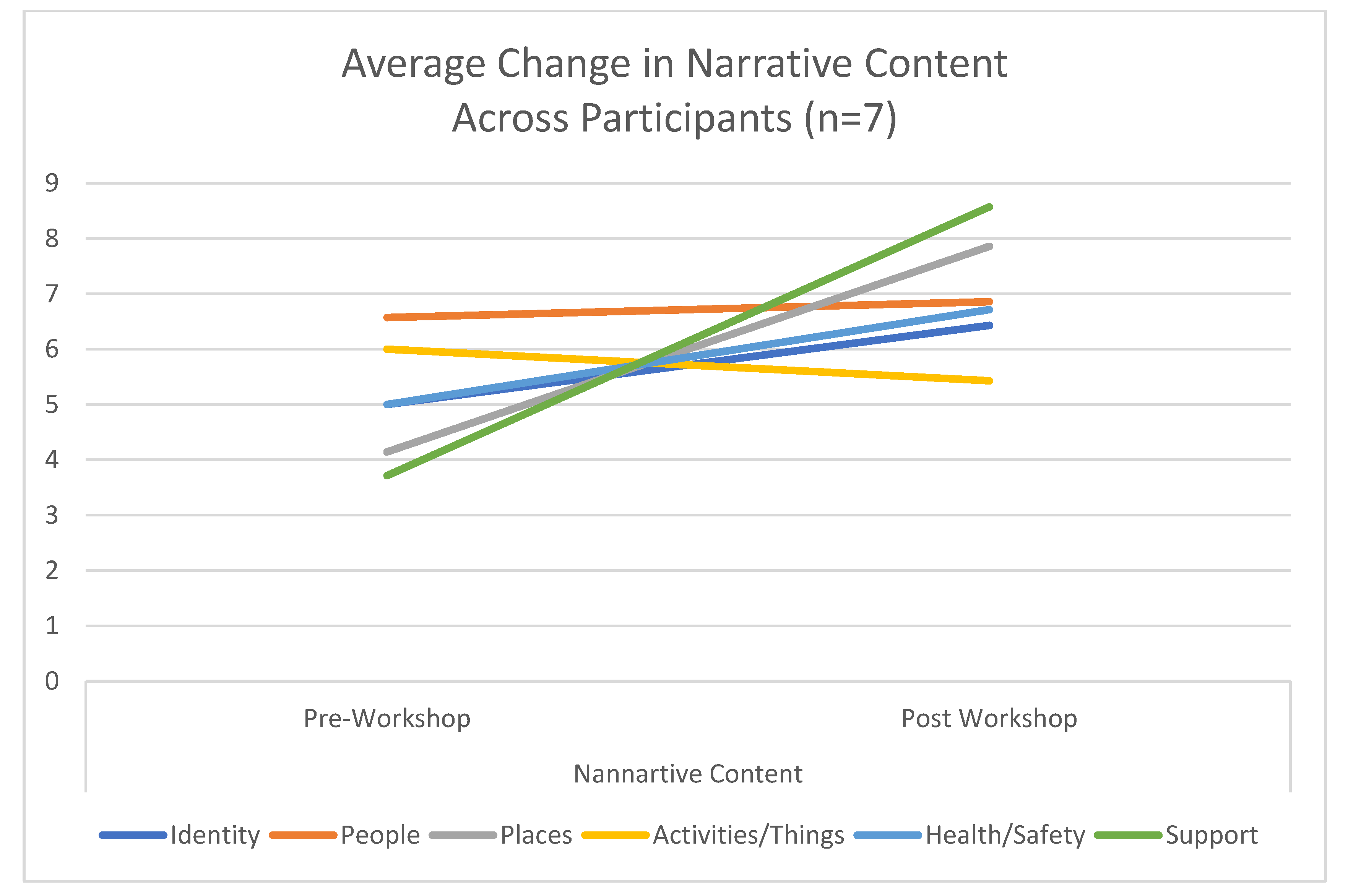
Figure 2.
Average Change in Narrative Elaboration Across Participants (n=7).
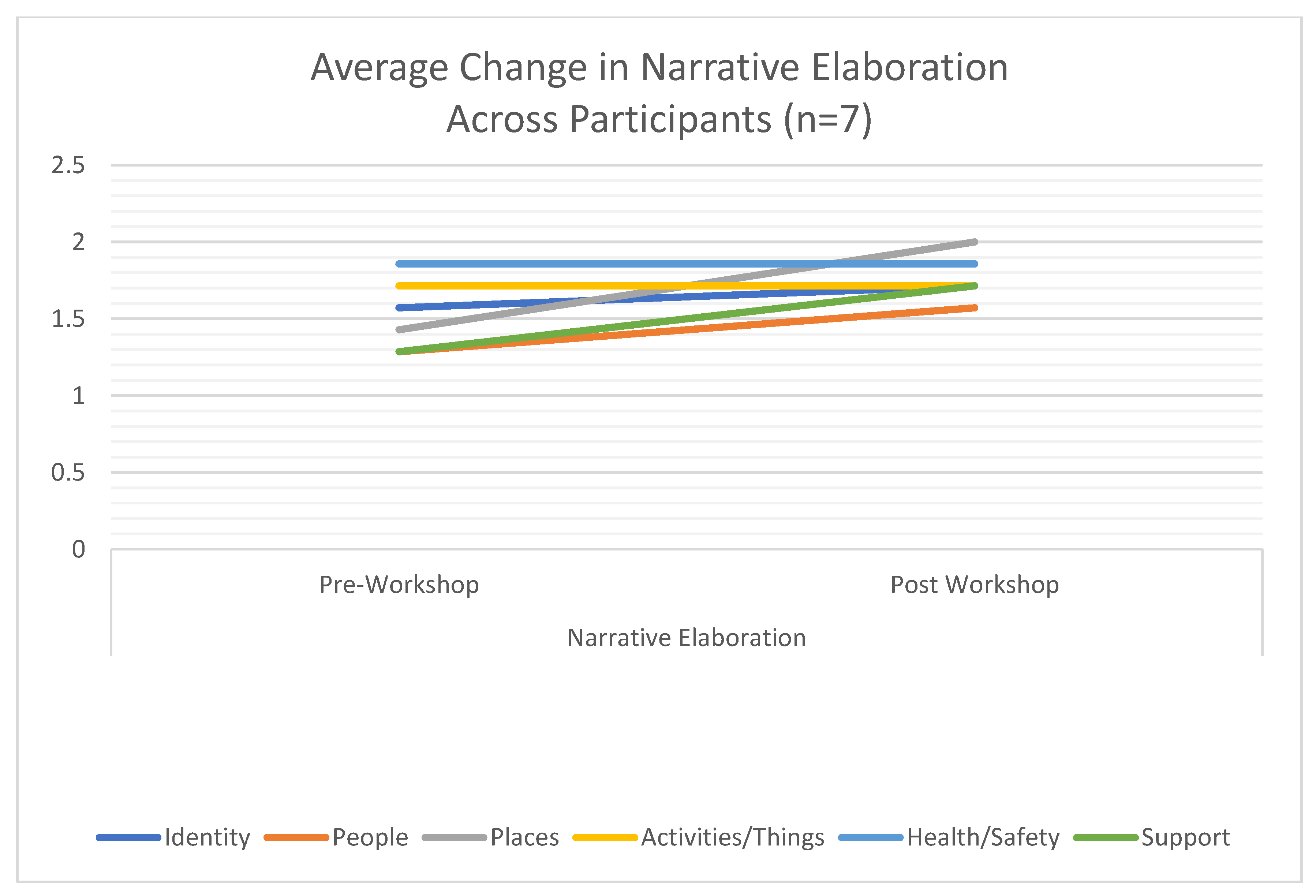

Table 1.
Adapted Narrative Coherence Coding Scheme Coding Table.
| Questions | Contextual Specificity/Thematic Elaboration* | Nonverbal | Additional Comments | |
|---|---|---|---|---|
| 1 | Could you tell me a bit about yourself? |
Copied highlighted transcript from below [X contents/0-3] |
[example: Sits back in chair, answers confidently, raises eyebrows, smiles] | |
| 2 | Could you tell me about people who are important to you? |
Copied highlighted transcript from below [X contents/0-3] |
[example: Looks up to think, looks around towards end of answer and rubs leg] | |
| 3 | Could you tell me places you like to go or spend time at? |
Copied highlighted transcript from below [X contents/0-3] |
[Example: Pierces lips to think] | |
| 4 | Could you tell activities/ things that are important to you that make you happy? |
Copied highlighted transcript from below [X contents/0-3] |
[Example: Slight excitement in voice while answering] | |
| 5 | Could you tell me things that are important for you to stay safe and healthy? |
Copied highlighted transcript from below [X contents/0-3] |
[Example: Nods wile answering and adjusts body] | |
| 6 | Could you tell me any additional support you need for your day-to day activities? |
Copied highlighted transcript from below [X content/0-3] |
[Example: Prepares to say answer prior to end of question, smiles once completed] |
*Coding Instruction: Step 1: Highlight the section of the transcript that captures Contextual Specificity and/or Thematic Elaboration to the relevant question. Copy it and paste it into the relevant section of the table for each question. Step 2: Contextual Specificity: Document the number of contents mentioned for each question (note: this captures expressed content as a count, not the context/situation). For example, “my family,” “Ted,” “Michelle,” and “Jack” would be counted as 4. Step 3: Thematic Elaboration: Score responses as follows—0 (no identifiable content); 1 (on-topic response with minimal detail); 2 (on-topic response with some related information); and 3 (substantially elaborated response that includes or infers personal meaning).
Table 2.
Changes in Content and Thematic Elaboration of Participants’ Narratives Across Community-Living Domains.
Table 2.
Changes in Content and Thematic Elaboration of Participants’ Narratives Across Community-Living Domains.
| Community-Living Domain | Content Pre, Mean (Range) | Content Post, Mean (Range) | Content Mean Change |
Elaboration Pre, Mean | Elaboration Post, Mean | Elaboration Mean Change |
|---|---|---|---|---|---|---|
| Identity | 5.00 (0–11) | 6.43 (2–12) | 1.43 | 1.57 | 1.71 | 0.14 |
| Important relationships | 6.57 (3–9) | 6.86 (5–10) | 0.29 | 1.29 | 1.57 | 0.26 |
| Meaningful places | 4.14 (2–8) | 7.86 (3–14) | 3.71 | 1.43 | 2.00 | 0.57 |
| Meaningful activities and things | 6.00 (2–14) | 5.23 (3–9) | -0.57 | 1.71 | 1.71 | 0 |
| Health and safety | 5.00 (2–12) | 6.71 (3–14) | 1.71 | 1.86 | 1.86 | 0 |
| Everyday support needs | 3.71 (1–10) | 8.57 (5–11) | 4.86 | 1.29 | 1.71 | 0.43 |
Note: Content is presented as the mean number of distinct items mentioned, with the observed range in parentheses. Thematic elaboration was rated on a 0–3 scale, with higher scores indicating greater detail and expression of personal meaning. Mean change represents the difference between post-workshop and pre-workshop scores.
Disclaimer/Publisher’s Note: The statements, opinions and data contained in all publications are solely those of the individual author(s) and contributor(s) and not of MDPI and/or the editor(s). MDPI and/or the editor(s) disclaim responsibility for any injury to people or property resulting from any ideas, methods, instructions or products referred to in the content. |
© 2026 by the authors. Licensee MDPI, Basel, Switzerland. This article is an open access article distributed under the terms and conditions of the Creative Commons Attribution (CC BY) license (http://creativecommons.org/licenses/by/4.0/).
Copyright: This open access article is published under a Creative Commons CC BY 4.0 license, which permit the free download, distribution, and reuse, provided that the author and preprint are cited in any reuse.