

Submitted:
31 August 2026
Posted:
02 September 2026
You are already at the latest version
Abstract
This paper presents the collection and potential applications of an open dataset acquired during the partial solar eclipse of 12 August 2026 from Lorry-lès-Metz, France. Observations were performed using a Vespera telescope and a Hestia telescope coupled with an iPhone 16 Pro Max smartphone. Publicly released on Zenodo, the dataset provides a resource for computer vision, machine learning, image processing, and educational activities.
Keywords:
partial eclipse
; smart telescopes
; computer vision
1. Introduction
The solar eclipse of 12 August 2026 was a highly anticipated event for the scientific community, astrophotographers, and the general public alike 1. Depending on the geographical location, the eclipse was observed either as total or partial, resulting in significantly different viewing conditions and visual experiences.
Beyond the temporary decrease in daylight during the event, solar eclipses remain inherently uncertain observational phenomena, as weather conditions can strongly influence what can ultimately be observed and recorded. From the Grand Est region in France, the eclipse was finally visible as partial, reaching a maximum solar coverage of approximately 90%, and the weather conditions were ideal.
Such events provide valuable opportunities for both professional and amateur astronomical observations [1]. In recent years, advances in compact and consumer-oriented astronomical instrumentation have enabled high-frequency image acquisition using relatively accessible equipment. In particular, the emergence of smart telescopes has considerably simplified the acquisition of solar images [2]. For example, the previous 2024 eclipse had already provided an opportunity to test this type of equipment for observational activities with students in Ohio (USA) [3].
From a computer vision perspective, such observations provide a rare source of temporally continuous imagery acquired under rapidly changing illumination and partial occlusion conditions.
This manuscript describes the collection of an open image dataset acquired during the 12 August 2026 partial solar eclipse from the limestone plateau of Lorry-lès-Metz, France, with a particular focus on the observational methodology, the technical aspects of the image acquisition process, and the structure of the associated dataset.
At the time of writing this paper, it is worth noting that a complementary effort aimed to capture data of the partial solar eclipse from a high-altitude balloon launched from Oldenburg, Germany [4].
2. Setup for Data Collection
As the date of the eclipse had been known well in advance, the idea of capturing images using the available equipment had naturally been anticipated, based on experience from the partial solar eclipse of 29 March 2025, for which the occultation was much less significant 2, while also taking into account experiments conducted by students in Poland during the same event [5]. The observation was carried out from the Metz region in France, at a location selected for its unobstructed visibility conditions. Since the eclipse was to occur rather late, it was necessary to observe the Sun while it was still very low above the horizon. The site ultimately chosen was the limestone plateau of Lorry-lès-Metz (latitude 49.1374191, longitude 6.0825714), a location that is both easily accessible and offers a particularly unobstructed eastern horizon. Such conditions are uncommon: the sky was exceptionally clear, with no clouds present at either low or high altitudes.
Images were collected by using two instruments (Figure 1):
- The primary image acquisition system consisted of a Vespera smart telescope configured for solar eclipse observations. The instrument, featuring a aperture and a focal length, automatically tracked the Sun throughout the event and continuously acquired images using its integrated Sony IMX462 sensor, providing a native field of view of approximately . The telescope was operated through a Samsung S25 Ultra smartphone using the vendor’s mobile application, Singularity, which allowed monitoring of the acquisition process in real time.
- A secondary acquisition system was based on the Hestia telescope – an optical instrument with a aperture, magnification, and a native field of view of – coupled with an iPhone 16 Pro Max smartphone for image capture, and by using the vendor mobile application (Gravity). This setup was used to obtain complementary observations during the eclipse event, with manual trigger.
For each instrument, the associated solar filters were used throughout the observation. Unlike during a total solar eclipse, there was no possibility of removing the filters at any stage of the event, even during the maximum phase of the partial eclipse, in order to avoid damaging the equipment.
The exact observation site was selected in front of an agricultural field in order to avoid disturbances from a nearby path and passing pedestrians (Figure 1). For both instruments, the tripods were positioned relatively high to maximize visibility. Levelling was carefully performed on stable ground using a bubble level, partially embedding the tripod legs into the soil to improve stability.
Although smart telescopes considerably simplify the observational workflow by automating tracking, image acquisition, and instrument configuration, eclipse observations still require careful preparation and monitoring. Particular attention was paid to power management, instrument stability, and environmental conditions throughout the acquisition session. Since a solar eclipse is a time-constrained event that cannot be repeated or resumed later, minimizing the risk of interruptions was essential. The observation site was therefore selected to reduce potential disturbances from nearby human activities, vehicles, or accidental interactions with the equipment.
This setup was used for about two and a half hours, starting shortly before the eclipse began and ending when the sun was completely hidden by the horizon.
3. Dataset Description
Published on Zenodo [6], the dataset contains a total of 5,303 images, including 5,255 images obtained with the Vespera telescope and 48 images acquired with the Hestia telescope coupled with an iPhone 16 Pro Max.
The Vespera acquisition sequence was designed to provide continuous temporal coverage of the eclipse event. All Vespera images were recorded with a fixed resolution of 1920 × 1080 pixels, ensuring homogeneous image dimensions throughout the sequence and facilitating chronological reconstruction and comparative image processing workflows. The large number of images acquired with the Vespera system also enabled the generation of a timelapse video of the eclipse event, which was made publicly available online 3, by following a technical video processing approach described in [7].
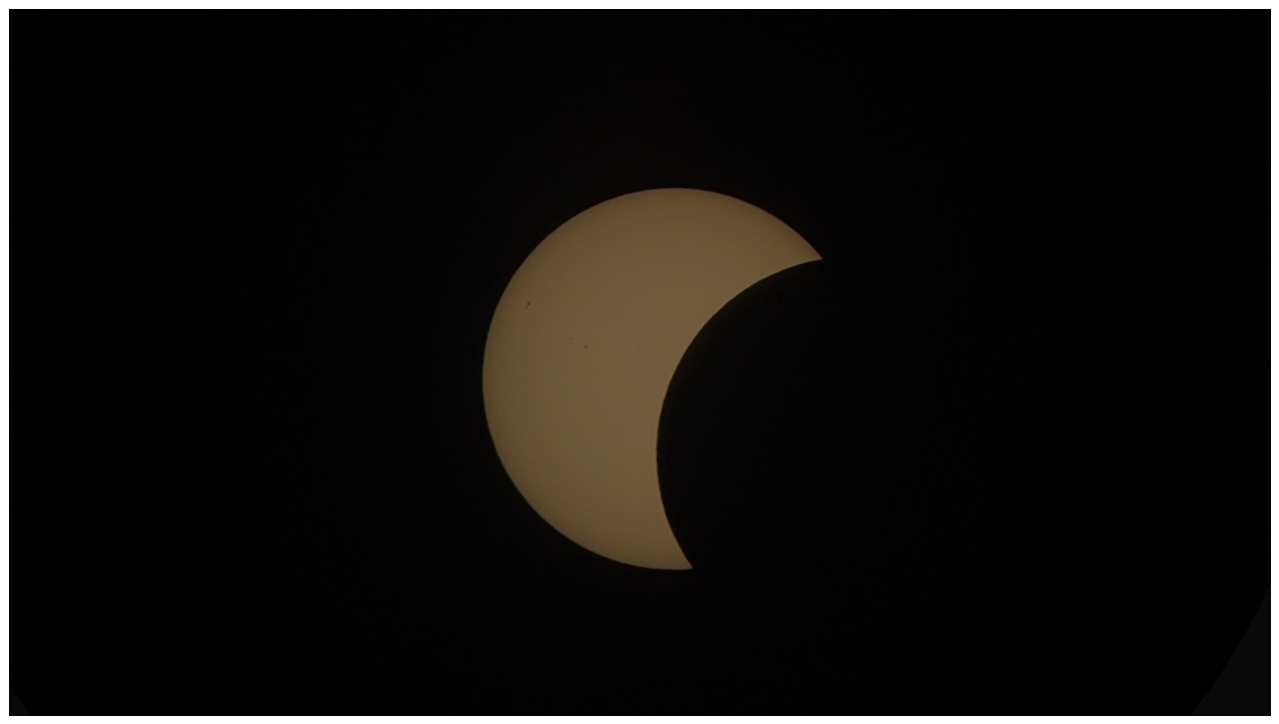
In contrast, the Hestia acquisition setup produced a smaller number of images with resolutions ranging from 1186 × 1186 pixels to 2314 × 2314 pixels. These variations are mainly due to the smartphone-based acquisition workflow and the use of different zoom levels during the observation session. Unlike the automated and homogeneous Vespera acquisition sequence, the Hestia images were captured more manually and with varying framing configurations in order to visually monitor different phases and details of the eclipse. As a result, some images were initially acquired for exploratory or observational purposes and were not specifically intended for long-term preservation within the final dataset.
In both cases, all files are distributed in JPEG format, and the file names contain the capture time associated with each image, enabling precise temporal ordering of the observations and synchronization between both acquisition systems. This naming convention also facilitates downstream processing tasks such as eclipse progression analysis, frame selection, and timelapse reconstruction.
One interesting point is that the Sun had large sunspots on that particular day, which were therefore also visible during the eclipse; this was noticeable in the Vespera images (Figure 2). The detailed information about these active sunspots regions can also be found on space weather monitoring website 4.
Finally, it should be noted that the images were not post-processed; the data published on Zenodo are provided exactly as acquired by the observations setups.
Figure 3.
Hestia image during the eclipse, captured at 19h49 (UTC+2).
4. Potential Use-Cases
A first interesting use case would consist in applying sunspot detection and segmentation models to the images in order to evaluate their robustness under partial occultation conditions (YOLO, RT-DETR, or even Vision-Language Models). For example, the dataset can be used to study how these models behave when the solar disk becomes partially hidden during the eclipse. To illustrate this point, we have conducted a preliminary experiment using the YOLO models introduced in [2] and implemented with the Ultralytics framework 5. In particular, the YOLO11 models were evaluated using test-time augmentation, a confidence threshold of 0.4, and full-resolution image inference. While Figure 4 clearly shows that the number of detected sunspots tends to decrease during the eclipse — and no longer increases once the Sun becomes no longer visible near the horizon — it also highlights how sensitive the YOLO11x model is to very small image variations, as the number of detected sunspots changes significantly from one image to another. A similar behaviour was observed for the other YOLO11 variants, suggesting that even very small visual variations between consecutive eclipse images can significantly affect the stability of object detection predictions, therefore opening the way to potential improvements in training datasets, training strategies, and detection network architectures.
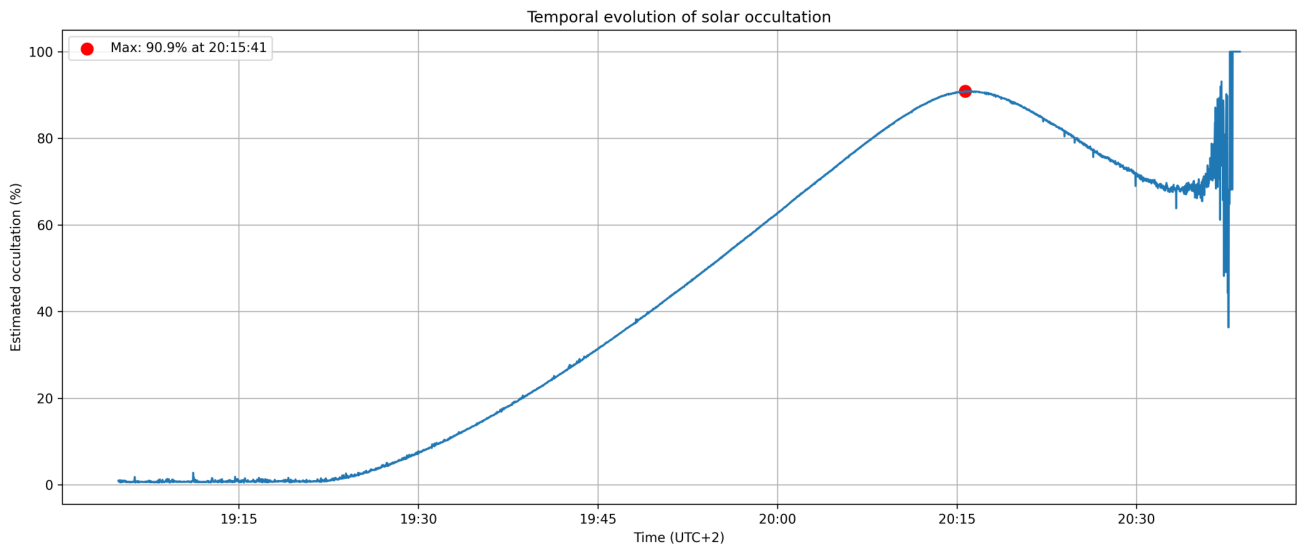
A second potential use case would involve estimating the solar occultation rate directly from the acquired images. By detecting the visible solar disk and measuring the fraction obscured by the Moon over time, it would be possible to reconstruct the temporal evolution of the eclipse and compare the measured values with the theoretical predictions available for the observation location. Similarly, we tested a Python-based contour detection approach on the images and obtained a maximum occultation at 20:15:41 UTC+2 (Figure 5). The resulting curve follows the temporal evolution of the eclipse relatively well, although images acquired after approximately 20:35 UTC+2 become increasingly difficult to exploit due to the decreasing visibility conditions near the horizon. This type of experiment illustrates how the dataset may be used for automated image analysis and temporal reconstruction tasks.
A final interesting aspect would consist in estimating the circularity coefficient of the solar disk, which is not always constant from one image to another due to atmospheric disturbances, local turbulence, optical distortions, and variations in acquisition conditions, potentially providing a simple indicator for image quality assessment and observational stability analysis.
Beyond research-oriented applications, these tasks could also serve as practical exercises or small-scale projects for students in machine learning and computer vision, particularly in areas related to image segmentation, object detection, temporal analysis, and scientific imaging workflows.
5. Conclusions
In this work, we have presented the acquisition of an open image dataset collected during the partial solar eclipse of 12 August 2026 from Lorry-lès-Metz, France. Using smart telescopes, a total of 5,303 timestamped images were acquired and made publicly available on Zenodo. The dataset provides a continuous visual record of the eclipse under partial eclipse conditions and may support exploratory work in Machine Learning and Computer Vision, including object detection and solar occultation estimation.
Future eclipse observation campaigns, including the 2027 total solar eclipse, will provide opportunities to extend this work with improved observational setups involving higher-resolution instruments, optimized optical configurations, and advanced H-alpha solar filtering systems in order to acquire larger and higher-quality imaging datasets.
Funding
This research was funded by the Luxembourg Institute of Science and Technology (LIST).
Data Availability Statement
The collected images are available on Zenodo https://zenodo.org/records/21916192. Additional materials used to support the results of this paper are available from the corresponding author upon request.
Conflicts of Interest
The author declares no conflict of interest.
References
- Harrington, P.S. Eclipse!: The what, where, when, why, and how guide to watching solar and lunar eclipses; Turner Publishing Company, 2008.
- Parisot, O. Data and Models for Sunspots Detection in Solar Images Captured with Smart Telescopes. In Proceedings of the Advanced Research in Technologies, Information, Innovation and Sustainability; Guarda, T.; Portela, F.; Gatica, G., Eds., Cham, 2025; pp. 153–163.
- Sullenberger, E. Lessons Learned From Solar Eclipse Citizen Science in Rural Ohio. Bulletin of the American Astronomical Society 2025, 56, 2024n9i041.
- Poppe, B.; Gronewold, E.; Gehlen, M.; Schrader, J.; Gauk, D.; Cordes, L.; Schmitz, M.I.; Schoenfeld, P.; Jaeger, S.; Drolshagen, G. Direct Imaging and Gradient-Based Analysis of the 12 August 2026 Partial Solar Eclipse from a Freely Rotating High-Altitude Balloon. arXiv preprint arXiv:2608.16257 2026.
- Wesołowski, M.; Gritsevich, M.; Bis, A.; Banaczyk, J. A partial solar eclipse observed from Rzeszów, Poland, on 29 march 2025. Physics Education 2026, 61, 025013.
- Parisot, O. Partial Solar Eclipse Observation Dataset, Metz (France), 12 August 2026, Vespera and Hestia Telescopes , 2026. [CrossRef]
- Parisot, O. Method and Tools to Collect, Process, and Publish Raw and AI-Enhanced Astronomical Observations on YouTube. Electronics 2025, 14. [CrossRef]
| 1 | |
| 2 | |
| 3 | |
| 4 | |
| 5 |
Figure 1.
Installation of the Vespera and the Hestia telescopes, a few minutes before the eclipse began (Lorry-Les-Metz, France, 12 August 2026).
Figure 1.
Installation of the Vespera and the Hestia telescopes, a few minutes before the eclipse began (Lorry-Les-Metz, France, 12 August 2026).
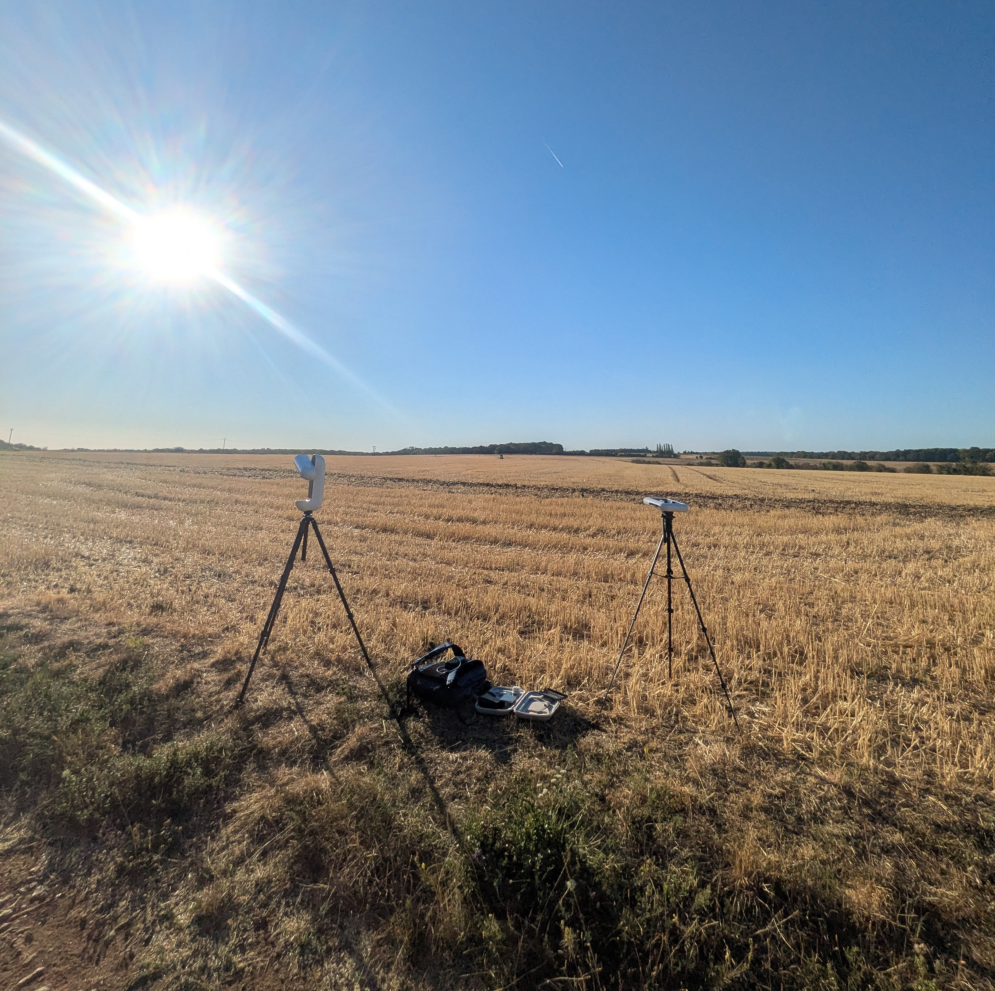
Figure 2.
Vespera image during the eclipse, captured at 19h43 (UTC+2).
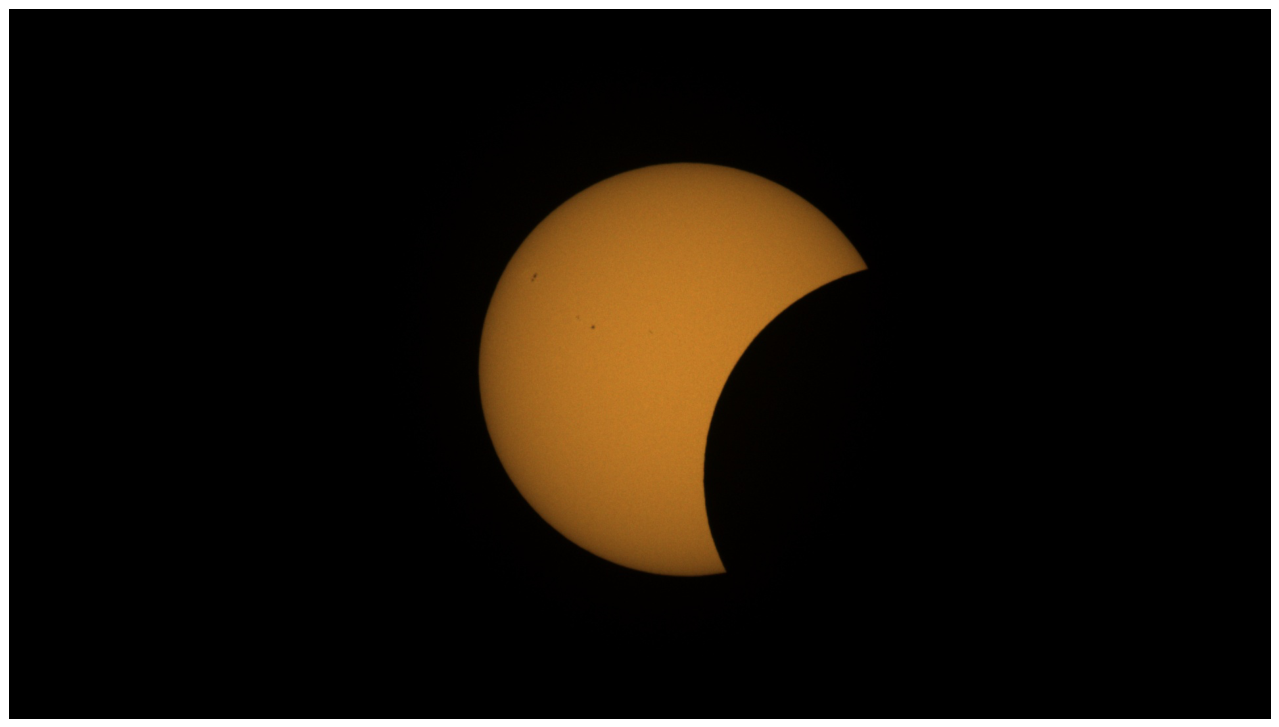
Figure 4.
Temporal evolution of sunspot detections obtained with the YOLO11x model introduced in [2]. The y-axis represents the number of detections, while the x-axis corresponds to the acquisition timestamp (UTC+2).
Figure 4.
Temporal evolution of sunspot detections obtained with the YOLO11x model introduced in [2]. The y-axis represents the number of detections, while the x-axis corresponds to the acquisition timestamp (UTC+2).
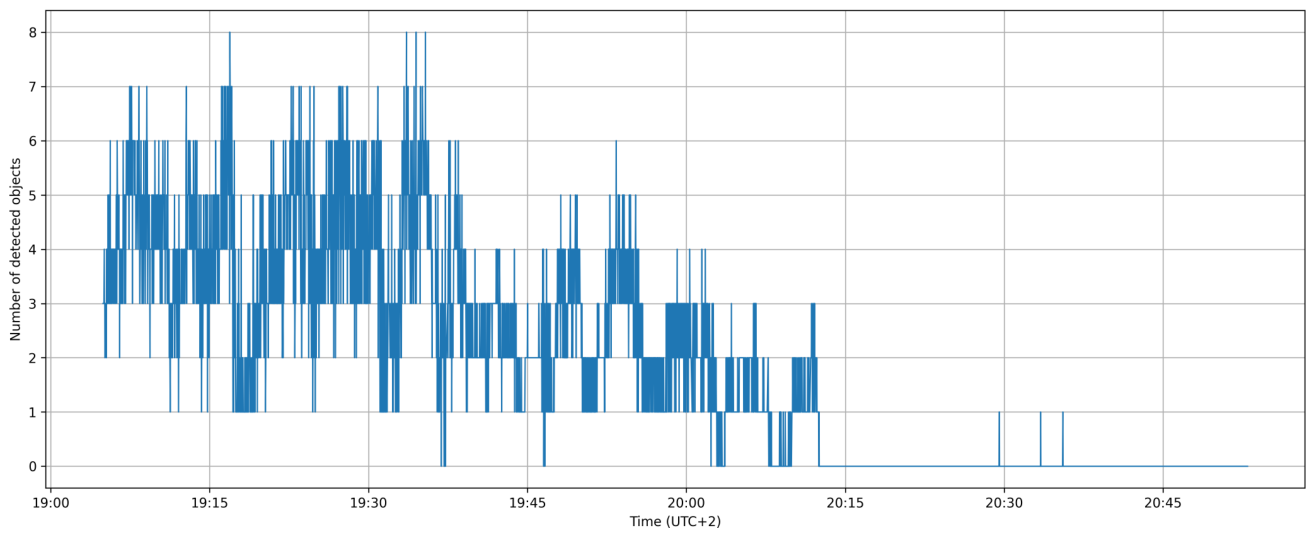
Figure 5.
Temporal evolution of sun occultation. The y-axis represents the percentage, while the x-axis corresponds to the acquisition timestamp (UTC+2).
Figure 5.
Temporal evolution of sun occultation. The y-axis represents the percentage, while the x-axis corresponds to the acquisition timestamp (UTC+2).
Disclaimer/Publisher’s Note: The statements, opinions and data contained in all publications are solely those of the individual author(s) and contributor(s) and not of MDPI and/or the editor(s). MDPI and/or the editor(s) disclaim responsibility for any injury to people or property resulting from any ideas, methods, instructions or products referred to in the content. |
© 2026 by the authors. Licensee MDPI, Basel, Switzerland. This article is an open access article distributed under the terms and conditions of the Creative Commons Attribution (CC BY) license (http://creativecommons.org/licenses/by/4.0/).
Copyright: This open access article is published under a Creative Commons CC BY 4.0 license, which permit the free download, distribution, and reuse, provided that the author and preprint are cited in any reuse.