

Submitted:
31 August 2026
Posted:
02 September 2026
You are already at the latest version
Abstract
Ghana has sustained constitutional democratic governance since 1992; however, concerns persist regarding executive dominance, weak institutional independence, and uneven economic performance. Drawing on institutional theory, this study examines whether constitutional separation of powers influences economic development beyond conventional macroeconomic factors. Using annual data from 1996 to 2023, the analysis employs a Bayesian State Space Structural Equation Modeling (BSS-SEM) framework to capture the dynamic and latent nature of institutional quality and development outcomes under limited sample size and missing data. Separation of powers is modeled as a latent construct and measured by the Rule of Law, Regulatory Quality, and Voice of Accountability, while economic development is modeled as a latent construct using the Human Development Index, Gross Domestic Product, and Foreign Direct Investment. The results reveal a positive, persistent effect of separation of powers on economic development, strengthening over time and underscoring the role of constitutional design in sustaining economic performance.
Keywords:
separation of powers
; economic development
; institutional quality
; Bayesian state space structural equation modeling
; ghana
1. Introduction
The significance of public institutions in fostering economic development in today's globalized economy is indispensable. These institutions provide the foundation for economic activities conducted by households, businesses, and governments, shaping the social behaviour that surround such activities. However, in the absence of a robust institutional framework, individual behaviour in economic activities may be unguided, leading to exploitation, corruption, and nepotism, which may significantly impede a nation's economic progress.
The separation of powers is a vital institutional arrangement in democratic governance structure, promotes checks and balances among the executives, legislative, and judicial branches. This institutional arrangement prevents the concentration of power, ensures accountability and protects citizens’ political liberty, thereby restraining abuse of power (Boucher & Kelly, 2009; Pozar-Szentmiklosy, 2024). This framework imposes constraints on government actions and fostering oversight, accountability, and transparency, limiting the scope of rent-seeking and arbitrary decision making.
The doctrine of the separation of powers, commonly linked to French Philosopher Montesquieu, was systematically articulated in his seminal work, “The Spirit of the Laws” (Montesquieu 1748/1989, Book XI, Ch. 6). Montesquieu's ideas had a profound influence on modern democratic governance systems, including the framing of constitutions and the structure of governmental institutions. Judicial independence (a key tenet of this doctrine) restricts interference from other branches of government, ensuring the fair and efficient implementation of economic policies and, consequently, enhancing economic performance. Institutions facilitate economic development by establishing rules that limit the concentration of political power, protecting citizens’ rights, protect property rights, enforce contracts, and promote transparency, which are critical to market efficiency (Oberdieck & Moch, 2023).
Thorstein Veblen, a foundational figure in institutional economics, emphasized the role of social and institutional factors in shaping economic behaviour and outcomes. Veblen (1899) argued that economics encompasses more than the financial transactions resulting from human actions. Rather, it delves into the ever-changing dynamics of the human culture. He observed a contrast between the ideals of industry, such as diligence, efficiency, and cooperation, and the motivations of businessmen, who were primarily focused on accumulating wealth and displaying their affluence rather than prioritizing industrial. Commons (1934) viewed institutions as collective arrangements that controls, enable, and extend individual action through socially organized rules and practices (Commons, 1934). His focus was on the role of institutions in shaping human behaviour and how collective actions and institutional settings influence society’s goals.
Drawing on the foundational theoretical basis for understanding institutions and governance, recent studies continue to demonstrate the importance of institutional independence and checks and balances for economic progress in developing countries. Contemporary institutional perspectives argue that the constitutional provision system of checks and balances extend beyond these formal structures to include informal institutions and practices that influence relations among branches of government highlighting the relevance of independent institutions in promoting economic performance (Pozar-Szentmiklosy, 2024).
Recent institutional economics literature highlights that economic development depends less on the ideological orientation of governments and more on the quality and independence of institutions. Koffman Jopia and Patricia Galilea Aranda, in their study demonstrated in cross-country evidence that core institutional attributes, including judicial independence, government integrity, and the protection of property rights, exert a stronger influence on economic performance than partisan political ideology (Koffman & Galilea Aranda, 2025).
The International Economic Development Council (IEDC) describes economic development as a series of strategies, policies, or activities aimed at enhancing the standard of living and quality of life within a community. This is achieved by sustaining employment opportunities and establishing a stable tax framework. The concept of the separation of powers has significant implications for economic development in various aspects, such as safeguarding property rights, rule of law, promotion of human rights, provision of checks and balances, policy stability, and promotion of good governance.
Economic development extends beyond simply increasing output by improving individual’s social well-being. It is crucial to establish systems that promote liberty and freedom in a nation to support development. Additionally, because the foundation of economics is rooted in human activities aimed at survival under conditions of limited resources, it is essential to create an enabling economic ecosystem that is free from exploitation, bias, nepotism, and corruption to foster business confidence and impartiality, which encourages actors to engage in productive economic activities. The relationship between the separation of powers and economic development is critical, (La Porta et al., 1998), yet underexplored subject in Ghana. Although Ghana has achieved notable progress in promoting political and economic democratization over the past few decades, questions persist about the efficacy of its institutional framework in combating corruption and nepotism to achieve sustainable economic development.
The principle of separation of powers, designed to prevent autocracy and protect liberty, has been variably applied in Ghana, shaped by colonial legacies, political instability, and evolving governance structures (Osabu-Kle, 2000; Hyden, 2013). Excessive executive dominance, coupled with corruption and nepotism, continues to impede Ghana’s economic potential. Although the 1992 constitution establishes separation of powers, institutional overlap, political interference, and weak accountability mechanisms persist in the country.
Since the inception of Constitutional governance in 1992, Ghana has witnessed a peaceful transition of political power between the two principal political parties, the National Democratic Congress (NDC) and the New Patriotic Party (NPP). Politicization of policies and lack of inclusiveness to leverage expertise and talents across these two parties, minor political parties and the public have been the order of the day.
Ministerial and Chief Executive Officers (CEOs) appointments for key sectors of the institutional structures are done by the executive president of the day, where partizan politics has taken centre stage by fixing party supporters who may or may not have the expertise to staff the position (square pegs in round holes). This phenomenon may adversely influence Ghana’s economic development because the appointment powers granted the executives under constitutional provisions limiting checks and balance across government structures. Corruption and nepotism remain a substantial impediment to advancement in Ghana, impeding economic progress and intensifying poverty and socioeconomic disparities (Transparency International, 2023).
Although previous research has scrutinized the relationship between governance structures and corruption (Treisman, 2000; Rose-Ackerman, 1999), the literature lacks substantial exploration of the role separation of powers performs in this context to influence economic development. Despite the recognition of separation of powers in the Ghanaian democratic governance, there is a lack of comprehensive studies on its specific impacts on economic development in Ghana. Existing research has primarily focused on broader political and institutional issues leaving gaps in our understanding of the mechanisms through which the separation of powers influences economic performance in developing countries.
Ghana has experience inconsistent economic trend since the 1992 constitution was enacted. This phenomenon may be attributed to many factors of the macroeconomic indicators such as the unemployment rate, exchange rate fluctuations, Central Bank policy rate, level of education, inflation, trade among others. These indicators may not fundamentally be the main issues confronting Ghana’s economic trajectory. Therefore, there is a pressing need to examine the relationship and the extent to which the separation of powers in Ghana’s governance structure contributes to or hinders corruption and economic development.
This study, therefore, aims to fill the existing gap by providing empirical evidence of the relationship between the separation of powers and economic development in Ghana. The findings of this research will help guide and shape the design and implementation of policies aimed at fostering inclusive and bolstering sustainable economic development in Ghana, ultimately contributing to the socio-economic improvement of Ghana’s development goals. Furthermore, this study will add to the vast knowledge of factors influencing economic development and provoke further studies on the separation of powers regarding institutions and economic progress.
2. Literature Review
The Constitution is a supreme legal document that outlines government structures, protects individual rights, and defines citizens' responsibilities, establishing legitimate and accountable government powers (Rousseau, 1762). Understanding the link between separation of powers as a constitutional provision and economic development is crucial to democratic governance. Separation of powers provides a foundational framework for checks and balances, limiting power among government branches and promoting accountability and civil rights protection (Tushnet et al., 2006).
Nzepang and Anya (2024) explored how the democratic separation of powers interacts with structural transformation in Sub-Saharan Africa. The two found that the legislative and judicial branch of government dependence on the executive hinders structural change and industry productivity. Studies like North (1991), Zingales (1998), Rajan and Djankov et al. (2002), Acemoglu et al. (2005), and Besley et al. (2011) show that strong political institutions (separation of powers) and independent regulatory bodies improve resource allocation, reduce inefficiencies, foster fair competition, enhances economic outcomes. Conversely, weak institutional frameworks lead to inefficiencies, rent-seeking, and slower growth (La Porta et al., 1999; Besley & Persson, 2011; Acemoglu & Robinson, 2012).
La Porta et al. (2021), Ginzburg et al. (2022), and Voigt (2020) found that courts insulated from political interference reduce corruption and uncertainty in economic policymaking, fostering investment and competition. Acemoglu and Robinson (2020) stressed that balancing state capacity and institutional independence, not just democratization, drives economic growth. They argue that separation of powers stabilizes governance during transitions and, prevent economic instability. However, Ackerman (2000) Elster (2013), and Devins and Fisher (2019), critique rigid separation of powers, claiming it can hinder governance by limiting inter-branch cooperation and collaboration. They advocate for interaction and compromise over strict isolation.
The separation of powers is intrinsically linked to the broader concept of rule of law, where legal norms constrain the exercise of power (Vile, 1967). According to Raz (2019), the rule of law ensures that governments act within the bounds of the established laws and that the individuals’ rights are protected. He further pointed out that the purpose of the rule of law is to limit governmental power for the law to fulfil its intended role, allowing citizens to continue their lives and engage in meaningful activities.
In democracies, maintaining judicial independence is essential for ensuring the rule of law and safeguarding individual rights. A judiciary free from political influence can hold the executive and legislature accountable, preventing arbitrary decisions and power abuses that harm economic stability (Haggard et al., 2008). Countries with strong judicial independence, like the United States and Germany, tend to have stable economies and attract higher Foreign Direct Investment (FDI). In contrast, weak judicial independence in many developing economies discourages investment due to fears of expropriation and legal unpredictability (La Porta et al., 1998). Transparency International (2023) warns that weakening judicial systems reduce accountability, which, in turn triggers corruption.
Institutional economists such as Veblen (1899), Commons (1931), and North (1990) have highlighted the role of institutions in shaping economic behavior and outcomes. They argue that well-established institutions guide individual actions, govern economic transactions, and influence social and cultural contexts, fostering economic development. North (1990) emphasizes that clear and enforceable property rights enable individuals and businesses to confidently engage in economic activities. Conversely, weak institutional frameworks (marked by a lack of separation of powers or political interference) undermine property rights and contract enforcement, creating uncertainty and discouraging investment.
Pereira (2017) argues that effective government institutions, not democracy, drive socio-economic growth. Governments shape economic rules (constraints and incentives like investment regulations and property rights) which influence growth and overall wealth (Luo, 2020). Property rights are especially vital, because constitutional protections provide security for investments, land acquisition, and wealth accumulation. Without these, exploitation, corruption, and nepotism can hinder economic progress (Acemoglu & Robinson, 2012). Similarly, constitutions that protect freedom of contract and enforce agreements foster a stable business environment, encouraging domestic and foreign investments.
North and Thomas (1973) identified institutions as key to economic performance, with relative price changes driving such institutional change. They argued that shifts in relative prices incentivize the creation of more efficient institutions. Hallerberg et al. (2009) emphasized that fiscal governance effectiveness depends on the political system. Despite the lack of full separation of powers due to the Communist Party’s control, China has achieved rapid growth. Some scholars attribute this success to market reforms and state intervention rather than institutional independence. However, the absence of judicial independence and legislative checks poses risks for long-term economic sustainability (Acemoglu & Robinson, 2012).
Institutional independence is important for economic development. Strong institutions are critical for creating an environment in which economic activity thrives. Institutions, such as regulatory bodies, financial institutions, and courts, function best when they operate independently and are free of political influence or corruption. The separation of powers ensures that these institutions can carry out their duties impartially, which is essential for maintaining an effective rule of law, securing property rights, and enforcing contracts. These factors are fundamental for creating a favourable environment for economic growth (North, 1990).
Many African countries, including Ghana have maintained excessively powerful executive branches even after democratization, limiting the legislative branch’s effectiveness (Prempeh, 2008). According to Ayee (2008), Ghana’s Parliament has struggled to assert itself against executive dominance, leading to weak checks and balances and limited policy influence. Opoku (2025) found out that, the extensive appointments power granted the President of Ghana by the 1992 Constitution, significantly undermines the autonomy of government branches. He also noted that key appointments, including those in the judiciary, ministerial positions, and executive roles in public institutions, are predominantly influenced by the executive. This practice influence by political considerations diminishes the effectiveness of institutional checks and balances.
According to Gyampo (2015), the power disparity between the executive and legislative branches in Ghana leads to an overly dominant executive, which heightens the sense of exclusion linked to winner-takes-all politics. Similarly, Corrales and Penfold (2011) attribute Venezuela’s economic instability to the concentration of power within the executive branch, weak legislative oversight, and reckless fiscal policies. They argued that, despite the high oil revenues under Chavez’s regime characterized by a unique blend of authoritarianism and populism to fund his social programs, there were economic mismanagement, which led to inefficiencies, inflation, and a long-term economic decline. According to Gilani et al. (2023), the executive’s interference in the jurisdiction of the judiciary and vice versa greatly affect the economic development.
Existing studies have substantially emphasized the importance of judicial independence, institutional quality, the rule of law, and governance for economic development. However, much of the literature concentrates on broad measures of institutional quality and governance, with little attention on the specific role of separation of powers as a constitutional mechanism through which democratic governance influences economic outcomes. In addition, empirically, few studies have specifically examined the relationship between the separation of powers and economic development. Although several studies have documented the democratic progress in Ghana while highlighting concerns regarding executive dominance and institutional weaknesses, limited empirical evidence exits on how the country’s separation of powers arrangements influence economic development. This study seeks to address these gaps by providing empirical evidence on the relationship between separation of powers and economic development in Ghana. The study will contribute to the literature by examining separation of powers specifically as a distinct institutional framework influencing Ghana’s economic performance, highlighting the challenges and opportunities for strengthening institutional checks and balances to promote sustainable economic development.
3. Methodology and Data
We employed a quantitative explanatory research design and applied factor analysis within the Structural Equation Modeling (SEM) framework, following the approach by Spearman (1904), Joreskog (1970), Nchor, Adamec and Kolman (2016) and Rumel (1970). Additionally, we applied Path Analysis, initially introduced by Wright (1921), to examine the relationship between the separation of powers and economic development in Ghana. SEM enables the estimation of latent constructs while accounting for measurements errors, simultaneously testing measurement models, and providing direct and indirect effects (Bullock, Harlow, & Mulaik, 1994). Its ability to model complex relationships makes it suitable for this study.
Recent researchers such as Byrne (2016), and Kline (2015), extensively explored the application of SEM in social sciences, provided practical guidelines and contributed to the understanding of mediation and moderation effects within SEM, enhancing its analytical power. The validity of the latent constructs depends on the quality, relevance, and comprehensiveness of the observed variable used for measurement (Duncan, 1975). The Bayesian State Space Structural Equation Modelling (BSS-SEM) approach was chosen over traditional SEM in this study because it can better handle smaller sample sizes and missing data and is more robust than traditional SEM, which typically relies on large samples. Unlike conventional SEM, Bayesian analysis incorporates prior information and produces full posterior distributions, which improves robustness under limited data (Lee, 2007; Song & Lee, 2012).
The relationship between institutional powers and economic development is inherently latent, dynamic, and uncertain, where observable indicators as proxies may contain measurement errors and evolve over time. By combining state space modeling, the model captures temporal evolution and measurement error, making it ideal for studying the dynamic, latent relationship between the separation of powers and economic development (Kalman, 1960; Harvey, 1989; Chow et al., 2010; Asparouhov and Hamaker, Muthen, 2018). The method is also suitable for handling non-normality, provides full posterior distributions for each parameter, offers a richer representation of uncertainty, and allows probabilistic statements, such as a 95% probability that the path coefficient from a predictor to the response variable is positive. Bayesian model estimation using Hamiltonian Monte Carlo (HMC) methods in Stan, a probabilistic programming language for Bayesian modeling, utilizes rstan, a package in R, and can achieve convergence in situations where maximum likelihood (ML) estimations may fail (Munthen & Asparouhov, 2012).
The analysis begins with a primary SEM diagram centered on two latent constructs: the Separation of Powers and Economic Development. Governance indicators were used as proxy variables for the branches of government (Executive, Legislative, and Judiciary) which serve as indicators of the separation of powers. Economic development is measured using three macroeconomic indicators: the Human Development Index, Gross Domestic Product, and Foreign Direct Investment. The SEM diagram specifying the model is presented in Figure 1.
SoP measurement equations are as follows:
ED measurement equations:
The following is the latent state space transition equations:
Separation of Powers (SoP) dynamics
Economic Development dynamics
In the above equations, denotes the factor loadings of the indicators on the latent construct, represents the measurement error variance for the indicators, denotes a normal Gaussian distribution, where lambda of the indicator is the expected value of the observed variable, given the latent state. is the regression coefficient of SoP on ED, (t) is the time index. ), are the autoregressive coefficients for the SoP and ED latent states, respectively, and ( are the standard deviations of the latent state disturbances (state noise). is the effect of SoP on ED, ( , ) are the standard normal shocks for latent states at time (t).
The sample size for the study is annual data spanning 1996 to 2023, resulting in 28 observations. However, due to three missing values pertaining to governance indicators, the observations for the SoP latent constructs were reduced to 25. Governance and development indicators as well as GDP and FDI data were sourced from the World Bank. The data for the HDI was sourced from the United Nations Development Program (UNDP). Descriptive statistics are displayed in Table 1.
The descriptive statistics show that variables differ substantially in their means and standard deviations; however, the Bayesian SEM incorporating state space is inherently robust to such variations. The Hamiltonian Monte Carlo (HMC) Stan algorithm estimates parameters based on the posterior distribution rather than relying on the multivariate normality assumptions required by the frequentist Maximum Likelihood (Lee, 2007). Given the descriptive statistics, we performed z-score standardization of the observed indicators and handling missing values to center them at zero and scale them to unit variance by creating a standardized data frame (Munthen & Asparouhov, 2012). Standardization ensures that all indicators contribute comparably to the estimates of latent construct, preventing variables with larger magnitudes from dominating the models. The rstan package in R was used to specify and sample the Bayesian models.
The study estimation was done utilizing the rstan, running HMC sampling with 4 chains, 4000 iterations per chain, and 2000 warm-up iterations. Advance turning parameters were set to improve convergence and sampling stability. A Posterior Impulse Response Function (IRF) was undertaken and plotted in the study to trace the dynamic effects of a one-time shock to the predictor variable on the dependent variable over time. By doing so, we can quantify short-run and long-run impacts. Post estimation posterior samples of parameters were extracted for inference, including latent states, factor loadings, and structural paths. To ensure robustness and validity of the model, a series of diagnostic tests were performed. Autocorrelation Function (ACF) plots of the latent construct residuals for white noise behavior to confirm that the residuals are independent and identically distributed and the state space model appropriately captures the time series dynamics.
Posterior Predictive Check (PPC) were conducted by generating a series of replicated datasets from the fitted model and overlaying their density distributions with the observed data. This is to confirm that the model structure and likelihood assumptions are adequate and that the Bayesian State Space SEM provides a good fit to the data. Together, these diagnostics were conducted to support or reject the reliability of the estimated short-and long-run effects, as well as the dynamic inferences drawn from the model.
4. Results
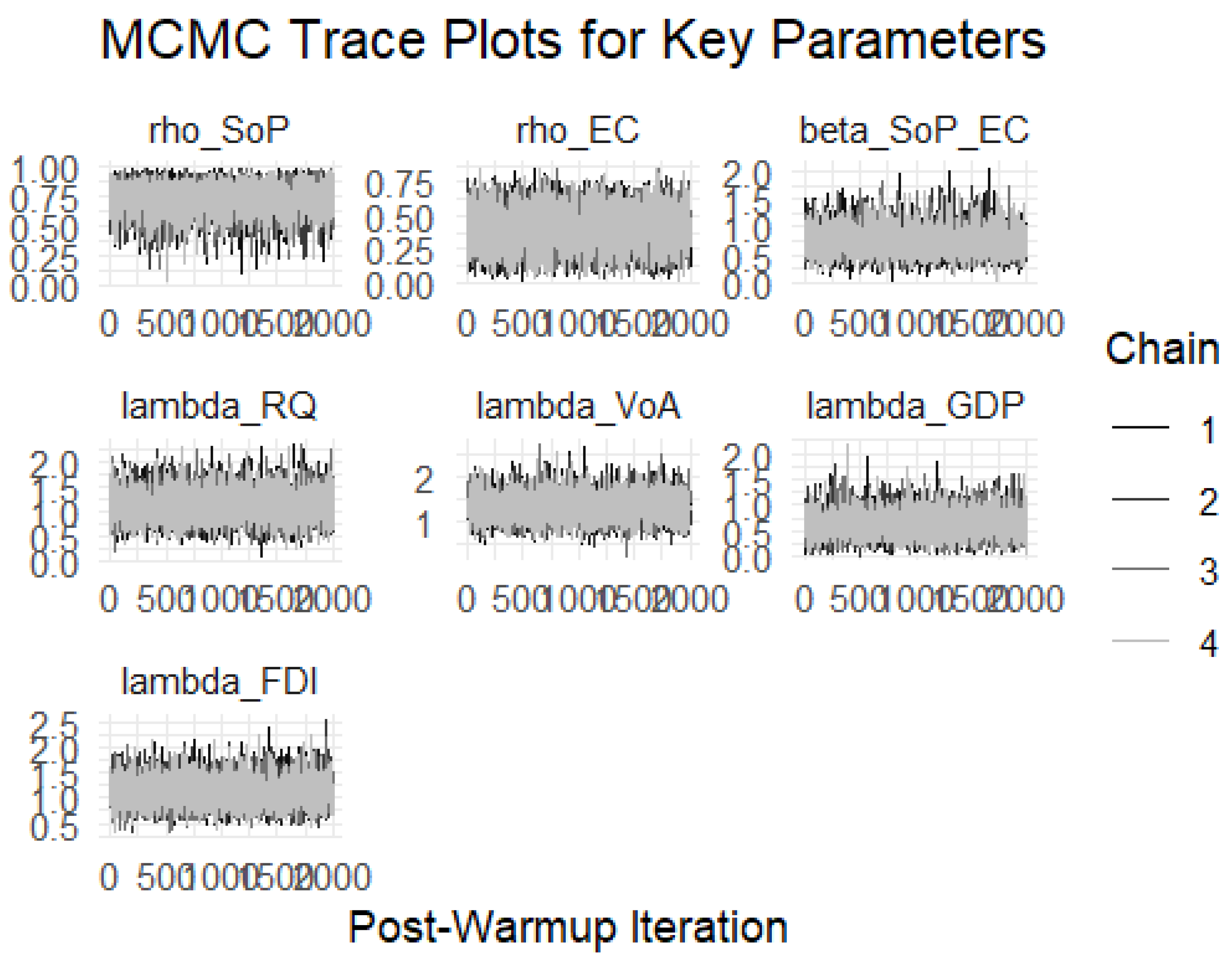
Table 2 presents the results of the primary Bayesian State Space Structural Equation Model (BSS-SEM) linking the observed indicators to their respective latent constructs: Separation of Powers (SoP) and Economic Development (ED). The estimation was performed using the Stan Hamiltonian Monte Carlo (HMC). Posterior inference was based on four chains, each consisting of 4000 iterations and 2000 warmups, resulting in 8000 post-warm-up posterior draws. The posterior estimate results of 1.00 (Rhat) value for all parameters showed that the four chains converged successfully. The neff (Effective Sample Size) presented high values, with almost all greater than 4000, suggesting that the posterior distributions were well sampled and the estimates were stable. Model convergence was also assessed visually using Markov Chain Monte Carlo (MCMC) trace plots, which indicates a healthy sampling with no trends or drifting downward or upward over the iterations (see Appendix, Figure 5). The visual evidence from the trace plots confirmed that the Stan model converged well.
The factor loadings of RoLaw and HDI were fixed at 1.0 to be the reference anchor indicators in the measurement model, which was absorbed into the latent state definition, and this is expected in Bayesian SEM behavior. The coefficient of the structural relationship (βSop→ED) of 0.74 represents a strong positive relationship between the two main constructs, Separation of Powers and Economic Development. The 95% credible interval of (0.34, 1.31) which excludes zero, indicates that the effect is statistically credible. The measurements loadings which are the (λ) parameters of RQ, VoA, GDP, and FDI represents how strongly the observed indicators load onto the latent factors. λRQ (1.11), λVoA (1.30), and λFDI (1.10) show strong associations, while λGDP(0.61) shows weak, though maintains positive and credible.
The autocorrelation scale (ρ) values for ρSoP (0.73) and ρED (0.42) indicate moderate-to-high internal consistency or spatial correlation within the respective raw components. The measurement error (σ), which is estimated at σmeas (0.73), while the process noise for the latent constructs remains relatively low, indicates that the model captures a fair amount of the underlying variance. The State Space model of rho (ρ) parameters are the autoregressive coefficients of the latent states. If the (ρ) value is close to 1.0, the latent state follows a random walk (nonstationary). If it is significantly less than 1, the system is mean-reverting (i.e., stationary). The estimates suggest that both stability of SoP and ED are stationary processes. However, ρSoP (0.73), suggests a stationary but highly persistent institutional process, while ρED (0.42), indicates a weaker persistent and more rapidly mean-reverting economic development process. Neither ρSoP nor ρED includes 1.0 in their 95% credible intervals (0.44, 0.93 and 0.11, 0.70) respectively, which indicates both latent variables are stationary. This suggest that the variables do not drift independently and that the risk of a spurious results caused by shared unit roots is statistically negligible.
Table 3 summarizes the estimated long-run impact of the predictors on the response variable based on 8000 posterior draws. The Mean Long-Run effect of (1.31), indicates that for every 1-unit permanent increase in the predictor variables, the response variable is expected to increase by approximately 1.314 units once the system reaches a steady state. Comparatively, as the short-run effect (β) was 0.74, the long-run impact was nearly double that of the immediate impact. This suggest that the relationship significantly strengthens over time as the system adjusts. The results show a 90% credible interval of (0.76, 2.05), which is entirely positive indicating a high confidence of at least a 95% probability that a positive long-run relationship exists. The evidence of stability with this formula (β/1-ρ) for a meaningful long-run effect if the system is stable, where (ρ < 1) presents ρED (0.42), then the denominator (1-0.42) which is (0.58 < 1) is positive and substantial.
The Posterior Impulse Response Function (IRF), which illustrates the dynamic effect of a one-time shock on the response variable over a 20-period horizon, is depicted in Figure 2. The X-axis illustrates the time intervals following the initial disturbance (0 to 20 periods). The Y-axis represents the size of the dependent variable’s response. The solid black line represents the median expected response over time, and the shaded red area represents the 90% credible interval representing uncertainty. At horizon 0, the solid black line peaks at approximately (0.70 to 0.75), which represents the immediate (short-run) impact of the shock. This effect was observed from the beginning. The red shaded area (90% credible interval) represents the range of the probable outcomes. The interval remains entirely above the zero line (the dashed horizontal line) only for approximately the first four periods. This indicates that the initial shock has a statistically significant positive effect for approximately the first four periods. The plot suggests a strong but short-lived impact. The full effect of a shock dissipates quickly within the first few periods, which highlights that dynamic adjustment occurs primarily in the short term.
Figure 3 shows the ACF diagnostic plot of the latent construct ED residuals, which indicates that the residuals are white noise, suggesting a strong positive sign that the model is capturing the time seires dynamics correctly and is likely not spurious. The dashed blue lines represents the 95% confidence interval, beyond which any bar indicates a statistically significant autocorrelation. However, Lags 1 through 14 vertical bars fall within the dashed blue lines. This indicates that the State Space model does not miss any significant lagged components in the transition equation, suggesting that the errors are independent and identically distributed, which is a key assumption of time series models.
Figure 3.
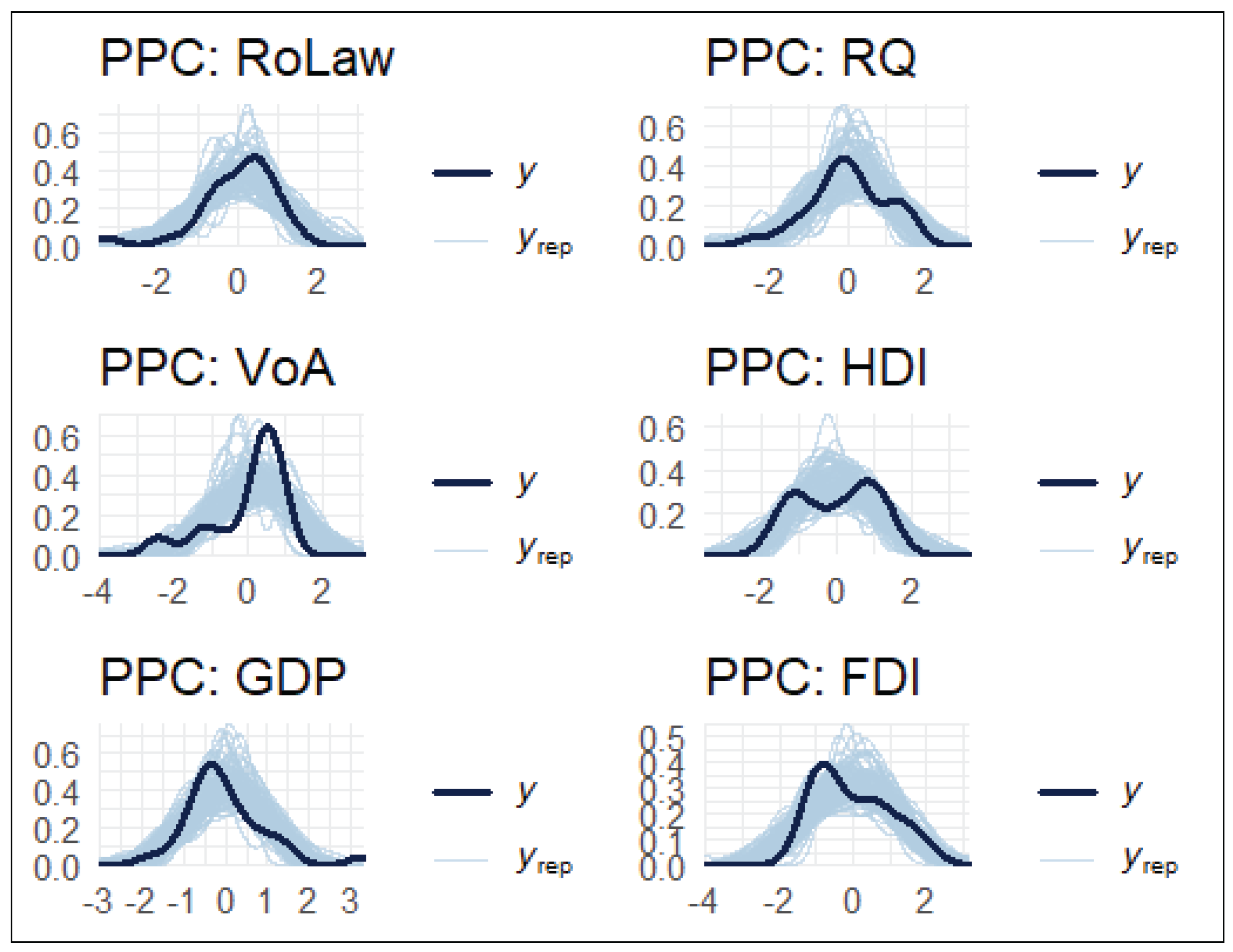
The set of Posterior Predictive Check (PPC) density overlay plots covering all six latent indicators is depicted in Figure 4. The dark blue line (y) represents the observed distribution of the actual scaled data points. The many light blue line (yrep) represents hundred separated datasets generated by the fitted model after training, where the goal of a good fit is for the light blue lines to cluster tightly around and overlap with the dark blue line. The Bayesian state-space SEM appears to provide a good fit to the observed data across all the six indicators. The simulated data generated by the model largely replicated the distribution of the actual data points, suggesting that the model’s structure and distributional assumption (normal likelihoods) were reasonable for this dataset.
Figure 3.
The set of Posterior Predictive Check (PPC) density overlay plots covering all six latent indicators is depicted in Figure 4. The dark blue line (y) represents the observed distribution of the actual scaled data points. The many light blue line (yrep) represents hundred separated datasets generated by the fitted model after training, where the goal of a good fit is for the light blue lines to cluster tightly around and overlap with the dark blue line. The Bayesian state-space SEM appears to provide a good fit to the observed data across all the six indicators. The simulated data generated by the model largely replicated the distribution of the actual data points, suggesting that the model’s structure and distributional assumption (normal likelihoods) were reasonable for this dataset.
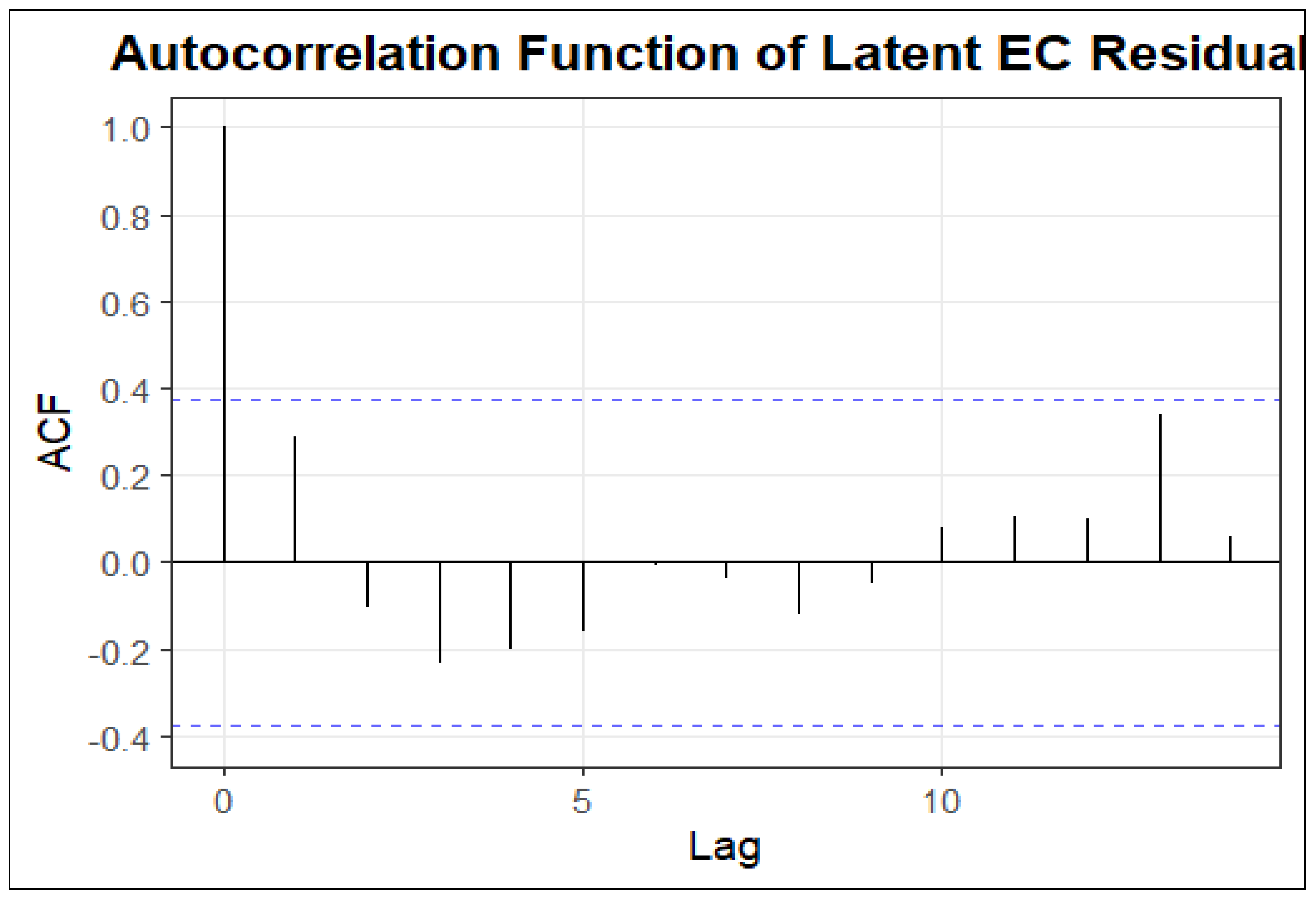
Figure 4.
Discussion
The findings of this study provide compelling evidence that the Separation of Powers (SoP) has a strong and positive impact on Economic Development (ED) in Ghana. The Bayesian State Space SEM (BSS-SEM) analysis shows a structural path coefficient of 0.74 from SoP to ED, with a 95% credible interval of (0.34, 1.31) that excludes zero, indicating a statistically credible short-run effect. The results suggest that improvements in governance structures in Ghana, manifested through an independent judiciary, accountable legislature, and effective executive regulations are associated with enhanced economic performance. This finding aligns with the institutional economics literature, particularly the arguments advanced by North (1990) and Acemoglu et at. (2005), Besley and Persson (2011), and La Porta et al. (1998, 2021) emphasized that strong, independent institutions reduce uncertainty, curb rent-seeking, and enhance market efficiency.
Furthermore, the long-run effect, estimated at 1.31, demonstrates that the influence of the separation of powers on economic development strengthens over time as the system approaches a steady state, highlighting the cumulative and dynamic nature of the impacts of institutions on economic development. This result supports Acemoglu and Robinson’s (2012, 2020) argument that sustainable economic development depends not only on democratization but also on the durability and balance of institutional constraints. The long-run amplification of SoP→ED relationship suggests that governance reforms yield increasing returns as institutional credibility, policy stability, and enforcement capacity become more entrenched.
The Posterior Impulse Response Function (IRF) results further illustrate the temporal dynamics of the relationship, suggesting that a one-time improvement in the separation of powers produces a significant positive response in economic development, primarily during the initial four periods. Although the effect diminishes over time, the immediate response underscores the potency of institutional reforms in generating short-term economic gains, which then stabilizes as the system adjusts. This pattern reconciles competing views in the literature: while critics of rigid separation of powers (Ackerman, 2000; Elster, 2013; Devins & Fisher, 2019) caution against institutional rigidity, the results suggests that an effective (not merely formal) separation of powers produces immediate gains while sustaining long-term stability. Thus, the findings do not contradict calls for inter-branch cooperation but rather demonstrate that cooperation must operate within credible institutional constraints. This amplifies theoretical expectations that well-functioning institutions catalyze for economic growth.
The autoregressive coefficient results of the latent states (= 0.73, = 0.42) indicate moderate to high stability, confirming that both constructs are stationary and mean-reverting. The absence of unit roots reduces the risk of spurious relationships, enhancing the reliability of both short-and long-term effect estimates. The moderate autocorrelation results of the latent states also suggest that while past values influence current states, the system does not exhibit an uncontrolled drift, reaffirming the robustness of the inferred relationships. This finding directly addresses methodological concerns common in time series institutional analysis and reinforces the argument advanced by Nzepang and Anya (2024) that executive dominance and weak institutional independence undermine long-term structural information in Sub-Saharan Africa. The higher persistence of SoP relative to ED reflects the slow-moving nature of institutional change, consistent with Veblen (1899), Commons (1931), and North (1990).
Diagnostic tests further validated the proposed model. The Autocorrelation Function (ACF) plots of the residuals confirmed white noise behavior, suggesting that the state-space model successfully captured the temporal structure of the data. The Posterior Predictive Checks (PPC) indicated that the simulated distributions of the latent indicators closely match the observed data, demonstrating that the model provides a reliable representation of the underlying process. Together, these diagnostics affirm that the Bayesian state-space SEM framework is well-suited to capture the dynamic latent relationship between the separation of powers and economic development, even with a small sample size, missing data, and non-normal distributions underscore the critical role of institutional design in shaping Ghana’s economic outcomes.
The positive effect of the separation of powers highlights the importance of judicial independence, legislative oversight, and accountable executive action in promoting policy stability, transparency, and the fair enforcement of property rights and contract. Given Ghana’s historical context of executive dominance and politicized appointments, this study emphasizes the need for reforms to enhance institutional independence and strengthen checks and balances across government branches. Such reforms could amplify both immediate and long-term economic benefits, reduce corruption, and nepotism, foster investor confidence, and create a more predictable environment for economic activities.
In summary, this study confirms that the separation of powers is not merely a constitutional ideal but also a practical driver of economic development. By providing robust empirical evidence using the Bayesian State Space Structural Equation Model, this study demonstrates both the short-term responsiveness and long-term cumulative effects of institutional quality on economic performance. These findings reinforce the broader institutional economics literature, highlighting that strong, independent, and accountable institutions are fundamental to sustainable economic growth and socioeconomic development in Ghana.
Taken together, the results confirm and extend the institutional economics literature by providing Ghana-specific, dynamic, and latent-variable based evidence that the separation of powers materially shapes economic outcomes. The findings also directly validate the claim that Ghana’s economic challenges cannot be fully explained by macroeconomic indicators alone, but are deeply rooted in institutional design, executive dominance, and weak accountability mechanisms.
5. Conclusion
This study provides robust empirical evidence that the separation of powers is a significant and dynamic driver in Ghana’s economic development. Using a Bayesian State Space Structural Equation Modeling (BSS-SEM) framework, the analysis demonstrates a strong and credible positive relationship between institutional checks and balances and economic performance, with effects that are both immediate and cumulative over time. The estimated short-run impact confirms that improvements in institutional independence and accountability yield prompt economic gains, while the larger long-run effect highlights the enduring influence of governance reforms as the system stabilizes.
The dynamic results, supported by a posterior impulse response analysis and diagnostic checks, indicate that institutional improvements generate meaningful but time-varying economic responses, reinforcing the importance of sustained governance quality over one-off reforms. The findings underscore that the effective separation of powers is not merely a constitutional principle but a practical mechanism for reducing corruption and nepotism, enhancing policy credibility, and fostering sustainable economic development in Ghana’s legislature. Therefore, strengthening institutional independence and checks and balances is central to Ghana’s long-term economic progress. This study reinforces the broader institutional consensus that economic development is inseparable from the quality of governance. For Ghana, meaningful progress toward sustainable development will depend not only on sound macroeconomic management but also on deepening institutional independence and recalibrating the constitutional checks and balances. In this regard, the separation of powers not only a safeguard of liberty but also a cornerstone of long-term economic prosperity.
References
- Acemoglu, D.; Robinson, J. A. Why nations fail: From the winners of the Nobel Prize in economics: The origins of power, prosperity and poverty. Profile. 2012. Available online: https://books.google.com.gh/books?id=PLlOCUIAh88C.
- Acemoglu, D.; Robinson, J. A. The narrow corridor: States, societies, and the fate of liberty; Penguin Publishing Group, 2020. [Google Scholar]
- Acemoglu, D.; Johnson, S.; Robinson, J. A. The colonial origins of comparative development: An empirical investigation. Am. Econ. Rev. 2001, 91(5), 1369–1401. [Google Scholar] [CrossRef]
- Acemoglu, D.; Johnson, S.; Robinson, J. A. Institutions as a fundamental cause of long-run growth. In Handbook of economic growth; Aghion, P., Durlauf, S. N., Eds.; Elsevier, 2005; Vol. 1, pp. 385–472. [Google Scholar]
- Ackerman, B. The new separation of powers. In Harvard Law Review; 2000; pp. 633–729. [Google Scholar]
- Asparouhov, T.; Hamaker, E. L.; Muthén, B. Dynamic structural equation models. Struct. Equ. Model. A Multidiscip. J. 2018, 25(3), 359–388. [Google Scholar] [CrossRef]
- Besley, T.; Persson, T. Pillars of prosperity: The political economics of development clusters; Princeton University Press, 2011. [Google Scholar] [CrossRef]
- Boucher, D.; Kelly, P. Political thinkers: From Socrates to the present; Oxford University Press, 2009. [Google Scholar] [CrossRef]
- Bullock, H. E.; Harlow, L. L.; Mulaik, S. A. Causation issues in structural equation modeling research. Struct. Equ. Model. A Multidiscip. J. 1994, 1(3), 253–267. [Google Scholar] [CrossRef]
- Byrne, B. M. Structural equation modeling with AMOS: Basic concepts, applications, and programming, 3rd ed.; Routledge, 2016. [Google Scholar] [CrossRef]
- Chow, S. M.; Ho, M. R.; Hamaker, E. L.; Dolan, C. V. Equivalence and differences between structural equation modeling and state-space modeling techniques. Struct. Equ. Model. A Multidiscip. J. 2010, 17(2), 303–332. [Google Scholar] [CrossRef]
- Commons, J. R. Institutional economics: Its place in political economy; MacMillan, 1934. [Google Scholar]
- Corrales, J.; Penfold, M. Dragon in the tropics: Hugo Chavez and the political economy of revolution in Venezuela; Brookings Institution Press, 2011. [Google Scholar]
- Devins, N.; Fisher, L. Political dynamics of constitutional law; West Academic Publishing, 2019. [Google Scholar]
- Devlieger, I.; Rosseel, Y. Factor score path analysis: An alternative for SEM? Methodol. Eur. J. Res. Methods Behav. Soc. Sci. 2017, 13 Suppl 1, 31–38. [Google Scholar]
- Djankov, S.; La Porta, R.; Lopez-de-Silanes, F.; Shleifer, A. The regulation of entry. Q. J. Econ. 2002, 117(1), 1–37. [Google Scholar] [CrossRef]
- Duncan, O. D. Introduction to structural equation models; Academic Press, 1975. [Google Scholar]
- Elster, J. Securities against misrule: Juries, assemblies, elections; Cambridge University Press, 2013. [Google Scholar]
- Engle, R. F.; Granger, C. W. J. Cointegration and error correction: Representation, estimation and testing. Econometrica 1987, 55, 251–276. [Google Scholar] [CrossRef]
- Fornell, C.; Larcker, D. F. Structural equation models with unobservable variables and measurement error: Algebra and statistics; Sage Publications, 1981. [Google Scholar]
- Gelman, A.; Rubin, D. B. Inference from iterative simulation using multiple sequences. Stat. Sci. 1992, 7(4), 457–472. [Google Scholar] [CrossRef]
- Gilani, S. R. H.; Ullah, Z.; Zahoor, S. Democracy, economic development, and the separation of powers in the 1973 Constitution Pakistan: A critical analysis. Qlantic J. Soc. Sci. Humanit. 2023. [Google Scholar] [CrossRef]
- Haggard, S.; MacIntyre, A.; Tiede, L. The rule of law and economic development. Annu. Rev. Political Sci. 2008, 11, 205–234. [Google Scholar] [CrossRef]
- Hallerberg, M.; Strauch, R.; von Hagen, J. Fiscal governance in Europe; Cambridge University Press, 2009. [Google Scholar]
- Harvey, A. Forecasting, structural time series models and the Kalman filter; Cambridge University Press, 1989. [Google Scholar] [CrossRef]
- Hyden, G. African politics in comparative perspective, 2nd ed.; Cambridge University Press, 2012. [Google Scholar]
- Jöreskog, K. G. Simultaneous factor analysis in several populations. ETS Res. Bull. Ser. 1970, 1970(2), 1–31. [Google Scholar] [CrossRef]
- Joshua, P. O. The separation of powers in Ghana a mirage? Examining the excess power of the executive arms of government of Ghana. Int. J. Res. Innov. Soc. Sci. (IJRISS) 2025. [Google Scholar] [CrossRef]
- Kalman, R. E. A new approach to linear filtering and prediction problems. ASME J. Basic Eng. 1960, 82, 35–45. [Google Scholar] [CrossRef]
- Keefer, P.; Knack, S. Why don’t poor countries catch up? A cross-national test of an institutional explanation. Econ. Inq. 1997, 35(3), 590–602. [Google Scholar] [CrossRef]
- Koffmann Jopia, E.; Galilea Aranda, P. Ideology, institutions, and economic growth: Panel evidence 1995–2022. arXiv 2025, arXiv:2509.04532. [Google Scholar] [CrossRef]
- La Porta, R.; Lopez-de-Silanes, F.; Shleifer, A.; Vishny, R. W. Law and finance. J. Political Econ. 1998, 106(6), 1113–1155. [Google Scholar] [CrossRef] [PubMed]
- La Porta, R.; Lopez-de-Silanes, F.; Shleifer, A.; Vishny, R. W. Investor protection: Origins, consequences, and reform. J. Financ. Econ. 1999, 58(1–2), 3–27. [Google Scholar]
- Lee, S.-Y. Structural equation modeling: A Bayesian approach; Wiley, 2007. [Google Scholar] [CrossRef]
- Luo, J. State of the world: Democracy’s impact on social and economic development V-Dem Institute; University of Gothenburg, 2020. [Google Scholar]
- Montesquieu, C. de S.; Baron de. The spirit of laws; Whitcomb, M., Ed.; University of Pennsylvania, 1748/1899. [Google Scholar]
- Munthen, B.; Asparouhov, T. Bayesian structural equation modelling: A more flexible representation of substantive theory. Psychol. Methods 2012, 17(3), 313–335. [Google Scholar] [CrossRef] [PubMed]
- Nchor, D.; Adamec, V.; Kolman, P. Comparison of shadow economies: the case of Ghana, Nigeria and UK. Mediterr. J. Soc. Sci. 2016, 7(1), 248–257. [Google Scholar] [CrossRef]
- North, D. C. Institutions, ideology, and economic performance. Cato J. 1991, 11, 477–488. [Google Scholar] [CrossRef]
- North, D. C.; Thomas, R. P. The rise of the western world: A new economic history; Cambridge University Press, 1973. [Google Scholar]
- Nzepang, F.; Anya, S. B. N. What is the interaction between separation of democratic powers and structural transformation in Sub-Saharan Africa? J. Knowl. Econ. 2024, 15(2), 7702–7722. [Google Scholar] [CrossRef]
- Oberdieck, T.; Moch, E. Principle of separation of powers between the legislature and judicially: Distribution of state power several state bodies for this purpose limitation of power. Int. J. Public Adm. Manag. Econ. Dev. 2023, 8(2). [Google Scholar] [CrossRef]
- Osabu-Kle, D. T. Compatible cultural democracy: The key to development in Africa; Peter Lang, 2000. [Google Scholar]
- Porta, R. L.; Lopez-de-Silanes, F.; Shleifer, A.; Vishny, R. W. Law and finance. J. Political Econ. 1998, 106(6), 1113–1155. [Google Scholar] [CrossRef] [PubMed]
- Pozsár-Szentmiklósy, Z. Informal Concentration of Powers in Illiberal Constitutionalism: The Case of Hungary. Hague J. Rule Law 2024, 16, 289–314. [Google Scholar] [CrossRef]
- Prempeh, H. K. Presidential power in comparative perspective: The puzzling persistence of imperial presidency in post-authoritarian Africa. Hastings Const. Law Q. 2007, 35, 761–816. [Google Scholar]
- Rajan, R.; Zingales, L. Financial dependence and growth. Am. Econ. Rev. 1996, 88(3), 559–586. [Google Scholar]
- Raz, J. The law’s own virtue. Oxf. J. Leg. Stud. 2019, 39(1), 1–15. [Google Scholar] [CrossRef]
- Rose-Ackerman, S. Corruption and government: Causes, consequences, and reform; Cambridge University Press, 1999. [Google Scholar]
- Rummel, R. J. Applied factor analysis; Northwestern University Press, 1988. [Google Scholar]
- Song, X. Y.; Lee, S. Y. A tutorial on the Bayesian approach for analyzing structural equation models. J. Math. Psychol. 2012, 56(3), 135–148. [Google Scholar] [CrossRef]
- Spearman, C. General intelligence, objectively determined and measured. Am. J. Psychol. 1904, 15, 201–292. [Google Scholar] [CrossRef]
- Tavares, J.; Wacziarg, R. How democracy affects growth. Eur. Econ. Rev. 2001, 45, 1341–1378. [Google Scholar] [CrossRef]
- Transparency International. Corruption perceptions index. 2023. Available online: https://www.transparency.org/en/cpi.
- Treisman, D. The causes of corruption: A cross-national study. J. Public Econ. 2000, 76(3), 399–457. [Google Scholar] [CrossRef]
- Tushnet, M.; Jackson, V. C. Comparative constitutional law, 2nd ed.; Foundation Press, 2006. [Google Scholar]
- Veblen, T. The theory of the leisure class: An economic study of institutions; Macmillan, 1899. [Google Scholar]
- Vile, M. J. C. Constitutionalism and the separation of powers; Clarendon Press, 1967. [Google Scholar]
- Wright, S. Correlation and causation. J. Agric. Res. 1921, 20(7), 557–585. [Google Scholar]
Figure 1.
In the diagram above, SoP denotes Separation of Powers and is measured by three indicators: Rule of Law (RoLaw), representing the Judiciary; Regulatory Quality (RQ), representing the Executive; and Voice of Accountability (VoA), representing the legislature. ED denotes Economic Development and is measured by the Human Development Index (HDI), Gross Domestic Product (GDP), and Foreign Direct Investment (FDI). The arrow lines denote coefficients and variances, where a single head from SoP to ED represents the path coefficient, the double head represents covariances, and ԑ represents error components. The Bayesian state-space structural equation model is specified by the following equations:.
Figure 1.
In the diagram above, SoP denotes Separation of Powers and is measured by three indicators: Rule of Law (RoLaw), representing the Judiciary; Regulatory Quality (RQ), representing the Executive; and Voice of Accountability (VoA), representing the legislature. ED denotes Economic Development and is measured by the Human Development Index (HDI), Gross Domestic Product (GDP), and Foreign Direct Investment (FDI). The arrow lines denote coefficients and variances, where a single head from SoP to ED represents the path coefficient, the double head represents covariances, and ԑ represents error components. The Bayesian state-space structural equation model is specified by the following equations:.
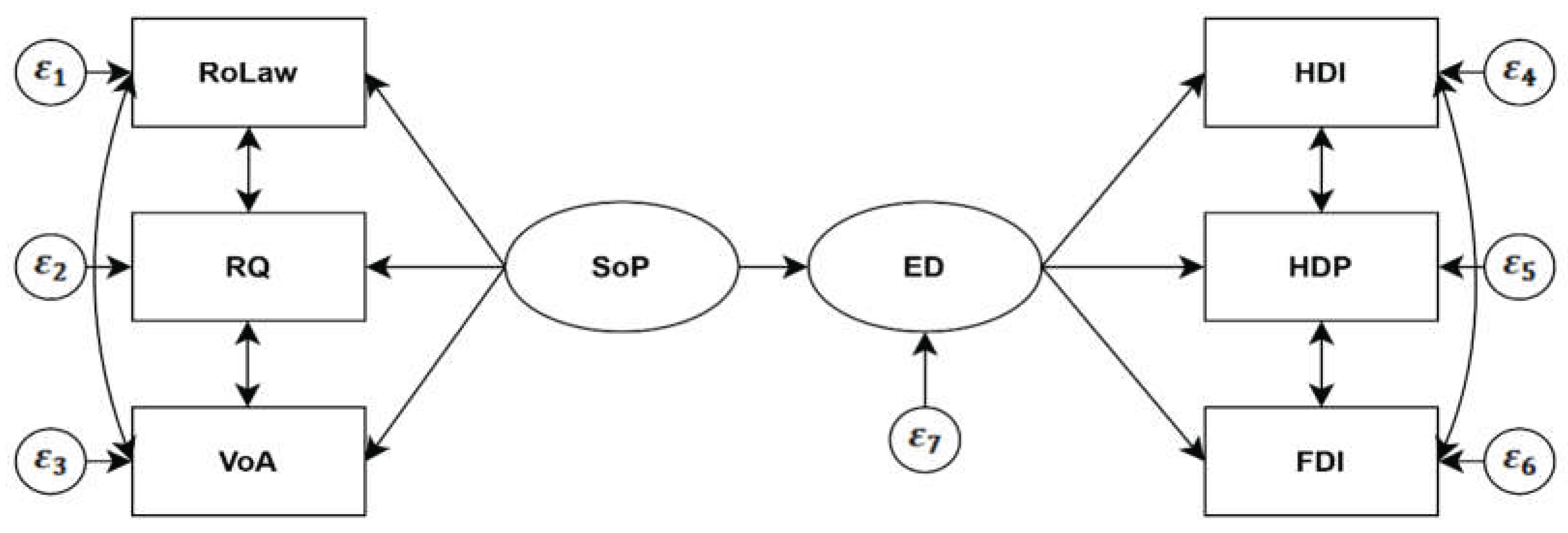
Figure 2.
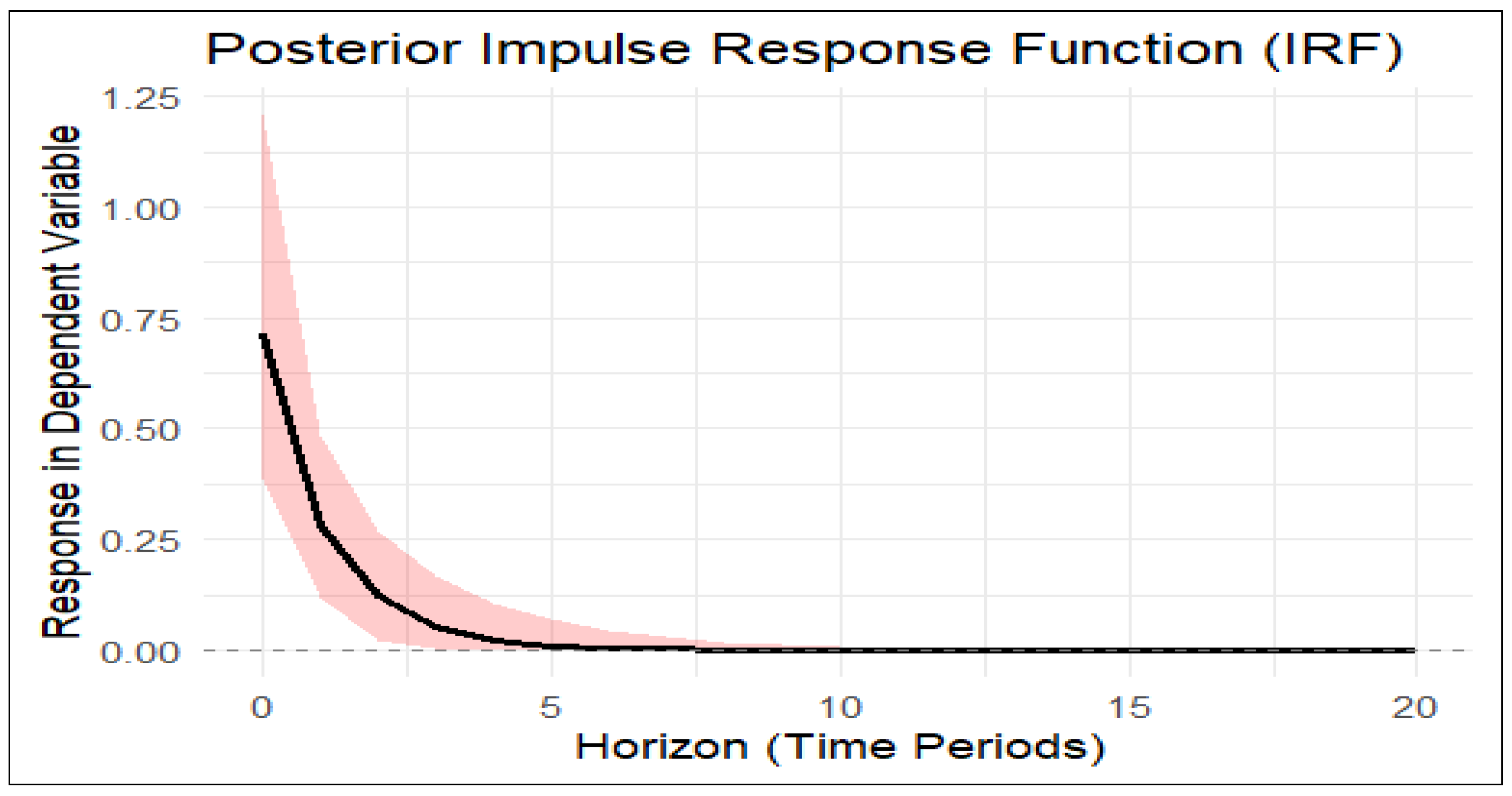

Table 1.
Summary of Posterior Estimates from Stan Model Inference (Parameters).
| Variable | Obs | Mean | Std.Dev | Min | Max | Skewness | Kurtosis | |
|---|---|---|---|---|---|---|---|---|
| HDI GDP |
28 28 |
0.56 5.42 |
0.05 2.65 |
0.49 0.51 |
0.63 14.05 |
-0.13 1.13 |
-1.61 2.03 |
|
| FDI | 28 | 4.26 | 2.65 | 0.96 | 9.47 | 0.47 | -1.18 | |
| RoLaw | 25 | -0.03 | 0.13 | -0.44 | 0.15 | -1.38 | 2.49 | |
| RQ | 25 | -0.14 | 0.15 | -0.51 | 0.10 | -0.29 | -0.37 | |
| VoA | 25 | 0.36 | 0.23 | 0.21 | 0.60 | -1.23 | 0.34 | |
Table 2.
Summary of Posterior Estimates from Stan Model Inference (Parameters).
| Parameter | Mean | SD | 2.5%(Lower) | 97.5%(Upper) | neff | Rhat |
|---|---|---|---|---|---|---|
| βSop→ED ρSoP |
0.74 0.73 |
0.25 0.12 |
0.34 0.44 |
1.31 0.93 |
4112 3617 |
1.00 1.00 |
| ρED | 0.42 | 0.16 | 0.11 | 0.70 | 5331 | 1.00 |
| λRQ | 1.11 | 0.30 | 0.58 | 1.74 | 6588 | 1.00 |
| λVoA | 1.30 | 0.30 | 0.77 | 1.93 | 7158 | 1.00 |
| λGDP | 0.61 | 0.25 | 0.17 | 1.15 | 5792 | 1.00 |
| λFDI | 1.10 | 0.28 | 0.63 | 1.71 | 8105 | 1.00 |
| σmeas | 0.73 | 0.04 | 0.64 | 0.82 | 7402 | 1.00 |
Table 3.
Summary of Long-Run Effect.
| Metric | Value |
|---|---|
| Mean Median (50%) 90% Credible Interval Interquartile Range |
1.31 1.25 0.76, 2.05 1.02 – 1.53 |
| Min/Max | -0.34/4.57 |
Disclaimer/Publisher’s Note: The statements, opinions and data contained in all publications are solely those of the individual author(s) and contributor(s) and not of MDPI and/or the editor(s). MDPI and/or the editor(s) disclaim responsibility for any injury to people or property resulting from any ideas, methods, instructions or products referred to in the content. |
© 2026 by the authors. Licensee MDPI, Basel, Switzerland. This article is an open access article distributed under the terms and conditions of the Creative Commons Attribution (CC BY) license.
Copyright: This open access article is published under a Creative Commons CC BY 4.0 license, which permit the free download, distribution, and reuse, provided that the author and preprint are cited in any reuse.