

Submitted:
31 August 2026
Posted:
02 September 2026
You are already at the latest version
Abstract
Background: Urinary tract infections (UTI) are a major driver of laboratory testing and antimicrobial prescribing, yet inappropriate urine collection, specimen handling, due to limited patient and nursing engagement can compromise diagnostic accuracy and contribute to unnecessary or inappropriate antibiotic use. This study evaluated knowledge, attitudes, and practices (KAP) related to pre-analytical diagnostic stewardship (DS), infection prevention and control (IPC), and antimicrobial stewardship (AMS) amongst nurses and hospitalized UTI patients. Methods: A cross-sectional study was conducted at two tertiary hospitals in Oman between September 2022 and August 2023. Three structured, internally validated questionnaires assessed pre-analytical DS, IPC, and AMS amongst nurses and patients. A total of 327 nurses participated, including 165 for the pre-analytical DS survey and 162 for the IPC and AMS survey; 77 hospitalized patients with UTI completed the patient questionnaire. KAP domain scores were standardized to a 0–100 scale and summarized as mean ± SD. MANOVA assessed the effects of covariates on combined KAP outcomes. Mann–Whitney U, Kruskal–Wallis tests compared KAP scores across demographic and professional groups. Results: Patients demonstrated strong awareness of importance of correct urine collection (91%); however, only 7.9% reported receiving midstream urine instructions, contrasting with 86.1% of nurses who reported providing them. They demonstrated high IPC engagement with 88.3% willing to prompt hand hygiene/glove use among doctors and nurses, and 74% would question antibiotic necessity. Amongst nurses gaps persisted in inserting new catheter before culture (66.7%) and refrigeration of specimens if delay expected (36.4%). Work experience significantly influenced pre-analytical KAP outcomes (p=0.002). Knowledge amongst nurses was high for hand hygiene, IPC prevention and antibiotic resistance drivers; however, 56.3% incorrectly associated antibiotics with pain/inflammation. Institutional affiliation significantly influenced IPC/AMS practice scores (p=0.004). Overall, findings revealed motivated stakeholders alongside discrete, actionable weaknesses in diagnostic and antimicrobial stewardship workflows. Conclusion: This study identifies a critical but modifiable gap between perceived and patient-experienced pre-analytical DS practices in UTI . Strengthening microbiology and nursing collaborative diagnostic stewardship, standardizing patient instructions, improving specimen-handling infrastructure, and actively engaging patients represent practical, high-impact strategies to enhance diagnostic accuracy, infection prevention, and antimicrobial stewardship in Oman.
Keywords:
pre-analytic diagnostic stewardship
; infection prevention and control
; antimicrobial stewardship
; UTI
1. Introduction
Inappropriate antimicrobial prescriptions in urinary tract infections (UTI), increase the burden of antimicrobial resistance (AMR). [1,2,3,4,5]. Laboratory diagnosis of UTI continues to be challenging making it increasingly important to implement diagnostic stewardship (DS). DS optimizes preanalytical, analytical, and post analytical aspects of diagnostic testing.[6,7]. It is upstream of AMS and plays a vital role in ensuring the right result is released at the right time and providing guidance in appropriate antimicrobial prescribing.[8,9,10].
Nurses and patients play an essential role in execution of the pre-analytic aspect of DS [11,12]. Appropriate sample collection and transport improves quality of samples thus reducing unnecessary diagnostic delays, inappropriate treatments and higher costs [13,14]. Few studies have conducted integrated knowledge, attitude and practice (KAP) surveys of nurses and patients in pre-analytic DS, IPC and AMS, and tailor the educational sessions after analyzing the survey results. [15]. Targeted educational sessions for nurses are essential for optimum implementation of DS, AMS and quality improvement [15,16].
Patients are increasingly being considered equal stakeholders in their health outcomes. Involving them in implementation of IPC, AMS and pre-analytic aspect of DS may be impactful. An integrated approach that combines DS, IPC, and AMS is vital for strengthening healthcare systems and improving patient safety [17]. This study assessed the nurses’ and patients’ KAP in pre-analytic DS, IPC, and AMS in simple and catheter associated UTI in order to tailor their education.
2. Material and Methods
This cross sectional study analyzed KAP related to pre-analytical DS, IPC, and AMS amongst nurses and patients, at two tertiary care centers in Oman: Sultan Qaboos University Hospital, (facility A) Muscat and Suhar Hospital, (facility B) Suhar from September 2022 to August 2023. The study was carried out in the Department of Microbiology and Immunology, College of Medicine and Health Sciences (CoMHS), SQU, in coordination with the clinical departments. Ethical approval for this study was granted by the Medical Research Ethics Committee (MREC) at CoMHS (Ref: SQU-EC/377/2021) and the Ministry of Health’s Health Studies and Research Approval Committee (HSRAC; Ref: MoH/CSR/21/24496). Nurses posted at and patients with UTI admitted in medical, surgical, orthopedic, gynecology and obstetrics wards were surveyed through Google Forms. The form contained an initial obligatory consent question, which, if answered with “No”, immediately ended the questionnaire. All questions, except an initial question requesting email address, were obligatory. The final question was followed by links to educational videos on hand hygiene and antimicrobial-resistance.
The sample size was determined by the average monthly admissions to medical and surgical wards involving urine culture requests. Utilizing the Raosoft sample size calculator with a 5% margin of error and a 95% confidence interval, a required sample size of 63 participants was established (accessed 2 February 2023 http://www.raosoft.com/samplesize.html). Three questionnaires (two for nursing staff and one for patients) were internally validated and adjusted prior to implementation, by piloting with a cohort of nurses (n=30) and patients (n=12). The nurses’ questionnaire had two sections each, with 5 sub-sections. The first survey instrument was designed to assess KAP related to pre-analytical DS. It covered the end-to-end workflow, from specimen collection to handling and laboratory transport. The second one assessed their KAP on the AMS and IPC (Table 1).
Digital links to the questionnaires were disseminated through ward nurse managers, who facilitated distribution to the nursing staff within their respective units. Participants were sent the link to the form through email and WhatsApp. Educational sessions focused on the DS/AMS/IPC in the context of UTIs. The patients’ questionnaire had 7 sections with the educational moments integrated in the questionnaire itself. Each patient was interviewed and educated individually. Their educational sessions addressed urine collection techniques, UTI prevention strategies, hand hygiene, patient safety protocols, and basic concepts of AMS. Bilingual instructional posters (Arabic and English) detailing clean-catch midstream urine collection techniques were developed and disseminated (Figure 1).
3. Statistical Analysis
Raw data sheets were encrypted with VeraCrypt, using Advanced Encryption Standard (AES) with a 256-bit key length (AES-256). Data were analyzed through MS-Excel 365, descriptive statistics were calculated. Charts of the relevant results were created. The KAP scores were calculated by summing the scores for the corresponding items. As each domain contained a different number of items, the total scores for each domain were transformed to a scale ranging from 0 to 100 and the mean ± standard deviation (SD) was calculated. The Kolmogorov-Smirnov normality test was performed on these scores.
Mann-Whitney U and Kruskal-Wallis tests were conducted to compare the means of three dimensions based on the institute, gender, highest qualification, and work experience categories.
To assess the effect of institute, gender, highest qualification, and work experience on the combined outcomes of KAP, a multivariate analysis of variance (MANOVA) was performed.
Additionally, the adjusted p-value was calculated for each domain and variable by adjusting for the effects of other variables. A p-value less than 0.05 was considered statistically significant. Statistical analyses were conducted using SPSS version 30 (IBM Corp., Armonk, NY, USA).
4. Results
This study assessed two vital players in the pre-analytic DS, IPC, and MS- nurses (327) and patients (77), from two hospitals. Both groups demonstrated keenness in participating in the survey.
5. Patient KAP Regarding Urine Culture Collection Protocols, Infection Control and Antibiotic Usage
Among the 78 patients approached, 77, (98.7%) responded amongst which females, 66.2% dominated. Questions pertained to DS, and IPC measures (Table 2). Detailed clinical profile is provided in Supplementary Table S1. The majority (66.2%) presented with symptoms, flank pain being the most prevalent (56.9%), often persisting for over a week (45.1% of symptomatic patients).
Patients demonstrated a high level of awareness regarding the importance of correct urine specimen collection. Overall, 91% recognized that appropriate sample collection was important for generating accurate microbiological results. However, this awareness was not consistently matched by reported practice. A significant difference in practice was observed between the two hospitals (p = 0.008; Supplementary Table S2). Among patients who provided midstream urine samples, only 7.9% reported receiving even cursory instructions from nurses regarding the correct method of collection, while the remainder reported receiving no instructions. This contrasted sharply with nurses’ self-reported practice, where 86.1% stated that they routinely provided clear and complete instructions to patients. This discrepancy highlighted an important gap between provider-reported practice and patient-experienced care. Facility A performed better in this regard.
Alcohol based hand rub was the dominant HH method (94.8%). Poor adherence (55.8%) to HH was reported amongst relatives and caregivers. Personal protective equipment (PPE) were utilized appropriately by healthcare workers (HCW) as reported by 97.4% patients. They demonstrated good knowledge of appropriate IPC and PPE ( 88.3%). After being told the importance of HH, majority stated that they would prompt the HCW to practice hand hygiene (HH) and don gloves. Patients were keen to receive guidance on urine sample collection, prevention of recurrence of UTIs, catheter care and the appropriate use of antibiotics supplemented by visual aids.
Only 27.3% patients were currently on antibiotics, while nearly half (49.4%) had received them previously for UTI. Compliance to antibiotics prescription was high (87%). Interestingly 74% stated they would actively question the need for further antibiotic treatment.
6. KAP Among Nurses for Pre-Analytic Diagnostic Stewardship
Amongst 172 nurses approached, 165 responded, (63%: facility A, 36%: facility B), with 29.1% being in the 31-35-year age bracket. Diverse nationalities were noted, with Indian (47.3%) and Omanis (37%) predominating. A significant 72.1% held Bachelor's degree was held by majority (72.1%), 27.9% possessed 11-15 years’ experience (Supplementary Table 3). On analysis of four variables- institution, gender, highest qualifications and work experience (years) by MANOVA, work experience showed a significant global effect over the combined dependent variables, KAP (p = 0.002), Supplementary Table 4. The results of univariate analysis showed a significant effect of work experience on knowledge (p=0.002) and practice scores (p < 0.001). Nurses with 11- 15 years’ experience had the highest knowledge score (34.04 ± 8.05) and nurses with 1- 5 years’ experience have the lowest knowledge score (25.75 ± 10.04) (Supplementary Table 5). Work experience had a significant impact, both with and without adjustments for other variables (p < 0.001). Analysis of the mean practice scores across different levels of work experience revealed a noticeable decline in practice scores between 10 and 20 years of experience. Nurses with more than 20 years of experience achieved the highest mean score of 80.89 ± 11.02 (Figure 2a).
As mentioned above, 86.1% nurses reported instructing patients on proper urine collection, focusing on avoiding specimen contamination (89.9%) and collection of a clean midstream sample (MSU) (88.1%). Majority (63.6%) stated that written instructions for MSU were available, while 42.9% gave verbal instructions. Most (88.5%) believed that their duties extended to instructing the patients on appropriate collection of urine specimens. Majority (84.8%) had received training in sample collection from catheterized patients; 88.5% obtained the specimen via the catheter tube, 87% disinfected the sampling port prior to collection, 66.7% replaced catheters in place >2 weeks before culture. Patient education was considered important by 84.2% for accurate microbiology results. Immediate sample transport (74.5%) was practiced, but if delays occurred refrigeration wasn't universal (36.4% reported refrigeration; 29.7% lacked access). Our educational initiatives were welcomed by 86.1% of nurses, with 77.6% desiring in-person sessions on pre-analytic DS. Posters (40.6%) and video presentations (39.4%) were less preferred (Table 3).
7. KAP Among Nurses for IPC and AMS
Amongst the 162 nurses who responded, 98.8% understood the importance of HH before/after patient contact and sample handling (Table 4). Universal agreement existed on IPC's crucial role and HH importance (98.8%) in preventing infections. Nosocomial infections were correctly identified by 94.4%, and 98.8% understood it’s link with adverse patient outcomes. Majority, 97.5% were aware that antibiotic utility extended to treating bacterial infections, although 56.3% incorrectly linked them to management of pain/inflammation as well. Exceptional knowledge of side effects (allergic reactions 93.1%, common symptoms 96.3%) and impact on endogenous flora (80.6%) was observed. Excellent awareness of reasons behind the escalating antimicrobial resistance (inappropriate prescribing and dosage (94.4%), loss of activity of antibiotics against bacteria (94.4%), use of broad-spectrum antibiotics (79.6%), poor IPC (77.5%) was demonstrated.
The importance of DS and AMS interventions in curbing AMR and optimum patient outcome was appreciated by 88.9% nurses. MANOVA revealed that, the institutional culture had a significant global effect on the combined dependent variable, KAP (P = 0.004) (Supplementary Table 4) which were explored further by univariate analysis, with and without adjusting the effect for other variables. The practice scores revealed that the facility itself had a highly significant effect (p < 0.001). Facility B had a higher practice score (90.67 ± 6.28) than Facility A (Supplementary Table 6). Without adjusting for other variables, work experience appeared to have a significant effect (p=0.04); however, after adjusting, no significance was observed (p=0.09). Assessing the mean of the practice score within the years of work experience, the practice score increased until 10 years, (the highest mean score, 91.07 ± 5.31), but declined after 10 years (Figure 2b).
8. Discussion
This study recognizes that both nurses and patients are important stakeholders in optimizing patient care and tailored continuous education is essential to achieve this. Carefully structured KAPs are useful tools to understand baseline competencies and help identify which areas need augmented training and where positive feedback would promoting their engagement and ownership.
Effective DS hinges entirely on the excellent execution of the pre-analytic component, the primary players of which are the nurses and the patients themselves. It was heartening to find that patients clearly understood the importance of a correctly collected sample, underscoring a high awareness of causality [10,18]. Patient involvement shifts their role from passive recipients to active co-producers of care [19]. This engagement reduces preventable errors, and optimizes patient management. Our study uniquely engages patients in improving DS and AMS in UTI, an initiative which revealed a gap in the nurses’ knowledge and practice regarding instructions provided in collection of MSU. Over 90% patients reported a lack of guidance as against 86% nurses who reported providing the instructions. This highlights an area for improvement. This contrasts with Eley et al.'s (2016) finding where 50% received instructions [20]. Providing both verbal and written instructions has been linked to better patient knowledge and satisfaction [20]. Lack of clear instruction leads to contamination and false-positive results and thus impacting DS [13]. Inculcating best practices amongst nurses through continuous education will strengthen pre-analytic DS, curb false positive results and inappropriate antibiotic use [21].
Majority (78.6%) of catheterized patients reported adherence to HH and PPE use during catheter insertion, indicating good IPC practices. Other studies have reported similar findings [22]. Most patients (71.4%) understood the importance of proper sample collection and IPC. The relatively flat hierarchy in Oman empowers patients (88.3%) to unhesitatingly request HH or don gloves prior to examination. This contrasts with steep vertical hierarchies in many countries. [23]. Most patients (87%) reported adherence to completing antibiotic courses, a practice not aligning with the current guidance of stopping once having recovered, to minimize resistance [24]. Interestingly, 74% stated they would inquire why antibiotics were prescribed, which serves as an excellent nudge to the doctors to rethink the prescription. Such awareness amongst patients highlights the positive impact of patient education on antimicrobial stewardship [25].
Since routine urine samples are usually MSU, the nurses’ role in guiding patients in collection of appropriate urine samples is crucial but not fully appreciated by them. Mere availability of guidelines will not suffice, with only 63.6% being aware of it, active training is essential. We verified the practices followed by the staff by asking a few pointed questions to the patients. A significant gap was observed between nurses' and patients’ reported and observed practice regarding appropriateness of instructions given respectively. This underscores the importance of regular in-person training in the pre-analytic component of DS. We believe that DS in MSU needs to be urgently spearheaded as it remains severely neglected area. The nurses (88.5%) accepted their responsibility to educate patients and understood that poor collection leads to false reports and unnecessary treatment [26]. Aligning with CDC guidelines (2019), majority of them (66.7%) recognized the necessity of replacing indwelling catheters that had been in situ for more than two weeks prior to specimen collection [27]. In terms of sample handling, a concerning percentage (29.7%) lacked refrigeration access and needs addressing. [9,28]. Our study revealed that work experience influenced pre-analytic DS (p = 0.002). This suggests that pre-analytic DS skills are acquired through cumulative clinical exposure and repeated interaction with microbiology services. These findings highlight the importance of structured mentoring and continuous professional training, to improve specimen quality and diagnostic accuracy. Studies have shown that pre-analytical DS directly influence microbiological results, antimicrobial prescribing, and patient outcomes [29].
Overall, the nurses demonstrated sound IPC awareness. The increasing concern of AMR in the Middle East highlights the importance of implementing IPC practices.26 Our study found high HH adherence rates among nurses (98.8% during patient care, 95% during sample handling), comparable to other centers [30]. A study reported 79.6% HH compliance rate among nurses [31], while Al Dawsari et al reported 55.8% compliance amongst nurses [32]. Nurses were well conversant with the antimicrobial spectrum (97.5%) and appreciated the ensuing collateral damage (80.6%). A significant majority (90%) correctly identified that inappropriate dosing, misuse, and the over-reliance on broad-spectrum agents are key drivers of antimicrobial resistance. They also acknowledged poor IPC practices promote AMR [33]. They believed it important to complete the antibiotic course (> 90%) and advised patients accordingly (96.9%) which contrasts with emerging knowledge [24]. Most nurses (88.8%) believed that AMS and DS initiatives improve patient outcomes. Such high level of awareness amongst nurses is essential to promote AMS. Significant institutional differences in IPC and AMS practice domains were observed (adjusted p < 0.001), suggesting greater institutional commitment, multidisciplinary collaboration play a big role in improvement [34,35]. Our findings clearly indicate that continuous competency-based training in diagnostic stewardship, IPC and AMS is essential for nursing staff with a mandatory training after 10 years in order to equip them to address the new challenges.
Based on nurses' expressed interest, a comprehensive symposium on antimicrobial and diagnostic stewardship and IPC was organized, involving all relevant stakeholders (nurses, physicians, Lab technicians and pharmacists), an interdisciplinary approach which we strongly advocate, This broader approach assesses the KAP and then educates the stakeholders, thus promoting multimodal diagnostic and antimicrobial stewardship [28,36].
9. Conclusions
This KAP spotlights a critical need: strengthening the pre-analytic phase of diagnostics, especially collection and handling of MSU. Significant gaps in knowledge and practices among both nurses and patients has direct implications for diagnostic accuracy, patient safety, and antimicrobial stewardship. While attitudes were generally positive, inconsistent adherence to evidence-based practices such as proper urine collection, timely transport, undermines the effectiveness of diagnostic stewardship initiatives.
Nurses, being the first point of contact in clinical workflows, play a pivotal role in ensuring that diagnostic processes are optimized. Their empowerment through ongoing training in IPC, sample handling, and the principles of antimicrobial resistance mitigation is vital. Simultaneously, patient education campaigns must be developed to encourage compliance with hygiene, sampling, and follow-up protocols.
Enhancing the diagnostic literacy and strengthening the pre-analytical phase through stewardship-informed strategies is not merely a laboratory concern, it is a public health imperative. Robust implementation of DS, AMS and IPC programs is essential across all healthcare institutions is recommended to stem the tide of AMR.
Supplementary Materials
The following supporting information can be downloaded at the website of this paper posted on Preprints.org. Table S1: Clinical Profile of Patients; Table S2: Comparing the Staff Practice Score Reported by Patients; Table S3: Demographic Characteristics of the Participating Nurses; Table S4: MANOVA Analysis of Four Variables in the Pre-Analytic Diagnostic Stewardship and IPC & AMS KAP; Table S5: Analysis of KAP of the Nurses' Pre-Analytic Diagnostic Stewardship for Urinary Tract Infections; Table S6: Nurses' Assessment of Knowledge, Awareness, and Practice for Prevention and Control of Healthcare-Associated Infections and Antimicrobial Stewardship.
Author Contributions
Conceptualization, M.R. and N. A.S.; data curation, N.A.S., M.R., Z.A. J.,M.K. A.A.M. and A.H.S; formal analysis, N.A.S., M.R. A.A.M. and Z.A.J.; investigation, N.A.S., M.R., Z.A.J. N.A.R and A. B.K; methodology, Z.AJ, N.A.S and M.R.; writing— Drafting of the initial manuscript, N.A.S, M.R; Manuscript revision and technical editing, N.A.S., M.R., M.K, A.H.S, A.A.M, N.A.R, A.B.K, Z.A.J..; supervision, M.R. The final version of this manuscript has been read and authorized for publication by all contributing authors.
Institutional Review Board Statement
The study was conducted in accordance with the Declaration of Helsinki and approved by the Medical Research Ethics Committee of Sultan Qaboos University (protocol code SQU-EC/EC/377/2021; MREC #2678, date of approval: 23 February 2022).
Conflicts of Interest
The authors declare no conflict of interest.
References
- Goebel, M.C.; Trautner, B.W.; Grigoryan, L. The Five Ds of Outpatient Antibiotic Stewardship for Urinary Tract Infections. Clin. Microbiol. Rev. 2021, 34. [CrossRef]
- Khalawi, F.; Arain, S.; Thorakkattil, S.A.; Parakkal, S.A.; Alghashmari, F.F.J.; Karattuthodi, M.S.; Kunhikatta, V.; AlHamad, H.S.; Alshammari, N.E.; AlHomoud, A. Appropriateness of Antibiotic Prescribing for Urinary Tract Infection in the Emergency Department of a Tertiary Care Hospital. Clin. Epidemiol. Glob. Health 2024, 27, 101608. [CrossRef]
- Rahimi, S.; Bakht, M.; Farshadzadeh, Z.; Nikkhahi, F. A Review of Colistin-Resistant Escherichia Coli Isolates in the Middle East: Mechanisms, Epidemiology, and Dissemination from Different Sources in Humans, Animals, Foodand Soil. Arch. Razi Inst. 2024, 79, 13. [CrossRef]
- Alkhawaldeh, R.; Abu Farha, R.; Abu Hammour, K.; Alefishat, E. The Appropriateness of Empiric Treatment of Urinary Tract Infections in a Tertiary Teaching Hospital in Joran: A Cross-Sectional Study. Antibiotics 2022, 11, 629. [CrossRef]
- Thapa, R.B.; Shrestha, S.; Adhikari, P.; Shrestha, R. Antibiotic Resistance Patterns in Uropathogens: Insights from a Nepalese Tertiary Care Setting. Ther. Adv. Infect. Dis. 2025, 12. [CrossRef]
- Gomez, J.; Domonoske, C.; Chang, M. Introduction to Antibiotic Stewardship Principles for the Perioperative Nurse. AORN J. 2023, 117, 291–299. [CrossRef]
- Centers for Disease Control and Prevention Core Elements of Antibiotic Stewardship for Health Departments | Antibiotic Prescribing and Use | CDC Available online: https://www.cdc.gov/antibiotic-use/php/core-elements/health-departments/?CDC_AAref_Val=https://www.cdc.gov/antibiotic-use/core-elements/health-departments.html (accessed on 19 April 2026).
- Burkett, E.; Carpenter, C.R.; Arendts, G.; Hullick, C.; Paterson, D.L.; Caterino, J.M. Diagnosis of Urinary Tract Infection in Older Persons in the Emergency Department: To Pee or Not to Pee, That Is the Question. Emergency Medicine Australasia 2019, 31, 856–862. [CrossRef]
- Claeys, K.C.; Blanco, N.; Morgan, D.J.; Leekha, S.; Sullivan, K. V. Advances and Challenges in the Diagnosis and Treatment of Urinary Tract Infections: The Need for Diagnostic Stewardship. Curr. Infect. Dis. Rep. 2019, 21, 11. [CrossRef]
- Hueth, K.D.; Prinzi, A.M.; Timbrook, T.T. Diagnostic Stewardship as a Team Sport: Interdisciplinary Perspectives on Improved Implementation of Interventions and Effect Measurement. Antibiotics 2022, 11, 250. [CrossRef]
- Morado, F.; Wong, D.W. Applying Diagnostic Stewardship to Proactively Optimize the Management of Urinary Tract Infections. Antibiotics 2022, 11, 308. [CrossRef]
- Whelan, P.S.; Nelson, A.; Kim, C.J.; Tabib, C.; Preminger, G.M.; Turner, N.A.; Lipkin, M.; Advani, S.D. Investigating Risk Factors for Urine Culture Contamination in Outpatient Clinics: A New Avenue for Diagnostic Stewardship. Antimicrobial Stewardship & Healthcare Epidemiology 2022, 2, e29. [CrossRef]
- LaRocco, M.T.; Franek, J.; Leibach, E.K.; Weissfeld, A.S.; Kraft, C.S.; Sautter, R.L.; Baselski, V.; Rodahl, D.; Peterson, E.J.; Cornish, N.E. Effectiveness of Preanalytic Practices on Contamination and Diagnostic Accuracy of Urine Cultures: A Laboratory Medicine Best Practices Systematic Review and Meta-Analysis. Clin. Microbiol. Rev. 2016, 29, 105–147. [CrossRef]
- Hayward, G.; Mort, S.; Yu, L.-M.; Voysey, M.; Glogowska, M.; Croxson, C.; Yang, Y.; Allen, J.; Cook, J.; Tearne, S.; et al. Urine Collection Devices to Reduce Contamination in Urine Samples for Diagnosis of Uncomplicated UTI: A Single-Blind Randomised Controlled Trial in Primary Care. British Journal of General Practice 2022, 72, e225–e233. [CrossRef]
- Gupta, R.; Sharma, S.; Bablani, V.; Manocha, S.; Srinivasan, M. Empowering Nurses for Effective Diagnostic Stewardship: An Initiative to Address Anti-Microbial Resistance. Nurse Educ. Pract. 2025, 82, 104223. [CrossRef]
- Schinas, G.; Dimopoulos, G.; Akinosoglou, K. Understanding and Implementing Diagnostic Stewardship: A Guide for Resident Physicians in the Era of Antimicrobial Resistance. Microorganisms 2023, 11, 2214. [CrossRef]
- Bonaconsa, C.; Mbamalu, O.; Surendran, S.; George, A.; Mendelson, M.; Charani, E. Optimizing Infection Control and Antimicrobial Stewardship Bedside Discussion: A Scoping Review of Existing Evidence on Effective Healthcare Communication in Hospitals. Clinical Microbiology and Infection 2024, 30, 336–352. [CrossRef]
- Alemu, W.; Girma, E.; Mulugeta, T. Patient Awareness and Role in Attaining Healthcare Quality: A Qualitative, Exploratory Study. Int. J. Afr. Nurs. Sci. 2021, 14, 100278. [CrossRef]
- Marzban, S.; Najafi, M.; Agolli, A.; Ashrafi, E. Impact of Patient Engagement on Healthcare Quality: A Scoping Review. J. Patient Exp. 2022, 9. [CrossRef]
- Eley, R.; Judge, C.; Knight, L.; Dimeski, G.; Sinnott, M. Illustrations Reduce Contamination of Midstream Urine Samples in the Emergency Department. J. Clin. Pathol. 2016, 69, 921–925. [CrossRef]
- SaifulBahri, S.F.; Satish, A.L.-S.; Abdul Azeez, M.E.; Suppiah, G.; Liu, C.Z.W.; Adnan, M.A.; Chang, K.Y.W.; Tay, J.F.; Toh, C.C. Effectiveness of Educational Video versus Standard Verbal Instruction on Midstream Urine Collection among Elective Urology Patients: A Randomized Controlled Trial . African Journal of Urology 2026, 32, 10. [CrossRef]
- Patel, P.K.; Advani, S.D.; Kofman, A.D.; Lo, E.; Maragakis, L.L.; Pegues, D.A.; Pettis, A.M.; Saint, S.; Trautner, B.; Yokoe, D.S.; et al. Strategies to Prevent Catheter-Associated Urinary Tract Infections in Acute-Care Hospitals: 2022 Update. Infect. Control Hosp. Epidemiol. 2023, 44, 1209–1231. [CrossRef]
- Butenko, S.; Lockwood, C.; McArthur, A. Patient Experiences of Partnering with Healthcare Professionals for Hand Hygiene Compliance: A Systematic Review. JBI Database System. Rev. Implement. Rep. 2017, 15, 1645–1670. [CrossRef]
- Borek, A.J.; Edwards, G.; Santillo, M.; Wanat, M.; Glogowska, M.; Butler, C.C.; Walker, A.S.; Hayward, G.; Tonkin-Crine, S. Re-Examining Advice to Complete Antibiotic Courses: A Qualitative Study with Clinicians and Patients. BJGP Open 2023, 7, BJGPO.2022.0170. [CrossRef]
- Havlicek, K.L.; Muhsin, A. Can Antibiotic Stewardship Be Achieved by Utilizing the Stewardship Through Educating Patients (S.T.E.P.) Process? Cureus 2023. [CrossRef]
- Advani, S.D.; Gao, C.A.; Datta, R.; Sann, L.; Smith, C.; Leapman, M.S.; Hittelman, A.B.; Sabetta, J.; Dembry, L.-M.; Martinello, R.A.; et al. Knowledge and Practices of Physicians and Nurses Related to Urine Cultures in Catheterized Patients: An Assessment of Adherence to IDSA Guidelines. Open Forum Infect. Dis. 2019, 6. [CrossRef]
- Johnson, P.; Gilman, A.; Lintner, A.; Buckner, E. Nurse-Driven Catheter-Associated Urinary Tract Infection Reduction Process and Protocol. Crit. Care Nurs. Q. 2016, 39, 352–362. [CrossRef]
- Eisinger, S.W.; Schwartz, M.; Dam, L.; Riedel, S. Evaluation of the BD Vacutainer Plus Urine C&S Preservative Tubes Compared With Nonpreservative Urine Samples Stored at 4°C and Room Temperature. Am. J. Clin. Pathol. 2013, 140, 306–313. [CrossRef]
- Bowler, S.; Brown, J. Diagnostic Stewardship: Establishing the Role of the Hospital Nurse to Inform Local Engagement Strategies. Infection Prevention in Practice 2024, 6, 100381. [CrossRef]
- Iliyasu, G.; Dayyab, F.; Habib, Z.; Tiamiyu, A.; Abubakar, S.; Mijinyawa, M.; Habib, A. Knowledge and Practices of Infection Control among Healthcare Workers in a Tertiary Referral Center in North-Western Nigeria. Ann. Afr. Med. 2016, 15, 34. [CrossRef]
- Sidiki, A.I.; Moomin, A.; Lishchuk, A.N.; Adam, M.K.; Al-Ariki, M.K.; Ananko, V.A.; Baatiema, L.; Angmortey, N.R.; Adu-Gyamfi, P.K.T.; Mensah, K.B. Compliance and Adherence to Hand Hygiene Practices for Effective Infection Control. J. Water Health 2024, 22, 896–904. [CrossRef]
- Aldawsari, M.; Kim Lam, S.; Abdul Raman, R.; Mohd Taib, N.; Aboshaiqah, A. Knowledge, Attitude and Practice of Hand Hygiene among Healthcare Workers Caring for Children with Leukaemia in the Paediatric Oncology Ward of King Saud Medical City, Saudi Arabia. Malaysian Journal of Medical Sciences 2023, 30, 116–131. [CrossRef]
- Lalithabai, D.S.; Hababeh, M.O.; Wani, T.A.; Aboshaiqah, A.E. Knowledge, Attitude and Beliefs of Nurses Regarding Antibiotic Use and Prevention of Antibiotic Resistance. SAGE Open Nurs. 2022, 8. [CrossRef]
- Michie, S.; van Stralen, M.M.; West, R. The Behaviour Change Wheel: A New Method for Characterising and Designing Behaviour Change Interventions. Implementation Science 2011, 6, 42. [CrossRef]
- Chetty, S.; Swe-Han, K.S.; Mahabeer, Y.; Pillay, A.; Essack, S.Y. Interprofessional Education in Antimicrobial Stewardship, a Collaborative Effort. JAC. Antimicrob. Resist. 2024, 6. [CrossRef]
- Irfan, N.; Brooks, A.; Mithoowani, S.; Celetti, S.J.; Main, C.; Mertz, D. A Controlled Quasi-Experimental Study of an Educational Intervention to Reduce the Unnecessary Use of Antimicrobials For Asymptomatic Bacteriuria. PLoS One 2015, 10, e0132071. [CrossRef]
Figure 1.
Patient instructions for midstream urine collection (English and Arabic version).
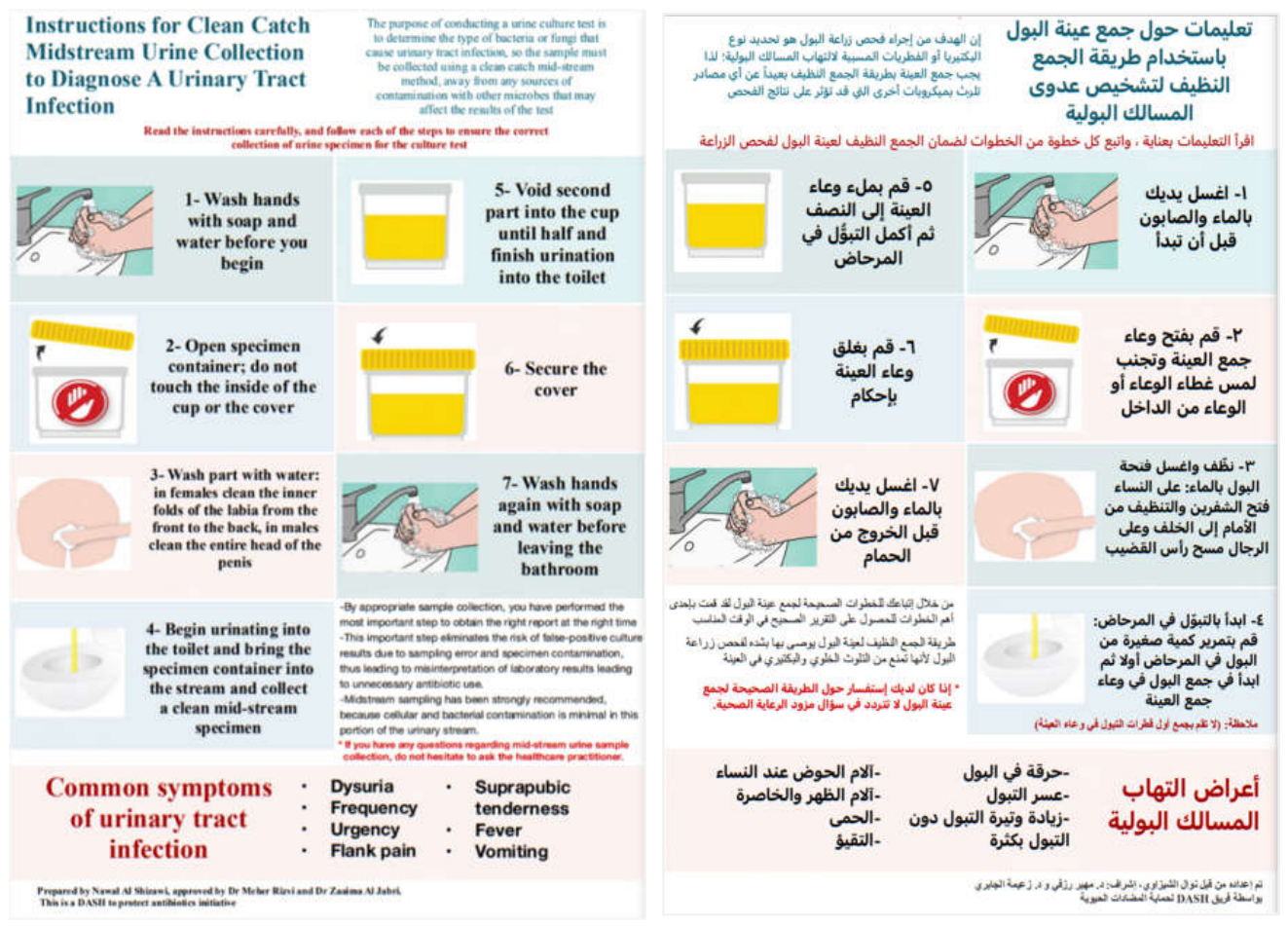
Figure 2.
(a) Mean of practice score across the different levels of work experience, (b) Mean of practice score across the different levels of work experience in IPC and AMS.
Figure 2.
(a) Mean of practice score across the different levels of work experience, (b) Mean of practice score across the different levels of work experience in IPC and AMS.
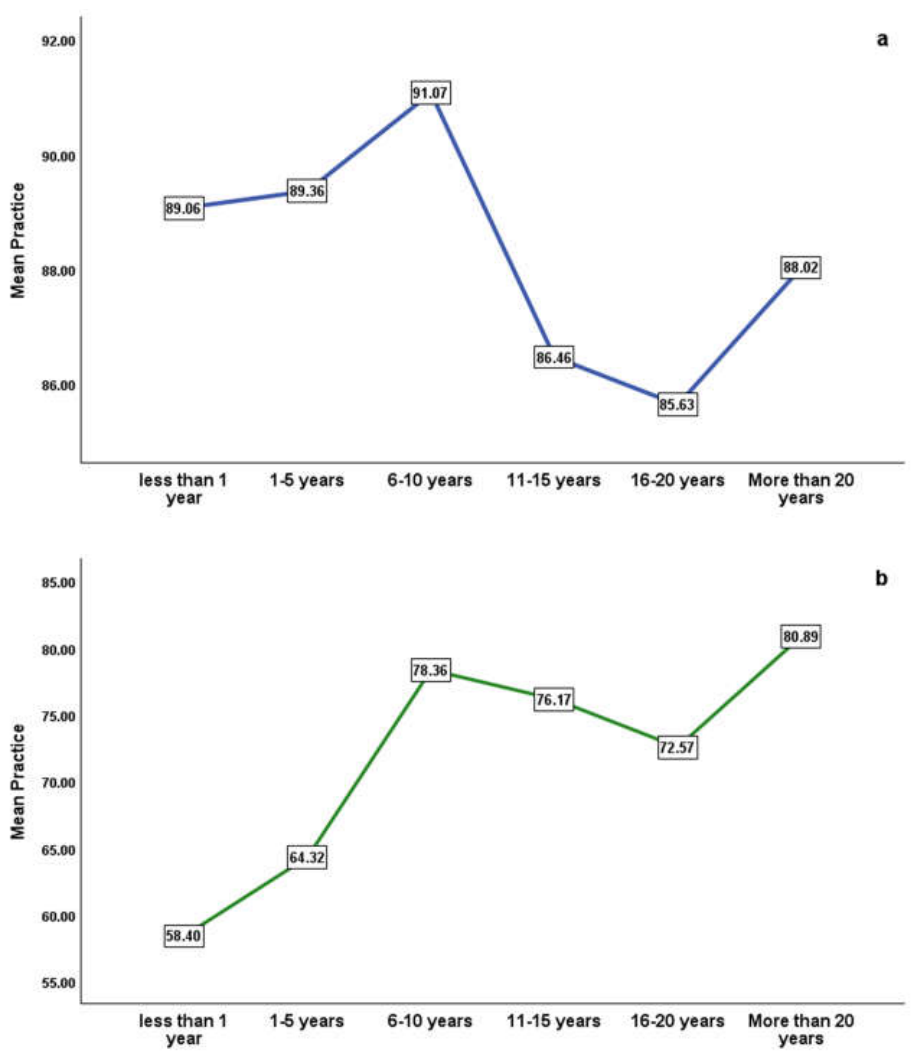

Table 1.
KAP Questionnaire categories among patients and nurses.
| Section | Patients’ questionnaires Sample handling, IPC, Antimicrobial Stewardship (ASP) |
Nurses’ questionnaire-1 Pre-analytic diagnostic stewardship for urine culture and sensitivity. |
Nurses’ questionnaire-2 IPC, HAI, ASP |
|---|---|---|---|
| 1. | Informed consent | Informed consent | Informed consent |
| 2. | Demographic characteristics | Baseline demographic and work-related variables | Demographics and work-related information |
| 3. | Clinical profile and medical characteristics | Patient preparation for urine sample collection | Prevention and control of healthcare-associated infections |
| 4. | Patient’s practice and actual preparation for urine sample collection | Urine sample handling procedures and transportation to the laboratory | Appropriate antibiotic use, antibiotic resistance and prevention of antibiotic resistance |
| 5. | Infection Prevention and control | Feedback and opinion | Feedback and opinion |
| 6. | Knowledge about appropriate Antibiotic use and Antimicrobial resistance | ||
| 7. | Feedback and opinion |
Table 2.
Clinical Profile of Patients and their KAP for Pre-analytic Diagnostic Stewardship (n=77).
| Domain | Key finding | n/N (%) |
|---|---|---|
| Clinical presentation | Patients presenting with UTI symptoms | 51 (66.2) |
| Flank pain among all patients | 46 (56.9) | |
| Symptoms lasting >1 week among symptomatic patients | 35 (45.1) | |
| Comorbidities | Patients with ≥1 comorbidity | 60 (77.9) |
| Hypertension | 32 (41.7) | |
| Diabetes mellitus | 31 (40.0) | |
| MSU collection (non-catheterized, n=63) | Received instructions on MSU collection | 5/63 (7.9) |
| Instructions provided by nurse | 5/5 (100) | |
| Catheter-related practices (catheterized, n=14) | Reported hand hygiene/glove use before procedures | 11/14 (78.6) |
| Observed urine collected from catheter tube | 8/14 (57.1) | |
| Believed daily questioning of catheter necessity is important | 10/14 (71.4) | |
| Wanted education on catheter care before discharge | 14/14 (100) | |
| Perception of diagnostic accuracy (all participants, n=77) | Believed correct sample collection improves microbiology result accuracy | 70/77 (90.9 |
Table 3.
Key findings of nurses’ KAP for urine specimen collection and pre-analytic stewardship (n=172).
Table 3.
Key findings of nurses’ KAP for urine specimen collection and pre-analytic stewardship (n=172).
| Domain | Key indicator | n/N (%) |
|---|---|---|
| Patient instruction for MSU | Nurses who instruct patients on proper urine collection | 142 (86.1) |
| Instruction included avoiding contamination | 143 (89.9) | |
| Instruction included collecting a clean midstream specimen | 140 (88.1) | |
| Availability of guidance | Any guidance for proper urine collection available | 105 (63.6) |
| Verbal instructions available | 45 (42.9) | |
| Written instructions available | 32 (30.5) | |
| Role perception | Nurses identified as responsible for patient instruction | 146 (88.5) |
| Urine collection in catheterized patients | Received training for collecting urine from catheterized patients | 140 (84.8) |
| Collected from catheter tube (not drainage bag) | 146 (88.5) | |
| Cleaned sampling port with alcohol swab | 127(87.0) | |
| Knew catheter >2 weeks should be replaced before culture | 110 (66.7) | |
| Impact on laboratory accuracy | Believed patient education improves microbiology result accuracy | 139 (84.2) |
| Transport and storage | Sent urine immediately after collection | 123 (74.5) |
| Refrigerated/on ice if delay occurred | 60 (36.4) | |
| Reported no refrigerator/ice box available | 49 (29.7) | |
| Educational interventions | Supported educational activities on proper sample collection | 142 (86.1) |
| Wanted educational information on the topic | 128 (77.6) | |
| Preferred in-person presentation | 61 (39.4) | |
| Preferred poster-based education | 63 (40.6) |
Table 4.
Summary of Knowledge, Attitudes and Practices (KAP) Regarding Healthcare-Associated Infections, Antimicrobial Use and Antimicrobial Stewardship Among Nurses (n = 162).
Table 4.
Summary of Knowledge, Attitudes and Practices (KAP) Regarding Healthcare-Associated Infections, Antimicrobial Use and Antimicrobial Stewardship Among Nurses (n = 162).
| Domain | Key indicator | n (%) |
|---|---|---|
| Knowledge – Infection Prevention & Control | Correctly reported that hand hygiene should be performed before and after patient contact | 160 (98.8) |
| Agreed that infection prevention and control is the key measure to prevent spread of infection | 162 (100.0) | |
| Agreed that effective handwashing is the most important measure for preventing infection | 162 (100.0) | |
| Correctly recognised that nosocomial infections are acquired in healthcare settings | 153 (94.4) | |
| Agreed that HAIs increase morbidity, mortality and hospital stay | 160 (98.8) | |
| Knowledge – Antimicrobial Resistance | Recognised that antibiotics are used to treat bacterial infections | 158 (97.5) |
| Agreed that inappropriate antibiotic use promotes antimicrobial resistance | 153 (94.4) | |
| Agreed that broad-spectrum antibiotic use increases antimicrobial resistance | 129 (79.6) | |
| Agreed that poor infection control contributes to spread of AMR | 126 (77.8) | |
| Agreed that improved healthcare hygiene reduces spread of resistant organisms | 160 (98.8) | |
| Recognised that narrow-spectrum therapy following culture and susceptibility testing reduces AMR | 137 (84.6) | |
| Believed AMR will become a greater clinical problem in the future | 119 (73.5) | |
| Practice / Stewardship | Agreed that nurses should review microbiology culture reports and inform clinicians | 110 (67.9) |
| Agreed that diagnostic and antimicrobial stewardship improves clinical outcomes | 144 (88.9) | |
| Had received formal antimicrobial stewardship training | 33 (20.4) | |
| Supported educational activities on infection prevention and control | 150 (92.6) | |
| Believed all healthcare professionals should receive AMR training | 151 (93.2) |
Disclaimer/Publisher’s Note: The statements, opinions and data contained in all publications are solely those of the individual author(s) and contributor(s) and not of MDPI and/or the editor(s). MDPI and/or the editor(s) disclaim responsibility for any injury to people or property resulting from any ideas, methods, instructions or products referred to in the content. |
© 2026 by the authors. Licensee MDPI, Basel, Switzerland. This article is an open access article distributed under the terms and conditions of the Creative Commons Attribution (CC BY) license (http://creativecommons.org/licenses/by/4.0/).
Copyright: This open access article is published under a Creative Commons CC BY 4.0 license, which permit the free download, distribution, and reuse, provided that the author and preprint are cited in any reuse.