

Submitted:
05 September 2026
Posted:
07 September 2026
You are already at the latest version
Abstract
Functional reserve is treated here as a latent physiological construct. Under controlled challenge its measurable phenotype is rate asymmetry—the ratio of restoration rate to degradation rate within a domain. The proposed estimator is ρd = rg / rl, formed only when both rates are fitted constants obtained from the same instrument in identical units. The primary quantity is the minimum of the point estimates across eligible domains; uncertainty is reported separately as a bootstrap or simultaneous interval for that minimum. Mandatory core domains (force recovery, lactate clearance, dual-task cost recovery) are required for cross-person comparison and are reported with the domain count.On the acute cycle the model predicts ρ < 1: parallel multi-factorial degradation outruns sequential, energy-constrained restoration. Net adaptation occurs later, outside the measured window. The governing domain—the eligible domain with the smallest ρd—identifies the recovery bottleneck under the specified challenge. Intensity is measured, volume is measured, frequency is inherited.The construct shares formal structure with a companion single-domain definition formed over weeks, but operates at a different timescale and reflects different physiology.
Keywords:
functional reserve
; rate asymmetry
; governing minimum
; recovery kinetics
; challenge testing
1. Foundation
Functional reserve is the surplus capacity separating independent function from disability. It is demand-dependent. Prevailing operationalisations treat it as a stock measured at rest and combined by weighted summation. Three properties of that architecture are rejected: measurement at rest, substitutability across domains, and the use of levels rather than rates.
A companion paper defines a within-person gain–loss ratio for a single domain over a train–detrain window of weeks (O’Leary, 2026). The present paper defines a related quantity on the acute challenge–recovery cycle (seconds to minutes) and supplies the multi-domain aggregation rule. The two constructs share formal structure but differ in timescale and underlying physiology; this is not a direct generalisation of domain count alone.
Ontology
- Functional reserve — latent physiological construct
- Challenge response — observed perturbation trajectory
- Rate asymmetry — measurable kinetic phenotype
- Governing domain — the eligible domain with the smallest estimated ρd
2. Construction
Mandatory core. Force recovery, lactate clearance, and dual-task cost recovery are always required. They were chosen because each admits a matched instrument, none requires laboratory infrastructure beyond ordinary clinical equipment, they span three distinct rate-limiting physiologies, and each literature already contains established challenge protocols. The core is the minimum common panel specified for cross-person comparison; it is not claimed to be exhaustive.
Rate definition. For each eligible domain a standardised challenge is applied. Both rates are fitted constants obtained under the kinetic discipline of the companion paper:
- rl — degradation rate under load
- rg — restoration rate after load removal
ρd = rg / rl
Same-instrument rule. Both rates must be recorded by the identical instrument in identical units. Domains that cannot meet this rule are ineligible. No z-score substitution is permitted.
Primary quantity and uncertainty. ρmin = mind of the point estimates (ρ̂d). Uncertainty is reported as a bootstrap or simultaneous interval for ρmin itself. Taking the minimum of independent domain-wise lower confidence bounds is rejected: an imprecisely measured domain would systematically win the minimum.
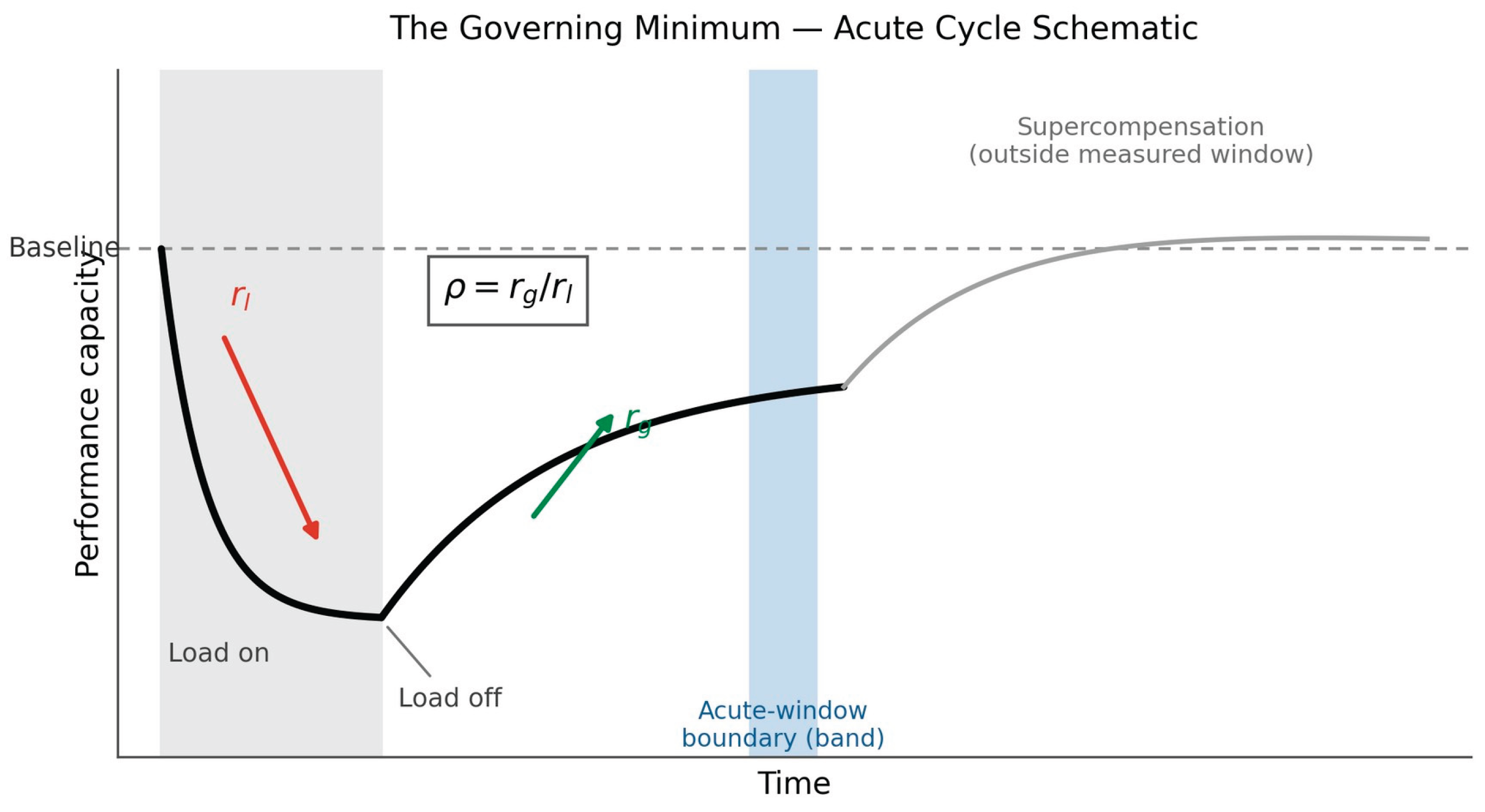
Acute-window boundary. Plateau detection is an independent preprocessing step. After load removal the performance variable is examined for the earliest time t* at which (i) the local first derivative is statistically indistinguishable from zero within the instrument noise model and (ii) the derivative remains non-positive for a consecutive confirmation interval of length τ. All data up to t* are eligible for fitting rg; data after t* are excluded. Because the plateau is noisy, t* is reported as a band. τ is a free parameter fixed before data collection; sensitivity of ρmin and of domain ordering to reasonable variation in τ is a required reporting item.
Experimental isolation. Water immersion removes axial load while preserving graded muscular demand through velocity-dependent resistance and producing the same central fluid shift seen in bed rest. It isolates muscular work from joint loading.
3. Interpretation
Why the model predicts ρ < 1 on the acute cycle. Degradation under load is multi-factorial and parallel. Restoration after load is sequential and energy-constrained. The structural asymmetry predicts that the recovery limb will be shallower than the loss limb. The claim is restricted to the acute window.
Governing domain. The domain whose restoration is most constrained relative to its degradation yields the lowest ρd. Because domains are non-substitutable, that domain sets the recovery interval the person actually requires under the specified challenge. Asymmetry explains why ρ < 1; non-substitutability explains why the minimum is taken. These remain separate arguments. The governing domain is a rate-asymmetry bottleneck; it is not synonymous with the most clinically abnormal domain.
Timescale distinction. Net adaptation (supercompensation) lies outside the acute window. ρ therefore predicts the required recovery gap rather than the adaptive outcome. The required gap G is a monotonically decreasing function of ρmin whose exact form is to be determined empirically.
Clinical consequence. Two patients can share the same rehabilitation programme and the same numerical minimum yet diverge. One recovers; the other plateaus. The under-recovered patient was re-challenged before the governing domain returned to baseline and therefore accumulated deficit under a programme that looked identical on paper. Intensity is measured. Volume is measured. Frequency is inherited.
4. Worked Illustration
Illustrative values only. Uncertainty intervals for ρmin are omitted from this illustration; section 2 requires that they be reported with any measured estimate.
| Domain | rl | rg | ρ̂d |
| Force recovery | 12.4 N·s−1 | 8.1 N·s−1 | 0.65 |
| Lactate clearance | 0.28 mmol·L−1·min−1 | 0.19 mmol·L−1·min−1 | 0.68 |
| Dual-task cost recovery | 42 ms·min−1 | 31 ms·min−1 | 0.74 |
ρmin = 0.65 (force domain), over three domains. A programme dosed to the lactate or cognitive figures under-recovers the mechanical domain.
5. Schematic
Figure 1.
Acute cycle schematic. Steep loss limb under load, shallower recovery limb that decelerates into a visible plateau, acute-window boundary drawn as a band on that plateau, and supercompensation overshoot (lighter weight) outside the measured window.
Figure 1.
Acute cycle schematic. Steep loss limb under load, shallower recovery limb that decelerates into a visible plateau, acute-window boundary drawn as a band on that plateau, and supercompensation overshoot (lighter weight) outside the measured window.
6. Relation to Prior Work
Convertino’s compensatory reserve is the closest precedent. It measures under progressive challenge and reports remaining margin to decompensation. It is the single-domain, single-limb, margin-to-threshold special case of the present framework. Convertino reports the level of remaining capacity; the slope of that trajectory is rl. The later review by Suresh, Convertino and colleagues makes the same object explicit: a single integrated waveform index of remaining compensatory mechanisms in hemorrhage, with multi-system organ dysfunction named only as the far end of that continuum (Suresh et al., 2019). A second near-miss returned by the sparse intersections is Ferrucci’s aerobic resilience in the Baltimore Longitudinal Study of Aging. Mitochondrial oxidative capacity (kPCr) predicts VO2peak and a ratio of peak capacity to the energetic cost of walking, attenuated after age 70 (Trevisan et al., 2026). That is a capacity ratio inside one energetic domain, not a minimum of matched-instrument rate ratios across domains.
Limiting-factor models already embody a bottleneck rule. The novelty claimed here is restricted to the quantity being minimised: a matched-instrument rate asymmetry rather than a peak level.
The stimulus-response programme in physical resilience is the nearest live work and shares this paper’s premise. Varadhan and colleagues (2008) proposed characterising loss of resilience in homeostatic regulation through the dynamics of response to a standardised stimulus rather than through resting level, and the Study of Physical Resilience and Aging has developed that proposal into an empirical programme (Walston et al., 2023). Bandeen-Roche and colleagues (2025) analysed multi-system stimulus-response data in the SPRING pilot — Holter time series, cortisol response to adrenocorticotropic hormone stimulation, and repeated diurnal salivary cortisol — and derived dynamic component scores intended to capture adaptive capacity across systems. Related work has applied provocative testing and orthostatic challenge in community-dwelling older adults toward the same end.
That programme and the present construct agree on the measurement condition and differ on the aggregation rule. Both hold that reserve is visible under provocation rather than at rest, and both measure response dynamics rather than levels. Three differences follow. The quantity extracted here is a ratio of two fitted rate constants, restoration against degradation, in the same instrument and identical units, rather than a component score derived across heterogeneous measures. Domains are combined by a minimum rather than by a composite or factor structure, on the claim that non-substitutable domains admit no averaging. And the window is the acute challenge-and-recovery cycle, seconds to minutes, whereas the resilience programme is anchored to major clinical stressors and to recovery trajectories over months.
The novelty claimed is therefore narrow. Not that provocation is the correct measurement condition, which that literature established. Not that multi-system dynamics carry information about reserve, which it has demonstrated. The claim is that the quantity to be minimised across domains is a matched-instrument rate asymmetry, and that the minimum rather than a composite is the governing figure.
Search statement. A structured prior-art search was conducted in PubMed on 26 August 2026 using ten Title/Abstract query strings combining terms for rate-based reserve measurement, minimum and limiting-factor rules, multi-domain physiological capacity, and stimulus-response characterisation of resilience. The full strings are given in Supplementary Table S1. Counts were read from the PubMed result header and independently confirmed against the NCBI E-utilities esearch interface on the same day. No date, language, or article-type filter was applied, and counts are not deduplicated across strings. Returned counts ranged from 1 to 1,423, and are given by string below. The five intersections closest to the present construct returned 7, 9, 5, 2 and 1 records (24 Title/Abstract records; no overlapping PMIDs). All 24 were screened. None reports loss and recovery rates measured across physiological domains and reduced to a governing minimum. The nearest named constructs in those intersections are Convertino’s compensatory reserve (a single integrated waveform index) and Ferrucci’s aerobic resilience (a capacity ratio inside the mitochondrial and energetic domain), both addressed above. The remaining records are lexical collisions: epidemiological incidence rate ratios attached to a frailty label called physiological reserve; heart-rate asymmetry of RR intervals; protein-domain architecture; and industrial loss and recovery rates. No prior report was identified of a multi-domain minimum of matched-instrument gain-to-loss rate ratios under controlled acute challenge. Counts change as MEDLINE grows; the strings, not the integers, are the reproducible object.
| # | Construct intersection | Hits |
| 1 | Rate ratio × reserve × multidomain | 7 |
| 2 | Law of the minimum × capacity | 127 |
| 3 | Weakest link / governing domain | 41 |
| 4 | Rate asymmetry × reserve | 9 |
| 5 | Recovery rate × individual differences | 5 |
| 6 | Physiological resilience × kinetics | 51 |
| 7 | Stimulus-response × reserve | 19 |
| 8 | Multisystem × bottleneck | 2 |
| 9 | Compensatory reserve × multidomain | 1 |
| 10 | Functional reserve × measurement | 1,423 |
Strings 1, 4, 5, 8 and 9 are the sparse intersections closest to the construct; string 10 is a breadth check on measurement language around functional reserve and is not a novelty claim. The search was limited to one database, to PubMed-indexed material, and to title and abstract fields. Grey literature, non-indexed monographs, and pre-1966 sources were not searched systematically.
Novelty claim (modest form). This article proposes a multi-domain kinetic operationalization of functional reserve in which the smallest restoration-to-degradation rate ratio identifies the governing domain under a standardized acute challenge.
7. Falsification
The construct is falsified if, under measurement satisfying section 2:
ρmin has no more predictive value than the mean of the eligible point estimates (ρ̂d).
The governing domain is unstable within persons across repeated equivalent challenges.
ρmin carries no relation to the recovery interval required for net adaptation.
8. Limitations
The construct is untested. The acute-window boundary rule remains to be validated across laboratories. τ is a free parameter whose influence must be reported. Standardised challenge protocols are not specified here. The prior-art search was limited to a single database and to title and abstract screening of the 24 records at the five sparse intersections; grey literature and non-indexed sources were not searched systematically.
Declarations
Funding
None reported.
Data Availability Statement
Not applicable; no new data were generated or analysed. All numerical values are illustrative.
Conflicts of Interest
The author declares no competing interests.
Ethics
Not applicable; conceptual article.
Use of Artificial Intelligence
AI tools were used for background research, citation retrieval, and output formatting. All content and conclusions were created by the author, who is solely responsible for the work.
References
- O’Leary, RT. The Gain–Loss Ratio: Defining a Missing Quantity in Human Capacity Dynamics. SportRxiv 2026. [Google Scholar] [CrossRef]
- Convertino, VA; Howard, JT; Hinojosa-Laborde, C; et al. Individual-specific, beat-to-beat trending of significant human blood loss: the compensatory reserve. Shock. 2015, 44 (Suppl 1), 27–32. [Google Scholar] [CrossRef] [PubMed]
- Suresh, MR; Chung, KK; Schiller, AM; Holley, AB; Howard, JT; Convertino, VA. Unmasking the Hypovolemic Shock Continuum: The Compensatory Reserve. J Intensive Care Med. 2019, 34(9), 696–706. [Google Scholar] [CrossRef] [PubMed]
- Trevisan, C; Tian, Q; Fishbein, KW; et al. Association of mitochondrial oxidative capacity with physical fitness in ageing: the Baltimore longitudinal study of ageing. Age Ageing 2026, 55(2), afag022. [Google Scholar] [CrossRef] [PubMed]
- Fried, LP; Tangen, CM; Walston, J; et al. Frailty in older adults: evidence for a phenotype. J Gerontol A Biol Sci Med Sci. 2001, 56(3), M146–M156. [Google Scholar] [CrossRef] [PubMed]
- Rockwood, K; Mitnitski, A. Frailty in relation to the accumulation of deficits. J Gerontol A Biol Sci Med Sci. 2007, 62(7), 722–727. [Google Scholar] [CrossRef] [PubMed]
- McEwen, BS; Stellar, E. Stress and the individual: mechanisms leading to disease. Arch Intern Med. 1993, 153(18), 2093–2101. [Google Scholar] [CrossRef] [PubMed]
- Varadhan, R; Seplaki, CL; Xue, QL; Bandeen-Roche, K; Fried, LP. Stimulus-response paradigm for characterizing the loss of resilience in homeostatic regulation associated with frailty. Mech Ageing Dev. 2008, 129(11), 666–670. [Google Scholar] [CrossRef] [PubMed]
- Walston, J; Varadhan, R; Xue, QL; et al. A Study of Physical Resilience and Aging (SPRING): conceptual framework, rationale, and study design. J Am Geriatr Soc. 2023, 71(8), 2393–2405. [Google Scholar] [CrossRef] [PubMed]
- Bandeen-Roche, K; Zhu, J; Xue, QL; et al. Characterization of dynamic adaptation to stressors using multisystem stimulus-response data: the Study of Physical Resilience in Aging pilot. J Gerontol A Biol Sci Med Sci. 2025, 80(6), glaf056. [Google Scholar] [CrossRef] [PubMed]
- World Health Organization. World Report on Ageing and Health; WHO: Geneva, 2015. [Google Scholar]
- Bompa, TO; Haff, GG. Periodization: Theory and Methodology of Training, 5th ed.; Human Kinetics: Champaign, IL, 2009; ISBN 9780736074834. [Google Scholar]
- Sprengel, C. Von den Substanzen der Ackerkrume und des Untergrundes. Journal für Technische und Ökonomische Chemie 1828. [Google Scholar]
- von Liebig, J. Organic Chemistry in Its Applications to Agriculture and Physiology; Taylor and Walton: London, 1840. [Google Scholar]
- Older monograph page ranges (Sprengel, von Liebig) remain secondary-source verified only
Disclaimer/Publisher’s Note: The statements, opinions and data contained in all publications are solely those of the individual author(s) and contributor(s) and not of MDPI and/or the editor(s). MDPI and/or the editor(s) disclaim responsibility for any injury to people or property resulting from any ideas, methods, instructions or products referred to in the content. |
© 2026 by the authors. Licensee MDPI, Basel, Switzerland. This article is an open access article distributed under the terms and conditions of the Creative Commons Attribution (CC BY) license (http://creativecommons.org/licenses/by/4.0/).
Copyright: This open access article is published under a Creative Commons CC BY 4.0 license, which permit the free download, distribution, and reuse, provided that the author and preprint are cited in any reuse.