

Submitted:
30 August 2026
Posted:
01 September 2026
You are already at the latest version
Abstract
Background/Objectives: The Mediterranean diet (MD) is a set of customs and eating habits developed in countries bordering the Mediterranean sea thousands of years ago. These habits are frequently proposed as a complement to pharmacological therapies for chronic diseases and could also counteract their onset. This study aimed to investigate adherence to the MD in workers from 22 companies in Latium (Italy) and to evaluate the association of diet with workers' health. Methods: Workers undergoing their health surveillance examination and routine blood tests (total cholesterol, HDL cholesterol, triglycerides, glucose) were invited to fill in the Mediterranean Diet Adherence Screener (MEDAS), the Effort-Reward Imbalance (ERI) questionnaire for work-related stress, the Sleep Condition Indicator (SCI) for sleep quality, the STOP-Bang questionnaire for obstructive sleep apnea (OSA) risk, the General Health Questionnaire (GHQ12) for low mental health, and the Abdel-Khalek questionnaire (AKQ) for happiness. 1,475 out of 1,608 workers (91.7%) participated in the study. Results: The prevalence of high adherence to the MD was 53.8% (95%CI 51.3; 56.4). Female workers reported greater adherence to the MD than males (Mann-Whitney U, p< 0.001). MD adherence was positively correlated with age (Spearman’s rho = 0.071, p< 0.01). In multiple logistic regression models adjusted for age and gender, the MEDAS score was inversely associated with hypertension [aOR=0.923 (95%CI=0.861; 0.990)], hypercholesterolemia [aOR=0.939 (95%CI=0.882; 0.999)], hypertriglyceridemia [aOR= 0.909 (95%CI=0.838; 0.985)], and metabolic syndrome [aOR =0.900 (95%CI=0.824; 0.982)]. The MEDAS score was inversely related to low mental health [aOR=0.943 (95%CI=0.893; 0.996) p=0.036] and positively related to happiness [aOR =1.094 (95%CI= 1.038; 1.154) p< 0.001]. Conclusions: Although the association between diet adherence and health is weak, the MD remains a useful measure for promoting health in the workplace.
Keywords:
health promotion
; total worker health
; metabolic syndrome
; hypertension
; dyslipidemia
; hyperglycemia
; obesity
; depression
; happiness
; sleep disorders
1. Introduction
Workplace health surveillance provides an opportunity for bringing many people together in a setting with medical facilities and demonstrates the advantage of combining legally mandated medical checkups, aimed at preventing occupational risks, with health promotion programs. This approach, which is implemented in Italy as Promotion included in Prevention (PIP) [1] and in the US as Total Worker Health© (TWH) [2], is characterized by principles of autonomy (the worker can refuse to participate), universality (all workers are eligible), and free access for all workers. Most of these programs are aimed at identifying and preventing chronic diseases [3,4,5]. The effectiveness of these types of interventions in the workplace setting, however, is sparse and inconsistent [6]. To increase effectiveness and sustainability, some researchers suggest encouraging worker participation [7,8] and focusing on positive outcomes, such as well-being, quality of life or satisfaction [9,10,11].
For over 20 years we have followed these principles by implementing health participatory promotion initiatives in the workplace, even in small and very small companies, preferably with a salutogenic approach, and have consistently achieved nearly 100% employee participation [12]. Our 2022 nutritional health project revealed that many workers had poor eating habits and a poor knowledge of the principles of proper nutrition [13]. Health eating awareness has emerged as a crucial factor against disordered eating [14]. Research has demonstrated the effectiveness of MD promotion programs in enhancing community adherence and reducing metabolic risk factors [15,16,17,18]. From the standpoint of the health system, the MD is an affordable intervention that could result in significant long-term savings [19]. For all these reasons, in 2023, in consultation with the workers, we planned a program to promote the MD in all workplaces under our medical supervision.
The term “Mediterranean diet” encompasses a series of dietary practices that originated thousands of years ago in the Mediterranean basin and that continue to be largely followed by the people living on its shores. The MD consists mainly of plant-based foods (wheat, fruits, vegetables, olive oil), a low consumption of animal products, and a moderate consumption of wine during meals. There are regional differences in the way local products are grown, cooked, and eaten. The properties of the MD were discovered after the Second World War and given prominence by the Seven Countries Study [20]. In 2010, the diet was included on UNESCO’s Representative List of Intangible Cultural Heritage of Humanity [21].
Its positive effects may be attributed to several physiological processes, such as increased endothelial function, antithrombotic activity, reduced oxidative stress and inflammatory indicators, improved insulin sensitivity, and favorable modification of lipid profiles. Bioactive substances like polyphenols, dietary fiber, and monounsaturated and polyunsaturated fatty acids are primarily responsible for these benefits [22] acting on gut microbiome and plasma metabolome [23,24,25]. Systematic reviews indicate that MD improves HbA1c [26], LDL cholesterol, and triglycerides levels [27], homeostatic model assessment of insulin resistance (HOMA-IR) index, total-, low-density lipoprotein (LDL)- and high-density lipoprotein (HDL)-cholesterol [28] and may be a favorable strategy for targeting hepatic steatosis and lipid metabolism disorders [29]. High adherence to the MD is associated with reduced mortality in people with pre-existing metabolic illnesses as well as moderate but clinically significant improvements in metabolic health [30]. In comparison with other diets, it generally achieves better results [31,32]. It may also reduce body mass index, waist circumference, triglycerides, and the fatty liver index score in overweight or obese subjects more efficiently than alternative diets or recommendations [33].
Its anti-inflammatory potential may help prevent and slow down the evolution of cardiovascular diseases [34,35,36] by lowering serum high-sensitivity C-reactive protein (hs-CRP) levels and by favorably influencing the reduction of cardiovascular (CVD) risk factors such as blood pressure and lipid profiles [37]. Scientific evidence supports the use of Mediterranean Dietary Approaches to Stop Hypertension (DASH) diet [38]. The DASH diet is a workable strategy for managing blood pressure, hypercholesterolemia, and weight loss [39]. More generally, the MD produced beneficial effects not only on all components and most risk factors of metabolic syndrome (MetS), but also on CVD and stroke incidence [28].
The antioxidant effect of the MD also has beneficial effects on the production of melatonin and consequently on sleep [40]. Compared to people with insufficient sleep duration, poor-quality sleep, and later chronotype, individuals with sufficient sleep duration, good-quality sleep, and earlier chronotype had considerably greater probabilities of having high MD scores [41]. Moreover, the MD has a reciprocal relationship with sleep disorders such as obstructive sleep apnea (OSA) and insomnia. A prospective study showed that there is significant interaction between the MD and sleep disorders, and this influences cardiovascular mortality [42]. The ATTICA cohort study showed that the protective association between MD adherence and cardiovascular risk was found only in participants who slept adequately [43].
According to a growing body of scientific research, increasing adherence to the MD is linked to positive results for mental health [44,45]. In adult populations from a variety of geographic contexts, the MD has been linked to positive mental health outcomes such as fewer symptoms of anxiety and depression, less perceived stress, reduced cognitive decline and a better quality of life and general wellbeing in both healthy individuals and those with comorbidities [46]. The MD’s anti-inflammatory and antioxidant properties, as well as its impact on gut microbiota, are among the mechanisms at play [47]. MD could also play a role in the primary prevention of cancer [48] and is associated with a reduced risk of all-cause mortality [49].
Aging of the workforce, that goes hand in hand with that of the world population, means that chronic pathologies are increasingly common among working people, especially those with low-paid jobs. Poor adherence to the MD is associated with low economic status and poor quality of life [50]. Poor eating habits have been reported in workers from a variety of economic sectors worldwide [51,52,53]. This has led to absenteeism and lost productivity with consequent high costs for employers and companies [54,55]. Poor eating habits have been linked to a variety of occupational situations such as stress at work, long hours, working shifts, and a lack of ingredients that support a healthy diet [56,57]. Advocating healthy dietary practices is part of many workplace health promotion programs, even if there is limited evidence to demonstrate the extent to which MD adherence impacts on absenteeism or work ability. Many promotional studies have been conducted using methods that do not allow us to have clear proof of their effectiveness. Systematic reviews concluded that there is no evidence of a positive return on investment [3,6]. Knowledge of the diet followed by workers and the relationship between eating habits and metabolic and psychosocial problems is definitely the first step in planning health promotion intervention.
For these reasons, we deemed it appropriate to investigate the degree of adherence to the Mediterranean diet among the workers of the companies we monitored. We used the MEDAS (Mediterranean Diet Adherence Screener) questionnaire, a validated tool widely used in numerous countries [58]. The primary aim of the research was therefore to evaluate adherence to the MD in the Latium region and to verify whether there was any difference based on gender, age, or work sector. A second objective was to assess the association between the degree of adherence to the diet and the main metabolic and mental health parameters used in occupational medicine.
The hypotheses we formulated before the MD promotion campaign were:
1. MD adherence is inversely associated with MetS and its components (obesity, hypertension, hyperglycemia, hypercholesterolemia, hypertriglyceridemia);
2. MD adherence is inversely associated with the risk of OSA and insomnia;
3. MD adherence is inversely associated with the risk of distress, anxiety, depression, and unhappiness.
2. Materials and Methods
2.1. Population
A health promotion program aimed at encouraging adherence to the MD was extended to all the workers exposed to occupational risk factors who were called in for periodic medical checkups intended to prevent risks in 2023. Information on their eating habits was collected using the tools described in this article. After collecting the questionnaires, they were given training on the principles of proper nutrition by means of seminars and the distribution of leaflets.
At the end of their annual medical examination, out of the 1,608 workers undergoing health surveillance, 1,475 responded to the invitation to take part in the health promotion program (91.7% participation rate). The workers were employed in different companies, including the commercial (111, 7.5%), industrial (49, 3.3%), social (260, 17.6%), and health (1,055, 71.5%) sectors. There were more female employees (1009, 68.4%) than male employees (466, 31.6%). The average age was 47.21±11.20.
The project was approved by the University Department of Life Sciences and Public Health on January 20, 2023 (PROT. No. APROV. IST DIPUSVSP-22-02-239) and by the Ethics Committee of the Università Cattolica del Sacro Cuore, Policlinico A. Gemelli, Rome, on February 23, 2023 (ID 5570 prot.n.0006903/23).
2.2. Questionnaire
To evaluate adherence to the MD we used the Italian version [58] of the 14-point Mediterranean Diet Adherence Screener (MEDAS) [59]. This questionnaire, containing 14 dichotomy questions, was developed within the Prevención con Dieta Mediterránea (PREDIMED) study group to conveniently determine adherence to the traditional MD and provide patients with an immediate feedback [60]. The score, which expresses the degree of adherence to the MD, ranges between 0 and 14. A score equal to or above 9 indicates high adherence [61].
The Italian version [62] of Siegrist’s Effort-Reward Imbalance (ERI) questionnaire [63] was used to investigate work-related stress. The shortened form of the questionnaire was adopted for this investigation [64]. The Italian version consists of a total of ten questions, each requiring a response on a 4-point Likert scale. With a score ranging from 3 to 12, three questions gauge the amount of effort employees put into their work, while the remaining seven questions gauge the tangible or intangible benefits that they receive from their jobs (scores ranging from 7 to 28). The weighted ratio of effort to reward (ERI) is used to calculate stress. Distress is indicated by a score greater than 1. In this study, Cronbach’s alpha for effort and reward was 0.841 and 0.746, respectively.
Sleep quality was assessed using the Italian version [65] of the Sleep Condition Indicator (SCI) [66], short version (SCI-2) [67]. This consists of two questions; responses on a 5-point Likert scale result in a score ranging from 0 to 8. High scores indicate better sleep quality, while scores below 4 indicate a risk of insomnia. In this study, the reliability of the questionnaire, measured as Cronbach’s alpha, was 0.835.
We used two binary questions about snoring and observed apnea from the STOP-Bang questionnaire [68,69] to assess the risk of suffering from obstructive sleep apnea (OSA) according to recommendations for large surveys of the Italian Interdisciplinary Technical Committee for Sleepiness and Safety in OSAS Patients [70]. The GHQ12, an abbreviated version of the General Health Questionnaire, was used to detect mild mental health issues such as anxiety and depression symptoms, or other symptoms that require a more clinical evaluation in order to provide early detection of possible psychiatric disorders [71,72,73]. The questionnaire has twelve 4-point items; responses can be rated using a Likert scale (1-2-3-4) or a binary scale (0-0-1-1) [74]. We chose the Likert scale for which the cut-off is 11 points [75,76]. In this study, Cronbach’s alpha for the questionnaire was 0.878.
Happiness level was measured according to the Abdel-Khalek questionnaire (AKQ) [77] using a single item rated from 0 to 10.
During periodic medical examinations, the measurements of anthropometric data (height, weight, and waist circumference) followed criteria established by the International Society for the Advancement of Kinanthropometry (ISAK) [78]. The body mass index (BMI) was calculated by dividing a worker’s weight in kilograms by her/his height in square meters [79]. According to the 2023 ESH European Hypertension guideline update [80,81], hypertension was defined as systolic pressure ≥140 mmHg, diastolic pressure ≥90 mmHg, or continuous antihypertensive treatment.
Triglycerides, total cholesterol, HDL cholesterol, and blood glucose were measured. The International Diabetes Federation (IDF) [82], the National Cholesterol Education Program Expert Panel on the Detection, Evaluation, and Treatment of High Cholesterol in Adults (NCEP/ATPIII) [83], the American Association of Clinical Endocrinologists (AACE) [84], and the Joint Societies Guidelines on Management of Cholesterol [85] were taken into consideration when defining cut-off levels of metabolic parameters. Hypercholesterolemia was defined as total cholesterol exceeding 200 mg/dl (5.2 mmol/l), HDL cholesterol below 40 mg/dL (1.03 mmol/L) in men and below 50 mg/dL in women, or treatment for hyperlipidemia. Hypertriglyceridemia was defined as a serum triglyceride level of over 150 mg/dL (1.7 mmol/L). High fasting glucose was defined as a plasma glucose level greater than 100 mg/dL (5.6 mmol/L) or the use of hypoglycemic medication.
No generative artificial intelligence (GenAI) has been used in this paper to create text, data, or graphics, or to assist in study design, data collection, analysis, or interpretation. The dataset used in this study has been deposited in a publicly available database (Zenodo, accession number xxx
2.3. Data Analysis
The Anderson-Darling test [86] was used to verify whether the variables of interest followed a normal distribution. Nonparametric methods were used for variables that did not follow a normal distribution; however, as suggested by Lumley [87], the sample size convinced us that parametric methods could be used even when this assumption was not met. Consequently, to compare the MEDAS score values in the different categories we used the Mann-Whitney U test for two groups or the Kruskal-Wallis test for multiple groups, but similar results were obtained with the Student’s t-test or with the ANOVA analysis of variance and the Bonferroni post-hoc test.
To assess the prevalence of pathological conditions, continuous variables were dichotomized using the questionnaire cutoff, the median value, or the normal limits of blood tests. Fifty years was taken as the age limit for the elderly. The Clopper-Pearson exact test was used to establish 95% confidence intervals (95% CI) of the prevalences and the Chi-square test was adopted to compare proportions.
To assess the association between the degree of adherence to the MD and metabolic and psychosocial variables, we constructed multiple logistic regression models with the presence/absence of pathology as the dependent variable and the MEDAS score, age, and gender as independent variables, thus obtaining the adjusted odds ratio (aOR) and 95% confidence intervals (95%CI).
Statistical analyses were performed using version 31.0 of the IBM/SPSS package.
3. Results
3.1. MEDAS Score Distribution
The MEDAS questionnaire provided values ranging from 2 to 14, with a median value of 9 points, which corresponds to the cut-off for high adherence to the MD. The Anderson-Darling test indicated a significant deviation from normality (A2=14.558, p<0.001) (Figure 1). The distribution had negative skewness (=-0.114), with extreme values lower than the mean. The distribution curve was platykurtic (kurtosis=-0.237). The mean score of the MEDAS questionnaire was 8.66±2.05.
In the sample, 793 workers achieved or exceeded 9 correct answers on the MEDAS questionnaire, thereby indicating high adherence to the MD. The prevalence of high adherence was 53.8 (95%CI 51.3; 56.4).
The questions that showed the greatest non-adherence to MD principles regarded the consumption of fish and shellfish (only 32.6% reported consuming the latter three or more times a week) and also butter, margarine or cream, since only 29.7% avoided consuming more than a teaspoon a day, even though olive oil was the main condiment for 95.8%. In fact, many respondents (34.6%) reported olive oil consumption lower than the 4 tablespoons per day indicated by MD standards. Also, less than the recommended quantity of fruit and legumes were consumed by 36.7% and 46.0% of participants, respectively.
Female workers reported greater adherence to the MD than males, scoring 8.82±2.01 and 8.32±2.11, respectively (Mann-Whitney U, p<0.001; Student t, p<0.001). There were 568 high adherents to the MD (56.3%) among women, while male adherents were 225 (48.4%) (Pearson’s chi square p=0.004).
MD adherence was positively correlated with age (Spearman’s rho p<0.01). Younger workers, aged up to 50 years, had a lower prevalence of high adherence to the MD compared to those over 50 years of age (chi square p<0.05).
No significant difference in the MEDAS score was observed between workers who performed night work (n=310) and the others (n=1163) (Student’s t test 8.72±2.12 vs. 8.65±2.03, p=0.593).
A comparison of the employment sectors revealed significant differences in the degree of adherence to the MD (one-way ANOVA p=0.004). On average, industrial workers had a significantly lower level of adherence (7.71±2.14) than social (8.67±2.12, p<0.002) and healthcare workers (8.73±2.02, p<0.001). In the social and healthcare sectors, the majority of workers reported high adherence to the MD, while the opposite occurred in retail and industrial workers who showed the lowest adherence to the principles of the diet (Table 1).
3.2. Association of Diet with Metabolic Diseases
Laboratory tests and physical examinations indicated that 332 workers (22.5; 95%CI 20.4; 24.7) had abdominal or central obesity. Furthermore, 274 (prevalence 18.6, 95% CI 16.7; 20.7) had high blood pressure or were undergoing treatment for hypertension. Dyslipidemia (low HDL cholesterol, elevated total cholesterol, or ongoing treatment) was reported by 351 participants (23.9; 95%CI 21.7; 26.2), and hypertriglyceridemia by 170 workers (11.6; 95%CI 10.0; 13.3). 161 workers (10.9; 95%CI 9.5; 12.8) had hyperglycemia or were undergoing treatment for it. Workers who were already undergoing treatment at the time of observation were: 184 (12.5%) for blood pressure, 181 (12.3%) for cholesterol, 53 (3.6%) for triglycerides, 66 (4.5%) for glucose, and 245 (16.6%) for weight. Overall, 302 workers (20.5% of the total) were being treated for one or more metabolic disorders. 145 individuals (9.9; 95%CI 8.4; 11.5) were suffering from at least three of these conditions at the same time (MetS patients).
We examined the association between the degree of adherence to the MD and the presence of each metabolic disease using Pearson’s chi square (Table 2). Workers without metabolic disorders had a higher degree of adherence to the diet; however, differences failed to reach statistical significance and merely approached it for hypertriglyceridemia. A comparison of MEDAS scores in workers with hypertriglyceridemia and those with normal triglycerides using the Mann-Whitney U test indicated that the null hypothesis of equivalence should be rejected (p<0.007). Workers with normal triglycerides reported a mean MEDAS score of 8.71±2.03, while those with high triglycerides scored 8.24±2.1; the difference was highly significant also using a two-tailed Student t-test for unassumed equal variances (p<0.007).
Using multiple logistic regression models, we assessed the association between diet and metabolic diseases. The MEDAS score was significantly associated with hypertension [aOR = 0.923 (0.861; 0.990)], hypercholesterolemia [aOR=0-939 (0.882; 0.999)], hypertriglyceridemia [aOR= 0.909 (0.838; 0.985)], and metabolic syndrome [aOR =0.900 (0.824; 0.982)]; the relationship approached significance in the case of hyperglycemia [aOR =0.925 (0.852; 1.005)] and obesity [aOR = 0.942 (0.887; 1.001)] (Table 3).
3.3. Association of Diet with Psychosocial Variables
We studied the association between diet and variables by measuring work-related stress, insomnia, psychological distress and happiness. Questions related to these variables had a slightly higher rate of incomplete responses than the others. For example, 1,389 people answered all work-related stress questions, while 86 respondents (5.8%) provided incomplete or missing answers. Since incomplete responses to other sections of the questionnaire were rare, we interpreted this as reluctance to provide information on perceived stress. Among the respondents, 540 obtained an ERI score higher than one, thereby indicating distress, or an imbalance between effort and rewards. We can therefore affirm that 38.9% of workers (95%CI 36.3; 41.5) perceive a discrepancy between the efforts made and the rewards they receive for the work done.
Symptoms of insomnia were reported by 332 workers (22.8%; (95%CI 20.6; 25.0). Workers with good sleep quality had a MEDAS score similar to those with symptoms of insomnia or poor sleep quality (8.67±2.09 vs. 8.63±1.67) (Mann Whitney U p=0.763).
Suspected OSA was observed in 193 workers (13.1; 95%CI 11.4; 15.0). These workers had a slightly lower MEDAS score than those who had no symptoms (8.46 ± 1.92 vs.8.70 ± 2.07); however, the difference was not significant (Mann-Whitney U= 0.061).
Symptoms consistent with anxiety, depression or other common psychological disorders (GHQ12 score of 12 or more) were reported by 481 people, 32.7% (95%CI 30.3; 35.2). Workers in good mental health reported a higher mean MEDAS score than those who were at risk for mental health problems (8.7±2.1 vs. 8.6±1.9), however the distribution of the MEDAS score in the two groups was not significantly different (Mann Whitney U p= 0.159).
A median value of 7 and a mean of 6.85±1.9 were found for happiness. This variable deviated substantially from normality (Anderson-Darling test=34.5, p<0.001). It showed a negative asymmetry (-0.895) as demonstrated by the mean which was lower than the median value, and was leptokurtic (kurtosis = 1.23), with a high possibility of observing extreme values. By dividing the distribution of happiness scores at the median, the MEDAS score distribution in the two groups was significantly different (Mann-Whitney U p<0.003).
We examined the relationship between the degree of MD adherence and psychosocial variables by using psychosocial conditions as dependent variables and the MEDAS score, gender, and age as independent variables. Examination of adjusted odds ratios indicated a significant inverse relationship between diet adherence and low mental health (GHQ12) [aOR=0.943 (95%CI=0.893; 0.996) p=0.036], and a highly significant association with happiness [aOR =1.094 (95%CI= 1.038; 1.154) p<0.001] (Table 4).
4. Discussion
This study confirmed that workers’ adherence to the MD was weakly inversely associated with metabolic and psychological disorders. Our convenience sample, composed of workers from 22 companies in Latium, Italy, reported strong adherence to the MD, with a 53.8% prevalence of high adherence (95%CI 51.3; 56.4), and a 70.9% prevalence of medium to high adherence (MEDAS >8). Previous studies had generally observed lower levels of adherence to the MD, reporting 34% high adherence among schoolteachers in Portugal [88]; 36.2% in over 100,000 Spanish workers undergoing routine health examination [89]; 46.7% in young Turkish adults [90]; 36.4% moderate-to-high adherence in Spanish students [91], and 46.4% moderate-to-high adherence in Spanish adults [92]. We found levels of adherence higher than these only in a research study conducted on a multinational financial company located in Madrid that reported an 89% medium or high MEDAS adherence [93]. It is not surprising that the mean MEDAS score in this sample of workers (8.66±2.05) was much higher than those observed in clinical series, e.g. in polyendocrine metabolic ovarian syndrome (PMOS) (6.8 ± 2.3) [94], female infertility (7.6 ± 1.2) [95], or cancer prevention programs (4.00 ± 1.71) [96]. The MEDAS values observed in our study were within the range of variation that was observed between baseline (8.72 ±1.82) and follow-up (8.38 ± 1.45) measurement in a population-based longitudinal study conducted in Lombardy, Northern Italy [97].
In our sample, MEDAS scores varied significantly across work sectors. Healthcare and social service workers reported significantly higher compliance than industrial workers. The most likely hypothesis is that this difference was the consequence of a higher level of food and health awareness among healthcare and social service workers compared to industrial workers. Indeed, it is known that literacy, and especially electronic access to information, are associated with the pursuit of healthy lifestyles and greater adherence to the MD [98,99,100,101,102].
The association between MEDAS and age that we observed is intriguing, as aging and cardiovascular risk may overlap in numerous ways, with deregulated nutrient sensing as a common mechanism and lifestyle as a communal modifier [103]. The relationship between age and MEDAS could be attributed to the gradual transition from the MD to continental eating styles that is currently occurring in Mediterranean countries [104] where young people are less inclined to follow the MD than their older colleagues. Studies observing age variation have also suggested another reason - older people possess more cooking skills than young people; in fact, there is a correlation between cooking skills and adherence to the MD [105,106]. In our study, we observed that female workers had a higher MEDAS score than male workers. This could also be due to women having greater cooking skills than men.
In the workers we monitored, MD adherence was inversely associated with MetS and most of its components. The cross-sectional nature of our study does not allow for a definitive interpretation of this association. On the basis of clinical studies reporting the beneficial effects of the MD on anthropometric parameters and metabolic indicators in association with the treatment of chronic diseases, the strength of the association between the MEDAS score and metabolic disorders was lower than one might have expected. However, these studies on patients were not linked to workplaces where it would be useful to understand whether adherence to the MD can prevent the onset of diseases. The weak association we observed does not invalidate the hypothesis that the MD protects against the onset of metabolic diseases. Moreover, although our sample was predominantly composed of healthy workers, we must not overlook the fact that a significant number were chronically treated for metabolic diseases and had probably been given medical advice to follow a specific dietary regimen. Thus, many high adherents to the MEDAS were patients with metabolic diseases who were undergoing treatment related to diet, and this minimized the strength of the association between MEDAS and metabolic well-being. In conclusion, our study endorses the findings of Rees’ systematic review which concluded that there is little or limited evidence of the moderate benefits of the MD on metabolic and cardiovascular risk factors in primary prevention, and low evidence for secondary prevention [107].
In the complex relationship between nutrition, metabolism, and mental health, sleep definitely plays a critical role. For this reason, we investigated three topics: night shift work, sleep apnea (OSA), and insomnia.
The literature indicates that night workers have an increased metabolic and vascular risk and that the MD may contribute to a risk reduction strategy [108]. However, occupational studies have failed to provide clear indications. One study reported that shift workers consumed more irregular and frequent meals than day workers and often ate at night [109]. In another study, workers with a high frequency of night shifts had a higher energy intake than day workers but followed the same dietary pattern [110]. Conflicting results were also found in Italian studies. Some observed that night workers had higher MEDAS scores than their colleagues [111], while others obtained the opposite result [112]. In our study, workers performing night shifts reported slightly higher adherence to the MD than their colleagues, but the difference was not significant. Overall, we deem studies on the MD and night shift work to be inconclusive.
In patients affected by OSA, higher adherence to the MD was associated with a lower likelihood of having insomnia [113]. Combining the MD and weight reduction with traditional OSA treatment has yielded positive results [114]. On the grounds of these findings, the MD is recommended in OSA patients alongside basic therapy, producing some improvement in more severe cases [115]. We have no prospective or retrospective studies that can indicate whether the MD protects against the development of OSA. In our sample, only two workers had been diagnosed with OSA and treated with CPAP, while the others had not been diagnosed or treated, although they manifested symptoms of apnea. However, apneic workers reported lower adherence to the MD than colleagues, but the difference was not significant.
In the literature, higher adherence to the MD is associated with better sleep outcomes [116,117]. Studies performed outside the Mediterranean basin revealed a connection between sleep quality and adopting a Mediterranean-style diet, indicating the possibility of biological processes supporting this relationship [118]. However, the causal relationship between the MD and good sleep has not yet been proven [119]. Most of the research did not examine the directionality or causal links between diet and variations in sleep quality [117]. Moreover, well-conducted studies have found no association between diet and sleep duration or quality [120]. In our sample we found no significant association between insomnia or sleep quality and adherence to the MD.
Psychosocial factors are certainly the most difficult to investigate since objective measures are lacking and the researcher can only evaluate workers’ perceptions and responses. The MD has been linked in various geographical regions to positive mental health effects in adults, such as diminished symptoms of depression and anxiety, decreased perceived stress, and enhanced quality of life and overall wellbeing, applicable to both healthy individuals and those with comorbid conditions. The mechanisms involved include the antioxidant and anti-inflammatory properties of the MD and its influence on gut flora [47]. Nevertheless, the overall quality and reliability of the findings remain constrained by wide variation in assessments, small samples, and significant methodological limitations [121]. We did not find a significant association between the MD and occupational stress but could confirm that MD adherence was inversely associated with poor mental health and positively associated with happiness in life.
In conclusion, the results of the associations between the MD and health, although evident, were less significant than expected. This may depend on the fact that the “current” MD is an adaptation of the traditional lifestyle rather than a direct continuation [122]. The changing characteristics of foods, rather than adherence to the principles of the diet, make it increasingly difficult to emulate the eating style of many decades ago. For this reason, in some studies, the antioxidant effects of the MD were lower than anticipated [123]. In the absence of new and stronger evidence, or more effective dietary regimens, we believe that promotion of the MD in workplaces should be continued.
Our study, in addition to evaluating MD adherence among workers from various companies in Latium, sheds light on the relationship between adherence to diet principles and physical and mental health. Despite the large number of workplace health promotion programs that aim to improve diet, there are few studies on this topic. The data presented in this work is a basis on which to build intervention to improve workers’ health over time. The health surveillance service in companies is strongly interested in promoting health and reducing the productive burden of chronic diseases. Pharmacological treatment is the responsibility of the attending physician, but the occupational physician can support this effort by disseminating useful practices, correct lifestyles and relaxation techniques. Diet and exercise, with a combination of energy reduction and control over the percentage of macronutrient intake, along with regular structured exercise and stress reduction, is the generally practiced route [124]. Effectively reducing risk factors depends largely on patient motivation which improves lifestyle adherence. The occupational physician can provide ongoing support and counseling. Regular interpersonal interaction with workers is the mainstay of all treatment [125].
This study has several strengths. The main one is that it investigated one topic, i.e. adherence to the MD and its relationship with many indicators of physical and mental health in the workplace. To the best of our knowledge, we are not aware of other studies that have simultaneously considered so many factors. Promotional action included in routine prevention is not common, but it provides a way of revealing the health status of the population without resorting to significant financial resources. This study had the advantage of recruiting almost all the workers at a very low cost that did not require funding from companies or public agencies. Programs used for data collection and statistical analysis methods are available free of charge to doctors interested in this kind of research. The method can easily be duplicated by other occupational physicians. Collecting larger samples may help to better clarify the value of the MD in primary and secondary prevention.
However, this advantage was accompanied by several limitations. Firstly, the convenience sample limited the possibility of referring results to different cultural, social, and economic occupational environments. Obviously, conducting the survey as part of a nutritional health promotion program included in mandatory health surveillance reduced costs and made it possible to verify the effectiveness of MD promotion. These observations could be extended to other production settings if other occupational physicians were willing to apply this method.
Secondly, this exploratory study investigated the relationship between diet adherence and numerous variables, choosing only a few parameters for each. In some cases, the variable was measured by a single item; this certainly reduced statistical validity. No other options were possible due to the limited time available for health surveillance examinations which have to be conducted without causing excessive disruption to production activities. Further studies could adopt a greater number of indicators and combine instrumental and laboratory measurements to examine metabolic or psychological disorders separately,
Thirdly, as in all cross-sectional studies, it is not possible to determine the direction of the associations. Also in this case, a solution could be found by choosing health surveillance as the study setting. Cohort studies could be performed by repeating health surveillance examinations with the same workers; this is an advantage of workplace studies and would be a logical extension of this investigation.
5. Conclusions
Workers from numerous companies in Latium, who undergo mandatory health surveillance, have a good level of adherence to the MD. Adherence was higher among women and older workers and was associated with a lower prevalence of metabolic diseases, sleep disorders, and mental health problems. Although the association between diet adherence and health is weak, the MD remains a useful measure for promoting health in the workplace.
Supplementary Materials
The following supporting information can be downloaded at the website of this paper posted on Preprints.org. Table S1: MEDAS questionnaire and percentage of adherence to each question.
Author Contributions
Conceptualization, N.M.; methodology, N.M.; formal analysis, N.M.; investigation, N.M., I.M, G.V, and M.G.; data curation, N.M.; writing—original draft preparation, N.M.; writing—review and editing, N.M.; supervision, L.I. All authors have read and agreed to the published version of the manuscript.
Funding
This research received no external funding.
Institutional Review Board Statement
The study was conducted in accordance with the Declaration of Helsinki, and approved by the University Department of Life Sciences and Public Health on January 20, 2023 (PROT. No. APROV. IST DIPUSVSP-22-02-239) and by the Ethics Committee of the Università Cattolica del Sacro Cuore, Policlinico A. Gemelli, Rome, on February 23, 2023 (ID 5570 prot.n.0006903/23).
Informed Consent Statement
Informed consent was obtained from all subjects involved in the study.
Data Availability Statement
The dataset used in this study has been deposited in a publicly available database (Zenodo, accession date 2026/8/30 doi number 10.5281/zenodo.22176706).
Acknowledgments
We thank E.A. Wright who revised the language.
Conflicts of Interest
The authors declare no conflicts of interest.
Abbreviations
The following abbreviations are used in this manuscript:
| 95%CI | Confidence intervals at 95% |
| AACE | American Association of Clinical Endocrinologists |
| AKQ | Abdel-Khalek questionnaire |
| aOR | Adjusted odds ratio |
| BMI | Body mass index |
| CVD | Cardiovascular disease |
| DASH | Mediterranean Dietary Approaches to Stop Hypertension |
| ERI | Effort-Reward Imbalance |
| GHQ12 | General Health Questionnaire-12 |
| HbA1c | Glycated hemoglobin |
| HDL | High-density lipoprotein |
| HOMA-IR | Homeostatic Model Assessment of Insulin Resistance |
| Hs-CRP | High-sensitivity C-reactive protein |
| IDF | International Diabetes Federation |
| ISAK | International Society for the Advancement of Kinanthropometry |
| LDL | Low-density lipoprotein |
| MD | Mediterranean Diet |
| MEDAS | Mediterranean Diet Adherence Screener |
| MetS | Metabolic syndrome |
| miRNA | Micro ribonucleic acid |
| NCEP/ATPIII | National Cholesterol Education Program Expert Panel on Detection, Evaluation, and Treatment of High Cholesterol in Adults |
| OR | Odds ratio |
| OSA | Obstructive sleep apnea |
| OSAS | Obstructive sleep apnea syndrome |
| PIP | Promotion in Prevention |
| PREVIMED | Prevención con Dieta Mediterránea (Prevention with Mediterranean Diet |
| SCI | Sleep Condition Indicator |
| TWH | Total Worker Health |
References
- Magnavita, N.; Meraglia, I.; Viti, G. Promotion included in prevention (PIP). Eur. J. Public Health 2024, 34(3 Sup), ckae144.1726. [Google Scholar] [CrossRef]
- National Institute for Occupational Safety and Health. Total Worker Health. Available online: https://www.cdc.gov/niosh/twh/index.html (accessed on 30 July 2026).
- Baid, D.; Hayles, E.; Finkelstein, E.A. Return on Investment of Workplace Wellness Programs for Chronic Disease Prevention: A Systematic Review. Am. J. Prev. Med. 2021, 61(2), 256–266. [Google Scholar] [CrossRef] [PubMed]
- Maidment, D.W.; Clarkson, K.; Shiel, E.V.; Nielsen, K.; Yarker, J.; Munir, F. A Rapid Systematic Review Assessing the Effectiveness of Interventions to Promote Self-Management in Workers with Long-Term Health Conditions and Disabilities. Int. J. Environ. Res. Public Health 2024, 21(12), 1714. [Google Scholar] [CrossRef] [PubMed]
- Nazarov, S.; Manuwald, U.; Leonardi, M.; Silvaggi, F.; Foucaud, J.; Lamore, K.; Guastafierro, E.; Scaratti, C.; Lindström, J.; Rothe, U. Chronic Diseases and Employment: Which Interventions Support the Maintenance of Work and Return to Work among Workers with Chronic Illnesses? A Systematic Review. Int. J. Environ. Res. Public Health 2019, 16(10), 1864. [Google Scholar] [CrossRef] [PubMed]
- Wolfenden, L.; Goldman, S.; Stacey, F.G.; Grady, A.; Kingsland, M.; Williams, C.M.; Wiggers, J.; Milat, A.; Rissel, C.; Bauman, A.; Farrell, M.M.; Légaré, F.; Ben Charif, A.; Zomahoun, H.T.V.; Hodder, R.K.; Jones, J.; Booth, D.; Parmenter, B.; Regan, T.; Yoong, S.L. Strategies to improve the implementation of workplace-based policies or practices targeting tobacco, alcohol, diet, physical activity and obesity. Cochrane Database Syst. Rev. 2018, 11(11), CD012439. [Google Scholar] [CrossRef] [PubMed]
- Magnavita, N. Medical Surveillance, Continuous Health Promotion and a Participatory Intervention in a Small Company. Int. J. Environ. Res. Public Health 2018, 15(4), pii: E662. [Google Scholar] [CrossRef] [PubMed]
- Robertson, M.M.; Parker, T.; Henning, R.A.; Nobrega, S.; Gilmer, D.; Morocho, C.; Calvo, A.; Cavallari, J.M.; Brennan, M. Validation and field tests of an organizational readiness toolkit for pre-implementation assessment and continuous improvement of participatory programs to advance occupational safety, health, and wellbeing. Work Epub ahead of print. 2026, 10519815261433950. [Google Scholar] [CrossRef] [PubMed]
- Wrede, S.J.S.; Gärtner, I.M.; Mortsiefer, A. Salutogenic Principles in Workplace Health Promotion Interventions: A Scoping Review. J. Prev. Epub ahead of print. 2022). 2026. [Google Scholar] [CrossRef] [PubMed]
- Rogerson, G.; Clinton, M.; Whelan, M.; Gibson, R. The Effect of Workplace Interventions With a Dietary Component on Organisational-Related Outcomes: A Systematic Review of the Evidence. J. Hum. Nutr. Diet. 2026, 39(3), e70277. [Google Scholar] [CrossRef] [PubMed]
- Magnavita, N. Obstacles and Future Prospects: Considerations on Health Promotion Activities for Older Workers in Europe. Int. J. Environ. Res. Public Health 2018, 15(6), pii: E1096. [Google Scholar] [CrossRef] [PubMed]
- Magnavita, N. Workplace Health Promotion Embedded in Medical Surveillance: The Italian Way to Total Worker Health Program. Int. J. Environ. Res. Public Health 2023, 20(4), 3659. [Google Scholar] [CrossRef] [PubMed]
- Magnavita, N.; Meraglia, I.; Isolani, L. Eating Disorders in the Workplace. Nutrients 2025, 17(14), 2300. [Google Scholar] [CrossRef] [PubMed]
- Hendricks, E.; Jenkinson, E.; Falconer, L.; Griffiths, C. How effective are psychosocial interventions at improving body image and reducing disordered eating in adult men? A systematic review. Body Image 2023, 47, 101612. [Google Scholar] [CrossRef] [PubMed]
- Cortes-Fernandez, M.E.; Cortes-Fernandez, E.; Zarzuelo, M.J. Effectiveness of a community-based nutritional intervention on Mediterranean Diet adherence in rural older adults: A quasi-experimental study. Aten. Primaria Epub ahead of print. 2026, 58(10), 103575. [Google Scholar] [CrossRef] [PubMed]
- Volpe, R.; Ciccone, M.M.; Pala, B.; Barbarano, F.; Camastra, S.; Caprio, M.; Casirati, A.; Ferrera, A.; Galletti, F.; Greatti, A.; Mollica, M.P.; Paolillo, S.; Parretti, D.; Nucci, D.; Veronese, N.; Fontana, L.; Maggi, S.; Onder, G.; Silano, M.; Zanetti, M.; Gianfredi, V.; Ricci, M.; Volpe, M.; Mediterranean Diet Guidelines Group. Effectiveness of Mediterranean diet for the primary prevention of cardiovascular diseases: A systematic review and meta-analysis featured in the Italian National Guidelines “La Dieta Mediterranea”. Nutrition 2026, 148, 113038. [Google Scholar] [CrossRef] [PubMed]
- Madondo, E.; Moore, S.; Huffstetler, G.; Kaufman, E.; Odom, B.; Boone, K.; Mzayek, F.; Bartelli, D. Evaluation of the effectiveness of nutrition education program in promoting healthy dietary habits in Memphis, Tennessee: a quasi-experimental pilot study. BMC Public Health 2026, 26(1), 1669. [Google Scholar] [CrossRef] [PubMed]
- Polak, R.; Budd, M.A.; Finkelstein, A.; Goldsmith, R.; Goldstein, R.; Gray, B.E.; Keshet, R.; Tirosh, A. One-Year Weight Loss Following a Remote Culinary Medicine Program: A Bi-Center Randomized Controlled Trial. Obesity 2026, 34(5), 1045–1055. [Google Scholar] [CrossRef] [PubMed]
- Morsella, A.; Veronese, N.; Gianfredi, V.; Limongi, F.; Saverio Ragusa, F.; Nucci, D.; Maggi, S.; Silano, M.; Randazzo, C.; Romiti, G.F.; Lezo, A.; Rossi, L.; Volpe, M.; Zanetti, M.; Onder, G. Mediterranean Diet Guidelines Group. Economic evaluations of the Mediterranean diet: a systematic review. Nutrition 2026, 148, 113183. [Google Scholar] [CrossRef] [PubMed]
- Minelli, P.; Montinari, M.R. The Mediterranean Diet And Cardioprotection: Historical Overview And Current Research. J. Multidiscip. Healthc. 2019, 12, 805–815. [Google Scholar] [CrossRef] [PubMed]
- Dominguez, L.J.; Veronese, N.; Ragusa, F.S.; Petralia, V.; Ciriminna, S.; Di Bella, G.; Schirò, P.; Sabico, S.; Al-Daghri, N.M.; Barbagallo, M. Mediterranean diet and spirituality/religion: eating with meaning. Aging Clin. Exp. Res. 2024, 36(1), 223. [Google Scholar] [CrossRef] [PubMed]
- Schwingshackl, L.; Morze, J.; Wallerer, S.; Hoffmann, G. Updates on Mediterranean diet and health status: active ingredients and pharmacological mechanisms. Br. J. Pharmacol. 2026, 183(13), 3484–3502. [Google Scholar] [CrossRef] [PubMed]
- Garcia Mendez, D.F.; Rowley, C.; Lodge, S.; Egan, S.; Zeng, A.X.; Campbell, M.A.; Jones, J.; D’Vaz, N.; Holmes, E.; Christophersen, C.T. High adherence to a Mediterranean diet is associated with a diverse faecal microbiome and reduced systemic inflammation in a cohort of pregnant women. Sci. Rep. Epub ahead of print. 2026. [Google Scholar] [CrossRef] [PubMed]
- Li, J.; Guasch-Ferré, M.; Chung, W.; Ruiz-Canela, M.; Toledo, E.; Corella, D.; Bhupathiraju, S.N.; Tobias, D.K.; Tabung, F.K.; Hu, J.; Zhao, T.; Turman, C.; Feng, Y.A.; Clish, C.B.; Mucci, L.; Eliassen, A.H.; Costenbader, K.H.; Karlson, E.W.; Wolpin, B.M.; Ascherio, A.; Rimm, E.B.; Manson, J.E.; Qi, L.; Martínez-González, M.Á.; Salas-Salvadó, J.; Hu, F.B.; Liang, L. The Mediterranean diet, plasma metabolome, and cardiovascular disease risk. Eur. Heart J. 2020, 41(28), 2645–2656. [Google Scholar] [CrossRef] [PubMed]
- Fontalba-Romero, M.I.; Lopez-Enriquez, S.; Lago-Sampedro, A.; García-Escobar, E.; Pastori, R.L.; Domínguez-Bendala, J.; Álvarez-Cubela, S.; Valdes, S.; Rojo, G.; Garcia-Fuentes, E.; Labajos-Manzanares, M.T.; García-Serrano, S. Association between the Mediterranean Diet and Metabolic Syndrome with Serum Levels of miRNA in Morbid Obesity. Nutrients 2021, 13(2), 436. [Google Scholar] [CrossRef] [PubMed]
- Feeley, J.; Abraham, A.; Gonzalez, N.; Parab, R.; Chadalawada, L.; Pasquel, F.J. Dietary approaches for glycemic management in type 1 diabetes: A systematic review of Mediterranean and low-carbohydrate diets. S1751-9918(26)00115-4; Prim Care Diabetes. Epub ahead of print. 2026. [Google Scholar] [CrossRef] [PubMed]
- Lauria, F.; Formisano, A.; Dello Russo, M.; Quaglia, C.; Giacco, R.; Russo, G.L.; Spagnuolo, C.; Vitale, M. Mediterranean diet, gut microbiota, and type 2 diabetes: A systematic review and meta-analysis of intervention trials. Nutr. Metab. Cardiovasc Dis. 2026, 36(5), 104433. [Google Scholar] [CrossRef] [PubMed]
- Papadaki, A.; Nolen-Doerr, E.; Mantzoros, C.S. The Effect of the Mediterranean Diet on Metabolic Health: A Systematic Review and Meta-Analysis of Controlled Trials in Adults. Nutrients 2020, 12(11), 3342. [Google Scholar] [CrossRef] [PubMed]
- Zou, J.; Tian, F.; Cui, S.; Hou, J.; Li, Z.; Wei, Y.; Cui, H.; Li, Y.; Zhou, S.; He, Z.; Ma, X. Comparative efficacy of different diet modalities on metabolic profiles and liver functions in metabolic dysfunction-associated fatty liver disease: a network meta-analysis. BMC Gastroenterol. 2025, 26(1), 25. [Google Scholar] [CrossRef] [PubMed]
- Muscogiuri, G.; Maiorino, M.I.; Paolini, B.; Aversano, F.; Buscemi, C.; Cappiello, I.; Caruso, I.; Ceriani, E.; Chimienti, M.; Cicero, F.A.G.; Cintoni, M.; Desideri, G.; D’Eusebio, C.; Medea, G.; Patti, M.C., MD; Randazzo, C.; Troiano, E.; Vitale, M.; Zimmitti, S.; Veronese, N.; Gianfredi, V.; Volpe, M.; Ricci, M.; Maggi, S.; Onder, G.; Silano, M.; Nucci, D.; Zanetti, M.; Fontana, L.; Casirati, A.; Leonardi, F. Mediterranean Diet Guideline Groups. Mediterranean diet for the management of pre-existing metabolic diseases: Evidence from a systematic review and meta-analysis featured in the Italian national guidelines “La Dieta Mediterranea”. Nutrition 2026, 142, 112975. [Google Scholar] [CrossRef] [PubMed]
- Bruna-Mejias, A.; San Martin, J.; Arciniegas-Diaz, D.; Meneses-Caroca, T.; Salamanca-Cerda, A.; Beas-Gambi, A.; Paola-Loaiza-Giraldo, J.; Ortiz-Ahumada, C.; Nova-Baeza, P.; Oyanedel-Amaro, G.; Orellana-Donoso, M.; Suazo-Santibáñez, A.; Sanchis-Gimeno, J.; Valenzuela-Fuenzalida, J.J. Comparison of the Mediterranean Diet and Other Therapeutic Strategies in Metabolic Syndrome: A Systematic Review and Meta-Analysis. Int. J. Mol. Sci. 2025, 26(12), 5887. [Google Scholar] [CrossRef] [PubMed]
- Lv, J.; Jiao, S.; Li, W.; Ding, S.; Ma, L.; Zhang, Q. Network meta-analysis of the effects of different dietary patterns on patients with metabolic syndrome. Front Nutr. 2025, 12, 1634545. [Google Scholar] [CrossRef] [PubMed]
- Hernandez, A.V.; Marti, K.M.; Marti, K.E.; Weisman, N.; Cardona, M.; Biello, D.M., Jr.; Pasupuleti, V.; Benites-Zapata, V.A.; Roman, Y.M.; Piscoya, A. Effect of Mediterranean Diets on Cardiovascular Risk Factors and Disease in Overweight and Obese Adults: A Systematic Review and Meta-Analysis of Randomized Controlled Trials. J. Am. Nutr. Assoc. 2025, 44(5), 387–404. [Google Scholar] [CrossRef] [PubMed]
- Estruch, R.; Martínez-González, M.A.; Corella, D.; Salas-Salvadó, J.; Ruiz-Gutiérrez, V.; Covas, M.I.; Fiol, M.; Gómez-Gracia, E.; López-Sabater, M.C.; Vinyoles, E.; Arós, F.; Conde, M.; Lahoz, C.; Lapetra, J.; Sáez, G.; Ros, E.; PREDIMED Study Investigators. Effects of a Mediterranean-style diet on cardiovascular risk factors: a randomized trial. Ann. Intern Med. Erratum in: Ann Intern Med. 2018;169(4):270-271.. 2006, 145(1), 1–11. [Google Scholar] [CrossRef] [PubMed]
- Estruch, R.; Ros, E.; Salas-Salvadó, J.; Covas, M.I.; Corella, D.; Arós, F.; Gómez-Gracia, E.; Ruiz-Gutiérrez, V.; Fiol, M.; Lapetra, J.; Lamuela-Raventos, R.M.; Serra-Majem, L.; Pintó, X.; Basora, J.; Muñoz, M.A.; Sorlí, J.V.; Martínez, J.A.; Martínez-González, M.A.; PREDIMED Study Investigators. Primary prevention of cardiovascular disease with a Mediterranean diet. N Engl. J. Med. Retraction in: N Engl J Med. 2018;378(25):2441-2442. Erratum in: N Engl J Med. 2014;370(9):886. Corrected and republished in: N Engl J Med. 2018;378(25):e34.. 2013, 368(14), 1279–90. [Google Scholar] [CrossRef] [PubMed]
- Estruch, R.; Ros, E.; Salas-Salvadó, J.; Covas, M.I.; Corella, D.; Arós, F.; Gómez-Gracia, E.; Ruiz-Gutiérrez, V.; Fiol, M.; Lapetra, J.; Lamuela-Raventos, R.M.; Serra-Majem, L.; Pintó, X.; Basora, J.; Muñoz, M.A.; Sorlí, J.V.; Martínez, J.A.; Fitó, M.; Gea, A.; Hernán, M.A.; Martínez-González, M.A.; PREDIMED Study Investigators. Primary Prevention of Cardiovascular Disease with a Mediterranean Diet Supplemented with Extra-Virgin Olive Oil or Nuts. N Engl. J. Med. 2018, 378(25), e34. [Google Scholar] [CrossRef] [PubMed]
- Jiang, R.; Wang, T.; Han, K.; Peng, P.; Zhang, G.; Wang, H.; Zhao, L.; Liang, H.; Lv, X.; Du, Y. Impact of anti-inflammatory diets on cardiovascular disease risk factors: a systematic review and meta-analysis. Front Nutr. 2025, 12, 1549831. [Google Scholar] [CrossRef] [PubMed]
- Castro-Barquero, S.; Ruiz-León, A.M.; Sierra-Pérez, M.; Estruch, R.; Casas, R. Dietary Strategies for Metabolic Syndrome: A Comprehensive Review. Nutrients 2020, 12(10), 2983. [Google Scholar] [CrossRef] [PubMed]
- Lari, A.; Sohouli, M.H.; Fatahi, S.; Cerqueira, H.S.; Santos, H.O.; Pourrajab, B.; Rezaei, M.; Saneie, S.; Rahideh, S.T. The effects of the Dietary Approaches to Stop Hypertension (DASH) diet on metabolic risk factors in patients with chronic disease: A systematic review and meta-analysis of randomized controlled trials. Nutr. Metab. Cardiovasc Dis. 2021, 31(10), 2766–2778. [Google Scholar] [CrossRef] [PubMed]
- Grao-Cruces, E.; Calvo, J.R.; Maldonado-Aibar, M.D.; Millan-Linares, M.D.C.; Montserrat-de la Paz, S. Mediterranean Diet and Melatonin: A Systematic Review. Antioxid. (Basel) 2023, 12(2), 264. [Google Scholar] [CrossRef] [PubMed]
- Arab, A.; Lempesis, I.G.; Garaulet, M.; Scheer, F.A.J.L. Sleep and the Mediterranean diet: A systematic review and meta-analysis. Sleep Med. Rev. 2025, 80, 102071. [Google Scholar] [CrossRef] [PubMed]
- Wang, Y.; Fan, H.; Ren, Z.; Liu, X.; Niu, X. Sleep disorder, Mediterranean diet, and all-cause and cause-specific mortality: a prospective cohort study. BMC Public Health 2023, 23(1), 904. [Google Scholar] [CrossRef] [PubMed]
- Damigou, E.; Chrysohoou, C.; Vafia, C.; Barkas, F.; Kravvariti, E.; Vlachopoulou, E.; Kyrili, K.; Tsioufis, C.; Pitsavos, C.; Liberopoulos, E.; Sfikakis, P.P.; Panagiotakos, D. Mediterranean Diet and Cardiovascular Disease: The Moderating Role of Adequate Sleep-Results from the ATTICA Cohort Study (2002-2022). Nutrients 2023, 16(1), 12. [Google Scholar] [CrossRef] [PubMed]
- Molero, P.; De Lorenzi, F.; Gędek, A.; Strater, C.; Popescu, E.; Ortuño, F.; Van Der Does, W.; Martínez-González, M.A.; Molendijk, M.L. Diet quality and depression risk: A systematic review and meta-analysis of prospective studies. J. Affect Disord. 2025, 382, 154–166. [Google Scholar] [CrossRef] [PubMed]
- Sprengel, M.L.; Mansoor, R.; Latsou, N.; Allen, S.; Lubarsky, O.; Mark, K.; Gizzi, L.; Vieten, C. Anti-inflammatory diets and mental health: a scoping review of randomized controlled trials and systematic evidence syntheses. Front Nutr. 2026, 13, 1795350. [Google Scholar] [CrossRef] [PubMed]
- Soldevila-Domenech, N.; Ayala-Garcia, A.; Zhou, X.; Yi, S.Y.; Ros, E.; Sala-Vila, A.; Lehtisalo, J.; Steffen, L.M.; de la Torre, R. IAFNS Retrospective Harmonization Expert Working Group Diet and Cognitive Function in Aging: An Individual Participant Data Meta-Analysis from Eight Cohorts in Europe and the United States. In J Nutr.; Blackwell, C.K., Khoo, C., Mansolf, M.A., Ros, E., Snetselaar, L., Wey, T., Eds.; 2026; p. 101694. [Google Scholar] [CrossRef] [PubMed]
- Kabthymer, R.H.; Karimi, L.; Livesay, K.; Lee, M.; Apostolopoulos, V.; Millar, R.; McKay, S.; Barry, S.; Olga, C.N.; Colomer, M.F.; Soultanakis, H.; Conduit, R.; Takac, M.; Mizzi, S.; Sidossis, L.S.; Tierney, A.; Itsiopoulos, C.; Feehan, J.; Courten, B. Effect of Mediterranean diet on mental health outcomes: a systematic review. Nutr. Res. Rev. 2025, 39, e9. [Google Scholar] [CrossRef] [PubMed]
- Brunello, A.; Nucci, D.; Veronese, N.; Laviano, A.; Fontana, L.; Volpe, M.; Maggi, S.; Onder, G.; Silano, M.; Zanetti, M.; Casirati, A.; Alonzo, E.; Fichera, M.; Crudele, L.; Giussani, C.; Misotti, A.; Paolini, B.; Ragusa, F.S.; Trestini, I.; Gianfredi, V.; Mediterranean Diet Guideline Group. Efficacy of Mediterranean diet for the primary prevention of oncological diseases: A systematic review and meta-analysis featured in the Italian National Guidelines “La Dieta Mediterranea”. Nutrition 2026, 148, 113131. [Google Scholar] [CrossRef] [PubMed]
- Nucci, D.; Ragusa, F.S.; Mazza, E.; Veronese, N.; Gianfredi, V.; Volpe, M.; Maggi, S.; Onder, G.; Sieber, C.; Zanetti, M.; Silano, M.; Chernykh, A.; Lorenzo, F.D.; Romiti, G.F.; Schirò, P.; Ungar, A.; Mediterranean Diet Guideline Group. Adherence to the Mediterranean diet and all-cause mortality: A systematic review and meta-analysis within the Italian National Guidelines “La Dieta Mediterranea”. Nutrition 2026, 147, 113189. [Google Scholar] [CrossRef] [PubMed]
- Duarte, C.; Campos, A.; Pereira, T.; Lima, J.P.M. Low Mediterranean Diet Adherence Is Associated with Poor Socioeconomic Status and Quality of Life: A Cross-Sectional Analysis. Nutrients 2025, 17(5), 906. [Google Scholar] [CrossRef] [PubMed]
- Crizzle, A.M.; Bigelow, P.; Adams, D.; Gooderham, S.; Myers, A.M.; Thiffault, P. Health and wellness of long-haul truck and bus drivers: A systematic literature review and directions for future research. J. Transp. Health 2017, 7, 90–109. [Google Scholar] [CrossRef]
- Mohaddes Ardabili, H.; Sheikh Andalibi, M.S.; Safari, M.; Khakpour, S.; Tayefi, M.; Reza Moallem, S.; Fayaz, M.; Zarifian, A.; Saberi Karimian, M.; Khorasanchi, Z.; et al. A comparison of dietary intake between personnel of a gas processing company and a sample population of public employees from Mashhad. Clin. Nutr. ESPEN. 2020, 38, 124–128. [Google Scholar] [CrossRef] [PubMed]
- Han, K.; Choi-Kwon, S.; Sug Kim, K. Poor dietary behaviors among hospital nurses in Seoul, South Korea. Appl. Nurs. Res. 2016, 30, 38–44. [Google Scholar] [CrossRef] [PubMed]
- Drewnowski, A. Impact of nutrition interventions and dietary nutrient density on productivity in the workplace. Nutr. Rev. 2020, 78, 215–224. [Google Scholar] [CrossRef] [PubMed]
- Kukla-Acevedo, S.A.; Ernst, M.G.; Sommer, E.C.; Adams, L.E.; Barkin, S.L. Diet Quality and School Attendance: Cost Analysis Informing Absence-Reduction Strategies in Schools With Underserved Students. J. Sch. Health 2023, 93(1), 44–52. [Google Scholar] [CrossRef] [PubMed]
- Nicholls, R.; Perry, L.; Duffield, C.; Gallagher, R.; Pierce, H. Barriers and facilitators to healthy eating for nurses in the workplace: An integrative review. J. Adv. Nurs. 2017, 73, 1051–1065. [Google Scholar] [CrossRef] [PubMed]
- Zorbas, C.; Palermo, C.; Chung, A.; Iguacel, I.; Peeters, A.; Bennett, R.; Backholer, K. Factors perceived to influence healthy eating: A systematic review and meta-ethnographic synthesis of the literature. Nutr. Rev. 2018, 76, 861–874. [Google Scholar] [CrossRef] [PubMed]
- García-Conesa, M.T.; Philippou, E.; Pafilas, C.; Massaro, M.; Quarta, S.; Andrade, V.; Jorge, R.; Chervenkov, M.; Ivanova, T.; Dimitrova, D.; Maksimova, V.; Smilkov, K.; Ackova, D.G.; Miloseva, L.; Ruskovska, T.; Deligiannidou, G.E.; Kontogiorgis, C.A.; Pinto, P. Exploring the Validity of the 14-Item Mediterranean Diet Adherence Screener (MEDAS): A Cross-National Study in Seven European Countries around the Mediterranean Region. Nutrients 2020, 12(10), 2960. [Google Scholar] [CrossRef] [PubMed]
- Schröder, H.; Fitó, M.; Estruch, R.; Martínez-González, M.A.; Corella, D.; Salas-Salvadó, J.; Lamuela-Raventós, R.; Ros, E.; Salaverría, I.; Fiol, M.; Lapetra, J.; Vinyoles, E.; Gómez-Gracia, E.; Lahoz, C.; Serra-Majem, L.; Pintó, X.; Ruiz-Gutierrez, V.; Covas, M.I. A short screener is valid for assessing Mediterranean diet adherence among older Spanish men and women. J. Nutr. 2011, 141(6), 1140–5. [Google Scholar] [CrossRef] [PubMed]
- Zazpe, I.; Sanchez-Tainta, A.; Estruch, R.; Lamuela-Raventos, R.M.; Schröder, H.; Salas-Salvado, J.; Corella, D.; Fiol, M.; Gomez-Gracia, E.; Aros, F.; et al. A large randomized individual and group intervention conducted by registered dietitians increased adherence to Mediterranean-type diets: The PREDIMED study. J. Am. Diet. Assoc. 2008, 108, 1134–1144. [Google Scholar] [CrossRef] [PubMed]
- Montemayor, S.; Mascaró, C.M.; Ugarriza, L.; Casares, M.; Llompart, I.; Abete, I.; et al. Adherence to Mediterranean Diet and NAFLD in Patients with Metabolic Syndrome: The FLIPAN Study. Nutrients 2022, 14(15), 3186. [Google Scholar] [CrossRef] [PubMed]
- Magnavita, N. Two tools for health surveillance of job stress: The Karasek Job Content Questionnaire and the Siegrist Effort Reward Imbalance Questionnaire. G. Ital. Med. Lav. Ergon. 2007, 29(3), 667–670. [Google Scholar] [PubMed]
- Siegrist, J. Adverse health effects of high-effort/low-reward conditions. J. Occup. Health Psychol. 1996, 1, 27–41. [Google Scholar] [CrossRef] [PubMed]
- Magnavita, N.; Garbarino, S.; Siegrist, J. The use of parsimonious questionnaires in occupational health surveillance. Psychometric properties of the short Italian version of the Effort/Reward Imbalance questionnaire. TSWJ Sci. World J. 2012, 2012, 372852. [Google Scholar] [CrossRef] [PubMed]
- Palagini, L.; Ragno, G.; Caccavale, L.; Gronchi, A.; Terzaghi, M.; Mauri, M.; Kyle, S.; Espie, C.A.; Manni, R. Italian validation of the Sleep Condition Indicator: A clinical screening tool to evaluate Insomnia Disorder according to DSM-5 criteria. Int. J. Psychophysiol. 2015, 98 3 Pt 1, 435–40. [Google Scholar] [CrossRef] [PubMed]
- Espie, C.A.; Kyle, S.D.; Hames, P.; Gardani, M.; Fleming, L.; Cape, J. The Sleep Condition Indicator: a clinical screening tool to evaluate insomnia disorder. BMJ Open 2014, 4(3), e004183. [Google Scholar] [CrossRef] [PubMed]
- Espie, C.A.; Machado, P.; Carl, J.R.; Kyle, S.D.; Cape, J.; Siriwardena, A.N.; Luik, A.I. The Sleep Condition Indicator: Reference Values Derived From a Sample of 200 000 Adults. J. Sleep Res. 2018, 27(3), e12643. [Google Scholar] [CrossRef] [PubMed]
- Chung, F.; Yegneswaran, B.; Liao, P.; et al. STOP questionnaire: a tool to screen patients for obstructive sleep apnea. Anesthesiology 2008, 108, 812–821. [Google Scholar] [CrossRef] [PubMed]
- Chung, F.; Subramanyam, R.; Liao, P.; et al. High STOP-Bang score indicates a high probability of obstructive sleep apnoea. Br. J. Anaesthesiol. 2012, 108, 768–775. [Google Scholar] [CrossRef] [PubMed]
- Giustini, E. The Interdisciplinary Technical Table (TTI) Sleepiness and Safety in OSAS Patients.Il Tavolo Tecnico Interdisciplinare (TTI) Sonnolenza e Sicurezza nei pazienti OSAS. Riv. Soc. It Med. Gen. 2013, 4, 32. [Google Scholar]
- Goldberg, D. The detection of psychiatric illness by questionnaire; Oxford University Press, 1972. [Google Scholar]
- Banks, M.H.; Clegg, C.W.; Jackson, P.R.; Kemp, N.J.; Stafford, E.M.; Wall, T.D. The use of the General Health Questionnaire as an indicator of mental health in occupational studies. J. Occup. Psychol. 1980, 53, 187–194. [Google Scholar] [CrossRef]
- Goldberg, D.; Williams, P.A. User’s guide to the general health questionnaire; NFER-Nelson: Windsor, 1991. [Google Scholar]
- Donath, S. The validity of the 12-item general health questionnaire in Australia: a comparison between three scoring methods. Aust. N Z. J. Psychiatr. 2001, 35(2), 231–235. [Google Scholar] [CrossRef] [PubMed]
- Goldberg, D.P.; Gater, R.; Sartorius, N.; Ustun, T.B.; Piccinelli, M.; Gureje, O.; et al. The validity of two versions of the GHQ in the WHO study of mental illness in general health care. Psychol. Med. 1997, 27(1), 191–197. [Google Scholar] [CrossRef] [PubMed]
- Lundin, A.; Hallgren, M.; Theobald, H.; Hellgren, C.; Torgén, M. Validity of the 12-item version of the general health questionnaire in detecting depression in the general population. Public Health 2016, 136, 66–74. [Google Scholar] [CrossRef] [PubMed]
- Abdel-Khalek, A.M. Measuring happiness with a single-item scale. Soc. Behav. Personal. 2006, 139–150. [Google Scholar] [CrossRef]
- Petri, C.; Campa, F.; Holway, F.; Pengue, L.; Arrones, L.S. ISAK-Based Anthropometric Standards for Elite Male and Female Soccer Players. Sports 2024, 12(3), 69. [Google Scholar] [CrossRef] [PubMed]
- UK National Health Service. Calculate your body mass index (BMI) for adults. Available online: https://www.nhs.uk/health-assessment-tools/calculate-your-body-mass-index/calculate-bmi-for-adults (accessed on 20 July 2026).
- European Society of Hypertension. 2023 ESH Guidelines for the Management of Arterial Hypertension. Available online: https://www.eshonline.org/guidelines/2023-guidelines/ (accessed on 20 July 2026).
- American College of Cardiology. 2023 ESH Hypertension Guideline Update: Bringing Us Closer Together Across the Pond. Available online: https://www.acc.org/latest-in-cardiology/articles/2024/02/05/11/43/2023-esh-hypertension-guideline-update (accessed on 20 July 2026).
- The IDF Consensus Worldwide Definition of the Metabolic Syndrome. Available online: https://www.idf.org/e-library/consensus-statements/60-idfconsensus-worldwide-definitionof-the-metabolic-syndrome.html (accessed on 20 July 2026).
- Expert panel on detection, evaluation, and treatment of high blood cholesterol in adults. Executive summary of the third report of the National Cholesterol Education Program (NCEP) expert panel on detection, evaluation, and treatment of high blood cholesterol in adults (adult treatment panel III). JAMA 2001, 285, 2486–2497. [CrossRef] [PubMed]
- Einhorn, D.; Reaven, G.M.; Cobin, R.H.; Ford, E.; Ganda, O.P.; Handelsman, Y.; Hellman, R.; Jellinger, P.S.; Kendall, D.; Krauss, R.M.; et al. American College of Endocrinology position statement on the insulin resistance syndrome. Endocr. Pract. 2003, 9, 237–252. [Google Scholar] [CrossRef]
- Grundy, S.M.; Stone, N.J.; Bailey, A.L.; Beam, C.; Birtcher, K.K.; Blumenthal, R.S.; Braun, L.T.; de Ferranti, S.; Faiella-Tommasino, J.; Forman, D.E.; Goldberg, R.; Heidenreich, P.A.; Hlatky, M.A.; Jones, D.W.; Lloyd-Jones, D.; Lopez-Pajares, N.; Ndumele, C.E.; Orringer, C.E.; Peralta, C.A.; Saseen, J.J.; Smith, S.C., Jr.; Sperling, L.; Virani, S.S.; Yeboah, J. 2018 AHA/ACC/AACVPR/AAPA/ABC/ACPM/ADA/AGS/APhA/ASPC/NLA/PCNA Guideline on the Management of Blood Cholesterol: A Report of the American College of Cardiology/American Heart Association Task Force on Clinical Practice Guidelines. Circulation Erratum in: Circulation. 2019;139(25):e1182-e1186. doi: 10.1161/CIR.0000000000000698. Erratum in: Circulation. 2023;148(7):e5. doi: 10.1161/CIR.0000000000001172.. 2019, 139(25), e1082–e1143. [Google Scholar] [CrossRef] [PubMed]
- Anderson, T.W.; Darling, D.A. Asymptotic theory of certain “goodness-of-fit” criteria based on stochastic processes. Ann. Math. Stat. 1952, 23, 193–212. [Google Scholar] [CrossRef]
- Lumley, T.; Diehr, P.; Emerson, S.; Chen, L. The importance of the normality assumption in large public health data sets. Annu. Rev. Public Health 2002, 23, 151–169. [Google Scholar] [CrossRef] [PubMed]
- Oliveira, L.; Raposo, A.; Alslamah, T.; Alfheeaid, H.A.; Alqarawi, N.; Esgalhado, M. Mediterranean Diet Adherence and Sleep Quality Among Primary and Secondary School Teachers in Portugal: An Exploratory Cross-Sectional Study. Nutrients 2025, 17(18), 2948. [Google Scholar] [CrossRef] [PubMed]
- Marzoa Jansana, M.D.; Tárraga López, P.J.; Guarro Miquel, J.J.; López-González, Á.A.; Riutord Sbert, P.; Busquets-Cortés, C.; Ramírez-Manent, J.I. Sociodemographic, Lifestyle, and Quality of Life Determinants of Atherogenic Risk: A Cross-Sectional Study in a Large Cohort of Spanish Workers. J. Clin. Med. 2025, 14(19), 6876. [Google Scholar] [CrossRef] [PubMed]
- Ekici, E.M.; Yücel, S.; Güler, Ü.; Ersoy, E.T.; Mengi Çelik, Ö. Associations between mediterranean diet adherence, binge eating behavior, and oral health-related quality of life in adults. J. Health Popul Nutr. 2025, 44(1), 418. [Google Scholar] [CrossRef] [PubMed]
- López-Moreno, M.; Garcés-Rimón, M.; Miguel, M.; Iglesias López, M.T. Adherence to Mediterranean Diet, Alcohol Consumption and Emotional Eating in Spanish University Students. Nutrients 2021, 13(9), 3174. [Google Scholar] [CrossRef] [PubMed]
- García-Perea, A.; Fernández-Cruz, E.; de la O-Pascual, V.; Gonzalez-Zorzano, E.; Moreno-Aliaga, M.J.; Tur, J.A.; Martinez, J.A. Nutritional and Lifestyle Features in a Mediterranean Cohort: An Epidemiological Instrument for Categorizing Metabotypes Based on a Computational Algorithm. Medicina 2024, 60(4), 610. [Google Scholar] [CrossRef] [PubMed]
- Reinoso-Barbero, L.; Muñoz-Dueñas, P.; Redondo-Lavirgen, M.; Ferrández, C.; Gómez-Paredes, L.; Muñoz-Gutiérrez, J.; Pérez-Herreras, C.; Gómez-Gallego, F.; Fernández-Montero, A. Association between adherence to the Mediterranean diet and metabolic syndrome in workers at a multinational company in Madrid. Cross-sectional study. Clin. Investig. Arterioscler. Epub ahead of print. 2026, 500945. [Google Scholar] [CrossRef] [PubMed]
- Yurtseven, K.; Akbaba, A.K.; Pınarlı Falakacılar, Ç.; İbanoğlu, M.C.; Engin-Üstün, Y. Mediterranean diet adherence and metabolic parameters in women with polycystic ovary syndrome: a retrospective cross-sectional study. BMC Womens Health Epub ahead of print. 2026. [Google Scholar] [CrossRef] [PubMed]
- Liprino, A.; Corsetti, V.; Giacone, F.; Russo, G.I.; Asmundo, M.G.; Chamayou, S.; Guglielmino, A. Are We Still Mediterranean? Dietary Quality and Adherence in Sicilian Women Undergoing ART: A Prospective Observational Cohort Study. Medicina 2025, 62(1), 23. [Google Scholar] [CrossRef] [PubMed]
- Baş, D.; Schoinas, E.S.; Kestane, V.U.; Aytulu, T. The relationship between health literacy, nutrition literacy, and beliefs and behaviors related to cancer prevention. S0027-9684(26)00069-6; J Natl Med Assoc. Epub ahead of print. 2026. [Google Scholar] [CrossRef] [PubMed]
- Mattavelli, E.; Olmastroni, E.; Casula, M.; Grigore, L.; Pellegatta, F.; Baragetti, A.; Magni, P.; Catapano, A.L. Adherence to Mediterranean Diet: A Population-Based Longitudinal Cohort Study. Nutrients 2023, 15(8), 1844. [Google Scholar] [CrossRef] [PubMed]
- Aslan Gonul, B.; Caferoglu Akin, Z. Digital healthy eating literacy: its role in sustainable food choices and mediterranean diet adherence. BMC Public Health 2025, 25(1), 2109. [Google Scholar] [CrossRef] [PubMed]
- Dib, E.A.; Julien, S.G. Lifestyle Factors and Diet-Disease-Related Knowledge: A Network Psychometric Analysis of Cardiovascular Health Literacy Among Lebanese Adults. Nutrients 2026, 18(13), 2196. [Google Scholar] [CrossRef] [PubMed]
- Cortes-Fernandez, M.E.; Cortes-Fernandez, E.; Zarzuelo, M.J. Effectiveness of a community-based nutritional intervention on Mediterranean Diet adherence in rural older adults: A quasi-experimental study. Aten. Primaria Epub ahead of print. 2026, 58(10), 103575. [Google Scholar] [CrossRef] [PubMed]
- Güler, Ü.; Mengi̇ Çeli̇k Ö; Başpınar, E.N.; Deği̇rmenci̇oğlu, E.; Eser, B.; Serenli̇oğlu, D.; Kılıç, G.; Gençoğlu, İ.; Kaya, M.; Sarıteke, Y. Associations between digital healthy diet literacy, artificial intelligence attitudes, mediterranean diet adherence, and health-related quality of life in adults. BMC Public Health 2026, 26(1), 1598. [Google Scholar] [CrossRef] [PubMed]
- Örnek, N.Ö.; Akçalı, Ç.; Özyurt, M. Relationships among mediterranean diet adherence, sustainable food literacy, and depression in healthcare professionals. BMC Health Serv. Res. 2025, 25(1), 1480. [Google Scholar] [CrossRef] [PubMed]
- Yang, K.; Hou, R.; Zhao, J.; Wang, X.; Wei, J.; Pan, X.; Zhu, X. Lifestyle effects on aging and CVD: A spotlight on the nutrient-sensing network. Ageing Res. Rev. 2023, 92, 102121. [Google Scholar] [CrossRef] [PubMed]
- Lacirignola, C.; Capone, R.; El Bilali, H.; Debs, P.; Cardone, G.L.; Driouech, N.; Dernini, S.B.B.; Gitz, V.M.A. Priority 5, Mediterranean food consumption patterns: Diet, environment, society, economy and health. Feed. Knowl. 2017, 139–184. [Google Scholar]
- Begüm Kalyoncu Atasoy, Z.; Coşkun, E.; Çekirdekoğlu, S.; Durmaz, S.; Besler, H.T. Air fryer ownership, household food-related task sharing, cooking skills, and mediterranean diet adherence among cohabiting adults in Türkiye: A cross-sectional study. PLoS ONE 2026, 21(7), e0352090. [Google Scholar] [CrossRef] [PubMed]
- Casucci, M.G.; Muñoz-Martínez, J.; Caneda-Ferrón, B.; Salinas-Roca, B.; Orta-Ramirez, A.; Vidal, E.; Rodríguez-Monforte, M.; Medeiro da Costa, I.; Costa, V.; Renzi, S.; Carrillo-Álvarez, E. The Association Between Mediterranean Diet -Related Health Literacy, Cooking Skills and Mediterranean Diet Adherence in the Spanish Population. Nutrients 2026, 18(2), 235. [Google Scholar] [CrossRef] [PubMed]
- Rees, K.; Takeda, A.; Martin, N.; Ellis, L.; Wijesekara, D.; Vepa, A.; Das, A.; Hartley, L.; Stranges, S. Mediterranean-style diet for the primary and secondary prevention of cardiovascular disease. Cochrane Database Syst. Rev. 2019, 3(3), CD009825. [Google Scholar] [CrossRef] [PubMed]
- Xu, J.; Chen, Z.; Niu, F.; Chen, Y.; Sun, X.; Wei, W.; Tian, Z.; Sun, C. Accelerometer-Measured Physical Activity, Mediterranean Diet, and Premature Mortality and Life Expectancy Among Night Shift Workers: A UK Biobank Longitudinal Study. J. Nutr. 2026, 156(7), 101558. [Google Scholar] [CrossRef] [PubMed]
- Clark, A.B.; Coates, A.M.; Davidson, Z.E.; Bonham, M.P. Dietary Patterns under the Influence of Rotational Shift Work Schedules: A Systematic Review and Meta-Analysis. Adv. Nutr. 2023, 14(2), 295–316. [Google Scholar] [CrossRef] [PubMed]
- Hulsegge, G.; Boer, J.M.; van der Beek, A.J.; Verschuren, W.M.; Sluijs, I.; Vermeulen, R.; Proper, K.I. Shift workers have a similar diet quality but higher energy intake than day workers. Scand. J. Work Environ. Health 2016, 42(6), 459–468. [Google Scholar] [CrossRef] [PubMed]
- Leso, V.; Dolce, P.; Greco, M.; Durante, A.; Di Lauro, L.; Pedata, P.; Fontana, L.; Iavicoli, I. Association Between Shift Work and Metabolic Alterations: Possible Contributing Factors. Saf. Health Work. 2026, 17(1), 134–141. [Google Scholar] [CrossRef] [PubMed]
- Lotti, S.; Moretton, M.; Bulgari, M.; Costantini, L.; Dall’Asta, M.; De Amicis, R.; Esposito, S.; Ferraris, C.; Fiorini, S.; Formisano, E.; Giustozzi, D.; Guglielmetti, M.; Membrino, V.; Moroni, A.; Napoletano, A.; Perone, N.; Proietti, E.; Tristan Asensi, M.; Vici, G.; Colombini, B.; Martini, D.; Sofi, F.; Dinu, M.; Working Group “Young Members” of the Italian Society of Human Nutrition (SINU). Association between shift work and eating behaviours, sleep quality, and mental health among Italian workers. Eur. J. Nutr. 2025, 64(2), 97. [Google Scholar] [CrossRef] [PubMed]
- Kechribari, I.; Kontogianni, M.D.; Georgoulis, M.; Lamprou, K.; Critselis, E.; Vagiakis, E.; Yiannakouris, N. Association of adherence to the Mediterranean diet and physical activity habits with the presence of insomnia in patients with obstructive sleep apnea. Sleep Breath 2022, 26(1), 89–97. [Google Scholar] [CrossRef] [PubMed]
- Georgoulis, M.; Yiannakouris, N.; Kechribari, I.; Lamprou, K.; Perraki, E.; Vagiakis, E.; Kontogianni, M.D. The effectiveness of a weight-loss Mediterranean diet/lifestyle intervention in the management of obstructive sleep apnea: Results of the “MIMOSA” randomized clinical trial. Clin. Nutr. 2021, 40(3), 850–859. [Google Scholar] [CrossRef] [PubMed]
- Rokou, A.; Eleftheriou, A.; Tsigalou, C.; Apessos, I.; Nena, E.; Dalamaga, M.; Voulgaris, A.; Steiropoulos, P. Effect of the Implementation of a Structured Diet Management Plan on the Severity of Obstructive Sleep Apnea: A Systematic Review. Curr. Nutr. Rep. 2023, 12(1), 26–38. [Google Scholar] [CrossRef] [PubMed]
- Minari, T.P.; Pisani, L.P. Unraveling the connection between the Mediterranean diet and sleep health: from biological mechanisms to clinical implications. Sleep Breath 2025, 29(6), 369. [Google Scholar] [CrossRef] [PubMed]
- Ahn, S.; Zaman, W.S.B.W.K.; Goh, S.K.; Chan, C.K. Relationship of sleep quality, BMI, Dietary, and socioeconomic attributes among young adults: A systematic review. J. Health Psychol. 2026, 31(5), 1771–1788. [Google Scholar] [CrossRef] [PubMed]
- Godos, J.; Ferri, R.; Lanza, G.; Caraci, F.; Vistorte, A.O.R.; Yelamos Torres, V.; Grosso, G.; Castellano, S. Mediterranean Diet and Sleep Features: A Systematic Review of Current Evidence. Nutrients 2024, 16(2), 282. [Google Scholar] [CrossRef] [PubMed]
- Godos, J.; Grosso, G.; Castellano, S.; Galvano, F.; Caraci, F.; Ferri, R. Association between diet and sleep quality: A systematic review. Sleep Med. Rev. 2021, 57, 101430. [Google Scholar] [CrossRef] [PubMed]
- Verkaar, A.J.C.F.; Winkels, R.M.; Kampman, E.; Luik, A.I.; Voortman, T. Associations of dietary patterns with objective and subjective sleep duration and sleep quality in a population-based cohort study. Sleep Med. 2024, 119, 365–372. [Google Scholar] [CrossRef] [PubMed]
- Golmohammadi, M.; Kabiri, S.S.; Sadeghi, F.; Mousavi Jam, S.A.; Nachvak, S.M.; Ebrahimzadeh Attari, V. Adherence to the MIND (Mediterranean-DASH Intervention for Neurodegenerative Delay) diet and depression, stress, and anxiety: a systematic review. BMC Nutr. Epub ahead of print. 2026. [Google Scholar] [CrossRef] [PubMed]
- Daley, S.F.; Hinson, M.R. Mediterranean Diet. In StatPearls [Internet]; StatPearls Publishing: Treasure Island (FL), 10 Jan 2026. [Google Scholar]
- Ilari, S.; Proietti, S.; Milani, F.; Vitiello, L.; Muscoli, C.; Russo, P.; Bonassi, S. Dietary Patterns, Oxidative Stress, and Early Inflammation: A Systematic Review and Meta-Analysis Comparing Mediterranean, Vegan, and Vegetarian Diets. Nutrients 2025, 17(3), 548. [Google Scholar] [CrossRef] [PubMed]
- Pérez, E.A.; González, M.P.; Martínez-Espinosa, R.M.; Vila, M.D.M.; Reig García-Galbis, M. Practical Guidance for Interventions in Adults with Metabolic Syndrome: Diet and Exercise vs. Changes in Body Composition. Int. J. Environ. Res. Public Health 2019, 16(18), 3481. [Google Scholar] [CrossRef] [PubMed]
- Bassi, N.; Karagodin, I.; Wang, S.; Vassallo, P.; Priyanath, A.; Massaro, E.; Stone, N.J. Lifestyle modification for metabolic syndrome: a systematic review. Am. J. Med. 2014, 127(12), 1242.e1–10. [Google Scholar] [CrossRef] [PubMed]
Figure 1.
Distribution of MEDAS scores and comparison with the quartiles of the ideal Gaussian distribution.
Figure 1.
Distribution of MEDAS scores and comparison with the quartiles of the ideal Gaussian distribution.
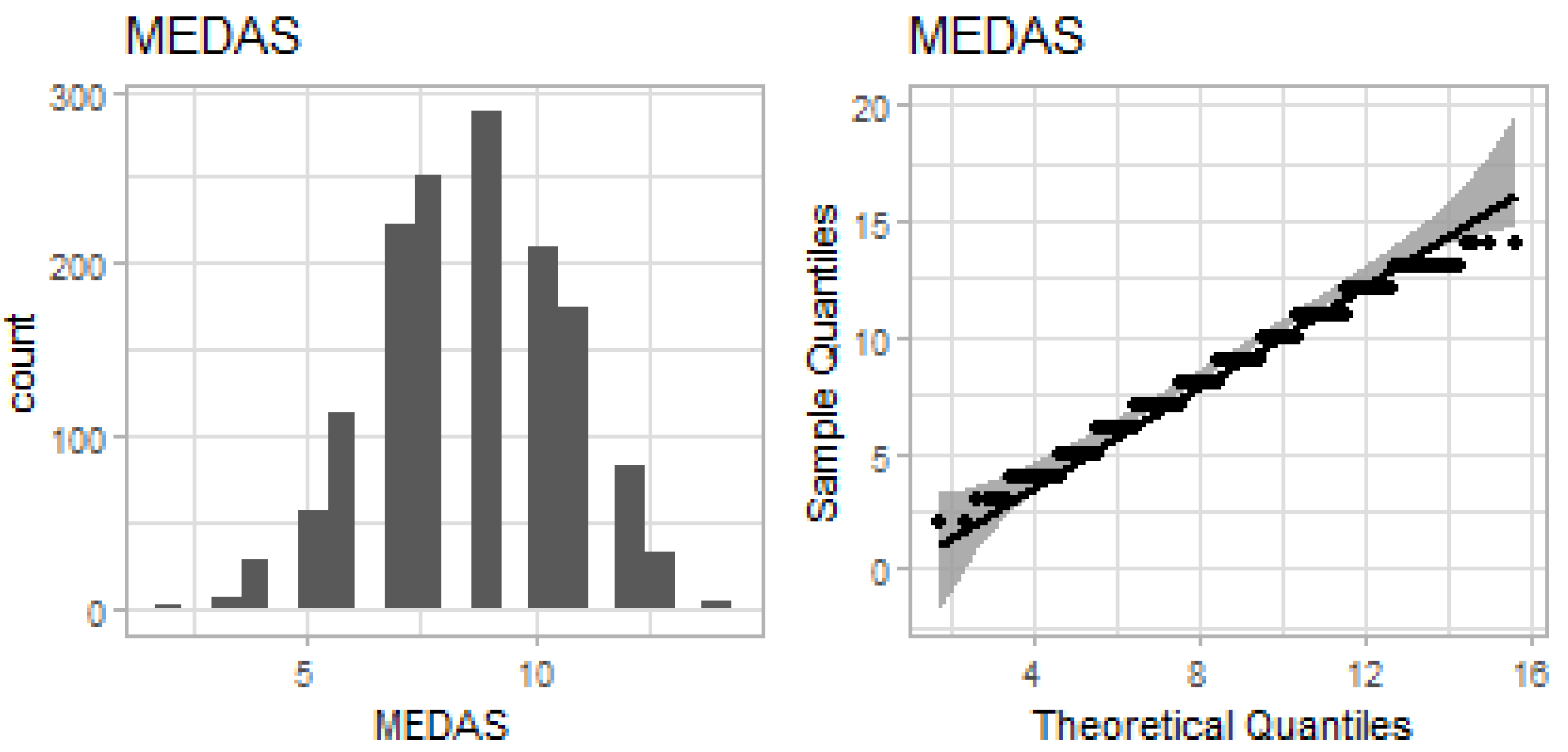

Table 1.
Comparison of the frequency of low and high adherence to the MD across genders, age groups, work shift types and occupational sectors.
Table 1.
Comparison of the frequency of low and high adherence to the MD across genders, age groups, work shift types and occupational sectors.
| Variable |
Low adherence to MD N (%) |
High adherence to MD N (%) |
p |
| Gender, male | 240 (51.6%) | 225 (48.4%) | 0.004 1 |
| female | 440 (43.7%) | 568 (56.3%) | |
| Age: young | 397 (48.7%) | 419 (51.3%) | 0.033 1 |
| aged (>50yr) | 283 (43.1%) | 374 (56.9%) | |
| Shift: no night work | 545 (46.9%) | 618 (53.1%) | 0.298 1 |
| night work | 135 (43.5%) | 175 (56.5%) | |
| Sector: Retail | 56 (50.5%) | 55 (49.5%) | 0.042 1 |
| Industrial | 31 (63.3%) | 18 (36.7%) | |
| Social | 125 (48.1%) | 135 (51.9%) | |
| Healthcare | 468 (44.4%) | 585 (55.6%) |
1 chi square.
Table 2.
Comparison of the prevalence of metabolic disease in workers with low and high adherence to the diet.
Table 2.
Comparison of the prevalence of metabolic disease in workers with low and high adherence to the diet.
| Variable |
Low adherence to MD N (%) |
High adherence to MD N (%) |
p |
| Elevated blood pressure | 132 (19.4%) | 142 (17.9%) | 0.466 1 |
| Low HDL-Cholesterol | 169 (24.9%) | 182 (23.1%) | 0.424 1 |
| Hypertriglyceridemia | 90 (13.2%) | 80 (10.2%) | 0.067 1 |
| Hyperglycemia | 80 (11.8%) | 81 (10.4%) | 0.370 1 |
| Obesity | 158 (23.2%) | 174 (21.9%) | 0.554 1 |
| MetS | 70 (10.3%) | 75 (9.5%) | 0.613 1 |
1 chi square.
Table 3.
Association between the MEDAS score and metabolic disease. Multiple logistic regression models adjusted for age and gender.
Table 3.
Association between the MEDAS score and metabolic disease. Multiple logistic regression models adjusted for age and gender.
| Metabolic disease | aOR 1 (95%CI) | p |
| Hypertension | 0.923 (0.861; 0.990) | 0.025 |
| Cholesterol dyslipidemia | 0.939 (0.882; 0.999) | 0.048 |
| Hypertriglyceridemia | 0.909 (0.838; 0.985) | 0.020 |
| Hyperglycinemia | 0.925 (0.852; 1.005) | 0.064 |
| Obesity | 0.942 (0.887; 1.001) | 0.055 |
| MetS | 0.900 (0.824; 0.982) | 0.018 |
1 Adjusted for age and gender.
Table 4.
Association between the MEDAS score and psychosocial variables. Multiple logistic regression models adjusted for age and gender.
Table 4.
Association between the MEDAS score and psychosocial variables. Multiple logistic regression models adjusted for age and gender.
| Psychosocial 1. | aOR1 (95%CI) | p |
| Work stress (ERI) | 1.017 (0.963; 1.074) | 0.541 |
| Insomnia (SCI) | 1.043 (0.980; 1.109) | 0.183 |
| Suspected OSA | 0.946 (0.978; 1.020) | 0.146 |
| Low mental health (GHQ12) | 0.943 (0.893; 0.996) | 0.036 |
| Happiness | 1.094 (1.038; 1.154) | <0.001 |
1 Adjusted for age and gender.
Disclaimer/Publisher’s Note: The statements, opinions and data contained in all publications are solely those of the individual author(s) and contributor(s) and not of MDPI and/or the editor(s). MDPI and/or the editor(s) disclaim responsibility for any injury to people or property resulting from any ideas, methods, instructions or products referred to in the content. |
© 2026 by the authors. Licensee MDPI, Basel, Switzerland. This article is an open access article distributed under the terms and conditions of the Creative Commons Attribution (CC BY) license (http://creativecommons.org/licenses/by/4.0/).
Copyright: This open access article is published under a Creative Commons CC BY 4.0 license, which permit the free download, distribution, and reuse, provided that the author and preprint are cited in any reuse.