
Submitted:
31 August 2026
Posted:
01 September 2026
You are already at the latest version
Abstract
Accurate ethnicity data is essential for understanding the size and needs of communities in Aotearoa New Zealand. Potential misclassification of Fijian and Fijian Indian ethnicity has been identified in census and administrative collections, affecting the visibility of these groups in population statistics. Using 2023 Census data available in the Integrated Data Infrastructure, this study applies census variables relating to birthplace, parental ethnicity, and language to identify people who may belong to the Fijian Indian population in addition to those recorded with the Fijian Indian ethnicity code. The 2023 Census recorded 23,808 people with Fijian Indian ethnicity, while the combined-variable approach identified an estimated 75,024 people. This result is consistent with analysis of the 2018 Census, which identified an estimated 73,056 people. Findings suggest that the recorded ethnicity code captures only part of the wider population and that visibility depends on how the ethnicity standard is implemented across census and administrative collections. Because administrative data lacks the level of detail needed to identify small groups, it is likely to provide a less complete view than census-based approaches. Using multiple census variables provides a more complete view of the Fijian Indian population and highlights the importance of consistently implementing the ethnicity standard.
Keywords:
ethnicity data
; population statistics
; census data
; misclassification
; Fijian Indian population
; Integrated Data Infrastructure
; ethnicity standard
; data quality
1. Introduction
Detailed ethnicity data is essential for understanding the size and needs of communities in Aotearoa New Zealand. It informs population statistics, equity monitoring, and the allocation of public resources [1,2,3,4].
Ethnicity in Aotearoa is defined by Statistics New Zealand (Stats NZ) through the Statistical Standard for Ethnicity and the Ethnicity New Zealand Standard Classification [5]. The ethnicity standard is based on self-identification and allows people to identify with more than one ethnic group. It describes ethnicity as the group or groups that people identify with or feel they belong to. It also sets out contributing characteristics such as a common proper name, shared cultural practices, a shared sense of ancestry, and a common geographic origin. Population statistics based on census population counts are useful for decision making because they apply the ethnicity standard through a single ethnicity question, a fixed reference period, and consistent processing rules. The census remains the most reliable source of ethnicity data and is the benchmark for assessing data quality in administrative systems [6,7,8]. Figure 1 shows the ethnicity question used in the census (paper or online form), which remains the gold standard for collecting ethnicity data.1
To output ethnicity data, Stats NZ uses a hierarchical ethnicity classification with Level 1 ethnic groupings (European, Māori, Pacific Peoples, Asian, Middle Eastern/Latin American/African (MELAA), and Other), Level 2 major ethnic groups, and more detailed Level 3 and Level 4 categories (Table 1). Understanding the hierarchy is important because population statistics are often reported at Level 1, and occasionally at Level 2. For example, data may be presented for Chinese or Indian populations rather than the broader Asian category, or for Samoan populations rather than Pacific Peoples. The hierarchy also matters for administrative data, which increasingly contributes to population statistics and to the Integrated Data Infrastructure (IDI). Many administrative systems do not allow people to record a more specific ethnicity, limiting the level of detail available and affecting how small groups can be represented.
Previous analysis identified misclassification of Fijian and Fijian Indian ethnicity in census and administrative collections [9]. This affects the visibility of these groups in official statistics and in the information used for planning and funding services to address needs [10]. Fijian Indian ethnicity is a Level 4 ethnic group and is aggregated into Indian ethnicity at Level 2, and Asian ethnicity at Level 1. Fijian ethnicity, identified separately at Level 2 and Level 4, is included within the Pacific Peoples ethnic group at Level 1. Because the detailed Fijian Indian code does not capture the full population, aggregation can further affect how the population is represented in official statistics.
Census data shows clear demographic and socioeconomic differences between people who identify as Fijian and those who identify as Fijian Indian [11]. Fijian Indians have a higher median age, higher rates of multilingualism, higher median personal income, and higher home ownership rates than those identified as Fijian [12]. Reporting the two groups separately supports accurate representation in official statistics and reflects the way communities identify. Table 2 illustrates how aggregation of detailed ethnic groups into broader categories can alter the apparent characteristics of populations.
Ethnicity is self-reported and the way the question is asked and processed can influence the level of detail recorded [13,14]. Analysis of the 2018 Census showed that relying on the detailed Fijian Indian ethnicity code did not identify the full Fijian Indian population [9]. Some responses may also be shaped by proxy reporting or assigned through administrative pathways. The 2018 Census analysis used birthplace, parental ethnicity, and language, particularly where ethnicity information was incomplete or missing, to produce a revised ethnicity estimate that was higher than the published figure. The revisions highlight the importance of understanding how ethnicity data collection and processing practices affect outputs and interpretation, and the need for detailed ethnicity information to support clear reporting for all groups.
The 2023 Census introduced changes relevant to ethnicity data quality, including refinements to the online ethnicity lookup process and the increased use of administrative and imputed information where census responses were unavailable [15]. These developments provide an opportunity to reassess findings from the 2018 Census and examine whether identification of the Fijian Indian population has changed.
Analyses of data collection practices are of particular value in the context of Aotearoa moving toward greater reliance on administrative data for population statistics. The Future Census Independent Evaluation Panel emphasised the importance of high-quality ethnicity data in this context [16]. It noted that inconsistent implementation of the ethnicity standard across administrative systems creates risks for data equity and for the visibility of communities in official statistics. Inconsistent ethnicity recording practices can reduce the visibility of small population groups [13,17,18]. Understanding how the ethnicity standard is implemented across systems is essential as administrative data becomes a larger component of population statistics.
The way ethnicity information is obtained can influence the level of detail captured, although this study cannot directly assess these effects [13,19]. The aim of this paper is to explore the impact of these changes on the 2023 Census approach and to provide an updated estimate of the potential size of the Fijian Indian population, while improving understanding of how the ethnicity standard is applied in census and administrative collections. Comparison with 2018 findings also enables assessment of whether changes introduced for the 2023 Census improved identification of the Fijian Indian population and highlights the continuing importance of ethnicity data as official statistics.
2. Materials and Methods
The method follows the approach used in the earlier analysis of 2018 Census data and reflects the availability of linked information in the IDI [9]. This study uses 2023 Census of Population and Dwellings data available in the IDI. The IDI brings together information from the census and from a wide range of administrative sources [20]. It allows ethnicity information to be viewed across different administrative collections and survey results, making it possible to examine how ethnicity is recorded, stored, and updated in different settings. All data are anonymised before access and are subject to the confidentiality rules that apply to the IDI [21]. Access to the data was provided by Stats NZ under conditions that give effect to the security and confidentiality provisions of the Data and Statistics Act 2022. The results are the work of the authors and are not official statistics.
The 2023 Census used a combined collection model involving online forms, paper forms, administrative data, and statistical imputation [7,15]. People could complete the census online or on paper. Where census responses were unavailable, administrative data, information from previous censuses, and imputation methods were used to fill gaps in census variables, including ethnicity [15]. Ethnicity data was therefore either directly collected, sourced from administrative information, or imputed to ensure that at least one ethnicity was recorded for each person in the dataset. The census file available in the IDI includes variables identifying the source of ethnicity information and the mode through which the information entered the census dataset. However, the dataset does not identify whether responses were self-reported, proxy reported or collected through assisted collection.
Census variables reflecting characteristics specified in the Ethnicity Standard were used to identify people who may belong to the Fijian Indian population in addition to those recorded with the Fijian Indian ethnicity code. The recorded Fijian Indian ethnicity code provides the primary starting point for identifying the population. Birthplace reflects a shared geographic origin. Parental ethnicity reflects shared origins and descent. Language reflects elements of common culture [22]. Together, these variables shown in Table 3 provide a broader view of the Fijian Indian population than the recorded ethnicity code alone. Identification of children is limited to those living in the household at the time of the 2023 Census.
The analysis uses five sequential filtering steps to obtain population counts. Each variable attempts to identify people who may belong to the Fijian Indian population, and each step excludes those already counted. This sequence avoids double counting and demonstrates the contribution of each variable to the revised estimate.
Counts were obtained for the following census variables in the following sequence:
- People who reported Fijian Indian ethnicity (code 43112) in the 2023 Census.
- People born in Fiji who were recorded with an Indian not further defined (nfd) ethnicity code (43100) and were not included in the first step.
- Children in a child role, including adult children, living in households with at least one parent coded as Fijian Indian (43112), or coded as Indian nfd (43100) and born in Fiji, where the child did not report Fijian Indian ethnicity.
- People born in Fiji (country code 1502) who reported speaking Fiji Hindi (language code 07112), who were not counted in earlier steps and were not coded as Indian nfd.
- People born in Aotearoa New Zealand who reported speaking Fiji Hindi or Hindi, had Fijian ethnicity (code 36111), were not included in earlier steps, and were not coded as Indian nfd.
The 2023 Census dataset also includes information on the mode of collection for each response. Records identified as online responses may include information obtained directly from census forms, administrative sources, or imputation processes. Details of whether the information was self-reported, proxy reported or obtained through assisted collection are not available. These variables provide insight into the different pathways through which ethnicity information entered the census dataset and allow consideration of how source and collection pathway may influence the completeness and level of detail captured.
The analysis was carried out in R version 4.5.1. The sequence of variable filters can be replicated by applying each step in the order described and excluding people counted in earlier steps.
3. Results
3.1 People Who Reported Fijian Indian Ethnicity
The 2023 Census recorded 23,808 people who reported Fijian Indian ethnicity [23]. This is the official published figure and reflects the number of people who selected Fijian Indian ethnicity through the online lookup process or provided Fijian Indian as a written response. The count is 57% higher than the 15,132 people recorded in the 2018 Census.
3.2 Updated Fijian Indian Estimate Using the 2023 Census
Applying additional census variables relating to birthplace, parental ethnicity, and language provides a broader estimate of the size of the Fijian Indian population than the ethnicity code alone.
As shown in Table 4, the combined census-variable approach identified 75,024 people in 2023. This is more than three times the number identified through the Fijian Indian ethnicity code alone.
The largest additional group comprised 36,030 people who were born in Fiji and recorded with an Indian nfd ethnicity code. A further 14,124 people were identified through the parent-child relationship variable, representing children living in households with at least one parent coded as Fijian Indian or coded as Indian nfd and born in Fiji, where the child was not recorded as Fijian Indian. An additional 951 Fiji-born speakers of Fiji Hindi were identified who were not coded as Indian nfd, together with 111 Aotearoa New Zealand-born speakers of Fiji Hindi or Hindi who reported Fijian ethnicity and were not coded as Indian nfd.
The total estimate of 75,024 is 2.7% higher than the corresponding estimate of 73,056 produced using a similar approach for the 2018 Census. Table 4 presents the counts obtained from each variable for both census years.
3.3. Contribution of Each 2023 Census Variable
People born in Fiji and recorded with an Indian nfd ethnicity code accounted for almost half of the updated estimate. The parent-child relationship variable identified the second largest group, adding 14,124 people who were not recorded as Fijian Indian. The language variables identified a further 1,062 people through Fiji Hindi or Hindi language responses that were not captured in previous steps. Taken together, birthplace, parental ethnicity, and language identified additional people who were not captured through the detailed Fijian Indian ethnicity code.
3.4. Patterns of Misclassification
Comparison of ethnicity with birthplace, parental ethnicity, and language variables identified individuals who met one or more characteristics associated with the Fijian Indian population but who were not recorded using the detailed Fijian Indian ethnicity code. Birthplace, parental ethnicity, and language each identified distinct groups that were not captured through the Fijian Indian code alone. The largest of these groups comprised Fiji-born people recorded with an Indian nfd ethnicity code. Additional individuals were identified through household parental relationships and through Fiji Hindi language responses. Consistent patterns across multiple census variables contributed substantially to the difference between the recorded Fijian Indian ethnicity count and the updated estimate.
3.5. Ethnicity Data Source and Mode of Reporting
The 2023 Census dataset includes information on how ethnicity information entered the census file. Ethnicity information could be derived from direct census responses, administrative sources, or statistical imputation. The dataset also identifies the collection mode associated with each record. Information on these variables provides insight into the range of pathways through which ethnicity information entered the census dataset and helps explain variation in the level of detail recorded for ethnicity responses.
4. Discussion
The 2023 Census recorded 23,808 people with Fijian Indian ethnicity, representing a 57% increase on the count recorded in 2018. At the same time, the combined-variable approach identified an estimated 75,024 people who met one or more characteristics associated with the Fijian Indian population. While the increase in the recorded Fijian Indian count suggests improved identification through the census ethnicity question, the detailed ethnicity code continues to identify only a subset of the wider population identified using birthplace, parental ethnicity, and language information.
Several factors may have contributed to the increase in the number of people recorded with the Fijian Indian ethnicity code between 2018 and 2023. The 2023 Census introduced refinements to the online ethnicity lookup process that may have improved capture of detailed ethnicity responses. The increase also reflects demographic change, including continued migration from Fiji and growth in the Aotearoa New Zealand-born population. However, despite these improvements, substantial differences remain between the number of people recorded with the detailed ethnicity code and the number identified through the broader set of census variables.
The largest contribution to the revised estimate came from people born in Fiji who were recorded with an Indian not further defined ethnicity code. This finding is consistent with earlier work and reflects the migration history of the community. It also demonstrates the importance of understanding how responses to the ethnicity question are translated into population statistics. Many people who may identify with the Fijian Indian community appear to be recorded using broader Indian categories rather than the detailed Fijian Indian code. As a result, reliance on the detailed code alone provides only a partial picture of the community.
Children living in households with at least one parent coded as Fijian Indian or as Indian not further defined and born in Fiji also formed a substantial component of the revised estimate. Many children in this group were not recorded as Fijian Indian. This pattern was also observed in the earlier 2018 analysis and may reflect household reporting practices, the way ethnicity is recorded for children, or differences between parental and child ethnic identification. The finding highlights the complexity of ethnicity reporting within families and demonstrates the importance of household-level analysis when examining small population groups.
Language variables identified a smaller but important group that was not captured through ethnicity coding. Fiji Hindi speakers who were not recorded as Fijian Indian provide further evidence that characteristics described in the ethnicity standard can identify populations that are not fully visible through ethnicity codes alone. Taken together, birthplace, parental ethnicity, and language each capture different dimensions of ethnicity and contribute additional information about the size and characteristics of the population.
The findings reinforce earlier concerns regarding the implementation of the ethnicity standard across census and administrative collections. This study does not suggest that ethnicity should be assigned or inferred in place of self-identification. Rather, it demonstrates that the way ethnicity information is collected, processed, and coded influences the visibility of communities in official statistics. The differences observed between the recorded Fijian Indian count and the revised estimate suggest that important dimensions of identity may not be fully reflected in published population counts when reliance is placed solely on detailed ethnicity codes.
The findings also have implications for the Future Census programme and for the increasing use of administrative data in the production of population statistics. Administrative collections often do not capture detailed ethnicity information and may apply the ethnicity standard differently across systems. Some collections rely on broader ethnic categories, some overwrite previously recorded ethnicities, and some depend upon proxy reporting. These practices can reduce the visibility of smaller populations and make it difficult to assess the completeness of ethnicity information over time. The Fijian Indian population provides a useful case study of how these issues can affect population statistics for groups that are primarily visible at detailed classification levels.
The proposed Census Attributes Survey is intended to evaluate the quality of census outputs derived from administrative sources. However, the ability of such approaches to examine detailed Level 4 ethnic groups remains uncertain. Small populations such as Fijian Indian are unlikely to be represented in sufficient numbers to permit robust assessment of ethnicity quality, and the administrative sources used for comparison may themselves lack detailed ethnicity information. As a result, some of the issues identified in this study may be difficult to detect through future quality assurance processes.
More broadly, the results demonstrate that detailed ethnicity measurement remains important for understanding the diversity of Aotearoa New Zealand's population. The findings suggest that improvements in ethnicity collection and coding practices may be more important than changes to the ethnicity classification itself. Any changes to collection practices should be undertaken in consultation with affected communities to ensure that improvements in data quality support visibility, equity monitoring, and appropriate use of ethnicity information in decision making. Continued research into how ethnicity information enters administrative systems would help improve understanding of the strengths and limitations of emerging approaches to population measurement.
Strengths and Limitations
A strength of this study is the use of the 2023 Census dataset available in the IDI, enabling detailed analysis at the level of families and households. Access to the census file within the IDI provides a secure environment for analysis and allows ethnicity information to be considered alongside the structure of related census records, even though this study did not draw directly on linked administrative datasets. The method was guided by the characteristics described in the Stats NZ ethnicity standard, providing a consistent framework for examining the extent to which the recorded Fijian Indian ethnicity code captures the wider population. While the focus of this study is the Fijian Indian population, the visibility issues are likely to be relevant to other small ethnic communities.
A further strength is the use of multiple indicators reflecting different dimensions of ethnicity. These indicators include ethnicity, birthplace, parental ethnicity, and language. Each provides a distinct source of information about people who may belong to the Fijian Indian population and together offer a broader understanding of the community than the detailed ethnicity code alone.
This study also has several limitations. The ethnicity standard specifies that ethnicity is based on self-identification. The approach used in this study does not assign ethnicity and is not intended to replace self-identification. Instead, it uses census variables that reflect characteristics described in the ethnicity standard to identify people who may belong to the wider Fijian Indian population when the detailed ethnicity code is not recorded. It is therefore not possible to determine whether all people included in the revised estimate would self-identify as Fijian Indian. This is the most important limitation of the study and should be considered when interpreting the results.
The analysis of children with Fijian Indian parents relies on census relationship information. These relationships do not necessarily reflect biological relationships and include only children who were living in the household at the time of the census. The earlier 2018 study identified some children living elsewhere through linked census data, but this was not possible in the same way for the 2023 analysis. As a result, the parental ethnicity component of the revised estimate is likely to be conservative.
The study is further limited by the information available within the census file provided through the IDI. The dataset identifies the source and mode of ethnicity collection but does not indicate whether ethnicity was self-reported, proxy reported, or collected through assisted enumeration. Consequently, the study is unable to directly assess the influence of these reporting pathways on the level of detail recorded for ethnicity responses.
Ethnic identification may also change over time. No attempt was made to examine ethnic mobility in this study because previous work has suggested that its effect is relatively small compared with issues arising from data collection, coding practices, and the availability of detailed ethnicity information [24,25].
Finally, neither this study nor the earlier 2018 analysis accounts for census under coverage measured through the Post-Enumeration Survey (PES). The 2023 PES identified net under coverage within both Asian and Pacific population groups. Although detailed measures are not available for the Fijian Indian population specifically, the findings suggest that the estimates presented here may remain a slight underestimate of the total population.
5. Conclusions
This study demonstrates that the number of people recorded with Fijian Indian ethnicity in the 2023 Census was substantially higher than in 2018, suggesting improvements in the identification of the population through standard census collection processes. However, the detailed Fijian Indian ethnicity code continues to identify only a portion of the wider population that can be observed through other census variables.
Using information on birthplace, parental ethnicity, and language, the study identified a substantially larger population than that recorded through the ethnicity code alone. The findings indicate that important dimensions of Fijian Indian identity are not fully represented in official counts when reliance is placed solely on detailed ethnicity coding.
The results highlight the importance of consistent implementation of the ethnicity standard and demonstrate how ethnicity collection, coding, and processing practices influence the visibility of small population groups. While the study does not seek to redefine ethnicity or replace self-identification, it shows the value of considering multiple dimensions of ethnicity when evaluating the completeness of official statistics.
The findings have implications for both future census development and the growing use of administrative data for population statistics in Aotearoa New Zealand. Improvements in ethnicity collection and coding practices are likely to be more important than changes to the ethnicity classification itself if detailed population reporting is to be maintained. Further research using linked data, examining reporting pathways, and evaluating the implementation of ethnicity standards across datasets would contribute to a clearer understanding of how diverse populations are represented in official statistics.
Author Contributions
Conceptualisation, S.M., J.G. and R.D.; methodology, R.D. and S.M.; writing original draft preparation, J.G., P.A., S.M. and R.D.; writing review and editing, P.A., J.G., R.D., S.M.; All authors have read and agreed to the published version of the manuscript.
Funding
This research received no external funding.
Institutional Review Board Statement
Ethical review and approval were waived for this study due to this research being based on publicly available official census and administrative population statistics, appropriately aggregated and deidentified.
Informed Consent Statement
Not applicable. Informed consent was waived because this research did not recruit any participants for the research reported.
Data Availability Statement
Access to the data used in this research was provided by Stats NZ under conditions designed to give effect to the security and confidentiality provisions of the Data and Statistics Act 2022. The results presented are the work of the authors, not Stats NZ or individual data suppliers. These results are not official statistics. They have been created for research purposes from the Integrated Data Infrastructure (IDI) which is carefully managed by Stats NZ. For more information about the IDI please visit https://www.stats.govt.nz/integrated-data/.
The summary data extracted from the IDI which supports the conclusions of this article will be made available by the authors on request.
Conflicts of Interest
Declare conflicts of interest or state “The authors declare no conflicts of interest.” Authors must identify and declare any personal circumstances or interests that may be perceived as inappropriately influencing the representation or interpretation of reported research results. Any role of the funders in the design of the study; in the collection, analyses or interpretation of data; in the writing of the manuscript; or in the decision to publish the results must be declared in this section. If there is no role, please state “The funders had no role in the design of the study; in the collection, analyses, or interpretation of data; in the writing of the manuscript; or in the decision to publish the results”.
Abbreviations
The following abbreviations are used in this manuscript:
| IDI | Integrated Data Infrastructure |
| MELA | Middle Eastern/Latin American/African |
| nfd | not further defined |
| PES | Post-enumeration Survey |
References
- Bycroft, C. Social and population statistics architecture for New Zealand; Stats NZ, Ed.; Wellington, New Zealand, 2011. [Google Scholar]
- Bycroft, C. Options for future New Zealand censuses: Census Transformation programme; Stats NZ, Ed.; Wellington, New Zealand, 2013. [Google Scholar]
- Mathur, R.; et al. How do we collect good-quality data on race and ethnicity and address the trust gap? The Lancet 2022, 400(10368), 2028–2030. [Google Scholar] [CrossRef] [PubMed]
- Stats NZ. Regulatory Impact Statement: Modernising the census. 2025. Available online: https://www.stats.govt.nz/assets/Uploads/Corporate/Cabinet-papers/Modernising-our-approach-to-the-2028-Census/Regulatory-Impact-Statement-Modernising-the-census.pdf (accessed on 17 March 2026).
- Stats NZ. Ethnicity New Zealand Standard Classification 2005 V3.0.0. 2026. Available online: https://aria.stats.govt.nz/aria/#ClassificationView:uri=http://stats.govt.nz/cms/ClassificationVersion/C0HVlUFIIAgScN9U (accessed on 17 March 2026).
- Minister of Health. Te Mana Ola: The Pacific Health Strategy. 2023. Available online: https://www.health.govt.nz/publications/te-mana-ola-the-pacific-health-strategy (accessed on 17 March 2026).
- Stats NZ. Census data user guide. 2024. Available online: https://www.stats.govt.nz/methods/2023-census-data-user-guide/ (accessed on 17 March 2026).
- Stats NZ. Quality of ethnicity data in the experimental administrative opulation census (APC): High level summary. 2025. Available online: https://www.stats.govt.nz/assets/Research/Quality-of-ethnicity-data-in-the-experimental-administrative-population-census-APC-High-level-summary.pdf (accessed on 17 March 2026).
- Narayan, P.; et al. Towards Achieving a More Accurate Population Count for Peoples of Fiji Living in Aotearoa. Populations 2025, 1(3). [Google Scholar] [CrossRef]
- Public Health Advisory Committee. Determining our Future - Social, Cultural, Economic and Commercial Determinants of Wellbeing in Aotearoa New Zealand: Actions to improve our health and wellbeing. 2025. Available online: https://www.health.govt.nz/system/files/2025-08/PHAC-determining-our-future-v5.pdf (accessed on 17 March 2026).
- Stats NZ. Place and ethnic group summaries - Fijian Indian. 2024. Available online: https://tools.summaries.stats.govt.nz/ethnic-group/fijian-indian (accessed on 17 March 2026).
- Stats NZ. Pace and ethnic group summaries - Fijian. 2024. Available online: https://tools.summaries.stats.govt.nz/ethnic-group/fijian (accessed on 17 March 2026).
- Yao, E.S.; et al. Unpacking tick-boxes: considerations and recommendations for collecting, analysing, and interpreting ethnicity data. J. R. Soc. N Z. 2025, 55(6), 1432–1451. [Google Scholar] [CrossRef] [PubMed]
- Yao, E.S.; et al. Classifying multiple ethnic identifications. Demogr. Res. 2021, 44, 481–512. [Google Scholar] [CrossRef]
- Stats NZ. Ethnicity - 2023 Census: Information by Concept. 2023. Available online: https://datainfoplus.stats.govt.nz/Item/nz.govt.stats/1f1ca131-a9aa-483b-98ab-d22bf84ae944 (accessed on 17 March 2026).
- Stats NZ. Evaluation of New Zealand’s future census options for 2028 and beyond. 2025. Available online: https://www.stats.govt.nz/assets/Uploads/Evaluation-of-New-Zealands-future-census-options-for-2028-and-beyond.pdf (accessed on 17 March 2026).
- Didham, R.; Callister, P. The effect of ethnic prioritisation on ethnic health analysis: a research note. NZ Med. J. 2012, 125(1359), 58–66. [Google Scholar]
- Didham, R.; Rocha, Z.L. Where you feel you belong: classifying ethnicity and mixedness in New Zealand. In The Palgrave International Handbook of Mixed Racial and Ethnic Classification; Rocha, Z., Aspinall, P., Eds.; Springer, 2020; pp. 587–604. [Google Scholar]
- Stats NZ. Reviewing the quality of ethnicity data from administrative sources: Comparison with the census. 2024. Available online: https://www.stats.govt.nz/research/reviewing-the-quality-of-ethnicity-data-from-administrative-sources-comparison-with-the-census/ (accessed on 17 March 2026).
- Milne, B.J.; et al. Data resource profile: the New Zealand integrated data infrastructure (IDI). Int. J. Epidemiol. 2019, 48(3), 677–677e. [Google Scholar] [CrossRef] [PubMed]
- Stats NZ. How we keep integrated data safe. 2022. Available online: https://www.stats.govt.nz/integrated-data/how-we-keep-integrated-data-safe/ (accessed on 17 March 2026).
- Safran, W. Language, ethnicity and religion: a complex and persistent linkage. Nations Natl. 2008, 14(1), 171–190. [Google Scholar] [CrossRef]
- Stats NZ. Aotearoa Data Explorer. 2024. Available online: https://explore.data.stats.govt.nz/vis?fs[0]=2023%20Census%2C0%7CEthnicity%252C%20culture&pg=0&fc=2023%20Census&bp=true&snb=140&df[ds]=ds-nsiws-disseminate&df[id]=CEN23_ECI_018&df[ag]=STATSNZ&df[vs]=1.0&dq=2018%2B2023.9999.43112.99.99&to[TIME]=false (accessed on 17 March 2026).
- Didham, R. Ethnic mobility in the New Zealand census, 1981-2013: A preliminary look. N. Z. Popul. Rev. 2016, 42, 27. [Google Scholar]
- Yao, E.S.; et al. Ethnic identification from pre-birth to early adolescence: longitudinal patterns and methodological considerations. J. Popul. Res. 2025, 42(3), 40. [Google Scholar] [CrossRef]
| 1 | The Census question asks, “What ethnic group do you belong to? Mark the space or spaces that apply to you”, and responses are coded to detailed Level 4 categories only when people write in or select those specific groups. |
Figure 1.
Census ethnicity question, from the paper form.
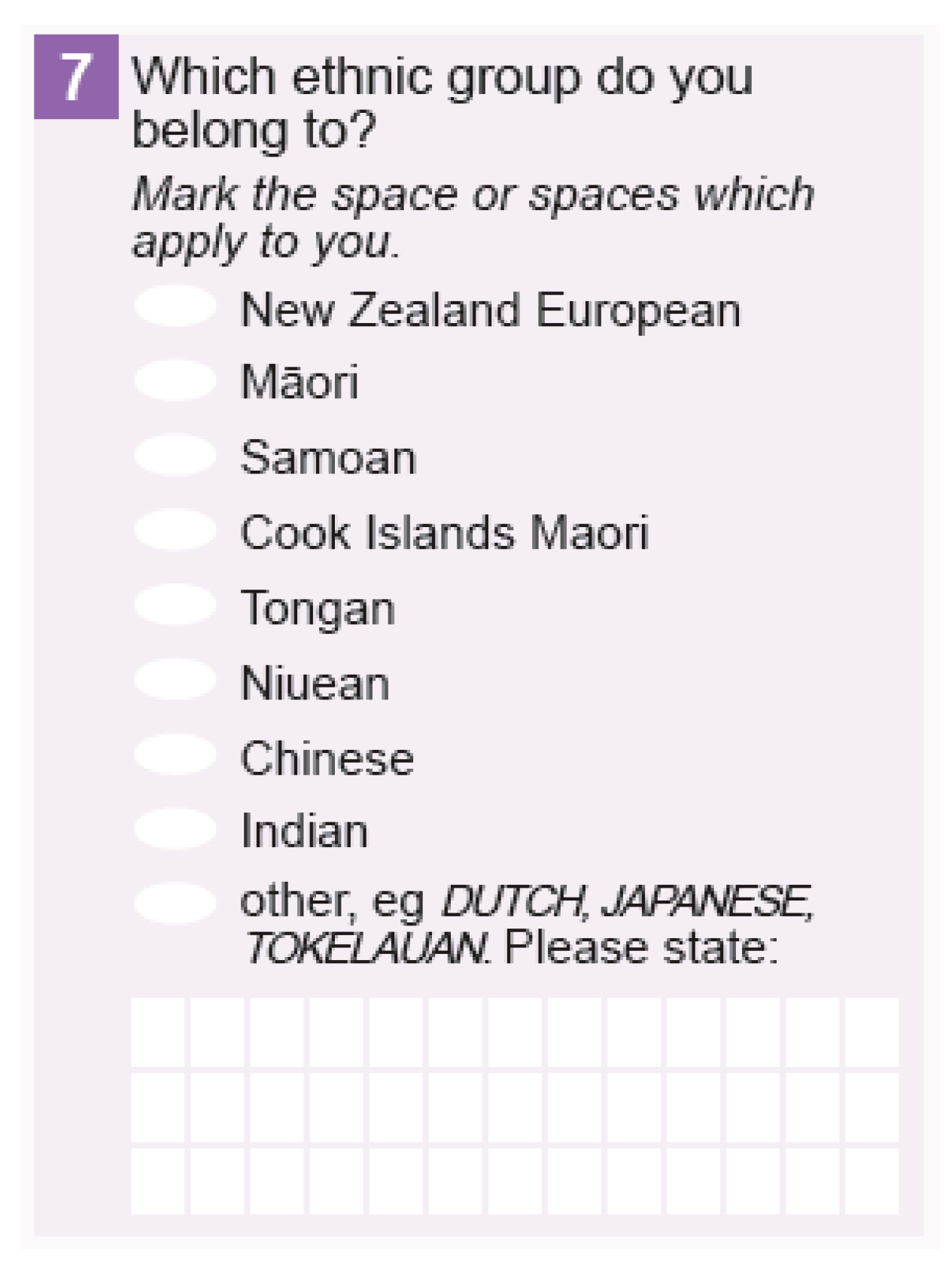

Table 1.
Stats NZ Ethnicity Standard Classification 2005 V2.1.0.
| Prioritisation order | Level 1 ethnic group codes | Ethnic Group |
|---|---|---|
| 1 | 2 | Māori |
| 2 | 3 | Pacific Peoples |
| 3 | 4 | Asian |
| 4 | 5 | Middle Eastern/Latin American/African (MELAA) |
| 5 | 6 | Other Ethnicity |
| 6 | 1 | European |
| 9 | 9 | Residual Categories |
Table 2.
Selected 2023 Census indicators from the Stats NZ Place and Ethnic Group Summaries for Fijian, Pacific Peoples, Fijian Indian and Asian populations.
Table 2.
Selected 2023 Census indicators from the Stats NZ Place and Ethnic Group Summaries for Fijian, Pacific Peoples, Fijian Indian and Asian populations.
| Indicator | Fijian | Pacific Peoples | Fijian Indian | Asian |
|---|---|---|---|---|
| Population size | 25,038 | 442,632 | 23,808 | 861,576 |
| Median age | 29.2 years | 24.9 years | 35.6 years | 33.8 years |
| Born overseas | 57.8% | 32.6% | 72.2% | 74.9% |
| Overseas born* | 46% | 30.6% | 22.3% | 48.9% |
| Multilingual | 36.7% | 38.8% | 59.7% | 52.8% |
| Median personal income | $41,400 | $35,200 | $48,600 | $43,900 |
| Post-school qualification | 52.2% | 39.3% | 55.3% | 59.8% |
| Home ownership | 23.5% | 19.9% | 46.9% | 42.6% |
*(arrived less than 10 years ago).
Table 3.
Ethnicity standard and how it is applied in this analysis.
| Characteristic from the Stats NZ ethnicity standard | How we are measuring it |
|---|---|
| A common proper name | Ethnicity of Fijian Indian |
| One or more elements of common culture* | Language of Fiji Hindi** |
| Unique community of interests, feelings and actions | Not measured |
| Shared sense of common origins or ancestry | Parents with Fijian Indian ethnicity |
| Common geographic origin | Country of birth of Fiji |
*(religion, customs, language) **(religion not included; customs not measured).
Table 4.
Counts of the Fijian Indian community from the combined 2023 Census variables, compared to 2018 Census.
Table 4.
Counts of the Fijian Indian community from the combined 2023 Census variables, compared to 2018 Census.
| Census variable | 2018 count | 2023 count |
|---|---|---|
| People who reported Fijian Indian ethnicity | 15,132 | 23,808 |
| Fiji born people recorded with an Indian nfd ethnicity code | 38,190 | 36,030 |
| Children with at least one parent coded as Fijian Indian or as Indian not further defined and Fiji born | 18,279 | 14,124* |
| Fiji born speakers of Fiji Hindi who were not coded as Indian | 1,365 | 951 |
| New Zealand born speakers of Fiji Hindi or Hindi with Fijian ethnicity who were not coded as Indian not further defined | 90** | 111 |
| Total updated estimate | 73,056 | 75,024 |
*The 2023 analysis did not include children living in other households. **The 2018 analysis did not identify a comparable group of New Zealand born speakers of Fiji Hindi or Hindi with Fijian ethnicity due to differences in the structure of the linked census dataset but identified Fiji Hindi speakers born in Aotearoa.
Disclaimer/Publisher’s Note: The statements, opinions and data contained in all publications are solely those of the individual author(s) and contributor(s) and not of MDPI and/or the editor(s). MDPI and/or the editor(s) disclaim responsibility for any injury to people or property resulting from any ideas, methods, instructions or products referred to in the content. |
© 2026 by the authors. Licensee MDPI, Basel, Switzerland. This article is an open access article distributed under the terms and conditions of the Creative Commons Attribution (CC BY) license (http://creativecommons.org/licenses/by/4.0/).
Copyright: This open access article is published under a Creative Commons CC BY 4.0 license, which permit the free download, distribution, and reuse, provided that the author and preprint are cited in any reuse.