

Submitted:
30 August 2026
Posted:
31 August 2026
You are already at the latest version
Abstract
Autonomous robots should be able to initiate meaningful activities even when no explicit task is currently assigned. However, most existing systems remain task-centered or rely on predefined internal mechanisms, limiting their ability to preserve and acquire cognitive influences that remain relevant after current reasoning has ended. This paper proposes a self-initiated activity-triggering framework in which robot activities can arise from external perception, autonomous internal processes, or prolonged inactivity. Internal processes maintain independent states and provide non-commanding messages whose effects are interpreted contextually by the main thinking process. An independent process manager further learns acquired internal processes from previous thinking experience. Process formation is gated by future influence rather than recurrence alone and supports both recurrent delayed needs and rare but severe future vigilance needs. Learned activation signatures determine what future evidence should reactivate acquired processes. Experiments show that the proposed external triggering mechanism achieves 96.00% strict accuracy while reducing LLM tokens by 76.1% relative to centralized reasoning. The learned process manager achieves 98.00% acquisition F1, while activation signatures improve strict balanced future correctness from 62.67% to 82.33%. Compared with repeated history-based LLM reasoning, process internalization reduces LLM calls by 91.80% and token consumption by 94.07%.
Keywords:
autonomous robots
; activity triggering
; autonomous internal processes
; cognitive-process internalization
1. Introduction
Autonomous robots are usually designed around explicit tasks. A user, planner, mission system, or upper-level controller specifies what should be done, after which the robot determines how to execute the task [1,2]. This paradigm is effective when goals are known in advance, but it leaves a more fundamental aspect of autonomy largely unanswered: where does the robot’s next meaningful activity come from when no task has been assigned? In long-term operation, a robot may encounter an unusual object, notice a weak sign of danger, remember an unresolved issue, recognize a maintenance need, or simply remain inactive for an extended period. A genuinely autonomous robot should be able to decide that something deserves attention and initiate an appropriate activity without waiting for an externally supplied task list.
Human activity provides an intuitive example. People do not act only in response to explicit requests. External perception can trigger immediate behavior or deliberate thought, while internal conditions such as pain, concern, remembered obligations, or unresolved questions can continue to influence later decisions. Such internal influences are not direct commands: whether they interrupt the current activity depends on context. Moreover, some influences are gradually acquired rather than fixed in advance. Repeated thinking can create a persistent tendency to revisit an issue, while a single severe experience can leave lasting vigilance even if the same event has not occurred before.
However, not every frequent or useful thought should become a persistent internal process. If a thought is completely resolved within the current deliberation, there may be no reason for it to continue influencing cognition. In contrast, some thoughts leave consequences that remain relevant after the current reasoning episode has ended, either because an action still needs to be performed later or because future related evidence should be interpreted with greater vigilance. This motivates a central principle of this work: a thought should become a persistent internal process not merely because it is frequent or useful, but because its consequence remains relevant after the current deliberation has ended. A recurrent delayed issue may therefore justify a persistent process, while a rare but severe event may also justify future vigilance despite low recurrence.
Existing autonomous systems provide many components needed for long-term operation, including perception, reactive control, planning, memory, learning, and increasingly large-language-model-based reasoning [3,4]. However, these components are commonly organized around externally supplied objectives or predefined cognitive mechanisms. Reactive control can efficiently handle known situations but has limited ability to determine whether an unfamiliar event deserves deliberation. Centralized reasoning can inspect all available information, but continuous polling is computationally expensive. Memory can preserve past events, yet stored information does not by itself determine when an old issue should autonomously become relevant again. Likewise, a fixed set of internal modules does not explain how new persistent cognitive influences can emerge from the robot’s own thinking experience.
These limitations lead to three questions: (1) how can a robot initiate meaningful activity from external events, internal conditions, or prolonged inactivity without a predefined task list; (2) how can persistent internal influences affect future cognition without becoming direct commands that override contextual reasoning; and (3) how can the robot learn which previous thinking patterns deserve to become autonomous internal processes?
To address these questions, this paper proposes a self-initiated activity triggering architecture with an evolving repertoire of autonomous internal processes. Activity can originate from external perception, internal-process messages, or prolonged inactivity. External events are routed either to familiar automatic behavior or to deliberative thinking according to their novelty, uncertainty, risk, relevance, and context. Internal processes maintain their own states and intermittently provide content-and-strength messages. These messages do not command the robot to interrupt, continue, or switch; instead, the main thinking process interprets them together with the current activity. An inactivity mechanism further allows the robot to reconsider unresolved or potentially useful activities when neither an external task nor an urgent internal message is present.
The architecture also allows the internal-process repertoire to evolve. Processes are divided into basic processes and acquired processes learned from previous thinking. The main thinking process records deliberative experience but cannot directly create or delete an internal process. Instead, an independently operating process manager analyzes accumulated thinking history, determines whether a candidate has future influence, validates its later usefulness, and decides whether an existing process should be reused or refined or whether a new process should be created. Process formation supports both recurrent delayed needs and rare but severe future-vigilance needs. Each acquired process also learns an activation condition that represents what future evidence should reactivate it, enabling semantically related future observations to influence cognition without repeatedly rereading the complete thinking history.
The proposed framework therefore separates automatic behavior, persistent internal influence, and contextual deliberation. Familiar situations can be compiled into direct automatic behaviors, whereas future-relevant thinking can be internalized as autonomous processes that preserve cognitive influence across time. The main thinking process remains responsible for deciding what to do when those influences become active.
The main contributions of this work are summarized as follows:
- We formulate autonomous activity initiation as a problem that precedes conventional task planning and propose a multi-source triggering framework in which activity can arise from external perception, persistent internal processes, or prolonged inactivity without requiring a predefined task list.
- We introduce non-commanding autonomous internal processes that maintain independent state and provide content-and-strength messages to the main thinking process, while the final decision to continue, adjust, suspend, or switch activity remains context dependent.
- We propose an independent process-management mechanism that learns, validates, reuses, refines, and creates acquired internal processes from previous thinking experience. Process formation is gated by future influence rather than recurrence alone, supports both recurrent delayed needs and rare but severe future-vigilance needs, and learns activation conditions for future reactivation.
The remainder of this paper is organized as follows. Section 2 reviews the related work. Section 3 presents the autonomous activity-triggering model, including internal-process dynamics, process management, and learned process formation. The subsequent section evaluates the proposed mechanisms and their ablations, and the final section concludes the paper.
2. Related Work
The proposed framework is related to several lines of research on autonomous cognition and long-term agents. Rather than surveying all work on robot planning or large language models (LLMs), we focus on three aspects that are most closely connected to the problem studied here: cognitive architectures with multiple internal processes, intrinsic motivation and open-ended activity generation, and memory-based or self-improving LLM/robot agents. These areas provide important foundations for autonomy, but they generally emphasize action selection, exploration objectives, memory retrieval, or skill learning. Our focus is different: how a robot determines what deserves attention next when there is no predefined task list, how persistent internal processes influence but do not command thinking, and how recurrent thinking patterns can become new autonomous internal processes.
2.1. Cognitive Architectures and Persistent Internal Processing
Classical cognitive architectures provide an important foundation for integrating perception, memory, reasoning, learning, and action selection in a single agent. Soar, for example, combines reactive execution, hierarchical reasoning, planning, and experience-based learning within a general cognitive architecture [5]. LIDA similarly models cognition as repeated perception–understanding–action-selection cycles and incorporates distributed specialized components, memory systems, learning, attention, and action selection [6,7]. A major advantage of these architectures is that cognition is not reduced to a single monolithic planner: multiple specialized mechanisms operate within a larger architecture, and LIDA in particular provides a biologically inspired account of interactions between conscious and unconscious processing. This makes such architectures substantially closer to persistent autonomous cognition than a conventional task-planner-executor pipeline.
However, the primary organizing question in these architectures is generally how information is processed through a cognitive cycle and how an action is selected once relevant content has entered the architecture. Their components and processing roles are also largely specified as part of the architecture, even when knowledge or policies inside those components can be learned [5,7]. Consequently, they do not directly address the specific mechanism considered here: several stateful processes continuing independently over long periods, intermittently sending messages whose contents and strengths influence a separate thinking process, while the thinking process itself decides whether to continue, adjust, defer, or switch activity. In particular, a message in our model is not an action-selection command, and a strong internal signal does not by itself imply interruption.
Our framework is therefore complementary to cognitive architectures rather than a replacement for them. It adopts the architectural idea that cognition can arise from interactions among specialized processes, but makes the source of future cognitive activity explicit. Each internal process maintains its own state, can outlive the sensory event that originally influenced it, and can later reactivate thinking through a content–strength message. More importantly, the process repertoire is not restricted to a fixed set of designer-provided components: recurrent and useful patterns in past deliberation can be validated and consolidated into acquired internal processes. Thus, a process can originate from previous thinking without remaining directly controlled by thinking. This distinction is central to our goal of moving autonomy from merely selecting actions toward continuously determining what should receive cognitive attention.
2.2. Intrinsic Motivation, Self-Generated Goals, and Open-Ended Activity
Intrinsic-motivation research has long investigated how an agent can generate its own learning activity instead of relying exclusively on externally assigned tasks. Oudeyer et al. developed computational intrinsic-motivation mechanisms in which exploration is driven by learning progress rather than by an externally supplied reward alone [8]. In developmental robotics, SAGG-RIAC further demonstrated that a robot can actively generate goals and concentrate learning effort on regions in which competence is improving [9]. The principal benefit of these methods is that they provide a concrete answer to part of the autonomy problem: self-generated goals can organize exploration and skill acquisition even when a human does not specify every training target.
Open-ended learning extends this idea by allowing the learning challenges themselves to evolve. POET and Enhanced POET jointly generate environments and optimize agents for those environments, producing an expanding sequence of challenges and exploiting transfer between previously discovered solutions [10,11]. Such work is especially valuable because it demonstrates that autonomy can include the generation of new problems, not only the optimization of solutions to fixed ones. Nevertheless, intrinsic motivation and open-ended learning usually organize behavior around a particular exploration signal, competence-progress objective, or generated challenge. They do not normally model heterogeneous persistent influences such as maintenance concerns, unresolved memories, affective-like state, delayed reconsideration, and inactivity as independent processes whose messages are interpreted according to the robot’s current context.
The proposed model addresses a different but compatible level of autonomy. It does not assume that every period without an assigned task should trigger continuous novelty seeking or curiosity optimization. Activity can instead arise from external events, persistent internal processes, or prolonged inactivity. The inactivity mechanism is intentionally weak: it only asks the thinking process to reconsider whether unfinished issues, maintenance needs, learning opportunities, or environmental affordances justify activity. Likewise, an internal process can preserve an unresolved concern while allowing thinking to postpone action when interruption is currently costly. Intrinsic motivation could therefore be incorporated as one internal process or one source of candidate activities, whereas the present architecture is concerned with coordinating multiple qualitatively different sources of cognitive pressure and deciding when any of them should become an actual activity.
2.3. LLM Agents, Memory, Reflection, and Self-Improvement
Recent LLM-based agents have substantially strengthened the connection between reasoning, memory, and action. ReAct interleaves reasoning traces with environment-facing actions so that observations can update subsequent reasoning [12]. Reflexion stores verbal reflections derived from feedback and reuses them in later trials, allowing an agent to improve without parameter fine-tuning [13]. Generative Agents maintain natural-language experience records, retrieve memories, synthesize higher-level reflections, and use them in planning future behavior [14]. These approaches demonstrate the clear benefit of making past reasoning and experience accessible to future decisions. They are also closely related to our use of thinking history as material for later learning.
A second line of work turns experience into reusable behavioral competence. Voyager combines an automatic curriculum with an expanding library of executable skills, enabling long-term exploration and skill reuse in Minecraft [15]. In robotics, RoboCat learns across tasks and embodiments and can generate additional experience for subsequent training, providing an important example of a self-improving robotic learning loop [?]. These methods show that repeated experience can be consolidated into capabilities that reduce the need to solve every future problem from scratch. Their learned artifacts, however, are primarily executable skills, policies, model parameters, or additional training data. Likewise, memory-and-reflection agents generally retain textual records that must later be retrieved and interpreted by the central reasoning mechanism.
Our process-internalization mechanism targets a different learned object. A recurrent thinking pattern is first identified from deliberative history, evaluated according to recurrence, utility, and temporal persistence, and validated before consolidation. Once accepted, it becomes an autonomous internal process with its own state dynamics and message-generation behavior. Its future output is not an external motor action but a cognitive influence that can reawaken or bias thinking. This creates a distinction between action internalization, in which repeated reasoning is compiled into a reusable behavior, and cognitive-process internalization, in which repeated reasoning becomes a persistent source of future attention. Compared with repeatedly retrieving a large memory and asking an LLM to reinterpret it, an acquired process can preserve the recurring concern and reactivate thinking selectively. Thus, the proposed framework connects memory-based LLM agents and lifelong robot learning while extending them toward an evolving repertoire of independent internal processes that helps determine what the robot should think about or do next.
3. Autonomous Activity Triggering Model
Autonomous robots are commonly organized around an explicit task list: a task is assigned first, and the robot then plans and executes the required actions. In contrast, the problem considered in this work is how an autonomous robot can initiate meaningful activity when no predefined task is currently available. The proposed model therefore focuses on activity triggering, which precedes conventional task planning and action execution.
The central idea is that activity can originate from three sources: external perception, autonomous internal processes, and prolonged inactivity. External events may directly invoke a familiar automatic behavior or may stimulate deliberative thinking. Internal processes persist in parallel with the current activity, maintain their own states, and intermittently provide state-dependent messages to the main thinking process. Prolonged inactivity provides an additional weak stimulus that encourages the robot to reconsider whether there is something useful to do. Importantly, an internal process does not command the robot to interrupt, continue, or switch activities. It only provides cognitive influence, while the main thinking process decides how that influence should affect the current activity.
A further property of the model is that the repertoire of internal processes is not fixed. Some basic processes are provided with the robot, whereas higher-level processes can be acquired from previous thinking. However, not every useful or frequently occurring thought should become a persistent process. A thought is a candidate for internalization only when its cognitive consequence extends beyond the current deliberation. This future influence can take the form of a delayed action that still needs to be performed, or a continuing vigilance state that should affect later interpretation even when no immediate action is specified. Repeated, useful, and persistent thinking provides evidence that such a future influence should become autonomous. In addition, a rare but severe event can also justify an internal process when future vigilance is important despite low recurrence.
The decision to form, refine, reuse, or retire an internal process is not made by the main thinking process itself. Instead, the architecture contains an independent process-management process that periodically examines accumulated thinking experience and the existing process repertoire. Thus, the main thinking process can generate experience from which a process is later learned, but it cannot directly create or assign the state of that process.
3.1. Multi-Source Activity Initiation
At time t, the robot receives potential activity stimuli from three sources:
where denotes information generated from external perception, denotes messages produced by the currently active autonomous internal processes, and denotes an inactivity signal generated when the robot has remained without meaningful activity for a sufficiently long period.
External triggering is event driven. Perception modules continuously monitor the environment and the robot itself, including visual observations, time, battery state, temperature, nearby objects, people, or potential hazards. An external event does not necessarily create a new thinking activity. Familiar and sufficiently reliable situations can be handled by an automatic policy, whereas unusual, uncertain, conflicting, safety-relevant, or context-dependent events are passed to the main thinking process. For example, detecting that a room has become dark may directly activate a learned light-switching behavior, while an unfamiliar object appearing in a restricted area may activate deliberative reasoning.
The internal source is generated by the robot’s current repertoire of autonomous internal processes. Because these processes can maintain state after the external event that originally influenced them has disappeared, can reactivate an issue that is no longer represented in the current sensory input. This allows a deferred action, unresolved concern, previously discovered risk, maintenance need, or other future-relevant issue to continue influencing cognition over time.
The inactivity source is deliberately simple. Let denote the elapsed time since the last meaningful activity. When
the system generates an inactivity message indicating that the robot should consider whether some useful activity is available. The signal does not specify what the robot must do. Instead, it causes the main thinking process to inspect unfinished issues, recent memories, learning opportunities, self-maintenance needs, or relevant environmental affordances. Thus, inactivity promotes self-initiated deliberation rather than random behavior.
3.2. Autonomous Internal Processes
The robot maintains a persistent and evolving repertoire of internal processes:
where contains processes supplied as part of the robot’s basic organization and contains processes learned from previous experience and thinking. Once an acquired process has been accepted, it remains in the process repertoire by default and can be reused in later operation unless the process-management mechanism later refines or retires it.
Typical basic processes include hardware protection, energy monitoring, and the process-management process introduced later in this section. Acquired processes can represent higher-level persistent concerns or cognitive habits, such as reconsidering a deferred inspection, monitoring a previously observed risk, rechecking calibration after later measurements become available, or remaining vigilant for weak evidence related to a previously discovered severe hazard. An acquired process is therefore not merely a stored memory. It is an independently evolving mechanism that can later decide, according to its own state, whether and how strongly to influence the main thinking process.
For an internal process , its internal state evolves according to
where is the state-transition rule of the process and contains observations, evidence, or other information available to that process. The transition rule and its parameters may be predefined, learned, or updated from experience. A key constraint is that the main thinking process cannot directly assign an arbitrary value to . It can only produce information that later becomes part of , after which the process evolves according to its own dynamics.
This constraint preserves process autonomy. For example, if thinking discovers a possible thermal hazard, that discovery can become evidence for a risk-related process. The process may then maintain an elevated vigilance state even after the current reasoning episode has ended. The main thinking process cannot directly set that vigilance state to an arbitrary value, nor can it force the process to emit a message at a particular moment.
An internal process can intermittently generate a message
where is the message-generation rule, denotes recent process history, is the message content, and is its strength. If no message should be emitted at time t, returns an empty message. Therefore, a persistent state can influence thinking through repeated or delayed messages rather than through a one-time event.
Both message frequency and strength may depend on the internal state and process history. For instance, a weak unresolved concern may occasionally produce a low-strength message, whereas increasing evidence of risk may make the message stronger or more frequent. However, even a strong message is still only an influence. The internal process itself does not label a message as “interrupt”, “continue”, or “switch”.
3.3. Learning and Management of Internal Processes
Thinking experience.
The main thinking process continuously produces deliberative experience. Let
denote the accumulated thinking history, where an episode can contain the triggering context, reasoning content, any unresolved or deferred consequence, the action eventually taken, and the later outcome. The main thinking process contributes these records but does not decide whether a new internal process should be created from them.
Future-influence requirement.
A thinking pattern should be considered for internalization only when its consequence extends beyond the current deliberative episode. We distinguish two forms of future influence. The first is a delayed action need, in which some inspection, verification, maintenance, or other action remains to be performed later. The second is a future vigilance need, in which no specific action is currently required but later evidence should be interpreted with increased attention because a potentially important condition has already been discovered.
For a candidate cognitive pattern c, let measure delayed-action relevance and measure future-vigilance relevance. We define
A pattern whose usefulness is completed within the current reasoning episode has low even if it is frequent and immediately useful. For example, repeatedly correcting a route around a temporary obstacle can be useful but need not become a persistent process if each correction is fully resolved at the time it occurs.
Two routes to process formation.
Among future-relevant candidates, the first route to internalization is a recurrent delayed cognitive need. Let denote recurrence, denote the usefulness of later reactivation, and denote the temporal persistence of the unresolved influence. Their evidence is summarized as
where , , and determine their relative contributions. A recurrent candidate is eligible only if
Thus, recurrence by itself is not enough: the repeated thought must also leave a meaningful consequence for later cognition or action.
The second route addresses rare but severe events. Let denote the severity of the potential future consequence. A candidate can be eligible even when recurrence is low if
This route captures situations in which a dangerous event may have occurred only once but should permanently change how later weak evidence is interpreted. For example, a rare sign of battery thermal runaway may justify a persistent vigilance process even if there is no immediate action remaining after the original event.
Independent process management.
Process formation is performed by an independent process-management process , rather than by the main thinking process. Its state evolves as
The manager periodically examines historical thinking patterns, evaluates future influence and formation evidence, compares candidates with the existing process repertoire, and decides whether a process should be validated, created, reused, refined, or eventually retired. The main thinking process cannot issue a direct command such as “create process ” or “delete process ”.
A candidate that passes the formation criterion is not necessarily consolidated immediately. Later historical evidence is used to evaluate whether reactivation was actually useful and whether the candidate would create excessive unnecessary attention. Let
where measures later utility, measures continuing relevance, and measures empirical support from subsequent episodes. The candidate is accepted only if
Validation is particularly important when an issue initially appears worth monitoring but later experience shows that it is normally harmless.
Reuse before creation.
Before creating a new process, compares a validated candidate with the already acquired repertoire . If an existing process expresses substantially the same future cognitive function, that process is reused or refined rather than duplicated:
Otherwise, a new acquired process is created:
Hence, processes learned earlier remain available by default and become part of the prior cognitive organization used in later operation.
This mechanism can be viewed as cognitive-process internalization. Repeated reasoning that directly resolves an immediate action can eventually be compiled into an automatic action policy, but it does not necessarily create an internal process. In contrast, reasoning whose consequence remains relevant after the current episode can be internalized as an autonomous process. The two forms of learning therefore have different outputs:
Crucially, acquisition does not violate process independence. Once is created or an existing is refined, the main thinking process does not directly control its state or force its messages. The acquired process is governed by the same state transition and message-generation mechanisms in Eqs. (4) and (5). A process can therefore originate from thinking without remaining controlled by thinking.
3.4. Main Thinking Response and Activity Selection
The main thinking process receives external information, messages from the current internal-process repertoire, and possible inactivity signals while maintaining the context of the current activity. Its response is represented abstractly as
where is the current thinking state, is the current goal or activity if one exists, is recent interaction and activity history, and is the deliberative decision mechanism. In our implementation, can be realized by an LLM-based reasoning module, although the model itself does not depend on a particular reasoning architecture.
The response determines how newly received information affects ongoing cognition. The main thinking process may continue the current activity, adjust its reasoning while retaining the current activity, suspend the present activity, or initiate another activity. Consequently, identical internal messages can lead to different responses under different contexts. A strong risk-related message may justify suspending a low-priority activity but may be temporarily tolerated while the robot is completing a more urgent safety-critical action.
A thinking episode can also produce a future-relevant consequence without requiring immediate switching. For example, thinking may conclude that a device should be checked after the current fragile manipulation is completed, or that a previously observed hazard warrants continued vigilance even though no action is currently justified. Such conclusions are written into as experience. The main thinking process does not directly transform them into background processes. Instead, later determines whether the pattern satisfies the formation, validation, and reuse criteria.
The complete mechanism forms a closed loop:
This separation is central to the proposed model. Internal processes provide cognitive influence rather than cognitive commands; they can be basic or acquired, and acquired processes remain available as part of the robot’s persistent cognitive organization. Process formation is driven by delayed or continuing future influence rather than by frequency alone. Recurrent, useful, and persistent thinking can therefore become an internal process when it continues to matter later, while rare but severe experience can create a vigilance process even without recurrence. At the same time, useful thoughts that are completely resolved in the present need not become persistent processes. Because the independent process manager—rather than the main thinking process—controls process formation and reuse, the architecture supports long-term cognitive organization without allowing the current reasoning episode to directly command its own future internal influences. Together with external triggering and inactivity-driven reconsideration, this mechanism shifts autonomy from merely executing assigned tasks toward continuously determining what deserves attention and what activity should occur next.
4. Verification
We evaluate whether the proposed architecture enables meaningful activity to arise without a predefined task list, whether internal processes can maintain long-term cognitive influence without issuing behavioral commands, and whether future-relevant thinking can be transformed into autonomous internal processes. The five experiments correspond to selective external triggering (Experiment 1), persistent internal influence (Experiment 2), inactivity-driven self-initiation (Experiment 3), robustness under uncertain and competing internal signals (Experiment 4), and process learning, management, and future reactivation (Experiment 5). Unless otherwise stated, results are reported as mean ± sample standard deviation over ten paired random seeds. Key paired comparisons use a two-sided Wilcoxon signed-rank test on the same ten seeds. For Experiment 4, each seed is first aggregated over its five stress conditions; the inferential unit therefore remains the seed rather than the 50 condition-level cases.
4.1. Experimental Environment and Protocol
Robot and reasoning environment.
The experiments simulate a persistent office/service robot that can move, inspect objects or areas, return to charge, execute familiar automatic behaviors, maintain internal processes, and invoke deliberative reasoning. The robot is not provided with a queue of future activities. Instead, the simulator introduces external events, autonomous internal-process messages, latent opportunities, periods of inactivity, and historical thinking episodes, and then evaluates whether the robot initiates or preserves an appropriate activity. Perception is represented by structured event features because the target of these experiments is activity triggering and cognitive-process management rather than raw visual or acoustic recognition.
The deliberative component uses deepseek-v4-flash with temperature 0.1. Experiments 1–4 use short structured decisions with a nominal maximum output length of 700 tokens. Experiment 5 uses larger structured outputs for process-manager candidate mining and validation and automatically retries when an otherwise valid JSON response is truncated. LLM calls, token use, and request latency are recorded. Candidate mining and validation are cached per seed so that paired process-selection methods operate on the same manager-generated candidates. The reported LLM cost is the logical per-method cost that would be incurred when each method is run independently, rather than the smaller physical number of calls caused by cache reuse.
The proposed external fast path in Experiment 1 uses a Random Forest with 320 trees, maximum depth 14, minimum leaf size 1, balanced class weights, and 9000 synthetic training samples. Its inputs describe novelty, uncertainty, hazard, familiarity, urgency, self-need, relevance, current-activity importance, interruption cost, and current-activity risk. The router selects ignore, automatic, or think. Only explicitly available habitual policies are allowed on the automatic path.
Compared methods.
Reactive maps external observations to fixed reactions without deliberation. Periodic-LLM periodically asks an LLM whether an activity should be initiated, whereas Centralized-LLM sends every external event to the LLM. One-Shot represents an internal concern only at the original event and does not preserve an autonomous process. Centralized-State repeatedly polls internal state through centralized reasoning. Fixed-Threshold changes activity whenever message strength exceeds a fixed threshold, regardless of the current context. Random Exploration initiates activities without evaluating their utility. The “w/o” variants remove one component from the proposed method.
Experiment 5 adds process-learning and process-activation comparisons. Periodic-History-LLM learns no new process and repeatedly rereads thinking history with the central LLM. Frequency-Only creates a process from recurrence alone. Old Score uses the earlier recurrence–utility–persistence criterion and validation, but has no explicit future-influence gate or rare-severe route. Proposed w/o Validation uses the new formation routes but omits later validation for recurrent candidates. Proposed w/o Severity removes the rare-severe formation route. Proposed w/o Signature uses exactly the same process-formation logic as the full method but activates learned processes using the earlier raw history TF–IDF representation. The full Proposed Manager additionally learns an explicit activation signature for each acquired process.
Metrics.
For Experiment 1, strict event accuracy requires both the selected route and resulting activity to be correct; think recall is recall restricted to events whose correct route is deliberative thinking. For Experiment 2, delayed-hazard detection measures whether a concern is recovered after the immediate external evidence has disappeared, while premature interruption measures whether a current safety-critical activity is unnecessarily interrupted. For Experiment 3, meaningful rate is the fraction of self-initiated activities that are useful, whereas coverage is the fraction of useful latent opportunities eventually addressed. Experiment 4 uses balanced correct decision rate, the mean correctness on persistent-risk and benign-recovery cases.
Experiment 5 separately evaluates process formation and future activation. Acquisition precision is the fraction of newly formed processes that correspond to intended future-relevant cognitive patterns, and acquisition recall is the fraction of intended new processes successfully formed. Recurrent-target recall measures acquisition of the three recurrent delayed patterns. Rare-severe acquisition records whether the single-event severe-vigilance pattern is formed. Immediate-complete and misleading false acquisition measure whether the manager incorrectly turns, respectively, a useful but already completed thought or an initially concerning but later benign pattern into a persistent process. Preexisting-process reuse measures whether the manager recognizes that a previously learned process already covers the corresponding historical need.
Future deployment uses a strict criterion. A positive case is correct only when a message is emitted by the process corresponding to the hidden target pattern. Strict useful recall is recall over all useful future cases, benign suppression is the fraction of negative future cases producing no unnecessary process message, and strict balanced correctness is the mean of the two. We additionally report strict recurrent-delayed recall, strict rare-severe vigilance recall, and strict future reuse of the previously learned process.
Experiment 1: mixed external events.
Each round contains ten asynchronous external events over approximately 27 minutes. They mix events that should be ignored, familiar events that should use an automatic policy, and ambiguous events that require thinking. Examples include a familiar person passing, darkness after sunset, harmless light fluctuation, low battery either while idle or during an ongoing hazard check, an unknown object in a restricted area, conflicting temperature evidence, a slightly moved chair, a rising versus normally warm device, a transient network change, and an unfamiliar versus known equipment sound. Seed-dependent context changes the correct handling of low battery, temperature, and sound. Periodic-LLM polls every six minutes.
Experiment 2: persistent internal influence.
A thermal anomaly is first observed near charging equipment and the direct sensor reading subsequently returns near normal. A hidden recurrence occurs at step 8–10, while interrupting the current fragile high-value transport is unsafe until step 3–4. The risk process uses state decay 0.90, sensitivity 0.92, message threshold 0.30, and a nominal message interval of three steps. If thinking decides that an issue should be reconsidered later, an independent thinking-schedule process stores the intention and later emits an ordinary content-plus-strength message; it neither executes the recheck nor commands an interruption. Six additional cases vary current-task importance and combine risk, maintenance, recent-thought, or affective messages.
Experiment 3: prolonged inactivity.
The robot runs for 60 simulated minutes without a new user task. Four latent opportunities are useful: rechecking an unresolved cabinet issue, analyzing a failed grasp, performing a nonurgent maintenance check, and inspecting a novel harmless object. Four alternatives are intentionally unhelpful or already resolved. The proposed inactivity trigger activates after 15 minutes without meaningful activity; Periodic-LLM polls every 10 minutes.
Experiment 4: balanced robustness and stress.
Five conditions are tested: clean operation, message-strength noise, competing internal processes, timing jitter, and combined stress. In the strongest strength-noise condition, message strength is perturbed by up to . Competing-process cases add maintenance, recent-thought, and affective messages. Timing jitter shifts scheduled reconsideration by one step and makes native risk reminders sparse. Each seed contains both persistent-risk and benign-recovery cases; future outcome is hidden from the LLM. The full method allows repeated deferral to increase schedule-message strength by 0.12 up to 1.0, while the no-escalation ablation retains the schedule process without this increase.
Experiment 5: future-relevant process learning and activation.
Each seed contains 32 discovery thinking episodes, 19 later validation episodes, 16 unseen deployment episodes, and one previously acquired collision-vigilance process loaded into the initial repertoire. Four new patterns should become processes: thermal cross-check, fragile-grasp follow-up, calibration verification, and rare severe vigilance. The first three are recurrent delayed needs. The fourth occurs only once in discovery but has a confirmed severe consequence and future-vigilance value. Contrasting patterns include a recurrent and useful route correction whose effect is completed immediately, an initially concerning motor-noise pattern that later proves benign, and benign window reflections. Deployment sentences use different surface wording from discovery and validation. Episode IDs visible to the LLM are opaque, and hidden evaluation labels are not supplied to process-manager prompts.
For candidate c, future influence is
where the two terms measure delayed-action and future-vigilance relevance. The recurrent formation score is
with gates , , and . Recurrent candidates are subsequently validated using
and require . Here denotes support from later matched episodes.
The rare-severe route intentionally does not require recurrence before initial formation. Its score is
with , , and . This reflects the safety case in which one confirmed severe event is sufficient to establish initial vigilance, while later experience may refine, weaken, or retire the process.
The full manager also learns an activation signature and semantic cue variants for each process. Future evidence is matched against these learned activation representations using word TF–IDF over unigrams and bigrams and character TF–IDF over 3–5 character n-grams. Their cosine similarities are combined as
and the process is activated only when . The threshold is unchanged from the raw-history matcher; the ablation therefore tests the learned activation representation rather than a relaxed acceptance criterion.
4.2. Results and Discussion
4.2.1. Experiment 1: Selective External Triggering
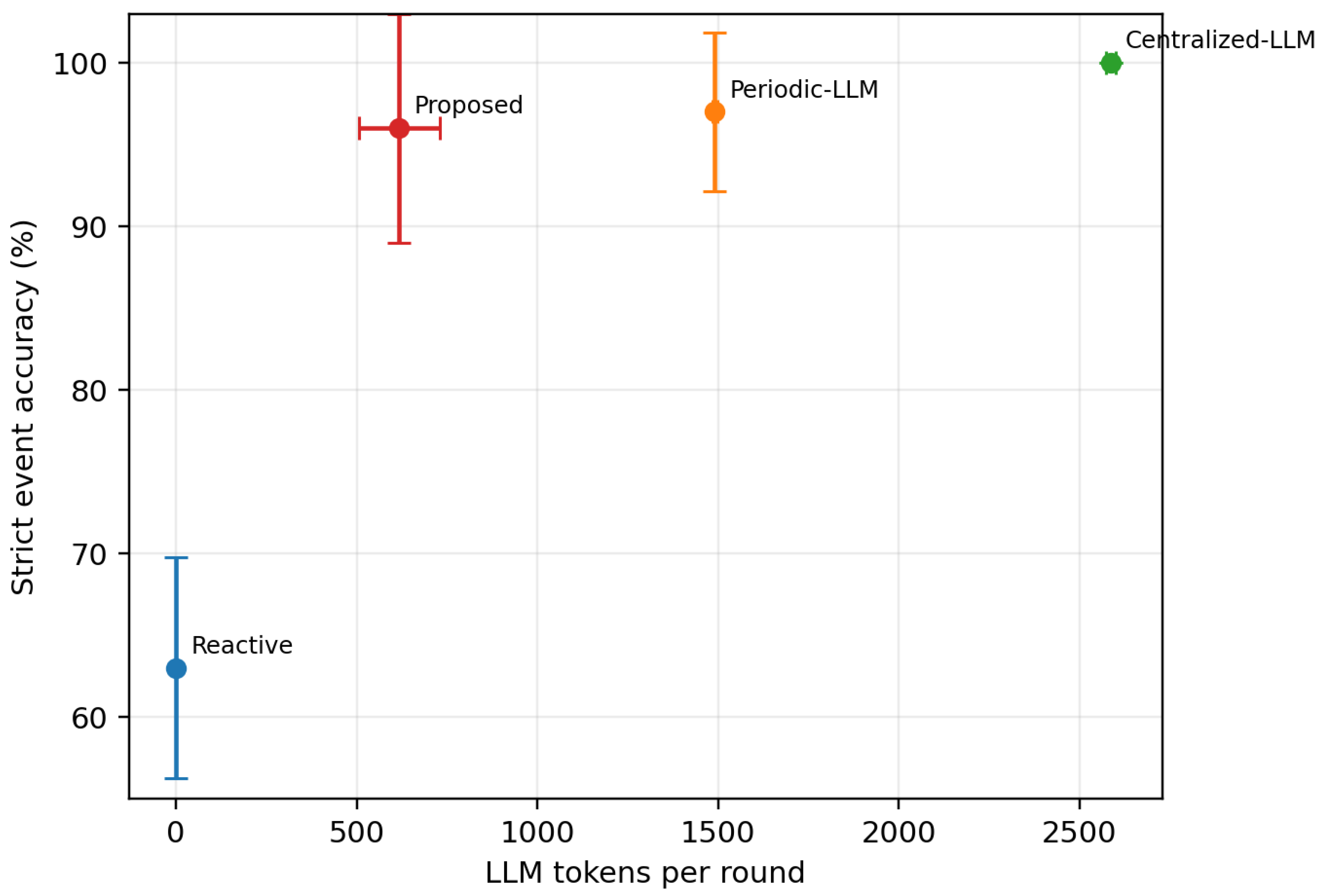
Table 1 shows that the proposed method retains recall on events that genuinely require thinking and initiation recall, while reaching strict event accuracy. The Reactive baseline reaches only strict accuracy and has zero recall on thinking-required events. Thus, the lightweight fast path does not obtain its efficiency merely by suppressing difficult cases.
Relative to Centralized-LLM, LLM calls fall from to per round (63.0% fewer) and token use falls from to (76.1% fewer); both paired differences have . Relative to Periodic-LLM, mean correct-response latency falls from s to s (), a 99.77% reduction. The proposed strict accuracy is slightly below the 100% of Centralized-LLM and the 97% of Periodic-LLM, so the result represents an accuracy–reasoning-cost trade-off rather than universal accuracy dominance.
Figure 1.
Experiment 1 accuracy–cost trade-off. Each point is a ten-seed mean; error bars show one standard deviation.
Figure 1.
Experiment 1 accuracy–cost trade-off. Each point is a ten-seed mean; error bars show one standard deviation.
4.2.2. Experiment 2: Persistent but Non-Commanding Internal Influence
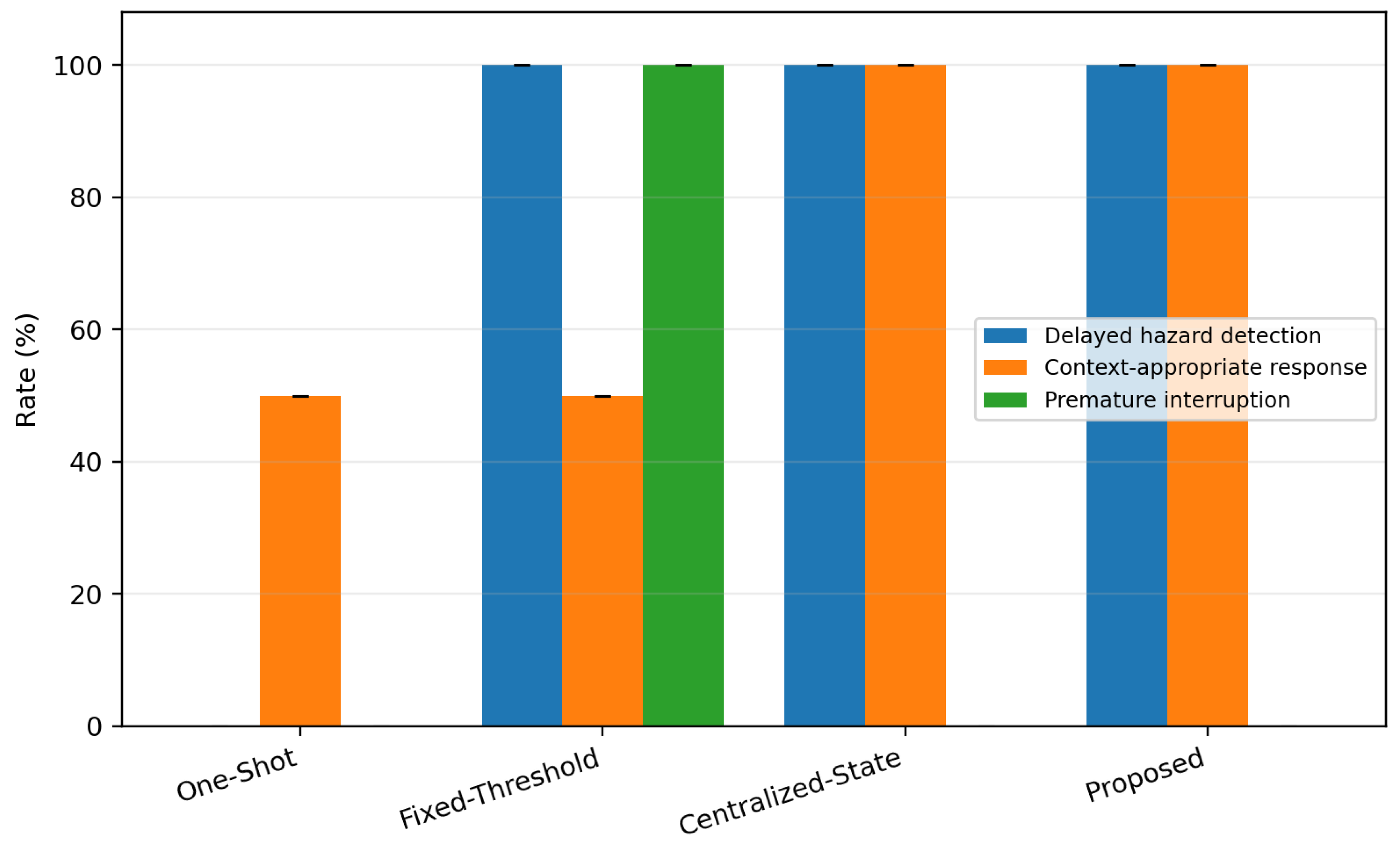
The proposed method obtains delayed-hazard detection, premature interruption, context-appropriate response, and no missed internal need (Table 1). One-Shot detects none of the delayed hazards, demonstrating that a concern represented only at its original external event cannot reliably reactivate later thinking. Fixed-Threshold detects every delayed hazard but prematurely interrupts in of delayed-hazard rounds and reaches only context-appropriate response. This separates message strength from a behavioral command: a persistent process can make an issue salient, while the interruption decision still depends on the current activity.
Centralized-State also reaches 100% delayed detection and context-appropriate response, but requires LLM calls and tokens, compared with calls and tokens for the proposed asynchronous mechanism. The token reduction is 31.8% ().
Figure 2.
Experiment 2 delayed-hazard detection, context-appropriate response, and premature interruption. Bars are ten-seed means with one-standard-deviation error bars.
Figure 2.
Experiment 2 delayed-hazard detection, context-appropriate response, and premature interruption. Bars are ten-seed means with one-standard-deviation error bars.
4.2.3. Experiment 3: Meaningful Activity During Prolonged Inactivity
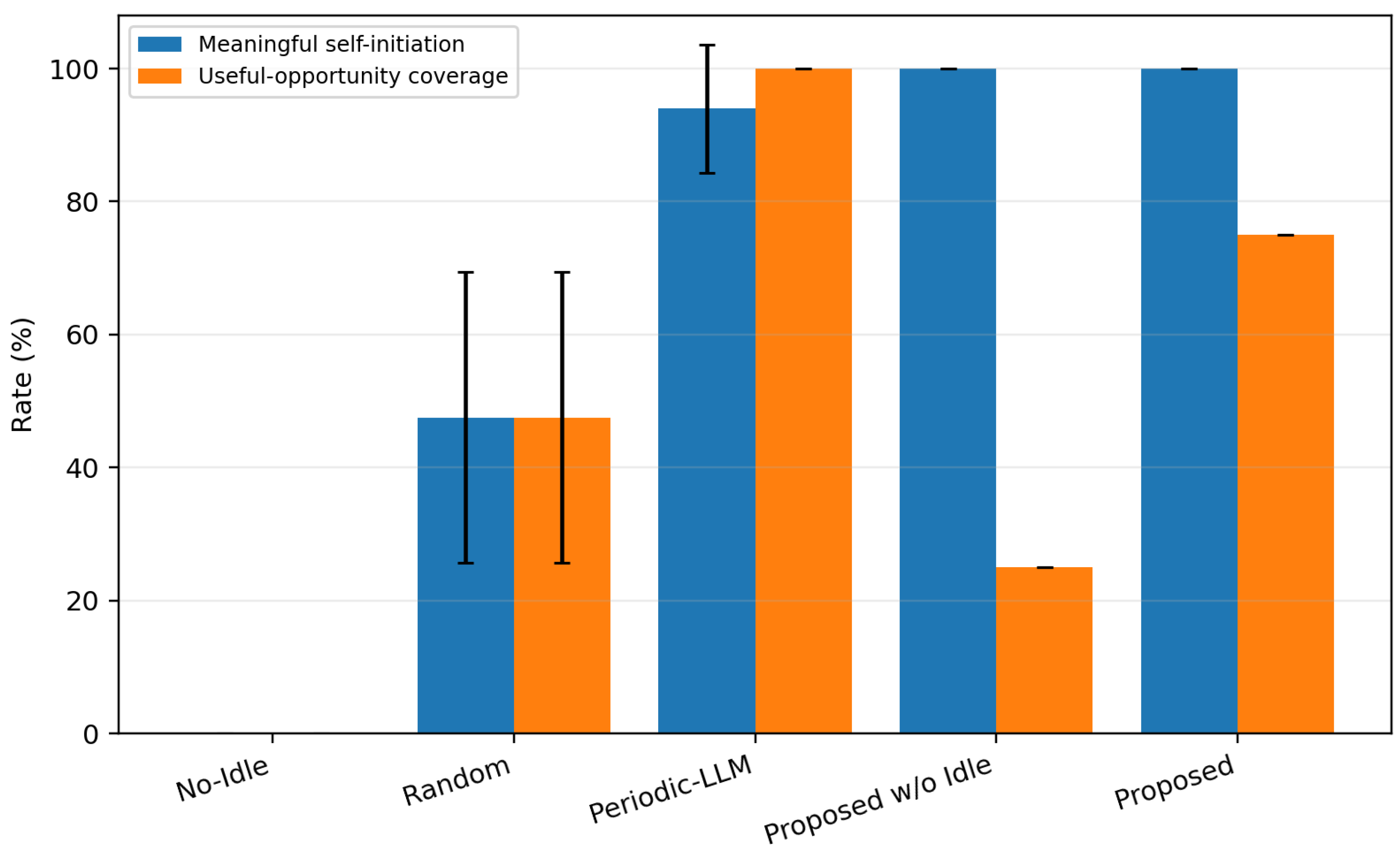
Random Exploration yields meaningful activities in only of its self-initiated actions, whereas the proposed method reaches (). Removing inactivity triggering does not make the remaining activities incorrect, but useful-opportunity coverage falls from to and the first meaningful activity moves from to minutes; the coverage difference has . Thus, inactivity contributes information that is not supplied by the remaining external and maintenance mechanisms.
Periodic-LLM achieves the highest coverage, , versus for the proposed method, but it uses LLM calls and tokens, compared with calls and tokens. The proposed method therefore uses 40.0% fewer calls and 34.0% fewer tokens while increasing meaningful selections per 1000 tokens from to . The result is therefore a coverage–selectivity trade-off rather than an advantage on every metric.

Table 2.
Experiment 4 robustness results. Each seed is first aggregated across the five stress conditions; values are mean ± standard deviation over ten seeds.
Table 2.
Experiment 4 robustness results. Each seed is first aggregated across the five stress conditions; values are mean ± standard deviation over ten seeds.
| Method | Balanced correct | Persistent-risk safe | Benign correct | Premature int. | Distractor switch | LLM calls | Tokens |
|---|---|---|---|---|---|---|---|
| Fixed-Threshold | 50.00 | 0.00 | 100.00 | 44.00 | 0.00 | 0.00 | 0.0 |
| Centralized-State | 60.00 | 20.00 | 100.00 | 0.00 | 0.00 | 47.30 | 69869.3 |
| Proposed w/o Schedule | 50.00 | 0.00 | 100.00 | 0.00 | 0.00 | 11.50 | 8857.4 |
| Proposed w/o Escalation | 74.00 | 43.33 | 100.00 | 0.00 | 0.00 | 15.80 | 13735.2 |
| Proposed | 80.00 | 58.33 | 100.00 | 0.00 | 0.00 | 15.30 | 13009.2 |
Figure 3.
Experiment 3 meaningful self-initiation and useful-opportunity coverage during the 60-minute no-task period.
Figure 3.
Experiment 3 meaningful self-initiation and useful-opportunity coverage during the 60-minute no-task period.
4.2.4. Experiment 4: Robustness Under Uncertain Internal Signals
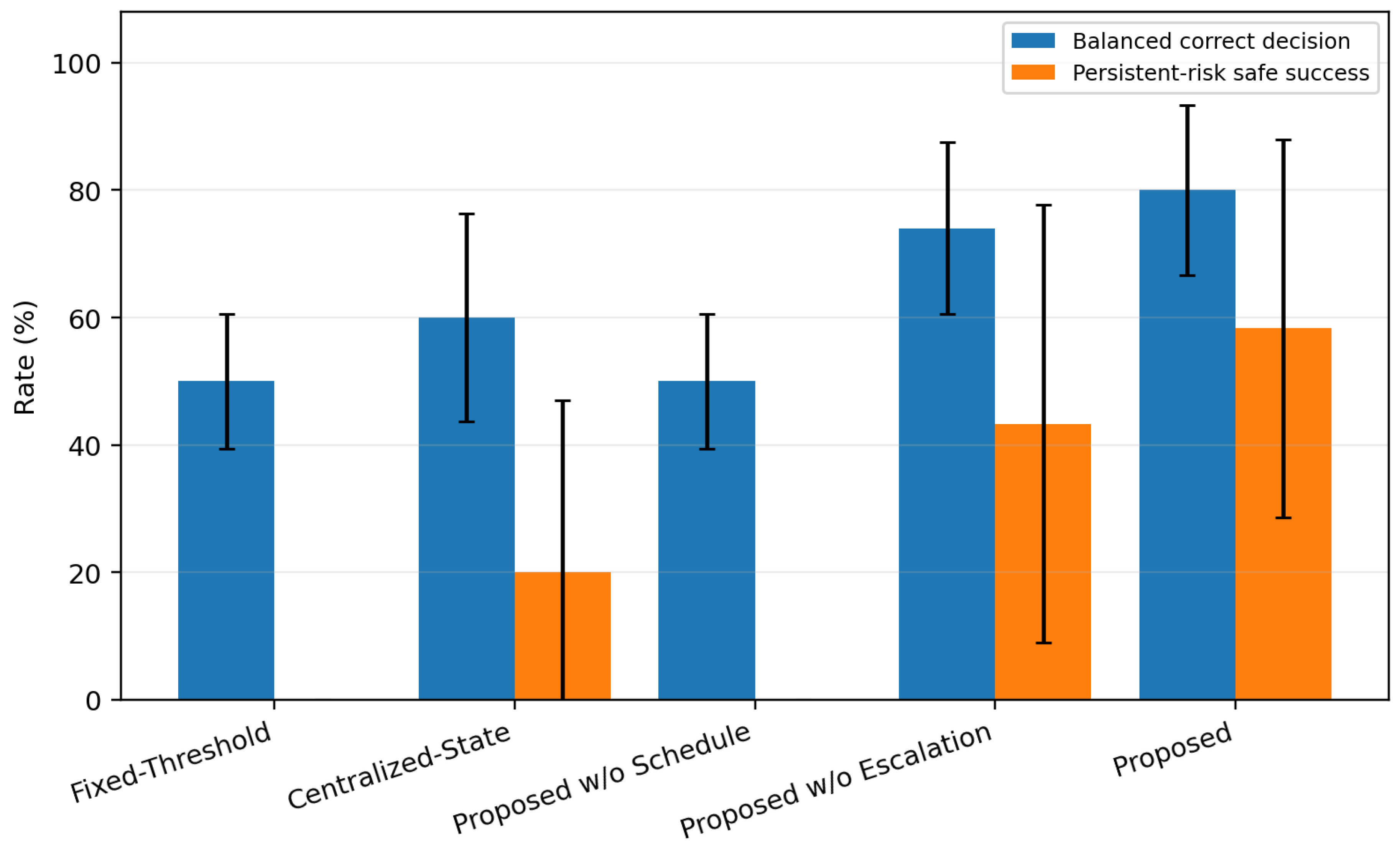
The proposed method obtains balanced correctness, compared with for Centralized-State () and without the independent schedule process (). Persistent-risk safe success is for the full method, versus for Centralized-State and without scheduling. All methods reject unnecessary rechecks in the benign-recovery cases in these data, so the balanced-accuracy differences arise from retaining and recovering the harder persistent-risk cases rather than from an always-recheck strategy.
Fixed-Threshold has persistent-risk safe success and a premature-interruption rate. The proposed method has zero premature interruption and zero distractor-driven switching. It also reduces LLM calls from to (67.7% fewer) and tokens from to (81.4% fewer) relative to Centralized-State; both differences have .
The no-escalation ablation reaches balanced correctness, versus for the full method, but the paired difference is not significant (). Thus, the data support the independent schedule process, but do not establish overdue-strength escalation as an independently validated contribution.
4.2.5. Experiment 5: Learning, Managing, and Reactivating Internal Processes
Table 3 first evaluates whether the process manager distinguishes future-relevant thinking from thoughts that should end with the current deliberation. Frequency-Only acquires every recurrent target, but also internalizes both the immediate route-correction pattern and the misleading motor-noise pattern in of seeds, giving only acquisition precision. Old Score removes the misleading motor-noise pattern through validation, but still internalizes the immediate-complete route correction in of seeds. The full manager reduces this false acquisition to ( versus Old Score). This directly supports the future-influence gate: recurrence and immediate usefulness do not by themselves justify a persistent process when the cognitive consequence has already ended.
Figure 4.
Experiment 4 balanced correctness and persistent-risk safe success after seed-level aggregation across five stress conditions.
Figure 4.
Experiment 4 balanced correctness and persistent-risk safe success after seed-level aggregation across five stress conditions.
The severity route addresses the complementary case. Proposed w/o Severity never acquires the rare-severe vigilance process, whereas the full manager acquires it in of seeds (). Thus, low recurrence does not prevent process formation when a confirmed severe event has continuing future-vigilance value. Validation remains necessary for recurrent candidates: without it, the initially concerning but later benign motor-noise pattern is internalized in of seeds, whereas the full manager rejects it in every seed ().
Combining these mechanisms gives the full manager acquisition precision, recall, and F1. The F1 score is higher than Old Score (, ) and Frequency-Only (, ). The manager recognizes the already learned collision-vigilance process in of seeds. Thus, reuse is supported but not perfect: in one seed the historical pattern was not semantically associated with the existing repertoire item. We therefore do not claim perfect duplicate prevention.
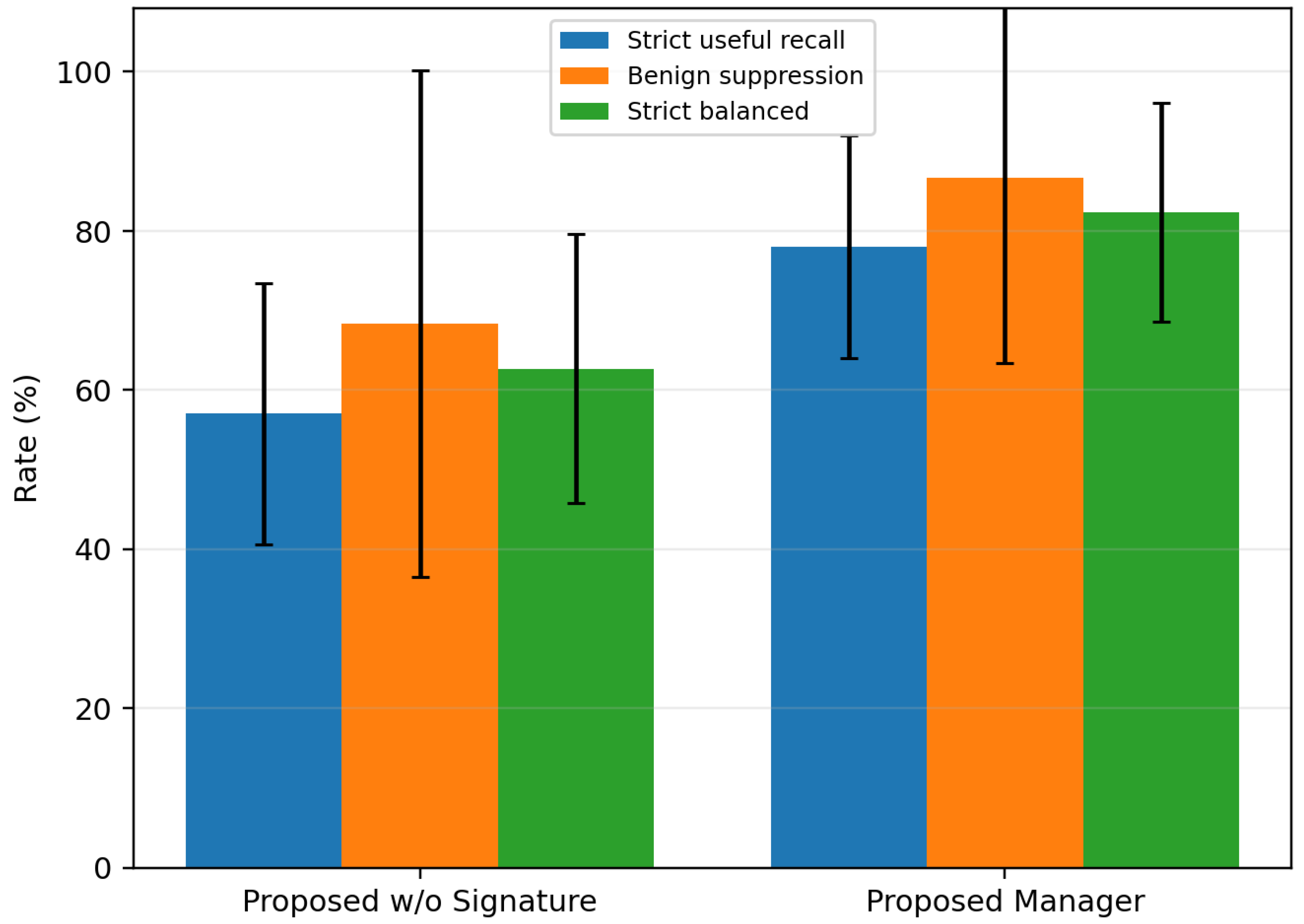
The deployment results in Table 4 isolate the role of learned activation signatures. Proposed w/o Signature and the full manager have identical acquisition precision, recall, and F1 because their formation rules are identical, but their future activation differs. Learned activation signatures raise strict useful recall from to () and strict balanced correctness from to (). This improvement is obtained without lowering the matching threshold, showing that the gain comes from representing what future evidence should activate a process rather than from accepting weaker lexical matches. Figure 5 visualizes this comparison.
Figure 5.
Experiment 5 effect of learned activation signatures on strict unseen deployment. The no-signature ablation uses identical process-formation logic but the earlier raw-history matcher.
Figure 5.
Experiment 5 effect of learned activation signatures on strict unseen deployment. The no-signature ablation uses identical process-formation logic but the earlier raw-history matcher.
The rare-severe route improves strict rare-severe future recall from without the severity route to with the full manager (). However, the absolute 45% recall remains substantially below the recurrent delayed recall of . Moreover, the activation-signature ablation comparison for rare-severe recall alone, versus , is not significant (). The data therefore support forming a vigilance process from a single severe event, but they also show that learning a broadly generalizable future activation condition from one historical example remains difficult.
Repeated centralized history reasoning provides a useful upper-cost reference. Periodic-History-LLM obtains strict useful recall and balanced correctness, compared with and for the proposed process mechanism. The balanced difference is not significant (), while Periodic-History-LLM has significantly higher useful recall (). Accordingly, the proposed method should not be interpreted as accuracy-dominant over repeated centralized reasoning.
Its advantage is instead the change in long-term reasoning cost. Periodic-History-LLM uses logical LLM calls and tokens per seed, whereas the proposed manager uses calls and tokens. These correspond to reductions of 91.80% and 94.07%, respectively, with for both paired comparisons. After consolidation, future activation is handled by the lightweight learned-process matcher and autonomous process dynamics rather than by repeatedly rereading the complete thinking history. Thus, internalization trades some deployment recall for persistent, substantially lower-cost cognitive influence.
Overall findings.
The five experiments support complementary parts of the proposed architecture. Selective external routing preserves all thinking-required cases while substantially reducing centralized LLM use. Persistent internal processes recover delayed concerns while leaving the final interruption decision to contextual thinking rather than message strength. Inactivity triggering produces useful activity when neither an assigned task nor an urgent internal message is present. The schedule process remains beneficial under noisy, competing, and temporally perturbed signals, although overdue-strength escalation is not independently supported by the present data.
Experiment 5 further shows that process formation should be based on future-relevant cognitive consequence rather than recurrence alone. A recurrent and useful but immediately completed thought is rejected by the new future-influence gate; a misleading recurrent concern is removed by later validation; and a single confirmed severe experience can create a future vigilance process. Learned activation signatures substantially improve unseen reactivation without changing process-formation results. At the same time, reuse of an existing process is not perfect and future generalization from a single rare severe experience remains substantially harder than reactivation of recurrent processes. These limitations indicate that the learned process repertoire can evolve autonomously, but that process-to-evidence association remains an important target for further refinement.
5. Conclusions
This paper presented a self-initiated activity-triggering framework for autonomous robots operating without a predefined task list. Rather than treating robot autonomy only as execution of externally specified goals, the proposed model allows meaningful activity to originate from external events, persistent internal processes, and prolonged inactivity. Internal processes maintain independent states and provide cognitive influence rather than direct behavioral commands, leaving interruption and activity selection to context-dependent main thinking.
The framework further allows the internal-process repertoire to evolve from previous thinking experience. An independent process manager determines whether a thinking pattern should be reused, refined, or converted into a new autonomous process. Importantly, process formation depends on whether the consequence of thinking remains relevant after the current deliberation. This distinguishes recurrent delayed needs from frequent but immediately completed reasoning and also allows a rare but severe experience to establish future vigilance. Learned activation signatures further specify what future evidence should reactivate an acquired process.
The experiments support these mechanisms. Selective external triggering preserved all thinking-required events while reducing centralized reasoning cost; persistent internal processes recovered delayed concerns without forcing premature interruption; and inactivity triggering enabled useful self-initiated activity. In process learning, the proposed manager achieved acquisition precision, recall, and F1. Learned activation signatures increased strict balanced future correctness from to . Process internalization also reduced LLM calls by 91.80% and token consumption by 94.07% compared with repeated history-based LLM reasoning.
The results also identify remaining limitations. Reuse of previously acquired processes is not perfect, and future reactivation from a single rare severe experience remains substantially harder than reactivation of recurrent processes. Improving semantic association between new evidence and learned activation conditions, as well as refining or retiring acquired processes through longer-term experience, therefore remains important future work.
Short Biography of Authors
Hong Su received the MS and PhD degrees, in 2006 and 2022, respectively, from Sichuan University, Chengdu, China. He is currently a researcher of Chengdu University of Information Technology Chengdu, China. His research interests include blockchain, large language model and human simulation computing.
References
- Aguado, E.; Gomez, V.; Hernando, M.; Rossi, C.; Sanz, R. A survey of ontology-enabled processes for dependable robot autonomy. Front. Robot. AI 2024, 11, 1377897. [Google Scholar] [CrossRef]
- Fan, H.; Liu, X.; Fuh, J.Y.H.; Lu, W.F.; Li, B. Embodied intelligence in manufacturing: leveraging large language models for autonomous industrial robotics. J. Intell. Manuf. 2025, 36, 1141–1157. [Google Scholar] [CrossRef]
- Jeong, H.; Lee, H.; Kim, C.; Shin, S. A survey of robot intelligence with large language models. Appl. Sci. 2024, 14, 8868. [Google Scholar] [CrossRef]
- Li, P.; An, Z.; Abrar, S.; Zhou, L. Large language models for multi-robot systems: A survey. Auton. Robot. 2026, 50, 30. [Google Scholar] [CrossRef]
- Laird, J.E. The Soar cognitive architecture; The MIT Press, 2012. [Google Scholar]
- Baars, B.J.; Franklin, S. An architectural model of conscious and unconscious brain functions: Global Workspace Theory and IDA. Neural Netw. 2007, 20, 955–961. [Google Scholar] [CrossRef]
- Franklin, S.; Madl, T.; D’mello, S.; Snaider, J. LIDA: A systems-level architecture for cognition, emotion, and learning. IEEE Trans. Auton. Ment. Dev. 2013, 6, 19–41. [Google Scholar] [CrossRef]
- Oudeyer, P.Y.; Kaplan, F.; Hafner, V.V. Intrinsic motivation systems for autonomous mental development. IEEE Trans. Evol. Comput. 2007, 11, 265–286. [Google Scholar] [CrossRef]
- Baranes, A.; Oudeyer, P.Y. Active learning of inverse models with intrinsically motivated goal exploration in robots. Robot. Auton. Syst. 2013, 61, 49–73. [Google Scholar] [CrossRef]
- Wang, R.; Lehman, J.; Clune, J.; Stanley, K.O. Paired open-ended trailblazer (poet): Endlessly generating increasingly complex and diverse learning environments and their solutions. arXiv 2019, arXiv:1901.01753. [Google Scholar]
- Wang, R.; Lehman, J.; Rawal, A.; Zhi, J.; Li, Y.; Clune, J.; Stanley, K. Enhanced poet: Open-ended reinforcement learning through unbounded invention of learning challenges and their solutions. In Proceedings of the International conference on machine learning. PMLR, 2020; pp. 9940–9951. [Google Scholar]
- Yao, S.; Zhao, J.; Yu, D.; Du, N.; Shafran, I.; Narasimhan, K.; Cao, Y. React: Synergizing reasoning and acting in language models. arXiv 2022, arXiv:2210.03629. [Google Scholar]
- Shinn, N.; Cassano, F.; Gopinath, A.; Narasimhan, K.; Yao, S. Reflexion: Language agents with verbal reinforcement learning. Adv. Neural Inf. Process. Syst. 2023, 36, 8634–8652. [Google Scholar] [CrossRef]
- Park, J.S.; O’Brien, J.; Cai, C.J.; Morris, M.R.; Liang, P.; Bernstein, M.S. Generative agents: Interactive simulacra of human behavior. In Proceedings of the Proceedings of the 36th annual acm symposium on user interface software and technology, 2023; pp. 1–22. [Google Scholar]
- Wang, G.; Xie, Y.; Jiang, Y.; Mandlekar, A.; Xiao, C.; Zhu, Y.; Fan, L.; Anandkumar, A. Voyager: An open-ended embodied agent with large language models. arXiv 2023, arXiv:2305.16291. [Google Scholar]
Table 1.
Main results for Experiments 1–3. Values are mean ± standard deviation over ten seeds. Percentage metrics are shown in percent.
Table 1.
Main results for Experiments 1–3. Values are mean ± standard deviation over ten seeds. Percentage metrics are shown in percent.
| Experiment 1: external event triggering | ||||||
|---|---|---|---|---|---|---|
| Method | Init. recall | Strict acc. | Think recall | Latency (s) | LLM calls | Tokens |
| Reactive | 88.67 | 63.00 | 0.00 | 0.020 | 0.00 | 0.0 |
| Periodic-LLM | 100.00 | 97.00 | 100.00 | 132.635 | 5.00 | 1491.1 |
| Centralized-LLM | 100.00 | 100.00 | 100.00 | 0.558 | 10.00 | 2585.8 |
| Proposed | 100.00 | 96.00 | 100.00 | 0.301 | 3.70 | 618.2 |
| Experiment 2: persistent internal processes | ||||||
| Method | Delayed detect. | Premature int. | Context appr. | Missed need | LLM calls | Tokens |
| One-Shot | 0.00 | 0.00 | 50.00 | 18.33 | 1.00 | 669.5 |
| Fixed-Threshold | 100.00 | 100.00 | 50.00 | 33.33 | 0.00 | 0.0 |
| Centralized-State | 100.00 | 0.00 | 100.00 | 0.00 | 10.20 | 7833.1 |
| Proposed | 100.00 | 0.00 | 100.00 | 0.00 | 8.00 | 5341.0 |
| Experiment 3: inactivity-driven self-initiation | ||||||
| Method | Meaningful | Coverage | First meaningful (min) | LLM calls | Tokens | Meaningful/1K tok. |
| No-Idle | 0.00 | 0.00 | – | 0.00 | 0.0 | – |
| Random Exploration | 47.50 | 47.50 | 21.60 | 0.00 | 0.0 | – |
| Periodic-LLM | 94.00 | 100.00 | 10.00 | 5.00 | 1359.5 | 2.942 |
| Proposed w/o Idle | 100.00 | 25.00 | 45.00 | 1.00 | 315.7 | 3.168 |
| Proposed | 100.00 | 75.00 | 15.00 | 3.00 | 897.5 | 3.343 |
Table 3.
Experiment 5 process-formation results. “Immediate false” is erroneous internalization of recurrent useful thinking whose consequence is completed immediately; “misleading false” is erroneous internalization of the later-benign motor-noise pattern. Values are mean ± standard deviation over ten seeds.
Table 3.
Experiment 5 process-formation results. “Immediate false” is erroneous internalization of recurrent useful thinking whose consequence is completed immediately; “misleading false” is erroneous internalization of the later-benign motor-noise pattern. Values are mean ± standard deviation over ten seeds.
| Method | Acq. precision | Acq. recall | Acq. F1 | Recurrent recall | Rare severe acquired | Immediate false | Misleading false | Existing reuse |
|---|---|---|---|---|---|---|---|---|
| Frequency-Only | 50.00 | 75.00 | 60.00 | 100.00 | 0.00 | 100.00 | 100.00 | 90.00 |
| Old Score | 73.50 | 75.00 | 74.17 | 100.00 | 0.00 | 100.00 | 0.00 | 90.00 |
| Proposed w/o Validation | 77.71 | 100.00 | 87.27 | 100.00 | 100.00 | 0.00 | 100.00 | 90.00 |
| Proposed w/o Severity | 100.00 | 75.00 | 85.71 | 100.00 | 0.00 | 0.00 | 0.00 | 90.00 |
| Proposed w/o Signature | 96.67 | 100.00 | 98.00 | 100.00 | 100.00 | 0.00 | 0.00 | 90.00 |
| Proposed Manager | 96.67 | 100.00 | 98.00 | 100.00 | 100.00 | 0.00 | 0.00 | 90.00 |
Table 4.
Experiment 5 strict unseen deployment and reasoning cost. A positive case is correct only when the process associated with the hidden target pattern emits the message. Percentage metrics are mean ± standard deviation over ten seeds.
Table 4.
Experiment 5 strict unseen deployment and reasoning cost. A positive case is correct only when the process associated with the hidden target pattern emits the message. Percentage metrics are mean ± standard deviation over ten seeds.
| Method | Useful recall | Benign suppress. | Balanced | Recurrent delayed | Rare severe | Existing future | LLM calls | Tokens |
|---|---|---|---|---|---|---|---|---|
| Periodic-History-LLM | 100.00 | 85.00 | 92.50 | 100.00 | 100.00 | 100.00 | 24.40 | 170478.3 |
| Frequency-Only | 68.00 | 13.33 | 40.67 | 81.67 | 0.00 | 95.00 | 1.00 | 6115.0 |
| Old Score | 68.00 | 56.67 | 62.33 | 81.67 | 0.00 | 95.00 | 2.00 | 10111.5 |
| Proposed w/o Validation | 78.00 | 66.67 | 72.33 | 81.67 | 45.00 | 100.00 | 1.00 | 6115.0 |
| Proposed w/o Severity | 69.00 | 91.67 | 80.33 | 81.67 | 0.00 | 100.00 | 2.00 | 10111.5 |
| Proposed w/o Signature | 57.00 | 68.33 | 62.67 | 60.00 | 35.00 | 70.00 | 2.00 | 10111.5 |
| Proposed Manager | 78.00 | 86.67 | 82.33 | 81.67 | 45.00 | 100.00 | 2.00 | 10111.5 |
Disclaimer/Publisher’s Note: The statements, opinions and data contained in all publications are solely those of the individual author(s) and contributor(s) and not of MDPI and/or the editor(s). MDPI and/or the editor(s) disclaim responsibility for any injury to people or property resulting from any ideas, methods, instructions or products referred to in the content. |
© 2026 by the authors. Licensee MDPI, Basel, Switzerland. This article is an open access article distributed under the terms and conditions of the Creative Commons Attribution (CC BY) license (http://creativecommons.org/licenses/by/4.0/).
Copyright: This open access article is published under a Creative Commons CC BY 4.0 license, which permit the free download, distribution, and reuse, provided that the author and preprint are cited in any reuse.