

Submitted:
29 August 2026
Posted:
31 August 2026
You are already at the latest version
Preprints on COVID-19 and SARS-CoV-2
Abstract
ABO and Rhesus blood groups have been associated with COVID-19 susceptibility and severity in several international cohorts, but African data remain scarce his study evaluates the association between ABO/Rh blood groups and COVID-19 severity and mortality in Senegal. We conducted a retrospective study of RT-PCR-confirmed COVID-19 patients with available blood group data. Clinical severity (severe forms: Severe and Critical) and in-hospital mortality were analyzed by ABO group and Rhesus status using Fisher’s exact test with Bonferroni correction (×4 for ABO groups) and global Chi-square. Odds Ratios (OR) with 95% confidence intervals (Woolf method) were calculated. ABO distribution: O (47.8%), A (28.8%), B (16.9%), AB (6.4%); Rh+ 94.2%. Severe forms accounted for 27.1% and deaths for 10.2%. No statistically significant association was found between ABO/Rh and severe disease (Chi²=2.40; p=0.494) or mortality (Chi²=1.00; p=0.802). All ORs remained* non-significant after Bonferroni correction. A non-significant trend toward higher mortality in group B (14.0% vs 9.4%; OR=1.57; p=0.312) and zero deaths among Rh− patients (0/17) warrant cautious interpretation. ABO and Rhesus blood groups have no significant impact on COVID-19 severity or mortality in this Senegalese cohort, suggesting that the role of blood groups in COVID-19 outcomes may vary across population.
Keywords:
COVID-19
; ABO blood group
; rhesus
; severe forms
; mortality
; senegal
; aristide le dantec hospital
; first wave
; second wave
; odds ratio
1. Introduction
COVID-19, caused by SARS-CoV-2, was declared a global pandemic on March 11, 2020, leading to considerable morbidity and mortality [1,2]. While the majority of patients present with mild forms, a significant proportion develops severe and critical forms associated with high mortality, particularly in elderly patients and those with comorbidities [3].
Since the early weeks of the pandemic, several research groups hypothesized a role of ABO blood groups in COVID-19 susceptibility and severity. A preliminary Chinese study suggested an overrepresentation of blood group A among infected patients and a potentially protective effect of blood group O [4]. These data prompted numerous investigations in various international cohorts, yielding discordant results [5,6,7]. Proposed mechanisms include ABO-SARS-CoV-2 antigenic interactions, differences in von Willebrand factor levels, and variations in infection susceptibility [8].
In Senegal, the Epidemiological Treatment Center (CTE) of Aristide Le Dantec Hospital in Dakar served as one of the main sites for COVID-19 patient management during the first pandemic waves. African data on the role of blood groups in COVID-19 outcomes remain scarce, and to our knowledge no Senegalese study has simultaneously evaluated the association between ABO/Rh groups and COVID-19 mortality.
The objective of this study is to analyze the association between ABO and Rhesus blood groups, clinical severity, and mortality from COVID-19 in the combined cohort of the first pandemic waves at the CTE of Aristide Le Dantec Hospital, Dakar.
2. Materials and Methods
Retrospective, descriptive, and analytical study conducted at the CTE of Aristide Le Dantec Hospital, Dakar. It covers patients hospitalized during the 1st wave (2020) and 2nd wave (2021) of COVID-19.
All patients with RT-PCR-confirmed COVID-19, hospitalized at the CTE, with ABO/Rh blood group documented in their medical records were included. Patients without available blood group data (n=37) were excluded, resulting in an analyzed sample of 295 patients.
Primary severity variable: severe form (Severe and Critical), defined according to WHO criteria. Primary mortality variable: in-hospital death. Independent variable: ABO blood group (O, A, B, AB) and Rhesus status (Rh+, Rh−).
Associations between blood group and severity or mortality were assessed using Fisher’s exact test (comparison of each group vs. all others combined) and global Chi-square (4 ABO groups × 2 outcomes). Bonferroni correction (×4 for the 4 ABO comparisons) was applied. Odds Ratios (OR) with 95% confidence intervals (Woolf method) were calculated. The significance threshold was p < 0.05. All analyses were performed using Python 3 (scipy, pandas).
All data were anonymized prior to analysis, in accordance with good clinical practices and applicable regulations in Senegal. This study was conducted in compliance with the principles of the Declaration of Helsinki.
3. Results
3.1. Population Characteristics
A total of 295 patients with documented blood group were included (out of 332 patients hospitalized at the CTE during the first pandemic waves). Mean age was 57.5 ± 18.1 years. Male predominance was marked (65.1% men). Severe forms accounted for 80 patients (27.1%) and 30 deaths (10.2%) were recorded.
3.2. ABO and Rhesus Blood Group Distribution
ABO distribution: 141 patients of group O (47.8%), 85 of group A (28.8%), 50 of group B (16.9%), and 19 of group AB (6.4%). Rh-positive status accounted for 94.2% (n=278) and Rh-negative for 5.8% (n=17). This distribution is consistent with available data on the general Senegalese population.

Table 1.
Distribution of ABO/Rh blood groups, clinical severity and mortality.
| Group | n (%) | Mild (n) | Moderate (n) | Severe (n) | Critical (n) | Severe forms (%) | Deaths (%) | p Severe | p Deaths |
|---|---|---|---|---|---|---|---|---|---|
| ABO GROUPS | |||||||||
| O | 141 (47.8%) | 74 | 26 | 21 | 20 | 29.1% | 9.2% | 0.513 | 0.701 |
| A | 85 (28.8%) | 40 | 20 | 13 | 12 | 29.4% | 9.4% | 0.567 | 1.000 |
| B | 50 (16.9%) | 32 | 7 | 7 | 4 | 22.0% | 14.0% | 0.485 | 0.312 |
| AB | 19 (6.4%) | 11 | 5 | 2 | 1 | 15.8% | 10.5% | 0.299 | 1.000 |
| RHESUS GROUPS | |||||||||
| Rh+ | 278 (94.2%) | — | — | — | — | 27.7% | 10.8% | 0.414 | 0.234 |
| Rh− | 17 (5.8%) | — | — | — | — | 17.6% | 0.0% | — | 0.234 |
| TOTAL | |||||||||
| Total | 295 (100%) | 163 | 58 | 43 | 31 | 27.1% | 10.2% | Chi²=2.40 | Chi²=1.00 |
Figure 1.
Distribution of ABO blood groups (n=295).
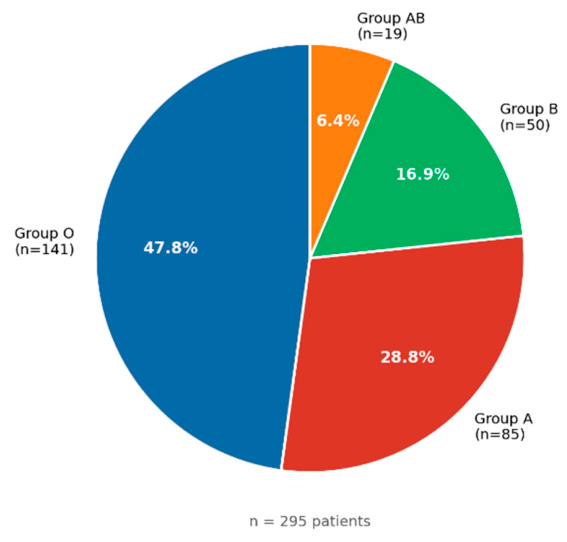
Figure 2.
Proportions of severe forms (A) and deaths (B) by ABO blood group.
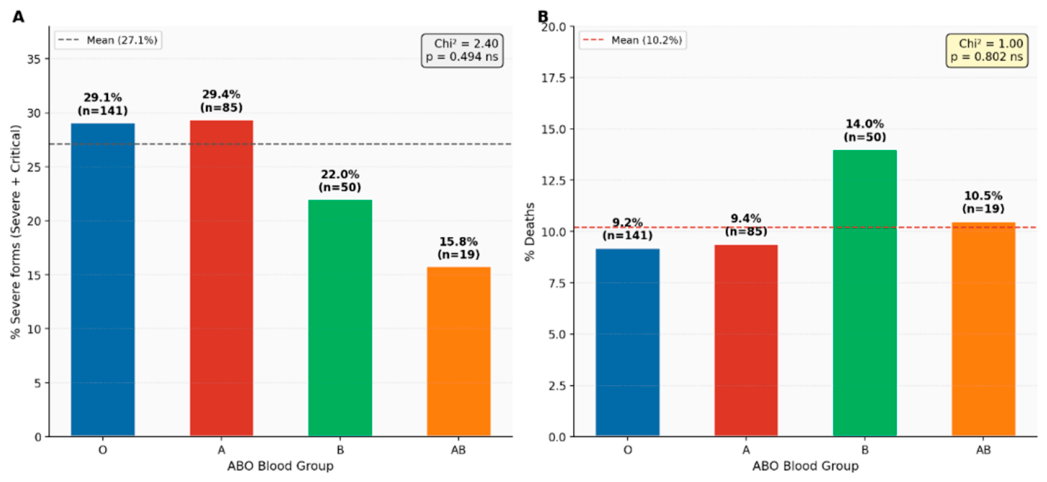
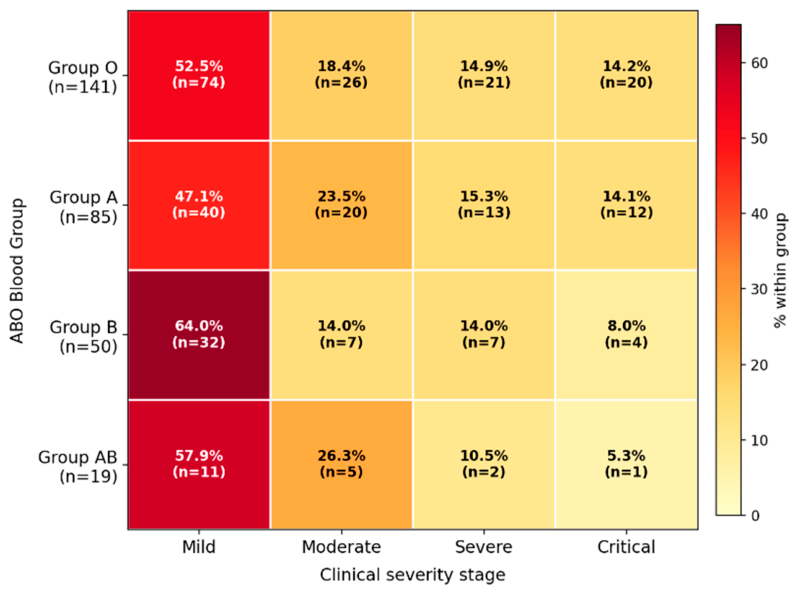
Figure 3.
Heatmap of COVID-19 severity distribution by ABO group.
3.3. Association Between ABO Group and Severe Forms
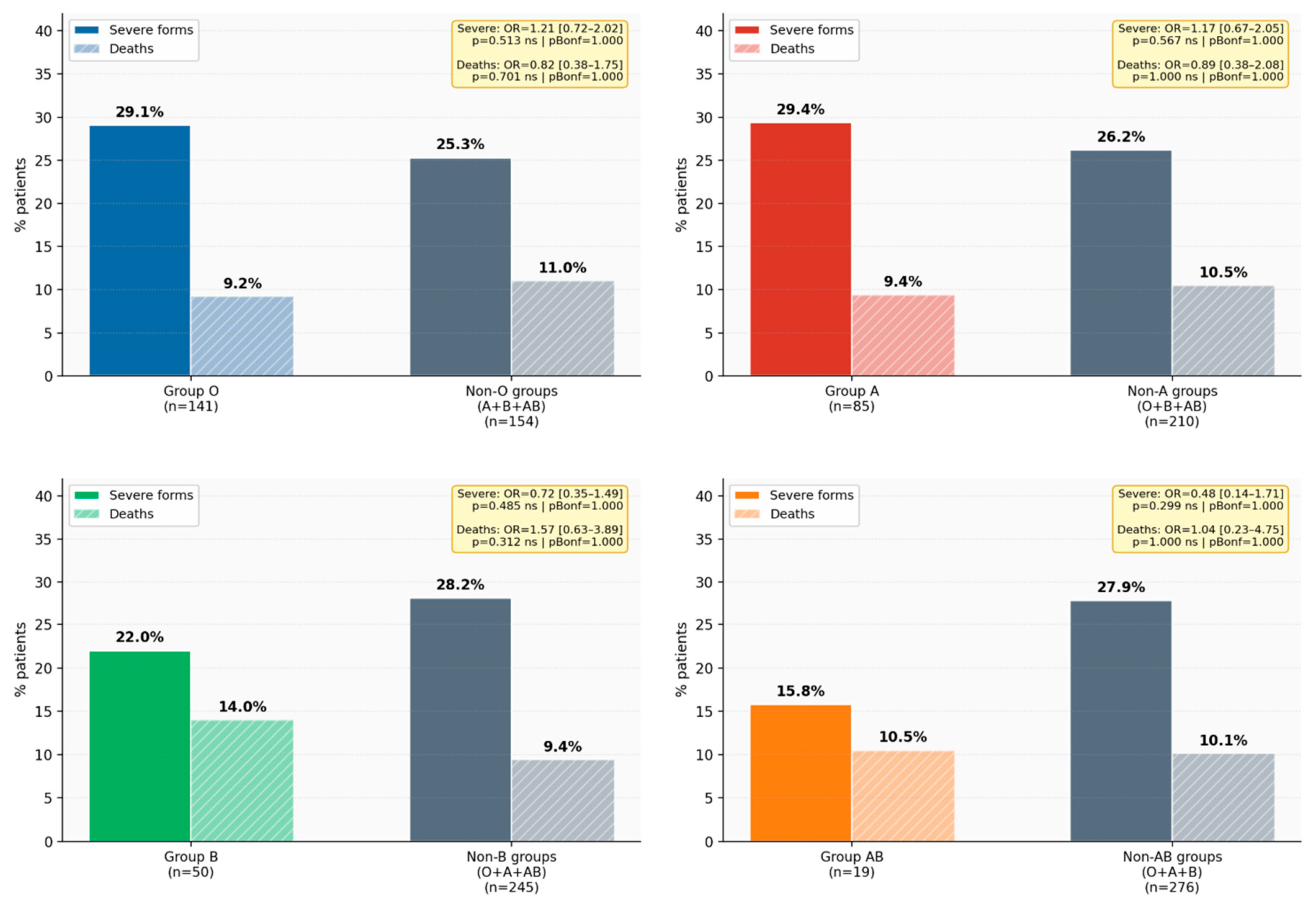
No statistically significant association between ABO blood group and the occurrence of severe forms was observed (Chi² = 2.40; p = 0.494). Proportions of severe forms by ABO group were: 29.1% (group O), 29.4% (group A), 22.0% (group B), and 15.8% (group AB). ORs calculated for each group versus all others combined were all non-significant, both in crude analysis and after Bonferroni correction (Table II, Figure 4).
3.4. Association Between ABO Group and Mortality
Overall mortality was 10.2% (30/295), ranging from 9.2% in group O, 9.4% in group A, 14.0% in group B, to 10.5% in group AB. No difference reached statistical significance (global Chi² = 1.00; p = 0.802).
A non-significant trend toward higher mortality in group B is worth noting (OR = 1.57; 95% CI [0.63–3.89]; p = 0.312; Bonferroni p = 1.000). The limited statistical power due to the small number of deaths (n=30) precludes any definitive conclusion on this point, which will require confirmation in larger cohorts.
3.5. Association Between Rhesus Status and Severity/Mortality
Rh-negative status (n=17) was not associated with severe forms (17.6% vs 27.7% in Rh+; p = 0.414). No deaths were recorded among the 17 Rh− patients (0.0% vs 10.8% in Rh+), with a p-value of 0.234 by Fisher’s exact test. This result, though suggestive, must be interpreted with extreme caution given the very small Rh− subgroup (n=17), which is insufficient for any definitive conclusion.
Table 2.
Odds Ratios for severe forms and deaths by ABO/Rh group (n=295).
| Comparison | OR | 95% CI | p crude | p Bonf. | OR | 95% CI | p crude | p Bonf. |
|---|---|---|---|---|---|---|---|---|
| SEVERE FORMS | DEATHS | |||||||
| Group O vs non-O | 1.21 | [0.72–2.02] | 0.513 | 1.000 | 0.82 | [0.38–1.75] | 0.701 | 1.000 |
| Group A vs non-A | 1.17 | [0.67–2.05] | 0.567 | 1.000 | 0.89 | [0.38–2.08] | 1.000 | 1.000 |
| Group B vs non-B | 0.72 | [0.35–1.49] | 0.485 | 1.000 | 1.57 | [0.63–3.89] | 0.312 | 1.000 |
| Group AB vs non-AB | 0.48 | [0.14–1.71] | 0.299 | 1.000 | 1.04 | [0.23–4.75] | 1.000 | 1.000 |
| Rh+ vs Rh− | 1.79 | [0.51–6.33] | 0.414 | — | — | 0 deaths/Rh− | 0.234 | — |
OR = Odds Ratio; 95% CI = 95% Confidence Interval (Woolf method); p Bonf. = p after Bonferroni correction (×4 for ABO). Two-sided Fisher’s exact test. — = not calculable (0 events).
Figure 4.
Comparative Forest plot of Odds Ratios for severe forms (●) and deaths (◆) for each ABO/Rh group versus all other groups combined. Logarithmic scale. CTE Aristide Le Dantec Hospital, Dakar (n=295).
Figure 4.
Comparative Forest plot of Odds Ratios for severe forms (●) and deaths (◆) for each ABO/Rh group versus all other groups combined. Logarithmic scale. CTE Aristide Le Dantec Hospital, Dakar (n=295).
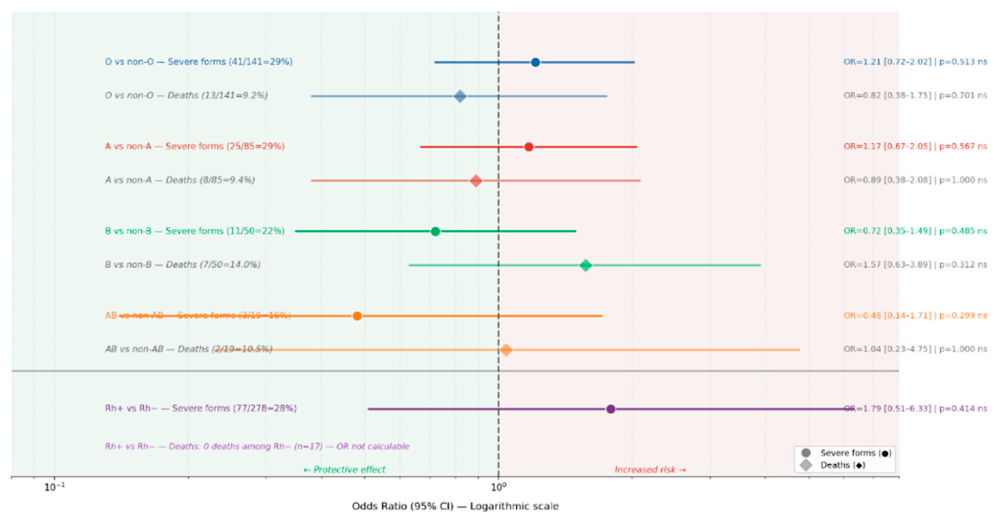
Figure 5.
Individual comparison of each ABO group versus all other groups combined: proportions of severe forms and deaths with Odds Ratios and p-values (crude and Bonferroni). CTE Aristide Le Dantec Hospital, Dakar (n=295).
Figure 5.
Individual comparison of each ABO group versus all other groups combined: proportions of severe forms and deaths with Odds Ratios and p-values (crude and Bonferroni). CTE Aristide Le Dantec Hospital, Dakar (n=295).
4. Discussion
The ABO blood group distribution observed in this cohort, with a predominance of group O (47.8%), followed by group A (28.8%), B (16.9%), and AB (6.4%), is consistent with available data on the Senegalese and West African population [4,5]. This distribution differs from those of Caucasian or Asian populations where group A is often more prevalent, which may partly explain discordances between studies.
The present study found no significant association between ABO blood group and COVID-19 severity (p = 0.494). This result is consistent with several recent meta-analyses which, after adjustment for confounding factors (age, sex, comorbidities), do not find an independent effect of blood groups on clinical severity [6,7]. The landmark study by Zhao et al. [4] had suggested a protective role for group O, but this initial work had important methodological limitations (absence of adjustment, unrepresentative sample sizes).
No significant association between ABO blood group and mortality was identified in this cohort (Chi² = 1.00; p = 0.802). However, a trend toward higher mortality in group B (14.0% vs 9.4% for other groups; OR = 1.57 [0.63–3.89]) is worth noting. Although non-significant, this trend is biologically plausible, as studies have suggested a role of the B antigen in hypercoagulability and inflammatory response [8]. The limited statistical power due to the number of deaths (n=30) and the relatively modest cohort size preclude any definitive conclusion.
The absence of deaths among the 17 Rh− patients (0.0% vs 10.8% in Rh+) is a striking finding, but must be interpreted with the greatest caution. The probability that this difference is due to chance remains high (p = 0.234), and the Rh− subgroup (n=17) is clearly insufficient for any conclusion. Further studies with larger Rh− populations will be needed to explore this finding.
Our results suggest that ABO/Rh blood group does not constitute, in clinical practice, a reliable predictive marker of COVID-19 severity or mortality in this Senegalese cohort. In resource-limited settings, other biological parameters such as NLR, neutrophils, or lymphocytes have demonstrated better predictive value and appear more relevant for risk stratification at admission.
Main limitations include: the retrospective study design; the exclusion of 37 patients without available blood group data (possible selection bias); the absence of multivariate adjustment for comorbidities and age; the small Rh− subgroup (n=17) limiting statistical power for this subgroup; and the absence of external validation.
5. Conclusions
This study of 295 COVID-19 patients at the CTE of Aristide Le Dantec Hospital in Dakar, during the first pandemic waves, found no statistically significant association between ABO or Rhesus blood groups and the occurrence of severe forms or deaths from COVID-19.
A non-significant trend toward higher mortality in group B (OR = 1.57; p = 0.312) and zero mortality among Rh− patients deserve exploration in larger cohorts. In clinical practice, blood group cannot replace validated biological markers such as NLR or neutrophil count for COVID-19 risk stratification at admission in the Senegalese context.
Author Contributions
Conceptualization, A.K.; Methodology, A.K.; Validation, M.L.K.; Formal analysis, A.K.; Investigation, M.L.K.; Data curation, M.L.K.; Writing – original draft, A.K.; Writing – review & editing, A.O.T.; Supervision, A.S. and A.O.T. Koundio Abou: Study conception and design; statistical analyses (Python 3: Fisher’s exact test, Bonferroni correction, Odds Ratio calculation); results interpretation; manuscript drafting and finalization. Kabou Marie Léa: Clinical and biological data collection and entry. Sène Abdoulaye: Scientific supervision Touré Awa Oumar: General scientific supervision; critical revision of the manuscript; approval of the final version. All authors have read and approved the final version of the manuscript.
Funding
This research received no specific grant from any funding agency in the public, commercial, or not-for-profit sectors..
Ethics Approval
This study was conducted in compliance with the principles of the Declaration of Helsinki and was approved within the institutional framework of Aristide Le Dantec Hospital and Cheikh Anta Diop University of Dakar, Senegal. As a retrospective study conducted on fully anonymized medical records, formal review by a named Institutional Review Board (IRB) or Ethics Committee was not required under applicable Senegalese regulations governing retrospective anonymized studies.
Consent to Participate
This study was conducted on retrospective anonymized medical records. Individual informed consent to participate was waived in accordance with applicable Senegalese regulations governing retrospective studies on anonymized data, as no personal identifying information was collected or processed. All patient data were fully de-identified prior to any analysis.
Data Availability Statement
The data supporting the findings of this study are not publicly available due to patient confidentiality constraints. The aggregated and anonymized data underlying the results reported (Tables I and II, Figure 1, Figure 2, Figure 3, Figure 4 and Figure 5) are available from the corresponding author upon reasonable request, subject to approval by the relevant institutional authorities of Aristide Le Dantec Hospital, Dakar, Senegal.².
Acknowledgments
The authors thank all medical and paramedical staff of the Epidemiological Treatment Center (CTE) and the Hematology Laboratory of Aristide Le Dantec Hospital in Dakar for their commitment throughout the successive pandemic waves of 2020–2021, and for their contribution to the clinical and biological documentation of patients that served as the basis for this work.
Conflicts of Interest
The authors declare no competing interests.
Abbreviations
| ABO | ABO blood group system |
| CI | Confidence Interval |
| COVID-19 | Coronavirus Disease 2019 |
| CTE | Epidemiological Treatment Center |
| FMPO-UCAD | Faculté de Médecine, de Pharmacie et d’Odontologie — Université Cheikh Anta Diop de Dakar |
| IRB | Institutional Review Board |
| MSAS | Ministry of Health and Social Action of Senegal |
| NLR | Neutrophil-to-Lymphocyte Ratio |
| OR | Odds Ratio |
| Rh | Rhesus blood group system |
| RT-PCR | Reverse Transcription Polymerase Chain Reaction |
| SARS-CoV-2 | Severe Acute Respiratory Syndrome Coronavirus 2 |
| WHO | World Health Organization |
References
- References must be numbered in order of appearance in the text (including citations in tables and legends) and listed World Health Organization. WHO Director-General’s opening remarks at the media briefing on COVID-19 — 11 March 2020. Geneva: WHO; 2020.
- Ministry of Health and Social Action of Senegal. COVID-19 situation reports. Dakar: MSAS; 2020-2021.
- Guan WJ, Ni ZY, Hu Y, et al. Clinical characteristics of coronavirus disease 2019 in China. N Engl J Med. 2020;382(18):1708-1720. [CrossRef]
- Zhao J, Yang Y, Huang H, et al. Relationship between the ABO blood group and the COVID-19 susceptibility. Clin Infect Dis. 2021;73(2):328-331.
- Boudin L, Janvier F, Bylicki O, Dutasta F. ABO blood groups are not associated with risk of acquiring the SARS-CoV-2 infection in young adults. Haematologica. 2020 Dec 1;105(12):2841-2843. PMID: 33256383; PMCID: PMC7716357. [CrossRef]
- Latz CA, DeCarlo C, Boitano L, et al. Blood type and outcomes in patients with COVID-19. Ann Hematol. 2020;99(9):2113-2118. [CrossRef]
- Fan Q, Zhang W, Li B, Li DJ, Zhang J, Zhao F. Association Between ABO Blood Group System and COVID-19 Susceptibility in Wuhan. Front Cell Infect Microbiol. 2020 Jul 21;10:404. PMID: 32793517; PMCID: PMC7385064. [CrossRef]
- Franchini M, Cruciani M, Mengoli C, Marano G, Candura F, Lopez N, Pati I, Pupella S, De Angelis V. ABO blood group and COVID-19: an updated systematic literature review and meta-analysis. Blood Transfus. 2021 Jul;19(4):317-326. Epub 2021 May 12. PMID: 34059188; PMCID: PMC8297670. [CrossRef]
Disclaimer/Publisher’s Note: The statements, opinions and data contained in all publications are solely those of the individual author(s) and contributor(s) and not of MDPI and/or the editor(s). MDPI and/or the editor(s) disclaim responsibility for any injury to people or property resulting from any ideas, methods, instructions or products referred to in the content. |
© 2026 by the authors. Licensee MDPI, Basel, Switzerland. This article is an open access article distributed under the terms and conditions of the Creative Commons Attribution (CC BY) license (http://creativecommons.org/licenses/by/4.0/).
Copyright: This open access article is published under a Creative Commons CC BY 4.0 license, which permit the free download, distribution, and reuse, provided that the author and preprint are cited in any reuse.