
Submitted:
30 August 2026
Posted:
31 August 2026
You are already at the latest version
Abstract
This study aims to substantiate and evaluate an economic-mathematical model for de-veloping the open research competence of academic staff at Ukrainian universities align-ing academic publishing with European Standards. Data on open publications by Ukrainian institutions, the number of Ukrainian journals indexed in Scopus, and the au-thors’ proprietary metric of Open Science training activity for 2020–2025 were used. Line-ar programming and scenario analysis were applied to justify the resource distribution. The proposed model serves as a normative decision-support framework to evaluate re-source allocation priorities rather than an empirical causal-inference model. While publi-cation openness (% OA) acts as the primary outcome proxy, institutional presence (jour-nals in Scopus) and training activities represent enabling capacity-building factors. The share of open-access publications increased from 50.25% in 2020 to 63.64% in 2025. However, the number of Ukrainian journals in Scopus decreased from 202 in 2022 to 168 in 2025. The integral indicator of open research competence increased from 0.088 in 2020 to 0.816 in 2024 but decreased to 0.720 in 2025. The optimisation model showed that un-der the chosen weights and constraints, the optimal allocation is 45% to support OA pub-lications, 35% to Open Science training, and 20% to journal infrastructure. The proposed framework is a normative decision-support tool that translates a pre-specified set of Open Science indicators and policy weights into an optimisation model for resource allocation. It does not claim to establish causal links between institutional capacity and Open Science outcomes; rather, it provides a transparent, quantitative lens for prioritising limited re-sources among open-access support, journal infrastructure and researcher training.
Keywords:
open science
; open access
; research competency
; article processing charges
; universities of Ukraine
1. Introduction
The process of integrating the Ukrainian scientific space into the European research ecosystem acutely raises the question of compliance of domestic publishing practices with international standards. The key driver of this harmonisation is the open research competence of academic staff, which within the current landscape of scholarly communication should be interpreted as an integrated editorial and management construct. It not only determines an individual author’s ability to work according to the principles of Open Science, but also directly affects the sustainability and competitiveness of universities’ entire institutional publishing infrastructure.
Open science has become one of the key norms of contemporary research policy, as it combines open access to publications, the reuse of research data, transparency of methodologies, and wider societal participation in knowledge production (European Commission, n.d.; UNESCO, 2021). In the European research area, these practices are not only of a communicative nature but also of regulatory importance: participation in Horizon Europe requires compliance with the requirements for open access, FAIR data management, and responsible dissemination of research results (European IP Helpdesk, 2024). In Ukraine, these orientations are enshrined in the National Plan for Open Science, which serves as the basis for universities’ institutional transition to open research practices (Cabinet of Ministers of Ukraine, 2022).
For Ukraine, the issue of open science has become particularly important amid the full-scale military conflict. The destruction of scientific infrastructure, the loss of equipment, the forced mobility of researchers, and budgetary constraints have increased the need for digital tools to preserve and disseminate scientific results (UNESCO, 2024). The economic context is also critical, with real GDP declines starting in 2022 and limited public funding reducing universities’ capacity to maintain research activity in traditional ways (National Bank of Ukraine, 2023; World Bank, 2026). Under such circumstances, open repositories, digital identifiers, open data, and international cooperation platforms transform from supplementary services into components of university institutional sustainability.
Previous studies show that the Ukrainian open-access system has a specific structure (Bediukh et al., 2024, 2025). On the one hand, the share of open publications is increasing, and international cooperation supports the visibility of Ukrainian science (Hladchenko, 2025; Kaliuzhna & Hauschke, 2024). On the other hand, the national journal landscape remains unevenly integrated into international bases, and conflict-related disruption reinforce dependence on external publication and indexing channels (de Rassenfosse et al., 2023; Nazarovets, 2024). According to SCImago, Ukraine has significant scientific potential in the global publishing landscape. Yet, this potential requires institutional support to transition from a quantitative presence to a sustainable open research infrastructure (SCImago, 2025).
At the same time, open access comes at a financial cost. The classic definition of Open Access emphasises free access for the reader (Budapest Open Access Initiative, n.d.); however, in many models, costs are transferred to the author or institution via Article Processing Charges. Combined with FAIR data requirements (Wilkinson et al., 2016) and new open peer review models (Ross-Hellauer, 2017), this means that universities need to consider publication budgets and systemically generated open research competence. In this study, such competence is interpreted within the competence approach as an integrated set of knowledge, operational skills, and value attitudes that enable academic staff to conduct research in accordance with the principles of Open Science (Raven, 1984).
The financial dimension of the problem is exacerbated by the fact that the global transition to open access has not eliminated the market concentration of academic publishing. Much of the revenue from open-access publishing accrues to a small number of large commercial publishers (Butler et al., 2023), who together generated over US$1 billion in APC revenue between 2015 and 2018 alone, with market concentration further increasing after the introduction of funder OA mandates such as Plan S (Butler et al., 2023; Grove, 2024). Analysis of hybrid open access for 2018–2022 revealed significant market concentration: three commercial publishers — Elsevier, Springer Nature, and Wiley — accounted for 49% of hybrid journals, representing 63% of the total article volume, and published 66% of the open access articles in hybrid journals; through transformative agreements, their market share reached 74% (Grove, 2024). Аverage article processing charges (APCs) in many disciplines have reached levels that represent a substantial financial burden for university budgets in middle-income countries (Budzinski et al., 2020; Butler et al., 2023; Klebel & Ross-Hellauer, 2023; Schimmer et al., 2015; Schönfelder, 2020; Solomon & Björk, 2016; Vervoort et al., 2021). Therefore, the development of open research competence should include the ability to choose reliable and cost-effective publication channels, use Green and Diamond Open Access, work with institutional repositories, and avoid inefficient resource expenditure on publication fees.
It is also important to acknowledge that several major commercial publishers introduced APC waivers or discounts for Ukrainian-affiliated authors following the onset of the full-scale military conflict in 2022 [for example, Elsevier, Springer]. While these measures have reduced the immediate financial barrier for individual authors, they are time-limited, publisher-specific, and do not resolve the structural tension between subscription/APC-based publishing models and the transparency and reproducibility objectives of Open Science; the market-concentration concern raised in this article therefore relates to medium- and long-term systemic sustainability rather than to the current emergency measures.
The research gap lies in the lack of an economic-mathematical model that would enable quantitative assessment of the development of open research competence at Ukrainian universities and, at the same time, justify the distribution of limited resources among the key areas of Open Science. Most available approaches view open science as regulatory or infrastructure policy, but university governance requires a model that combines publishing openness, journal infrastructure, and researcher training.
In this study we treat the following as the primary desirable Open Science outcomes for the Ukrainian context under resource constraints: (1) the share of research outputs that are immediately openly accessible (OA share); (2) the maintenance and improvement of nationally controlled, internationally visible publication channels (proxied by the number of Scopus-indexed Ukrainian journals); and (3) the diffusion of practical Open Science competencies among academic staff (proxied by training intensity). We deliberately prioritise article-level openness over other important but currently unmeasurable dimensions (DOI coverage, ORCID uptake, FAIR data sharing, open peer review) because comparable national time-series data for the latter do not yet exist. The model is therefore a first-order approximation; future iterations should incorporate these additional outcome indicators as soon as systematic monitoring data become available.
The purpose of the article is to develop and evaluate a model for the development of open research competence among academic staff of Ukrainian universities in the context the harmonisation of academic standards for publishing activity. The article has three tasks: firstly, to determine indicators suitable for a quantitative description of such competence; secondly, to calculate an integral indicator of its development for 2020–2025; thirdly, to propose an optimisation approach to the distribution of limited resources between open publishing activity, journal infrastructure, and Open Science training programmes.
2. Materials and Methods
The methodological basis comprised general scientific and specialised research methods: system analysis, comparative analysis, statistical methods of data processing, methods of economic and mathematical modelling, indicator standardisation, integral evaluation, linear programming, and scenario modelling. In contrast to descriptive approaches, the proposed model translates open research competence into a measurable category suitable for monitoring and management planning.
The research process involved four stages. In the first stage, the content of open research competence was defined as a combination of cognitive, operational, and value-motivational components. The cognitive component covers knowledge of Open Science principles, open-access models, DOIs, ORCIDs, repositories, and Horizon Europe requirements. The operational component relates to depositing publications, preparing the Data Management Plan, managing FAIR data, and using digital infrastructures. The value-motivational component covers academic integrity, readiness for open review, and international cooperation.
At the second stage, a system of indicators was formed (Table 1). Three indicators are included in the model:
1) the OA indicator reflects the actual level of openness of the publication activity of Ukrainian institutions;
2) indicator J characterises the institutional presence of Ukrainian scientific periodicals in the international academic space. It is assumed that a higher number of Scopus-indexed Ukrainian journals reflects, indirectly, broader institutional adoption of internationally recognised editorial and Open Science standards required for indexing (e.g., DOI assignment, ORCID integration, ethical publishing statements, metadata quality). This assumption is not separately tested here: J does not distinguish between fully open-access, hybrid, and subscription-based journals among those indexed, and changes in J may also reflect factors unrelated to Open Science practices, such as revisions to Scopus indexing criteria or journal consolidation. J is used solely as a convenient, publicly available proxy for the institutional presence of Ukrainian journals in the international indexing system. We do not claim that an increase in J is caused by improved Open Science practices, nor that every Scopus-indexed journal necessarily embodies high Open Science standards. The indicator does not distinguish full OA, hybrid or subscription titles. Any interpretation of J as reflecting editorial Open Science competence remains an untested assumption of the model and should be treated with caution. Future work should disaggregate J by access model (full OA vs. hybrid vs. closed) to test this assumption directly;
3) the indicator Tr is used as an authors’ proprietary metric indicator of training activity, reflecting the educational and competence component of the model. Tr is not interpreted as official training statistics for each year but is used as a consistent index of the intensity of training activity, since complete comparable national data for 2020–2025 are not available.
An economic-mathematical approach was used in the study to move from a qualitative description of the model to its quantitative assessment. The following function represents the integral indicator of the development of open research competence:
where OA – the share of open access publications (SCImago, 2025); J – the number of Ukrainian journals indexed in Scopus (Elsevier, n.d.); and Tr – the Open Science training activity index. It should be emphasised that C is a weighted composite index constructed from the chosen indicators and weights; the subsequent optimisation results are mathematical consequences of this construction. The model is a normative decision-support instrument, not a causal-inference or predictive model. No claim is made that changes in J or Tr cause changes in OA (or vice versa).
In the third stage, all indicators were normalised. Since these indicators differ in their units of measurement and ranges of variation, to ensure their mathematical synthesis within the limits of a single integral indicator, the procedure of linear normalisation – formula min–max was applied:
where () – the actual value of the indicator in the respective year, while and – respectively, the minimum and maximum values of the indicator over the entire analysed period from 2020 to 2025. The normalised indicators take values within the interval [0; 1]. The min–max normalisation was applied using the empirically observed minimum and maximum of each indicator over 2020–2025, rather than theoretical bounds (e.g., a 0–100% range for OA), in order to capture relative year-on-year progress within the observed Ukrainian context. We acknowledge this is a modelling choice: using the theoretical maximum for OA would compress its normalised values and change its relative contribution to C. We report this as a limitation and recommend that future work test the sensitivity of C to alternative normalisation schemes (e.g., theoretical bounds, z-score standardisation).
Using the theoretical upper bound of 100% for OA would have compressed its normalised values and altered its relative contribution to C; we therefore report the empirical min–max choice as a modelling decision whose sensitivity should be tested in future work.
All indicators were interpreted as stimulants: an increase in each of them potentially enhances open research competence. The integral indicator was calculated as a weighted sum:
The weighting coefficients w1 = 0.40 (for OA), w2 = 0.25 (for J), and w3 = 0.35 (for Tr) were established to reflect the relative significance of each criterion in forming the integral indicator. The weights represent a policy-oriented decision model rather than statistically estimated parameters. The methodological framework is based on the Analytic Hierarchy Process (AHP) developed by T. Saaty (Saaty, 1980). This method is based on a pairwise comparison of criteria by experts, using a scale from 1 to 9. To operationalise the model while addressing national data limitations, the Open Science training activity index (Tr) is conceptualised as a methodological baseline and proof-of-concept demonstration. The strategic relevance of this framework has intensified alongside Ukraine’s accelerating integration into the European Open Science ecosystem, the evolution of open access (OA) policies, and the rollout of the Ukrainian Research Information System (URIS). The empirical foundation and research impulse for this construct originated three years ago within the scientific initiative funded under Project No. 26GF013-02, “Theoretical Foundations for Harmonising the Editorial Practices of Ukrainian Scientific Publications with International Standards for Ukraine’s Competitive Integration into the European Open Science Area” (contract No. 132.03/0192 dated 02 March 2026, National Research Fund of Ukraine).
OA was assigned the highest weight (0.40) because national and EU Open Science policy frameworks treat immediate public accessibility of research outputs as the primary and most directly observable indicator of open science maturity, while J and Tr are treated as enabling infrastructural and capacity-building conditions rather than end outcomes in themselves. This is a normative prioritisation choice among several plausible alternatives — for instance, a policy framework emphasising data reproducibility might instead assign the highest weight to data-sharing compliance or FAIR-data indicators once such data become available. We make this prioritisation explicit here so that the weighting scheme can be scrutinised, contested, or adapted by other researchers and institutions with different policy priorities.
Accordingly, the Tr variable synthesises empirical insights and longitudinal observations from capacity-building workshops and training initiatives conducted across Ukraine over recent years by international scientific communication leaders—including the European Association of Science Editors (EASE), the Committee on Publication Ethics (COPE), and the Directory of Open Access Journals (DOAJ)—in close synergy with the project’s expert team. Because complete comparable data on the number of participants, contact hours or certified programmes across all Ukrainian universities are not available, Tr functions solely as a demonstrative component of the model. It illustrates the educational dimension of open research competence and should be replaced by more granular indicators once systematic national monitoring data become accessible.
The panel of 12 experts comprised managing and chief editors of peer-reviewed journals hosted at Taras Shevchenko National University of Kyiv and other leading Ukrainian Higher Education Institutions (HEIs). All selected experts actively participated in key project dissemination and training events, including international editorial workshops in Oxford, UK (2026), and dedicated publishing panels at the Kyiv Book Arsenal (2025–2026). The panel provided qualitative validation of the relative ranking, while final numerical weights were fixed by the authors for methodological transparency.
The constructed pairwise comparison matrix for the three criteria is as follows:
To determine the weighting coefficients, the matrix was normalised by dividing each column element by its column sum, and the row averages were then calculated. The consistency of the matrix was verified by calculating the maximum eigenvalue (), the consistency index (CI), and the consistency ratio (CR):
where n – the number of criteria; RI – random consistency index. For n = 3, the value of RI = 0.58.
It should be noted that the pairwise comparison matrix was constructed to be internally consistent with the target weighting structure (w1 = 0.40, w2 = 0.25, w3 = 0.35) rather than derived as an independent empirical output of the expert survey. Consequently, the resulting CR = 0 reflects this constructed consistency rather than an empirical validation of expert agreement. The expert consultation was used to confirm the plausibility and relative ranking of the three weights, not to generate them de novo.
The advantage of the OA indicator is justified by the fact that it directly reflects the openness of publishing activity; high weight Tr – in that trainings form practical skills needed to work with repositories, DOI, ORCID, DMP, and FAIR data; weight J – in that the journal infrastructure indirectly supports the visibility and quality of national scientific communication.
At the fourth stage, optimisation modelling was performed. For the optimisation component, a hypothetical budget of UAH 1,000,000 was used and allocated among three areas: x1 – support for OA publications, x2 – support for Ukrainian journals indexed in Scopus, and x3 – Open Science training activities. The objective function maximises the aggregate contribution of resources to the development of open research competence.
To test the robustness of the findings, scenario analysis was applied at the final stage. The pessimistic scenario reflected a further decline in the institutional indicator; the baseline scenario reproduced the change in the integral indicator between 2023 and 2025; and the optimistic scenario assumed the restoration of the positive dynamics observed in 2023–2024.
Since the study is based on aggregated open data, published sources, and the authors’ own calculations, and does not involve personal data, no specialised procedure for obtaining ethics committee approval or informed consent from individual participants was required.
To guarantee methodological isolation and avoid corporate-finance endogeneity, the model deliberately excludes proxy weights based on enterprise financial metrics (such as registered capital or commercial asset valuation), relying strictly on aggregated bibliometric data and certified institutional Open Science training metrics.
3. Results
The proposed author’s model of the development of open research competence among academic staff at Ukrainian universities is based on a four-level implementation structure: individual, faculty, university, and national. Each level has its own function, but they all form a single system for competence formation and maintenance.
At the individual level, the model aims to develop the knowledge, skills, and motivation of academic staff. It is about mastering the principles of Open Science, Open Access, FAIR, using ORCID, DOI, repositories, open data, and digital tools of scientific communication. The main tools of this level are training, self-education, and practical application of open research practices.
At the faculty level, open practices are spread through methodical interaction, mentoring, twinning, seminars, and exchange of experience between departments. This level ensures the transition from individual competence of individual teachers to a collective culture of openness within the faculty.
At the university level, the model provides for the institutional consolidation of open science through Open Access policies, the development of institutional repositories, KPI monitoring, support for publishing activity, and the development of Ukrainian scientific journals indexed in Scopus and Web of Science. It is at this level that openness becomes an element of the university’s strategy, not just an individual initiative of the researcher.
At the national level, the model envisages coordination of open science through the Ministry of Education and Science of Ukraine, participation in Open4UA projects, interaction with EOSC, support for university publishing houses, development of national Open Science policies, and integration of Ukrainian universities into the European Research Area.
Consequently, the development of open research competence is not limited to individual training, but requires simultaneous work at the individual, faculty, university, and national levels, as shown in Table 2.
A feature of the proposed model is the integration of the economic-mathematical approach. The model is considered not only as a descriptive scheme of competence development but also as an optimisation problem in which it is necessary to maximise the integral indicator C under limited resource constraints. Such resources include funding, study time, universities’ organisational capacity, access to digital infrastructure, and the ability to scale training programmes.
The dynamics of open publishing activity indicates the significant spread of Open Access in the scientific space of Ukrainian institutions. The share of OA publications increased from 50.25% in 2020 to 64.71% in 2024, and remained relatively high in 2025 – 63.64%. Such dynamics confirm that even under the conditions of the ongoing military conflict, Ukrainian universities and scientific institutions retain the ability for open scientific communication. At the same time, the number of Ukrainian journals indexed in Scopus, after growing to 202 in 2022, decreased to 168 in 2025, which creates a risk of institutional narrowing of the national publication space (Table 3).
The calculation of the integral indicator C showed uneven but generally positive dynamics. In 2020, the C value was 0.088, and in 2024 it reached a maximum value of 0.816. In 2025, the indicator decreased to 0.720 (Figure 1). This decrease is primarily due to a drop in indicator J, as the standardised number of Ukrainian journals indexed in Scopus reached its lowest level for the entire period. Consequently, under the structure of the present model, the value of C is sensitive not only to individual-level openness but also to the stability of the institutional publishing environment (indicator J).
To determine the optimal distribution of resources across the main areas of model implementation, a linear programming problem was used. The goal of the optimisation model is to maximise the overall effect of the model’s resource provision:
where xi – the share of resources directed to the corresponding direction of model implementation; ci – the efficiency coefficient of the corresponding direction.
The coefficients correspond to the indicator weights for OA, J, and Tr, reflecting their relative significance in forming an integral indicator of open research competence. This allows combining expert evaluation of the criteria’s significance with subsequent optimisation calculations in the Microsoft Excel Solver environment. The objective function has the form:
where: x1 – the share of resources aimed at supporting OA publications; x2 – the share of resources aimed at supporting scientific journals of Ukraine indexed in Scopus; x3 – the share of resources directed to Open Science training.
The lower and upper bounds in constraints (10)–(12) were set by the research team as plausible managerial thresholds reflecting minimum viability and maximum concentration risk for each direction, rather than derived from an independent empirical optimisation study. Given these bounds and the linear objective function, the optimal allocation corresponds to a corner solution in which each variable is pushed toward the bound favoured by its efficiency coefficient; this is an expected property of linear programming with box constraints and should not be read as evidence of a more complex underlying trade-off structure.
The model constraint is given as follows:
The first limitation means that all available resources must be fully distributed among the three areas. The lower limits ensure that no direction will be excluded from funding, as each one is necessary for the model to function. The upper limits prevent excessive concentration of resources in only one direction and ensure the balance of the model.
Budget constraint, assuming a hypothetical annual funding amount of UAH 1,000,000:
where F1, F2, F3 – amounts of funding for the relevant areas.
In addition to the financial limitations, the conditional time resource of the model implementation is considered:
where 100 hours per year – estimated time limit used for proportional distribution of organisational resources between model directions.
According to the optimisation model, the largest share of resources should be allocated to supporting open access and OA publications – 45%, or UAH 450,000 under a hypothetical budget of UAH 1,000,000, since the OA indicator has the highest efficiency coefficient of 0.40. The second priority area is Open Science training – 35% or UAH 350,000 - which highlights the importance of the educational and competence-based component for achieving sustainable changes in research practices. Support for Ukrainian journals indexed in Scopus should receive 20%, or UAH 200,000. This does not diminish the importance of this area; however, within the model’s framework, its impact on the individual level of open research competence is more indirect than that of OA publications and training activities. The maximum integral effect under the given constraints is:
This illustrates the feasibility of applying economic and mathematical modelling to justify the need for funding Open Science and to determine the most effective resource allocation structure.
A scenario-based approach was used to assess the possible consequences of implementing the model. This approach allows for accounting for the fact that the actual dynamics of the integral indicator C depend on training activity and the stability of the institutional environment, particularly indicator J (Figure 2).
Scenario analysis confirmed that the weakening of the institutional component is the most significant risk. The pessimistic scenario assumes the negative impact of the J decrease is maintained and gives a C gain of -0.096. The baseline scenario, which reproduces the change observed between 2023 and 2025, amounts to −0.056. This means that the baseline scenario does not imply an increase in the C integral indicator. Under the current 2025 dynamics, maintaining a high level of training activity alone does not guarantee growth in C. The optimistic scenario, which assumes the restoration of the positive dynamics observed in 2023–2024, yields a value of +0.040. Therefore, training activity has the greatest effect when combined with a stable open-access policy and support for journal infrastructure.
Thus, the economic and mathematical modelling of the mechanisms for implementing the proposed model enabled moving from a qualitative description of open research competence to a quantitative justification of its development.
4. Discussion
The central interpretive caution is that the model does not demonstrate causal relationships. The statement that open research competence cannot be reduced to individual digital literacy follows directly from the deliberate inclusion of J and Tr alongside OA; it is not an independent empirical result. Likewise, the observed co-movement of indicators is descriptive, not causal. Testing whether institutional capacity or training intensity actually improves Open Science outcomes would require a different research design (panel data, difference-in-differences, matched institutional comparisons) that lies outside the scope of the present normative optimisation exercise.
Given the structure and weights of the model, the composite indicator C cannot be reduced to individual digital literacy alone; by construction it also incorporates institutional publishing infrastructure (J) and training intensity (Tr). This is a design feature of the framework, not an empirical finding. It is a multi-level institutional capacity that combines author behaviour, publishing infrastructure, editorial standards, university repositories, data management, and open access financial mechanisms. This interpretation is consistent with international experience in university open publishing, research infrastructures, and capacity-building projects, including UCL Press, OpenAIRE, and Open4UA (Lviv Polytechnic National University, n.d.; OpenAIRE, n.d.; UCL Press, n.d.).
This multidimensionality follows directly from the model’s construction — the integral indicator C combines OA, J and Tr by design — and should therefore be read as a structural premise of the model rather than an empirically discovered causal finding. The model does not test a causal relationship between, for example, institutional capacity and improved Open Science outcomes; it evaluates and compares indicator trajectories under a pre-specified weighting scheme. Testing such causal links would require a separate research design (e.g., panel regression, difference-in-differences across institutions, or matched comparison of universities with differing training intensity) that falls outside the scope of the present descriptive-optimisation framework.
Overall, the model offers a structured quantitative lens that can complement normative approaches to open science by supporting resource allocation decisions under constraints. By combining indicator-based evaluation with linear programming and scenario analysis, it provides academic editors, university managers and policymakers with a transparent tool for prioritising scarce resources among open-access support, journal infrastructure and researcher training. The quantitative relationship identified between training intensity (Tr), publishing infrastructure (J) and open-access outcomes (OA) should be treated as a working hypothesis that requires further testing with disaggregated editorial-competency data. In the context of current siyutaion in Ukriane, this prioritisation nevertheless supplies a practical, data-informed roadmap for aligning national publishing ecosystems with European editorial and ethical standards.
The observed reduction of Ukrainian journals indexed in Scopus from 202 in 2022 to 168 in 2025 is unlikely to be explained by physical conflict-related disruption alone; it may also reflect gaps in Open Science competencies within national editorial boards. Many domestic editorial teams may lack deep operational literacy in international publishing standards. It is plausible that, under increased scrutiny from international indexing databases during the 2022–2025 period, journals that had not transitioned from passive digital presence to active Open Science integration were disproportionately affected. While the model does not directly measure editorial competencies and therefore cannot establish causality, this pattern is consistent with the interpretation that supporting journal infrastructure (J) is unlikely to succeed without parallel investment in the editorial competencies required by the modern European research area.
A methodological limitation of the proposed mathematical model lies in the operationalization of open research competence and editorial quality. In this study, indexing in international databases such as Scopus is employed primarily as a quantifiable proxy indicator rather than an absolute, all-encompassing metric of scientific excellence or adherence to Open Science principles. While database indexing provides standardized, verifiable, and internationally recognized parameters for evaluating research visibility and output, it does not fully capture the nuanced qualitative dimensions of research integrity, community engagement, or institutional context.
In addition, although the cognitive component of the framework (Section 2) references a broader set of Open Science practices — DOI assignment, ORCID uptake, data-sharing compliance, FAIR data management — the current model uses only the share of open-access publications (OA) as an outcome indicator. This choice reflects the absence of systematically collected, comparable national statistics on DOI/ORCID coverage or data-sharing rates for Ukrainian institutions over 2020–2025, rather than a judgement that OA is the sole relevant outcome. Future extensions should incorporate these as additional, separately weighted outcome indicators once comparable data become available, and should test empirically whether they move together with or independently of OA share.
Consequently, the reliance on Scopus metrics should be interpreted as a practical modeling abstraction designed to capture broad systemic trends among Ukrainian researchers. Future iterations of the model could benefit from integrating multi-criteria frameworks that incorporate qualitative peer evaluations, local open-access repository analytics, and alternative metrics (Altmetrics). This would complement formal indexing data and offer a more holistic assessment of open research competence aligned with evolving European standards.
A further limitation concerns the Tr indicator. As an author-constructed ordinal proxy based on the intensity of known training initiatives, it cannot claim the same empirical robustness as the OA and J indicators derived from bibliometric sources. Future applications of the model should therefore either replace Tr with officially collected training statistics or treat it strictly as an illustrative variable.
5. Conclusions
The model presented here is a normative, policy-oriented decision-support tool. Its quantitative results reflect the indicators and weights chosen by the authors; they should not be read as causal discoveries.
The proposed model for the development of open research competence combines a four-level implementation structure, three competence components, a system of quantitative indicators, and an economic-mathematical evaluation mechanism. Its practical value lies in the fact that makes it possible to describe the directions of competence development, to quantitatively assess their dynamics, optimise the distribution of resources, and determine the effectiveness of model implementation in the context of Ukraine since 2022.
The obtained results show that the Ukrainian case differs from the models of well-funded European systems. Ukraine combines a relatively high and growing share of open publications with limited financial capacity to pay APCs and a vulnerable national journal infrastructure. This creates a management dilemma: if universities rely only on the commercial Gold OA model, formal openness may increase, but inequalities between institutions and researchers will deepen. That is why Diamond OA, institutional repositories, inter-university publishing platforms and centralised APC funds can be more sustainable mechanisms for the next period than an exclusive focus on author’s payment for publications.
For scientific journal editors and publishing platform managers, the results mean that the journal infrastructure should be considered part of the Open Science capacity. Reducing the number of Ukrainian journals indexed in Scopus may reduce the variety of publication channels for Ukrainian researchers and weaken the country’s representation in global scientific communication. Therefore, strengthening the capacity of editorial offices, a transparent review policy, DOI, quality metadata, publication ethics, English-language visibility of websites, and compliance with the requirements of international databases are auxiliary and basic elements of open research competence at the institutional level.
For universities, the optimistic scenario shows that the greatest effect is achieved not through concentrating resources in one direction, but through balanced support. OA publications ensure direct openness of results, training shapes researchers’ competencies, and journal infrastructure creates sustainable channels of national and international communication. Such a balance is especially important for resilience, as it allows for the simultaneous preservation of scientific results in a digital environment, the maintenance of international visibility, and the more rational use of limited budgets. The broader international context also confirms that during periods of system failures, the importance of open, networked, and sustainable research systems increases.
The practical value of the model lies in its potential as a university monitoring tool. The university can calculate OA, J, Tr, and C indicators each year, compare them with the previous period, and adjust resource decisions accordingly. For example, if the share of OA publications increases but the Tr indicator remains low, it is advisable to invest in short advanced training modules. If J falls, the priority should be to support editorial offices and improve journal sites, DOIs, metadata, and ethical procedures. If APC barriers remain high, the university should develop a repository, Diamond OA, and collective author support mechanisms.
Beyond internal resource reallocation, government- or consortium-level negotiation with commercial publishers — e.g., national Read-and-Publish agreements, consortial APC discounts, or extension of existing waivers — represents a complementary policy lever not directly captured by the optimisation model. Because such agreements can lower the effective cost of Gold OA without requiring proportional increases in Tr or J, future versions of the model could treat negotiated APC discounts as an additional decision variable or as a scenario parameter affecting the OA-related budget requirement.
It is advisable to direct further research to the approval of the model at the level of individual universities or groups of universities, as well as to the construction of a panel database on open science in Ukraine. A separate direction should be the analysis of the costs of various open-access strategies: commercial Gold OA, Diamond OA, Green OA, institutional repositories, and transformational agreements. This will make it possible to move from conditional optimisation to real budget planning of Open Science programmes.
It should be noted that Diamond OA is not cost-free: it typically relies on volunteer editorial labour, university or library subsidies, or short-term project grants, and is often run on open-source platforms (e.g., OJS) with limited technical and marketing capacity. Its sustainability therefore depends on stable institutional funding rather than the elimination of publishing costs altogether. Moreover, its effect on the specific metrics used in this study is not automatic: a Diamond journal that is not indexed in major bibliometric databases would not improve J, and volunteer-run editorial teams may struggle to meet the DOI, metadata, and long-term preservation standards required for Scopus inclusion. Diamond OA should therefore be treated as a complementary rather than universal strategy, whose net effect on the model’s indicators warrants separate empirical assessment
Therefore, the development of open research competence is a necessary condition for modernising and restoring the Ukrainian system of higher education and science. The proposed model demonstrates that open research competence should be developed through a combination of open publishing activity, journal infrastructure support, and systematic training of scientific and teaching staff. In the recovery period, such a combination can strengthen the international visibility of Ukrainian research, reduce the risk of losing scientific output, ensure compliance with European Open Science requirements, and increase the efficient use of limited financial resources.
In sum, open research competency should be treated as a measurable, multidimensional framework that links researchers’ publication and peer-review skills with institutional open science policies, sustainable funding approaches for open access, and the resilience of national publishing infrastructure. When embedded in university governance and policy, this framework can support the consistent alignment of academic publishing in Ukraine with European editorial standards.
Author Contributions
Conceptualization – G.K., M.N., O.M., O.N.; Data Curation – G.K., O.M.; Investigation – G.K., M.N., O.M., O.N.; Methodology – G.K., M.N., O.M.; Writing - Original Draft – G.K., M.N., O.M., O.N.; Writing - Review & Editing – G.K., M.N., O.N.; Visualization – O.M.
Funding
This article is prepared as one of the results of the research project No. 26GF013-02, “Theoretical Foundations for Harmonising the Editorial Practices of Ukrainian Scientific Publications with International Standards for Ukraine’s Competitive Integration into the European Open Science Area”, under contract No. 132.03/0192 dated 02 March 2026 for the implementation of grant support from the National Research Fund of Ukraine (NRFU).
Institutional Review Board Statement
Not applicable.
Informed Consent Statement
Not applicable.
Data Availability Statement
The data used to calculate the OA indicator, defined as the share of open-access publications, were obtained from SCImago Journal & Country Rank (SCImago, 2025; https://www.scimagojr.com/countrysearch.php?country=UA; accessed on 3 August 2026). The data supporting the J indicator, defined as the number of Ukrainian journals indexed in Scopus, were obtained from the Scopus source title list (Elsevier, n.d.; https://downloads.ctfassets.net/o78em1y1w4i4/7xtaTxNiNcWRTeZkV86eNy/710bfd3c7f7c7c9c88eeb3638ba4be43/ext_list_Jun_2026.xlsx; accessed on 3 August 2026; access may require an institutional subscription). The Tr indicator was constructed by the authors as an Open Science training activity index. The indicator values and all derived calculations are presented in Table 3 and Figure 1 and Figure 2 of the article. No separate dataset was generated.
Conflicts of Interest
The authors have no conflict of interest to declare.
References
- Bediukh, O., Dunaievska, O., Hurtman, Y., Zhenchenko, M., Izarova, I., Naumova, M., & Kharlamova, G. (2024). Ecosystem of Ukrainian scientific publications: Harmonisation of practices with international standards. Part 1: Challenges for authors in the scholarly publishing system [in Ukrainian]. VPTs “Kyivskyi universytet”. [CrossRef]
- Bediukh, O., Hurtman, Y., Danylchenko-Cherniak, O., Dunaievska, O., Zhenchenko, M., Izarova, I., Naumova, M., Rohozha, M., Stavytskyy, A., & Kharlamova, G. (2025). Ecosystem of Ukrainian scientific publications: Harmonisation of practices with international standards. Part 2: Organisational, legal and economic challenges for publications in the scholarly publishing ecosystem [in Ukrainian]. VPTs “Kyivskyi universytet”. [CrossRef]
- Budapest Open Access Initiative. (n.d.). Read the declaration. Available online: https://www.budapestopenaccessinitiative.org/read/ (accessed on 3 August 2026).
- Budzinski, O.; Grebel, T.; Wolling, J.; Zhang, X. Drivers of article processing charges in open access. Scientometrics 2020, 124, 2185–2206. [Google Scholar] [CrossRef]
- Butler, L.-A.; Matthias, L.; Simard, M.-A.; Mongeon, P.; Haustein, S. The oligopoly’s shift to open access: How the big five academic publishers profit from article processing charges. Quantitative Science Studies 2023, 4(4), 778–799. [Google Scholar] [CrossRef]
- Cabinet of Ministers of Ukraine. On approval of the National Plan for Open Science: Order of 8 October 2022 No. 892-r [in Ukrainian]. 2022. Available online: https://zakon.rada.gov.ua/go/892-2022-%D1%80 (accessed on 3 August 2026).
- de Rassenfosse, G.; Murovana, T.; Uhlbach, W.-H. The effects of war on Ukrainian research. Humanities and Social Sciences Communications 2023, 10, 856. [Google Scholar] [CrossRef]
- Elsevier. (n.d.). Scopus Content: the Source title list. Available online: https://downloads.ctfassets.net/o78em1y1w4i4/7xtaTxNiNcWRTeZkV86eNy/710bfd3c7f7c7c9c88eeb3638ba4be43/ext_list_Jun_2026.xlsx (accessed on 3 August 2026).
- European Commission. (n.d.). Open Science. Available online: https://research-and-innovation.ec.europa.eu/strategy/strategy-research-and-innovation/our-digital-future/open-science_en (accessed on 3 August 2026).
- European IP Helpdesk. Your guide to Open Science in Horizon Europe; Publications Office of the European Union, 2024; Available online: https://bibliotecnica.upc.edu/sites/default/files/pagines_generals/investigadors/european_ip_helpdesk-ea0924355enn.pdf (accessed on 3 August 2026).
- Grove, J. (2024, January 25). For-profit publishing giants ‘big winners’ of open access push. Times Higher Education. Available online: https://www.timeshighereducation.com/news/profit-publishing-giants-big-winners-open-access-push.
- Hladchenko, M. Access models, authorship patterns, and citation impact in Ukrainian scholarly publishing (2020–2023). Scientometrics 2025, 130, 6349–6374. [Google Scholar] [CrossRef]
- Kaliuzhna, N.; Hauschke, C. Open access in Ukraine: Characteristics and evolution from 2012 to 2021. Quantitative Science Studies 2024, 5(4), 1022–1041. [Google Scholar] [CrossRef]
- Klebel, T.; Ross-Hellauer, T. The APC-barrier and its effect on stratification in open access publishing. Quantitative Science Studies 2023, 4(1), 22–43. [Google Scholar] [CrossRef]
- Lviv Polytechnic National University. (n.d.). OPEN4UA: Open Science for Ukrainian higher education system. Available online: https://lpnu.ua/en/open4ua (accessed on 3 August 2026).
- National Bank of Ukraine. Comment by the National Bank on the change in real GDP in 2022 [in Ukrainian]. 14 April 2023. Available online: https://bank.gov.ua/ua/news/all/komentar-natsionalnogo-banku-schodo-zmini-realnogo-vvp-u-2022-rotsi (accessed on 3 August 2026).
- Nazarovets, M. Unlocking the hidden realms: Analysing the Ukrainian journal landscape with Ulrichsweb. Learned Publishing 2024, 37(3), e1605. [Google Scholar] [CrossRef]
- OpenAIRE. (n.d.). Open scholarly communication infrastructure. Available online: https://www.openaire.eu/ (accessed on 3 August 2026).
- Raven, J. Competence in modern society: Its identification, development and release; H. K. Lewis, 1984. [Google Scholar]
- Ross-Hellauer, T. What is open peer review? A systematic review. F1000Research 2017, 6, 588. [Google Scholar] [CrossRef] [PubMed]
- Saaty, T. L. The analytic hierarchy process: Planning, priority setting, resource allocation; McGraw-Hill, 1980. [Google Scholar]
- Schimmer, R.; Geschuhn, K. K.; Vogler, A. Disrupting the subscription journals’ business model for the necessary large-scale transformation to Open Access; Max Planck Digital Library, 2015. [Google Scholar] [CrossRef]
- Schönfelder, N. Article processing charges: Mirroring the citation impact or legacy of the subscription-based model? Quantitative Science Studies 2020, 1(1), 6–27. [Google Scholar] [CrossRef]
- SCImago. SCImago Journal & Country Rank, 1996–2025 . 2025. Available online: https://www.scimagojr.com/countrysearch.php?country=UA (accessed on 3 August 2026).
- Solomon, D. J.; Björk, B.-C. Article processing charges for open access publication: The situation for research intensive universities in the USA and Canada. PeerJ 2016, 4, e2264. [Google Scholar] [CrossRef] [PubMed]
- UCL Press. (n.d.). Leading the way in open access publishing. Available online: https://www.uclpress.co.uk/ (accessed on 3 August 2026).
- UNESCO. Recommendation on Open Science; UNESCO, 2021. [Google Scholar] [CrossRef]
- UNESCO. Analysis of war damage to the Ukrainian science sector and its consequences UNESCO . 2024. Available online: https://unesdoc.unesco.org/ark:/48223/pf0000388803 (accessed on 3 August 2026).
- Vervoort, D.; Ma, X.; Bookholane, H. Equitable open access publishing: Changing the financial power dynamics in academia. Global Health: Science and Practice 2021, 9(4), 733–736. [Google Scholar] [CrossRef] [PubMed]
- Wilkinson, M. D.; Dumontier, M.; Aalbersberg, I. J.; Appleton, G.; Axton, M.; Baak, A.; Blomberg, N.; Boiten, J.-W.; da Silva Santos, L. B.; Bourne, P. E.; Bouwman, J.; Brookes, A. J.; Clark, T.; Crosas, M.; Dillo, I.; Dumon, O.; Edmunds, S.; Evelo, C. T.; Finkers, R.; …; Mons, B. The FAIR Guiding Principles for scientific data management and stewardship. Scientific Data 2016, 3, 160018. [Google Scholar] [CrossRef] [PubMed]
- World Bank. Updated Ukraine recovery and reconstruction needs assessment released . 23 February 2026. Available online: https://www.worldbank.org/en/news/press-release/2026/02/23/updated-ukraine-recovery-and-reconstruction-needs-assessment-released (accessed on 3 August 2026).
Figure 1.
Dynamics of integral indicator C in 2020–2025. Source: Created by the authors based on calculations in Microsoft Excel.
Figure 1.
Dynamics of integral indicator C in 2020–2025. Source: Created by the authors based on calculations in Microsoft Excel.
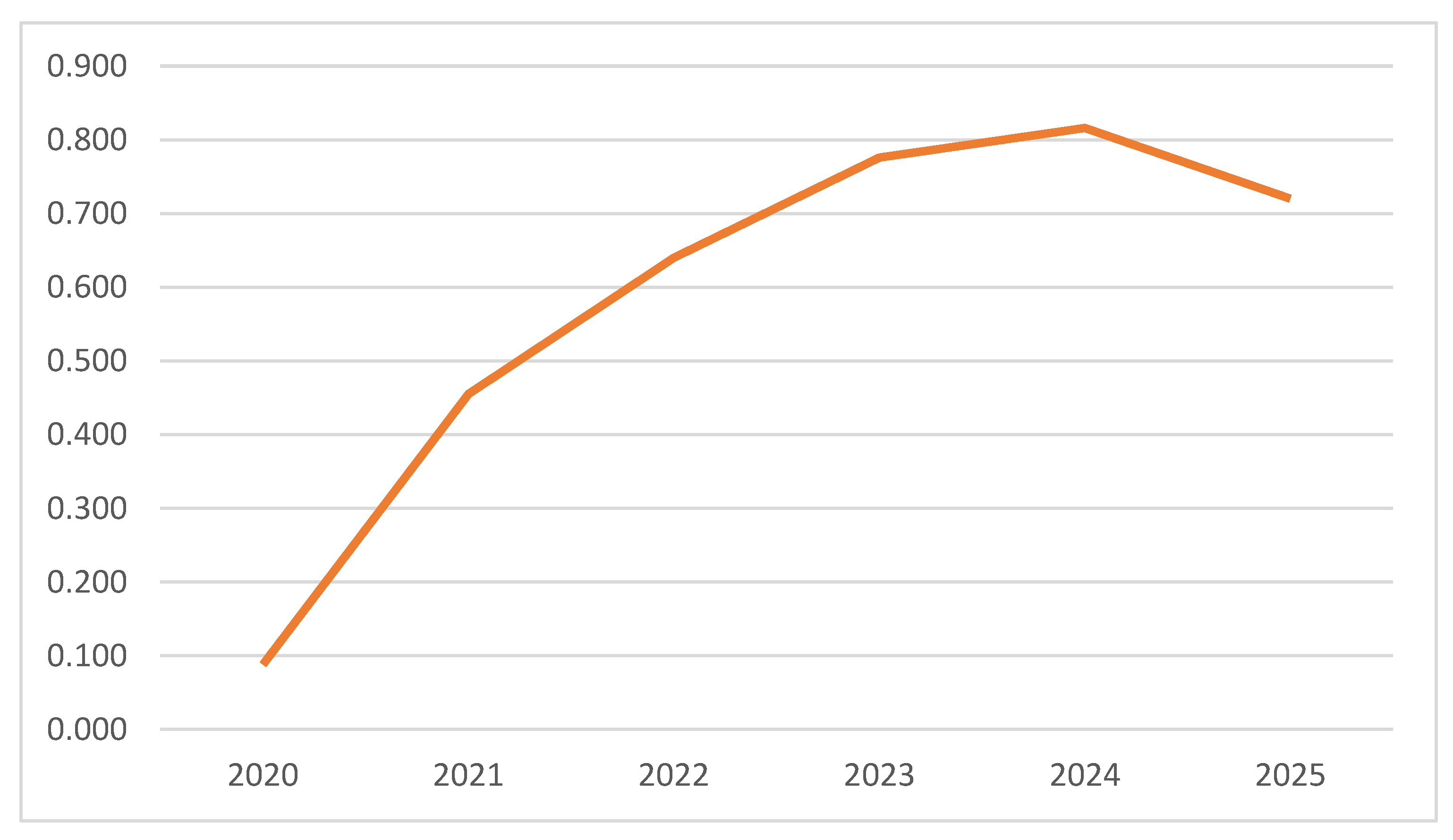
Figure 2.
Scenario estimation of the increment of the integral indicator C. Source: Created by the authors in Microsoft Excel.
Figure 2.
Scenario estimation of the increment of the integral indicator C. Source: Created by the authors in Microsoft Excel.
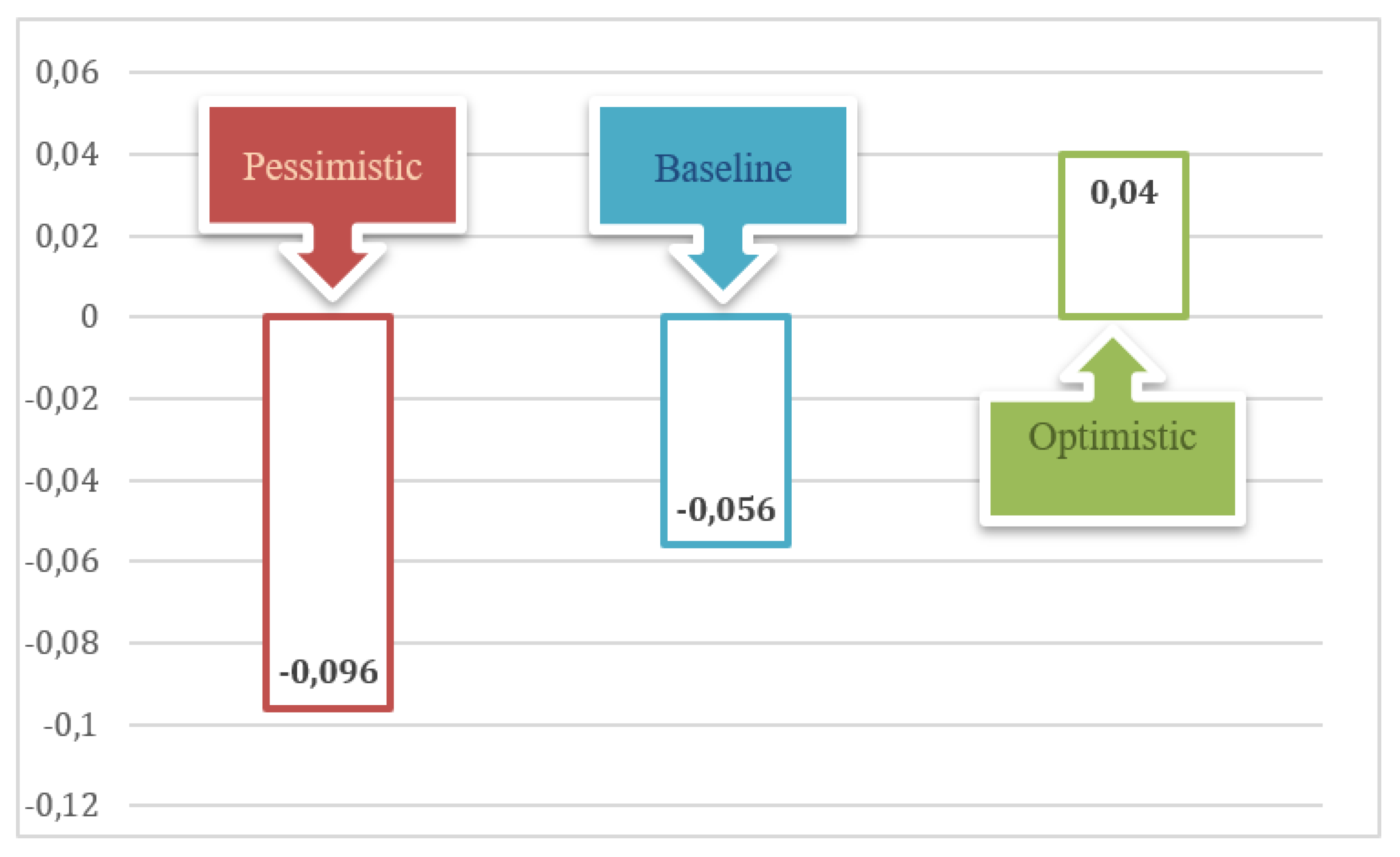

Table 1.
Key components and indicators of the open research competence development model.
| Model component | Content of the component | Indicator in the model | Expected result |
|---|---|---|---|
| Open publishing activity | Dissemination of research results in open access | OA | Growth in the share of OA publications |
| Institutional presence in international bases | Presentation of Ukrainian journals indexed in Scopus | J | Strengthening the international visibility of Ukrainian science |
| Open Science Training Activity | Training of academic staff in the principles and practices of open science | Tr | Developing knowledge, skills and a culture of openness |
| Integral result | Generalised assessment of the development of open research competence | C | Increasing the level of open research competence |
Source: Created by the authors.
Table 2.
Matrix of competences of the model of development of open research competence.
| Component competences |
Individual level |
Faculty level |
University level |
National level |
|
|---|---|---|---|---|---|
| Knowledge | • Open Science, Open Access, FAIR • ORCID, DOI, repositories • academic integrity |
• local practices of open science • methodical interaction • exchange of experience |
• OA institutional policies • KPI and monitoring • repository support |
• Ministry of Education and Science of Ukraine, EOSC, Open4UA • national coordination • European integration |
|
| Skills | • self-archiving of publications • work with ORCID/DOI • search for OA resources |
• twinning and mentoring • organisation of seminars • team interaction |
• monitoring of OA indicators • administration of platforms • journal support |
• networking of universities • analytics and coordination • scaling practices |
|
|
Attitude/ values |
• readiness for open exchange • responsibility and transparency • quality orientation |
• culture of cooperation • mutual support • dissemination of successful practices |
• institutional support for openness • encouraging innovation • sustainable development of competences |
• strategic sustainability of the system • enhancing RIs & R&D • integration into the ERA |
|
| Key indicators of the model | |||||
| OA – share of OA publications | J – number of Ukrainian journals indexed in Scopus/WoS | Tr – index of training activity | C – integral indicator of competence development | ||
Source: Created by the authors.
Table 3.
Dynamics of model indicators and the integral indicator of open research competence, 2020–2025.
Table 3.
Dynamics of model indicators and the integral indicator of open research competence, 2020–2025.
| Year | Share of OA, % | OAnorm | J | Jnorm | Tr, % | Tr norms | Weight OA | Weight J | Weight Tr | C | Absolute growth C | Growth rate, % |
|---|---|---|---|---|---|---|---|---|---|---|---|---|
| 2020 | 50.25 | 0.000 | 180 | 0.353 | 10 | 0.000 | 0.40 | 0.25 | 0.35 | 0.088 | — | — |
| 2021 | 56.63 | 0.441 | 194 | 0.765 | 15 | 0.250 | 0.40 | 0.25 | 0.35 | 0.455 | 0.367 | 417.05 |
| 2022 | 58.03 | 0.538 | 202 | 1.000 | 20 | 0.500 | 0.40 | 0.25 | 0.35 | 0.640 | 0.185 | 40.66 |
| 2023 | 60.88 | 0.735 | 186 | 0.529 | 30 | 1.000 | 0.40 | 0.25 | 0.35 | 0.776 | 0.136 | 21.25 |
| 2024 | 64.71 | 1.000 | 177 | 0.265 | 30 | 1.000 | 0.40 | 0.25 | 0.35 | 0.816 | 0.040 | 5.15 |
| 2025 | 63.64 | 0.926 | 168 | 0.000 | 30 | 1.000 | 0.40 | 0.25 | 0.35 | 0.720 | -0.096 | -11.76 |
Source: Calculated by the authors in Microsoft Excel based on Scopus data.
Disclaimer/Publisher’s Note: The statements, opinions and data contained in all publications are solely those of the individual author(s) and contributor(s) and not of MDPI and/or the editor(s). MDPI and/or the editor(s) disclaim responsibility for any injury to people or property resulting from any ideas, methods, instructions or products referred to in the content. |
© 2026 by the authors. Licensee MDPI, Basel, Switzerland. This article is an open access article distributed under the terms and conditions of the Creative Commons Attribution (CC BY) license (http://creativecommons.org/licenses/by/4.0/).
Copyright: This open access article is published under a Creative Commons CC BY 4.0 license, which permit the free download, distribution, and reuse, provided that the author and preprint are cited in any reuse.