

Submitted:
30 August 2026
Posted:
31 August 2026
You are already at the latest version
Abstract
Post-harvest peeling of yam tubers is labor-intensive and can cause substantial edible-matter loss, particularly when tubers have irregular geometries. This study developed and evaluated an adaptive spring-loaded peeling machine designed to follow local yam surface profiles during processing. The machine combines a reciprocating cutting head, independently compliant spring-loaded knives, a two-chuck holding arrangement, and controlled angular indexing. It was designed for tubers 50–200 mm in diameter and 100–600 mm in length, with a target capacity of 240–300 kg h−1. Engineering development included cutting-force analysis, power-transmission design, spring-rate selection, structural verification, prototype fabrication, and performance testing using ten dry yam tubers. Peeling efficiency ranged from 89.9% to 99.9% (mean 94.65±3.61 %), peeling loss ranged from 2.67% to 5.91% (mean 3.92±0.98 %), and peeling rate ranged from 41.76 to 51.92 mm s−1 (mean 44.94±3.04 mm s−1). The estimated machine capacity was approximately 270 kg h−1. Relative to previously reported yam peelers, the prototype combined high peel removal with comparatively low edible-matter loss. The results demonstrate the potential of localized mechanical compliance and controlled indexing to improve small- and medium-scale yam processing, while replicated trials are still required to establish performance across cultivars, moisture conditions, and operating settings.
Keywords:
post-harvest engineering
; agricultural mechanization
; yam processing
; peeling efficiency
; edible-matter loss
; spring-loaded knife
; root and tuber crops
1. Introduction
Yam is an important root and tuber crop for food supply, household consumption, and agro-processing. Its commercial value depends not only on production but also on timely and efficient post-harvest operations. Mechanized post-harvest equipment can reduce drudgery and processing losses while improving labor productivity and product consistency [1]. Peeling is particularly important because it precedes slicing, drying, milling, cooking, and flour production. However, yam peeling remains difficult to mechanize because tubers vary substantially in diameter, length, curvature, and local surface profile.
Manual peeling is flexible enough to follow irregular tuber geometries, but it is labor-intensive, time-consuming, operator-dependent, and unsuitable for high-throughput processing [2,3]. Chemical and thermal approaches can loosen the peel, but chemical use, residue management, energy demand, and partial cooking can limit their suitability for decentralized processing [4,5,6]. Mechanical peeling therefore remains attractive where fresh tissue must be preserved and processing is required at small or medium scale.
Abrasive drums and rotating brush systems are simple and productive, but incomplete contact in recessed regions and excessive contact at protruding regions can produce a trade-off between peel removal and flesh loss. A multi-tuber peeling machine demonstrated the potential of mechanized processing but also showed that performance depends on product properties and operating conditions [7]. For yam specifically, a spring-loaded knife machine reported efficiencies of 71.2–100% and losses of 3.67–14.29% [8]. A combined yam peeling and slicing machine achieved 87.86% efficiency, 12.1% peeling loss, and 114 kg h−1 throughput [9]. Earlier drum-based equipment reported efficiency up to 95%, but peeling loss reached 23% [10]. These results demonstrate the continuing need to combine high peel removal, reduced edible-matter loss, and practical processing capacity.
Recent work has explored more adaptive approaches. A computer-vision-assisted cassava system used contour recognition to guide peeling and reported improved control of efficiency and flesh loss [11]. A waterjet potato-peeling study used fluid–structure interaction to investigate precision-peeling parameters [12]. Although such systems demonstrate the value of adaptation and precision, practical mechanical solutions for highly irregular yam tubers remain limited.
The engineering hypothesis of the present study is that the cutting elements should accommodate the local geometry of the tuber rather than force the tuber through a fixed global cutting envelope. Accordingly, this work develops an adaptive spring-loaded yam peeling machine that combines localized knife compliance, reciprocating cutting motion, and controlled angular indexing. The objectives were to: (i) design and fabricate the machine using accessible workshop processes; (ii) establish the force, power, and spring requirements; (iii) evaluate peeling efficiency, peeling loss, peeling rate, and capacity using ten tubers; and (iv) benchmark the prototype against previously reported yam-peeling technologies.
2. Materials and Methods
2.1. Design Requirements and Engineering Concept
The machine was developed for dry yam tubers stored for at least two months. The principal design requirements were to accommodate substantial geometric variability, use locally available materials and conventional fabrication methods, permit straightforward maintenance, and provide a processing capacity suitable for small- and medium-scale operations. The design envelope covered tuber diameters of 50–200 mm and lengths of 100–600 mm. The target capacity was 240–300 kg h−1.
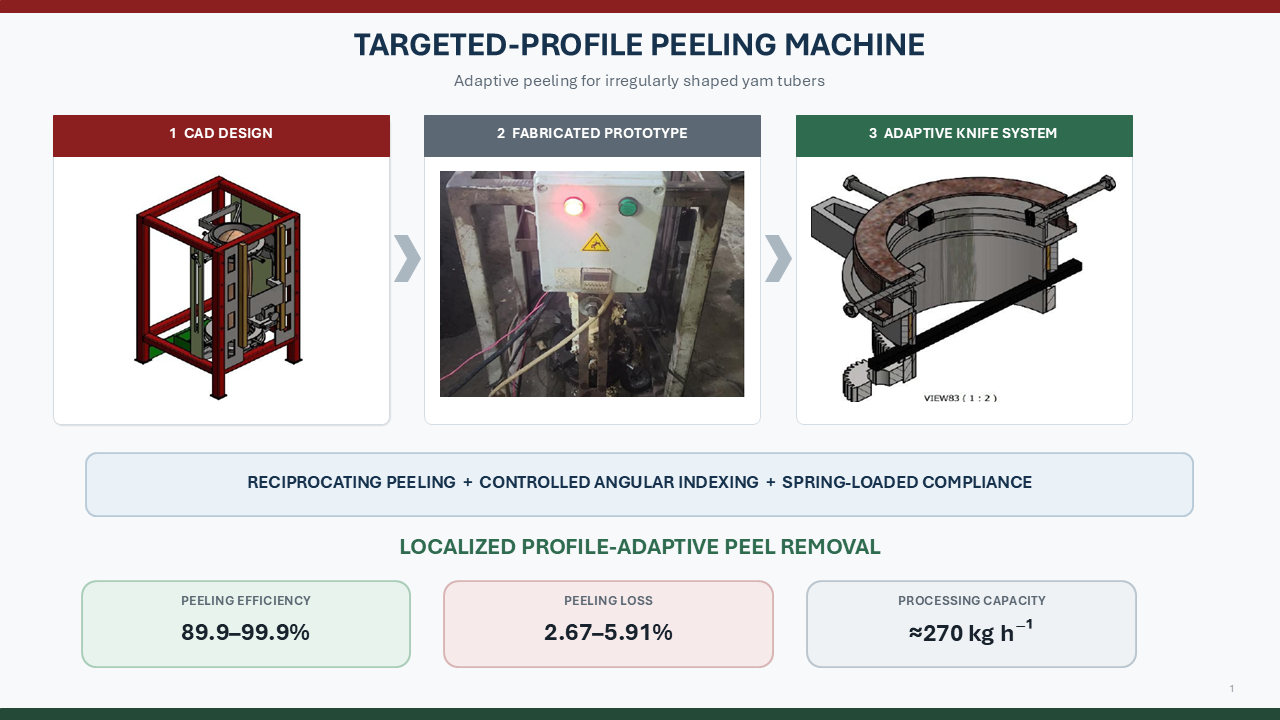
The developed machine consists of five principal subsystems: a reciprocating cutting head, two holding chucks, an indexing and quick-return transmission, linear guide rails, and a structural frame. The tuber is held approximately along its longitudinal axis between an adjustable non-indexing chuck and an indexing chuck. During the forward stroke, the cutting head traverses the tuber length while the spring-supported knives progressively remove the peel. At the end of each stroke, the cutting head returns to its initial position and the indexing chuck rotates the tuber to expose a new surface region. The spring-loaded knives are mounted on roller bearings and can deflect independently, enabling localized conformity to irregular yam profiles. Figure 1 presents the CAD assembly model and fabricated prototype developed in this study.
2.2. Materials Selection and Prototype Fabrication
Materials were selected by considering strength, wear resistance, corrosion resistance, machinability, cost, and local availability. High-speed steel was used for the knife edges to retain sharpness under repeated interaction with fibrous yam tissue. Mild steel was used for the knife shanks and housings because it is readily available and machinable. A36 carbon-steel sections and plates were used for the pivot arm and structural frame because of their strength, ductility, and weldability.
The prototype was fabricated using conventional workshop processes. As shown in Figure 1(b), the completed machine was constructed from standard steel sections, compression springs, bearings, and commercially available transmission components. The fabricated system closely followed the CAD configuration shown in Figure 1(a), ensuring that the intended reciprocating cutting action, adaptive knife compliance, and angular indexing mechanisms were implemented. The use of locally available materials and conventional fabrication techniques enhances maintainability and supports future adoption by small- and medium-scale yam processors.
2.3. Cutting-Force and Power-Transmission Design
The maximum peeling shear stress, , was taken as 9.5 N mm−2 based on reported resistance values for root and tuber crop processing [13]. The nominal peel thickness was 2 mm. The peel area engaged during one stroke was estimated as
where is the maximum circumference engaged by the tool and t is the peeling thickness. For mm and mm,
Using Merchant’s cutting relation, the shear angle was calculated as
where and . With , and . The shear force was
The cutting and thrust forces were estimated as
which gave N and N. Friction in the reciprocating head was represented by
where , kg, and m s−2. Thus, N and the total operating force was
For an 80 mm gear diameter, the calculated torque at gear A was
A 2:1 gear ratio gave 36.93 N m at gear B. The calculated power requirement was 110.784 W. Applying a design factor of 1.8 produced a minimum selected specification of 200 W, up to 30 rpm, and 100 N m torque.
2.4. Spring-Loaded Compliance Design
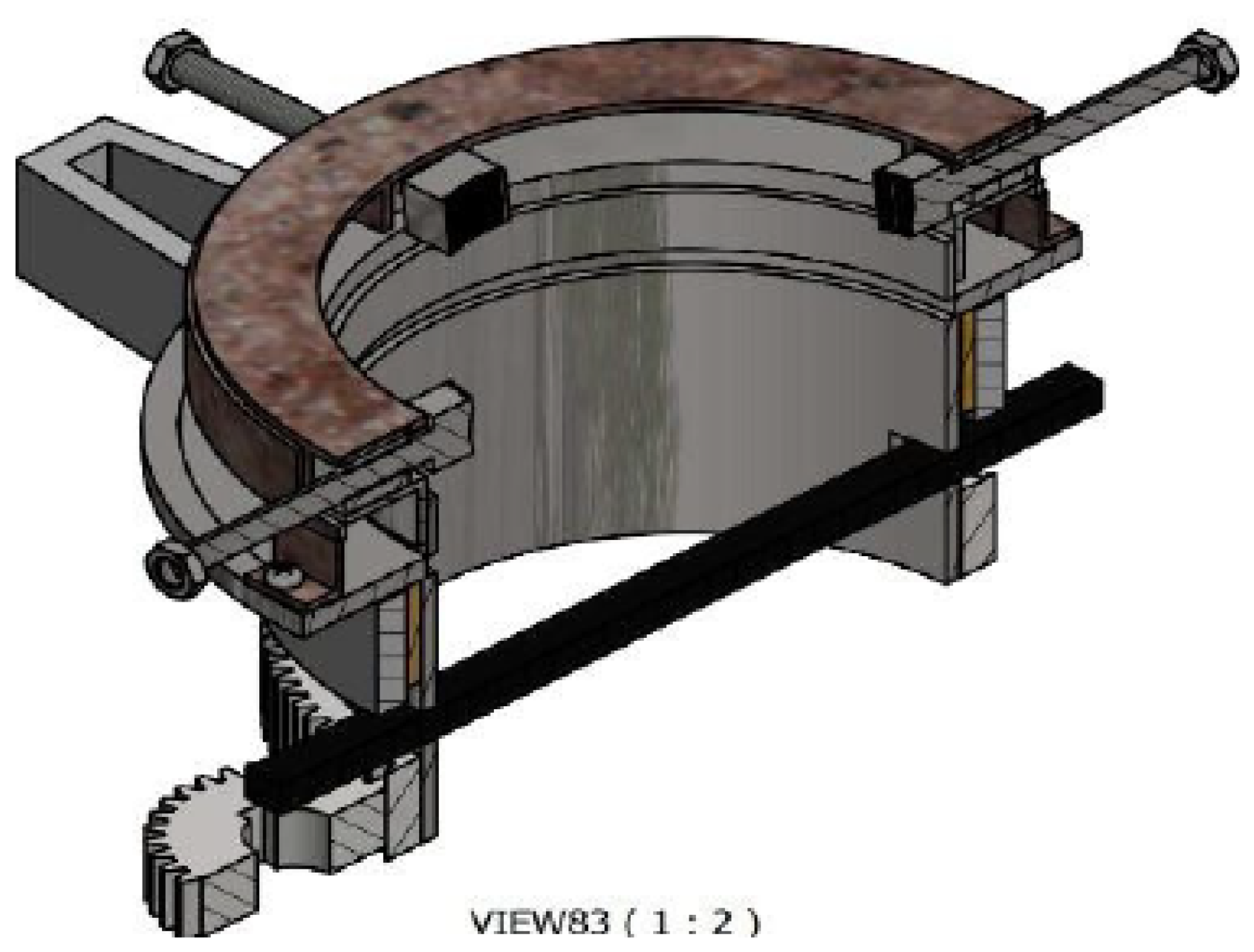
Knife compliance is required because peel resistance and local geometry vary along the tuber surface. Controlled mechanical compliance has also been used in adaptive elastomeric mounting systems to manage force transmission under variable loading [14,15]. In the present machine, three identical compression springs support the knife system and permit local displacement of the blades.
Figure 2.
Spring-loaded knife assembly providing localized compliance during peeling of irregular yam surfaces.
Figure 2.
Spring-loaded knife assembly providing localized compliance during peeling of irregular yam surfaces.
The spring preload was
where k is the combined spring rate and is the preload deflection. The residual force under thrust loading was
and the effective instantaneous cutting depth was
A parametric study was used to identify a spring rate that required minimal adjustment across the expected range of peel resistance. The selected combined rate was 80 N mm−1. Therefore, for three identical springs, the individual spring rate was 26.67 N mm−1. The spring geometry was evaluated using
where mm, , and N mm−2. The resulting wire diameter was 2.96 mm.
2.5. Performance Evaluation and Data Analysis
Ten dry yam tubers with different masses, diameters, and lengths were used for the expanded prototype performance evaluation. Each tuber constituted one independent experimental observation. The tubers were evaluated using the same machine configuration and performance-measurement procedure. The initial tuber mass, diameter, peel length, peeling time, and post-peeling mass were recorded. Derived values were calculated from these measurements.
Peeling efficiency was defined as
where is total tuber surface area and is the surface area remaining unpeeled. Peeling loss was
where and are tuber masses before and after peeling, respectively. Peeling rate was
where is peeled length and is peeling time. Results were summarized using the range, arithmetic mean, and sample standard deviation. Linear or quadratic regression curves were fitted only as descriptive indicators of patterns within the ten-observation dataset. No treatment-based inferential analysis was performed because the experiment did not contain replicated groups defined by controlled operating settings.
3. Results
3.1. Peeling Performance
Table 1 summarizes the ten independent tuber observations. Mean peeling efficiency was %, mean peeling loss was %, and mean peeling rate was mm s−1. The estimated machine capacity was approximately 270 kg h−1, within the target range of 240–300 kg h−1.
3.2. Descriptive Relationships
Peeling efficiency ranged from 89.9% to 99.9%. Figure 3 shows a positive descriptive relationship between tuber diameter and peeling efficiency:
The relationship remained positive in the expanded dataset, although it was weaker than the relationship obtained from the preliminary five-observation subset. Diameter therefore contributed to the observed efficiency variation, but it did not fully explain machine performance.
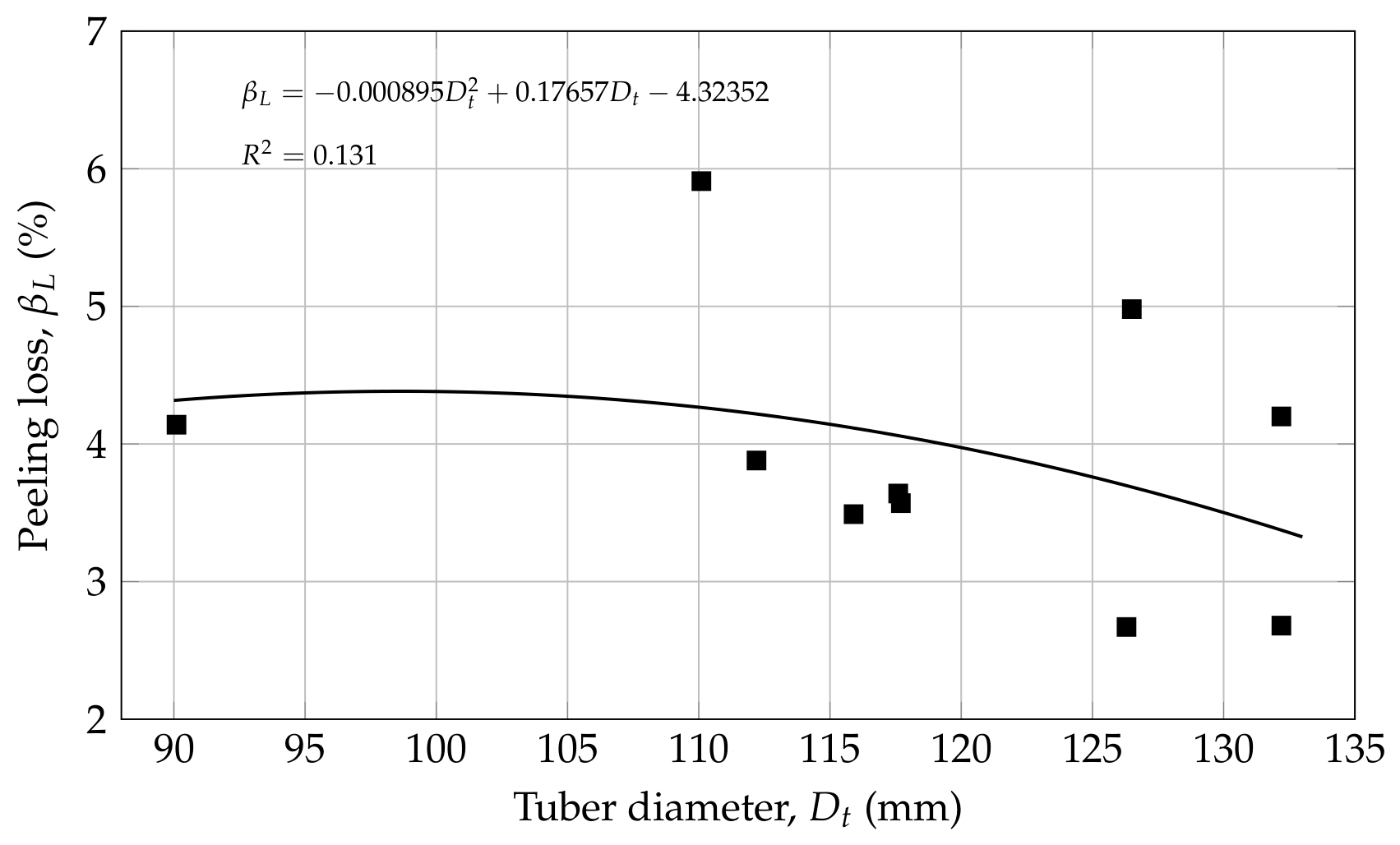
Peeling loss ranged from 2.67% to 5.91%. The descriptive quadratic relationship was
The low coefficient of determination indicates that tuber diameter alone explained little of the observed variation in peeling loss. Local curvature, surface irregularity, peel adhesion, moisture condition, and tissue heterogeneity are likely to be influential.
Figure 4.
Relationship between tuber diameter and peeling loss for the ten-tuber dataset.
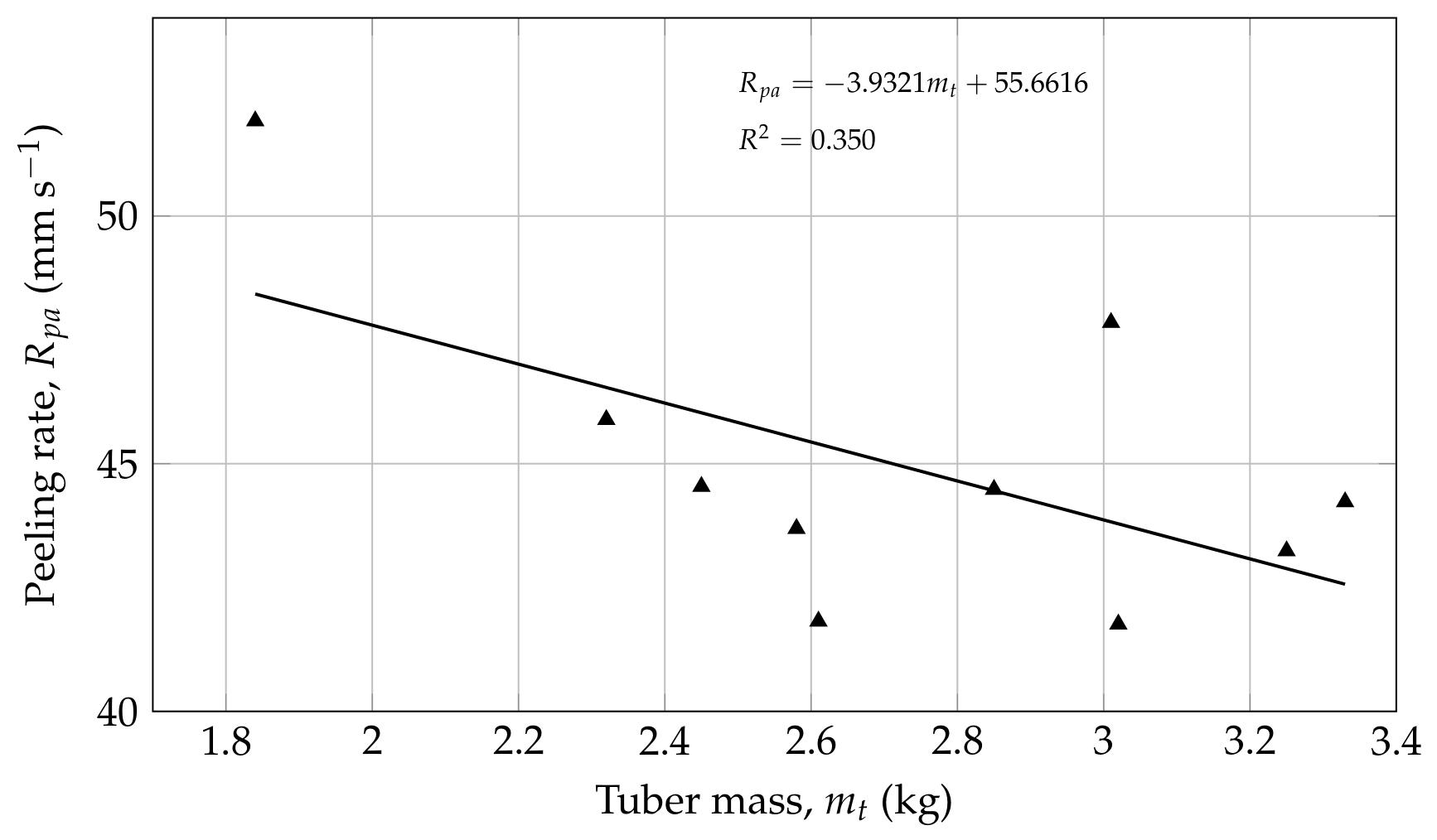
Peeling rate ranged from 41.76 to 51.92 mm s−1. The fitted descriptive relationship was
This relationship indicates a moderate tendency for peeling rate to decrease with increasing tuber mass, but additional controlled observations are required before the equation can be used predictively.
Figure 5.
Relationship between tuber mass and peeling rate for the ten-tuber dataset.
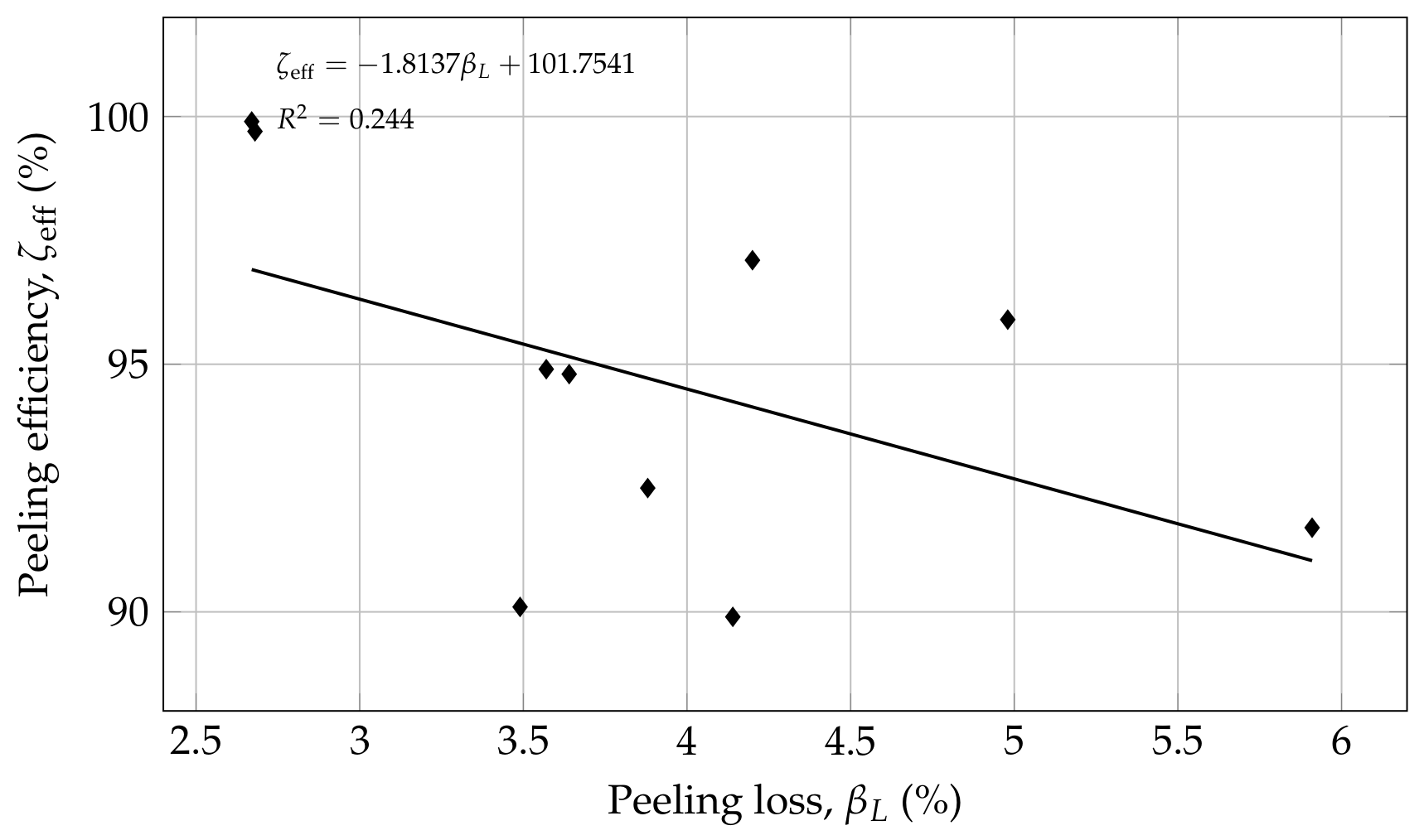
The relationship between peeling loss and efficiency was
The negative slope is consistent with a general efficiency–loss trade-off, but the low coefficient of determination shows that peeling loss alone does not explain most of the efficiency variation.
Figure 6.
Efficiency–loss relationship for the ten-tuber dataset.
4. Discussion
4.1. Comparison with Existing Yam-Peeling Technologies
Table 2 places the present results beside selected yam-peeler values reported in the literature. Direct comparison should be interpreted cautiously because the studies used different tuber varieties, maturity conditions, test protocols, and definitions of performance. Nevertheless, the present machine combined an efficiency range of 89.9–99.9%, loss of 2.67–5.91%, and estimated capacity of approximately 270 kg h−1. The loss range was lower than those reported for the selected earlier yam-peeling machines, while capacity exceeded the 114 kg h−1 reported for the combined peeler-slicer [9].
The principal design distinction is that each spring-supported knife can respond locally to tuber geometry, while angular indexing exposes successive surface regions. This avoids requiring the tuber to conform to a fixed circular opening or full-profile cutting envelope. The approach offers a mechanical alternative to more complex computer-vision and waterjet solutions [11,12], with potential advantages in workshop manufacture and maintainability.
4.2. Post-Harvest and Practical Implications
For small- and medium-scale yam processors, the main practical objectives are to reduce drudgery, preserve edible tissue, increase throughput, and use equipment that can be maintained locally. The estimated capacity of approximately 270 kg h
−1 met the design objective, while the observed loss range indicates that the compliant knife arrangement can limit excess flesh removal in the tested tubers. If demonstrated through replicated and field-oriented trials, these features could support labor productivity and reduce avoidable material loss during primary processing.
The machine was intentionally based on conventional mechanical components rather than specialized sensing or robotic hardware. This design choice may improve accessibility, but practical deployment will also depend on operator safety, sanitation, cleaning time, knife replacement, energy use, lifecycle cost, and performance under continuous operation. The developed machine demonstrates potential for reducing manual peeling drudgery and improving labor productivity where mechanization options remain limited.
4.3. Interpretation of the Expanded Dataset
The addition of five independently recorded tuber observations broadened the tested ranges of mass, diameter, peel length, and peeling time. The overall mean values remained close to those estimated from the preliminary five-observation subset, while the sample standard deviations for efficiency, loss, and rate decreased. This consistency supports the stability of the central performance estimates. However, the expanded dataset also reduced the coefficients of determination for several regression relationships. In particular, the weak diameter–loss and efficiency–loss relationships indicate that performance cannot be explained by one geometric or outcome variable alone.
The results therefore support the engineering function of the prototype more strongly than they support any universal regression model. The machine achieved high efficiency and relatively low loss across the observed tubers, but future experiments should explicitly vary and replicate operating speed, spring preload, indexing angle, cultivar, storage duration, moisture content, and tuber-shape descriptors.
4.4. Limitations and Future Work
Although the dataset contains ten independent tuber observations, the experiment did not include replicated treatment groups involving controlled variations in machine settings or tuber conditions. The regression equations should therefore be interpreted as descriptive trends rather than predictive models. Tuber cultivar, moisture content, storage history, peel adhesion, curvature, and surface defects were not separately controlled. The surface-area method used for estimating peeling efficiency should also be documented with a repeatable measurement protocol in future studies.
Further work should evaluate larger randomized samples across cultivars and storage conditions; include replicated operating speeds, spring preloads, and indexing angles; report uncertainty and inferential statistics; quantify energy consumption, hygiene, and cleaning requirements; and conduct operator-safety and economic assessments. Continuous-duration testing would also be necessary before commercial-scale recommendations are made.
5. Conclusions
An adaptive spring-loaded yam peeling machine was developed to address the post-harvest challenge posed by irregular tuber geometry. The machine combines reciprocating cutting, localized spring compliance, and controlled angular indexing. In an evaluation involving ten dry yam tubers, peeling efficiency was 89.9–99.9% (mean %), peeling loss was 2.67–5.91% (mean %), peeling rate was 41.76–51.92 mm s−1 (mean mm s−1), and estimated capacity was approximately 270 kg h−1. The comparative results indicate that the developed concept can combine high peel removal with relatively low edible-matter loss.
The expanded dataset strengthens the prototype-validation evidence but does not replace the need for replicated, statistically designed experiments. Larger field-oriented evaluations are required to establish robustness, economics, sanitation, safety, and applicability across yam varieties and processing conditions. The adaptive peeling concept may contribute to the development of accessible post-harvest processing technologies for root and tuber crops, particularly where labor requirements, processing inefficiencies, and material losses remain important challenges.Future studies should include larger sample populations, replicated operating conditions, and techno-economic assessment to support commercial implementation.
Author Contributions
Conceptualization, A.O.; methodology, A.O. and I.L.; engineering analysis, I.L.; CAD and machine design, fabrication support and testing, B.O.O, F.O.; experimental work and data provision, B.O.O.; data interpretation, A.O., I.L. and B.O.O.; validation, M.A.O.; writing—original draft preparation, A.O. and I.L.; writing—review and editing, I.L., F.O., B.O.O. and M.A.O.; supervision, A.O. All authors have read and agreed to the published version of the manuscript.
Funding
This research received no external funding.
Institutional Review Board Statement
Not applicable.
Informed Consent Statement
Not applicable.
Data Availability Statement
The data supporting the findings of this study are available from the corresponding author upon reasonable request.
Acknowledgments
The authors acknowledge the technical support received during prototype fabrication and testing. Microsoft Copilot was used to assist with language editing, document organization, formatting, and update of manuscript tables and plots from the author-provided dataset. All technical content, measurements, calculations, interpretations, references, and final wording were reviewed and approved by the authors, who take full responsibility for the manuscript.
Conflicts of Interest
The authors declare no conflict of interest.
References
- Food and Agriculture Organization of the United Nations. On-Farm Postharvest and Value Addition. Available online: https://www.fao.org/sustainable-agricultural-mechanization/guidelines-operations/on-farm-postharvest-and-value-addition/en/ (accessed on 22 August 2026).
- Igbeka, J.C.; Jory, M.; Griffon, D. Selective mechanization for cassava processing. Agric. Mech. Asia Afr. Lat. Am. 1992, 23, 45–50. [Google Scholar]
- Amoah, R.S.; Amoah, F.; Bobobee, E.Y.H.; Addo, A.; Darko, J.O.; Akowuah, J.O. A review of mechanical cassava peeling and its adoption by processors. J. Ghana Inst. Eng. 2022, 22, 1–12. [Google Scholar] [CrossRef]
- Toker, I.; Bayindirli, A. Enzymatic peeling of apricots, nectarines and peaches. LWT–Food Sci. Technol. 2003, 36, 215–221. [Google Scholar] [CrossRef]
- Bishai, M.; Singh, A.; Adak, S.; Prakash, J.; Roy, L.; Banerjee, R. Enzymatic peeling of potato: A novel processing technology. Potato Res. 2015, 58, 301–311. [Google Scholar] [CrossRef]
- Luh, B.S.; Woodroof, J.G. Commercial Vegetable Processing, 2nd ed.; AVI Publishing: New York, NY, USA, 1988. [Google Scholar]
- Fadeyibi, A.; Ajao, O.F. Design and performance evaluation of a multi-tuber peeling machine. AgriEngineering 2020, 2, 55–71. [Google Scholar] [CrossRef]
- Ojolo, S.J.; Orisaleye, J.I.; Badiru, A.B. Design and fabrication of a yam peeling machine. J. Eng. Res. 2016, 21, 1–12. [Google Scholar] [CrossRef]
- Ayodeji, S.P.; Akinnuli, B.O.; Olabanji, O.M. Development of yam peeling and slicing machine for flour processing. J. Mach. Manuf. Autom. 2014, 3, 74–83. [Google Scholar]
- Adetoro, K.A. Development of a yam peeling machine. Glob. Adv. Res. J. Eng. Technol. Innov. 2012, 1, 85–88. [Google Scholar]
- Ogunnigbo, O.C.; Oosthuizen, C.C.; Beneke, L.W. Innovative computer vision-assisted peeling system for enhanced efficiency in cassava tuber processing. ABUAD J. Eng. Res. Dev. 2026, 9, 85–96. [Google Scholar] [CrossRef]
- Shi, Y.; Hu, H.; Zhang, S.; Zhu, L.; Wang, Y.; Cao, G.; Zhan, Q. Optimization and experiment on parameters for potato peeling using waterjet based on fluid–structure interaction. Agriculture 2025, 15, 2136. [Google Scholar] [CrossRef]
- Odigboh, E.U. Cassava production, processing and utilization. In Handbook of Tropical Foods; Chan, H.T., Ed.; Marcel Dekker: New York, NY, USA, 1983; pp. 145–200. [Google Scholar]
- Ladipo, I.L.; Fadly, J.D.; Faris, W.F. Evaluation of elastomeric models for engine mountings applications. Int. J. Veh. Noise Vib. 2015, 11, 210–224. [Google Scholar] [CrossRef]
- Ladipo, I.L.; Darsivan, F.J.; Faris, W.F. Computational validation of magnetorheological elastomers for engine mount application. Int. J. Recent Technol. Eng. 2019, 7, 180–184. [Google Scholar]
Figure 1.
Developed adaptive spring-loaded yam peeling machine showing (a) the three-dimensional CAD assembly model and (b) the fabricated prototype used for performance testing. The fabricated machine closely follows the original design configuration and incorporates a reciprocating cutting head, spring-supported knife mechanism, guide rails, chuck assemblies, and structural support frame for peeling irregularly shaped yam tubers.
Figure 1.
Developed adaptive spring-loaded yam peeling machine showing (a) the three-dimensional CAD assembly model and (b) the fabricated prototype used for performance testing. The fabricated machine closely follows the original design configuration and incorporates a reciprocating cutting head, spring-supported knife mechanism, guide rails, chuck assemblies, and structural support frame for peeling irregularly shaped yam tubers.
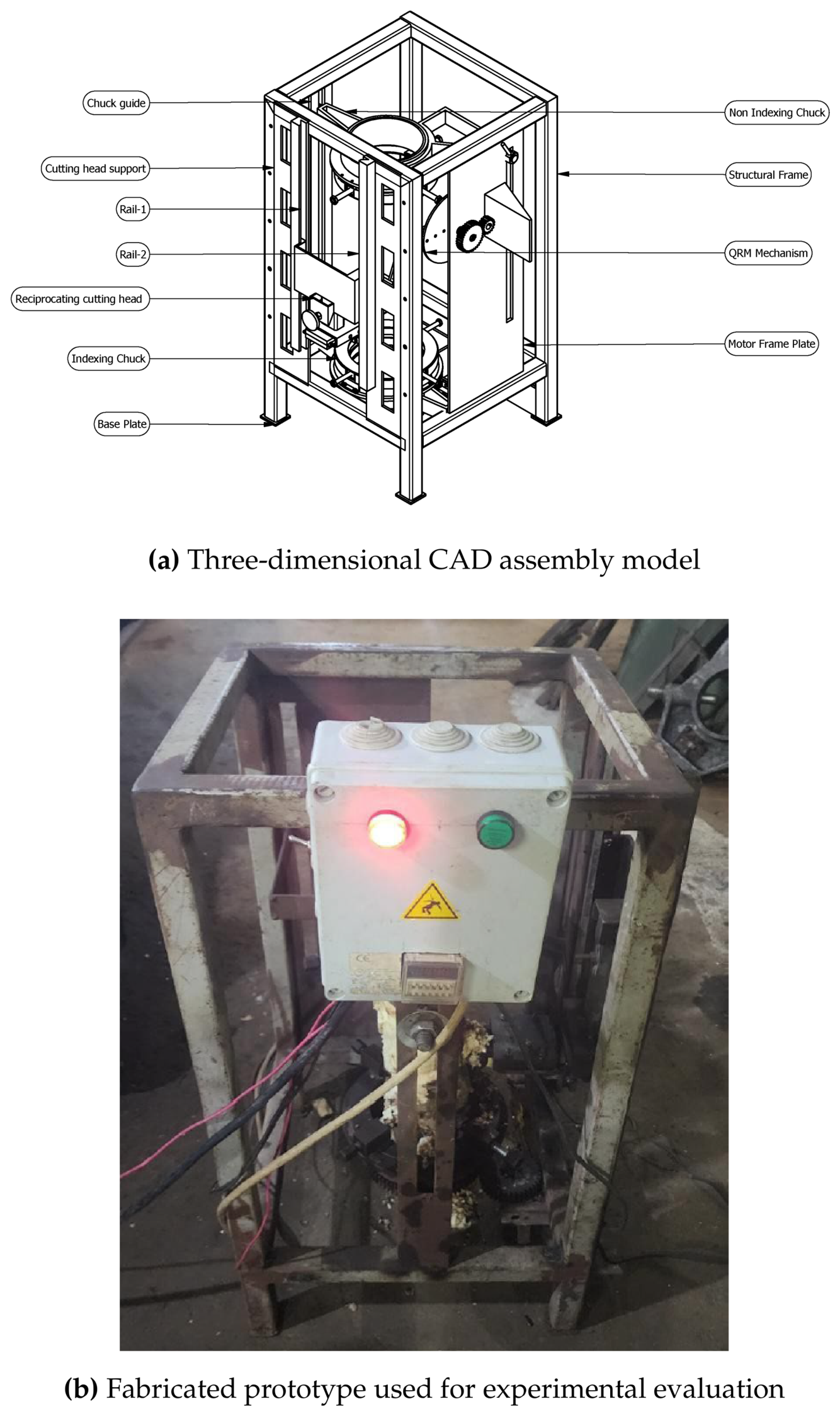
Figure 3.
Relationship between tuber diameter and peeling efficiency for the ten-tuber dataset.
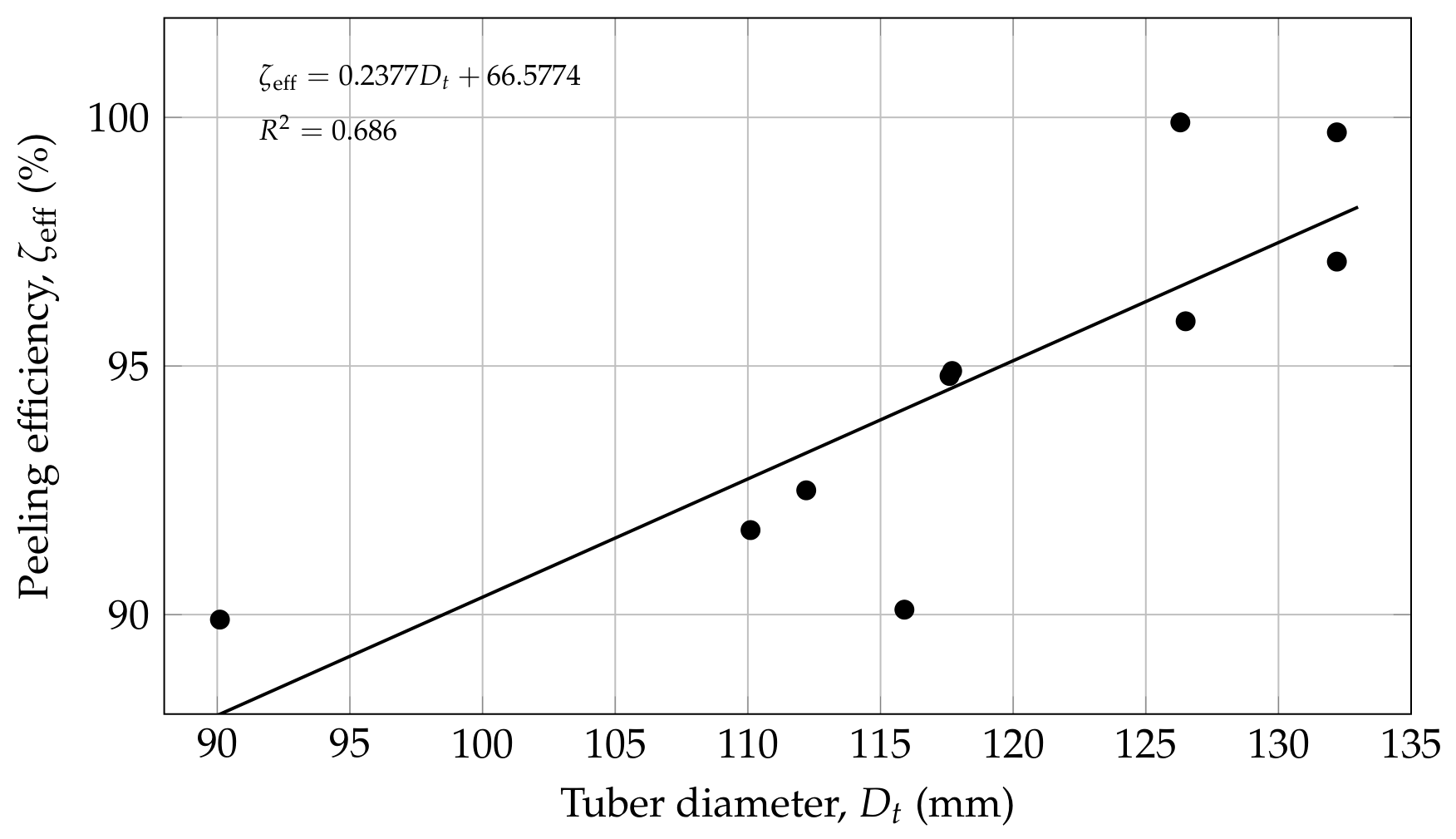

Table 1.
Performance evaluation of the adaptive yam peeling machine using ten tubers.
| Exp. | ||||||||
|---|---|---|---|---|---|---|---|---|
| (kg) | (mm) | (mm) | (s) | (kg) | (%) | (%) | (mm s−1) | |
| 1 | 1.84 | 90.1 | 274.49 | 5.29 | 1.764 | 4.14 | 89.9 | 51.92 |
| 2 | 2.45 | 110.1 | 263.66 | 5.92 | 2.305 | 5.91 | 91.7 | 44.54 |
| 3 | 2.32 | 112.2 | 246.16 | 5.36 | 2.230 | 3.88 | 92.5 | 45.89 |
| 4 | 2.58 | 115.9 | 266.27 | 6.09 | 2.490 | 3.49 | 90.1 | 43.69 |
| 5 | 3.02 | 117.6 | 309.40 | 7.41 | 2.910 | 3.64 | 94.8 | 41.76 |
| 6 | 2.61 | 117.7 | 262.74 | 6.28 | 2.517 | 3.57 | 94.9 | 41.82 |
| 7 | 2.85 | 126.3 | 267.36 | 6.01 | 2.774 | 2.67 | 99.9 | 44.48 |
| 8 | 3.01 | 126.5 | 282.26 | 5.90 | 2.860 | 4.98 | 95.9 | 47.85 |
| 9 | 3.25 | 132.2 | 291.28 | 6.74 | 3.163 | 2.68 | 99.7 | 43.24 |
| 10 | 3.33 | 132.2 | 301.67 | 6.82 | 3.190 | 4.20 | 97.1 | 44.23 |
| Mean | 2.73 | 118.08 | 276.53 | 6.18 | 2.620 | 3.92 | 94.65 | 44.94 |
| SD | 0.46 | 12.58 | 19.53 | 0.66 | 0.447 | 0.98 | 3.61 | 3.04 |
Table 2.
Indicative comparison with selected yam-peeling technologies.
| Technology | Efficiency (%) | Peeling loss (%) | Capacity (kg h−1) |
|---|---|---|---|
| Eccentric/drum yam peeler [10] | up to 95 | up to 23 | not reported |
| Yam peeler and slicer [9] | 87.86 | 12.1 | 114 |
| Spring-loaded/power-screw yam peeler [8] | 71.2–100 | 3.67–14.29 | not reported |
| Present adaptive spring-loaded machine | 89.9–99.9 | 2.67–5.91 | approximately 270 |
Disclaimer/Publisher’s Note: The statements, opinions and data contained in all publications are solely those of the individual author(s) and contributor(s) and not of MDPI and/or the editor(s). MDPI and/or the editor(s) disclaim responsibility for any injury to people or property resulting from any ideas, methods, instructions or products referred to in the content. |
© 2026 by the authors. Licensee MDPI, Basel, Switzerland. This article is an open access article distributed under the terms and conditions of the Creative Commons Attribution (CC BY) license (http://creativecommons.org/licenses/by/4.0/).
Copyright: This open access article is published under a Creative Commons CC BY 4.0 license, which permit the free download, distribution, and reuse, provided that the author and preprint are cited in any reuse.