

Submitted:
19 August 2026
Posted:
31 August 2026
You are already at the latest version
Abstract
Background/Objectives Hypoxaemia is the most common adverse event during procedural sedation. High-flow nasal ox-ygen (HFNO) may reduce desaturation through continuous positive airway pressure, elimination of anatomical dead space, and precise FiO₂ delivery. This study aimed to assess the association between HFNO and the incidence of desaturation (SpO₂ < 90% at any time) during deep seda-tion for colonoscopy in a high-risk population. Methods A single-centre retrospective cohort study with propensity score matching was performed. It in-cluded 200 consecutive adult patients at high risk of adverse respiratory events undergoing deep sedation, grouped by oxygen delivery device: HFNO via nasal cannula versus Venturi mask. Results After 1:1 nearest-neighbour propensity score matching, 71 matched pairs were obtained. In the matched cohort, desaturation occurred in 12.7% of patients receiving HFNO versus 22.5% of controls (matched-pairs OR 0.53; 95% CI: 0.23–1.23; p = 0.211; McNemar's test), an absolute risk reduction of 9.8 percentage points. A sensitivity analysis using conditional logistic regression confirmed the direction and magnitude of the effect (adjusted OR 0.52; 95% CI: 0.22–1.21; p = 0.129). Post hoc power analysis indicated 30.8% statistical power in the current sample; 265 matched pairs would be required to achieve 80% power. Conclusions HFNO was associated with a meaningful reduction in the likelihood of desaturation during deep sedation for colonoscopy in a high-risk population (OR 0.53), consistent with available me-ta-analytic evidence for this risk stratum. This study provides a data-derived sample size estimate (265 matched pairs) for a future prospective randomised trial.
Keywords:
high-flow nasal oxygen
; procedural sedation
; colonoscopy
1. Introduction
Gastrointestinal endoscopy is one of the most frequently performed diagnostic and therapeutic procedures worldwide, with demand rising steadily as a result of colorectal cancer screening programmes targeting an increasingly elderly and comorbid population [1]. Deep sedation, most commonly propofol-based, has become the standard of care for endoscopic procedures, as it improves patient tolerance, facilitates procedural completion, and reduces discomfort [2,3,4] Hypoxaemia is the most common sedation-related adverse event, arising primarily from respiratory centre depression, upper airway obstruction secondary to muscular hypotonia, and reduced chest wall compliance, all potentiated by increasing sedation depth [5,6,7]. Reported desaturation rates vary widely across studies, but events requiring airway intervention occur in approximately 6% of procedures in unselected populations, with higher rates in patients identified as high risk [8].
Established predictors of desaturation during sedated endoscopy include age over 60 years, ASA physical status ≥ III, body mass index (BMI) >30 kg/m2, pre-existing obstructive sleep apnoea (OSA), and significant cardiorespiratory comorbidities [9,10]. Patients with OSA and obesity are particularly vulnerable during deep sedation [11,12,13].
High-flow nasal oxygen (HFNO) has emerged over the past decade as an effective non-invasive respiratory support modality in critically ill patients, and its use has progressively extended to non-ICU procedural settings. HFNO delivers heated, humidified gas at flows up to 60 L/min through purpose-designed nasal cannulae, enabling stable FiO2 delivery independent of the patient’s peak inspiratory flow [14,15]. Its physiological effects are mediated through four mechanisms: a flow-dependent positive end-expiratory pressure at the nasopharyngeal level (~0.8–1.0 cmH2O per 10 L/min), which promotes alveolar recruitment [16,17], nasopharyngeal washout of exhaled CO2-rich gas, increasing alveolar ventilation relative to minute ventilation [18], elimination of room-air entrainment that makes conventional low-flow devices unreliable [14] and delivery of gas at body temperature and 100% relative humidity, improving mucociliary clearance and comfort [19].
HFNO has evidence supporting its use during bronchoscopy, orotracheal intubation, and gastrointestinal endoscopy [20,21,22]. Results in the endoscopic setting remain inconsistent, however, with some randomised trials showing a significant reduction in desaturation and others finding no benefit over conventional oxygen therapy [23,24,25]. This heterogeneity likely reflects differences in patient selection, flow rates and FiO2 employed, outcome definitions, and, critically, the failure of many non-randomised studies to adequately account for confounding by indication.
To address this limitation, we conducted a retrospective cohort study in a high-risk population undergoing deep sedation for colonoscopy, applying propensity score matching (PSM) to control for the principal sources of confounding by indication. The primary objective was to estimate the association between HFNO and procedure-related desaturation after adjustment for baseline differences. A secondary objective was to provide a data-derived sample size estimate for a prospective confirmatory randomised trial.
2. Materials and Methods
Study Design and Setting
A single-centre retrospective cohort study was conducted in accordance with the Declaration of Helsinki and was approved by the Institutional Ethics Committee (Ethics Committee for Clinical Trials at the 12 de Octubre University Hospital, Madrid, Spain) and the Ethics Committee for Research Involving Medicinal Products (protocol code 18/016; date of approval: 24 January 2018). This manuscript was prepared in accordance with the STROBE statement for cohort studies [26].
Patients
Adult patients (≥ 18 years) undergoing deep sedation for colonoscopy between February 2018 and February 2020 were eligible if they met pre-specified criteria for high risk of respiratory adverse events related to OSA, assessed using the STOP-BANG questionnaire, an eight-item screening tool (snoring, tiredness, observed apnoea, blood pressure, BMI > 35 kg/m2, age > 50 years, neck circumference > 43 cm in men or > 41 cm in women, and male gender; one point per positive item). A total score ≥ 5 identifies a high probability of moderate-to-severe OSA, while scores ≥ 2 combined with an individual high-risk factor also identify clinically relevant risk [27]. Patients were assigned to one of seven pre-specified, mutually exclusive inclusion categories, which also constituted the seven-level procedure-indication variable used in the propensity score model (Table 1). Exclusion criteria were severe pulmonary disease and simultaneous gastroscopy.
The final cohort comprised 200 patients: 100 received HFNO and 100 received conventional oxygen therapy.
Oxygen Delivery and Sedation Protocol
In the HFNO group, oxygen was delivered via heated humidified high-flow nasal cannula (Optiflow®, Fisher & Paykel Healthcare, California, USA) at 50 L/min, FiO2 0.50. In the control group, oxygen was administered via Venturi mask at 12 L/min (FiO2 0.40); this choice, rather than simple low-flow nasal cannulas, was a deliberate design decision to ensure comparable baseline oxygenation conditions and avoid disadvantaging the control group. Sedation was performed using propofol combined with fentanyl, titrated to achieve deep sedation, and all procedures were performed by experienced intensivists.
Outcome Definition
The primary outcome was desaturation, defined as SpO2 < 90% at any point during the procedure, recorded prospectively by the attending intensivist as part of standard clinical documentation. Secondary endpoints—rescue airway manoeuvre rates (jaw-thrust/chin-lift and Guedel airway insertion), nadir SpO2, and procedural interruption—were extracted from the underlying prospective registry.
Propensity Score Estimation and Matching
The propensity score was estimated using multivariate logistic regression, with HFNO receipt as the dependent variable and age, sex, procedure indication, baseline SpO2, and pre-existing pulmonary disease as predictors; continuous covariates were standardised, and the discriminative ability of the model was assessed using the area under the ROC curve (AUC). Matching was performed using a 1:1 nearest-neighbour algorithm without replacement, with a calliper width of 0.2 standard deviations of the logit of the propensity score, as recommended by Austin [28]. Treated (HFNO) patients were randomly ordered before matching to avoid systematic order bias. Balance between groups was assessed using the standardised mean difference (SMD); SMD < 0.10 was considered indicative of adequate balance [29].
Statistical Analysis
Continuous variables are presented as mean and standard deviation (SD), and categorical variables as frequency and percentage. In the matched cohort, the primary outcome was analysed using the McNemar test, with the matched-pair odds ratio (OR) and its 95% confidence interval (CI) estimated from the discordant pairs. As a pre-specified sensitivity analysis, conditional logistic regression (CLR) was applied to the matched pairs, conditioning on pair membership, as a more conservative alternative confirming robustness to the analytical method. A post-hoc power analysis was performed, assuming constant the proportion of discordant pairs and the observed OR, to estimate the sample size required for 80% and 90% statistical power at a two-sided α = 0.05. All analyses were performed using Python 3.11 (scikit-learn, scipy.stats, statsmodels); a two-tailed p-value < 0.05 was considered statistically significant.
3. Results
Patient Characteristics and Pre-Matching Comparability
Between February 2018 and February 2020, 200 patients were included. The mean age was 63.4 (SD 11.2) years; 32.5% were male. Most patients were ASA physical status II (38.5%) or III (55.0%); only 5.5% were ASA IV and 1.0% ASA I (Table 1). The mean total dose of propofol was 200 mg in the HFNO group and 190 mg in the control group; fentanyl dose was 75 μg in both groups, with no statistically significant differences.
Before matching, the two groups differed meaningfully in the distribution of procedural indication categories (OSA treated with CPAP: SMD 0.43; STOP-BANG ≥ 2 + age > 50 years: SMD 0.24; moderate-severe OSA: SMD 0.25) and in the prevalence of pre-existing pulmonary disease (HFNO 8% vs. control 16%; SMD 0.25), suggesting preferential allocation of HFNO to patients with a more favourable respiratory profile, consistent with confounding by indication.
Propensity Score Model and Matching
The logistic regression model yielded an AUC of 0.682 (Youden optimal threshold 0.494; sensitivity 59.0%, specificity 73.0%), indicating moderate discriminative ability appropriate for a PS model in a non-randomised setting (Figure 1). The 1:1 nearest-neighbour algorithm, with a calliper of 0.1223 logit units, yielded 71 matched pairs (142 patients); 29 patients from each group were excluded due to absence of a suitable match within the calliper.
Covariate Balance After Matching
After matching, 10 of 17 covariates achieved SMD < 0.10 (Table 1). The most pronounced residual imbalance was in baseline SpO2 (SMD 0.28), reflecting the very low variance of this variable across the sample (range 93–100%, majority at 99–100%); the absolute mean difference was ~0.5 percentage points, clinically inconsequential. Procedure indication moderate-severe OSA (SMD 0.24) and STOP-BANG ≥ 2 + age > 50 years (SMD 0.14) also remained marginally above the 0.10 threshold, attributable to small cell sizes.
Primary Outcome: Desaturation
In the unmatched cohort, desaturation occurred in 11 of 100 HFNO patients and 19 of 100 controls (crude OR 0.53; p = 0.166, chi-square).
In the matched cohort (71 pairs), desaturation was recorded in 9 of 71 HFNO patients (12.7%) and 16 of 71 controls (22.5%). Analysis of discordant pairs (McNemar test) identified 8 pairs in which the HFNO patient desaturated but the control did not, and 15 pairs in which the reverse occurred, with 47 concordant negative pairs and 1 concordant positive pair. The matched-pair OR was 0.53 (95% CI 0.23–1.23; p = 0.211). Although statistical significance was not reached, the direction and magnitude of the effect are consistent with a clinically meaningful protective association (Figure 2).
Sensitivity Analysis: Conditional Logistic Regression
CLR applied to the 71 matched pairs yielded an adjusted OR of 0.52 (95% CI 0.22–1.21; p = 0.129), confirming the direction and magnitude of the McNemar estimate. The slight widening of the confidence interval and attenuation of the p-value reflect the more conservative nature of CLR, which adjusts for all matched covariates simultaneously. The convergence of both methods strengthens confidence that the observed protective association is not an artefact of the statistical approach.
Secondary Outcomes: Rescue Airway Manoeuvres
Jaw-thrust or chin-lift manoeuvres were required in 17.2% of control patients versus 5.0% of HFNO patients (p = 0.006), and Guedel airway insertion was needed in 11.1% versus 4.4% (p = 0.057), despite the HFNO group having a higher baseline OSA burden. No patient in either group required bag-mask ventilation with two operators, orotracheal intubation, or laryngeal mask airway placement.
Power Analysis
Post-hoc power analysis, assuming a constant proportion of discordant pairs (32.4%) and the observed OR of 0.53, indicated that the current sample of 71 matched pairs provided only 30.8% statistical power. The significance threshold of p < 0.05 is estimated to be crossed at approximately 150 matched pairs (power 56.4%). Achieving 80% power would require 265 matched pairs, and 90% power would require 355 matched pairs (Table 2).
4. Discussion
Principal Findings
The main finding of this study is that HFNO was associated with a clinically relevant reduction in the odds of desaturation during deep sedation for colonoscopy in a high-risk population, corresponding to a 9.8 percentage-point absolute risk reduction, with a concordant estimate from CLR (adjusted OR 0.52). Although neither analysis reached statistical significance, the direction and magnitude of the effect are consistent with the available randomised evidence and with the hypothesis that HFNO provides physiologically meaningful respiratory protection in patients with elevated baseline risk.
The overall desaturation rate in the control group (19% before matching, 22.5% after matching) is consistent with rates reported in similarly selected high-risk populations. Thiruvenkatarajan et al. [30], in a multicentre RCT of patients with ASA ≥ III, BMI > 30 kg/m2, or suspected OSA (n = 132), reported desaturation in 9.1% of controls versus 7.7% in the HFNO group (p = 0.77), while Riccio et al.25, in morbidly obese patients (mean BMI ~48 kg/m2), found desaturation rates of 45.2% in controls. Our intermediate rate reflects the moderate-to-high risk profile of our population and the comparator employed (Venturi mask at FiO2 0.40), chosen to provide conditions more comparable to HFNO than the low-flow nasal cannulae used in other trials [23].
Our matched-pair OR of 0.53 falls precisely within the range of effect sizes reported in the high-risk subgroup assessed by Liou et al. [31], and is consistent with the pooled estimates from Hung et al. [32] (seven RCTs, n = 2,998; significant reductions in desaturation, rescue airway interventions, and procedural interruption) and Carron et al. [33]. These convergences across independent datasets lend biological plausibility to the observed association despite the absence of statistical significance in the present sample.
Confounding by Indication and Methodological Contribution
A fundamental challenge in any non-randomised comparison of HFNO versus conventional oxygen is confounding by indication. In our cohort, this was empirically confirmed: before matching, the HFNO group contained fewer patients with pre-existing pulmonary disease (8% vs. 16%; SMD 0.25) and showed systematic differences in the distribution of indication categories. Comparing the two unmatched groups directly would have diluted the apparent effect of HFNO, or made the control group appear artificially worse, which may partly explain the inconsistency across previously published observational studies. PSM effectively resolved most of these imbalances (10 of 17 covariates achieved SMD < 0.10); the most notable residual imbalance, baseline SpO2 (SMD 0.28), reflects the intrinsically low variance of this variable and is clinically inconsequential.
Why the Study Was Underpowered
The post-hoc power analysis reveals that the current sample provided only 30.8% statistical power to detect the observed OR of 0.53, for two compounding reasons: only 71 of the original 200 patients yielded matched pairs after applying the 0.2 SD calliper, and only 23 of those 71 pairs were discordant on desaturation, the only pairs contributing information to the McNemar statistic. It bears emphasis that failure to achieve statistical significance does not constitute evidence of absence of effect: the 95% CI (0.23–1.23), while crossing the null value, is consistent with a true effect ranging from a 77% reduction to a 23% increase in odds, reflecting the uncertainty inherent in a small matched sample. The power analysis provides a concrete, data-driven basis for a prospective study—265 matched pairs—one of the principal quantitative contributions of this work.
OSA, Risk Stratification, and HFNO Mechanism
The selection of patients based on OSA diagnosis or high STOP-BANG score has important implications. Sedative and analgesic agents blunt the microarousal reflexes that normally protect patients with OSA from sustained pharyngeal collapse during sleep, and sedation-induced muscle relaxation combined with reduced respiratory drive makes the upper airway even more susceptible to collapse than during natural sleep [11]. HFNO is therefore expected to confer particular benefit in OSA patients: its PEEP-like effect at the nasopharyngeal level (~3–5 cmH2O at 50 L/min with closed mouth) counteracts the collapsing pressure on the pharyngeal walls, and continuous high-flow washout maintains upper airway oxygenation during apnoeic episodes [16].
In the original data underlying this cohort, patients who desaturated were disproportionately drawn from the highest-risk inclusion categories: 72.7% of desaturating HFNO patients and 57.9% of desaturating controls had been enrolled on the basis of established OSA with CPAP therapy or STOP-BANG ≥ 5, consistent with Riccio et al. [25] (54.6% desaturation in controls with STOP-BANG ≥ 5 versus 38.9% with HFNO), supporting risk stratification as the key methodological feature required to demonstrate a significant treatment effect of HFNO.
Rescue Airway Interventions
The statistically significant reduction in jaw-thrust manoeuvres (17.2% vs. 5.0%, p = 0.006) and the near-significant reduction in Guedel airway insertion (11.1% vs. 4.4%, p = 0.057) add important clinical dimensions beyond the binary desaturation outcome. These findings are consistent with Nay et al. [34], who in a multicentre RCT of moderate-to-high risk patients reported jaw-thrust manoeuvres in 32.4% of controls versus 11.1% of HFNO patients (p < 0.001), and with the meta-analytic finding by Hung et al. [32] that HFNO reduces the relative risk of rescue airway interventions. Rescue manoeuvres interrupt the endoscopic procedure and carry their own risk of adverse events, so their reduction may represent an independent clinical benefit of HFNO.
HFNO Parameters in Context
The HFNO protocol used in this study, 50 L/min, FiO2 0.50, falls within the range employed in the positive trials. Kim et al.35 used FiO2 1.0 at 50 L/min in endoscopic retrograde cholangiopancreatography patients and reported zero desaturation events in the HFNO group versus 19% in controls; Nay et al. [34] used 70 L/min post-induction with FiO2 0.50 and demonstrated a statistically significant reduction in desaturation. Hung et al. [32] specifically identified low FiO2 and low flow rates as factors potentially contributing to HFNO failure in endoscopic settings, consistent with Mazzeffi et al. [36], whose randomised trial of HFNO during advanced upper endoscopy under general anaesthesia showed reduced desaturations compared with standard nasal cannula.
Limitations
Several limitations must be acknowledged. First, the retrospective, single-centre design limits external generalisability and exposes the study to unmeasured confounding beyond the variables included in the PS model. Second, the residual imbalance in baseline SpO2 (SMD 0.28) may represent a small source of confounding, even though its absolute clinical magnitude is negligible. Third, although both the McNemar test and CLR yielded concordant estimates, the absence of statistical significance in both analyses precludes definitive conclusions. Fourth, 58 of the 200 patients had no entry in the complications registry; cross-referencing with the principal registry confirmed that this absence uniformly corresponded to absence of any recorded complication, though this interpretation relies on complete documentation fidelity.
Clinical and Research Implications
This study provides three contributions of practical value. First, it demonstrates that PSM can be applied to observational endoscopy sedation data to empirically confirm and quantify confounding by indication, with the HFNO effect, after adjustment, fully consistent with the RCT literature. Second, the post-hoc power analysis provides a well-defined, data-derived sample size target for a prospective confirmatory trial: 265 matched pairs. Third, the convergence of our OR estimate with other high-risk subgroup data [31,32,33] supports risk stratification based on OSA/STOP-BANG criteria as the appropriate patient selection strategy for a definitive trial, rather than recruiting unselected endoscopy patients in whom the benefit of HFNO is likely to be diluted to the point of undetectability.
5. Conclusions
HFNO was associated with a clinically relevant and analytically robust reduction in the odds of desaturation during deep sedation for colonoscopy in a high-risk population. The absence of statistical significance reflects insufficient power, not absence of effect. A prospective randomised trial targeting 265 matched pairs and powered to detect an OR of 0.53 is warranted. Risk stratification based on OSA/STOP-BANG criteria should be adopted as the primary inclusion criterion.
Author Contributions
Óscar Martínez-González † Conceptualization, Formal analysis, Investigation, Writing—review & editing; M. Ángeles Alonso-Fernández † Conceptualization, Formal analysis, Investigation, Writing—review & editing; Rafael Blancas Supervision, Formal analysis, Validation, Writing—original draft; Mónica García-Alonso, Carmen Martín-Parra, Elena Marín-Alcolado, Susana Soto-Fernández, Blanca López-Matamala, M.José Pérez-Grueso, Miriam Chana-García, María de Lucas-Gallego, Madian Manso-Álvarez, Investigation. † Note: Ó. Martínez-González and M.Á. Alonso-Fernández contributed equally to this work.
Funding
This research received no external funding.
Data Availability Statement
The data supporting the findings of this study are not publicly available due to privacy and ethical restrictions but are available from the corresponding author, and can be provided to the Editor-in-Chief upon request.
Conflicts of Interest
The authors declare no conflicts of interest. The study received no external funding; therefore, this section is not applicable.
Abbreviations
The following abbreviations are used in this manuscript:
ARR — Absolute Risk Reduction
ASA — American Society of Anesthesiologists (physical status classification)
AUC — Area Under the Curve
BMI — Body Mass Index
CEIm — Ethics Committee for Clinical Trials
CI — Confidence Interval
CLR — Conditional Logistic Regression
CO2 — Carbon Dioxide
CPAP — Continuous Positive Airway Pressure
FiO2 — Fraction of Inspired Oxygen
HFNO — High-Flow Nasal Oxygen
ICU — Intensive Care Unit
OR — Odds Ratio
OSA — Obstructive Sleep Apnoea
PEEP — Positive End-Expiratory Pressure
PS — Propensity Score
PSM — Propensity Score Matching
RCT — Randomised Controlled Trial
ROC — Receiver Operating Characteristic
SD — Standard Deviation
SMD — Standardised Mean Difference
SpO2 — Peripheral Oxygen Saturation
STROBE — Strengthening the Reporting of Observational Studies in Epidemiology
References
- Behrens, A.; Kreuzmayr, A.; Manner, H.; et al. Acute Sedation-Associated Complications in GI Endoscopy (ProSed 2 Study): Results from the Prospective Multicentre Electronic Registry of Sedation-Associated Complications. Gut 2019, 68(no. 3), 445–452. [Google Scholar] [CrossRef] [PubMed]
- Dumonceau, J. M.; Riphaus, A.; Aparicio, J. R.; et al. European Society of Gastrointestinal Endoscopy, European Society of Gastroenterology and Endoscopy Nurses and Associates, and the European Society of Anaesthesiology Guideline: Non-Anesthesiologist Administration of Propofol for GI Endoscopy. Endoscopy 2010, 42(no. 11), 960–974. [Google Scholar] [CrossRef] [PubMed]
- Vargo, J. J.; Cohen, L. B.; Rex, D. K.; Kwo, P. Y. Position Statement: Nonanesthesiologist Administration of Propofol for GI Endoscopy. Gastroenterology 2009, 137(no. 6), 2161–2167. [Google Scholar] [CrossRef] [PubMed]
- Triantafillidis, J. K.; Merikas, E.; Nikolakis, D.; Papalois, A. E. Sedation in Gastrointestinal Endoscopy: Current Issues. World J. Gastroenterol. 2013, 19(no. 4), 463–481. [Google Scholar] [CrossRef] [PubMed]
- Sharma, V. K.; Nguyen, C. C.; Crowell, M. D.; et al. A National Study of Cardiopulmonary Unplanned Events after GI Endoscopy. Gastrointest. Endosc. 2007, 66(no. 1), 27–34. [Google Scholar] [CrossRef]
- Pigò, F.; Gottin, M.; Conigliaro, R. The Incidence of Adverse Events in Adults Undergoing Procedural Sedation with Propofol Administered by Non-Anesthetists: A Systematic Review and Meta-Analysis. Diagnostics 2025, 15(no. 10), 1234. [Google Scholar] [CrossRef] [PubMed]
- Amornyotin, S. Sedation-Related Complications in Gastrointestinal Endoscopy. World J. Gastrointest. Endosc. 2013, 5(no. 11), 527–533. [Google Scholar] [CrossRef] [PubMed]
- Martínez, Ó.; Ballesteros, D.; Estébanez, B.; Chana, M.; López, B.; Martín, C.; Algaba, Á.; Vigil, L.; Blancas, R. Characteristics of Deep Sedation in Gastrointestinal Endoscopic Procedures Performed by Intensivists. Med. Intensiv. 2014, 38(no. 9), 533–540. [Google Scholar] [CrossRef] [PubMed]
- Cote, G. A.; Hovis, R. M.; Ansstas, M. A.; et al. Incidence of Sedation-Related Complications with Propofol Use during Advanced Endoscopic Procedures. Clin. Gastroenterol. Hepatol. 2010, 8(no. 2), 137–142. [Google Scholar] [CrossRef] [PubMed]
- Qadeer, M. A.; Vargo, J. J.; Dumot, J. A.; et al. Capnographic Monitoring of Respiratory Activity Improves Safety of Sedation for Endoscopic Cholangiopancreatography and Ultrasonography. Gastroenterology 2009, 136(no. 5), 1568–1576. [Google Scholar] [CrossRef] [PubMed]
- Eastwood, P. R.; Platt; Shepherd, K.; Maddison, K.; Hillman, D. R. Collapsibility of the Upper Airway at Different Concentrations of Propofol Anesthesia. Anesthesiology 2005, 103(no. 3), 470–477. [Google Scholar] [CrossRef] [PubMed]
- Pelosi, P.; Croci, M.; Ravagnan, I.; et al. The Effects of Body Mass on Lung Volumes, Respiratory Mechanics, and Gas Exchange during General Anesthesia. Anesth. Analg. 1998, 87(no. 3), 654–660. [Google Scholar] [CrossRef] [PubMed]
- Jense, H. G.; Dubin, S. A.; Silverstein, P. I.; O’Leary-Escolas, U. Effect of Obesity on Safe Duration of Apnea in Anesthetized Humans. Anesth. Analg. 1991, 72(no. 1), 89–93. [Google Scholar] [CrossRef] [PubMed]
- Nishimura, M. High-Flow Nasal Cannula Oxygen Therapy in Adults. J. Intensive Care 2015, 3(no. 1), 15. [Google Scholar] [CrossRef] [PubMed]
- Parke, R. L.; Eccleston, M. L.; McGuinness, S. P. The Effects of Flow on Airway Pressure during Nasal High-Flow Oxygen Therapy. Respir. Care 2011, 56(no. 8), 1151–1155. [Google Scholar] [CrossRef] [PubMed]
- Groves, N.; Tobin, A. High Flow Nasal Oxygen Generates Positive Airway Pressure in Adult Volunteers. Aust. Crit. Care 2007, 20(no. 4), 126–131. [Google Scholar] [CrossRef] [PubMed]
- Möller, W.; Feng, S.; Domanski, U.; et al. Nasal High Flow Reduces Dead Space. J. Appl. Physiol. 2017, 122(no. 1), 191–197. [Google Scholar] [CrossRef] [PubMed]
- Biselli, P. J.; Kirkness, J. P.; Grote, L.; Fricke, K.; Schwartz, A. R.; Smith, P.; Schneider, H. Nasal High-Flow Therapy Reduces Work of Breathing Compared with Oxygen during Sleep in COPD and Smoking Controls: A Prospective Observational Study. J. Appl. Physiol. 2017, 122(no. 1), 82–88. [Google Scholar] [CrossRef] [PubMed]
- Spoletini, G.; Alotaibi, M.; Blasi, F.; Hill, N. S. Heated Humidified High-Flow Nasal Oxygen in Adults: Mechanisms of Action and Clinical Implications. Chest 2015, 148(no. 1), 253–261. [Google Scholar] [CrossRef] [PubMed]
- Lucangelo, U.; Vassallo, F. G.; Marras, E.; et al. High-Flow Nasal Interface Improves Oxygenation in Patients Undergoing Bronchoscopy. Crit. Care Res. Pract. 2012, 2012, 506382. [Google Scholar] [CrossRef] [PubMed]
- Simon, M.; Braune, S.; Frings, D.; et al. High-Flow Nasal Cannula Oxygen versus Non-Invasive Ventilation in Patients with Acute Hypoxaemic Respiratory Failure Undergoing Flexible Bronchoscopy—A Prospective Randomised Trial. Crit. Care 2014, 18(no. 6), 712. [Google Scholar] [CrossRef] [PubMed]
- Miguel-Montanes, R.; Hajage, D.; Messika, J.; et al. Use of High-Flow Nasal Cannula Oxygen Therapy to Prevent Desaturation during Tracheal Intubation of ICU Patients with Mild-to-Moderate Hypoxemia. Crit. Care Med. 2015, 43(no. 3), 574–583. [Google Scholar] [CrossRef] [PubMed]
- Lin, Y.; Zhang, X.; Li, L.; et al. High-Flow Nasal Cannula Oxygen Therapy and Hypoxia during Gastroscopy with Propofol Sedation: A Randomized Multicentre Clinical Trial. Gastrointest. Endosc. 2019, 90(no. 4), 591–601. [Google Scholar] [CrossRef] [PubMed]
- Douglas, N.; Ng, I.; Nazeem, F.; et al. A Randomised Controlled Trial Comparing High-Flow Nasal Oxygen with Standard Management for Conscious Sedation during Bronchoscopy. Anaesthesia 2018, 73(no. 2), 169–176. [Google Scholar] [CrossRef] [PubMed]
- Riccio, C. A.; Sarmiento, S.; Minhajuddin, A.; Nasir, D.; Fox, A. A. High-Flow versus Standard Nasal Cannula in Morbidly Obese Patients during Colonoscopy: A Prospective, Randomized Clinical Trial. J. Clin. Anesth. 2019, 54, 19–24. [Google Scholar] [CrossRef] [PubMed]
- von Elm, E.; Altman, D. G.; Egger, M.; et al. The Strengthening the Reporting of Observational Studies in Epidemiology (STROBE) Statement: Guidelines for Reporting Observational Studies. Lancet 2007, 370(no. 9596), 1453–1457. [Google Scholar] [CrossRef] [PubMed]
- Chung, F.; Yegneswaran, B.; Liao, P.; et al. STOP Questionnaire: A Tool to Screen Patients for Obstructive Sleep Apnea. Anesthesiology 2008, 108(no. 5), 812–821. [Google Scholar] [CrossRef] [PubMed]
- Austin, P. C. Optimal Caliper Widths for Propensity-Score Matching When Estimating Differences in Means and Differences in Proportions in Observational Studies. Pharm. Stat. 2011, 10(no. 2), 150–161. [Google Scholar] [CrossRef] [PubMed]
- Austin, P. C. Using the Standardized Difference to Compare the Prevalence of a Binary Variable between Two Groups in Observational Research. Commun. Stat. Comput. 2009, 38(no. 6), 1228–1234. [Google Scholar] [CrossRef]
- Thiruvenkatarajan, V.; Dharmalingam, A.; Arenas, G.; et al. Effect of High-Flow vs. Low-Flow Nasal plus Mouthguard Oxygen Therapy on Hypoxaemia during Sedation: A Multicentre Randomised Controlled Trial. Anaesthesia 2022, 77(no. 1), 46–53. [Google Scholar] [CrossRef] [PubMed]
- Liou, S. C.; Hsu, C. M.; Chen, C.; Su, M. Y.; Chiu, C. T. Assessment of the Berlin Questionnaire for Evaluation of Hypoxemia Risk in Subjects Undergoing Deep Sedation for Screening Gastrointestinal Endoscopy. Ther. Clin. Risk Manag. 2018, 14, 1331–1336. [Google Scholar] [CrossRef] [PubMed]
- Hung, K. C.; Chang, Y. J.; Chen, I. W.; et al. Efficacy of High Flow Nasal Oxygenation against Hypoxemia in Sedated Patients Receiving Gastrointestinal Endoscopic Procedures: A Systematic Review and Meta-Analysis. J. Clin. Anesth. 2022, 77, 110651. [Google Scholar] [CrossRef] [PubMed]
- Carron, M.; Zarantonello, F.; Tellaroli, P.; Ori, C. Perioperative noninvasive ventilation in obese patients: a qualitative review and meta-analysis. Surg. Obes. Relat. Dis. 2016, 12(3), 681–691. [Google Scholar] [CrossRef] [PubMed]
- Nay, M. A.; Fromont, L.; Eugene, A.; et al. High-Flow Nasal Oxygenation or Standard Oxygenation for Gastrointestinal Endoscopy with Sedation in Patients at Risk of Hypoxaemia: A Multicentre Randomised Controlled Trial (ODEPHI Trial). Br. J. Anaesth. 2021, 127(no. 2), 133–142. [Google Scholar] [CrossRef] [PubMed]
- Kim, S. H.; Bang, S.; Lee, K. Y.; Park, S. W.; Park, J. Y.; Lee, H. S.; Oh, H.; Oh, Y. J. Comparison of High Flow Nasal Oxygen and Conventional Nasal Cannula during Gastrointestinal Endoscopic Sedation in the Prone Position: A Randomized Trial. Can. J. Anaesth. 2021, 68(no. 4), 460–466. [Google Scholar] [CrossRef] [PubMed]
- Mazzeffi, M. A.; Petrick, K. M.; Magder, L.; et al. High-Flow Nasal Cannula Oxygen in Patients Having Anesthesia for Advanced Esophagogastroduodenoscopy: HIFLOW-ENDO, A Randomized Clinical Trial. Anesth. Analg. 2021, 132(no. 3), 743–751. [Google Scholar] [CrossRef] [PubMed]
Figure 1.
AUC of the propensity score model. The AUC of the propensity score model is 0.682, indicating moderate discriminatory power which is adequate and to be expected for a propensity score model. The Youden optimal point (red) lies at a threshold of 0.494: sensitivity of 59.0%, specificity of 73.0%.
Figure 1.
AUC of the propensity score model. The AUC of the propensity score model is 0.682, indicating moderate discriminatory power which is adequate and to be expected for a propensity score model. The Youden optimal point (red) lies at a threshold of 0.494: sensitivity of 59.0%, specificity of 73.0%.
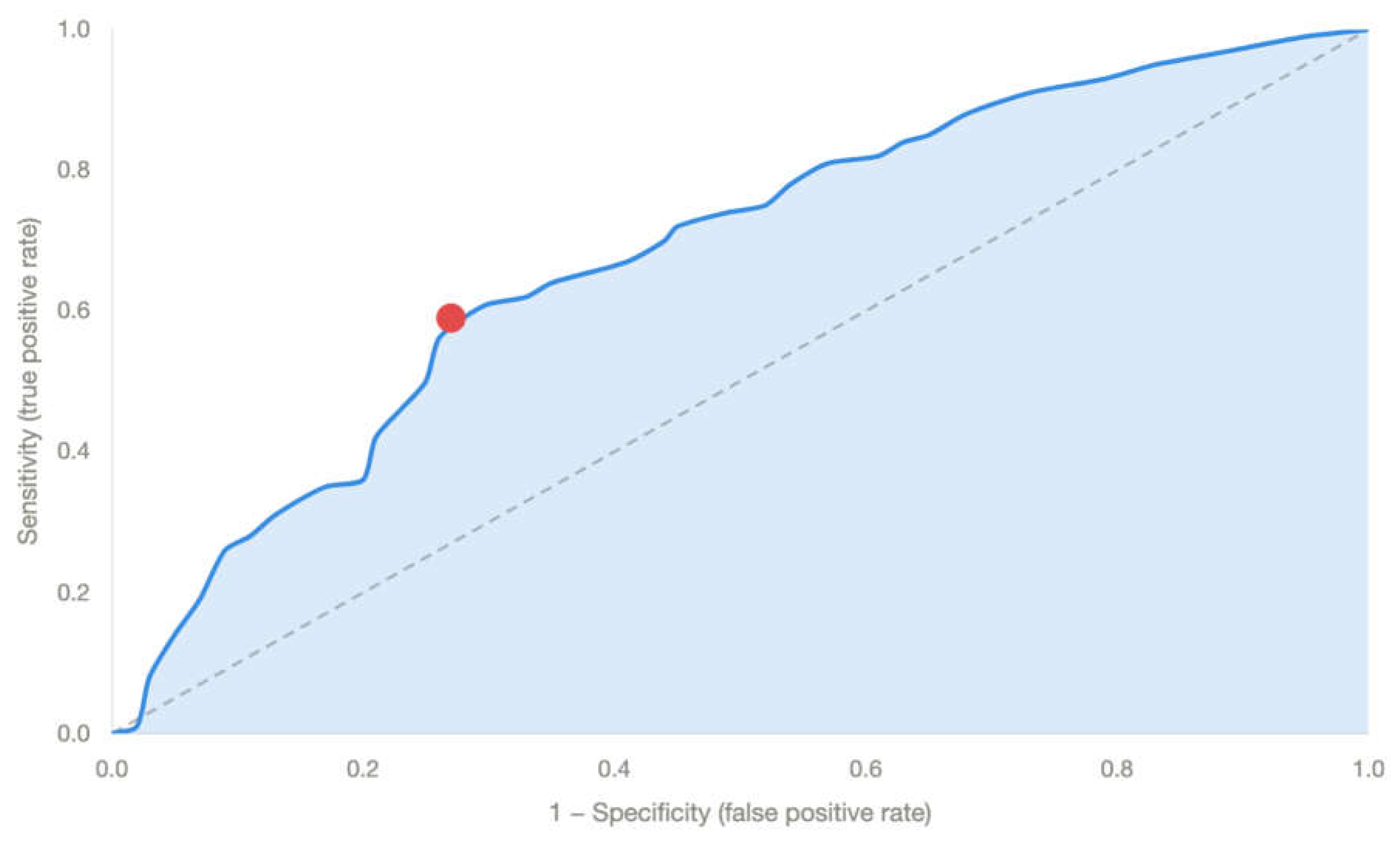
Figure 2.
High-flow nasal oxygen and desaturation during deep sedation for colonoscopy in a high-risk population (propensity-matched cohort) Primary outcome in the propensity-matched cohort (71 pairs). (A) Desaturation rate (SpO2 < 90% at any time) in the high-flow nasal oxygen (HFNO) and control groups, with the matched-pair odds ratio (McNemar). ARR = absolute risk reduction, in percentage points. (B) Concordance (2×2) table of matched pairs; orange cells denote discordant pairs, which determine the matched-pair odds ratio (8/15 = 0.53). (C) Odds ratio estimates for the primary McNemar analysis (square) and the conditional logistic regression sensitivity analysis (diamond), with 95% confidence intervals on a logarithmic scale.
Figure 2.
High-flow nasal oxygen and desaturation during deep sedation for colonoscopy in a high-risk population (propensity-matched cohort) Primary outcome in the propensity-matched cohort (71 pairs). (A) Desaturation rate (SpO2 < 90% at any time) in the high-flow nasal oxygen (HFNO) and control groups, with the matched-pair odds ratio (McNemar). ARR = absolute risk reduction, in percentage points. (B) Concordance (2×2) table of matched pairs; orange cells denote discordant pairs, which determine the matched-pair odds ratio (8/15 = 0.53). (C) Odds ratio estimates for the primary McNemar analysis (square) and the conditional logistic regression sensitivity analysis (diamond), with 95% confidence intervals on a logarithmic scale.
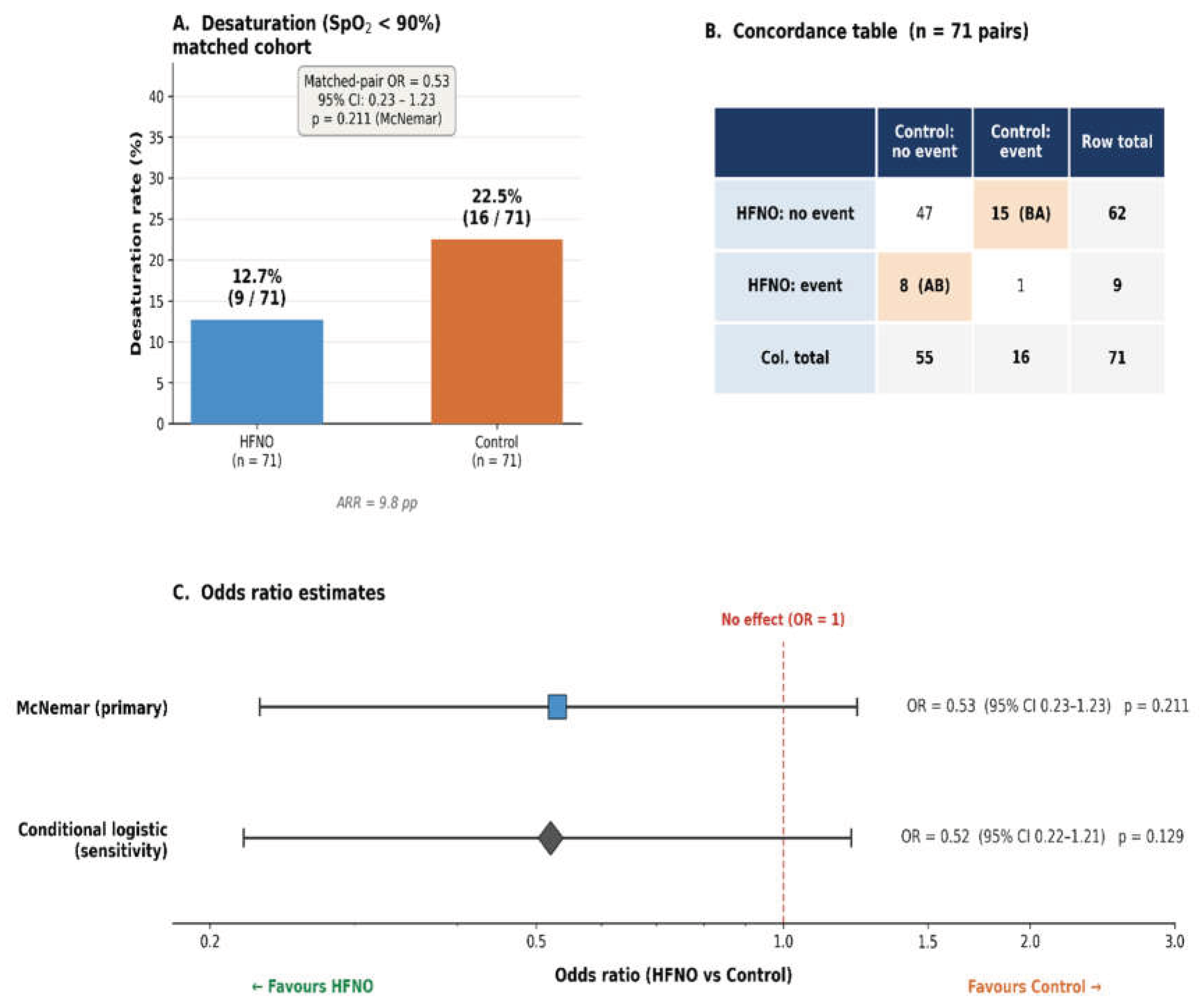

Table 1.
Baseline characteristics and primary outcome of the study population before and after propensity score matching, stratified by oxygen delivery device.
Table 1.
Baseline characteristics and primary outcome of the study population before and after propensity score matching, stratified by oxygen delivery device.
| Variable | Pre-matching (n = 200) | Post-matching (n = 142) | ||||||
|---|---|---|---|---|---|---|---|---|
| HFNO (n=100) | Control (n=100) | p-value | SMD | HFNO (n=71) | Control (n=71) | p-value | SMD | |
| Continuous variables | — | — | — | — | — | — | — | — |
| Age, years | 63.6 (11.5) | 63.3 (10.9) | 0.870 | 0.023 | 63.6 (11.4) | 62.8 (11.1) | 0.671 | 0.071 |
| Body weight, kg | 83.2 (13.6) | 83.6 (15.2) | 0.852 | 0.026 | 82.0 (13.2) | 84.7 (16.1) | 0.276 | 0.183 |
| BMI, kg/m2 | 30.5 (4.6) | 30.3 (4.9) | 0.765 | 0.043 | 30.5 (4.8) | 30.7 (4.9) | 0.795 | 0.044 |
| Baseline SpO2, % | 99.1 (1.5) | 99.3 (1.2) | 0.301 | 0.147 | 98.9 (1.7) | 99.4 (1.1) | 0.095 | 0.282 |
| Categorical variables | — | — | — | — | — | — | — | — |
| Male sex, n (%) | 29 (29.0) | 36 (36.0) | 0.365 | 0.150 | 25 (35.2) | 25 (35.2) | 1.000 | 0.000 |
| Pre-existing pulm. disease, n (%) | 8 (8.0) | 16 (16.0) | 0.128 | 0.248 | 8 (11.3) | 6 (8.5) | 0.778 | 0.095 |
| ASA physical status | — | — | — | — | — | — | — | — |
| ASA I | 0 (0.0) | 2 (2.0) | 0.477 | 0.202 | 0 (0.0) | 2 (2.8) | 0.476 | 0.241 |
| ASA II | 34 (34.0) | 43 (43.0) | 0.245 | 0.186 | 26 (36.6) | 32 (45.1) | 0.393 | 0.173 |
| ASA III | 60 (60.0) | 50 (50.0) | 0.201 | 0.202 | 41 (57.7) | 34 (47.9) | 0.313 | 0.198 |
| ASA IV | 6 (6.0) | 5 (5.0) | 1.000 | 0.044 | 4 (5.6) | 3 (4.2) | 1.000 | 0.065 |
| Procedure indication | — | — | — | — | — | — | — | — |
| Moderate-severe OSA | 0 (0.0) | 3 (3.0) | 0.245 | 0.249 | 0 (0.0) | 2 (2.8) | 0.476 | 0.241 |
| OSA treated with CPAP | 33 (33.0) | 15 (15.0) | 0.005 | 0.431 | 13 (18.3) | 14 (19.7) | 1.000 | 0.036 |
| STOP-BANG score ≥ 5 | 33 (33.0) | 37 (37.0) | 0.657 | 0.084 | 29 (40.8) | 30 (42.3) | 1.000 | 0.029 |
| STOP-BANG score ≥ 2 + male sex | 11 (11.0) | 9 (9.0) | 0.814 | 0.067 | 6 (8.5) | 7 (9.9) | 1.000 | 0.049 |
| STOP-BANG score ≥ 2 + BMI > 35 | 2 (2.0) | 2 (2.0) | 1.000 | 0.000 | 2 (2.8) | 2 (2.8) | 1.000 | 0.000 |
| STOP-BANG score ≥ 2 + neck circumference | 4 (4.0) | 7 (7.0) | 0.535 | 0.132 | 4 (5.6) | 3 (4.2) | 1.000 | 0.065 |
| STOP-BANG score ≥ 2 + age > 50 years | 17 (17.0) | 27 (27.0) | 0.124 | 0.243 | 17 (23.9) | 13 (18.3) | 0.537 | 0.138 |
| Primary outcome | — | — | — | — | — | — | — | — |
| Desaturation, n (%) | 11 (11.0) | 19 (19.0) | 0.166 | 0.225 | 9 (12.7) | 16 (22.5) | 0.186 | 0.261 |
Continuous variables: mean (SD); categorical variables: n (%). SMD: standardised mean difference. SMD < 0.10: adequate balance; SMD ≥ 0.10: residual imbalance (shown in red). HFNO: high-flow nasal oxygen. SMD values in red indicate residual imbalance (SMD ≥ 0.10).
Table 2.
Post-hoc power analysis for the McNemar test.
| Matched pairs (N) | Discordant pairs (est.) | Power | Expected p-value |
Interpretation |
|---|---|---|---|---|
| 71 | 23 | 30.8% | 0.211 | ← Current study (underpowered) |
| 100 | 32 | 41.0% | 0.120 | |
| 120 | 39 | 47.5% | 0.082 | |
| 150 | 49 | 56.4% | 0.048 | ← Significance threshold (p < 0.05) |
| 175 | 57 | 63.0% | 0.031 | |
| 200 | 65 | 68.8% | 0.020 | |
| 265 | 86 | 80.5% | 0.007 | ← Recommended minimum (80% power) |
| 355 | 115 | 90.4% | 0.002 | ← 90% power |
| 500 | 162 | 97.2% | < 0.001 |
Estimated statistical power and projected p-value as a function of the number of matched pairs, assuming a constant discordant-pair proportion of 32.4% and an odds ratio of 0.53 (observed). α = 0.05 (two-tailed).Assumptions: proportion of discordant pairs = 32.4% (observed); OR = 0.53 (observed). Power estimated using the McNemar one-sample test approximation.
Disclaimer/Publisher’s Note: The statements, opinions and data contained in all publications are solely those of the individual author(s) and contributor(s) and not of MDPI and/or the editor(s). MDPI and/or the editor(s) disclaim responsibility for any injury to people or property resulting from any ideas, methods, instructions or products referred to in the content. |
© 2026 by the authors. Licensee MDPI, Basel, Switzerland. This article is an open access article distributed under the terms and conditions of the Creative Commons Attribution (CC BY) license (http://creativecommons.org/licenses/by/4.0/).
Copyright: This open access article is published under a Creative Commons CC BY 4.0 license, which permit the free download, distribution, and reuse, provided that the author and preprint are cited in any reuse.