

Submitted:
31 August 2026
Posted:
31 August 2026
You are already at the latest version
Abstract
This review proposes a new life-course nutritional hypothesis generated from Okinawa’s unique postwar history and changing longevity advantage relative to mainland Japan. After World War II, Okinawa underwent rapid socioeconomic and dietary change and experienced a nutrition transition earlier than mainland Japan. During subsequent decades, Okinawa developed a marked relative longevity advantage, which later diminished as longevity in mainland Japan continued to improve. We propose that this pattern may partly reflect differences in the timing and sequence of life-course nutritional environments. Older Okinawan cohorts experienced an initially relatively Lean nutritional environment followed by postwar nutritional enrichment, approximating a Lean-to-Rich trajectory. Comparable trajectories may have emerged later in mainland Japan, potentially contributing to national catch-up, while progressively younger Okinawan cohorts experienced the post-transition environment from earlier life stages, increasingly approximating a Rich-to-Rich trajectory. We therefore propose the Lean-to-Rich Healthy Aging Hypothesis, distinguishing three conceptual trajectories: persistent relative nutritional restraint (Lean-to-Lean), transition from an initially Lean to a subsequently Rich nutritional environment (Lean-to-Rich), and prolonged nutritional abundance (Rich-to-Rich). We hypothesize that Lean-to-Rich may be more favorable for healthy longevity than either persistent Lean-to-Lean or prolonged Rich-to-Rich. The hypothesis does not specify the optimal timing, magnitude, duration, or composition of the transition, and available ecological evidence cannot distinguish a sequence effect from cumulative Rich exposure. Rather than establishing causality, this framework generates testable predictions concerning how the sequence and duration of nutritional environments across the life course may influence healthy longevity.
Keywords:
Okinawa
; longevity
; healthy aging
; nutrition transition
; life-course nutrition
; nutritional trajectory
; body mass index
; cohort effect
1. Introduction
Okinawa has long been recognized internationally as a region of exceptional longevity. Older Okinawan generations, particularly those born before World War II, have exhibited low mortality and a high prevalence of survival to advanced age[1,2].
The traditional Okinawan diet, historically characterized by relatively low energy intake and a high proportion of plant-derived foods, has frequently been proposed as one contributor to this longevity phenotype[2]. Long-term analyses of older Okinawan cohorts have documented relatively low caloric intake, low body mass index, low mortality from age-related diseases, and survival patterns consistent with extended longevity[2].
Other potential contributors include genetic and familial factors, physical activity, and broader lifestyle and psychosocial characteristics[3,4,5]. Studies from the Okinawa Centenarian Study have demonstrated a strong familial component to exceptional longevity, while traditional Okinawan lifestyles have also been characterized by regular physical activity and other potentially favorable health behaviors.
However, the historical pattern of Okinawan longevity is more complex than a simple narrative of persistent exceptional longevity. Evidence regarding the prewar period is limited and methodologically heterogeneous. Poulain and Herm concluded that available prewar life tables did not demonstrate a clear and consistent longevity advantage for Okinawa relative to mainland Japan[1]. Direct examination of the historical prefectural life tables compiled by Mizushima, which cover multiple periods between 1921 and 1956, indicates that the historical evidence should be considered in terms of period- and sex-specific variation rather than as a simple binary distinction between the presence or absence of an Okinawan longevity advantage[6]. This issue is examined in greater detail in Section 4.1. Accordingly, the present hypothesis does not depend on whether Okinawa had already established a longevity advantage before World War II.
A more methodologically consistent picture is available from the official Prefectural Life Tables of the Ministry of Health, Labour and Welfare from 1975 onward[7]. These data reveal a striking postwar trajectory in Okinawa’s longevity relative to Japan as a whole.
Among men, the difference in life expectancy at birth between Okinawa and the national average increased from +0.36 years in 1975 to +1.39 years in 1985, but subsequently declined, became negative around 2000, and reached −0.76 years in 2020. Among women, the corresponding advantage increased from +1.95 years in 1975 to +2.95 years in 1985 and then progressively narrowed to +0.28 years by 2020[7].
Importantly, the loss of this relative advantage did not reflect a simple decline in absolute longevity in Okinawa. Okinawan life expectancy continued to increase, but improvements elsewhere in Japan increasingly matched or exceeded those in Okinawa[7]. Thus, the postwar Okinawan experience is characterized not simply by a decline in longevity, but by the emergence, amplification, and subsequent convergence of a relative longevity advantage.
2. Okinawa’s Earlier Postwar Nutrition Transition
The temporal pattern shown in Figure 1 becomes particularly intriguing when considered alongside Okinawa’s distinctive postwar nutritional history. Following World War II, Okinawa remained under U.S. administration from 1945 until 1972 and experienced rapid socioeconomic and dietary change [8]. Food availability expanded, imported foods became increasingly accessible, and consumption of meat, animal products, oils, and other foods characteristic of the postwar nutritional environment increased[8].
Importantly, this nutritional transformation occurred earlier in Okinawa than in mainland Japan. Historical dietary data summarized by Todoriki and colleagues indicate that the increase in the proportion of total dietary energy derived from fat preceded the corresponding national transition by approximately a decade[8]. The fat-energy ratio should not be interpreted as the causal exposure itself; rather, it provides a measurable historical marker of a broader transition involving food availability, dietary composition, and nutritional abundance.
This temporal gap is central to the present hypothesis. Because Okinawa entered the post-transition nutritional environment earlier, people of the same birth cohort in Okinawa and mainland Japan could experience different nutritional sequences. An Okinawan born before the transition could spend a substantial period in a relatively Lean nutritional environment and subsequently enter a Richer environment, whereas a mainland Japanese person of the same birth cohort could remain in the earlier nutritional environment for longer. Conversely, later-born Okinawans would encounter the post-transition environment from progressively earlier stages of life, while comparable mainland cohorts could retain a longer preceding Lean period.
Thus, the Okinawa–mainland difference was not merely a difference in diet at a particular point in time. It created a time lag in life-course nutritional trajectories across successive birth cohorts.
When the longevity trajectory in Figure 1 is considered together with the nutrition-transition time lag in Figure 2, a potentially informative historical pattern emerges. Okinawa underwent nutritional enrichment earlier than mainland Japan and subsequently developed a marked relative longevity advantage[7,8]. As mainland Japan later underwent a similar nutritional transition, this advantage progressively narrowed[7]. At the same time, successively younger Okinawan cohorts were exposed to the post-transition nutritional environment from increasingly earlier stages of life[8].
These parallel temporal patterns raise the possibility that the relevant exposure may not be simply a Lean or Rich nutritional state, but the sequence in which these environments are experienced. We therefore propose the Lean-to-Rich Healthy Aging Hypothesis, which is developed in the following section.
The central historical interpretation is twofold. First, because Okinawa underwent nutritional transition earlier, Lean-to-Rich trajectories may have emerged there before comparable trajectories became common in mainland Japan. This earlier emergence may have contributed to Okinawa’s initial relative longevity advantage. Second, as mainland Japan subsequently generated its own Lean-to-Rich cohorts, national longevity may have caught up, while younger Okinawan cohorts increasingly approximated Rich-to-Rich trajectories. These processes may together have contributed to the subsequent convergence in longevity between Okinawa and Japan as a whole.
This interpretation does not imply that nutrition alone caused the observed longevity trends, nor does it establish that Lean-to-Rich is superior to other nutritional trajectories. Rather, Okinawa’s unusual historical experience provides a setting in which differences in the timing of nutritional transition can be used to generate a testable life-course hypothesis.
Accordingly, this review examines two principal propositions: (1) whether Lean-to-Rich may be more favorable for healthy longevity than persistent Lean-to-Lean, and (2) whether Lean-to-Rich may be more favorable than prolonged Rich-to-Rich. We first consider the Okinawan historical evidence underlying each proposition and then examine independent epidemiological evidence relevant to their plausibility. We also consider competing explanations, including cumulative duration of Rich exposure and developmental mismatch under the developmental origins of health and disease (DOHaD) framework, and identify the evidence required to distinguish among these possibilities.
3. The Lean-to-Rich Healthy Aging Hypothesis
We propose three conceptual life-course nutritional trajectories.
Lean-to-Lean
Rich-to-Rich
Rich-to-Rich represents nutritional abundance beginning relatively early and continuing for a prolonged period.
Lean-to-Rich
Lean-to-Rich represents an initially relatively Lean nutritional environment followed by transition into a Richer nutritional environment.
We hypothesize that such a sequence may potentially combine advantages of the other two states: relatively low cumulative metabolic burden during the Lean phase, followed by greater nutritional adequacy and physiological reserve after transition to Rich.
The hypothesis can therefore be expressed as two propositions:
Lean-to-Rich > Lean-to-Lean?
and
Lean-to-Rich > Rich-to-Rich?
These are hypotheses, not established relationships.
Crucially, the hypothesis does not define when the transition should occur. It also does not specify its magnitude, speed, duration, or nutrient composition. Current historical data are insufficient to determine whether transition during childhood, adolescence, adulthood, middle age, or later life is optimal.
Likewise, “Rich” should not be equated with overnutrition. Nutritional enrichment may include greater availability of protein, fat, micronutrients, and energy without necessarily producing obesity.
The proposed framework concerns nutritional trajectory, not a prescription for deliberate restriction followed by weight gain.
Figure 3.
The Lean-to-Rich Healthy Aging Hypothesis.
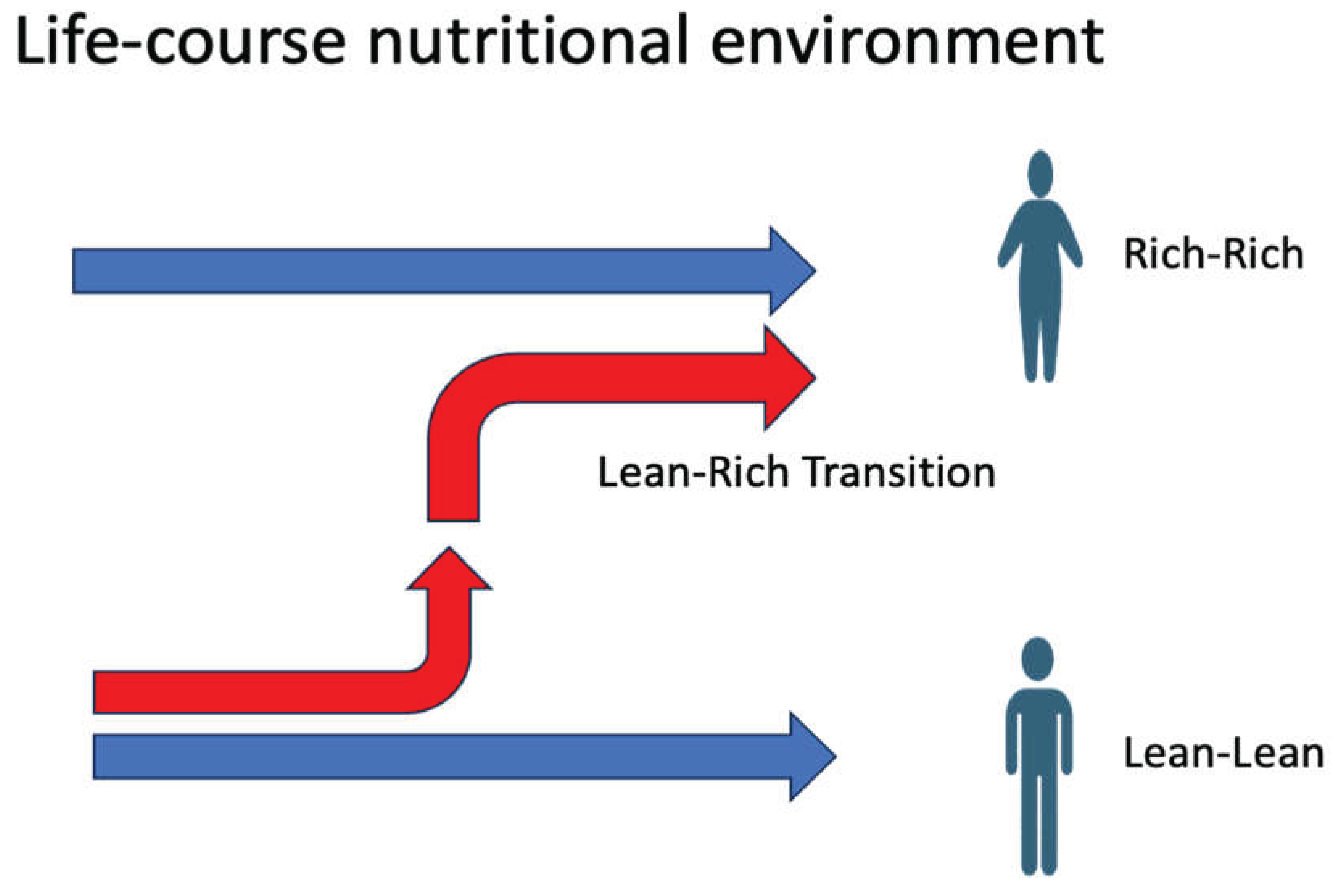
Three conceptual life-course nutritional trajectories are proposed: Lean-to-Lean, Lean-to-Rich, and Rich-to-Rich. Lean-to-Lean represents persistent relative nutritional restraint, Rich-to-Rich represents prolonged exposure to nutritional abundance, and Lean-to-Rich represents an initially Lean nutritional environment followed by transition to a Rich nutritional environment. “Lean” and “Rich” refer to relative nutritional environments rather than body mass index, body size, or specific caloric thresholds. The hypothesis does not specify the optimal timing, magnitude, duration, rate, or nutritional composition of the transition. Lean-to-Rich is proposed as a potentially favorable trajectory for healthy longevity, but causal superiority over the other trajectories has not been established.
4. Why Might Lean-to-Rich Be More Favorable Than Lean-to-Lean?
4.1. The Okinawa–Mainland Historical Contrast
The first proposition asks whether remaining in a relatively Lean nutritional environment for longer is necessarily more favorable than transitioning from Lean to Rich.
The historical contrast between Okinawa and mainland Japan provides a hypothesis-generating observation. Because Okinawa underwent its postwar nutrition transition earlier, comparable birth cohorts in the two regions could experience different nutritional trajectories during the same historical period[8]. Older Okinawan cohorts who had spent substantial portions of their lives in a relatively Lean nutritional environment subsequently experienced nutritional enrichment, thereby approximating a Lean-to-Rich trajectory. In contrast, because the corresponding transition occurred later in mainland Japan, comparable mainland cohorts remained exposed to the earlier, relatively Lean nutritional environment for longer.
Thus, during the period when the postwar Okinawan longevity advantage emerged and increased, the regional contrast can be conceptualized approximately as:
Okinawa: earlier emergence of Lean-to-Rich trajectories
Mainland Japan: persistence of relatively more Lean-to-Lean trajectories
This temporal contrast is notable when considered alongside the official postwar life-table data. Okinawa’s relative longevity advantage increased during the early observation period and reached its maximum in 1985 in both sexes, before subsequently declining[7]. The timing does not establish that earlier nutritional enrichment caused the advantage. Nevertheless, the coexistence of an earlier nutrition transition and a subsequent relative longevity advantage is consistent with the possibility that transitioning from a Lean to a Richer nutritional environment may, under some conditions, be more favorable than remaining in a relatively Lean environment for longer.
The historical evidence before the modern official prefectural life-table series warrants a more nuanced interpretation. Poulain and Herm concluded that available prewar life tables did not demonstrate a clear and consistent longevity advantage for Okinawa relative to mainland Japan[1]. Direct examination of the historical prefectural life tables compiled by Mizushima, however, reveals a more heterogeneous pattern[6]. The historical tables include period- and sex-specific estimates in which Okinawa’s relative position varied substantially, with some estimates showing a favorable Okinawan life expectancy, particularly among women[6].
This observation does not necessarily conflict with Poulain and Herm’s broader conclusion. Favorable estimates in particular periods or sexes do not by themselves establish a consistent prewar Okinawan longevity advantage, and differences in data quality, registration completeness, and life-table methodology complicate direct comparisons across historical periods[1,6]. Rather, direct examination of the primary historical source suggests that the prewar pattern may be more heterogeneous—and in some periods more favorable to Okinawa—than a simple binary characterization of the presence or absence of a longevity advantage would imply.
Importantly, the present hypothesis does not require either the presence or absence of a prewar Okinawan longevity advantage. Its central historical basis is the postwar temporal contrast: Okinawa underwent nutritional transition earlier than mainland Japan[8], and its relative longevity advantage subsequently emerged, increased, peaked, and then converged toward the national level[7]. The prewar life tables therefore provide historical context rather than a necessary premise of the Lean-to-Rich framework.
Importantly, this comparison does not imply that persistent Lean exposure is intrinsically harmful. Nor does it establish that nutritional enrichment itself improves survival. Rather, it raises a narrower question: could a Lean-to-Rich nutritional sequence provide an advantage over remaining relatively Lean for a longer period?
Independent evidence from older-adult nutrition, body mass, mortality, and physiological reserve can then be considered to assess the plausibility of this proposition.
4.2. Evidence from Body Mass and Mortality in Older Adults
Independent epidemiological evidence provides additional plausibility.
A large meta-analysis by Winter and colleagues included 32 studies and 197,940 community-dwelling adults aged 65 years and older[14]. Compared with a BMI of 23.0–23.9 kg/m², mortality increased progressively at lower BMI levels, whereas overweight was not associated with increased mortality. Specifically, mortality risk was already increased at BMI 21.0–21.9 and increased further at BMI 20.0–20.9[14].
In particular, BMI values within or near the conventionally defined normal range for younger adults were associated with increased mortality in older adults. The association was not substantially altered in several sensitivity analyses, although important concerns regarding reverse causation and smoking remain[14].
Other cohort studies and meta-analyses have similarly suggested that the BMI range associated with the lowest mortality may shift upward with age, with both low BMI and marked obesity associated with increased risk[14].
These findings do not prove that intentional weight gain improves survival, and BMI cannot be used as a direct proxy for nutritional trajectory. Reverse causation, chronic illness, smoking, selective survival, and differences in body composition remain important considerations[14].
Nevertheless, they challenge the assumption that the nutritional or body-reserve state associated with low metabolic burden earlier in life necessarily remains optimal indefinitely.
4.3. Nutritional and Physiological Reserve
Aging is associated with declining physiological reserve and increased vulnerability to malnutrition, dehydration, loss of muscle mass, and illness-related nutritional deterioration. Clinical nutrition guidelines therefore emphasize early identification of malnutrition risk and adequate nutritional intake in older persons[12]. The ESPEN guideline specifically recommends routine screening for malnutrition in older people and generally cautions against unnecessary dietary restriction; weight-reducing diets are recommended only selectively in obese older persons with weight-related health problems and in combination with physical exercise[12].
Under these circumstances, inadequate energy and protein availability may increase vulnerability to frailty, functional decline, and adverse clinical outcomes[11,12]. Adequate nutritional support is therefore considered an important component of maintaining nutritional status and function in older adults[12].
Thus, a Richer nutritional environment might become beneficial when it represents nutritional adequacy and physiological reserve, rather than chronic metabolic excess.
The first component of the Lean-to-Rich hypothesis therefore does not suggest that Lean is harmful. Instead, it proposes that the balance between metabolic restraint and physiological reserve may change over time.
Together, Okinawa’s historical trajectory and the wider aging literature support the possibility that:
Lean-to-Rich may be more favorable than persistent Lean-to-Lean.
However, this proposition remains indirect and requires individual-level testing.
5. Why Might Lean-to-Rich Be More Favorable Than Rich-to-Rich?
5.1. Birth Cohort × Regional Nutrition-Transition Timing
The approximately decade-long difference in nutrition-transition timing between Okinawa and mainland Japan creates a potentially informative interaction between birth cohort and region[8]. Older Okinawans born well before the postwar transition experienced a substantial period in a relatively Lean nutritional environment before entering the Richer postwar environment and therefore approximate a Lean-to-Rich trajectory. In contrast, successively younger Okinawan cohorts were exposed to the post-transition environment from progressively earlier stages of life and increasingly approximate a Rich-to-Rich trajectory.
Because the corresponding nutrition transition occurred later in mainland Japan, individuals of the same birth cohort could have experienced different nutritional sequences depending on region[8]. During an intermediate period, some birth cohorts may therefore have occupied a trajectory-mismatch zone: their Okinawan counterparts had already experienced prolonged exposure to the post-transition environment, whereas individuals of the same birth cohort in mainland Japan retained a longer preceding Lean period.
This framework generates a qualitative prediction. If Lean-to-Rich is more favorable than prolonged Rich-to-Rich exposure, the deterioration in Okinawa’s relative mortality should become particularly apparent among cohorts exposed to the Rich environment substantially earlier in Okinawa than in mainland Japan, whereas the regional difference should be smaller among older cohorts in whom both populations retained a substantial preceding Lean period.
Published age-specific mortality data are broadly concordant with this prediction. Poulain and Herm reported Okinawa-to-Japan mortality-rate ratios by 5-year age group from 1975 to 2020, based on data from the Japanese Mortality Database[1,15]. They observed that the least favorable relative mortality occurred in the youngest age group examined (50–54 years) and in the most recent periods, whereas the greatest relative advantage for Okinawa was observed at ages 80–89 years[1].
For descriptive illustration, the absolute differences between the published male Okinawa-to-Japan mortality-rate ratios in 1985—the year in which Okinawa’s overall longevity advantage peaked—and 2020 were derived directly from the values reported in Table 1 of Poulain and Herm[1]. The ratio increased from 0.867 to 1.391 at ages 50–54 years (Δ = +0.524) and from 0.906 to 1.341 at ages 55–59 years (Δ = +0.435). The corresponding differences were +0.284 at ages 60–64, +0.310 at ages 65–69, +0.165 at ages 70–74, +0.188 at ages 75–79, and +0.181 at ages 80–84 years. In contrast, at ages 85–89 years, the ratio changed only from 0.982 to 0.944 (Δ = −0.038). These descriptive differences were derived solely from the published values reported by Poulain and Herm[1]; no additional statistical modeling or inferential analysis was performed.
Thus, the deterioration in Okinawa’s relative mortality was greatest among the younger age groups examined and markedly attenuated among the oldest groups. This age gradient is concordant with the transition-timing framework: cohorts expected to have experienced the greatest regional contrast in the timing and duration of exposure to the post-transition nutritional environment showed the greatest deterioration in relative mortality, whereas older cohorts with a substantial preceding Lean period retained a more favorable relative pattern.
This concordance should be interpreted as post hoc and hypothesis-generating rather than confirmatory. The nutritional trajectories were inferred from population-level historical conditions rather than measured at the individual level, and the calculation cannot distinguish an effect of nutritional sequence from the cumulative duration of Rich exposure. Nevertheless, the quantitative age gradient provides a more specific empirical observation against which the birth-cohort × transition-timing framework can be evaluated.
5.2. Age-Specific Longevity Patterns in Official Life Tables
Official prefectural life tables provide a complementary observation[16]. In 2020, the relative position of Okinawa compared with the national average differed substantially by attained age.
Among men, remaining life expectancy in Okinawa exceeded the national average at older ages but was lower at younger ages. At age 75, remaining life expectancy was 12.93 years in Okinawa compared with 12.47 years nationally, and at age 65 it was 20.07 versus 19.89 years. In contrast, at age 40 it was 41.71 versus 42.43 years, and at age 20 it was 61.08 versus 61.84 years[16]. A similar age gradient was present among women, with the Okinawan advantage being more pronounced at older ages[16].
Rankings derived from the corresponding prefectural values illustrate the same pattern. Okinawan men ranked second nationally in remaining life expectancy at age 75 and 15th at age 65, but 43rd at both ages 20 and 40. Okinawan women ranked first at ages 65 and 75 but 15th at ages 20 and 40 [16] (authors’ calculations).
These age-specific differences should not be interpreted as direct evidence of nutritional cohort effects, because attained age, birth cohort, and period effects cannot be separated in a single cross-sectional life table. Nevertheless, the preservation of relative longevity among older Okinawans and its attenuation or reversal among younger groups is directionally consistent with the birth-cohort × nutrition-transition framework described above.
5.3. Independent Demographic Support from Poulain and Herm
Poulain and Herm provide important independent demographic evidence[1].
Their birth-cohort analyses demonstrate a pronounced generational divide in Okinawan mortality. Older prewar-born cohorts exhibited favorable mortality relative to mainland Japan, whereas this advantage progressively diminished among later-born cohorts and was eventually reversed among younger postwar generations[1].
They also discuss the rapid postwar nutrition transition, westernization, obesity, metabolic syndrome, and other changes as possible contributors to this generational divergence[1].
However, their work should not be interpreted as the source of the Lean-to-Rich hypothesis. The present framework originates from the regional timing gap in nutritional transition and asks whether the interaction between birth cohort and transition timing creates systematically different life-course nutritional trajectories.
Poulain and Herm’s data are therefore best viewed as independent evidence consistent with a prediction generated by this framework.
Their findings do not directly test Lean-to-Rich, nor do they compare Lean-to-Lean, Lean-to-Rich, and Rich-to-Rich trajectories.
5.4. Why Prolonged Rich Exposure Could Be Unfavorable
The Rich-to-Rich trajectory potentially carries greater cumulative metabolic burden. Longer exposure to abundant energy availability may increase the lifetime probability of obesity, insulin resistance, diabetes, hypertension, dyslipidemia, cardiovascular disease, and premature mortality[10,13].
Younger postwar Okinawan generations developed substantially greater levels of obesity and cardiometabolic risk than the older generations traditionally associated with exceptional longevity[8,17]. Mortality among younger and middle-aged Okinawan men also became less favorable relative to national values[18].
This pattern is consistent with the possibility that a Rich environment may be beneficial when it follows a Lean phase and provides nutritional reserve, but less favorable when exposure begins earlier and persists for decades.
However, this leads to an important competing explanation.
6. Sequence or Cumulative Exposure? A Critical Alternative Explanation
6.1. Sequence Versus Cumulative Exposure
The cohort patterns described above do not uniquely establish an effect of nutritional sequence. A simpler alternative explanation is that they reflect the cumulative duration of exposure to a Rich nutritional environment. Because Okinawa underwent nutritional transition earlier, younger Okinawan cohorts necessarily accumulated longer exposure to the post-transition environment than comparable mainland cohorts[8].
Thus, two related but distinct explanations are compatible with the available observations. Under the sequence hypothesis, a preceding Lean period followed by transition to Rich confers an advantage beyond that attributable to the duration of Rich exposure itself. Under the cumulative-exposure hypothesis, the preceding Lean period has no independent effect; the observed pattern reflects primarily the metabolic consequences of longer exposure to nutritional abundance. The distinction between accumulation, timing, and life-course exposure patterns is well established in life-course epidemiology[19,20].
These mechanisms are intrinsically correlated in the Okinawan historical setting because earlier transition simultaneously shortens the preceding Lean period and lengthens subsequent Rich exposure. Ecological data therefore cannot separate them. Available population-level indicators such as secular changes in body weight, obesity, diabetes, or other metabolic outcomes may help characterize the cumulative burden associated with the post-transition environment[8,17], but they cannot independently identify a sequence effect because the timing of transition determines both the duration of subsequent Rich exposure and the length of the preceding Lean period. We therefore do not attempt to distinguish these mechanisms quantitatively using the available ecological data.
A critical future test will be whether a preceding Lean period predicts healthy longevity after the duration and intensity of subsequent Rich exposure are accounted for. Individual-level longitudinal cohorts, migrant populations experiencing nutritional transition at different ages, sibling or family comparisons spanning periods of rapid nutritional change, and cross-population natural experiments may provide opportunities to distinguish these models[19,20]. Particularly informative would be comparisons among individuals or populations with similar cumulative Rich exposure but different durations or intensities of preceding Lean exposure. Persistence of an association with the preceding Lean phase under such conditions would provide evidence more specific to the sequence hypothesis.
6.2. Relation to DOHaD and the Developmental Mismatch Hypothesis
At first sight, the Lean-to-Rich hypothesis may appear to conflict with the developmental origins of health and disease (DOHaD) framework and the related thrifty-phenotype hypothesis. These established concepts propose that nutritional constraint during fetal or early postnatal development followed by greater nutritional abundance may create a developmental mismatch that increases later cardiometabolic risk[21,22,23].
The Lean-to-Rich hypothesis should therefore not be interpreted as proposing that fetal, infant, or early-childhood nutritional deprivation followed by nutritional abundance is beneficial. The historical Okinawan observations underlying the present hypothesis concern a substantially broader and apparently later life-course exposure window. The older cohorts that subsequently exhibited the strongest longevity advantage had spent childhood, adolescence, and a substantial portion of adulthood before the major postwar nutritional transition, whereas later-born cohorts encountered the changing postwar food environment at progressively younger ages[1,8].
This generational pattern is noteworthy because it provides no evidence that an early developmental Lean-to-Rich transition is beneficial. If anything, the loss of Okinawa’s mortality advantage among progressively later-born cohorts is compatible with the possibility that transition during earlier developmental periods may have different, and potentially adverse, consequences[1].
Thus, the apparent contrast between Lean-to-Rich and DOHaD may reflect differences in exposure window rather than opposing biological principles. DOHaD primarily concerns nutritional programming during developmental critical periods and subsequent disease risk[22,23], whereas the present hypothesis asks whether a later transition between nutritional environments may influence overall healthy longevity through a balance between cumulative metabolic burden and later nutritional or physiological reserve.
The Okinawan historical evidence does not identify an optimal age for such a transition. It does, however, caution against extrapolating the proposed Lean-to-Rich advantage to fetal or early-childhood undernutrition. Determining whether there is an age or developmental boundary below which Lean-to-Rich becomes unfavorable rather than favorable represents an important and testable extension of the hypothesis.
7. A Unified Interpretation of Okinawa’s Rise and Loss of Longevity Advantage
The preceding observations allow a single conceptual model to be proposed.
Phase 1: Emergence of the Okinawan Advantage
Okinawa underwent its nutrition transition earlier than mainland Japan[8]. Older Okinawan cohorts experienced a relatively Lean nutritional environment followed by postwar nutritional enrichment, thereby approximating a Lean-to-Rich trajectory. Comparable mainland cohorts, in contrast, remained in a relatively Lean nutritional environment for longer.
If Lean-to-Rich is more favorable than persistent Lean-to-Lean, the earlier emergence of Lean-to-Rich cohorts in Okinawa could have contributed to a temporary relative longevity advantage. This interpretation is consistent with the period during which the Okinawa–Japan life-expectancy difference increased and eventually reached its maximum[7].
Phase 2: Mainland Japan Catches Up
Mainland Japan subsequently underwent its own nutrition transition[8]. Cohorts that had previously remained in a relatively Lean nutritional environment increasingly experienced nutritional enrichment, thereby generating Lean-to-Rich trajectories with a temporal lag relative to Okinawa.
If this trajectory is favorable, the later emergence of Lean-to-Rich cohorts in mainland Japan could have contributed to improvements in mortality and life expectancy and, consequently, to narrowing of the earlier Okinawan advantage. This interpretation is consistent with the observation that Okinawa’s absolute life expectancy continued to increase even while its relative advantage over the national average declined[7].
Phase 3: Rich-to-Rich Cohorts Emerge in Okinawa
Meanwhile, successively younger Okinawan birth cohorts experienced progressively less of the earlier Lean nutritional environment and increasingly prolonged exposure to the post-transition environment[8]. Their life-course nutritional trajectories therefore increasingly approximated Rich-to-Rich rather than Lean-to-Rich.
The convergence may therefore reflect three concurrent processes: a declining contribution of Lean-to-Rich cohorts in Okinawa, an increasing contribution of Lean-to-Rich cohorts in mainland Japan, and the emergence of increasingly Rich-to-Rich cohorts in Okinawa. Together, these processes could contribute to the observed convergence in longevity.
This unified framework differs from an interpretation in which the loss of Okinawa’s longevity advantage is attributed simply to “westernization.” Westernization may indeed have contributed to unfavorable health trends in younger Okinawan generations[1,8], but the present hypothesis adds a temporal and life-course dimension: the same broad nutritional enrichment may have different consequences depending on the nutritional environment that preceded it and the stage of life at which it occurred.
Thus, the rise and subsequent loss of Okinawa’s relative longevity advantage may represent two phases of the same underlying historical process rather than two unrelated phenomena. The earlier nutrition transition initially created a temporal advantage in the emergence of Lean-to-Rich trajectories in Okinawa; later, the corresponding transition in mainland Japan reduced this difference, while increasingly prolonged Rich exposure emerged among younger Okinawan cohorts.
This life-course formulation represents the principal theoretical contribution of the Lean-to-Rich Healthy Aging Hypothesis.
8. Alternative Explanations and Limitations
Several important limitations should be considered when interpreting the Lean-to-Rich Healthy Aging Hypothesis.
First, the evidence underlying the hypothesis is primarily historical and ecological. Individual nutritional trajectories were not measured across the life course. Classification of populations or birth cohorts as approximating Lean-to-Lean, Lean-to-Rich, or Rich-to-Rich trajectories is therefore based on the nutritional environments prevailing during different historical periods rather than on directly observed individual exposures. Considerable heterogeneity in diet, socioeconomic conditions, body composition, and metabolic health undoubtedly existed within each cohort. Accordingly, associations observed at the population level cannot be assumed to apply directly to individuals[19,24].
Second, Okinawa’s postwar nutrition transition occurred simultaneously with profound changes in many other determinants of health and survival. Medical care, sanitation, infectious disease control, education, income, housing, transportation, occupational patterns, physical activity, smoking, alcohol consumption, reproductive patterns, and social structure all changed during the same period[1,8]. U.S. administration of Okinawa from 1945 to 1972 also created distinctive socioeconomic, cultural, food-environmental, and health-care conditions[8]. These factors could independently generate or modify regional and sex-specific mortality patterns. The temporal correspondence between nutritional transition and longevity trends therefore cannot establish that nutrition was the principal causal determinant, or that nutritional sequence provides a better explanation than these competing factors.
Third, the comparison between Okinawa and mainland Japan should not be regarded as a controlled natural experiment. The approximately decade-long difference in nutrition-transition timing provides an informative historical contrast[8], but the two populations differed in many respects other than nutrition. The regional time lag should therefore be regarded as a hypothesis-generating historical circumstance rather than an instrumental or quasi-randomized exposure.
Fourth, nutrition transition itself is multidimensional. The fat-energy ratio provides a useful and relatively well-documented historical indicator of the transition in Okinawa and mainland Japan[8], but it cannot capture the full complexity of nutritional change. Total energy intake, protein intake, carbohydrate quality, micronutrient adequacy, food processing, dietary diversity, animal- versus plant-derived foods, and patterns of physical activity changed concurrently[8]. Accordingly, “Lean” and “Rich” in the present framework represent relative nutritional environments and should not be interpreted as specific thresholds of fat intake, energy intake, or body mass index.
Fifth, the use of life expectancy at birth in Figure 1 requires particular caution. Life expectancy at birth incorporates mortality across the entire age distribution, including infant and childhood mortality[25]. Regional differences in the pace of improvement in early-life mortality could therefore have contributed to changes in the Okinawa–Japan life-expectancy gap independently of adult nutritional trajectories. Although the age-specific mortality and remaining-life-expectancy patterns discussed in Section 5 provide complementary evidence at older ages, they do not quantify the contribution of early-life mortality to the expansion of Okinawa’s relative advantage between 1975 and 1985. Age-decomposition analyses of the Okinawa–Japan life-expectancy difference would be required to determine how much of the historical change arose from mortality at different ages[26].
Sixth, the markedly different longevity trajectories in men and women indicate that nutritional sequence alone cannot explain the Okinawan pattern. In the official life-table series, the male Okinawan advantage disappeared around 2000 and became increasingly negative thereafter, whereas women retained a small positive advantage through 2020[7]. Sex differences in smoking, alcohol consumption, obesity, occupational exposures, health-care utilization, and cardiometabolic risk may have modified the consequences of nutritional and socioeconomic transition[1,8]. The Lean-to-Rich framework should therefore be regarded as one potential life-course component of the observed population pattern rather than a complete explanation of its sex-specific trajectories.
Seventh, historical life-expectancy estimates before the establishment of the modern official prefectural life-table series require caution. Direct examination of the historical prefectural life tables compiled by Mizushima, which cover multiple periods between 1921 and 1956, indicates that the historical evidence should be considered in terms of period- and sex-specific variation rather than as a simple binary distinction between the presence or absence of an Okinawan longevity advantage[6]. Poulain and Herm concluded that available prewar life tables did not demonstrate a clear and consistent longevity advantage for Okinawa relative to mainland Japan[1]. These interpretations are not necessarily contradictory: period- or sex-specific variation in the historical tables would not by itself establish a consistent prewar Okinawan longevity advantage. Differences in registration completeness, source data, and life-table methodology further limit direct comparisons between early estimates and modern life tables[1,6]. For this reason, the quantitative Okinawa–Japan comparison in Figure 1 is restricted to the official Prefectural Life Table series of the Ministry of Health, Labour and Welfare from 1975 onward[7]. Importantly, the Lean-to-Rich hypothesis does not depend on the assumption that Okinawa either did or did not possess a longevity advantage before World War II.
Eighth, the age-specific differences in remaining life expectancy observed in contemporary Okinawan life tables should not automatically be interpreted as birth-cohort effects. In 2020, Okinawa retained a more favorable relative position at older ages than at younger ages[16], but a cross-sectional life table cannot separate age, period, and cohort effects[27]. These age gradients are therefore considered observations consistent with, rather than evidence proving, the proposed birth-cohort × nutrition-transition framework. Formal birth-cohort analyses provide stronger supporting evidence but remain observational[1].
Ninth, historical claims of exceptional survival to extreme ages may be sensitive to age validation and the completeness of vital registration[28]. Such concerns are particularly relevant to studies based on counts of centenarians or exceptionally old individuals. However, the principal quantitative observations used in the present framework derive from official prefectural life tables and age-specific mortality-rate data rather than from centenarian or supercentenarian counts[7]. Concerns regarding extreme-age validation therefore do not directly invalidate the analyses presented here, although they warrant caution when the broader Okinawan longevity literature is interpreted.
Tenth, evidence from BMI and mortality studies in older adults should also be interpreted cautiously. The association between low BMI and increased mortality may partly reflect reverse causation from chronic disease, smoking, selective survival, loss of muscle mass, or other confounding factors[10,14]. Moreover, BMI does not distinguish adipose tissue from lean mass and cannot be regarded as a direct measure of nutritional adequacy[29]. These studies therefore support only the broader proposition that persistent nutritional restraint or low physiological reserve may not remain optimal throughout the life course; they do not directly demonstrate a benefit of transitioning from Lean to Rich.
Eleventh, as discussed in Section 6, the available ecological evidence cannot distinguish the proposed effect of nutritional sequence from the cumulative duration of exposure to a Rich environment. Earlier nutritional transition simultaneously shortens the preceding Lean period and lengthens subsequent Rich exposure, making the two mechanisms intrinsically correlated in the Okinawan historical setting. This is a central limitation of the present framework rather than a conventional residual-confounding issue. Demonstrating an independent sequence effect will require individual-level longitudinal or natural-experimental data in which preceding Lean exposure and the duration and intensity of subsequent Rich exposure can be separated[19,20].
Twelfth, the proposed Lean-to-Rich trajectory should not be extrapolated to nutritional deprivation during fetal life or early childhood. As discussed in relation to the DOHaD and developmental mismatch frameworks, nutritional constraint during developmental critical periods followed by subsequent abundance may increase later cardiometabolic risk[21,22,23]. The Okinawan observations underlying the present hypothesis do not establish a benefit of such early-life mismatch. Rather, the cohorts displaying favorable later-life mortality experienced substantial portions of their lives before the major postwar nutrition transition[1,8]. The optimal age or developmental window for a potentially favorable Lean-to-Rich transition therefore remains unknown.
Thirteenth, the hypothesis does not specify the optimal timing, magnitude, rate, duration, or nutritional composition of the transition. This lack of specification reflects the limits of the available historical evidence rather than evidence that all transitions are equivalent. Effects of nutritional enrichment may vary according to age, sex, baseline nutritional status, genetic background, physical activity, body composition, and the specific nutrients or foods involved. A favorable transition, if it exists, may therefore represent a range of trajectories rather than a single universal pattern.
Finally, the three proposed trajectories—Lean-to-Lean, Lean-to-Rich, and Rich-to-Rich—are conceptual archetypes rather than discrete biological categories. Actual life-course nutritional histories are continuous, multidimensional, and heterogeneous. An individual may be relatively Lean with respect to energy availability but Rich in protein or micronutrients, whereas another may consume abundant energy but remain nutritionally deficient in other respects. Future studies should therefore operationalize these trajectories using repeated measures of diet, body composition, metabolic status, and functional reserve rather than assigning individuals to categories based solely on historical period, geographic location, or BMI.
Taken together, these limitations preclude causal inference from the current evidence. However, they also help define the conditions under which the Lean-to-Rich Healthy Aging Hypothesis can be tested and potentially falsified. The present framework should therefore be regarded not as evidence that Lean-to-Rich is an established optimal nutritional trajectory, but as a hypothesis generated from Okinawa’s unusual historical experience that warrants evaluation using individual-level life-course data, age-specific mortality analyses, and comparisons across populations with differing timings of nutritional transition.
9. Testing the Lean-to-Rich Hypothesis
The Lean-to-Rich Healthy Aging Hypothesis generates several testable predictions and should be evaluated against alternative life-course models rather than solely by seeking observations consistent with it.
First, longitudinal studies should reconstruct individual nutritional trajectories rather than relying on single dietary or BMI measurements. Repeated information on diet, body composition, physical activity, metabolic status, and socioeconomic conditions would allow Lean-to-Lean, Lean-to-Rich, and Rich-to-Rich trajectories to be modeled directly[19,20]. The central prediction is that individuals who experience a substantial Lean period followed by nutritional enrichment will exhibit more favorable healthy-aging outcomes than individuals who remain persistently Lean or experience prolonged Rich exposure, provided that major confounding factors are adequately addressed.
Second, analyses should explicitly compare sequence models with accumulation models[19,20]. A critical test is whether a preceding Lean period predicts better outcomes after the duration and intensity of subsequent Rich exposure are accounted for. Conversely, the sequence hypothesis would be weakened if the preceding Lean period showed no independent association with healthy longevity after cumulative Rich exposure and relevant confounders were controlled. If outcomes were explained entirely by the duration or intensity of Rich exposure irrespective of the preceding nutritional environment, an accumulation model would be favored over the Lean-to-Rich sequence hypothesis.
Third, direct comparison of the proposed trajectories provides another falsification test. The hypothesis would be challenged if Rich-to-Rich trajectories consistently produced healthy-aging outcomes comparable to or more favorable than Lean-to-Rich trajectories across independent populations. Similarly, if persistent Lean-to-Lean trajectories were consistently associated with outcomes equal to or better than Lean-to-Rich after accounting for illness-related weight loss and other sources of reverse causation, the proposed advantage of transition would not be supported.
Fourth, migrant studies may be particularly informative. Individuals from the same source population who migrate to nutritionally richer environments at different ages effectively undergo environmental transition at different life stages. Migrant studies have long been used to examine how changes in environment and lifestyle modify chronic-disease risk among populations sharing related ancestral backgrounds[30,31]. Comparisons among migrants with similar durations of subsequent Rich exposure but different durations of preceding Lean exposure could help distinguish a sequence effect from cumulative exposure. Failure to observe any relationship between the preceding nutritional environment and healthy-aging outcomes under such conditions would argue against a sequence-specific effect.
Fifth, populations in East Asia and other regions that underwent rapid economic and nutritional development at different historical times provide an opportunity to test the transition-timing prediction generated from Okinawa. Nutrition transition has occurred at markedly different rates and historical periods across populations[32,33]. If the Lean-to-Rich hypothesis has broader validity, regions with earlier nutritional transitions should initially generate Lean-to-Rich cohorts sooner, followed later by increasing Rich-to-Rich exposure among younger cohorts, whereas regions undergoing later transitions should show corresponding cohort patterns with a temporal lag. Failure to observe such temporal displacement across populations with clearly different transition timings would weaken the proposed birth-cohort × transition-timing framework.
Sixth, the hypothesis should be tested against outcomes beyond total mortality, including disability-free survival, frailty, sarcopenia, cardiovascular disease, diabetes, cognitive impairment, and functional independence. Healthy aging is increasingly conceptualized in terms of maintaining functional ability rather than survival alone[34]. A nutritional trajectory that improves survival while substantially worsening disability or chronic disease would not necessarily support a Healthy Aging hypothesis. The appropriate endpoint should therefore ultimately incorporate both longevity and preserved function.
Taken together, the hypothesis would be most strongly supported if a preceding Lean nutritional environment predicted favorable healthy-aging outcomes independently of cumulative Rich exposure, if Lean-to-Rich trajectories outperformed both Lean-to-Lean and Rich-to-Rich trajectories, and if the predicted cohort patterns shifted temporally across populations according to the historical timing of nutritional transition. Conversely, failure of these predictions—particularly the absence of an independent sequence effect after cumulative exposure is accounted for—would favor simpler alternative explanations and would require modification or rejection of the Lean-to-Rich sequence hypothesis.
10. Lessons from Okinawa’s History for Future Healthy Aging
The history of Okinawa suggests that nutritional exposure should perhaps be considered dynamically rather than as a fixed state.
Much of nutrition research asks whether restriction or abundance is preferable, whether a particular BMI is optimal, or whether one dietary pattern is associated with longer life[9,10,14]. The Lean-to-Rich hypothesis poses a different question:
Could the nutritional environment that is favorable at one stage differ from the environment that is favorable after that stage?
The central proposition is therefore not:
Lean is better than Rich,
nor:
Rich is better than Lean.
Instead:
A transition from Lean to Rich may be more favorable than remaining in either nutritional state throughout the life course.
This idea may help reconcile apparently conflicting observations. Lower cumulative metabolic exposure may reduce cardiometabolic risk[9,10]. At the same time, adequate nutritional and physiological reserve may become increasingly important for resilience, muscle preservation, recovery from illness, and survival at older ages[12].
Lean-to-Rich potentially combines these two properties.
Whether it actually does so remains unknown.
Okinawa is particularly informative because its unusual postwar history produced a measurable temporal separation in nutritional transition from mainland Japan[8]. That separation may have made life-course differences visible at the population level.
The historical lesson should not therefore be interpreted as a recommendation to reproduce the traditional Okinawan diet or deliberately manipulate nutrition at a particular age. Instead, it suggests a general principle:
Healthy aging may depend not only on what nutritional environment is experienced, but also on the order and duration in which nutritional environments are experienced.
11. Conclusions
Okinawa’s exceptional longevity cannot be understood fully by assuming that its traditional Lean nutritional environment was uniformly beneficial or that subsequent nutritional enrichment was uniformly harmful. Okinawa underwent postwar nutritional enrichment earlier than mainland Japan[8], creating a temporal separation in life-course nutritional trajectories across successive birth cohorts. During the subsequent decades, Okinawa developed a marked relative longevity advantage, which later diminished as longevity elsewhere in Japan continued to improve and younger Okinawan generations experienced the post-transition nutritional environment from progressively earlier stages of life[1,7].
These historical observations suggest a unified interpretation. The earlier nutrition transition in Okinawa may have generated Lean-to-Rich cohorts before comparable trajectories became common in mainland Japan, potentially contributing to the emergence of Okinawa’s relative longevity advantage. The later emergence of Lean-to-Rich trajectories in mainland Japan may have contributed to national catch-up, while progressively younger Okinawan cohorts increasingly approximated Rich-to-Rich trajectories. Together, these processes may have contributed to the subsequent convergence in longevity between Okinawa and Japan as a whole.
We therefore propose the Lean-to-Rich Healthy Aging Hypothesis: a life-course trajectory beginning in a relatively Lean nutritional environment and subsequently transitioning to a Richer environment may be more favorable for healthy longevity than either persistent relative nutritional restraint or prolonged nutritional abundance.
The hypothesis does not define the optimal timing, magnitude, duration, or nutritional composition of this transition and should not be extrapolated to fetal or early-childhood nutritional deprivation followed by abundance[21,22,23]. Moreover, the available ecological evidence cannot distinguish an effect of nutritional sequence itself from that of cumulative duration of exposure to a Rich environment. These alternatives require direct testing using individual-level life-course data and natural experiments in which transition timing and exposure duration can be separated.
Rather than establishing causality, the proposed framework transforms Okinawa’s unusual historical experience into a series of testable predictions. Its principal contribution is to shift attention from whether a Lean or Rich nutritional environment is inherently favorable to whether the sequence and duration of nutritional environments across the life course influence healthy longevity. Although generated from Okinawa’s unique postwar history, the Lean-to-Rich Healthy Aging Hypothesis may provide a broader framework for understanding healthy aging in populations worldwide that have undergone nutritional transitions at different times and rates.
Author Contributions
Conceptualization, Y.O.; methodology, Y.O.; formal analysis, Y.O.; data curation, Y.O.; writing—original draft preparation, Y.O.; writing—review and editing, Y.O.; visualization, Y.O. The author has read and agreed to the published version of the manuscript.
Funding
This research received no external funding.
Institutional Review Board Statement
Not applicable. This study is based entirely on secondary analysis of previously published, publicly available, aggregated national and prefectural statistical data (e.g., life tables and mortality statistics from the Ministry of Health, Labour and Welfare, Japan) and did not involve the collection of new data from human participants.
Informed Consent Statement
Not applicable. This study did not involve human participants and used only publicly available, de-identified aggregate statistical data.
Data Availability Statement
Acknowledgments
During the preparation of this manuscript, the author used ChatGPT (OpenAI) for English-language editing, manuscript organization, and formatting assistance. The author reviewed and edited all AI-assisted output and takes full responsibility for the content of this publication.
Conflicts of Interest
The author declares no conflicts of interest.
References
- Poulain, M.; Herm, A. Exceptional Longevity in Okinawa: Demographic Trends since 1975. J. Intern. Med. 2024, 295, 387–399. [Google Scholar] [CrossRef]
- Willcox, B.J.; Willcox, D.C.; Todoriki, H.; Fujiyoshi, A.; Yano, K.; He, Q.; Curb, J.D.; Suzuki, M. Caloric Restriction, the Traditional Okinawan Diet, and Healthy Aging: The Diet of the World’s Longest-Lived People and Its Potential Impact on Morbidity and Life Span. Ann. N. Y. Acad. Sci. 2007, 1114, 434–455. [Google Scholar]
- Suzuki, M.; Willcox, B.J.; Willcox, C.D. Implications from and for Food Cultures for Cardiovascular Disease: Longevity. Asia Pac. J. Clin. Nutr. 2001, 10, 165–171. [Google Scholar] [CrossRef]
- Willcox, B.J.; Willcox, D.C.; He, Q.; Curb, J.D.; Suzuki, M. Siblings of Okinawan Centenarians Share Lifelong Mortality Advantages. J. Gerontol. A Biol. Sci. Med. Sci. 2006, 61, 345–354. [Google Scholar] [CrossRef]
- Willcox, B.J.; Willcox, D.C.; Suzuki, M. Demographic, Phenotypic, and Genetic Characteristics of Centenarians in Okinawa and Japan: Part 1-Centenarians in Okinawa. Mech. Ageing Dev. 2017, 165, 75–79. [Google Scholar] [CrossRef]
- Mizushima, H. Fukenbetsu Seimeihyo-Shu: Taisho 10-nen–Showa 31-Nen; Life Insurance Culture Research Institute: Osaka, Japan, 1961. [Google Scholar]
- Prefectural Life Tables: Trends in Life Expectancy by Prefecture; Ministry of Health, Labour and Welfare: Japan, 2022.
- Todoriki, H.; Willcox, D.C.; Willcox, B.J. The Effects of Post-War Dietary Change on Longevity and Health in Okinawa. Okinawan J. Am. Stud. 2004, 1, 52–61. [Google Scholar]
- Fontana, L.; Partridge, L. Promoting Health and Longevity through Diet: From Model Organisms to Humans. Cell 2015, 161, 106–118. [Google Scholar] [CrossRef]
- Global BMI Mortality Collaboration; Di Angelantonio, E.; Bhupathiraju, S.; Wormser, D.; Gao, P.; Kaptoge, S.; Berrington de Gonzalez, A.; Cairns, B.; Huxley, R.; Jackson, C.; et al. Body-Mass Index and All-Cause Mortality: Individual-Participant-Data Meta-Analysis of 239 Prospective Studies in Four Continents. Lancet 2016, 388, 776–786. [Google Scholar] [CrossRef]
- Cederholm, T.; Barazzoni, R.; Austin, P.; Ballmer, P.; Biolo, G.; Bischoff, S.C.; Compher, C.; Correia, I.; Higashiguchi, T.; Holst, M.; et al. ESPEN Guidelines on Definitions and Terminology of Clinical Nutrition. Clin. Nutr. 2017, 36, 49–64. [Google Scholar] [CrossRef]
- Volkert, D.; Beck, A.M.; Cederholm, T.; Cruz-Jentoft, A.; Goisser, S.; Hooper, L.; Kiesswetter, E.; Maggio, M.; Raynaud-Simon, A.; Sieber, C.C.; et al. ESPEN Guideline on Clinical Nutrition and Hydration in Geriatrics. Clin. Nutr. 2019, 38, 10–47. [Google Scholar] [CrossRef]
- GBD 2015 Obesity Collaborators; Afshin, A.; Forouzanfar, M.H.; Reitsma, M.B.; Sur, P.; Estep, K.; Lee, A.; Marczak, L.; Mokdad, A.H.; Moradi-Lakeh, M.; et al. Health Effects of Overweight and Obesity in 195 Countries over 25 Years. N. Engl. J. Med. 2017, 377, 13–27. [Google Scholar] [CrossRef]
- Winter, J.E.; MacInnis, R.J.; Wattanapenpaiboon, N.; Nowson, C.A. BMI and All-Cause Mortality in Older Adults: A Meta-Analysis. Am. J. Clin. Nutr. 2014, 99, 875–890. [Google Scholar] [CrossRef]
- Japanese Mortality Database. Available online: https://www.ipss.go.jp/p-toukei/JMD/index-en.asp (accessed on 27 August 2026).
- 2020 Prefectural Life Tables; Ministry of Health, Labour and Welfare: Japan, 2022.
- Matsushita, Y.; Takahashi, Y.; Mizoue, T.; Inoue, M.; Noda, M.; Tsugane, S. JPHC Study Group Overweight and Obesity Trends among Japanese Adults: A 10-Year Follow-up of the JPHC Study. Int. J. Obes. (Lond) 2008, 32, 1861–1867. [Google Scholar] [CrossRef]
- Hokama, T.; Binns, C. Declining Longevity Advantage and Low Birthweight in Okinawa. Asia Pac. J. Public Health 2008, 20 Suppl, 95–101. [Google Scholar]
- Ben-Shlomo, Y.; Kuh, D. A Life Course Approach to Chronic Disease Epidemiology: Conceptual Models, Empirical Challenges and Interdisciplinary Perspectives. Int. J. Epidemiol. 2002, 31, 285–293. [Google Scholar] [CrossRef]
- Kuh, D.; Ben-Shlomo, Y.; Lynch, J.; Hallqvist, J.; Power, C. Life Course Epidemiology. J. Epidemiol. Community Health 2003, 57, 778–783. [Google Scholar] [CrossRef]
- Hales, C.N.; Barker, D.J. Type 2 (non-Insulin-Dependent) Diabetes Mellitus: The Thrifty Phenotype Hypothesis. Diabetologia 1992, 35, 595–601. [Google Scholar] [CrossRef]
- Barker, D.J.P. The Origins of the Developmental Origins Theory. J. Intern. Med. 2007, 261, 412–417. [Google Scholar] [CrossRef]
- Gluckman, P.D.; Hanson, M.A.; Cooper, C.; Thornburg, K.L. Effect of in Utero and Early-Life Conditions on Adult Health and Disease. N. Engl. J. Med. 2008, 359, 61–73. [Google Scholar] [CrossRef]
- Morgenstern, H. Ecologic Studies in Epidemiology: Concepts, Principles, and Methods. Annu. Rev. Public Health 1995, 16, 61–81. [Google Scholar] [CrossRef]
- Preston, S.H.; Heuveline, P.; Guillot, M. Demography: Measuring and Modeling Population Processes; Blackwell Publishers: Malden, MA, 2001; ISBN 9781557864512. [Google Scholar]
- Arriaga, E.E. Measuring and Explaining the Change in Life Expectancies. Demography 1984, 21, 83–96. [Google Scholar] [CrossRef]
- Bell, A.; Jones, K. Another ’futile Quest'? A Simulation Study of Yang and Land's Hierarchical Age-Period-Cohort Model. Demogr. Res. 2014, 30, 333–360. [Google Scholar] [CrossRef]
- Newman, S.J. Errors as a Primary Cause of Late-Life Mortality Deceleration and Plateaus. PLoS Biol. 2018, 16, e2006776. [Google Scholar] [CrossRef]
- Nuttall, F.Q. Body Mass Index: Obesity, BMI, and Health: A Critical Review. Nutr. Today 2015, 50, 117–128. [Google Scholar]
- Marmot, M.G.; Syme, S.L. Acculturation and Coronary Heart Disease in Japanese-Americans. Am. J. Epidemiol. 1976, 104, 225–247. [Google Scholar] [CrossRef]
- Robertson, T.L.; Kato, H.; Gordon, T.; Kagan, A.; Rhoads, G.G.; Land, C.E. Epidemiologic Studies of Coronary Heart Disease and Stroke in Japanese Men Living in Japan, Hawaii and California: Coronary Heart Disease Risk Factors in Japan and Hawaii. Am. J. Cardiol. 1977, 39, 244–249. [Google Scholar] [CrossRef]
- Popkin, B.M. Global Nutrition Dynamics: The World Is Shifting Rapidly toward a Diet Linked with Noncommunicable Diseases–. Am. J. Clin. Nutr. 2006, 84, 289–298. [Google Scholar] [CrossRef]
- Popkin, B.M.; Adair, L.S.; Ng, S.W. Global Nutrition Transition and the Pandemic of Obesity in Developing Countries. Nutr. Rev. 2012, 70, 3–21. [Google Scholar] [CrossRef]
- World Report on Ageing and Health; World Health Organization, 2015.
Figure 1.
Historical change in Okinawa’s longevity advantage relative to Japan, 1975–2020. Longevity advantage was calculated as life expectancy at birth in Okinawa minus the corresponding national life expectancy for each sex and year. Positive values indicate longer life expectancy in Okinawa than the national average, whereas negative values indicate shorter life expectancy. Data were obtained from the Ministry of Health, Labour and Welfare, Japan, Trends in Life Expectancy by Prefecture, Table 80000[7], and differences were calculated by the authors. No statistical modeling or smoothing was applied. The Okinawan advantage increased during the early observation period, peaked in 1985 in both sexes, and subsequently declined. In men, the difference became negative around 2000, whereas in women the advantage progressively narrowed but remained slightly positive in 2020.
Figure 1.
Historical change in Okinawa’s longevity advantage relative to Japan, 1975–2020. Longevity advantage was calculated as life expectancy at birth in Okinawa minus the corresponding national life expectancy for each sex and year. Positive values indicate longer life expectancy in Okinawa than the national average, whereas negative values indicate shorter life expectancy. Data were obtained from the Ministry of Health, Labour and Welfare, Japan, Trends in Life Expectancy by Prefecture, Table 80000[7], and differences were calculated by the authors. No statistical modeling or smoothing was applied. The Okinawan advantage increased during the early observation period, peaked in 1985 in both sexes, and subsequently declined. In men, the difference became negative around 2000, whereas in women the advantage progressively narrowed but remained slightly positive in 2020.
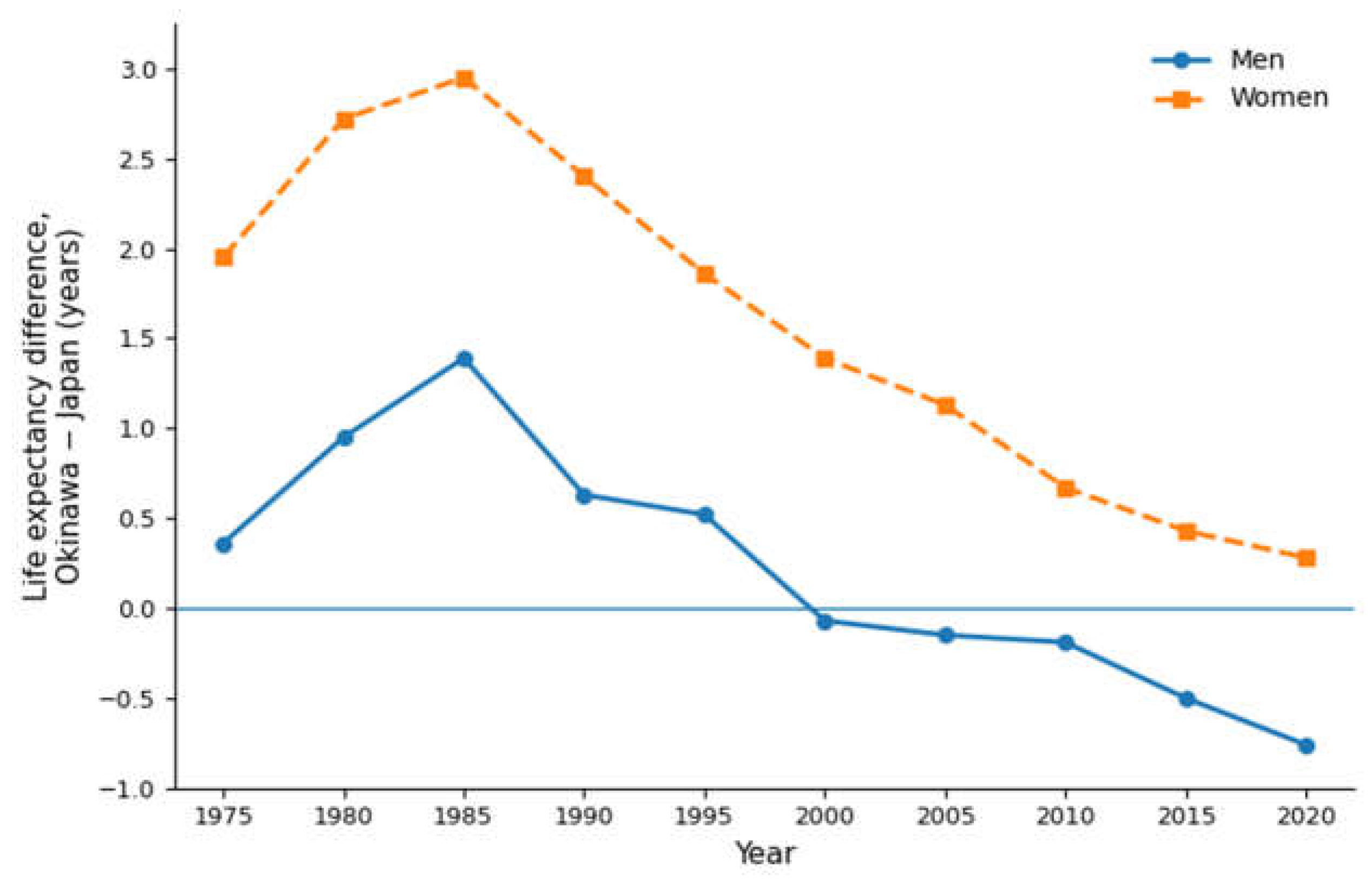
Figure 2.
Conceptual schematic of the earlier postwar nutrition transition in Okinawa than in mainland Japan. The approximate timing of nutritional transition is based on Todoriki et al[8], who reported that the increase in dietary fat intake occurred earlier in Okinawa than in Japan overall, with the fat-energy ratio reaching approximately 25% around 1970 in Okinawa and around 1980 in Japan. The approximately 10-year difference is used here to illustrate the regional time lag underlying the proposed life-course framework. The blue-to-red gradient and the terms “Lean” and “Rich” are conceptual representations introduced in the present hypothesis and are not quantitative data or terminology derived from Todoriki et al.
Figure 2.
Conceptual schematic of the earlier postwar nutrition transition in Okinawa than in mainland Japan. The approximate timing of nutritional transition is based on Todoriki et al[8], who reported that the increase in dietary fat intake occurred earlier in Okinawa than in Japan overall, with the fat-energy ratio reaching approximately 25% around 1970 in Okinawa and around 1980 in Japan. The approximately 10-year difference is used here to illustrate the regional time lag underlying the proposed life-course framework. The blue-to-red gradient and the terms “Lean” and “Rich” are conceptual representations introduced in the present hypothesis and are not quantitative data or terminology derived from Todoriki et al.
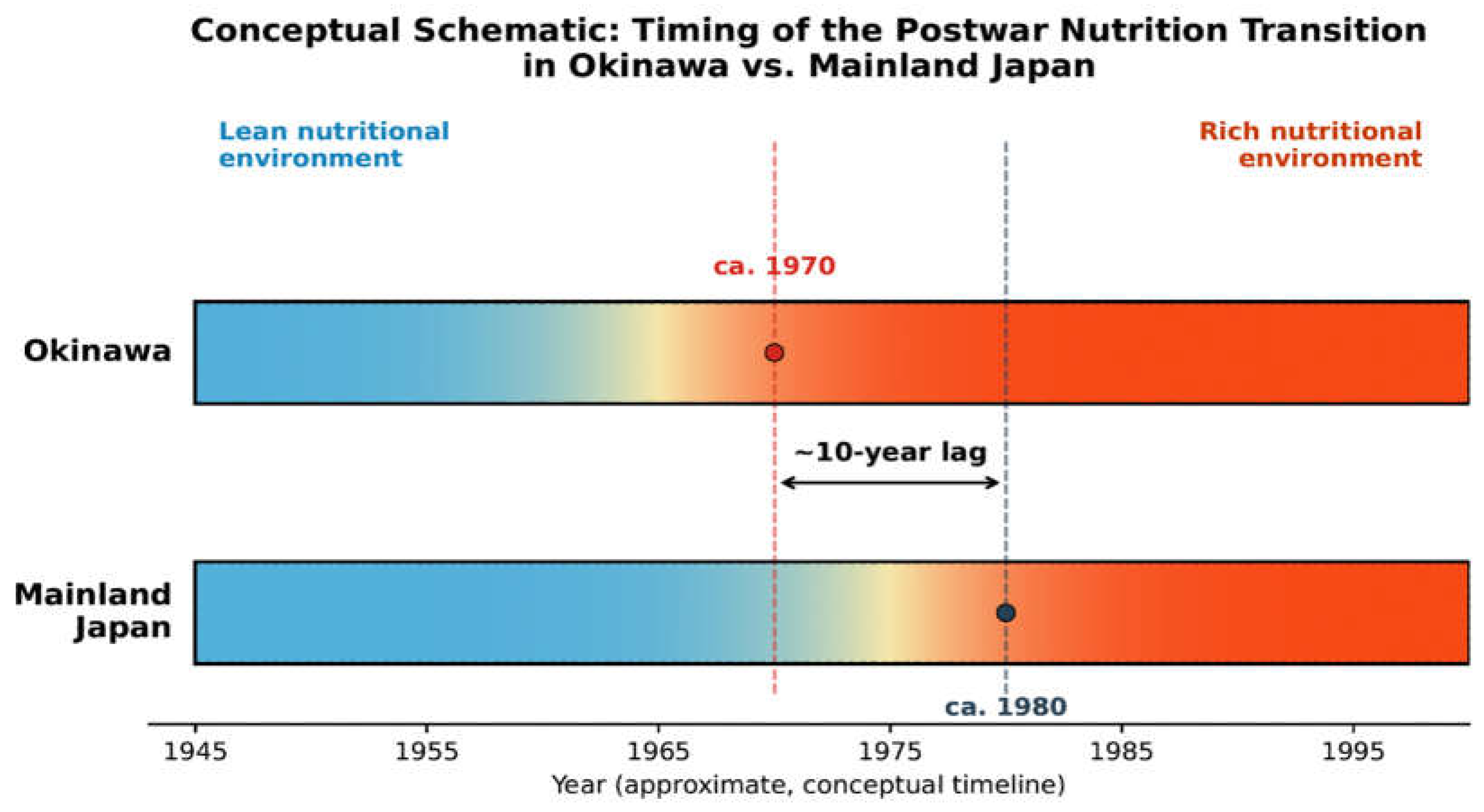

Table 1.
Evidence relevant to the Lean-to-Rich Healthy Aging Hypothesis. Evidence is organized according to the two principal propositions: Lean-to-Rich versus Lean-to-Lean and Lean-to-Rich versus Rich-to-Rich. Okinawan historical observations are hypothesis-generating; other epidemiological and demographic evidence provides supporting plausibility. No study directly compares all three proposed trajectories.
Table 1.
Evidence relevant to the Lean-to-Rich Healthy Aging Hypothesis. Evidence is organized according to the two principal propositions: Lean-to-Rich versus Lean-to-Lean and Lean-to-Rich versus Rich-to-Rich. Okinawan historical observations are hypothesis-generating; other epidemiological and demographic evidence provides supporting plausibility. No study directly compares all three proposed trajectories.
| Evidence | Representative source | Main observation | Does not establish | Relevance to hypothesis |
| A. Lean-to-Rich vs. Lean-to-Lean | ||||
| Postwar Okinawa–Japan longevity trajectory | MHLW Prefectural Life Tables[7] | Okinawa’s relative longevity advantage increased, peaked in 1985, and subsequently narrowed | Nutrition caused the trajectory | Hypothesis-generating demographic pattern |
| Earlier Okinawan nutrition transition | Todoriki et al. [8]; MHLW [7] (integrated in the present review) | Nutrition transition occurred earlier in Okinawa than mainland Japan | Earlier transition caused longevity differences | Core hypothesis-generating temporal observation |
| Older-adult BMI and survival | Winter et al.[14] | Low BMI was associated with higher mortality; moderately higher BMI was often favorable | Nutritional enrichment prolongs life | Persistent Lean status may not remain optimal |
| Undernutrition and physiological reserve | Volkert et al.[12]; Cederholm et al.[11] | Low nutritional reserve is associated with frailty and adverse outcomes | Optimal timing or composition of enrichment | Supports potential benefit of later nutritional adequacy |
| B. Lean-to-Rich vs. Rich-to-Rich | ||||
| Birth cohort × transition timing | Todoriki et al. [8]; MHLW [7] (integrated in the present review) | Earlier transition generated different nutritional exposure histories by region and cohort | Nutritional sequence is causal | Core hypothesis-generating cohort framework |
| Okinawan age/cohort mortality patterns | MHLW [7]; Hokama et al. [18]; Poulain & Herm [1] | Older cohorts remained relatively favorable; younger postwar cohorts became progressively less favorable | Nutrition caused the cohort gradient | Independent demographic support |
| Prolonged metabolic burden | Todoriki et al.[8]; Matsushita et al.[17]; Di Angelantonio et al.[10]; GBD 2015 Obesity Collaborators[13] | Younger Okinawans developed greater metabolic burden; prolonged adiposity is associated with adverse outcomes | Rich-to-Rich alone caused excess mortality | Supports potential disadvantage of prolonged Rich exposure |
| Present hypothesis | Lean-to-Rich Healthy Aging Hypothesis | Integrates nutrition-transition timing, birth cohort, and longevity trajectory | Direct superiority of Lean-to-Rich | Nutritional sequence becomes a testable life-course determinant |
Disclaimer/Publisher’s Note: The statements, opinions and data contained in all publications are solely those of the individual author(s) and contributor(s) and not of MDPI and/or the editor(s). MDPI and/or the editor(s) disclaim responsibility for any injury to people or property resulting from any ideas, methods, instructions or products referred to in the content. |
© 2026 by the authors. Licensee MDPI, Basel, Switzerland. This article is an open access article distributed under the terms and conditions of the Creative Commons Attribution (CC BY) license (http://creativecommons.org/licenses/by/4.0/).
Copyright: This open access article is published under a Creative Commons CC BY 4.0 license, which permit the free download, distribution, and reuse, provided that the author and preprint are cited in any reuse.