
Submitted:
27 August 2026
Posted:
31 August 2026
You are already at the latest version
Abstract
This paper presents findings from a mixed-methods study eliciting requirements for a Future Museum ecosystem connecting tangible artefacts with their historical, social, and cultural contexts through citizen curation and connected heritage experiences, including virtual worlds and game-based experi-ences. Thirty participants watched a concept video, completed semi-structured interviews, played two levels of the Discover Babylon serious game as a technology demonstrator, and completed post-game evaluation and requirements elicitation questions. Participants valued digital artefacts that could be collected, curated, shared and connected to contextual information and experiences. They also wanted virtual museum spaces to retain the architectural character and presentation conventions of physical museums. Connected heritage experiences were expected to place artefacts within historical environments, demonstrate their creation and use, and support exploration, puzzles, quizzes and challenges. Participants identified limitations in Discover Babylon’s dated controls, navigation, pacing and audiovisual presentation, but valued its historical setting, opportunities for exploration, puzzles, educational content and representation of Mesopotamian life. Across the Future Museum concept, col-lection was valued not only as a game-like incentive, but also as a means of personal curation, learning and social sharing. The study contributes requirements for Future Museum ecosystems, connected heritage experiences and modern game-like implementations. Its originality lies in conceptualising the Future Museum not as a single virtual museum or standalone application, but as an interconnected ecosystem linking physical museum contexts, virtual artefacts, museum architecture, personal and shared collections, and heritage experiences to support access, contextual understanding, curation and engagement with less familiar histories and overlooked cultural artefacts. Its significance lies in identifying requirements for connecting these elements to support access, contextual understand-ing, curation, and engagement. Its significance lies in identifying requirements for connecting these elements to support access, contextual understanding, curation and engagement.
Keywords:
cultural heritage
; virtual worlds
; digital heritage
; ancient worlds
; serious games
; future museums
; requirements elicitation
1. Introduction
This paper presents findings from a mixed-methods empirical study eliciting requirements for a future museum ecosystem comprising citizen-curated exhibitions, shareable digital representations of physical artefacts, and interconnected heritage experiences accessible across multiple devices and platforms. For clarity, we refer to the specific concept relevant to this work as the `Future Museum’. Figure 1 illustrates this concept as a shareable virtual environment in which collections, artefacts and related heritage experiences are connected through themed spaces. From a cultural computing perspective, the study examines how such an ecosystem might communicate, contextualise and connect tangible artefacts with their historical, social and cultural contexts [1].
The underpinning research was motivated by ambitions to improve the context, visibility and meaning of artefacts; to interconnect collections and experiences; and to create engaging opportunities for the exploration of less familiar histories and overlooked cultural artefacts that receive less attention in traditional museum settings. Of course, history and heritage have histories of their own. The ways in which we have traditionally recorded and communicated histories and cultures have often depended upon texts and images, while our personal encounters with heritage have depended on visits to historical sites or to museums filled with tangible artefacts. In large part, what we have therefore understood as history has been shaped by these media and encounters, and we have thus dwelt on facts and dates rather than the less tangible lived experiences, cultural practices, skills and knowledge of people in the past. But even our access to tangible heritage through museums is necessarily selective, since large museums have considerable holdings and typically have exhibition capacity for only 5% or less of their objects at any time [2,3]. Many artefacts therefore remain inaccessible to public audiences, and the stories, practices and cultural knowledge associated with them may remain similarly disconnected from wider engagement.
Virtual Reality (VR), Augmented Reality (AR), Mixed Reality (MR), and Extended Reality (XR) have, of course, opened up digital access opportunities for artefacts that are physically inaccessible, but what we lack is a design vision for a future museum that not only exploits the benefits of these technologies, but also provides a means of interconnecting artefacts, experiences and individuals. A further limitation of existing digital heritage provision is its uneven coverage and tendency to focus on histories of national or regional relevance. The motivations for this study were therefore both broad and narrow. Broad in the sense that we aimed to explore a future museum design – to, if you will, advance a future museum blueprint – and narrow in the sense that we sought to specifically explore the challenge of enabling engagement for a population less familiar with particular histories and with artefacts that have traditionally received less attention. In doing so, the work was informed by speculative explorations of how existing and emerging technologies might support future forms of heritage engagement [4,5,6].
1.1. The Important Role of Physical Museums
The intention of the Future Museum is not to replace physical museums, but to explore how future digital museum ecosystems could complement them by extending access, context, engagement and opportunities for participation. Indeed, in this vision, physical museums are fundamental to the infrastructure for connecting artefacts, histories, experiences and communities across physical and digital spaces.
This emphasis on connectedness reflects the continuing importance of physical museums themselves. For example, recent museum developments such as the Museum of Tomorrow in Rio de Janeiro, the Museum of the Future in Dubai, and Berlin’s Futurium [7] demonstrate growing interest in museums not only as repositories of objects and histories, but as engaging and interactive spaces for imagining alternative futures. The Future Museum proposed here therefore builds upon, rather than replaces, the physical museum experience. This is significant because heritage comprises both tangible artefacts and intangible practices, but opportunities to connect them are limited. Recent work on multisensory and hybrid museums highlights the role of narration, interaction and accessibility in connecting physical and digital museum experiences, while emphasising the need for digital content to remain meaningfully connected to the original artefacts and contexts [8]. Work on interactive virtual museums using haptic glove technology also shows how embodied interaction can extend virtual engagement beyond visual display [9]. Building on these possibilities, a future museum ecosystem could enable visitors to move seamlessly between artefacts, histories, traditions and experiences, rather than encountering each in isolation.
1.2. Virtual Heritage, Interconnection and Museum Deployment
VR provides opportunities to create immersive environments for artefacts, exhibitions, monuments, buildings and historical sites [10]. Meta-analysis evidence also suggests that AR and VR can have positive effects on learner perceptions and learner achievement in museum learning, particularly when supplementing exhibits [11]. This, together with the fact that digital space expands more freely than physical space, makes VR an attractive medium through which to experience the Future Museum and its contents. However, access to immersive VR in the home remains constrained by headset ownership, uncertainty about its value beyond gaming and limited expectations among prospective users [12].
Attending a museum is an experience in itself and often adds to the aesthetic of experiencing ancient artefacts [13], but VR can supplement this experience by improving access to artefacts that may not be on display, or cannot be touched, and thus support engagement [14]. Interactive 3D viewer interfaces can similarly support close inspection and manipulation of virtual cuneiform artefacts across web-based and museum contexts [15].
Beyond improving access, VR offers opportunities to reconnect artefacts with the places, stories, and experiences to which they relate, providing forms of context that can be difficult to communicate in the limited spaces of physical exhibition galleries. Museum professionals have identified one of the principal advantages of VR as its ability to create the world around an object, providing context without diminishing the object itself [16]. This may be particularly valuable for smaller or less visually striking artefacts whose significance depends heavily upon their wider historical and cultural contexts. VR also provides the ability to virtually visit historical sites, which may be remote, fragile, or otherwise restricted, bringing a global audience where they ordinarily could not enter [17].
However, VR is not without weaknesses when used to create virtual museums. Going to a real-world museum is often a social experience, where a group of individuals can engage with each other as well as the subject matter. But virtual museums as they currently exist are mostly tailored to single users, lacking the social experience, although multi-user interaction across VR and AR devices is technically possible [10,16,18]. As a result, they may reproduce aspects of museum access while weakening the shared encounter that often characterises physical museum visits. As Cecotti [10] observed, the lack of social interaction prevents many virtual museums from fully representing the museum experience. Similarly, heritage experiences rarely connect to each other [19]. For example, a virtual street view style tour of a museum gallery does not connect to a movie on the collection, nor a game on the topic; and games on the topic (unless they are on the same platform) do not connect with each other. Nor is there connectivity between contexts, for example, a physical museum space is not connected to its equivalent virtual space, a physical artefact is not connected to its digital equivalent, and vice versa. Consequently, visitors are often required to navigate independently between a museum collection and its digital archives, virtual experiences, videos and games despite each relating to the same heritage content. The future museum challenge is therefore not only one of digitisation, but also one of meaningful interconnection between tangible and intangible heritages, between physical and virtual contexts, between experiences and between individuals. The latter is particularly important because discussion, shared discovery and collaborative interpretation are often central aspects of museum visits.
Installing VR into museums could provide an opportunity for those without VR headsets to experience Future Museum content and could allow museums to curate virtual experiences without the complexities of expanding and decorating the physical space [20]. However, deployment presents other challenges. Even a temporary VR exhibit in a physical museum requires increased staffing and specialised training, which would create a financial burden for the museum [16]. However, the Future Museum could create synergies by enabling digital artefacts, architectural assets and connected experiences to be shared, reused and combined across different contexts, allowing the ecosystem to evolve incrementally despite limited resources [6]. Realising this vision would nevertheless require practical models for funding, developing, and sustaining the ecosystem. Its development might proceed through funded heritage projects, open-source initiatives, shared digital resources, and contributions from museums, researchers, developers, and heritage communities.
Existing research has also identified a range of practical design considerations for immersive heritage experiences, including the use of high-quality 3D representations, careful curation of virtual content, and support for diverse hardware configurations [10]. However, such guidance largely concerns individual experiences rather than the design of interconnected heritage ecosystems.
Related work has also explored user-centred virtual museum platforms. For example, ‘The Invisible Museum’ enables curators and users to create immersive virtual 3D exhibitions with VR support, storytelling and personalised tours [21]. Whilst sharing the Future Museum’s interest in participation and digital heritage engagement, The Invisible Museum focuses on the creation and exploration of individual virtual exhibitions. By contrast, the Future Museum proposed here is concerned with connecting exhibitions, artefacts, users and experiences across a wider ecosystem of physical and digital heritage resources.
1.3. Connected Heritage Experiences and Engagement
Connected heritage experiences share many characteristics with serious games, particularly their use of interactive environments to support learning and engagement. Serious games have been used as a tool to enable users to achieve a specific learning outcome while ensuring that they are sufficiently engaged [22]. While serious games have previously been applied to a wide range of domains, including education, healthcare and military training [23], the use of serious games for learning about cultural heritage and enhancing museum visits has been studied primarily in relation to tangible artefacts (physical objects) [24] and virtual exhibitions [21], yet much less so for intangible heritage such as social practices, rituals, and language. The United Nations Educational, Scientific and Cultural Organization (UNESCO) describes intangible cultural heritage as “an important factor in maintaining cultural diversity in the face of growing globalization” [25]. An environment which can cater for both tangible artefacts and intangible heritage can widen public accessibility and interest and therefore add cultural value.
The challenge is not simply to create educational heritage experiences, but also to attract and sustain engagement with histories and artefacts that visitors may not initially seek out. This reflects a longstanding dichotomy in serious games research between the pursuit of educational outcomes and the need to provide sufficiently engaging experiences. This is particularly relevant in the case of lesser-known histories, such as Ancient Mesopotamia, where the educational value may be substantial, but the subject matter may be unfamiliar to many audiences in the West and elsewhere who have not been taught the history or visited the region and, in the absence of large, visually imposing monuments and artefacts often associated with more familiar historical periods, may not immediately capture attention [26].
As well as the experience of the virtual world, game mechanics adopted from commercial games can improve engagement through repeat and longer play. One such mechanic is in-game collectible items, which have been shown to increase player engagement in the game, while also increasing mental demand and invested effort [27]. Players report that they tend to return to a game after playing when they are aware that a collectible is available, and they also have a fear of missing out when they know they might lose a collectible – some games enhance this engagement by making collectibles time-dependent [28]. Such game mechanics could enhance museum experiences, although they would need to be balanced relative to the location of the exhibit (at home, or within a museum), and to the time developers wish players to spend within the experience – which could be short, to increase the number of visitors at an exhibit, or longer, to deepen the experience. However, the application of such mechanics requires careful consideration, as reward-oriented systems may encourage participation for the sake of collection and progression rather than engagement with the heritage content itself [29,30,31].
Nevertheless, game-inspired approaches are not without criticism. Poorly designed reward systems risk trivialising heritage content or encouraging superficial engagement. The challenge is therefore not simply to increase engagement, but to ensure that engagement contributes to curiosity, interpretation and understanding.
1.4. The Future Museum Concept
As illustrated in Figure 1, the Future Museum is a shareable virtual environment comprising interconnected spaces, collections, and experiences. Within this vision, users can move between museum exhibitions and a range of related heritage experiences. As shown, portals to connected experiences can be accessed directly from galleries displaying relevant heritage artefacts, enabling a step into the past. The collection and curation of digital artefacts build on earlier work on virtual museum ‘takeouts’ and DIY exhibitions, which enabled users to create, display and share personalised exhibitions of selected 3D museum artefacts [32].
Table 1 provides examples of the types of experiences that may be linked within such an ecosystem, including serious games, VR experiences, puzzles, documentaries, and online resources. These may be directly connected experiences, such as games, quizzes, VR environments or expert-guided vignettes, or indirectly connected recommendations, such as films, books, articles, and online resources. They may also vary in historical framing, ranging from factual to fictionalised formats, such as films or time-travel vlogs, provided their relationship to the artefacts and histories is clear and not misleading. Connected experiences may also include conversational large language model (LLM)-enabled avatars or AI-supported guides that help users engage with the lives and perspectives of people in the past, with potential to support historical empathy and understanding [33]. Such systems, of course, require careful attention to trust, guardrails and accuracy [34,35].
To explore this concept empirically, the study focuses on one historically significant but comparatively less familiar ancient context. The following section introduces Ancient Mesopotamia as the case study and explains why it is particularly relevant for exploring connected virtual heritage experiences.
1.5. Ancient Mesopotamian Case Study
The focus on Ancient Mesopotamia follows earlier work concerned with improving the visibility and engagement of less familiar histories and overlooked cultural artefacts, including cuneiform tablets [26,36]. This case study examines that challenge within the broader Future Museum concept.
Mesopotamia, from the Greek mesos and potamos, meaning “between rivers”, was the ‘cradle of civilisation’ some 5,000 years ago, nestled between the Euphrates and Tigris rivers. Ancient Mesopotamians are credited with many innovations, including humankind’s first mathematics, first writing, and even the first customer complaint, as well as the earliest known board game, the Royal Game of Ur. However, despite the significance of the earliest human civilisations and the earliest writings of the ‘cuneiform’ script inscribed in handheld clay tablets, Mesopotamian history remains less familiar to many in the West than the histories of Ancient Egypt, Greece, and Rome.
The small, palm-sized cuneiform tablet artefacts illustrated in Figure 2 may also be less visually striking than larger museum objects. There are also comparatively few digital games or virtual heritage experiences focused on Mesopotamia [37,38].
Ancient Mesopotamia therefore provides a focused case for exploring how connected virtual heritage experiences might support engagement with culturally significant but less familiar artefacts, particularly where their significance depends on wider historical, social and cultural context.
1.6. Discover Babylon Serious Game
The aim of the study was to elicit requirements, not only for the Future Museum itself, but also for engaging experiences that could accompany curated collections of virtual Mesopotamian artefacts. A notable and pioneering ancient-world game experience developed over twenty years ago, Discover Babylon placed users in historically informed Mesopotamian environments to explore digital representations of museum and library objects, encounter artefacts in context and learn about ancient Mesopotamian culture through gameplay [39,40]. Developed through a collaboration involving UCLA’s Cuneiform Digital Library Initiative, the Federation of American Scientists and the Walters Art Museum, the game was innovative in its attempt to combine museum collections, library resources, virtual worlds, challenges, question-and-answer tools and immediate feedback within a single learning game, and it remains one of the only substantial game-based digital heritage experiences focused on Ancient Mesopotamia [37,38].
Discover Babylon comprised a museum-based ‘kiosk’ and a longer game experience as illustrated in Figure 3 [39,40]. The kiosk game was designed as a short museum-based experience to enhance visitors’ appreciation of the Near Eastern Art collection of the Walters Art Museum in Baltimore, Maryland. The game premise introduces disturbances in time and space, linked to Professor Simon Dexter’s discovery of a time-travel device. The player is tasked with locating objects and following clues that connect the museum setting with ancient Mesopotamian locations. This framing is important because it creates a direct relationship between museum artefacts, historical interpretation and interactive exploration.
Hanes [37] argued that games such as Discover Babylon demonstrate the potential of digital heritage experiences to support learning through exploration, contextualisation and interaction rather than through the presentation of information alone.
Although developed almost two decades ago, Discover Babylon remains noteworthy because it attempted to combine museum collections, historical interpretation and gameplay within a single experience. Consequently, despite its age, the game provides a useful technology demonstrator through which to consider the kinds of experiences that might form part of a future museum ecosystem. Rather than being viewed as a model to be reproduced, the game offers an illustrative example of how artefacts, historical narratives and interactive engagement can be brought together within a digital heritage experience.
1.7. Research Aim, Questions and Contributions
The preceding discussion highlighted the fragmented nature of many heritage resources and experiences across physical museums, digital collections, games, virtual environments and other platforms. The Future Museum responds to this challenge by envisioning an interconnected ecosystem that links artefacts, contexts and experiences, while supporting both exploration and participation.
The aim of this research was to evolve the design concept of the Future Museum and to elicit requirements for both the museum ecosystem itself and the connected heritage experiences within it. Accordingly, the study addressed the following research questions:
- RQ1: What requirements do users identify for a Future Museum ecosystem connecting artefacts, contexts and heritage experiences?
- RQ2: What requirements emerge for connected heritage experiences within such an ecosystem, including game-like experiences examined through Discover Babylon?
In addressing these questions, the paper makes three contributions. First, it develops the concept of the Future Museum as an interconnected heritage ecosystem, rather than as a single virtual museum or stand-alone VR application. Second, it reports empirical findings from a mixed methods requirements elicitation study involving participant responses to a concept video and to Discover Babylon as an example connected heritage experience. Third, it identifies requirements for both the wider Future Museum ecosystem and the connected experiences within it, including requirements relating to access, artefact representation, contextualisation, navigation, social use, guidance, challenge and feedback.
2. Materials and Methods
To address the research questions, a mixed-methods requirements elicitation study was conducted at Keele University, UK, in 2025 during the spring and autumn semesters. As summarised in Figure 4, the study combined background questions, a Future Museum concept video, semi-structured interview questions, gameplay using selected levels of Discover Babylon, post-game evaluation, connected heritage experience requirements elicitation and fact recall questions.
2.1. Participants and Recruitment
The study was reviewed and approved by the Faculty of Natural Sciences (Non-Psychology) Research Ethics Committee of Keele University (Protocol code 0857; approved 25/02/2025). Participants were recruited from staff and students at Keele University, and from regional members of the public aged 18 or over. All participants provided written informed consent before taking part in the study and were provided with a £10 voucher after completing follow-up fact recall questions. A pseudonymisation process was used to provide each participant with a numerical identifier (P01-P30).
2.2. Study Design
An overview of the study components is provided in Figure 4. As shown, the study began with participant demographic and background questions, followed by the Future Museum concept video and the first requirements elicitation interview. Participants then played selected levels of Discover Babylon, completed a composite post-game evaluation and immediate fact recall questions, responded to connected heritage experience questions, and were later invited to complete follow-up questions on further learning and fact recall. The fact recall questions were based on the historical and cultural content presented within Discover Babylon. Their use immediately after gameplay and at follow-up was informed by the evaluation approach used by Hanes [37].
The study combined two requirements elicitation components. The first focused on the Future Museum concept, which was introduced through a short concept video and then explored through semi-structured interview questions. The concept video introduced the proposed ecosystem, including the use of QR codes to unlock digital artefacts, assets for themed rooms and links to related media, resources and heritage experiences during museum visits, and the subsequent access, curation and exploration of these elements in museum and home settings through AR, desktop, and VR interfaces. It provided participants with a shared understanding of the concept before the first requirements elicitation interview.
The second requirements elicitation component focused on connected heritage experiences, using Discover Babylon as a technology demonstrator. Technology demonstrators are working or partially working examples that make design possibilities concrete enough for participants to evaluate and discuss. They are useful for requirements elicitation as they can help participants engage with design possibilities, generate ideas and respond to unfamiliar technologies or interaction concepts [41,42]. Discover Babylon served this purpose by providing a playable example of how a connected, game-like heritage experience might accompany curated virtual artefacts within a Future Museum ecosystem [43]. The following sections outline each study component in more detail.
2.2.1. Future Museum Concept Video and Requirements Elicitation I
Figure 5 shows screenshots from the Future Museum concept video [44]. As shown, the video introduced the Future Museum as a virtual interconnected curation space where users can access, curate and share collected digital museum artefacts and connected heritage experiences. The video also illustrated alternative modes of interaction, including AR interaction, desktop access and VR-based exploration. The video combined illustrations of the wider Future Museum concept together with explanatory voiceover, followed by views of a Unity-created virtual museum prototype used to demonstrate an exhibition room containing digital artefacts and connected media.
After watching the video, participants were asked semi-structured interview questions about the Future Museum concept. These questions addressed participants’ initial responses to the concept, its perceived potential for improving the visibility and engagement of cuneiform artefacts, its suitability for museum and home contexts, and its possible influence on museum visiting. They also explored interest in collecting digital artefacts and using them with connected heritage experiences. The interview topics are summarised in Figure 6; the full set of questions is provided in Appendix A.
2.2.2. Discover Babylon Gameplay
Participants played Levels 1 and 2 of Discover Babylon (illustrated by screenshots in Figure 7). Level 1 begins in a museum setting and introduces the player to the game premise and time-travel scenario. Level 2 is set in Uruk in 3100 BCE and includes activities such as attending scribe school and trading in the market.
These levels were selected because they introduced the museum-to-ancient-world structure of the game and provided participants with sufficient experience of gameplay, historical content and interaction to inform the subsequent evaluation and requirements elicitation questions.
2.2.3. Post-Gameplay Evaluation and Requirements Elicitation II
After gameplay, participants completed a composite post-game evaluation, immediate fact recall questions and connected heritage experience requirements elicitation questions. The composite post-game evaluation was based on previous work by Rhodes et al. [36], which outlined a composite questionnaire approach using selected items from established questionnaires. This approach was informed by the composite evaluation approach of Tcha-Tokey et al. [45] which combined items from the Immersive Tendency Questionnaire [46], Flow4D16 [47], the System Usability Scale (SUS) [48] and AttracDiff2 [49]. These were supplemented with selected questions based on a light-touch MDA framework assessment [50], game experience questions from Hanes [37], and usability heuristics applied to computer games [51]. The complete set of post-game evaluation questions is provided in Appendix A.
Participants answered six fact recall questions immediately after gameplay. At follow-up, the first three questions were repeated alongside three new questions, resulting in nine distinct questions across the two assessments. Examples of fact recall questions are provided in Table 2.
The connected heritage experience requirements elicitation questions asked participants to reflect on Discover Babylon both as a game and as a possible connected heritage experience linked to collected artefacts. As summarised in Figure 8, these questions addressed participants’ likes and dislikes, willingness to play a modern version, priorities for improvement, and views on which elements would or would not work if the game were connected to collected artefacts. Participants were also invited to comment on the mechanics, dynamics and aesthetics of the game. The full set of questions is listed in Appendix A.
One week after participation, participants were invited by email to answer a short set of follow-up questions. These asked whether participants had undertaken, or planned to undertake, any further learning about Ancient Mesopotamia, and incorporated the follow-up fact recall questions.
2.3. Software, Hardware and Exemplar Artefacts
2.3.1. Software
The Future Museum prototype was developed using the Unity Game Engine (v2022.3.10f1), with the SteamVR plugin (v2.7.3) to facilitate VR development. Blender (v3.5) was used to create the 3D museum environment, textures and non-artefact furnishings. Additional software included Paint.NET and the VS Code Integrated Development Environment with the Unity extension for linting and IntelliSense support.
2.3.2. Hardware
The Future Museum prototype was developed and tested using a Valve Index head-mounted display. This was primarily driven by a desktop computer with an AMD Ryzen 9 5950X processor and an NVIDIA GeForce RTX 2070 SUPER graphics card, running Windows 10. Participants did not directly interact with the VR prototype during this study; instead, the prototype was presented through the concept video described in Section 2.2.1. The study itself was conducted using laboratory desktop PCs to present the questionnaires and concept video, and to run Discover Babylon.
2.3.3. Exemplar Artefacts
The exemplar 3D cuneiform tablet artefacts used in the prototype were acquired courtesy of National Museums Liverpool (World Museum) using the Virtual Cuneiform Tablet Reconstruction (VCTR) project [52] photogrammetric turntable system [53] and an EinScan-SP 3D scanner with Discovery Pack. Related work within the VCTR project has explored the digitisation of cuneiform tablets and the development of interactive and collaborative environments for manipulating and reconstructing virtual cuneiform artefacts [54,55,56].
2.4. Data Collection and Analysis
Responses to the questionnaire components of the study were collected using Microsoft Forms and inspected and visualised using Excel and Python. Interviews were audio-recorded and transcribed using Microsoft Clipchamp. Participant responses to the requirements elicitation questions were analysed thematically following Clarke and Braun [57]. This analysis was conducted manually, with NVivo (v14.23.2) used to support data organisation and coding. Initial codes were identified from participant responses and subsequently grouped into higher-level themes through iterative review and assessment by the research team. Following the thematic analysis, Microsoft 365 Copilot Think Deeper, GPT 5.6 was used to check the coverage of selected participant responses. Cook et al. [58] reported that LLMs can support summarisation in qualitative data analysis, provided that outputs remain subject to researcher oversight. In our analysis, the LLM was used to support this coverage check only and was not used to generate themes, interpret findings or determine study conclusions.
3. Results
This section presents findings relating to participant responses to the Future Museum concept, evaluations of Discover Babylon, and the requirements elicited from both components of the study.
3.1. Participant Demographics and Background
Thirty participants were recruited, most of whom () completed the follow-up fact recall questions. Of the 30 participants, 18 were male and 12 were female; 19 were staff or students of Keele University and 11 were regional members of the public; and 15 participants reported their discipline/expertise as being within the field of Computer Science. Participant age categories varied from 18-24 years to 64+ years, with 21 participants aged under 35 years and 9 aged over 35 years.
Twenty-one participants reported visiting museums annually, with four reporting that they did not visit museums and five reporting quarterly visits. No participant reported substantial familiarity with Mesopotamian history, although 14 reported some degree of interest in the topic.
Twenty-eight of the 30 participants reported playing games, most commonly: browser games , first-person shooters and role-playing games , using a variety of platforms and devices, most commonly Microsoft Windows, smartphones, and consoles, with six participants also reporting owning a VR headset. Reported frequency of gameplay ranged from ‘not at all’ to ‘daily’ , and session duration ranged from less than one hour to more than five hours .
3.2. Future Museum Concept Responses
Participants responded positively to the Future Museum concept. Their responses particularly concerned the ability to handle otherwise inaccessible artefacts, retain digital artefacts after a museum visit, create and share personal collections, access artefacts from different locations, and connect objects with further historical context and experiences. Participants also liked the idea of collecting virtual artefacts, with several likening this to collecting in games such as Pokémon.
The following subsections present these findings under themes concerning artefact handling, museum takeouts, collection and curation, platform aesthetics and access, and connections between artefacts and their historical contexts.
3.2.1. Handling of Virtual Artefacts
A key theme was the handling of virtual artefacts. As illustrated in the concept video, museum visitors could scan a QR code to add a digital artefact model to their personal Future Museum collection and subsequently manipulate it in three dimensions. Such interaction would not ordinarily be permitted with the physical artefact and would enable fragile objects to be handled without risk. For example, participants commented that:
“I love that you could reach out and hold the artefacts... you’d never, ever get to experience that in real life” (P02)
“I think there is some artefacts that you wouldn’t be able to handle, but if you could handle [them] in virtual reality [it] would be much more interesting.” (P04)
“the ability to handle and manipulate what could be quite fragile objects that may not be on display all the time” (P19)
The handling of virtual artefacts also could be a key factor in improving the engagement for lesser-known artefacts.
“If I can’t get a good look at something, I tend to skip over it ... Otherwise it doesn’t keep my interest” (P05)
“People will look at those kinds of things, squint on them a bit and then walk away. But if you had something like this, it would encourage you to have a proper look” (P02)
One participant offered a contrasting perspective:
“part of the mystery [and] mystique is that it is behind the glass and I can’t touch it. It is something to be viewed not as a spectacle, but as something that is out of reach.” (P24)
While this view was not widely expressed, another participant suggested retaining a glass case that individuals could choose to open:
“maybe [there could be] a glass case, or another button where I could push to open up the case” (P01)
3.2.2. Museum Takeouts
The idea of museum takeouts was another key theme. Participants valued the opportunity to retain accessible digital representations of artefacts after a museum visit, with P17 describing this as “bringing the museum to home” and, similarly:
“to have something digital to take away, rather than just like a pamphlet ... it would also allow individuals to put other supplementary artefacts that would bolster the understanding of the main exhibit.” (P19)
This could allow a museum artefact, whose meaning is more reliant on information presented alongside it, to be better understood after the initial museum experience which prompted the interest in that particular artefact. Others compared the museum takeout feature to:
“your own learning bank wherever you went” (P25)
especially as the virtual museum is envisioned to be accessible on multiple devices, including smartphones.
3.2.3. Collections, Curation and Sharing
Several participants liked the idea of collecting virtual artefacts. P20 compared the experience to other games where collecting is a key feature:
“I grew up with the Pokémon era. We loved collecting monsters and whatnot.” (P20)
Participants also suggested incentives for collecting,
“like if you got a badge or something for collecting a certain amount” (P25)
Participants also considered how technology and game-like collection might engage younger audiences:
“especially with younger people, I feel like it would really fuel their interest in it to know there’s like a like an aspect of technology in there where they’re like, oh, something shiny. And then they ... look at it just for fun and they end up getting like, sucked into it, you know.” (P02)
Participants also liked the self-curation feature:
“the ability to self-curate ... it makes it more personal. There’s people who enjoy looking at everything ... and there’s people who sort of only want to focus on the things they’re specifically interested in ... they can just scan the things they want to.” (P26)
The personalisation of the museum could also add to this, encouraging users to develop collections reflecting their individual interests. Participants also responded positively to sharing collections with family and friends.
“My mum is interested in this kind of stuff, so I would be like ‘Hey mama, come over, look at this’.” (P16)
3.2.4. Virtual Museum Aesthetics and Access
Many participants commented on the aesthetics of the virtual museum prototype.
“museums are often very grand ... pillars or [other decorations] based on where the artefacts are from, it could be designed to fit the architecture of that” (P21)
A key benefit that participants commented on was the ability for the Future Museum concept to improve accessibility. Participants identified multiple forms of accessibility that the Future Museum could support.
“I’ve worked in National Trust properties where because places were old, they didn’t have accessible spaces” (P11)
Individuals with mobility difficulties may find it challenging to both get to and to move around a museum. They may wish to explore the museum’s artefacts from a more familiar location.
“it could work as well for accessibility because not everyone could get to a museum.” (P21)
Another form of accessibility is the format in which the artefacts are presented. P19 commented on technological accessibility, suggesting that the system could present artefact information in a way that could:
“allow an individual who wouldn’t have the technical know-how to be able to access that easily” (P19)
“being able to access such things in an easier format, which is quite intuitive ... would bring in a lot more people and attention to those artefacts and ... learn more about the history of those artefacts surrounding them.” (P20)
An additional form of accessibility is the distance that museums may be from potential visitors.
“especially if you’re out in the countryside or away from the city, it’s expensive whether you’re driving or bus, whatever, to get to the city and then get to the museum ... That’s a luxury that a lot of people just can’t afford” (P24)
“there might be an artefact you’re really interested in in Japan, but it’s ... a lot more accessible on your prototype than it would be to fly to Japan” (P21)
3.2.5. Artefacts in Historical Context and Use
Participants also commented on the ability of the virtual museum to connect the artefact models with their historical context. Participants felt this was important:
“The cool part is learning this history and the context of it” (P16)
“it would be useful to combine different aspects of the history surrounding the artefact ... you could display that [a cuneiform tablet-based exhibit] as a permanent exhibit but then have other digital interactions of other assets that would explain aspects of that society that would bring about that artefact. Such as the tools that we used to engrave or carve into that tablet.” (P19)
Participants also expressed interest in moving beyond handling and examining artefact models to interacting with them in ways that demonstrated their historical use:
“So, you talked about swords [as an example], Bronze Age weapons. If that’d be a way for you to use them against something or somebody in the museum itself, that’d be interesting.” (P04)
3.2.6. Summary of Themes and Findings
Participants particularly appreciated the accessibility that the Future Museum concept could provide across physical, geographical and technological contexts. They also liked the ability to handle virtual objects and to take away digital representations of objects from the museum in order to curate their own virtual museum. Participants additionally valued opportunities to share personal collections and connect artefacts with their historical contexts and uses.
Some participants wanted the virtual museum prototype to convey more of the grandeur and architectural character associated with physical museums. Participants also emphasised the importance of accessing artefacts and related information through mobile devices. A less anticipated finding was that some participants wanted virtual artefacts to retain aspects of conventional museum presentation, including initially displaying them within glass cases while allowing individuals to open the cases and handle the artefacts.
3.3. Discover Babylon Serious Game Experience Evaluation
Following gameplay, participants evaluated their experience of Discover Babylon using the composite post-game measures described in Section 2.2.3. Figure 9 summarises participant questionnaire responses relating to flow, usability, perceived qualities, game experience and heuristic evaluation. The complete list of questions is provided in Appendix A (Table A2). The section also reports what participants liked and disliked about the game, their priorities for improvement and its potential as a connected heritage experience.
Flow questionnaire responses, particularly the median response of 2.5 to Q7, ‘I feel like I’m experiencing an exciting moment’ (1=Disagree, 6=Agree), indicated that participants did not generally experience the game as exciting. Usability responses were mixed. The median response of 2 to Q10, ‘I thought there was too much inconsistency in the game’ (1 = Disagree, 5 = Agree), indicated that participants generally regarded the game as consistent. However, the median response of 4 to Q11, ‘I found the game very cumbersome to use’ (1 = Disagree, 5 = Agree), indicated substantial usability difficulties.
The AttracDiff2 response to Q14, ‘Undemanding/Challenging’ (1 = Undemanding, 5 = Challenging), had a median of 2, positioning the experience towards undemanding rather than challenging.
The principal difficulties concerned navigation and support. The median response to Q21, ‘How would you rate the navigation of the game?’ (1 = Very Poor, 10 = Very Good), was 3.5. Only three participants rated navigation at 7 or above on the ten-point scale. P03 described the game as “very slow” with “clunky controls”, while P27 reported “getting lost [and] not knowing what to do”. P21 similarly reported, “I wish there was a map so I could know where to find things”, explaining that they had initially been unsure where to go.
The heuristic evaluation identified limited support for accelerating common interactions, with a median response of 2 to Q31, ‘The game allows me to speed up common interactions by providing hotkeys or scripting’ (1 = Disagree, 5 = Agree). Responses also indicated limitations in recovering from errors and obtaining help when difficulties arose. P26 noted that there was “no way to review your current objective” or the information already collected, and suggested that being able to revisit learned material before attempting a puzzle would be useful.
Despite these usability limitations, participants valued the game’s historical setting, exploratory framing, artefact collection and educational content. Although the storyline and time-travel premise did not emerge as distinct themes, participants responded positively to its representation of Mesopotamian life. P02 valued how the game enabled participants to “actually see what life was like ... rather than having it left entirely to the imagination”. P21 appreciated “the free world aspect of being able to explore”. P13 stated, “I always like collecting shiny things”. P03 described the game as “informative about Mesopotamian culture” and considered the quizzes “a good idea to encourage learning”. Participants also responded positively to puzzles, quizzes and opportunities to explore Ancient Mesopotamian environments. P27 valued “the puzzles and knowledge”, while P02 identified “a simulated version of the setting available to explore” as suitable for a connected experience.
Participants commented on the game’s legacy graphics and sound. P02 considered that it “could be very much improved visually” and suggested that ambient music would have improved the experience. P21 described the graphics as “old” and “quite pixelated”, while P03 considered the voice acting “terrible” and P16 observed that the “The game looks very dated”. P05 stated that “Considering the age of the game, I think the aesthetics are OK but could benefit a great deal from updating”.
Participants generally indicated that they would consider playing a modern version of Discover Babylon. Their recommended priorities for improvement included contemporary controls, clearer navigation, improved guidance and feedback, accessible records of objectives and collected information, stronger pacing and challenge, and updated graphics and sound.
3.4. Fact Recall
Fact-recall performance varied across questions and did not provide conclusive evidence of learning or retention. Participants generally performed better on questions for which answers could be inferred from familiar environmental or practical cues, such as the use of white roofs in hot climates and donkeys for carrying loads. Questions requiring recall of specific historical names or terminology produced fewer correct responses. The apparent variation in question difficulty prevented meaningful comparison between immediate and follow-up responses. Consequently, the findings were insufficient to evaluate the educational dimension of Discover Babylon as a serious game.
3.5. Requirements Elicited
The findings from the Future Museum concept interviews and post-game evaluation were translated into requirements for the Future Museum ecosystem, connected heritage experiences and a modern Discover Babylon-type experience, summarised in Table 3, Table 4 and Table 5, respectively.
3.5.1. Future Museum Ecosystem Requirements
The Future Museum ecosystem requirements were derived from participant responses concerning access, artefact handling, museum takeouts, collection and curation, sharing, and the presentation of museum spaces. These requirements concern the infrastructure through which artefacts, collections and connected heritage experiences would be accessed and managed.
3.5.2. Connected Heritage Experience Requirements
The connected heritage experience requirements were derived from responses concerning historical context, exploration, artefact use, puzzles, quizzes and the relationship between collected artefacts and related experiences. These requirements apply to games, reconstructed environments and other interactive experiences accessed through the Future Museum ecosystem.
3.5.3. Requirements and Recommendations for a Modern Discover Babylon-Type Experience
The evaluation of Discover Babylon identified requirements and recommendations specifically associated with a modern game-like heritage experience. Requirements describe functions or qualities needed to support the experience, whereas recommendations concern improvements arising from limitations of the legacy game used as the demonstrator. The resulting entries concern elements participants valued and the usability, navigation, guidance, pacing and audiovisual limitations identified during gameplay.
4. Discussion
Several aspects of the findings offer insights that warrant discussion, including the relationships between physical and digital museum contexts, personal curation and connected heritage experiences.
The first research question (RQ1) asked What requirements do users identify for a Future Museum ecosystem connecting artefacts, contexts and heritage experiences?
Participants responded positively to the Future Museum concept despite their limited familiarity with Ancient Mesopotamian history. They valued opportunities to handle otherwise inaccessible artefacts, retain digital representations after museum visits, create and share personal collections and connect artefacts with their historical contexts and uses. The findings distinguish requirements for the Future Museum ecosystem from those for connected heritage experiences, while showing how the two could be connected through collected artefacts.
Collection was valued not only as a game-like incentive but also as a means of personal curation, continued learning and social sharing. Comparisons with Pokémon and suggestions for badges indicate that collection mechanics could encourage participation. However, participants also emphasised selective collection, personal exhibitions and access to accompanying information. Collection should therefore support engagement with heritage content and the development of personally meaningful collections rather than accumulation alone.
Access was understood in physical, geographical, financial and technological terms. Participants referred to inaccessible historic buildings, the cost and difficulty of travel, distant museum collections and the need for intuitive access to artefact information. One participant suggested that flyers could provide access to sample Future Museum content. These responses reveal a tension between encouraging visits to physical museums and providing access for those unable to visit. Requiring an initial museum visit to collect a digital artefact could preserve the relationship between the original object, its collection and the visitor’s experience, but alternative routes may be needed for those excluded by mobility, distance or cost.
An interesting finding was that some participants wanted the virtual museum to convey more of the grandeur and architectural character associated with physical museums. Museums could provide not only digital representations of artefacts and accompanying decorative and period-specific assets but also selected digital representations of their own architectural features, galleries or exhibition environments. Such assets could preserve associations between artefacts and the institutions responsible for their care while allowing citizen-curated collections to retain some of the visual and spatial character of physical museums. This would extend the Future Museum concept by connecting artefacts and experiences with aspects of museum architecture and institutional context.
The suggestion that artefacts might initially remain within virtual display cases was somewhat unexpected. Participants valued being able to handle fragile and otherwise inaccessible objects, but familiar museum display conventions retained significance. A virtual display case that could subsequently be opened would preserve an initial sense of distance and museum presentation while enabling interaction unavailable in a physical museum. Virtual environments therefore need not reproduce the restrictions of physical museums but selected architectural and curatorial conventions may influence how artefacts are perceived and approached.
Participants also distinguished between examining an artefact model and encountering an artefact within a historical setting or activity. Handling supported close inspection, whereas connected experiences could demonstrate how artefacts were created, used and situated within past societies. This distinction clarifies the relationship between the Future Museum ecosystem and the experiences connected through it: the ecosystem supports access, collection, curation and sharing, while connected experiences extend interpretation through historical exploration and contextualised interaction.
The second research question (RQ2) asked What requirements emerge for connected heritage experiences within such an ecosystem, including game-like experiences examined through Discover Babylon?
The evaluation of Discover Babylon showed that participants valued historical exploration, artefact collection, puzzles, quizzes, and opportunities to experience aspects of Mesopotamian life. However, controls, navigation, guidance, challenge, and audiovisual presentation frequently obstructed engagement. Low ratings for excitement and navigation should not, therefore, be interpreted simply as evidence that the historical subject matter lacked appeal. Participants continued to value the historical and educational content while identifying problems with its implementation.
Although participants valued the quizzes and historical content, the fact-recall findings did not provide conclusive evidence of the game’s educational effectiveness. The questions were uneven in difficulty; some answers could be inferred, whereas others required recall of specific historical names or terminology. This limited the extent to which differences in responses could be attributed to learning or retention rather than question difficulty. Although accommodating the varied knowledge and abilities of intergenerational museum audiences may be challenging, future experiences could better adapt their educational content, quizzes, and challenges to different users.
The use of Discover Babylon also highlighted a methodological consideration associated with using legacy games as technology demonstrators. Unlike concept videos, storyboards or paper prototypes, playable games embody the controls, graphics, sound and interaction conventions of their development period. This is important because a mismatch between these conventions and participants’ expectations of contemporary games may distract attention from the experiential possibilities. Nevertheless, we observed that Discover Babylon made an otherwise unfamiliar proposition concrete and generated strong positive responses to its historical exploration, reconstructed environments, artefact collection, puzzles, quizzes and educational content. It therefore proved valuable as a technology demonstrator, while also showing that interpretation of the resulting requirements should distinguish enduring experiential requirements from responses to dated technology. In terms of other limitations of the study, participants encountered the Future Museum through a concept video rather than direct interaction with the prototype, and only six owned a VR headset. Half of the participants reported expertise or study in Computer Science, which may have influenced their responses to the technologies presented. Although participants were presented with various examples of connected heritage experiences, the playable evaluation focused on one serious game within the specific context of Ancient Mesopotamia. Further evaluation will therefore be needed to determine how the requirements apply to other participant groups, heritage contexts and forms of connected experience.
5. Conclusions and Further Work
The paper contributes requirements for an interconnected Future Museum ecosystem, separate requirements for connected heritage experiences and recommendations arising from the evaluation of a game-like technology demonstrator. Its originality lies in conceptualising the Future Museum as an ecosystem connecting physical museum contexts, digital artefacts, personal collections, and related heritage experiences, rather than as a single virtual museum or stand-alone application. Its significance lies in demonstrating how these elements could be connected to support access, personal curation, contextual understanding, and continued engagement with less familiar histories and overlooked cultural artefacts.
Further work will evolve the Future Museum concept through a stakeholder interview study involving museum professionals, heritage specialists, game designers, educational experts, technology specialists and other relevant practitioners. This broader range of perspectives will help identify the curatorial, educational, technological, and institutional considerations involved in taking the concept forward. Questions concerning how the Future Museum might be realised and sustained remain open for future investigation, with possible routes including collaborative projects, open-source development, and community initiatives. It is hoped that the concept and requirements presented here will inform and inspire further research and practical initiatives concerned with interconnected museum and heritage experiences.
Supplementary Materials
The following supporting information can be viewed at
, Video S1: Pre Interview Video.
Author Contributions
Conceptualization, R.R. and S.W. and D.W.; methodology, D.W.; software, R.R.; validation, R.R., S.W. and T.C.; formal analysis, R.R. and S.W.; investigation, R.R. and S.W.; resources, R.R. and S.W..; data curation, R.R.; writing—original draft preparation, R.R., S.W., T.C. and D.W.; writing—review and editing, R.R., S.W., T.C. and D.W.; visualization, R.R., T.C. and S.W.; S.W., supervision, S.W; project administration, R.R. and S.W., funding acquisition, R.R.. All authors have read and agreed to the published version of the manuscript.
Funding
This research received no external funding.
Institutional Review Board Statement
The study was conducted in accordance with the Declaration of Helsinki and with a favourable ethical opinion from the Faculty of Natural Sciences (Non-Psychology) Research Ethics Committee of Keele University, UK (Protocol code 0857; approved 25/02/2025).
Informed Consent Statement
Informed consent was obtained from all subjects involved in the study.
Data Availability Statement
The original quantitative data presented in the study are openly available in [TBC] at [TBC].
Acknowledgments
The authors thank Laurence Hanes for a copy of the Discover Babylon game, and National Museums Liverpool (World Museum) for the 3D artefact models used in the virtual museum prototype.
Conflicts of Interest
The authors declare no conflicts of interest.
Abbreviations
The following abbreviations are used in this manuscript:
| AI | Artificial Intelligence |
| AR | Augmented Reality |
| BCE | Before Common Era |
| HMD | Head-Mounted Display |
| IDE | Integrated Development Environment |
| LLM | Large Language Model |
| MR | Mixed Reality |
| VCTR | Virtual Cuneiform Tablet Reconstruction |
| VR | Virtual Reality |
| XR | Extended Reality |
Appendix A

Table A1.
Semi-structured interview questions about the Future Museum concept.
| This is a prototype system, and everything in that video is subject to change. What did you like about the prototype and what could be improved? |
|---|
| The current area of research is specifically improving the visibility and engagement of cuneiform tablets using technologies such as Virtual Reality. Do you think that the prototype would help bring attention to these artefacts? |
| The prototype system is being developed for both museum and home use. Do you think that the prototype would work in these contexts? |
| If this prototype was completed and installed in a museum as a part of an exhibit, would you be more likely to visit that museum? |
| Do you think you would download the completed prototype at home and use it with your own VR headset, if you had one? |
| A potential vision for the future we have is that you would be able to “collect” digital copies of artefacts from museums, and use them to have related experiences, such as Discover Babylon. If such a system existed, would you engage with it? |
| If the system existed, would that make you more likely to visit museums? Do you have any ideas for improving the visibility and engagement of these artefacts? |
Table A2.
Post-Gameplay Questions.
| Question | Flow4d16, Disagree (1) to Agree (6) |
|---|---|
| 1 | I feel like I have complete control over my actions. |
| 2 | At each step, I know what I have to do. |
| 3 | I feel like I’m in control of the situation. |
| 4 | Time seems to flow differently than usual. |
| 5 | I feel like time is passing quickly. |
| 6 | I lose my usual sense of time. |
| 7 | I feel like I’m experiencing an exciting moment. |
| 8 | This activity gives me a lot of well-being. |
| Question | SUS, Disagree (1) to Agree (5) |
| 9 | I thought the game was easy to use. |
| 10 | I thought there was too much inconsistency in the game. |
| 11 | I found the game very cumbersome to use. |
| Question | Attracdiff2, First word (1) to Second word (5) |
| 12 | Confusing / Clearly Structured |
| 13 | Dull / Captivating |
| 14 | Undemanding / Challenging |
| 15 | Disagreeable / Likeable |
| 16 | Discouraging / Motivating |
| Question | Game Experience (Hanes, 2020) |
| 17 | How much did you enjoy what you played? (1=Not at all, 5=Very Much) |
| 18 | To what extent did you feel that you wanted to explore the level and learn about it? (1=Not at all, 5=Very Much) |
| 19 | Would you say that playing the game has increased your interest in ancient Mesopotamian history? (1=Not at all, 5=Very Much) |
| 20 | How much do you feel you learned about ancient Mesopotamia from playing the level? (1=Nothing, 5=A lot) |
| 21 | How would you rate the navigation of the game? (1=Very Poor, 10=Very Good) |
| 22 | How would you rate the museum location in the game? (1=Very Poor, 10=Very Good) |
| 23 | How would you rate the Uruk location in the game? (1=Very Poor, 10=Very Good) |
| 24 | How would you rate the characters of the game? (1=Very Poor, 10=Very Good) |
| Question | Heuristic Evaluation, Disagree (1) to Agree (5) |
| 25 | The game keeps users informed about what is going on through appropriate feedback within reasonable time. |
| 26 | The game’s world is closely matched to the real world. |
| 27 | The game allows users to easily recover from unintentional activation of system functions. |
| 28 | The game’s controls are like other games that I have played using this input style. |
| 29 | The game prevents erroneous activation of functions. |
| 30 | The game reduces the amount I need to remember by showing context-appropriate actions when necessary. |
| 31 | The game allows me to speed up common interactions by providing hotkeys or scripting. |
| 32 | The game shows no more information than is necessary to me, but not so little information I need to search for that information when I need it. |
| 33 | The game shows appropriate error messages when something goes wrong, and allows me to recover from errors easily. |
| 34 | The game contains easy to understand help and other documentation that I can consult if I get stuck or encounter an error. |
Table A3.
Post-game Questions.
| What did you like about the game? |
|---|
| What didn’t you like about the game? |
| Would you play Discover Babylon of your own accord if a more modern version was created? |
| If a more modern version of Discover Babylon was to be developed, what would be your priority for improvements? |
| Think about the Virtual Interconnected Curation Space presented in the video that you watched. If a modern version of Discover Babylon was an experience that came with the artefacts that you collected, what parts of Discover Babylon do you think would work as an experience that came with an artefact? |
| What parts of Discover Babylon do you think would not work as an experience that came with an artefact? |
| Did you play until the fishing minigame, or stop playing early? |
| Please comment on the Mechanics and Dynamics of the game. |
| Please comment on the Aesthetics of the game. |
References
- Rauterberg, M.; Chen, H.; Gutierrez, F.J.; Pike, M.; Rhodes, R.; Shehade, M.; Wang, J.; Woolley, S. From culture and computing to cultural computing: A scoping review. Int. J. Human–Computer Interact. 2026, 1–32. [Google Scholar] [CrossRef]
- Davey, E. The 99% of the British Museum not on show. Available online: http://news.bbc.co.uk/local/london/hi/people_and_places/arts_and_culture/newsid_8595000/8595594.stm (accessed on 23 August 2026).
- Institution, S. Smithsonian Collections Media Fact Sheet. 2018. Available online: https://www.si.edu/newsdesk/factsheets/smithsonian-collections (accessed on 23 August 2026).
- Auger, J. Speculative design: crafting the speculation. Digit. Creat. 2013, 24, 11–35. [Google Scholar] [CrossRef]
- Flint, T.; O’Keefe, B.; Mastermaker, M.; Sturdee, M.; Benyon, D. Narratives of blended experience. Interact. With Comput. 2024, 36, 126–140. [Google Scholar] [CrossRef]
- Woolley, S.; Rhodes, R. Back to the future museum–speculative design for virtual citizen-curated museums. In Proceedings of the 38th International BCS Human-Computer Interaction Conference (BCS HCI 25), 2025; BCS Learning & Development; pp. 320–324. [Google Scholar]
- Koch, N. Scientific nationalism and museums of the future in Germany and the UAE. Political Geogr. 2024, 113, 103144. [Google Scholar] [CrossRef]
- Pietroni, E. Multisensory museums, hybrid realities, narration, and technological innovation: A discussion around new perspectives in experience design and sense of authenticity. Heritage 2025, 8, 130. [Google Scholar] [CrossRef]
- Fallows, E.; White, D.; Brownsword, N. Design and development approach for an interactive virtual museum with haptic glove technology. In Proceedings of the Proceedings of the 25th International Academic Mindtrek Conference, 2022; pp. 242–255. [Google Scholar]
- Cecotti, H. Cultural heritage in fully immersive virtual reality. Virtual Worlds 2022, 1, 82–102. [Google Scholar] [CrossRef]
- Zhou, Y.; Chen, J.; Wang, M. A meta-analytic review on incorporating virtual and augmented reality in museum learning. Educ. Res. Rev. 2022, 36, 100454. [Google Scholar] [CrossRef]
- Hall, L.; Paracha, S.; Mitsche, N.; Flint, T.; Stewart, F.; MacFarlane, K.; Hagan-Green, G.; Dixon-Todd, Y. When will immersive virtual reality have its day? Challenges to IVR adoption in the home as exposed in studies with teenagers, parents, and experts. PRESENCE Virtual Augment. Real. 2019, 28, 169–201. [Google Scholar] [CrossRef]
- Levent, N.; Pascual-Leone, A. (Eds.) The multisensory museum: Cross-disciplinary perspectives on touch, sound, smell, memory, and space; Bloomsbury Publishing USA, 2014. [Google Scholar]
- Ariya, P.; Wongwan, N.; Worragin, P.; Intawong, K.; Puritat, K. Immersive realities in museums: evaluating the impact of VR, VR360, and MR on visitor presence, engagement and motivation. Virtual Real. 2025, 29, 117. [Google Scholar] [CrossRef]
- Woolley, S.; Collins, T.; Gehlken, E.; Rhodes, R.; Dhar, M. Interactive 3D Viewer Interfaces for Virtual Museum Artefacts. In Proceedings of the 35th International BCS Human-Computer Interaction Conference. BCS Learning & Development, 2022; pp. 1–4. [Google Scholar]
- Shehade, M.; Stylianou-Lambert, T. Virtual reality in museums: Exploring the experiences of museum professionals. Appl. Sci. 2020, 10, 4031. [Google Scholar] [CrossRef]
- Minucciani, V.; Benente, M.; Strada, F.; Bottino, A. Virtual reality for cultural heritage: emotional involvement and design for all. Proceedings of the Proceedings of the 15th International Conference on Applied Human Factors and Ergonomics (AHFE 2024) AHFE Int. Open Access 2024, Vol. 128, 12–22. [Google Scholar] [CrossRef]
- Li, Y.; Ch’ng, E.; Cai, S.; See, S. Multiuser interaction with hybrid VR and AR for cultural heritage objects. In Proceedings of the 2018 3rd Digital Heritage International Congress (DigitalHERITAGE); IEEE, 2018; pp. 1–8. [Google Scholar]
- Woolley, S.; Collins, T.; Rhodes, R.; Polack, F.A. Museums of the future: heritage experiences in the reality-virtuality continuum. In Proceedings of the 34th British HCI Workshop and Doctoral Consortium. BCS Learning & Development, 2021; pp. 1–4. [Google Scholar]
- Baradaran Rahimi, F.; Boyd, J.E.; Eiserman, J.R.; Levy, R.M.; Kim, B. Museum beyond physical walls: an exploration of virtual reality-enhanced experience in an exhibition-like space. Virtual Real. 2022, 26, 1471–1488. [Google Scholar] [CrossRef]
- Zidianakis, E.; Partarakis, N.; Ntoa, S.; Dimopoulos, A.; Kopidaki, S.; Ntagianta, A.; Ntafotis, E.; Xhako, A.; Pervolarakis, Z.; Kontaki, E.; et al. The invisible museum: a user-centric platform for creating virtual 3D exhibitions with VR support. Electronics 2021, 10, 363. [Google Scholar] [CrossRef]
- Khan, I.; Melro, A.; Amaro, A.C.; Oliveira, L. Systematic review on gamification and cultural heritage dissemination. J. Digit. Media Interact. 2020, 3, 19–41. [Google Scholar]
- Kara, N. A systematic review of the use of serious games in science education. Contemp. Educ. Technol. 2021, 13, ep295. [Google Scholar] [CrossRef]
- Anderson, E.F.; McLoughlin, L.; Liarokapis, F.; Peters, C.; Petridis, P.; De Freitas, S. Developing serious games for cultural heritage: a state-of-the-art review. Virtual Real. 2010, 14, 255–275. [Google Scholar] [CrossRef]
- UNESCO. What is intangible cultural heritage? n.d. Available online: https://ich.unesco.org/en/what-is-intangible-heritage-00003 (accessed on 30 July 2026).
- Rhodes, R.; Woolley, S. Connected Virtual Experiences for Small and Less Visible Museum Artefacts. In Proceedings of the 35th International BCS Human-Computer Interaction Conference. BCS Learning & Development, 2022; pp. 1–2. [Google Scholar]
- Naglé, T.; Bateman, S.; Birk, M.V. Pathfinder: The behavioural and motivational effects of collectibles in gamified software training. Proc. ACM Hum.-Comput. Interact. 2021, 5, 1–23. [Google Scholar]
- Park, H.E.G. Designing engagement: Exploring affordances in freemium digital games. Technol. Soc. 2025, 81, 102840. [Google Scholar] [CrossRef]
- Nicholson, S. A RECIPE for Meaningful Gamification. In Gamification in Education and Business; Reiners, T., Wood, L.C., Eds.; Springer International Publishing: Cham, 2015; pp. 1–20. [Google Scholar] [CrossRef]
- Mekler, E.D.; Brühlmann, F.; Tuch, A.N.; Opwis, K. Towards understanding the effects of individual gamification elements on intrinsic motivation and performance. Comput. Hum. Behav. 2017, 71, 525–534. [Google Scholar] [CrossRef]
- Koivisto, J.; Hamari, J. The rise of motivational information systems: A review of gamification research. Int. J. Inf. Manag. 2019, 45, 191–210. [Google Scholar] [CrossRef]
- Woolley, S.; Mitchell, J.; Collins, T.; Rhodes, R.; Rukasha, T.; Gehlken, E.; Ch’ng, E.; Cooke, A. Virtual museum ‘takeouts’ and DIY exhibitions–augmented reality apps for scholarship, citizen science and public engagement. In Proceedings of the Euro-mediterranean Conference, Cham, 2020; pp. 323–333. [Google Scholar]
- Endacott, J.; Brooks, S. An Updated Theoretical and Practical Model for Promoting Historical Empathy. Soc. Stud. Res. Pract. 2013, 8, 41–58. [Google Scholar] [CrossRef]
- Jiang, Z.; Qin, Y.; Finnegan, D. ‘Chattable’ Avatars: Using LLMs to power visitor engagement with historical persons. In Proceedings of the 38th International BCS Human-Computer Interaction Conference (BCS HCI 25), 2025; BCS Learning & Development; pp. 91–102. [Google Scholar]
- Zhang, S.; Ma, M.; Li, Y.; Man, K.L.; Smith, J.; Yue, Y. The effects of LLM-empowered chatbots and avatar guides on the engagement, experience, and learning in virtual museums. Int. J. Human–Computer Interact. 2025, 1–13. [Google Scholar] [CrossRef]
- Rhodes, R.; Woolley, S.I.; White, D. Towards designs for virtual interconnected curation spaces of heritage artefacts, experiences and histories. In Proceedings of the 37th International BCS Human-Computer Interaction Conference. BCS Learning & Development, 2024; pp. 236–241. [Google Scholar]
- Hanes, L.C. Presenting ancient history through serious games: a case-study in Assyriology. Doctoral thesis, University of Birmingham, 2020. [Google Scholar]
- Rhodes, R.; Woolley, S.I. Virtual and augmented reality interfaces for 3D Mesopotamian environments and artefacts–A survey. In Proceedings of the 36th International BCS Human-Computer Interaction Conference. BCS Learning & Development, 2023; pp. 61–65. [Google Scholar]
- Lucey-Roper, M. Discover Babylon: Creating a vivid user experience by exploiting features of video games and uniting museum and library collections. In Proceedings of the Museums and the Web 2006: Proceedings, Albuquerque, New Mexico, 2006; Available online: http://www.archimuse.com/mw2006/papers/lucey-roper/lucey-roper.html (accessed on 29 July 2026).
- Discover Babylon. 2007. Available online: https://web.archive.org/web/20070516095349/http://www.discoverbabylon.org:80/ (accessed on 23 August 2026).
- Steen, M.; Manschot, M.; De Koning, N. Benefits of co-design in service design projects. Int. J. Des. 2011, 5. [Google Scholar]
- Ciolfi, L.; Avram, G.; Maye, L.; Dulake, N.; Marshall, M.T.; van Dijk, D.; McDermott, F. Articulating co-design in museums: Reflections on two participatory processes. In Proceedings of the Proceedings of the 19th ACM Conference on Computer-Supported Cooperative Work & Social Computing, 2016; pp. 13–25. [Google Scholar]
- Sviridova, A.; Verlinden, J. Materialization of the future: The demarcation line between prototypes and demonstrators. In Proceedings of the EKSIG 2023: From Abstractness to Concreteness – experiential knowledge and the role of prototypes in design research, Milan, Italy, 2023; pp. 19–20. [Google Scholar] [CrossRef]
- Rhodes, R. Future museum concept video. 2025. Available online: https://youtu.be/mMRzielSrZw (accessed on 23 August 2026).
- Tcha-Tokey, K.; Loup-Escande, E.; Christmann, O.; Richir, S. A questionnaire to measure the user experience in immersive virtual environments. In Proceedings of the Proceedings of the 2016 Virtual Reality International Conference, 2016; pp. 1–5. [Google Scholar]
- Witmer, B.G.; Singer, M.J. Measuring presence in virtual environments: A presence questionnaire. PRESENCE 1998, 7, 225–240. [Google Scholar] [CrossRef]
- Heutte, J. La part du collectif dans la motivation et son impact sur le bien-être comme médiateur de la réussite des étudiants: Complémentarités et contributions entre l’autodétermination, l’auto-efficacité et l’autotélisme. Doctoral dissertation, Université Paris-Nanterre, 2011. [Google Scholar]
- Brooke, J. SUS: A quick and dirty usability scale. In Usability Evaluation in Industry; CRC Press, 1996; pp. 4–7. [Google Scholar]
- Hassenzahl, M.; Burmester, M.; Koller, F. AttrakDiff: Ein Fragebogen zur Messung wahrgenommener hedonischer und pragmatischer Qualität. In Proceedings of the Mensch & Computer 2003: Interaktion in Bewegung, Wiesbaden, 2003; pp. 187–196. [Google Scholar]
- Hunicke, R.; LeBlanc, M.; Zubek, R. MDA: A formal approach to game design and game research. Proc. Proc. AAAI Workshop Chall. Game AI 2004, Vol. 4, 1722. [Google Scholar]
- Kendrick, A. 10 usability heuristics applied to video games. 2019. Available online: https://www.nngroup.com/articles/usability-heuristics-applied-video-games/ (accessed on 11 June 2024).
- Project, V. Virtual Cuneiform Tablet Reconstruction Project. Available online: https://virtualcuneiform.org/ (accessed on 23 August 2026).
- Collins, T.; Woolley, S.I.; Gehlken, E.; Ch’ng, E. Automated low-cost photogrammetric acquisition of 3D models from small form-factor artefacts. Electronics 2019, 8, 1441. [Google Scholar] [CrossRef]
- Woolley, S.I.; Flowers, N.J.; Arvanitis, T.N.; Livingstone, A.; Davis, T.R.; Ellison, J. Three-dimensional capture, representation, and manipulation of Cuneiform tablets. Proc. Three-Dimens. Image Capture Appl. IV 2001, Vol. 4298, 103–110. [Google Scholar] [CrossRef]
- Collins, T.; Woolley, S.I.; Ch’ng, E.; Hernandez-Munoz, L.; Gehlken, E.; Nash, D.; Lewis, A.; Hanes, L. A virtual 3D cuneiform tablet reconstruction interaction. In Proceedings of the Proceedings of the 31st British Computer Society Human Computer Interaction Conference, Sunderland, UK, 2017; HCI ’17. [Google Scholar] [CrossRef]
- Woolley, S.; Hernandez-Munoz, L.; Gehlken, E.; Collins, T.; Nash, D.W.; Lewis, A.L.; Hanes, L. A collaborative artefact reconstruction environment. In Proceedings of the Proceedings of the 31st International BCS Human Computer Interaction Conference, Sunderland, UK, 2017; HCI ’17, pp. 1–11. [Google Scholar] [CrossRef]
- Clarke, V.; Braun, V. Thematic analysis. J. Posit. Psychol. 2017, 12, 297–298. [Google Scholar] [CrossRef]
- Cook, D.A.; Ginsburg, S.; Sawatsky, A.P.; Kuper, A.; D’Angelo, J.D. Artificial intelligence to support qualitative data analysis: promises, approaches, pitfalls. Acad. Med. 2025, 100, 1134–1149. [Google Scholar] [CrossRef]
Figure 1.
The Future Museum as a shareable, interconnected virtual space of collections, assets, artefacts and experiences. Illustrated here as a modern museum atrium with connected rooms, including a medieval-themed room (left) and Mesopotamian-themed exhibition room (right) containing curated cuneiform tablets, with both rooms having portals to connected experiences such as immersive virtual worlds, time-travel vlogs and serious games.
Figure 1.
The Future Museum as a shareable, interconnected virtual space of collections, assets, artefacts and experiences. Illustrated here as a modern museum atrium with connected rooms, including a medieval-themed room (left) and Mesopotamian-themed exhibition room (right) containing curated cuneiform tablets, with both rooms having portals to connected experiences such as immersive virtual worlds, time-travel vlogs and serious games.
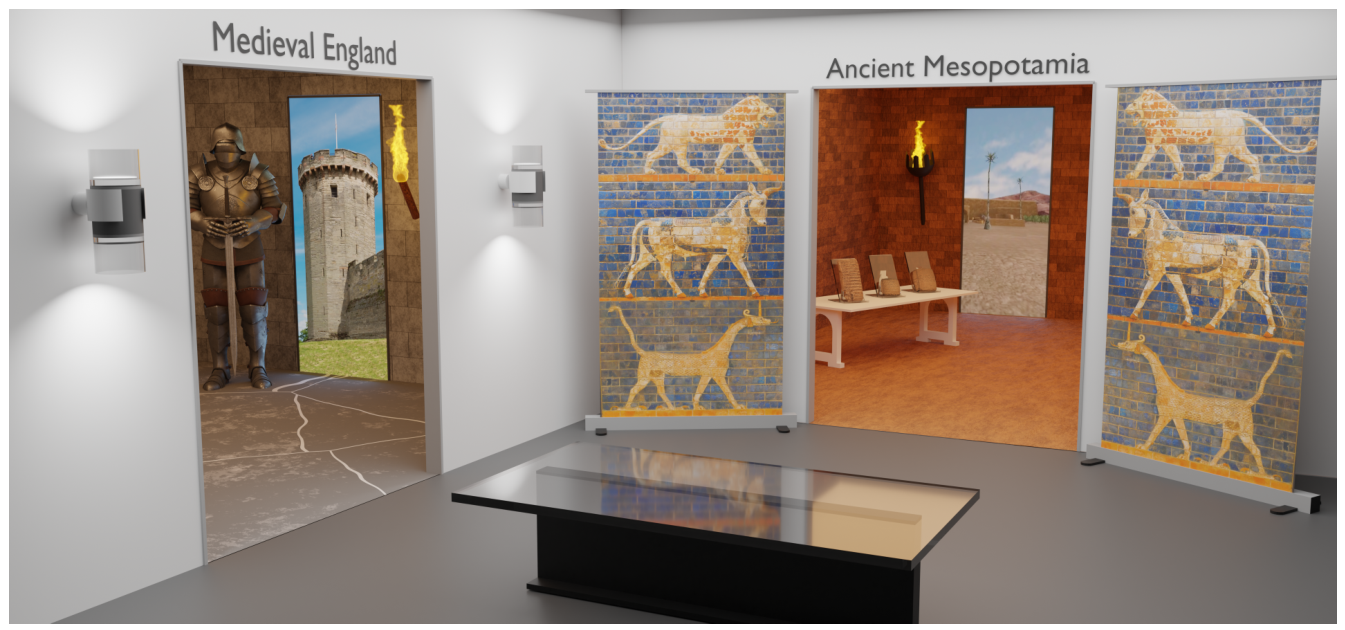
Figure 2.
Example set of curated and virtually exhibited Mesopotamian cuneiform tablets (scans courtesy of National Museums Liverpool (World Museum)). These include (left) Old Akkadian tablet, ca. 2340-2200 BCE (WML 56.22.247); (centre) Old Assyrian envelope, ca. 1950-1850 BCE (WML 49.47.41a) and (right) the envelope contents (WML 49.47.41b).
Figure 2.
Example set of curated and virtually exhibited Mesopotamian cuneiform tablets (scans courtesy of National Museums Liverpool (World Museum)). These include (left) Old Akkadian tablet, ca. 2340-2200 BCE (WML 56.22.247); (centre) Old Assyrian envelope, ca. 1950-1850 BCE (WML 49.47.41a) and (right) the envelope contents (WML 49.47.41b).
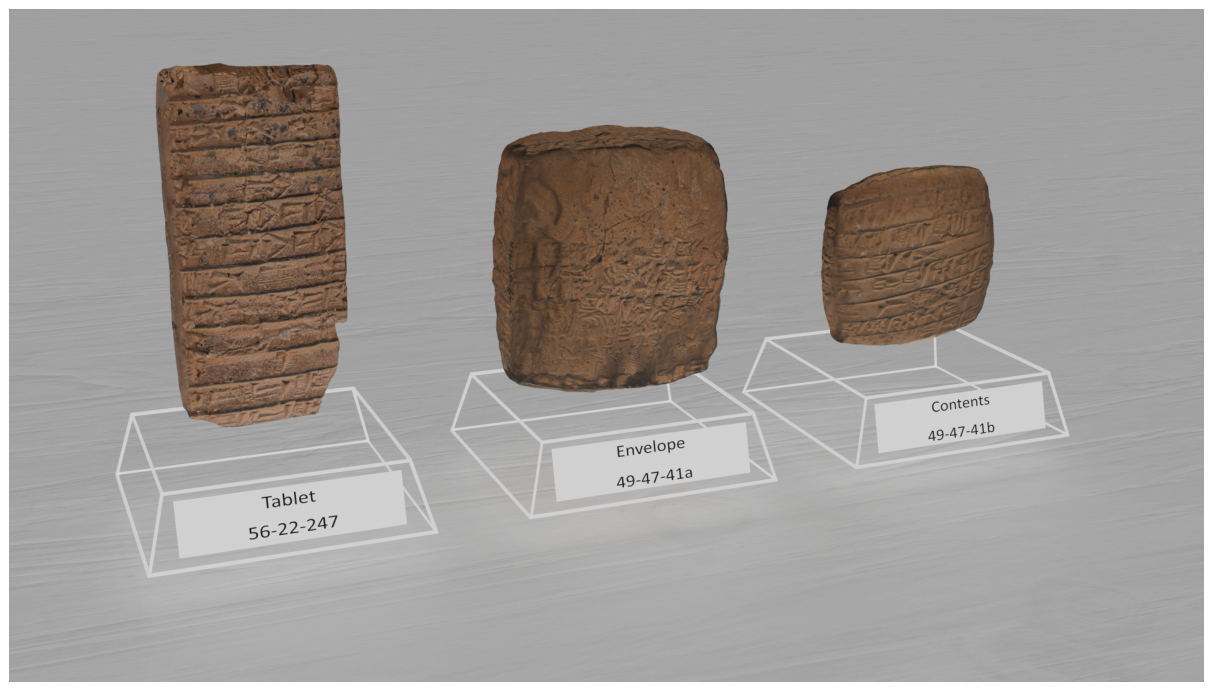
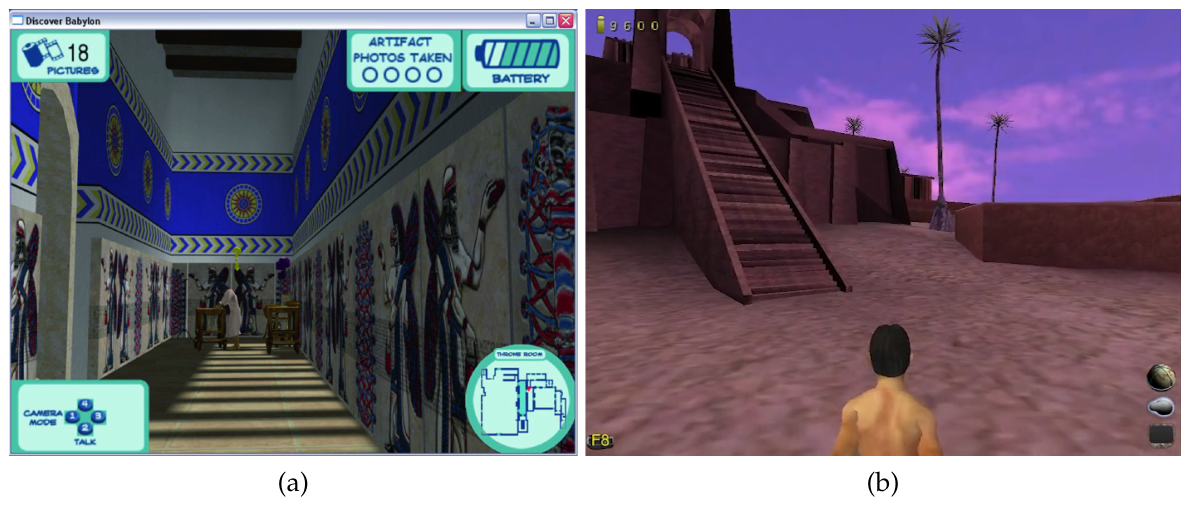
Figure 3.
Discover Babylon (a) the kiosk game and (b) the Ur level, set in 2100 BCE [40].
Figure 4.
Overview of the mixed-methods requirements elicitation study components.
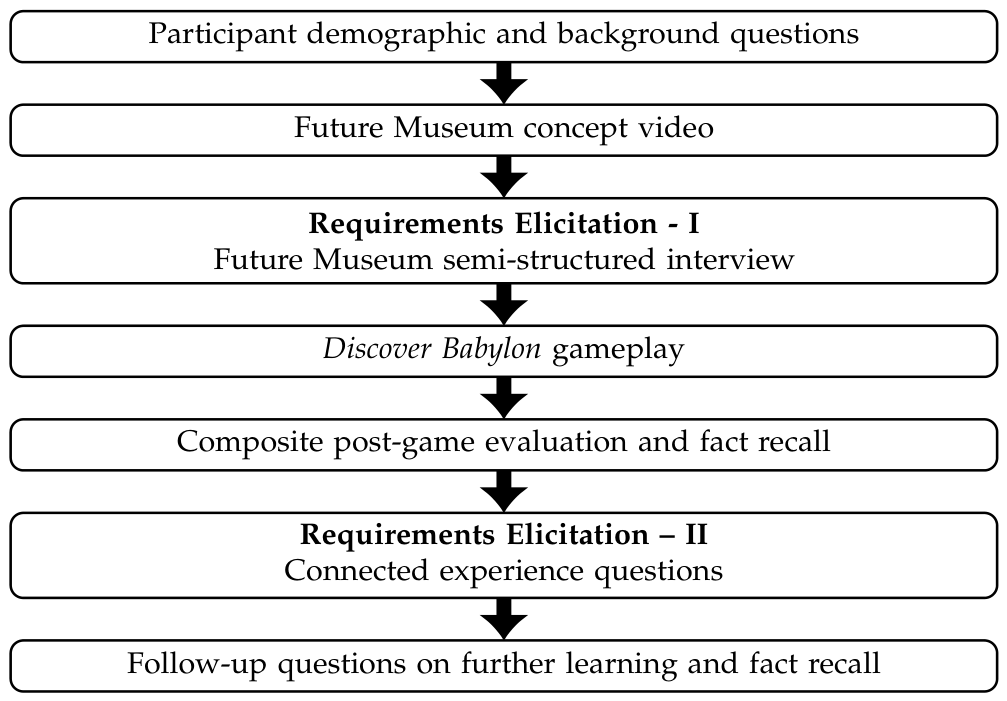
Figure 5.
Screenshots from the Future Museum concept video [44] showing (a) the Future Museum as a virtual interconnected curation space; (b) the sharing of curated collections; (c) a Unity prototype of a virtual room of exhibited artefacts and connected media; and (d) a similar virtual museum room experienced using a VR headset.
Figure 5.
Screenshots from the Future Museum concept video [44] showing (a) the Future Museum as a virtual interconnected curation space; (b) the sharing of curated collections; (c) a Unity prototype of a virtual room of exhibited artefacts and connected media; and (d) a similar virtual museum room experienced using a VR headset.
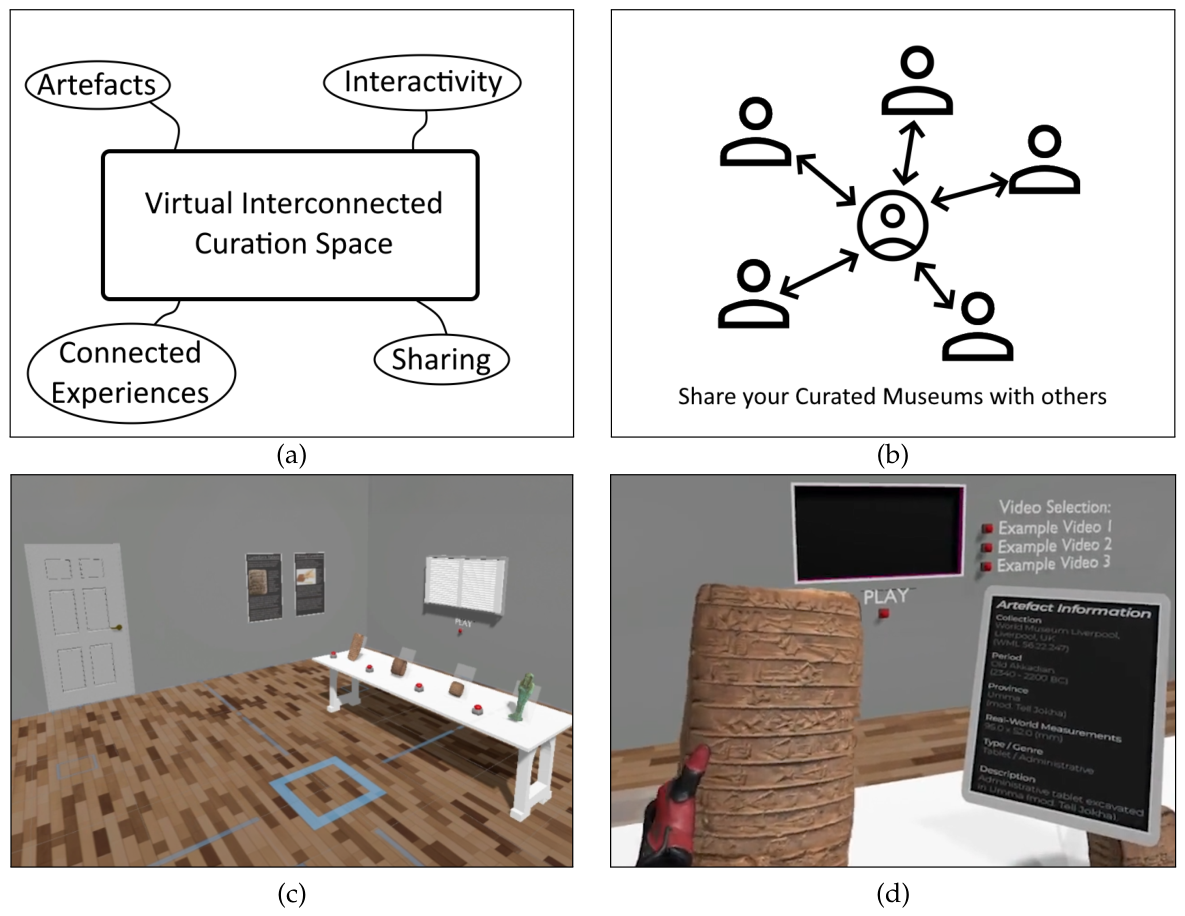
| (a) | (b) |
| (c) | (d) |
Figure 6.
Outline of semi-structured interview questions about the Future Museum concept.
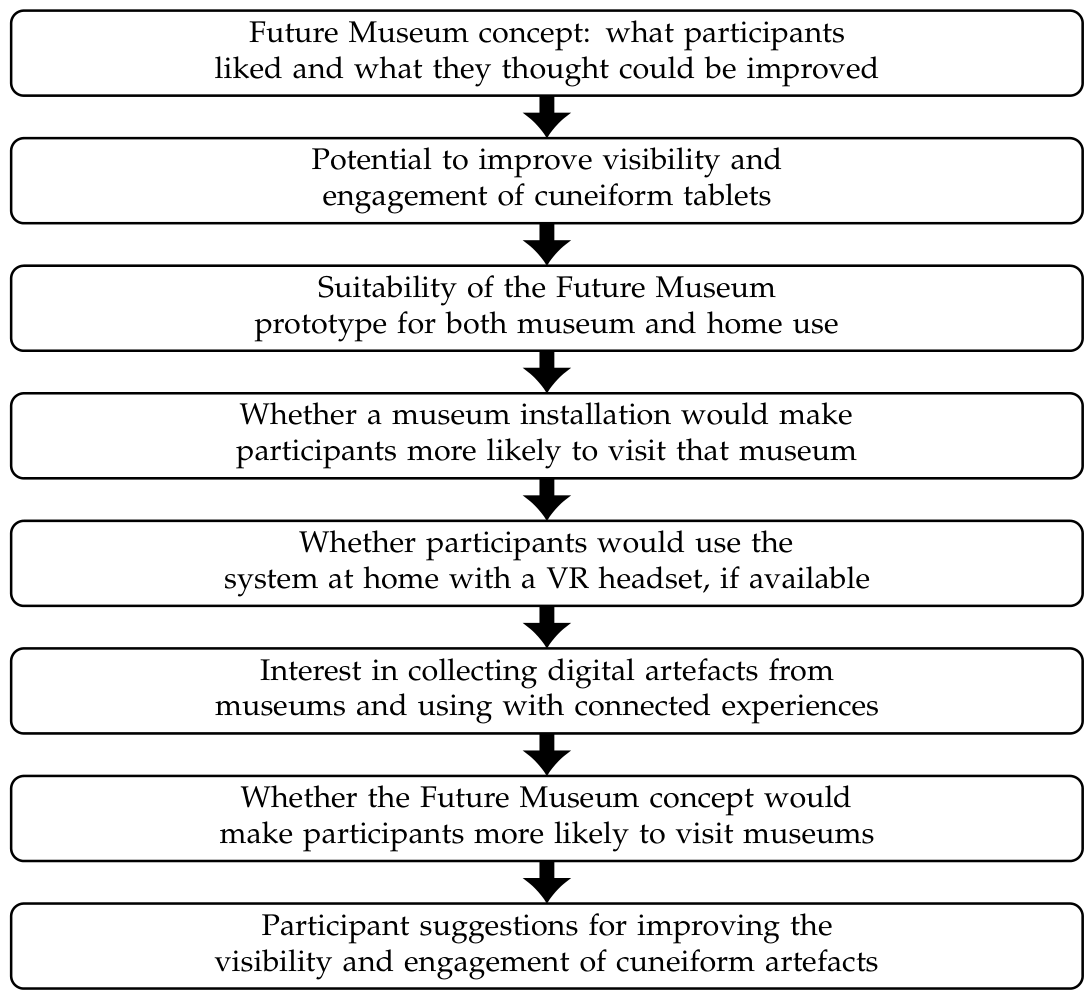
Figure 7.
Screenshots from the Discover Babylon serious game [40], (a) Level 1: Museum, present day, completing tasks to achieve time travel, (b) - (d) Level 2: Uruk, 3100 BCE, showing, respectively, the player attending scribe school, trading in the market, and returning to scribe school.
Figure 7.
Screenshots from the Discover Babylon serious game [40], (a) Level 1: Museum, present day, completing tasks to achieve time travel, (b) - (d) Level 2: Uruk, 3100 BCE, showing, respectively, the player attending scribe school, trading in the market, and returning to scribe school.
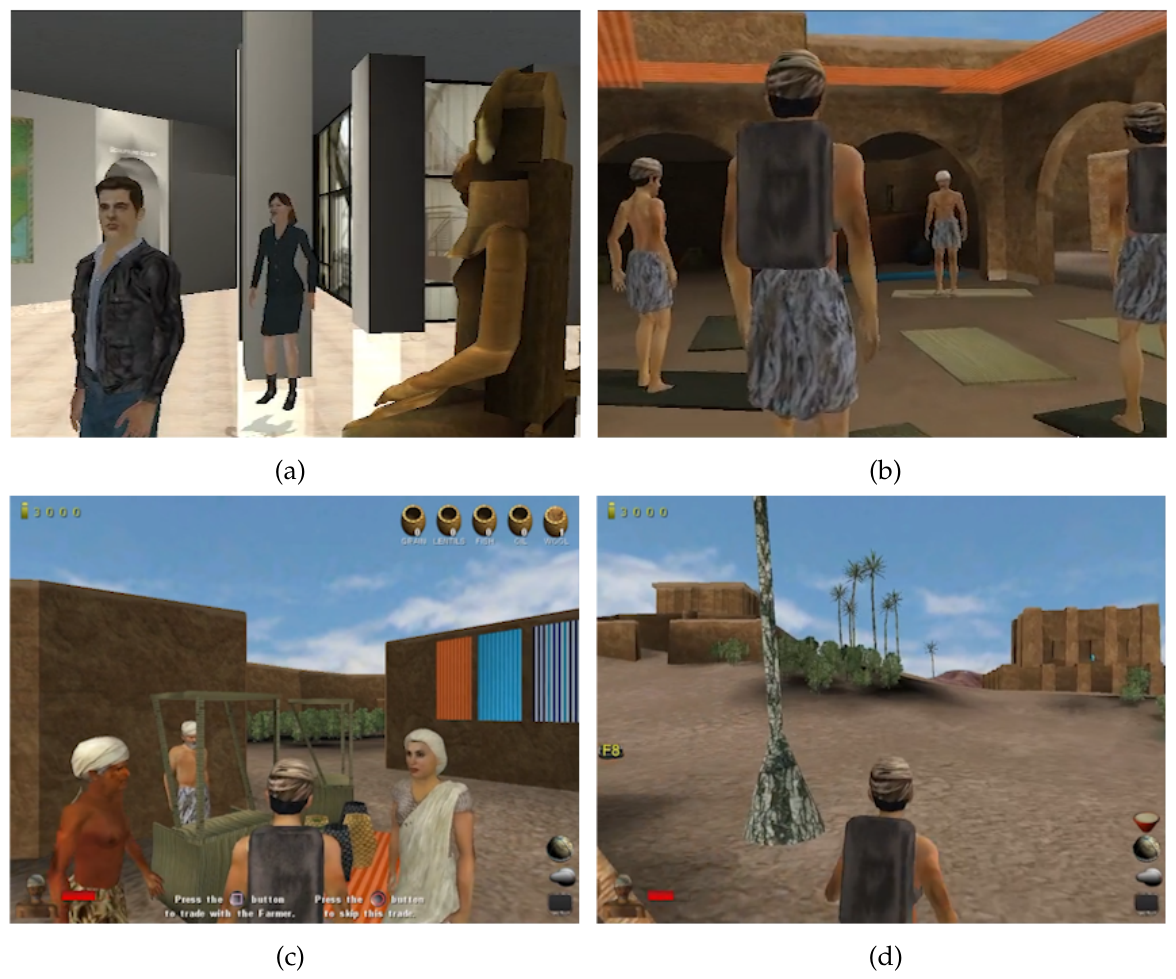
| (a) | (b) |
| (c) | (d) |
Figure 8.
Outline of post-game requirements elicitation questions concerning Discover Babylon as a game and as a possible connected heritage experience.
Figure 8.
Outline of post-game requirements elicitation questions concerning Discover Babylon as a game and as a possible connected heritage experience.
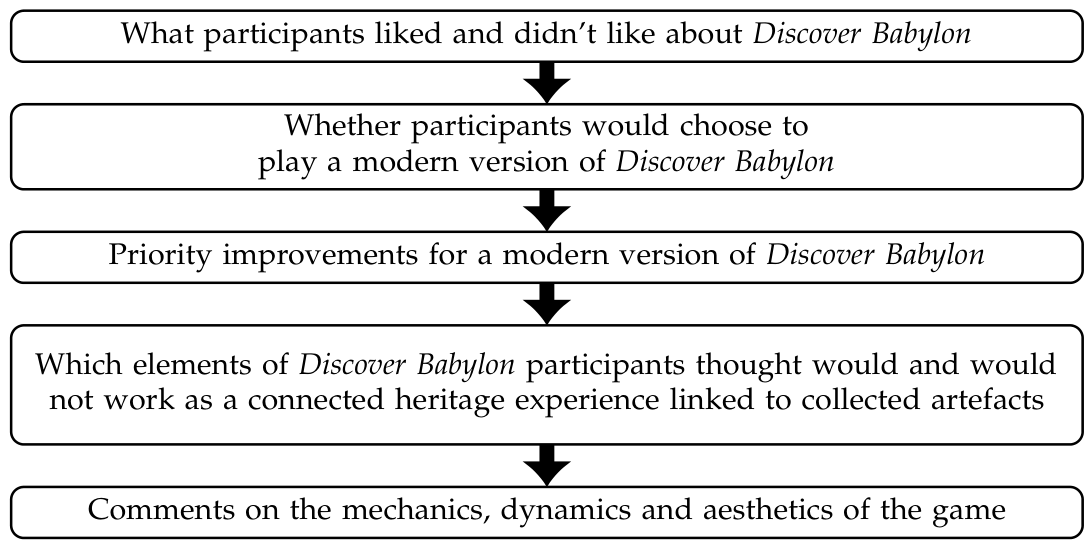
Figure 9.
Composite post-game evaluation inter-quartile box plots of participant responses for component questionnaires.
Top from left to right: Flow (Flow4D16) [47], System Usability Scale (SUS) [48], AttracDiff2 [49]. Bottom from left to right: Game Experience [37] and Heuristic Evaluation [51].
Response scales for the questions were as follows: Q1-8, Disagree (1) to Agree (6); Q9-11, Disagree (1) to Agree (5); Q12, Confusing (1) to Clearly Structured (5); Q13, Dull (1) to Captivating (5); Q14, Undemanding (1) to Challenging (5); Q15, Disagreeable (1) to Likeable (5); Q16, Discouraging (1) to Motivating (5); Q17-19, Not at all (1) to Very Much (5); Q20, Nothing (1) to A lot (5); Q21-24, Very Poor (1) to Very Good (10); and Q25-34, Disagree (1) to Agree (5).
Figure 9.
Composite post-game evaluation inter-quartile box plots of participant responses for component questionnaires.
Top from left to right: Flow (Flow4D16) [47], System Usability Scale (SUS) [48], AttracDiff2 [49]. Bottom from left to right: Game Experience [37] and Heuristic Evaluation [51].
Response scales for the questions were as follows: Q1-8, Disagree (1) to Agree (6); Q9-11, Disagree (1) to Agree (5); Q12, Confusing (1) to Clearly Structured (5); Q13, Dull (1) to Captivating (5); Q14, Undemanding (1) to Challenging (5); Q15, Disagreeable (1) to Likeable (5); Q16, Discouraging (1) to Motivating (5); Q17-19, Not at all (1) to Very Much (5); Q20, Nothing (1) to A lot (5); Q21-24, Very Poor (1) to Very Good (10); and Q25-34, Disagree (1) to Agree (5).
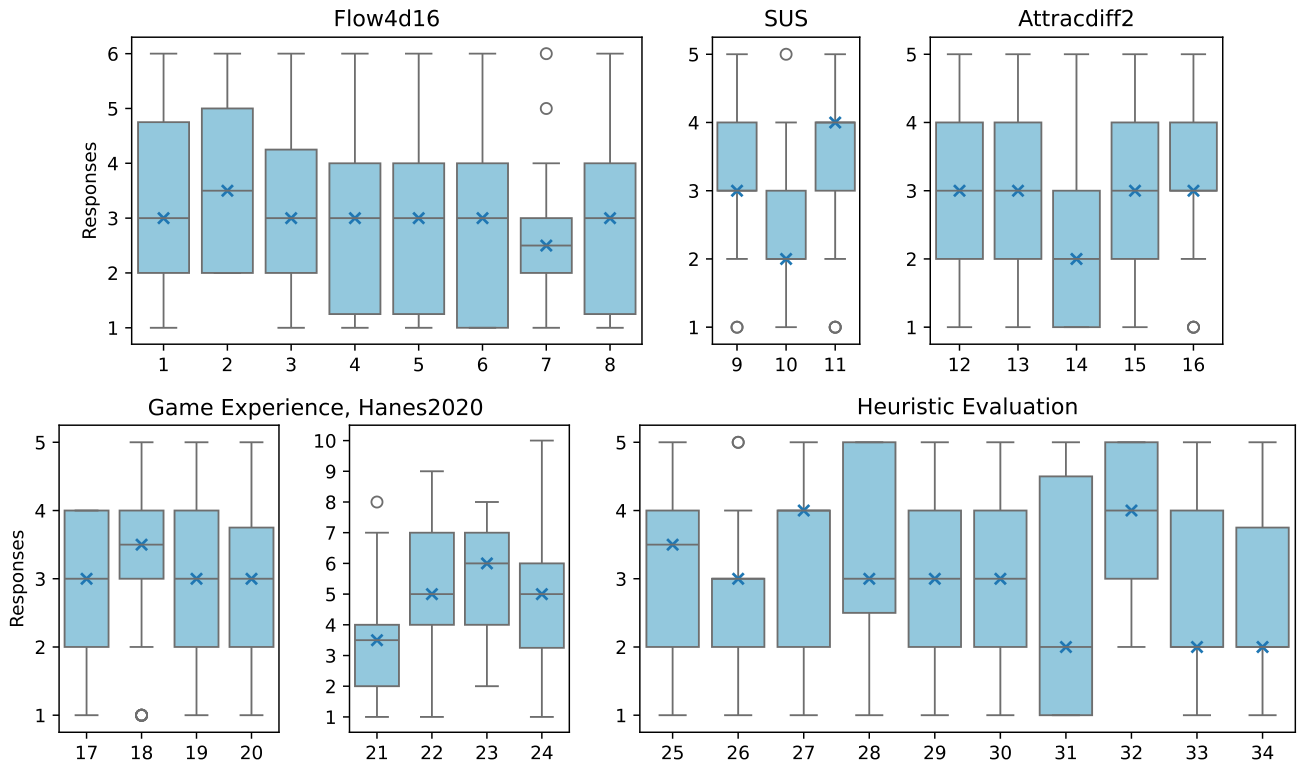
Table 1.
Examples of connected experiences and recommended resources in the Future Museum.
| Future Museum Experiences and Recommendations |
|---|
| Puzzles and quizzes |
| Videos, movies, media and documentaries |
| Online resources |
| Books, articles and written materials |
| VR, AR and XR apps and experiences |
| Games including serious games |
| AI avatars, virtual tour guides, specialist vignettes |
Table 2.
Examples of fact recall questions.
| Carved stone cylinders were rolled across clay tablets for decorative purposes. True or False? |
|---|
| Why might people have slept on their roofs during summer in ancient Mesopotamia? |
| What animal was mostly used to carry large loads over long distances in the Uruk period? |
| What was the primary material used for writing on in ancient Mesopotamia? Throughout ancient Mesopotamia, writing first developed as a book-keeping tool for recording wages and the flow of goods. True or False? |
| All children throughout Mesopotamia would learn to read and write? True or False? |
Table 3.
Requirements for the Future Museum Ecosystem.
| ID | Requirement | Evidence and rationale |
|---|---|---|
| FM1 | Enable collection of digital museum artefacts | Participants valued retaining digital artefacts after museum visits |
| FM2 | Support personal curation and organisation of collected virtual artefacts | Participants valued self-curation and collections reflecting individual interests |
| FM3 | Allow handling and manipulation of 3D virtual artefact models | Handling fragile, inaccessible or undisplayed artefacts was a key theme |
| FM4 | Provide access across locations, devices and platforms | Participants emphasised access from different locations and devices |
| FM5 | Enable collections to be shared with others | Participants valued sharing collections with family and friends |
| FM6 | Provide access for people unable to visit or navigate physical museums | Participants identified physical, geographical and financial barriers to access |
| FM7 | Reflect appropriate museum architecture and visual character | Some participants wanted the grandeur and architectural character of physical museums |
| FM8 | Balance museum-like display with opportunities for interaction | Participants valued handling but also suggested initially displaying artefacts in cases |
| FM9 | Link artefacts with contextual information and connected heritage experiences | Participants wanted to understand artefacts’ histories, contexts and uses |
| FM10 | Use collection incentives to support curation and continued learning | Participants valued collecting, badges, personal curation and continued access to information |
Table 4.
Requirements for Connected Experiences.
| ID | Requirement | Evidence and rationale |
|---|---|---|
| CE1 | Maintain a strong relationship with collected artefacts | Participants considered which experiences could accompany collected artefacts |
| CE2 | Place artefacts within relevant historical, social and cultural contexts | Participants valued learning about the histories surrounding artefacts |
| CE3 | Demonstrate how artefacts were created, handled or used | Participants wanted to move beyond inspection towards historically contextualised use |
| CE4 | Support exploration of reconstructed historical environments | Participants valued historical settings and opportunities for exploration |
| CE5 | Include relevant puzzles, quizzes or challenges | Participants valued puzzles, knowledge and quizzes as supports for learning |
| CE6 | Integrate historical information into interaction and exploration | Participants valued learning through dialogue, activities and historical environments |
| CE7 | Provide supporting information about artefacts and their contexts | Participants wanted access to information associated with artefacts and activities |
| CE8 | Support appropriate devices and interaction modes | Participants had differing levels of gaming experience and access to VR equipment |
| CE9 | Ensure game-like elements support the heritage content | Participants valued game-like engagement when it supported historical learning |
Table 5.
Requirements and Recommendations for a Modern Discover Babylon-Type Experience.
| ID | Requirement | Evidence and rationale |
|---|---|---|
| DB1 | Retain historical setting, narrative framing, exploration, artefact collection, puzzles and educational content | Participants valued these elements, which were connected through the time-travel narrative. |
| DB2 | Enable artefacts to be encountered in historical settings and their uses explored | Participants valued seeing artefacts in context and understanding how they were used |
| DB3 | Use contemporary controls, movement and camera conventions | Participants described controls and movement as clunky, awkward or oversensitive |
| DB4 | Provide maps, directional cues and navigation support | Navigation received low ratings, and participants requested maps and directions. |
| DB5 | Allow objectives and collected information to be reviewed | Participants reported being unable to review objectives or previously collected information |
| DB6 | Provide clear guidance, feedback, help and error recovery | Participants identified limited help, feedback and support for recovering from errors |
| DB7 | Improve pacing and challenge, with options to accelerate repeated interactions | Participants described the game as slow, tedious and relatively undemanding |
| DB8 | Update graphics, animation, sound and voice presentation | Participants described the audiovisual presentation as dated and in need of updating |
Disclaimer/Publisher’s Note: The statements, opinions and data contained in all publications are solely those of the individual author(s) and contributor(s) and not of MDPI and/or the editor(s). MDPI and/or the editor(s) disclaim responsibility for any injury to people or property resulting from any ideas, methods, instructions or products referred to in the content. |
© 2026 by the authors. Licensee MDPI, Basel, Switzerland. This article is an open access article distributed under the terms and conditions of the Creative Commons Attribution (CC BY) license.
Copyright: This open access article is published under a Creative Commons CC BY 4.0 license, which permit the free download, distribution, and reuse, provided that the author and preprint are cited in any reuse.