

Submitted:
29 August 2026
Posted:
31 August 2026
You are already at the latest version
Abstract
Purpose: This paper develops and articulates a three-dimensional conceptual framework for understanding employee discretionary behaviours in organisations. The framework integrates target orientation (interpersonal–organisational), role boundary (extra-role–in-role), and change orientation (reactive–proactive) to provide a holistic lens for analysing employee behavioural patterns. Design/methodology/approach: The study adopts a conceptual and narrative approach, reviewing relevant literature in organisational behaviour, human resource management, and work psychology to identify core discretionary behavioural dimensions. These dimensions are synthesised into a three- dimensional space, allowing behaviours to be positioned simultaneously across multiple continua. Findings: The proposed framework demonstrates that employee discretionary behaviours cannot be adequately understood through single-dimension or binary classifications. By integrating three behavioural dimensions, the model reveals a multidimensional behavioural space in which in-role and extra-role behaviours, interpersonal and organisational targets, and reactive and proactive orientations can coexist. The framework offers a structured basis for mapping, comparing, and interpreting diverse employee discretionary behaviours. Theoretical implications: The study contributes to organisational behaviour theory by extending existing discretionary behaviour classifications into a unified multidimensional model. It provides a foundation for future theory development by enabling researchers to examine interactions among behavioural dimensions rather than treating them in isolation. Practical implications: For managers, the framework offers a diagnostic tool for understanding discretionary work behaviour patterns, informing performance management, leadership development, and other HR interventions. Originality/value: The paper introduces a novel three-dimensional behavioural framework that advances conceptual clarity in employee discretionary behaviour research. Through the integration of the three fundamental behavioural dimensions, the model offers a flexible and extensible platform for both empirical testing and practical application.
Keywords:
change orientation
; discretionary behaviours
; extra-role
; in-role
; target orientation
1. Introduction
The literature widely acknowledges that discretionary employee behaviours that extend beyond formal job requirements contribute positively to organisational effectiveness. Such behaviours have been conceptualised under a variety of labels; including organisational citizenship behaviour (OCB), contextual performance, organisational spontaneity, prosocial behaviour, extra-role behaviour, civic citizenship, taking charge, personal initiative, innovative work behaviour, and citizenship performance (Borman, 2004; Borman & Motowidlo, 1993; Brief & Motowidlo, 1986; ; Frese, Fay, Hilburger, Leng & Tag, 1997; George & Brief, 1992; Graham, 1991; Janssen, 2000; Morrison & Phelps, 1999; Organ, 1988; Podsakoff et al., 2000; Van Dyne et al., 1995). Although these constructs differ in emphasis, they share a common feature, not only being discretionary work behaviours that are not fully captured by formal job descriptions; but that are also critical for organisational effectiveness. As intimated by Katz (1964: 132) more than 60 years ago, ‘an organisation which depends solely upon its blueprint of prescribed behaviour is a fragile social system’.
Since the 1980’s, there has been a proliferation of citizenship-like behaviours, with Podsakoff et al. (2000) identifying 30 different dimensions of OCB, and Fernandes et al. (2021) identifying around 96 OCB dimensions. As a result, despite the substantial body of research on the nature of discretionary work behaviours, the literature remains fragmented. Different scholars use different terms, and in some cases, fail to draw on each other’s work to provide an integrated perspective (Marinova et al., 2015).
Simplified conceptual frameworks have been suggested and tested to integrate discretionary behaviours (e.g. Marinova et al., 2010, Moon et al., 2004; Van Dyne et al., 1995) and their dimensions (e.g. LePine et al., 2002; Hoffman et al., 2007; Organ, 1988; Smith et al., 1993; Williams & Anderson, 1991). However, existing frameworks tend to focus on single dimensions—such as whether these behaviours are extra-role or in-role (Morrison, 1994), interpersonal or organisational (Williams & Anderson, 1991), and reactive or proactive (Crant, 2000; Marinova et al., 2010)—often treating these distinctions as binary rather than continuous. Worryingly, conceptually similar behaviours are classified inconsistently across studies, and important differences among behaviours are obscured. The problem has been compounded by the fact that researchers have focused more on the relationship between discretionary work behaviours and other constructs than on their nature, or indeed, on how employees perceive them in practice (Fernandes et al., 2021).
The current paper argues that existing frameworks have limitations in that they tend to examine discretionary behavioural dimensions in isolation rather than as coexisting orientations within multiple behavioural spaces. As a result, current frameworks militate against the nature of these behaviours in practice.
The purpose of the paper is therefore to develop an integrative, multidimensional diagnostic framework that captures how employee discretionary behaviours vary simultaneously across (a) target orientation (interpersonal–organisational), (b) role boundary orientation (extra-role–in-role), and (c) change orientation (reactive–proactive). These dimensions are conceptualised as continua that are integrated into a three-dimensional space, within which diverse employee discretionary behaviours can be located and understood.
By conceptualising employee discretionary behaviours within a three-dimensional behavioural space, this study advances and explores a holistic lens for understanding such behaviours. The proposed 3-dimensional framework does not replace existing taxonomies of discretionary work behaviours; rather, it provides a unifying structure that accommodates them. In doing so, it shifts the analytical focus from debating categorical boundaries to examining relative positioning and interaction among behavioural dimensions, thereby enhancing conceptual clarity and theoretical integration.
The paper proceeds as follows. The next section reviews literature on existing integrative frameworks on discretionary work behaviours. Section 3 briefly describes the approach for the review, and section 4 proposes and justifies an integrative, three-dimensional classification framework that captures how employee behaviours vary simultaneously across target orientation, role boundary orientation, and change orientation. The classification of illustrative taxonomies of discretionary behaviours on the framework and the provision of evidence from the literature to support the model is also presented. Section 5 provides theoretical and practical implications, limitation and prospects for future research. The final section provides conclusions.
1. Theoretical Underpinnings
1.1. The Evolution of Discretionary Work Behaviours
As early as 1938, Barnard realised the need for organisational members to willingly cooperate for the good of the organisation. Katz and Kahn (1978) argued that for an organisation to function effectively, among other resources, it must have employees who undertake innovative and spontaneous activities that go beyond prescribed job requirements. These behaviours are known collectively as discretionary work behaviours (Khaola, 2018, 2025; Podsakoff et al., 2000).
OCB is the best-known and most rigorously researched discretionary behaviour (Podsakoff et al., 2000; Organ, 2018). It was originally defined by Organ (1988:4) as ‘the behaviour that is discretionary, not directly or explicitly recognised by the formal reward system and that in the aggregate promotes the effective functioning of the organisation’. In response to criticism about this definition, especially concerning whether OCB is extra-role and rewarded, Organ (1997:91) repackaged the OCB definition as total ‘contributions to the maintenance and enhancement of the social and psychological context that supports task performance’.
Sample discretionary behaviours, their definitions and sources are illustrated in Table 1.
As shown in Table 1, OCB comprises several behavioural dimensions (Fernandes et al., 2021; Podsakoff et al., 2000; 2009). The table includes some common discretionary behaviour constructs related to OCB, including taking charge (Morrison & Phelps, 1999), personal initiative ( Frese et al., 1997), voice (Van Dyne & LePine, 1998) innovative work behaviour (Janssen, 2000), and issue selling (Dutton & Ashford, 1993).
Consequently, in additional to popular affiliative discretionary behaviours, Table 1 includes several well-known change-oriented behaviours. Along with OCB constructs, Marinova et al. (2015) also explored the nature of some change-oriented behaviours included in Table 1.
Overall, the sample discretionary behaviours cited above represent a family of work behaviours that vary in their target, role boundary, and change orientation, rather than a homogeneous category of extra-role acts. In an attempt to integrate the fragmented literature on discretionary work behaviours, prior studies have proposed different simple, yet parsimonious frameworks and models.
1.1. Different Conceptual Frameworks of Discretionary Behaviours
1.1.1. Role Boundary of Discretionary Behaviours
In the 1980’s, Organ and colleagues coined one of the well-known discretionary behaviour – OCB (Bateman & Organ, 1983; Organ, 2018; Organ, 1988; Smith et al., 1983). OCB was conceptualised as an extra-role, non-rewarded behaviour – as opposed to in-role behaviour that is often described in job descriptions (Podsakoff et al., 2009). However, one problem facing researchers has been that the number of citizenship-like extra-role behaviours in the literature has been increasing without clear integrative framework (Spitzmuller et al., 2008). The other debate that existed for decades relates to whether OCB dimensions are all extra-role, and hence discretionary.
Based on role theories, Morrison (1994) was one of the first scholars to challenge the definition of OCB as extra-role behaviour, arguing that some OCBs that researchers conventionally defined as extra-role were actually defined as in-role by employees. She argued that employees may engage in OCBs because they define their jobs broadly, not because they reciprocate good treatment from employers as was originally theorised (Organ, 1988). Many researchers have since replicated the findings of Morrison (1994) in different work settings and contexts (e.g. Chiaburu & Byrne, 2009; Kamdar et al., 2006; McAllister et al., 2007; Tepper et al., 2001; Van Dyne et al., 2008, Vey & Campbell, 2004).
Some researchers have challenged another widely held view, namely, that OCBs are not rewarded; submitting instead that supervisors do consider OCBs when assessing performance and promoting employees (Allen, 2006; Allen & Rush, 1998; McKenzie, Podsakoff & Fetter, 1993). In a paper aptly entitled ‘Organisational citizenship behaviour: It’s construct clean-up time’, Organ (1997) concedes that there are ambiguities surrounding the definition of OCB, and recommends dropping the term ‘extra-role’ from the definition of the concept. Not everybody however agrees that the uneasiness and blurred distinction between extra-role and in-role nature of OCB should lead to the removal of the term ‘extra-role’ in its definition.
While acknowledging the complexity and dynamism of extra-role behaviours across hierarchical, temporal, individual and professional levels of analysis, Van Dyne and colleagues (1995:246) favour conceptual clarity, and argue that ‘if constructs are defined so broadly as to include both in-role and extra-role behaviours, it would be difficult to focus on the specific behaviour of interest and exclude peripherally related behaviour’. To Vey and Campbell (2004:120), ‘redefining OCB to exclude the extra-role characteristic might weaken the theoretical underpinnings of the construct’. They advocate instead that behaviours that are truly extra-role should be identified and measured appropriately in research. While separating in-role from extra-role behaviours can be a worthwhile exercise, it can be illusive because the degree to which OCBs are perceived as extra-role or in-role is complex and dynamic (Van Dyne et al., 1995), and possibly subjective, and context-dependent.
Kidder and Parks (2001) suggest that OCB dimensions can be arranged on a continuum of ‘extra-rolenes’ from altruism (the most active form of OCB) to conscientiousness (the most passive form of OCB). These authors do not suggest that OCB dimensions are either extra-role or in-role, but rather that they can be arranged in a continuum of ‘extra-roleness’, or put in different words, that OCBs differ to the extent to which employees perceive them as extra-role or in-role.
Organ et al. (2006:143) observe that employees may feel that certain behaviours are expected as part of their jobs even though they may still believe that such behaviours are discretionary and not formally rewarded. Podsakoff et al. (2000) support that employees may feel that they are expected to do anything that contributes to organisational effectiveness. That notwithstanding, McAllister et al. (2007:1208) caution that ‘whether a particular form of OCB is seen as in-role or extra-role is not the same as whether it is seen as discretionary or nondiscretionary or whether it is perceived to be instrumentally associated with personal outcomes’. Marinova et al. (2010:1468) have submitted that research is yet to consider whether some types of OCB could be viewed as more rewarded or more in-role than other types of OCB.
The current paper acknowledges that OCBs differ in the degree to which they are perceived as in-role or extra-role; not that they are actually in-role or extra-role. Put differently, rather than treating in-role and extra-role as mutually exclusive categories, the framework suggested in this paper conceptualises role boundary orientation (along with other orientations) as a continuum, reflecting employees’ subjective interpretations of role expectations of discretionary behaviours.
1.1.1. Target Orientation of Discretionary Behaviours
One popular way of categorising discretionary behaviours has been to assess whether they are targeted at the organisation, or individuals within the organisation (Khaola, 2018). Based on the concept of OCB, the simple, yet parsimonious framework suggested by Williams and Anderson (1991) is often used as an underlying framework in this regard (Spitzmuller et al. 2008). This framework differentiates between OCB targeted at individuals (OCBI or interpersonal aspects of OCB) and OCB targeted at organisations (OCBO or impersonal aspects of OCB). Unlike other frameworks that rely on exploratory factor analysis to derive the components of OCB, this framework is rooted in sound theory (Spitzmuller et al. 2008), and allows the examination of the ‘target similarity effects’ based on the target of OCB (Lavelle et al., 2009). The notion of ‘target similarity effects’ in this context suggests that employees direct their reciprocation efforts to either the organization or individuals depending on whether they respectively perceive the organization or individuals to be the source of their assistance (Khaola & Sebotsa, 2014; McNeely & Meglino, 1994).
In the 1980’s, Smith et al. (1983) proposed two dimensions of OCB – altruism reflecting aspects of OCBI, and generalized compliance reflecting aspects of OCBO. Later, Organ (1988) proposed a popular five-model framework comprising altruism, courtesy, conscientiousness, civic virtue, and sportsmanship (see Table 1 for definitions). The first two dimensions capture interpersonal aspects of OCB (i.e. OCBI) and the latter three dimensions capture the impersonal aspects of OCB (i.e. OCBO). Two years later Organ (1990) proposed an expanded taxonomy of OCBs that included peacekeeping and cheerleading dimensions, which can be categorized under OCBI.
As summarised by Khaola (2018), examples of OCB-related discretionary behaviours benefiting individuals (OCBI) include Graham’s (1989) interpersonal helping; Van Scotter and Motowidlo’s (1996) interpersonal facilitation; Farh et al’s (1997) altruism and interpersonal harmony; Van Dyne and LePine’s (1998) helping; Farh et al.’s (2004) helping co-workers and interpersonal harmony; Van Dyne et al.‘s (1994) social participation; Coleman and Borman’s (2000) interpersonal citizenship behaviour; McNeely and Meglino’s (1994) prosocial individual behavior; Coldwell and Callaghan’s (2014) individual support; and Morrison’s (1994) altruism.
On the flipside, OCB–related discretionary behaviours directed at organisations (OCBO) include Graham’s (1989) organizational loyalty; Van Scotter and Motowidlo’s (1996) job dedication; Farh et al.’s (1997) conscientiousness, civic virtue, and protecting company resources; Borman and Motowidlo’s (1993, 1997) endorsing, supporting, and defending organizational goals; Van Dyne and LePine’s (1998) voice behaviour; Morrison and Phelps’s (1999) taking charge; Farh et al.’s (2004) promoting company’s image; Van Dyne et al.’s (1994) loyalty, obedience, and conscientiousness; Coleman and Borman’s (2000) organizational citizenship behaviour; McNeely and Meglino’s (1994) prosocial organisational behaviour; Coldwell and Callaghan’s (2014) organisational support; Morrison’s (1994) conscientiousness, sportsmanship, involvement, and keeping up with changes; and Moorman and Blankely’s (1995) loyal boosterism, personal industry, and individual initiative (Khaola, 2018).
A few dimensions that do not fit squarely within the broad dimensions proposed by Williams and Anderson’s (1991) framework include Van Scotter and Motowidlo’s (1996) job dedication; Van Dyne et al.’s (1994) functional participation; Farh et al.’s (2004) self-training, keeping workplace clean, social welfare participation; and Coleman and Borman’s (2000) job-task citizenship behaviour (Khaola, 2018).
It could be observed from the discretionary behaviours cited above that; some are change-oriented and proactive in nature. This makes it imperative to consider the change orientation of discretionary behaviours.
1.1.1. Change Orientation of Discretionary Behaviours
The concept of OCB, probably the most popular discretionary work behaviour, focuses on modest behaviours that sustain the status quo (Marinova et al., 2010; Morrison & Phelps, 1999), and hence leave out other discretionary behaviours that are change-oriented in nature. These other behaviours include taking charge, personal initiative, voice, innovative work behaviour, issue selling and several proactive OCBs (Bettencourt, 2004; Choi, 2007). These proactive dimensions are also characteristically targeted at the organisation.
The studies by Chiaburu et al. (2011) and MacKenzie et al. (2011: 561) posit that affiliative and change-oriented OCBs are conceptually and empirically distinguishable because they fall on separate factors and have different antecedents. However, as discretionary behaviours, affiliative and change-oriented OCBs also overlap. In their study, Potoňik and Anderson (2016) posited that most change-oriented constructs, just like OCB, are discretionary, and with the exception of creativity and innovation (which can also be formally required), they include extra-role elements. In addition to the target of OCB (interpersonal versus organisational), Moon et al. (2004) proposed a circumplex model of OCB with two additional axes (promotive versus protective) to provide for a four quadrant model that can integrate the OCBs (see Figure 1). In other words, they superimposed the change-orientation axes over target orientation axes to construct their model, which provided a required advancement in theory.
Based on this model, four representative behaviours were identified - helping behaviour that is interpersonal and promotive; innovation that is organisational and promotive; compliance that is organisational and protective; and sportsmanship that is interpersonal and protective.
Marinova et al. (2010) tested this model, and largely found support for the different dimensions of OCBs. However, these authorities noted that their approach was simplified, and called for other conceptually meaningful ways to contrast different types of discretionary behaviours. Pursuant to this call, the framework advanced in this paper integrates target orientation (interpersonal–organisational), role boundary (extra-role–in-role), and change orientation (reactive–proactive) to provide a holistic lens for categorising and analysing employee behavioural patterns
Taken together, the proposed diagnostic framework illustrates that discretionary work behaviours cannot be meaningfully understood through singular labels that persist in the current literature. Instead, the paper submits that discretionary behaviours occupy positions within a multidimensional space where their meaning depends on relative orientation across target, role boundary, and change dimensions. The proposed three-dimensional framework (Figure 2) offers a more flexible and theoretically coherent platform for organising existing discretionary and guiding future empirical research.
This framework provides eight integrated spaces in which discretionary behaviours can be located.
1. Methods and Approach
The study adopts a conceptual and narrative review methodology to identify, evaluate and synthesise empirical and conceptual research on discretionary work behaviours. The narrative review was chosen because of its flexibility in handling diverse types of literature, and particularly its ability to integrate existing theoretical frameworks and empirical studies (Tenakwah & Watson, 2025).
1. Findings, Suggested Classification Framework and Propositions
1.1. The Proposed Classification Framework, Sample Discretionary Work Behaviours and Evidence from Literature
Selected discretionary behaviours are illustrated in Figure 3.
The paper justifies the dominant orientation of selected discretionary behaviours in Figure 3 based on conceptual definitions in Table 1 and the literature so far reviewed.
1.1.1. Target Orientation of Selected Discretionary Work Behaviours
To the knowledge of the author of this paper, the target of OCBs and other discretionary behaviour has not evoked as much debate in the literature as that of their role boundary and change orientation. As a result, following the work of Williams and Anderson (1991), the paper replicates past studies and categorises discretionary behaviours as ranging from those that help individuals to those that assist the organisation to achieve its goals. For the purposes of the framework being presented in this paper, altruism and sportsmanship are defined as more targeted towards individuals (co-workers and supervisors); and conscientiousness, courtesy, civic virtue, taking charge, personal initiative, voice, innovative work behaviour and issue selling as more targeted towards the organisation than the individuals within organisations. These are confirmed by the definitions provided in Table 1. In the next sub-sections, the paper justifies sample discretionary behaviour taxonomies along their role boundary and change orientation, often as employees are likely to perceive them.
1.1.1. Classification of Conscientiousness, Courtesy and Civic Virtue
Conscientiousness, courtesy and civic virtue represent discretionary work behaviours that support organisational functioning by means of three mechanisms. First, they maintain compliance norms; second they foster cooperation and encourage participation in organisational life (Organ et al., 2006; Podsakoff et al., 2000); and third, they preserve existing relationships; maintain harmony, and reinforce rather than challenge existing frameworks (Bettencourt, 2004; Choi, 2007). Since people high on these discretionary behaviours emphasise the observance of norms within existing cooperative systems (Organ et al., 2006); focus on obedience to written and unwritten norms; support the status quo by carefully conforming to policies and procedures (Marinova et al., 2010); they are considered to be more reactive than proactive in nature.
While it may be relatively easy to classify discretionary behaviours as either proactive or reactive, it remains illusive to classify them as either relatively in-role or extra-role, principally because discretionary behaviours are perceived to be extra-role by definition.
That notwithstanding, Kidder and Parks (2001) have posited that OCB dimensions can be arranged on a continuum of ‘extra-rolenes’ from altruism (the most active form of OCB) to conscientiousness (the most passive form of OCB). This suggests that conscientiousness is deemed more in-role than other dimensions of OCB. Conscientiousness (a.k.a. compliance or obedience) reflects relatively ‘in-role’ activities such as good attendance, punctuality, conforming to policies, norms and rules, and avoiding excessive breaks (Marinova et al., 2010). Since people high on these discretionary behaviours emphasise the observance of norms within existing cooperative systems (Organ et al., 2006); focus on obedience to written and unwritten norms; support the status quo by carefully conforming to policies and procedures (Marinova et al., 2010); they are considered to be more reactive than proactive in nature.
While it is relatively easy to separate conscientiousness from other dimensions in terms of whether it can be perceived as in-role or extra-role, courtesy and civic virtue dimensions are difficult to locate in the continuum. Empirical studies however give us some clue as to how employees perceive these dimensions.
The study by Vey and Campbell (2004) found that conscientiousness and courtesy were described as more in-role than other dimensions, while altruism and civic virtue were described as more extra-role. However, Van Dyne et al. (1995:238) posited that examples given for conscientiousness, courtesy, and civic virtue appeared more likely to be in-role job expectations in many jobs. Thus, Vey and Campbell (2004) and Van Dyne et al. (1995) differ with regard to the classification of civic virtue. That notwithstanding, as suggested by Van Dyne et al. (1995:240), conceptualisation of civic virtue as suggested by Organ (1988) is more compliant and affiliative (e.g. reading company mail or attending meetings) than civic virtue suggested by Graham (1986) which is more promotive or proactive (e.g. encouraging others to speak at meetings or challenging the majority). This paper submits that, since examples of civic virtue used in most scales follow the conceptualisation of Organ (1988), civic virtue is likely to be perceived as more in-role than extra-role by employees. Courtesy is also likely to be perceived as more in-role than extra-role because keeping supervisors and other employees informed is expected in many jobs (Van Dyne et al., 1995).
In summary, conscientiousness, courtesy and civic virtue are likely to be perceived as more in-role than extra-role; more reactive than proactive; and more directed at the organisation than at individuals.
Proposition 1: Conscientiousness, courtesy and civic virtue are likely to be perceived as more in-role than extra-role; more reactive than proactive; and more directed at the organisation than at individuals.
1.1.1. Classification of Taking Charge, Personal Initiative, and Voice
As posited by Morrison and Phelps (1999), proactive components of extra-role behaviours have received little theoretical attention in research. Taking charge, personal initiative and voice are examples of such extra-role, discretionary behaviours.
Organ et al. (2006:310) observed that taking charge or personal initiative, as dimensions of OCB, are difficult to distinguish from in-role behaviours because they differ more in degree than in kind. Along similar lines of thinking, Marinova et (2010) hypothesised and confirmed that taking charge was likely to be perceived as the most in-role and rewarded of the four types of OCB under their study (taking charge, helping, compliance and sportsmanship) because it is both proactive (promotive) and targeted at the organisation. Consistent with these findings, it is plausible to expect that voice can be classified as more in-role and rewarded because it has similar features with taking charge concept. Both behaviours are proactive, and are targeted at helping the organisation. In fact, Crant (2000) identified personal initiative, taking charge and innovation as elements of proactive behaviours. As explained in Table 1, taking charge, personal initiative and voice are agentic behaviours or actions that anticipate, prevent or address problems before they occur.
In summary, it is plausible to submit that taking charge, personal initiative, and voice are likely to be perceived as more in-role than extra-role; more directed at the organisation than individuals; and more proactive than reactive.
Proposition 2: Taking charge, personal initiative, and voice are likely to be perceived as more in-role than extra-role; more directed at the organisation than individuals; and more proactive than reactive.
1.1.1. Classification of Innovative Work Behaviour (IWB) and Issue Selling
IWB and issue selling are likely to be described as extra-role that in-role. Even though many researchers identify IWB as extra-role (e.g. Janssen, 2000; Reuvers et al, 2008), some provide evidence that the concept may be both extra-role and in-role. The extra-role nature of IWB is likely to be more pronounced during the early phases of the process, particularly during opportunity recognition, idea generation and idea promotion – and progressively weaker as innovative ideas become formally authorised, implemented and institutionalised within organisational roles (Tuominen & Toivonen, 2011). While the exact classification of IWB can be illusive, the current study submits that the concept can be perceived as more extra-role than in-role, except in cases where innovation is expected (e.g. in research and development, design or entrepreneurial organisations). First, IWB is not part of job description, and instead, it is defined as part of ‘spontaneous behaviours’ that transcend prescribed roles (Katz, 1964; Spanuth & Wald, 2017). In fact, Bos-Nehles and Veenendal (2017) see IWB as an extra-role or discretionary behaviour that is neither described in job description nor recognised in formal reward systems of many organisations. Second, innovation is risky, and unless it is defined as a job requirement, employees may be less motivated to engage in it (Yuan & Woodman, 2010).
Like IWB, issue selling is extra-role behaviour. As originally conceived by Dutton and Ashford (1993), issue selling is a discretionary behaviour. It is therefore likely to occupy the end of the interpersonal – organisation dimension because its primary target is organisational attention. Although the behaviour is enacted through interpersonal interactions, its intended referent is typically the organisation or its decision–makers rather than individual co-workers.
In summary, IWB and issue selling are likely to be perceived perceived as more extra-role than in-role; more proactive than reactive; and more directed at the organisation that individuals.
Proposition 3: Innovative work behaviour and issue selling are likely to be perceived as more extra-role than in-role; more proactive than reactive; and more directed at the organisation that individuals.
1.1.1. Classification of Altruism or Helping Behaviour
Altruism is more extra-role relative to other OCBs because people voluntarily take initiatives to help others with work-related problems or to orient new employees. In fact, it has been conceptualised as the most active form of OCB (Kidder & Parks, 2001; Vey & Campbell, 2004), and has been found by both Vey and Campell (2004) and Van Dyne et al. (1995) as extra-role in nature. Even though altruism encourages a positive work environment by reinforcing relationships (Moon et al., 2004), it involves action-oriented initiatives, and is therefore more proactive in orientation than other OCBs. A bias for initiative, action and improvement, though measured, characterise altruistic behaviour. Next to taking charge, Marinova et al. (2010) found helping to be more a promotive form of OCB than compliance and sportsmanship.
In summary, altruism is likely to be perceived as more extra-role than in-role; more proactive than reactive; and more directed at individuals than at the organisation.
Proposition 4: Altruism is likely to be perceived as more extra-role than in-role; more proactive than reactive; and more directed at individuals than at the organisation.
1.1.1. Classification of Sportsmanship
Compared to other discretionary behaviours (e.g. conscientiousness, courtesy and civic virtue), sportsmanship is likely to be perceived as more extra-role than in-role (Van Dyne, 1995:238). Refraining from complaining about less than ideal situations; being tolerant to co-workers; exhibiting a positive attitude (Organ, 1988; Podsakoff et al., 1990) may be expected activities, but they are apparently discretionary behaviours. Vey and Campbell (2004) presented evidence that conscientiousness and courtesy were described as more in-role than other dimensions, while altruism and civic virtue were described as more extra-role than other dimensions; implying that sportsmanship is at least perceived as more extra-role than both conscientiousness and courtesy. While being a sport can be extra-role in nature, it is by no means proactive.
In summary, sportsmanship is likely to be perceived as more extra-role than in-role; more reactive than proactive; and more directed at individuals than at the organisation.
Proposition 5: Sportsmanship is likely to be perceived as more extra-role than in-role; more reactive than proactive; and more directed at individuals than at the organisation.
1. Discussion, Theoretical and Practical Implications
The proposed integrative framework has several theoretical and practical implications.
1.1. Theoretical Implications
The framework challenges the tendency to conceptualise discretionary behaviours through binary classifications. Existing models have often distinguished discretionary behaviours according to whether they are in-role or extra (Organ, 1988), interpersonal or organisational (Williams & Anderson, 1991), and proactive or reactive (Chiaburu et al., 2011; Marinova et al., 2010). The proposed framework instead position these dimensions as continua that coexist within a multidimensional space. This shifts a theoretical question from whether the behaviour belongs to a particular category to the extent to which it is oriented towards a particular target, role boundary, and degree of proactivity.
The framework provides an integrative structure for a fragmented body of research on discretionary behaviours. Instead of examining discretionary behaviour concepts as distinct behavioural domains, the suggested framework suggests that these behaviours can be understood as members of a broader family of discretionary behaviours that differ in their relative positioning across the three dimensions.
The framework contributes to the longstanding debate concerning whether all discretionary behaviours are extra-role in nature (Kidder & Parks, 2001; Vey & Campbell, 2004). Rather than assuming that discretionary behaviours have a fixed role status; the framework proposes that their perceived role boundary is continuous, subjective and context dependent. This is consistent with evidence that employees may perceive behaviours conventionally conceptualised as extra-role as part of their job responsibilities (Morrison, 1994). IWB provides a useful illustration: activities that begin as discretionary (e.g. idea generation) may become increasingly in-role as innovation is formally authorised, implemented and institutionalised.
Overall, the framework proposes a different but complementary way of theorising discretionary behaviours – from categorical types to relative positions in a multidimensional behavioural space.
1.1. Practical Implications
The framework has several practical implications, including in areas of performance management, leadership development/employee training, and other HR interventions. First, the framework suggests that performance should move beyond a simple distinction between task performance and extra-role performance. Because discretionary behaviours vary simultaneously in target, role boundary and change orientation, managers should recognise that different work behaviours contribute to organisational effectiveness in different ways. Thus, performance management systems should distinguish rather than aggregate discretionary behaviours as one concept. Specifically, performance criteria should reflect role expectations. For instance, where innovation or proactive problem solving is formally expected, these behaviours may gradually be treated as part of in-role performance rather than discretionary behaviours. Second, the framework can be useful in a differentiated, targeted training and leadership development. For instance, if an organisation wants to improve discretionary behaviours that are relatively in-role, reactive and targeted at the organisation, the emphasis of training can be on compliance, policy awareness, reliability, communication and organisational participation. Similarly, if an organisation wants to inculcate discretionary behaviours that are relatively extra-role, proactive and directed at the organisation, the emphasis can be on creativity, innovation, opportunity recognition, issue selling, and change-oriented leadership. Furthermore, for training intended to increase issue selling should develop the ability to identify strategically important issues, frame them persuasively and influence managerial attention. Training for IWB should encompass opportunity recognition, idea generation, idea promotion and idea implementation rather than treating innovation as a single competency. Third, the 3-dimensional framework can be used as an HR diagnostic tool for identifying gaps between desired and actual behaviour patterns. For example, organisations seeking greater innovation and adaptability may need to complement HR practices that reinforce compliance and role conformity with interventions that encourage initiative, constructive challenge and experimentation. The framework therefore recognises that discretionary behaviours may become increasingly in-role as organisational expectations change, implying that HR systems should be sufficiently flexible to accommodate the movement of behaviours across the in-role–extra-role continuum as practices become institutionalised.
1.1. Limitations and Prospects for Future Research
This paper has several limitations that can also be used as platform for future research. First, the proposed framework is basically conceptual and has not yet undergone empirical validation. Although many existing discretionary behaviours can be positioned according to their target, role orientation and change orientation, the precise location of these behaviours requires empirical validation. Future research could employ methods such as confirmatory factor analysis, multidimensional scaling or discrete choice experiments to test whether employees and supervisors perceive these behavioural dimensions as proposed in this paper. Because the discretionary behaviours can vary simultaneously across target, role-boundary and change dimensions; future research can also examine whether particular combinations of these orientations have different antecedents, mechanisms and outcomes.
Second, considerable conceptual overlap exists among discretionary behaviours (LePine et al., 2002). As a result, positioning of a particular behaviour at the specific point within the framework may involve some degree of theoretical judgment. Third, the distinction between in-role and extra-role behaviour is inherently fluid. Behaviours initially regarded as discretionary may become incorporated into formal job descriptions overtime time, while employee and managerial expectations may also differ across contexts. The framework should therefore be interpreted as representing the dominant orientation of a behaviour than a permanent classification. Finally, the framework may be influenced by contextual and cultural conditions that are not explicitly incorporated into the model. Organisational culture, leadership, HR practices, psychological safety, structures and national culture may shape how discretionary behaviours are understood, interpreted and enacted. This limitation is important to acknowledge because much of the existing literature on these concepts has been developed in the Western contexts. Further research in African and other global South settings is necessary to establish the applicability of the framework and to determine whether the three dimensions operate similarly across institutional and cultural environments.
1. Conclusions
The aim of this paper is to reconceptualise discretionary work behaviours as multi-dimensional rather than as discrete behavioural categories. It proposes three-dimensional framework behavioural space anchored on target orientation, role orientation and change orientation within which sample discretionary behaviours (OCB, voice, taking charge, personal initiative, IWB and issue selling) can be positioned. The framework challenges the conventional in-role – extra-role distinction by demonstrating how seemingly different behaviour can occupy different position within a common behavioural space. The paper provides a basis for more nuanced theoretical analysis and further offers implications for performance management, HR development, and other organisational interventions. Future studies should empirically validate the framework proposed in this paper.
References
- Allen, T. D. Rewarding good citizens: The relationship between citizenship behaviour, gender, and occupational rewards. J. Appl. Soc. Psychol. 2006, 36(1), 120–143. [Google Scholar] [CrossRef]
- Allen, Tammy D.; Rush, Michael C. The effects of organizational citizenship behavior on performance judgments: a field study and a laboratory experiment. J. Appl. Psychol. 1998, 83.2, 247. [Google Scholar] [CrossRef] [PubMed]
- Bateman, T. S.; Organ, D. W. Job satisfaction and good soldier: the relationship between affect and employee ‘citizenship’’. Acad. Manag. J. 1983, 26, 587–595. [Google Scholar] [CrossRef] [PubMed]
- Bettencourt, L. A. Change-oriented organisational citizenship behaviour: the direct and moderating influence of goal-orientation. J. Retail. 2004, 80, 165–180. [Google Scholar]
- Borman, W. C. The concept of organisational citizenship. Curr. Dir. Psychol. Sci. 2004, 13, 38–241. [Google Scholar] [CrossRef]
- Borman, W. C.; Motowidlo, S. J. Expanding the criterion domain to include elements of contextual performance. In Personnel Selections in Organisations; Schmitt, N., Borman, W. C., Eds.; Jossey Bass: San Francisco, 1993; pp. 71–98. [Google Scholar]
- Borman, W. C.; Motowidlo, S. J. Task performance and contextual performance: The meaning for personal selection research. Hum. Perform. 1997, 10, 99–109. [Google Scholar] [CrossRef] [PubMed]
- Brief, A. P.; Motowidlo, S. J. Prosocial behaviours. Acad. Manag. Rev. 1986, 11, 710–725. [Google Scholar] [CrossRef] [PubMed]
- Bos-Nehles, A. C.; Veenendaal, A. A. Perceptions of HR practices and innovative work behavior: the moderating effect of an innovative climate. Int. J. Hum. Resour. Manag. 2019, 30(18), 2661–2683. [Google Scholar] [CrossRef]
- Chiaburu, D. S.; Byrne, Z. S. Predicting OCB role definitions: Exchanges with the organisational and psychological attachment. J. Bus. Psychol. 2009, 24, 201–214. [Google Scholar] [CrossRef]
- Chiaburu, D. S.; Oh, In-S.; Berry, C. M.; Li, N.; Gardner, R. G. The five factor model of personality traits and organisational citizenship behaviour: a meta-analysis. J. Appl. Psychol. 2011, 96(6), 1140–1166. [Google Scholar] [PubMed]
- Choi, J. N. Change-oriented organisational citizenship behaviour: Effects on work environment characteristics and intervening psychological processes. J. Organ. Behav. 2007, 28, 467–485. [Google Scholar] [CrossRef]
- Coldwell, D. A. L.; Callaghan, C. W. Specific organisational citizenship behaviours and organisational effectiveness: The development of a conceptual heuristic device. J. Theory Soc. Behav. 2014, 44(3), 347–367. [Google Scholar] [CrossRef]
- Coleman, V. I.; Borman, W. C. Investigating the underlying structure of the citizenship performance domain. Hum. Resour. Manag. Rev. 2000, 10, 25–44. [Google Scholar] [CrossRef]
- Crant, J. M. Proactive behavior in organizations. J. Manag. 2000, 26(3), 435–462. [Google Scholar] [CrossRef]
- Dutton, J. E.; Ashford, S. J. Selling issues to top management. Acad. Manag. Rev. 1993, 18(3), 397–428. [Google Scholar] [CrossRef]
- Farh, J.; Early, P. C.; Lin, S. Impetus for action: A cultural analysis of justice and organisational citizenship behaviour in Chinese Society. Adm. Sci. Q. 1997, 42, 421–444. [Google Scholar] [CrossRef]
- Farh, J.; Zhong, C.; Organ, D. W. Organisational citizenship behavior in the People’s Republic of China. Organ. Sci. 2004, 15(2), 241–253. [Google Scholar]
- Fernandes, P.; Pereira, R.; Wiedenhöft, G.; Costa, P. The individuals' discretionary behaviors at work. An overview and analysis of its growing interest. Heliyon 2021, 7(10). [Google Scholar] [CrossRef] [PubMed]
- Frese, M.; Fay, D. Personal initiative (PI): An active performance concept for work in the 21st century. In Research in Organisational Behaviour; Staw, B. M., Sutton, R. M., Eds.; Elsevier Science: Amsterdam, 2001; Volume 23, pp. 133–187. [Google Scholar]
- Frese, M.; Fay, D.; Hilburger, T.; Leng, K.; Tag, A. The concept of personal initiative: Operationalization, reliability and validity in two German samples. J. Occup. Organ. Psychol. 1997, 70, 139–161. [Google Scholar] [CrossRef]
- George, J. M.; Brief, A. P. Feeling doing good: A conceptual analysis of the mood at work-organisational spontaneity relationship. Psychol. Bull. 1992, 112, 310–329. [Google Scholar] [CrossRef] [PubMed]
- Graham, J. W. An essay on organisational citizenship behaviour. Empl. Responsib. Rights J. 1991, 4, 249–270. [Google Scholar]
- Graham, J. W. Organisational citizenship behaviour: construct redefinition, operationalization and validation; Unpublished working paper; Loyola University of Chicago, 1989. [Google Scholar]
- Hoffman, B. J.; Blair, C. A.; Meriac, J. P.; Woehr, D. J. Expanding the criterion domain? A quantitative review of the OCB literature. J. Appl. Psychol. 2007, 92(2), 555–566. [Google Scholar] [CrossRef] [PubMed]
- Janssen, O. Job demands, perceptions of effort-reward fairness and innovative work behaviour. J. Occup. Organ. Psychol. 2000, 73, 287–302. [Google Scholar] [CrossRef]
- Janssen, O. Job demands, perceptions of effort-reward fairness and innovative work behaviour. J. Occup. Organ. Psychol. 2000, 73, 287–302. [Google Scholar] [CrossRef]
- Kamdar, D.; McAllister, D. J.; Turban, D. B. All in a day’s work: How follower individual differences and justice perceptions predict OCB role definitions and behaviour. J. Appl. Psychol. 2006, 91(4), 841–855. [Google Scholar] [CrossRef] [PubMed]
- Katz, D. Motivational basis of organisational behaviour. Behav. Sci. 1964, 9, 131–146. [Google Scholar] [PubMed]
- Katz, D.; Kahn, R. L. The Social Psychology of Organizations; Wiley: New York, 1978. [Google Scholar]
- Kidder, D. L.; Parks, J. M. The good soldier: who is s (he)? Journal of Organizational Behavior: The International Journal of Industrial, Occupational and Organizational Psychology and Behavior 2001, 22(8), 939–959. [Google Scholar] [CrossRef]
- Khaola, P. P. Leading and managing people at the nexus of citizenship and innovative work behaviours: organisational and national policy implications. Inaugural lecture delivered at the National University of Lesotho. 2025. Available online: https://repository.tml.nul.ls/server/api/core/bitstreams/0f99ecd1-8581-46ee-adb4-7224e7919275/content.
- Khaola, P. P. Fostering innovative behaviours through leadership and fairness: commitment and citizenship behaviours as successive mediators; University of the Witwatersrand: Johannesburg (South Africa), 2018. [Google Scholar]
- Khaola, P. P.; Sebotsa, T. Person-organisation fit, organization commitment and organizational citizenship behaviour. Dan. J. Manag. Bus. Sci. 2015, 67–74. [Google Scholar]
- Lavelle, J. J.; Brokner; Konovsky, J.; Price, M. A.; Henley, K. H.; Taneja, A. B.; Vinekar, A.V. Commitment, procedural fairness, and organisational citizenship behaviour: a multi-foci analysis. J. Organ. Behav. 2009, 30(3), 337–357. [Google Scholar]
- LePine, J. A.; Erez, A.; Johnson, D. E. The nature and dimensionality of organisational citizenship behaviour: A critical review and meta-analysis. Appl. Psychol. An. Int. Rev. 2002, 87(1), 52–65. [Google Scholar]
- Marinova, S. V.; Moon, H.; Van Dyne, L. Are all good soldier behaviours the same? Supporting the multidimensionality of organisational citizenship behaviours based on rewards and roles. Hum. Relat. 2010, 63(10), 1463–1485. [Google Scholar]
- Marinova, S. V.; Peng, C.; Lorinkova, N.; Van Dyne, L.; Chiaburu, D. Change-oriented behavior: A meta-analysis of individual and job design predictors. J. Vocat. Behav. 2015, 88, 104–120. [Google Scholar] [CrossRef]
- McAllister, D. J.; Kamdar, D.; Morrison, E. W.; Turban, D. B. Disentangling role perceptions: How perceived role breadth, discretion, instrumentality, and efficacy relate to helping and taking charge. J. Appl. Psychol. 2007, 92(5), 1200–1211. [Google Scholar] [CrossRef] [PubMed]
- McNeely, B. L.; Meglino, B. M. The role of dispositional and situational antecedents in prosocial organisational behaviour: An examination of the intended beneficiaries of prosocial behaviour. J. Appl. Psychol. 1994, 79(6), 836–844. [Google Scholar]
- MacKenzie, S. B.; Podsakoff, P. M.; Fetter, R. The impact of organizational citizenship behavior on evaluations of salesperson performance. J. Mark. 1993, 57(1), 70–80. [Google Scholar] [CrossRef]
- MacKenzie, S. B.; Podsakoff, P. M.; Podsakoff, N. P. Change-oriented organisational citizenship behaviour and organisational effectiveness: Do change-oriented behaviours really have an impact on the organisations’bottom-line? Pers. Psychol. 2011, 64, 559–592. [Google Scholar]
- Moon, H.; Van Dyne, L.; Wrobel, K. The cirumplex model and the future of Organisational citizenship behaviour research. In Handbook of Organisational Citizenship Behaviour: A Review of ‘Good Soldier’ Activity in Organisations; Turnipseed, D. L., Ed.; Nova Science Publishers Inc: New York, 2004; pp. 1–22. [Google Scholar]
- Moorman, R. H.; Blakely, G. L. Individualism-collectivism as an individual difference predictor of organisational citizenship behaviour. J. Organ. Behav. 1995, 16(2), 127–142. [Google Scholar] [CrossRef]
- Morrison, E. W. Role definitions and organizational citizenship behavior: The importance of the employee's perspective. Acad. Manag. J. 1994, 37(6), 1543–1567. [Google Scholar] [CrossRef]
- Morrison, E. W.; Phelps, C. C. Taking charge at work: extra-role efforts to initiate workplace change. Acad. Manag. J. 1999, 42(4), 403–419. [Google Scholar] [CrossRef] [PubMed]
- Organ, D. W. Organizational citizenship behavior: Recent trends and developments. Annu. Rev. Organ. Psychol. Organ. Behav. 2018, 5(1), 295–306. [Google Scholar] [CrossRef]
- Organ, D. W. Organizational citizenship behavior: It's construct clean-up time. Hum. Perform. 1997, 10(2), 85–97. [Google Scholar] [CrossRef] [PubMed]
- Organ, D. W. The motivational basis of organisational citizenship behaviour. In Research in Organisational Behaviour; Barry, M. S., Cummings, L. L., Eds.; JAI Press: Greenwich CT, 1990; Volume 12, pp. 43–72. [Google Scholar]
- Organ, D.W. Organizational Citizenship Behavior: The Good Soldier Syndrome; Lexington Books: Lexington, MA, 1988. [Google Scholar]
- Organ; Podsakoff, D. W.; MacKenzie, P. M.S. B. Organisational citizenship behaviour: Its nature, antecedents and consequences; Sage: Thousand Oaks, CA, 2006. [Google Scholar]
- Podsakoff, P. M.; MacKenzie, S. B.; Paine, J. B.; Bachrach, D. G. Organizational citizenship behaviours: a critical review of the theoretical and empirical literature and suggestions for future research. J. Manag. 2000, 26, 513–563. [Google Scholar] [CrossRef]
- Podsakoff, P.; MacKenzie, S.; Moorman, R.; Fetter, R. Transformational leader behaviours and their effects on followers’ trust in leader, satisfaction and organisational citizenship behaviours. Leadersh. Q. 1990, 1(2), 107–142. [Google Scholar]
- Potoňik, K.; Anderson, N. A constructively critical review of change and innovation-related concepts: towards conceptual and operational clarity. Eur. J. Work Organ. Psychol. 2016. [Google Scholar] [CrossRef]
- Reuvers, M.; van Engen, M. L.; Vinkenburg, C. J.; Wilson-Evered, E. Transformational leadership and innovative work behaviour: exploring the relevance of gender differences. Leadersh. Innov. 2008, 17(3), 227–244. [Google Scholar] [CrossRef]
- Smith, C. A.; Organ, D. W.; Near, J. P. Organisational citizenship behaviour: its nature and antecedents. J. Appl. Psychol. 1983, 68, 653–663. [Google Scholar]
- Spanuth, T.; Wald, A. How to unleash the innovative work behavior of project staff? The role of affective and performance-based factors. Int. J. Proj. Manag. 2017, 35(7), 1302–1311. [Google Scholar] [CrossRef]
- Spitzmuller, M.; Dyne, L.; Ilies, R. Organizational citizenship behavior: A review and extension of its nomological network. In The SAGE handbook of organizational behavior: Volume I - micro approaches; Barling, J., Cooper, C., Eds.; SAGE Publications Ltd: London, 2008; pp. 106–124. [Google Scholar] [CrossRef]
- Spitzmuller, M.; Dyne, L.; Ilies, R. Organizational citizenship behavior: A review and extension of its nomological network. In The SAGE handbook of organizational behavior: Volume I - micro approaches; Barling, J., Cooper, C., Eds.; SAGE Publications Ltd: London, 2008; pp. 106–124. [Google Scholar] [CrossRef]
- Tenakwah, E. S.; Watson, C. Embracing the AI/automation age: preparing your workforce for humans and machines working together. Strategy Leadersh. 2025, 53(1), 32–48. [Google Scholar] [CrossRef]
- Tepper, B. J.; Lockart, D.; Hoobler, J. Justice, citizenship, and role definition effects. J. Appl. Psychol. 2001, 86(4), 789–796. [Google Scholar] [CrossRef] [PubMed]
- Tuominen, T.; Toivonen, M. Studying innovation and change activities in KIBS through the lens of innovative behaviour. Int. J. Manag. 2011, 15(02), 393–422. [Google Scholar] [CrossRef]
- Van Dyne, L.; Cummings, L. L.; Parks, J. M. Extra-role behaviours: in pursuit of construct and definitional clarity (A bridge over muddled waters). In Research in organisational behaviour; Cummings, L. L., Staw, B. M., Eds.; JAI Press: Greenwich, CT, 1995; Vol. 17, pp. 215–285. [Google Scholar]
- Van Dyne, L.; Graham, J. W.; Dienesch, R. M. Organisational citizenship behaviour: Construct redefinition, measurement, and validation. Acad. Manag. J. 1994, 37, 765–802. [Google Scholar] [CrossRef]
- Van Dyne, L.; Kamdar, D.; Joireman, J. In-role perceptions buffer the negative impact of low LMX on helping and enhance the positive impact of high LMX on voice. J. Appl. Psychol. 2008, 93(6), 1195–1207. [Google Scholar] [CrossRef] [PubMed]
- Van Dyne, L.; LePine, J. A. Helping and voice extra-role behaviours: Evidence of construct and predictive validity. Acad. Manag. J. 1998, 41(1), 108–119. [Google Scholar] [CrossRef]
- Van Scotter, J. R.; Motowidlo, S. J. Interpersonal facilitation and job dedication as separate facets of contextual performance. J. Appl. Psychol. 1996, 81, 525–531. [Google Scholar] [CrossRef]
- Vey, M.; Campbell, J. P. In-role or extra-role organisational citizenship behaviour: which are we measuring? Hum. Perform. 2004, 17(1), 119–135. [Google Scholar] [CrossRef] [PubMed]
- Williams, L. J.; Anderson, S. E. Job satisfaction and organisational commitment as predictors of organisational and in-role behaviours. J. Manag. 1991, 17, 601–617. [Google Scholar]
- Yuan, F.; Woodman, R. W. Innovative behavior in the workplace: The role of performance and image outcome expectations. Acad. Manag. J. 2010, 53(2), 323–342. [Google Scholar] [CrossRef]
- Ethical use of artificial intelligence (AI): The author used OpenAI’s ChatGPT to draw Figures 2 and 3. However, each dimension was suggested by the author, and where used, the information from AI was actively edited by the author.
Figure 1.
Discretionary behaviours on two-dimensional space representing change orientation (reactive – promotive) and target orientation (individual – organisational). Source: Adapted from Marinova et al. (2010), p. 1467
Figure 1.
Discretionary behaviours on two-dimensional space representing change orientation (reactive – promotive) and target orientation (individual – organisational). Source: Adapted from Marinova et al. (2010), p. 1467
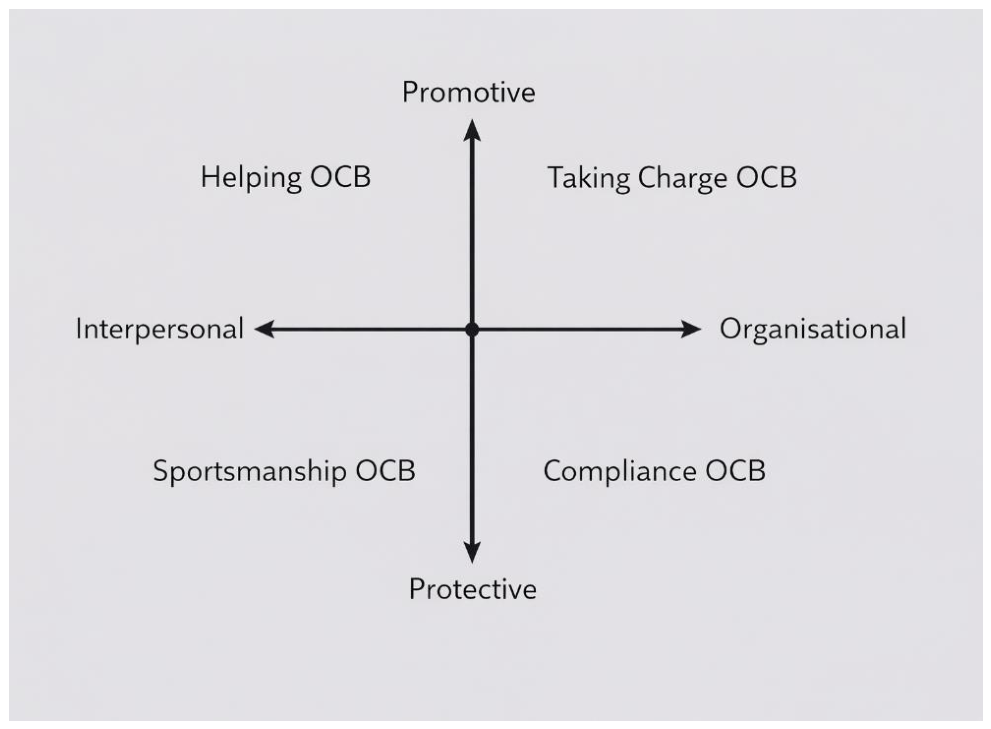
Figure 2.
Three-dimensional space representing employee behaviour dimensions. Note. The x-axis represents target behaviour (interpersonal to organisational), the y-axis represents role boundary (extra-role to in-role), and the z-axis represents change orientation (reactive to proactive).
Figure 2.
Three-dimensional space representing employee behaviour dimensions. Note. The x-axis represents target behaviour (interpersonal to organisational), the y-axis represents role boundary (extra-role to in-role), and the z-axis represents change orientation (reactive to proactive).
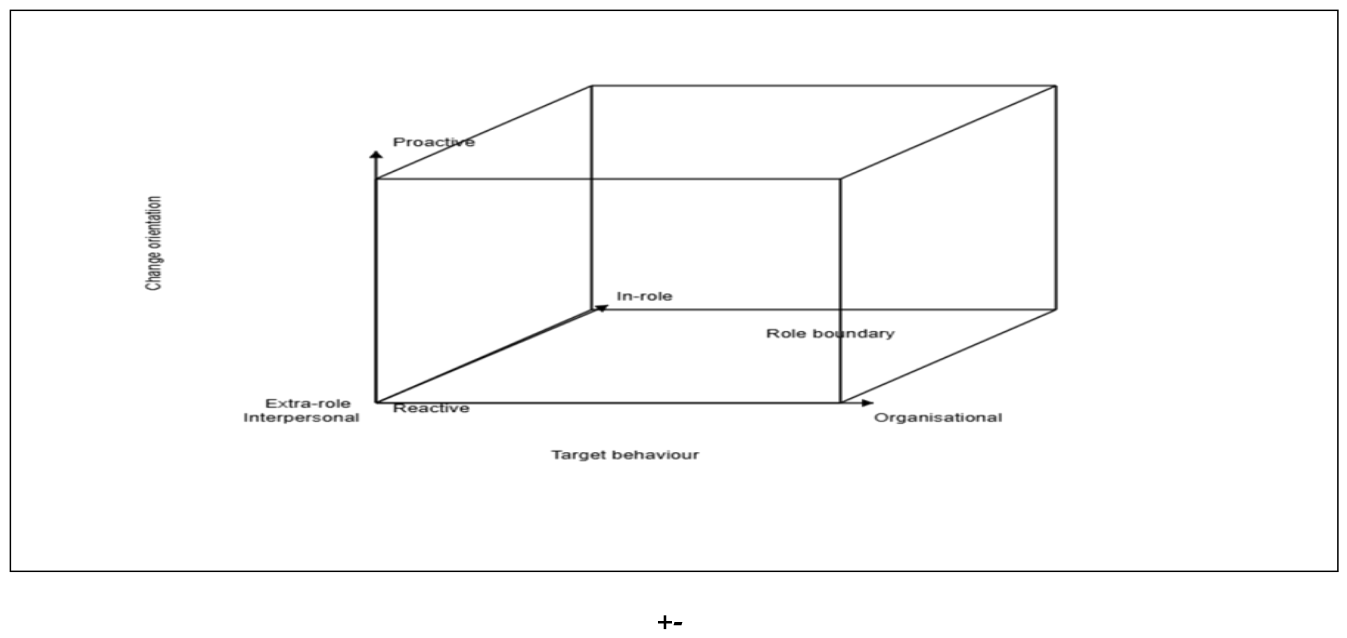
Figure 3.
Three-dimensional framework of employee discretionary behaviours. Notes: The figure illustrates a 3D Cartesian space representing three dimensions of employee behaviours: Interpersonal → Organisational (X-axis), Extra-role → In-role (Y-axis), and Reactive → Proactive (Z-axis). Each behaviour is positioned according to its alignment along these dimensions. Shaded planes indicate major categories: In-role, Extra-role, Organisational, Interpersonal, Reactive, and Proactive. For instance, Conscientiousness, Courtesy, and Civic Virtue are located at the intersection of In-role, Organisational, and Reactive, while Altruism is located at Extra-role, Interpersonal, and Proactive.
Figure 3.
Three-dimensional framework of employee discretionary behaviours. Notes: The figure illustrates a 3D Cartesian space representing three dimensions of employee behaviours: Interpersonal → Organisational (X-axis), Extra-role → In-role (Y-axis), and Reactive → Proactive (Z-axis). Each behaviour is positioned according to its alignment along these dimensions. Shaded planes indicate major categories: In-role, Extra-role, Organisational, Interpersonal, Reactive, and Proactive. For instance, Conscientiousness, Courtesy, and Civic Virtue are located at the intersection of In-role, Organisational, and Reactive, while Altruism is located at Extra-role, Interpersonal, and Proactive.
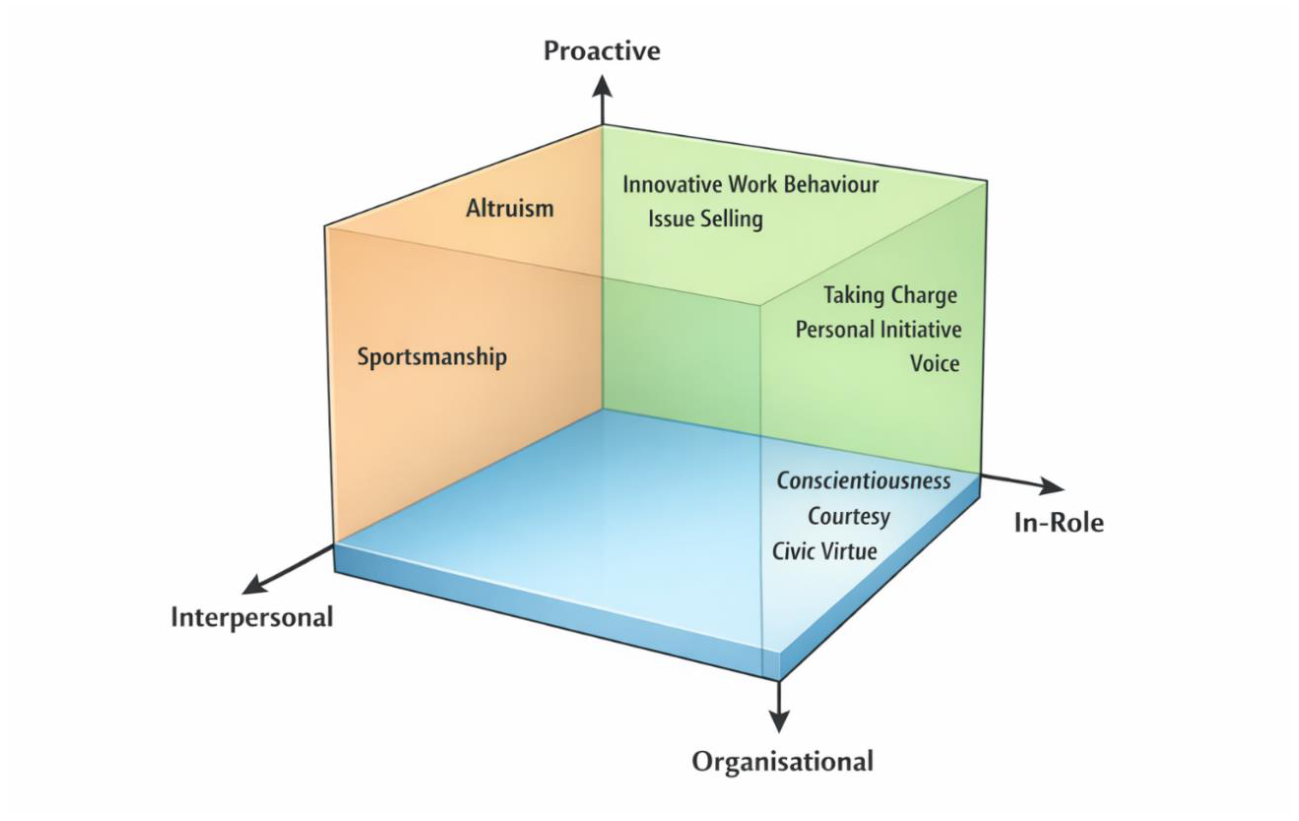

Table 1.
Conceptual definitions of selected discretionary behaviours.
| Dimension | Definition | Source/author/s |
| Altruism | Employee voluntary actions that help another employee with work task or problem | Smith et al., 1983; Organ, 1988; Podsakoff et al., 1990 |
| Courtesy | Employee discretionary behaviour aimed at preventing work-related problems with others | Organ, 1988; Podsakoff et al., 1990 |
| Civic virtue | Behaviour indicating that an employee actively participate in, is involved, and is concerned about the life of the organisation | Organ, 1988; Podsakoff et al., 1990 |
| Conscientious-ness (a.k.a. compliance) | Employee discretionary behaviour that goes beyond minimum role requirements, including in areas of attendance, obedience and adherence to rules, regulations and procedures | Smith et al., 1983; Organ, 1988; Podsakoff et al., 1990 |
| Sportsmanship | Willingness of an employee to tolerate less than ideal circumstances without complaining and/or making problems seem greater than they really are | Organ, 1988; Podsakoff et al., 1990 |
| Taking charge | Extra-role behaviour that entails voluntary and constructive efforts by individual employees, to effect organisationally functional change with respect to how work is executed within the contexts of their jobs, work units, or organisations | Morrison and Phelps, 1999:403 |
| Voice behaviour | A promotive behaviour that emphasises expression of constructive challenge intended to improve rather than merely criticize. Voice is making innovative suggestions for change and recommending modifications to standard procedures even when others disagree | Van Dyne and LePine, 1998: 109 |
| Personal initiative | Work behaviour characterised by its self-starting nature, its proactive approach and by being persistent in overcoming difficulties that arise in the pursuit of a goal | Frese & Fay, 2001:134; Frese et al., 1997 |
| Innovative work behaviour | The intentional creation, introduction and application of new ideas within a work role, group or organisation, in order to benefit role performance, the group, or the organisation | Janssen, 2000:288 |
| Issue selling | A discretionary process through which employees attempt to influence management by bringing strategic issues, concerns and opportunities to their attention. “Individuals’ behaviors that are directed toward affecting others’ attention to and understanding of issues.” |
Dutton & Ashford, 199 3: 398 |
Disclaimer/Publisher’s Note: The statements, opinions and data contained in all publications are solely those of the individual author(s) and contributor(s) and not of MDPI and/or the editor(s). MDPI and/or the editor(s) disclaim responsibility for any injury to people or property resulting from any ideas, methods, instructions or products referred to in the content. |
© 2026 by the authors. Licensee MDPI, Basel, Switzerland. This article is an open access article distributed under the terms and conditions of the Creative Commons Attribution (CC BY) license (http://creativecommons.org/licenses/by/4.0/).
Copyright: This open access article is published under a Creative Commons CC BY 4.0 license, which permit the free download, distribution, and reuse, provided that the author and preprint are cited in any reuse.