

Submitted:
28 August 2026
Posted:
31 August 2026
You are already at the latest version
Abstract
Aging induces profound physiological changes that alter drug disposition and response, narrowing therapeutic windows and increasing susceptibility to adverse drug reactions (ADRs). This review synthesizes current evidence on age-related pharmacokinetic and pharmacodynamic changes, with a focus on pharmacogenomic determinants of drug response in older adults. Progressive decline in renal function, hepatic metabolic capacity, and alterations in body composition collectively necessitate age-appropriate dose adjustments. Polypharmacy, prevalent in community-dwelling and hospitalized older adults, compounds these challenges through drug–drug and drug–drug–gene interactions. Pharmacogenomic testing—particularly for CYP2D6, CYP2C19, CYP2C9, and SLCO1B1—offers a promising strategy to personalize therapy, while deprescribing frameworks provide practical approaches to mitigate medication-related risks. This review presents a comprehensive framework for understanding the mechanistic basis of altered drug response in older adults and proposes actionable strategies for optimizing pharmacotherapy in this vulnerable population.
Keywords:
aging
; pharmacokinetics
; pharmacodynamics
; polypharmacy
; pharmacogenomics
; geriatric pharmacotherapy
; adverse drug reactions
1. Introduction
Geriatric patients, defined as those aged ≥65 years, are among the highest consumers of medications worldwide [1]. The complexity of pharmacotherapy in this population is increased due to age-related physiological changes, multiple coexisting diseases, and the concurrent use of several medications, prescribers, and pharmacies. The most significant aspect of aging is the gradual reduction in functional units over time—the smallest structures able to carry out the specific physiological roles of their respective organs, such as nephrons in the kidneys, alveoli in the lungs, or neurons in the brain [2,3]. Another characteristic is the disruption of regulatory processes that ensure functional integration between cells and organs, reducing the ability to maintain homeostasis under physiological stress [3,4].
Older adults consume a disproportionate share of medications, with polypharmacy affecting 30–40% of community-dwelling individuals over 65 years and hyperpolypharmacy (ten or more medications) reaching 39–45% in geriatric and psychiatric inpatient settings [1,5,6]. The average number of medications taken by community-dwelling elderly is 8.7, increasing to 9.5 in those aged 80–99 years [6]. In the ASPREE cohort, 98.8% of participants carried at least one actionable pharmacogenetic genotype, with polypharmacy affecting 83.9% and CYP450 inhibitor/inducer use in 68.2%. However, only 27.5% received a medication for which a deviation from standard prescribing would be recommended based on their genotype [7].
The physiological changes accompanying aging profoundly affect both pharmacokinetics (what the body does to the drug) and pharmacodynamics (what the drug does to the body) (Figure 1) [8]. These alterations, combined with the high prevalence of polypharmacy, create a substantial risk for adverse drug reactions (ADRs) [9]. Importantly, many of these ADRs are preventable through appropriate dose adjustment, drug selection, and pharmacogenomic-guided prescribing [10,11,12].
This review synthesizes evidence from selected publications to provide a comprehensive framework for understanding age-related changes in drug disposition and response, with practical recommendations for optimizing pharmacotherapy in geriatric patients.
2. Aging and Alterations in Drug Response
2.1. Pharmacokinetic Changes
Pharmacokinetics involves the movement of drugs and their metabolites through the body, covering absorption, distribution, metabolism, and excretion (ADME) [3]. Aging induces significant structural and functional changes across all organ systems, affecting each of these processes.
2.1.1. Drug Absorption
Age-related changes in gastrointestinal physiology have modest but clinically significant effects on drug absorption [2,13]. Gastric acid secretion declines with age (hypochlorhydria), increasing gastric pH and reducing the solubility and systemic absorption of weakly basic compounds [2,14]. Gastric emptying slows with advancing age, which can paradoxically increase the absorption of some drugs while decreasing that of others. Active transport processes, including those for calcium, iron, thiamine, and folic acid, are substantially impaired in the aging gastrointestinal tract [2,13].
Delayed gastric emptying affects drugs that are unstable in acidic environments, as it postpones their arrival at the preferred absorption site [3]. A notable exception is calcium carbonate, which requires an acidic environment for optimal absorption; delayed gastric motility can benefit this drug by prolonging its presence in the stomach [3,15]. Additionally, reduced splanchnic blood flow and decreased intestinal mucosal surface area [3,16,17], as well as a significant decline in pancreatic enzyme secretion [18], contribute to altered absorption patterns. While the rate of absorption from subcutaneous or intramuscular sites can be slowed by reduced tissue blood flow and accelerated by decreased muscle mass, the absorption of inhaled medications is hindered by declines in chest wall flexibility, ventilation–perfusion balance, and alveolar surface area [19].
2.1.2. Drug Distribution
The distribution of medications throughout the body of geriatric patients differs significantly from younger patients, which can lead to potential overdose risks. Geriatric patients typically experience a 20–40% increase in body fat, alongside a 10–15% decrease in lean body mass and total body water [3,6,13]. This altered composition affects the distribution volume of hydrophilic and lipophilic drugs.
Lipophilic drugs such as chlordiazepoxide, morphine, amiodarone, and diazepam tend to have a larger volume of distribution in geriatric patients, creating a larger reservoir within the body [3,6]. Because drug clearance is proportional to distribution volume, lipophilic drugs exhibit longer clearance times, resulting in extended durations of action and increased risk of residual effects [3]. Conversely, hydrophilic drugs such as digoxin, lithium, ethanol, and theophylline have a reduced distribution volume, leading to higher plasma concentrations and necessitating smaller doses to achieve therapeutic levels [3,20,21]. For water-soluble drugs, the reduced volume of distribution is often balanced by decreased renal clearance, with little net effect on the elimination half-life [3,20].
Plasma protein binding is altered in older adults. Acidic drugs such as diazepam, phenytoin, warfarin, and acetylsalicylic acid primarily bind to albumin, while basic drugs like lidocaine and propranolol bind to α₁-acid glycoprotein [3,22,23]. While concentrations of these proteins generally remain stable with age, albumin levels can decrease due to conditions like malnutrition or acute illness, whereas α1-acid glycoprotein levels may increase during acute kidney injury [23,24]. The unbound (free) concentration of a drug is crucial for its pharmacological effect and poses a higher risk of toxicity, particularly with highly protein-bound drugs such as phenytoin and warfarin [3,25].
2.1.3. Drug Metabolism
Hepatic drug metabolism undergoes substantial age-related decline, with reductions in both liver mass and functional enzyme activity [3,6,13,26,27]. Total liver volume decreases by 20–40% in older adults, with more pronounced reductions in women. Hepatic blood flow declines by 35–50%, further reducing the clearance of drugs with high hepatic extraction ratios [3,26].
The functional capacity of cytochrome P450 enzymes declines with age, though the degree of decline varies significantly by isoform [7,13,26]. Corton et al. [26] examined global gene expression in livers of young (21–45 years) and old (69+ years) individuals, identifying age- and sex-dependent changes in xenobiotic metabolism genes. Multitissue analysis of ADME gene expression by McCoy [27] revealed distinct clustering patterns based on organ system identity, with both sex and age effects across multiple human organ systems.
To provide a systematic overview of the available evidence for each major enzyme and transporter, we compiled Table 1, which summarises reported changes, types of evidence, conflicting data, and interpretation caveats.
Molecular aspects of geriatric pharmacotherapy were reviewed by Rzeczycki et al. [6], who emphasized that activity of cytochrome P450 enzymes, especially in phase I reactions, is significantly reduced with age. The analysis covers changes in pharmacokinetics, including the role and regulation of CYP enzymes, whose activity decreases substantially in older patients. Phase II pathways like glucuronidation appear less affected by age, as seen with drugs such as lorazepam [3].
First-pass metabolism diminishes with age, likely due to decreased liver size and blood flow, as well as reduced activity of CYP and other biotransformation enzymes [3]. Consequently, the bioavailability of drugs that undergo significant first-pass metabolism, such as opioids and metoclopramide, can substantially increase, necessitating lower initial doses [3,35] (Figure 2).
2.1.4. Drug Excretion
Elimination refers to the final process by which a drug exits the body. For most drugs, elimination occurs primarily through the kidneys. Kidney function typically starts to decline around mid-life and continues to decline with age [3,36]. This decline is linked to changes such as reduced kidney size and filtering capacity. Renal blood flow declines by approximately 10% per decade after age 40 [3]. Glomerular filtration rate declines by 6.3–8 mL/min/1.73 m2 per decade after age 30–40 [3,13,37]. Tubular function also declines with age, affecting the secretion and reabsorption of numerous drugs, including organic anions and cations [3,13].
As people age, their lean muscle mass decreases, which counters the expected increase in serum creatinine levels. Therefore, serum creatinine concentration becomes a less reliable indicator of renal function in geriatric patients [3,38]. To prevent toxicity from drug accumulation in geriatric patients with decreased renal function, dosage reduction is advised for drugs with a narrow therapeutic index such as digoxin and theophylline [3]. Adjustments in daily doses or dosing frequency are necessary for drugs that heavily rely on renal elimination [3,39].
2.2. Pharmacodynamic Changes
Pharmacodynamics describes the effects of drugs on the body [40]. The pharmacological impact of a drug is influenced by the quantity and affinity of target receptors at the site of action, as well as signal transduction and homeostasis regulation [41]. Understanding pharmacodynamic changes in geriatrics is particularly challenging. Research has indicated some alterations in pharmacodynamics for drugs affecting the central nervous system and cardiovascular system.
Aging is associated with reduced β-adrenergic receptor density and sensitivity, attenuating the chronotropic and inotropic responses to β-agonists such as dobutamine and salbutamol [3,42,43]. The exact mechanisms behind these changes remain largely unknown. Hypothesized mechanisms include variations in neurotransmitter and receptor concentrations, hormonal shifts, increased blood–brain barrier permeability, reduced P-glycoprotein activity, and compromised glucose metabolism [3,44]. Additionally, alterations in homeostatic mechanisms, like weakened reflex tachycardia and disrupted regulation of temperature and electrolyte balance [41], can increase the likelihood of ADRs.
Geriatric patients exhibit increased sensitivity to central nervous system depressants, including benzodiazepines, opioids, and antipsychotics [45,46,47]. Factors such as loss of neuronal substance, reduced synaptic activity, impaired brain glucose metabolism, and rapid drug penetration into the central nervous system contribute to the increased sensitivity and stronger response of geriatric patients to drugs that affect the peripheral and central nervous systems [3,48]. Baroreceptor reflex sensitivity declines with age, predisposing older adults to orthostatic hypotension with drugs that reduce peripheral vascular resistance [45].
3. Polypharmacy
Polypharmacy is the norm rather than the exception in geriatric practice [1,5,9,49,50,51] (Figure 3). de Vries et al. [1] examined polypharmacy, potentially inappropriate medication, and pharmacogenomics drug exposure in the Rhineland Study (over 5,000 adults), reporting rates of polypharmacy (15.9%), potentially inappropriate medication (6.4%), and pharmacogenomic drug exposure (20.5%); among participants aged 65 years or older, 54.1% carried at least one of these risk factors and 27.4% carried two or more, compared with only 16% of those under 65. Longitudinal data from English primary care have confirmed substantial and early-life exposure to pharmacogenomic drugs [52].
Bousman et al. [7] found that 83.9% of a large cohort of older adults experienced polypharmacy during a 5-year period. Among those with polypharmacy, 70.0% used at least one cautionary medication with actionable PGx guidelines, whereas cautionary medication use among those without polypharmacy was 66.6%. Furthermore, 25–94% of older adults in studies included in a scoping review by Ianni et al. were exposed to two or more concurrent PGx medications, with nursing home residents showing the highest proportion (94%) [5]. This underscores the high prevalence of polypharmacy involving PGx-relevant drugs and supports the case for multi-gene panel testing in this population. Ianni et al. also identified that medications most frequently prescribed included pantoprazole (range 0%–49.6%), simvastatin (range 0%–54.9%), and ondansetron (range 0.1%–62.6%) [5].
The clinical consequences of polypharmacy are substantial:
Hospitalizations: ADRs are a significant cause of emergency care in older adults. In a university hospital emergency department, ADRs accounted for 7.8% of all emergency visits, with higher rates among patients aged 80–89 years (14% in men and 19% in women) [9]. Antithrombotic agents and cytotoxic drugs were among the most frequently implicated treatments.
Prescribing cascades: Adverse effects of one drug are misinterpreted as symptoms of a new condition, leading to unnecessary additional prescriptions [3]. Common examples include prescribing Non-Steroidal Anti-Inflammatory Drugs (NSAIDs) for statin-induced myalgia or antibiotics for cough induced by β-blockers.
Drug–drug–gene interactions (DDGIs): Genetic variability in drug-metabolizing enzymes, combined with polypharmacy, creates complex interactions that cannot be predicted by genotype alone [51,53].
Pharmacist-led interventions that combine medication review with pharmacogenomic testing illustrate the scale of clinically actionable overlap: in a cohort of 200 pharmacogenomic consultations within the Program of All-Inclusive Care for the Elderly (PACE), 165 participants carried at least one actionable drug–gene pair, and over one-third of all identified drug–gene pairs were judged clinically actionable, translating into substantial estimated cost avoidance once pharmacists’ recommendations were implemented [54]. Complementary service-implementation work has combined clinical decision-support systems with buccal-swab pharmacogenomic testing for primary-care patients on seven or more medications, aiming to flag multidrug and drug–gene interactions before they cause harm [49]. At the level of individual toxidromes, pharmacists’ recognition of chronic serotonin toxicity in polypharmacy patients has been proposed to benefit specifically from pharmacogenomic data on serotonergic drug metabolism (especially CYP2D6 and CYP2C19), since a patient’s underlying metabolizer phenotype can determine whether an otherwise unremarkable combination of serotonergic agents accumulates to toxic effect [47].
In a small pilot case–control study, frequently hospitalized older adults with polypharmacy had a higher burden of major pharmacogenetic polymorphisms and gene–drug interactions than matched controls [16]. These findings support the hypothesis that pharmacogenetic testing could help identify older adults with polypharmacy at highest risk of hospitalization, although larger studies are needed to confirm causality.
4. Role of Pharmacogenetic Variants
Pharmacogenomic testing offers a promising strategy to prevent ADRs and optimize therapy in older adults [5,8,9,10,11,12]. In a longitudinal NHS primary-care analysis, Kimpton et al. [52] found both high exposure to PGx-relevant drugs and that three genes — CYP2D6, CYP2C19, and SLCO1B1 — accounted for >95% of their metabolism, supporting a focused pre-emptive panel design [52].
Lozupone et al. [50] reviewed pharmacogenetics of neurological and psychiatric diseases at older age, concluding that pharmacogenomics is underutilized in geriatric neuropsychiatry despite strong evidence. Pirmohamed [8] provided a comprehensive overview of pharmacogenomics status and future perspectives, emphasizing the gap between genotype-based predictions and observed phenotypes (phenoconversion).
Chen et al. [55] conducted a pharmacogenetic analysis of the model-based pharmacokinetics of five anti-HIV drugs, demonstrating that aging significantly influences drug exposure and that pharmacogenetic effects may be modified by age. This underscores the importance of age-adjusted pharmacogenomic interpretation.
Importantly, having an actionable genotype does not necessarily translate into a prescribing change. While 69.5% of older adults used at least one cautionary medication over a 5-year period, only 27.5% used a medication for which a deviation from standard prescribing would be recommended based on their genotype [7]. This highlights the need for careful integration of PGx results with actual medication use, as the clinical actionability of testing depends on the specific drugs a patient is taking.
Ianni et al. (2025) identified 215 unique medications with pharmacogenetic recommendations prescribed to older adults, of which 82 (40%) were associated with actionable CPIC guidelines (levels A, A/B, or B). Medications with the highest potential prescribing rates included pantoprazole (range 0%–49.6%), simvastatin (range 0%–54.9%), and ondansetron (range 0.1%–62.6%) [5].
5. Most Significant Pharmacogenes
Population-level data provide context for the scale of PGx actionability in geriatrics. In a large cohort of 13,670 older adults, Bousman et al. found that VKORC1 (61.1%) and CYP2C19 (59.6%) were the most frequently observed actionable genotypes, followed by CYP2C9 (52.4%), CYP2D6 (35.2%), and SLCO1B1 (27.7%) [7]. These findings align with a larger scoping review of 31 studies, which identified CYP2D6 (25.6%), CYP2C19 (18.3%), and CYP2C9 (11%) as the most frequent genes implicated in actionable drug–gene interactions in older adults [5]. Table 2 summarises the core pharmacogenes relevant to geriatric prescribing, their predicted phenotype frequencies, age-related functional changes, and representative drugs.
Furthermore, 68.2% of participants in the ASPREE cohort reported taking at least one inhibitor or inducer of CYP2B6, CYP2C9, CYP2C19, CYP2D6, or CYP3A5 during the study period. Commonly used inhibitors included esomeprazole (28.7%, CYP2C19 moderate inhibitor), amlodipine (22.9%, CYP3A5 moderate inhibitor), and omeprazole (8.6%, CYP2C19 weak inhibitor). The most common inducers were corticosteroids such as prednisone (10.5%) and betamethasone (7.1%), all of which are weak CYP3A5 inducers [7]. These findings emphasize that phenoconversion—where drug interactions alter metabolic capacity independently of genotype—is likely common in geriatric populations and should be considered alongside genetic testing.
While CYP enzymes represent the most extensively studied pharmacogenes, they are not the only determinants of drug response in older adults. Pharmacogenetic associations have also been described for biologic therapies used in autoimmune diseases, where variants in genes encoding drug targets or immune receptors may influence treatment outcomes. Variants in FCGR3A (rs396991) have been associated with response to rituximab, and polymorphisms in TNF (rs1800629) may influence response to etanercept in rheumatoid arthritis and other inflammatory conditions [PharmGKB]. While these associations are not yet part of routine clinical guidelines, they highlight the potential for PGx-guided selection of biologic therapies in older adults with autoimmune diseases.
5.1. CYP2D6
CYP2D6 is arguably the single most consequential pharmacogene in geriatric pharmacotherapy, both because of the breadth of drugs it metabolizes (approximately 25% of all marketed drugs, including antidepressants, antipsychotics, β-blockers, and opioids) [51,60,61,62] and because its functional activity is disproportionately unstable in polypharmacy. In a cohort of 464 genotyped patients on therapeutic drug monitoring, serum concentrations of risperidone and its active metabolite 9-hydroxyrisperidone varied with both age and CYP2D6 genotype, indicating that ageing itself modifies the genotype–exposure relationship rather than simply adding to it [61]. Similarly, in 173 polypharmacy patients aged 70 and older, prescribed daily doses of CYP2D6-metabolized drugs with hemodynamic effects differed by CYP2D6 genotype-predicted metabolizer status; however, the study did not demonstrate corresponding differences in measured hemodynamic responses, suggesting that pharmacodynamic tolerance may attenuate genotype effects [62]. A population pharmacokinetic model built on 325 older adults treated with venlafaxine (up to 300 mg/day for 12 weeks) found that CYP2D6 metabolizer status affected drug clearance and exposure to both venlafaxine and its active metabolite at both lower and higher dose ranges [60].
Beyond germline genotype, CYP2D6 activity in this population is further destabilized by phenoconversion — a mismatch between genotype-predicted and actually observed metabolic phenotype, driven by comorbidity and, especially, concomitant CYP2D6-interacting drugs. Using a validated dietary biomarker (solanidine) to phenotype CYP2D6 activity directly, Sarömba et al. [51] studied 88 geriatric patients (median age 83, median 15 concurrent medications) and found a progressively greater downward shift from genotype-predicted CYP2D6 activity as the number of CYP2D6-interacting substrates and inhibitors increased, demonstrating that genotype–phenotype discordance is common in polypharmacy settings and that functional phenotyping provides additional value beyond genotyping alone [51]. Phenoconversion is not restricted to CYP2D6 substrates in the strict sense: a case report of a 68-year-old bilateral lung transplant recipient documented severe, dose-related bradykinesia after tacrolimus (a CYP3A4/5 substrate) was co-administered with two CYP3A4/5 inhibitors (fluconazole and diltiazem), illustrating how drug–drug interactions (DDIs) can convert a genotypically normal metabolizer into a functional poor metabolizer regardless of the gene involved [63].
5.2. CYP2C19
CYP2C19 polymorphisms are clinically important in older adults across at least two major drug classes: proton pump inhibitors (PPIs) and SSRIs. For omeprazole — the PPI most sensitive to CYP2C19 genotype among commonly used agents — Na et al. [64] demonstrated that CYP2C19 polymorphisms affect omeprazole pharmacokinetics in elderly subjects, with poor metabolizers having substantially higher drug exposure, extending earlier work showing that age itself alters the relationship between CYP2C19 genotype and omeprazole pharmacokinetics.
For escitalopram, a combined physiologically-based pharmacokinetic (PBPK) modeling and clinical study in 88 elderly patients with major depressive disorder found that simulated escitalopram exposure was 2.1-fold higher in CYP2C19 poor metabolizers than in extensive metabolizers; consistent with this, dose-normalized trough concentrations in the clinical cohort were 1.6-fold higher in poor metabolizers (P=0.0132) [65]. Based on these findings, the authors proposed that a 10 mg/day dose may be appropriate for poor metabolizers, while extensive and intermediate metabolizers who do not respond at 10 mg/day could be titrated up to 20 mg/day — a more granular, phenotype-specific recommendation than the blanket dose ceiling currently advised for elderly patients generally [65]. This finding is notable because it directly challenges a one-size-fits-all geriatric dosing cap by showing that the “safe” dose for one metabolizer subgroup may be subtherapeutic for another.
The influence of CYP2C19 phenotype on drug response was also examined by Jang et al. [65], who applied PBPK modeling to optimize assessment of age-related fluoxetine accumulation in the elderly, quantifying age-related differences in fluoxetine pharmacokinetics and evaluating the influence of CYP2C19 phenotype.
In a large population-based cohort, CYP2C19 was the second most frequently observed actionable gene (59.6%), with an estimated 27.5% of participants using medications (e.g., PPIs, clopidogrel) for which CYP2C19-guided prescribing would be clinically relevant [7]. PPIs were used by 16.6% of participants, and 7.9% of these users carried an actionable CYP2C19 genotype [7]. Across multiple studies, pantoprazole (range 0%–49.6%), omeprazole (range 0%–34.8%), and citalopram (range 0%–17.8%) were among the most frequently prescribed CYP2C19 substrates [5].
5.3. CYP2C9 and VKORC1
CYP2C9 and VKORC1 are key determinants of warfarin dosing [12,66,67]. Lin et al. [66] genotyped 16 variants across VKORC1, CYP2C9, CYP4F2, and EPHX1 in very elderly, frail Han-Chinese patients; a multivariable model combining VKORC1 rs9923231, CYP2C9 rs1057910, EPHX1 rs2260863, CYP4F2 rs2189784, and body surface area explained 26.9% of warfarin dose variability — notably including EPHX1, a gene outside the standard VKORC1/CYP2C9 pairing, as an independent contributor in this age group [66].
In a randomized controlled trial of 507 Chinese elderly patients with nonvalvular atrial fibrillation, genotype-guided warfarin dosing significantly improved the percentage of time in the therapeutic INR range (TTR) compared with standard clinical dosing (70.80 ± 24.39% vs 53.44 ± 26.73%; absolute difference 17.36%, 95% CI: 11.82–22.89; P < 0.001). The cumulative incidence of ischaemic stroke was also significantly lower in the genotype-guided group (2.39% vs 6.82%; HR 0.22, 95% CI: 0.065–0.77; P < 0.05), while haemorrhagic events did not differ significantly between groups [12].
Unlike CYP2D6 and CYP2C19, where age-related and phenoconversion effects have been characterized in reasonably large cohorts, CYP2C9 evidence specific to older adults is comparatively sparse and often entangled with CYP2C19 in combined analyses. A large naturalistic therapeutic drug monitoring study — 857 serum concentrations from 252 patients on valproic acid, genotyped for both CYP2C9 and CYP2C19 — examined age, sex, and genotype together as covariates of the dose-adjusted steady-state concentration (C:D ratio), reflecting the reality that in routine geriatric psychiatric and neurological practice these two genes are rarely evaluated in isolation from one another or from age [67].
This entanglement matters for interpretation: because CYP2C9 and CYP2C19 jointly influence valproic acid clearance, and age independently affects the same pharmacokinetic parameters, isolating a pure “CYP2C9-in-the-elderly” effect from a single study is difficult, and stronger gene-specific claims for CYP2C9 in geriatric populations would benefit from additional dedicated cohorts — a gap worth flagging explicitly rather than overstating the certainty of this section relative to the CYP2D6 and CYP2C19 evidence above.
Among community-dwelling older adults, VKORC1 (61.1%) and CYP2C9 (52.4%) are among the most frequently observed actionable genotypes [7]. Although warfarin use is declining with the introduction of DOACs, VKORC1 and CYP2C9 genotyping remains relevant for older adults on warfarin therapy and for predicting sensitivity to other vitamin K antagonists. Warfarin was prescribed to 1.1–11.1% of older adults across included studies [5].
5.4. SLCO1B1 and Statins
Statin pharmacogenomics in older adults centers on SLCO1B1, the hepatic uptake transporter gene most strongly linked to statin-associated myopathy risk, though much of the applied literature frames this within the broader problem of statin DDIs in an aging, polypharmacy-exposed population rather than as an isolated genetic effect [14,68,69]. Bellosta and Corsini [14] catalogued the range of statin DDIs and their mechanisms as statin use expanded in the elderly, while Damiani et al. [68] focused specifically on elderly patients (over 75 years old), noting that comorbidity burden and polypharmacy compound the risk that a DDI will precipitate statin-associated myopathy or hepatotoxicity in this age group.
Direct pharmacogenetic evidence in older adults is more limited, and this is where Srimatimanon et al. [69] filled a specific gap: a pharmacokinetic study in healthy Thai adults examined the effect of age on plasma exposure to simvastatin and its active metabolite, simvastatin acid, explicitly accounting for key SLCO1B1 variants known to affect statin disposition, and situated its findings against a meta-analysis of published data from other ethnic populations together with an exploratory pharmacogenetic screen of additional disposition-related genes [69]. The study found that aging significantly increased simvastatin Cmax while SLCO1B1 decreased function was associated with higher simvastatin acid exposure.
Read together, these three sources illustrate a common pattern across genes discussed in this section: age and genotype are rarely investigated as fully independent factors, but rather as compounding variables that jointly determine statin exposure and myopathy risk in the aging patient.
Statins were the most frequently used cautionary medications in a recent large cohort of older adults, with 29.3% of participants reporting use of atorvastatin, rosuvastatin, or simvastatin [7]. Among statin users, approximately 28–30% carried actionable SLCO1B1 or CYP2C9 variants for which dose adjustment or alternative medication would be recommended to reduce the risk of musculoskeletal symptoms [7,21]. Simvastatin was one of the most frequently prescribed PGx medications across 31 studies, with prescribing rates ranging from 0% to 54.9% [5].
5.5. ABCB1
ABCB1 (encoding P-glycoprotein) evidence in older adults spans both drug efflux at the intestinal/renal level and drug-induced neurotoxicity. In 128 patients aged 80 and older (median age 87.5) with nonvalvular atrial fibrillation, ABCB1 (rs1045642, rs4148738) genotype did not significantly alter overall steady-state rivaroxaban trough concentration or prothrombin time, but carriers of the rs4148738/rs1045642 TT genotype experienced clinically relevant non-major bleeding more frequently than CC carriers — indicating that in the very old, ABCB1 genotype may matter more for a specific safety endpoint (bleeding) than for average pharmacokinetic exposure [70].
Tanabe et al. [71] found that paclitaxel-induced sensory peripheral neuropathy is associated with an ABCB1 single nucleotide polymorphism (1236 TT genotype) and older age in Japanese patients, suggesting that ABCB1 genotyping may help predict neuropathy risk.
5.6. HLA
Beyond the metabolism- and transport-focused genes above, HLA variants are the dominant pharmacogenetic risk factor for a distinct and life-threatening category of adverse reaction — severe cutaneous adverse reactions (SCARs) — that disproportionately affects older patients treated for gout. In a Thai case-control study of 86 allopurinol-induced SCARs (19 DRESS, 67 SJS/TEN) against 182 allopurinol-tolerant controls, HLA-B*58:01 carriage was associated with a markedly elevated risk of both DRESS (OR 149.2) and SJS/TEN (OR 175.0), with female sex an additional independent risk factor (OR 4.6); overall mortality among SCAR cases was 11.4% [72]. Given that allopurinol is a first-line urate-lowering therapy commonly initiated in older adults with gout and reduced renal clearance, this gene stands apart from the others reviewed in this section in that its clinical actionability rests on pre-treatment screening to prevent a rare but often fatal reaction, rather than on titrating a dose within a tolerated range.
6. Cardiovascular Pharmacogenomics
Pharmacogenomic testing in cardiovascular disease has been extensively studied in older adults [11,14,53,67,68,70]. For example, variants in ACE (rs1799752, rs4646994) have been associated with response to ACE inhibitors, and polymorphisms in ADD1 (rs4961) may influence hydrochlorothiazide efficacy [PharmGKB]. Božina et al. [11] reviewed the use of pharmacogenomics in elderly patients treated for cardiovascular diseases, providing evidence for CYP2C9, VKORC1, SLCO1B1, and CYP2C19 in warfarin, clopidogrel, and statin therapy.
Chai et al. [53] investigated metoprolol population pharmacokinetics in older Chinese patients with CKM syndrome, demonstrating joint effects of rs1065852 (CYP2D6) and clinical scores on clearance, supporting integrated pharmacogenomic and clinical modeling for beta-blocker dosing.
Bellosta and Corsini [14] and Damiani et al. [68] reviewed statin interactions and SLCO1B1-related myopathy risk in elderly patients. Božina et al. [11] provided evidence for CYP2C9, VKORC1, SLCO1B1, and CYP2C19 in warfarin, clopidogrel, and statin therapy.
The therapeutic classes most frequently studied in relation to pharmacogenetic prescribing in older adults were psychotropic (n=29), analgesic (n=29), and cardiovascular (n=27) medications, reflecting the high prevalence of these drug classes in geriatric practice and their substantial pharmacogenetic evidence base [5].
6.1. Antihypertensives
Hypertension is a significant risk factor for cardiovascular disease, stroke, and renal disease, and its prevalence notably increases with age, affecting approximately 65% of geriatric patients [73]. The pathophysiology of hypertension in the elderly is complex and multifactorial, characterized by increased total peripheral vascular resistance, decreased arterial compliance, reduced cardiac output, increased blood pressure variability due to age-related baroreceptor function decline, and decreased blood flow with dysregulated auto-regulation in critical organs [74,75].
All antihypertensive drugs can predispose older patients to symptomatic orthostatic hypotension, postprandial hypotension, falls, and syncope. The adverse effects vary depending on the specific antihypertensive drugs used, their dosages, the presence of co-morbidities, and potential DDIs [76,77]. Delirium linked to β-blocker use may manifest through symptoms like confusion, disorientation, agitation, aggression, as well as visual and auditory hallucinations [78]. Calcium channel blockers also have notable adverse effects; for example, verapamil is primarily linked to bradyarrhythmia and constipation, while nifedipine is associated with hypotension, peripheral oedema, skin rash, and tachycardia [79].
6.2. Diuretics
Age-related changes in renal tubular function can influence how drugs affect the kidneys, particularly with organic acid diuretics like furosemide and bumetanide [80,81]. Diuretic therapy in geriatric patients requires careful management due to their increased susceptibility to fluid and electrolyte imbalances, such as hypokalaemia, hyponatremia, hypomagnesemia, and volume depletion [82,83]. Additionally, diuretics can trigger delirium through dehydration and electrolyte disturbances [84].
6.3. Digitalis
Digoxin is effectively absorbed in the gastrointestinal tract, but in geriatric patients, the time to peak plasma concentrations is extended from an average of 38 hours in younger individuals to 69 hours in older adults [85]. Reduced lean body mass decreases the distribution volume of digoxin, necessitating a reduction in loading doses by approximately 20%. Several factors contribute to an increased risk of digoxin toxicity in geriatrics, including renal impairment, temporary dehydration, and the use of NSAIDs, which are prevalent in this age group [86].
6.4. Statins
In geriatric patients, statins are generally well tolerated, with most adverse effects being mild and short-lived [87]. Research indicates that the safety profiles of atorvastatin and simvastatin are comparable in patients younger and older than 65 years who have stable coronary disease. However, monitoring levels of creatine kinase and liver enzymes is essential when using statins, as these medications can lead to rhabdomyolysis and myopathy in both elderly and younger individuals [88,89].
Statins have been consistently shown to reduce cardiovascular events in both younger and older populations. For patients aged over 65 years, statin therapy reduces the risk of major cardiovascular events by 19%, which is comparable to the 22% reduction seen in younger individuals [90]. However, the benefits of statin treatment typically become evident after at least one year of continuous use, and elderly individuals, due to their shorter life expectancy and higher burden of comorbidities, may derive fewer benefits from statin therapy compared to younger populations [91]. The benefit–risk ratio must be carefully evaluated in geriatric patients, who often have more complex health profiles.
6.5. Anticoagulants
Advanced age is linked to platelet dysfunction, reduced synthesis of coagulation factors, and increased fragility of blood vessels [92]. Administering anticoagulant therapy to prevent stroke in the elderly is particularly challenging due to their heterogeneity, which includes higher rates of comorbidities, polypharmacy, frailty, and cognitive decline, along with functional and psychosocial concerns [93].
Despite evidence supporting the efficacy of direct oral anticoagulants (DOACs), European clinical practice guidelines suggest that DOACs are preferable for geriatric patients, as they reduce the risk of stroke without increasing the likelihood of major bleeding. Consequently, DOACs provide a greater net clinical benefit, encompassing both thromboembolic and bleeding risks, compared to vitamin K antagonists [94]. Multiple meta-analyses support the clinical benefits of DOACs over vitamin K antagonists in geriatric patients [95,96]. Concerns have emerged about the effectiveness and safety of non-vitamin K antagonist oral anticoagulants in real-world clinical settings, particularly in patients with multiple comorbidities and concurrent medication use [97].
7. Psychotropic Drugs and CYP2D6/CYP2C19
Psychotropic drugs are among the most commonly prescribed medications in older adults, and their metabolism is heavily dependent on CYP2D6 and CYP2C19 [10,46,50,60,61,65,98,99,100]. Psychotropic medications are frequently used to treat mental health conditions such as depression and anxiety, as well as to manage behavioural and psychological symptoms of dementia [101,102]. The use of psychotropic medications tends to increase with age, with up to 63% of residents in care homes across Western Europe prescribed at least one psychotropic drug [103]. This high rate of use is also observed among geriatric patients in community settings [104].
van der Schans et al. [10] conducted the CYSCE trial, a pragmatic randomized controlled trial of CYP2D6 screening in elderly starting therapy with nortriptyline or venlafaxine. Men et al. [60] demonstrated that CYP2D6 phenotype significantly influences venlafaxine pharmacokinetics in older adults with depression. Molden et al. [61] found that aging significantly increases dose-adjusted serum concentrations of risperidone active moiety in patients with known CYP2D6 genotype. Jang et al. [65,100] used physiologically based pharmacokinetic modeling to optimize assessment of escitalopram and fluoxetine response in geriatrics, confirming that CYP2C19 phenotype significantly influences drug exposure.
Psychotropic pharmacotherapy is where CYP2D6 and CYP2C19 pharmacogenetics converge most consequentially with age, because these are precisely the drug classes (SSRIs, SNRIs, tricyclics, antipsychotics) where gene-by-gene effects are most pronounced. For venlafaxine, CYP2D6 metabolizer status affects drug clearance and exposure to both the parent drug and its active metabolite at both lower and higher dose ranges [60]. For risperidone, serum concentrations of the drug and its active metabolite 9-hydroxyrisperidone vary with both age and CYP2D6 genotype, indicating that ageing itself modifies the genotype–exposure relationship rather than simply adding to it [61]. For escitalopram, a combined PBPK modeling and clinical study in 88 elderly patients with major depressive disorder found that simulated exposure was 2.1-fold higher in CYP2C19 poor metabolizers than in extensive metabolizers; consistent with this, dose-normalised trough concentrations were 1.6-fold higher in poor metabolizers (P=0.0132) [65]. The same research group applying PBPK modeling to escitalopram has extended this approach to fluoxetine, aiming to characterise age-related drug accumulation in older adults, though the specific quantitative findings of that fluoxetine-focused study were not independently verified here beyond the general PBPK-in-geriatrics approach [100]. Whether this pharmacogenetic knowledge changes real-world prescribing is only partially answered by the literature. A Swiss claims-data study of 41,275 patients on escitalopram found that only 6.4% switched to a different antidepressant, and among switchers, just 35.4% moved to a drug with an available PGx dosing guideline; critically, elderly patients were less likely than younger patients to switch to a PGx-guided alternative, despite prior work showing that CYP2C19 poor metabolizers switch away from escitalopram 3.3 times more often than normal metabolizers [46]. This suggests that even where the pharmacogenetic signal for treatment failure is well established, older patients are the group least likely to benefit from it in routine switching behaviour — an implementation gap distinct from, and arguably more concerning than, the biological effect itself. Direct trial evidence on whether CYP2D6 testing improves outcomes in geriatric psychiatry is mixed. van der Schans et al. [10] conducted the CYSCE trial, a pragmatic randomized controlled trial of CYP2D6 pharmacogenetic screening in older patients starting nortriptyline or venlafaxine. The study found that patients in the immediate-testing arm reached adequate drug levels significantly faster than a non-randomized control group (P=0.004), but a similar, non-significant trend was observed in the delayed/comparator randomized arm (P=0.087); the authors concluded that their results do not support CYP2D6 screening to accelerate dose adjustment in this population [10]. This null-to-mixed randomized finding is an important counterweight to the mechanistic and pharmacokinetic evidence: even for a gene with strong biological plausibility and clear dose-exposure relationships, translating that into a measurable clinical benefit via testing has not been consistently demonstrated in older patients.
7.1. Benzodiazepines
Benzodiazepines, being lipid-soluble, tend to have a prolonged half-life in geriatric individuals due to their accumulation in fat tissues. This extended duration of action, combined with the increased sensitivity of geriatric patients to sedative-hypnotics, can lead to delirium [98,99]. Advancing age is linked to heightened sensitivity to the central nervous system effects of benzodiazepines. For instance, diazepam can induce sedation at lower doses and plasma concentrations in geriatric patients [98,105]. The adverse effects of benzodiazepines, such as dizziness, ataxia, drowsiness, and impaired psychomotor function, tend to become more pronounced with age [98]. Research has shown that geriatric individuals taking benzodiazepines with a long elimination half-life face an increased risk of falls, a higher likelihood of hip fractures, and a greater chance of being involved in motor vehicle accidents due to sedation [106,107,108]. According to Beers’ criteria, it is advisable to avoid long-acting benzodiazepines in the elderly, with a preference for short- and intermediate-acting options [99].
7.2. Antidepressants
Depression stands out as a leading cause of disability globally and significantly contributes to the overall burden of disease [109]. In geriatric populations, depression has a pooled prevalence of 31.74% (95% CI: 27.90–35.59), making it one of the most common psychiatric disorders in this age group, posing serious risks for both disability and mortality [110]. In geriatric patients, the manifestation of depression is often complicated by cognitive issues, as symptoms such as memory difficulties, distress, and anxiety can overshadow the underlying depression [110,111].
Tricyclic Antidepressants: While effective, tricyclic antidepressants cause a range of side effects due to muscarinic receptor blockade, including dry mouth, sweating, tachycardia, urinary retention, blurred vision, postural hypotension, and confusion [112]. Of particular concern is postural hypotension, which can lead to serious outcomes such as sudden drops in blood pressure, increasing the risk of hip fractures [113,114]. Among tricyclic antidepressants, nortriptyline and desipramine tend to be better tolerated by older adults [112]. Nevertheless, second-generation antidepressants are generally favoured for geriatric patients and those with heart disease, as they have fewer side effects and are less toxic in overdose situations [115].
Selective Serotonin Reuptake Inhibitors: SSRIs and SNRIs are generally considered easy to administer, yet approximately 35% of geriatric patients diagnosed with depression are prescribed antidepressants at low-intensity regimens [116]. Fluoxetine is commonly prescribed for geriatric patients; however, 30–40% of patients treated with fluoxetine do not achieve an adequate therapeutic response [117,118]. High-quality evidence shows that paroxetine has strong anticholinergic properties and carries a significant risk of causing sedation and orthostatic hypotension, making it unsuitable for use in geriatric patients [113]. Instead, several safer alternatives are recommended for this population, including citalopram, escitalopram, sertraline, venlafaxine, mirtazapine, and bupropion. Citalopram was one of the most frequently studied CYP2C19 substrates, with prescribing rates ranging from 0% to 17.8% [5].
Atypical Antidepressants: Mirtazapine has not been extensively studied in the context of treating late-life anxiety disorders, but its favourable side effect profile and minimal potential for DDIs make it a recommended option for geriatric patients [115]. Mirtazapine can be particularly beneficial for geriatric adults experiencing anxiety alongside sleep disturbances or appetite loss. Its sedative properties can help improve sleep, while its appetite-stimulating effects can address weight-loss issues [115]. Bupropion, an aminoketone, is an effective and well-tolerated antidepressant for geriatric patients, though its main side effects include insomnia, agitation, and headache, with the most severe being a reduced seizure threshold [119].
7.3. Antipsychotic Drugs
Antipsychotic drugs are commonly used to manage psychiatric disorders in geriatric patients. Regulatory agencies issued warnings in the mid-2000s regarding the use of atypical antipsychotics in people with dementia due to an increased risk of death and stroke in this population [120]. Similarly, cohort studies have demonstrated an association between the use of typical antipsychotics and a heightened risk of mortality in geriatric individuals [120,121]. The use of antipsychotic medications, particularly clozapine and olanzapine, has been linked to an increased risk of treatment-induced diabetes mellitus and dyslipidaemia [122]. Both conventional and atypical antipsychotics have been associated with an increased risk of sudden death and pneumonia, likely due to their anticholinergic effects leading to complications such as swallowing difficulties. Other serious risks, such as deep venous thrombosis, have also been reported [122].
7.4. Mood Stabilisers and Antiepileptics
Mood-stabilising drugs are commonly prescribed to prevent the recurrence of depression and to manage and treat bipolar disorder [123,124]. Lithium, commonly used to treat bipolar disorder and mania, requires careful plasma concentration monitoring, particularly in geriatric patients [125]. Since lithium is metabolised and excreted by the kidneys, and kidney function tends to decline with age, dosages should be reduced for elderly patients [126]. Recent longitudinal studies of long-term care residents with dementia reveal a noteworthy trend: while there has been a 6% decline in antipsychotic prescribing, there has been a significant increase in the use of both sedative and non-sedative antidepressants, as well as a small increase in the use of mood stabilisers [127,128].
The incidence and prevalence of epilepsy are highest among the elderly, nearly twice that of children, and it continues to increase with age [129]. Selecting appropriate antiepileptic drugs for elderly patients is crucial, given the pharmacokinetic and pharmacodynamic changes they experience, as well as their increased susceptibility to DDIs due to polypharmacy. Geriatric patients generally require lower doses of antiepileptic drugs compared to younger adults [130]. Newer antiepileptic drugs tend to be more suitable for elderly patients due to their lower risk of side effects and fewer drug interactions. Traditional antiepileptic drugs like carbamazepine, phenytoin, and phenobarbital are enzyme inducers, which can reduce the efficacy of medications such as anticoagulants, antidepressants, and cardiovascular drugs. In contrast, valproate is an enzyme inhibitor and may increase the concentration of other drugs. Newer antiepileptic drugs like lamotrigine and levetiracetam, with minimal drug interactions, may be more appropriate for geriatric patients on multiple medications [129].
8. PGx and Risk of Falls
Falls are among the most consequential ADRs in older adults, and their pharmacogenetic dimension runs through several genes already discussed [45,63,131,132]. A dedicated review identified falls as a distinct ADR category in the elderly, noting that pharmacogenetic variability can contribute to drug-induced falls through impaired elimination in patients with inherited deficiency of CYP2C9, CYP2C19, or CYP2D6 [45]. Interestingly, a subsequent prospective population-based study explicitly designed to test this hypothesis (ActiFE-Ulm, n=1,377 community-dwelling older adults, 1-year follow-up) found that use of CYP2C19-metabolized drugs was associated with falls, but the genotype-predicted metabolizer phenotype itself was not — a dissociation that complicates the straightforward “poor metabolizer → higher exposure → higher fall risk” narrative and suggests that drug selection and exposure route may matter more than germline genotype alone for this particular outcome.
NSAIDs appear to be a major contributing factor to falls. Walker et al. reported a 10-fold increased likelihood of falling with NSAID use (including low-dose aspirin) [133]. A meta-analysis linked NSAID use to an increased risk of falls, with an unadjusted odds ratio of 1.21 [134]. Polypharmacy is also a key risk factor for falls in the elderly [135]. Interestingly, a 2016 study by Zia et al. showed that the use of ≥2 fall risk-increasing drugs, rather than polypharmacy alone, was a significant predictor of falls [135].
Argevani et al. [63] described tacrolimus-induced bradykinesia secondary to phenoconversion in an elderly post-bilateral lung transplant patient, highlighting that drug-induced movement disorders can increase fall risk. James et al. [131] documented nimodipine-induced junctional bradycardia in an elderly patient with subarachnoid hemorrhage, demonstrating that cardiovascular ADRs can precipitate falls (CYP3A5*3/*3 genotype, predicting poor CYP3A-mediated metabolism). Ji et al. [132] presented a case of carbamazepine-induced paroxysmal dysarthria and ataxia in an elderly patient, highlighting that carbamazepine can induce specific neurotoxicity even at standard doses in susceptible elderly individuals.
Although NSAIDs have been implicated in falls and fractures in observational studies, the magnitude of this association varies across populations and study designs, and data specific to older adults are heterogeneous. Further research is needed to clarify the extent to which NSAIDs and other analgesics contribute to falls in geriatric populations and whether PGx-guided prescribing can mitigate this risk.
9. Oncology Pharmacogenomics in Older Adults and Transplantation
Older adults with cancer face unique pharmacotherapeutic challenges, including higher rates of comorbidities, polypharmacy, frailty, and altered drug disposition [136,137,138,139,140]. Oncologic pharmacotherapy concentrates several of the risks already discussed in this review — narrow therapeutic index drugs, DDIs, and drug–gene interactions — in a population that is disproportionately older and comorbid. The evidence here splits into genuinely pharmacogenetic findings, non-genetic risk-prediction tools, and drug-interaction studies that are germane to safe prescribing but do not involve genotyping; distinguishing between these matters, since not all “toxicity risk” evidence in oncology is pharmacogenetic in nature.
Genetic evidence. In gastric cancer patients treated with fluoropyrimidine-platinum chemotherapy, standard DPYD genotypes used in European clinical guidelines occur at a frequency below 0.7% in the Latin American population studied, making them largely unusable as a risk-stratification tool in that population; the authors instead built a combined SNP-plus-clinical-parameter nomogram to predict grade ≥3 overall toxicity [137]. In non-small-cell lung cancer patients receiving platinum-based chemotherapy, an age-related common miRNA polymorphism was reported to be associated with severe toxicity, though the specific gene, effect size, and confirmatory details of this finding were not independently verified here and should be checked against the full text before citing specific numbers [138]. Tanabe et al. [71] found that paclitaxel-induced sensory peripheral neuropathy is associated with ABCB1 polymorphism and older age. Mueller-Schoell et al. [139] used pharmacometric simulation to demonstrate that obesity alters endoxifen plasma levels in young breast cancer patients, with implications for older patients.
Tamoxifen, a widely used adjuvant therapy for hormone receptor-positive breast cancer, is metabolized to its active metabolite endoxifen primarily by CYP2D6. Polymorphisms in CYP2D6 resulting in poor metabolizer status are associated with reduced endoxifen concentrations and potentially decreased treatment efficacy [PharmGKB]. CYP2D6 genotyping is recommended by CPIC for tamoxifen therapy, though its clinical utility in older adults with breast cancer remains an area of active investigation.
Non-genetic geriatric-oncology risk tools. Two widely used clinical risk scores for chemotherapy toxicity — CARG and CRASH — were tested for external validity in a prospective cohort of 248 older patients referred for pretherapeutic geriatric assessment, and both performed poorly as predictors of severe toxicity in that external cohort [136]. This null result is a useful counterpoint to genetic approaches: neither purely clinical/functional scores nor (as shown in earlier sections) genotype alone has yet proven to be a reliable, portable predictor of toxicity risk in older cancer patients, suggesting that combined models (as attempted in [137]) may be a more promising direction than either approach in isolation. Complementing risk-scoring approaches, digital/wearable remote-monitoring tools such as GeRI aim to capture functional decline and toxicity signals continuously in the home setting rather than at scheduled clinic visits, though this specific study addressed usability and participatory design rather than toxicity prediction accuracy [140]. Davis et al. [141] provided guideline clinical insights on opioid conversion in adults with cancer. Importantly, that consensus guideline is based on a systematic review and Delphi process; it does not have a direct pharmacogenetic focus, though opioid conversion is indirectly relevant to CYP2D6 metabolism of codeine and tramadol.
Drug–drug and drug–gene interactions in cancer supportive care. Morgans et al. [142] discussed managing drug interactions with enzalutamide in patients with prostate cancer. Enzalutamide, used for prostate cancer that disproportionately affects men over 65, is a moderate inducer of CYP2C9 and CYP2C19 and a strong inducer of CYP3A4; because these men commonly receive concurrent cardiovascular medication, the authors specifically flag that co-administration with warfarin reduces warfarin exposure via CYP2C9 induction and should either be avoided or accompanied by closer INR monitoring [142].
Sadeghi et al. examined co-prescription of low-dose methotrexate and trimethoprim-sulfamethoxazole and the 30-day risk of death among older adults. In a population-based cohort of 3,204 older adults on low-dose methotrexate, co-prescription of trimethoprim-sulfamethoxazole (versus a cephalosporin) did not increase 30-day mortality (0.87% vs 0.94%; RR=0.93) but did increase the risk of hospitalization (RR=1.49) and infection (RR=2.78). Although this study does not directly evaluate a pharmacogenetic mechanism, it illustrates the importance of DDIs in older adults, which may interact with PGx factors to influence toxicity risk [143]. This is a reminder that not every clinically important interaction risk in this population is pharmacogenetic, and that non-genetic DDIs remain an important, complementary source of preventable harm alongside the gene-based mechanisms emphasized elsewhere in this review.
Cheung and Tang [144] reviewed personalized immunosuppression after kidney transplantation, discussing the role of pharmacogenomics (CYP3A5, tacrolimus) in optimizing dosing for elderly transplant recipients.
10. Real-World Utilization of PGx Drugs in Older Adults
Real-world utilization of medications with pharmacogenetic recommendations in older adults has been examined in several studies [1,5,52,145]. The review highlights significant opportunities for pharmacogenomic-guided prescribing optimization.
The scale is substantial and remarkably consistent across health systems. In a large Chinese population study of older adults, over 43% were prescribed medications with CPIC Level A actionable pharmacogenetic biomarkers — predominantly CYP2C19- and SLCO1B1-associated drugs such as clopidogrel and statins — and an estimated 36.5% of those exposed could potentially benefit from genotype-guided dose adjustment [145]. This converges closely with the NHS primary-care finding discussed in Section “Role of Pharmacogenetic Variants”, where CYP2D6, CYP2C19, and SLCO1B1 together governed over 95% of pharmacogenomically relevant prescribing [52], and with the scoping review identifying 215 pharmacogenetically relevant medications in real-world use among older adults, 82 of them carrying actionable recommendations [5] — together indicating that pharmacogenetically actionable exposure in this age group is the rule rather than the exception across at least three distinct health systems and populations.
This high background exposure creates the practical context for testing uptake, which itself lags behind exposure. Lee et al. [146] explored facilitators and barriers to the adoption of pharmacogenetic testing in an inner-city population. Notably, that study was conducted in an antithrombosis clinic setting, where patients were at elevated bleeding risk; despite this risk profile, awareness, knowledge, and willingness to pay for pharmacogenetic testing varied considerably, highlighting the need for education and community engagement to overcome barriers such as perceived negative impact of results and test utility concerns [146].
Among exclusively older adult cohorts (≥65 years), the most frequently prescribed actionable medications included simvastatin (range 2.1%–21.3%), clopidogrel (range 4.5%–29.8%), and pantoprazole (range 3.9%–34.4%). The genes primarily associated with these medications were CYP2C19 (n=7) and CYP2D6 (n=3) [5] (Figure 4). Read together with the sections below on pre-emptive versus reactive testing and barriers to implementation, this pattern — high actionable drug exposure paired with uneven testing uptake — frames pre-emptive testing not as a speculative future capability but as a response to an already-existing, well-quantified prescribing reality.
11. Pre-Emptive vs Reactive Testing
Pre-emptive pharmacogenetic testing offers advantages over reactive testing in older adults [8,10,146]. The CYSCE trial evaluated the clinical utility of CYP2D6 screening in older adults initiating nortriptyline or venlafaxine and reported improved treatment tolerability in the genotype-guided group [10].
The evidence assembled in this review points toward pre-emptive (pre-treatment) pharmacogenetic testing as the more defensible strategy for older adults, though direct comparative trial evidence remains limited. The rationale is cumulative rather than singular: Pirmohamed [8] frames genotyping cost as no longer the binding constraint on implementation, shifting the practical question from “can we test” to “when should we test”. Given that over 40% of older adults already carry actionable gene-drug exposure at any given time [145], and that this exposure compounds with polypharmacy rather than occurring in isolation, a reactive strategy — testing only after an adverse reaction or treatment failure has already occurred — forfeits the opportunity to prevent the first such event, which in an older, more physiologically vulnerable patient may carry disproportionately severe consequences (as in the HLA-B*58:01/allopurinol SCAR data, where mortality reached 11.4% [72]).
At the same time, the strongest available randomized evidence on reactive-versus-pre-emptive dosing for a specific drug pair is more equivocal than this rationale alone would suggest. The CYSCE trial’s pragmatic, prospective test of pre-emptive CYP2D6 screening before starting nortriptyline or venlafaxine did not find consistent evidence that immediate genotyping accelerated reaching adequate drug levels compared to standard dosing, once compared within its randomized arms rather than against the non-randomized control [10]. This tempers the strength of any blanket recommendation: the case for pre-emptive testing is strongest where the potential harm from a first exposure is severe or irreversible (HLA-B SCARs, tacrolimus/CYP3A phenoconversion causing falls), and least clearly established where the outcome of interest is simply reaching an adequate therapeutic drug level somewhat faster, as in CYSCE [10]. Testing strategy, in other words, may need to be tailored to the severity of the downstream event being prevented rather than applied uniformly across all gene-drug pairs — a nuance the facilitators-and-barriers literature suggests is not yet reflected in how testing is actually adopted in practice [146].
Lee et al. [146] found that facilitators of pharmacogenetic testing included providing further information about the test, elaborating on its benefits for predicting treatment efficacy, and patients’ trust in their providers, while barriers included concerns about negative consequences of results and perceived lack of utility among patients whose medications were already working. Kimpton et al. [52] demonstrated that exposure to pharmacogenomic drugs commences early in adulthood, suggesting that pre-emptive testing could provide lifetime benefits. Zhao et al. [145] showed that pre-emptive testing could significantly reduce ADRs and improve therapeutic outcomes in older adults.
Having established the rationale for pre-emptive testing, we now turn to concrete recommendations for interpreting pharmacogenetic results in older adults. Table 3 summarises evidence-based guidance on key aspects such as phenoconversion, panel selection, frailty, renal function, and the limits of genotype-only interpretation, with explicit grading of supporting evidence.
In addition to genotype-guided dosing, clinicians must consider how pharmacogenetically actionable drugs intersect with established criteria for potentially inappropriate prescribing in older adults. Table 4 maps this overlap against the AGS Beers Criteria® for the most commonly prescribed drug classes, highlighting both reinforcing and independent constraints.
12. Barriers to Implementation and Future Perspectives: Multi-Gene Panels
Several barriers limit the widespread adoption of pharmacogenetic testing in geriatric practice [5,13,146]. Cost, clinician education, and lack of guidelines are significant barriers to implementation [5]. Lee et al. [146] identified barriers in an inner-city population, including concerns about negative consequences of results and perceived lack of utility among patients whose medications were already working. Schlender et al. [13] reviewed current strategies to streamline pharmacotherapy for older adults, identifying that integrating pharmacogenomics into clinical workflows requires overcoming structural barriers such as electronic health record integration and clinical decision support. Bain et al. [149] provided a framework for medication risk mitigation, coordinating and collaborating with health care systems, universities, and researchers to facilitate practice-based research and implementation of pharmacogenomic services.
The barriers documented across this review cluster into three types, rather than a single generic “lack of awareness” problem. First, patient-level barriers: even in a population with elevated bleeding risk who stood to gain the most from testing, awareness and willingness to pay for pharmacogenetic testing varied, and specific facilitators and barriers to adoption were identified within a real clinical workflow [146]. Second, system-level barriers: real-world scoping data show that pharmacogenetically actionable prescribing is already pervasive (215 relevant medications, 82 actionable [5]), yet this actionable prescribing volume has not been matched by routine testing infrastructure, implying the bottleneck lies in clinical workflow and reimbursement rather than in identifying which drugs matter. Third, knowledge-translation barriers: streamlining pharmacotherapy for older adults broadly requires integrating pharmacogenetic, pharmacokinetic, and comorbidity information simultaneously [13], a complexity that a fragmented “one gene, one drug” testing model does not resolve on its own — a limitation that motivates the multi-gene panel approaches discussed below.
Multi-gene pharmacogenetic panels offer a comprehensive approach to personalized therapy in older adults [6,8,55]. Pirmohamed’s broader framing of pharmacogenomics as a maturing, cost-permitting field [8], combined with molecular-aging perspectives on how the drug-handling machinery itself changes with age [6], together support panel-based, age-integrated testing as a more realistic target for geriatric pharmacogenomic implementation than sequential single-gene testing.
A concrete example illustrates why this matters methodologically. In a cohort of 74 older HIV-infected patients on combination antiretroviral therapy (atazanavir/ritonavir or efavirenz with tenofovir/emtricitabine), a model integrating pharmacogenetic variants with chronological age and pharmacokinetic data — analyzed via ANOVA, multiple linear regression, and Random Forest ensemble methods — was needed to characterize how aging and multiple gene variants jointly shaped exposure to two drugs given in combination, rather than any single gene-drug pair considered alone [55]. This is arguably a template for the panel-based future of geriatric pharmacogenomics: because older patients are simultaneously exposed to multiple drugs governed by multiple genes with a comparatively modest individual effect size, and because comorbidity itself modifies drug clearance independently of genotype, a testing strategy built around single gene-drug pairs will systematically underexplain the variability seen in practice.
Rzeczycki et al. [6] reviewed molecular aspects of geriatric pharmacotherapy, highlighting that multi-omics approaches, including transcriptomics, proteomics, and metabolomics, offer new opportunities for understanding age-related variability in drug response.
The integration of multi-gene panels with clinical decision support systems could enable pre-emptive pharmacogenetic testing in older adults, reducing ADRs and optimizing therapy [13,55,149].
As highlighted in the review by Ianni et al., the breadth of actionable PGx medications in older adults exceeds the scope of single-gene testing approaches [5]. A multi-gene panel covering CYP2D6, CYP2C19, CYP2C9, SLCO1B1, VKORC1, ABCB1, and HLA-B*58:01 at minimum — the genes with the strongest evidence base reviewed in Section 4 and Section 5 — appears more clinically relevant and cost-effective for this population, which is at highest risk of polypharmacy and where real patients rarely present with a single actionable variant in isolation [5].
13. Materials and Methods
This article is a targeted narrative review. To identify evidence on pharmacogenomic determinants of drug response, dosing, and toxicity in older adults, a structured literature search was conducted in PubMed/MEDLINE. The final search was performed on [23 August 2026] using the following Boolean string: (“pharmacogenomics” OR “pharmacogenetics” OR “PGx” OR “CYP2D6” OR “CYP2C19” OR “CYP2C9” OR “SLCO1B1”) AND (“elderly” OR “geriatric” OR “older adults” OR “aging”) AND (“dosing” OR “toxicity” OR “adverse drug reaction” OR “personalized medicine”).
The search was restricted to English-language, peer-reviewed publications. To focus on contemporary evidence, results were limited to studies published from 2015 to 2026. The PubMed filter “Aged: 65+ years” was applied to ensure geriatric relevance. Priority was given to systematic reviews, meta-analyses, clinical guidelines, randomized controlled trials, and prospective observational studies; case reports, non-geriatric studies, and animal studies were excluded. After applying date and age filters and removing duplicates, 310 records since 1989 were screened by title and abstract. Following full-text assessment, 55 publications were considered sufficiently relevant and methodologically appropriate for inclusion in the final narrative synthesis.
To supplement the PubMed search and ensure broader coverage of the topic, a complementary search was performed in Google Scholar using similar keyword combinations (e.g., “pharmacogenetics older adults”, “CYP2D6 elderly dosing”). This step was particularly useful for identifying studies not indexed in PubMed, including some conference proceedings, preprints, and gray literature relevant to geriatric pharmacogenomics.
Reference lists of eligible primary studies and major clinical guidelines (CPIC, DPWG, Beers Criteria, STOPP/START) were manually screened to identify additional relevant reports.
The combined search strategies (PubMed and Google Scholar) identified a substantial body of literature. Because this is a narrative review, it was not preregistered, and no formal meta-analysis or risk-of-bias instrument was applied. The final reference list represents a curated selection of high-quality evidence, with emphasis on clinically actionable findings and well-validated pharmacogenetic associations in geriatric populations.
For claim-level citation, primary human studies were preferred when available; reviews were used for synthesis, and references were assigned to the specific sentence they support rather than collected in broad paragraph-level blocks.
Evidence was classified operationally using a four-tier system:
- Level 1: Established clinical pharmacology principles—reproducible human data on age-related Pharmacokinetic / Pharmacodynamic changes, validated across multiple cohorts or incorporated into major clinical guidelines (e.g., CPIC, DPWG, Beers, STOPP/START).
- Level 2: Supported human evidence—designed observational studies or pharmacokinetic trials with adequate sample sizes, showing consistent age-related effects but lacking comprehensive guideline endorsement.
- Level 3: Human observational or discovery evidence—data from smaller cohorts, retrospective analyses, or pharmacogenomic association studies without independent validation.
- Level 4: Preclinical or mechanistic evidence—data from animal models, in vitro systems, or single-setting human studies that require confirmation in geriatric patient populations.
These levels describe evidential maturity, not biological or clinical importance.
14. Conclusions
The aging process induces significant structural and functional changes across all organ systems, resulting in a reduced capacity to maintain homeostasis, particularly under physiological stress. While some organ systems may retain baseline functionality at rest, the decline in functional reserve enhances vulnerability to stressors. Key pharmacokinetic changes include alterations in body composition, such as increased adiposity and reduced total body water, which expand the volume of distribution for lipid-soluble drugs and reduce the clearance of both lipid- and water-soluble drugs. These changes collectively prolong the plasma elimination half-life of many therapeutic agents. Concurrently, aging-associated pharmacodynamic shifts, such as heightened receptor sensitivity and diminished compensatory homeostatic responses, further increase drug sensitivity.
Randomized controlled trials and observational studies have demonstrated improved tolerability and potential cost savings with genotype-guided prescribing in selected populations. Clinical decision support systems can further enhance prescribing safety by identifying DDGIs in real-time.
Deprescribing using established frameworks remains the cornerstone of geriatric pharmacotherapy, reducing unnecessary medications and preventing prescribing cascades. The successful implementation of these strategies requires multidisciplinary collaboration among physicians, pharmacists, clinical pharmacologists, and other healthcare providers.
As the global population ages, the need for evidence-based, individualized pharmacotherapy in older adults will only grow. Continued research into the pharmacogenomic, pharmacodynamic, and pharmacokinetic determinants of drug response in geriatric populations—particularly in the oldest-old (≥80 years), those with frailty, and those with multiple comorbidities—is essential to ensure safer, more effective, and more equitable pharmacotherapy for older adults worldwide.
Author Contributions
Conceptualization, A.A.B. and A.V.C.; methodology, A.A.B.; formal analysis, A.A.B.; investigation, A.A.B., I.V.M. and M.S.A.; data curation, M.S.A.; writing—original draft preparation, A.A.B.; writing—review and editing, A.V.C. and M.S.A.; visualization, A.A.B. and I.V.M.; supervision, A.V.C.; project administration, A.V.C.; funding acquisition, A.V.C. All authors have read and agreed to the published version of the manuscript.
Funding
This work was supported by the State Assignment of the Ministry of Health of the Russian Federation (reg. No. 1025101700003-6, topic ‘Development of the pharmacogenomic diagnostic panel AgeDisDx for personalized therapy of age-related diseases’).
Institutional Review Board Statement
Not applicable.
Informed Consent Statement
Not applicable.
Data Availability Statement
No new data were created or analyzed in this study.
Conflicts of Interest
The authors declare no conflicts of interest.
Abbreviations
The following abbreviations are used in this manuscript:
| ADME | Absorption, Distribution, Metabolism, Excretion |
| ADR | Adverse Drug Reaction |
| ANOVA | Analysis of Variance |
| AUC | Area Under the Curve |
| CI | Confidence Interval |
| CKD | Chronic Kidney Disease |
| CPIC | Clinical Pharmacogenetics Implementation Consortium |
| CYP | Cytochrome P450 |
| DDGI | Drug–Drug–Gene Interaction |
| DDI | Drug–Drug Interaction |
| DOAC | Direct Oral Anticoagulant |
| DPWG | Dutch Pharmacogenetics Working Group |
| HIV | Human Immunodeficiency Virus |
| HLA | Human Leukocyte Antigen |
| INR | International Normalized Ratio |
| NSAID | Non-Steroidal Anti-Inflammatory Drug |
| OATP | Organic Anion Transporting Polypeptide |
| PACE | Program of All-Inclusive Care for the Elderly |
| PBPK | Physiologically Based Pharmacokinetic |
| PET | Positron Emission Tomography |
| P-gp | P-glycoprotein |
| PGx | Pharmacogenomics / Pharmacogenetics |
| PPI | Proton Pump Inhibitor |
| SCAR | Severe Cutaneous Adverse Reaction |
| SNRI | Serotonin–Norepinephrine Reuptake Inhibitor |
| SSRI | Selective Serotonin Reuptake Inhibitor |
| START | Screening Tool to Alert to Right Treatment |
| STOPP | Screening Tool of Older Persons’ Prescriptions |
| TTR | Time in Therapeutic Range |
| UGT | Uridine Diphosphate Glucuronosyltransferase |
References
- de Vries, F.M.; Stingl, J.C.; Breteler, M.M.B. Polypharmacy, Potentially Inappropriate Medication and Pharmacogenomics Drug Exposure in the Rhineland Study. Br. J. Clin. Pharmacol. 2021, 87, 2732–2756. [Google Scholar] [CrossRef]
- Mangoni, A.A.; Jarmuzewska, E.A. Incorporating Pharmacokinetic Data into Personalised Prescribing for Older People: Challenges and Opportunities. Eur. Geriatr. Med. 2021, 12, 435–442. [Google Scholar] [CrossRef]
- Drenth-van Maanen, A.C.; Wilting, I.; Jansen, P.A.F. Prescribing Medicines to Older People—How to Consider the Impact of Ageing on Human Organ and Body Functions. Brit J. Clin. Pharma 2020, 86, 1921–1930. [Google Scholar] [CrossRef]
- Markota, M.; Rummans, T.A.; Bostwick, J.M.; Lapid, M.I. Benzodiazepine Use in Older Adults: Dangers, Management, and Alternative Therapies. Mayo Clin. Proc. 2016, 91, 1632–1639. [Google Scholar] [CrossRef]
- Ianni, B.D.; Yiu, C.H.; Tan, E.C.K.; Lu, C.Y. Real-World Utilization of Medications With Pharmacogenetic Recommendations in Older Adults: A Scoping Review. Clin. Transl. Sci. 2025, 18, e70126. [Google Scholar] [CrossRef]
- Rzeczycki, P.; Pęciak, O.; Plust, M.; Droździk, M. Molecular Aspects of Geriatric Pharmacotherapy. Cells 2025, 14, 1363. [Google Scholar] [CrossRef]
- Bousman, C.A.; Narang, A.; Al Bkhetan, Z.; Woods, R.L.; Orchard, S.G.; Owen, A.J.; Fravel, M.A.; Gilmartin-Thomas, J.; Ryan, J.; Fransquet, P.D.; et al. Prevalence of Actionable Pharmacogenetic Genotype Frequencies, Cautionary Medication Use, and Polypharmacy in Community-Dwelling Older Adults. Clin. Pharma Ther. 2025, 118, 337–342. [Google Scholar] [CrossRef]
- Pirmohamed, M. Pharmacogenomics: Current Status and Future Perspectives. Nat. Rev. Genet 2023, 24, 350–362. [Google Scholar] [CrossRef]
- Kauppila, M.; Backman, J.T.; Niemi, M.; Lapatto-Reiniluoto, O. Incidence, Preventability, and Causality of Adverse Drug Reactions at a University Hospital Emergency Department. Eur. J. Clin. Pharmacol. 2021, 77, 643–650. [Google Scholar] [CrossRef]
- van der Schans, J.; Hak, E.; Postma, M.; Breuning, L.; Brouwers, J.R.B.J.; Ditters, K.; Jansen, P.A.F.; Kok, R.M.; Maring, J.G.; van Marum, R.; et al. Effects of Pharmacogenetic Screening for CYP2D6 Among Elderly Starting Therapy With Nortriptyline or Venlafaxine: A Pragmatic Randomized Controlled Trial (CYSCE Trial). J. Clin. Psychopharmacol. 2019, 39, 583–590. [Google Scholar] [CrossRef]
- Božina, N.; Vrkić Kirhmajer, M.; Šimičević, L.; Ganoci, L.; Mirošević Skvrce, N.; Klarica Domjanović, I.; Merćep, I. Use of Pharmacogenomics in Elderly Patients Treated for Cardiovascular Diseases. Croat. Med. J. 2020, 61, 147–158. [Google Scholar] [CrossRef]
- Zhu, Y.; Xu, C.; Liu, J. Randomized Controlled Trial of Genotype-guided Warfarin Anticoagulation in Chinese Elderly Patients with Nonvalvular Atrial Fibrillation. J. Clin. Pharm. Ther. 2020, 45, 1466–1473. [Google Scholar] [CrossRef]
- Schlender, J.-F.; Vozmediano, V.; Golden, A.G.; Rodriguez, M.; Samant, T.S.; Lagishetty, C.V.; Eissing, T.; Schmidt, S. Current Strategies to Streamline Pharmacotherapy for Older Adults. Eur. J. Pharm. Sci. 2018, 111, 432–442. [Google Scholar] [CrossRef]
- Bellosta, S.; Corsini, A. Statin Drug Interactions and Related Adverse Reactions: An Update. Expert Opin. Drug Saf. 2018, 17, 25–37. [Google Scholar] [CrossRef]
- Cheng, L.; Wong, H. Food Effects on Oral Drug Absorption: Application of Physiologically-Based Pharmacokinetic Modeling as a Predictive Tool. Pharmaceutics 2020, 12, 672. [Google Scholar] [CrossRef]
- Finkelstein, J.; Friedman, C.; Hripcsak, G.; Cabrera, M. Pharmacogenetic Polymorphism as an Independent Risk Factor for Frequent Hospitalizations in Older Adults with Polypharmacy: A Pilot Study. PGPM 2016, Volume 9, 107–116. [Google Scholar] [CrossRef]
- Crombag, M.-R.; Joerger, M.; Thürlimann, B.; Schellens, J.; Beijnen, J.; Huitema, A. Pharmacokinetics of Selected Anticancer Drugs in Elderly Cancer Patients: Focus on Breast Cancer. Cancers 2016, 8, 6. [Google Scholar] [CrossRef]
- Swinford, C.G.; Risacher, S.L.; Wu, Y.-C.; Apostolova, L.G.; Gao, S.; Bice, P.J.; Saykin, A.J. Altered Cerebral Blood Flow in Older Adults with Alzheimer’s Disease: A Systematic Review. Brain Imaging Behav. 2023, 17, 223–256. [Google Scholar] [CrossRef]
- Löhr, J. -M.; Panic, N.; Vujasinovic, M.; Verbeke, C.S. The Ageing Pancreas: A Systematic Review of the Evidence and Analysis of the Consequences. J. Intern Med. 2018, 283, 446–460. [Google Scholar] [CrossRef]
- Manickavel, S. Pathophysiology of Respiratory Failure and Physiology of Gas Exchange during ECMO. Indian J. Thorac. Cardiovasc Surg. 2021, 37, 203–209. [Google Scholar] [CrossRef]
- Onetto, A.J.; Sharif, S. Drug Distribution. In StatPearls [Internet]; Available from; StatPearls Publishing: Treasure Island (FL); Https://Www.Ncbi.Nlm.Nih.Gov/Books/NBK567736/, 26 Jun 2023. [Google Scholar]
- Bisht, S.; Chauhan, V.; Patel, P. Clinical Significance of Volume of Distribution in Pharmacotherapy. In StatPearls; StatPearls Publishing: Treasure Island (FL), 2026. [Google Scholar]
- Bteich, M. An Overview of Albumin and Alpha-1-Acid Glycoprotein Main Characteristics: Highlighting the Roles of Amino Acids in Binding Kinetics and Molecular Interactions. Heliyon 2019, 5, e02879. [Google Scholar] [CrossRef]
- Smith, S.A.; Waters, N.J. Pharmacokinetic and Pharmacodynamic Considerations for Drugs Binding to Alpha-1-Acid Glycoprotein. Pharm. Res. 2019, 36, 30. [Google Scholar] [CrossRef]
- Bharadwaj, S.; Ginoya, S.; Tandon, P.; Gohel, T.D.; Guirguis, J.; Vallabh, H.; Jevenn, A.; Hanouneh, I. Malnutrition: Laboratory Markers vs Nutritional Assessment. Gastroenterol. Rep. 2016, gow013. [Google Scholar] [CrossRef]
- Corton, J.C.; Lee, J.S.; Liu, J.; Ren, H.; Vallanat, B.; DeVito, M. Determinants of Gene Expression in the Human Liver: Impact of Aging and Sex on Xenobiotic Metabolism. Exp. Gerontol. 2022, 169, 111976. [Google Scholar] [CrossRef]
- McCoy, M. Multitissue Analysis of Absorption, Distribution, Metabolism, and Excretion Gene Expression: Sex and Age Effects across Human Organ Systems. Drug Metab. Dispos. 2025, 53, 100162. [Google Scholar] [CrossRef]
- Rattanacheeworn, P.; Kerr, S.J.; Kittanamongkolchai, W.; Townamchai, N.; Udomkarnjananun, S.; Praditpornsilpa, K.; Thanusuwannasak, T.; Udomnilobol, U.; Jianmongkol, S.; Ongpipattanakul, B.; et al. Quantification of CYP3A and Drug Transporters Activity in Healthy Young, Healthy Elderly and Chronic Kidney Disease Elderly Patients by a Microdose Cocktail Approach. Front. Pharmacol. 2021, 12, 726669. [Google Scholar] [CrossRef]
- Polasek, T.M.; Patel, F.; Jensen, B.P.; Sorich, M.J.; Wiese, M.D.; Doogue, M.P. Predicted Metabolic Drug Clearance with Increasing Adult Age. Brit J. Clin. Pharma 2013, 75, 1019–1028. [Google Scholar] [CrossRef]
- Kinirons, M.T.; O’Mahony, M.S. Drug Metabolism and Ageing. Brit J. Clin. Pharma 2004, 57, 540–544. [Google Scholar] [CrossRef]
- Hilmer, S.N.; Shenfield, G.M.; Le Couteur, D.G. Clinical Implications of Changes in Hepatic Drug Metabolism in Older People. tcrm 2005, 1, 151–156. [Google Scholar] [CrossRef]
- Harder, F.; Brouwers, J.; Vanuytsel, T.; Oswald, S.; Augustijns, P. Advanced Age-Related Changes in Intestinal Drug Transporters and Metabolising Enzymes: A Targeted Proteomics Study. Mol. Pharm. 2026, 23, 2935–2943. [Google Scholar] [CrossRef]
- Rzeczycki, P.; Pęciak, O.; Plust, M.; Droździk, M. Potential Links Between Aging, Mitochondrial Dysfunction, and Drug Transporter Function—Molecular Mechanisms and Pharmacokinetic Implications. IJMS 2026, 27, 2206. [Google Scholar] [CrossRef]
- Marie, S.; Lecoq, A.-L.; Breuil, L.; Caillé, F.; Lebon, V.; Comtat, C.; Goutal, S.; Becquemont, L.; Bottlaender, M.; Verstuyft, C.; et al. Imaging the Impact of Sex and Age on OATP Function in Humans: Consequences for Whole-Body Pharmacokinetics and Liver Exposure. Acta Pharm. Sin. B 2025, 15, 2736–2745. [Google Scholar] [CrossRef]
- Herman, T.F.; Santos, C. First-Pass Effect. In StatPearls; StatPearls Publishing: Treasure Island (FL), 2026. [Google Scholar]
- Fang, Y.; Gong, A.Y.; Haller, S.T.; Dworkin, L.D.; Liu, Z.; Gong, R. The Ageing Kidney: Molecular Mechanisms and Clinical Implications. Ageing Res. Rev. 2020, 63, 101151. [Google Scholar] [CrossRef]
- Mallappallil, M.; Friedman, E.A.; Delano, B.G.; McFarlane, S.I.; Salifu, M.O. Chronic Kidney Disease in the Elderly: Evaluation and Management. Clin. Pract. (Lond) 2014, 11, 525–535. [Google Scholar] [CrossRef]
- Yim, J.; Son, N.-H.; Kyong, T.; Park, Y.; Kim, J.-H. Muscle Mass Has a Greater Impact on Serum Creatinine Levels in Older Males than in Females. Heliyon 2023, 9, e21866. [Google Scholar] [CrossRef]
- Kyriakopoulos, C.; Gupta, V. Renal Failure Drug Dose Adjustments. In StatPearls; StatPearls Publishing: Treasure Island (FL), 2026. [Google Scholar]
- Marino, M.; Jamal, Z.; Zito, P.M. Pharmacodynamics. In StatPearls; StatPearls Publishing: Treasure Island (FL), 2026. [Google Scholar]
- Błeszyńska, E.; Wierucki, Ł.; Zdrojewski, T.; Renke, M. Pharmacological Interactions in the Elderly. Medicina 2020, 56, 320. [Google Scholar] [CrossRef]
- Reeve, E.; Wiese, M.D.; Mangoni, A.A. Alterations in Drug Disposition in Older Adults. Expert Opin. Drug Metab. Toxicol. 2015, 11, 491–508. [Google Scholar] [CrossRef]
- Mukhtar, O.; Jackson, S.H.D. Drug Therapies in Older Adults (Part 1). Clin. Med. (Lond) 2015, 15, 47–53. [Google Scholar] [CrossRef]
- Teleanu, R.I.; Niculescu, A.-G.; Roza, E.; Vladâcenco, O.; Grumezescu, A.M.; Teleanu, D.M. Neurotransmitters-Key Factors in Neurological and Neurodegenerative Disorders of the Central Nervous System. Int. J. Mol. Sci. 2022, 23, 5954. [Google Scholar] [CrossRef]
- Just, K.S.; Schneider, K.L.; Schurig, M.; Stingl, J.C.; Brockmöller, J. Falls: The Adverse Drug Reaction of the Elderly and the Impact of Pharmacogenetics. Pharmacogenomics 2017, 18, 1281–1297. [Google Scholar] [CrossRef]
- Roth, M.M.; Meier, C.R.; Huber, C.A.; Meyer Zu Schwabedissen, H.E.; Allemann, S.; Schneider, C. Antidepressant Drug Switching in the Swiss Population with a Focus on Escitalopram and Drugs with Pharmacogenetic Dosing Guidelines: A Drug Utilization Study Using Claims Data. Pharmacogenomics J. 2025, 25, 24. [Google Scholar] [CrossRef]
- Schuh, M.J. Chronic Serotonin Toxicity in the Older Patient With Polypharmacy. Sr. Care Pharm. 2022, 37, 394–398. [Google Scholar] [CrossRef]
- Bounds, C.G.; Patel, P. Benzodiazepines. In StatPearls; StatPearls Publishing: Treasure Island (FL), 2026. [Google Scholar]
- Schwartz, E.J.; Turgeon, J.; Patel, J.; Patel, P.; Shah, H.; Issa, A.M.; Knowlton, O.V.; Knowlton, C.H.; Bain, K.T. Implementation of a Standardized Medication Therapy Management Plus Approach within Primary Care. J. Am. Board Fam. Med. 2017, 30, 701–714. [Google Scholar] [CrossRef]
- Lozupone, M.; Panza, F.; Stella, E.; La Montagna, M.; Bisceglia, P.; Miscio, G.; Galizia, I.; Daniele, A.; di Mauro, L.; Bellomo, A.; et al. Pharmacogenetics of Neurological and Psychiatric Diseases at Older Age: Has the Time Come? Expert Opin. Drug Metab. Toxicol. 2017, 13, 259–277. [Google Scholar] [CrossRef]
- Sarömba, J.A.; Müller, J.P.; Tupiec, J.; Roeth, A.; Kurt, B.; Kahles, F.; Laurentius, T.; Bollheimer, C.; Stingl, J.C.; Just, K.S. Solanidine-Derived CYP2D6 Phenotyping Elucidates Phenoconversion in Multimedicated Geriatric Patients. Br. J. Clin. Pharmacol. 2025, 91, 1842–1852. [Google Scholar] [CrossRef]
- Kimpton, J.E.; Carey, I.M.; Threapleton, C.J.D.; Robinson, A.; Harris, T.; Cook, D.G.; DeWilde, S.; Baker, E.H. Longitudinal Exposure of English Primary Care Patients to Pharmacogenomic Drugs: An Analysis to Inform Design of Pre-emptive Pharmacogenomic Testing. Brit J. Clin. Pharma 2019, 85, 2734–2746. [Google Scholar] [CrossRef]
- Chai, H.; Sia, J.E.V.; Hu, D.; Jia, Y.; Hu, S.; Wu, X.; Liu, D.; Lai, X.; Cui, C. Metoprolol Population Pharmacokinetics in Older Chinese Patients With CKM Syndrome: Joint Effects of Rs1065852 and CKM2 S2 - BAG Score on Clearance. Clin. Transl. Sci. 2026, 19, e70677. [Google Scholar] [CrossRef]
- Bain, K.T.; Knowlton, C.H.; Matos, A. Cost Avoidance Related to a Pharmacist-Led Pharmacogenomics Service for the Program of All-Inclusive Care for the Elderly. Pharmacogenomics 2020, 21, 651–661. [Google Scholar] [CrossRef]
- Chen, J.; Akhtari, F.S.; Wagner, M.J.; Suzuki, O.; Wiltshire, T.; Motsinger-Reif, A.A.; Dumond, J.B. Pharmacogenetic Analysis of the Model-Based Pharmacokinetics of Five Anti-HIV Drugs: How Does This Influence the Effect of Aging? Clin. Transl. Sci. 2018, 11, 226–236. [Google Scholar] [CrossRef]
- Mostafa, S.; Kirkpatrick, C.M.J.; Byron, K.; Sheffield, L. An Analysis of Allele, Genotype and Phenotype Frequencies, Actionable Pharmacogenomic (PGx) Variants and Phenoconversion in 5408 Australian Patients Genotyped for CYP2D6, CYP2C19, CYP2C9 and VKORC1 Genes. J. Neural Transm. 2019, 126, 5–18. [Google Scholar] [CrossRef]
- Mostafa, S.; Polasek, T.M.; Sheffield, L.J.; Huppert, D.; Kirkpatrick, C.M.J. Quantifying the Impact of Phenoconversion on Medications With Actionable Pharmacogenomic Guideline Recommendations in an Acute Aged Persons Mental Health Setting. Front. Psychiatry 2021, 12, 724170. [Google Scholar] [CrossRef]
- Lee, C.R.; Luzum, J.A.; Sangkuhl, K.; Gammal, R.S.; Sabatine, M.S.; Stein, C.M.; Kisor, D.F.; Limdi, N.A.; Lee, Y.M.; Scott, S.A.; et al. Clinical Pharmacogenetics Implementation Consortium Guideline for CYP2C19 Genotype and Clopidogrel Therapy: 2022 Update. Clin. Pharma Ther. 2022, 112, 959–967. [Google Scholar] [CrossRef]
- Cooper-DeHoff, R.M.; Niemi, M.; Ramsey, L.B.; Luzum, J.A.; Tarkiainen, E.K.; Straka, R.J.; Gong, L.; Tuteja, S.; Wilke, R.A.; Wadelius, M.; et al. The Clinical Pharmacogenetics Implementation Consortium Guideline for SLCO1B1, ABCG2, and CYP2C9 Genotypes and Statin-Associated Musculoskeletal Symptoms. Clin. Pharma Ther. 2022, 111, 1007–1021. [Google Scholar] [CrossRef]
- Men, X.; Taylor, Z.L.; Marshe, V.S.; Blumberger, D.M.; Karp, J.F.; Kennedy, J.L.; Lenze, E.J.; Reynolds, C.F.; Stefan, C.; Mulsant, B.H.; et al. CYP2D6 Phenotype Influences Pharmacokinetic Parameters of Venlafaxine: Results from a Population Pharmacokinetic Model in Older Adults with Depression. Clin. Pharmacol. Ther. 2024, 115, 1065–1074. [Google Scholar] [CrossRef]
- Molden, E.; Waade, R.B.; Hoff, M.; Haslemo, T. Impact of Ageing on Serum Concentrations of Risperidone and Its Active Metabolite in Patients with Known CYP2D6 Genotype. Basic Clin. Pharma Tox 2016, 119, 470–475. [Google Scholar] [CrossRef]
- Romskaug, R.; Wyller, T.B.; Straand, J.; Kersten, H.; Molden, E. Prescribed Doses of CYP2D6-Metabolized Drugs and Hemodynamic Responses in Relation to CYP2D6 Genotype Among Older Patients Exposed to Polypharmacy. Drugs Aging 2020, 37, 425–433. [Google Scholar] [CrossRef]
- Argevani, L.; Schuh, M.J.; Crosby, S. Tacrolimus-Induced Bradykinesia Secondary to Phenoconversion in an Elderly Post-Bilateral Lung Transplant Patient. Sr. Care Pharm. 2021, 36, 34–41. [Google Scholar] [CrossRef]
- Na, J.Y.; Jeon, I.; Yoon, J.; Choi, Y.; Yoon, S.H.; Yu, K.-S.; Chung, J.-Y. Influence of CYP2C19 Polymorphisms on the Pharmacokinetics of Omeprazole in Elderly Subjects. Clin. Pharmacol. Drug Dev. 2021, 10, 1469–1477. [Google Scholar] [CrossRef]
- Jang, Y.J.; Kim, D.K.; Lim, S.; Hong, E. Impact of CYP2C19 Phenotype on Escitalopram Response in Geriatrics: Based on Physiologically-Based Pharmacokinetic Modeling and Clinical Observation. Clin. Pharma Ther. 2025, 117, 826–835. [Google Scholar] [CrossRef]
- Lin, X.; Chen, H.; Ni, L.; Yu, Y.; Luo, Z.; Liao, L. Effects of EPHX1 Rs2260863 Polymorphisms on Warfarin Maintenance Dose in Very Elderly, Frail Han-Chinese Population. Pharmacogenomics 2020, 21, 863–870. [Google Scholar] [CrossRef]
- Smith, R.L.; Haslemo, T.; Refsum, H.; Molden, E. Impact of Age, Gender and CYP2C9/2C19 Genotypes on Dose-Adjusted Steady-State Serum Concentrations of Valproic Acid—a Large-Scale Study Based on Naturalistic Therapeutic Drug Monitoring Data. Eur. J. Clin. Pharmacol. 2016, 72, 1099–1104. [Google Scholar] [CrossRef]
- Damiani, I.; Corsini, A.; Bellosta, S. Potential Statin Drug Interactions in Elderly Patients: A Review. Expert Opin. Drug Metab. Toxicol. 2020, 16, 1133–1145. [Google Scholar] [CrossRef]
- Srimatimanon, T.; Udomnilobol, U.; Chariyavilaskul, P.; Siwamogsatham, S.; Praditpornsilpa, K.; Vorasettakarnkij, Y.; Petchlorlian, A.; Vanwong, N.; Piriyapongsa, J.; Tipsombatboon, P.; et al. Intrinsic Factors Influencing Simvastatin and Simvastatin Acid Pharmacokinetics: Age-Related Studies in Thai Adults and Cross-Population Comparisons. Clin. Transl. Sci. 2026, 19, e70472. [Google Scholar] [CrossRef]
- Sychev, D.; Ostroumova, O.; Cherniaeva, M.; Shakhgildian, N.; Mirzaev, K.; Abdullaev, S.; Denisenko, N.; Sozaeva, Z.; Kachanova, A.; Gorbatenkova, S.; et al. The Influence of ABCB1 (Rs1045642 and Rs4148738) Gene Polymorphisms on Rivaroxaban Pharmacokinetics in Patients Aged 80 Years and Older with Nonvalvular Atrial Fibrillation. High Blood Press Cardiovasc Prev. 2022, 29, 469–480. [Google Scholar] [CrossRef]
- Tanabe, Y.; Shimizu, C.; Hamada, A.; Hashimoto, K.; Ikeda, K.; Nishizawa, D.; Hasegawa, J.; Shimomura, A.; Ozaki, Y.; Tamura, N.; et al. Paclitaxel-Induced Sensory Peripheral Neuropathy Is Associated with an ABCB1 Single Nucleotide Polymorphism and Older Age in Japanese. Cancer Chemother. Pharmacol. 2017, 79, 1179–1186. [Google Scholar] [CrossRef]
- Saksit, N.; Tassaneeyakul, W.; Nakkam, N.; Konyoung, P.; Khunarkornsiri, U.; Chumworathayi, P.; Sukasem, C.; Suttisai, S.; Piriyachananusorn, N.; Tiwong, P.; et al. Risk Factors of Allopurinol-Induced Severe Cutaneous Adverse Reactions in a Thai Population. Pharmacogenet Genom. 2017, 27, 255–263. [Google Scholar] [CrossRef]
- Oliveros, E.; Patel, H.; Kyung, S.; Fugar, S.; Goldberg, A.; Madan, N.; Williams, K.A. Hypertension in Older Adults: Assessment, Management, and Challenges. Clin. Cardiol. 2020, 43, 99–107. [Google Scholar] [CrossRef]
- The SPRINT Research Group A Randomized Trial of Intensive versus Standard Blood-Pressure Control. N Engl. J. Med. 2015, 373, 2103–2116. [CrossRef]
- McEniery, C.M.; Cockcroft, J.R.; Roman, M.J.; Franklin, S.S.; Wilkinson, I.B. Central Blood Pressure: Current Evidence and Clinical Importance. Eur. Heart J. 2014, 35, 1719–1725. [Google Scholar] [CrossRef]
- Rivasi, G.; Rafanelli, M.; Mossello, E.; Brignole, M.; Ungar, A. Drug-Related Orthostatic Hypotension: Beyond Anti-Hypertensive Medications. Drugs Aging 2020, 37, 725–738. [Google Scholar] [CrossRef]
- Juraschek, S.P.; Simpson, L.M.; Davis, B.R.; Beach, J.L.; Ishak, A.; Mukamal, K.J. Effects of Antihypertensive Class on Falls, Syncope, and Orthostatic Hypotension in Older Adults: The ALLHAT Trial. Hypertension 2019, 74, 1033–1040. [Google Scholar] [CrossRef]
- Cojocariu, S.A.; Maștaleru, A.; Sascău, R.A.; Stătescu, C.; Mitu, F.; Leon-Constantin, M.M. Neuropsychiatric Consequences of Lipophilic Beta-Blockers. Medicina 2021, 57, 155. [Google Scholar] [CrossRef]
- Khan, K.M.; Patel, J.B.; Patel, P. Nifedipine. In StatPearls; StatPearls Publishing: Treasure Island (FL), 2026. [Google Scholar]
- Sidhu, G.; Puckett, Y. Bumetanide. In StatPearls; StatPearls Publishing: Treasure Island (FL), 2026. [Google Scholar]
- Arumugham, V.B.; Shahin, M.H. Therapeutic Uses of Diuretic Agents. In StatPearls; StatPearls Publishing: Treasure Island (FL), 2026. [Google Scholar]
- Chyou, T.-Y.; Nishtala, P.S. Identifying Frequent Drug Combinations Associated with Delirium in Older Adults: Application of Association Rules Method to a Case-Time-Control Design. Pharmacoepidemiol Drug Saf. 2021, 30, 1402–1410. [Google Scholar] [CrossRef]
- Marvanova, M. Drug-Induced Cognitive Impairment: Effect of Cardiovascular Agents. Ment. Health Clin. 2016, 6, 201–206. [Google Scholar] [CrossRef]
- Khan, T.M.; Patel, R.; Siddiqui, A.H. Furosemide. In StatPearls; StatPearls Publishing: Treasure Island (FL), 2026. [Google Scholar]
- Izmir Ataturk Egitim ve Arastirma Hastanesi, Klinik Farmakoloji ve Toksikoloji Birimi, Izmir, Turkiye; Ozturk, Z.; Cuhadar, S.; Izmir Ataturk Egitim ve Arastirma Hastanesi, Tibbi Biyokimya Laboratuvari, Izmir, Turkiye Effects of Age, Gender, and Comorbid Diseases on Serum Digoxin Levels During Digoxin Treatment. Bezmialem Sci. 2018, 31–36. [CrossRef]
- Qamer, S.Z.; Malik, A.; Bayoumi, E.; Lam, P.H.; Singh, S.; Packer, M.; Kanonidis, I.E.; Morgan, C.J.; Abdelmawgoud, A.; Allman, R.M.; et al. Digoxin Use and Outcomes in Patients With Heart Failure With Reduced Ejection Fraction. Am. J. Med. 2019, 132, 1311–1319. [Google Scholar] [CrossRef]
- Sizar, O.; Khare, S.; Patel, P.; Talati, R. Statin Medications. In StatPearls; StatPearls Publishing: Treasure Island (FL), 2026. [Google Scholar]
- McIver, L.A.; Siddique, M.S. Atorvastatin. In StatPearls; StatPearls Publishing: Treasure Island (FL), 2026. [Google Scholar]
- Talreja, O.; Cassagnol, M. Simvastatin. In StatPearls; StatPearls Publishing: Treasure Island (FL), 2026. [Google Scholar]
- Horodinschi, R.-N.; Stanescu, A.M.A.; Bratu, O.G.; Pantea Stoian, A.; Radavoi, D.G.; Diaconu, C.C. Treatment with Statins in Elderly Patients. Medicina 2019, 55, 721. [Google Scholar] [CrossRef]
- Catapano, A.L.; Graham, I.; De Backer, G.; Wiklund, O.; Chapman, M.J.; Drexel, H.; Hoes, A.W.; Jennings, C.S.; Landmesser, U.; Pedersen, T.R.; et al. 2016 ESC/EAS Guidelines for the Management of Dyslipidaemias. Eur. Heart J. 2016, 37, 2999–3058. [Google Scholar] [CrossRef]
- Montenont, E.; Rondina, M.T.; Campbell, R.A. Altered Functions of Platelets during Aging. Curr. Opin. Hematol. 2019, 26, 336–342. [Google Scholar] [CrossRef]
- Bo, M.; Marchionni, N. Practical Use of Direct Oral Anti Coagulants (DOACs) in the Older Persons with Atrial Fibrillation. Eur. J. Intern. Med. 2020, 71, 32–38. [Google Scholar] [CrossRef]
- Van Gelder, I.C.; Rienstra, M.; Bunting, K.V.; Casado-Arroyo, R.; Caso, V.; Crijns, H.J.G.M.; De Potter, T.J.R.; Dwight, J.; Guasti, L.; Hanke, T.; et al. 2024 ESC Guidelines for the Management of Atrial Fibrillation Developed in Collaboration with the European Association for Cardio-Thoracic Surgery (EACTS). Eur. Heart J. 2024, 45, 3314–3414. [Google Scholar] [CrossRef]
- Sharma, M.; Cornelius, V.R.; Patel, J.P.; Davies, J.G.; Molokhia, M. Efficacy and Harms of Direct Oral Anticoagulants in the Elderly for Stroke Prevention in Atrial Fibrillation and Secondary Prevention of Venous Thromboembolism: Systematic Review and Meta-Analysis. Circulation 2015, 132, 194–204. [Google Scholar] [CrossRef]
- Grymonprez, M.; Steurbaut, S.; De Backer, T.L.; Petrovic, M.; Lahousse, L. Effectiveness and Safety of Oral Anticoagulants in Older Patients With Atrial Fibrillation: A Systematic Review and Meta-Analysis. Front. Pharmacol. 2020, 11, 583311. [Google Scholar] [CrossRef]
- Roberti, R.; Iannone, L.F.; Palleria, C.; Curcio, A.; Rossi, M.; Sciacqua, A.; Armentaro, G.; Vero, A.; Manti, A.; Cassano, V.; et al. Direct Oral Anticoagulants: From Randomized Clinical Trials to Real-World Clinical Practice. Front. Pharmacol. 2021, 12, 684638. [Google Scholar] [CrossRef]
- Dubovsky, S.L.; Marshall, D. Benzodiazepines Remain Important Therapeutic Options in Psychiatric Practice. Psychother. Psychosom. 2022, 91, 307–334. [Google Scholar] [CrossRef]
- By the 2023 American Geriatrics Society Beers Criteria® Update Expert Panel American Geriatrics Society 2023 Updated AGS Beers Criteria® for Potentially Inappropriate Medication Use in Older Adults. J. Am. Geriatr. Soc. 2023, 71, 2052–2081. [CrossRef]
- Jang, Y.J.; Heo, D.-G.; Hong, E. Application of Physiologically Based Pharmacokinetic Modeling to Optimize Assessment of Age-Related Fluoxetine Accumulation in the Elderly. CPT Pharmacomet. Syst. Pharmacol. 2026, 15, e70319. [Google Scholar] [CrossRef]
- Kratz, T.; Diefenbacher, A. Psychopharmacological Treatment in Older People: Avoiding Drug Interactions and Polypharmacy. Dtsch. Arztebl. Int. 2019, 116, 508–518. [Google Scholar] [CrossRef]
- Tible, O.P.; Riese, F.; Savaskan, E.; von Gunten, A. Best Practice in the Management of Behavioural and Psychological Symptoms of Dementia. Ther. Adv. Neurol. Disord. 2017, 10, 297–309. [Google Scholar] [CrossRef]
- Grill, P.; Marwick, C.; De Souza, N.; Burton, J.K.; Hughes, C.; Guthrie, B. The Burden of Psychotropic and Anticholinergic Medicines Use in Care Homes: Population-Based Analysis in 147 Care Homes. Age Ageing 2021, 50, 183–189. [Google Scholar] [CrossRef]
- Bajracharya, R.; Qato, D.M. Patterns of Psychoactive Medication Use in Community-Dwelling Older Adults in the US in 2016: A Descriptive Cross-Sectional Study. J. Aging Health 2021, 33, 86–100. [Google Scholar] [CrossRef]
- Edinoff, A.N.; Nix, C.A.; Hollier, J.; Sagrera, C.E.; Delacroix, B.M.; Abubakar, T.; Cornett, E.M.; Kaye, A.M.; Kaye, A.D. Benzodiazepines: Uses, Dangers, and Clinical Considerations. Neurol. Int. 2021, 13, 594–607. [Google Scholar] [CrossRef]
- Na, I.; Seo, J.; Park, E.; Lee, J. Risk of Falls Associated with Long-Acting Benzodiazepines or Tricyclic Antidepressants Use in Community-Dwelling Older Adults: A Nationwide Population-Based Case-Crossover Study. Int. J. Environ. Res. Public Health 2022, 19, 8564. [Google Scholar] [CrossRef]
- Maust, D.T.; Bohnert, A.S.B.; Strominger, J.; Alexander, N.; Min, L.; Hoffman, G.J.; Goldstick, J.E. Prescription Characteristics Associated with Fall-Related Injury Risk among Older Adults Prescribed Benzodiazepines: A Cohort Study. BMC Geriatr. 2022, 22, 824. [Google Scholar] [CrossRef]
- Donnelly, K.; Bracchi, R.; Hewitt, J.; Routledge, P.A.; Carter, B. Benzodiazepines, Z-Drugs and the Risk of Hip Fracture: A Systematic Review and Meta-Analysis. PLoS ONE 2017, 12, e0174730. [Google Scholar] [CrossRef]
- GBD 2017 Disease and Injury Incidence and Prevalence Collaborators Global, Regional, and National Incidence, Prevalence, and Years Lived with Disability for 354 Diseases and Injuries for 195 Countries and Territories, 1990-2017: A Systematic Analysis for the Global Burden of Disease Study 2017. Lancet 2018, 392, 1789–1858. [CrossRef]
- Zenebe, Y.; Akele, B.; W/Selassie, M.; Necho, M. Prevalence and Determinants of Depression among Old Age: A Systematic Review and Meta-Analysis. Ann. Gen. Psychiatry 2021, 20, 55. [Google Scholar] [CrossRef]
- Mirkena, Y.; Reta, M.M.; Haile, K.; Nassir, Z.; Sisay, M.M. Prevalence of Depression and Associated Factors among Older Adults at Ambo Town, Oromia Region, Ethiopia. BMC Psychiatry 2018, 18, 338. [Google Scholar] [CrossRef]
- Moraczewski, J.; Awosika, A.O.; Aedma, K.K. Tricyclic Antidepressants. In StatPearls; StatPearls Publishing: Treasure Island (FL), 2026. [Google Scholar]
- Briggs, R.; Carey, D.; McNicholas, T.; Claffey, P.; Nolan, H.; Kennelly, S.P.; Kenny, R.A. The Association between Antidepressant Use and Orthostatic Hypotension in Older People: A Matched Cohort Study. J. Am. Soc. Hypertens. 2018, 12, 597–604.e1. [Google Scholar] [CrossRef]
- Kok, R.M.; Reynolds, C.F. Management of Depression in Older Adults: A Review. JAMA 2017, 317, 2114–2122. [Google Scholar] [CrossRef]
- Srifuengfung, M.; Pennington, B.R.T.; Lenze, E.J. Optimizing Treatment for Older Adults with Depression. Ther. Adv. Psychopharmacol. 2023, 13, 20451253231212327. [Google Scholar] [CrossRef]
- Gutsmiedl, K.; Krause, M.; Bighelli, I.; Schneider-Thoma, J.; Leucht, S. How Well Do Elderly Patients with Major Depressive Disorder Respond to Antidepressants: A Systematic Review and Single-Group Meta-Analysis. BMC Psychiatry 2020, 20, 102. [Google Scholar] [CrossRef]
- da Silva, A.C.C.; Raasch, J.R.; Vargas, T.G.; Peteffi, G.P.; Hahn, R.Z.; Antunes, M.V.; Perassolo, M.S.; Linden, R. Simultaneous Determination of Fluoxetine and Norfluoxetine in Dried Blood Spots Using High-Performance Liquid Chromatography-Tandem Mass Spectrometry. Clin. Biochem 2018, 52, 85–93. [Google Scholar] [CrossRef]
- Crocco, E.A.; Jaramillo, S.; Cruz-Ortiz, C.; Camfield, K. Pharmacological Management of Anxiety Disorders in the Elderly. Curr. Treat. Options Psychiatry 2017, 4, 33–46. [Google Scholar] [CrossRef]
- Huecker, M.R.; Smiley, A.; Saadabadi, A. Bupropion. In StatPearls; StatPearls Publishing: Treasure Island (FL), 2026. [Google Scholar]
- Mühlbauer, V.; Möhler, R.; Dichter, M.N.; Zuidema, S.U.; Köpke, S.; Luijendijk, H.J. Antipsychotics for Agitation and Psychosis in People with Alzheimer’s Disease and Vascular Dementia. Cochrane Database Syst. Rev. 2021, 12, CD013304. [Google Scholar] [CrossRef]
- Arai, H.; Nakamura, Y.; Taguchi, M.; Kobayashi, H.; Yamauchi, K.; Schneider, L.S. J-CATIA Study Group Mortality Risk in Current and New Antipsychotic Alzheimer’s Disease Users: Large Scale Japanese Study. Alzheimers Dement 2016, 12, 823–830. [Google Scholar] [CrossRef]
- Gareri, P.; Segura-García, C.; Manfredi, V.G.L.; Bruni, A.; Ciambrone, P.; Cerminara, G.; De Sarro, G.; De Fazio, P. Use of Atypical Antipsychotics in the Elderly: A Clinical Review. Clin. Interv. Aging 2014, 9, 1363–1373. [Google Scholar] [CrossRef]
- Nath, M.; Patel, P. Mood Stabilizers. In StatPearls; StatPearls Publishing: Treasure Island (FL), 2026. [Google Scholar]
- McCormick, U.; Murray, B.; McNew, B. Diagnosis and Treatment of Patients with Bipolar Disorder: A Review for Advanced Practice Nurses. J. Am. Assoc. Nurse Pract. 2015, 27, 530–542. [Google Scholar] [CrossRef]
- Fountoulakis, K.N.; Tohen, M.; Zarate, C.A. Lithium Treatment of Bipolar Disorder in Adults: A Systematic Review of Randomized Trials and Meta-Analyses. Eur. Neuropsychopharmacol. 2022, 54, 100–115. [Google Scholar] [CrossRef]
- Christl, J.; Müller-Oerlinghausen, B.; Bauer, M.; Kamp, D.; Fußer, F.; Benninghoff, J.; Fehrenbach, R.A.; Lange-Asschenfeldt, C.; Rapp, M.; Ibach, B.; et al. Lithium Therapy in Old Age: Recommendations from a Delphi Survey. Pharmacopsychiatry 2023, 56, 188–196. [Google Scholar] [CrossRef]
- Vasudev, A.; Shariff, S.Z.; Liu, K.; Burhan, A.M.; Herrmann, N.; Leonard, S.; Mamdani, M. Trends in Psychotropic Dispensing Among Older Adults with Dementia Living in Long-Term Care Facilities: 2004-2013. Am. J. Geriatr. Psychiatry 2015, 23, 1259–1269. [Google Scholar] [CrossRef]
- Ivers, N.M.; Taljaard, M.; Giannakeas, V.; Reis, C.; Williams, E.; Bronskill, S. Public Reporting of Antipsychotic Prescribing in Nursing Homes: Population-Based Interrupted Time Series Analyses. BMJ Qual. Saf. 2019, 28, 121–131. [Google Scholar] [CrossRef]
- Seo, J.G.; Cho, Y.W.; Kim, K.T.; Kim, D.W.; Yang, K.I.; Lee, S.T.; Byun, J.I.; No, Y.J.; Kang, K.W.; Kim, D.; et al. Pharmacological Treatment of Epilepsy in Elderly Patients. J. Clin. Neurol. 2020, 16, 556–561. [Google Scholar] [CrossRef]
- Kaur, U.; Chauhan, I.; Gambhir, I.S.; Chakrabarti, S.S. Antiepileptic Drug Therapy in the Elderly: A Clinical Pharmacological Review. Acta Neurol. Belg. 2019, 119, 163–173. [Google Scholar] [CrossRef]
- James, C.L.; Turnbull, M.T.; Freeman, W.D. Nimodipine-Induced Junctional Bradycardia in an Elderly Patient with Subarachnoid Hemorrhage. Pharmacogenomics 2020, 21, 387–392. [Google Scholar] [CrossRef]
- Ji, F.; Wu, D.; He, C.; Si, Y.; Sun, H. Carbamazepine-Induced Paroxysmal Dysarthria and Ataxia in an Elderly Patient: A Case Report and Clinical Considerations. Neurotox. Res. 2026, 44, 27. [Google Scholar] [CrossRef]
- Walker, P.C.; Alrawi, A.; Mitchell, J.F.; Regal, R.E.; Khanderia, U. Medication Use as a Risk Factor for Falls among Hospitalized Elderly Patients. Am. J. Health-Syst. Pharm. 2005, 62, 2495–2499. [Google Scholar] [CrossRef]
- Ngcobo, N.N. Influence of Ageing on the Pharmacodynamics and Pharmacokinetics of Chronically Administered Medicines in Geriatric Patients: A Review. Clin. Pharmacokinet. 2025, 64, 335–367. [Google Scholar] [CrossRef]
- Zia, A.; Kamaruzzaman, S.B.; Tan, M.P. The Consumption of Two or More Fall Risk-Increasing Drugs Rather than Polypharmacy Is Associated with Falls. Geriatr. Gerontol. Int. 2017, 17, 463–470. [Google Scholar] [CrossRef]
- Frelaut, M.; Paillaud, E.; Beinse, G.; Scain, A.-L.; Culine, S.; Tournigand, C.; Poisson, J.; Bastuji-Garin, S.; Canoui-Poitrine, F.; Caillet, P. External Validity of Two Scores for Predicting the Risk of Chemotherapy Toxicity Among Older Patients With Solid Tumors: Results From the ELCAPA Prospective Cohort. The Oncologist 2023, 28, e341–e349. [Google Scholar] [CrossRef]
- Cordova-Delgado, M.; Bravo, M.L.; Cumsille, E.; Hill, C.N.; Muñoz-Medel, M.; Pinto, M.P.; Retamal, I.N.; Lavanderos, M.A.; Miquel, J.F.; Rodriguez-Fernandez, M.; et al. A Case-Control Study of a Combination of Single Nucleotide Polymorphisms and Clinical Parameters to Predict Clinically Relevant Toxicity Associated with Fluoropyrimidine and Platinum-Based Chemotherapy in Gastric Cancer. BMC Cancer 2021, 21, 1030. [Google Scholar] [CrossRef]
- Fang, C.; Li, X.; Gong, W.; Wu, N.; Tang, J.; Yin, J.; Li, X.; Zhang, W.; Zhou, H.; Liu, Z. Age-related Common miRNA Polymorphism Associated with Severe Toxicity in Lung Cancer Patients Treated with Platinum-based Chemotherapy. Clin. Exp. Pharma Physio 2017, 44, 21–29. [Google Scholar] [CrossRef]
- Mueller-Schoell, A.; Klopp-Schulze, L.; Schroth, W.; Mürdter, T.; Michelet, R.; Brauch, H.; Huisinga, W.; Joerger, M.; Neven, P.; Koolen, S.L.W.; et al. Obesity Alters Endoxifen Plasma Levels in Young Breast Cancer Patients: A Pharmacometric Simulation Approach. Clin. Pharma Ther. 2020, 108, 661–670. [Google Scholar] [CrossRef]
- Mir, N.; Curry, G.; Lee, N.K.; Szmulewitz, R.Z.; Huisingh-Scheetz, M. A Usability and Participatory Design Study for GeRI, an Open-Source, Remote Cancer Treatment Toxicity and Frailty Monitoring Platform for Older Adults. J. Geriatr. Oncol. 2024, 15, 101595. [Google Scholar] [CrossRef]
- Davis, M.P.; Bohlke, K.; Davies, A. Opioid Conversion in Adults With Cancer: MASCC-ASCO-AAHPM-HPNA-NICSO Guideline Clinical Insights. J. Pain Symptom Manag. 2026, 71, e141–e144. [Google Scholar] [CrossRef]
- Morgans, A.K.; Looney, B.; Mack, J.; Bianco, J. Managing Drug Interactions with Enzalutamide in Patients with Prostate Cancer: A Podcast. Drug Saf. 2026, 49, 1–7. [Google Scholar] [CrossRef]
- Sadeghi, H.; Ahmadi, F.; McArthur, E.; Sontrop, J.M.; Abdullah, S.S.; Urquhart, B.L.; Kim, R.B.; Muanda, F.T. Co-Prescription of Low-Dose Methotrexate and Trimethoprim-Sulfamethoxazole and the 30-Day Risk of Death among Older Adults: A Cohort Study. Br. J. Clin. Pharmacol. 2025, 91, 1263–1271. [Google Scholar] [CrossRef]
- Cheung, C.Y.; Tang, S.C.W. Personalized Immunosuppression after Kidney Transplantation. Nephrology 2022, 27, 475–483. [Google Scholar] [CrossRef]
- Zhao, Z.; Zhao, Y.; Hu, X.; Wang, X.; Wang, G.; Zhang, X.; Dong, W.; Shi, L.; Guan, X.; Lu, C.Y.; et al. Use of Drugs With Actionable Pharmacogenetic Biomarkers and Possible Prescribing Changes Among Older People. J. Am. Geriatr. Soc. 2025, 73, 3679–3689. [Google Scholar] [CrossRef]
- Lee, Y.M.; Manzoor, B.S.; Cavallari, L.H.; Nutescu, E.A. Facilitators and Barriers to the Adoption of Pharmacogenetic Testing in an Inner-City Population. Pharmacotherapy 2018, 38, 205–216. [Google Scholar] [CrossRef]
- David, V.; McInerney, C.D.; Tomlinson, J.; Bryant, E.; Sagoo, G.S.; Cheong, V.-L.; Smith, H.; Fylan, B.; Rattray, M. Use of Medications with Pharmacogenomic Guidelines and Adverse Outcomes in Hospitalised Older Patients: A Retrospective Cross-Sectional Study. Pharmacogenomics J. 2026, 26, 3. [Google Scholar] [CrossRef]
- Vermehren, C.; Søgaard Nielsen, R.; Jørgensen, S.; Drastrup, A.M.; Westergaard, N. Drug Use among Nursing Home Residents in Denmark for Drugs Having Pharmacogenomics Based (PGx) Dosing Guidelines: Potential for Preemptive PGx Testing. JPM 2020, 10, 78. [Google Scholar] [CrossRef]
- Bain, K.T.; Knowlton, C.H.; Turgeon, J. Medication Risk Mitigation. Clin. Geriatr. Med. 2017, 33, 257–281. [Google Scholar] [CrossRef]
Figure 1.
The pharmacogene panel remains identical across the lifespan, but the interpretation of genotype-phenotype relationships requires age-specific considerations. Ontogeny (enzyme maturation) influences response in children, while phenoconversion due to factors like polypharmacy, drug-drug interactions, and physiological changes masks the genotype in the elderly.
Figure 1.
The pharmacogene panel remains identical across the lifespan, but the interpretation of genotype-phenotype relationships requires age-specific considerations. Ontogeny (enzyme maturation) influences response in children, while phenoconversion due to factors like polypharmacy, drug-drug interactions, and physiological changes masks the genotype in the elderly.
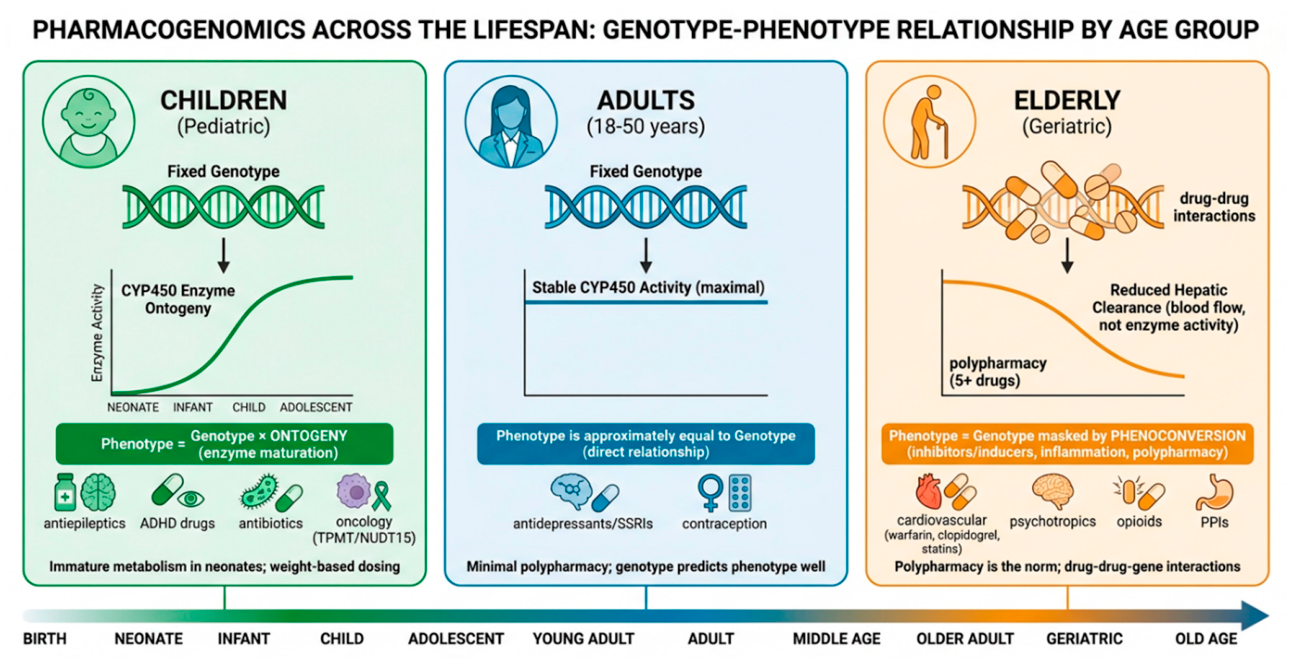
Figure 2.
The aging liver paradox: preserved enzyme activity per gram, reduced clearance in vivo. Comparison of hepatic clearance determinants between young adult and aging liver (≥75 years). While cytochrome P450 activity per gram of liver tissue remains largely preserved with age, total hepatic clearance declines due to reduced liver mass (↓20–30%), decreased hepatic blood flow (↓35–50%), and pseudocapillarization (reduced sinusoidal fenestrations), which impairs drug access to hepatocytes. In vitro studies show comparable CYP activity per mg protein between young and old, whereas in vivo studies demonstrate reduced systemic clearance of high-extraction drugs (e.g., midazolam, CYP3A4 substrate) and increased AUC of statins (e.g., atorvastatin). This paradox implies that genotype-predicted normal metabolizer status may functionally manifest as intermediate metabolizer in the elderly for high-extraction drugs, where the rate-limiting step shifts from enzyme activity to drug delivery (blood flow) and total enzyme mass. This phenomenon primarily does not apply to low-extraction CYP2D6 substrates or Phase II conjugation (UGT).
Figure 2.
The aging liver paradox: preserved enzyme activity per gram, reduced clearance in vivo. Comparison of hepatic clearance determinants between young adult and aging liver (≥75 years). While cytochrome P450 activity per gram of liver tissue remains largely preserved with age, total hepatic clearance declines due to reduced liver mass (↓20–30%), decreased hepatic blood flow (↓35–50%), and pseudocapillarization (reduced sinusoidal fenestrations), which impairs drug access to hepatocytes. In vitro studies show comparable CYP activity per mg protein between young and old, whereas in vivo studies demonstrate reduced systemic clearance of high-extraction drugs (e.g., midazolam, CYP3A4 substrate) and increased AUC of statins (e.g., atorvastatin). This paradox implies that genotype-predicted normal metabolizer status may functionally manifest as intermediate metabolizer in the elderly for high-extraction drugs, where the rate-limiting step shifts from enzyme activity to drug delivery (blood flow) and total enzyme mass. This phenomenon primarily does not apply to low-extraction CYP2D6 substrates or Phase II conjugation (UGT).
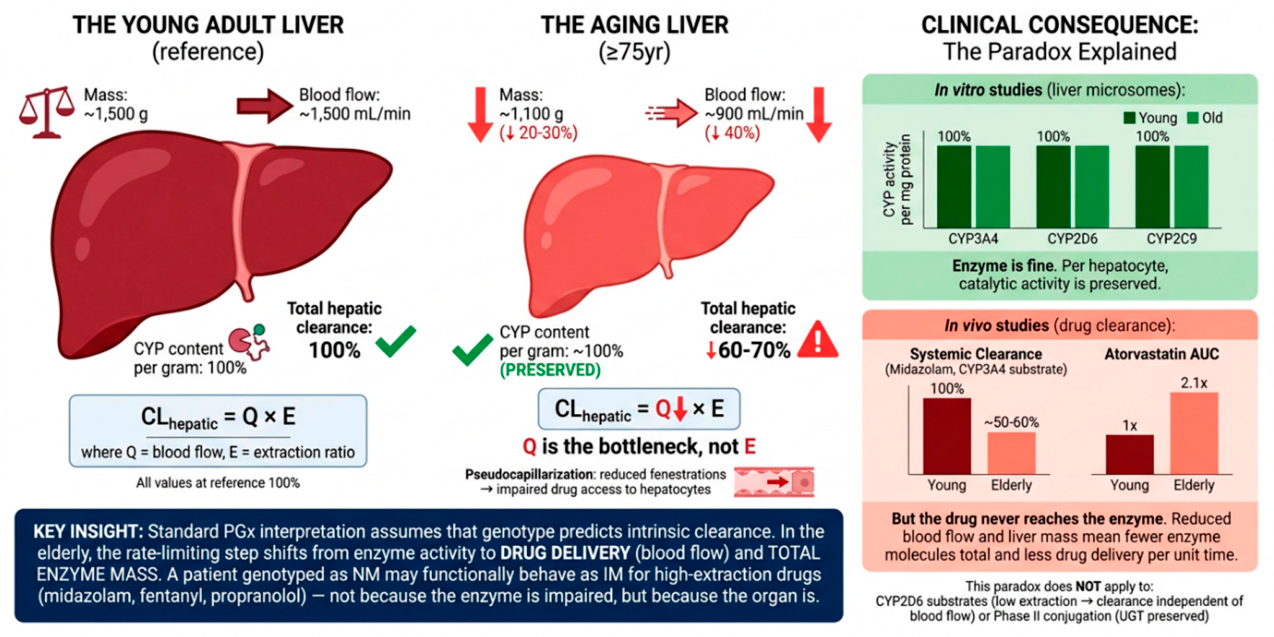
Figure 3.
Polypharmacy and pharmacogenomic medication exposure in older adults. (a) Prevalence of polypharmacy, potentially inappropriate medication use, pharmacogenomic drug exposure, and exposure to multiple pharmacogenomic-relevant medications in older adults, based on data reported in the Rhineland Study [1], a longitudinal primary care study [7], and a scoping review [5]. (b) Major clinical consequences and pharmacogenomic implications of polypharmacy in older adults, including adverse drug reactions (ADRs), prescribing cascades, and drug–drug–gene interactions (DDGIs). Data and concepts are summarized from the cited literature.
Figure 3.
Polypharmacy and pharmacogenomic medication exposure in older adults. (a) Prevalence of polypharmacy, potentially inappropriate medication use, pharmacogenomic drug exposure, and exposure to multiple pharmacogenomic-relevant medications in older adults, based on data reported in the Rhineland Study [1], a longitudinal primary care study [7], and a scoping review [5]. (b) Major clinical consequences and pharmacogenomic implications of polypharmacy in older adults, including adverse drug reactions (ADRs), prescribing cascades, and drug–drug–gene interactions (DDGIs). Data and concepts are summarized from the cited literature.
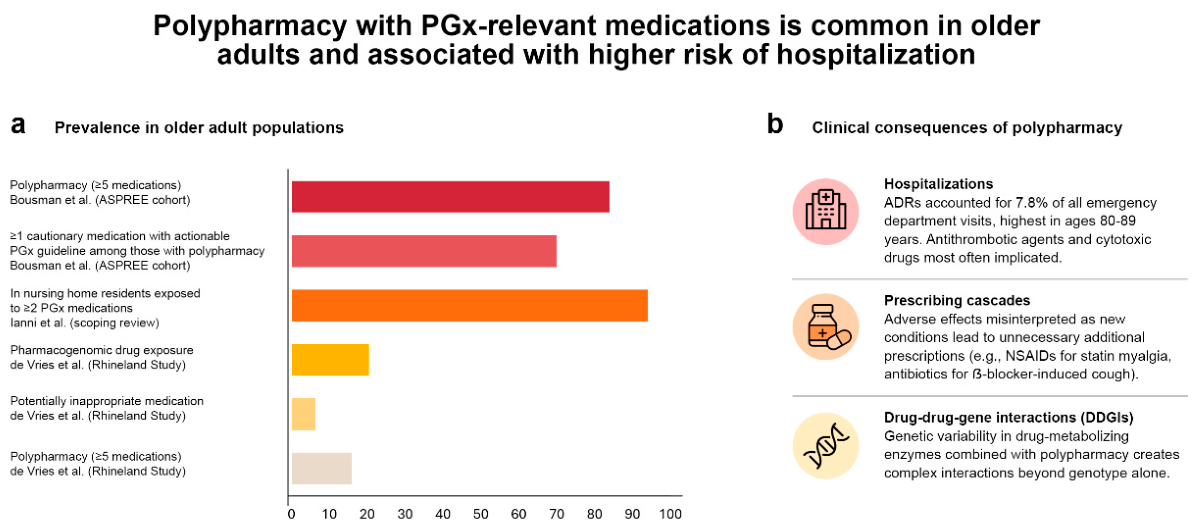
Figure 4.
Prescribing frequency of pharmacogenetically actionable drugs in patients ≥65 years across five cohort studies. For each drug, the horizontal line represents the range of prescribing rates (min–max) reported in studies with separate data for adults ≥65 years [5]. The dot indicates the median rate. Colors correspond to the associated gene; drugs with multiple genes (Warfarin, Amitriptyline) are shown separately for each gene with a slight vertical offset. Notes: Data for Atorvastatin and Tramadol lacked a published median; their dot positions represent the mean of the range (20.35% and 11.75%, respectively).
Figure 4.
Prescribing frequency of pharmacogenetically actionable drugs in patients ≥65 years across five cohort studies. For each drug, the horizontal line represents the range of prescribing rates (min–max) reported in studies with separate data for adults ≥65 years [5]. The dot indicates the median rate. Colors correspond to the associated gene; drugs with multiple genes (Warfarin, Amitriptyline) are shown separately for each gene with a slight vertical offset. Notes: Data for Atorvastatin and Tramadol lacked a published median; their dot positions represent the mean of the range (20.35% and 11.75%, respectively).
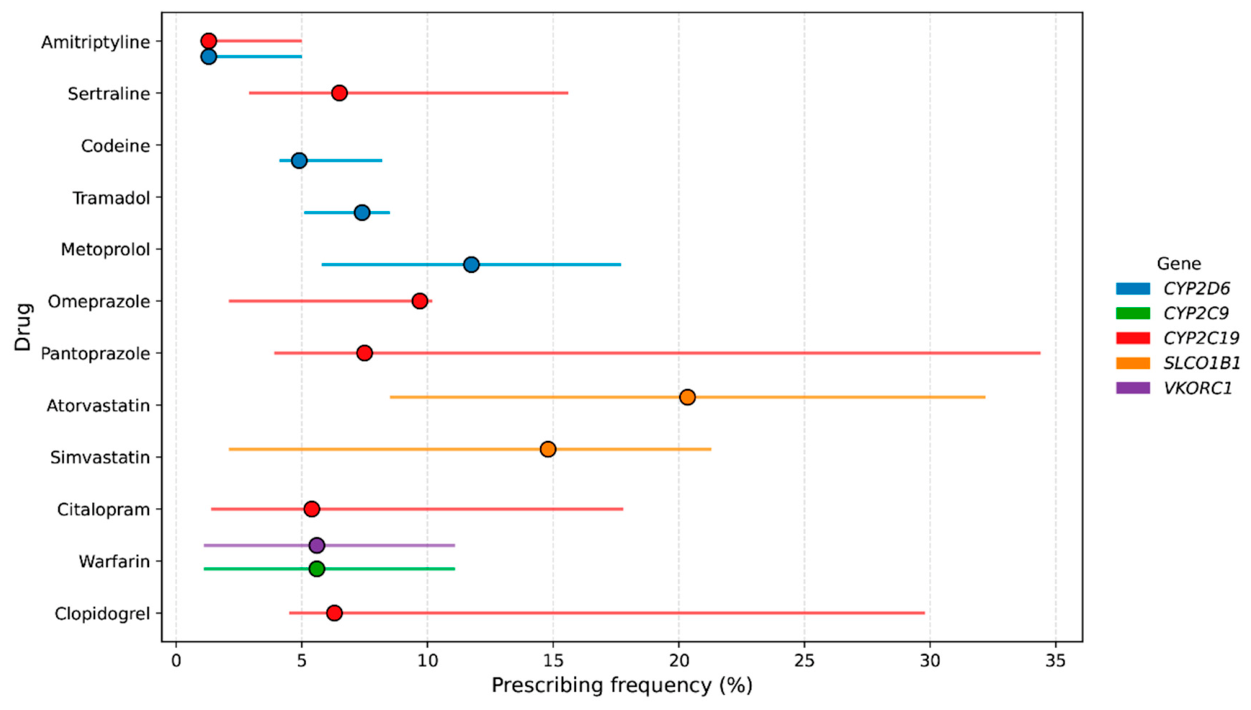

Table 1.
Age-related changes in drug-metabolising enzymes and transporters.
| Enzyme / transporter | Reported change with ageing | Type of evidence | Conflicting or limiting evidence | Consequence for interpretation |
| CYP3A | Midazolam AUC geometric mean ratio 2.30 (95% CI 1.70–3.09) in healthy older adults vs healthy young adults; atorvastatin AUC ratio 2.14 (1.52–3.02), both with prolonged half-life [28] In older adults with CKD the ratios were 2.90 and 4.15 respectively [28] Modelled midazolam clearance falls 27% between ages 20–25 and 65–70 [29] |
In vivo microdose probe cocktail (n=20 young / 16 older / 17 older with CKD) [28]; PBPK simulation [29] | Small sample sizes; the study population was Thai, and CYP3A5*3 genotype was determined but the cohort was not powered for genotype stratification [28] | The largest single age effect among the pathways listed. Applies to genotypically normal patients, so it operates on top of, not instead of, genotype-based dose adjustment |
| CYP2C19 | Modelled S-mephenytoin clearance falls 39% between ages 20–25 and 65–70 [29] | PBPK simulation, not a clinical measurement [29] | S-mephenytoin was the one probe of five whose simulated clearance fell outside 3.5-fold of clinical study values [29]; direct in vivo probe data in older adults are sparse [30] | Should be presented as a modelled estimate. Combined with the high prevalence of actionable CYP2C19 genotypes (59.6% [7]), the practical driver of exposure remains genotype plus co-medication |
| CYP2C9 | Modelled S-warfarin clearance falls 36% between ages 20–25 and 65–70 [29] | PBPK simulation [29] | Direct in vivo age-stratified probe data limited [30] | Relevant to warfarin and NSAID exposure, but genotype remains the larger source of between-patient variability |
| CYP1A2 | Modelled caffeine clearance falls 33% between ages 20–25 and 65–70 [29] | PBPK simulation [29] | Inducibility by smoking is a separate and larger source of variability | No actionable pharmacogenetic guideline; relevant mainly as a background covariate for clozapine and theophylline |
| CYP2D6 | Modelled desipramine clearance falls 31% between ages 20–25 and 65–70 [29] In vivo probe studies indicate that intrinsic CYP2D6 activity is largely preserved with ageing [30] |
PBPK simulation [29]; in vivo probe-drug literature [30] | The modelled decrease and the preserved-activity conclusion come from different methods and are not strictly comparable: the simulation propagates age-related changes in liver mass, microsomal protein and blood flow rather than a change in enzyme activity per se [29] | For CYP2D6 the dominant older-adult modifier is phenoconversion by co-medication, not ageing |
| Flow-limited hepatic metabolism (general) | Metabolism of flow-limited drugs is reduced by approximately 40%, consistent with the reduction in hepatic blood flow in older people [31] | Narrative synthesis of in vivo pharmacokinetic studies [31] | The categorisation of individual drugs as flow- or capacity-limited is not always clean [31] | Explains why high-extraction substrates behave differently from low-extraction substrates such as CYP2D6 probes |
| Phase II conjugation (UGT) | In vitro metabolism of many capacity-limited drugs is relatively preserved, consistent with preservation of the content, activity and gene expression of phase I and phase II enzymes with age [31] | Narrative synthesis [30,31] | Not quantified as a single effect size; drug-by-drug variation is substantial [31] | Glucuronidated substrates are less affected by hepatic ageing than high-extraction CYP3A substrates |
| Intestinal ABC transporters (P-gp, BCRP, MRPs) | Targeted duodenal proteomics identified significant age-related changes in protein abundance, with age coefficients from −0.36 to 0.51: decreased abundance of CES2, PEPT1 and villin-1, and increased abundance of BCRP and MRP1, MRP3 and MRP4 [32] | Targeted mass-spectrometry proteomics of duodenal tissue with multiple regression on age and sex; the study is framed specifically around advanced age rather than the general adult age range [32] | A 2026 review reports the opposite direction, with lower intestinal and hepatic BCRP expression in older compared with young adults [33] One human study documented roughly 60% lower intestinal ABCB1 expression with ageing, constrained by a sample size of 8 and spatial sampling bias [33] In the microdose cocktail study, changes in dabigatran etexilate exposure — the intestinal P-gp probe — were observed in CKD, not with ageing alone [28] |
This is an active disagreement in the literature and should be presented as such. It cannot currently support a directional clinical recommendation |
| OATP1B1 / hepatic OATP | No conclusive age effect: pitavastatin, the OATP1B probe, showed only a trend rather than a definite change [28] Whole-body PET with 11C-glyburide (n=16) found baseline liver exposure 42.6 ± 18.4% higher in females over 50 than in males over 50, consistent with higher blood-to-liver transfer rates [34] |
In vivo microdose probe [28]; whole-body dynamic PET-MR [34] | The PET study compared males under 30, males over 50 and females over 50 in groups of 4–7; the demonstrated significant difference was between sexes, not between age groups [34] | Sex is currently the better-evidenced determinant of hepatic OATP function than age. Statin clearance changes in older adults are more plausibly attributed to hepatic blood flow than to the transporter itself [28,31] |
Notes: Values from [29] are outputs of in vitro–in vivo extrapolation coupled with physiologically based pharmacokinetic simulation in five-year age bands, not measured clearances; they are labelled “modelled” wherever they appear. Values from [28] are measured geometric mean ratios with 95% confidence intervals from a prospective microdose study.
Table 2.
Core pharmacogenes relevant to prescribing in adults aged 65 and over.
| Gene | Pharmacological role | Genotype-predicted phenotype distribution | Effect of ageing on activity | Representative guideline-covered drugs used in older adults |
| CYP2D6 | Oxidative metabolism of many antidepressants, antipsychotics, beta-blockers and opioid prodrugs; low hepatic extraction ratio | 53.2% predicted normal metabolisers (n=5,408) [56] Actionable-genotype frequency in the ASPREE cohort not reported separately [7] |
Intrinsic activity largely preserved; low extraction ratio means reduced hepatic blood flow has limited effect [30]. Modelled desipramine clearance falls 31% between ages 20–25 and 65–70 [29]. Phenoconversion by co-medication is the dominant modifier [57] | Metoprolol (DPWG), tramadol, codeine, ondansetron, paroxetine, nortriptyline, amitriptyline, tamoxifen (CPIC level A) [5] |
| CYP2C19 | Metabolism of proton-pump inhibitors, bioactivation of clopidogrel, metabolism of citalopram/ escitalopram and sertraline | 39.7% predicted normal metabolisers (n=5,408) [56] Actionable genotype in 59.6% — second most frequent gene in ASPREE (n=13,670) [7] |
Modelled S-mephenytoin clearance falls 39% between ages 20–25 and 65–70 [29]; capacity-limited pathway, so blood-flow decline contributes less than for high-extraction drugs [30,31] | Clopidogrel, pantoprazole, omeprazole, lansoprazole, citalopram, escitalopram, sertraline, voriconazole (CPIC level A) [5,58] |
| CYP2C9 | Metabolism of S-warfarin, most NSAIDs, phenytoin and sulfonylureas | 64.8% predicted normal metabolisers (n=5,408) [56] | Modelled S-warfarin clearance falls 36% between ages 20–25 and 65–70 [29]. Direct in vivo probe data in older adults remain limited [30] | Warfarin, celecoxib, ibuprofen, meloxicam, piroxicam, flurbiprofen, phenytoin, fluvastatin (CPIC level A) [5,59] |
| VKORC1 | Pharmacodynamic target of vitamin K antagonists; not a metabolic enzyme | Actionable genotype in 61.1% — most frequent gene in ASPREE (n=13,670) [7] | No metabolic ageing effect applies. Age enters warfarin dosing as an independent clinical covariate, not through this gene | Warfarin, acenocoumarol, phenprocoumon (CPIC level A) [5] |
| SLCO1B1 | Encodes OATP1B1, which mediates hepatic uptake of all statins | Not reported separately in [7] or [56]; refer to the CPIC allele frequency tables | No conclusive age effect on OATP1B1 activity: pitavastatin exposure was not conclusively altered by ageing in a microdose cocktail study [28]. Whole-body PET with the OATP probe 11C-glyburide (n=16) identified sex, not age, as the demonstrated determinant of hepatic exposure [34] | Simvastatin, atorvastatin, rosuvastatin, pravastatin, pitavastatin, lovastatin, fluvastatin (CPIC level A) [59] |
| CYP3A5 | Together with CYP3A4 determines tacrolimus disposition | Not reported separately in [7] or [56] | CYP3A activity as a whole declines markedly with age independently of CYP3A5 genotype [28] | Tacrolimus (CPIC level A) [5] |
Table 3.
Practical recommendations for pharmacogenetic interpretation in older adults.
| # | Recommendation | Supporting evidence | Strength of support | Reference |
| 1 | Reconcile current medication for cytochrome P450 inhibitors and inducers before translating genotype into a predicted phenotype | In the ASPREE cohort, 68.2% of participants reported use of at least one inhibitor or inducer of a cytochrome P450 enzyme linked to a prescribing guideline during the trial. In an acute aged-persons mental health cohort (n=137), accounting for phenoconversion increased the predicted frequency of CYP2D6 intermediate metabolisers by 11.7% at admission and 16.1% at discharge, and of CYP2C19 intermediate metabolisers by 13.1% and 11.7%. Of 120 prescriptions of 19 medications with actionable recommendations at admission, 50 (42%) carried an actionable recommendation before phenoconversion and 60 (50%) after. | Direct — two cohorts with quantified effect | [7,57] |
| 2 | Prioritise a compact pre-emptive panel centred on CYP2D6, CYP2C19, CYP2C9, SLCO1B1 and VKORC1 | Across 31 real-world utilisation studies, the genes most frequently implicated in actionable drug–gene interactions were CYP2D6 (25.6%), CYP2C19 (18.3%) and CYP2C9 (11%). In cohorts restricted to adults aged 65 and over, CYP2C19 was the predominant gene among the ten most-prescribed actionable drugs. In ASPREE, VKORC1 (61.1%) and CYP2C19 (59.6%) were the most frequent genes carrying actionable genotypes, and statins, NSAIDs and proton-pump inhibitors were the most-used cautionary medication classes. | Direct | [5,7] |
| 3 | Prefer pre-emptive panel testing over reactive single-gene testing in this age group | 98.8% of ASPREE participants carried at least one actionable genotype, with a mean of 3.04 per participant. Among studies restricted to adults aged 65 and over, 25–94% were exposed to two or more medications with pharmacogenetic recommendations; the highest proportion was in nursing home residents. | Direct | [5,7] |
| 4 | Treat frailty as a priority indication rather than a reason to defer testing | In 59,973 NHS hospital admissions of patients aged 65 and over, models incorporating the number of guideline-covered medications were the best fit for length of stay and for repeat admission specifically in the high-frailty stratum; in the low- and intermediate-frailty strata, models with and without that variable performed comparably. Frailty carried the largest coefficient of any predictor (9.64 for high frailty in the unplanned-admission model). | Indirect — the study had no genotype data and the authors state this explicitly. It supports prioritising frail patients for testing; it does not demonstrate that guideline doses require further downward adjustment in frailty | [147] |
| 5 | Interpret genotype alongside renal function rather than in isolation | In the microdose cocktail study, older adults with CKD had markedly greater exposure than older adults without it for the same probes: atorvastatin AUC ratio 4.15 (2.98–5.79) versus 2.14 (1.52–3.02), and midazolam 2.90 (2.16–3.88) versus 2.30 (1.70–3.09). Altered exposure of the intestinal P-gp probe dabigatran etexilate was observed in the CKD group specifically. | Direct, though from a single small study | [28] |
| 6 | Do not transfer adult CPIC dose recommendations to patients over 75 without accounting for reduced CYP3A capacity | Midazolam AUC was 2.30-fold higher and atorvastatin AUC 2.14-fold higher in healthy older adults than in healthy young adults, in participants unselected for actionable genotype. Metabolism of flow-limited drugs is reduced by approximately 40% in older people, consistent with the reduction in hepatic blood flow. | Direct for the magnitude of the CYP3A effect; the extrapolation to a specific dose adjustment is expert opinion | [28,31] |
| 7 | Re-examine the pharmacogenetic interpretation at every change of therapy rather than treating the report as a one-off result | 83.9% of ASPREE participants reported polypharmacy (five or more concurrent medications). In a Danish nursing home cohort (n=141), the most frequent drug interaction flagged with a warning was the combination of a proton-pump inhibitor with clopidogrel, a recognised phenoconversion mechanism. | Direct for the prevalence data; the recommendation to re-review is a reasonable inference from it | [7,148] |
| 8 | State the limits of the report explicitly, including that genotype does not capture inhibitors and inducers, renal function, hepatic function or frailty status | No dataset quantifying the effect of this reporting practice was identified. | Expert opinion — no supporting dataset identified | — |
| 9 | Where a strong inhibitor can be withdrawn, do so before phenotyping or before initiating a sensitive substrate | Phenoconversion is a reversible pharmacological effect, in contrast to genotype; the quantitative effect of withdrawal on predicted phenotype in older adults was not identified in a retrievable study. | Expert opinion, mechanistically grounded — no outcome dataset identified | [57] for the magnitude of phenoconversion only |
| 10 | Use therapeutic drug monitoring in preference to genotype-only interpretation for narrow-therapeutic-index drugs in patients with several concurrent risk factors | No study quantifying the proportion of pharmacokinetic variability explained by genotype specifically in older adults was identified. | Expert opinion — no supporting dataset identified | — |
Table 4.
Overlap between potentially inappropriate prescribing and pharmacogenetic actionability.
| Drug or class | Gene(s) | Basis for caution in older adults | Interaction between the two considerations |
| Antidepressants with strong anticholinergic activity (amitriptyline, clomipramine, desipramine, doxepin >6 mg/day, imipramine, nortriptyline, paroxetine) | CYP2D6, CYP2C19 | Beers 2023 Table 2: avoid — highly anticholinergic, sedating, cause orthostatic hypotension (quality of evidence high, recommendation strong). Tertiary tricyclics also appear under syncope, and antidepressants as a class under history of falls or fractures, in Beers 2023 Table 3 [99] | A poor-metaboliser genotype raises exposure to drugs already flagged for avoidance on pharmacodynamic grounds. Genotype does not make the drug appropriate; it identifies the patients in whom harm is most likely if it is used. Note that paroxetine is on this list and is itself a strong CYP2D6 inhibitor |
| Proton-pump inhibitors (omeprazole, pantoprazole, lansoprazole, esomeprazole, rabeprazole, dexlansoprazole) | CYP2C19 | Beers 2023 Table 2: avoid scheduled use beyond 8 weeks unless a high-risk indication applies — risk of C. difficile infection, pneumonia, gastrointestinal malignancy, bone loss and fracture [99] | Third most-used cautionary class in ASPREE at 7.9% [7], and pantoprazole and omeprazole are among the most prescribed actionable drugs in cohorts aged 65 and over. The duration limit and the genotype-based dose adjustment are independent constraints |
| Non-COX-2-selective NSAIDs, oral (ibuprofen, meloxicam, piroxicam, flurbiprofen, naproxen, diclofenac and others) | CYP2C9 | Beers 2023 Table 2: avoid chronic use unless alternatives are ineffective and a gastroprotective agent can be taken; Table 3: avoid in heart failure and in a history of gastric or duodenal ulcer; Table 6: avoid at CrCl below 30 mL/min. Celecoxib is COX-2-selective and appears in the heart-failure and kidney-function criteria rather than in the Table 2 non-selective list [99] | Second most-used cautionary class in ASPREE at 14.2% [7]. Reduced CYP2C9 function prolongs exposure in a class already flagged for avoidance, and the renal criterion applies concurrently |
| Warfarin | CYP2C9, VKORC1, CYP4F2 | Beers 2023 Table 2 (new in the 2023 update): avoid starting warfarin as initial therapy for non-valvular atrial fibrillation or venous thromboembolism unless DOACs are contraindicated or there are substantial barriers to their use (quality high, recommendation strong); continuation may be reasonable in long-term users with well-controlled INR. Table 5: avoid combining warfarin with amiodarone, ciprofloxacin, macrolides other than azithromycin, trimethoprim-sulfamethoxazole or SSRIs [99] | Worth stating explicitly in the discussion: because the 2023 criteria discourage initiating warfarin in this age group, the population in which CYP2C9 and VKORC1 genotyping alters an initial dose is narrower than it was under earlier criteria. The listed interactions are also phenoconversion mechanisms |
| Sulfonylureas (glimepiride, glyburide/glibenclamide, glipizide, gliclazide) | CYP2C9 | Beers 2023 Table 2: avoid as first- or second-line monotherapy or add-on therapy; if a sulfonylurea is used, prefer a short-acting agent (glipizide) over a long-acting one (glyburide, glimepiride), which confer a higher risk of prolonged hypoglycaemia [99] | The 2023 update expanded this criterion from long-acting agents only to the whole class. Chlorpropamide was moved off the main tables because it is no longer marketed in the United States — reviews that still list it as the exemplar are citing the pre-2023 criteria |
| Tramadol | CYP2D6 | Beers 2023 Table 4 (use with caution): may exacerbate or cause SIADH or hyponatraemia, with sodium monitoring advised on initiation or dose change; Table 6: reduce the immediate-release dose and avoid the extended-release form at CrCl below 30 mL/min. Opioids as a class appear under delirium and under history of falls or fractures in Table 3 [99] | Poor metabolisers obtain reduced analgesia from bioactivation while retaining the non-opioid adverse effects; ultrarapid metabolisers are exposed to excess active metabolite. Neither is addressed by the criteria themselves |
| Codeine | CYP2D6 | Not named individually in the Beers 2023 criteria; opioids as a class appear under delirium and under history of falls or fractures in Table 3, and under the opioid–benzodiazepine and opioid–gabapentinoid interactions in Table 5 [99] | Same bioactivation logic as tramadol. A co-prescribed CYP2D6 inhibitor converts a normal metaboliser into a functional poor metaboliser, which the explicit criteria do not capture |
| SSRIs (citalopram, escitalopram, sertraline) | CYP2C19 | Beers 2023 Table 4 (use with caution): SSRIs may exacerbate or cause SIADH or hyponatraemia; Table 3: antidepressants under history of falls or fractures; Table 5: avoid combining with warfarin. The maximum daily citalopram dose above age 60 is a regulatory label restriction and not a Beers criterion [99] | The age-based label ceiling and the genotype-based dose reduction are separate constraints that apply concurrently rather than substituting for one another |
| Clopidogrel | CYP2C19 | Not a potentially inappropriate medication in the Beers 2023 criteria. The criteria instead position clopidogrel as the safer comparator: prasugrel and ticagrelor are placed in Table 4 for caution in adults aged 75 and over because both increase major bleeding relative to clopidogrel [99] | The most frequently used actionable drug in the cohorts aged 65 and over and in Danish nursing homes [148]. Its pharmacogenetic relevance stands on its own and should not be presented as reinforcing a potentially-inappropriate flag |
| Statins (simvastatin, atorvastatin and others) | SLCO1B1, ABCG2, CYP2C9 | Not included in the Beers 2023 criteria [99] | The most-used cautionary class in ASPREE at 29.3% [7]. Volume of use rather than per-patient risk is what makes this the highest-yield gene–drug pair in this age group [59] |
Disclaimer/Publisher’s Note: The statements, opinions and data contained in all publications are solely those of the individual author(s) and contributor(s) and not of MDPI and/or the editor(s). MDPI and/or the editor(s) disclaim responsibility for any injury to people or property resulting from any ideas, methods, instructions or products referred to in the content. |
© 2026 by the authors. Licensee MDPI, Basel, Switzerland. This article is an open access article distributed under the terms and conditions of the Creative Commons Attribution (CC BY) license.
Copyright: This open access article is published under a Creative Commons CC BY 4.0 license, which permit the free download, distribution, and reuse, provided that the author and preprint are cited in any reuse.