
Submitted:
28 August 2026
Posted:
31 August 2026
You are already at the latest version
Preprints on COVID-19 and SARS-CoV-2
Abstract
During the COVID-19 (-19) pandemic, young children were infected and became ill less frequently than adults. Nevertheless, children are regarded as one of the populations disproportionately affected by pandemic-related measures, particularly social isolation, which may have influenced their psychological well-being and overall development. However, the extent of these developmental impairments, especially in younger children, remains insufficiently understood.This study analyses and compares cohorts of young children (aged 4-6) with speech disorders before (2018/ 2019), during (2019–2021), and after (2021/2022) the pandemic. For all cohorts, extensive and repeated educational, logopaedic, and psychological assessment records covering a one-year period were available. Hypothesis: Pandemic-related measures resulted in behavioural, social-emotional, linguistic and developmental impairments in young children. Methodology: Cohorts of preschool children with speech disorders treated in a German speech therapy day-care centre (Sprachheilkindergarten) during the periods 2018/19 (n = 9) (A), 2019/20 (n = 8) (C-19) (B), 2020/21 (n = 8) (C-19) (C), and 2021/22 (n = 10) (D) were retrospectively analysed and compared using existing therapy documentation and validated assessment procedures. The following domains were examined: learning/performance, social-emotional behaviour, communication, speech fluency, articulation, and language comprehension. In total, 35 children aged 4–6 years across four cohorts were included in the analysis. Results: At admission to the speech therapy kindergarten, children in groups B and C (C-19, 2019–2021) demonstrated competencies comparable to those observed in groups A and D. All cohorts benefited from the therapeutic interventions provided in the kindergarten setting; however, children in groups B and C (C-19) exhibited smaller developmental gains compared to cohorts A and D.The strongest improvements were observed in the domains of learning/performance, communication and articulation, whereas no changes were found in social-emotional behaviour and speech fluency. Language development gains achieved through the therapeutic interventions were likewise reduced in groups B and C (C-19). Notably, all children showed markedly reduced linguistic abilities at the time of kindergarten admission. Conclusions: The educational and therapeutic measures implemented within the kindergarten setting appear to have substantially mitigated potential negative consequences of pandemic-related restrictions with respect to social-emotional behaviour. None of the children showed deterioration in the examined domains. Nevertheless, therapy-related improvements in groups B and C (C-19) were lower than those observed in the control cohorts A and D.Overall, the findings suggest a positive impact of educational support and highlight the importance of maintaining such measures during exceptional circumstances, including future pandemics.
Keywords:
Covid-19 pandemic
; impact on speech-language disturbed preschoolers
; development
; social-emotional behaviour
; importance of daycare institutions
Introduction
The pandemic spread of the coronavirus in the years 2020 - 2021, commonly referred to as the COVID-19 crisis, led, among other consequences, to the implementation of a wide range of measures aimed primarily at reducing viral transmission and protecting public health systems from overload. These included extensive protective strategies such as strict isolation measures, social distancing policies, quarantine regulations, and the closure of public institutions (e.g., schools and daycare facilities). Some of these interventions were also influenced by political decision-making processes. Such measures, while potentially effective in mitigating infection rates, also resulted in unintended effects, the consequences of which should be systematically examined in order to inform responses to potential future epidemic events of a similar nature. In addition to the direct effects of SARS-CoV-2 infections, these isolation measures led to significant additional “social problems” among various vulnerable populations, including residents of nursing homes, hospitalized patients, and children. In children, COVID-19 infections were comparatively rare and generally less severe in their clinical course [1,2]. However, from pediatric, psychological, and educational perspectives, children are considered a disproportionately affected population due to the indirect effects of isolation measures and the associated disruptions to social behaviour and development. The literature suggests that younger children, particularly infants and preschool-aged children, experienced fewer social and psychological long-term effects compared to older children and adolescents. Nevertheless, the observed impairments in children are, at least in part, attributable to stringent public health measures such as prolonged isolation and exclusion from schools and daycare facilities, which were implemented particularly consistently in Germany. Based on current evidence, there is considerable heterogeneity in the reported extent of long-term effects on children [3]. This variability can be attributed to several factors, including differences in sample sizes, the heterogeneity of national public health measures, especially with regard to the degree of social isolation across countries [4,5], and variations in the criteria used to assess psychological outcomes. Furthermore, methodological differences contribute to the inconsistency of findings. Some studies rely on subjective assessments provided by teachers or parents, while others are based on cross-sectional data collected at a single time point. In certain cases, evaluations are derived from questionnaires completed by caregivers or educators, whereas in others, assessments are conducted by trained personnel. While these studies have yielded valuable insights, their findings must be interpreted with caution due to these methodological limitations [6,7,8,9]. To the best of the authors’ knowledge, no study to date has specifically investigated the consequences of the COVID-19 pandemic in preschool children receiving long-time logopaedic therapy due to language development disorders. Additionally, to the best of the authors’ knowledge, no previous study has comprehensively monitored various developmental skills in preschool children during the pandemic.
Psychological resilience in infants and children is strongly influenced by contextual factors. Foremost among these is the stabilizing role of a well-functioning, supportive family environment characterized by stable relationships and an adequate socioeconomic status [9,10,11,12]. During the COVID-19 crisis, however, many families experienced substantial social challenges, which in turn affected individual family members. In some cases, parents were unable to work, families were confined to often limited living spaces, and both children and adults were at times restricted from leaving their homes. The physical and psychological burden associated with pandemic-related measures was considerable, and illness as well as death played a significant role. These findings indicate that the social circumstances of families during the COVID-19 crisis played a crucial role which often particularly affected children [7,8,9,13,14]. In addition, children’s broader social environments, including contact with peers, participation in sports activities, and attendance at daycare facilities and/or schools, were significantly disrupted by the stringent regulations implemented in Germany, in contrast to countries such as Sweden. In particular, the suspension of daycare attendance for preschool children had lasting consequences. Children without prior daycare are more likely to suffer from mental health issues in the long term. Moreover, they were later less accustomed to initiating social interactions and navigating group settings [15,16]. Children with special (medical) needs were particularly challenged, as access to necessary medical and educational interventions was partially disrupted. Orgilés et al. [5] and Linnavalli et al. [4] report that in countries such as Sweden and Jordan, where COVID-19 measures were less restrictive, children appeared to experience fewer adverse effects such as developmental or emotional problems. Oppermann et al. [8] further observed that children from stable and supportive family environments seemed to cope relatively well, even under stringent pandemic-related restrictions.
Multiple studies have analysed the effects of the COVID-19 pandemic on the speech and language development of preschool children. In summary, the pandemic appears to have adversely affected language development. However, the extent of these language difficulties varies widely and depends on numerous factors, including the social environment and opportunities for speech and language learning. One important external factor is an adverse social environment, whereas attendance at a daycare institution has been suggested to have a protective effect. Another pandemic-specific factor is mask-wearing, which may have substantially affected speech and language development. To the best of our knowledge, no study has investigated the effects of long-term speech-language therapy in preschool children during the COVID-19 pandemic [17,18,19].
Despite the growing body of literature on the psychosocial consequences of the COVID-19 pandemic in children, findings remain heterogeneous and are often limited by methodological constraints, such as cross-sectional designs, variable assessment criteria, and reliance on proxy reports. In addition, there is a lack of longitudinal data based on standardized assessments, particularly for specific clinical populations. Notably, little is known about the impact of the pandemic on preschool children with language disorders, especially in structured therapeutic settings that may have mitigated the effects of social restrictions. Therefore, further research is needed to better understand both baseline characteristics and developmental trajectories in this population across different phases of the pandemic.
The present study investigates and compares the psychological, educational, and speech-language outcomes in groups of preschool children aged 4 to 6 years with language disorders attending a specialized speech and language daycare center (Sprachheilkindergarten) in Germany, based on available diagnostic and therapeutic records from the years 2018 to 2022. The year 2018 represents the pre-pandemic period, 2020 and 2021 correspond to the COVID-19 pandemic period, and 2022 reflects the post-pandemic phase. A particular strength of this study lies in the repeated, assessment of the children using consistent pedagogical, speech-language, and psychological criteria. These assessments were conducted by trained professionals (educators, speech-language therapists, psychologists, and mototherapists), whose team composition remained unchanged throughout the entire study period from 2018 to 2022. The various test procedures were conducted on specified dates by the same researchers using identical testing procedures.
In contrast to children without special needs, who were required to adhere to strict isolation measures during the COVID-19 pandemic (i.e., exclusion from daycare attendance), the children with language disorders included in this study were able to return to daycare (Spachheilkindergarten) after a relatively short interruption of approximately five weeks. Consequently, they were substantially less affected by prolonged isolation measures. The following domains and abilities were assessed and continuously monitored in the children: “learning and performance behaviour,” “social-emotional development,” “communication,” and the speech-language domains “language comprehension,” “speech fluency,” and “articulation” [20]. We consider these domains to encompass a large proportion of the key aspects of child development.
The study addressed the following research questions:
- Do preschool children with language disorders assessed during the COVID-19 pandemic (2019/2020 and 2020/2021) differ in baseline characteristics from children assessed in the pre-pandemic (2018/2019) and post-pandemic (2021/2022) periods with regards to learning and performance behaviour, social-emotional development, communication, and speech-language abilities?
- Do developmental trajectories and therapeutic outcomes in preschool children with language disorders differ between the COVID-19 pandemic period (2019/2020 and 2020/2021) and the pre-pandemic (2018/2019) and post-pandemic (2021/2022) periods?
In Germany, and particularly in Lower Saxony, specialized speech and language therapy preschools (i.e., Sprachheilkindergarten) are available. The concept underlying these institutions is based on scientific evidence demonstrating that speech and language therapy during the preschool years can lead to long-term improvements in language abilities, even in children with severe language disorders, thereby enabling a large proportion of these children to achieve typical educational and later occupational development trajectories. These specialized preschools (Sprachheilkindergarten) are based on a multimodal intervention, in which children receive support from specialized educators, speech and language therapists, movement therapists, and psychologists. In addition to targeting language development, the concept also promotes broader competencies, such as peer communication and psychological stabilization. Prior to admission to a speech and language therapy preschool (Sprachheilkindergarten), it must be ensured that no additional disorders or medical conditions are present. In most cases, children have already received more than 30 unsuccessful hours of outpatient speech and language therapy. At the time of admission, children are typically between 4 and 6 years of age, and the average duration of attendance in these institutions is limited to approximately 12 to 18 months. In contrast to regular preschools (kindergarten), which typically have a child-to-staff ratio of approximately 25:2, speech and language therapy preschools operate with a substantially lower ratio of about 8:1.5 [21,22].
Methods
Study Design
The present study is a retrospective analysis including four groups of preschool children attending a specialized speech and language therapy preschool (Sprachheilkindergarten) in Hanover, Germany, across four consecutive therapy years from summer 2018 to summer 2022. This period also encompasses the COVID-19 pandemic between 2019 and 2021. The data used in this study were derived from routinely collected observational and therapeutic records. Upon admission to the preschool, parents signed a care agreement providing written consent for all diagnostically necessary assessments and for the use of the resulting data for scientific purposes. No additional assessments beyond routine clinical and educational evaluations were conducted for the purpose of this study.
Study Participants
A total of 35 children (23 boys, 12 girls) aged 4 to 6 years with language development delay or disorder were included in the study. On the basis of the monitored domains the sample comprised four homogenous therapy cohorts from the years 2018/2019 (n = 9), 2019/2020 (n = 8), 2020/2021 (n = 8), and 2021/2022 (n = 10); Table 1. The therapy years 2019/2020 and 2020/2021 were substantially influenced by various governmental COVID-19 measures, which were implemented in Germany in a particularly strict and consistent manner. All children were diagnosed with a pronounced language development disorder (ICD-10: F80.9). Some children additionally presented with minor comorbid conditions, such as orofacial motor difficulties (ICD-10: F82). Table 2 summarizes the characteristics of the children by therapy cohort, including IQ, number of siblings, age at admission, and duration of therapeutic intervention. As shown in Table 3, the groups were well comparable. Approximately 80% of the families experienced socioeconomic disadvantage, with family incomes ranging from low to very low. This socioeconomic profile was similar across all study groups, from the 2018/19 to the 2021/22 cohorts.
At admission, all children underwent comprehensive psychological, speech and language, and educational assessments, and the results were documented. During the therapy period, children were routinely assessed four times per year with regard to their speech and language abilities and 2 to 3 times per year with respect to their psychological, educational, and overall development. These assessments were based on a range of instruments, most of which were validated (Table 4), and were conducted by experienced, identical educators, speech and language therapists, and psychologists. Test procedures and structure of educational assessments did not change within the study-period 2018 to 2022. Based on the assessment results, therapeutic interventions were adjusted as needed.
As children attending speech and language therapy preschools (Sprachheilkindergarten) often experience difficulties completing age-appropriate standardized assessments due to their language impairments and delayed overall development, supplementary developmental profiling according to Zollinger [29] was used in some cases. This is a non-standardized developmental assessment designed for children aged 9 to 42 months, providing additional clinically relevant information. Although the children in this study were in part older than 42 months, the use of this instrument nevertheless yielded useful complementary insights in selected cases.
It is generally accepted that both standardized and non-standardized assessment procedures, as well as questionnaires, can capture only selected aspects of the abilities and characteristics of the children under investigation. Therefore, comprehensive and repeated assessments are essential to obtain as complete and accurate a picture as possible of the children’s abilities, limitations, and developmental progress. Of particular interest in the present study were the core domains of “learning and performance behaviour,” “social emotional characteristics,” “communication,” “articulation,” “speech fluency,” and “language comprehension.” The assessments of the speech-language domains “communication,” “articulation,” “speech fluency,” and “language comprehension” are derived on the criteria of the ICF-CY, 2007 [20]. The domains “”learning and performance behaviour” and “social emotional characteristics” were developed in accordance with the principles of the ICF-CY, 2007 [20].
Evaluations of these domains were based on assessments provided by educators and therapists. For the purposes of this study, these evaluations were quantified using a rating scale analogous to school grading, ranging from 1 point (not present) to 5 points (normal, age-appropriate), as detailed in Appendix Table A1. These ratings constituted the basis for all subsequent analyses. Appendix Table A2 provides an overview of the specific subcriteria considered for each of the assessed core domains.
To assess the baseline pedagogical and speech-language status and to document developmental trajectories, the scaled ratings obtained at admission to the speech and language therapy preschool (Sprachheilkindergarten) were compared with those recorded at the end of the therapy year. This approach allowed for the identification of positive changes (increase in scores) as well as negative changes (decrease in scores). For statistical analysis, median values and interquartile ranges (IQR) were calculated. Statistical analyses and significances in the various groups were conducted by non-parametric Kruskal-Wallis-test and Mann-Whitney-U-test.
Covid-19 Pandemic and Epidemiological Measures in Germany
The COVID-19 pandemic emerged in late 2019, with the official begin in Germany in December 2019. The first nationwide “hard” lockdown was implemented from March to May 2020, followed by a second lockdown from December 2020 to April 2021. Additional restrictions for unvaccinated adults were in place from November 2021 to April 2022. Most nationwide pandemic-related restrictions were lifted in April 2022 [1]. For the purposes of the present study, the 2018/2019 cohort was classified as the pre-COVID-19 cohort, the 2019/2020 and 2020/2021 cohorts as the COVID-19 pandemic cohorts, and the 2021/2022 cohort as the post-COVID-19 cohort.
Pedagogical Principles and Assessment Criteria
All participating children were assessed upon admission to the speech and language therapy preschool (Sprachheilkindergarten), and individualized therapy and support plans were developed based on these initial evaluations. The criteria for the pedagogical assessments corresponded to the core domains described above. The specialized educators (1.5 educators per eight children) aimed to improve these abilities over the course of the therapy year through targeted pedagogical interventions, including the promotion of social competence, everyday life skills, creative activities, and physical movement. In contrast to speech and language therapists, educators did not provide direct correction of speech. The duration of therapy, typically ranging from 12 to 18 months, allowed for continuous long-term support and the development of stable social relationships between educators and children. The children usually receive one speech-language therapy session (45 min) twice a week. Additionally the children received 1 to 2 hours mototherapy per week. The daily therapy session at the speech and language therapy preschool (Sprachheilkindergarten) lasted 6 hours.
Statistical Considerations and Limitations
Based on validated and non-validated assessment procedures, as well as repeated written educational assessments, the summary ratings in the present study were determined independently by three blinded evaluators: an educator with expertise in language development, a speech and language therapist, and an experienced paediatrician. In most cases, consensus was achieved among the raters. In cases of disagreement, the final rating was determined by majority decision; however, this was necessary only in a few isolated instances.
Several methodological considerations should be taken into account when interpreting the findings. The present study represents a psychological investigation and is therefore subject to known limitations, particularly those associated with small sample sizes. Potential sources of bias include inter-rater variability, examiner bias, individual differences among the children, and the inherently subjective nature of certain assessments. Ideally, studies of this type would include a control group or a larger sample size, neither of which was available in the present study. Nevertheless, from the perspective of the investigators, the findings of this real-world study are informative and provide valuable insights into child development during the COVID-19 pandemic.
2.6. Informed Consent of Parents and/ or Caregivers; Ethic Approval
Upon enrolment in the speech therapy preschool, parents or legal caregivers provided written informed consent for their children to undergo the routine educational and therapeutic assessments. As part of this consent process, they also agreed that the results of these assessments could be used, where appropriate, for scientific research and publication. No additional examinations or assessments were performed specifically for the purposes of the present study.
The study was approved by the Ethics Committee of the Medical Association (Ärztekammer) of Lower Saxony (Ethikkommission bei der Ärztekammer Niedersachsen) on 4 September 2025.
Results
The different study cohorts from the years 2018/2019, 2019/2020, 2020/2021, and 2021/2022 were largely comparable in their composition, with the exception of IQ (Table 2 and Table 3). Statistical analysis using the Kruskal-Wallis-test shows that, at the time of admission, the cohorts studied from the 2018/ 2019 to 2021/ 2022 were homogenous across all monitored domains (“learning,” “communication,” “speech fluency,” “social-emotional development,” “language comprehension,” and “articulation”); Table 1. The individual scores are presented in Figure 1. Taken together, these findings suggest that, upon admission to the preschool, the overall developmental abilities of the children were not more severely impaired during the COVID-19 pandemic than in the pre- or post-pandemic periods.
With regard to therapeutic outcomes after one year of therapy, the individual and median scores across the assessed domains indicated improvement in most children. However, statistical analysis demonstrated significant improvements across all study groups only in the domains of “communication” and “articulation “(Table 5). Analysis of the speech-language domains (“communication”, “speech fluency”, “language comprehension”, and “articulation”) further showed significant improvements in “language comprehension”, “articulation”, and “communication” among children in the pre- and post-COVID-19 cohorts. In contrast, no significant improvement in language comprehension was observed in the cohorts assessed during the COVID-19 pandemic (Table 5). These observations concerning speech-language abilities documents successful speech-language therapy in the pre- and post-Covid-19 periods and, moreover, it might indicate disadvantages and/or educational problems for the children during the COVID-19 period.
The domain “learning / performance” behaviour also appeared to improve in most children, particularly in those assessed during the COVID-19 pandemic.
In addition, Table 6 presents the percentage of children in each group who showed improvement and/or deterioration during the therapy year based on the individual ratings. Notably, across all cohorts, no consistent evidence of deterioration was observed in any of the assessed domains.
Notably, the findings for “social-emotional development” remained unchanged across all groups during the analysed period from 2018/19 to 2021/22 (Table 5).
Recommendations made by the speech and language therapy preschool (Sprachheilkindergarten) regarding further therapeutic interventions or transition to school settings were comparable to those observed in previous years and did not show notable deviations. Of the 35 children included in the study, 20 were recommended for specialized speech and language schools, nine for mainstream educational settings, and three for special education schools (Figure 2). These distributions for subsequent measures were largely consistent across cohorts before, during, and after the COVID-19 pandemic and correspond to long-standing institutional observations [21,22].
Discussion and Conclusion
The analysis of the data from the different cohorts before, during, and after the COVID-19 pandemic yielded several noteworthy findings. The level of impairment in the various groups at admission to the speech and language therapy preschool (Sprachheilkindergarten) during the pandemic was comparable to that observed in children assessed after the pandemic. From the author’s perspective, these findings suggest that the children’s environmental conditions even during Covid-19 pandemic appear to be sufficient to stabilize their mental health. One important factor supporting the children might be stable family structures, as has been discussed by Oppermann et al. [8], Reiß et al. [9], Döpfner et al. [6], Fong et al. [14], Sasha et al [15] and Fegert et al [16]. In contrast to older children, external environmental factors are likely to play a less prominent role in early childhood, and may therefore be of comparatively limited influence. Studies by Ravens-Sieberer et al. [30] and Brooks et al. [3] suggest that social and psychological problems were more pronounced in older children and adolescents than in younger children, which may also reflect differences in resilience.
Findings of the present study indicates that communication, articulation and learning were the most influenceable domains of the children’s abilities across all time periods [33,34]. In contrast, and in partial agreement with the findings of Oppermann et al. [8], social emotional characteristics appeared relatively stable and unchanged across Covid-19-period in all groups. This observation contrasts with findings from other studies [7,15], which identify social emotional changes as a primary concern. One possible explanation could be that speech-language disabled children due to their impaired communicative abilities [32] in the present study are unable to describe their emotional state. This might result in misjudgement, consequently. In principle this problem would be an underlying impairment in communication abilities, which is a widespread disorder in speech-language disturbed children [32]. Even the data of the present study documents impaired communication abilities in all therapy groups. It seems possible that limited communication abilities lead to both underestimation and overestimation of other developmental domains, including social emotional functioning. Therefore, the authors consider the interaction between communication and social emotional development to be particularly relevant and recommend that this relationship should be taken into account in future studies.
Another possible explanation for the relatively stable social emotional findings might be that the children transitioned from a presumable protected family environment into a highly structured and supportive preschool setting, where they received intensive care. Davies et al. [34] and Doove et al. [35] have described a protective effect of schools and preschools during the COVID-19 pandemic with respect to psychological outcomes. In contrast to non-disabled children, the children of the present study were allowed to return to preschool with significantly fewer restrictions after a short interruption of five to six weeks, which likely limited the duration and impact of social isolation.
Numerous studies have reported impairments in speech and language development among young children associated with COVID-19-related restrictions, whereas attendance at daycare institutions appears to prevent or at least mitigate these adverse effects to some extent [17,18,19]. The findings of the present study are consistent with this observation and further support the beneficial role of daycare institutions. However, these findings should be interpreted in light of the fact that the present speech and language therapy preschool was able to maintain many of its educational and therapeutic services despite the pandemic restrictions.
A central focus of the present study was the developmental progress of children during the therapy year. Statistical analysis suggests that therapeutic gains during the pandemic years (2019/2020 and 2020/2021) were somewhat lower compared to the cohorts before (2018/19) and after (2021/22) the pandemic. At the individual level, the most pronounced improvements were observed in learning/ performance behaviour, articulation and communication, whereas changes in social emotional behaviour and speech fluency were comparatively modest. Nevertheless, children in all cohorts (2018/2019, 2019/2020, 2020/2021, 2021/2022) appeared to benefit from the therapeutic interventions provided in the speech and language therapy preschool (Sprachheilkindergarten), at least to some extent.
Several studies from Germany [6,8,9] and some reviews [14,15,16] have suggested that children, including young children, may have experienced relevant developmental impairments during the COVID-19 pandemic due to a combination of various influences. Strict isolation measures were in place for the majority of children in Germany. Combined with reduced childcare, this may have been a major cause of the observed developmental problems frequently. Based on these assumptions present study provides some evidence that intensive childcare for example in a daycare institution might protect children against mental deterioration to a certain extent. As mentioned earlier, we believe that the domains examined reflect a large part of the early childhood development. However, beneath the critical points of the study with small groups and the lack of a control group, it should be taken into account, that the children received intensive treatment in the kindergarten. This included inter alia an optimal staff-to-child ratio and a great number of speech-language experts.
In conclusion the preliminary findings of the present study might indicate that intensive targeted pedagogical and therapeutic interventions, both within families and in structured preschool settings, may have mitigated or prevented more pronounced negative developmental outcomes in the children studied [8,13,15]. These findings might support the importance of structured educational support, particularly during periods of societal disruption similar to the Covid-19-period.
Based on these preliminary findings for future situations involving similar public health measures, such as social isolation, the authors suggest that maintaining access to preschool environments for young children might be beneficial, as these settings provide essential pedagogical support. This may be particularly feasible given the comparatively lower incidence and severity of COVID-19 in children relative to adults [1,2]. In addition, providing parents with targeted pedagogical guidance may further strengthen resilience in young children and potentially also in older children through improved family environments [36,37).
The findings of this study suggest that pedagogical and therapeutic interventions might be associated with improvements of varying magnitude across all cohorts. Importantly, no consistent evidence of deterioration was observed in any of the assessed domains despite the pandemic-related restrictions. Furthermore, the results might indicate that communication difficulties may represent a more significant challenge than social emotional functioning in the cohorts. However, it is important to note that this small study is based on well-founded observations and correlations, but does not necessarily document causal relationships.
Appendix A

Table A1.
Assessment and rating of documented skills.
| Rating | Assessment of skills |
| 1 | Not available |
| 2 | Most severe disruption, not suitable for everyday use |
| 3 | Significant disruption, very limited suitability for everyday use |
| 4 | Noticeable disruption, suitable for everyday use with restrictions |
| 5 | No impairment, age-appropriate or better |
Table A2.
Criteria and characteristics for various skills: a: learning and performance behaviour; b: social-emotional behaviour; c: communication behaviour; d: language comprehension; e: language fluency; f: articulation.
Table A2.
Criteria and characteristics for various skills: a: learning and performance behaviour; b: social-emotional behaviour; c: communication behaviour; d: language comprehension; e: language fluency; f: articulation.
| Table A2. a: Selection of criteria for “learning and performance behaviour”:. |
| Plays alone and in a group |
| Can assign and name basic and mixed colors |
| Recognizes objects simultaneously up to n=5 |
| Begins to paint representational images, paints simple “stick figures” |
| Perseverance rarely limited, good concentration |
| Confident in planning actions when constructing |
| Table A2. b: Selection of some criteria for “social-emotional behaviour”:. |
| Social competence in groups present |
| Social rules are accepted |
| Ability to accept criticism |
| Develops own conflict resolution strategies |
| Does not require special supervision |
| Table A2. c: Selection of some criteria for “communication behaviour”:. |
| There is attentiveness/eye contact |
| Appropriate need to communicate |
| Can listen |
| Can wait |
| Speaker-listener switch |
| Presentation of narrative contexts |
| Table A2. d: Selection of some criteria for “language comprehension”:. |
| Understands explanations |
| Understands plot structures |
| Phonological awareness |
| Understands additive tasks |
| Age-appropriate vocabulary |
| Table A2. e: Selection of some criteria for “language fluency”:. |
| Speech disfluencies |
| Supportive gestures |
| Table A2. f: Selection of some criteria for “articulation”:. |
| Spontaneous speech understandable |
| Sound inventory |
| Dysgrammatism |
References
- Ullrich, D. (2024): Corona-SARS-CoV-Epidemie: Coronainfektionen bei Kindern und Erzieherinnen in Kindergärten der Region Hannover von Dezember 2020 bis Januar 2023. Monatsschr Kinderheilk 172, 437-444 (2024). [CrossRef]
- Zimmermann,P., Curtis,N. Coronavirus infections in children including COVID-19. An Overview of the epidemiology, clinical features, diagnosis, treatment and prevention option in children. Pediatr Inf Dis J, 2020, 39, 355-368. [CrossRef]
- Brooks, S.K., Webster, R.K., Smith, L.E., Woodland, L., Wessely, S., Greenberg, N., Rubin, G.J. The psychological impact of quarantine and how to reduce it: Rapid review of the evidence. Lancet 2020, 395, 912-920.
- Linnavali,T., Kalland, M. Impact of COVID-19 restriction on the social-emotional wellbeing of preschool children and their families. Education sciences, 2021, 11(8), 435. [CrossRef]
- Orgiles,M., Francisco, R., Delvecchio, E., Espada, J.P., Mazzeschi, C., Pedro, M., Morales,A. Psychological symptoms in Italian, Spanish and Portugues youth during the COVID-19health crisis: A longitudinal study. Child Psychiatry&Human Development 2022, 53(5), 853-862. Htttps://doi.org/10.1007/s10578.021-01211-0.
- Döpfner, m., Adam, J., Habbel, C., Schulte, B., Schulze-Husmann, K., Simons, M., Heuer, F., Wegner, C., Bender, St., TEMPO-Studiengruppe, B-Fast Studiengruppe (2021): Die psychische Belastung von Kindern, Jugendlichen und ihren Familien während der COVID-19-Pandemie und der Zusammenhang mit emotionalen und Verhaltensauffälligkeiten. Bundesgesundheitsbl 2021, 64:1522-1532; [CrossRef]
- Feinberg, M.E., Mogle, J.A., Lee, J.K., Tornell, S.L., Hostetler, M.lL., Cifelli, J.A., Bai, S., Hotez,E. Impact of the COVID-19 pandemic on parent, child, and family functioning. Family Process, 2022, 61(1), 361-374. [CrossRef]
- Oppermann, E., Blaurock, S., Zander, L., Anders, Y. Children`s Social-Emotional Development During the COVID-19 Pandemic: Protective Effects of the Quality of the Children`s Home and Preschool learning Environments. Early Education and Development, 2024, 35:7, 1432-1460. [CrossRef]
- Reiß, F., Ottova-Jordan, V., Bilz, L., Moor, I., Dadacyznski, K., Helmchen, R.M. et al (2025): Auswirkungen der Corona-Maßnahmen auf das Leben von Kindern und Jugendlichen: Ergebnisse der bundesweiten HBSC-Studie2022. J Health Monit. 2025; 10(1): e12954. [CrossRef]
- Peek, L. (2008): Children and disaster: Understanding Vulnerability, Developing Capacities, and Promoting Resilience – An Introduction. Children, Youth and Environments 18 (1): 1-29. http://www.jstor.org/stable/10.7721/chilyoutenvi.18.1.0001.
- Masten, A.S., Barnes, A.J. Resilience in children: Developmental Perspectives. Children; 2018, 5(7):98. [CrossRef] [PubMed Central]
- Morris, A.S., Silk, J.S., Steinberg, L., Myers, S.s., Robinson, L.R. The role of the family context in the development of emotion regulation. Social Development, 2007, 16(2), 361-388. [CrossRef]
- Wustmann Seiler, C., Sticca, F., Gasser-Haas, O., Simoni, H. (2022): Long-Term Promotive and Protective Effects of Early Childcare Quality on the Social-Emotional Development in Children. Frontieres in Psychology 2022; 13, S854756. [CrossRef] [PubMed] [PubMed Central]
- Fong, V., Iarocci, G. Child and Family Outcomes Following Pandemics: A Systemic Review and Recommendation on COVID-19 Policies. Journal Pediatric Psychology. 2020, 45(10): 1124-1143. [CrossRef] [PubMed] [PubMed Central]
- Sasha, A., Sa, S., Hong-nei, W., Cynthia R.R., Leni, T., Jordan, K.H.V., Kanawaljeet, J.S.A. Effects of the COVID-19 pandemic on early childhood development and mental health: A systemic review and meta-analysis of comparative studies. Psychology International 2024, 6 (4), 986-1012, Doi.org/10.3390/psycholint6040062.
- Fegert, J.M., Vitiello, B., Plener, P.L., Clemens, V. Challenges and burden of the Coronavirus 2019 (COVID-19) pandemic for child and adolescent mental health: a narrative review to highlight clinical research needs in the acute phase and the long return to normality. Child and Adolescent Psychiatry and Mental Health, 2020, 14. [CrossRef]
- Zuniga-Montanez, C., Davie, C., Ligoxygakis, L., Kacelan, D., Gonzales-Gomez, N. Annual Research Review: How did Covid-19 affect young children`s language environment and language development? A scoping review. Journal of Child Psychology and Psychiatry, 2025, 66:4, 569-587. [CrossRef]
- Weng, Y., Rong, Y., Peng, G. Language development in the shadow of COVID-19 pandemic: evidence from audiovisual speech perception. Humanities & Social Sciences Communications.2026, 13: 968, doi.org/10.1057/s41599-026-07281-1.
- Hoffmann, St., Tschorn, M., Spallek, J. Social inequalities in early childhood language development during the Covid-19 pandemic: a descriptive study with data from three consecutive school entry surveys in Germany. International Journal for Equity & Health, 2024, 2, doi.org/10.1186/s12939-023-02079-y.
- WHO.ICF-CY International Classification of Functioning, Disability and Health – Children and Youth Version; WHO: Geneva, Switzerland ,2007.
- Flöther, M., Schlüter, E., Bruns, T. Multidisciplinary Assessment and Management of children with hearing and language disorders – An assessment of the effectiveness of a concept from Lower Saxony, Germany. LOGOS Interdiszip. 2011,19,282-292.
- Ullrich, D., Ullrich, K., Marten, M. (2014): A longitudinal assessment of early childhood education with integrated speech therapy for children with significant language impairment in Germany. Internat. J . Language Commun. Disorders, 49 (5); 558-566. [CrossRef]
- Grimme,H. SETK 3-5: Sprachentwicklungstest für 3-5jährige Kinder; Hogrefe: Göttingen, Germany, 2001.
- Kiese-Himmel, C. AWST-R: Aktiver Wortschatztest für 3-5jährige Kinder; Hogrefe: Göttingen, Germany, 2005.
- Kauschke, C.; Siegmüller, J. Patholinguistische Diagnostik bei Sprachentwicklungsstörungen, 2md ed.; Hogrefe: Göttingen, Germany, 2009.
- KABC-II Kaufmann Assessment Battery for Children, 2nd ed.; Kaufmann, A.A., Kaufmann, N.L., Eds.; Deutsche Bearbeitung Hrsg; Melchers, P., Melchers, M., Hogrefe: Göttingen, Germany, 2015.
- Snijders-Oomen. Non-Verbal Intelligence Test SON-R 2,5-7; Hild,P., Winkel, M., Wijnberg-Williams, B., Laros,J., Eds.; Swets&Zeitlinger B.V.: Lisse, The netherland, 1997.
- Zimmer, R; Volkamer,M. MOT4-6: Motoriktest für vier- bis schsjährige Kinder, 2nd ed.; Verlag Weinheim: Landsberg, Germany 1987.
- Zollinger, B. Die Entdeckung der Sprache 1975, 9th ed.; Haupt: Bern, Switzerland, 2015.
- Ravens-Sieberer, U., Kaman, A., Erhart, M., Devine, J., Schlack, R., Otto, C. Impact of the COVID-19 pandemic on quality of life and mental health in children and adolescents in Germany. Eur Child Adolesc Psychiatry 2022; 31(6), 879-889. Epub2021 Jan 25. [CrossRef]
- Operto, F.F., Abate,C.S., Piscitelli, F.T., Olivieri, M., Rizzo, L., Sica, G., Labate, A., Rocella, M., Carotenuto, M., Pastorino, G.M.G. (2022): Adolescents with neuropsychiatric Disorders during the COVID-19 Pandemic: Focus on Emotional Well-Being and parental Stress. Healthcare 2022; 10(12)2368. [CrossRef] [PubMed] [PubMed Central]
- Ullrich, D., Marten, M. (2025): Development of Language and Pragmatic Communication Skills in Preschool Children with Developmental Language Disorder in a Speech Therapy Kindergarten – A Real World Study. Children 2025, 12 (7), 921. https://doi:10.3390/children12070921.
- American Psychiatric Association. Diagnostic and Statistical Manual of Mental Disorders, 5th ed., Text Revisioj, DSM-5-TR; American Psychiatric Association: Washington, DC, USA 2013.
- Davies, C., Hendry, A., Gibson, S.P., Gliga, T., McGillion, M., Gonzales-Gomez,N. Early childhood education and care (ECEC) during COVID-19 boosts growth in language and executive function. Infant Child Dev, 2021, 30(4), e2241. [CrossRef]
- Doove, B.M., Feron, F.J.M.; van Os, J., Drukker, M. Preschool Communication: Early Identification of Concerns about Preschool language development and Social Participation. Front.Public Health 2021,8. [CrossRef]
- Yoshikawa, H., Wuermli, A.J., Britto, P.R., Dreyer, B., Leckman, J., Lye, St.,Ponguta, L.A., Richter, L.M., Stein, A. Effects of the global Coronavirus Disease-2019 pandemic on early childhood development: short- and long-term risks and mitigating program and policy actions. Journal of Pediatrics, 2020, 223, 1888-193. [CrossRef]
- Foster, R. Long-term impacts of the COVID-19 pandemic on child development. The family institute at Northwesten University, 2023, 1-11. https://www.family-institute.org/... (accessed 29.04.2026) Tables.
Figure 1.
a-f: Classification of the individual children (Boys: 0; Girls: X) concerning their main competences and abilities examined: a: Learning/ Performance Behaviour; b: Social-emotional Development; c: Communication; d: Language Comprehension; e: Fluency of Speech; f: Articulation. (Median value: --).
Figure 1.
a-f: Classification of the individual children (Boys: 0; Girls: X) concerning their main competences and abilities examined: a: Learning/ Performance Behaviour; b: Social-emotional Development; c: Communication; d: Language Comprehension; e: Fluency of Speech; f: Articulation. (Median value: --).
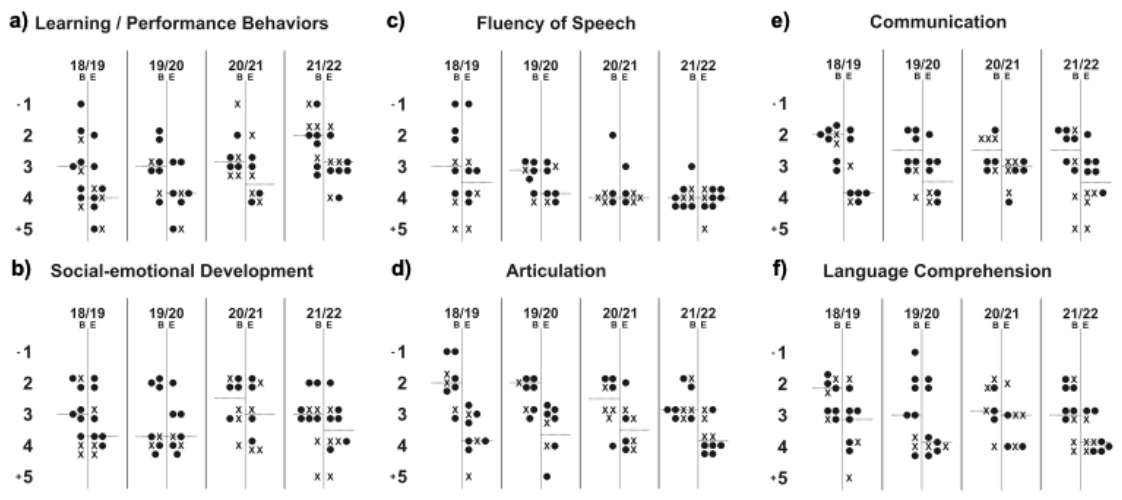
Figure 2.
Support recommendations after leaving Speech-Language-Therapy Preschool (Kindergarten); Boys: 0; Girls: X.
Figure 2.
Support recommendations after leaving Speech-Language-Therapy Preschool (Kindergarten); Boys: 0; Girls: X.
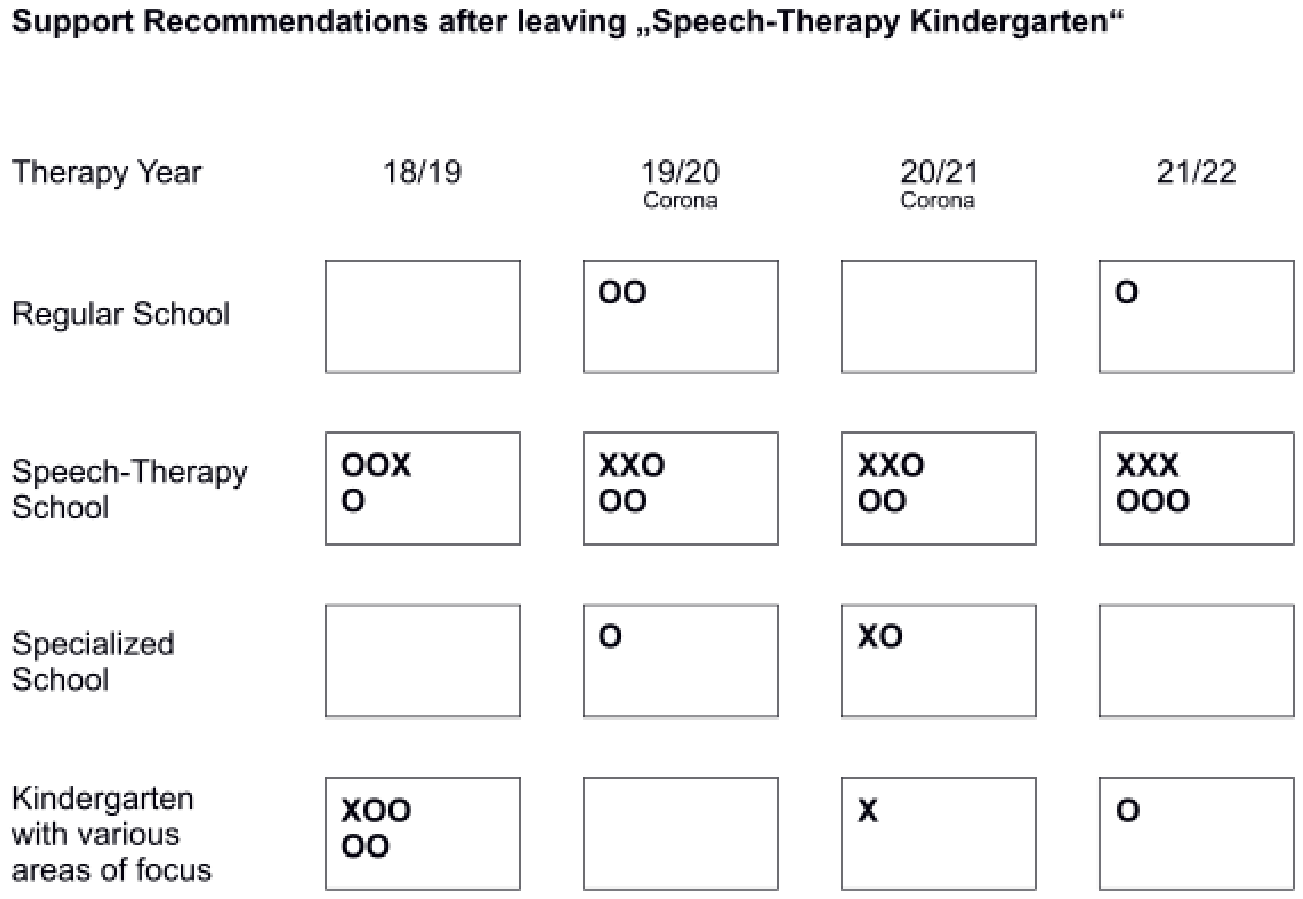
Table 1.
Differences of various skills (domains) in the groups from year 18/19 up to year 21/22 at the beginning of therapy (calculated by Kruskal-Wallis-test).
Table 1.
Differences of various skills (domains) in the groups from year 18/19 up to year 21/22 at the beginning of therapy (calculated by Kruskal-Wallis-test).
| Year | 18/ 19 | 19/20 20/21 Corona pandemic |
21/22 | |
| Skills | ||||
| Learning/ Performance |
No significant differences | |||
| Communication | No significant differences | |||
| Fluency of Speech | No significant differences | |||
| Social-emotional development | No significant differences | |||
| Language Comprehension | No significant differences | |||
| Articulation | No significant differences | |||
Table 2.
a -d: Characterization of children in the different study groups: a: Therapy year 18/19; b: Therapy year 19/20; c: Therapy year 20/21; d: Therapy year: 21/22.
Table 2.
a -d: Characterization of children in the different study groups: a: Therapy year 18/19; b: Therapy year 19/20; c: Therapy year 20/21; d: Therapy year: 21/22.
| Table 2a: | |||||
| Therapy year 18/19 | |||||
| Child | Gender | Age (years/months) |
Number of siblings | Duration of therapy (months) |
IQ |
| A1 | m | 5 /10 | 1 | 20 | 88 |
| A2 | m | 5/10 | 4 | 12 | 86 |
| A3 | m | 5/3 | 1 | 13 | 115 |
| A4 | f | 5/1 | 1 | 13 | 97 |
| A5 | m | 4/6 | 4 | 9 | |
| A6 | m | 6/1 | 2 | 5 | 97 |
| A7 | f | 5/10 | 0 | 6 | 94 |
| A8 | m | 5/10 | 3 | 16 | 87 |
| A9 | m | 5/10 | 1 | 13 | 91 |
| N=9 | m/f= 7/2 | Median: 5/10 | Median: 1 | Median: 13 | Median: 93 |
| Table 2b: | |||||
| Therapy year 19/20 (coronavirus measures) | |||||
| Child | Gender | Age (years/months) |
Number of siblings | Duration of therapy (months) |
IQ |
| B1 | m | 5 /5 | 5 | 12 | 69 |
| B2 | m | 5/8 | 2 | 12 | 75 |
| B3 | m | 6/3 | 3 | 12 | 73 |
| B4 | f | 6/3 | 1 | 9 | 109 |
| B5 | m | 5/1 | 1 | 16 | 107 |
| B6 | m | 5/9 | 1 | 12 | 95 |
| B7 | f | 4/11 | 1 | 10 | 116 |
| B8 | m | 5/11 | 1 | 10 | 87 |
| N=8 | m/f= 6/2 | Median: 5/9 | Median:1 | Median: 11 | Median: 91 |
| Table 2c: | |||||
| Therapy year 20/21 (coronavirus measures) | |||||
| Child | Gender | Age (years/months) |
Number of siblings | Duration of therapy (months) |
IQ |
| C1 | f | 5 /7 | 1 | 16 | 98 |
| C2 | m | 5/2 | 1 | 7 | 108 |
| C3 | m | 6/7 | 2 | 11 | 85 |
| C4 | f | 5/11 | 8 | 13 | 101 |
| C5 | f | 5/7 | 0 | 11 | 80 |
| C6 | f | 5/9 | 2 | 9 | 55 |
| C7 | m | 5/11 | 0 | 9 | 83 |
| C8 | m | 5/1 | 2 | 11 | 97 |
| N=8 | m/f= 4/4 | Median: 5/8 | Median: 2 | Median: 11 | Median: 91 |
| Table 2d: | |||||
| Therapy year 21/22 | |||||
| Child | Gender | Age (years/months) |
Number of siblings | Duration of therapy (months) |
IQ |
| C1 | m | 5 /11 | 0 | 12 | 80 |
| C2 | m | 5/1 | 1 | 12 | 107 |
| C3 | f | 5/8 | 3 | 11 | 95 |
| C4 | f | 5/8 | 3 | 11 | 86 |
| C5 | f | 6/3 | 1 | 11 | 111 |
| C6 | m | 5/5 | 3 | 11 | 95 |
| C7 | m | 5/11 | 1 | 11 | 81 |
| C8 | m | 5/11 | 0 | 11 | 95 |
| C9 | m | 5/0 | 3 | 11 | 120 |
| C10 | f | 5/7 | 3 | 11 | 73 |
| N=10 | m/f= 6/4 | Median: 5/8 | Median: 2 | Median: 11 | Median: 95 |
Table 3.
Comparison of the various study groups.
| Therapy year | 18/19 |
19/20 Covid-19 measures |
20 Covid-19 measures |
21 |
| Number of children | 9 | 8 | 8 | 10 |
| Gender m/f | 7/2 | 6/2 | 4/4 | 6 |
| Median age (year/month) IQR (months) |
5/10 8 months |
5/9 10 months |
5/8 9 months |
5/8 5 months |
| Median number of siblings IQR (number) |
1 2.5 |
1 2.0 |
2 2.0 |
2 2.0 |
| Median duration of therapy (months) | 13 | 11 | 11 | 11 |
| Median IQ IQR: IQ |
93 9 |
91 34 |
91 21 |
95 28 |
Table 4.
Test procedures in the Speech and Language Therapy Preschool (Kindergarten).
| Skills | Test Procedure | Validated |
| Language and Speech | SETK – 3-5 Test for language/ speech development of children 3-5 years [23] | yes |
| AWST-R – Vocabulary test for children 3-5 years[24] | yes | |
| PDSS – Patholinguistic diagnostics for speech-language-impaired children[25] | yes | |
| Cognition | Kaufmann Assessment Battery for Children II (KABC-II 2015) [26] |
yes |
| SON-R 2.5-7 – Non-verbal IQ-test for children 2.5-7 years [27] | yes | |
| Motor skills and Movement |
MOT 4-6 – Test for children 4-6 years [28] | yes |
| Development | Zollinger`s development profiles [29] | no |
Table 5.
Significant improvement of various skills (domains) within the year of treatment (calculated by Mann-Whitney-U-test).
Table 5.
Significant improvement of various skills (domains) within the year of treatment (calculated by Mann-Whitney-U-test).
| Year | 18/ 19 | 19/20 20/21 Corona pandemic |
21/22 | ||
| Skills | |||||
| Learning/ Performance |
n.s. | P < 0.05 | P < 0.05 | P < 0.05 | |
| Communication | P < 0.05 | P < 0.05 | P < 0.05 | P < 0.05 | |
| Fluency of Speech | n.s. | n.s. | n.s. | n.s. | |
| Social-emotional development | n.s. | n.s. | n.s. | n.s. | |
| Language Comprehension | P < 0.05 | n.s. | n.s. | P < 0.05 | |
| Articulation | P < 0.05 | P < 0.05 | P < 0.05 | P < 0.05 | |
Table 6.
Percentage of children with changes/improvements of various abilities/ skills during the therapy year: a: Learning and performance ability; b: Social-emotional behaviour; c: Communication behaviour; d: Language comprehension; d: Language fluency; e: Articulation.
Table 6.
Percentage of children with changes/improvements of various abilities/ skills during the therapy year: a: Learning and performance ability; b: Social-emotional behaviour; c: Communication behaviour; d: Language comprehension; d: Language fluency; e: Articulation.
| Table 6a | ||||
| Criterion: Learning and performance ability | ||||
| Number of children | n=9 | n=8 | n=8 | n=10 |
| Period (year) | 18/19 | 19 | 20 | 21/22 |
| Coronavirus measures | No | Yes | Yes | No |
| Improvement 2 points | 22 | 13 | 13 | 20 |
| Improvement 1 point | 56 | 63 | 50 | 40 |
| No change | 22 | 25 | 38 | 20 |
| Deterioration | 0 | 0 | 0 | 0 |
| Table 6b | ||||
| Criterion: Social-emotional behaviour | ||||
| Number of children | n=9 | n=8 | n=8 | n=10 |
| Period (year) | 18/19 | 19 | 20 | 21/22 |
| Coronavirus measures | No | Yes | Yes | No |
| Improvement 2 points | 0 | 0 | 0 | 0 |
| Improvement 1 point | 34 | 13 | 38 | 50 |
| No change | 66 | 88 | 63 | 50 |
| Deterioration | 0 | 0 | 0 | 0 |
| Table 6c | ||||
| Criterion: Communication behaviour | ||||
| Number of children | n=8 | n=7 | n=8 | n=10 |
| Period (year) | 18/19 | 19 | 20 | 21/22 |
| Coronavirus measures | No | Yes | Yes | No |
| Improvement 2 points | 38 | 14 | 13 | 10 |
| Improvement 1 point | 38 | 43 | 50 | 70 |
| No change | 25 | 43 | 38 | 20 |
| Deterioration | 0 | 0 | 0 | 0 |
| Table 6d | ||||
| Criterion: Language comprehension | ||||
| Number of children | n=9 | n=8 | n=8 | n=10 |
| Period (year) | 18/19 | 19 | 20 | 21/22 |
| Coronavirus measures | No | Yes | Yes | No |
| Improvement 2 points | 44 | 13 | 25 | 30 |
| Improvement 1 point | 0 | 38 | 25 | 30 |
| No change | 56 | 50 | 50 | 40 |
| Deterioration | 0 | 0 | 0 | 0 |
| Table 6e | ||||
| Criterion: Language Fluency | ||||
| Number of children | n=8 | n=7 | n=8 | n=9 |
| Period (year) | 18/19 | 19 | 20 | 21/22 |
| Coronavirus measures | No | Yes | Yes | No |
| Improvement 2 points | 0 | 0 | 0 | 0 |
| Improvement 1 point | 38 | 29 | 17 | 22 |
| No change | 63 | 71 | 83 | 78 |
| Deterioration | 0 | 0 | 0 | 0 |
| Table 6f | ||||
| Criterion: Articulation | ||||
| Number of children | n=9 | n=8 | n=8 | n=10 |
| Period (year) | 18/19 | 19 | 20 | 21/22 |
| Coronavirus measures | No | Yes | Yes | No |
| Improvement 2 points | 67 | 13 | 25 | 10 |
| Improvement 1 point | 11 | 88 | 38 | 80 |
| No change | 22 | 0% | 38% | 10 |
| Worsening | 0 | 0 | 0 | 0 |
Disclaimer/Publisher’s Note: The statements, opinions and data contained in all publications are solely those of the individual author(s) and contributor(s) and not of MDPI and/or the editor(s). MDPI and/or the editor(s) disclaim responsibility for any injury to people or property resulting from any ideas, methods, instructions or products referred to in the content. |
© 2026 by the authors. Licensee MDPI, Basel, Switzerland. This article is an open access article distributed under the terms and conditions of the Creative Commons Attribution (CC BY) license (http://creativecommons.org/licenses/by/4.0/).
Copyright: This open access article is published under a Creative Commons CC BY 4.0 license, which permit the free download, distribution, and reuse, provided that the author and preprint are cited in any reuse.