

Submitted:
28 August 2026
Posted:
31 August 2026
You are already at the latest version
Abstract
Population aging is a defining demographic transformation in Latin America, but its subnational spatial dynamics remain insufficiently understood. This study examines how population aging becomes spatially differentiated during an advanced stage of demographic transition, using the Maule Region of Chile as a case study between 1992 and 2024. We conducted a longitudinal ecological analysis using official Population and Housing Census data from 1992, 2002, 2017, and 2024 at provincial and commune levels. The Aging Index, defined as the number of people aged 65 years and over per 100 people younger than 15 years, was used as the main demographic indicator. To assess demographic acceleration and territorial differentiation, we calculated absolute change, multiplication indices, average annual growth rates, and intercensal growth rates. Spatial dependence was evaluated using Global Moran’s I and Local Indicators of Spatial Association based on a first-order queen contiguity matrix, with robustness checks using alternative spatial weights. Territorial inequality was assessed through dispersion measures, the Gini coefficient, and β-convergence analysis. Sex-specific Aging Indices, old-age and youth dependency ratios, and the share of the oldest-old population were also examined. By 2024, the Maule Region reached an Aging Index of 83.9, exceeding the national value of 79.0. Aging levels were highest in Cauquenes and in predominantly rural communes such as Curepto, Vichuquén, Hualañé, and Licantén. Intercensal growth rates increased over successive periods, indicating acceleration of population aging. Spatial clustering intensified, with Global Moran’s I increasing from 0.188 in 1992 to 0.298 in 2024, and significant High-High clusters emerging in coastal dryland communes. Territorial dispersion widened, while β-convergence was not statistically significant, indicating persistent local divergence rather than convergence toward similar aging profiles. Aging was consistently higher among women, old-age dependency exceeded youth dependency in nine communes, and the oldest-old represented more than one-quarter of older adults in the most aged territories. These findings show that subnational population aging may combine regional demographic aging with local divergence, spatial concentration, and territorial inequality. Integrating demographic and spatial indicators can support comparative population studies and geographically targeted planning for rapidly aging regions in Latin America and comparable contexts.
Keywords:
population aging
; aging index
; spatial analysis
; demographic transition
1. Introduction
Population aging is commonly understood as a national demographic transition driven by fertility decline and increasing longevity (Gianfredi et al., 2025). However, from a population studies perspective, this transition is mediated by the spatial distribution of demographic components. Local differences in fertility, mortality, migration, rurality, and socioeconomic opportunity can produce divergent age structures within the same national or regional population (Rontos, K., 2025). Therefore, subnational aging should be examined not only as a change in the proportion of older adults, but also as a process of demographic differentiation across local populations (Zhang et al., 2022).
Chile is undergoing one of the most rapid demographic transitions in Latin America, driven by sustained increases in life expectancy and persistently low fertility rates that have remained below replacement level (Mardones et al., 2025). Life expectancy at birth increased from 70.6 years in 1990 to 81.1 years in 2024, while the total fertility rate declined from 2.58 births per woman to a historic low of 1.16 in 2023 (Instituto Nacional de Estadísticas, 2022). Consequently, the proportion of the population aged 65 years and over has more than doubled, increasing from 6.6% in 1992 to 14% nationally in 2024. Official projections indicate that by 2050, individuals aged 60 years and older will account for approximately 30% of Chile’s total population and more than one-third of the population in the Maule Region (Instituto Nacional de Estadísticas, 2022). This demographic transition poses substantial challenges for healthcare systems, regional development, social protection, and territorial planning (Rojas et al., 2022).
Population aging is a multidimensional process with profound demographic, social, and economic implications. As the proportion of older adults increases, healthcare systems face growing demand for chronic disease management, long-term care, and age-friendly environments, while local governments are required to adapt infrastructure and public services to changing demographic needs (Fernández-Ortiz & Peñaloza-Quintero, 2025). However, these impacts are not distributed uniformly across territories. Differences in fertility, mortality, migration, socioeconomic conditions, and access to health and social resources generate heterogeneous demographic trajectories, producing areas that age much more rapidly than others (Kim et al., 2021; Maestas et al., 2016; Tang et al., 2022). Consequently, understanding the territorial dimension of population aging has become increasingly important for evidence-based planning and the design of policies tailored to rapidly aging populations.
Territorial differences in population aging are increasingly recognized as a major challenge for regional development. Variations in demographic dynamics reshape local economic structures, modify demand for infrastructure and public services, and intensify pressure on healthcare systems (Maestas et al., 2016; Tang et al., 2022). Importantly, these trajectories are not independent across space. Territories experiencing faster aging frequently form geographically contiguous areas rather than isolated cases, while differences between rapidly and slowly aging territories may widen or narrow over time. A comprehensive understanding of demographic aging therefore requires not only describing changes in aging levels, but also examining their pace, spatial concentration, and territorial inequality.
These processes are particularly evident in the Maule Region, one of Chile’s most rural regions and among those experiencing the fastest demographic aging. According to the 2024 Population Census, the regional Aging Index (AI) reached 83.9, exceeding the national value of 79.0. The combination of sustained fertility decline, increasing longevity, high rurality, and continued outmigration of younger populations has accelerated demographic aging and amplified territorial disparities among provinces and communes (Observatorio del Envejecimiento, n.d.). Despite the importance of these demographic transformations, their spatial evolution within the region remains insufficiently documented.
Most previous studies have described temporal changes in population aging at national or regional scales, whereas considerably less attention has been given to how aging evolves across local territories, whether its pace accelerates over time, whether territorial inequalities widen, and whether spatial clustering emerges as demographic transitions progress. Addressing these questions is essential because population aging is not only a demographic phenomenon but also a territorial process whose consequences depend on where and how rapidly it occurs. While the Aging Index is widely used to quantify demographic aging and population replacement (Rojas et al., 2022), analyses based solely on this indicator provide limited insight into the spatial organization and territorial dynamics of the aging process.
To address this gap, this study combines conventional demographic indicators with complementary measures of demographic change and spatial analysis. In addition to the Aging Index, we evaluate the pace of aging through intercensal growth rates, characterize territorial inequality using dispersion and convergence analyses, and assess spatial dependence using global and local measures of spatial autocorrelation. This integrated framework allows us to examine not only whether population aging has intensified, but also whether it has become increasingly spatially concentrated and territorially unequal.
Accordingly, the objective of this study was to examine how population aging becomes spatially differentiated during an advanced stage of demographic transition, using the Maule Region of Chile as a case study between 1992 and 2024. Specifically, we aimed to (i) describe the evolution of the Aging Index across provinces and communes; (ii) determine whether the pace of aging accelerated across successive intercensal periods; (iii) assess whether local populations converged toward similar aging profiles or whether territorial inequalities widened over time through dispersion and β-convergence analyses; (iv) identify whether population aging became spatially clustered using global and local measures of spatial autocorrelation; and (v) characterize the demographic structure of the older population according to sex, dependency ratios, and the oldest-old population. By integrating demographic, territorial, and spatial analyses, this study provides a comprehensive assessment of population aging as a differentiated territorial process and contributes to population studies by showing how rapid demographic transition may produce spatial concentration, local divergence, and unequal aging trajectories within the same regional population.
2. Methods
Study Area and Study Design
This ecological longitudinal study examined the evolution of population aging in the Maule Region, Chile, between 1992 and 2024 using official census data at both the provincial and municipal levels. The Maule Region, located in central Chile, comprises four provinces and 30 communes distributed across approximately 30,296 km², representing nearly 4% of the national territory. It is the most rural region in the country, with approximately one-third of its population living in rural areas, and includes five major geographical zones: coastal plains, coastal range, central valley, foothills, and the Andes Mountains. The regional capital is Talca (Figure 1).
The study adopted a quantitative ecological design with a temporal trend approach based on secondary data obtained from the Regional Directorate of the National Institute of Statistics (INE). This design enabled the evaluation of long-term demographic changes and territorial differences in population aging over a 32-year period using standardized census information.
The Aging Index (AI) was calculated as the number of individuals aged 65 years and older per 100 individuals younger than 15 years, according to Equation [1].
Population estimates were obtained from the Population and Housing Censuses conducted by the National Institute of Statistics in 1992, 2002, 2017, and 2024.
Data Sources
The censuses conducted in 1992, 2002, and 2017 followed a de facto methodology, whereby individuals were enumerated according to the place where they spent the night preceding the census. This approach includes a very small proportion of non-usual residents (approximately 0.02%-0.10%). In contrast, the 2024 census adopted a de jure methodology, recording individuals according to their usual place of residence.
The dataset included age, sex, and municipality of residence, which were used to calculate the Aging Index and complementary demographic indicators. The study period (1992-2024) was selected to capture long-term demographic trends while allowing the evaluation of changes associated with the recent demographic transition.
Thematic maps and graphical representations were produced using Redatam 7 and ArcGIS 10.8 to visualize the spatial evolution of population aging across the Maule Region.
The Aging Index and Complementary Demographic Indicators
The Aging Index (AI) was used as the primary indicator of demographic aging because it provides a standardized measure of the relationship between the older (≥65 years) and young (<15 years) populations, facilitating comparisons across territories and over time (Rojas et al., 2022).
To complement the AI and characterize different dimensions of demographic change, three whole-period indicators were calculated:
- -
- Absolute Change (Δ): difference between the AI values observed in 1992 and 2024, representing the overall magnitude of demographic aging during the study period.
- -
- Multiplication Index (MI): ratio between the AI in 2024 and 1992, expressing how many times the index increased over the 32-year period (Equation [2]).
- -
- Average Annual Growth Rate (AAGR): compound annual growth rate of the AI between 1992 and 2024, calculated using the standard compound growth Equation [3].
These indicators provide complementary perspectives on demographic aging. Absolute change quantifies the magnitude of aging, the multiplication index facilitates comparisons among territories with different baseline demographic structures, and the AAGR summarizes the average annual intensity of demographic change (Lutz et al., 2008; Preston et al., 2002; United Nations Department of Economic and Social Affairs Population Division, 2017). Their combined use offers a more comprehensive assessment than any single indicator alone and follows established approaches in longitudinal demographic research (Reher et al., 2007).
Because these whole-period indicators are mathematically determined by the initial (1992) and final (2024) AI values, they cannot by themselves demonstrate whether the aging process accelerated over time. Therefore, compound annual growth rates were additionally calculated for each intercensal interval (1992-2002, 2002-2017, and 2017-2024). Comparing these subperiod-specific growth rates allowed us to directly evaluate changes in the pace of demographic aging throughout the study period.
Spatial Autocorrelation and Inequality Analysis
Spatial dependence in the commune-level Aging Index was evaluated for each census year using the global Moran’s I statistic (Moran, 1950), while local spatial clusters were identified using the Local Indicators of Spatial Association (LISA) proposed by Anselin (1995). Spatial relationships were defined using a first-order queen contiguity matrix based on the official commune boundaries provided by the Biblioteca del Congreso Nacional de Chile (BCN). The spatial weights matrix was row-standardized and applied consistently across all census years because no communes were created or subdivided in the Maule Region during the study period.
The statistical significance of Global Moran’s I was assessed using standardized z-scores under the randomization assumption. Local spatial clusters were identified using 999 random permutations, and statistical significance was adjusted using the Benjamini-Hochberg false discovery rate (FDR) procedure to account for multiple comparisons (Benjamini & Hochberg, 1995). To evaluate the robustness of the results, additional analyses were performed using rook contiguity and k-nearest-neighbour spatial weight matrices.
Territorial inequality was examined through two complementary approaches. First, σ-convergence was assessed by evaluating temporal changes in the dispersion of commune-level AI values using the standard deviation, coefficient of variation, range, and Gini coefficient. Increasing dispersion over time was interpreted as evidence of territorial divergence. Second, β-convergence was evaluated by regressing the annualized logarithmic growth rate of the AI between 1992 and 2024 against the logarithm of the initial AI value in 1992 (Barro & Sala-i-Martin, 1992). A statistically significant negative regression coefficient would indicate that initially younger communes experienced faster relative aging, suggesting convergence in demographic aging trajectories.
Sex Composition and Dependency Structure
Using age- and sex-disaggregated data from the 2024 Population Census, additional demographic indicators were calculated to characterize the internal structure of the older population. These included sex-specific Aging Indices, the female-male difference in the AI, the old-age dependency ratio (population aged ≥65 years divided by the population aged 15–64 years), the youth dependency ratio (population aged <15 years divided by the population aged 15-64 years), and the proportion of the oldest-old population (individuals aged ≥80 years) among adults aged 65 years and older.
These complementary indicators provide additional insight into the demographic composition of aging across communes and help identify territories where demographic dependency and care needs are likely to be greatest.
Statistical Analysis and Data Availability
Descriptive statistics, demographic indicators, dispersion measures, and β-convergence analyses were performed using IBM SPSS Statistics version 23. Global Moran’s I and Local Indicators of Spatial Association (LISA), including the false discovery rate correction, were computed using the Spatial Statistics toolbox in ArcGIS 10.8 with the queen contiguity spatial weights matrix described above. Choropleth maps illustrating the spatial evolution of the Aging Index were also produced in ArcGIS 10.8.
The data supporting the findings of this study are available from the corresponding author upon reasonable request.
3. Results
The results are presented progressively to evaluate the study hypothesis that population aging in the Maule Region has become increasingly accelerated, spatially concentrated, and territorially unequal. We first describe temporal changes in the Aging Index (AI) at the provincial and municipal levels, followed by analyses of spatial autocorrelation, territorial inequality, and the demographic structure of the older population.
Provincial Trends in the Aging Index
Table 1 summarizes the evolution of the AI across the four provinces of the Maule Region between 1992 and 2024. Population aging increased substantially in every province throughout the study period, confirming a sustained demographic transition across the region.
By 2024, Cauquenes recorded the highest AI (108.2), followed by Linares (88.9), Curicó (83.3), and Talca (77.7). Although all provinces experienced marked increases over the 32-year period, the provincial ranking remained unchanged, indicating persistent territorial differences in demographic aging. The regional AI increased from 22.5 in 1992 to 83.9 in 2024, exceeding the national value (79.0) and confirming that the demographic transition has progressed more rapidly in the Maule Region than in Chile overall.
Whole-period indicators consistently reflected the magnitude of this demographic change. Absolute increases ranged from 56.9 AI points in Talca to 75.7 points in Cauquenes, while the AI more than tripled in every province during the study period. Average annual growth rates between 1992 and 2024 varied from 3.83% in Cauquenes to 4.32% in Linares, indicating sustained demographic growth throughout the region.
However, the subperiod analyses provide the strongest evidence that population aging accelerated over time. Regional annual growth rates increased from 3.29% during 1992-2002 to 4.51% during 2002-2017 and 4.83% during 2017-2024. This progressive increase was observed in all four provinces, with Curicó and Linares exhibiting the highest recent growth rates. Because the whole-period indicators are mathematically derived from the initial and final AI values, these intercensal growth rates provide the direct evidence that the pace of demographic aging intensified over successive census periods.
Compared with national trends, the Maule Region consistently exhibited faster demographic aging. While Chile as a whole experienced a 3.54-fold increase in the AI between 1992 and 2024, the provinces of Linares and Curicó approached fourfold increases, and Cauquenes maintained the highest aging levels throughout the study period. These findings indicate that territorial disparities are not limited to differences in AI levels but also involve differences in the pace at which demographic aging is occurring.
Figure 2 illustrates these temporal trajectories. Although all provinces followed a similar upward pattern, the separation among provincial curves persisted throughout the study period, with Cauquenes consistently remaining the oldest province and Talca the youngest. The steepening of the curves after 2002 visually reinforces the acceleration identified through the intercensal growth rates.
Communal Patterns and Territorial Disparities
Marked territorial heterogeneity emerged at the municipal level (Table 2 and Figure 3). Although all 30 communes experienced substantial increases in the Aging Index between 1992 and 2024, both the magnitude and pace of demographic aging varied considerably across the region.
In 2024, the highest AI values were observed in predominantly rural communes, particularly Curepto (184.0), Vichuquén (137.4), Hualañé (126.7), Licantén (117.8), Pelluhue (114.7), and Chanco and Pencahue (111.3). These values greatly exceeded both the regional and national averages, reflecting advanced demographic aging in territories characterized by high rurality and sustained population loss among younger age groups. Curepto exhibited the most pronounced demographic aging, with an AI more than twice the regional average.
By contrast, substantially lower AI values were recorded in communes such as Maule (37.4), Constitución (73.3), Curicó (74.0), and Romeral (75.9). Maule remained the youngest commune in the region, a pattern that likely reflects continued urban expansion and the settlement of younger households in peri-urban areas surrounding the regional capital.
Urban communes also experienced substantial demographic aging despite maintaining comparatively younger age structures. The AI increased from 20.4 to 84.3 in Talca, from 20.0 to 74.0 in Curicó, and from 21.6 to 85.8 in Linares, indicating that demographic aging has become widespread throughout the region regardless of the degree of urbanization. Nevertheless, rural communes consistently exhibited higher AI values, suggesting that population aging has progressed more rapidly outside the principal urban centres.
The temporal evolution shown in Figure 3 reveals that territorial differences became increasingly pronounced over successive census years. While relatively moderate contrasts were observed in 1992, a clear spatial gradient had emerged by 2017 and became even more evident in 2024, with the highest AI values concentrated in the coastal and interior rural communes and lower values predominating in the central valley and peri-urban communes.
Overall, these findings demonstrate that demographic aging has affected every commune in the Maule Region but has progressed unevenly across territories. Rather than converging toward similar demographic profiles, communes followed distinct aging trajectories, resulting in increasingly differentiated territorial patterns. This growing heterogeneity provides the basis for the subsequent spatial autocorrelation and territorial inequality analyses, which evaluate whether these differences have become geographically structured over time.
Spatial Structure and Its Intensification
Beyond differences in AI levels among communes, the spatial distribution of population aging became progressively more structured over time (Table 4). Global Moran’s I increased from 0.188 in 1992 (p = 0.051) to 0.298 in 2024 (p = 0.001), indicating that demographic aging evolved from an almost random spatial pattern to a significantly clustered one. This trend became statistically significant from 2017 onward and remained consistent across alternative spatial weight matrices, confirming the robustness of the observed spatial dependence.
Local Indicators of Spatial Association (LISA) further revealed that high-aging communes increasingly formed geographically contiguous clusters rather than isolated territories. After controlling for multiple comparisons using the Benjamini-Hochberg false discovery rate procedure, Hualañé and Licantén remained significant High-High clusters, identifying a coastal dryland area where highly aged communes are surrounded by neighbouring territories with similarly elevated AI values. This spatial pattern is also evident in Figure 3, where adjacent communes such as Curepto, Vichuquén, Hualañé, and Licantén collectively define the principal high-aging area of the region.
Although Curepto and Vichuquén recorded the highest AI values in the Maule Region, they did not retain statistical significance after false discovery rate correction. This result most likely reflects the relatively small number of spatial units and the demographic characteristics of neighbouring communes rather than the absence of a genuine territorial concentration of aging.
Together, these findings indicate that population aging has become increasingly spatially organized, with contiguous rural territories exhibiting markedly higher aging levels than the rest of the region.
Sex Composition and Dependency Structure
The 2024 Population Census also revealed important differences in the demographic composition of the older population (Table 3). Across the Maule Region, aging was consistently more advanced among women, with an average female-male AI difference of approximately 10 points. The largest disparities were observed in urban communes, including Talca (+29.5) and Linares (+26.9), whereas a small number of rural communes, such as Licantén (-9.1), exhibited slightly higher AI values among men.
Dependency indicators further highlighted the demographic consequences of this transition. In nine communes (Curepto, Pencahue, Río Claro, Cauquenes, Chanco, Pelluhue, Hualañé, Licantén, and Vichuquén) the old-age dependency ratio exceeded the youth dependency ratio, indicating that older adults now outnumber children relative to the working-age population. This demographic crossover reflects an advanced stage of population aging and suggests increasing pressure on healthcare systems, long-term care services, and local social support networks.
The oldest-old population (≥80 years) also represented a substantial proportion of older residents. In communes such as Curepto and Cauquenes, individuals aged 80 years and over accounted for approximately 27% of the population aged 65 years and older, highlighting the concentration of the oldest and potentially most care-dependent population groups within the region.
Territorial Inequality and Convergence
The increasing spatial concentration of aging was accompanied by growing territorial inequality (Table 4). Dispersion measures demonstrated a clear widening of differences among communes over time. The range of AI values increased from 18.5 points in 1992 to 146.6 points in 2024, while the standard deviation rose almost fivefold during the study period. Likewise, the coefficient of variation increased after 2002, indicating that differences among communes became progressively larger rather than converging.
β-convergence analysis provided little evidence that younger communes were catching up with older ones. Although the regression coefficient was negative (β = -0.984), the association was not statistically significant (p = 0.135), suggesting only a weak tendency for initially younger communes to age more rapidly in relative terms. This limited convergence was insufficient to offset the widening absolute differences observed across the region.
Taken together, these findings demonstrate that demographic aging in the Maule Region has evolved simultaneously along three complementary dimensions. First, the pace of aging has accelerated over successive intercensal periods. Second, aging has become increasingly spatially concentrated, giving rise to statistically significant clusters of highly aged communes. Third, territorial disparities have widened rather than diminished, indicating that demographic aging has progressed unevenly across communes. These three dimensions collectively characterize population aging as an increasingly differentiated territorial process rather than a uniform regional demographic transition.
4. Discussion
This study examined the spatial and temporal evolution of population aging in the Maule Region between 1992 and 2024 using an integrated demographic and spatial analytical framework. The findings demonstrate that population aging is not only increasing across the region but is also accelerating, becoming progressively more spatially concentrated, and generating growing territorial inequalities. Together, these results indicate that demographic aging should be understood as a territorial process rather than solely as a demographic transition. By combining conventional demographic indicators with spatial analytical methods, this study provides a more comprehensive characterization of the territorial dynamics of aging than approaches based exclusively on temporal changes in the Aging Index.
A first major finding is the acceleration of population aging throughout the study period. Although the Aging Index increased continuously across all provinces and communes, the analysis of successive intercensal growth rates showed that the pace of aging intensified over time rather than remaining constant. This distinction is important because conventional demographic indicators summarize changes between two points in time but cannot determine whether the underlying process itself is accelerating. By incorporating intercensal growth rates, this study demonstrates that demographic aging in the Maule Region has entered a phase of increasingly rapid expansion, extending previous descriptive analyses conducted in Chile.
These findings are consistent with the broader demographic transition observed worldwide. Population aging has become one of the defining demographic transformations of the twenty-first century, driven primarily by sustained fertility decline and increasing life expectancy (United Nations, 2019; OECD, 2021; Gianfredi et al., 2025). Although these demographic drivers are common across countries, their pace and territorial expression differ substantially according to migration dynamics, socioeconomic conditions, and regional development (Harasty & Ostermeier, 2020). In Latin America, this transition is progressing more rapidly than many health and social protection systems can adapt, raising increasing concern regarding the sustainability of healthcare, pension, and long-term care systems (CEPAL, 2024). The patterns observed in the Maule Region are consistent with these demographic processes. The sustained increase in the Aging Index across all provinces likely reflects the combined effects of declining fertility, increasing life expectancy, and continued outmigration of younger populations. Moreover, the persistence of the provincial hierarchy suggests that these demographic drivers have operated with different intensity across territories, reinforcing pre-existing spatial differences rather than reducing them. Within this context, the Maule Region illustrates how these global demographic forces are expressed unevenly across territories, with several communes already reaching aging levels comparable to those observed in much older demographic contexts.
A second important contribution of this study is the demonstration that demographic aging has become progressively structured in space. The increase in Global Moran’s I, together with the emergence of statistically significant High-High clusters identified through LISA analysis, indicates that aging is no longer randomly distributed across the region but instead concentrates within geographically contiguous territories. Similar spatial processes have recently been documented in several European regions, where demographic aging and regional development exhibit clear spatial dependence rather than evolving independently across administrative units (Krisjane et al., 2023; Nicolini & Roig, 2024). These findings reinforce the idea that territorial context is not merely the setting in which aging occurs but an active determinant of demographic change.
The coastal dryland communes identified as high-aging clusters exemplify how demographic processes interact with territorial characteristics. These communes are characterized by relatively high rurality, sustained outmigration of younger populations, and limited economic diversification, conditions that reinforce the process commonly described as aging in place (Colmenares et al., 2022; Biascioli, 2024). Comparable demographic trajectories have been reported in rural Europe and other agricultural regions, where selective migration increasingly reshapes local age structures and accelerates population aging outside metropolitan areas (Bednaříková et al., 2016; Ji et al., 2017; Cohen & Greaney, 2022). Although migration was not directly analysed in the present study, the spatial configuration of aging observed across the Maule Region is highly consistent with these demographic mechanisms.
Beyond spatial concentration, the present study demonstrates that territorial inequalities have widened over time. The progressive increase in dispersion measures, together with the absence of significant β-convergence, indicates that communes are not converging toward similar demographic profiles but instead are following increasingly differentiated aging trajectories. Consequently, demographic aging is becoming progressively concentrated within specific territories rather than uniformly distributed across the region. This finding has important implications because it suggests that future healthcare demand, long-term care needs, and social dependency will likewise become increasingly localized.
The demographic composition of the older population reinforces this interpretation. Women consistently exhibited higher Aging Index values than men across most communes, while nine communes had already reached the demographic crossover at which old-age dependency exceeds youth dependency. Furthermore, individuals aged 80 years and older represented more than one-quarter of the older population in the most aged communes, indicating a growing concentration of the oldest and potentially most care-dependent population groups. Similar patterns have been described throughout Latin America, where women experience greater longevity but also higher levels of functional dependency and long-term care needs (Aranco et al., 2022). Likewise, Rivero-Cantillano and Spijker (2016) have argued that increasing longevity challenges traditional definitions of old age, whereas Minoldo and Peláez (2017) highlighted the importance of considering demographic dependency beyond chronological age alone. Albala (2020) further emphasized that although Chile has the highest life expectancy in South America, important inequalities remain in healthy aging and disability-free life expectancy, underscoring that longer survival does not necessarily imply healthier aging.
The territorial implications of these demographic changes extend beyond age structure alone. International evidence consistently shows that the consequences of aging depend strongly on access to healthcare, long-term care services, transportation, social cohesion, and the characteristics of the built environment (Burnette et al., 2021; Zhang et al., 2019; Zhang et al., 2020; Cabañero-García et al., 2025). Recent studies conducted in Chile further demonstrate that urban accessibility, neighborhood characteristics, and the spatial distribution of services influence frailty, nutritional status, and other health outcomes among older adults (Mena et al., 2025; Ormazábal et al., 2025). Consequently, interpreting demographic aging solely through population indicators provides only a partial understanding of the challenges faced by aging territories. Integrating demographic information with spatial and health-related indicators offers a more comprehensive basis for territorial planning and public policy.
From a policy perspective, the findings suggest that uniform regional strategies are unlikely to adequately address the heterogeneous geography of demographic aging. Communes where old-age dependency has already surpassed youth dependency will require earlier expansion of primary healthcare, geriatric services, long-term care, transportation systems, and age-friendly infrastructure than younger territories. Incorporating spatial demographic evidence into regional planning could therefore improve resource allocation and support more efficient and equitable responses to future population aging.
This study highlights the value of integrating complementary demographic indicators with established spatial analytical techniques to provide a more comprehensive assessment of territorial aging. While the Aging Index remains one of the most widely used measures of demographic aging (Rojas et al., 2022), the combined use of intercensal growth rates, dispersion metrics, convergence analysis, and spatial autocorrelation provides a more comprehensive understanding of how demographic aging evolves across territories. This analytical framework may be applicable to other regions experiencing rapid demographic transitions and facilitate comparative territorial analyses both within Chile and internationally.
These findings highlight the importance of incorporating territorial perspectives into demographic research and regional planning in rapidly aging societies.
5. Conclusions
These findings show that subnational population aging may involve simultaneous regional aging and local demographic divergence. Although all communes moved toward older age structures, they did so at different speeds and from different baseline conditions, producing increasingly differentiated local population profiles. By integrating demographic indicators with spatial analytical techniques, this study shows that population aging is not a uniform demographic transition, but a spatially differentiated process marked by acceleration, spatial concentration, and territorial inequality.
The identification of high-aging clusters, widening disparities among communes, and territories where old-age dependency has surpassed youth dependency highlights the need to incorporate spatial and territorial perspectives into demographic analysis and regional planning. These findings suggest that future demand for healthcare, long-term care, transportation, age-friendly infrastructure, and social support will become increasingly concentrated in specific rural territories, requiring differentiated rather than uniform policy responses.
Methodologically, this study supports the use of combined demographic and spatial approaches to assess population aging in regions undergoing rapid demographic transition. Future research should integrate demographic trends with migration, socioeconomic conditions, health status, functional capacity, and access to services to better understand how aging interacts with territorial inequalities and to support equitable, age-friendly planning.
Limitations of the Study
This study has several limitations. First, it relied on secondary census data, and differences between the de facto (1992, 2002, and 2017) and de jure (2024) census methodologies may have introduced minor inconsistencies in the comparability of population estimates across census rounds. Second, the ecological design based on aggregated commune-level data precludes individual-level inference and causal interpretation of the observed associations. Third, because the spatial analyses were conducted using commune-level administrative units, the findings are subject to the Modifiable Areal Unit Problem (MAUP), whereby measures of spatial autocorrelation and territorial inequality may vary according to the spatial scale or zoning system adopted (Openshaw, 1984; Fotheringham & Wong, 1991). Finally, the relatively small number of spatial units (30 communes) limited the statistical power of local cluster detection, although the consistency of the results across alternative spatial weighting schemes supports the robustness of the overall findings.
Funding
This research received no external funding.
Ethics Approval
This study was based exclusively on secondary analysis of publicly available, aggregated data from the National Institute of Statistics of Chile. Therefore, according to local institutional requirements, ethics committee approval and informed consent were not required.
Data and Code Availability Statement
The data used in this study were obtained from the Population and Housing Censuses conducted by the National Institute of Statistics of Chile for the years 1992, 2002, 2017, and 2024. Aggregated demographic data are available from the National Institute of Statistics of Chile. The derived indicators and spatial analysis files supporting the findings of this study are available from the corresponding author upon reasonable request.
Acknowledgments
We thank the National Institute of Statistics (INE), Maule Regional Directorate, specifically Héctor Becerra, Pedro Rojas, Ma. Paula Salazar and Francisco Díaz for facilitating our access to census data and technical support, essential for the development of this study.
Use of Generative AI
During the preparation of this manuscript, the authors used ChatGPT, based on GPT-5.5 Thinking, as a language-support tool to assist with English editing, refinement of academic wording, and improvement of clarity and coherence. The tool was not used to generate original data, conduct statistical analyses, create results, or draw scientific conclusions. All AI-assisted text was critically reviewed, edited, and approved by the authors, who take full responsibility for the accuracy, integrity, and final content of the manuscript.
References
- Albala, C. (2020). El envejecimiento de la población chilena y los desafíos para la salud y el bienestar de las personas mayores. Revista Médica Clínica Las Condes, 31(1), 7–12. [CrossRef]
- Anselin, L. (1995). Local Indicators of Spatial Association—LISA. Geographical Analysis, 27(2), 93–115. [CrossRef]
- Aranco, N., Ibarrarán, P., & Stampini, M. (2022). Prevalencia de la dependencia funcional entre las personas mayores en 26 países de América Latina y el Caribe. [CrossRef]
- Barro, R. J., & Sala-i-Martin, X. (1992). Convergence. Journal of Political Economy, 100(2), 223–251. [CrossRef]
- Bednaříková, Z., Bavorová, M., & Ponkina, E. V. (2016). Migration motivation of agriculturally educated rural youth: The case of Russian Siberia. Journal of Rural Studies, 45, 99–111. [CrossRef]
- Benjamini, Y., & Hochberg, Y. (1995). Controlling the false discovery rate: A practical and powerful approach to multiple testing. Journal of the Royal Statistical Society: Series B, 57(1), 289–300. [CrossRef]
- Biascioli, A. (2024). Demographic change in cities Trends, challenges and insights from G7 economies OECD Regional Development Papers. www.oecd.org.
- Burnette, D., Ye, X., Cheng, Z., & Ruan, H. (2021). Living alone, social cohesion, and quality of life among older adults in rural and urban China: A conditional process analysis. International Psychogeriatrics, 33(5), 469–479. [CrossRef]
- Cabañero-Garcia, E., Martinez-Lacoba, R., Pardo-Garcia, I., & Amo-Saus, E. (2025). Barriers to health, social and long-term care access among older adults: a systematic review of reviews. International Journal for Equity in Health, 24(1), 72. [CrossRef]
- CEPAL. (2024). Anuario Estadístico de América Latina y El Caribe 2024 / Statistical Yearbook for Latin America and The Caribbean 2024. Retrieved September 1, 2025. Available online: https://bit.ly/m/CEPAL.
- Cohen, S. A., & Greaney, M. L. (2022). Aging in Rural Communities. Current Epidemiology Reports, 10(1), 1. [CrossRef]
- Colmenares, N., Abarca, K., Colmenares, N., & Abarca, K. (2022). La migración a nivel local en Chile. Desafíos, demandas y políticas en tiempos de pandemia*. Si Somos Americanos, 22(1), 164–192. [CrossRef]
- Fernández-Ortiz, Y. N., & Peñaloza-Quintero, R. E. (2025). Social health inequalities in healthy ageing, Colombia 2018. Discover Social Science and Health, 5(1). [CrossRef]
- Fotheringham, A. S., & Wong, D. W. S. (1991). The Modifiable Areal Unit Problem in Multivariate Statistical Analysis. Environment and Planning A, 23(7), 1025–1044. [CrossRef]
- Gianfredi, V., Nucci, D., Pennisi, F., Maggi, S., Veronese, N., & Soysal, P. (2025). Aging, longevity, and healthy aging: the public health approach. Aging Clinical and Experimental Research, 37(1), 125. [CrossRef]
- Harasty, C., & Ostermeier, M. (2020). Population ageing: Alternative measures of dependency and implications for the future of work. International Labour Organization, (5), 53. Available online: https://www.ilo.org/publications/population-ageing-alternative-measures-dependency-and-implications-future-1.
- Instituto Nacional de Estadísticas. (2022, September). Cerca de un tercio de la población de Chile en 2050 estaría compuesta por personas mayores. Available online: https://www.ine.gob.cl/prensa/2022/09/27/cerca-de-un-tercio-de-la-poblaci%C3%B3n-de-chile-en-2050-estar%C3%ADa-compuesta-por-personas-mayores.
- Ji, Y., Hu, X., Zhu, J., & Zhong, F. (2017). Demographic change and its impact on farmers’ field production decisions. China Economic Review, 43, 64–71. [CrossRef]
- Kim, Y., Schneider, T., Faß, E., & Lochbaum, M. (2021). Personal social capital and self-rated health among middle-aged and older adults: a cross-sectional study exploring the roles of leisure-time physical activity and socioeconomic status. BMC Public Health, 21(1), 48. [CrossRef]
- Krisjane, Z., Berzins, M., Krumins, J., Apsite-Berina, E., & Balode, S. (2023). Uneven geographies: ageing and population dynamics in Latvia. Regional Science Policy & Practice, 15(4), 893–909. [CrossRef]
- Lutz, W., Sanderson, W., & Scherbov, S. (2008). The coming acceleration of global population ageing. Nature, 451(7179), 716–719. [CrossRef]
- Maestas, N., Mullen, K. J., & Powell, D. (2016). The Effect of Population Aging on Economic Growth, the Labor Force and Productivity.
- Mardones, F., Caulier-Cisterna, R., & Donoso, M. (2025). The demographic transition in Chile. MOJ Public Health, Volume 14(Issue 2), 196–198. [CrossRef]
- Mena, C., Ormazabal, Y., Molina, N., Fuentes, E., Cantillana, J. C., Villalobos, V., Sandoval, M., Palomo, I., & Arauna, D. (2025). Urban Quality and Health in Older Adults: A Cross-Sectional Geospatial Analysis of Frailty, Nutrition Status, and Biochemical/Hematological Parameters (Preprint). JMIR Aging. [CrossRef]
- Minoldo, M. S. T., & Peláez, E. (2017). Retos del envejecimiento para la protección social de la vejez. Reflexiones desde Latinoamérica. Papeles de Poblacion, 23(93), 9–58. [CrossRef]
- Moran, P. A. P. (1950). Notes on continuous stochastic phenomena. Biometrika, 37(1/2), 17–23. [CrossRef]
- Nicolini, R., & Roig, J. L. (2024). The spatial dimension of ageing and growth in European regions. Annals of Regional Science, 73(4), 1649–1679. [CrossRef]
- Observatorio del envejecimiento. (n.d.). Retrieved June 29, 2025. Available online: https://observatorioenvejecimiento.uc.cl/paginas-categorias/reportes/.
- OECD. (2021). Perspectivas económicas de América Latina 2021. OECD Publishing. [CrossRef]
- Openshaw, S. (1984). The Modifiable Areal Unit Problem. Concepts and Techniques in Modern Geography 38. Geo Books, Norwich, UK.
- Ormazábal, Y., Arauna, D., Cantillana, J. C., Palomo, I., Fuentes, E., & Mena, C. (2025). Unveiling the Frailty Spatial Patterns Among Chilean Older Persons by Exploring Sociodemographic and Urbanistic Influences Based on Geographic Information Systems: Cross-Sectional Study. JMIR Aging, 8. [CrossRef]
- Preston, S. H., Heuveline, Patrick., & Guillot, Michel. (2002). Demography: measuring and modeling population processes. 291.
- Reher, D. S., Dyson, T., Somoza, J., Livi Bacci, M., Newson, L., Pérez-Brignoli, H., Pérez Moreda, V., & González-Quiñones, F. (2007). Towards long-term population decline: a discussion of relevant issues. European Journal of Population / Revue Européenne de Démographie 2007 23:2, 23(2), 189–207. [CrossRef]
- Rivero-Cantillano, R., & Spijker, J. (2016). Del rejuvenecimiento al envejecimiento de la población ¿o viceversa?: Chile en el contexto de América Latina, 1950-2050. Notas de Población, 42(101), 127–155. [CrossRef]
- Rojas, F. H., Rodríguez, L., Julibeth, C., & León, R. (2022). Documentos de trabajo: Envejecimiento en Chile. Evolución, características de las personas mayores y desafíos demográficos para la población.
- Rontos, K. Demographic Trends and Regional Development. Economies 2025, 13, 349. [CrossRef]
- Tang, B., Li, Z., Hu, S., & Xiong, J. (2022). Economic Implications of Health Care Burden for Elderly Population. Inquiry (United States), 59. [CrossRef]
- United Nations. (2019). World Population Prospects 2019: Highlights|Naciones Unidas. Retrieved September 1, 2025. Available online: https://www.un.org/es/desa/world-population-prospects-2019-highlights.
- United Nations. Department of Economic and Social Affairs Population Division. (2017). World population ageing, 2017: highlights. United Nations, 1–124. Available online: https://digitallibrary.un.org/record/3799351.
- Zhang, L., Zeng, Y., Wang, L., & Fang, Y. (2020). Urban–rural differences in long-term care service status and needs among home-based elderly people in China. International Journal of Environmental Research and Public Health, 17(5). [CrossRef]
- Zhang, T., Liu, C., & Ni, Z. (2019). Association of access to healthcare with self-assessed health and quality of life among old adults with chronic disease in china: Urban versus rural populations. International Journal of Environmental Research and Public Health, 16(14). [CrossRef]
- Zhang, K.; Sun, H.; Li, X. Aging Population Spatial Distribution Discrepancy and Impacting Factor. Sustainability 2022, 14, 9528. [CrossRef]
Figure 1.
Geographical location and administrative division of the Maule Region.
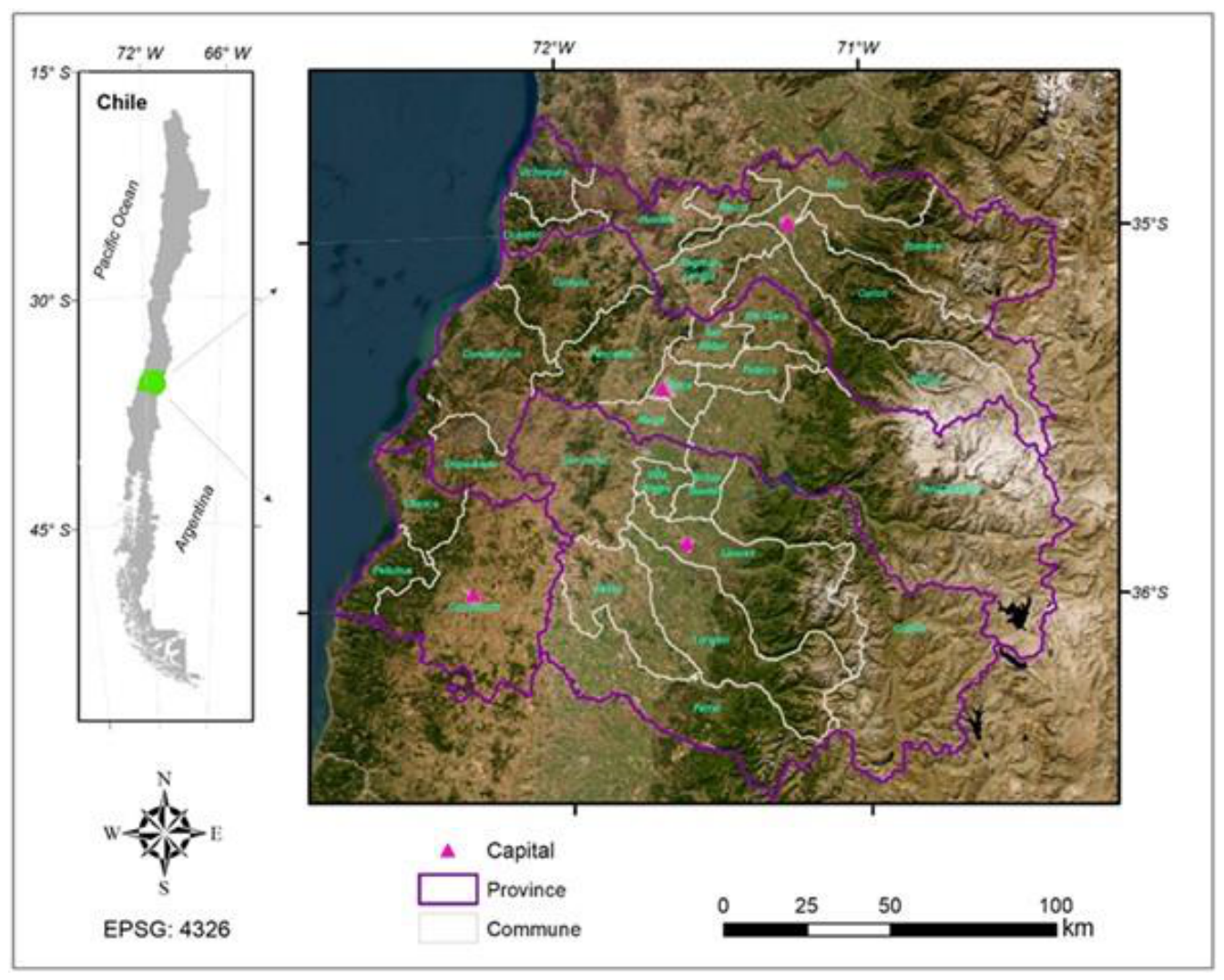
Figure 2.
Trend in the AI across the provinces of the Maule Region (1992-2024).
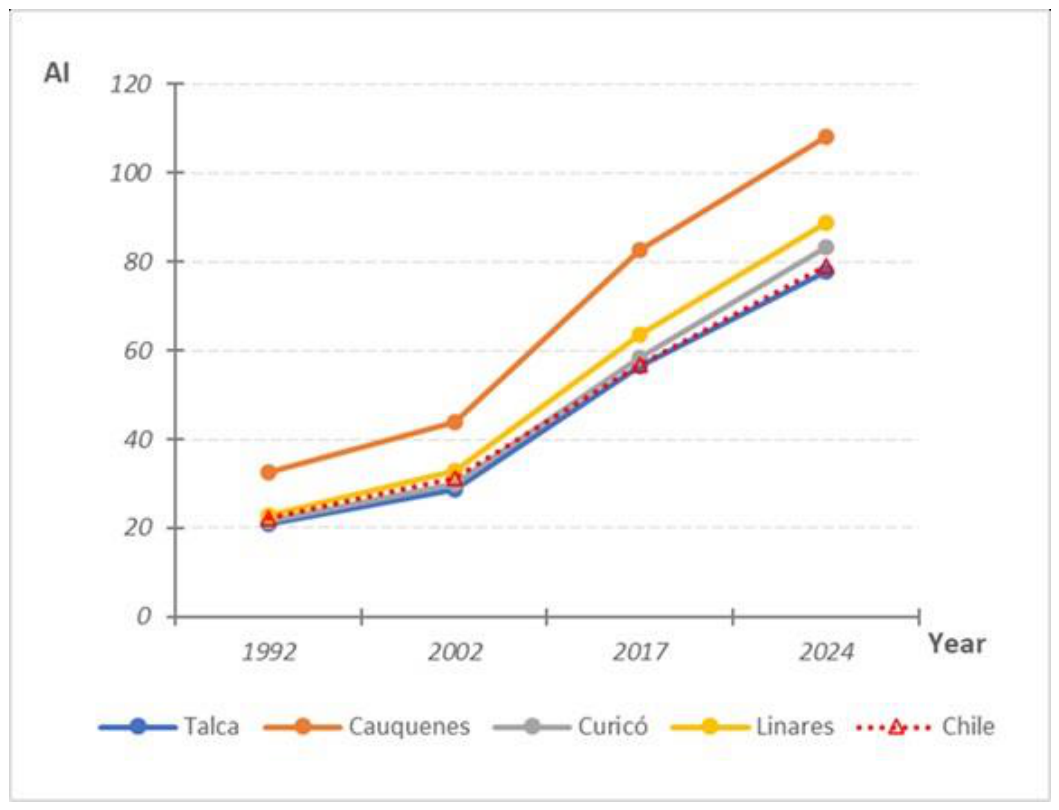
Figure 3.
Evolution of the AI in the communes of the Maule region across four census years (1992-2024).
Figure 3.
Evolution of the AI in the communes of the Maule region across four census years (1992-2024).
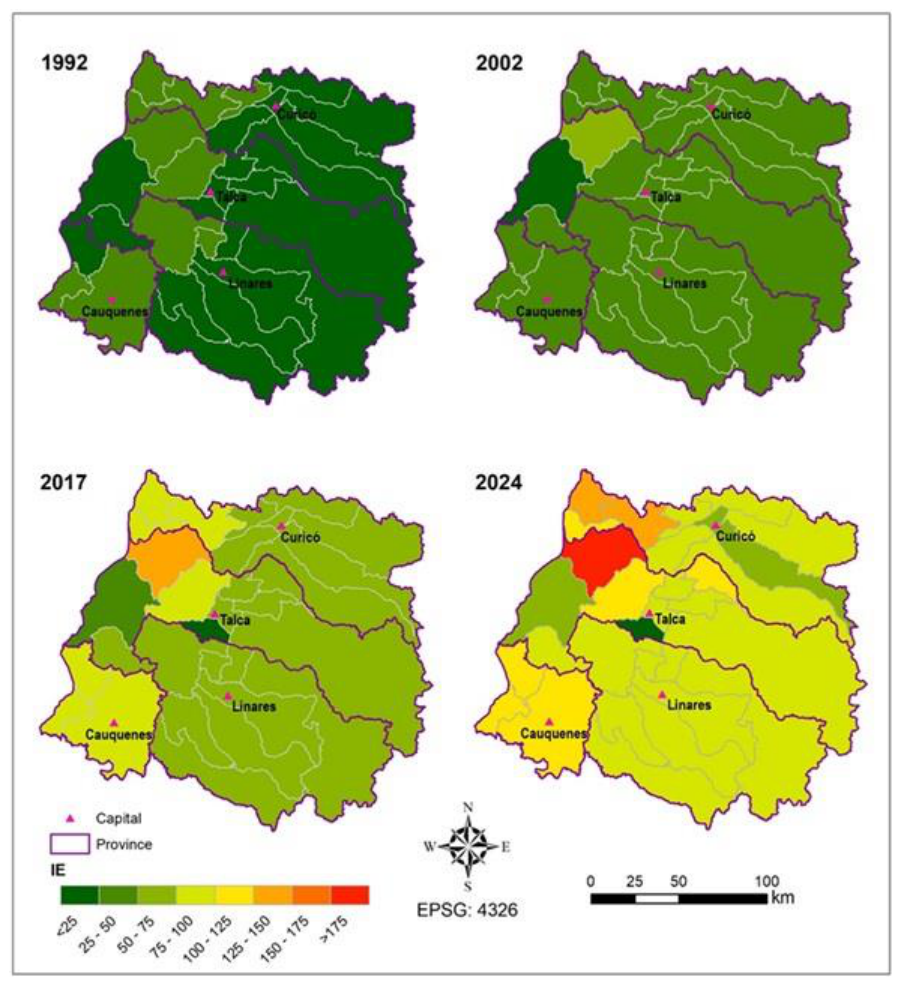

Table 1.
Evolution of AI in provinces of the Maule Region (1992-2024).
| Province | 1992 | 2002 | 2017 | 2024 | Δ | MI | AAGR 92–24 |
AAGR 92–02 |
AAGR 02–17 |
AAGR 17–24 |
|---|---|---|---|---|---|---|---|---|---|---|
| Talca | 20.8 | 28.6 | 56.4 | 77.7 | 56.9 | 3.74 | 4.20 | 3.24 | 4.63 | 4.68 |
| Cauquenes | 32.5 | 43.9 | 82.6 | 108.2 | 75.7 | 3.33 | 3.83 | 3.05 | 4.30 | 3.93 |
| Curicó | 21.7 | 30.1 | 58.3 | 83.3 | 61.6 | 3.84 | 4.29 | 3.33 | 4.51 | 5.23 |
| Linares | 23.0 | 32.9 | 63.5 | 88.9 | 65.9 | 3.87 | 4.32 | 3.64 | 4.48 | 4.92 |
| Region | 22.5 | 31.1 | 60.3 | 83.9 | 61.4 | 3.73 | 4.20 | 3.29 | 4.51 | 4.83 |
| Chile | 22.3 | 31.3 | 56.9 | 79.0 | 56.7 | 3.54 | 4.03 | 3.45 | 4.06 | 4.80 |
AI = Aging Index (pop. 65+ / pop. <15 × 100); Δ = absolute change 2024-1992; MI = multiplication index (AI2024/AI1992); AAGR = compound annual growth rate; Subperiods reveal acceleration: regional AAGR rises 3.29 → 4.51 → 4.83%/yr. Source: INE Censuses 1992, 2002, 2017, 2024.
Table 2.
Aging Index by commune (1992-2024) and 2024 local spatial cluster (LISA).
| Commune | 1992 | 2002 | 2017 | 2024 | LISA 2024 |
|---|---|---|---|---|---|
| Talca | 20.4 | 28.3 | 62.3 | 84.3 | - |
| Constitución | 16.4 | 20.6 | 45.9 | 73.3 | - |
| Curepto | 32.4 | 55.5 | 132.6 | 184.0 | - |
| Empedrado | 17.1 | 28.2 | 63.0 | 89.9 | - |
| Maule | 22.6 | 28.1 | 26.1 | 37.4 | - |
| Pelarco | 20.8 | 34.7 | 74.3 | 97.3 | - |
| Pencahue | 33.7 | 43.0 | 86.8 | 111.3 | - |
| Río Claro | 19.9 | 30.3 | 68.6 | 101.5 | - |
| San Clemente | 21.5 | 29.6 | 59.3 | 81.7 | Low-Low |
| San Rafael | 23.9 | 28.5 | 57.7 | 82.1 | - |
| Cauquenes | 34.9 | 45.9 | 83.0 | 106.2 | - |
| Chanco | 25.0 | 36.9 | 80.0 | 111.3 | - |
| Pelluhue | 29.3 | 41.4 | 83.9 | 114.7 | - |
| Curicó | 20.0 | 27.5 | 52.4 | 74.0 | - |
| Hualañé | 32.2 | 41.3 | 92.0 | 126.7 | High-High* |
| Licantén | 30.5 | 37.4 | 80.1 | 117.8 | High-High* |
| Molina | 23.5 | 33.7 | 59.0 | 86.1 | - |
| Rauco | 26.8 | 36.4 | 69.0 | 99.1 | - |
| Romeral | 17.5 | 26.8 | 57.4 | 75.9 | - |
| Sagrada Familia | 20.8 | 31.2 | 64.8 | 95.4 | - |
| Teno | 20.7 | 28.7 | 62.0 | 93.5 | - |
| Vichuquén | 25.9 | 35.8 | 98.9 | 137.4 | - |
| Linares | 21.6 | 31.7 | 60.0 | 85.8 | - |
| Colbún | 21.9 | 31.5 | 63.9 | 90.9 | - |
| Longaví | 20.2 | 30.1 | 65.6 | 93.9 | - |
| Parral | 23.9 | 34.5 | 66.1 | 93.9 | - |
| Retiro | 21.8 | 32.9 | 69.4 | 98.1 | - |
| San Javier | 28.2 | 36.4 | 62.8 | 80.2 | - |
| Villa Alegre | 27.6 | 40.6 | 73.5 | 99.0 | - |
| Yerbas Buenas | 20.3 | 27.7 | 58.1 | 85.7 | Low-Low |
LISA = Local Indicator of Spatial Association (local Moran), queen contiguity, 999 permutations. High-High = aged commune surrounded by aged neighbours (hot spot); Low-Low = young surrounded by young; * significant after Benjamini-Hochberg FDR correction (α=0.05); unstarred = significant at raw p<0.05 only (San Clemente, Yerbas Buenas); ‘-‘ = not significant. Geometry: BCN official commune cartography.
Table 3.
Age structure of the older population by commune, Maule Region, 2024.
| Commune | AI total | AI men | AI women | Fem. gap (W-M) |
OADR | YDR | % 80+ of 65+ |
|---|---|---|---|---|---|---|---|
| Talca | 84.3 | 69.9 | 99.4 | +29.5 | 21.6 | 25.6 | 22.3 |
| Constitución | 73.3 | 69.0 | 77.9 | +8.9 | 20.9 | 28.6 | 19.2 |
| Curepto | 184.0 | 174.3 | 194.4 | +20.1 | 38.0 | 20.7 | 27.3 |
| Empedrado | 89.9 | 85.8 | 94.8 | +9.0 | 23.9 | 26.6 | 22.7 |
| Maule | 37.4 | 34.7 | 40.2 | +5.5 | 12.1 | 32.3 | 17.5 |
| Pelarco | 97.3 | 90.1 | 105.1 | +15.0 | 26.8 | 27.6 | 22.8 |
| Pencahue | 111.3 | 113.4 | 109.1 | -4.3 | 26.3 | 23.6 | 21.9 |
| Río Claro | 101.5 | 102.5 | 100.5 | -2.0 | 26.4 | 26.0 | 20.8 |
| San Clemente | 81.7 | 81.2 | 82.3 | +1.1 | 23.2 | 28.4 | 20.2 |
| San Rafael | 82.1 | 78.8 | 85.5 | +6.7 | 23.8 | 29.0 | 20.0 |
| Cauquenes | 106.2 | 94.0 | 118.2 | +24.2 | 29.4 | 27.7 | 27.3 |
| Chanco | 111.3 | 107.0 | 115.9 | +8.9 | 28.5 | 25.6 | 26.5 |
| Pelluhue | 114.7 | 106.4 | 123.1 | +16.7 | 32.0 | 27.9 | 24.9 |
| Curicó | 74.0 | 64.6 | 83.6 | +19.0 | 20.2 | 27.3 | 20.8 |
| Hualañé | 126.7 | 118.2 | 136.2 | +18.0 | 31.2 | 24.6 | 21.4 |
| Licantén | 117.8 | 122.6 | 113.5 | -9.1 | 28.6 | 24.3 | 21.4 |
| Molina | 86.1 | 77.0 | 95.8 | +18.8 | 23.3 | 27.1 | 20.2 |
| Rauco | 99.1 | 94.2 | 104.2 | +10.0 | 25.2 | 25.5 | 21.3 |
| Romeral | 75.9 | 72.7 | 79.1 | +6.4 | 20.6 | 27.2 | 20.2 |
| Sagrada Familia | 95.4 | 94.9 | 95.9 | +1.0 | 23.8 | 24.9 | 20.3 |
| Teno | 93.5 | 91.5 | 95.5 | +4.0 | 23.9 | 25.6 | 21.2 |
| Vichuquén | 137.4 | 135.4 | 139.5 | +4.1 | 31.2 | 22.7 | 22.9 |
| Linares | 85.8 | 72.6 | 99.5 | +26.9 | 23.8 | 27.8 | 21.5 |
| Colbún | 90.9 | 82.7 | 99.9 | +17.2 | 25.6 | 28.2 | 19.8 |
| Longaví | 93.9 | 94.9 | 92.9 | -2.0 | 24.9 | 26.5 | 19.7 |
| Parral | 93.9 | 85.8 | 102.3 | +16.5 | 26.4 | 28.1 | 23.4 |
| Retiro | 98.1 | 97.2 | 99.1 | +1.9 | 26.2 | 26.7 | 19.7 |
| San Javier | 80.2 | 74.8 | 85.7 | +10.9 | 23.4 | 29.1 | 22.4 |
| Villa Alegre | 99.0 | 89.1 | 109.5 | +20.4 | 27.9 | 28.2 | 22.9 |
| Yerbas Buenas | 85.7 | 84.7 | 86.7 | +2.0 | 23.6 | 27.6 | 19.1 |
AI = Aging Index; Fem. gap = AI (women) - AI (men); OADR = old-age dependency ratio (65+/15-64 ×100); YDR = youth dependency ratio (0-14/15-64 ×100); % 80+ of 65+ = oldest-old share within the older population. Demographic crossover (OADR>YDR) reached in 9 communes: Curepto, Pencahue, Río Claro, Cauquenes, Chanco, Pelluhue, Hualañé, Licantén, Vichuquén. Source: INE Census 2024 (files D1, D2).
Table 4.
Spatial autocorrelation, dispersion and convergence of the commune-level AI in the Maule Region (1992-2024).
Table 4.
Spatial autocorrelation, dispersion and convergence of the commune-level AI in the Maule Region (1992-2024).
| Census year | Moran’s I | z | p | Mean AI | SD | CV (%) | Range | Gini |
|---|---|---|---|---|---|---|---|---|
| 1992 | 0.188 | 1.95 | 0.051 | 24.0 | 5.1 | 21.0 | 18.5 | 0.115 |
| 2002 | 0.119 | 1.40 | 0.160 | 33.8 | 7.0 | 20.6 | 34.9 | 0.109 |
| 2017 | 0.229 | 2.50 | 0.012 | 69.3 | 18.6 | 26.8 | 106.5 | 0.134 |
| 2024 | 0.298 | 3.21 | 0.001 | 96.9 | 24.8 | 25.6 | 146.6 | 0.125 |
Global Moran’s I (queen, row-standardized; significance from analytic z-scores under the randomization null) rises and gains significance over time, indicating intensifying spatial clustering of aging. Dispersion metrics (SD, range) show σ-divergence across communes since 2002. Robustness (2024): Rook I=0.290 (p=0.002), KNN4 I=0.368 (p<0.001). β-convergence (annual log-growth 1992-2024 vs. log AI1992): β=-0.984 (95% CI -2.295 to +0.327; p=0.135; R²=0.078); weak, non-significant convergence in rates coexisting with divergence in levels.
Disclaimer/Publisher’s Note: The statements, opinions and data contained in all publications are solely those of the individual author(s) and contributor(s) and not of MDPI and/or the editor(s). MDPI and/or the editor(s) disclaim responsibility for any injury to people or property resulting from any ideas, methods, instructions or products referred to in the content. |
© 2026 by the authors. Licensee MDPI, Basel, Switzerland. This article is an open access article distributed under the terms and conditions of the Creative Commons Attribution (CC BY) license (http://creativecommons.org/licenses/by/4.0/).
Copyright: This open access article is published under a Creative Commons CC BY 4.0 license, which permit the free download, distribution, and reuse, provided that the author and preprint are cited in any reuse.