

Submitted:
28 August 2026
Posted:
30 August 2026
You are already at the latest version
Abstract
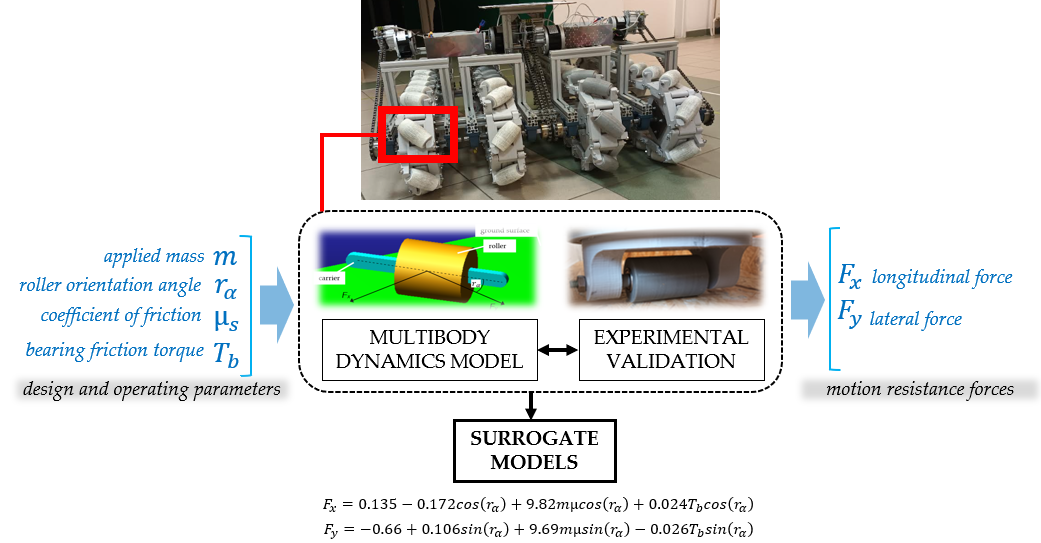
Mobile robots with omnidirectional locomotion have attracted increasing attention owing to their superior maneuverability in confined environments. Although omnidirectional wheeled robots have been widely investigated, research on omnidirectional tracked robots remains limited. One of the key challenges in the design of such systems is the computationally efficient determination of motion resistance resulting from the rollers-surface interaction. Therefore, this study aims to develop surrogate models for predicting the longitudinal and lateral motion resistance of an omnidirectional tracked roller. A multibody dynamics model of a single roller was developed to simulate the contact interaction under different roller orientation angles, applied masses, coefficients of friction, and bearing friction torque. An experimentally validated model was subsequently employed to multiple regression surrogate models relating the operating and design parameters to the motion resistance forces. The developed surrogate models achieved coefficients of determination exceeding 99%, enabling rapid prediction of both longitudinal and lateral forces while preserving high predictive accuracy. The proposed surrogate models provide a computationally efficient alternative to repeated multibody dynamics simulations and support the design of omnidirectional tracked mobile robots.
Keywords:
mobile robot
; omnidirectional tracked robot
; omni-track robot
; surrogate model
; multibody dynamics model
; motion resistance
; design
; robotics
Copyright: This open access article is published under a Creative Commons CC BY 4.0 license, which permit the free download, distribution, and reuse, provided that the author and preprint are cited in any reuse.