
Submitted:
28 August 2026
Posted:
30 August 2026
You are already at the latest version
Abstract
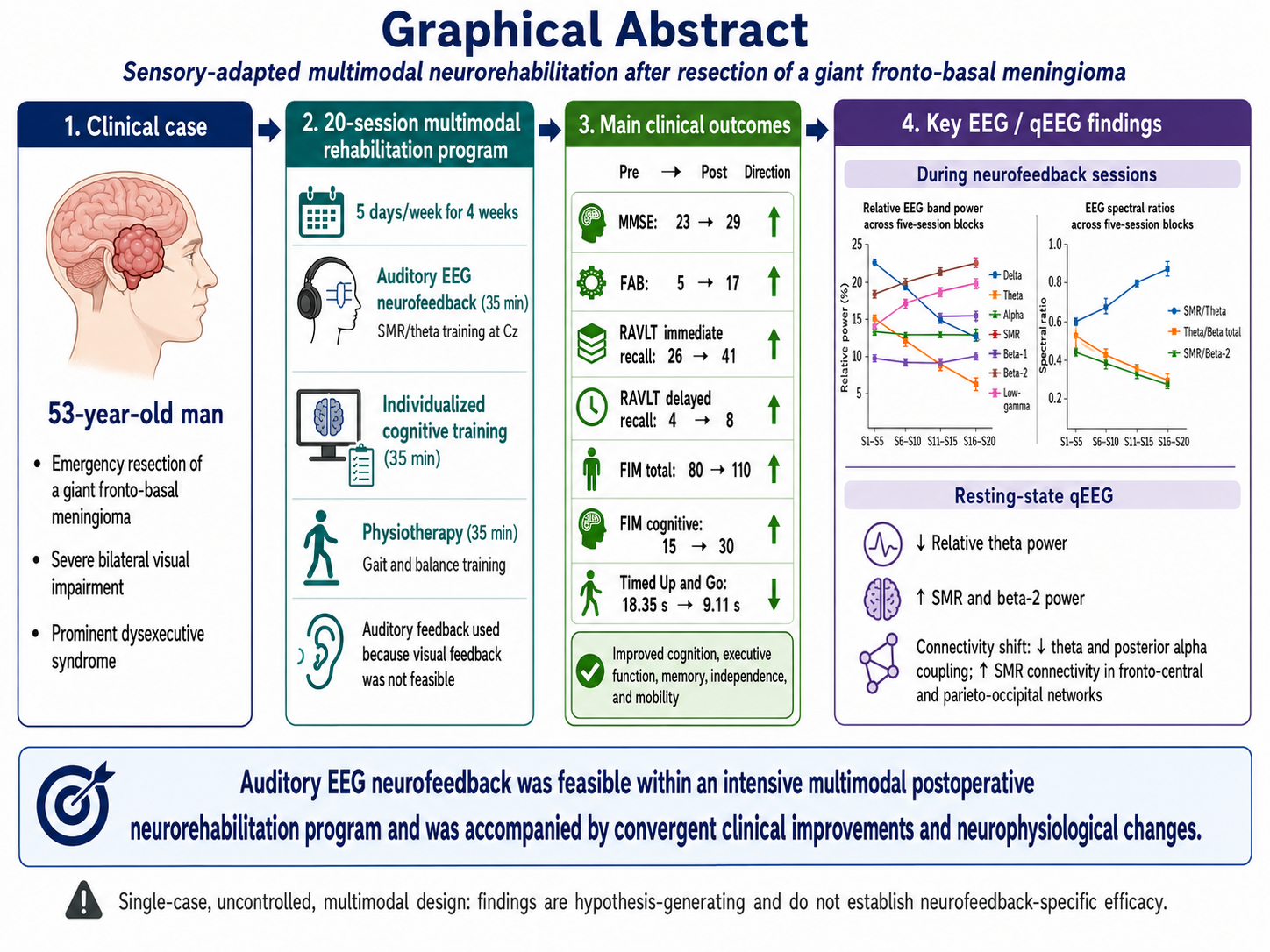
Background/Objectives: Patients undergoing resection of large fronto-basal meningiomas may present persistent cognitive, behavioral, motor, and functional impairments. Evidence regarding EEG neurofeedback as part of postoperative neurorehabilitation remains preliminary. This case report describes the feasibility and associated clinical and neurophysiological changes of a sensory-adapted multimodal rehabilitation program.
Methods: A 53-year-old man underwent emergency resection of a giant fronto-basal meningioma and subsequently completed 20 inpatient rehabilitation sessions over four weeks. Each session included auditory SMR/theta EEG neurofeedback at Cz, individualized cognitive training, and physiotherapy. Neuropsychological, emotional, functional, and mobility outcomes were assessed before and after treatment. EEG outcomes included longitudinal single-channel recordings acquired during neurofeedback sessions and 19-channel resting-state recordings obtained under eyes-open and eyes-closed conditions before and after the program. Spectral power, spectral ratios, and weighted phase-lag index connectivity were analyzed descriptively.
Results: Reliable or measurement-based improvements were observed in global cognition, executive functioning, immediate and delayed verbal recall, total and cognitive functional independence, and mobility. Across the 20 neurofeedback sessions, the conservative primary analysis retained 9,936 of 10,261 epochs and showed reduced theta activity, increased SMR and beta activity, increased SMR/theta, and reduced theta/total-beta. Resting-state EEG showed lower relative theta power and higher SMR, beta-1, and beta-2 power under both recording conditions. Connectivity changes included reduced theta and posterior alpha coupling together with increased SMR connectivity across fronto-central and parieto-occipital networks.
Conclusions: Sensory-adapted EEG neurofeedback was feasible within an intensive multimodal rehabilitation program and was accompanied by convergent cognitive, functional, and neurophysiological changes. Because of the single-case, uncontrolled, multimodal design, the findings cannot establish treatment-specific efficacy and should be considered hypothesis-generating.
Keywords:
meningioma
; neurorehabilitation
; EEG neurofeedback
; cognitive rehabilitation
; quantitative EEG
; functional connectivity
; executive dysfunction
; case report
Copyright: This open access article is published under a Creative Commons CC BY 4.0 license, which permit the free download, distribution, and reuse, provided that the author and preprint are cited in any reuse.