
Submitted:
28 August 2026
Posted:
28 August 2026
You are already at the latest version
Abstract
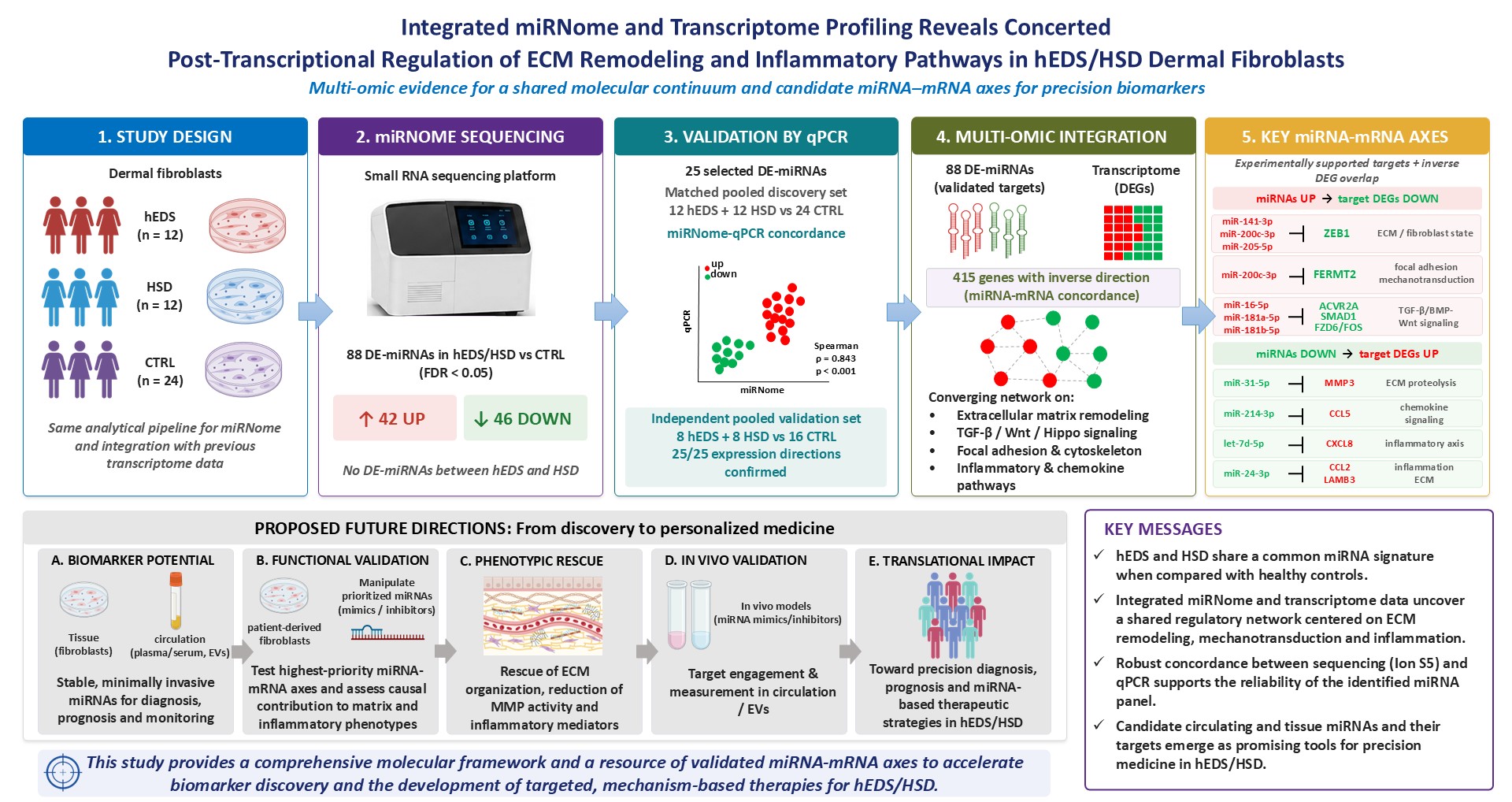
Hypermobile Ehlers–Danlos syndrome (hEDS) and hypermobility spectrum disorders (HSD) are clinically diagnosed connective tissue conditions without validated molecular biomarkers. We investigated whether miRNA-mediated post-transcriptional regulation converges between them. miRNome sequencing was performed in dermal fibroblasts from 12 hEDS, 12 HSD, and 24 control individuals, followed by qPCR assessment of 25 selected differentially expressed miRNAs (DE-miRNAs) in the discovery samples and an independent pooled fibroblast cohort, and integration with a previously generated transcriptome. No miRNA reached statistical significance in the direct hEDS-HSD comparison, whereas pooled hEDS/HSD analysis identified 88 DE-miRNAs versus controls (42 upregulated and 46 downregulated). Experimentally supported targets of the upregulated and downregulated miRNAs overlapped, in the expected inverse direction, with 388 downregulated and 27 upregulated genes, respectively. These candidate regulatory axes converged on TGF-β/BMP, Wnt/Hippo, focal-adhesion and cytoskeletal programs, and on a more focused chemokine-inflammatory module. The results define a shared fibroblast miRNA signature across hEDS and HSD, nominate miRNA-mRNA axes for mechanistic testing, and provide a rationale for future validation in individual patients, disease-relevant tissues, and circulating biofluids.
Keywords:
hypermobile Ehlers-Danlos syndrome
; hypermobility spectrum disorders
; microRNA
; miRNome
; extracellular matrix
; fibroblast
; inflammation
; multi-omics
Copyright: This open access article is published under a Creative Commons CC BY 4.0 license, which permit the free download, distribution, and reuse, provided that the author and preprint are cited in any reuse.