

Submitted:
27 August 2026
Posted:
28 August 2026
You are already at the latest version
Abstract
The objective of this study is to determine the relationship between costly prosociality toward known and unknown school peers and well-being, school aggression, and school climate in secondary school students, including the predictive capacity of costly prosociality regarding these variables. A correlational and predictive quantitative study was conducted using a sample of 529 Chilean secondary school students recruited through convenience sampling. Likert-type self-report scales were administered to measure costly prosociality, school aggression, well-being, and school climate. Correlation among the variables was measured and two predictive models of school climate were tested using structural equation modeling. Differences were found in the relationship among variables and in the predictive power of school climate, depending on the type of beneficiary who received help. In the discussion section, results are analyzed in light of the literature.
Keywords:
costly prosociality
; beneficiary familiarity
; school climate
1. Introduction
Prosociality is fundamental to people’s development, social cohesion, and the progress of societies [1]. In schools, it has been linked to reduced violence [2], increased well-being [3], and improved school climate [4], three dimensions prioritized in school policy worldwide [5]. However, less is known about how prosociality and these school variables interact when help entails major costs to the benefactor [6].
Across the multiple expressions of prosociality, the cost of help is a key factor in the decision to deploy it [7]. Despite its importance, however, more research is needed to gain a clearer understanding of its modes of expression [8]. This need is especially pressing in school settings, where students can promote violence, be passive observers, or behave prosocially to defend victims [9].
Costly prosociality is a type of help that carries major sacrifices and risks for the benefactor. Specifically, it differs from other types of prosociality due to its high cognitive, social, and material cost [10] and because of how fundamental it can be to the beneficiary [11].
Nowadays, bodies such as the Ref. [18] regard students as active agents in efforts to improve school climate and reduce school violence. In Latin America, several educational policies and school climate programs have incorporated bystanders or active observers as a way of addressing school violence. Although limited evidence is available regarding these types of interventions, the systematic review conducted by Ref. [12] shows that bullying reduction programs have been implemented in several educational institutions, strengthening social skills, peer support, and prosocial behaviors.
Precisely, high-cost prosocial behavior (HCPB) comprises actions such as defending the victims of physical violence [13] and socially including persons who have been excluded [10]. Adolescence is an especially critical stage regarding the manifestation of these behaviors. According to Ref. [8], young people can lie and/or break social norms to protect relatives, friends, and unknown people, even when this entails personal risk. It is worth noting, though, that this behavior can differ in connection with the benefactor’s developmental stage, sex, and degree of familiarity with the beneficiary [8].
The evidence presented indicates that it is necessary to gain a clearer understanding of the multiple expressions of prosociality at school, especially when it entails costs and risks for the benefactor. It is relevant to understand how HCPB interacts with school climate and school violence, as students may misinterpret the victims’ need for help and adopt controversial measures to defend them [14]. Furthermore, it is worth noting that the effect of HCPB on well-being has not been conclusively determined [15,16]. Students who engage in HCPB are more likely to intervene in order to stop school violence; thus, they actively contribute toward a positive school climate [17]. However, the constant risk and stress involved might result in burnout.
In consequence, distinguishing between costly prosociality toward known and unknown peers, considering its variation by sex and grade, constitutes a pertinent approach aimed at shedding light on its differential associations with school climate, aggression among peers, and student well-being. These variables have been reported to be essential components of school functioning [18] and are addressed in the present study.
1.1. High-Cost Prosocial Behavior
Prosociality is a behavior that consists in voluntarily helping others to solve their needs and difficulties [11]. When it entails major risks or sacrifices for the benefactor, it constitutes a high-cost prosocial behavior (HCPB), that is, a type of helping behavior associated with large resource investments, more effort, and greater cognitive, emotional, and behavioral risks/costs [10]. This manifestation of prosociality has not been extensively researched, especially in educational settings [6].
Ref. [8] identified several actions as expressions of risky prosociality, including lying, defending, losing personal benefits or reputation, and breaking rules to help someone. Similarly, Ref. [10] have linked risky prosociality with defending and including others. For example, in schools, it is exhibited by students who actively stop a fight or invite a classmate who has been rejected by their peers to join them in a school activity.
Research has shown that HCPB is a sign of greater community commitment [19], being linked to increased self-efficacy, personal growth [16,20], and moral development [19]. Ref. [21] state that adolescents must meet their social connection needs, which may cause them to seek socially gratifying but risky experiences that involve helping others. In addition, traits such as higher tolerance of uncertainty, sensation seeking, and greater concern over social reputation have been linked to higher levels of risky prosociality in young people [8].
At school, students’ interactions allow this behavior to develop, given the opportunities available for practicing various modes of coexistence with peers, which increases the complexity of prosocial behaviors [22].
Some authors have found differences in HCPB associated with age, the relationship with the beneficiary, and sex, but the available evidence is insufficient and thus inconclusive. Regarding age, Ref. [22] have specified that prosocial behavior is less prevalent in early adolescence, and that it increases with age due to a stronger need for social integration [22]. These changes are also influenced by the relationship with the beneficiary. Several studies [8,23] have suggested that, at the start of secondary education, social dominance among students is greatly important, leading to a higher frequency of risky and non-selective defense behaviors toward unknown peers; in contrast, toward the end of secondary education, the value of friendship-based relationships has been found to increase, which causes prosocial behavior to become more selective, being directed at peers closer to the benefactor.
With respect to sex, in childhood, girls tend to exhibit more prosocial behaviors aimed at comforting others, while boys engage in riskier prosocial behaviors [22]. Nevertheless, Ref. [13] assert that these disparities are due to different ways of behaving prosocially as a result of gender stereotypes, whose influence is stronger during adolescence. Thus, male adolescents feel compelled to exhibit defensive prosocial behaviors toward others [24], whereas female adolescents are driven to be kind and obliging [13].
1.2. Costly Prosociality, School Climate, and School Aggression
School climate is defined as the shared perceptions of students, teachers, and families regarding the relationships, practices, norms, and conditions that characterize the daily life of the school and the experiences of the educational community [25].
As for school violence, it is a worldwide problem that represents an urgent challenge for schools [26]. It is a broad-ranging phenomenon that encompasses multiple types of harm and victimization that take place in educational settings, including physical, psychological, and sexual violence, along with other types of aggression among members of the school community. Its manifestations include school aggression, defined as intentional behaviors of a physical, verbal, or relational nature that occur at school and which are aimed at causing harm or displeasure to others [27]. The present study covers school aggression, since it is considered to be one of the most frequent manifestations of school violence.
With respect to the relevance of school climate, it has been shown to be essential for learning and education [28], fostering safe and participatory learning contexts and influencing students’ socioemotional development [25]. By contrast, school aggression has deep and lasting negative impacts, affecting the mental health, quality of life, well-being, and academic performance of both victims and assailants [29].
Authors have stressed that, to reduce the various expressions of school violence and improve school climate, it is essential to help students to develop socioemotional skills, including problem-solving, empathy, and assertive communication [30].
In this context, prosociality is a key behavior. There is evidence that support among peers improves school climate and reduces violence [31]. For instance, Ref. [23] found that HCPB improves two fundamental dimensions of school climate: commitment to the school and perception of the school as a safe space. In addition, when students defend victims of aggression, bonds of friendship are likely to emerge between the benefactor and the beneficiary [32]. Regarding school violence, student witnesses of violence are a major factor in its development: when they back the assailants, bullying is more frequent; in contrast, when they support and defend the victims, attacks on peers are reduced [33]. This could also result in the establishment of an anti-bullying culture and increased student well-being [34], emerging as a protective factor against bullying [35]. However, HCPB within the context of school violence can also be controversial depending on whether students employ adaptive or maladaptive defensive strategies [36].
1.3. Costly Prosociality and Well-Being
Psychological well-being is defined as a person’s subjective experience of positive psychological states such as pleasure, personal realization, beneficial interpersonal relationships, personal development, and a sense of purpose and control over their life [37].
Nowadays, well-being promotion in schools has become a core objective of educational policy worldwide [38]. Well-being is not only the basis for students’ successful learning, but also one of the goals of education in this century [39].
Among the causes of well-being, the literature lists biopsychosocial factors such as adverse life events, genetic predispositions, family problems, neurobiological determinants, and school conditions [40]. Among the latter factors, it has been established that exposure to tense and violent school contexts has a negative impact on students’ mental health and psychological well-being [41].
With respect to prosocial behavior and well-being, the literature has revealed a strong link between these variables, though there is not enough evidence regarding the conditions under which a positive or negative association is produced [15,16]. There is evidence of greater life satisfaction and well-being [16] in students who engage in HCPB. Nevertheless, authors have also identified a higher prevalence of mental health issues like anxiety and depression in young people who take on the role of protecting others [42], feelings of fear and concern due to reprisals stemming from helping others, and higher rates of emotional dysregulation in students who witness violence, including those who defend victims [43]. In addition, even though empirical studies have mainly examined how school climate can improve student well-being [44], the broaden-and-build theory proposes that well-being facilitates the construction of social resources, strengthening interpersonal trust, openness, and relationship quality [45]. On an empirical level, a study by Ref. [46] shows that positive emotions lead to better social functioning and integration over time, suggesting the presence of a plausible mechanism through which well-being could foster a more favorable school climate.
Considering the above, the objective of this study is to answer the following research question: what is the relationship between HCPB toward known and unknown peers and well-being, school aggression, and school climate in secondary school students, and what is the predictive capacity of HCPB regarding these variables? The general objective of the study is to analyze this relationship and the predictive power of HCPB toward known and unknown peers regarding well-being, school aggression, and school climate in Chilean secondary school students. On a specific level, the objectives of the study are: a) to characterize HCPB levels in secondary school students, comparing by sex, grade, and type of beneficiary (known/unknown); b) to determine the statistical relationship among student HCPB toward known and unknown peers, well-being, school aggression, and school climate; and c) to generate a predictive model using structural equation modeling to analyze the impact of HCPB toward known and unknown peers on psychological well-being, school aggression, and school climate, also considering the predictive role of psychological well-being and school aggression regarding school climate.
The following hypotheses are advanced: a) HCPB differs by type of beneficiary, sex, and grade; b) HCPB toward known and unknown students is linked to the variables well-being, school aggression, and school climate; c) HCPB toward known and unknown peers explains, to a significant degree, the variability of psychological well-being, school aggression, and school climate. In addition, psychological well-being and school aggression are expected to operate as predictors of school climate, so that the effect of HCPB on the latter will be partially mediated by both constructs.
2. Materials and Method
2.1. Design
This correlational and explanatory study utilized a cross-sectional design, as the variables were not manipulated and data were collected at a single moment. A quantitative methodology was used.
2.2. Participants and Sampling
Convenience sampling -a type of non-probability sampling- was used, resulting in the inclusion of 529 secondary school students from two schools in northern Chile. Sample size was estimated with the A-priori Sample Size Calculator for Structural Equation Models developed by Ref. [47], considering six latent variables and 40 observed variables, an effect size of .20, a significance level of0.05, and a statistical power of 0.80. The calculator reported a minimum recommended sample size of 403 participants. The final sample comprised 529 students. They were 15.59 years old on average (SD = 1.26), 52% were female and 48% male, and 47% attended school 1 and 53% school 2.
2.3. Information Collection
This study is part of a Fondecyt Regular project (Nº 1250553) certified by the Research Ethics Committee (Certificado Nº 04-26) of a university located in northern Chile. The study was explained to the students and their parents. The participants were enrolled after completing informed assent and consent procedures. Information collection instruments were administered in the school facilities and during regular school hours.
- (a)
- Sociodemographic survey to collect student characterization data, including sex, age, grade, and school.
- (b)
- Multidimensional Measure of Prosocial Behavior by Ref. [13]. Within the context of the larger project to which this study belongs, the Multidimensional Measure of Prosocial Behavior by Ref. [13] was adapted for use in Chile. It is a self-report scale composed of 20 Likert items aimed at measuring various types of prosocial behavior in adolescents in the United States and Europe. It comprises five dimensions: defending, emotional support, inclusion, physical helping, and sharing. As part of the validation of this scale, a second-order model and two first-order factors of high-cost prosocial behavior were included, using the dimensions defending and inclusion [13]. Each dimension comprises four Likert-type items (Never = 1; Always = 5) that measure the help provided under conditions of school aggression and exclusion (for example, “I step in to stop fights”; “If a person is new to a group, I make an effort to include that person”). The validation of the second-order factor or costly prosociality exhibited adequate fit indicators (χ2 = 41.42, df = 17, p < 0.001, CFI = 0.996, TLI = 0.993, RMSEA = 0.052, SRMR = 0.046) and reliability levels ranging from 0.602 to 0.829 for the overall measure and its two factors. Based on the recommendations by Ref. [13], to measure HCPB by type of beneficiary –known/unknown student–, the participants were shown the 8 items from the defending and inclusion dimensions switching the beneficiary’s status: a) Condition 1, known beneficiary, “Answer thinking of school peers you know”; b) Condition 2, unknown beneficiary, “Answer thinking of school peers you DON’T know”.
- (c)
- Aggression scale [27]. This instrument was produced and validated for use in Chile by Ref. [27]. It is a self-report instrument that measures physical and verbal aggression among students through 11 Likert items and two factors: a) physical-verbal aggression and b) anger. The Chilean version by Ref. [27] exhibited adequate reliability (α = 0.86) and appropriate fit indicators (χ2 = 183.6, p < 0.001; CFI > 0.90; RMSEA = 0.08).
- (d)
- Personal Well-Being Index for Adolescents. The scale was designed by Ref. [48] and adapted and validated for use in Chile by Ref. [49]. It is a one-factor self-report scale that measures overall well-being in adolescents through 7 Likert-type items. The version developed by Ref. [49] exhibited acceptable reliability (α = 0.79) and goodness-of-fit (χ2 = 22.45, p < 0.02; CFI > 0.987; TLI = 0.976; RMSEA = 0.044).
- (e)
- School Social Climate Questionnaire. It is a self-report scale composed of 16 Likert-type items that measure secondary school students’ perception of school climate on two dimensions: faculty social climate and school social climate. It was adapted and validated for use in Chile by Ref. [50], who reported that the factor analysis performed yielded adequate values (Kaiser-Meyer = 0.91; Barlett’s test of sphericity = [χ2(91) = 4131.384; p < 0.01].
2.4. Data Analysis
The data were analyzed using the R software environment. For the first specific objective, descriptive statistics were calculated for the variables studied. To compare HCPB levels by group, the Kruskal-Wallis and Mann-Whitney U tests were used. To compare HCPB toward known and unknown peers, the Wilcoxon signed-rank test for matched samples was used. For the second specific objective, the variables studied were correlated using Spearman’s rank correlation coefficient.
Finally, for the third objective, two predictive models were tested using structural modeling. The first model evaluated the predictive capacity of HCPB toward unknown peers, while the second model examined HCPB toward known peers. The test of univariate normality yielded skewness values ranging from -1.38 to 1.76 and kurtosis values from -0.91 to 2.52, which is within the acceptable range for maximum likelihood estimation [51]. In consequence, and considering the size of the sample, maximum likelihood estimation was applied to the model. In addition, to increase the robustness of the estimations and the confidence intervals in the event of possible moderate deviations from normality, a procedure comprising 5000 resamples was implemented using bias-corrected bootstrap confidence intervals.
The next step consisted in specifying, identifying, estimating, and evaluating the structural model used to predict school climate based on HCPB, school aggression, and student well-being. Model fit was evaluated following the recommendations laid out by Ref. [51]. Several values were used as a reference, being adopted as guidelines and not as absolute cutoff points [51]: CMIN/df lower than 5, CFI and TLI higher than 0.90 (≥ 0.95 as excellent fit), RMSEA lower than0.08 (≤0.06 as excellent fit), and IFI close to one.
3. Results
3.1. Descriptive Results of the Variables Studied
Table 1 shows the descriptive statistics of the variables studied.
3.2. Costly Prosocial Behavior by Sex and Grade
Significant differences by sex were found in the overall measure of HCPB toward known students and in the dimension Inclusion toward known students, with small effect sizes and women showing higher mean ranges than men. Likewise, significant differences were observed in Inclusion toward unknown students, with a small effect size and, again, higher scores for women. No statistically significant differences were found in the Defense dimensions or in HCPB toward unknown students. Table 2 lays out these results.
In addition, the Kruskal-Wallis test was used to examine differences between different measures of HCPB depending on the participants’ grade, which revealed statistically significant disparities in overall HCPB toward known peers (H(3) =11.528, p = 0.009). Mean ranges indicate that eleventh grade students reached the highest scores (MR = 301.32), followed by those in tenth grade (MR = 266.89), twelfth grade (MR = 260.35), and ninth grade (MR = 241.96). Bonferroni-corrected post-hoc comparisons only revealed a significant difference between ninth and eleventh grade students (adjusted p = 0.006), with the latter exhibiting higher HCPB levels than the former.
Significant differences were also found in the Defense dimension of HCPB toward known peers (H(3) = 11.581, p = 0.009). Mean ranges indicated higher scores for eleventh grade students (MR = 295.74), followed by those in twelfth grade (MR = 294.83), tenth grade (MR = 266.74), and ninth grade (MR = 241.35). Bonferroni-corrected post-hoc comparisons only yielded a significant difference between ninth and eleventh grade students (adjusted p = 0.015), with the latter showing higher HCPB values than the former. The rest of the comparisons failed to reach statistical significance.
Finally, the Wilcoxon signed-rank test for matched samples was used to compare costly prosociality toward known and unknown students. The test revealed statistically significant differences between these conditions, W = 83409, Z = 10.13, p < 0.001, with a moderate effect size (r2 = 0.196). Costly prosociality toward known peers exhibited higher scores (Mdn = 3.38) than that toward unknown peers (Mdn = 3.00).
3.3. Correlation of the Variables with HCPB Toward Unknown Students
Table 3 shows that costly prosocial behavior toward unknown peers was positively associated with well-being and school climate. With respect to the association with school aggression, some smaller-magnitude negative correlations were observed.
3.4. Correlation of the Variables with HCPB Toward Known Students
HCPB toward known students exhibited positive correlations with well-being and school climate Likewise, negative associations were observed with most dimensions of school aggression and its overall measure (Table 4).
3.5. School Climate Predictive Models
Two structural equation models were evaluated to analyze the prediction of school climate upon the basis of HCPB, well-being, and school aggression. Since there is prior evidence for the structural validity and internal consistency of the school climate and school aggression scales, their dimensions were incorporated into the model as observed variables. This was done to reduce the complexity of the model and the number of parameters to be estimated, thus increasing the parsimony and stability of the estimations, given that the main objective of the study was to evaluate structural relationships among variables rather than to re-examine the models used to measure said scales [51].
Model 1 incorporated HCPB toward unknown students, while Model 2 incorporated HCPB toward known students. Both models exhibited adequate fit indicators for most estimators. The modification indices made it possible to establish correlations between the errors of items 3 and 4, yielding re-specified versions of Models 1 and 2. This was due to their similarities in terms of semantic content and the fact that both refer to the same specific situation –defending–, which may generate additional shared variance not explained by the latent factor evaluated. The re-specified models showed adequate fit indicators for all estimators. Specifically, Model 1 explained 34% of the school climate variance, whereas Model 2 explained 27%. In addition, HCPB toward unknown peers was not found to have a significant effect on school aggression (β = -.11, p = 0.073), while HCPB toward known peers exhibited a negative and significant effect on this variable (β = -.25, p < 0.05). In both models, well-being has a positive effect on school climate, whereas school aggression has a negative impact on it. Taken together, these models showed different patterns of associations between HCPB and the school variables according to the type of beneficiary. Table 5 shows these results, while Figure 1 and Figure 2 illustrate the models tested.
4. Discussion
The general objective of this study was to determine the relationship between HCPB toward known and unknown school peers and well-being, school aggression, and school climate in secondary school students, including the predictive capacity of costly prosociality regarding these variables. Overall, an association was found between these variables consistent with prior scientific evidence [2,3,4]. In addition, a novel finding is that the structural models yielded different patterns of predictive associations according to whether the beneficiary was known or unknown.
The first specific objective was to characterize HCPB levels in secondary school students, comparing them by sex, grade, and type of beneficiary (known/unknown). HCPB was hypothesized to differ by type of beneficiary, sex, and grade. With respect to sex, women exhibited higher levels of costly prosociality in some of the dimensions evaluated.
Regarding prosocial behavior in general, the literature has generally found evidence of higher levels in women, which could be partly due to different ways of manifesting prosocial behaviors and to gender stereotypes [13]. In contrast, with respect to HCPB, it has been reported that men are more likely to exhibit risky and agentive helping behaviors, while women tend to engage in caregiving and interpersonal support [6]. In line with the results of this study, Ref. [52] found more positive risky behaviors in women than in men, including dangerous prosocial behaviors. However, other researchers have found no evidence of sex-based differences [53]. In this regard, Ref. [53] acknowledge that certain specific types of risky behavior could probably manifest themselves differentially when comparing by sex.
In consequence, HCPB appears to have a complex relationship with sex. The findings of this study suggest that this association may differ as a result of the characteristics of the beneficiary, the type of HCPB, and the context where the help is rendered. The present study provides evidence of this association when the beneficiaries and known and unknown, when costly prosociality involves defending and including, and when these interactional dynamics take place in school settings.
With respect to educational level, overall HCPB and the dimension defense of known peers were found to be higher. In this regard, there is evidence that costly prosociality (e.g., defensive HCPB) increases during secondary education [22], especially toward one’s group [8], and that it gradually decreases as one approaches adulthood [10].
One possible explanation for the increase in HCPB observed in eleventh grade participants is that, during this period, students are consolidating their social bonds, which strengthens social connectedness and integration and might foster the manifestation of such behaviors [21,22]. In contrast, the start of secondary education might be a stage of exploration, progressive development of social skills, and adaptation to the educational system [54], while during the final year –twelfth grade– students’ interests are likely to be focused on new job-related or educational demands [55]. This makes it possible to hypothesize the existence of a midpoint of maximum psychosocial integration in educational trajectories, characterized by high levels of belonging, social integration, and commitment to others, which is likely to promote the manifestation of HCPB. Future studies could be conducted to test this hypothesis.
Finally, in line with the available evidence, HCPB toward known students was found to be higher than that directed at unknown peers. In this regard, Ref. [23] have noted that, as they progress in secondary education, students gradually ascribe more value to friendship bonds, which may be linked to costly prosocial behaviors toward group members. To explain this phenomenon, Ref. [8] examine the role of interpersonal closeness, empathy, and sense of belonging, which they regard as potential drivers of HCPB toward known peers. On a practical level, these results could orient educational policies aimed at promoting active student participation in violence reduction and school climate improvement initiatives, bearing in mind that it would be necessary to plan and implement specialized interventions to promote HCPB toward different types of beneficiaries.
The second objective of the study was to determine how HCPB toward known and unknown peers correlated with well-being, school aggression, and school climate. A link between these variables was hypothesized, with the analyses performed revealing a positive association between HCPB toward both known and unknown peers, well-being, and school climate. In contrast, HCPB toward known students exhibited more negative correlations with school aggression and its dimensions than HCPB directed at unknown peers.
Some authors have reported evidence similar to that presented in this article, describing positive associations between costly prosociality, school climate [31], and well-being [16]. With respect to school climate, in this study, HCPB toward both known and unknown peers was linked to the two dimensions of the instrument used: institutional climate, which measures perceived safety and positive relationships; and faculty climate, which measures the quality of the interpersonal relationships between students and teachers [50]. One possible explanation for this phenomenon is that defense and inclusion behaviors may generate positive responses in the beneficiaries such as gratitude, safety, a sense of belonging, and well-being, in addition to fostering friendship ties [32], thus generating a more positive school climate.
With respect to well-being, evidence for a link with prosociality is less consistent [15,16]. This study provides new evidence in support of a positive association with well-being, although with some differences in the size of this association depending on the type of beneficiary, as the correlation is slightly stronger when helping known peers. The limited consistency among the studies that have examined the relationship between costly prosociality and well-being may be due to the impact of mediating variables, such as students’ emotional regulation capacity when providing help and their knowledge about how to help in these contexts [56], which may be associated with greater well-being.
The link found between HCPB and school aggression is a noteworthy finding, as more negative associations were observed when costly prosociality is directed at known peers. Even though several studies that have examined general prosociality [31] and defensive prosociality [34,35] have reported a negative association with school violence, the present study suggests that the link between HCPB and school aggression may depend on the type of beneficiary.
Finally, in order to fulfill the last specific objective, two predictive models of school climate were evaluated, considering HCPB, well-being, and school aggression. These models were hypothesized to have predictive power regarding school climate, and the results showed distinct patterns of associations according to the type of beneficiary.
In the model involving unknown students, the path from HCPB to school aggression was not statistically significant, whereas it was statistically significant in the model involving known peers. Furthermore, the model involving unknown peers accounted for 34% of the variance in school climate, compared with 27% in the model involving known peers.
Regarding the above, the first aspect to consider is the role of the beneficiary. Although costly prosociality tends to benefit persons within the benefactor’s group [8], the findings presented in this article indicate that, descriptively, the model involving HCPB toward unknown peers accounted for a larger proportion of variance in school climate than the model involving HCPB toward known peers. A possible interpretation of this phenomenon is that prosocial behaviors aimed at unknown peers may have a greater potential to influence school climate because they transcend in-group relationships, extending to the school community at large. Thus, said behaviors may have a stronger effect on the collective norms of respect, support, and inclusion that configure school climate [25].
It is worth noting that, in the model involving unknown peers, the association between HCPB and school aggression was not statistically significant. This observation may be attributed to the fact that school aggression is a relational phenomenon whose meaning and dynamics depend on the existing bond between the assailant and the victim [57]. In this context, helping a known classmate could be part of a relational pattern that is less compatible with aggression toward the same peer group. In contrast, when prosocial behavior is directed at an unknown peer, said behavior could represent a one-off episode that does not necessarily reflect the student’s usual prosocial interaction pattern, which is why it does not have a continuous impact on school aggression. Future studies could focus on testing these hypotheses.
The above finding is especially relevant because the literature shows that supporting victims of school aggression is a protective factor against bullying [35]; however, the present findings suggest that this outcome may vary according to the type of beneficiary.
Another point to consider is the positive effect of HCPB on well-being. At present, the available evidence is contradictory and inconclusive regarding the relationship between these variables [15,16]. In this study, the effect of HCPB on student well-being was found to be positive, which is in line with research that has linked this type of prosociality with greater life satisfaction and well-being [16]. However, it is worth pointing out that the present study only utilized an overall measure of well-being; therefore, it is not possible to specify what type of student well-being actually increases.
The predictive models generated highlight the potential relevance of beneficiary type when examining the associations between HCPB and the school variables studied. This is an issue that educational policies on school climate and student witnesses of violence have not taken into account. Furthermore, these results suggest that the associations between HCPB and the school variables may also vary according to the relational context in which prosocial behavior occurs.
The models developed show that HCPB has a multi-level influence on the school variables studied –on an individual level, on well-being; on an interactional level, on school aggression; and on an organizational level, on school climate–, which suggests that this type of prosociality is a relevant resource for the functioning of educational communities.
The present study has a number of limitations worth pointing out. First, it only considered students attending public schools in Chile, which constrains the results presented to this type of population. Second, only two manifestations of costly prosociality were measured, which means that these results should be understood to apply only to students’ inclusion and defense behaviors. Finally, the only dimension of school violence measured was school aggression.
In conclusion, this study provides evidence that clarifies the relationship between HCPB, well-being, school aggression, and school climate. The results presented reveal significant associations between HCPB and the school variables examined, as well as predictive relationships within the structural models tested. They also constitute a warning about the need to consider the differential effect of HCPB by type of beneficiary, which may be important for educational policies that encourage students to play an active role in tackling school violence and school climate issues. Taken together, the findings suggest that costly prosociality is not only an individual student characteristic, but a social resource with the potential to improve personal well-being and school climate quality. Specifically, behaviors directed at more distant peers seem to play an especially relevant role in the construction of positive school climates, suggesting a new line of research on the role of the beneficiary of costly prosocial behavior in the functioning of educational communities.
References
- Kim, M.; Sul, S. How helping others helps us: neural mechanisms. 2026. [Google Scholar] [CrossRef]
- linking prosocial behavior to psychological and physical wellbeing. Front. Hum. Neurosci. 20 1–8. [CrossRef]
- Manzano-Sánchez, D.; Gómez-Mármol, A.; Valero-Valenzuela, A.; Jiménez-Parra, J. F. School climate and responsibility as predictors of antisocial and prosocial behaviors and violence: A study towards self-determination theory. Behav. Sci. 2021, 11(36), 1–13. [Google Scholar] [CrossRef]
- Li, L.; Khan, A.; Rameli, M. Assessing the relationship between prosocial behavior and well-being: Basic psychological need as the mediator. Eur. J. Investig. Health Psychol. Educ. 13 2023, 2179–2191. [Google Scholar] [CrossRef]
- Wang, C.; Li, B.; Zhang, L.; Liu, Y.; Xu, P. Prosocial behavior and teachers’ attitudes towards bullying on peer victimization among middle school students: Examining the cross-level moderating effect of classroom climate. Sch. Psychol. Rev. 2022, 53(5), 579–592. [Google Scholar] [CrossRef]
- Țîroiu, E.-O. Preventing and reducing violence in schools by forming prosocial behaviors. Eur. Proc. Educ. Sci. 2023, 72, 629–637. [Google Scholar] [CrossRef]
- Hammond, S.; Hill, R.; Edwards, V. Prosocial Behavior in School Contexts. In The Cambridge Handbook of Prosociality: Development, Mechanisms, Promotion; Malti, T., Davidov, M., Eds.; Cambridge University Press: Cambridge, UK, 2023; pp. 442–458. [Google Scholar]
- Wu, Q.; Song, M.; Ayoub, J.; Dunninget, D.; Tian, D.; Moradi-Pari, E. Prosocial decisions in naturalistic helping scenarios are predicted by cost-benefit tradeoffs and individual disposition. Commun. Psychol. 2026, 4(2), 1–16. [Google Scholar] [CrossRef]
- Armstrong-Carter, E.; Telzer, E. The development of prosocial risk-taking behavior: Mechanisms and opportunities. Child Dev. Perspect. 2025, 19(2), 63–71. [Google Scholar] [CrossRef]
- Bautista, G.; Vera, J.; Tánori Quintana, J. Conducta prosocial, desconexión moral y empatía en observadores en situaciones de violencia escolar [Prosocial behavior, moral disengagement, and empathy among observers in situations of school violence]. Psykhe 2024, 33(1), 1–15. [Google Scholar] [CrossRef]
- Padilla-Walker, L. M.; Memmott-Elison, M. K.; Nielson, M. G. Longitudinal change in high-cost prosocial behaviors of defending and including during the transition to adulthood. J. Youth Adolesc. 2018, 47, 1853–1865. [Google Scholar] [CrossRef]
- Binder, B.; Eid, M.; Lorenz, T. Defining prosociality: Systematic review on prosocial, altruistic, helping and proactive behaviors incorporating artificial intelligence. In The Journal of Positive Psychology; Advance online publication; 2026. [Google Scholar] [CrossRef]
- Rodas, D.; Ramírez, A.; Galarza, J. N. Programas de intervención contra el acoso escolar en Latinoamérica: Revisión sistemática [Intervention programs to combat school bullying in Latin America: A systematic review]. Av. En. Psicol. Latinoam. 2025, 43(2), 1–23. [Google Scholar] [CrossRef]
- Nielson, M. G.; Padilla-Walker, L.; Holmes, E. How do men and women help? Validation of a multidimensional measure of prosocial behavior. J. Adolesc. 2017, 56, 91–106. [Google Scholar] [CrossRef]
- Bruno, L.; Joelsson, T.; Franzén, A.; Gottzén, L. Heroes and others: Tensions and challenges in implementing mentors in violence prevention in Swedish schools. J. Gend.-Based Violence 2020, 4(2), 141–155. [Google Scholar] [CrossRef]
- Hirani, S.; Ojukwu, E.; Bandara, N. A. Understanding the role of prosocial behavior in youth mental health: Findings from a scoping review. Adolescents 2022, 2, 358–380. [Google Scholar] [CrossRef]
- Tomar, A. Prosocial behavior and wellbeing among middle-aged individuals. Int. J. Nov. Res. Dev. 2023, 8(9), 791–805. Available online: https://ijnrd.org/papers/IJNRD2309093.pdf.
- Kohen, A.; Langdon, M.; Riches, B. The making of a hero: Cultivating empathy, altruism, and heroic imagination. J. Humanist. Psychol. 2019, 59(4), 617–633. [Google Scholar] [CrossRef]
- Organización de las Naciones Unidas para la Educación; la Ciencia y la Cultura. Safe to learn and thrive: Ending violence in and through education. UNESCO. 2024. Available online: https://www.unesco.org/en/articles/safe-learn-and-thrive-ending-violence-and-through-education/ (accessed on 28 July 2026).
- Gini, G.; Pozzoli, T.; Hauser, M. Bullies have enhanced moral competence to judge relative to victims, but lack moral compassion. Personal. Individ. Differ. 2011, 50(5), 603–608. [Google Scholar] [CrossRef]
- Rosli, S. N.; Perveen, A. The relationship between prosocial behavior and psychological well-being among undergraduate students. Int. J. Acad. Res. Bus. Soc. Sci. 2021, 11(6), 276–289. [Google Scholar] [CrossRef]
- Armstrong-Carter, E.; Bibby, E.S.; Burroughs, M.; Flannery, J.E.; Nelson, B.W.; Duell, N.; Prinstein, M.J.; Telzer, E.H. Adolescents are more likely to help others on days they take risks and crave social connections. J. Res. Adolesc. 2021, 32(4), 1421–1432. [Google Scholar] [CrossRef]
- Hammond, S.; Brownell, C. Prosocial development across the lifespan. In Encyclopedia on Early Childhood Development; Tremblay, R., Boivin, M., Peters, R.D., Eds.; 2015; Available online: https://www.child-encyclopedia.com/prosocial-behaviour/according-experts/prosocial-development-across-lifespan.
- Waasdorp, T.; Fu, R.; Clary, L.; Bradshaw, C. School climate and bullying bystander responses in middle and High School. J. Appl. Dev. Psychol. 2022, 80, 1–34. [Google Scholar] [CrossRef]
- Carlo, G.; Randall, B. The development of a measure of prosocial behaviors for late adolescents. J. Youth Adolesc. 2002, 31(1), 31e44. [Google Scholar] [CrossRef]
- Castro, C.; Barata, M. C.; Alexandre, J.; Santos, R. Placing social and emotional support at the center of school climate: A scoping review of measures for middle and secondary schools. Educ. Psychol. Rev. 2026, 38(1), 10192. [Google Scholar] [CrossRef]
- Mosito, C.; Sitoyi, Z. School violence and its impact on teachers’ well-being. Perspect. Educ. 2024, 42(1), 131–147. [Google Scholar] [CrossRef]
- López, V.; Orpinas, P. Las escalas de agresión y victimización: validación y prevalencia en estudiantes chilenos [Aggression and Victimization Scales: Validation and Prevalence Among Chilean Students]. Rev. Latinoam. De Psicol. 2012, 44(2), 109–124. [Google Scholar]
- Wang, M. T.; Degol, J. L. School climate: A review of the construct, measurement, and impact on student outcomes. Educ. Psychol. Rev. 2016, 28(2), 315–352. [Google Scholar] [CrossRef]
- İlğan, A.; Üztemur, S.; Gökalp, A. Understanding peer bullying and broader school aggression from a school psychology perspective: a Social-Ecological Model based on extracurricular activities, instructional capacity, and learning contexts. Front. Psychol. 2026, 17, 1775082. [Google Scholar] [CrossRef]
- Cunha, J. M.; Amaral, H. T.; Ricci, B. N.; Roza, S. A.; Yano, V. A. N. Compreender a violência escolar: Uma revisão rápida sobre as características, fatores associados e intervenções [Understanding school violence: A brief review of characteristics, associated factors, and interventions]. Rev. Bras. De Educ. 2025, 30, e3052640. [Google Scholar] [CrossRef]
- Freeman, I.; Tellez, J.; Jones, A. Effectiveness of school violence prevention programs in elementary schools in the United States: A systematic review. Soc. Sci. 2024, 13(4), 1–19. [Google Scholar] [CrossRef]
- Monks, C. P.; Rix, K. Friendships among young children: Links with social behaviour. Early Child Dev. Care 2024, 194(11–12), 1230–1243. [Google Scholar] [CrossRef]
- Xie, H.; Ngai, S. Participant roles of peer bystanders in school bullying situations: Evidence from Wuhan, China. Child. Youth Serv. Rev. 2020, 110(2), 104762. [Google Scholar] [CrossRef]
- Willems, R.; Sapouna, M.; De Amicis, L.; et al. Encouraging positive bystander responses to bias-based bullying in primary schools through a serious game approach: A Non-randomized controlled evaluation of the ‘GATE-BULL’ Program. Int. J. Bullying Prev. 2024, 7, 566–580. [Google Scholar] [CrossRef]
- Chicote-Beato, M.; Bodoque-Osma, A. R.; Martins, F.; González-Víllora, S. Prosocial behaviour in primary and secondary school students. Effects of the CYBUPRE intervention. Br. Educ. Res. J. 2026, 00, 1–24. [Google Scholar] [CrossRef]
- Lambe, L. J.; Craig, W. M. Peer defending as a multidimensional behavior: Development and validation of the Defending Behaviors Scale. J. Sch. Psychol. 2020, 78, 38–53. [Google Scholar] [CrossRef]
- Dhanabhakyam, M.; Sarath, M. Psychological wellbeing: A systematic literature review. Int. J. Adv. Res. Sci. Commun. Technol. (IJARSCT) 2023, 3(1), 603–607. [Google Scholar] [CrossRef]
- Hossain, S.; O’Neill, S.; Strnadová, I. What constitutes student well-being: A scoping review of students’ perspectives. Child Indic. Res. 2023, 16, 447–483. [Google Scholar] [CrossRef]
- Govorova, E.; Benítez, I.; Muñiz, J. How schools affect student well-being: A cross-cultural approach in 35 OECD countries. Front. Psychol. 2020, 11, 431. [Google Scholar] [CrossRef]
- Storch, E.; Yang, R. Welcoming 2024: Supporting students’ well-being. Child. Health Care 2024, 53(2), 109–112. [Google Scholar] [CrossRef]
- Sibisi, N.; Sibisi, N.; Zandile Faith Mpofu, Z. Preventative strategies to curb school violence: A case study of selected schools in Hhohho District of Eswatini, Mbabane. Soc. Sci. 2024, 13(2), 1–18. [Google Scholar] [CrossRef]
- Greene, J.; Cohen, D.; Siskowski, C.; Toyinbo, P. The relationship between family caregiving and the mental health of emerging young adult caregivers. J. Behav. Health Serv. Res. 2017, 44, 551–563. [Google Scholar] [CrossRef]
- Fabris, M.; Longobardi, C.; Morese, R.; Marengo, D. Exploring multivariate profiles of psychological distress and empathy in early adolescent victims, bullies, and bystanders involved in cyberbullying episodes. Int. J. Environ. Res. Public Health 2022, 19(16), 1–14. [Google Scholar] [CrossRef]
- Aldridge, J. M.; McChesney, K. The relationships between school climate and adolescent mental health and wellbeing: A systematic literature review. Int. J. Educ. Res. 2018, 88, 121–145. [Google Scholar] [CrossRef]
- Fredrickson, B. L. The role of positive emotions in positive psychology: The broaden-and-build theory of positive emotions. Am. Psychol. 2001, 56(3), 218–226. [Google Scholar] [CrossRef]
- Kim, E. S.; Wilkinson, R.; Okuzono, S. S.; Chen, Y.; Shiba, K.; Cowden, R. G.; VanderWeele, T. J. Positive affect during adolescence and health and well-being in adulthood: An outcome-wide longitudinal approach. PLoS Med. 2024, 21(4), e1004365. [Google Scholar] [CrossRef]
- Soper, D.S. A-priori Sample Size Calculator for Structural Equation Models [Software]. 2026. Available online: https://www.danielsoper.com/statcalc/ (accessed on 12 July 2026).
- Cummins, R.; Eckersley, R.; Pallant, J.; Van Vugt, J.; Misajon, R. Developing a national index of subjective wellbeing: The Australian Unity Wellbeing Index. Soc. Indic. Res. 2003, 64(2), 159–190. [Google Scholar] [CrossRef]
- Alfaro, J.; Castellá, J.; Bedin, L.; Abs, D.; Casas, F.; Valdenegro, B.; et al. Adaptación del Índice de Bienestar Personal para adolescentes en lengua española y portuguesa [Adaptation of the personal well-being index for adolescents in Spanish and Portuguese]. Univ. Psychol. 2014, 13(1), 239–252. [Google Scholar]
- Guerra, C.; Castro, L.; Vargas, J. Examen psicométrico del Cuestionario de Clima Social del Centro Escolar en estudiantes chilenos [Psychometric analysis of the School Climate Questionnaire among Chilean students]. Psicothema 2011, 23(1), 140–145. [Google Scholar]
- Kline, R. Principles and Practice of Structural Equation Modeling, 5th ed.; Guilford Press: New York, NY, USA, 2023. [Google Scholar]
- Duell, N.; Steinberg, L. Differential correlates of positive and negative risk taking in adolescence. J. Youth Adolesc. 2020, 49, 1162–1178. [Google Scholar] [CrossRef]
- Duell, N.; Lansford, J. E.; Rothenberg, W. A.; Alampay, L. P.; Al-Hassan, S. M.; Bacchini, D.; Bornstein, M. H.; Chang, L.; Deater-Deckard, K.; Di Giunta, L.; Dodge, K. A.; Gurdal, S.; Junla, D.; Liu, Q.; Long, Q.; Oburu, P.; Pastorelli, C.; Skinner, A. T.; Sorbring, E.; Uribe, L.; Yotanyamaneewong; Steinberg, L. Positive risk taking across the world. J. Res. Adolesc. 2025, 35(2), 1–15. [Google Scholar] [CrossRef]
- Rose, B.; Kurz, E.; Bruns, K. E.; Wolgast, A. Social, cognitive, and motivational changes in students’ transitions to secondary school: A systematic review. Int. J. Educ. Life Transit. 2025, 5(1), 1–37. [Google Scholar] [CrossRef]
- Mata-Correas, M.; Hernández-Franco, V.; Prieto-Ursúa, M. Indecisión vocacional evolutiva y compleja en Secundaria, Bachillerato y Formación Profesional: Una revisión sistemática exploratoria [Complex, evolving vocational indecision in middle school, high school, and vocational training: An exploratory systematic review]. Educ. XX1 2025, 28(2), 257–303. [Google Scholar] [CrossRef]
- Cuadra, D.; Monárdez, M.; Espinosa, J.; Pérez, D.; Sandoval, J.; Landabur, R.; Castro, P.; Vera, A. Defending and including students with special educational needs: a qualitative study with Chilean students. Front. Psychol. 2026, 17, 1846202. [Google Scholar] [CrossRef]
- Monks, C. P. A model of peer aggression and victimization on the social spectrum: A relational perspective. Dev. Rev. 2023, 69, 101088. [Google Scholar] [CrossRef]
Figure 1.
Model 1: HCPB toward unknown peers predicting school climate. Note. the regression between HCPB and school aggression was not significant (p = 0.073). The rest of the regressions exhibited significance values ranging from0.001 to0.046. IC= institutional social climate; FC = faculty climate; ANG = anger; PVA = physical and verbal aggression.
Figure 1.
Model 1: HCPB toward unknown peers predicting school climate. Note. the regression between HCPB and school aggression was not significant (p = 0.073). The rest of the regressions exhibited significance values ranging from0.001 to0.046. IC= institutional social climate; FC = faculty climate; ANG = anger; PVA = physical and verbal aggression.
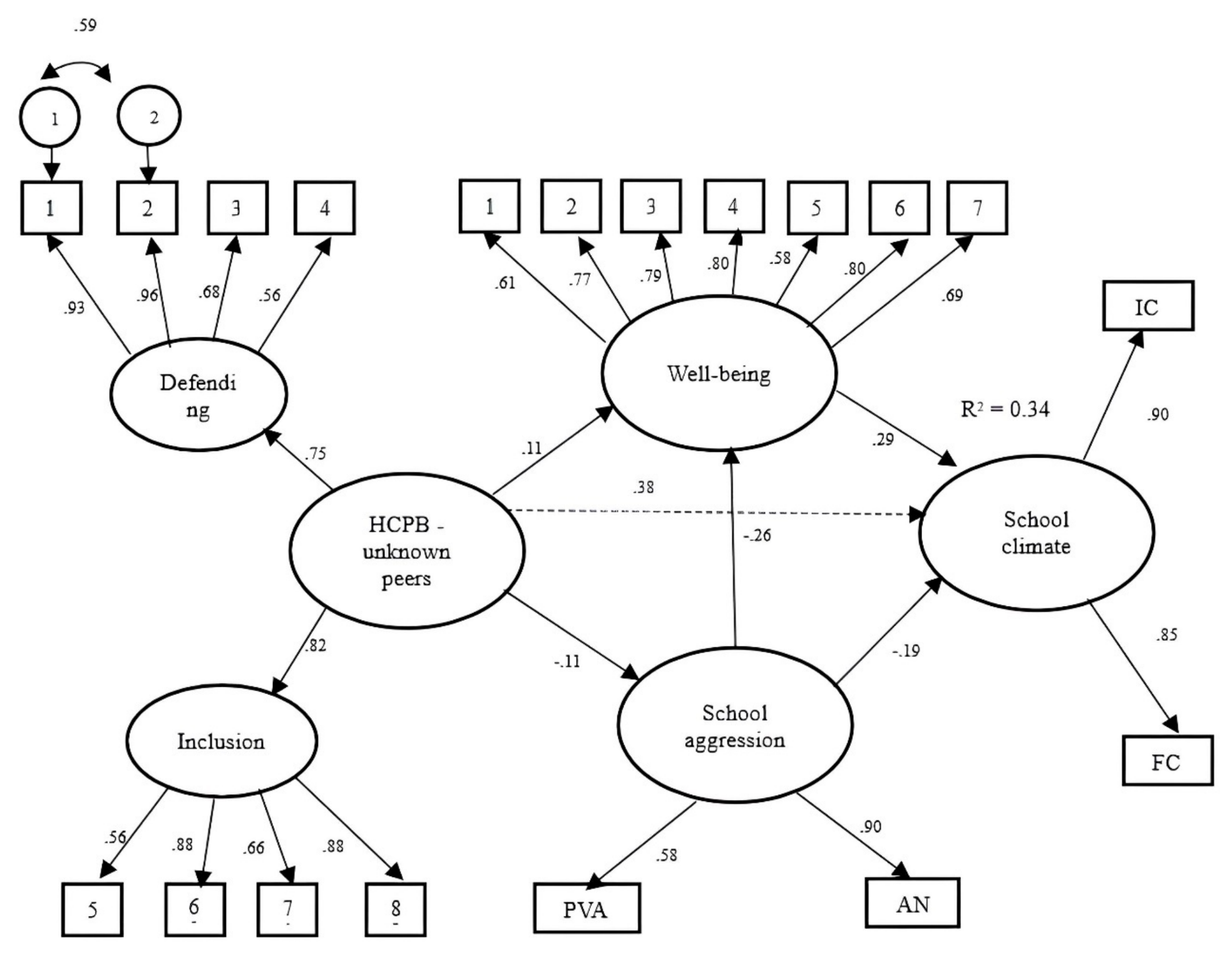
Figure 2.
Model 2: HCPB toward known peers predicting school climate. Note. All regressions were significant, with significance values ranging from0.001 to0.026.
Figure 2.
Model 2: HCPB toward known peers predicting school climate. Note. All regressions were significant, with significance values ranging from0.001 to0.026.
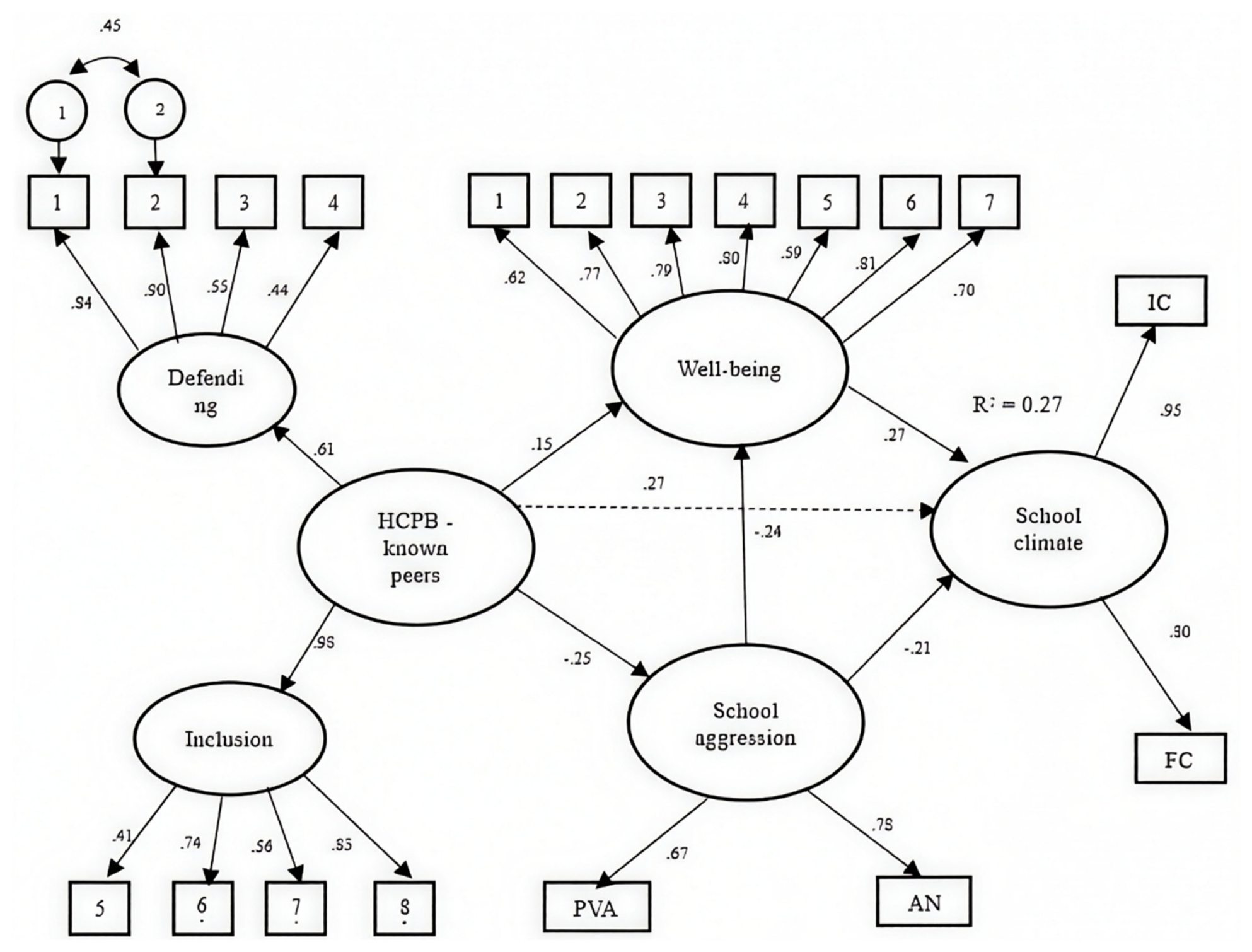

Table 1.
Descriptive statistics.
| Minimum | Maximum | Mean | SD | |
|---|---|---|---|---|
| HCPB—known peers | 1.00 | 5.00 | 3.35 | .755 |
| Defense—known peers | 1.00 | 5.00 | 2.88 | .932 |
| Inclusion—known peers | 1.00 | 5.00 | 3.81 | .859 |
| HCPB—unknown peers | 1.00 | 5.00 | 3.05 | .938 |
| Defense—unknown peers | 1.00 | 5.00 | 2.53 | 1.09 |
| Inclusion—unknown peers | 1.00 | 5.00 | 3.57 | 1.06 |
| Well-being | 1.00 | 10.0 | 7.29 | 1.99 |
| School aggression | 1.00 | 5.64 | 1.90 | 1.04 |
| Verbal-physical school aggression | 1.00 | 5.67 | 1.78 | 1.05 |
| School aggression—anger | 1.00 | 6.00 | 2.50 | 1.62 |
Table 2.
Costly prosocial behavior by sex.
| Variable | n | Mean range | U value | Z value | p value | rrb | |
|---|---|---|---|---|---|---|---|
| HCPB—known peers | 30047.0 | -2.640 | .008 | .133 | |||
| Man | 252 | 245.73 | |||||
| Woman | 275 | 280.74 | |||||
| Defense—known peers | 33944.0 | -.406 | .685 | -- | |||
| Man | 252 | 261.20 | |||||
| Woman | 275 | 266.57 | |||||
| Inclusion—known peers | 27616.0 | -4.047 | .000 | .203 | |||
| Man | 252 | 236.09 | |||||
| Woman | 275 | 289.58 | |||||
| HCPB—unknown peers | 30297.0 | -1.851 | .064 | -- | |||
| Man | 245 | 246.66 | |||||
| Woman | 273 | 271.02 | |||||
| Defense—unknown peers | 33993.0 | .171 | .864 | -- | |||
| Man | 246 | 261.68 | |||||
| Woman | 274 | 259.44 | |||||
| Inclusion—unknown peers | 28441.0 | -3.375 | .001 | .171 | |||
| Man | 251 | 239.31 | |||||
| Woman | 273 | 283.82 |
Note. rrb = rank-biserial correlation (effect size).
Table 3.
Correlation of the variables with HCPB toward unknown students.
| 2 | 3 | 4 | 5 | 6 | 7 | 8 | 9 | 10 | |
|---|---|---|---|---|---|---|---|---|---|
| 1. HCPB—unknown peers | .868** | .843** | .156** | -.073 | -.033 | -.086 | .345** | .313** | .342** |
| 2. Defense—unknown peers | 1.000 | .482** | .130** | -.004 | .075 | -.090* | .280** | .220** | .328** |
| 3. Inclusion—unknown peers | 1.000 | .131** | -.135** | -.143** | -.074 | .322** | .332** | .267** | |
| 4. Well-being | 1.000 | -.174** | -.101* | -.239** | .348** | .344** | .307** | ||
| 5. School aggression | 1.000 | .917** | .772** | -.287** | -.291** | -.208** | |||
| 6. Aggression—PV | 1.000 | .506** | -.245** | -.263** | -.156** | ||||
| 7. Anger | 1.000 | -.257** | -.238** | -.219** | |||||
| 8. School climate | 1.000 | .943** | .917** | ||||||
| 9. Institutional social climate | 1.000 | .739** | |||||||
| 10. Faculty climate | 1.000 |
Note. * significant correlation at0.05; ** significant correlation at0.01; PV = physical and verbal.
Table 4.
Correlation of the variables with HCPB toward known students.
| 2 | 3 | 4 | 5 | 6 | 7 | 8 | 9 | 10 | |
|---|---|---|---|---|---|---|---|---|---|
| 1. HCPB—known peers | .846** | .807** | .236** | -.155** | -.133** | -.141** | .302** | .306** | .256** |
| 2. Defense—known peers | 1.000 | .393** | .206** | -.055 | -.009 | -.098* | .203** | .187** | .188** |
| 3. Inclusion—known peers | 1.000 | .197** | -.211** | -.219** | -.136** | .311** | .334** | .243** | |
| 4. Well-being | 1.000 | -.174** | -.101* | -.239** | .348** | .344** | .307** | ||
| 5. School aggression | 1.000 | .917** | .772** | -.287** | -.291** | -.208** | |||
| 6. Aggression—PV | 1.000 | .506** | -.245** | -.263** | -.156** | ||||
| 7. Anger | 1.000 | -.257** | -.238** | -.219** | |||||
| 8. School climate | 1.000 | .943** | .917** | ||||||
| 9. Institutional social climate | 1.000 | .739** | |||||||
| 10. Faculty climate | 1.000 |
Note. * significant correlation at0.05; ** significant correlation at0.01; PV = physical and verbal.
Table 5.
Fit indicators of the structural models evaluated.
| Model | χ2 | df | χ2/df | p | CFI | TLI | IFI | RMSEA | IC90_inf | IC90_sup |
|---|---|---|---|---|---|---|---|---|---|---|
| Model 1: HCPB—unknown peers | 628.09 | 144 | 4.36 | <.001 | .901 | .883 | .902 | .084 | .078 | .091 |
| Model 1: HCPB—unknown peers, re-specified | 435.25 | 143 | 3.04 | <.001 | .940 | .929 | .941 | .066 | .059 | .073 |
| Model 2: HCPB—known peers | 489.365 | 144 | 3.39 | <.001 | .910 | .893 | .911 | .071 | .064 | .078 |
| Model 2: HCPB—known peers, re-specified | 387.405 | 143 | 2.71 | <.001 | .936 | .924 | .937 | .060 | .053 | .067 |
Disclaimer/Publisher’s Note: The statements, opinions and data contained in all publications are solely those of the individual author(s) and contributor(s) and not of MDPI and/or the editor(s). MDPI and/or the editor(s) disclaim responsibility for any injury to people or property resulting from any ideas, methods, instructions or products referred to in the content. |
© 2026 by the authors. Licensee MDPI, Basel, Switzerland. This article is an open access article distributed under the terms and conditions of the Creative Commons Attribution (CC BY) license (http://creativecommons.org/licenses/by/4.0/).
Copyright: This open access article is published under a Creative Commons CC BY 4.0 license, which permit the free download, distribution, and reuse, provided that the author and preprint are cited in any reuse.