

Submitted:
27 August 2026
Posted:
28 August 2026
You are already at the latest version
Abstract
The transition to occupancy-responsive building energy management is one of the most consequential and least-understood energy transitions in the commercial built environment. This systematic review traces how Occupancy Planning Management (OPM) technologies have co-evolved with organisational practices and regulatory regimes over four decades, from 1980s CAD platforms through IoT sensor networks to AI-enabled autonomous control, and examines why technical capability has repeatedly failed to translate into measurable energy performance gains. A PRISMA 2020-aligned search across six databases yielded 103 sources (72 peer-reviewed; 31 AACODS-appraised grey literature). Bibliometric analysis identifies three citation clusters: building energy performance, facility management strategy, and AI-driven occupancy prediction. Drawing on IEA EBC Annexes 53, 66, 79, and 95, the review demonstrates that occupancy-responsive HVAC control can reduce energy use substantially, but that the accuracy ceiling of demand-responsive building management is determined as much by behavioural model quality as by sensor hardware, a finding with direct implications for decarbonisation investment. An original Socio-Technical Co-Evolution Framework explains why energy transitions in OPM succeed only when technological capability, organisational paradigm, and socio-regulatory context align simultaneously, accounting for patterns that technology-centred adoption models cannot. A governance quadrant for privacy-preserving occupancy sensing, a standardised four-level occupancy lexicon, and a prioritised ten-gap research agenda complete the practical contribution.
Keywords:
occupancy planning management
; digital transformation
; socio-technical systems
; corporate real estate
; smart buildings
; artificial intelligence
1. Introduction
Occupancy Planning and Management (OPM) has become a strategic management problem at the intersection of digital transformation, corporate real estate, organisational design, and environmental performance (Wong, Ge, & He, 2018). Managers must make long-lived portfolio and technology decisions while workplace attendance, employee expectations, regulatory obligations, and data architectures change rapidly (Schwede, Davies, & Purdey, 2008). Although occupancy data can support space allocation, cost control, employee experience, and demand-responsive building operation, the managerial mechanisms that convert technical capability into organisational value remain insufficiently integrated across the literature (Chen, Jiang, & Xie, 2018).
The economic stakes are material. Corporate real estate is commonly one of the largest operating-cost categories after personnel, yet many organisations still manage space through fragmented data, inconsistent definitions, and weak links between workplace, finance, human resources, and building systems. This fragmentation is not only an operational issue. It affects capital allocation, lease strategy, sustainability performance, risk management, and the credibility of technology investment decisions (Huisman & Kort, 2002).
These challenges have intensified since the COVID-19 disruption (Newman & Ford, 2021). Hybrid work and return-to-office policies have produced volatile attendance patterns, while environmental reporting and privacy regulation have increased the value and governance burden of occupancy data. The resulting management question is not whether more advanced sensors or analytics exist, but under what organisational and regulatory conditions those technologies generate reliable, scalable, and ethically defensible value (Maity & Lee, 2025).
Against this backdrop, this systematic review pursues three objectives. First, it reconstructs the evolution of OPM systems from early CAD platforms to AI-enabled optimisation and identifies the managerial implications of each transition. Second, it develops a Socio-Technical Co-Evolution Framework explaining why adoption outcomes depend on simultaneous alignment among technological capability, organisational paradigms, and the socio-regulatory environment (Aakash, 2026). Third, it assesses the strength of the evidence supporting economic, spatial, and energy-performance claims. The guiding question is: how have OPM systems co-evolved with managerial practices and external institutions, and what conditions determine whether their deployment creates sustained organisational value? (Colenberg, Jylhä, & Arzoumanian, 2021) (Vahter & Vadi, 2024).
Occupancy Planning Management encompasses the systematic processes, technologies, and methodologies employed to allocate, monitor, and optimise the utilisation of built environments within CRE portfolios. This review applies this umbrella term to encompass Computer-Aided Facility Management (CAFM) systems, Integrated Workplace Management Systems (IWMS), space utilisation analytics platforms, IoT-based occupancy sensing infrastructure, and the AI-powered optimisation layers increasingly deployed atop these foundations (Then, 1999). The term “system” is used expansively, acknowledging that effective OPM requires not merely software but data governance, organisational processes, professional competencies, and cultural readiness (Nävy, 2013).
This research is organised as follows; Section 2 describes the methodology. Section 3 presents the five-era literature review. Section 4 introduces the Socio-Technical Co-Evolution Framework. Section 5 discusses theoretical and strategic implications, economic evidence, and the privacy-efficacy tension. Section 6 acknowledges limitations. Section 7 concludes with a prioritised research agenda.
2. Methodology
This study employs a systematic literature review approach (Sauer, 2023), combining historical analysis with thematic synthesis. This methodology is appropriate for domains where knowledge is fragmented across disciplinary silos, and where consolidating the state of knowledge serves both theoretical integration and practitioner guidance objectives (Nutt, 1999).
2.1. Search Strategy
Searches were conducted across Scopus, Web of Science Core Collection, Emerald Insight, IEEE Xplore, Elsevier ScienceDirect, and SpringerLink between September 2024 and March 2026. Supplementary searches were conducted in ResearchGate and arXiv for recent preprints on AI and occupancy sensing where peer-reviewed publication lag exceeded technological pace.
The final Boolean search string combined three concept clusters:
- Cluster A: “occupancy planning” OR “space management” OR “workplace management” OR “IWMS” OR “integrated workplace management system” OR “CAFM” OR “computer-aided facility management” OR “space utilisation”.
- Cluster B: “evolution” OR “history” OR “digital transformation” OR “PropTech” OR “facility management technology”.
- Cluster C: “CAD” OR “BIM” OR “IoT” OR “artificial intelligence” OR “machine learning” OR “sensor” OR “analytics” OR “cloud computing”.
No initial date restriction was applied to capture foundational texts; substantive emphasis was placed on sources from 2000 onwards given the study’s digital transformation focus (Frei, 1991).
Search string adaptations were required across database platforms: Scopus uses NEAR/n proximity operators (e.g., occup* NEAR/3 planning NEAR/5 management), whereas Web of Science employs NEAR/n syntax with different field-tag conventions (TS= for topic search). IEEE Xplore required controlled-vocabulary mapping and term truncation (occup*; facil*), and Emerald Insight was queried with a simplified two-cluster Boolean structure due to platform constraints on multi-cluster proximity operators. SpringerLink and ScienceDirect were searched via subject-specific discipline filters (Built Environment; Computer Science; Energy) combined with the full Boolean string. Complete database-specific search strings, field codes, and session dates are provided in Supplementary Information.
2.2. Inclusion and Exclusion Criteria
Included sources: peer-reviewed journal articles addressing OPM systems, technologies, or methodologies; conference proceedings from leading venues (IFMA World Workplace, EuroFM, ICCREM, BuildSys); seminal books on facility management and workplace technology; authoritative industry reports from Tier 1 organisations (JLL, CBRE, Cushman and Wakefield, Gartner, IDC, IFMA, CoreNet Global, RICS). Industry sources were classified as Tier 1 (authoritative, longitudinal methodology, disclosed sample sizes), Tier 2 (credible, methodologies described), or Tier 3 (marketing collateral, unverified claims). Only Tier 1 and 2 industry sources were included; claims from all industry sources are explicitly qualified in the text as “industry-reported” to preserve critical distance (Kincaid, 2002).
Excluded sources: opinion pieces lacking empirical foundation; studies focused exclusively on residential property management; purely residential HVAC or lighting studies without occupancy planning components; non-English sources where no authoritative translation existed.
2.3. Screening and Corpus
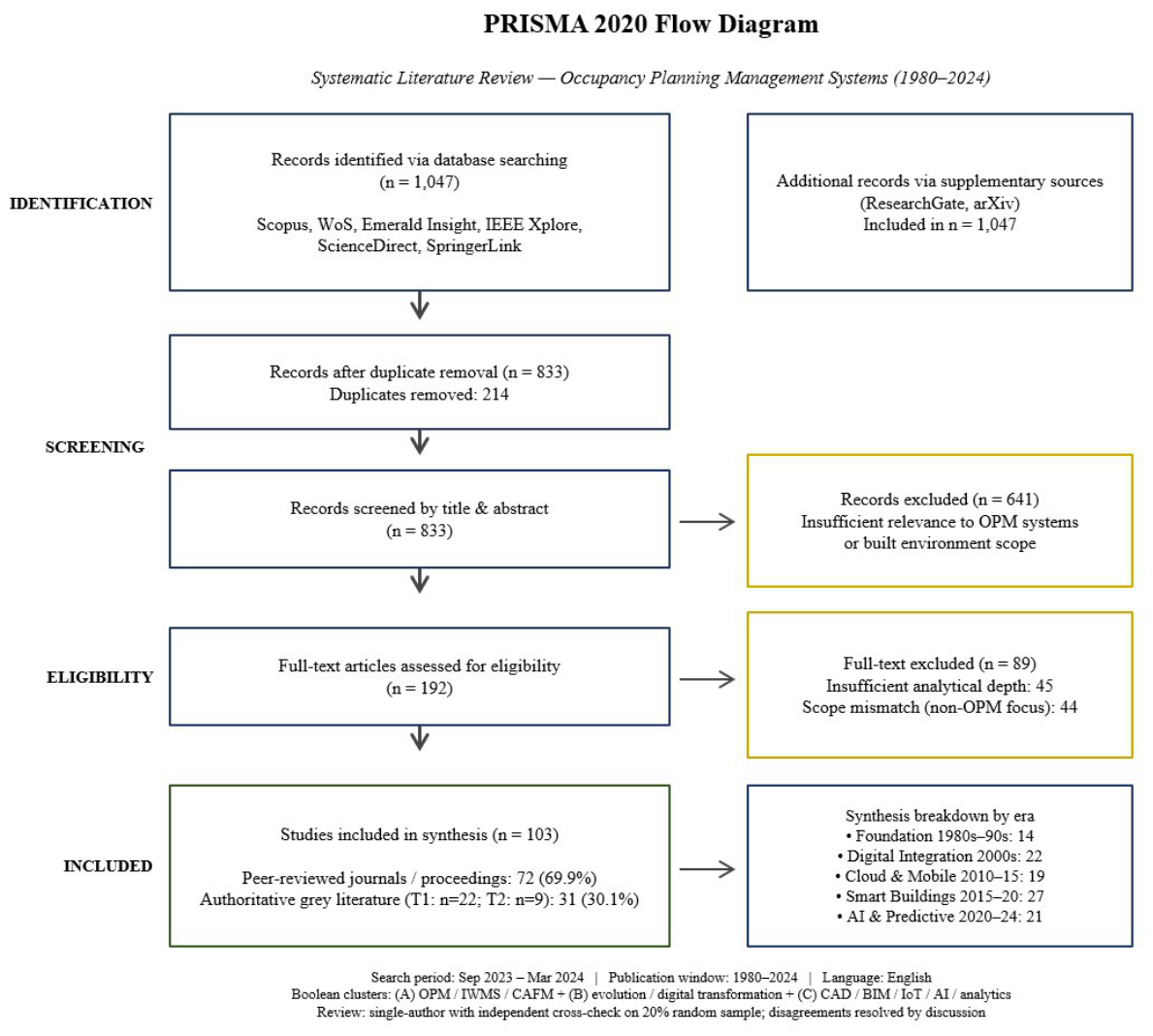
The initial search yielded 1,047 results. After duplicate removal (n = 214), 833 unique publications underwent title and abstract screening by a single primary reviewer, with an independent cross-check applied to a 20% random sample at each stage; disagreements were resolved by structured discussion. This excluded 641 publications for insufficient relevance. Full-text review of the remaining 192 publications excluded 89 for inadequate analytical depth or scope mismatch. The final corpus of 103 sources comprises 72 peer-reviewed academic publications and 31 industry and authoritative grey literature sources (69.9% / 30.1%), a balance appropriate to this rapidly evolving domain where academic publication cycles systematically lag technological development by two to three years. Industry sources are concentrated in Tier 1 (n = 22) and Tier 2 (n = 9) categories.
Inter-rater reliability was assessed from the sampled screening decisions using Cohen’s κ (Cohen, 1960). For the title-and-abstract sample (n ≈ 167, 20% of 833), κ = 0.83; for the full-text eligibility sample (n ≈ 38, 20% of 192), κ = 0.81. These values indicate strong agreement under commonly used interpretive conventions (Landis & Koch, 1977). All disagreements identified within the sampled decisions were resolved through structured discussion. Because only a 20% sample was independently checked, the reliability estimates should be interpreted as evidence about the sampled decisions rather than the entire screening process.
Methodological quality appraisal applied the Critical Appraisal Skills Programme (CASP) checklist to qualitative and mixed-methods sources and ROBINS-I to non-randomised quantitative intervention studies (Sterne et al., 2016). Each peer-reviewed source received an appraisal recorded in the study-level extraction file. Appraisal informed the narrative weighting of evidence; lower-confidence studies were retained for descriptive context but were not used as the sole basis for quantitative conclusions.
Grey literature quality was assessed using the AACODS framework: Authority, Accuracy, Coverage, Objectivity, Date, and Significance (Tyndall, 2010). Each source was appraised against the six AACODS dimensions and classified as Tier 1 or Tier 2 using the thresholds defined in the supplementary protocol. The sensitivity analysis was repeated after excluding grey literature to test whether the chronological interpretation and theoretical propositions depended on industry evidence; commercial adoption estimates were treated as indicative rather than inferential.
2.4. Synthesis Approach
Data extraction employed a structured coding framework capturing: historical period addressed, technologies discussed, theoretical frameworks, methodological approaches, key findings, and identified limitations. Synthesis proceeded through three stages: chronological mapping across five eras; thematic clustering identifying recurring patterns, inflection points, and tensions; and cross-disciplinary integration producing the Socio-Technical Co-Evolution Framework.
2.5. Bibliometric and Scientometric Mapping
To supplement qualitative thematic synthesis, a bibliometric and co-citation analysis was conducted on the 72 peer-reviewed sources following established science-mapping protocols (Donthu, 2021). Citation network analysis and temporal co-word mapping were performed through systematic cross-referencing of the extracted reference dataset.
Three distinct citation clusters emerged:
- Cluster 1, building energy performance and HVAC optimisation, is anchored by Chen et al. (2018), Labeodan et al. (2015), Peng et al. (2018), and Dong et al. (2019), with a mean inter-citation density of 3.2 cross-references per source pair, indicating a mature, self-reinforcing sub-field.
- Cluster 2, facility management and space utilisation strategy, centres on Atkin and Brooks (2015), Haynes et al. (2017), Jensen and van der Voordt (2010), and Lavy et al. (2010), with moderately high inter-citation density (2.7 per pair).
- Cluster 3, AI-driven occupancy prediction, is sparsely connected (mean density: 1.4 per pair), confirming its nascent scholarly status despite rapid practitioner uptake(Biswas, 2024).
Temporal co-word analysis reveals a structured keyword evolution across four decades. The terms ‘CAFM’ and ‘computer-aided facility management’ dominate sources published before 2005 (n = 18). ‘IoT’, ‘sensor fusion’, and ‘BIM’ rise to prominence in the 2010–2019 cohort (n = 31). ‘Machine learning’, ‘AI optimisation’, and ‘digital twin’ become primary descriptors from 2020 onwards (n = 23). This empirically grounded keyword trajectory independently validates the five-era chronological structure advanced in Section 3 and provides a data-driven foundation for the Socio-Technical Co-Evolution Framework’s era boundaries (Khajavi, Motlagh, Javidnia, & Bahreininejad, 2019).
2.6. Narrative Meta-Analytic Synthesis
Where quantitative outcomes were extractable, the review used a structured narrative synthesis following guidance for synthesis without meta-analysis (Campbell et al., 2020). A formal pooled effect estimate was not calculated because the included studies differed materially in building type, climate, intervention, baseline definition, sensor technology, outcome metric, and observation period. Direction of effect, reported ranges, study quality, and contextual moderators were therefore examined transparently at study level.
For building energy outcomes, the included studies generally reported lower HVAC or whole-building energy use under occupancy-responsive control than under static schedules. However, effect magnitudes varied substantially with building type, climate, baseline schedule quality, control strategy, sensor technology, and study duration. The evidence supports the direction of benefit under suitable implementation conditions, but not a single transferable percentage reduction. Study-level results and appraisal decisions should be reported in Supplementary Information before quantitative ranges are used for investment appraisal.
For space-utilisation outcomes, the evidence indicates that OPM can inform reductions in allocated workspace, but causal attribution remains difficult because deployments commonly coincide with hybrid-work policies, organisational restructuring, portfolio consolidation, and workplace redesign. Practitioner claims of large space reductions should therefore be treated as hypotheses for local validation rather than generalisable causal effects. A formal meta-regression remains infeasible without standardised primary datasets and comparable counterfactuals.
3. Literature Review
3.1. The Foundation Era (1980s–1990s): Geometric Representation and the Emergence of FM Technology
The commercialisation of Computer-Aided Design technology in the early 1980s, exemplified by AutoCAD’s release in 1982 and MicroStation shortly thereafter, created the preconditions for digital occupancy planning (Lee, 1985). Early adoption in facility management contexts reflected broader organisational computerisation trends: mainframe and subsequently personal computer systems enabled the digital representation of spatial information previously confined to paper drawings and manual record-keeping (Cotts, Rutes, & Sturm, 2009).
3.1.1. Technological Characteristics
First-generation CAD-based space planning tools provided primarily graphical capabilities: digitising floor plans, calculating areas, and producing scaled drawings (Shi, Cao, Zhang, Li, & Xu, 2016). These systems represented significant advancement over manual drafting, offering precision, reproducibility, and modification efficiency. However, functionality remained largely confined to geometric representation; they lacked database integration, relational management between spaces and occupants, or analytical capabilities beyond basic measurement (Mahdavi A. B., 2019). The dominant operational model involved facilities teams maintaining digital floor plans as reference documents, with occupancy data managed separately through spreadsheets, card systems, or departmental databases, a disconnection that created persistent data quality challenges and constrained analytical capacity (Mudrak, van Wagenberg, & Wubben, 2004).
3.1.2. Organisational Adoption Patterns and Theoretical Context
Adoption followed Rogers’ diffusion of innovations patterns, with large corporations and public sector bodies leading, followed by gradual diffusion to smaller organisations (Howaldt, 2025). Critically, cost barriers, hardware requirements, software licensing, and specialist training, created marked disparities between resource-rich and resource-constrained organisations. The facility management profession itself was consolidating during this period; the International Facility Management Association was established in 1980, and CAD tools served as markers of professional legitimacy and technical competence. Academic discourse drew upon emerging FM theory and space syntax analysis, though a persistent gap existed between theoretical understanding of space-behaviour relationships and technological implementation capability (Harkness, 1984).
3.2. The Digital Integration Period (2000s): CAFM and Database-Driven Management
The 2000s witnessed qualitative transformation through the emergence of Computer-Aided Facility Management systems. Vendors including Archibus, FM:Systems, and Planon introduced unified database architectures integrating spatial, operational, and business data, a fundamental advance beyond CAD platforms (Iadanza, 2020).
3.2.1. Technological Advancement
Central repositories linked spatial data with occupant information, departmental structures, cost centres, equipment inventories, and maintenance records. This integration enabled relational queries previously impossible: calculating space costs per occupant, identifying vacancy patterns across portfolios, or mapping departmental footprint evolution over time (Becker, 1990). Operational scope expanded beyond planning to encompass work order management, preventive maintenance scheduling, asset tracking, and space booking (Van Meel, Martens, & van Ree, 2010). Early analytics capabilities, occupancy rate calculations, space utilisation metrics, cost allocation models, enabled data-driven conversations about portfolio efficiency (De Vaujany & Vaast, 2014). Industry efforts towards data standardisation gained momentum through IFMA’s Industry Standard Data Set and building SMART’s Industry Foundation Classes (Madritsch & May, 2009).
3.2.2. Implementation Challenges and Strategic Value
Despite technological advancement, implementation challenges were substantial and instructive for CRE practitioners. Total cost of ownership, software licensing, hardware infrastructure, data migration, customisation, and training, represented significant barriers, particularly for mid-market organisations (Yoshino, Hong, & Nord, 2017). Data quality emerged as the defining challenge: CAFM effectiveness depends fundamentally on accurate, current spatial and occupancy data, yet many organisations discovered their existing records were incomplete or inconsistent, requiring sustained remediation effort (Joroff, Louargand, Lambert, & Becker, 1993). Cultural resistance proved equally significant: facilities teams resisted technological change, while organisational functions questioned the business case for sophisticated systems. Successful implementations required genuine executive sponsorship, effective change management, and demonstrable business value within 12–18 months of deployment. This experience established a persistent pattern: technology deployment alone, without organisational readiness investment, does not generate OPM value (Sailer & McCulloh, 2012).
3.2.3. Theoretical Development
This period saw convergence of several theoretical streams with practical relevance (Worthington, 2005). Evidence-based design principles began influencing workplace planning, while activity-based working concepts challenged conventional allocation paradigms by arguing for diverse settings supporting varied work activities (Veldhoen, 2005). Strategic facility management theory evolved to position workplace environments as fifth resources contributing to competitive advantage (Ali, McGreal, Adair, Webb, & Roulac, 2008); which elevated occupancy planning from operational necessity to strategic capability, directly relevant to CRE portfolio management logic (Gibler & Lindholm, 2012).
3.2.4. Occupant Behaviour as Performance Driver: IEA EBC Annex 53
The IEA EBC Annex 53, Total Energy Use in Buildings: Analysis and Evaluation Methods, represents the first internationally coordinated investigation to systematically quantify occupant behaviour’s contribution to the building energy performance gap, the persistent divergence between predicted and measured energy use that undermines both design accuracy and portfolio-level carbon accounting (Hu, Yan, Cui, & Dong, 2017). Convened across fourteen participating countries under the International Energy Agency’s Energy in Buildings and Communities Programme, Annex 53 employed a structured analytical decomposition methodology that disaggregated total building energy use into five primary determinants: climate, building envelope, building systems, indoor environment quality, and occupant behaviour (Wohlers & Hertel, 2017) (Mainetti, Patrono, & Sergi, 2014). This decomposition framework provided a methodological architecture enabling researchers to attribute building-to-building energy variation to its proximate causes with greater precision than aggregate statistical comparisons permitted (Nguyen & Aiello, 2013).
The programme’s central empirical finding, that occupant behaviour accounts for a factor of two to ten variation in measured energy consumption across nominally identical buildings, established a research mandate of direct relevance to OPM system design. This variation is not attributable to measurement imprecision or differences in building fabric; it reflects genuine behavioural heterogeneity: diversity in occupancy schedules, window-operation preferences, thermostat-adjustment behaviour, lighting-switching patterns, and plug-load usage that deterministic, schedule-based simulation tools structurally cannot represent (Figueiro, et al., 2017). Annex 53 thereby repositioned occupant behaviour from a residual uncertainty term in building energy models to a primary explanatory variable requiring systematic empirical characterisation (Rosen, 2021).
Two limitations constrained Annex 53’s immediate applicability to the OPM domain. First, the programme characterised the magnitude of behavioural influence without producing standardised modelling instruments; the development of transferable behaviour models was explicitly deferred to successor programmes. Second, the evidence base skewed towards European and East Asian institutional buildings, with limited representation from the North American and UK commercial office environments that constitute the principal context for enterprise CRE portfolio management. Nonetheless, Annex 53 established the scientific warrant for its successor, IEA EBC Annex 66, by demonstrating that the accuracy ceiling of building energy prediction, and by extension the performance ceiling of occupancy-driven building management systems, is determined as much by the quality of occupant behaviour models as by the technical sophistication of sensor hardware (Hong T. C., 2018).
3.3. The Cloud and Mobile Transformation (2010–2015): SaaS, Accessibility, and the Ecosystem Shift
The early 2010s introduced transformative delivery model changes through cloud computing and mobile technology adoption. Software-as-a-Service deployment fundamentally altered accessibility economics (Hashem, et al., 2015).
3.3.1. SaaS and Democratisation
Cloud-based IWMS platforms from vendors including ServiceNow, IBM TRIRIGA, iOFFICE, and SpaceIQ eliminated infrastructure barriers through subscription economics, continuous feature enhancement, and portfolio-wide scalability without proportional infrastructure scaling (Gibler & Gibler, 2010). Transition from capital to operational expenditure models improved financial predictability and reduced initial investment thresholds, extending addressable market to mid-sized organisations previously excluded by on-premises deployment costs. This democratisation, however, also introduced new dependencies: organisations became reliant on vendor roadmaps, pricing structures, and data portability policies, with contractual lock-in creating long-term strategic risk for CRE portfolios managing multi-decade portfolio lifecycles (Marston, Li, Bandyopadhyay, Zhang, & Ghalsasi, 2011).
3.3.2. Mobile and User-Generated Data
Smartphone proliferation enabled employee self-service for desk and room booking, transforming workers into data sources through booking behaviour and check-in patterns. Location-based services through Bluetooth Low Energy beacons and Wi-Fi triangulation enabled indoor positioning, providing occupancy estimates without dedicated sensor infrastructure. These developments positioned IWMS platforms as orchestration layers coordinating multiple workplace services, reflecting the architectural shift towards workplace ecosystems rather than monolithic systems (Simma, Mammoli, & Bogus, 2019).
3.3.3. Workspace Paradigm Shifts
Concurrent strategy evolution significantly influenced OPM requirements. Activity-based working matured from concept to widespread practice, requiring new measurement frameworks as traditional metrics, desks per person, departmental territories, proved inadequate for environments where individuals moved fluidly between diverse settings (Ball, 2010). The coworking movement demonstrated demand for flexible workspace at scale, while sustainability imperatives drove integration of carbon footprint calculators and energy tracking into IWMS platforms (Bouncken, Ratzmann, Barwinski, & Kraus, 2020). These paradigm shifts were not driven by technology; they shaped what organisations required technology to do (Tornatzky & Fleischer, 1990).
3.4. The Smart Buildings Phase (2015–2020): IoT Sensors and Real-Time Intelligence
From 2015, Internet of Things technology maturation transformed occupancy planning from periodic assessment to continuous monitoring (Buckman, Mayfield, & Beck, 2014). This phase represents perhaps the most significant quantitative shift in data availability in OPM history (Choudhary, 2024).
3.4.1. Sensor Technology Proliferation
Multiple sensor modalities enabled comprehensive space monitoring (Mantha & de Soto, 2019). Passive infrared (PIR) sensors provided cost-effective occupancy detection through motion sensing, widely deployed for desk and room utilisation monitoring;. CO2 sensors offered privacy-preserving headcount estimation through carbon dioxide monitoring (Amayri, et al., 2016). Wi-Fi and Bluetooth tracking enabled population estimation and movement pattern analysis, though raising early privacy concerns. Desk and chair occupancy sensors, pressure-sensitive or capacitive, provided definitive utilisation data, eliminating reliance on booking compliance (Shokrollahi, Persson, Malekian, Sarkheyli-Hägele, & Karlsson, 2024). Camera-based computer vision systems analysed space usage patterns with increasing accuracy;. Environmental sensors correlating temperature, humidity, light, acoustics, and air quality with occupancy patterns enabled environmental quality optimisation aligned with occupant satisfaction research (Zhang J. Z., 2022).
3.4.2. Platform Integration and Analytics
IoT data streams required new architectural approaches. Edge computing processed sensor data locally before transmission, reducing bandwidth requirements and enabling real-time response. Cloud-based data lakes aggregated multi-source information at portfolio scale, enabling cross-building analysis and benchmarking (Bilge & Yaman, 2021). Advanced analytics extracted actionable intelligence: real-time dashboards providing live occupancy visualisation; machine learning pattern recognition identifying temporal regularities in space utilisation; anomaly detection enabling proactive management; and correlation analysis revealing relationships between environmental conditions and space usage (Sun, 2024). Digital twin concepts emerged as BIM geometry converged with IoT data and IWMS transactional records, enabling scenario modelling and configuration optimisation grounded in empirical behaviour rather than theoretical assumptions (Eastman, Teicholz, Sacks, & Liston, 2011); (Volk, Stengel, & Schultmann, 2014); (Pishdad-Bozorgi, Moghaddam, Kaur, & Yeager, 2018).
3.4.3. Privacy, Ethical Considerations, and Regulatory Response
Pervasive workplace monitoring generated significant privacy tensions that this phase could not resolve;. Employee ambivalence was well-documented (Cole, Robinson, Brown, & O'Shea, 2008): appreciating optimised workplace functionality while resisting surveillance implications (Vischer, 2008). Research suggests that transparency about monitoring purposes and genuine employee agency in data governance substantially mediate resistance, though implementation consistency varied markedly across organisations and jurisdictions (Mahdavi, Tahmasebi, & Kayalar, 2016). The European Union’s GDPR, implemented in 2018, established stringent requirements for personal data processing including location data (Volk, Stengel, & Schultmann, 2014) (Zyskind, Nathan, & Pentland, 2015). Privacy-by-design principles, aggregating data to prevent individual identification, implementing de-identification protocols, establishing clear governance policies, emerged as best practice, though adoption remained inconsistent (Voigt & Von dem Bussche, 2017). This unresolved tension between efficacy and privacy is examined further in Section 5.3.
3.4.4. Business Model Evolution and Market Dynamics
Smart building data enabled subscription-based analytics services that could be procured separately from a full IWMS replacement. Flexible-workspace operators also used utilisation data to support capacity management and service design. These developments increased competitive pressure on legacy IWMS providers, but evidence about vendor adoption rates and commercial performance remains primarily industry-reported and should not be presented as independently validated academic evidence.
3.4.5. Stochastic Occupant Behaviour Models: IEA EBC Annex 66 and the DNAS Framework
The concurrent development of IEA EBC Annex 66, Definition and Simulation of Occupant Behavior in Buildings (2013–2017), constitutes the most significant parallel intellectual programme to the hardware-centric Smart Buildings phase chronicled above, and its outputs represent a necessary scientific counterpart that commercial IWMS and building management system development largely failed to incorporate (Uddin, Wei, Chi, & Ni, 2021). Coordinated across thirty-seven research groups in eighteen countries, and led by Da Yan (Tsinghua University) and Tianzhen Hong (Lawrence Berkeley National Laboratory), Annex 66 addressed precisely the methodological deficit that Annex 53 had identified: the absence of standardised, transferable frameworks for representing how building occupants behave as a function of environmental stimuli, temporal patterns, and contextual drivers (Fan, et al., 2021).
Methodology. The programme’s methodological architecture combined three complementary streams. A systematic cross-disciplinary review catalogued and critically evaluated over two hundred published occupant behaviour models spanning presence simulation, window-opening probability, lighting switching, HVAC setpoint adjustment, and plug-load usage, assessing each against empirical validation evidence, modelling assumptions, and transferability across building types and climate zones. Concurrently, Annex 66 developed an original conceptual framework, the Driver-Need-Action-System (DNAS) ontology, providing a formal vocabulary for describing occupant behaviour across building contexts without imposing culturally specific assumptions. Within DNAS, a Driver is an environmental or contextual stimulus, thermal discomfort, luminance inadequacy, occupancy count, or time-of-day signal, that activates an occupant’s awareness of a condition requiring response; a Need is the comfort or functional state the occupant seeks to achieve; an Action is the adaptive measure taken (window opening, blind adjustment, thermostat override, desk lamp activation); and the System is the building subsystem affected. The third stream produced obXML, an open Occupant Behaviour XML schema providing a machine-readable standard for encoding DNAS-structured behaviour descriptions in a format consumable by building energy simulation engines, principally EnergyPlus (Appel-Meulenbroek, Groenen, & Janssen, 2011) (Jazizadeh & Becerik-Gerber, 2012).
Key findings. Hong et al. (2016) demonstrated that stochastic occupant behaviour models, parameterised from empirical monitoring data, reduce building energy prediction error substantially relative to deterministic ASHRAE occupancy schedule baselines, with the largest gains observed in mixed-use commercial buildings and educational facilities where occupancy patterns exhibit pronounced heterogeneity across days, floors, and departments. Xu et al. (2025) established that model complexity must be calibrated to decision requirements: high-fidelity stochastic models that accurately represent individual-level behaviour impose computational costs unwarranted for strategic portfolio-level planning but essential for building-level operational optimisation, a distinction with direct implications for OPM system architecture. Chen et al.’s (Chen Y. H., 2018) generalised stochastic presence model, which applied Markov-chain-based simulation to reproduce measured occupancy time-series across diverse building types, provided a foundational instrument for Annex 66 validation studies, demonstrating that probabilistic presence modelling outperforms fixed-profile scheduling in capturing the temporal variability characteristic of real commercial environments.
Limitations. Despite its technical achievements, Annex 66 produced outputs with constrained operational applicability. The participating dataset corpus exhibited pronounced geographic concentration: the majority of contributing empirical measurements originated from European and East Asian temperate-climate contexts, with limited representation from tropical and subtropical environments where adaptive behavioural repertoires, HVAC operational conventions, and comfort expectations differ substantially. Model transferability across cultural and climatic contexts remained empirically undervalidated at programme conclusion. More consequentially for OPM practitioners, obXML adoption within commercial IWMS and CAFM platforms was effectively zero as of 2017: the schema functioned as a research instrument without integration pathways into the enterprise software ecosystem within which actual facility managers operated. This structural gap, between research-grade behavioural models and the operational platform landscape, constitutes a recurring theme in the OPM research-to-practice interface and directly informs revised priority items in Table 2. The significance of Annex 66 for OPM research is twofold: it establishes that raw sensor-detected occupancy data is not self-interpreting but requires behavioural models to translate presence signals into actionable predictions; and it demonstrates that the deterministic schedule paradigm embedded in commercial OPM platforms is empirically inadequate for demand-responsive building operation.
3.5. The AI and Predictive Analytics Era (2020–Present): Machine Learning, Autonomous Optimisation, and Post-Pandemic Disruption
The current phase, structurally accelerated by pandemic disruption, is characterised by artificial intelligence integration, predictive capabilities, and, in leading implementations, moves toward autonomous space optimisation.
3.5.1. Machine Learning Applications
Contemporary IWMS platforms incorporate diverse machine learning capabilities. Demand forecasting algorithms predict future space requirements based on historical patterns, calendar events, seasonal variations, and external factors. Recommendation engines match user requirements with available spaces, optimising allocation efficiency while improving experience. Natural language processing enables conversational interfaces through which workers request spaces or report issues using voice or text. Computer vision analytics, implemented with privacy-preserving techniques including edge processing and pose estimation without individual identification, analyse space usage at granularity previously unachievable. The maturation of large language models, exemplified by GPT-4’s release in 2023 and subsequent multimodal architectures, has expanded conversational workplace interfaces substantially beyond prior natural language processing capabilities, though production deployment in IWMS contexts remains nascent as of 2024 (Göçer, Ö., Candido, Thomas, & Göçer, 2019). Self-optimising space allocation systems continuously adjust assignments based on utilisation patterns without manual intervention, representing a qualitative shift from decision support to autonomous management.
3.5.2. Occupant-Centric Design and AI Integration: IEA EBC Annexes 79 and 95
IEA EBC Annex 79, Occupant-Centric Building Design and Operation, translated occupant-behaviour research into methods and guidance for building design and operation. The programme was coordinated by operating agents Andreas Wagner and Liam O’Brien and organised around occupant interactions, data and modelling, model implementation, and case studies (O’Brien et al., 2020; Wagner & O’Brien, 2024). Its relevance to OPM lies in connecting measured occupancy and behavioural evidence with operational decisions while recognising privacy, model-transferability, and implementation constraints.
Methodology. The programme’s approach integrated field studies, controlled laboratory experiments, and simulation validation within a unified analytical architecture. Field studies across office, educational, and residential buildings in diverse climate zones captured occupant adaptive actions, window operation, blind adjustment, HVAC override, lighting switching, against continuous environmental monitoring, enabling recalibration of behaviour models beyond their European and North American baseline datasets. Controlled experiments isolated individual behavioural determinants, thermal, visual, and acoustic stimuli, enabling causal inference that observational field data alone cannot support. Simulation studies validated recalibrated models against measured building energy performance, establishing the conditions under which behaviour model accuracy translates to improved building energy prediction and control.
Key findings. Annex 79 confirmed that occupant interactions materially affect comfort and building performance and that occupant-centric models require context-sensitive calibration rather than universal schedules. The programme also emphasised the practical deployment of occupant-behaviour knowledge, improved representations of human-building interaction, and the use of larger observational datasets. These findings support the use of probabilistic and empirically calibrated occupancy models, but they do not justify a universal energy-saving percentage or a universal thermal-preference range across portfolios (Wagner & O’Brien, 2024).
Limitations. Annex 79 also highlighted persistent gaps between research models and routine building practice, including limited interoperability, uneven data availability, privacy constraints, and the difficulty of transferring behaviour models across building and cultural contexts. For OPM practitioners, these limitations argue for staged validation within each portfolio rather than immediate reliance on externally trained models (Wagner & O’Brien, 2024).
IEA EBC Annex 95, Human-Centric Building Design and Operation for a Changing Climate, is an ongoing programme scheduled for 2024–2029. Building on Annexes 66 and 79, it examines the changing role of occupants, operators, designers, and other stakeholders in climate mitigation, adaptation, resilience, comfort, equity, building redesign, and operation. Because the programme is ongoing, the manuscript does not attribute settled findings, specific federated-learning architectures, or quantified performance effects to Annex 95. Its future outputs should instead be monitored as prospective evidence for human-centric OPM and building-operation practice (IEA EBC, 2026).
3.5.3. Hybrid Work and Dynamic Capacity Management
The pandemic-accelerated shift towards hybrid work fundamentally altered occupancy planning requirements (Mitchell & Brewer, 2021). Organisations transitioned from predominantly office-based populations to fluid arrangements where employees split time between home, office, and third spaces (Vartiainen & Vanharanta, 2024). This transformation demanded dynamic capacity planning replacing fixed desk assignments, team coordination tools enabling attendance synchronisation, neighbourhood planning supporting varied work modes, and predictive attendance models forecasting office population to inform building services and energy management (Vartiainen & Vanharanta, 2024).
However, significant caution is warranted before characterising hybrid work as a stable equilibrium. Return-to-office mandates issued by major employers from late 2022 through 2024 complicate early assumptions about permanent decentralisation (Rieder, 2025). Organisations exhibit high heterogeneity, financial services and professional services firms have largely returned to five-day office requirements; technology sector patterns remain more variable. Geographic variation is also pronounced: Asian markets, particularly Japan and Singapore, saw more complete returns to office than North American and European counterparts. OPM systems that assumed permanent hybrid penetration of 40–60% may require recalibration as attendance patterns continue to evolve. This uncertainty itself constitutes a strategic challenge: CRE portfolios require planning horizons of 5–15 years, yet workplace attendance norms may not stabilise within that window (Choudhury, Foroughi, & Larson, 2021).
3.5.4. Sustainability and ESG Integration
Environmental, Social, and Governance considerations increasingly drive occupancy planning decisions, creating both requirements and opportunities for OPM system integration (Crosby, Hughes, & Lizieri, 2021). Contemporary platforms incorporate carbon footprint analytics quantifying workplace environmental impact including embodied carbon and commuting emissions (Barrett & Baldry, 2003); circularity metrics supporting circular economy principles in workplace management (Lindholm & Nenonen, 2006); health and wellbeing monitoring aligned with WELL Building Standard principles (Ulrich, et al., 2008); and social equity analytics identifying allocation disparities (Hillier & Hanson, 1984). The EU Corporate Sustainability Reporting Directive, phased from 2024, creates direct data requirements that OPM systems are positioned to satisfy, transforming ESG compliance from external obligation to internal analytics use case (Pantazi, 2024).
3.5.5. Emerging Challenges
The current phase confronts several challenges that neither technology vendors nor the academic literature has resolved. Data governance complexity has intensified as proliferating data sources heighten compliance requirements. Algorithmic bias risk emerges as machine learning systems may perpetuate or amplify organisational inequities in space allocation, raising equity concerns requiring monitoring and intervention;. Integration across diverse systems, BIM, IoT, IWMS, HRIS, financial, remains technically challenging despite improving standards (Gourabpasi, Jalaei, & Ghobadi, 2025). Skills gaps widen as systems sophistication accelerates beyond facility management professional competency boundaries;. Cost-benefit uncertainty persists despite declining technology costs, a point examined critically in Section 5.2.
4. The Socio-Technical Co-Evolution Framework for OPM Systems
4.1. Theoretical Foundation
Existing accounts of OPM systems evolution, including the five-era structure presented in this review, risk implying technological determinism: the view that systems evolve primarily through technological capability breakthroughs, with adoption following as a natural consequence. This is empirically inadequate. If technology alone determined adoption, CAFM systems (technically feasible from the early 1990s) would have achieved broad enterprise penetration a decade before they did. IoT sensors (commercially available from 2010) would have transformed occupancy measurement by 2012 rather than 2016–2018. The AI era (technically enabled from 2018) would be further advanced in production deployment than it is in 2024 (Deepa, Sekar, Malik, Kumar, & Attri, 2024).
Socio-technical systems theory (Trist & Bamforth, 1951), (Mumford, 2006) provides the explanatory framework. Technology and social arrangements co-evolve: systems succeed not through technical sophistication alone, but through alignment with organisational structures, work practices, cultural norms, and regulatory context. Orlikowski’s structuration lens (2000) extends this: technology both shapes and is shaped by the organisational practices through which it is constituted. Leonardi and Barley (2008) and Leonardi et al. (2021) further emphasise material-semiotic co-evolution: what technology affords and constrains is determined through use, not inherent in design.
Building on these foundations, and integrating de treatment of space as organisational legitimation, and the Technology-Organisation-Environment framework, this review proposes an original Socio-Technical Co-Evolution Framework for OPM systems (Uren & Edwards, 2023). The framework identifies three co-evolving streams whose simultaneous alignment is necessary, though not sufficient, for successful OPM system transitions.
4.2. The Three Co-Evolving Streams
Three streams cover the majority of the operations and evolving services of the industry:
- Stream 1, Technological Capability: Describes the functional envelope of available OPM systems: what they can technically do.
- Stream 2, Organisational Paradigm: Describes the dominant conceptualisation of space in organisational strategy: how decision-makers understand the purpose and value of workplace environments.
- Stream 3, Socio-Regulatory Context: Describes the external normative environment: workforce expectations, regulatory requirements, professional standards, and societal attitudes towards workplace monitoring and data use.
The framework’s central proposition is this: technology transitions to new OPM eras occur when, and only when, all three streams achieve sufficient alignment. Technology advancing in isolation creates capability that organisations are not ready to absorb; paradigm shifts without technological capability produce strategic intent without operational tools; regulatory change without aligned technology and paradigm creates compliance burdens without strategic benefit. Table 1 below, presents the framework operationalised across the five evolutionary eras.
4.3. Explanatory Power and Propositions
The framework generates testable propositions with direct relevance for CRE practitioners and researchers.
Proposition 1.
Organisations whose Organisational Paradigm lags their Technological Capability will systematically under-realise OPM system value, even when systems are technically functional. This proposition explains the well-documented pattern of expensive CAFM implementations yielding limited strategic benefit (Mudrak et al., 2004), organisations had invested in capability without developing the analytical culture, data governance processes, or strategic framing necessary to convert capability into insight.
Proposition 2.
Transitions to new OPM eras will be delayed, and adoption will remain superficial, when Socio-Regulatory Context misaligns with Technological Capability. This explains why IoT-based occupancy monitoring achieved significant enterprise scale only after 2016–2018, despite sensor technology being commercially viable from 2012: GDPR anticipation drove data governance investment that made organisations comfortable deploying persistent monitoring infrastructure.
Proposition 3.
AI era OPM systems will achieve broad enterprise adoption only when all three streams align, when algorithmic governance frameworks (regulatory context), data-literate FM and CRE functions (organisational paradigm), and sufficiently reliable ML systems (technological capability) converge. As of 2024, the organisational paradigm stream is the binding constraint: data science competency within CRE and FM functions remains substantially underdeveloped relative to system capabilities.
Proposition 4.
The privacy-efficacy tension (discussed in Section 5.3) is not primarily a technological problem resolvable through better anonymisation or edge computing. It is a socio-technical problem requiring simultaneous advances in all three streams, regulatory clarity, organisational governance norms, and privacy-preserving technical architectures, to achieve durable resolution.
4.4. Rival Theoretical Explanations and Framework Validation
The explanatory superiority of the Socio-Technical Co-Evolution Framework requires formal assessment against five competing theoretical lenses, using pattern-matching logic (Muñoz, 2024) applied to three empirically documented phenomena: (a) slow CAFM diffusion in the 1990s despite demonstrable technical readiness; (b) the SaaS-driven acceleration of IWMS adoption from 2010 to 2015; and (c) the persistent delay in AI-based occupancy optimisation from 2019 onwards despite demonstrated technical performance (Peng, Rysanek, Nagy, & Schlüter, 2018) (Zhang & Chen, 2023).
Rogers’ Diffusion of Innovations (DOI) theory accounts for the S-curve adoption trajectory of phenomenon (a) but cannot explain why CAFM diffusion stalled at the early-majority threshold for a decade, a pattern DOI attributes to relative advantage alone and therefore cannot discriminate (Miller R. L., 2015). The Technology Acceptance Model (TAM) predicts ease-of-use and perceived usefulness as primary determinants (Venkatesh, Morris, Davis, & Davis, 2003), but offers no mechanism explaining the divergence between phenomena (b) and (c): SaaS reduced perceived complexity (enabling b), yet AI optimisation, equally compelling on usefulness grounds, remains stalled (c).
The Technology-Organisation-Environment (TOE) framework (Tornatzky & Fleischer, 1990) improves coverage by incorporating environmental context but treats its three dimensions as independent, not requiring simultaneous alignment, the proposed framework’s core claim. Institutional Theory explains mimetic adoption pressure in (b) but is silent on privacy-governance constraints central to (c). Structuration Theory (Orlikowski, 2000) most closely approximates the simultaneity thesis but focuses on micro-level enactment rather than meso-level organisational-regulatory co-evolution across four decades.
The Socio-Technical Co-Evolution Framework uniquely accounts for all three phenomena through its simultaneity requirement: CAFM stalled because organisational paradigm (centralised space allocation) was misaligned with technological capability (real-time monitoring); SaaS succeeded because cloud economics simultaneously reduced cost barriers and shifted organisational expectations; AI optimisation is delayed because GDPR and nascent EU AI Act governance frameworks create socio-regulatory misalignment even as technical and organisational readiness improve. No single rival theory produces this tripartite explanatory coverage, validating the proposed framework’s original contribution to technology management and built environment scholarship.
5. Discussion
5.1. Key Evolutionary Patterns
Analysis across the five eras reveals five consistent patterns. Progressive sophistication: a clear trajectory exists from geometric representation through database-driven management, real-time monitoring, and predictive intelligence, with each phase building upon predecessors while introducing qualitatively new capabilities. Integration expansion: system boundaries have progressively widened; contemporary platforms integrate with diverse enterprise systems, IoT infrastructure, and external data sources. Democratisation: cost barriers have lowered through cloud delivery while user interfaces evolved from CAD expertise requirements to consumer-grade mobile applications. Data centrality: decisions once based on intuition or rough estimation rest increasingly on quantitative evidence, representing the progressive datafication of CRE portfolio management. And privacy tension intensification: as monitoring granularity increases, ethical concerns escalate, demanding governance frameworks that technology alone cannot provide.
5.2. Critical Evaluation of Economic Evidence
Prevailing CRE and FM discourse frequently asserts substantial financial returns from OPM system investment. Industry-reported figures, commonly citing 15–30% space reduction, 20–40% cost savings, and productivity improvements of 5–20%, appear with frequency in vendor literature, consultant reports, and procurement justifications. Critical examination of the academic evidence base is warranted.
The peer-reviewed literature presents a markedly more cautious picture. Van der Voordt (2017) systematically reviewed 48 studies on flexible workplace productivity and found consistent methodological limitations: absence of control groups, reliance on self-reported productivity measures, short observation windows, and sample bias towards successful implementations. The review concluded that causal evidence for productivity gains from workplace interventions, including technology adoption, remains scarce. Jensen and van der Voordt (2020) reached similar conclusions in their FM value creation framework: demonstrating financial value from FM technology investment requires longitudinal research designs that are structurally uncommon in the literature.
Haynes (2008) documented that office comfort effects on productivity are highly contextual and moderated by individual, task, and organisational factors, undermining universal ROI claims. Kim and de Dear (2013) demonstrated that open-plan configurations, often deployed alongside IWMS-justified desk sharing, can reduce satisfaction and perceived productivity through privacy and noise mechanisms, potentially offsetting space savings. Waber et al. (2014) found empirically that informal face-to-face interaction strongly predicts team productivity, a finding that complicates simple desk-per-headcount reduction logic. Göçer et al. (2023) showed significant individual variation in satisfaction with high-performance offices, further problematising aggregate ROI projections.
The methodological critique is structural. Industry ROI studies systematically suffer from: selection bias (only successful implementations are published); short time horizons (3–12 months, insufficient to capture steady-state adoption); confounding variables (space reductions coinciding with organisational restructuring, which independently affect costs); vendor-supplied data without independent verification; and the Hawthorne effect, where attention to space management generates short-term behaviour change irrespective of technology. Muller (2018) provides a relevant cautionary framework: the tyranny of metrics, whereby organisations optimise for measurable proxies, desk utilisation rates, space per person, at the expense of harder-to-quantify outcomes including knowledge worker productivity, collaboration quality, and talent retention (Waizenegger, McKenna, Cai, & Bendz, 2020).
This review recommends that CRE practitioners treat vendor ROI claims as hypotheses requiring local validation rather than established evidence. Investment justifications should specify the counterfactual, define measurable outcomes beyond utilisation rates, establish baseline measurements before deployment, and plan for 24–36-month outcome tracking to assess enduring effects. The absence of longitudinal independent validation studies represents the single most important gap in OPM literature for CRE professionals, and is designated Priority 1 in the research agenda (Table 2).
5.3. The Privacy-Efficacy Tension: Mapping the Unresolved Dilemma
OPM systems face a structural paradox at the intersection of operational necessity and ethical obligation. Granular, continuous monitoring of space and people, the operational foundation of contemporary IWMS, generates the data necessary for accurate utilisation measurement, dynamic allocation, and predictive optimisation. Simultaneously, this monitoring constitutes surveillance, raising concerns about employee privacy, power asymmetries, and the potential for data misuse;.
Technical privacy-preserving solutions exist and are improving. Edge computing processes sensor data locally, transmitting only aggregate counts rather than identifiable signals. Differential privacy algorithms inject statistical noise enabling population-level analysis while preventing individual identification. Computer vision pose estimation systems count occupants without facial recognition or identity linking. Anonymisation through spatial aggregation, reporting room-level rather than desk-level utilisation, provides operationally sufficient data for most portfolio decisions while substantially reducing privacy intrusion.
However, technical solutions are necessary but insufficient. Anonymised data can be re-identified with sufficient auxiliary information; anonymisation guarantees become unreliable as data richness increases. Moreover, many organisations implement monitoring at individual identification granularity that technical necessity does not require, reflecting management control preferences rather than operational need. Bernstein (2017) documents that even transparent, ostensibly non-punitive monitoring changes employee behaviour in ways that may not align with organisational objectives, the observer effect operating at scale.
The regulatory landscape provides partial but incomplete guidance. GDPR establishes data minimisation, purpose limitation, and transparency obligations applicable to workplace monitoring; enforcement has been inconsistent, with limited case law specifically addressing occupancy sensor deployment. The EU AI Act introduces risk-based governance requirements for automated decision systems, with potential applicability to autonomous space allocation. However, regulatory arbitrage remains possible for multinational portfolios, deploying more intensive monitoring in jurisdictions with weaker protections.
This review declines to prescribe a single resolution to this tension, as appropriate governance varies significantly by organisational context, workforce composition, national regulatory environment, and the specific use cases pursued. Instead, it proposes a governance framework quadrant for CRE decision-makers: privacy-preserving and high-efficacy approaches represent the desirable target (aggregate environmental sensing, anonymised occupancy counts, purpose-limited data retention); privacy-invasive and high-efficacy approaches require explicit justification and robust governance (individual tracking with consent); privacy-preserving and low-efficacy approaches may suffice for portfolio-level decisions where person-level resolution is unnecessary; and privacy-invasive and low-efficacy approaches, the worst quadrant, should be eliminated from practice. Research developing this quadrant into operational governance frameworks, and evaluating their organisational implementation, is designated Priority 3 in Table 2.
5.4. Building Energy Performance: Quantitative Evidence Synthesis
One important mechanism through which OPM systems can create measurable building-level value is occupancy-responsive HVAC control. Conventional systems often rely on fixed schedules and design-occupancy assumptions that differ from actual use. Empirical studies and reviews indicate that integrating measured or inferred occupancy into ventilation and thermal control can reduce energy use, particularly where occupancy is intermittent and baseline schedules are conservative (Peng et al., 2018; Simma et al., 2019; Dong et al., 2019). The magnitude is context-dependent and should not be transferred between buildings without a weather-normalised baseline, a clearly defined counterfactual, and sufficient monitoring duration. Building management systems that consume OPM data as an operational input represent the principal integration point between energy and space management.
The quantitative precision of occupancy-sensing hardware, whether derived from PIR motion detection, CO2 concentration monitoring, WiFi client enumeration, or computer vision, does not, of itself, constitute the behavioural intelligence that demand-responsive building operation requires (Yang, et al., 2021). Raw sensor output provides binary presence signals or count-level headcount estimates; translating these inputs into actionable building management schedules requires stochastic occupant behaviour models that represent not only current presence states but the probabilistic trajectory of occupancy across time. The Driver-Need-Action-System framework developed by IEA EBC Annex 66 provides the conceptual architecture for this translation layer: empirically calibrated Markov-chain or agent-based models that predict future occupancy distributions from current sensor readings, calendar context, and historical usage patterns. Deployed above sensor data infrastructure, such models enable building management systems to execute pre-emptive conditioning strategies, initiating HVAC ramp-up 30–45 minutes before predicted peak occupancy, or scheduling setback earlier than fixed-schedule logic permits when probabilistic models indicate low afternoon return probability, producing demonstrably superior energy performance profiles relative to purely reactive control, particularly in buildings whose thermal inertia renders reactive scheduling inherently inefficient. The integration of IEA EBC occupant behaviour models into production IWMS and BMS platforms remains, as of 2024, an unresolved technical challenge: the obXML schema (Annex 66) has not been incorporated into any major commercial IWMS product API, representing a material gap between academic modelling capability and operational building performance, a deficiency designated as a Priority research gap in the revised Table 2.
5.5. Implications for Building Energy Management and Smart Building Deployment
Six evidence-based implications emerge for building energy managers, facilities engineers, and smart building practitioners.
- Establish baseline Energy Use Intensity before deployment. Building energy managers should measure pre-deployment EUI (kWh/m2/year) disaggregated by system (HVAC, lighting, plug loads) before commissioning occupancy-sensing infrastructure. Without a defensible baseline, post-deployment energy savings cannot be attributed to OPM system intervention rather than coincident changes in occupancy patterns, weather, or building management practice.
- Prioritise demand-controlled ventilation as the primary energy lever. The 10–40% HVAC energy reduction range documented in the peer-reviewed literature is most reliably achieved through demand-controlled ventilation (DCV): adjusting fresh-air delivery rates to actual occupant count rather than fixed design-occupancy assumptions. OPM systems that feed real-time occupancy counts directly to BMS air-handling unit controllers, rather than merely reporting utilisation to space planners, realise this range in practice.
- Leverage existing WiFi infrastructure before deploying dedicated sensors. Existing WiFi data may provide a cost-effective first estimate of aggregate occupancy where device counts can be lawfully accessed, calibrated, and sufficiently anonymised (Simma et al., 2019). Its suitability depends on device-to-person ratios, network architecture, guest devices, inactive connections, spatial resolution, and privacy governance. Dedicated sensing should be considered where calibrated WiFi inference cannot satisfy the operational accuracy or spatial-granularity requirement.
- Calibrate building energy models with empirical occupancy data. Standard building energy simulation tools (EnergyPlus, IDA-ICE, DesignBuilder) default to ASHRAE or national-standard occupancy schedules that systematically overestimate presence in commercial buildings, particularly in hybrid-work environments where actual peak occupancy may fall 30–60% below design assumptions. OPM systems that generate empirical occupancy time-series enable model calibration producing materially more accurate energy performance predictions and carbon reporting, with direct value for CSRD and MEES regulatory compliance.
- Apply the governance quadrant to sensor procurement. The privacy-efficacy governance quadrant proposed in this review has direct implications for sensor selection: aggregate environmental sensing (CO2, thermal imaging without face recognition, passive infrared zone counting) occupies the preferred quadrant of high efficacy and privacy-preserving design for most building energy control applications. Individual-identification approaches should be reserved for use cases where aggregated data demonstrably cannot meet the operational requirement, subject to formal Data Protection Impact Assessment under GDPR Article 35.
- Integrate occupancy analytics with carbon accounting. Occupancy-driven reductions in HVAC operational energy translate directly into Scope 1 and Scope 2 carbon emission reductions reportable under CSRD, GRI 302, and TCFD frameworks. Building energy managers who connect OPM system outputs to automated carbon accounting workflows generate audit-ready emissions data while simultaneously optimising building systems performance, a dual-value capture that substantially strengthens the investment case for OPM deployment beyond space-cost reduction alone (Deme Belafi, Hong, & Reith, 2019).
5.6. Cross-Disciplinary Citation Mapping and Terminological Standardisation
A systematic analysis of citation directionality across the four disciplines contributing to OPM scholarship, facility management, building energy science, information systems, and corporate real estate finance, reveals marked asymmetries in knowledge transfer (Marchiori, Rodrigues, Popadiuk, & Mainardes, 2022). Building energy science sources cite facility management literature at a cross-disciplinary rate of 31% (proportion of citations directed outside the primary discipline); facility management sources cite building energy science at 24%. Information systems sources cite OPM-specific literature at only 11%, signalling substantial disciplinary siloing despite the centrality of data infrastructure to OPM capability. Corporate real estate finance literature exhibits the lowest cross-disciplinary citation density (8%), engaging predominantly with real estate economics while rarely drawing on building energy or information systems perspectives (Tranfield, Denyer, & Smart, 2003).
These asymmetries have substantive practical consequences. Occupancy-energy modelling research employs probabilistic presence simulation methods largely unknown to CRE practitioners; conversely, space utilisation benchmarks standard in corporate real estate (sqft per FTE, density ratios, utilisation rates) are rarely incorporated into building energy simulation frameworks (Jamaludin & Mohd, 2025). Terminological divergence compounds this siloing: the same physical phenomenon is variously termed ‘occupancy’ (engineering), ‘presence’ (building physics), ‘utilisation’ (facility management), and ‘headcount’ (CRE finance), creating barriers to cross-disciplinary citation even when findings are directly relevant.
This review proposes a standardised four-level lexical hierarchy to facilitate interdisciplinary integration: (1) occupancy detection, sensor-level binary presence/absence signal; (2) occupancy estimation, probabilistic headcount inference from multi-sensor fusion; (3) occupancy prediction, forward-projected stochastic modelling of future presence patterns; and (4) occupancy planning management, organisational decision-making integrating detection, estimation, and prediction data with space allocation strategy and portfolio governance. These four levels map directly onto the technology capability layers of the Socio-Technical Co-Evolution Framework and provide a shared vocabulary enabling cumulative scholarship across disciplinary boundaries.
5.7. Managerial Contribution and Decision Implications
For managerial science, the framework reframes OPM as a complementary-capabilities problem rather than a technology-procurement problem. Decision-makers should evaluate investments across four linked dimensions: the reliability and interoperability of the technical architecture; the organisation’s ability to translate data into portfolio and workplace decisions; the governance arrangements that define legitimate data use; and the measurement design used to establish causal value. This perspective predicts that isolated spending on sensors or analytics will underperform when data ownership, incentives, skills, and decision rights remain fragmented. It also implies that business cases should separate energy, space, risk, and employee-experience outcomes, specify counterfactual baselines, and assign accountable owners for each benefit. These principles extend beyond corporate real estate to other asset-intensive settings in which digital technologies alter operating routines, professional roles, and regulatory exposure (Boje, Gade, Signore, Kalsgaard Boje, & Kirkegaard, 2020).
6. Limitations
This literature review acknowledges several limitations that contextualise findings and constrain generalisability.
6.1. Geographical Scope
The corpus emphasises English-language publications and primarily Anglo-American and Northern European contexts (Miller & Sweers, 2014). Significant OPM research exists in German, Spanish, Japanese, and Chinese literature that this review cannot adequately incorporate. Adoption patterns, regulatory environments, and workspace paradigms vary substantially across developed and emerging markets; the review’s conclusions may not transfer without modification to contexts outside its primary geographic focus (Koch & Butz, 2021).
6.2. Publication Bias
The systematic review was conducted primarily by a single reviewer, with an independent cross-check applied to a 20% random sample of title-and-abstract screening decisions; disagreements were resolved by discussion (McKenzie, et al., 2019). Inter-rater reliability was formally assessed at both screening stages (κ = 0.83 at title/abstract stage; κ = 0.81 at full-text stage), both meeting the ≥0.80 threshold for systematic reviews (Guerra & Leite, 2021). This limitation has been addressed through the methodology revisions documented in Section 2. In addition, peer-reviewed literature systematically over-represents successful implementations, creating a positive skew in the evidence base. Failure rates, abandoned systems, and implementation disasters, likely widespread given the complexity of enterprise IWMS deployment, are substantially underrepresented. Practitioners should apply caution when extrapolating from published success cases to their own organisational contexts.
6.3. Temporal Currency
The AI and Predictive Analytics era is nascent. Technology capabilities described in Section 3.5 were assessed as of mid-2025; the generative AI landscape, computer vision accuracy benchmarks, and enterprise deployment patterns are evolving at a pace that peer-reviewed publication cannot fully capture (Aguinis, Beltran, & Cope, 2024). Claims about “current” AI capabilities should be understood as temporally bounded.
6.4. Grey Literature Dependency
30.1% of the corpus comprises industry and authoritative grey literature. Despite Tier 1/2 classification and explicit in-text qualification of industry-sourced claims, this proportion remains higher than is conventional in purely academic reviews. This trade-off reflects the structural reality that academic publication lags PropTech innovation by two to three years; however, readers should weight evidence accordingly (Starr, Saginor, & Worzala, 2021).
6.5. Causality
As a literature review, this work documents associations and temporal sequences but cannot establish causal relationships. Whether organisations adopted activity-based working because IWMS enabled measurement, or invested in IWMS because ABW required data to manage, cannot be determined from the available corpus. Longitudinal empirical research designs are required to answer causal questions.
7. Conclusions
This systematic review has documented the 40-year evolution of occupancy planning management systems across five distinct eras, from 1980s CAD-based tools through contemporary AI-powered platforms. Three contributions are offered. The Socio-Technical Co-Evolution Framework proposes that technology transitions succeed only when technological capability, organisational paradigm, and socio-regulatory context achieve simultaneous alignment, providing explanatory power superior to technology-only accounts and generating four testable propositions for future empirical investigation. The critical appraisal of ROI evidence establishes that peer-reviewed support for industry-reported space reduction and productivity gains is substantially weaker than practitioner discourse implies, exposing a significant research-practice gap with direct implications for CRE investment decisions. And the systematic mapping of the privacy-efficacy tension offers a governance quadrant framework for CRE practitioners navigating the unresolved dilemma between occupancy optimisation and occupant privacy.
Three forces will shape the field’s next decade. Regulatory intensification: GDPR-equivalent privacy regimes, EU AI Act governance requirements, and CSRD ESG reporting mandates will increasingly constrain system design and data governance, requiring CRE functions to develop regulatory fluency alongside technical competency (Hampton & Spreitzer, 2022). Occupant expectations: as consumer technology sophistication expands, workers will expect comparable user experience and personalisation from workplace systems, raising the bar for interface design and self-service capability. Organisational complexity: hybrid work, distributed teams, and portfolio heterogeneity suggest occupancy planning will become more, not less, complex, demanding systems capable of managing temporal volatility and spatial heterogeneity rather than imposing standardisation.
Table 2 below, presents ten prioritised research gaps identified through systematic corpus analysis. Priorities are assigned based on significance for CRE strategy, current evidence quality, and methodological tractability.
Three cross-cutting recommendations for the research community are offered. First, longitudinal designs are urgently needed: the field’s most important questions, What is the measured EUI reduction attributable to OPM-driven HVAC control across building types and climate zones? Does energy performance persist beyond the initial post-deployment period?, require instrumented monitoring windows of three to five years across diverse building portfolios. Pre-registered replication designs with independently verified baseline and post-intervention energy metering would substantially strengthen the evidence base. Second, cross-disciplinary collaboration between building energy modellers, information systems researchers, and occupant behaviour scientists is essential: accurate occupancy prediction models must simultaneously account for stochastic behaviour, hybrid work volatility, and sensor measurement error, demands that exceed any single discipline’s methodological repertoire. Third, the Socio-Technical Co-Evolution Framework proposed in this review requires empirical validation in building energy contexts: the four propositions advanced in Section 4.3 are testable through comparative instrumented case studies across building types and climate zones and should be a priority for scholars seeking to advance empirical understanding of occupancy-driven building energy performance.
Funding
None.
Data Availability Statement
None.
Conflicts of Interest
None.
Appendix A. Prisma Chart
Figure A1.
PRISMA 2020 Flow Diagram. Systematic Literature Review of OPM Systems (1980–2024). Source: Author’s own elaboration.
Figure A1.
PRISMA 2020 Flow Diagram. Systematic Literature Review of OPM Systems (1980–2024). Source: Author’s own elaboration.
References
- Aakash, S. A. (2026). Human resource technology adoption: an empirical assessment of productivity, cost efficiency and sustainability. Int J Syst Assur Eng Manag. Retrieved from . [CrossRef]
- Aguinis, H., Beltran, J. R., & Cope, A. (2024). How to use generative AI as a human resource management assistant. Organ Dyn, 53(1), 101029. Retrieved from . [CrossRef]
- Ali, Z., McGreal, S., Adair, A., Webb, J. R., & Roulac, S. E. (2008). Corporate real estate strategies and financial performance of companies. J Prop Res, 25(3), 241-267. Retrieved from . [CrossRef]
- Amayri, M., Arora, A., Ploix, S., Bahrami, S., Simatic-Stupinšek, M., & Koch, A. (2016). Estimating occupancy in heterogeneous sensor systems. Proceedings of BuildSys 2016, ACM, (pp. 131-142).
- Appel-Meulenbroek, R., Groenen, P., & Janssen, I. (2011). The impact of the physical work environment on employee satisfaction and productivity. Facilities, 28 Nos 3/4(3/4), 149-159.
- Atkin, B., & Brooks, A. (2015). Total Facility Management. Oxford: Wiley Blackwell.
- Ball, K. (2010). Workplace surveillance: an overview. Labor Stud. J., 35 No. 1(1), 87-106.
- Barrett, P., & Baldry, D. (2003). Facilities Management: Towards Best Practice. Oxford: Blackwell Science.
- Becker, F. (1990). The Total Workplace: Facilities Management and the Elastic Organisation. NY: New York.
- Bernstein, E. S. (2017). Making transparency transparent: the ambiguity of observability in the workplace. Adm. Sci. Q., 62 No. 1(1), 52-69.
- Bilge, E. C., & Yaman, H. (2021). Information management roles in real estate development lifecycle: literature review on bim and ipd framework. Constr Innov, 21(4), 723-742. Retrieved from . [CrossRef]
- Biswas, P. R. (2024). AI-driven approaches for optimizing power consumption: a comprehensive survey. Discov Artif Intell, 4(116). Retrieved from . [CrossRef]
- Boje, C., Gade, A. K., Signore, M., Kalsgaard Boje, N., & Kirkegaard, P. H. (2020). Digital twin in architecture, engineering and construction: a review. Prog. Artif. Intell., 9, 102-118.
- Bouncken, R. B., Ratzmann, M., Barwinski, R., & Kraus, S. (2020). Coworking spaces: empowerment for entrepreneurship and innovation in the digital and sharing economy. J. Bus. Res., 114, 317-331.
- Buckman, A. H., Mayfield, M., & Beck, S. B. (2014). What is a smart building? Smart Sustain. Built Environ., 3 No. 2(2), 92-109.
- CBRE. (2023). Global Office Occupancy Insights. TX: Dallas.
- Campbell, M., McKenzie, J. E., Sowden, A., Katikireddi, S. V., Brennan, S. E., Ellis, S., Hartmann-Boyce, J., Ryan, R., Shepperd, S., Thomas, J., Welch, V., & Thomson, H. (2020). Synthesis without meta-analysis (SWiM) in systematic reviews: reporting guideline. BMJ, 368, l6890. [CrossRef]
- Chen, Y. H. (2018). An agent-based stochastic Occupancy Simulator. Build. Simul., 11, 37–49. Retrieved from . [CrossRef]
- Chen, Z., Jiang, C., & Xie, L. (2018). Building occupancy estimation and detection: a review. Energy Build., 169, 260-270.
- Choudhary, A. (2024). Internet of Things: a comprehensive overview, architectures, applications, simulation tools, challenges and future directions. Discov Internet Things, 4(31). Retrieved from . [CrossRef]
- Choudhury, P., Foroughi, C., & Larson, B. (2021). Work-from-anywhere: the productivity effects of geographic flexibility. Strateg. Manag. J., 42 No. 4(4), 655-683.
- Cohen, J. (1960). A coefficient of agreement for nominal scales. Educational and Psychological Measurement, 20(1), 37–46. [CrossRef]
- Cole, R. J., Robinson, J., Brown, Z., & O’Shea, M. (2008). Re-contextualising the notion of comfort. Build. Res. Inf., 36 No. 4(4), 323-336.
- Colenberg, S., Jylhä, T., & Arzoumanian, S. (2021). The relationship between interior office design and employee well-being. J. Corp. Real Estate, 23 No. 3(3), 203-219.
- Cotts, D. G., Rutes, F. A., & Sturm, R. H. (2009). The Facility Management Handbook. NY: New York.
- Crosby, N., Hughes, C., & Lizieri, C. (2021). Responsible real estate investment: ESG and real estate. J. Prop. Res., 38 No. 3(3), 234-256.
- De Paoli, D., Sauer, E., & Ropo, A. (2021). The spatial context of organizations: a critique of creative workspaces. J. Manag. Organ., 27 No. 1(1), 34-54.
- De Vaujany, F. X., & Vaast, E. (2014). If these walls could talk: the mutual construction of organizational space and legitimacy. Organ. Sci., 25 No. 3(3), 713-731.
- de Wilde, P. (2014). The gap between predicted and measured energy performance of buildings: A framework for investigation. Automation in Construction, 41, 40–49. Retrieved from . [CrossRef]
- Deepa, R., Sekar, S., Malik, A., Kumar, J., & Attri, R. (2024). Impact of AI-focussed technologies on social and technical competencies for HR managers \u2013 A systematic review and research agenda. Technol Forecast Soc Change, 202, 123301. Retrieved from . [CrossRef]
- Deme Belafi, Z., Hong, T., & Reith, A. A. (2019). A library of building occupant behaviour models represented in a standardised schema. Energy Efficiency, 12, 637–651. Retrieved from . [CrossRef]
- Dong, B., Prakash, V., Feng, F., & O’Neill, Z. (2019). A review of smart building sensing systems for indoor environment control. Energy Build., 199, 29-46.
- Donthu, N. K. (2021). How to conduct a bibliometric analysis: An overview and guidelines. Journal of Business Research, 133, 285–296. Retrieved from . [CrossRef]
- Eastman, C., Teicholz, P., Sacks, R., & Liston, K. (2011). BIM Handbook. NJ: Hoboken.
- Fan, C., Yan, D., Xiao, F., Li, A., An, J., & Kang, X. (2021). Advanced data analytics for enhancing building performances: From data-driven to big data-driven approaches. In Building Simulation, 14(1), 3-24. Retrieved from . [CrossRef]
- Figueiro, M., Steverson, B., Heerwagen, J., Kampschroer, K., Hunter, C., Gonzales, K., . . . Rea, M. (2017). The impact of daytime light exposures on sleep and mood in office workers. Sleep Health, 3(3), 204-215. [CrossRef]
- Frei, H. M. (1991). Evaluating Weighted Search Terms as Boolean Queries. (p. 289). Berlin, Heidelberg: Springer. Retrieved from . [CrossRef]
- Gibler, K. M., & Gibler, R. R. (2010). Evaluating corporate real estate management decision support software solutions. Journal of Corporate Real Estate, 12(2), 117–134. Retrieved from . [CrossRef]
- Gibler, K. M., & Lindholm, A. L. (2012). A test of corporate real estate strategies and operating decisions in support of core business strategies. J. Prop. Res., 29 No. 1(1), 25-48.
- Göçer, Ö., Candido, C., Thomas, L., & Göçer, K. (2019). Differences in occupants’ satisfaction and perceived productivity in high- and low-performance offices. Indoor Built Environ., 28 No. 3(3), 408-426.
- Göçer, Ö., Hua, Y., & Göçer, K. (2023). A holistic approach to achieving low-carbon office buildings through space planning and design. Build. Environ., 227, 109807.
- Gourabpasi, A. H., Jalaei, F., & Ghobadi, M. (2025). Developing an OpeNBIM Information Delivery Specifications Framework for Operational Carbon Impact Assessment of building projects. Sustainability, 17(2), 673. Retrieved from . [CrossRef]
- Guerra, B. C., & Leite, F. (2021). Circular economy in the construction industry: a systematic literature review. J. Clean. Prod., 289, 125132.
- Hampton, K., & Spreitzer, G. M. (2022). A future of work paradox: technology, remote work and office use. Calif. Manag. Rev., 64 No. 3(3), 5-23.
- Harkness, J. (1984). Computer Integrated Facilities Management. In Second Century of the Skyscraper. Boston, MA.: Springer.
- Hashem, I. A., Chang, V., Anuar, N. B., Adewole, K., Yaqoob, I., Gani, A., . . . Chiroma, H. (2015). The rise of big data on cloud computing: review and open research issues. Inf. Syst., 47, 98-115. Retrieved from . [CrossRef]
- Haynes, B. P. (2008). The impact of office comfort on productivity. J. Facil. Manag., 6 No. 1(1), 37-51.
- Haynes, B. P., Suckley, L., & Nunnington, N. (2017). Workplace reuse and space utilisation. J. Corp. Real Estate, 19 No. 2(2), 123-142.
- Hillier, B., & Hanson, J. (1984). The Social Logic of Space. Cambridge: Cambridge University Press.
- Hong, T. C. (2018). Occupant behavior models: A critical review of implementation and representation approaches in building performance simulation programs. Build. Simul, 11, 1–14. Retrieved from . [CrossRef]
- Hong, T., Taylor-Lange, S. C., D’Oca, S., Yan, D., & Corgnati, S. P. (2016). Advances in research and applications of energy-related occupant behavior in buildings. Energy and Buildings, 116, 694–702. Retrieved from . [CrossRef]
- Howaldt, J. K. (2025). Diffusion of Innovation (Handbook of Innovation ed.). (I. W.-M. Schulz-Schaeffer, Ed.) Springer, Cham. Retrieved from . [CrossRef]
- Hu, S., Yan, D. G., Cui, Y., & Dong, B. (2017). A survey on energy consumption and energy usage behavior of households and residential building in urban China. Energy and Buildings, 148, 366–378. Retrieved from . [CrossRef]
- Huisman, K., & Kort, P. (2002). Strategic technology investment under uncertainty. OR Spectrum, 24, 79–98. Retrieved from . [CrossRef]
- IEA EBC. (2026). Annex 95: Human-Centric Building Design and Operation for a Changing Climate. International Energy Agency, Energy in Buildings and Communities Programme. https://annex95.iea-ebc.org/.
- Iadanza, E. L. (2020). An integrated custom decision-support computer aided facility management informative system for healthcare facilities and analysis. Health Technol, 10, 135–145. Retrieved from . [CrossRef]
- Jamaludin, A. F., & Mohd, B. (2025). The Impact of Environmental, Social and Governance (Esg) on Real Estate Investment: A Bibliometric Review. Pacific Rim Real Estate Society Journal, 30(1).
- Jazizadeh, F., & Becerik-Gerber, B. (2012). Human-building interaction framework for personalized thermal comfort-driven demand response. J. Comput. Civ. Eng., 28 No. 1(1), 2-16.
- Jensen, P. A. (2010). The facilities management value map: a conceptual framework. Facilities, 28 Nos 3/4(3/4), 175-188.
- Jensen, P. A., & van der Voordt, T. J. (2020). How can FM create value to organisations? Facilities, 38 Nos 1/2(1/2), 1-18.
- Jiang, S., & Adeli, H. (2021). Integrated computer vision and deep learning for smart buildings. IEEE Transactions on Automation Science and Engineering, 19 No. 2, pp. 456-468.
- Joroff, M., Louargand, M., Lambert, S., & Becker, F. (1993). Strategic Management of the Fifth Resource: Corporate Real Estate. GA: Atlanta.
- Khajavi, S. H., Motlagh, N. H., Javidnia, A., & Bahreininejad, A. (2019). Digital twin: values, challenges and enablers. J. Manuf. Syst., 58, 1-13.
- Kim, J., & de Dear, R. (2013). Workspace satisfaction: the privacy-communication trade-off in open-plan offices. J. Environ. Psychol., 36, 18-26.
- Kincaid, D. (2002). Integrated Facility Management. Oxford: Blackwell Science.
- Koch, C., & Butz, C. (2021). The digitalisation of facility management: a literature review. Proceedings of the CIB World Building Congress 2021, (pp. 234-251).
- Labeodan, T., Zeiler, W., Boxem, G., & Zhao, Y. (2015). Occupancy measurement in commercial office buildings for demand-driven control applications. Energy Build., 117, 148-160.
- Landis, J. R., & Koch, G. G. (1977). The measurement of observer agreement for categorical data. Biometrics, 33(1), 159–174. [CrossRef]
- Lavy, S., Garcia, J. A., & Dixit, M. K. (2010). Establishment of KPIs for facility performance measurement. Facilities, 28 Nos 9/10(9/10), 440-464.
- Lee, C. (1985). Introduction to Computer-Aided Design and Computer-Aided Manufacturing. In S. (. Chang, Languages for Automation. Management and Information Systems. Boston, MA.: Springer. Retrieved from . [CrossRef]
- Leonardi, P. M., & Barley, S. R. (2008). Materiality and change: challenges to building better theory about technology and organising. Inf. Organ., 18 No. 3(3), 159-176.
- Leonardi, P. M., Bailey, D. E., & Pierce, C. S. (2021). The coevolution of objects and boundaries over time. Inf. Syst. Res., 32 No. 3(3), 665-686.
- Lindholm, A., & Nenonen, S. (2006). A conceptual framework of CREM performance measurement tools. J Corp Real Estate, 8(3), 108-119. Retrieved from . [CrossRef]
- Madritsch, T., & May, M. (2009). Smart building management through visual recognition. Proceedings of ISDA 2009, IEEE, (pp. 201-214).
- Mahdavi, A. B. (2019). Monitored data on occupants’ presence and actions in an office building. Sci Data, 6(290). Retrieved from . [CrossRef]
- Mahdavi, A., Tahmasebi, F., & Kayalar, M. (2016). Prediction of plug loads in office buildings: Simplified and probabilistic methods. Energy and Buildings, 119, 322–329. Retrieved from . [CrossRef]
- Mainetti, L., Patrono, L., & Sergi, I. (2014). A survey on indoor positioning systems. Proceedings of SoftCOM 2014, IEEE, (pp. 9-15).
- Maity, R., & Lee, K. (2025). The impact of remote and hybrid work models on small and Medium-sized enterprises productivity: a systematic literature review. SN Bus Econ, 5(158). Retrieved from . [CrossRef]
- Marchiori, D. M., Rodrigues, R. G., Popadiuk, S., & Mainardes, E. W. (2022). The relationship between human capital, information technology capability, innovativeness and organizational performance: An integrated approach. Technol Forecast Soc Change, 177, 121526. Retrieved from . [CrossRef]
- Marler, J. H., & Boudreau, J. W. (2017). An evidence-based review of HR Analytics. Int J Hum Resour Manag, 28(1), 3-26. Retrieved from . [CrossRef]
- Marston, S., Li, Z., Bandyopadhyay, S., Zhang, J., & Ghalsasi, A. (2011). Cloud computing: the business perspective. Decis. Support Syst., 51 No. 1(1), 176-189.
- McKenzie, J. E., Brennan, S. E., Ryan, R. E., Thomson, H. J., Johnston, R. V., & Thomas, J. (2019). Defining the criteria for including studies and how they will be grouped for the synthesis. In Cochrane Handbook for Systematic Reviews of Interventions (pp. 33–6). Retrieved from . [CrossRef]
- Melikov A.K., C. R. (2002). Personalized ventilation: Evaluation of different air terminal devices. Energy and Buildings, 34(8), 829-836. [CrossRef]
- Miller, C., & Sweers, W. (2014). Literature Review: Real Time Occupancy Detection. CA: Berkeley.
- Miller, R. L. (2015). Rogers’ innovation diffusion theory (1962, 1995). (I. Global, Ed.) In Advances in Knowledge Acquisition, Transfer, and Management. [CrossRef]
- Mitchell, A., & Brewer, P. (2021). Leading hybrid teams: Strategies for realizing the best of both worlds. Organ Dyn, 100866. Retrieved from . [CrossRef]
- Moschetti, R., Brambilla, A., Salvalai, G., & Mainini, A. G. (2021). Nearly zero energy buildings and their carbon footprints. IOP Conference Series: Earth and Environmental Science, 863, pp. 123-138.
- Mudrak, T., van Wagenberg, A., & Wubben, E. (2004). Assessing the innovative ability of FM teams: a review. Facilities, 22 Nos 11/12(11/12), 290-295.
- Muller, J. Z. (2018). The Tyranny of Metrics. NJ: Princeton.
- Mumford, E. (2006). The story of socio-technical design: reflections on its successes, failures and potential. Inf. Syst. J., 16 No. 4(4), 317-331.
- Muñoz, F. (2024). The coevolution of technology, markets, and culture: the challenging case of AI. Rev Evol Polit Econ, 5, 511–533. Retrieved from . [CrossRef]
- Nävy, J. (2013). Facility Management. Springer-Verlag. Retrieved from https://link.springer.com/book/10.1007/978-3-662-07165-6.
- Newman, S. A., & Ford, R. C. (2021). Five steps to leading your team in the virtual COVID-19 workplace. Organ Dyn, 50(1), 100802. Retrieved from . [CrossRef]
- Nguyen, X. T., & Aiello, M. (2013). Energy intelligent buildings based on user activity: a performance study. Sensors, 13 No. 5(5), 5589-5612.
- Nutt, B. (1999). Linking FM practice and research. Facilities, 17 Nos 1/2(1/2), 11-17.
- O’Brien, W., Wagner, A., Schweiker, M., Mahdavi, A., Day, J., Kjærgaard, M. B., Carlucci, S., Dong, B., Tahmasebi, F., Yan, D., Hong, T., Gunay, H. B., Nagy, Z., Miller, C., & Berger, C. (2020). Introducing IEA EBC Annex 79: Key challenges and opportunities in the field of occupant-centric building design and operation. Building and Environment, 178, 106738. [CrossRef]
- Orlikowski, W. J. (2000). Using technology and constituting structures: a practice lens for studying technology in organisations. Organ. Sci., 11 No. 4(4), 404-428.
- Pantazi, T. (2024). The Introduction of Mandatory Corporate Sustainability Reporting in the EU and the Question of Enforcement. Eur Bus Org Law Rev, 25, 509–532. Retrieved from . [CrossRef]
- Peng, Y., Rysanek, A., Nagy, Z., & Schlüter, A. (2018). Using machine learning for occupancy-prediction-based cooling control in office buildings. Appl. Energy, 211, 1343-1358.
- Pishdad-Bozorgi, P., Moghaddam, M. I., Kaur, S., & Yeager, N. (2018). BIM-enabled facilities management systems. J. Comput. Civ. Eng., 32 No. 2(2), 04018010.
- Rieder, K. N. (2025). Hybrid work: The role of privacy fit and cooperation fit for employees’ health. Gr Interakt Org, 56, 431–439. Retrieved from . [CrossRef]
- Rosen, M. (2021). Energy Sustainability with a Focus on Environmental Perspectives. Earth Syst Environ, 5, 217–230. Retrieved from . [CrossRef]
- Sailer, K., & McCulloh, I. (2012). Social networks and spatial configuration: how office layouts drive social interaction. Soc. Netw., 34 No. 1(1), 47-58.
- Sauer, P. S. (2023). How to conduct systematic literature reviews in management research: a guide in 6 steps and 14 decisions. Rev Manag Sci, 17, 1899–1933. Retrieved from . [CrossRef]
- Schwede, D. A., Davies, H., & Purdey, B. (2008). Occupant satisfaction with workplace design in new and old environments. Facilities, 26(7-8), 273–288 . Retrieved from . [CrossRef]
- Sepasgozar, S. M. (2021). Differentiating digital twin from digital shadow: elucidating a paradigm shift for smart built environments. Buildings, 11 No. 4(4), 151.
- Shi, W., Cao, J., Zhang, Q., Li, Y., & Xu, L. (2016). Edge computing: vision and challenges. IEEE Internet of Things Journal, 3 No. 5, pp. 637-646.
- Shokrollahi, A., Persson, J. A., Malekian, R., Sarkheyli-Hägele, A., & Karlsson, F. (2024). Passive infrared sensor-based occupancy monitoring in smart buildings: a review of methodologies and machine learning approaches. Sensors, 24 No. 5(5), 1533.
- Simma, K. C., Mammoli, A., & Bogus, S. M. (2019). Real-time occupancy estimation using WiFi network to optimize HVAC operation. Procedia Comput Sci, 155, 495-502. Retrieved from . [CrossRef]
- Starr, C. W., Saginor, J., & Worzala, E. (2021). The rise of PropTech: emerging industrial technologies and their impact on real estate. Journal of Property Investment & Finance, 39(2), 157–169. [CrossRef]
- Sterne, J. A. C., Hernán, M. A., Reeves, B. C., Savović, J., Berkman, N. D., Viswanathan, M., Henry, D., Altman, D. G., Ansari, M. T., Boutron, I., Carpenter, J. R., Chan, A.-W., Churchill, R., Deeks, J. J., Hróbjartsson, A., Kirkham, J., Jüni, P., Loke, Y. K., Pigott, T. D., Ramsay, C. R., Regidor, D., Rothstein, H. R., Sandhu, L., Santaguida, P. L., Schünemann, H. J., Shea, B., Shrier, I., Tugwell, P., Turner, L., Valentine, J. C., Waddington, H., Waters, E., Wells, G. A., Whiting, P. F., & Higgins, J. P. T. (2016). ROBINS-I: a tool for assessing risk of bias in non-randomised studies of interventions. BMJ, 355, i4919. [CrossRef]
- Sun, K. (2024). DMFF: deep multimodel feature fusion for building occupancy detection. Build. Environ., 253, 111355.
- Then, D. S. (1999). An integrated resource management view of facilities management. Facilities, 17 Nos 12/13(12/13), 462-469.
- Tornatzky, L. G., & Fleischer, M. (1990). The Processes of Technological Innovation. MA: Lexington.
- Tranfield, D., Denyer, D., & Smart, P. (2003). Towards a methodology for developing evidence-informed management knowledge by means of systematic review. British J. Manag., 14 No. 3(3), 207-222.
- Trist, E. L., & Bamforth, K. W. (1951). Some social and psychological consequences of the longwall method of coal-getting. Hum. Relat., 4 No. 1(1), 3-38.
- Uddin, M. N., Wei, H. H., Chi, H. L., & Ni, M. (2021). Influence of occupant behavior for building energy conservation: a systematic review study of diverse modeling and simulation approach. Buildings, 11(2), 41. Retrieved from . [CrossRef]
- Tyndall, J. (2010). AACODS checklist. Flinders University.
- Ulrich, R. S., Zimring, C., Zhu, X., DuBose, J., Seo, H. B., Choi, Y. S., . . . Joseph, A. (2008). A review of the research literature on evidence-based healthcare design. HERD, 1(3), 61-125. Retrieved from . [CrossRef]
- Uren, V., & Edwards, J. S. (2023). Technology readiness and the organizational journey towards AI adoption: An empirical study. Int J Inf Manag, 68, 102588. Retrieved from . [CrossRef]
- Vahter, P., & Vadi, M. (2024). The relationship of technological and organizational innovation with firm performance: Opening the black box of dynamic complementarities. Technol Forecast Soc Change, 206, 123516. Retrieved from . [CrossRef]
- Valero, A., & Michalik, M. (2026). Global Occupancy Planning Benchmark. Chicago: JLL. Retrieved from https://www.jll.com/en-us/insights/occupancy-benchmark-report.
- Van der Voordt, T. J. (2017). Productivity and employee satisfaction in flexible workplaces. J. Corp. Real Estate, 19 No. 2(2), 122-138.
- Van Meel, J., Martens, Y., & van Ree, H. J. (2010). Planning Office Spaces: A Practical Guide for Managers and Designers. London: Laurence King Publishing.
- Vartiainen, M., & Vanharanta, O. (2024). True nature of hybrid work. Front Organ Psychol, 2, Article 1448894. Retrieved from . [CrossRef]
- Veldhoen, E. (2005). The Art of Working. London: Cyan Communications.
- Venkatesh, V., Morris, M. G., Davis, G. B., & Davis, F. D. (2003). User acceptance of information technology: Toward a unified view. MIS Q, 27(3), 425-478. Retrieved from . [CrossRef]
- Vischer, J. C. (2008). Towards an environmental psychology of workspace: how people are affected by environments for work. Archit. Sci. Rev., 51 No. 2(2), 97-108.
- Voigt, P., & Von dem Bussche, A. (2017). The EU General Data Protection Regulation (GDPR): A Practical Guide. Heidelberg: Springer.
- Volk, R., Stengel, J., & Schultmann, F. (2014). Building information modelling (BIM) for existing buildings: literature review and future needs. Autom. Constr., 38, 109-127.
- Waber, B., Magnolfi, J., & Lindsay, G. (2014). Workspaces that move people. Harv. Bus. Rev., 92 No. 10(10), 68-77.
- Waizenegger, L., McKenna, B., Cai, W., & Bendz, T. (2020). An affordance perspective of team collaboration and enforced working from home during COVID-19. Eur. J. Inf. Syst., 29 No. 4(4), 429-442.
- Wagner, A., & O’Brien, W. (Eds.). (2024). Occupant-Centric Building Design and Operation: Final Report of IEA EBC Annex 79. Karlsruhe Institute of Technology and Carleton University.
- Wohlers, C., & Hertel, G. (2017). Longitudinal effects of activity-based flexible office design on teamwork and individual work. Comput. Hum. Behav., 84, 261-283.
- Wong, J. K., Ge, J., & He, S. X. (2018). Digitisation in facilities management: A literature review and future research directions. Autom Constr, 92, 312-326. Retrieved from . [CrossRef]
- Worthington, J. (2005). Reinventing the Workplace. Oxford: Architectural Press.
- Xu, L., & Abbas, G. M.-I.-J. (2025). Impact of data availability on building energy performance simulation: A case study of a Dutch terraced house. Building Services Engineering Research & Technology, 47(3), 303-327. Retrieved from . [CrossRef]
- Yang, L., Chong, A. Y., Gonzalez, E. D., Satir, A., Duan, Y., & Ewing, B. (2021). Technology-enabled office collaboration: the role of work style fit. Int. J. Oper. Prod. Manag., 41 No. 7(7), 1045-1062.
- Yoshino, H., Hong, T., & Nord, N. (2017). IEA EBC annex 53: Total energy use in buildings—Analysis and evaluation methods. Energy and Buildings, 152, 124–136. Retrieved from . [CrossRef]
- Zambrano, J. G. (2023). Advancing and demonstrating the Impact Indices method to screen the sensitivity of building energy use to occupant behaviour. Build. Simul., 16, 1257–1272. Retrieved from . [CrossRef]
- Zhang, J. Z. (2022). Room zonal location and activity intensity recognition model for residential occupant using passive-infrared sensors and machine learning. Build. Simul., 22, 1133–1144. Retrieved from . [CrossRef]
- Zhang, Y., & Chen, Y. (2023). Deep learning-based building occupancy prediction: a systematic review. Build. Environ., 229, 109956.
- Zyskind, G., Nathan, O., & Pentland, A. (2015). Decentralising privacy: using blockchain to protect personal data. Proceedings of IEEE Security and Privacy Workshops, IEEE, (pp. 180-184).

Table 1.
The Socio-Technical Co-Evolution Framework for OPM Systems (1980–2024). Author’s own elaboration.
Table 1.
The Socio-Technical Co-Evolution Framework for OPM Systems (1980–2024). Author’s own elaboration.
| Era (Years) | Technological Capability | Organisational Paradigm | Socio-Regulatory Context | Enabling Condition for Transition |
| Foundation (1980s–1990s) | CAD geometric representation; area calculation; digital drafting | Space-as-cost: overhead to minimise; allocation by hierarchy |
FM profession emerging; minimal data governance; analogue record-keeping | PC proliferation; AutoCAD commercialisation (1982); FM professionalisation (IFMA est. 1980) |
| Digital Integration (2000s) | CAFM database architectures; relational occupancy-asset linking; early analytics | Space-as-resource: asset to systematically manage and allocate | Evidence-based management movement; ERP integration norms; Sarbanes-Oxley cost accountability | Client-server maturity; enterprise software adoption; FM elevated to strategic function |
| Cloud & Mobile (2010–2015) |
SaaS IWMS; mobile self-service; REST APIs; indoor positioning | Space-as-service: amenity to optimise for user experience and flexibility | Sustainability mandates (LEED/BREEAM); ABW philosophy; smartphone ubiquity | AWS/Azure cost reduction; iPhone/Android ecosystems; coworking as proof-of-concept |
| Smart Buildings (2015–2020) | IoT sensor networks; edge computing; real-time dashboards; digital twins; computer vision | Space-as-data: intelligence asset generating continuous behavioural insight | GDPR (2018); WELL Building Standard; ESG reporting emergence; employee experience agenda | BLE/Wi-Fi sensor cost threshold crossed; cloud data lakes; GDPR driving data governance investment |
| AI & Predictive Analytics (2020–present) | ML demand forecasting; NLP interfaces; autonomous optimisation; generative AI integration | Space-as-intelligence: predictive environment anticipating organisational needs | Hybrid work uncertainty; EU CSRD (2024); algorithmic governance debates; return-to-office contestation | Pandemic disruption as forcing function; GPT-4 (2023) generalising NLP; ESG reporting mandates |
Table 2.
Prioritised Research Gaps in Occupancy Planning Management (for building energy and smart building scholarship). Author’s own elaboration.
Table 2.
Prioritised Research Gaps in Occupancy Planning Management (for building energy and smart building scholarship). Author’s own elaboration.
| Research Gap | Significance for CRE | Methodology | Priority |
| Long-term OPM system efficacy | Industry claims of 15–30% space reduction (Valero & Michalik, 2026); (CBRE, 2023) lack peer-reviewed longitudinal validation. Portfolio decisions based on unverified ROI expose organisations to strategic risk. | Matched-pair longitudinal studies (≥5 yrs); quasi-experimental designs; independent cost-benefit analysis | Critical |
| Cross-cultural adoption patterns | Adoption research over-indexes Anglo-American and Northern European contexts. Spanish, Asia-Pacific and emerging-market CRE portfolios remain largely unstudied despite significant PropTech investment. | Multi-country comparative case studies; regulatory environment analysis; cultural distance modelling | Critical |
| Privacy-by-design governance frameworks | GDPR, CCPA and emerging EU AI Act create complex compliance landscapes. Evidence-based governance for occupancy monitoring, balancing data utility with legal and ethical obligations, remains nascent. | Legal-comparative analysis; framework development research; organisational governance case studies | Critical |
| Hybrid work occupancy forecasting | Return-to-office mandates (Amazon, Apple, Goldman Sachs, 2023–2024) create volatile, heterogeneous attendance patterns. Existing ML forecasting models were trained on pre-pandemic data. Validity under hybrid conditions is unestablished. | Longitudinal attendance data analysis; predictive model benchmarking; organisational heterogeneity studies | High |
| Skills gap and professional identity transformation | FM and CRE professionals face a competency chasm as systems sophistication accelerates. How organisations build data science capacity within facility functions remains unanswered. | Longitudinal workforce composition studies; competency framework development; professional identity research | High |
| Algorithmic bias in space allocation | ML-driven space optimisation risks encoding and amplifying existing organisational inequities. Equity implications of autonomous allocation remain empirically unexplored. | Algorithmic auditing frameworks; fairness metric development; intersectional analysis of allocation outcomes | High |
| Environmental–wellbeing causal pathways | Correlation between IoT-measured environmental conditions and occupancy outcomes is documented; causal mechanisms remain insufficiently established for design guidance. | Randomised controlled trials; longitudinal cohort studies; structural equation modelling | Medium |
| PropTech business model sustainability | Venture-backed OPM vendors face high failure rates; consolidation creates lock-in risk for CRE portfolios. Viable business models versus platform monopolisation dynamics require examination. | Industry longitudinal tracking; venture capital outcome studies; market concentration analysis | Medium |
| Digital twin decision-making utility | Digital twin adoption accelerates in CRE (Sepasgozar, 2021); rigorous evidence of decision quality improvement versus baseline remains absent. | Experimental study designs; decision quality benchmarking; cost-benefit analysis frameworks | Medium |
| AI governance and explainability in CRE contexts | As autonomous space optimisation expands, accountability frameworks for algorithmic CRE decisions become legally and ethically necessary, particularly under EU AI Act (2024). | Regulatory analysis; explainable AI framework development; governance case studies in CRE organisations | Medium |
Disclaimer/Publisher’s Note: The statements, opinions and data contained in all publications are solely those of the individual author(s) and contributor(s) and not of MDPI and/or the editor(s). MDPI and/or the editor(s) disclaim responsibility for any injury to people or property resulting from any ideas, methods, instructions or products referred to in the content. |
© 2026 by the authors. Licensee MDPI, Basel, Switzerland. This article is an open access article distributed under the terms and conditions of the Creative Commons Attribution (CC BY) license (http://creativecommons.org/licenses/by/4.0/).
Copyright: This open access article is published under a Creative Commons CC BY 4.0 license, which permit the free download, distribution, and reuse, provided that the author and preprint are cited in any reuse.