

Submitted:
27 August 2026
Posted:
28 August 2026
You are already at the latest version
Abstract
This article investigates a class of nonsmooth interval-valued multiobjective programming problems with vanishing constraints (NIMPPVCs) on Hadamard manifolds, under locally Lipschitz continuity assumptions on objective and constraint functions. We establish that the various standard constraint qualifications, namely Cottle-type, Slater-type, Mangasarian-Fromovitz-type, and linearly independent constraint qualifications, usually violate at any feasible point of NIMPPVC. Moreover, we introduce several NIMPPVC-tailored constraint qualifications for NIMPPVC, in particular, Abadie constraint qualification (ACQ-VC), generalized Abadie constraint qualification (GACQ-VC), generalized Guignard constraint qualification (GGCQ-VC), Cottle-type constraint qualification (CCQ-VC), Slater-type constraint qualification (SCQ-VC), Mangasarian-Fromovitz-type constraint qualification (MFCQ-VC), and linearly independent constraint qualification (LICQ-VC), and further establish interrelations among them. In addition to this, by employing GGCQ-VC, we establish the Karush-Kuhn-Tucker (KKT)-type necessary optimality conditions for LR-efficient solutions of NIMPPVC via Clarke subdifferentials. Moreover, sufficient criteria of optimality for NIMPPVC are derived under generalized geodesic convexity hypotheses and certain mild restrictions on the index sets. Furthermore, the sufficient optimality conditions established in this paper are applied to propose an algorithm for identifying the LR-efficient solutions of NIMPPVC. Various illustrative examples on Hadamard manifolds are furnished to highlight the significance of the results derived in this paper. To the best of our knowledge, constraint qualifications and optimality conditions for NIMPPVC have been investigated for the first time in the Hadamard manifold framework.
Keywords:
multiobjective optimization
; interval-valued optimization
; Clarke subdifferential
; vanishing constraints
; constraint qualifications
; optimality conditions
; nonsooth analysis
; Hadamard manifolds
MSC: 90C48; 49K10; 90C29; 90C46
1. Introduction
In optimization theory, the concept of mathematical programming problems with vanishing constraints (MPVCs) originates from the work of Achtziger and Kanzow [1]. The terminology vanishing constraints describes a structural property whereby, at certain feasible points, some constraints vanish or lose their relevance (see, for instance, [1,2]). One of the main difficulties associated with MPVCs is the non-convex nature of their feasible set, even in the presence of convex constraint functions (see, [3]). Moreover, in general, some of the standard constraint qualifications, namely the Mangasarian-Fromovitz constraint qualification (MFCQ) and linearly independent constraint qualification (LICQ), typically fail to hold at an arbitrary feasible point of MPVCs (see, for instance, [4]). Despite these challenges, MPVCs have several real-life applications in science and engineering, including topology design problems in mechanical structures [1] and robot path-finding problems (see, [5]). Constraint qualifications as well as optimality conditions for smooth multiobjective MPVCs have been established by Mishra et al. [6]. Moreover, Sadeghieh et al. [7] derived necessary and sufficient optimality conditions for nonsmooth multiobjective MPVCs via Clarke subdifferentials. For nonsmooth multiobjective MPVCs, Antczak [8] developed KKT-type necessary optimality conditions by employing a modified Cottle-type constraint qualification in terms of Clarke subdifferentials.
Various optimization problems arising in engineering, economics, and computer science often deal with uncertain data caused by measurement inaccuracies or variations in market behavior (see, for instance, [9,10]). In order to address these uncertainties in optimization problems, several optimization approaches, namely stochastic optimization, fuzzy optimization, and interval-valued optimization have been widely investigated (see, [11,12,13,14]). Due to the difficulties in finding a probability distribution function or a fuzzy membership function in stochastic and fuzzy optimization techniques, respectively, interval-valued optimization has emerged as a significant approach over stochastic and fuzzy optimization (see, for instance, [15,16,17,18,19,20,21]). The KKT-type sufficient optimality conditions for multiobjective interval-valued optimization problems involving differentiable functions have been studied by Wu [13]. Moreover, under the generalized Hukuhara differentiability assumptions, Singh et al. [22] established KKT-type optimality conditions for optimization problems involving multiple interval-valued objective functions. Optimality and duality results for interval-valued multiobjective programming problems involving nondifferentiable convex functions have been derived by Antczak [23].
Over the last few decades, researchers have recognized the vital need for employing non-Euclidean geometry, such as Riemannian geometry, to handle complex data structures (see, for instance, [24,25]). In particular, the application of Euclidean geometry in the analysis of symmetric positive definite (SPD) matrices may lead to misleading results and give rise to the so-called swelling effect (see, [26]). This swelling effect introduces spurious results by inflating the determinants of SPD matrices and can also distort the results of commonly used methods (see, [27]). Computing interpolations and averages of SPD matrices can break physical conservation laws if performed under Euclidean geometry (see, for instance, [28]). Furthermore, it has been recognized that several optimization problems emerging in engineering and science are more suitably modeled in the Riemannian manifold setting, rather than in the Euclidean space framework (see, for instance, [24,29] and the references cited therein). Generalizing various optimization techniques from the Euclidean space setting to Riemannian and Hadamard manifolds provides several key benefits. For instance, optimization problems that are non-convex in the Euclidean space framework can be reformulated as convex problems on Riemannian manifolds by employing an appropriate Riemannian metric (see, [30]). Furthermore, constrained optimization problems in the Euclidean space framework can be reformulated as unconstrained optimization problems in the Riemannian manifold setting, thereby allowing the incorporation of Riemannian geometry and the development of more accurate and efficient algorithms (see, [24,31]). Consequently, optimization on manifolds has emerged as an interesting area of research (see, for instance, [32,33,34]).
In the Hadamard manifold setting, Chen [35] has investigated KKT-type optimality conditions for smooth scalar objective interval-valued optimization problems. Ghosh et al. [36] have investigated constraint qualifications and optimality conditions for differentiable multiobjective optimization problems on Hadamard manifolds. Various constraint qualifications for multiobjective MPVCs involving differentiable functions in the Hadamard manifold setting have been studied by Upadhyay and Ghosh [37]. Moreover, Nguyen et al. [38] have derived necessary optimality conditions for unconstrained interval-valued optimization problems and investigated the existence of efficient points by employing the steepest descent algorithm in the Hadamard manifold framework.
Nonsmooth analysis on manifolds has gained substantial attention over the past few decades (see, for instance, [39,40]). This growing interest is primarily driven by the prevalence of nonsmooth functions on manifolds in many real-world optimization problems, such as control theory [41] and matrix analysis [42]. Hosseini [43] has investigated optimality conditions for nonsmooth constrained optimization problems involving locally Lipschitz continuous functions in the setting of complete Riemannian manifolds via Clarke subdifferentials. Further, Upadhyay et al. [44] have investigated constraint qualifications and optimality conditions for the nonsmooth case of multiobjective optimization problems by utilizing Clarke subdifferentials in the setting of Hadamard manifolds.
Constraint qualifications and necessary optimality conditions for various nonlinear programming problems involving multiple interval-valued objective functions in the Euclidean space setting have been extensively studied in the existing literature (see, for instance, [13,22,23] and the references cited therein). Moreover, significant progress has been made in the investigation of constraint qualifications and optimality criteria for multiobjective as well as interval-valued multiobjective optimization problems in the Hadamard manifold setting (see, for instance, [33,35,37,38,44] and the references cited therein). However, there is no research paper that deals with the constraint qualifications and optimality conditions for nonsmooth interval-valued multiobjective programming problems with vanishing constraints (NIMPPVCs) by employing Clarke subdifferentials in the Hadamard manifold framework. In light of the above discussion, this work aims to address the existing research gaps by introducing various constraint qualifications for NIMPPVC and further deriving necessary and sufficient optimality conditions for LR-efficient solutions of NIMPPVC in the Hadamard manifold setting.
Motivated by the results derived in [1,13,35,44] as well as practical relevance of MPVCs, in this paper, we study a class of nonsmooth multiobjective programming problems with vanishing constraints involving interval-valued objective functions and constraints in the setting of Hadamard manifolds under the locally Lipschitz continuity hypotheses. We show that various standard constraint qualifications, in particular, Cottle-type, Mangasarian-Fromovitz-type, Slater-type, and linearly independent constraint qualifications, may not hold at an arbitrary feasible point of NIMPPVC. Corresponding to NIMPPVC, we introduce NIMPPVC-tailored constraint qualifications, in particular, ACQ-VC, GACQ-VC, GGCQ-VC, CCQ-VC, SCQ-VC, MFCQ-VC, and LICQ-VC. We derive interrelations among these constraint qualifications for NIMPPVC under suitable assumptions. Specifically, we show that these constraint qualifications ensure the satisfaction of GGCQ-VC. In addition to this, by employing GGCQ-VC, we derive the KKT-type necessary optimality conditions for LR-efficient solutions of NIMPPVC using the notion of Clarke subdifferentials. Sufficient criteria of optimality for NIMPPVC are derived by utilizing generalized geodesic convexity assumptions together with mild restrictions on the index sets. An algorithm is also proposed to identify the LR-efficient solutions of NIMPPVC. Various illustrative examples are provided in the Hadamard manifold framework to highlight the applicability and significance of the results presented in this paper.
The novelty and contributions of this paper are fivefold: In the first fold, the results derived in this paper generalize the results established by Achtziger and Kanzow [1] from the Euclidean space setting to the Hadamard manifold framework and from MPVCs to nonsmooth interval-valued multiobjective MPVCs. In the second fold, several results related to constraint qualifications established in this paper generalize the corresponding results derived by Mishra et al. [6] from the Euclidean space framework to the Hadamard manifold setting, as well as from smooth multiobjective MPVCs to NIMPPVC. In the third fold, various results concerning constraint qualifications and optimality conditions for NIMPPVCs generalize the corresponding results derived by Maeda [45] from the Euclidean space setting to the framework of Hadamard manifolds, as well as from smooth multiobjective optimization problems to nonsmooth interval-valued multiobjective MPVCs. In the fourth fold, the results derived in this paper generalize the corresponding results established by Upadhyay and Ghosh [37] from smooth multiobjective MPVCs to NIMPPVCs. In the fifth fold, results related to constraint qualifications for NIMPPVCs generalize the corresponding results established by Ghosh et al. [36] from smooth multiobjective optimization problems to NIMPPVCs. Moreover, we utilize the intrinsic geometric properties of Hadamard manifolds to investigate the constraint qualifications and optimality conditions for NIMPPVC, rather than the notion of local coordinate charts. In view of the fact that interval-valued optimization techniques effectively address optimization problems involving uncertain data (see, [13]) and that NIMPPVC falls within a more general class of optimization problems, the results derived herein are applicable to a broader class of nonlinear programming problems than those addressed in the existing literature (see, for instance, [35,37]).
The rest of the paper is organized as follows: Some basic definitions and results related to Hadamard manifolds are recalled in Section 2. In Section 3, we establish that some standard constraint qualifications, namely, Cottle-type, Mangasarian-Fromovitz-type, Slater-type, and linearly independent constraint qualifications may violate at any arbitrary feasible points of NIMPPVC. In addition to this, we introduce several NIMPPVC-tailored constraint qualifications for NIMPPVC, namely, ACQ-VC, GACQ-VC, GGCQ-VC, CCQ-VC, SCQ-VC, MFCQ-VC, and LICQ-VC, and further establish interrelations among them. In Section 4, we derive the KKT-type necessary optimality conditions for LR-efficient solutions of NIMPPVC by employing GGCQ-VC. Moreover, we establish sufficient optimality criteria for LR-efficient solutions of NIMPPVC by utilizing generalized geodesic convexity hypotheses. Furthermore, we propose an algorithm to identify LR-efficient solutions of NIMPPVC. Section 5 concludes the paper and highlights several avenues for future investigation.
2. Notations and Mathematical Preliminaries
The notation refers to the collection of natural numbers, while represents the n-dimensional Euclidean space. We use to indicate the non-negative orthant of . Moreover, the symbol is used to represent the standard inner product on . Let ∅ denote the empty set.
Let us discuss the interval analysis from Moore [46]. We use the notation to represent the collection of all closed and bounded intervals in . Mathematically,
For any two intervals and , the relations given below will be utilized throughout the subsequent discussion (see, [46]):
- (a1)
- and
- (b1)
Let and . Then:
- (a2)
- and ,
- (b1)
- and . Equivalently, one of the conditions listed below is satisfied:
- (c2)
For any , an interval-valued function is defined as:
where are real-valued functions satisfying .
Now, let us recall some of the definitions and a few fundamental results about Hadamard manifolds from [29,32].
Let be an connected Riemannian manifold endowed with a Riemannian metric G. For any , the symbol represents the tangent space at . Moreover, for any , the notations and are employed to denote the inner product and its corresponding norm on respectively. For any set , , , and indicate closure, span, and convex hull of , respectively. We denote the positive conic hull of by . The disjoint union of the tangent spaces is known as the tangent bundle, denoted by A smooth curve joining and in is said to be geodesic, if , where ∇ is the unique Levi-Civita connection on and . The length of the curve is given as follows:
A geodesic is said to be minimal geodesic joining any two points and in if its length is equal to the Riemannian distance between and , given by:
The symbol is employed to signify the parallel transport from to along the unique minimal geodesic .
The Riemannian manifold is said to be geodesically complete at some , provided that every geodesic emanating from in is defined on Furthermore, is called geodesically complete, provided that is geodesically complete at every point The Hopf-Rinow theorem (see, [32]) states that a geodesically complete Riemannian manifold is a complete metric space. In addition, there always exists a minimal geodesic joining any two points and in provided that is geodesically complete. We say that is complete if it is a complete metric space. A simply-connected, complete Riemannian manifold is said to be Hadamard manifold, provided that it has non-positive sectional curvature everywhere.
Henceforth, the notation refers to a Hadamard manifold of dimension n, unless it is specified otherwise.
The exponential map for is a global diffeomorphism and its inverse satisfies where is the zero tangent vector. Let . Then a function is called locally Lipschitz continuous function on F with rank , if for every there exists some neighborhood of , such that
Below, we present the definition of the contingent cone on a Hadamard manifold from Karkhaneei and Mahdavi-Amiri [40].
Definition 1.
Consider and . The contingent cone of F at , denoted by , is defined as:
We recall the notions of the generalized directional derivative and the Clarke subdifferential in the definition given below (see, for instance, [47]).
Definition 2.
Let be a locally Lipschitz continuous function on . Then:
- (i)
-
The generalized directional derivative of Φ at in the direction , denoted by , is:where is the differential of the exponential map at
- (ii)
- The Clarke subdifferential of function Φ at , denoted by , is defined as follows:
The lemma presented below plays an important role in the subsequent analysis (see, for instance, [39]).
Lemma 1.
For any , let be a locally Lipschitz continuous function at with rank Then:
- (i)
- is a non-empty, compact, convex subset of and for any
- (ii)
- Let and be sequences in and tangent bundle respectively, such that converges to and for each . Moreover, let ξ be a cluster point of the sequence Then we have
The following Lebourg’s mean value theorem is from Barani [47].
Theorem 1.
Let be a locally Lipschitz continuous function on Then for any there exists some and such that
where the geodesic
The following theorem plays an important role in deriving the main results of this paper (see, for instance, [48]).
Theorem 2.
Let and be a locally Lipschitz continuous function. Then for every , there exists an element lies on the open line segment , such that
The concept of geodesic convexity is given in the following definition (see, for instance, [29]).
Definition 3.
Let . Then F is called a geodesic convex set, if for every pair of distinct points , the unique minimal geodesic lies entirely in F. That is, for every ,
The notion of a geodesic convex function presented below is from Barani [47].
Definition 4.
For a non-empty geodesic convex set , let be a locally Lipschitz continuous function on F. We say that Φ is a geodesic convex function at , if for every the following inequality holds:
If Φ and are geodesic convex at , then the function Φ is termed as a geodesic affine function at .
Now, we recall the following definitions of geodesic pseudoconvex and geodesic quasiconvex functions (see, for instance, [49,53]).
Definition 5.
Consider a non-empty geodesic convex set and a locally Lipschitz continuous function . The function Φ is said to be:
- (i)
- geodesic pseudoconvex (respectively, strictly geodesic pseudoconvex) at , provided that for each (respectively, , ) and for any , the inequality stated below holds:
- (ii)
- Geodesic quasiconvex at , provided that for each and for any , we have:
In the remainder of this section, we assume that is an arbitrary element of and is the corresponding tangent space of at , which is an n-dimensional real vector space. The following lemmas from [50] will be employed to derive the KKT-type necessary optimality conditions for LR-efficient solutions of NIMPPVC.
Lemma 2.
Let be an arbitrary index set, such that be a collection of non-empty convex sets in In addition, let
Then every non-zero vector in can be expressed as a non-negative linear combination of at most n linearly independent vectors, each belonging to some different set
Lemma 3.
Let , , and be any non-empty (need not be finite) index sets. Define the maps , and as follows:
Further, we assume that is a closed set. Then the following statements are equivalent:
Statement I. The following system of inequalities
has no solution
Statement II. The following relation holds true:
Lemma 4.
Let be any compact subset of . Then the following statements hold true:
- (i)
- The is a compact set.
- (ii)
- The is a closed cone, provided
3. Constraint qualifications for NIMPPVC
In this section, we consider a nonsmooth interval-valued multiobjective programming problem with vanishing constraints (NIMPPVC) in the Hadamard manifold setting. We show that various standard constraint qualifications, in particular, Cottle-type, Slater-type, Mangasarian-Fromovitz-type, and linearly independent constraint qualifications typically violate at any feasible point of NIMPPVC. Moreover, we introduce several NIMPPVC-tailored constraint qualifications for NIMPPVC, namely ACQ-VC, GACQ-VC, GGCQ-VC, CCQ-VC, SCQ-VC, MFCQ-VC, and LICQ-VC, and establish interrelations among them.
Consider the following nonsmooth interval-valued multiobjective programming problem with vanishing constraints on the Hadamard manifold :
where are assumed to be locally Lipschitz continuous functions on .
The feasible set of NIMPPVC, denoted by , is defined as follows:
Let . Now, the index set of all active inequality constraints and the set of all active constraint multipliers at , denoted by and , respectively, are defined as follows:
Remark 1.
- (i)
-
Let , , , for all .
- (a)
- If , , , , , and are continuously differentiable functions on , then NIMPPVC reduces to an MPVC, as considered by Achtziger and Kanzow [1].
- (b)
- If , , , are continuously differentiable functions on , then NIMPPVC reduces to the multiobjective optimization problem with inequality constraints, as considered by Maeda [45].
- (c)
- If , , then NIMPPVC reduces to the nonsmooth multiobjective nonlinear programming problem, as investigated by Li [51].
- (d)
- If , , , , and are continuously differentiable functions on , then NIMPPVC reduces to the multiobjective optimization problem with vanishing constraints, as investigated by Mishra et al. [6].
- (ii)
-
Let us assume that , , for all .
- (a)
- If , , , and are continuously differentiable functions on , then NIMPPVC reduces to the multiobjective MPVC, as considered by Upadhyay and Ghosh [37].
- (b)
- If , are defined on a non-empty geodesic convex subset F of , such that , then NIMPPVC reduces to the nonsmooth multiobjective programming problem, as considered by Upadhyay et al. [44].
- (c)
- If , and are continuously differentiable functions on , then NIMPPVC reduces to smooth multiobjective optimization problem, as considered by Ghosh et al. [36].
Now, we recall the notion of an LR-efficient solution of NIMPPVC (see, for instance, [34]).
Definition 6.
Let be any element of the feasible set Then is said to be an LR-efficient solution of NIMPPVC, if there does not exist any , such that
The set of all LR-efficient solutions of NIMPPVC is denoted by
For , we define the following index sets:
For an arbitrary , we define the following sets:
Let us define for every as follows:
In the following definitions, we introduce various constraint qualifications, namely Cottle-type constraint qualification (CCQ), Mangasarian-Fromovitz-type constraint qualification (MFCQ), Slater-type constraint qualification (SCQ), and linearly independent constraint qualification (LICQ) for NIMPPVC.
Definition 7.
Consider an arbitrary feasible element . Then:
- (i)
- The Cottle-type constraint qualification (CCQ) is satisfied at , provided that for every , the following system of inequalities admits a solution :
- (ii)
- The Mangasarian-Fromovitz-type constraint qualification (MFCQ) is satisfied at , if , form a linearly independent set of vectors. Furthermore, there exists some vector , such that the system of inequalities stated below is satisfied:
- (iii)
-
The Slater-type constraint qualification (SCQ) is satisfied at , if each of the functions , , and are geodesic convex on and are geodesic affine on . Furthermore, for every , the following system of inequalitieshas a solution
- (iv)
- The linearly independent constraint qualification (LICQ) is satisfied at , if , , , , form a linearly independent set of vectors.
Now, we establish that under some assumptions on and , CCQ is violated at an arbitrary feasible element of NIMPPVC in the following lemma.
Lemma 5.
Let be an arbitrary element, such that Then CCQ is not satisfied at
Proof.
On the contrary, we assume that CCQ holds at This implies that for every , the system of inequalities stated below
has a solution Let be fixed. Then , being a product of two locally Lipschitz continuous functions, is a locally Lipschitz continuous function on . Therefore, from Lemma 1, we have
For we have
In the light of (2), for every , we have
which is a contradiction. On the other hand, for , if , then from (2), we have:
which is a contradiction. If , then there exists , such that
It follows from (2) that
which is a contradiction to the following inequality from (2)
Therefore, CCQ is not satisfied at □
In the following lemma, we establish that LICQ is violated at some feasible point of NIMPPVC under fairly mild assumptions.
Lemma 6.
Consider an arbitrary feasible element of NIMPPVC, such that Then LICQ is not satisfied at .
Proof.
On the contrary, we assume that LICQ is satisfied at . This implies that , , , , form a linearly independent set of vectors.
In view of the given hypotheses, we have It follows that either or Moreover, we have
Therefore, being a zero vector cannot be a member of a set of linearly independent vectors.
On the other hand, for , if , then cannot be a member of a set of linearly independent vectors.
If for any , then there exists , such that
From (5), it follows that and do not form a linearly independent set of vectors, which is a contradiction to the given hypotheses. This completes the proof. □
Under certain assumptions on and , we show that SCQ is violated at any arbitrary feasible point of NIMPPVC, in the subsequent lemma.
Lemma 7.
Let for some arbitrary . Then SCQ is not satisfied at
Proof.
On the contrary, we assume that SCQ is satisfied at This implies that are geodesic convex functions on Moreover, are geodesic affine functions on , such that for each , the following system of inequalities has a solution :
By employing geodesic convexity and geodesic affine assumptions on and , respectively, in (6), we have
This implies that CCQ is satisfied at , which is a contradiction to Lemma 5. This completes the proof. □
In the following lemma, we establish that MFCQ is not satisfied at an arbitrary feasible element of NIMPPVC under some restrictions on the index sets and .
Lemma 8.
For an arbitrary , let . Then MFCQ is not satisfied at
Proof.
On the contrary, we assume that MFCQ is satisfied at . This implies that , form a linearly independent set of vectors, and there exists , satisfying the following:
Following the similar lines in the proof of Lemma 5, we have
which is a contradiction. Moreover, for an arbitrary index , from (7), we have
If , then we get the following:
which is a contradiction to (7).
Remark 2.
- (i)
-
Let , , , for all .
- (a)
- If , , , , , and are continuously differentiable functions on , then Lemmas 6 and 8 reduce to Lemmas 2 and 3, respectively, derived by Achtziger and Kanzow [1].
- (b)
- If , , , , and are continuously differentiable functions on , then Lemmas 5 and 6, 7, 8 reduce to Lemma 6.2 and Corollaries 6.4, 6.3, 6.2, respectively, as established by Mishra et al. [6].
- (ii)
- Lemmas 6 and 8 generalize Lemmas 3.1 and 3.2, respectively, as deduced by Upadhyay and Ghosh [37] from smooth multiobjective MPVCs to nonsmooth interval-valued multiobjective MPVCs, namely NIMPPVCs.
Let . For the problem NIMPPVC, we construct the following tightened auxiliary interval-valued nonlinear programming problem (TAINLP) in the framework of Hadamard manifold :
The feasible set of TAINLP, denoted by , is given as:
Define the following sets and X as follows:
Now, we introduce the notion of an NIMPPVC-tailored VC-linearizing cone to the set at some feasible point of NIMPPVC in terms of Clarke subdifferentials.
Definition 8.
Let The NIMPPVC-tailored VC-linearizing cone to the set at , denoted by , is given as:
The NIMPPVC-tailored VC-linearizing cone to the set X at is given as follows:
In the following definitions, we introduce various NIMPPVC-tailored constraint qualifications, in particular, ACQ-VC, GACQ-VC, GGCQ-VC, CCQ-VC, MFCQ-VC, SCQ-VC, and LICQ-VC for NIMPPVC.
Definition 9.
Let The NIMPPVC-tailored Abadie constraint qualification (ACQ-VC) is said to be satisfied at , if we have the following:
Definition 10.
Let . The NIMPPVC-tailored generalized Abadie constraint qualification (GACQ-VC) is said to be satisfied at , provided that the following inclusion holds:
Definition 11.
Let . Then we say that NIMPPVC-tailored generalized Guignard constraint qualification (GGCQ-VC) is satisfied at , provided that the following inclusion holds:
Definition 12.
Let We say that NIMPPVC-tailored Cottle-type constraint qualification (CCQ-VC) is satisfied at , provided that for each , the following system of inequalities
has a solution
Definition 13.
Let We say that NIMPPVC-tailored Mangasarian-Fromovitz-type constraint qualification (MFCQ-VC) is satisfied at , if for every , , form a linearly independent set of vectors. Furthermore, the system of inequalities stated below
has a solution
Definition 14.
Let We say that NIMPPVC-tailored Slater-type constraint qualification (SCQ-VC) is satisfied at , provided that , , , , and , are geodesic convex functions on . Moreover, , and are geodesic affine functions on , such that for every , the following system
has a solution .
Definition 15.
Let Then NIMPPVC-tailored linearly independent constraint qualification (LICQ-VC) is said to be satisfied at , if for every , , , , form a linearly independent set of vectors.
The proofs of the following lemmas readily follow from Definitions 9 and 10.
Lemma 9.
For an arbitrary , let ACQ-VC be satisfied at . Then GACQ-VC is satisfied at .
Lemma 10.
Let If GACQ-VC is satisfied at , then GGCQ-VC holds at
In the following theorem, we establish that MFCQ-VC is a sufficient condition for the satisfaction of CCQ-VC.
Theorem 3.
Let be an arbitrary element in the feasible set , such that MFCQ-VC is satisfied at . Further, we assume that for every
is a closed set. Then CCQ-VC is also satisfied at
Proof.
Suppose, to the contrary, that CCQ-VC fails to hold at Then there exists for which the system of inequalities stated below
does not admit any solution From Lemma 7 and the given hypotheses, the inclusion below is satisfied:
It follows that there exist , , , , such that
with , , , In light of the imposed hypothesis, MFCQ-VC holds at . This implies that the following system of inequalities
admits a solution Therefore, in view of (11) and (12), we have
Moreover, in light of (12) and (13), we get Therefore, from (11) we have
Since MFCQ-VC is satisfied at therefore, , which is a contradiction to the fact that . Therefore, CCQ-VC is satisfied at □
In the subsequent theorem, we establish that SCQ-VC is sufficient to ensure that CCQ-VC holds.
Theorem 4.
For any , let SCQ-VC be satisfied at . Then CCQ-VC is satisfied at
Proof.
In the subsequent theorem, we establish that CCQ-VC is a sufficient condition for guaranteeing that GGCQ-VC holds.
Theorem 5.
For any arbitrary element , let CCQ-VC be satisfied at Then GGCQ-VC is satisfied at
Proof.
From the given hypothesis, there exists , such that the system of inequalities in (10) is satisfied for Equivalently,
Now, we need to prove that
For this, let us assume that . It follows that
Let us consider a sequence , such that as Further, we define a sequence as follows:
Notably, as In view of (15), (16), and (17) we have
Now, corresponding to every element of the sequence we consider a sequence , such that as Consequently, we may construct a sequence as follows:
Notably, as By invoking Theorem 1 for every , there exist some , , and , such that
where Notably, and as Then in view of Lemma 1, we infer that there exists a subsequence of such that as . In the light of (18), it follows that for every we have:
Since as , it follows from (19) that
This implies that there exists a natural number such that
Following the similar steps, there exist such that we have:
For every , by employing the continuity property of and , there exist such that
Proceeding analogously one can show that
From (20), (21), (22), and (23), and by choosing it follows that
There is no loss of generality in assuming that for all indices . This implies that
Using the same argument, it follows that for every . Then the following inclusion holds:
Therefore, we have
This completes the proof. □
Remark 3.
- (i)
- Let , , , for all . If , , , are continuously differentiable functions on , then Theorems 3, 4, and 5 reduce to Lemmas 4.3, 4.4, and 4.5, respectively, as derived by Maeda [45].
- (ii)
- Theorem 5 generalizes Theorem 6.5 established by Mishra et al. [6] from the Euclidean space setting to the framework of Hadamard manifolds, as well as from smooth multiobjective MPVC to a nonsmooth multiobjective MPVC involving interval-valued objective functions and interval-valued inequality constraint functions.
- (iii)
- If for every , , , , and , are continuously differentiable functions, then Theorems 3, 4, and 5 reduce to Theorems 4.3, 4.4, and 4.5, respectively, as deduced by Ghosh et al. [36].
In the following theorem, we establish that if LICQ-VC is satisfied at some feasible element of NIMPPVC, then MFCQ-VC is satisfied at the same point.
Theorem 6.
Let , such that
is a closed set. If LICQ-VC holds at , then MFCQ-VC is satisfied at .
Proof.
Suppose, to the contrary, that there is no , satisfying the system of inequalities given below:
From the given hypotheses and Lemma 3, , , , such that
However, in (25) implies that and are not linearly independent, which contradicts the hypotheses that LICQ-VC is satisfied at . Hence, the proof is completed. □
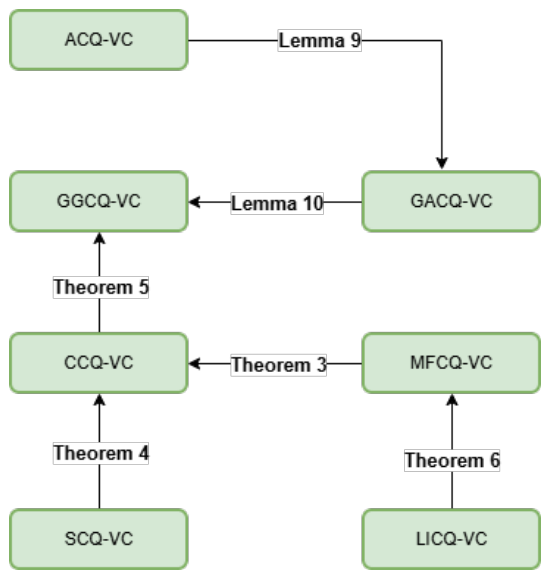
The relationships between various NIMPPVC-tailored constraint qualifications are illustrated in Figure 1.
Now, we furnish an example to establish that all the NIMPPVC-tailored constraint qualifications, namely, CCQ-VC, SCQ-VC, MFCQ-VC, LICQ-VC, ACQ-VC, and GACQ-VC, may fail at the LR-efficient solution of NIMPPVC, except GGCQ-VC. In particular, we demonstrate that GGCQ-VC is the weakest constraint qualification among all the presented NIMPPVC-tailored constraint qualifications for NIMPPVC.
Example 1.
Let us define the following set:
It is well-known that is a 2-dimensional Hadamard manifold endowed with the following Riemannian metric (see, [29]):
The exponential map for is defined as (see, for instance, [32]):
Moreover, the inverse of the exponential map for any is given by:
Consider the following problem:
The feasible set of (P1) is given by:
Evidently, is a feasible element of (P1). The index set Corresponding to , the sets , and X are given as follows:
Similarly, we get the following:
Now, the contingent cone to the set and at are given as:
It can be verified that the Clarke subdifferentials of , and at are:
The NIMPPVC-tailored VC-linearizing cone to the set X is:
Therefore, we have
It follows that GGCQ-VC is satisfied at . However, ACQ-VC, GACQ-VC, CCQ-VC, MFCQ-VC, SCQ-VC, and LICQ-VC are not satisfied at for (P1).
4. KKT-type Optimality Conditions for NIMPPVC
In this section, by employing GGCQ-VC, we establish the KKT-type necessary optimality conditions for LR-efficient solutions of NIMPPVC via Clarke subdifferentials. Furthermore, we derive sufficient criteria of optimality for LR-efficient solutions of NIMPPVC under generalized geodesic convexity hypotheses, along with appropriate restrictions on the index sets.
In the following theorem, we establish a crucial result that will play an important role in deriving the necessary optimality conditions for NIMPPVC.
Theorem 7.
For any , let GGCQ-VC be satisfied at . Then there is no , satisfying the system of inequalities given below:
Proof.
Suppose, to the contrary, that there exists , such that the system of inequalities in (26) is satisfied. As a consequence from Definition 8, we infer that . It may be assumed, without loss of generality, that
In view of the given hypotheses, GGCQ-VC is satisfied at which implies that
It follows that there exists a sequence , such that as Therefore, for each element of the sequence , we have some , satisfying:
where and for every . Then in view of Definition 1, there exist sequences , , and , for each , with as , such that
Now, we define
Therefore, for every , the following inequalities hold:
In view of the given hypotheses, we have is an LR-efficient solution of NIMPPVC. This implies that we arrive at the three cases. Let us consider Case 1:
A function is defined as follows:
In view of Theorem 2, there exist some and , such that
From Proposition 2.1.5 in [52], it can be inferred that there exists a subsequence of such that Using (30) we have
It follows that
On combining (29) and (31), we yield the following:
This implies that
which is a contradiction to (27).
In a similar manner, we arrive at a contradiction for the following cases:
This completes the proof. □
By employing GGCQ-VC, we derive the KKT-type necessary optimality conditions for LR-efficient solutions of NIMPPVC in the subsequent theorem.
Theorem 8.
For any , let GGCQ-VC be satisfied at Moreover, if we assume that
is a closed set, then there exist , , , , , such that
Proof.
In view of the given hypotheses and Theorem 7, the system of inequalities stated below does not have any solution:
By employing Lemma 3, there exist , , , , such that
Set , , and Therefore, there exist , , , , , such that
This completes the proof. □
Remark 4.
Let , , , for all . If , , , are continuously differentiable functions on , then Theorems 7 and 8 reduce to Theorems 3.1 and 3.2, respectively, as derived by Maeda [45].
Let . For the multipliers , , the following index sets are defined as follows:
The following result presents sufficient optimality conditions for LR-efficient solutions of NIMPPVC, under generalized geodesic convexity assumptions.
Theorem 9.
Let be an arbitrary element, such that there exist , , , , , and (32) is satisfied. Moreover, we assume that and , , , are geodesic quasiconvex functions at on the feasible set . Then , provided that are strictly geodesic pseudoconvex functions at on .
Proof.
On the contrary, assume that . Then there is no , such that
and there exists at least one index , for which exactly one of the relation below holds:
Using the strict geodesic pseudoconvexity of we have
On multiplying with with in (34), we get
In view of the given hypotheses, there exist , , , , , and (32) is satisfied. It follows that there exist , , , , , , satisfying the following:
From the given hypothesis we have
This implies that
On combining (37) and (38), we infer that and (36) can be rewritten as follows:
Since , therefore, we have
By employing geodesic quasiconvexity assumptions on , , , at , we yield the following from (40):
On multiplying with , , , in (41), we get:
On combining (39) and (42) we infer that
which is a contradiction to (35). Therefore, . □
To illustrate the significance of Theorems 8 and 9, we provide an example in the framework of a Hadamard manifold with non-constant sectional curvature.
Example 2.
Let and signify the sets of all real symmetric positive definite matrices and symmetric matrices of order respectively. That is, can be characterized as follows:
Let Then the notations and indicate the trace and determinant of matrix respectively. Moreover, admits the structure of a Riemannian manifold equipped with the given Riemannian metric (see, [31]):
From [31] it follows that is a Hadamard manifold with tangent space , for every
The exponential map for is defined as follows (see, for instance, [31]):
The inverse of the exponential map is given as:
where Log denotes the usual logarithmic function on Let be a function. Then its Riemannian gradient is given as follows (see, [31]):
where represents the Euclidean gradient of Ψ at
Now, we consider the following problem:
where , , are real-valued functions.
The set containing all the feasible elements of (P2) is:
Evidently, Furthermore, we obtain the following:
Moreover, there exist and , , , , , , such that
It can be verified that , , , and are strictly geodesic pseudoconvex at Q on the feasible set . In addition, , , are geodesic quasiconvex at Q on the feasible set . Corresponding to Q, the index set
which implies that
Therefore, all the hypotheses in Theorem 9 are satisfied. It follows that Q is an LR-efficient solution of (P2).
To find an LR-efficient solution of NIMPPVC, we propose the following algorithm based on Theorem 9.
Algorithm 1: An Algorithm for Finding an LR-efficient Solution of NIMPPVC
1. Initialization Step:
- (i)
- Input , , , , , , , , , real-valued locally Lipschitz continuous functions defined on an n-dimensional Hadamard manifold .
- (ii)
- Choose a finite number of points .
2. Feasibility Step:
- •
- If , for all , , for all , then is a feasible element of NIMPPVC.
- •
- Otherwise, is not a feasible element of NIMPPVC.
3. Finding Index Sets:
4. KKT Step:
Choose , , , , , , such that (32) is satisfied.
5. Check Generalized Geodesic Convexity:
Check the strictly geodesic pseudoconvexity of and geodesic quasiconvexity of , , , at on the feasible set .
6. Output:
- •
- If Step 5 is satisfied and , then is an LR-efficient solution of NIMPPVC.
- •
- Otherwise, return to Step 1(ii).
Now, we provide the following numerical example to highlight the significance of Algorithm 1.
Example 3.
Let be the Poincaré half-plane, which is defined as follows:
Notably, is a Hadamard manifold of dimension 2 with constant sectional curvature (see, [29]). The manifold is equipped with the Riemannian metric given below:
The exponential map for any is given by (see, [53]):
If ,
If ,
where
The inverse of the exponential map is given by (see, [29]):
where
Consider the following problem:
The feasible set of is
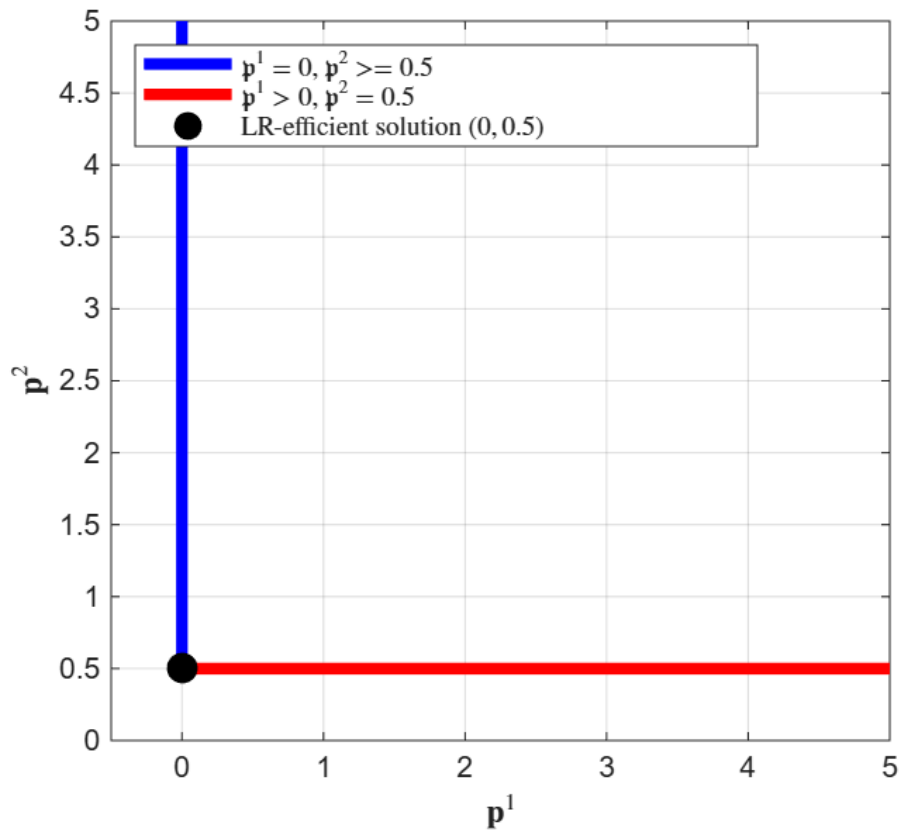
Let and . Now, we consider a finite set , defined as follows:
We then employ Algorithm 1 to find LR-efficient solutions of (P3) using MATLAB R2024b. The numerical results of Algorithm 1 are presented in Table 1.

Table 1.
LR-efficient Solution of () using Algorithm 1.
| S. No. | Data Points | Feasibility | KKT Conditions | Emptiness | Optimality | CPU Time (seconds) |
|---|---|---|---|---|---|---|
| 1. | (-1, 0.167) | No | - | - | - | 0.61 |
| 2. | (-1,0.5) | No | - | - | - | |
| 3. | (-1, 1) | No | - | - | - | |
| 4. | (-1, 2) | No | - | - | - | |
| 5. | (-1, 3) | No | - | - | - | |
| 6. | (0, 0.167) | No | - | - | - | |
| 7. | (0, 0.5) | Yes | Satisfied | Yes | LR-efficient solution | |
| 8. | (0, 1) | Yes | Not Satisfied | - | - | |
| 9. | (0, 2) | Yes | Not Satisfied | - | - | |
| 10. | (0, 3) | Yes | Not Satisfied | - | - | |
| 11. | (1, 0.167) | No | - | - | - | |
| 12. | (1, 0.5) | Yes | Not Satisfied | - | - | |
| 13. | (1, 1) | No | - | - | - | |
| 14. | (1,2) | No | - | - | - | |
| 15. | (1,3) | No | - | - | - | |
| 16. | (-2, 0.167) | No | - | - | - | |
| 17. | (-2,0.5) | No | - | - | - | |
| 18. | (-2,1) | No | - | - | - | |
| 19. | (-2,2) | No | - | - | - | |
| 20. | (-2,3) | No | - | - | - |
5. Conclusions and Future Research Directions
This article investigated a class of nonsmooth interval-valued multiobjective programming problems with vanishing constraints (NIMPPVC) in the Hadamard manifold setting, where the objective and constraint functions are assumed to satisfy locally Lipschitz continuity hypotheses. It has been derived that the various standard constraint qualifications, in particular, Cottle-type, Slater-type, Mangasarian-Fromovitz-type, and linearly independent constraint qualifications, are violated at any arbitrary feasible point of NIMPPVC. We have introduced several NIMPPVC-tailored constraint qualifications, namely ACQ-VC, GACQ-VC, GGCQ-VC, CCQ-VC, SCQ-VC, MFCQ-VC, and LICQ-VC, and further established interrelations among them. By employing GGCQ-VC, we have established the KKT-type necessary optimality conditions for LR-efficient solutions of NIMPPVC via Clarke subdifferentials. Moreover, sufficient criteria of optimality for LR-efficient solutions of NIMPPVC have been derived under generalized geodesic convexity assumptions. An algorithm has been proposed to identify the LR-efficient solutions of NIMPPVC. Various illustrative examples on Hadamard manifolds are furnished to highlight the significance of the results derived in this paper.
The findings presented in this paper generalize several known results available in the existing literature. For instance, the results established in this paper generalize the results derived by Achtziger and Kanzow [1] from the setting of Euclidean space to the Hadamard manifold framework and from MPVC to NIMPPVCs. Various results concerning constraint qualifications and optimality criteria for NIMPPVCs generalize the corresponding results established by Maeda [45] from the framework of Euclidean space to the Hadamard manifold setting, as well as from smooth multiobjective optimization problems to NIMPPVCs. Moreover, several results related to constraint qualifications established in this paper generalize the corresponding results derived by Mishra et al. [6] from the Euclidean space setting to the Hadamard manifold framework, as well as from smooth multiobjective MPVCs to NIMPPVCs. Furthermore, the results presented in this paper extend the corresponding findings of Upadhyay and Ghosh [37] from smooth multiobjective MPVCs to NIMPPVCs within the Hadamard manifold framework. In addition to this, results related to constraint qualifications for NIMPPVC in this paper generalize the corresponding results established by Ghosh et al. [36] from smooth multiobjective optimization problems to NIMPPVCs.
The results established in this paper suggest various options for research avenues. In view of the fact that for a locally Lipschitz continuous function, the limiting subdifferential provides a better Lagrange multiplier rule as compared to the Clarke subdifferential and is the smallest among all robust subdifferentials (see, [54]), various results related to optimality conditions for NIMPPVC established in this paper could be further sharpened by employing limiting subdifferentials in the framework of Riemannian manifolds.
Author Contributions
Conceptualization, B.B.U. and S.S.; Methodology, B.B.U. and S.S.; Software, S.S.; Validation, B.B.U. and S.S.; Formal analysis, S.S., L.T.T. and I.S.-M.; Investigation, B.B.U. and S.S.; Resources, B.B.U.; Writing—original draft, S.S.; Writing—review and editing, B.B.U., S.S., L.T.T. and I.S.-M.. All authors have read and agreed to the published version of the manuscript.
Funding
The second author is supported by the Ministry of Education, Government of India, through the Prime Minister Research Fellowship (PMRF) with PMRF-ID 2703571.
Data Availability Statement
No new data were created or analyzed in this study. Data sharing is not applicable to this article.
Conflicts of Interest
The authors declare that there are no actual or potential conflicts of interest in relation to this article.
References
- Achtziger, W.; Kanzow, C. Mathematical programs with vanishing constraints: Optimality conditions and constraint qualifications. Math. Program. 2008, 114(1), 69–99. [Google Scholar] [CrossRef]
- Hoheisel, T.; Kanzow, C. Stationary conditions for mathematical programs with vanishing constraints using weak constraint qualifications. J. Math. Anal. Appl. 2008, 337, 292–310. [Google Scholar] [CrossRef]
- Hoheisel, T.; Kanzow, C. On the Abadie and Guignard constraint qualifications for mathematical programs with vanishing constraints. Optimization 2009, 58, 431–448. [Google Scholar] [CrossRef]
- Hoheisel, T.; Kanzow, C. First- and second-order optimality conditions for mathematical programs with vanishing constraints. Appl. Math. 2007, 52, 495–514. [Google Scholar] [CrossRef]
- Latombe, J.C. Robot Motion Planning; Kluwer: Norwell, MA, USA, 1991. [Google Scholar]
- Mishra, S.K.; Singh, V.; Laha, V.; Mohapatra, R.N. On constraint qualifications for multiobjective optimization problems with vanishing constraints. In Optimization Methods, Theory and Applications; Xu, H., Wang, S., Wu, S.Y., Eds.; Springer: Berlin, Germany, 2015; pp. 95–135. [Google Scholar]
- Sadeghieh, A.; Kanzi, N.; Caristi, G.; Barilla, D. On stationarity for nonsmooth multiobjective problems with vanishing constraints. J. Glob. Optim. 2022, 82(4), 929–949. [Google Scholar] [CrossRef]
- Antczak, T. Optimality results for nondifferentiable vector optimization problems with vanishing constraints. J. Appl. Anal. Comput. 2023, 13(5), 2613–2629. [Google Scholar] [CrossRef] [PubMed]
- Moore, R.E. Methods and Applications of Interval Analysis; SIAM: Philadelphia, PA, USA, 1979. [Google Scholar]
- Moore, R.E. Computational Functional Analysis; Ellis Horwood Limited: England, 1985. [Google Scholar]
- Gutjahr, W.J.; Pichler, A. Stochastic multi-objective optimization: A survey on non-scalarizing methods. Ann. Oper. Res. 2016, 236(2), 475–499. [Google Scholar] [CrossRef]
- Shih, H.S.; Lai, Y.J.; Lee, E.S. Fuzzy approach for multi-level programming problems. Comput. Oper. Res. 1996, 23, 73–91. [Google Scholar] [CrossRef]
- Wu, H.C. The Karush–Kuhn–Tucker optimality conditions in multiobjective programming problems with interval-valued objective functions. Eur. J. Oper. Res. 2009, 196, 49–60. [Google Scholar] [CrossRef]
- Upadhyay, B.B.; Stancu-Minasian, I.M.; Sain, S.; Mishra, P. Generalized Minty and Stampacchia vector variational-like inequalities and interval-valued vector optimization problems. In Continuous Optimization and Variational Inequalities; Jayswal, A., Antczak, T., Eds.; Chapman and Hall/ CRC: New York, 2022; pp. 199–221. [Google Scholar]
- Jayswal, A.; Stancu-Minasian, I.-M.; Banerjee, J. Optimality conditions and duality for interval-valued optimization problems using convexifactors. Rend. Circ. Mat. Palermo. 2016, 65(1), 17–32. [Google Scholar] [CrossRef]
- Upadhyay, B.B.; Stancu-Minasian, I.M.; Mishra, P. On relations between nonsmooth interval-valued multiobjective programming problems and generalized Stampacchia vector variational inequalities. Optimization 2023, 72(10), 2635–2659. [Google Scholar] [CrossRef]
- Upadhyay, B.B.; Pandey, R.K.; Liao, S. Newton’s method for interval-valued multiobjective optimization problem. J. Ind. Manag. Optim. 2024, 20, 1633–1661. [Google Scholar] [CrossRef]
- Upadhyay, B.B.; Sain, S.; Stancu-Minasian, I.M. Lagrange duality and saddle point optimality conditions for nonsmooth interval-valued multiobjective semi-infinite programming problems with vanishing constraints. Axioms 2024, 13, 1–45. [Google Scholar] [CrossRef]
- Jayswal, A.; Stancu-Minasian, I.-M.; Banerjee, J. On interval-valued programming problem with invex functions. J. Nonlinear Convex Anal. 2016, 17(3), 549–567. [Google Scholar]
- Antczak, T.; Upadhyay, B.B.; Mohapatra, R.N. Optimality conditions and duality results for nondifferentiable vector interval-valued optimization problems with G-invex functions. Rend. Circ. Mat. Palermo II. Ser. 2026, 75(108), 1–25. [Google Scholar] [CrossRef]
- Jayswal, A.; Stancu-Minasian, I.M.; Banerjee, J.; Stancu, A.M. Sufficiency and duality for optimization problems involving interval-valued invex function in parametric form. Oper. Res. Int. J. 2015, 15, 137–161. [Google Scholar] [CrossRef]
- Singh, D.; Dar, B.A.; Kim, D.S. KKT optimality conditions in interval-valued multiobjective programming with generalized differentiable functions. Eur. J. Oper. Res. 2016, 254, 29–39. [Google Scholar] [CrossRef]
- Antczak, T. Optimality conditions and duality results for nonsmooth vector optimization problems with multiple interval-valued objective function. Acta Math. Sci. Ser. B Engl. Ed. 2017, 37, 1133–1150. [Google Scholar] [CrossRef]
- Absil, P.-A.; Mahony, R.; Sepulchre, R. Optimization Algorithms on Matrix Manifolds; Princeton University Press: Princeton, NJ, USA, 2009. [Google Scholar]
- Belkin, M.; Niyogi, P. Semi-supervised learning on Riemannian manifolds. Mach. Learn. 2004, 56, 209–239. [Google Scholar] [CrossRef]
- Arsigny, V.; Fillard, P.; Pennec, X.; Ayache, N. Geometric means in a novel vector space structure on symmetric positive-definite matrices. SIAM J. Matrix Anal. Appl. 2007, 29(1), 328–347. [Google Scholar] [CrossRef]
- Sommer, S.; Lauze, F.; Hauberg, S.; Nielsen, M. Manifold valued statistics, exact principal geodesic analysis and the effect of linear approximations. In Computer Vision–ECCV 2010, Lecture Notes in Computer Science; Daniilidis, K., Maragos, P., Paragios, N., Eds.; Springer: Berlin, Germany, 2010; pp. 43–56. [Google Scholar]
- Pennec, X. Manifold valued image processing with SPD matrices. In Riemannian Geometric Statistics in Medical Image Analysis; Pennec, X., Sommer, S., Fletcher, T., Eds.; Elsevier: Amsterdam, The Netherlands, 2020; pp. 75–134. [Google Scholar]
- Udrişte, C. Convex Functions and Optimization Methods on Riemannian Manifolds; Springer: Berlin, Germany, 2013. [Google Scholar]
- Papa Quiroz, E.A.; Quispe, E.M.; Oliveira, P.R. Steepest descent method with a generalized Armijo search for quasiconvex functions on Riemannian manifolds. J. Math. Anal. Appl. 2009, 341, 467–477. [Google Scholar] [CrossRef]
- Ferreira, O.P.; Louzeiro, M.S.; Prudente, L.F. Gradient method for optimization on Riemannian manifolds with lower bounded curvature. SIAM J. Optim. 2019, 29, 2517–2541. [Google Scholar] [CrossRef]
- Sakai, T. Riemannian Geometry; American Mathematical Society: Providence, RI, USA, 1996. [Google Scholar]
- Tung, L.T.; Singh, V. Optimality conditions and duality for mathematical programming with equilibrium constraints including multiple interval-valued objective functions on Hadamard manifolds. Jpn. J. Indust. Appl. Math. 2024, 41, 1105–1136. [Google Scholar] [CrossRef]
- Upadhyay, B.B.; Li, L.; Mishra, P. Nonsmooth interval-valued multiobjective optimization problems and generalized variational inequalities on Hadamard manifolds. Appl. Set.-Valued Anal. Optim. 2023, 5, 69–84. [Google Scholar] [CrossRef]
- Chen, S. The KKT optimality conditions for optimization problem with interval-valued objective functions on Hadamard manifolds. Optimization 2022, 71, 613–632. [Google Scholar] [CrossRef]
- Ghosh, A.; Upadhyay, B.B.; Stancu-Minasian, I.M. Constraint qualifications for multiobjective programming problems on Hadamard manifolds. Aust. J. Math. Anal. Appl. 2023, 20, 1–18. [Google Scholar] [CrossRef]
- Upadhyay, B.B.; Ghosh, A. On constraint qualifications for mathematical programming problems with vanishing constraints on Hadamard manifolds. J. Optim. Theory Appl. 2023, 199, 1–35. [Google Scholar] [CrossRef]
- Nguyen, L.T.; Chang, Y.L.; Hu, C.C.; Chen, J.S. Optimality and KKT conditions for interval-valued optimization problems on Hadamard manifolds. Optimization 2024, 74, 1–33. [Google Scholar] [CrossRef]
- Hosseini, S.; Pouryayevali, M.R. Generalized gradients and characterization of epi-Lipschitz sets in Riemannian manifolds. Nonlinear Anal. 2011, 74, 3884–3895. [Google Scholar] [CrossRef]
- Karkhaneei, M.M.; Mahdavi-Amiri, N. Nonconvex weak sharp minima on Riemannian manifolds. J. Optim. Theory Appl. 2019, 183, 85–104. [Google Scholar] [CrossRef]
- Chryssochoos, I.; Vinter, R.B. Optimal control problems on manifolds: A dynamic programming approach. J. Math. Anal. Appl. 2003, 287, 118–140. [Google Scholar] [CrossRef]
- Ledyaev, Y.S.; Zhu, Q.J. Nonsmooth analysis on smooth manifolds. Trans. Amer. Math. Soc. 2007, 359, 3687–3732. [Google Scholar] [CrossRef]
- Hosseini, S. Optimality conditions for global minima of nonconvex functions on Riemannian manifolds. Pac. J. Optim. 2015, 1–12. [Google Scholar]
- Upadhyay, B.B.; Ghosh, A.; Treanţa, S. Constraint qualifications and optimality criteria for nonsmooth multiobjective programming problems on Hadamard manifolds. J. Optim. Theory Appl. 2024, 200, 794–819. [Google Scholar] [CrossRef]
- Maeda, T. Constraint qualifications in multiobjective optimization problems: Differentiable case. J. Optim. Theory Appl. 1994, 80(3), 483–500. [Google Scholar] [CrossRef]
- Moore, R.E. Interval Analysis; Prentice-Hall: Englewood Cliffs, NJ, USA, 1966. [Google Scholar]
- Barani, A. Generalized monotonicity and convexity for locally Lipschitz function on Hadamard manifolds. Differ. Geom.-Dyn. Syst. 2013, 15, 26–37. [Google Scholar]
- Upadhyay, B.B.; Poddar, S. Optimality conditions and duality for robust nonsmooth multiobjective semi-infinite optimization problem on Hadamard manifolds. Appl. Anal. Optim. 2024, 8, 167–201. [Google Scholar]
- Chen, S.-I.; Fang, C.-J. Vector variational inequality with pseudoconvexity on Hadamard manifolds. Optimization 2016, 65, 2067–2080. [Google Scholar] [CrossRef]
- Tung, L.T.; Tam, D.H. Optimality conditions and duality for multiobjective semi-infinite programming on Hadamard manifolds. Bull. Iran. Math. Soc. 2022, 48, 2191–2219. [Google Scholar] [CrossRef]
- Li, X.F. Constraint qualifications in nonsmooth multiobjective optimization. J. Optim. Theory Appl. 2000, 106, 373–398. [Google Scholar] [CrossRef]
- Clarke, F.H. Optimization and Nonsmooth Analysis; Wiley-Interscience: New York, NY, USA, 1983. [Google Scholar]
- Upadhyay, B.B.; Ghosh, A.; Treanţa, S. Optimality conditions and duality for nonsmooth multiobjective semi-infinite programming problems with vanishing constraints on Hadamard manifolds. J. Math. Anal. Appl. 2023, 531, 1–25. [Google Scholar] [CrossRef]
- Mordukhovich, B.S. Variational Analysis and Generalized Differentiation I. Basic Theory; Springer-Verlag: Berlin, Germany, 2006. [Google Scholar]
Figure 1.
Interrelations among the constraint qualifications for NIMPPVC.
Disclaimer/Publisher’s Note: The statements, opinions and data contained in all publications are solely those of the individual author(s) and contributor(s) and not of MDPI and/or the editor(s). MDPI and/or the editor(s) disclaim responsibility for any injury to people or property resulting from any ideas, methods, instructions or products referred to in the content. |
© 2026 by the authors. Licensee MDPI, Basel, Switzerland. This article is an open access article distributed under the terms and conditions of the Creative Commons Attribution (CC BY) license (http://creativecommons.org/licenses/by/4.0/).
Copyright: This open access article is published under a Creative Commons CC BY 4.0 license, which permit the free download, distribution, and reuse, provided that the author and preprint are cited in any reuse.