
Submitted:
26 August 2026
Posted:
28 August 2026
You are already at the latest version
Abstract
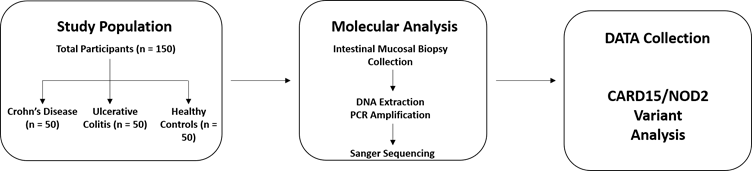
Crohn’s disease (CD) is a multifactorial inflammatory bowel disease (IBD) arising from interactions among genetic susceptibility, immune dysregulation, intestinal microbiota, and environmental factors. However, genetic and environmental determinants of IBD in Djibouti remain poorly characterized. This study aimed to characterize the demographic and clinical profile of IBD and investigate the distribution and association of major CARD15/NOD2 variants with CD in a Djiboutian population. A total of 150 participants aged 18–30 years were enrolled, including 50 CD patients, 50 ulcerative colitis (UC) patients, and 50 healthy controls. Demographic, clinical, familial, lifestyle, and environmental characteristics were recorded. Genomic DNA isolated from intestinal mucosal biopsies was analyzed by PCR followed by Sanger sequencing for R702W, G908R, and 1007fs variants. Carrier and allele frequencies were assessed using odds ratios (ORs), 95% confidence intervals (CIs), and categorical statistical tests. CD patients showed higher carrier frequencies of R702W (24.0%), G908R (16.0%), and 1007fs (20.0%) than controls (10.0%, 6.0%, and 8.0%, respectively). Allele-level analysis indicated increased odds for R702W (OR=2.55), G908R (OR=2.67), and 1007fs (OR=2.59), although associations were not statistically significant. Abdominal pain and chronic diarrhoea predominated clinically, with greater weight loss in CD and rectal bleeding in UC. Notably, all CD participants reported khat consumption before disease onset. These findings suggest potential genetic susceptibility to CD and identify khat consumption as a hypothesis-generating environmental factor requiring further investigation.
Keywords:
Crohn’s disease
; CARD15/NOD2
; R702W
; G908R
; 1007fs
; Khat
Copyright: This open access article is published under a Creative Commons CC BY 4.0 license, which permit the free download, distribution, and reuse, provided that the author and preprint are cited in any reuse.