

Submitted:
20 August 2026
Posted:
28 August 2026
You are already at the latest version
Abstract
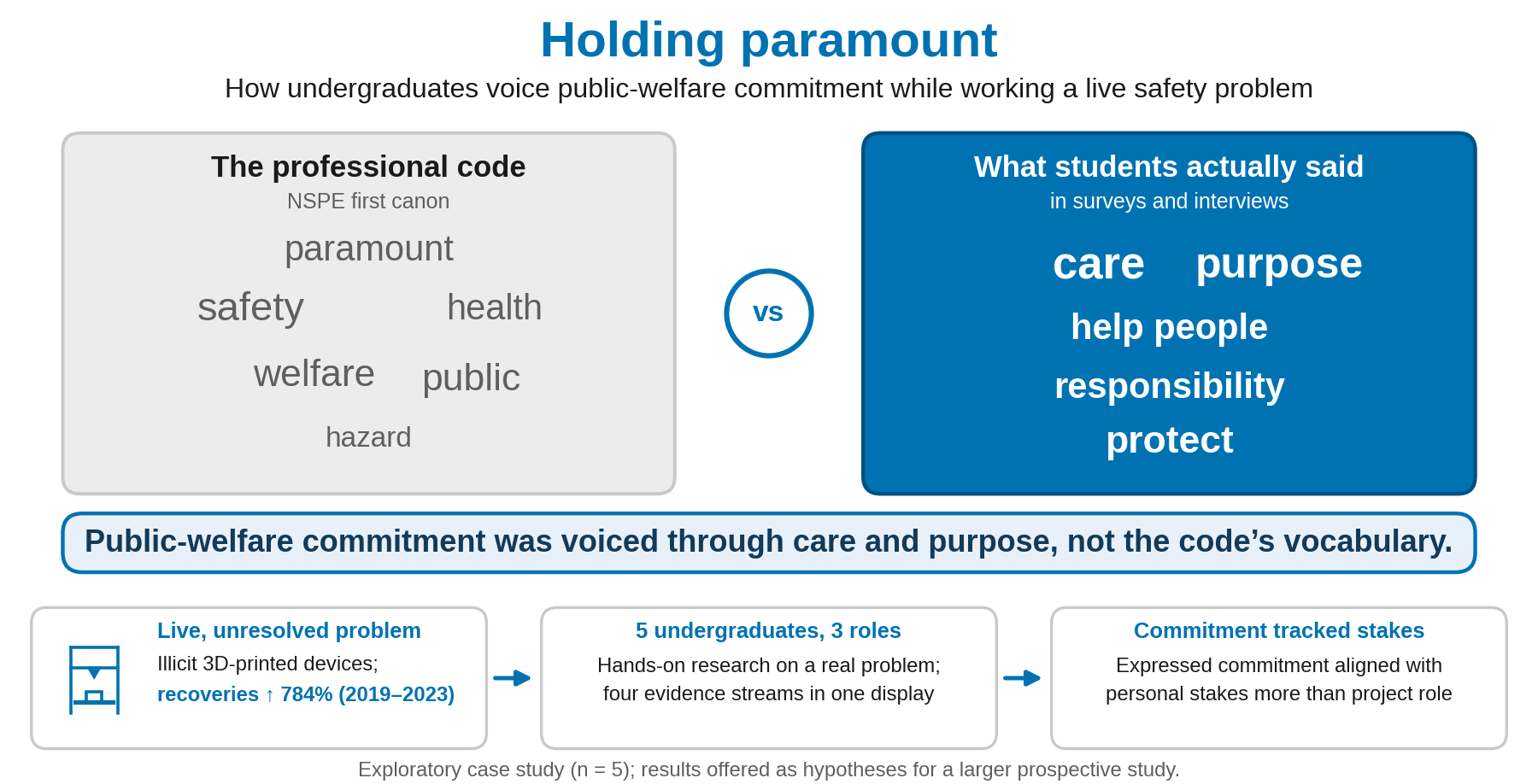
STEM education increasingly asks students to work on real-world problems, yet ethics is still taught mostly through retrospective studies of past failures that position students as analysts after a decision. This case study examines what undergraduate engineering students express when they instead work on an unresolved, real-world public-safety problem: the illicit manufacture of machinegun conversion devices (MCDs) on consumer 3D printers, for which no design safety standard currently exists. We ask how five stu-dents across three roles in a multi-year design research program express their com-mitment to public welfare, and in what language. Five undergraduate contributors completed the recruitment survey (n = 5), semi-structured interviews (n = 4), and a pilot survey of public-welfare obligation adapted from the NSPE Code of Ethics (n = 5); re-sponses were analyzed with an a priori dictionary-based text analysis and integrated through a joint display. Students voiced their obligation through the language of care and purpose rather than the vocabulary of the professional code. We advance these results as hypotheses for a larger prospective study: that real-world problem solving elicits pub-lic-welfare commitment and may bear on the documented decline across engineering education.
Keywords:
engineering education
; public welfare
; engineering ethics
; additive manufacturing
; project-based learning
; real-world learning
1. Introduction
STEM education increasingly emphasizes project-based learning to prepare students for the social and ethical responsibilities of professional practice (Mills & Treagust, 2003; Sheppard, Macatangay, Colby, & Sullivan, 2008). However, ethics in STEM is still taught mostly through retrospective studies of past failures, which ask students to analyze decisions that were already made and judged (Martin, Conlon, & Bowe, 2021). Research also documents a decline in students’ concern for public welfare across engineering education rather than a gain (Cech, 2014). Professional codes of ethics, chief among them the National Society of Professional Engineers (NSPE) Code, which charges engineers to hold paramount the safety, health, and welfare of the public, anchor much of this instruction, yet reviews of the field find their influence on students’ formation uneven and difficult to measure (Venkata Krishnan et al., 2026). This paper explores an undercurrent of this phenomenon: when undergraduates contribute to an unresolved real-world problem alongside professional researchers, how do they express professional ethical judgment, and how might engineering education deliberately structure such participation as ethical practice in ways that are mutually contributive rather than extractive?
The problem the students worked on is active and unresolved: the illicit manufacture of machinegun conversion devices on consumer 3D printers, for which no design safety standard yet exists. Working on a real problem asked these students to grapple with ethical decisions carrying genuine responsibility and consequences as well as current and personal stakes, and what they expressed bore on how they described themselves as engineers and how they stated their commitment to public welfare. We report this exploratory case study of five undergraduate contributors working across three project roles: two in paid undergraduate research, one in an honors thesis, and two in senior capstone design. This paper addresses two research questions:
- How do undergraduate contributors express their commitment to public welfare while working on an active, real-world problem, and does their role or perceived stakes impact their expressions?
- How does hands-on participation in an active public-safety problem shape the vocabulary and framing students use to describe their ethical obligations?
1.1. Background
How a Newsworthy Public Harm Became the Ground for Ethical Learning
A machinegun conversion device (MCD), often called a ‘switch’ or ‘auto sear,’ is a small part that converts a semi-automatic pistol to fully automatic fire at up to 1200 rounds per minute (20 rounds per second). Federal law makes it illegal for nearly everyone to manufacture or possess (26 U.S.C. § 5845(b); 18 U.S.C. § 922(o)). With the evolution of technology, these parts are now extraordinarily accessible through 3D printing: the part prints in about twenty minutes in commonly available plastic for roughly the cost of the material, on an inexpensive consumer machine, from files that circulate freely online. From 2019 to 2023, U.S. law enforcement recoveries of MCDs increased 784% (11,088 devices recovered nationwide; Bureau of Alcohol, Tobacco, Firearms and Explosives (ATF), 2025), and printed firearms and components have become a recurring subject of national and local news coverage.
The harm has an evident youth dimension. Instances involving high school and even middle school students producing these devices at home have been documented in several cities (Ong, 2026; Summers, 2026). The undergraduate students in this study had already encountered the technical problems they would work on prior, through news headlines. In their interviews, several shared that they had heard of 3D-printed firearms or “ghost guns” before working on these projects. Involvement with the 3D-printed MCD problem changed how they read subsequent news and how they understood their engineering responsibilities. It was the public harm dimension that primarily drew these students into the research. Then, direct engagement with the technical cause of that harm sharpened their awareness and renewed their sense of obligation. This bidirectional flow contributed to shaping their ethical response. One participant in this study said that she had not realized the 3D printers she already used could be connected to danger and gun violence and later, she described reading news of shootings differently. Furthermore, she then practiced ethical decision making with real-world consequences; she wrote and implemented a safety reminder for the makerspace training she runs. Her institution, like most U.S. universities, maintains a no-weapons policy that this printing capability effectively undermines.
The problem is also genuinely unresolved. It resists familiar controls, and no effective safeguard currently prevents a determined person from downloading a file and printing a prohibited part. The research program these students participated in conducts pre-standardization activities that support the development of voluntary consensus product-safety standards intended to address it. For this study, we focus not on the standards process but the character of the work the students did within it: research on a real, current, and unsolved threat to public safety, with no settled answer to hand them and opportunities to exercise ethical judgement and reasoning.
Engineering Ethics Education: Engaging Beyond Compliance
Engineering educators broadly value the formation of public-welfare commitment, and the profession has written that value into its accreditation (Mitcham, 2009; Howland et al., 2024). The Accreditation Board for Engineering and Technology (ABET) Criterion 3, Student Outcome 4, requires that engineering programs demonstrate that students can “recognize ethical and professional responsibilities in engineering situations and make informed judgments, which must consider the impact of engineering solutions in global, economic, environmental, and societal contexts” (ABET, 2025). At one author’s institution, a public expression of the engineer’s obligation to society is displayed prominently. Yet knowing a principle and feeling bound by it are distinct. Colby and Sullivan (2008), in their review of engineering ethics instruction, argue that ethical identity formation requires more than exposure to codes; it requires practice making high-stakes decisions in context where the student experiences responsibility for real consequences. Reviewing how programs teach ethics, Colby and Sullivan observe that such practice most often reaches students as short ethics modules within the capstone design course, and they urge institutions to track and coordinate ethical learning across the curriculum, from the first year through the senior capstone.
There is research documenting that for some students, concern for public welfare and professional responsibility tends to decline across their engineering education. Cech (2014) describes a culture of disengagement, in which students begin with strong humanitarian and social-impact values that attenuate as they move through their studies. Bielefeldt and Canney (2016), measuring social-responsibility attitudes directly, report a mixed picture of stability and decline across the college experience. Longitudinal studies show that as undergraduate students progress through their degrees, their attitudes, priorities, and identity formation are heavily influenced by “anticipatory socialization” and informal learning such as internships, industry engagement, team project dynamics, and perceived labor market expectations (Seron et al., 2015). Research on the hidden curriculum of engineering makes a complementary point: students absorb professional norms, and a sense of who belongs, as much through the implicit culture of their programs as through explicit instruction (Villanueva Alarcón et al., 2018). Tormey et al. (2015) extend this point to ethics specifically: where a program’s culture prizes narrowly technical solutions and individualistic, competitive assessment, open-ended ethical dilemmas can feel out of step with the discipline, positioning ethics instruction to swim against the cultural tide of the program. Consequently, changes in attitudes toward students’ identities and commitments observed over time reflect a complex interaction between formal coursework, professional culture, and external economic incentives (Howland et al., 2024; Stevens et al., 2008).
Engineering ethics pedagogy relies heavily on the case-study model: examining historical product failures like the Challenger disaster, the Ford Pinto, the Tacoma Narrows Bridge, and asking students to identify the ethical dimensions of decisions that were already made and judged (Martin et al., 2021). These retrospective cases are valuable for developing ethical reasoning, but they offer a limited model of professional ethical formation. They position students as analysts after the fact, rather than as agents in the moment of decision (Huff & Frey, 2005). Instructors themselves often express a preference for immersive, real-world projects (Martin et al., 2021), yet few programs have developed pedagogies that connect students’ classroom work to active ethical problems. A recent systematic review of engineering ethics interventions and assessments, covering 159 studies from 2013 to 2022, likewise finds ethics pedagogy unevenly implemented, still weighted toward classroom-bound instruction, and often confined to a single course or semester, a short-term focus that makes it hard to trace how students’ ethical understanding develops over time (Venkata Krishnan et al., 2026).
Project- and problem-based learning has become a common vehicle for this kind of situated practice, and there is evidence that it strengthens students’ sense of professional responsibility when the problems are authentic and consequential (Mills & Treagust, 2003). These students are also bound for professional practice, where, amidst Industry 5.0’s turn toward human-centered and socially responsible technology (Breque et al., 2021), ethics is a condition of the work rather than an independent and detachable subject. That professional horizon is where formal codes of ethics are meant to provide guidance and guardrails, yet the role of professional codes in engineering students’ ethical development is not well established. Davis (2012) defends engineering codes as central to professional identity, arguing that these codes crystallize shared commitments and give engineers a language for professional judgment. But virtue ethics and care-ethics approaches (Harris, 2008; Noddings, 1984) challenge this framing. They argue that abstract principles, detached from relational context and care of others, do not drive ethical action. From this perspective, ethical commitment emerges through relationships and through practice attending to others’ vulnerabilities, not through memorization of principles. Framed this way, ethical commitment is less a fact to be learned than a capacity that curricula can deliberately cultivate and assess by giving students structured, supported practice in recognizing and responding to a complex range of vulnerabilities and needs. As early as 1999, Pantazidou and Nair traced this tension in engineering education, finding that students develop moral agency through narratives of responsibility and relationship more readily than through instruction in ethical codes.
A long-standing tradition in the learning sciences points toward an alternative: learning ethics through authentic, situated practice aligned with Lave and Wenger’s (1991) theory of legitimate peripheral participation at the edge of professional practice. Applied to ethics education, this suggests that students develop ethical commitment when they contribute to real, high-stakes problems where their choices have consequences for others. Martin et al. (2021) found that case-based learning deepened when cases were immersive and involved stakeholder engagement; they argue for moving toward scenarios grounded in real practice. Existing programs already move in this direction: MIT’s Experiential Ethics summer course, for instance, pairs small-group ethical reflection with students’ concurrent internships and research, treating experiential ethics as a complement to, not a replacement for, conventional ethics coursework (Munday, 2026). TU Delft has likewise shifted from stand-alone ethics courses toward ethics modules embedded in technical courses and experiential approaches, grounded in a view of technology as value-laden (Phoenix et al., 2026), and Purdue’s EPICS program treats ethics as implicit in the everyday, micro-level decisions of design rather than as a separate topic (Kenny Feister et al., 2016). The same review also flags ethical self-efficacy (students’ confidence in acting on their ethical judgment) as underexplored, and points to mentorship, repeated situated practice, and exposure to role models as promising ways to build it (Venkata Krishnan et al., 2026). Hess and Fore (2018), in a systematic review of US engineering ethics interventions, found that interventions combining authentic context with explicit reflection on ethical decision-making showed the strongest evidence of attitude change in students.
Recent work continues to move case-based learning toward more authentic, sociotechnical forms; Saikia and Archer (2026), for example, augment case studies with active-learning modules to foreground the social dimensions of engineering practice. Yet little research examines how students develop ethical commitment while actively contributing to unresolved, high-stakes public-safety problems that lack a settled answer, where the students’ work genuinely affects whether and how the problem is addressed. Most empirical work on ethical formation focuses either on isolated classroom interventions or on post-hoc analysis of professionals’ retrospective accounts. The present study explores this gap by examining five undergraduate researchers’ expressed ethical commitment while they engaged in hands-on work on an unresolved, newsworthy public threat.
2. Materials and Methods
2.1. Approach
Within a faculty research program to advance safer 3D printing, we engaged five undergraduates as contributors to applied safety and policy research through three participation roles: two-term senior capstone design, a single-term honors thesis, and paid independent research (Table 1). We invited the students to participate as contributors in solving a real product-safety problem, and as stakeholders whose participation made the work consequential rather than a classroom exercise. The students’ tasks included problem definition, enforcement-landscape research, user-facing safety design, and firmware-structure work. This served as research that fed into pre-standardization work our professional research group carries forward. The students did not serve as members of a standards committee and did not attend standards meetings; they conducted data collection, policy research, and design work whose findings helped to inform the pre-standards phase.
The study draws on four streams of evidence per student:
- A recruitment survey (n = 5),
- A semi-structured interview of 30–60 minutes (n = 4; one student declined the interview),
- A pilot of a survey on the public-welfare obligations of the NSPE Code of Ethics (n = 5),
- A textual analysis of the students’ words expressed in streams 1, 2, and 3.
For the pilot commitment survey (Stream 3), the assignment of items to constructs is a priori, fixed during item generation. Each item in Questionnaire 2 is tagged with its intended construct:
- Public Welfare — 7 items
- Internalized Values — 5 items
- Licensure Commitment — 4 items
We report construct means as descriptive summaries of these a priori groupings. We do not test whether the items load as separate factors at n = 5, and we defer that validation to a larger sample.
For Stream 4, we analyzed the written and transcribed material with a dictionary-based text analysis in R (quanteda), using a single dictionary fixed a priori from the NSPE first canon, to hold paramount the safety, health, and welfare of the public. No term was derived from the corpus, so there is no term-selection circularity, though word sense remains a limitation. Counts are normalized to hits per 1,000 words. We report the text stream as a transparency check. In the prospective study we recommend replacing lexical counting with qualitative thematic coding or with semantic-embedding similarity between student text and canonical statements of the first canon.
We do not treat engineering identity as a measured construct. We note only that every participant described themselves as an engineer in open-ended responses; we did not administer a validated identity instrument (e.g., Carlone & Johnson, 2007; Godwin, 2016), so we make no claim about variation in identity. We focus on commitment, defined as the construct Meyer and Allen call normative commitment: an internalized, felt obligation—a sense that one ought to act (Meyer & Allen, 1991), which Meyer, Allen, and Smith extended to occupations (Meyer, Allen, & Smith, 1993). We do not adjudicate whether the obligation is owed to the profession or to its code; we scope it to the public-welfare values named in the NSPE Code of Ethics, chiefly the first canon. This represents an adaptation of Meyer and Allen’s framework: rather than commitment to an employing organization, we measure normative commitment to the public-welfare principle that professional engineering ethics codifies. In this study, we assess it through endorsement of items reflecting the NSPE first canon: the obligation to hold paramount the safety, health, and welfare of the public.
2.2. Participants, Consent, and Pseudonymization
Five students participated voluntarily under an approved institutional review board protocol. Because the cohort is small (n = 5) and drawn from one institution, role descriptors are generalized and identifying project detail is removed to limit reidentification by local readers, consistent with the protocol. Four completed interviews; the fifth (Student E) consented to the surveys but not to an interview, so that student contributes to the survey and text streams only. We identify students by pseudonym (A–E) and by role rather than name, and we retain the student’s role in the analysis because it may be explanatory. Names of staff, peers, employers, and collaborators are removed from quoted passages, and institutional detail is generalized.
3. Results
Students engaged the public-welfare obligation through concrete, protective goals: eliminating the prohibited parts and making printers safer and easier for younger users to use. In reflection, they described wanting to keep makerspace users safe and wanting to work on projects that “helped people.” Several showed awareness of the technology’s role in harm. One reported reading news of shootings differently, checking whether printed parts were involved. This student also added a safety reminder to the makerspace training they provide. Another described how quickly a determined person reaches the files, “about fifteen minutes” to a full tutorial video on YouTube detailing how to set up the 3D printer and manufacture MCDs. Two framed their motivation in professional-ethics terms: one wanted “a purpose bigger than myself” that would “go toward helping people,” and another located the work in being “a caring person.”
All five participants described themselves as engineers. Because we did not measure identity with a validated instrument, we do not interpret this uniformity. Our analysis concerns the variation we observed across the three commitment constructs.
The pattern was graded on the three streams that were able to record the students’ public welfare commitments directly, how the student framed the goal, what the student emphasized in the interview, and how the student endorsed public-welfare items on the pilot, and the rows of Table 2 are ordered by it. The two students who land together at the cohort’s public-welfare low, C (skills-oriented paid research) and E (capstone, but currently low-stakes), share low stakes in their projects, not a common role. The fourth stream, a dictionary count of first-canon vocabulary, did not reproduce this ordering, as the note to Table 2 details.
A further observation concerns vocabulary. As the quotes above show, students framed their obligation in the language of care, purpose, and helping (Streams 1 and 2). The canon’s own words, safety, health, welfare, and the public, rarely appeared, and when they did they often carried an unrelated sense (see the note to Table 2 and the Appendix). The student who voiced the strongest sense of purpose used none of the canon’s words at all, which shows the dictionary count missed commitment rather than measured it. This vocabulary finding rests on the qualitative reading of Streams 1 and 2; we report the dictionary counts only to make the word-sense limitation visible. We read the pattern as a finding about how these undergraduates talk about their obligations: the vocabulary of the NSPE Code is not yet their native language, which is itself relevant to professional formation and to how the Code’s canons might be taught.
Figure 1 presents the commitment pilot. Several cells sit at or near the four-point ceiling, which limits how finely the pilot can distinguish the students’ commitments. Because the pilot used a four-point forced-choice format, the endorsement clustered near the upper bound. The rank ordering among the most committed students therefore rests on small differences near the ceiling and should be read as ordinal and provisional.
4. Discussion
The findings and their implications should be discussed in the broadest context possible. Future research directions may also be highlighted. Three patterns stand out and inform the hypotheses we pose for future work.
4.1. Pattern 1: Task Engagement and Ethical Framing
The aspect of the ethical problem a student emphasized aligned with the specific task they worked on. The two capstone students divided the systems-level work into subsystems aligned with their technical interests: Student D worked on the user-facing safety and usability problem and framed the ethics around protecting young users, while Student E considered the G-code integrity and firmware-security piece and framed the work in technical terms. The honors-thesis student (B) worked alone on a defined project component related to geometry-based part recognition and framed the ethics as individual ownership and a purpose larger than the self. The students conducting paid-research (A and C) worked on problem definition and the policy and enforcement landscape, and their ethical talk centered on responsibility for where to take an open-ended problem. Different entry points, as well as different tasks within the same entry point, appear to surface different aspects of professional ethics. This pattern rests on the survey and interview streams.
4.2. Pattern 2: Commitment and Stakes
How strongly the student expressed commitment appeared to align with the self-reported stakes and personal relevance students found in their work, more so than with their project role or title alone. Project role, task-level stakes, and proximity to end users covary in this cohort. The two capstone students, for example, are at once both close to users and in the capstone role. This study cannot separate these explanations, so we state Pattern 2 as a conjecture raised by the data. For commitment measures, endorsement was highest for the capstone student working with users and lowest for the student whose current work is distanced from public safety, which fits stakes more than role.
4.3. Pattern 3: The Language of Formation
That students expressed obligation through care and purpose rather than the canon’s vocabulary of safety, health, welfare, and the public is not evidence that they hold the obligation weakly. It suggests instead that formal professional codes are not yet aligned with the language these students use to reason about duty. The care-and-purpose vocabulary that these students used aligns with the humanitarian and social-impact values that students enter engineering education with, as documented by Cech (2014) and tracked across the degree by the social-responsibility literature (Bielefeldt & Canney, 2016). Changes in vocabulary students use to describe their work as engineers could be partially explanatory of the decline in public-welfare orientation that motivates the study. This points to an opportunity in how the engineering ethics canon is introduced. Connecting ethics codes to the language of care and purpose students already use, so that the formal vocabulary names something they have felt rather than standing apart from it, may help the obligation take root, and experiential work like this offers one setting where that connection can form.
4.4. Limitations of the Formation Claim
We observed and documented students’ expressed commitment and articulated professional identity at a single timepoint during active engagement in consequential work. We cannot claim formation, or durable change in ethical reasoning, without longitudinal data tracking these students’ commitments before engagement, during, and months or years after project completion. What we can say is that as a case study engaging students in authentic high-stakes work, these students expressed commitment to public welfare in language of care and purpose rather than code vocabulary, and that this expression tracked more closely with task-level stakes rather than with project role. Whether this association is generalizable and whether expression in a one-time interview becomes durable formation are the hypotheses our data raise.
Several limitations constrain these hypotheses. First, the cohort is self-selected. Students who volunteer for research on gun-safety and public harm are plausibly predisposed toward public-welfare concern, which likely contributes to the high floor we observed—four of five students endorsed Public-Welfare items at or above 3.7 on the four-point scale. Selection limits generalization and means these results describe what already-engaged students express while doing this work, not whether such work would raise public-welfare commitment in a representative cohort. A prospective study should compare volunteers with assigned participants, or measure the same students before and after engagement, to separate selection from experience. Second, role is confounded with stakes and proximity to users: capstone students are both closest to users and in the capstone role, so this design cannot separate role, stakes, and proximity to the public as competing explanations, and a prospective study should be built to break that confound. Third, the dictionary stream is a transparency check rather than a measure (see Note to Table 2). Fourth, the sample is small (n = 5) and drawn from one institution, so these results should be viewed as case studies for hypothesis generation. Finally, engineering identity was not measured with a validated instrument, so we make no claim about it beyond the uniform self-description we observed. A larger study should widen the response format and add more discriminating items so that variation among high endorsers is not compressed against a ceiling.
5. Conclusions
Working on an active, unresolved safety problem gave students in our case study practice making the kinds of ethical decisions their future professional work demands, moving from recognizing a public harm to accepting responsibility for a design’s downstream use. Whether that practice is generalizable and transfers to other problems is worth testing directly. The results also suggest that standards development is teachable content, since students can learn what a standard is and what it is for by helping to build one, a direction we are pursuing in our standards-education work. The students performed legitimate pre-standards data collection and policy research and provided conclusions we are carrying forward. These students’ contribution to safety research deepened their understanding of both the engineer’s public obligation and the role of design and standards in addressing it.
For instructors seeking to build a comparable experience, our case points to four practical moves. Recruit around an active, newsworthy harm with a visible human dimension. Distribute differentiated tasks within one shared problem rather than assigning a single common deliverable, since the aspect of ethics each student emphasized tracked with the task they worked on. Scaffold proximity to stakeholders and consequences with a mindful approach to avoid exploitative design practices, as the students closest to end users and to real downstream harm expressed the strongest public-welfare commitment (Schneider et al., 2009). And prompt reflection in students’ own language of care and purpose before introducing the formal canon, so that “hold paramount the safety, health, and welfare of the public” names something they have already felt. These are design conjectures from a single cohort, offered as a starting point for practice and as hypotheses for the prospective study we propose. Building professional formation into active, high-stakes safety work may offer a complement to retrospective case-study pedagogy.
Author Contributions
Conceptualization, E.H.M., P.L.O., and S.G.D.; methodology, E.H.M. and S.G.D.; formal analysis, E.H.M.; investigation, E.H.M.; data curation, E.H.M.; writing (original draft), E.H.M.; writing (review and editing), E.H.M., P.L.O., and S.G.D.; supervision, S.G.D. All authors have read and agreed to the published version of the manuscript.
Funding
This research was supported in part by the Dartmouth Ethics Institute Thomas D. Sayles Research Grant.
Institutional Review Board Statement
The study was conducted in accordance with the Declaration of Helsinki and approved by the Institutional Review Board of Dartmouth College (protocol 33424; approved June 2025, modified June 2026).
Informed Consent Statement
Informed consent was obtained from all subjects involved in the study.
Data Availability Statement
The data presented in this study are available on request from the corresponding author. They are not publicly available because they consist of interview and survey responses from a small number of identifiable participants.
Acknowledgments
During the preparation of this manuscript, the authors used a generative AI assistant to support copyediting and revision; the authors reviewed and edited all output and take full responsibility for the content of this publication.
Conflicts of Interest
The authors declare no conflicts of interest.
Abbreviations
The following abbreviations are used in this manuscript:
| ATF | Bureau of Alcohol, Tobacco, Firearms, and Explosives |
| MCD | Machinegun Conversion Device |
| 3DP | 3-Dimensional Printing |
Appendix A
Appendix A.1. Contents of Questionnaires and Semi-Structured Interviews
Questionnaire 1
- Describe your project (specifically, the project related to 3D printing of illegal gun parts) in your own words.
- Before you started on the project, what experiences did you expect to get on this project? Please check all boxes that apply.
- Before you began your project, how confident were you that you could solve the problem presented to you in this project?
- If you worked on a team in this project, how did you think that teamwork would go? (If not on a team, please move to the next question.)
- Did you build a prototype as part of your project?
- How well did the project meet your expectations?
- What was one thing that you enjoyed about your project?
- What was one thing that you learned from your project?
- After completing the project, what experiences did you actually get on this project? Please check all boxes that apply.
- Would you consider participating in a ~30 minute zoom interview to share more of your thoughts on the project experience related to 3D printing and illegal guns?
- Any parting thoughts?
Semi-Structured Interview Questions
- Can you describe yourself in general terms related to your engineering program of study? For example, I am a mechanical engineer with experience in product design in a medical device, consumer product, and firearms context. My engineering education involved courses in mechanics, materials, design, manufacturing, dynamics, controls, and data analysis methods. Feel free to include other educational experiences as you wish to.
- Can you put yourself in the mindset you were in at the beginning of your project? What were you hoping to work on when you began your [capstone / internship / honors thesis] experience?
- What drew you to the project you ended up working on?
- Can you describe your project for me? What were some of the challenges, technical or social or otherwise, that you faced in the work?
- On a scale of 1 - 10 with 10 being the most challenging project you’ve ever worked on, how challenging do you think this project was? Why did you give that rating?
- Tell me about the project. How did it go? How do you feel about the process of completing the work? How do you feel about the final deliverable?
- Did this project turn out the way you expected it would? Why or why not?
- If you could tell me one or two takeaways from this project, what would they be?
- How do you think you will draw on your project experience in your future work, in school or your career?
- On a scale of 1 - 10 with 10 being the project you are most proud of, how proud are you of the work you did on this project? Why?
- How did this project change your awareness of gun violence in America?
- Is there anything else you would like to share about your project experience?
Questionnaire 2 (Commitment Pilot)
All questions had four levels with a forced-choice (no neutral): Strongly disagree, Disagree, Agree, or Strongly Agree.
- I would seek professional engineering licensure as a way of affirming to myself that I am ready to have my engineering judgment carry direct responsibility for public safety and well-being. (LC)
- I would treat my duty to protect public health and the environment as more important than meeting schedule, budget, or customer satisfaction targets. (PW)
- When competing priorities arise on a project, I see safeguarding the public as the benchmark against which all other decisions must be measured. (PW)
- I would still take time to question my own engineering assumptions even if no one else expected that level of reflection from me. (IV)
- To me, professional licensure signifies that an engineer has aligned their professional identity with the obligation to protect those who must rely on engineering work without being able to judge its technical details. (LC)
- I would routinely ask myself how a design could fail in ways that threaten human safety, even when past projects of the same type have had no recordable incidents. (PW)
- To me, professional licensure represents an engineer’s choice to let their standing in the field be measured by their commitment to public welfare as much as by their expertise. (LC)
- When I weigh options as an engineer, I deliberately center the needs and vulnerabilities of the people who will live with the outcomes, not just those who commission the work. (PW)
- When I follow guidance that prioritizes safety, reliability, or responsible use of resources, I express my own values about what engineering should accomplish. (IV)
- When I evaluate design options, I routinely ask myself how my choices could affect the safety and well-being of people many years from now. (PW)
- I would accept personal criticism or strained client relationships rather than agree to a course of action that, in my judgment, exposes the public to unacceptable danger. (PW)
- When I rely on engineering standards that emphasize public safety and welfare, I experience those requirements as mirroring my own ethical priorities, not as constraints on my work. (IV)
- When encountering conflicts between design choices and safety standards I would attempt to resolve the conflict in favor of safety, even if that created friction with project leadership. (PW)
- I would seek professional engineering licensure to align my formal professional status with the level of responsibility I already feel toward the people affected by my engineering decisions. (LC)
- The way engineers are expected to use their expertise for the public good fits with my own vision of a meaningful career. (IV)
- I experience the profession’s expectations about using engineering judgment as part of my personal standards for what it means to do work I can stand behind. (IV)
- Positionality: Reflecting on the project, how did your sense of yourself as an engineer change, if at all? (open-ended; not scored)
Appendix B
Appendix B.1. Text-Analysis Dictionaries and Procedure
(quanteda, R)
# install.packages(c(“quanteda”,”readtext”))
library(quanteda)
library(readtext)
rt <- readtext(“corpus/*.txt”)
# transcript_A..D, survey_freetext,
co <- corpus(rt)
docnames(co) <- gsub(“\\.txt$”, ““, docnames(co))
toks <- tokens(co, remove_punct = TRUE)
# A priori dictionary from the NSPE first canon (Canon 1: hold paramount the
# safety, health, and welfare of the public). No term derived from the corpus.
# Glob matching; counts normalized to hits per 1,000 words.
first_canon <- dictionary(list(first_canon = c(
“paramount”,”safe*”,”safeguard*”,”health*”,”welfare”,”wellbeing”,
“public”,”protect*”,”danger*”,”harm*”,”hazard*”)))
counts <- convert(dfm(tokens_lookup(toks, first_canon, valuetype = “glob”)), to = “data.frame”)
# Audit every match; word sense is why we do not treat counts as a measure:
kwic(toks, pattern = first_canon, valuetype = “glob”, window = 8)
Result (combined survey and interview text, hits per 1,000 words): A 1.5, B 0.0, C 2.1, D 1.5, E 0.0.
Word-sense audit (Stream 4). Of Student C’s three matches, two were “protection” in the sense of the firearm industry’s litigation protection rather than public welfare. Of Student D’s six matches, three were unrelated senses (“mental health,” and “public” in “public and a private school” and “public libraries”). Student A’s matches were all on-target. Students B and E produced no first-canon vocabulary, so the count does not distinguish them despite B’s strong purpose language. The key-word-in-context output below shows every match.
References
- ABET. Criteria for accrediting engineering programs, 2025–2026. 2025. Available online: https://www.abet.org/accreditation/accreditation-criteria/criteria-for-accrediting-engineering-programs-2025-2026/.
- Bielefeldt, A. R.; Canney, N. E. Changes in the social responsibility attitudes of engineering students over time. Science and Engineering Ethics 22 2016, 1535–1551. [Google Scholar] [CrossRef] [PubMed]
- Breque, M.; De Nul, L.; Petridis, A. Industry 5.0: Towards a sustainable, human-centric and resilient European industry; Publications Office of the European Union. European Commission: Directorate-General for Research and Innovation, 2021; Available online: https://data.europa.eu/doi/10.2777/308407.
- Bureau of Alcohol; Tobacco; Firearms and Explosives. National firearms commerce and trafficking assessment (NFCTA): Firearms trafficking investigations—Volume four. U.S. Department of Justice. 2025. Available online: https://www.atf.gov/firearms/national-firearms-commerce-and-trafficking-assessment-nfcta-firearms-trafficking-investigations-volume-four.
- Carlone, H. B.; Johnson, A. Understanding the science experiences of successful women of color: Science identity as an analytic lens. Journal of Research in Science Teaching 2007, 44(8), 1187–1218. [Google Scholar] [CrossRef]
- Cech, E. Culture of disengagement in engineering education. Science, Technology & Human Values 2014, 39(1), 42–72. Available online: https://www.jstor.org/stable/43671164. [CrossRef]
- Colby, A.; Sullivan, W. M. Ethics teaching in undergraduate engineering education. Journal of Engineering Education 2008, 97(3), 327–338. [Google Scholar] [CrossRef]
- Davis, M. A plea for judgment. Science and Engineering Ethics 2012, 18(4), 789–808. [Google Scholar] [CrossRef] [PubMed]
- Firearm Owners Protection Act of 1986, 18 U.S.C. § 922(o).
- Godwin, A. The development of a measure of engineering identity. 2016 ASEE Annual Conference & Exposition; 2016. [Google Scholar] [CrossRef]
- Guetterman, T. C.; Fetters, M. D.; Creswell, J. W. Integrating quantitative and qualitative results in health science mixed methods research through joint displays. Annals of Family Medicine 2015, 13(6), 554–561. [Google Scholar] [CrossRef] [PubMed]
- Harris, C. E. The good engineer: Giving virtue its due in professional ethics. Science and Engineering Ethics 2008, 14(2), 153–164. [Google Scholar] [CrossRef] [PubMed]
- Hess, J. L.; Fore, G. A systematic review of US engineering ethics interventions. Science and Engineering Ethics 2018, 24(2), 551–573. [Google Scholar] [CrossRef] [PubMed]
- Howland, S. J.; Jesiek, B. K.; Claussen, S.; Zoltowski, C. B. Measures of Ethics and Social Responsibility Among Undergraduate Engineering Students: Findings from a Longitudinal Study. Science and Engineering Ethics 2024, 30. [Google Scholar] [CrossRef] [PubMed]
- Huff, C.; Frey, W. Moral pedagogy and practical ethics. Science and Engineering Ethics 2005, 11(3), 389–408. [Google Scholar] [CrossRef] [PubMed]
- Kenny Feister, M.; Zoltowski, C. B.; Buzzanell, P. M.; Torres, D. H. Integrating ethical considerations in design [Conference paper]. 2016 ASEE Annual Conference & Exposition, New Orleans, LA, USA, June; 2016. [Google Scholar] [CrossRef]
- Lave, J.; Wenger, E. Situated learning: Legitimate peripheral participation; Cambridge University Press, 1991. [Google Scholar]
- Martin, D. A.; Conlon, E.; Bowe, B. Using case studies in engineering ethics education: The case for immersive scenarios through stakeholder engagement and real life data. Australasian Journal of Engineering Education 2021, 26(1), 47–63. [Google Scholar] [CrossRef]
- Meyer, J. P.; Allen, N. J. A three-component conceptualization of organizational commitment. Human Resource Management Review 1991, 1(1), 61–89. [Google Scholar] [CrossRef]
- Meyer, J. P.; Allen, N. J.; Smith, C. A. Commitment to organizations and occupations: Extension and test of a three-component conceptualization. Journal of Applied Psychology 1993, 78(4), 538–551. [Google Scholar] [CrossRef]
- Mills, J. E.; Treagust, D. F. Engineering education—Is problem-based or project-based learning the answer? Australasian Journal of Engineering Education 2003, 3(2), 2–16. Available online: http://www.aaee.com.au/journal/2003/mills_treagust03.pdf.
- Mitcham, C. A historico-ethical perspective on engineering education: from use and convenience to policy engagement. Engineering Studies 2009, 1, 35–53. [Google Scholar] [CrossRef]
- defining “machinegun” to include a part designed and intended for use in converting a weapon into a machinegun. National Firearms Act, 26 U.S.C. § 5845(b).
- National Society of Professional Engineers. NSPE Code of Ethics for Engineers; NSPE: Alexandria, VA, 2019; Available online: https://www.nspe.org/career-growth/ethics/nspe-code-ethics-engineers.
- Noddings, N. Caring: A feminine approach to ethics and moral education; University of California Press, 1984. [Google Scholar]
- Ong, J. SDPD: 16-year-old arrested at San Diego school campus with concealed gun in pants. 10News San Diego. 14 May 2026. Available online: https://www.10news.com/news/local-news/sdpd-16-year-old-arrested-at-san-diego-school-campus-with-concealed-gun-in-pants.
- Pantazidou, M.; Nair, I. Ethic of care: Guiding principles for engineering teaching and practice. Journal of Engineering Education 1999, 88(2), 205–212. [Google Scholar] [CrossRef]
- Phoenix, M.; Zhu, Q.; Gammon, A.; Clancy, R. An integrative review of engineering ethics education at Delft University of Technology: Contexts, assumptions, and practices. Science and Engineering Ethics 2026, 32(4), 28. [Google Scholar] [CrossRef] [PubMed]
- Saikia, M.; Archer, S. Case-based learning enhanced through active learning modules (ALM-Enhanced-CBL) can be used to promote sociotechnical engineering education. In Biomedical Engineering Education; 2026. [Google Scholar] [CrossRef]
- Seron, C.; Silbey, S. S.; Cech, E.; Rubineau, B. Persistence Is Cultural: Professional Socialization and the Reproduction of Sex Segregation. Work and Occupations 2015, 43(2), 178–214. [Google Scholar] [CrossRef]
- Sheppard, S. D.; Macatangay, K.; Colby, A.; Sullivan, W. M. Educating engineers: Designing for the future of the field; Jossey-Bass, 2008. [Google Scholar]
- Stevens, R.; O’Connor, K.; Garrison, L.; Jocuns, A.; Amos, D. M. Becoming an Engineer: Toward a Three Dimensional View of Engineering Learning. Journal of Engineering Education 2008, 97(3), 355–368. [Google Scholar] [CrossRef]
- Summers, D. Teen accused of making ghost guns with 3-D printer, bringing them to Garfield High. NBC 7 San Diego. 14 May 2026. Available online: https://www.nbcsandiego.com/news/san-diego-teen-accused-of-making-ghost-guns-with-3-d-printer/4024093/.
- Tormey, R.; LeDuc, I.; Isaac, S.; Hardebolle, C.; Cardia, I. V. The formal and hidden curricula of ethics in engineering education. 43rd annual SEFI conference, June; 2015. [Google Scholar]
- Venkata Krishnan, V.; DeHoust, B.; Miller, G.; Johnson, M.; Nepal, B.; Banerjee, A. Engineering ethics interventions and assessments: A systematic literature review. Science and Engineering Ethics 32 2026, 15. [Google Scholar] [CrossRef] [PubMed]
- Villanueva, I.; Gelles, L. A.; Di Stefano, M.; Smith, B.; Tull, R. G.; Lord, S. M.; Benson, L.; Hunt, A. T.; Riley, D. M.; Ryan, G. W. What does hidden curriculum in engineering look like and how can it be explored? [Conference paper]. 2018 ASEE Annual Conference & Exposition, Salt Lake City, UT, USA, June; 2018. [Google Scholar] [CrossRef]
Figure 1.
Per-student means on the three pilot constructs (1–4 agree scale; n = 5, one respondent per cell). Constructs comprise 16 forced-choice items (PW = 7, IV = 5, LC = 4); the positionality item is open-ended and excluded. Values near the 4.0 ceiling are not finely separable. Only the Public-Welfare subscale enters the joint display in Table 2; the Internalized Values and Licensure Commitment columns are shown here for completeness and are not part of the convergence analysis.
Figure 1.
Per-student means on the three pilot constructs (1–4 agree scale; n = 5, one respondent per cell). Constructs comprise 16 forced-choice items (PW = 7, IV = 5, LC = 4); the positionality item is open-ended and excluded. Values near the 4.0 ceiling are not finely separable. Only the Public-Welfare subscale enters the joint display in Table 2; the Internalized Values and Licensure Commitment columns are shown here for completeness and are not part of the convergence analysis.
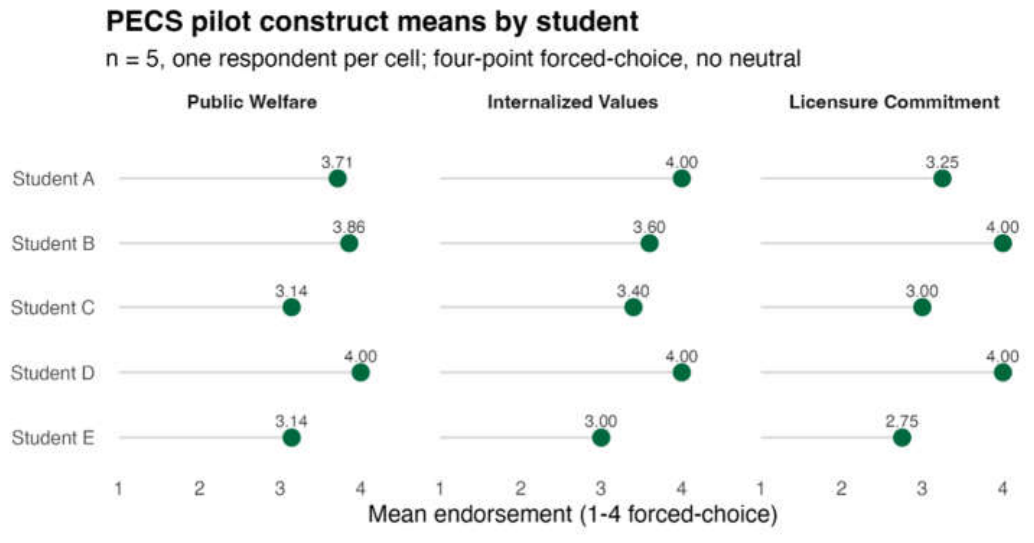

Table 1.
Study participants: roles, timing, background, and self-reported pride in the work.
| Pseudonym | Role | Timing | Self-Stated Background | Motivation | Pride (1 = not, 10 = very proud) |
| A | Paid Research |
Mid Year 3 | Mechanical engineering | “I had no idea that the 3D printers I’d been using could be associated with danger and gun violence… seeing [Student B] work on a project that’s so impactful really drew me in.” | 7 — “I learned the most after reflecting on what I did right and wrong.” |
| B | Honors Thesis | Final Term of Year 4 | Mechanical engineering | “I wanted to take individual leadership over something… I was excited by the overall purpose, that it had real-life implications.” | Declined to rate — “this was an awesome project and something I’m very proud to have been part of.” |
| C | Paid Research |
Summer Prior to Year 4 | Mechanical engineering | “I was hoping to see a project holistically and gain at least one technical skill.” | 6 — “I’m not 100% proud of my deliverables.” |
| D | Senior Capstone | First Half of Year 5 | Human-centered design and engineering | “I consider myself a pretty caring person, so I wanted to do something that actually helped people… I’m also super interested in 3D printers.” | 9 — “I’m proud that I committed to doing the hard things.” |
| E | Senior Capstone | First Half of Year 5 | Software engineering | “I enjoyed gaining a grasp on how 3D printer firmware was structured.” | Not reported (surveys only; declined interview) |
Table 2.
Joint display of student ethical engagement across the evidence streams (Guetterman, Fetters, & Creswell, 2015). The first three columns summarize what the student expressed; Stream 3 is the Public-Welfare subscale mean from the pilot (1–4 agree scale); Stream 4 is dictionary-based first-canon vocabulary in hits per 1,000 words, computed on the combined survey and interview text (Student E: survey only). Qualitative levels (high, mid, low) are relative rankings within this cohort, not absolute measures. The final column records agreement across the three stance streams, with the vocabulary stream reported as a check. Student E contributes to the survey and text streams only (declined interview); the pilot was completed by all five.
Table 2.
Joint display of student ethical engagement across the evidence streams (Guetterman, Fetters, & Creswell, 2015). The first three columns summarize what the student expressed; Stream 3 is the Public-Welfare subscale mean from the pilot (1–4 agree scale); Stream 4 is dictionary-based first-canon vocabulary in hits per 1,000 words, computed on the combined survey and interview text (Student E: survey only). Qualitative levels (high, mid, low) are relative rankings within this cohort, not absolute measures. The final column records agreement across the three stance streams, with the vocabulary stream reported as a check. Student E contributes to the survey and text streams only (declined interview); the pilot was completed by all five.
| Pseudonym (role) | Stream 1 — Recruitment survey (how the student framed their purpose in the work) | Stream 2 — Interview (emphasis in ethical talk; representative quote) | Stream 3 — Commitment pilot (endorsement of public-welfare / first-canon items) | Stream 4 — First-canon vocabulary (hits/1,000 words; see note) | Convergence |
| D (capstone) | Public protection: safer, easier printing for younger users | Protecting users; “a caring person… do something that actually helped people” | High (4.0) | 1.5 | Streams 1–3 converge high; text mid, half off-target (see note) |
| B (honors thesis) | Individual ownership of work with “real-life implications” | Individual leadership; “a purpose bigger than myself” | High (3.86) | 0.0 | Streams 1–3 converge high; text detects none (commitment voiced as purpose, not canon vocabulary) |
| A (paid research) | Recognizing 3D printing’s link to “danger and gun violence”; drawn in by impact | Responsibility for an open-ended, impactful problem; “I always mention, make sure we aren’t printing any weapons” | High-Mid (3.71) | 1.5 | Converge; text mid, all on-target (the only clean case) |
| C (paid research) | Holistic view of a project; gaining a technical skill | Problem definition and the enforcement landscape; “about fifteen minutes… a full instructional tutorial… printing machinegun conversion devices” | Mid (3.14) | 2.1 | Streams 1–3 mid; text count is the cohort’s highest but off-target (see note) |
| E (capstone) | Technical framing: understanding “how 3D printer firmware was structured” | No interview (declined) | Low (3.14 PW; 3.00 overall, lowest) — answered candidly as hypotheticals | 0.0 | Converge (low), the exception, on the streams E contributed |
* Note on Stream 4 (word sense). At this corpus size the first-canon counts are dominated by word sense rather than meaning. Only Student A’s matches were all on-target; several of Student C’s and Student D’s matches referred to unrelated senses such as litigation protection or public schooling, and the two students with the clearest commitment language scored zero. We therefore read Stream 4 as a transparency check that illustrates the limits of lexical counting, not as corroboration. The match-by-match audit is in the Appendix.
Disclaimer/Publisher’s Note: The statements, opinions and data contained in all publications are solely those of the individual author(s) and contributor(s) and not of MDPI and/or the editor(s). MDPI and/or the editor(s) disclaim responsibility for any injury to people or property resulting from any ideas, methods, instructions or products referred to in the content. |
© 2026 by the authors. Licensee MDPI, Basel, Switzerland. This article is an open access article distributed under the terms and conditions of the Creative Commons Attribution (CC BY) license (http://creativecommons.org/licenses/by/4.0/).
Copyright: This open access article is published under a Creative Commons CC BY 4.0 license, which permit the free download, distribution, and reuse, provided that the author and preprint are cited in any reuse.