

Submitted:
27 August 2026
Posted:
28 August 2026
You are already at the latest version
Preprints on COVID-19 and SARS-CoV-2
Abstract
Background: Romania continues to experience one of the highest tuberculosis (TB) burdens in the European Union/European Economic Area. During the COVID-19 pandemic, reduced inpatient capacity accelerated the use of ambulatory care for patients with drug-susceptible tuberculosis (DS-TB). This study evaluated treatment outcomes, outcome ascertainment, hospitalization requirements, and factors associated with unfavorable outcomes among patients managed through ambulatory TB services. Methods: We conducted a retrospective observational cohort study of adults with pulmonary or extrapulmonary DS-TB managed through ambulatory tuberculosis dispensaries affiliated with the “Marius Nasta” Institute of Pneumophthisiology, Bucharest, Romania, between January 2020 and December 2022. Treatment outcomes were defined according to World Health Organization criteria. Treatment success was calculated among patients with a determinate outcome and complemented by best-case/worst-case sensitivity analyses for patients classified as not evaluated. Factors associated with unfavorable outcome were assessed using Firth penalized-likelihood logistic regression. Hospitalization during treatment was analyzed as a secondary outcome. Results: The final cohort comprised 545 patients with DS-TB, with a mean age of 44.8 years and 56.1% being male. Among 308 patients with a determinate end-of-treatment outcome, 281 achieved treatment success and 27 experienced an unfavorable outcome, corresponding to a treatment-success rate of 91.2% (95% CI 87.5–94.1). However, 237 patients (43.5%) were classified as not evaluated; sensitivity analyses yielded treatment-success estimates ranging from 51.6% to 95.0%. Male sex was associated with unfavorable outcome in univariable analysis (OR 2.43, 95% CI 1.03–6.54; p = 0.042), but the association was no longer statistically significant after adjustment (aOR 2.70, 95% CI 0.90–10.67; p = 0.079). No other baseline factor was significantly associated with unfavorable outcome. Documented non-compliance was markedly more frequent among patients with unfavorable outcomes and was interpreted as a treatment-process indicator rather than a baseline prognostic factor. Hospitalization was required in 24 of 483 patients (5.0%), and adverse drug reactions were strongly associated with hospitalization (OR 5.95, 95% CI 2.55–13.72; p < 0.001). Conclusions: Structured ambulatory DS-TB care was feasible during the COVID-19 pandemic within a tertiary-care-linked dispensary network, with high treatment success among patients with known outcomes and a low requirement for hospitalization. However, the substantial proportion of patients without an evaluable final outcome limits interpretation of the overall success estimate. The findings emphasize the importance of complete outcome ascertainment, adherence support, adverse-event surveillance, and clear referral pathways in ambulatory TB programs. Prospective multicenter studies with comparator groups are needed to establish the long-term effectiveness, safety, and scalability of this model.
Keywords:
tuberculosis
; ambulatory care
; COVID-19
; pulmonary tuberculosis
; patient-centered care
; public health
; respiratory medicine
1. Introduction
Tuberculosis (TB) remains a major public health challenge worldwide and continues to impose a substantial burden on healthcare systems, particularly in countries with persistent transmission and delayed case detection. Romania continues to report the highest TB notification rate in the European Union/European Economic Area, despite a progressive decline in TB incidence over the last decade [1]. Between 2008 and 2018, Romania recorded an average annual decrease in TB incidence of approximately 5.5%; however, the estimated case detection rate remained around 87%, indicating the need for further strengthening of diagnostic pathways, treatment access, and continuity of care [2,3].
Historically, TB care in Romania has relied predominantly on hospital-based management, especially at treatment initiation. This approach was traditionally supported by concerns related to transmission control, clinical monitoring, treatment adherence, and the management of patients with complex disease or social vulnerability. However, prolonged hospitalization may increase healthcare costs, disrupt patients’ social and professional lives, and contribute to TB-related stigma. In this context, international recommendations increasingly support patient-centered and decentralized models of care, including ambulatory management whenever clinically appropriate [4]. Such models aim to improve accessibility, preserve social and professional functioning, reduce unnecessary hospitalization, and maintain treatment effectiveness through structured outpatient monitoring and adherence support [5,6,7].
Before the COVID-19 pandemic, Romania had already initiated a gradual transition toward ambulatory TB care through health-system interventions supported by the ROU-T-MoH Transition Grant 1762, “Addressing health system-related challenges in TB care in Romania,” financed by the Global Fund to Fight AIDS, Tuberculosis and Malaria [3]. One of the main objectives of this initiative was to evaluate the feasibility of diagnosing, treating, and monitoring selected TB patients in outpatient TB dispensaries, while avoiding hospitalization when it was not clinically necessary.
The emergence of the COVID-19 pandemic in early 2020 profoundly disrupted healthcare delivery worldwide. In Romania, specialized pulmonology and TB hospitals were substantially involved in the management of patients with SARS-CoV-2 infection, reducing the availability of hospital beds traditionally dedicated to TB care. As a result, ambulatory TB management expanded rapidly, not only for smear-negative pulmonary TB cases, as initially intended in pilot interventions, but also for a broader spectrum of patients, including smear-positive pulmonary TB and extrapulmonary TB cases. Although this reorganization was primarily driven by pandemic-related pressure, it created an important opportunity to evaluate outpatient TB care under real-world conditions.
The “Marius Nasta” Institute of Pneumophthisiology in Bucharest is the largest tertiary referral center for respiratory diseases and TB management in Romania. During the pandemic, affiliated TB dispensaries played an expanded role in diagnosis, treatment initiation, follow-up, adherence monitoring, management of adverse drug reactions, and referral of patients requiring hospitalization. Evaluating the outcomes of patients managed through this model is therefore important for informing future TB policy and assessing whether ambulatory care can be safely and effectively integrated into routine TB services beyond the pandemic context.
Although Romania had already initiated a gradual transition toward ambulatory TB care before the COVID-19 pandemic, real-world evidence regarding the outcomes and safety of this model remains limited. The pandemic-related reduction in hospital capacity created an opportunity to evaluate ambulatory care for drug-susceptible tuberculosis under routine programmatic conditions. Therefore, the aim of the study was to assess treatment outcomes, hospitalization requirements, adverse drug reactions, diagnostic confirmation, treatment adherence, and predictors of unfavorable outcomes among patients with pulmonary or extrapulmonary drug-susceptible TB managed through ambulatory services affiliated with the “Marius Nasta” Institute of Pneumophthisiology between 2020 and 2022.
2. Materials and Methods
2.1. Study Design and Setting
We conducted a retrospective observational cohort study of adults with drug-susceptible tuberculosis (DS-TB) managed through the ambulatory tuberculosis dispensaries of Sectors 4, 5 and 6 of Bucharest, affiliated with the “Marius Nasta” Institute of Pneumophthisiology, Romania. The study covered patients who initiated ambulatory treatment between 1 January 2020 and 31 December 2022, during the COVID-19 pandemic.
2.2. Study Population and Cohort Definition
Of 561 patients included, 16 were excluded because the tuberculosis diagnosis was subsequently invalidated (non-TB), yielding a final DS-TB cohort of 545 patients. Restricting enrolment to 2020–2022 ensured that every included patient had at least 12 months for end-of-treatment outcome ascertainment, consistent with the WHO cohort-reporting convention of assigning outcomes one year after the last enrolment.
For the analysis of factors associated with treatment outcome, the cohort was restricted to patients with a determinate end-of-treatment outcome (treatment success or unfavourable outcome). Patients classified as “not evaluated” (see 2.3) were, by definition, without a final favourable/unfavourable status and were therefore excluded from the outcome regression while being fully described in the cohort characterization
Inclusion and Exclusion Criteria
Patients were eligible for inclusion if they were ≥18 years old, had signed written informed consent, and were diagnosed with pulmonary or extrapulmonary DS-TB according to the criteria of the National Tuberculosis Prevention, Surveillance and Control Program. Eligible patients were registered in the tuberculosis dispensaries affiliated with the “Marius Nasta” Institute of Pneumophthisiology, and were managed through the ambulatory tuberculosis care program between January 2020 and December 2022.
Both bacteriologically confirmed and clinically diagnosed TB cases were included, provided that sufficient demographic, clinical, diagnostic, treatment-related, and outcome data were available in the TB registry or associated medical records. The descriptive cohort included all eligible adult patients registered in the ambulatory care program during the study period.
Patients were excluded from the descriptive cohort if they were <18 years old, had duplicate records, had an invalidated TB diagnosis, or had insufficient core clinical information preventing confirmation of TB diagnosis, registration status, or ambulatory management.
For binary treatment outcome analyses, patients with missing final treatment outcome data were excluded. Treatment success was defined as cure or treatment completion, whereas unfavorable treatment outcome was defined as treatment failure, death, treatment abandonment, or loss to follow-up. Therefore, treatment outcome analyses were restricted to patients with clearly classified final outcomes.
For diagnostic sub-analyses, including GeneXpert MTB/RIF testing, smear microscopy, and culture confirmation, patients were included only when the corresponding test result was available. Denominators differed according to data availability. The full descriptive cohort included 545 patients. Treatment-outcome analyses were restricted to the 308 patients with a determinate end-of-treatment outcome. Diagnostic analyses used variable-specific denominators according to test availability, and the corresponding denominator is reported for each analysis.
2.3. Ambulatory Care Model
Ambulatory TB care was delivered through TB dispensaries affiliated with the “Marius Nasta” Institute of Pneumophthisiology. Patients were managed as outpatients when hospitalization was not considered clinically mandatory according to National Tuberculosis Program procedures and treating physician's assessment. The ambulatory model included treatment initiation or continuation, directly observed or supervised treatment according to national practice, scheduled clinical follow-up, monitoring of treatment adherence, identification and management of adverse drug reactions, and referral for hospitalization was made in cases of clinical deterioration, severe adverse drug reactions, complications, or other medical indications.
2.4. Data Sources and Variables
Outcome Definitions
End-of-treatment outcomes were assigned according to the World Health Organization (WHO) definitions (2021 update), which are uniformly applicable across treatment regimens [1,2,3]. Cured and treatment completed together constitute treatment success. Unfavourable outcome comprised treatment failure, death during treatment, and loss to follow-up (treatment interrupted for ≥2 consecutive months); patients recorded as having taken part of the course and then stopped were classified as loss to follow-up. Patients with no assigned end-of-treatment outcome — including those transferred to another unit and those still on treatment were classified as not evaluated. Patients whose diagnosis was invalidated were not considered TB cases and were excluded entirely [1,2].
Variables
Baseline variables recorded at treatment initiation were sex, age, area of residence (urban/rural), disease localization (pulmonary, extrapulmonary, or concurrent), sputum-smear microscopy status, GeneXpert MTB/RIF result, and rifampicin-resistance status. Treatment-process variables (documented non-compliance, adverse drug reactions, and hospitalization during treatment) were recorded but, because they occur during rather than before treatment, were analyzed descriptively rather than as baseline predictors.
Statistical Analysis
Continuous variables are summarized as means with standard deviations or medians with interquartile ranges; categorical variables as counts and percentages, with denominators reported for each variable because of variable data completeness. Treatment success was calculated among patients with a determinate outcome, with an exact (Clopper–Pearson) 95% confidence interval. Because a substantial proportion of the cohort was not evaluated, the treatment-success rate was additionally bounded by a best-case/worst-case sensitivity analysis (all not-evaluated patients counted as successes, then as unfavourable). To assess whether missingness was informative, patients with a determinate outcome were compared with not-evaluated patients across baseline variables using the Mann–Whitney U test for age and Fisher’s exact test for categorical variables.
Factors associated with unfavourable outcome were examined using Firth’s penalized-likelihood logistic regression, which reduces small-sample bias and handles separation that ordinary logistic regression cannot; odds ratios (OR) are reported with 95% profile-likelihood confidence intervals [8,9]. Given the limited number of unfavourable events, each baseline predictor was first screened univariately, and a parsimonious multivariable model was fitted with no more than two predictors to respect the events-per-variable constraint. A pre-specified sensitivity analysis excluded deaths from the unfavourable composite, because death is a competing event whose predictors may differ from those of treatment failure or loss to follow-up [10]. Hospitalization during treatment was analyzed as a secondary outcome. A two-sided p < 0.05 was considered significant. Analyses were performed using IBM SPSS Statistics and R; the Firth penalized-likelihood logistic regression with profile-likelihood confidence intervals was implemented in R (logistf package).
3. Results
3.1. Cohort Characteristics
The final cohort comprised 545 patients with drug-susceptible tuberculosis. The mean age was 44.8 years (SD 16.0; median 42), and 306 (56.1%) were male. Most patients resided in urban areas N=443 (81.6% of those with residence recorded). Pulmonary disease predominated N=278 (80.6%) of 345 with localization recorded), with extrapulmonary disease in N=61 (17.7%) and concurrent disease in N=6 (1.7%). Where microbiological results were available, 183 (52.1%) of 351 tested were smear-positive and 278 (68.6%) of 405 were GeneXpert-positive. Documented non-compliance, adverse drug reactions and hospitalization occurred in 67, 71 and 24 patients, respectively. Baseline characteristics are shown in Table 1, and the cohort flow in Figure 1.
3.2. Treatment Outcomes and Outcome Ascertainment
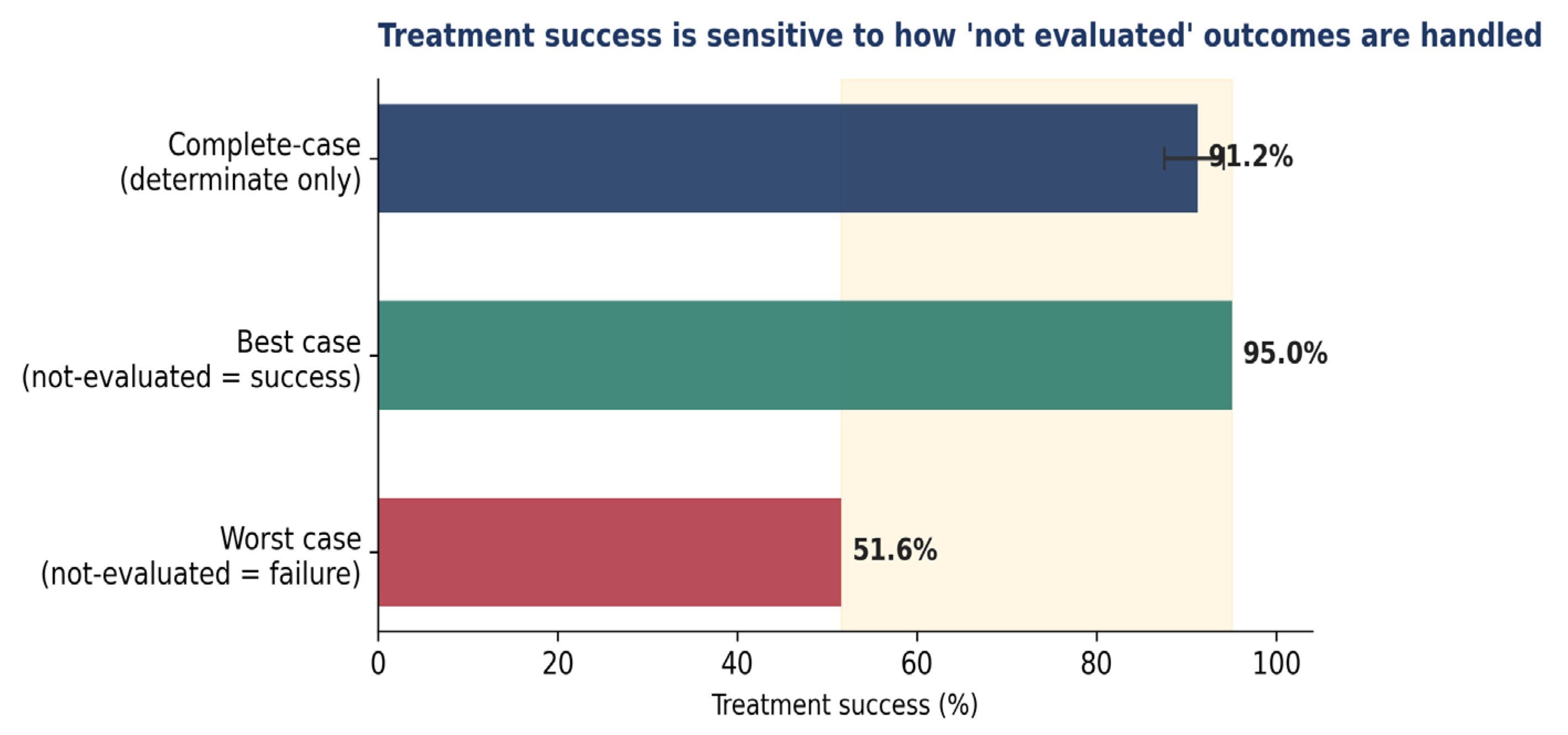
Among the 545 patients, 281 achieved treatment success (164 cured, 117 completed) and 27 had an unfavourable outcome (loss to follow-up 17, death 5, treatment failure 5). A substantial proportion of the cohort, 237 patients (43.5%), were classified as not evaluated according to the predefined end-of-treatment outcome criteria. Among the 308 patients with a determinate outcome, the treatment-success rate was 91.2% (95% CI 87.5–94.1). However, because 43.5% of the cohort was not evaluated, this estimate was sensitive to the handling of missing outcomes: the treatment-success rate ranged from 51.6% in the worst-case analysis to 95.0% in the best-case analysis.(Figure 3). The success rate should therefore be interpreted within this range rather than as a single point estimate.

Table 2.
End-of-treatment outcomes (WHO 2021 definitions), n = 545.
| Outcome | n | % of cohort |
| Cured | 164 | 30.1 |
| Treatment completed | 117 | 21.5 |
| Treatment success (total) | 281 | 51.6 |
| Loss to follow-up | 17 | 3.1 |
| Died | 5 | 0.9 |
| Treatment failure | 5 | 0.9 |
| Unfavourable outcome (total) | 27 | 5.0 |
| Not evaluated | 237 | 43.5 |
Not evaluated = no assigned determinate end-of-treatment outcome according to the predefined outcome criteria. Success rate among determinate outcomes = 281/308 = 91.2%.
3.3. Comparison of Evaluated and Not-Evaluated Patients
Patients with a determinate outcome differed from not-evaluated patients principally in disease localization: extrapulmonary disease was more frequent among not-evaluated patients (24% vs 13%, p = 0.007), consistent with the greater likelihood of transfer or incomplete follow-up in extrapulmonary tuberculosis. Differences in age (median 41 vs 44 years, p = 0.056), male sex (59% vs 52%, p = 0.082) and GeneXpert positivity (65% vs 74%, p = 0.081) were not statistically significant, while rural residence and smear positivity were similar (Table 3). This indicates the missingness was at least partly informative and should temper interpretation of the complete-case success rate.
3.4. Factors Associated with Unfavourable Outcome
Among the 308 patients with a determinate outcome (27 unfavourable events), male sex was the only baseline factor associated with unfavourable outcome on univariate Firth regression (OR 2.43, 95% CI 1.03–6.54; p = 0.042). Age, rural residence, extrapulmonary disease, smear positivity and GeneXpert positivity were not significantly associated (Table 4, Figure 2). In a parsimonious multivariable model adjusting for GeneXpert status, male sex was attenuated and no baseline factor remained independently significant (adjusted OR 2.70, 95% CI 0.90–10.67; p = 0.079). Excluding deaths from the unfavourable composite did not materially change these findings.
By contrast, the treatment-process variable of documented non-compliance was strongly associated with unfavourable outcome: 15/28 non-compliant patients (54%) had an unfavourable outcome versus 11/279 (4%) of compliant patients. Because non-compliance is measured during treatment and is temporally and definitionally linked to loss to follow-up, it is reported here descriptively as a process indicator rather than as a baseline prognostic factor. These results indicate that, in this cohort, unfavourable outcome was driven mainly by adherence during care rather than by baseline clinical characteristics — underscoring the central role of adherence support in ambulatory TB management.
Figure 2.
Univariate baseline predictors of unfavourable outcome (Firth OR, 95% profile-likelihood CI). Only male sex reached significance.
Figure 2.
Univariate baseline predictors of unfavourable outcome (Firth OR, 95% profile-likelihood CI). Only male sex reached significance.
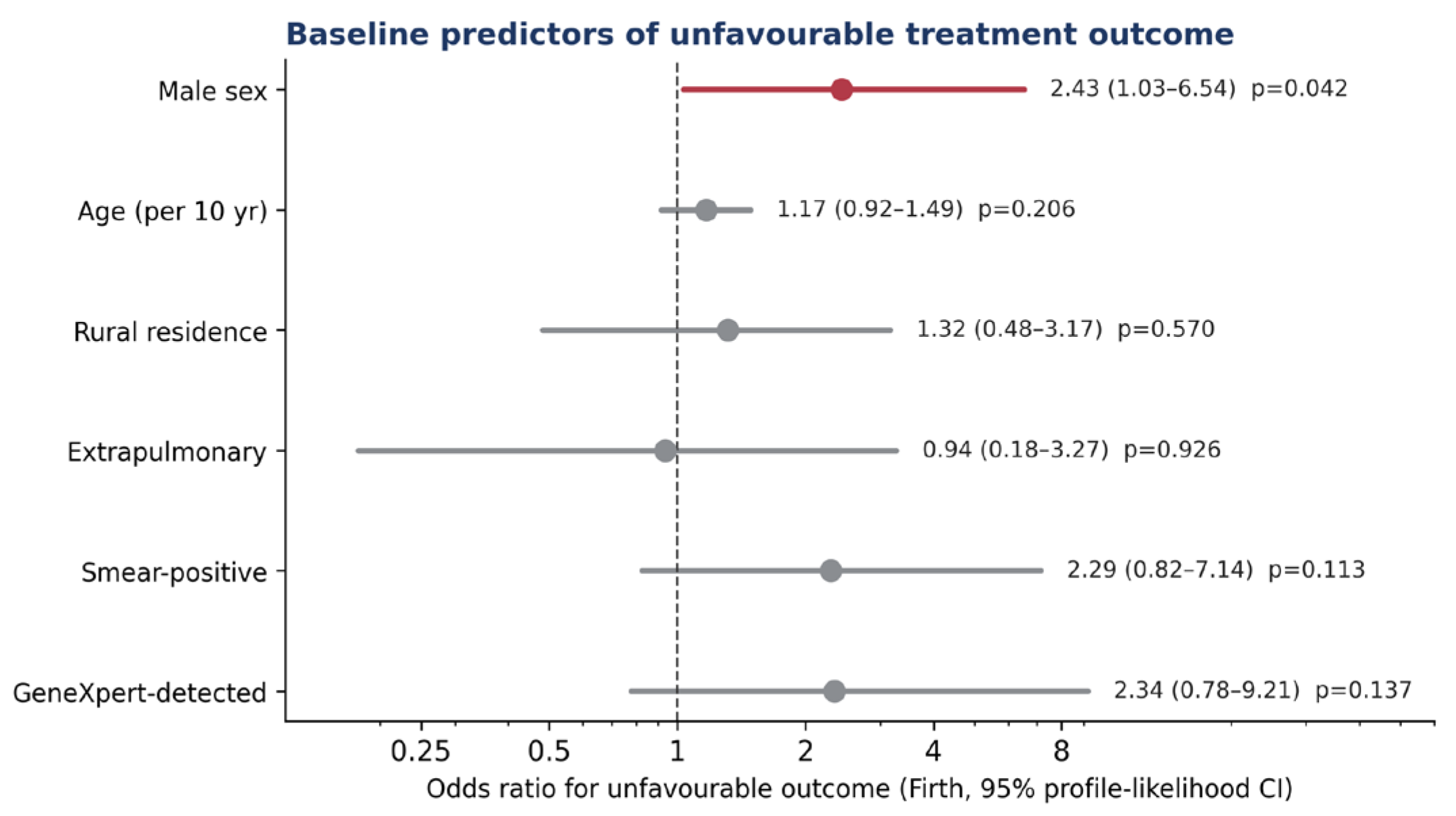
Figure 3.
Treatment-success rate under complete-case, best-case and worst-case handling of not-evaluated outcomes.
Figure 3.
Treatment-success rate under complete-case, best-case and worst-case handling of not-evaluated outcomes.
3.5. Hospitalization During Treatment (Secondary)
Hospitalization during ambulatory treatment was required in 24 of 483 patients (5.0%). Adverse drug reactions were strongly associated with hospitalization (Firth OR 5.95, 95% CI 2.55–13.72; p < 0.001), indicating that treatment-related toxicity was the principal driver of inpatient referral. No baseline demographic or microbiological variable was significantly associated with hospitalization.
4. Discussion
This real-world retrospective cohort study evaluated ambulatory care for drug-susceptible tuberculosis (DS-TB) during the COVID-19 pandemic within a tertiary-care-linked tuberculosis dispensary network in Bucharest, Romania. Several findings are particularly relevant. First, among patients with a determinate end-of-treatment outcome, treatment success was high, with 281 of 308 patients achieving cure or treatment completion. However, a substantial proportion of the overall cohort was classified as not evaluated, making the observed complete-case success rate sensitive to missing outcome data. Second, most baseline demographic, clinical, and microbiological characteristics were not significantly associated with unfavorable treatment outcome. Male sex was associated with unfavorable outcome in univariable analysis, but this association was attenuated after adjustment. Third, documented treatment non-compliance was strongly associated with unfavorable outcome as a treatment-process indicator, emphasizing the importance of adherence throughout ambulatory care. Finally, hospitalization during treatment was uncommon, while adverse drug reactions were strongly associated with the need for inpatient referral.
These findings are particularly relevant in the context of Romania's persistent TB burden. Romania continues to report one of the highest TB notification rates in the European Union/European Economic Area despite the progressive decline in TB incidence observed over recent decades [1,2]. Historically, TB management in Romania has relied substantially on hospitalization, particularly during treatment initiation, reflecting concerns regarding transmission, clinical monitoring, adherence, and the management of patients with severe disease or social vulnerability. International TB strategies, however, increasingly emphasize patient-centered and decentralized models of care in which ambulatory treatment is used whenever clinically appropriate [4,7]. Such approaches may preserve patients' social and professional functioning while reducing unnecessary use of hospital resources.
The COVID-19 pandemic accelerated the need to reorganize respiratory and TB services. Specialized respiratory hospitals had to simultaneously provide care for patients with SARS-CoV-2 infection, substantially increasing pressure on inpatient capacity. Under these circumstances, expansion of ambulatory TB management represented a pragmatic approach to maintaining continuity of treatment while reserving hospital resources for patients with clinical indications for admission. The present findings therefore provide relevant real-world evidence regarding the feasibility of delivering DS-TB care through an organized outpatient network during a period of major health-system disruption. Previous European and international experience has similarly supported decentralized and ambulatory approaches when they are accompanied by appropriate clinical supervision, adherence support, treatment monitoring, and mechanisms for timely referral to higher levels of care [11,12]. Economic analyses have also suggested that avoiding unnecessary hospitalization may reduce both health-system expenditure and the financial burden experienced by patients with TB [5,6].
Nevertheless, the treatment-success estimate requires careful interpretation. Among the 308 patients with a determinate outcome, the success rate was 91.2% (95% CI 87.5–94.1%). However, 237 patients, corresponding to 43.5% of the overall DS-TB cohort, were classified as not evaluated. Sensitivity analyses consequently produced a wide range of possible overall treatment-success estimates, from 51.6% when all not-evaluated patients were considered unfavorable outcomes to 95.0% when they were considered successful outcomes. This uncertainty is important because patients with and without a determinate outcome were not entirely comparable. Extrapulmonary TB was significantly more frequent among not-evaluated patients than among those with a known final outcome (24% vs. 13%, p = 0.007), while differences in age, sex, residence, smear positivity, and GeneXpert positivity did not reach statistical significance. These findings suggest that missing outcome data were at least partly informative rather than completely random. Accordingly, the 91.2% treatment-success rate should be interpreted as the outcome among patients with available end-of-treatment ascertainment rather than as an unqualified estimate for the entire ambulatory cohort.
The analysis of baseline characteristics provides an additional perspective on patients at risk of unfavorable outcome. Male sex was the only baseline characteristic significantly associated with unfavorable outcome in univariable Firth regression, with an OR of 2.43 (95% CI 1.03–6.54; p = 0.042). However, after adjustment for GeneXpert status, the association was attenuated and no longer reached conventional statistical significance (aOR 2.70, 95% CI 0.90–10.67; p = 0.079). Age, area of residence, disease localization, smear positivity, and GeneXpert MTB/RIF positivity were also not significantly associated with unfavorable outcome. These findings suggest that no robust baseline predictor of unfavorable outcome could be identified in this cohort. Nevertheless, only 27 unfavorable events occurred, resulting in limited statistical power and relatively wide confidence intervals. The absence of statistically significant associations should therefore not be interpreted as evidence that these characteristics have no prognostic relevance, but rather as an indication that their independent effects could not be demonstrated reliably in the present dataset.
Treatment adherence remained clinically important. Among patients with a determinate outcome, documented non-compliance was substantially more frequent among those experiencing an unfavorable outcome. Specifically, 15 of 28 non-compliant patients experienced an unfavorable outcome compared with 11 of 279 patients without documented non-compliance. Importantly, non-compliance was recorded during treatment and therefore represents a treatment-process characteristic rather than a baseline prognostic factor. It is also temporally and clinically related to treatment interruption and loss to follow-up. For these reasons, its association with unfavorable outcome should not be interpreted as demonstrating an independent causal effect. Instead, it highlights one of the principal operational requirements of ambulatory TB management: maintaining continuous engagement with patients throughout treatment. Structured adherence monitoring, rapid identification of treatment interruption, patient education, and appropriate social support should therefore remain central components of decentralized TB services.
Hospitalization during ambulatory treatment was required in only 24 of 483 patients with available information, corresponding to approximately 5.0% of the evaluated population. Adverse drug reactions were strongly associated with hospitalization, with an OR of 5.95 (95% CI 2.55–13.72; p < 0.001), whereas no baseline demographic or microbiological variable was significantly associated with inpatient referral. This finding illustrates the importance of maintaining effective safety mechanisms within ambulatory TB programs. Outpatient care should include systematic assessment for treatment-related toxicity, access to laboratory and clinical monitoring when indicated, rapid reassessment when adverse events occur, and clearly defined pathways for hospital referral. The low observed hospitalization requirement is encouraging from an operational perspective, although it should not be interpreted as direct evidence that ambulatory care is safer than inpatient management because the study lacked a contemporaneous comparator group.
The present findings also extend previous Romanian experience with ambulatory TB management. Earlier national evidence highlighted the continuing importance of surveillance, diagnostic accessibility, and continuity of care, particularly among vulnerable populations [13]. National program guidance provides the framework for TB diagnosis, treatment, monitoring, and follow-up in Romania [14]. Furthermore, previous Romanian studies and pilot initiatives had already explored the transition from predominantly hospital-based care toward outpatient management [15,17]. The present cohort differs in that ambulatory care was implemented during the exceptional circumstances of the COVID-19 pandemic and therefore represents evidence obtained under substantial health-system pressure. Evidence from Eastern Europe has also suggested that shifting from hospital-focused toward ambulatory TB care may provide broader public-health and economic benefits when appropriate community services and patient-support mechanisms are available [16].
However, successful decentralization requires more than simply reducing the number of hospital admissions. Previous Romanian experience has identified potential challenges related to outpatient TB management and highlighted the importance of appropriate organizational structures and patient-centered implementation [15,17]. Evidence from Eastern Europe similarly indicates that the public-health benefits of shifting from hospital-focused to ambulatory TB care depend on adequate community support and sustained engagement with patients [16]. Consequently, expansion of outpatient TB services should be accompanied by patient education, social assessment, adherence support, and accessible clinical follow-up.
Patient and community acceptance should also be considered when expanding ambulatory TB care. Evidence from Kazakhstan demonstrated that attitudes toward outpatient TB treatment may differ among patients, family members, and community members, with concerns regarding transmission, household exposure, and knowledge of TB potentially influencing acceptance of ambulatory management [18]. These considerations are also relevant to Romania. Patient education, appropriate counseling of household contacts, reduction of TB-related stigma, and clear infection-control guidance may facilitate acceptance and safe implementation of ambulatory treatment, particularly among patients living in socially vulnerable circumstances.
Infection prevention and control represents another essential component of this model. Previous modelling evidence has suggested that reducing hospitalization may contribute to limiting nosocomial transmission when combined with appropriate administrative, environmental, and personal protective measures [19]. The present study did not evaluate household transmission, contact-investigation outcomes, or transmission within healthcare environments, and therefore no conclusions regarding the epidemiological impact of ambulatory management can be drawn. Future studies should incorporate these outcomes alongside conventional measures of treatment success and safety.
Finally, the expansion of ambulatory TB care during 2020–2022 should be considered within the broader reorganization of respiratory healthcare during the COVID-19 pandemic. Previous work from the same tertiary respiratory institution documented the substantial clinical demands associated with SARS-CoV-2-related inpatient care during this period [20]. Against this background, strengthening ambulatory pathways for clinically appropriate patients with DS-TB represented part of a broader adaptation aimed at maintaining essential respiratory services while preserving inpatient capacity. Taken together, the present results support the feasibility of structured ambulatory DS-TB management within an established dispensary network, but they should not be interpreted as evidence of superiority over hospital-based care. Future prospective multicenter studies should incorporate standardized eligibility criteria, more complete outcome ascertainment, comparator groups, social and clinical risk factors, transmission-related outcomes, patient-reported outcomes, and formal cost-effectiveness analyses.
5. Limitations
This study has several limitations that should be considered when interpreting the findings. First, its retrospective observational design limits causal inference and depends on the completeness and accuracy of routinely collected registry and medical-record data. Most importantly, end-of-treatment outcome ascertainment was incomplete: 237 of 545 patients (43.5%) were classified as not evaluated. Consequently, although the treatment-success rate among patients with a determinate outcome was 91.2%, sensitivity analyses yielded a substantially wider possible range of 51.6–95.0% depending on how missing outcomes were classified. Moreover, extrapulmonary TB was significantly more frequent among patients without a determinate outcome than among those with complete outcome ascertainment, suggesting that missingness was at least partly informative rather than completely random. Therefore, the complete-case treatment-success estimate should not be interpreted as directly representative of the entire ambulatory cohort.
Second, the study was conducted in TB dispensaries affiliated with a single tertiary referral center in Bucharest, which may limit the generalizability of the findings to other regions of Romania or to healthcare systems with different organizational structures, patient populations, and access to outpatient TB services. In addition, patients selected for ambulatory management may have been clinically more stable than those requiring hospitalization at diagnosis, introducing potential selection bias. The absence of a contemporaneous inpatient comparison group further prevents direct assessment of the relative effectiveness, safety, or cost-effectiveness of ambulatory versus hospital-based TB care. Accordingly, the present findings should be interpreted primarily as evidence supporting the feasibility of structured ambulatory DS-TB management in this setting rather than as evidence of its superiority over inpatient care.
Third, data completeness varied across several clinical and microbiological variables, resulting in different denominators for disease localization, smear microscopy, GeneXpert MTB/RIF testing, hospitalization, and other analyses. This reflects the real-world nature of the dataset but may have introduced additional selection bias and reduced comparability between sub-analyses. The database also lacked detailed information on several potentially important clinical and social determinants of treatment outcome, including HIV status, diabetes mellitus, smoking, alcohol use, homelessness, socioeconomic vulnerability, nutritional status, body mass index, radiological disease severity, cavitary or bilateral pulmonary involvement, and baseline symptom burden. Residual confounding from these unmeasured factors therefore cannot be excluded.
Fourth, the number of unfavorable treatment outcomes was small, with only 27 events among 308 patients with a determinate outcome. Although Firth penalized-likelihood regression was used to reduce small-sample bias and address potential separation, the limited number of events constrained the complexity of the multivariable analysis and resulted in relatively wide confidence intervals. The finding that male sex was associated with unfavorable outcome in univariable analysis but not after adjustment should therefore be interpreted cautiously, and the absence of statistically significant associations for other baseline characteristics should not be regarded as evidence of absence of clinically meaningful effects. Similarly, documented non-compliance was analyzed as a treatment-process indicator rather than as a baseline prognostic factor because it occurs during treatment and is temporally related to outcomes such as treatment interruption and loss to follow-up.
Finally, the study did not evaluate household or nosocomial TB transmission, contact-investigation outcomes, infection-control performance, patient satisfaction, health-related quality of life, stigma, or direct and indirect costs. These outcomes are important when evaluating the broader public-health impact, acceptability, and sustainability of ambulatory TB care. Future prospective multicenter studies should therefore aim for more complete outcome ascertainment, include contemporaneous comparator groups, collect standardized clinical and social risk factors, and incorporate transmission-related outcomes, patient-reported measures, and formal cost-effectiveness analyses.
6. Conclusions
In this real-world retrospective cohort, structured ambulatory care for drug-susceptible tuberculosis during the COVID-19 pandemic was feasible within a tertiary-care-linked dispensary network in Bucharest. Among patients with a determinate end-of-treatment outcome, treatment success was high, while hospitalization during treatment was uncommon. However, the substantial proportion of patients classified as not evaluated limits the precision and generalizability of the overall treatment-success estimate and requires cautious interpretation of the complete-case results.
No robust baseline demographic, clinical, or microbiological predictor of unfavorable outcome was identified after adjustment, although male sex was associated with unfavorable outcome in univariable analysis. By contrast, documented non-compliance was strongly associated with unfavorable outcome as a treatment-process indicator, emphasizing the importance of continuous adherence monitoring and patient support throughout ambulatory treatment. Adverse drug reactions were strongly associated with hospitalization, highlighting the need for systematic toxicity surveillance, rapid clinical reassessment, and clear referral pathways within outpatient TB programs.
Overall, these findings support the continued development of structured, patient-centered ambulatory DS-TB care in Romania when adequate outpatient monitoring, adherence support, adverse-event management, and access to hospitalization are ensured. Nevertheless, because of the retrospective design, incomplete outcome ascertainment, potential selection bias, and absence of a contemporaneous inpatient comparator group, the present study should be interpreted as evidence of feasibility rather than superiority of ambulatory over hospital-based care. Future prospective multicenter studies with more complete outcome ascertainment, standardized clinical and social risk assessment, comparator groups, transmission-related outcomes, patient-reported measures, and formal cost-effectiveness analyses are needed to determine the long-term effectiveness, safety, and scalability of this model beyond the pandemic context.
Author Contributions
Conceptualization: I.M. and B.M.; methodology: I.M., A.S. and B.M.; software: A.N D.B.; validation:I.M., A.S., S.G.V. and B.M.; formal analysis: D.B.; investigation: I.M., A.S., S.G.V., M.B., O.P., T.P., D.B. and M.M.; resources: I.M. and B.M.; data curation: I.M., A.S. and D.B.; writing-original draft preparation, I.M., A.S. and D.B.; writing-review and editing: I.M., A.S., S.G.V., M.B., O.P., T.P., A.I., D.B., M.M. and B.M.; visualization: D.B. and A.S.; supervision, I.M., A.I. and B.M.; project administration, I.M. and B.M.; funding acquisition, I.M. and B.M. All authors have read and agreed to the published version of the manuscript.
Funding
This research received no external funding.
Institutional Review Board Statement
The study was conducted in accordance with the Declaration of Helsinki and approved by the Institutional Review Board (or Ethics Committee) of “Marius Nasta” Institute of Pneumophtysiology (no. 28301/07.12.2022).
Data Availability Statement
The data supporting the findings of this study are available from the corresponding author upon reasonable request, subject to institutional approval and applicable data-protection regulations.
Conflicts of Interest
The authors declare no conflict of interest.
References
- World Health Organization. Global Tuberculosis Report 2023; World Health Organization: Geneva, 2023. [Google Scholar]
- European Centre for Disease Prevention and Control. Tuberculosis Surveillance and Monitoring in Europe 2023; European Centre for Disease Prevention and Control, 2023. [Google Scholar]
- Lönnroth, K.; et al. Tuberculosis control and elimination 2010–50: Cure, care, and social development. Lancet 2010, 375, 1814–1829. [Google Scholar] [CrossRef] [PubMed]
- World Health Organization. WHO Consolidated Guidelines on Tuberculosis; World Health Organization: Geneva, 2022. [Google Scholar]
- Floyd, K.; et al. Cost and cost-effectiveness of tuberculosis control. Lancet 2012, 380, 1257–1275. [Google Scholar]
- Tanimura, T.; et al. Financial burden for tuberculosis patients. Eur. Respir. J. 2014, 43, 1763–1775. [Google Scholar] [CrossRef] [PubMed]
- Uplekar, M.; et al. WHO's new End TB Strategy. Lancet 2015, 385, 1799–1801. [Google Scholar] [CrossRef] [PubMed]
- Firth, D. Bias reduction of maximum likelihood estimates. Biometrika 1993, 80, 27–38. [Google Scholar] [CrossRef]
- Heinze, G.; Schemper, M. A solution to the problem of separation in logistic regression. Stat. Med. 2002, 21, 2409–2419. [Google Scholar] [CrossRef] [PubMed]
- Ku, C.-C.; et al. What is behind programmatic treatment outcome definitions for tuberculosis? Eur. Respir. J. 2020, 56, 2001751. [Google Scholar] [CrossRef] [PubMed]
- Dara, M.; et al. Tuberculosis control in Europe. Eur. Respir. J. 2015, 45, 1082–1095. [Google Scholar] [CrossRef] [PubMed]
- Bassili, A.; et al. Ambulatory tuberculosis care. Int. J. Tuberc. Lung Dis. 2013, 17, 141–146. [Google Scholar] [CrossRef] [PubMed]
- Munteanu, I.; Cioran, N.; van Hest, R.; Abubakar, I.; Story, A.; Chiotan, D.; de Vries, G.; Mahler, B. Tuberculosis Surveillance in Romania Among Vulnerable Risk Groups Between 2015 and 2017. Ther. Clin. Risk Manag. 2022, 18, 439–446. [Google Scholar] [CrossRef] [PubMed] [PubMed Central]
- Munteanu, I.; Mahler, B.; et al. Ghid Metodologic de Implementare a Programului Național de Prevenire, Supraveghere și Control al Tuberculozei și Altor Micobacterioze; 2023; ISBN 978-973-0-38231-0. [Google Scholar]
- Stanciu, I.; Pohrib, I.; Ghita, M.; Dantes, E. Are we ready to treat tuberculosis in ambulatory care? In Tuberculosis, ERS International Congress 2020 Abstracts; European Respiratory Society, 2020; p. 1441. [Google Scholar] [CrossRef]
- Kelly, S.L.; Jaoude, G.J.A.; Palmer, T.; Skordis, J.; Haghparast-Bidgoli, H.; et al. Public health benefits of shifting from hospital-focused to ambulatory TB care in Eastern Europe: Optimising TB investments in Belarus, the Republic of Moldova, and Romania. PLoS Glob. Public Health 2023, 3, e0001025. [Google Scholar] [CrossRef] [PubMed]
- Munteanu, I.; Popa, C.; Popa, C.; Cazacu, C.; Pleșită, A.; Teoibas, C.; Cioran; Nedelcu, R.; Valceanu, D.; Furtunescu, F.; Serban, A.; Mahler, B. Shifting to the ambulatory patient-centered tuberculosis care model in Romania—preliminary results of the pilot project conducted in Marius Nasta Institute of Pneumology dispensaries, January–December 2020. Pneumologia 2020, 69, 234–240. [Google Scholar] [CrossRef]
- Darisheva, M.; Tracy, M.; Terlikbayeva, A.; et al. Knowledge and attitudes towards ambulatory treatment of tuberculosis in Kazakhstan. BMC Health Serv. Res. 2020, 20, 563. [Google Scholar] [CrossRef] [PubMed]
- Basu, S.; Andrews, J.R.; Poolman, E.M.; Gandhi, N.R.; Shah, N.S.; Moll, A.; et al. Prevention of nosocomial transmission of extensively drug-resistant tuberculosis in rural South African district hospitals: An epidemiological modelling study. Lancet 2007, 370, 1500–1507. [Google Scholar] [CrossRef] [PubMed]
- Stoichita, A.; Ghita, M.; Mahler, B.; Vlasceanu, S.; Ghinet, A.; Mosteanu, M.; Cioacata, A.; Udrea, A.; Marcu, A.; Mitra, G.D.; et al. Imagistic Findings Using Artificial Intelligence in Vaccinated versus Unvaccinated SARS-CoV-2-Positive Patients Receiving In-Care Treatment at a Tertiary Lung Hospital. J. Clin. Med. 2023, 12, 7115. [Google Scholar] [CrossRef] [PubMed]
Figure 1.
Cohort flow and end-of-treatment outcome classification (WHO 2021 definitions).
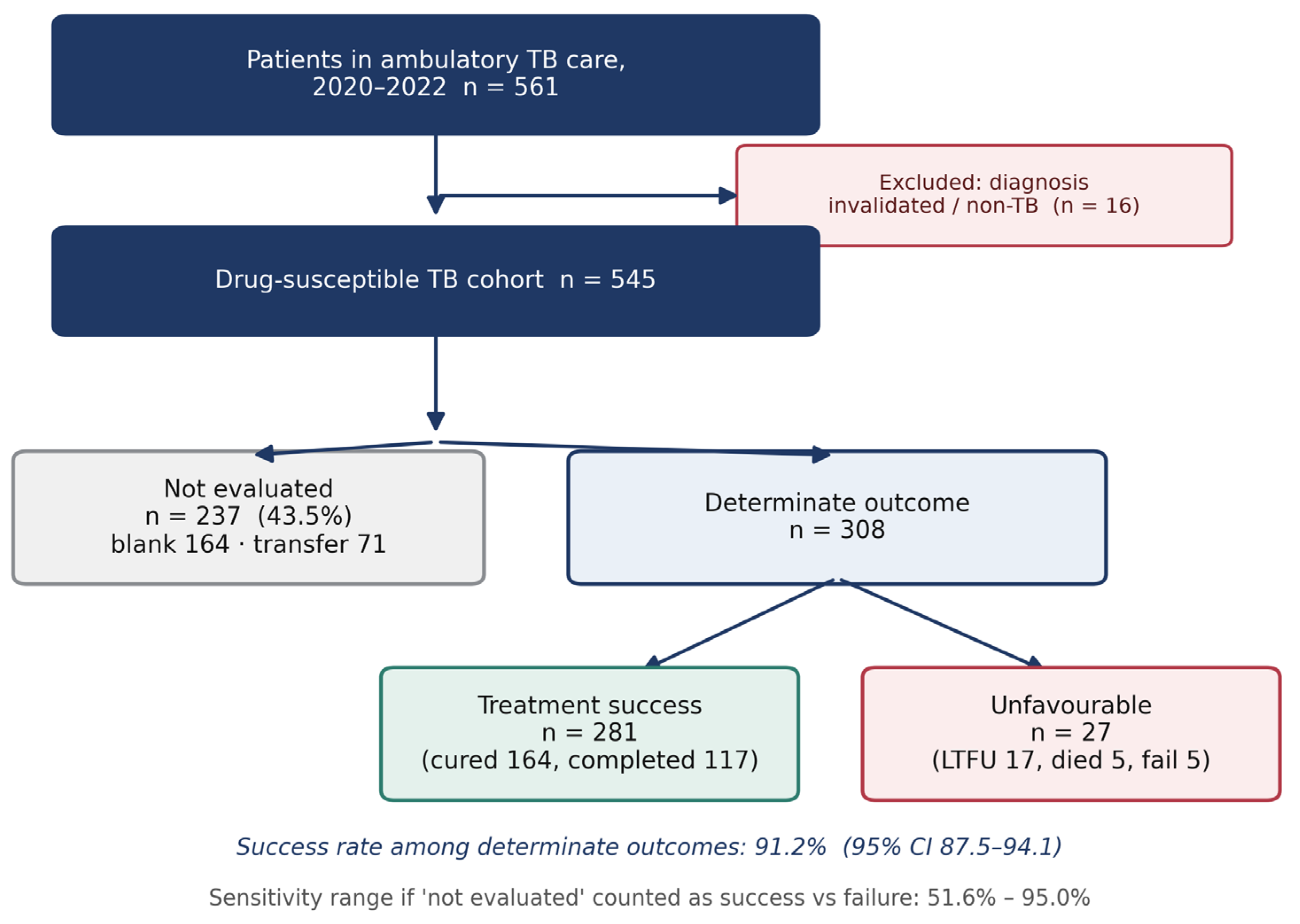
Table 1.
Baseline characteristics of the drug-susceptible TB cohort (n = 545).
| Characteristic | Category | Value |
| Sex | Male | 306 (56.1%) |
| Female | 239 (43.9%) | |
| Age, years | Mean ± SD | 44.8 ± 16.0 |
| Residence | Urban | 443 (81.6%) |
| Rural | 100 (18.4%) | |
| Localization* | Pulmonary | 278 (80.6%) |
| Extrapulmonary | 61 (17.7%) | |
| Pulmonary + extrapulmonary | 6 (1.7%) | |
| Smear microscopy* | Positive | 183 (52.1%) |
| Negative | 168 (47.9%) | |
| GeneXpert MTB/RIF* | Detected | 278 (68.6%) |
| Not detected | 127 (31.4%) | |
| Non-compliance (process) | Yes | 67 (12.3%) |
| Adverse drug reactions (process) | Yes | 71 (13.0%) |
| Hospitalization (process) | Yes | 24 (4.4%) |
*Percentages for localization, smear and GeneXpert use as the denominator only patients with that result recorded (localization 345, smear 351, GeneXpert 405), reflecting real-world registry completeness.
Table 3.
Determinate-outcome versus not-evaluated patients.
| Variable | Determinate (n=308) | Not evaluated (n=237) | p |
| Age, median (years) | 41 | 44 | 0.056 |
| Male sex | 183/308 (59%) | 123/237 (52%) | 0.082 |
| Rural residence | 58/307 (19%) | 42/236 (18%) | 0.823 |
| Extrapulmonary | 24/191 (13%) | 37/154 (24%) | 0.007 |
| Smear-positive | 94/190 (49%) | 89/161 (55%) | 0.286 |
| GeneXpert-detected | 158/242 (65%) | 120/163 (74%) | 0.081 |
Mann–Whitney U test (age); Fisher’s exact test (categorical). Denominators vary with data completeness.
Table 4.
Predictors of unfavourable treatment outcome (Firth penalized logistic regression, 95% profile-likelihood CI).
Table 4.
Predictors of unfavourable treatment outcome (Firth penalized logistic regression, 95% profile-likelihood CI).
| Predictor | OR / aOR (95% CI) | p |
| Male sex | 2.43 (1.03–6.54) | 0.042 |
| Age (per 10 yr) | 1.17 (0.92–1.49) | 0.206 |
| Rural residence | 1.32 (0.48–3.17) | 0.570 |
| Extrapulmonary | 0.94 (0.18–3.27) | 0.926 |
| Smear-positive | 2.29 (0.82–7.14) | 0.113 |
| GeneXpert-detected | 2.34 (0.78–9.21) | 0.137 |
| Multivariable (male sex + GeneXpert) | ||
| Male sex | 2.70 (0.90–10.67) | 0.079 |
| GeneXpert-detected | 2.16 (0.72–8.57) | 0.181 |
Reference categories: female sex, urban residence, pulmonary disease, smear-negative, GeneXpert not detected. Univariate n and events vary with completeness; multivariable n = 242, events = 17.
Disclaimer/Publisher’s Note: The statements, opinions and data contained in all publications are solely those of the individual author(s) and contributor(s) and not of MDPI and/or the editor(s). MDPI and/or the editor(s) disclaim responsibility for any injury to people or property resulting from any ideas, methods, instructions or products referred to in the content. |
© 2026 by the authors. Licensee MDPI, Basel, Switzerland. This article is an open access article distributed under the terms and conditions of the Creative Commons Attribution (CC BY) license (http://creativecommons.org/licenses/by/4.0/).
Copyright: This open access article is published under a Creative Commons CC BY 4.0 license, which permit the free download, distribution, and reuse, provided that the author and preprint are cited in any reuse.