

Submitted:
27 August 2026
Posted:
27 August 2026
You are already at the latest version
Abstract
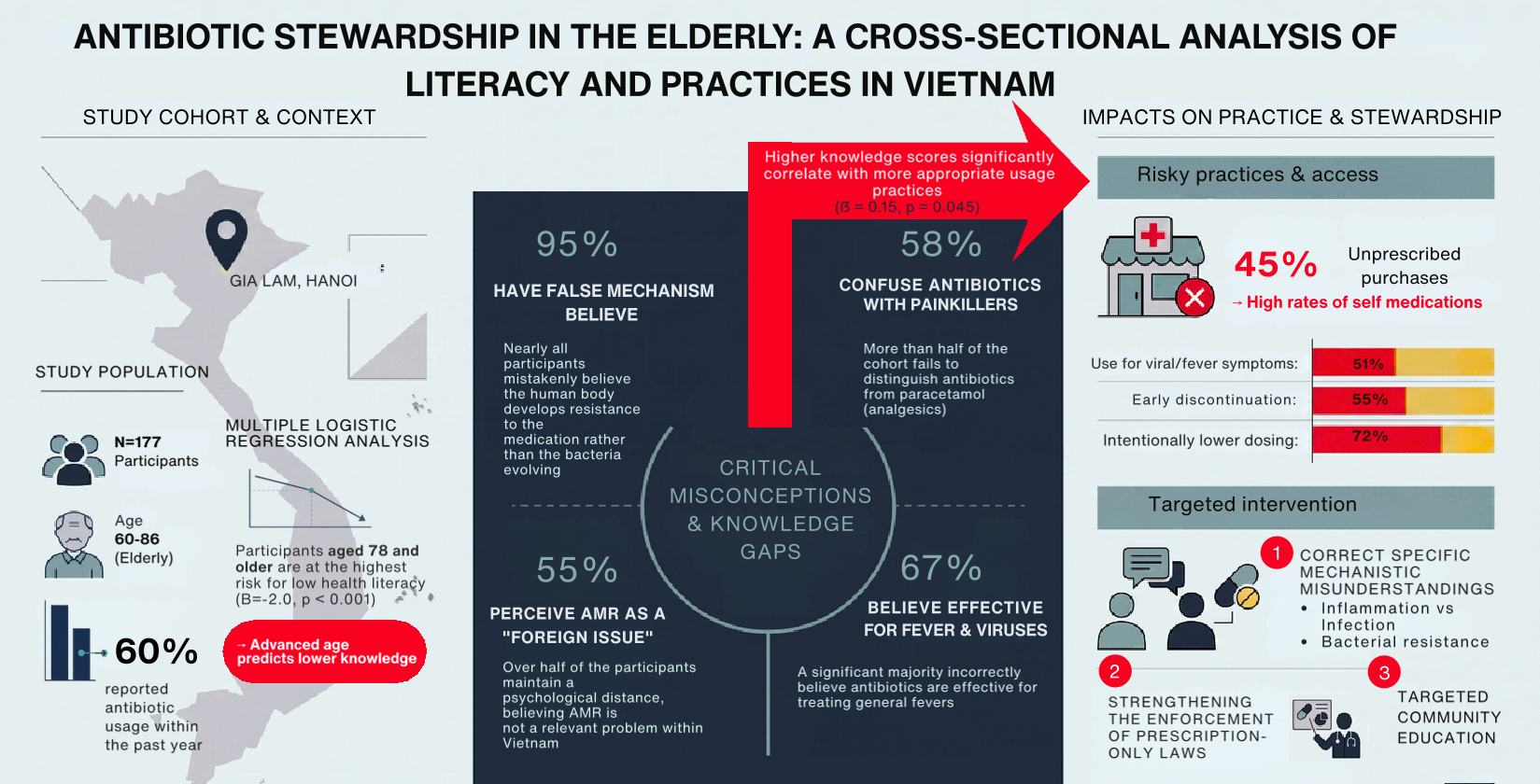
Background/Objectives: Antimicrobial resistance (AMR) poses a disproportionate mortality risk to older adults, yet this demographic is often overlooked in stewardship interventions compared to the general population or other at-risk/vulnerable groups. While awareness campaigns exist, it remains unclear how knowledge gaps influence antibiotic usage behaviors among the elderly in lower middle-income settings like Vietnam. This study evaluates antibiotic literacy and usage patterns among older adults (aged ≥ 60 years) in Hanoi, identifies sociodemographic predictors of these domains, and determines whether knowledge deficits predict inappropriate practices. Methods: A descriptive cross-sectional study was conducted on 177 retired individuals aged 60-86 years (44% male, 56% female) in Gia Lam Commune, Hanoi, via face-to-face interviews. A structured questionnaire, adapted from World Health Organization and validated regional studies, assessed demographics, knowledge, AMR awareness, and practices. Multivariable linear regression identified independent predictors of these outcome scores. Results: Usage prevalence was high; 60% of participants reported taking antibiotics in the past year. Although 91% acknowledged the personal threat of "antibiotic resistance", profound functional misconceptions persisted: 58% failed to distinguish antibiotics from analgesics (paracetamol), and 67% incorrectly believed antibiotics are effective for treating fever. Of concern, 95.5% mistakenly thought that the human body develops resistance to the medication, and 55% perceived AMR as a foreign issue irrelevant to Vietnam. Regression analysis revealed that advanced age (≥ 78 years) was a strong negative predictor of knowledge (β = -2.0; p < 0.001), while higher knowledge scores were significantly associated with better adherence to safe practices (β = 0.15; p = 0.045). Conclusions: Older adults in Vietnam demonstrate high superficial awareness of AMR but harbor critical misconceptions, particularly conflating antibiotics with analgesics and falsely believing the human body develops resistance. Furthermore, advanced age emerged as a significant vulnerability factor for low health literacy. Since greater knowledge directly predicts safer usage practices, interventions must move beyond general warnings to correct specific mechanistic misunderstandings, thereby mitigating self-medication and resistance in this highly vulnerable population.
Keywords:
antibiotic
; antimicrobial resistance
; elderly
; health literacy
; KAP study
; misconception
; Vietnam
1. Introduction
Antimicrobial resistance (AMR) is recognized as one of the most critical public health challenges of the 21st century, often described as a "silent pandemic" that threatens to undermine modern medicine [1]. The urgency of this crisis is underscored by recent forecasts from Global Research on Antimicrobial Resistance (GRAM), which predict 1.28 million attributable deaths from antibiotic-resistant infections by 2030, followed by a 69.6% increase in mortality by 2050 [2]. In Vietnam, from 2020 to 2023, a reported 269,681 deaths were linked to infection with pathogenic bacteria showing antibiotic resistance [3]. While this timeframe overlaps with the COVID-19 pandemic (a period that globally exacerbated the AMR burden due to secondary hospital-acquired infections and surges in prophylactic antibiotic use), these figures reflect the acceleration of an already alarming pre-pandemic upward trajectory in Southeast Asia and the Western Pacific. This trend underscores a chronic systemic vulnerability rather than a mere pandemic anomaly [2,4].
The rapid escalation of resistance is driven largely by irrational antibiotic consumption by the general public, which is compounded by their unrestricted access to medication. Recent studies indicate that 35.8% of Vietnamese individuals self-medicate, with a notably high 71.7% of these antibiotics purchased directly from community pharmacies without a prescription [5]. Both the misuse of antibiotics, such as selecting inappropriate classes or unnecessarily relying on broad-spectrum agents, and their continuous overuse through habitual or prophylactic consumption create a strong selective pressure for bacterial evolution, collectively accelerating the spread of AMR [6].
This inappropriate use is of particular concern for the elderly population. Due to immunodeficiency and a higher prevalence of comorbidities, older adults require more frequent antibiotic treatments, making them highly vulnerable to severe infections caused by resistant bacteria. Consequently, the global mortality burden is shifting dramatically toward this demographic: AMR-related deaths among adults aged 70 years and older increased by 80% from 1990 to 2021 and are projected to rise by another 146% by 2050 [2].
The central hypothesis of this study is that improving antibiotic literacy is a prerequisite for effective antimicrobial stewardship (AMS) at the community level, thereby reducing the burden of AMR. Systematic reviews of public awareness campaigns worldwide support this premise, demonstrating that increasing literacy leads to measurable reductions in consumption [7,8]. For instance, the French nationwide campaign "Antibiotics are not automatic" (2002-2007) resulted in a 26.5% reduction in antibiotic prescriptions over six years, demonstrating that shifting public perception from "automatic" to "conditional" translates to reduced usage [8].
While the link between low health literacy and poor health outcomes is theoretically established, there is a paucity of data specifically examining the correlation between antibiotic knowledge and actual usage practices among the elderly in Vietnam. Most studies in Vietnam have focused on general populations or healthcare students, leaving a critical gap in understanding the knowledge, awareness, and practices (KAP) profile of the senior demographic [5,9,10].
In order to address this critical gap, this study aims to: (1) evaluate the level of antibiotic literacy and usage patterns among older adults in Hanoi; (2) identify sociodemographic factors associated with these KAP domains; and (3) subsequently determine the correlation between these knowledge factors and actual usage practices. By determining the extent to which sociodemographic vulnerabilities and knowledge gaps predict high-risk behaviors, this study provides the necessary empirical evidence to design targeted educational interventions. Strengthening antibiotic literacy is a vital and cost-effective behavioral change strategy to reduce inappropriate use and thereby mitigate the escalating mortality trends associated with AMR among this vulnerable population [11].
2. Results
2.1. Study Population Characteristics
Of the 177 elderly participants, 99 were female (56%) and 78 were male (44%). Nearly three-quarters (n = 128; 72%) had a high school education or lower. Over three-quarters of participants resided in urban areas (n = 140; 79%). Around 60% (n = 106) reported taking antibiotics within the previous 12 months; only 5.1% (n = 9) stated that they had never taken antibiotics. Among 168 participants with a history of antibiotic use, 68% (n = 115) obtained a prescription from a medical practitioner before their most recent purchase. Most of them purchased antibiotics at either a hospital or a pharmacy. Very few participants purchased antibiotics via the Internet or from family and friends, or self-medicated using leftover antibiotics from previous treatments. Nearly 20% (n = 31) reported never having received advice or instructions from healthcare providers on how to take their antibiotics appropriately (Table 1).
2.2. Knowledge of Antibiotics and AMR Awareness
Participants demonstrated a high baseline understanding of the basic definition of antibiotics, with 82% (n = 145) correctly identifying them as anti-bacterial medication. However, substantial knowledge gaps were observed regarding clinical indications and mechanisms of antibiotics, particularly the misconceptions that antibiotics can be used for viral infections, fever, or body aches. Regarding AMR, while 90% (n = 139) acknowledged the general threat of resistance, 95.5% held the misconception that it is the human body, rather than bacteria, which becomes resistant to antibiotics. Nearly 45% (n = 66) were aware that resistant pathogens are transmissible between individuals (Table 2).
The knowledge of antibiotics and AMR (percentage of correct answers and mean score) was generally higher in women, people with higher education, urban residents, and skilled workers (Supplementary Table S1 and Table S2). In the multivariable regression analysis, older ages, rural/suburban residence, and lower education were associated with lower knowledge scores (Table 3).
1.3. Practices Related to Antibiotic Use
Adherence to recommended antibiotic practices was variable (Figure 1). While 73% (n = 123) reported completing the full course of antibiotics, practice gaps existed in around half of the population: antibiotic purchase without a prescription (45%), using antibiotics for viral symptoms (49%), antibiotic discontinuation before completing the full course (55%), and using a dose of antibiotics lower than recommended (72%).
Other high-risk behaviors, including sharing leftover antibiotics, intentional overdosing, and stockpiling, were less common (< 10%) (Table 4). In general, practices related to antibiotic use were similar between men and women, high and low education levels, urban and rural/suburban areas, and occupation groups (Supplementary Table S3 and Table S4). In the multivariable regression analysis, only better knowledge was associated with a higher practice score (Table 5).
3. Discussion
This study evaluated the knowledge, awareness, and practices regarding antibiotics and AMR among older adults in Gia Lam Commune, Hanoi. Overall, we identified a high prevalence of recent antibiotic use (~ 60%) and unprescribed self-medication (45%). Regarding knowledge, participants demonstrated functional knowledge gaps, such as confusing antibiotics with painkillers and being unable to distinguish viral from bacterial etiologies of infection. Furthermore, our regression models highlighted that while knowledge significantly predicts better practices, advanced age (≥ 78 years) is a strong negative predictor for both knowledge and AMR awareness, identifying the "most elderly" as a highly vulnerable demographic.
The prevalence of antibiotics use among our Vietnamese elderly population (60%) was much higher than that reported for the European Union average (~23%), Malaysia (42.8%), China (35.1%), and Thailand (7.77%) [12,13,14,15]. The direct consequence of this widespread, unmonitored self-medication is a severely elevated risk of community-acquired AMR [2,4]. Within the European Union, the relatively low average is maintained through strict, block-wide enforcement of prescription-only dispensing laws, coupled with frequent public education initiatives such as the European Antibiotic Awareness Day [16]. The low usage in Thailand is partly attributed to the Antimicrobial Smart Use program that started in 2007, which enables pharmacists to refuse inappropriate dispensing requests [4]. To address the AMR threat, the Vietnamese Government Ministry of Health promotes a regularly updated National Action Plan [17], whereby the sale of antibiotics without a prescription by community pharmacies is officially illegal. However, enforcement of this legislation remains extremely weak. Infrequent checks and negligible fines fail to provide sufficient disincentives to halt over-the-counter sales [18]. Consequently, direct purchase from a local pharmacy in Vietnam represents a convenient, rational response for older adults facing physical mobility constraints and the financial/time costs of hospital visits [19]. To mitigate this problem, future interventions must extend beyond public awareness campaigns. There is an urgent need to improve the existing National Action Plan by enforcing strict adherence to prescription-only regulations among community pharmacists, potentially through heavier penalties for violations or incentive-based compliance programs. This approach directly aligns with the WHO global research priorities in AMR that emphasize the urgent need for scalable dispensing practices and regulatory frameworks to improve AMS in low-and middle-income countries [11].
Only 30% of participants in this study recognized that antibiotics are not suitable to treat viruses, while 58% explicitly confused them with painkillers (e.g., paracetamol). Consequently, "fever" is automatically associated with a generic "infection", driving the inappropriate demand for antibiotics to treat self-limiting viral illnesses (colds/flu) and leading to early discontinuation (45%) once pain or fever subsides. This aligns with national data (67.9% misbelieve antibiotics effectively treat viruses) [9], and regional findings from Malaysia (48.5% confuse them with painkillers) [13] and Sri Lanka (~ 51%) [20]. This misunderstanding is rooted in Vietnamese linguistic ambiguity, where 'viêm' (inflammation) is used interchangeably with 'nhiễm trùng' (infection) [18]. Patients often view antibiotics as "stronger" painkillers. When self-limiting viral conditions resolve naturally, patients incorrectly attribute their recovery to the antibiotic rather than to their immune response, thus reinforcing a false belief system [21]. Therefore, educational campaigns must pivot from abstract AMR messaging to highly specific corrections, explicitly stating that antibiotics do not relieve pain or cure viral infections.
Regarding AMR awareness, our findings reveal a profound mechanistic misconception: a notable 95.5% of older adults incorrectly believed that antibiotic resistance occurs when the human body becomes resistant to the medication, with only 4.5% answering this question correctly. When a person believes that their body develops resistance, they falsely assume that their personal history of low antibiotic use grants them immunity from AMR, ignoring the reality that they can acquire drug-resistant bacteria from the community. Notably, while this "body vs. bacteria" confusion is a globally recognized challenge, with the foundational WHO multi-country survey reporting that 76% of the general public holds this exact fallacy [22], the prevalence in our elderly cohort (95.5%) is alarmingly higher than both the worldwide average and other regional estimates in Southeast Asia, which typically range from 60% to 80% [13,14,23]. The exceptionally high rate in our cohort likely stems from the abstract nature of microbiology and colloquial Vietnamese language, whereby older patients intuitively focus on their own physical response (e.g., "my body is used to the drug") rather than on pathogens invisible to the naked eye. This individualized misconception is further compounded by a dangerous psychological distance: 55% of participants in this study stated their erroneous belief that AMR does not affect Vietnam, while less than 45% recognized that resistant bacteria are transmissible [24]. Consequently, future public health messaging by the Vietnamese Government Ministry of Health and other agencies must pivot from generic warnings to highly specific biological education. Campaigns must explicitly clarify that bacteria evolve over time to potentially become resistant and can be transmitted to anyone, localizing the threat by emphasizing that AMR is an immediate danger to a person’s family and community.
Our multivariable analysis revealed that while greater knowledge significantly predicts better practices (manifested as a 0.15-point increase in practice score per knowledge point), the older demographic cohort exhibited significantly lower knowledge scores. The implication is that the most physically vulnerable group within the overall population is the least equipped to make safe medical decisions. This trend is corroborated by national research showing that "high-level" knowledge is lowest in the 50+ age group [10]. Importantly, this deficit likely reflects lower historical educational attainment and a lifelong reliance on "experience-based" medicine among the older generation, rather than age-related cognitive decline. Interestingly, this contrasts with Malaysia, where older age correlates with better AMS adherence due to frequent healthcare contact [25]. This discrepancy with another ASEAN member country suggests that clinical experiences are not effectively educating Vietnamese elderly patients. Furthermore, we observed a paradox in which some highly literate individuals are still self-medicating due to overconfidence in their "accumulated expertise" in medical matters [10,26].
4. Materials and Methods
4.1. Study Design and Population
A cross-sectional study was conducted on elderly retired people from September 2024 to September 2025 in Gia Lam Commune, Hanoi, Vietnam. We recruited people who were (1) aged 60 years or older, (2) retired from the formal workforce, and (3) willing to provide informed consent and complete the survey. Data collection was carried out in community-based settings, including public and residential areas within the commune.
4.2. Sampling
Due to the logistical complexities of accessing community-dwelling elderly populations, a convenience sampling methodology was employed. To maximize community representativeness, prospective participants were approached in-person at diverse communal hubs, such as community houses and local parks, at varied times of the day across three major municipalities: Trau Quy, Da Ton, and Dang Xa.
4.3. Study Instruments
The structured questionnaire was developed based on a comprehensive literature review of validated instruments from previous studies. The instrument consisted of three main sections: demographics; practice; and knowledge. Section 1 collected demographic characteristics including sex, age, education level, previous occupation, and residence. Participants were asked to classify their residential area as either urban, suburban, or rural, based on their own perception. These items were adapted from the World Health Organization (WHO) Antibiotic Resistance Multi-Country Public Awareness Survey [22]. The full English and Vietnamese versions of the questionnaire are available in Supplementary Text S1 and Supplementary Text S2, respectively.
Section 2 comprised 15 questions, adapted from a study on antibiotic practices in Vietnam [9]. The first four assessed prior antibiotic use, sources of procurement, and receipt of medical advice. The remaining questions evaluated usage habits, such as self-medication, sharing medication, early discontinuation, and dosing errors. These practice items were measured using a four-point Likert-type scale reflecting frequency and agreement: “Strongly agree/Often”, “Agree/Sometimes”, “Disagree/Rarely”, and “Strongly disagree/Never”.
Section 3 was divided into two parts. The first part (Section 3.1) contained 12 questions, adapted from a study in Malaysia [23], which assessed knowledge regarding antibiotic identification, indications, and side effects [23]. The second part (Section 3.2) consisted of 7 questions adapted from the WHO survey to assess awareness of AMR [22]. All knowledge items used “True”, “False”, and “Don’t Know” response options.
To ensure content validity, the adapted questionnaire was initially developed in English and rigorously reviewed by two senior team members, one a medical microbiologist with considerable AMR research expertise and the other a medical practitioner with experience of prescribing antibiotics in Vietnam. Following this validation process, the original English language instrument was translated into Vietnamese and back-translated into English to ensure face validity. Finally, the questionnaire was piloted on 10 older adults to verify its design, readability, and comprehension, with final modifications made before it was officially deployed.
4.4. Data Collection
Data were collected via face-to-face interviews administered by trained research personnel. This modality was specifically chosen to mitigate potential health literacy barriers or visual impairments common in elderly populations, ensuring accurate comprehension of the survey items. Each interview lasted approximately 30 minutes.
4.5. Study Outcomes
The primary outcomes of this study were general knowledge regarding antibiotics, awareness of AMR, and self-reported practices regarding antibiotic use.
For general knowledge regarding antibiotics (12 questions in Section 3.1), we counted the number of correct responses (ranging from 0 to 12). The “don’t know” response was considered incorrect. Awareness of AMR (7 questions in Section 3.2) followed the same scoring approach, resulting in an overall score ranging from 0 to 7.
For antibiotic use practices (11 questions in Section 2), responses were dichotomized. For positively framed items, responses of “Agree/Sometimes” and “Strongly agree/Often” were assigned 1 point, while “Disagree/Rarely” and “Strongly disagree/Never” were assigned 0 points. Negatively framed items were reverse coded accordingly. The total practice score was calculated by summing all items, ranging from 0 to 11, with higher scores indicating more appropriate antibiotic use practices.
4.6. Statistical Analysis
Descriptive statistics were utilized to profile participant demographics and their total scores for each section. Categorical variables were expressed as frequencies and percentages, while continuous composite scores were summarized using means (standard deviations (SD)), medians (interquartile ranges), and ranges (min-max). Differences among subgroups were tested using Pearson’s Chi-squared test or Fisher’s exact test for categorical variables, and using t-test, analysis of variance (ANOVA), or Kruskal-Wallis rank-sum test for quantitative variables, where appropriate.
We conducted multivariable linear regression models to identify independent factors associated with the knowledge, practice, and AMR awareness scores. Covariates included demographic characteristics, and, for the practice model, knowledge scores.
All statistical analyses were performed using R statistical computing software. A two-sided p-value of < 0.05 was considered statistically significant.
5. Conclusions
This study demonstrates that older adults in suburban Hanoi possess high levels of superficial awareness of AMR but lack the critical, functional knowledge required to make safe medical decisions, leading to widespread self-medication and inappropriate antibiotic use for viral symptoms. Advanced age is a significant risk factor for poor health literacy in this context. To effectively combat AMR in Vietnam, multifaceted interventions are urgently needed. These should include targeted, easy-to-understand educational campaigns tailored to the elderly via traditional media, alongside stricter enforcement of dispensing regulations at community pharmacies to reduce, and preferably prevent, unprescribed sales of antibiotics.
Supplementary Materials
The following supporting information can be downloaded at the website of this paper posted on Preprints.org. Text S1: Full English version of the questionnaire; Text S2: Full Vietnamese version of the questionnaire; Table S1: Responses to general antibiotic knowledge and AMR awareness, stratified by education level, residence, and occupation; Table S2: Mean scores for general antibiotic knowledge and AMR awareness across sociodemographic characteristics; Table S3: Self-reported practices related to antibiotic use, stratified by education level, residence, and occupation; Table S4: Mean appropriate antibiotic use practice scores across sociodemographic characteristics.
Author Contributions
Conceptualization, P.H.T.D.; methodology, P.H.T.D. and H.B.L.; validation, N.T.H.D.; formal analysis, P.H.T.D. and H.B.L.; investigation, H.H.T. and N.T.H.D.; data curation, H.H.T.; writing—original draft preparation, P.H.T.D.; writing—review and editing, H.H.T., N.T.H.D., H.B.L. and A.W.T.-R.; visualization, N.T.H.D.; supervision, H.B.L. and A.W.T.-R.; project administration, A.W.T.-R. All authors have read and agreed to the published version of the manuscript.
Funding
This research received no external funding.
Institutional Review Board Statement
This study was considered a public engagement activity by the VinUniversity-Vinmec Ethics Review Board and classified as an IRB exemption. However, it was advised that the study should be conducted ethically, ensuring participant well-being, staff and student safety, data protection, and adherence to university policies. Eligible subjects were informed of the purpose of the study, study procedure, right to withdraw, and protection of privacy and confidentiality before they were asked to provide informed consent. Each participant received 40,000 Vietnamese Dong (approximately USD 1.5) as compensation for their time taken to participate in the study. All investigators were trained in research ethics, and the study strictly followed the Declaration of Helsinki and Good Clinical Practice.
Informed Consent Statement
Each participant in this study provided written informed consent prior to their participation.
Data Availability Statement
The raw data supporting the conclusions of this article will be made available by the authors, without undue reservation.
Acknowledgments
The authors express their sincere thanks to the local authorities in Gia Lam Commune, Hanoi who assisted the team in gaining community access, facilitating communication with residents and ensuring the smooth execution of the fieldwork. We are profoundly grateful to those older adults who generously devoted their time to participate in this survey.
Conflicts of Interest
The authors declare that the research was conducted in the absence of any commercial or financial relationships that could be construed as a potential conflict of interest.
Abbreviations
The following abbreviations are used in this manuscript:
| AMR | Antimicrobial Resistance |
| AMS | Antimicrobial Stewardship |
| ASU | Antimicrobial Smart Use |
| CI | Confidence Interval |
| COVID-19 | Coronavirus Disease 2019 |
| EU | European Union |
| GRAM | Global Research on Antimicrobial Resistance |
| HIV/AIDS | Human Immunodeficiency Virus/Acquired Immunodeficiency Syndrome |
| KAP | Knowledge, Awareness, and Practices |
| OTC | Over-the-counter |
| REF | Reference group |
| SD | Standard Deviation |
| WHO | World Health Organization |
References
- Murray, C.J.L.; Ikuta, K.S.; Sharara, F.; Swetschinski, L.; Robles Aguilar, G.; Gray, A.; Han, C.; Bisignano, C.; Rao, P.; Wool, E.; et al. Global Burden of Bacterial Antimicrobial Resistance in 2019: A Systematic Analysis. The Lancet 2022, 399, 629–655. [Google Scholar] [CrossRef] [PubMed]
- Naghavi, M.; Vollset, S.E.; Ikuta, K.S.; Swetschinski, L.R.; Gray, A.P.; Wool, E.E.; Aguilar, G.R.; Mestrovic, T.; Smith, G.; Han, C.; et al. Global Burden of Bacterial Antimicrobial Resistance 1990–2021: A Systematic Analysis with Forecasts to 2050. Lancet 2024, 404, 1199–1226. [Google Scholar] [CrossRef] [PubMed]
- Institute for Health Metrics and Evaluation (IHME) The Burden of Antimicrobial Resistance (AMR) in Viet Nam. Institute for Health Metrics and Evaluation, 2023. Available online: https://www.healthdata.org/sites/default/files/2023-09/Viet_Nam.pdf.
- Zellweger, R.M.; Carrique-Mas, J.; Limmathurotsakul, D.; Day, N.P.J.; Thwaites, G.E.; Baker, S. on behalf of the Southeast Asia Antimicrobial Resistance Network; Members of the Southeast Asia Antimicrobial Resistance Network A Current Perspective on Antimicrobial Resistance in Southeast Asia. J. Antimicrob. Chemother. 2017, 72, 2963–2972. [Google Scholar] [CrossRef] [PubMed]
- Doan, D.A.; Nguyen, V.X.; Le, G.B.; Nguyen, T.T.X.; Dinh, D.X. Antibiotic Self-Medication and Home Storage among University Students in Vietnam: A Cross-Sectional Study. BMJ Open 2025, 15, e107987. [Google Scholar] [CrossRef] [PubMed]
- Capuozzo, M.; Zovi, A.; Langella, R.; Ottaiano, A.; Cascella, M.; Scognamiglio, M.; Ferrara, F. Optimizing Antibiotic Use: Addressing Resistance Through Effective Strategies and Health Policies. Antibiotics 2024, 13, 1112. [Google Scholar] [CrossRef] [PubMed]
- Arpit, K.; Raj, M.; Ladha, N. Patterns of Antibiotic Use and Public Awareness of Antimicrobial Resistance: A Systematic Review and Meta-Analysis. Int. J. Med. Pharm. Res. 2025, 6, 964–969. Available online: https://ijmpr.in/article/patterns-of-antibiotic-use-and-public-awareness-of-antimicrobial-resistance-a-systematic-review-and-meta-analysis-1583/.
- Afifi, H. The Effectiveness of Health Campaigns on Antibiotic Resistance: A Media and Pharmacy Practice Perspective. Infect. Drug Resist. 2025, 18, 5817–5828. [Google Scholar] [CrossRef] [PubMed]
- Di, K.N.; Tay, S.T.; Ponnampalavanar, S.S.L.S.; Pham, D.T.; Wong, L.P. Socio-Demographic Factors Associated with Antibiotics and Antibiotic Resistance Knowledge and Practices in Vietnam: A Cross-Sectional Survey. Antibiotics 2022, 11, 471. [Google Scholar] [CrossRef] [PubMed]
- Tran, V.N.; Huynh, T.Q.; Nguyen, P.T.N.; Nguyen, T.P.T.; Nguyen, H.A.; Hurter, G.; Nguyen, S.T.; Le, M.K.; Le, M.T.; Huynh, C.K.; et al. Public Knowledge and Attitudes towards Antibiotics and Antimicrobial Resistance (AMR) in Vietnam: A Cross-Sectional Study. Antimicrob. Steward. Healthc. Epidemiol. 2025, 5, e165. [Google Scholar] [CrossRef] [PubMed]
- Bertagnolio, S.; Dobreva, Z.; Centner, C.M.; Olaru, I.D.; Donà, D.; Burzo, S.; Huttner, B.D.; Chaillon, A.; Gebreselassie, N.; Wi, T.; et al. WHO Global Research Priorities for Antimicrobial Resistance in Human Health. Lancet Microbe 2024, 5, 100902. [Google Scholar] [CrossRef] [PubMed]
- Singh-Phulgenda, S.; Antoniou, P.; Wong, D.L.F.; Iwamoto, K.; Kandelaki, K. Knowledge, Attitudes and Behaviors on Antimicrobial Resistance among General Public across 14 Member States in the WHO European Region: Results from a Cross-Sectional Survey. Front. Public Health 2023, 11, 1274818. [Google Scholar] [CrossRef] [PubMed]
- Kong, L.S.; Islahudin, F.; Muthupalaniappen, L.; Chong, W.W. Knowledge and Expectations on Antibiotic Use among Older Adults in Malaysia: A Cross-Sectional Survey. Geriatrics 2019, 4, 61. [Google Scholar] [CrossRef] [PubMed]
- Liu, Y.; Zheng, Z.; Wang, X.; Xia, J.; Zhu, X.; Cheng, F.; Liu, Z. Factors Associated with the Incidence and the Expenditure of Self-Medication among Middle-Aged and Older Adults in China: A Cross-Sectional Study. Front. Public Health 2023, 11, 1120101. [Google Scholar] [CrossRef] [PubMed]
- Darasawang, W.; Laohasiriwong, W.; Mahato, R.K. Factors Affecting Antibiotics Consumption among the Elderly Population in Thailand. Int. J. Public Health Asia Pac. 2024, 3, 69–83. [Google Scholar] [CrossRef]
- Machowska, A.; Stålsby Lundborg, C. Drivers of Irrational Use of Antibiotics in Europe. Int. J. Environ. Res. Public Health 2018, 16, 27. [Google Scholar] [CrossRef] [PubMed]
- Thomas, S.A.; Mathew, P.; Ranjalkar, J.; Nguyen, T.B.V.; Giao, V.T.Q.; Chandy, S.J. Public Perception and Community-Level Impact of National Action Plans on Antimicrobial Resistance in Vietnam. JAC Antimicrob. Resist 2024, 6, dlad146. [Google Scholar] [CrossRef] [PubMed]
- Nguyen, H.H.; Ho, D.P.; Vu, T.L.H.; Tran, K.T.; Tran, T.D.; Nguyen, T.K.C.; van Doorn, H.R.; Nadjm, B.; Kinsman, J.; Wertheim, H. “I Can Make More from Selling Medicine When Breaking the Rules” – Understanding the Antibiotic Supply Network in a Rural Community in Viet Nam. BMC Public Health 2019, 19, 1560. [Google Scholar] [CrossRef] [PubMed]
- Doan, D.A.; Nguyen, A.D.; Le, G.B.; Nguyen, T.T.X.; Nguyen, P.L.; Dinh, D.X. Prevalence and Associated Factors of Antibiotic Self-Medication and Home Storage among Antibiotic Users: A Cross-Sectional Study in Vietnam. BMC Public Health 2025, 25, 1940. [Google Scholar] [CrossRef] [PubMed]
- Gunasekera, Y.D.; Kinnison, T.; Kottawatta, S.A.; Silva-Fletcher, A.; Kalupahana, R.S. Misconceptions of Antibiotics as a Potential Explanation for Their Misuse. A Survey of the General Public in a Rural and Urban Community in Sri Lanka. Antibiotics 2022, 11, 454. [Google Scholar] [CrossRef] [PubMed]
- McKinn, S.; Trinh, D.H.; Drabarek, D.; Trieu, T.T.; Nguyen, P.T.L.; Cao, T.H.; Dang, A.D.; Nguyen, T.A.; Fox, G.J.; Bernays, S. Drivers of Antibiotic Use in Vietnam: Implications for Designing Community Interventions. BMJ Glob. Health 2021, 6, e005875. [Google Scholar] [CrossRef] [PubMed]
- World Health Organization Antibiotic Resistance: Multi-Country Public Awareness Survey. 2015. Available online: https://iris.who.int/handle/10665/194460.
- Sien, K.H.; Omar, M.S. Knowledge and Attitude towards Antibiotic Use and Awareness on Antibiotic Resistance among Older People in Malaysia. Proc. Pak. Acad. Sci. 2018, 55, 1–9. Available online: https://www.ppaspk.org/index.php/PPAS-B/article/view/176.
- Lee, S.Y.; Shanshan, Y.; Lwin, M.O. Are Threat Perceptions Associated with Patient Adherence to Antibiotics? Insights from a Survey Regarding Antibiotics and Antimicrobial Resistance among the Singapore Public. BMC Public Health 2023, 23, 532. [Google Scholar] [CrossRef] [PubMed]
- Bhatt, V.; Ponnampalavanar, S.S.L.S.; Chong, C.W.; Tang, L.Y.; Krishnasamy, K.; Goh, S.S.L.; Teh, C.S.J. Socio-Demographic Factors and Public Knowledge of Antibiotic Resistance. Healthcare 2023, 11, 2284. [Google Scholar] [CrossRef] [PubMed]
- Scaioli, G.; Gualano, M.R.; Gili, R.; Masucci, S.; Bert, F.; Siliquini, R. Antibiotic Use: A Cross-Sectional Survey Assessing the Knowledge, Attitudes and Practices amongst Students of a School of Medicine in Italy. PLoS ONE 2015, 10, e0122476. [Google Scholar] [CrossRef] [PubMed]
Figure 1.
Proportion of responses to statements assessing appropriateness of antibiotic use practices.
Figure 1.
Proportion of responses to statements assessing appropriateness of antibiotic use practices.
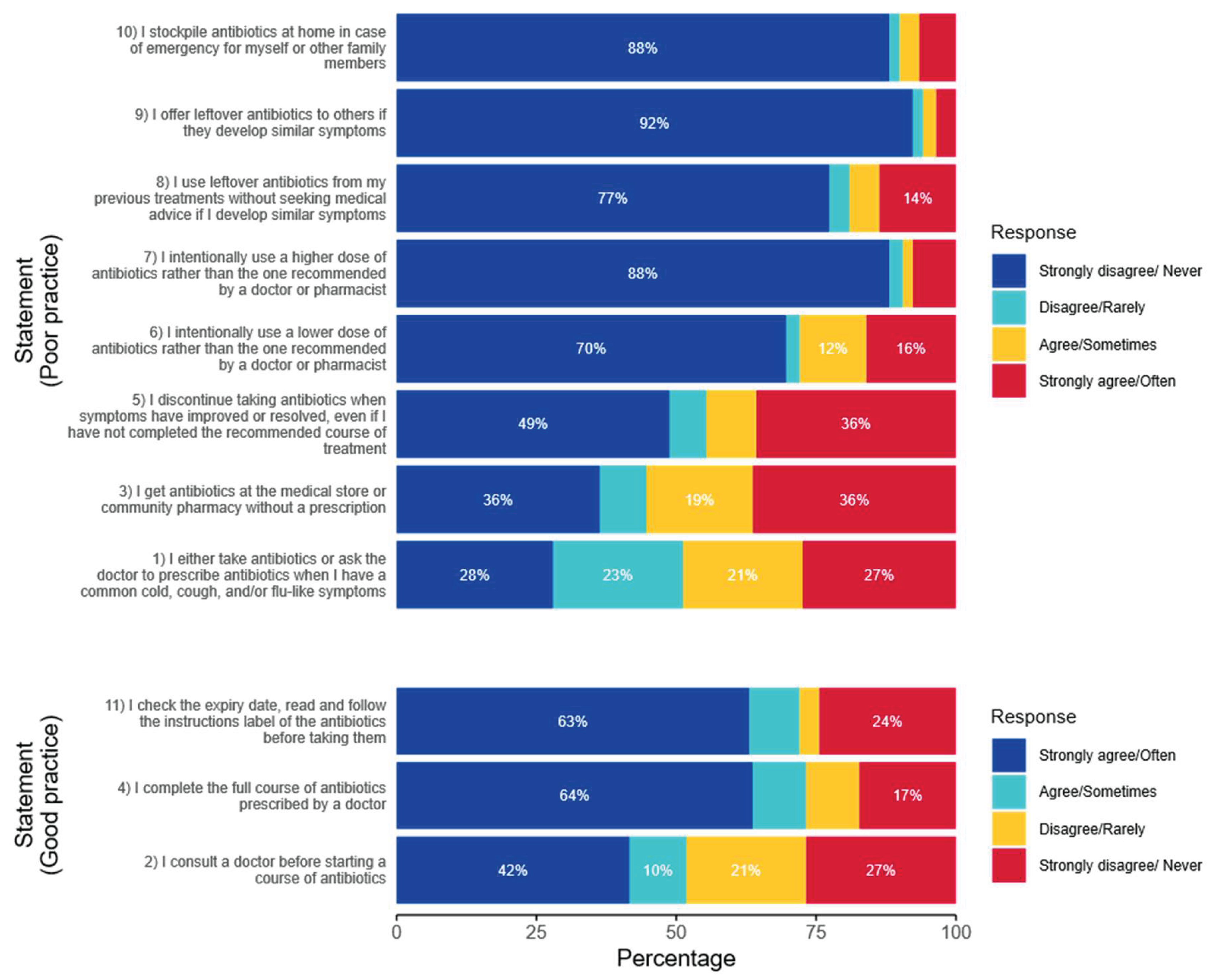

Table 1.
Sociodemographic characteristics and history of antibiotic use among older adults in Gia Lam Commune, Hanoi.
Table 1.
Sociodemographic characteristics and history of antibiotic use among older adults in Gia Lam Commune, Hanoi.
| Characteristic | N = 1771 |
| Participant Characteristics | |
| Sex | |
| Male | 78 (44%) |
| Female | 99 (56%) |
| Age group | |
| 60-67 | 80 (45%) |
| 68-77 | 73 (41%) |
| 78+ | 24 (14%) |
| Education level | |
| College or higher | 49 (28%) |
| High school or lower | 128 (72%) |
| Urban or suburban/rural | |
| Suburban or Rural | 37 (21%) |
| Urban | 140 (79%) |
| Occupation | |
| Not in paid employment | 19 (11%) |
| Non-skilled worker | 91 (51%) |
| Skilled worker | 44 (25%) |
| Other | 23 (13%) |
| Antibiotic Use Experience | |
| Last antibiotic consumption | |
| In the last month | 55 (31%) |
| In the last 6 months | 37 (21%) |
| In the last year | 14 (7.9%) |
| More than a year ago | 34 (19%) |
| Never | 9 (5.1%) |
| Cannot remember | 28 (16%) |
| Obtained the antibiotic prescription from a doctor | 115 (68%) |
| Instructed on taking antibiotics by a healthcare worker | 137 (82%) |
| Location of buying antibiotics | |
| Pharmacy | 101 (60%) |
| Hospital | 63 (38%) |
| Elsewhere | 4 (2%) |
1n (%).
Table 2.
Responses to general antibiotic knowledge and antimicrobial resistance awareness items, stratified by sex.
Table 2.
Responses to general antibiotic knowledge and antimicrobial resistance awareness items, stratified by sex.
| Overall | Sex | |||
| Characteristic | N = 1771 |
Male N = 781 |
Female N = 991 |
p-value2 |
| General Antibiotic Knowledge | ||||
| • Antibiotics are medicines that can kill bacteria | 145 (82%) | 69 (88%) | 76 (77%) | 0.045 |
| • Antibiotics can be used to treat viral infections | 53 (30%) | 29 (37%) | 24 (24%) | 0.062 |
| • Penicillin is an antibiotic | 141 (80%) | 72 (92%) | 69 (70%) | < 0.001 |
| • Paracetamol is an antibiotic | 75 (42%) | 37 (47%) | 38 (38%) | 0.2 |
| 1. All antibiotics do not cause side effects when taken at the recommended dose by doctors | 73 (41%) | 38 (49%) | 35 (35%) | 0.073 |
| • Some antibiotics may cause an allergic reaction | 124 (70%) | 61 (78%) | 63 (64%) | 0.036 |
| 2. Do you think these conditions can be treated with antibiotics? | ||||
| COVID-19 | 81 (46%) | 40 (51%) | 41 (41%) | 0.2 |
| Fever | 58 (33%) | 22 (28%) | 36 (36%) | 0.3 |
| Skin or wound infection | 9 (5.1%) | 3 (3.8%) | 6 (6.1%) | 0.7 |
| Body aches | 112 (63%) | 52 (67%) | 60 (61%) | 0.4 |
| Headaches | 125 (71%) | 63 (81%) | 62 (63%) | 0.009 |
| HIV/AIDS | 41 (23%) | 29 (37%) | 12 (12%) | < 0.001 |
| Antimicrobial Resistance | ||||
| • Antibiotic resistance occurs when your body becomes resistant to antibiotics, when they no longer work as well | 7 (4.5%) | 2 (2.8%) | 5 (6.1%) | 0.4 |
| 1. Many infections are becoming increasingly resistant to treatment by antibiotics | 139 (90%) | 68 (93%) | 71 (87%) | 0.2 |
| • Antibiotic resistance is a medical issue that could adversely affect me or my family | 141 (91%) | 61 (84%) | 80 (98%) | 0.002 |
| 2. Antibiotic resistance is an issue in other countries but NOT here | 85 (55%) | 47 (64%) | 38 (46%) | 0.024 |
| • Antibiotic resistance is only a problem for people who take antibiotics regularly | 30 (19%) | 15 (21%) | 15 (18%) | 0.7 |
| • Bacteria that are resistant to antibiotics can be spread from person to person | 66 (43%) | 37 (51%) | 29 (35%) | 0.054 |
| • Antibiotic-resistant infections increase the risk to hospital patients of undergoing medical procedures like surgery | 123 (79%) | 61 (84%) | 62 (76%) | 0.2 |
1n (%). 2Pearson's Chi-squared test; Fisher's exact test.
Table 3.
Multivariable linear regression analysis of factors associated with antibiotic knowledge and antimicrobial resistance awareness scores.
Table 3.
Multivariable linear regression analysis of factors associated with antibiotic knowledge and antimicrobial resistance awareness scores.
| Antibiotic Knowledge Score | AMR Awareness Score | |
| Characteristic | β (95% CI)1 | β (95% CI)1 |
| Sex (reference: Male) | ||
| Female | -0.68 (-1.5, 0.10) | -0.24 (-0.67, 0.18) |
| Age group (reference: 60-67) | ||
| 68-77 | -0.40 (-1.1, 0.34) | -0.91 (-1.3, -0.50)*** |
| 78+ | -2.0 (-3.1, -0.93)*** | -0.95 (-1.6, -0.30)** |
| Education level (reference: College or higher) | ||
| High school or lower | -1.2 (-2.1, -0.19)* | -0.30 (-0.81, 0.20) |
| Residence (reference: Suburban/rural) | ||
| Urban | 0.90 (0.07, 1.7)* | 0.23 (-0.24, 0.69) |
| Occupation (reference: Not in paid employment) | ||
| Non-skilled worker | -0.60 (-1.7, 0.49) | 0.02 (-0.59, 0.63) |
| Skilled worker | 0.44 (-0.93, 1.8) | 0.23 (-0.52, 0.97) |
| Other | 0.08 (-1.4, 1.6) | 0.51 (-0.31, 1.3) |
1*p < 0.05; **p < 0.01; ***p < 0.001. Abbreviation: CI = Confidence Interval.
Table 4.
Self-reported practices related to antibiotic use among older adults, stratified by sex.
| Overal | Sex | |||
| Statement | N = 1771 |
Male N = 781 |
Female N = 991 |
p-value2 |
| 1. I either take antibiotics or ask the doctor to prescribe antibiotics when I have a common cold, cough, and/or flu-like symptoms | 86 (51%) | 34 (46%) | 52 (55%) | 0.2 |
| 2. I consult a doctor before starting a course of antibiotics | 87 (52%) | 42 (57%) | 45 (48%) | 0.3 |
| 3. I get antibiotics at the medical store or community pharmacy without a prescription | 75 (45%) | 33 (45%) | 42 (45%) | > 0.9 |
| 4. I complete the full course of antibiotics prescribed by a doctor | 123 (73%) | 54 (73%) | 69 (73%) | > 0.9 |
| 5. I discontinue taking antibiotics when symptoms have improved or resolved, even if I have not completed the recommended course of treatment | 93 (55%) | 38 (51%) | 55 (59%) | 0.4 |
| 6. I intentionally use a lower dose of antibiotics rather than the one recommended by a doctor or pharmacist | 121 (72%) | 51 (69%) | 70 (74%) | 0.4 |
| 7. I intentionally use a higher dose of antibiotics rather than the one recommended by a doctor or pharmacist | 152 (90%) | 69 (93%) | 83 (88%) | 0.3 |
| 8. I use leftover antibiotics from my previous treatments without seeking medical advice if I develop similar symptoms | 136 (81%) | 58 (78%) | 78 (83%) | 0.5 |
| 9. I offer leftover antibiotics to others if they develop similar symptoms | 158 (94%) | 71 (96%) | 87 (93%) | 0.5 |
| 10. I stockpile antibiotics at home in case of emergency for myself or other family members | 151 (90%) | 66 (89%) | 85 (90%) | 0.8 |
| 11. I check the expiry date, read and follow the instructions label of the antibiotics before taking them | 121 (72%) | 53 (72%) | 68 (72%) | > 0.9 |
| 1n (%); | ||||
| 2Pearson's Chi-squared test; Fisher's exact test | ||||
Table 5.
Multivariable linear regression analysis of factors associated with appropriate antibiotic use practice scores.
Table 5.
Multivariable linear regression analysis of factors associated with appropriate antibiotic use practice scores.
| Characteristic | β (95% CI)1 |
| Total knowledge score | 0.15 (0.00, 0.30)* |
| Sex (reference: Male) | |
| Female | 0.74 (-0.03, 1.5) |
| Age group (reference: 60-67) | |
| 68-77 | -0.48 (-1.2, 0.24) |
| 78+ | -0.35 (-1.5, 0.77) |
| Education level (reference: College or higher) | |
| High school or lower | -0.44 (-1.4, 0.53) |
| Residence (reference: Suburban/rural) | |
| Urban | -0.21 (-1.0, 0.61) |
| Occupation (reference: Not in paid employment) | |
| Non-skilled worker | -0.18 (-1.2, 0.89) |
| Skilled worker | 0.10 (-1.2, 1.4) |
| Other | 1.0 (-0.45, 2.5) |
1*p < 0.05; **p < 0.01; ***p < 0.001. Abbreviation: CI = Confidence Interval.
Disclaimer/Publisher’s Note: The statements, opinions and data contained in all publications are solely those of the individual author(s) and contributor(s) and not of MDPI and/or the editor(s). MDPI and/or the editor(s) disclaim responsibility for any injury to people or property resulting from any ideas, methods, instructions or products referred to in the content. |
© 2026 by the authors. Licensee MDPI, Basel, Switzerland. This article is an open access article distributed under the terms and conditions of the Creative Commons Attribution (CC BY) license (http://creativecommons.org/licenses/by/4.0/).
Copyright: This open access article is published under a Creative Commons CC BY 4.0 license, which permit the free download, distribution, and reuse, provided that the author and preprint are cited in any reuse.