

Submitted:
26 August 2026
Posted:
27 August 2026
You are already at the latest version
Abstract
Background: Vertigo and dizziness are common neurological complaints in childhood, and increasing evidence suggests that a substantial proportion of recurrent vestibular symptoms may represent early manifestations of migraine-related disorders. However, current diagnostic criteria for pediatric vestibular migraine may underestimate migraine involvement in prepubertal children, in whom vestibular and autonomic symptoms often precede or occur independently of headache. Objectives: To reassess a large pediatric cohort of children with recurrent vestibular symptoms using a developmental migraine-spectrum model integrating vestibular manifestations, migraine precursors, and susceptibility markers. Methods: This retrospective multicenter study analyzed 146 children aged 3-12 years evaluated for recurrent vestibular symptoms between 1995 and 2022 at two Italian tertiary referral centers. All patients were initially classified according to the 2021 Bárány Society and International Headache Society criteria. A secondary structured evaluation assessed family history of migraine, headache characteristics, vestibular phenotype, benign paroxysmal torticollis, extra-vestibular migraine precursors (cyclic vomiting, recurrent abdominal pain, and related episodic syndromes), and migraine susceptibility markers including motion sickness and sensory hypersensitivity. Results: Of the 146 children, 144 fulfilled the Bárány Society criteria for Recurrent Vertigo of Childhood, whereas two presented with isolated benign paroxysmal torticollis, interpreted according to Pagnini’s model as a migraine-related manifestation of the descending vestibulo-cervical pathway [21]. None fulfilled the criteria for Vestibular Migraine of Childhood or probable Vestibular Migraine of Childhood. Headache was present in only 15.8% of patients and was generally mild to moderate. Most children exhibited recurrent isolated vestibular episodes with frequent autonomic symptoms, while a subgroup presented with benign paroxysmal torticollis. Motion sickness and sensory hypersensitivity were highly prevalent, and many patients showed additional developmental migraine precursors, including abdominal pain, cyclic vomiting, limb pain, and infant colic. Vestibular symptoms frequently preceded headache onset, supporting the hypothesis that migraine susceptibility may manifest predominantly through vestibular and autonomic pathways during childhood. Conclusions: Pediatric recurrent vertigo should be considered within a broader developmental migraine spectrum rather than as an isolated vestibular disorder. Current diagnostic criteria may lack sensitivity in prepubertal populations by emphasizing headache-related features. Integrating vestibular symptoms, developmental migraine equivalents, and susceptibility markers may improve early recognition of migraine-related vestibulopathy and provide a biologically plausible model for the developmental evolution of migraine-related vestibulopathy across childhood and adolescence.
Keywords:
vestibular migraine
; recurrent vertigo of childhood
; pediatric vertigo
; migraine diathesis
; benign paroxysmal torticollis
1. Introduction
Vertigo and dizziness are among the most frequent neurological complaints in childhood after headache and represent a common reason for referral to pediatric otolaryngology and neurotology services [1]. Although peripheral vestibular disorders, neurological conditions, and functional disorders must be considered in the differential diagnosis, increasing evidence indicates that migraine-related mechanisms account for a substantial proportion of recurrent episodic vestibular symptoms in children. Migraine is currently recognized as a complex neurobiological disorder involving altered sensory processing and dysfunction of multiple neuronal networks. Accordingly, vestibular migraine should no longer be regarded simply as migraine associated with vertigo, but rather as one phenotypic expression of a broader migraine diathesis. Vestibular symptoms may occur before, during, after, or independently of headache attacks and may represent the predominant clinical manifestation, particularly during childhood [2,3]. During early life, migraine expression differs substantially from the adult phenotype. Before puberty, headache may be absent, poorly characterized, or clinically overshadowed by episodic non-cephalic manifestations, including recurrent vertigo, benign paroxysmal torticollis, cyclic vomiting, abdominal migraine, motion sickness, and sensory hypersensitivity [4]. Epidemiological and clinical studies have demonstrated strong associations between recurrent vestibular symptoms in children and migraine-related features, such as family history of migraine, motion intolerance, and sensory hypersensitivity, supporting the concept that vestibular manifestations may represent integral components of the migraine spectrum rather than isolated vestibular disorders [5]. To improve diagnostic standardization, the Bárány Society and the International Headache Society introduced in 2021 consensus criteria distinguishing Vestibular Migraine of Childhood (VMC), probable Vestibular Migraine of Childhood (probable VMC), and Recurrent Vertigo of Childhood (RVC) [6] (Table 1). Although this classification represents an important advance, its reliance on headache-related criteria may reduce diagnostic sensitivity in prepubertal children, in whom migraine may manifest predominantly through vestibular and autonomic symptoms [7]. A developmental model of pediatric migraine suggests that different age-related phenotypes, including benign paroxysmal torticollis, cyclic vomiting, abdominal migraine equivalents, recurrent vestibular symptoms, and later vestibular migraine, may represent distinct expressions of an underlying migraine susceptibility. Within this framework, childhood vestibular disorders may reflect an evolving clinical spectrum rather than separate diagnostic entities.
Table 1. Diagnostic criteria for Vestibular Migraine of Childhood, probable Vestibular Migraine of Childhood, and Recurrent Vertigo of Childhood according to the 2021 Bárány Society–International Headache Society consensus.
The distinction between vertigo and dizziness is therefore clinically relevant, as pediatric patients frequently lack the vocabulary required to accurately characterize vestibular sensations [2]. The present study reports a 27-year multicenter experience involving 146 children evaluated for recurrent vestibular symptoms at two Italian tertiary referral centers. The aim was to reassess this cohort according to an expanded phenotypic model integrating vestibular manifestations, migraine developmental precursors, and susceptibility markers, testing the hypothesis that a proportion of children currently classified as having RVC may represent an early developmental phenotype within the migraine-related vestibular spectrum.
2. Materials and Methods
This retrospective observational study was conducted over a 27-year period (1995-2022) in two tertiary vestibology centers: the SOD Audiologia e Otorinolaringoiatria, Azienda Ospedaliera Universitaria Careggi, Florence, and the UOC Otorinolaringoiatria, “Madonna delle Grazie” Hospital, Matera, and UO Otorinolaringoiatria e Vestibologia, Ospedale “Giovanni Paolo II”, ASM Matera, Policoro. The study population consisted of 146 children aged 3-12 years evaluated for recurrent vestibular symptoms suggestive of migraine-related disorders (Table 2). Patients were included if they presented with recurrent spontaneous vestibular symptoms and had available clinical information regarding vestibular manifestations and migraine-related features. Patients with identifiable alternative causes of vertigo, including structural neurological disorders, congenital or acquired vestibular diseases, significant hearing impairment, inflammatory or infectious conditions, or incomplete clinical documentation were excluded. Categorical variables were summarized as absolute frequencies and percentages. Continuous variables were described using ranges and, where available, means or medians. No inferential statistical comparisons were performed because the study was designed as a retrospective descriptive cohort analysis. The cohort included 95 patients from Florence and 51 from Matera, with a female predominance. At presentation, 144 children exhibited recurrent vestibular symptoms, classified as spinning vertigo or non-spinning dizziness. Four of these patients also presented with benign paroxysmal torticollis. Two additional children presented with isolated recurrent benign paroxysmal torticollis, interpreted according to Pagnini’s model as a migraine-related manifestation of the descending vestibulo-cervical pathway [21]. Headache was reported in 23 patients (15.8%) and was generally mild to moderate in intensity. All patients were initially classified according to the 2021 Bárány Society and International Headache Society consensus criteria for pediatric vestibular disorders, including Vestibular Migraine of Childhood (VMC), probable Vestibular Migraine of Childhood, and Recurrent Vertigo of Childhood (RVC). Among the 146 patients, 144 fulfilled the criteria for RVC, whereas the two children with isolated recurrent torticollis did not meet the formal Bárány Society criteria for RVC but were included within the expanded migraine-related vestibular spectrum. None met diagnostic criteria for VMC or probable VMC. Given the potential limitations of current diagnostic frameworks in pediatric populations, a secondary structured reassessment was performed. Family history of migraine was assessed as a phenotypic variable and was not used as an inclusion criterion. This evaluation included migraine family history, sex, age at symptom onset, vestibular phenotype (spinning vertigo versus non-spinning dizziness), headache characteristics, and the presence of vestibular and extra-vestibular migraine-related precursors. Benign paroxysmal torticollis was considered a vestibular precursor, while cyclic abdominal pain and cyclic vomiting were considered extra-vestibular precursors. Additional probable migraine-related manifestations, including recurrent limb pain, recurrent fever, and infant colic, were also assessed. Migraine susceptibility markers, including motion sickness, sensory hypersensitivity, photophobia, phonophobia, osmophobia, dysosmia, and intolerance to motion stimuli, were systematically evaluated. A conceptual age stratification distinguishing prepubertal and postpubertal migraine-related vestibular phenotypes was also applied, considering 12 years as the upper limit for childhood vestibular migraine expression because of the potential influence of puberty-related hormonal changes.
3. Results
Among the 146 children, 144 met the Bárány Society criteria for RVC. The remaining two presented with isolated recurrent torticollis, considered a migraine-related vestibulo-cervical phenotype according to Pagnini’s model [21]. None fulfilled diagnostic criteria for Vestibular Migraine of Childhood or probable Vestibular Migraine of Childhood, despite presenting with a clinical picture strongly suggestive of migraine-related disease. A positive family history of migraine was documented in all patients. The predominant clinical presentation was recurrent vestibular symptoms, observed in almost all patients, while a small subgroup presented with associated vestibulo-cervical manifestations. Specifically, four children experienced both recurrent vestibular symptoms and benign paroxysmal torticollis, and two presented with isolated recurrent torticollis. Overall, six children exhibited a torticollis phenotype. In four patients, torticollis coexisted with recurrent vertigo or dizziness, whereas in two it represented the isolated clinical expression of a migraine-related vestibulo-cervical disorder. Symptom onset occurred predominantly between the ages of three and eight years. In patients with torticollis, episodes were retrospectively reported to have begun earlier, typically between two and four years of age. A clear female predominance was observed across the cohort, in keeping with known epidemiological patterns of migraine disorders. Headache was present in a minority of cases and was generally mild or moderate in intensity. In most patients, vestibular symptoms preceded the onset of headache, supporting the hypothesis that vestibular manifestations may represent an early expression of migraine biology in childhood. Vestibular episodes were characterized by abrupt onset during normal activity, variable duration ranging from minutes to several hours, and complete spontaneous resolution. Clinical manifestations included motor arrest, imbalance, fear behaviour and, in older children, clearly described spinning vertigo. Autonomic symptoms such as pallor, nausea, sweating, and anorexia were frequently observed, whereas vomiting occurred less consistently. In selected cases, parental smartphone recordings documented transient nystagmoid eye movements with peripheral characteristics. Patients with torticollis exhibited episodic tonic rotation and lateral flexion of the neck, with spontaneous resolution and no residual deficits. These episodes often preceded or coexisted with vestibular symptoms, suggesting a shared underlying mechanism. A substantial proportion of patients also presented with extra-vestibular migraine precursors, including recurrent abdominal pain, cyclic vomiting, recurrent limb pain, episodic unexplained fever, and a history of infant colic. Among these, abdominal pain and cyclic vomiting were the most consistently reported and frequently led to repeated negative gastrointestinal evaluations. Markers of migraine susceptibility were highly prevalent. Motion sickness was the most frequent feature, followed by sensory hypersensitivity manifestations such as phonophobia, hyperacusis, osmophobia, dysosmia, photophobia, and intolerance to motion or acceleration stimuli. These traits often preceded vestibular symptom onset and were considered strong indicators of an underlying migraine predisposition.
Figure 1.
Original classification of migraine-related vertigo proposed by Pagnini et al. Reproduced from Pagnini et al. [8] with permission from the authors.
Figure 1.
Original classification of migraine-related vertigo proposed by Pagnini et al. Reproduced from Pagnini et al. [8] with permission from the authors.
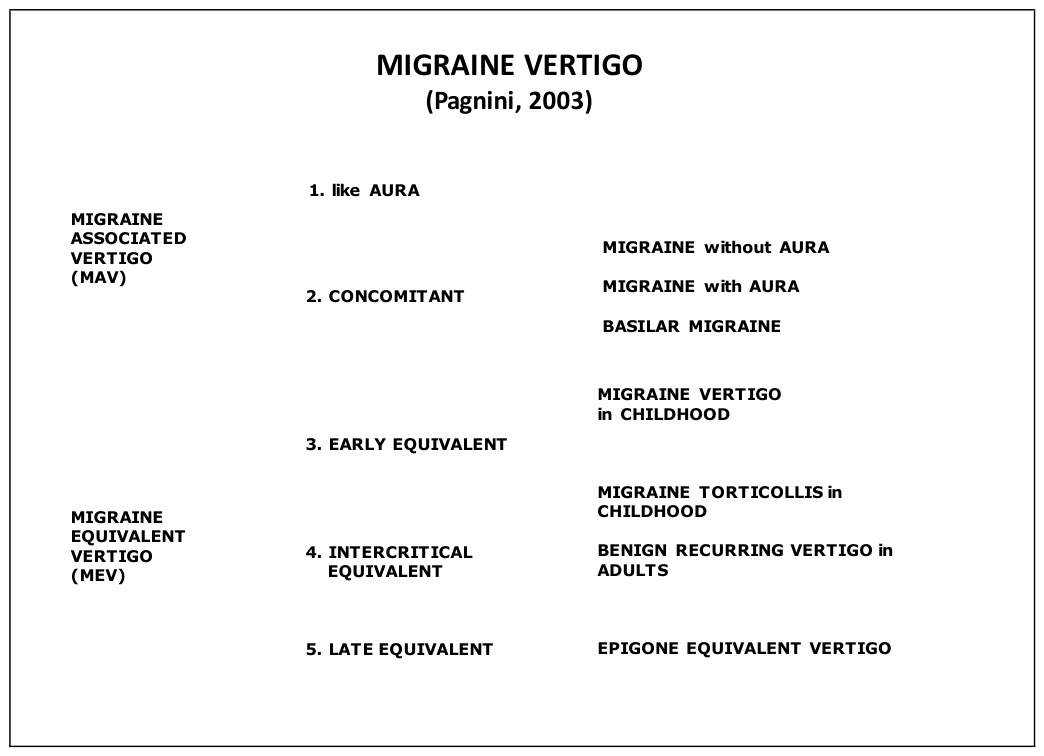
Figure 2.
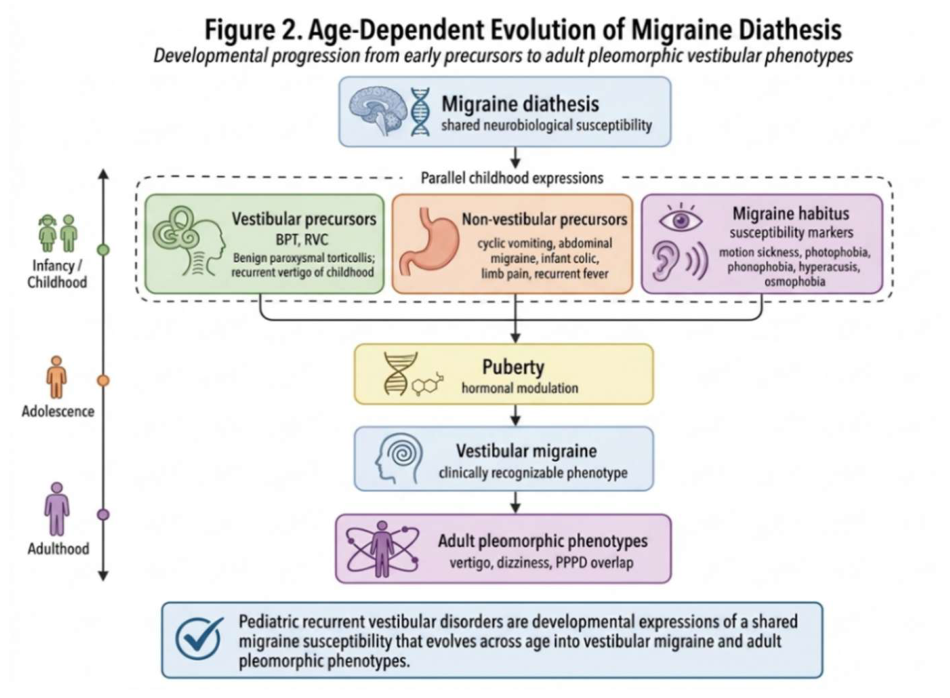
Age-dependent evolution of migraine diathesis. Vestibular precursors, non-vestibular precursors, and migraine habitus are represented as parallel and potentially coexisting childhood expressions and susceptibility traits, rather than obligatory sequential stages.
Figure 2.
Age-dependent evolution of migraine diathesis. Vestibular precursors, non-vestibular precursors, and migraine habitus are represented as parallel and potentially coexisting childhood expressions and susceptibility traits, rather than obligatory sequential stages.
3.1. Vestibular Migraine of Childhood (VMC)
- At least five episodes with vestibular symptoms of moderate or severe intensity, lasting between five minutes and 72 hours
- A current or past history of migraine with or without aura
- At least half of episodes are associated with at least one of the following three migraine features:
1. Headache with at least two of the following four characteristics:a) One-sided locationb) Pulsating qualityc) Moderate or severe pain intensityd) Aggravation by routine physical activity
2. Photophobia and phonophobia
3. Visual aura
- D. Age < 18 years
- E. Not better accounted for by another headache disorder, vestibular disorder, or other condition
3.2. Probable Vestibular Migraine of Childhood (Probable VMC)
- At least three episodes with vestibular symptoms of moderate or severe intensity, lasting between five minutes and 72 hours
- Only one of the criteria B and C for Vestibular Migraine of Childhood
- Age < 18 years
- Not better accounted for by another headache disorder, vestibular disorder, or other condition
3.3. Recurrent Vertigo of Childhood (RVC)
- At least three episodes with vestibular symptoms of moderate or severe intensity, lasting between 1 minute and 72 hours
- None of the criteria B and C for Vestibular Migraine of Childhood
- Age < 18 years
- Not better accounted for by another headache disorder, vestibular disorder, or other condition
4. Discussion
The present 27-year multicenter cohort study provides evidence that a substantial proportion of children classified under the current Bárány Society framework as having Recurrent Vertigo of Childhood (RVC) may represent early developmental manifestations within a broader migraine-related vestibular spectrum. Although the 2021 Bárány Society and International Headache Society consensus criteria constitute an important step toward standardized classification of pediatric vestibular disorders, our findings suggest that their current operational structure may underestimate migraine-related vestibular disease in prepubertal populations by placing disproportionate emphasis on the presence of headache as a defining diagnostic requirement. A key implication of our findings is that migraine-related vestibular disorders in childhood should be interpreted as a developmental phenotype rather than as a collection of discrete diagnostic entities (Figure 2). The clinical expression of migraine susceptibility appears to undergo age-dependent transformation, reflecting the maturation of sensory networks, nociceptive pathways, and neuroendocrine regulation [9]. In the prepubertal period, vestibular manifestations may represent the predominant expression of migraine biology, while headache may be absent, poorly developed, or clinically overshadowed by episodic vestibular and autonomic symptoms [10]. This developmental dissociation between vestibular symptoms and headache provides a plausible explanation for the low proportion of children fulfilling current diagnostic criteria for Vestibular Migraine of Childhood despite exhibiting multiple markers of migraine predisposition [11,12,13,14]. Within this model, recurrent vertigo of childhood may represent an early developmental expression of the same neurobiological disorder that later becomes clinically recognizable as vestibular migraine. Rather than indicating separate disease entities, childhood recurrent vertigo, benign paroxysmal torticollis, cyclic vomiting, abdominal migraine equivalents, and later vestibular migraine may reflect age-dependent phenotypic expressions of a shared migraine susceptibility. The transition from a predominantly vestibular phenotype during childhood toward a more multisensory and headache-associated phenotype after puberty may therefore represent a process of phenotypic maturation rather than disease progression. Puberty appears to represent a critical biological transition in this continuum. Hormonal maturation, particularly the influence of fluctuating gonadal hormones on trigeminovascular activation, sensory processing, and neurotransmitter systems, may modify the clinical expression of migraine susceptibility [15]. Although female predominance is generally considered more evident after puberty, females were also overrepresented in our prepubertal referral cohort. This finding may reflect referral patterns, selection factors, or an earlier sex-related modulation and should be interpreted cautiously [16,17,18]. The vestibular phenotype itself appears heterogeneous, suggesting variable involvement of different components of the central vestibular network. Some children experience predominantly rotatory vertigo, characterized by a clear perception of spinning and compatible with transient asymmetric dysfunction within vestibular pathways. Conversely, other patients report imbalance, rocking sensations, motion intolerance, or nonspecific dizziness without true spinning vertigo, suggesting a more symmetrical alteration of multisensory vestibular integration [19,20]. These differences should not necessarily be interpreted as evidence for distinct disorders, but rather as different clinical expressions of the same migraine-related dysfunction affecting vestibulo-thalamo-cortical, cerebellar, and brainstem networks. This concept may also explain why the terminology of “vertigo” alone fails to capture the full spectrum of pediatric migraine-related vestibular symptoms. The distinction between vertigo and dizziness is therefore clinically relevant, as pediatric patients frequently lack the vocabulary required to accurately characterize vestibular sensations [2]. A broader assessment incorporating the quality of vestibular symptoms, motion sensitivity, sensory hypersensitivity, autonomic activation, and developmental migraine precursors may improve diagnostic sensitivity and better identify children at risk of evolving toward classical vestibular migraine phenotypes. Overall, our findings support a reconceptualization of pediatric migraine-related vestibular disorders as a dynamic developmental spectrum characterized by age-dependent phenotypic transformation rather than as static disorders defined by the simultaneous presence of vestibular symptoms and headache [22,23]. Such a framework may allow earlier identification of migraine-related vestibular disease in childhood and provide a more biologically plausible model for longitudinal evolution across developmental stages. In our cohort, headache at presentation was reported in only 15.8% of children, despite the presence of a highly consistent migraine-associated phenotype characterized by positive family history of migraine, motion sickness, sensory hypersensitivity, autonomic activation during attacks, and multiple developmental episodic syndromes historically recognized as migraine precursors. This dissociation between headache and vestibular symptomatology supports the concept that, during early life, migraine susceptibility may preferentially manifest through vestibular and autonomic pathways rather than through the classic headache phenotype. The high prevalence of motion sickness and sensory hypersensitivity observed in our patients further supports their potential role as early markers of central sensory processing dysregulation. Moreover, the frequent coexistence of vestibular symptoms with benign paroxysmal torticollis underscores the likelihood that vestibular and cervico-motor paroxysmal disorders represent related developmental expressions of a shared migraine network instability affecting vestibulo-ocular and vestibulo-spinal pathways. In this context, benign paroxysmal torticollis, cyclic vomiting, abdominal migraine equivalents, and recurrent vertigo may be interpreted as age-dependent manifestations along a common migraine spectrum rather than as completely separate clinical entities. The absence of any patient fulfilling criteria for Vestibular Migraine of Childhood or probable Vestibular Migraine, despite the presence of multiple migraine-associated features, further highlights a potential limitation of current Bárány Society criteria, which remain partially anchored to adult-derived diagnostic constructs and may lack sensitivity for early-life, non-cephalic migraine expressions. Our developmental model expands the original classification proposed by Pagnini et al. [8] (Figure 1), in which migraine-related vestibular disorders are interpreted as age-dependent phenotypic expressions of the same neurobiological susceptibility rather than distinct nosological entities. From a clinical perspective, these findings support the integration of migraine susceptibility markers, including family history, developmental episodic syndromes, sensory hypersensitivity, motion intolerance, and autonomic symptomatology, into the diagnostic evaluation of children presenting with recurrent vertigo. This approach may improve early recognition of migraine-related vestibulopathy, reduce unnecessary diagnostic investigations, and refine prognostic counseling regarding later evolution toward classical migraine phenotypes.
5. Limitations of the Study
This study has several limitations. Its retrospective design and the long observation period may have resulted in incomplete or non-standardized documentation of some migraine precursors and susceptibility markers. Moreover, the proposed developmental interpretation is based on cross-sectional phenotypic reassessment rather than prospective longitudinal follow-up into adolescence and adulthood. The numerical prevalence of individual migraine-associated traits should therefore be interpreted cautiously and confirmed in prospective cohorts.
6. Conclusions
Pediatric recurrent vestibular disorders may represent heterogeneous clinical expressions of a shared migraine-related susceptibility. The present 27-year multicenter experience suggests that current diagnostic criteria may underestimate migraine involvement in childhood vestibular syndromes by relying excessively on the presence of headache. A broader developmental framework incorporating vestibular symptoms, extra-vestibular migraine precursors, and susceptibility markers may provide a more accurate representation of pediatric migraine biology. Such an approach has the potential to improve early diagnosis, optimize management, and refine prognostic assessment across developmental stages.
Author Contributions
Conceptualization, G.A.L. and P.P.; methodology, G.A.L., P.P. and R.P.; data curation, G.C., R.P. and F.A.L.; writing—original draft preparation, G.C. and R.P.; writing—review and editing, P.P., G.C., G.A.L. and F.A.L.; supervision, P.P. All authors have read and agreed to the published version of the manuscript.
Funding
This research received no external funding.
Institutional Review Board Statement
Ethical review and approval were not sought for this study because it was a retrospective analysis of clinical records collected during routine care over an extended period (more than 10 years). Only fully anonymized, non-identifiable data were included in the analysis, no additional diagnostic or therapeutic procedures were performed for research purposes, and patient privacy was preserved throughout the study.
Informed Consent Statement
Informed consent was not obtained because the study was based exclusively on the retrospective analysis of fully anonymized, non-identifiable clinical data collected during routine care. No information permitting identification of individual patients was used in the study.
Data Availability Statement
The original contributions presented in this study are included in the article. Further inquiries can be directed to the corresponding author.
Conflicts of Interest
The authors declare no conflicts of interest.
References
- Fancello, V.; Palma, S.; Monzani, D.; Pelucchi, S.; Genovese, E.; Ciorba, A. Vertigo and Dizziness in Children: An Update. Children Published. 2021, 8(11), 1025. [Google Scholar] [CrossRef]
- Bisdorff, A.; von Brevern, M.; Lempert, T.; Newman-Toker, D.E. Classification of vestibular symptoms: Towards an international classification of vestibular disorders. J. Vestib. Res. 2009, 19(1-2), 1–13. [Google Scholar] [CrossRef]
- Gioacchini, F.M.; Alicandri-Ciufelli, M.; Kaleci, S.; et al. Management of vertigo in children: a consensus paper. Eur. Arch. Oto-Rhino-Laryngol. 2021, 278, 4145–4156. [Google Scholar]
- Lempert, T.; Olesen, J.; Furman, J.; et al. Vestibular migraine: diagnostic criteria. J. Vestib. Res. 2012, 22, 167–172. [Google Scholar] [CrossRef]
- Lipton, R.B.; Bigal, M.E.; Diamond, M.; Freitag, F.; Reed, M.L.; Stewart, W.F.; AMPP Advisory Group. Migraine prevalence, disease burden, and the need for preventive therapy. Neurology 2007, 68(5), 343–9. [Google Scholar] [CrossRef] [PubMed]
- Smyth, D.; Britton, Z.; Murdin, L.; Arshad, Q.; Kaski, D. Vestibular migraine treatment: a comprehensive practical review. Brain 2022, 145(11), 3741–3754. [Google Scholar] [CrossRef] [PubMed] [PubMed Central]
- van de Berg, R.; Widdershoven, J.; Bisdorff, A.; et al. Vestibular migraine of childhood and recurrent vertigo of childhood: consensus document of the Barany Society and the International Headache Society. J. Vestib. Res. 2021, 31, 1–9. [Google Scholar] [CrossRef]
- Pagnini, P.; Verrecchia, L.; Giannoni, B.; Vannucchi, P. La vertigine emicranica (VE) [Migraine-related vertigo (MV)]. In Acta Otorhinolaryngol Ital; Italian, Oct 2003; Volume 23, (5, Suppl 75, pp. 19–27. [Google Scholar] [PubMed]
- Goadsby, P.J.; Holland, P.R.; Martins-Oliveira, M.; Hoffmann, J.; Schankin, C.; Akerman, S. Pathophysiology of Migraine: A Disorder of Sensory Processing. Physiol. Rev. 2017, 97(2), 553–622. [Google Scholar] [CrossRef] [PubMed] [PubMed Central]
- Duarte, J.A.; Leao, E.M.; Fragano, D.S.; et al. Vestibular Syndromes in Childhood and Adolescence. Int. Arch. Otorhinolaryngol. 2020, 24(4), e477–e481. [Google Scholar] [CrossRef]
- Charles, A. The pathophysiology of migraine: implications for clinical management. Lancet Neurol. 2018, 17, 174–182. [Google Scholar] [CrossRef]
- Furman, J.M.; Marcus, D.A.; Balaban, C.D. Vestibular migraine: clinical aspects and pathophysiology. Lancet Neurol. 2013, 12(7), 706–15. [Google Scholar] [CrossRef] [PubMed]
- Headache Classification Committee of the International Headache Society. The International Classification of Headache Disorders, 3rd edition. Cephalalgia 2018, 38, 1–211. [Google Scholar] [CrossRef]
- Pagnini, P.; Vannucchi, P.; Giannoni, B.; Pecci, R. Epigone migraine vertigo (EMV): a late migraine equivalent. Acta Otorhinolaryngol. Ital. 2014, 34(1), 62–70. [Google Scholar] [PubMed] [PubMed Central]
- Gelfand, A.A. Episodic Syndromes That May Be Associated With Migraine: A.K.A. “the Childhood Periodic Syndromes”. Headache 2015, 55(10), 1358–1364. [Google Scholar] [CrossRef]
- Lagman-Bartolome, A.M.; Lay, C. Pediatric migraine variants: a review of epidemiology, diagnosis, treatment, and outcome. Curr. Neurol. Neurosci. Rep. 2015, 15(6), 34. [Google Scholar] [CrossRef] [PubMed]
- Coppola, G.; Pierelli, F.; Schoenen, J. Habituation and migraine. Neurobiol. Learn Mem. 2009, 92(2), 249–59. [Google Scholar] [CrossRef] [PubMed]
- Jahn, K. Vertigo and dizziness in children. Handb. Clin. Neurol. 2016, 137, 353–63. [Google Scholar] [CrossRef] [PubMed]
- Marcelli, V.; Furia, T.; Marciano, E. Vestibular pathways involvement in children with migraine: a neuro-otological study. Headache 2010, 50(1), 71–6. [Google Scholar] [CrossRef] [PubMed]
- Mack, K.J. Vertigo, pediatric migraine, and best treatment. Eur. J. Paediatr. Neurol. Epub. 2022, 39, A5. [Google Scholar] [CrossRef] [PubMed]
- Pagnini, P.; Bentivegna, L.; Pecci, R. La vestibolopatia emicranica. In Vestibologia Clinica; 2014; pp. 489–514. [Google Scholar]
- Teggi, R.; Colombo, B.; Albera, R.; Asprella Libonati, G.; Balzanelli, C.; Batuecas Caletrio, A.; Casani, A.; Espinoza-Sanchez, J.M.; Gamba, P.; Lopez-Escamez, J.A.; Lucisano, S.; Mandala, M.; Neri, G.; Nuti, D.; Pecci, R.; Russo, A.; Martin-Sanz, E.; Sanz, R.; Tedeschi, G.; Torelli, P.; Vannucchi, P.; Comi, G.; Bussi, M. Clinical Features, Familial History, and Migraine Precursors in Patients With Definite Vestibular Migraine: The VM-Phenotypes Projects. Headache 2018, 58(4), 534–544. [Google Scholar] [CrossRef] [PubMed]
- Ralli, G.; Atturo, F.; de Filippis, C. Idiopathic benign paroxysmal vertigo in children, a migraine precursor. Int. J. Pediatr. Otorhinolaryngol. 2009, 73 Suppl 1, S16–8. [Google Scholar] [CrossRef] [PubMed]

Table 2.
Demographic characteristics, clinical presentation, migraine-related precursors, and susceptibility markers in the pediatric cohort.
Table 2.
Demographic characteristics, clinical presentation, migraine-related precursors, and susceptibility markers in the pediatric cohort.
| Number of patients | 146 (95 Florence + 51 Matera) |
|---|---|
| Age | 3-12 years |
| Sex | 92 F (63.0%) – 54 M (37.0%) |
| Sexual maturity | Pre-pubertal 100% |
| Familiarity for migraine | 146/146 (100%) |
| SYMPTOMS | |
| Vertigo described as a spinning sensation | 58/144 (40.3%) |
| Vertigo (spinning sensation) associated with autonomic symptoms | 47/58 (81.0%) |
| Dizziness | 86/144 (59.7%) |
| associated with autonomic symptoms | 53/86 (61.6%) |
| Headache | 23 (15.8%), generally mild to moderate and predominantly reported in children older than 10 years. |
| Benign paroxysmal torticollis (BPT) | 6/146 (4.1%); isolated BPT: 2/146 (1.4%) |
| Definite extra-vestibular migraine precursors | Cyclic abdominal pain 24 (16.4%) Cyclic vomiting 18 (12.3%) |
| Probable migraine-related precursors | Recurrent limb pain 16 (11.0%) Recurrent fever 10 (6.8%) Infant colic 32 (21.9%) |
| Migraine susceptibility markers | Motion sickness and/or intolerance to acceleration 104 (71.2%) Phonophobia, hyperacusis 63 (43.2%) Osmophobia, dysosmia 39 (26.7%) Photophobia 55 (37.7%) |
Disclaimer/Publisher’s Note: The statements, opinions and data contained in all publications are solely those of the individual author(s) and contributor(s) and not of MDPI and/or the editor(s). MDPI and/or the editor(s) disclaim responsibility for any injury to people or property resulting from any ideas, methods, instructions or products referred to in the content. |
© 2026 by the authors. Licensee MDPI, Basel, Switzerland. This article is an open access article distributed under the terms and conditions of the Creative Commons Attribution (CC BY) license (http://creativecommons.org/licenses/by/4.0/).
Copyright: This open access article is published under a Creative Commons CC BY 4.0 license, which permit the free download, distribution, and reuse, provided that the author and preprint are cited in any reuse.