

Submitted:
26 August 2026
Posted:
27 August 2026
You are already at the latest version
Abstract
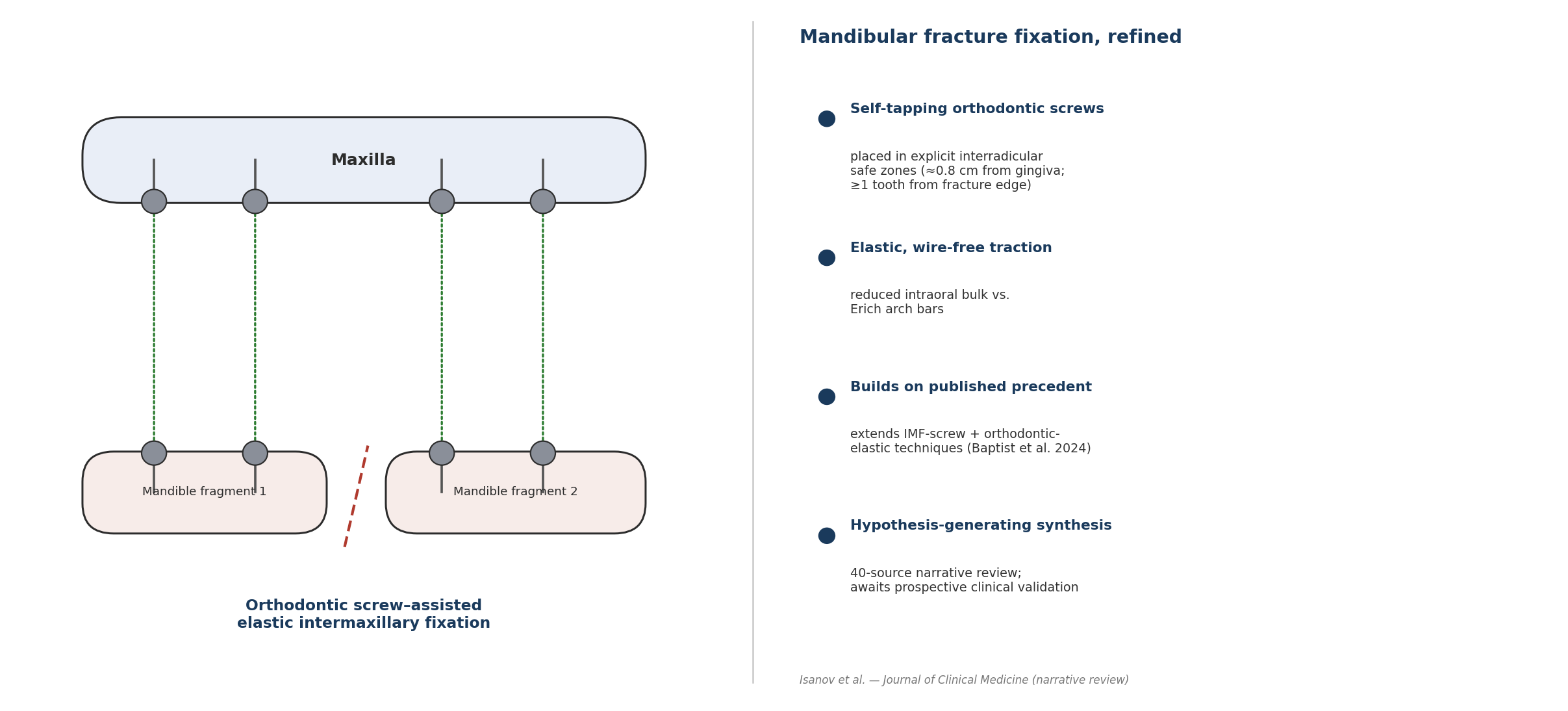
Background: Mandibular fractures are among the most common injuries encountered in oral and maxillofacial trauma and frequently require restoration of occlusion, stabilization of bone fragments, and maintenance of intermaxillary relationships during healing. Conventional Erich arch bars remain a widely used method of maxillomandibular fixation (MMF), but their application is associated with prolonged operative time, gingival and mucosal trauma, plaque accumulation, needle-stick risk to the operator, and reduced patient comfort. Bone-supported intermaxillary fixation (IMF) screws have been introduced as an alternative, yet screw-related complications — including root injury, mucosal overgrowth, loosening, and mechanical failure — continue to limit their universal adoption. Objective: This narrative review synthesizes the clinical, morphological, biomechanical, technical, and practical rationale for a proposed method of mandibular fracture stabilization using self-tapping titanium orthodontic screws, with heads placed intraorally in the alveolar process of the maxilla and mandible, connected by elastic intermaxillary traction. Methods: A narrative literature review was undertaken across five thematic domains: mandibular fracture management, Erich arch bars, intermaxillary fixation screws, orthodontic miniscrews, and the biomechanics of elastic maxillomandibular fixation. The proposed technique was then appraised against these existing fixation concepts and their documented clinical limitations. Results: The reviewed evidence indicates that screw-based intermaxillary fixation can shorten operative time, facilitate oral hygiene, and avoid extensive circumdental wiring relative to conventional arch bars. A closely related precedent already exists in the literature in the form of a published technical report combining IMF screws with orthodontic elastic chains; the present proposal extends this concept by using orthodontic titanium screws placed within explicitly defined interradicular safe zones — approximately 8 mm from the gingival margin and at least one tooth away from the fracture edge — connected by elastic rings applied between opposing screw heads to control the maxillomandibular relationship. Morphologically, placement within interradicular alveolar bone requires careful evaluation of root anatomy, cortical thickness, keratinized mucosa, and fracture configuration. Biomechanically, elastic intermaxillary traction distributes force between the maxilla and mandible while permitting controlled stabilization of the repositioned mandibular fragments. Conclusion: Orthodontic screw-assisted intermaxillary fixation, understood as a refinement of an approach already shown to be feasible in limited clinical use, represents a promising, minimally invasive intraoral strategy for selected mandibular fractures, with potential advantages that include reduced intraoral metal bulk, improved hygiene access, simplified elastic control, and controlled stabilization of mandibular fragments. Prospective clinical trials, cone-beam computed tomography (CBCT)–based anatomical safety studies, and dedicated biomechanical analyses are required before the method can be recommended for broad clinical use.
Keywords:
1. Introduction
2. Materials and Methods
3. Clinical Background of Mandibular Fracture Fixation
4. Conventional Erich Arch Bars: Strengths and Limitations
5. Intermaxillary Fixation Screws as the Closest Analogue

| Feature | Erich arch bars | Standard IMF screws | Baptist et al., 2024 [29] | Proposed method |
|---|---|---|---|---|
| Anchorage element | Teeth (circumdental wire) | Bone (generic bicortical screw) | Bone (generic IMF screw) | Bone (self-tapping orthodontic screw) |
| Force-transmission element | Wire ligature | Wire or elastic | Orthodontic elastic chain | Elastic ring |
| Explicit interradicular placement criteria | Not applicable | General (avoid roots) | Not specified in the source report | Explicit (≈0.8 cm from gingival margin; ≥1 tooth from fracture edge) |
| Reported evidence level | Multiple RCTs / meta-analyses | Multiple RCTs / meta-analyses | Single technical report / small series | None (proposed; hypothesis-generating) |
| Needle-stick / glove-perforation risk | High [16,17,20] | Low | Low (anticipated) | Low (anticipated) |
| Specialized instrumentation required | No | No | No | No |
6. Limitations of the Closest Analogue
7. Comparative Summary of Reviewed Authors and Evidence Synthesis
| Author(s) / source | Year | Study design | Sample / units analyzed | Comparison or focus | Key finding | Level of evidence* |
|---|---|---|---|---|---|---|
| AO Surgery Reference [1] | — | Technical / expert reference | Not applicable | Bone-supported IMF screws vs wire-based MMF | Defines screw placement principles and anatomical structures to avoid. | Level 5 |
| AO closed-treatment protocol [2] | — | Technical / expert reference | Not applicable | Elastic vs wire MMF duration | Recommends 4-week heavy elastics/wires, then lighter training elastics; ≤6 weeks total. | Level 5 |
| Fernandes et al. [3] | 2023 | Randomized clinical trial | Patients undergoing ORIF (n as reported) | Erich arch bars vs IMF screws | Comparable occlusal stability; arch bars slower to apply/remove and more biofilm. | Level 2b |
| West et al. [4] | 2014 | Prospective randomized study | 20 patients, 106 screws | MMF screws in open vs closed treatment | 25.5% overall screw failure; failure linked to low torque, closed treatment, posterior site. | Level 2b |
| Falci et al. [5] | 2015 | Systematic review | Multiple pooled studies | Erich arch bars as the reference MMF method | Evaluates whether arch bars remain the best available MMF method. | Level 1a |
| Fernandes et al. [6] | 2021 | Meta-analysis | Multiple pooled studies | Erich arch bars vs intermaxillary screws | Synthesizes comparative outcomes in fractures involving dental occlusion. | Level 1a |
| Jain and Rai [7] | 2021 | Systematic review and meta-analysis | 8 included studies | Bone-supported arch bars vs Erich arch bars | Screws faster to apply; hygiene difference not statistically significant. | Level 1a |
| Nandini et al. [8] | 2011 | Comparative clinical study | Clinical cohort (as reported) | Self-tapping screws vs Erich arch bars | Compares efficacy, complications, and indications of both methods. | Level 3b |
| Purmal et al. [11] | 2013 | CBCT volumetric mapping study | 193 patients | Safe vs danger zones for IMF screw placement | Defines mesiodistal/buccolingual safe zones for 1.0×7 mm screws. | Level 4 |
| Tepedino et al. [12] | 2020 | Systematic review and meta-analysis | Multiple pooled CBCT studies | Interradicular sites for orthodontic miniscrews | Posterior mandible offers more interradicular bone than the maxilla. | Level 1a |
| Fabbroni et al. [23] | 2004 | Prospective radiographic study | 232 screws / 440 teeth | Root contact during transalveolar screw placement | Major root contact in 11.2% and minor contact in 15.9% of screws. | Level 4 |
| Bali et al. [20] | 2011 | Prospective survey | 172 IMF procedures | Needlestick injury incidence during IMF | 23% procedure-level incidence of needlestick injury. | Level 4 |
| Papageorgiou et al. [14] | 2012 | Meta-analysis | 4987 miniscrews / 2281 patients | Orthodontic miniscrew failure and risk factors | Overall failure rate 13.5%; failure linked to jaw of insertion. | Level 1a |
| Baptist et al. [29] | 2024 | Technical report / case series | Not applicable | IMF screws + orthodontic E-chains | Novel wireless technique combining screws with elastic chains; closest published precedent. | Level 4 |
| Rai et al. [36] | 2011 | Randomized clinical study | Clinical cohort (as reported) | MMF screws vs Erich arch bars, plaque index | Plaque index lower with screws (1.88 vs 2.69); root damage 5.81% of screws. | Level 2b |
| Kalluri et al. [37] | 2024 | Systematic review and meta-analysis | Multiple pooled studies | Outcomes across MMF techniques | Positions bone-supported screws as time-efficient; safety operator-dependent. | Level 1a |
| Author / source | Study type / evidence level | Main fixation method analyzed | Reported relationship between technique and outcomes | Author-based correlation relevant to the proposed method |
|---|---|---|---|---|
| AO Surgery Reference | Technical surgical reference | Bone-supported maxillomandibular fixation with IMF screws | Screw placement must avoid tooth roots, the infraorbital nerve, and the inferior alveolar nerve; screws should be placed symmetrically in opposing jaws; long-term immobilization is not recommended because of mucosal injury risk. | Safe interradicular screw positioning is negatively associated with anatomical injury risk; symmetrical screw distribution is positively associated with controlled intermaxillary stabilization. |
| Fernandes et al., 2023 [3] | Randomized clinical trial | Erich arch bars vs IMF screws during mandibular fracture reduction | No significant difference in occlusal stability between arch bars and IMF screws; application and removal times were longer with arch bars; the arch-bar group showed higher biofilm and poorer hygiene status. | Screw-based fixation is negatively associated with application/removal time and plaque-retentive burden, with no clear negative association with occlusal stability in selected fractures. |
| West et al., 2014 [4] | Prospective randomized study, 20 adult patients, 106 screws | MMF screws in open and closed treatment of uncomplicated mandibular fractures | All patients achieved adequate fracture healing and acceptable occlusion at 5–6 weeks; overall screw failure was 25.5%, with 40% failure in the closed-MMF group versus 6% in the ORIF group; lower insertion torque, closed treatment, and posterior placement significantly affected failure. | Screw stability is positively associated with adequate insertion torque and negatively affected by posterior placement, closed-treatment use, and reduced patient compliance. |
| Nandini et al., 2011 [8] | Comparative clinical study | Self-tapping IMF screws vs Erich arch bars | The study compared efficacy, advantages, disadvantages, indications, and complications of Erich arch bars and self-tapping IMF screws in mandibular fracture management. | Self-tapping screw fixation is clinically relevant as an alternative to conventional arch bars, but requires careful assessment of complications and indications. |
| Jain and Rai, 2021 [7] | Systematic review and meta-analysis, 8 included studies | IMF screws vs Erich arch bars | IMF screws required significantly less time to achieve MMF, but no statistically significant difference in oral hygiene status was found between groups; complications such as mucosal coverage, root injury, screw loosening, and screw fracture limited the certainty of recommending IMF screws as a universal alternative. | Evidence supports faster application with screw-based fixation, but the correlation between screw use and improved hygiene remains mixed; screw-related complications must be treated as limiting variables. |
| AO closed-treatment protocol [2] | Technical surgical reference | MMF with elastics or wires | Heavy elastics or wires are commonly used for approximately 4 weeks, followed by lighter training elastics; MMF is usually maintained for no more than 6 weeks. | Duration and intensity of intermaxillary fixation are positively associated with stabilization needs, but prolonged fixation may increase hygiene and soft-tissue risk. |
| Purmal et al., 2013 [11] | CBCT volumetric mapping study, 193 patients | 3D safe/danger zone mapping for IMF screw placement | A 1.0 mm × 7 mm screw could be placed safely distal to the maxillary canines and <8 mm between the molars; in the mandible the safest sites were distal to the first premolar (>5 mm) and distal to the second premolar (>2 mm); right–left differences were significant (p<0.05). | Provides direct anatomical validation for interradicular, image-guided screw positioning and supports the proposed gingival-offset distance as anatomically conservative. |
| Study | Design | Randomization reported | Sample size | Main design-related limitation | Design-based risk level* |
|---|---|---|---|---|---|
| Fernandes et al., 2023 [3] | RCT | Yes | Not stated in abstract | Single-center; blinding of outcome assessors not specified | Moderate |
| West et al., 2014 [4] | Prospective randomized | Yes | 20 patients / 106 screws | Small sample; mixed open/closed subgroups reduce precision | Moderate |
| Rai et al., 2011 [36] | RCT | Yes | Not stated in abstract | Single-center; outcome assessment method not detailed in abstract | Moderate |
| Nandini et al., 2011 [8] | Comparative clinical study | Not stated | 20 patients | Small sample; randomization method not reported | Moderate–High |
| Singh et al., 2010 [28] | RCT | Yes | 40 patients | Single-center; condylar/subcondylar subgroup only | Moderate |
| Purmal et al., 2013 [11] | Cross-sectional (CBCT) | Not applicable | 193 patients | Retrospective imaging sample; selection criteria not detailed in abstract | Moderate |
| Jain and Rai, 2021 [7] | Systematic review + meta-analysis | Not applicable | 8 pooled studies | Pooled studies of heterogeneous design; formal GRADE not reported in abstract | Low–Moderate |
| Bins et al., 2015 [34] | Systematic review | Not applicable | 22 pooled studies (17 case series, 4 RCTs, 1 cohort) | Authors themselves rated included RCTs as low methodological quality | Moderate–High |
| Variable / exposure | Outcome | Expected direction | Supporting authors / sources | Interpretation for the proposed method |
|---|---|---|---|---|
| Interradicular screw placement outside root projection | Root injury risk | Negative | AO Surgery Reference; West et al. | Correct placement outside root projection should reduce the risk of root trauma. |
| Symmetrical placement of screws in opposing jaws | Occlusal control | Positive | AO Surgery Reference | Bilateral, antagonist-based screw positioning may improve distribution of fixation vectors. |
| Use of screw-based MMF instead of Erich arch bars | Application time | Negative | Fernandes et al.; Jain and Rai | Screw-based fixation is generally associated with shorter application time than arch bars. |
| Use of screw-based MMF instead of Erich arch bars | Removal time | Negative | Fernandes et al. | Screw removal is expected to be faster than arch-bar removal. |
| Use of arch bars | Dental biofilm / plaque retention | Positive | Fernandes et al. | Bulky arch bars and circumdental wires may increase plaque accumulation and hygiene difficulty. |
| Use of IMF screws | Oral hygiene improvement | Mixed | Fernandes et al.; Jain and Rai | Some studies report better hygiene with screws, whereas meta-analytic evidence shows insufficient consistent support. |
| Lower insertional torque | Screw failure | Positive | West et al. | Reduced primary stability increases the probability of screw loosening or failure. |
| Posterior jaw screw placement | Screw failure | Positive | West et al. | Posterior placement may carry higher failure risk, plausibly due to force vectors, bone anatomy, and functional loading. |
| Closed MMF treatment using screws | Screw failure / noncompliance | Positive | West et al. | Screw-only closed treatment may be more vulnerable to failure than screw use as an ORIF adjunct. |
| Prolonged immobilization with IMF screws | Mucosal damage | Positive | AO Surgery Reference | Long-term screw-based immobilization may increase mucosal irritation or coverage of screw heads. |
| Elastic intermaxillary fixation | Controlled occlusal stabilization | Positive | AO closed-treatment protocol | Elastics can maintain occlusion and allow controlled stabilization when applied with appropriate vectors. |
| Excessive elastic traction | Fragment rotation / open-bite risk | Positive | AO Surgery Reference | Over-tightening or unbalanced force vectors may cause fragment rotation or posterior open bite. |
| Direct root contact during insertion | Root injury / screw failure | Positive | Fabbroni et al.; Papageorgiou et al. | Root contact is directly associated with higher failure and non-vitality rates; supports strict interradicular targeting. |
| Use of circumdental wiring (Erich bars) vs screws | Needlestick injury risk | Negative (for screws) | Bali et al.; Pieper et al.; King and Christensen | Wire-based fixation carries a substantially higher documented needlestick/glove-perforation risk than screw-based anchorage. |
| Domain | Evidence from authors | Existing limitation | How the proposed method responds |
|---|---|---|---|
| Clinical domain | Occlusal stability with IMF screws may be comparable to Erich arch bars in selected mandibular fractures. | Existing evidence does not support unrestricted use of IMF screws for all fracture types. | The proposed method is limited to selected fractures with adequate dentition, stable occlusion, sufficient interradicular bone, and good patient compliance. |
| Morphological domain | AO emphasizes avoidance of tooth roots and neurovascular structures during IMF screw placement. | Root injury and mucosal coverage remain important complications. | The method specifies placement in the interradicular area, outside root projection, at approximately 0.8 cm from the gingival margin and at least one tooth away from the fracture edge. |
| Biomechanical domain | Screw failure is associated with low insertional torque, closed-treatment use, and posterior jaw placement. | Screw-based systems may fail under excessive loading or weak anchorage. | The method uses multiple screws distributed across both jaws and both sides of the fracture to distribute elastic traction forces. |
| Technical domain | IMF screws reduce application time compared with Erich arch bars. | Standard IMF screws are not always optimized for elastic traction and often require wires. | Orthodontic screws with accessible heads are used as intraoral anchorage points designed specifically for elastic rings. |
| Hygiene domain | Some studies show less biofilm and easier hygiene with screw-based fixation, but meta-analytic evidence is mixed. | Screw heads can still irritate mucosa or become covered if fixation is prolonged. | Reduced intraoral bulk compared with arch bars may facilitate oral hygiene, but follow-up and hygiene instruction remain mandatory. |
| Patient-centered domain | West et al. reported tolerability of MMF screws but also noted compliance problems in closed MMF treatment. | Patient noncompliance may compromise closed screw-based fixation. | The proposed method includes patient education, elastic-replacement instructions, hygiene monitoring, and emergency-release guidance. |
Interpretation of Author-Based Correlations
8. Morphological Rationale
9. Biomechanical Rationale
10. Technical Description of the Proposed Method
- A guiding hole is created with a bur in the interradicular region of the mandibular alveolar process, outside the projection of the tooth roots.
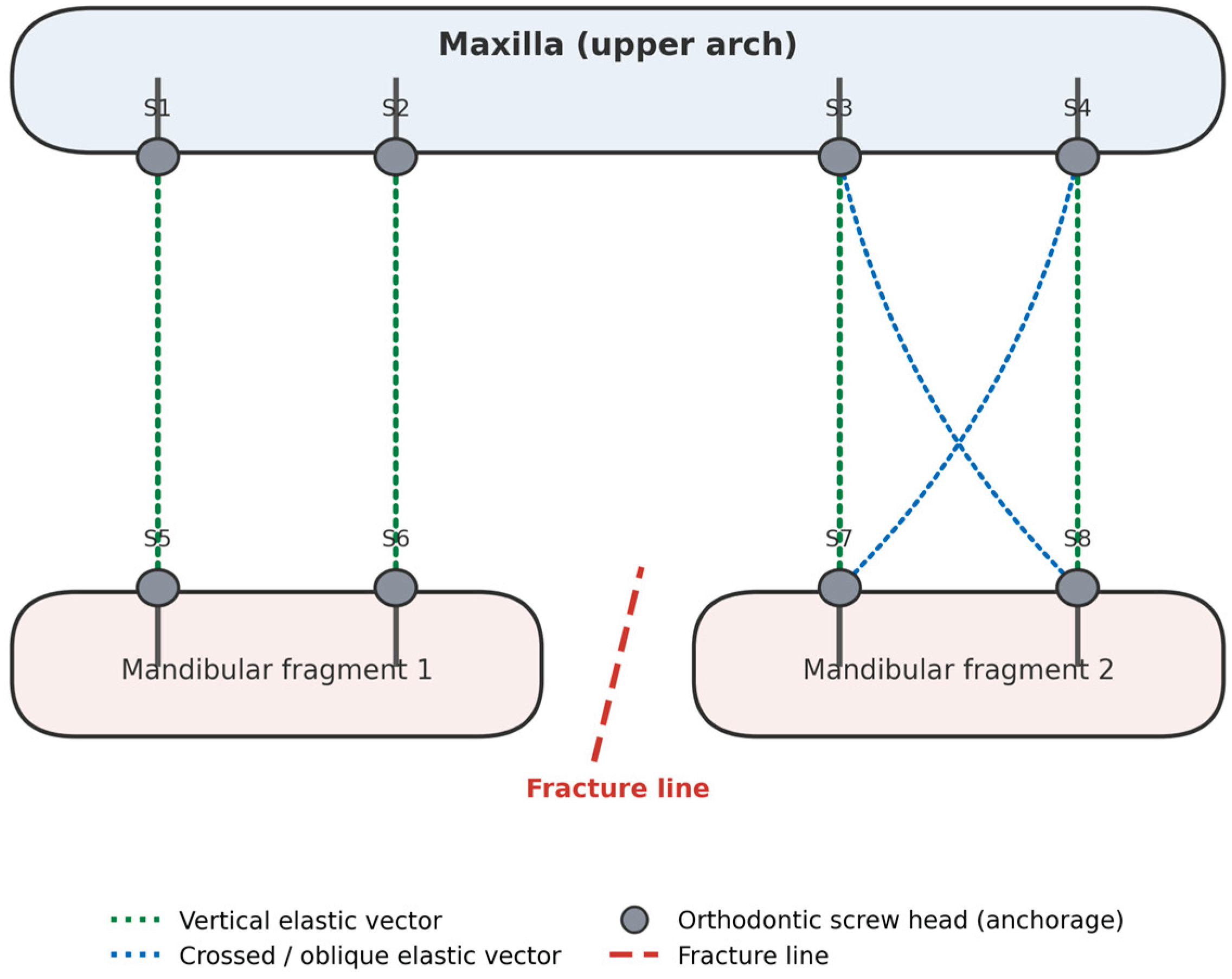
- A self-tapping titanium orthodontic screw with an accessible head is inserted using a screwdriver, positioned approximately 0.8 cm from the gingival margin and at least one tooth away from the edge of the fracture fragment.
- Corresponding screws are placed in the second mandibular fracture fragment, in the antagonist maxillary dentition, and in the maxilla and mandible on the side contralateral to the fracture.
- Elastic rings are applied between opposing screw heads to achieve intermaxillary fixation, arranged vertically, obliquely, or in a crossed configuration according to the fracture pattern and the desired vector of stabilization.
- Fixation is maintained until clinical and radiographic signs of fragment stabilization are achieved, with elastics inspected and replaced at scheduled follow-up visits.
11. Clinical Advantages of the Proposed Method
- Avoids circumdental wiring, reducing manipulation around multiple teeth and the amount of bulky metal retained in the mouth.
- May simplify oral hygiene, since screw heads occupy substantially less surface area than full-arch bars.
- Allows elastic rings to be replaced and adjusted more readily than wire ligatures.
- May reduce application and removal time relative to traditional arch bars.
- Remains fully intraoral and bone-supported, avoiding external incisions.
12. Possible Complications and Risk Control
13. Comparative Assessment
14. Limitations of This Review
15. Research Gaps and Future Directions
16. Conclusions
Author Contributions
Funding
Institutional Review Board Statement
Informed Consent Statement
Data Availability Statement
Acknowledgments
Conflicts of Interest
References
- AO Foundation Surgery Reference. Maxillomandibular fixation (MMF): bone-supported devices. In AO Surgery Reference.
- AO Foundation Surgery Reference. Closed treatment with maxillomandibular fixation for simple mandibular body fractures. In AO Surgery Reference.
- Fernandes, I.A.; Al-Moraissi, E.A.; Galvão, E.L.; Falci, S.G.M. Erich arch bars vs intermaxillary fixation screws for mandibular fracture reduction during ORIF: a randomized clinical trial. Clin. Oral Investig. 2023, 27(10), 6063–6071. [Google Scholar] [CrossRef] [PubMed]
- West, G.H.; Griggs, J.A.; Chandran, R.; Precheur, H.V.; Buchanan, W.; Caloss, R. Treatment outcomes with the use of maxillomandibular fixation screws in the management of mandible fractures. J. Oral Maxillofac. Surg. 2014, 72(1), 112–120. [Google Scholar] [CrossRef] [PubMed]
- Falci, S.G.; Douglas-de-Oliveira, D.W.; Stella, P.E.; Santos, C.R. Is the Erich arch bar the best intermaxillary fixation method in maxillofacial fractures? A systematic review. Med. Oral Patol. Oral Y Cirugía Bucal 2015, 20. [Google Scholar] [CrossRef] [PubMed]
- Fernandes, I.A.; Lopes, A.B.S.; Fonseca, P.G.; da Silva, T.A.; Rodrigues, A.B.; Galvão, E.L.; et al. Comparison between Erich arch bars and intermaxillary screws in maxillofacial fractures involving the dental occlusion: a meta-analysis. Int. J. Oral Maxillofac. Surg. 2021, 50, 83–95. [Google Scholar] [CrossRef] [PubMed]
- Jain, A.; Taneja, S.; Rai, A. What is a better modality of maxillomandibular fixation: bone-supported arch bars or Erich arch bars? A systematic review and meta-analysis. Br. J. Oral Maxillofac. Surg. 2021, 59, 858–866. [Google Scholar] [CrossRef] [PubMed]
- Nandini, G.D.; Balakrishna, R.; Rao, J. Self-tapping screws versus Erich arch bar for intermaxillary fixation: a comparative clinical study in the treatment of mandibular fractures. J. Maxillofac. Oral Surg. 2011, 10, 127–131. [Google Scholar] [CrossRef] [PubMed]
- An audit of mandibular fractures treated by intermaxillary fixation using intraoral cortical bone screws. PubMed. [CrossRef] [PubMed]
- Is healing outcome of 2 weeks intermaxillary fixation different from that of 4 to 6 weeks intermaxillary fixation in the treatment of mandibular fractures? PubMed. [CrossRef] [PubMed]
- Purmal, K.; Alam, M.K.; Pohchi, A.; Abdul Razak, N.H. 3D mapping of safe and danger zones in the maxilla and mandible for the placement of intermaxillary fixation screws. PLoS ONE 2013, 8(12), e84202. [Google Scholar] [CrossRef] [PubMed]
- Tepedino, M.; Cattaneo, P.M.; Niu, X.; Cornelis, M.A. Interradicular sites and cortical bone thickness for miniscrew insertion: a systematic review with meta-analysis. Am. J. Orthod. Dentofac. Orthop. 2020, 158(6), 783–798.e20. [Google Scholar] [CrossRef] [PubMed]
- Baethge, C.; Goldbeck-Wood, S.; Mertens, S. SANRA—a scale for the quality assessment of narrative review articles. Res. Integr. Peer Rev. 2019, 4, 5. [Google Scholar] [CrossRef] [PubMed]
- Papageorgiou, S.N.; Zogakis, I.P.; Papadopoulos, M.A. Failure rates and associated risk factors of orthodontic miniscrew implants: a meta-analysis. Am. J. Orthod. Dentofac. Orthop. 2012, 142(5), 577–595.e7. [Google Scholar] [CrossRef] [PubMed]
- Alharbi, F.; Almuzian, M.; Bearn, D. Miniscrews failure rate in orthodontics: systematic review and meta-analysis. Eur. J. Orthod. 2018, 40(5), 519–530. [Google Scholar] [CrossRef] [PubMed]
- Pieper, S.P.; Schimmele, S.R.; Johnson, J.A.; Harper, J.L. A prospective study of the efficacy of various gloving techniques in the application of Erich arch bars. J. Oral Maxillofac. Surg. 1995, 53(10), 1174–1176. [Google Scholar] [CrossRef] [PubMed]
- King, B.J.; Christensen, B.J. Hybrid arch bars reduce placement time and glove perforations compared with Erich arch bars during the application of intermaxillary fixation: a randomized controlled trial. J. Oral Maxillofac. Surg. 2019, 77(6), 1228.e1–1228.e8. [Google Scholar] [CrossRef] [PubMed]
- Gamal Hassan, A.; Elshial, M.; Hassan, B.; Ismail Ahmed, M.; Nabil, H.; Sabry, E. Orthodontic elastics: a narrative review of biomechanics, biological responses, and evidence-based clinical guidelines for everyday practice. Cureus 2026, 18(1), e100972. [Google Scholar] [CrossRef] [PubMed]
- Gualtieri, M.; Pisapia, F.; Fadda, M.T.; Priore, P.; Valentini, V. Mandibular fractures epidemiology and treatment plans in the center of Italy: a retrospective study. J. Craniofac Surg. 2021, 32(4), e346–e349. [Google Scholar] [CrossRef] [PubMed]
- Bali, R.; Sharma, P.; Garg, A. Incidence and patterns of needlestick injuries during intermaxillary fixation. Br. J. Oral Maxillofac. Surg. 2011, 49(3), 221–224. [Google Scholar] [CrossRef] [PubMed]
- Qureshi, A.A.; Reddy, U.K.; Warad, N.M.; Badal, S.; Jamadar, A.A.; Qurishi, N. Intermaxillary fixation screws versus Erich arch bars in mandibular fractures: a comparative study and review of literature. Ann. Maxillofac. Surg. 2016, 6(1), 25–30. [Google Scholar] [CrossRef] [PubMed]
- Hashemi, H.M.; Parhiz, A. Complications using intermaxillary fixation screws. J. Oral Maxillofac. Surg. 2011, 69(5), 1411–1414. [Google Scholar] [CrossRef] [PubMed]
- Fabbroni, G.; Aabed, S.; Mizen, K.; Starr, D.G. Transalveolar screws and the incidence of dental damage: a prospective study. Int. J. Oral Maxillofac. Surg. 2004, 33(5), 442–446. [Google Scholar] [CrossRef] [PubMed]
- Bottini, G.B.; Roccia, F.; Sobrero, F. Management of pediatric mandibular condyle fractures: a literature review. J. Clin. Med. 2024, 13(22), 6921. [Google Scholar] [CrossRef] [PubMed]
- Papadopoulos, M.A.; Tarawneh, F. The use of miniscrew implants for temporary skeletal anchorage in orthodontics: a comprehensive review. Oral Surg. Oral Med. Oral Pathol. Oral Radiol. Endod. 2007, 103(5), e6–e15. [Google Scholar] [CrossRef] [PubMed]
- Kumar, M.; Gupta, A.; Mittal, A.; Kaur, H.; Verma, A.; Kasrija, R.; Gupta, S. Management of edentulous and atrophic mandibular fractures: a systematic review of treatment modalities and outcomes. Cureus 2025, 17(6), e85164. [Google Scholar] [CrossRef] [PubMed]
- Stähli, C.; Eliades, T.; Papageorgiou, S.N. Functional appliance treatment for mandibular fractures: a systematic review with meta-analyses. J. Oral Rehabil. 2021, 48(8), 945–954. [Google Scholar] [CrossRef] [PubMed]
- Singh, V.; Bhagol, A.; Goel, M.; Kumar, I.; Verma, A. Outcomes of open versus closed treatment of mandibular subcondylar fractures: a prospective randomized study. J. Oral Maxillofac. Surg. 2010, 68(6), 1304–1309. [Google Scholar] [CrossRef] [PubMed]
- Alves, M., Jr.; Baratieri, C.; Araújo, M.T.S.; Souza, M.M.G.; Maia, L.C. Root damage associated with intermaxillary screws: a systematic review. Int. J. Oral Maxillofac. Surg. 2012, 41(11), 1445–1450. [Google Scholar] [CrossRef] [PubMed]
- Coletti, D.P.; Salama, A.; Caccamese, J.F., Jr. Application of intermaxillary fixation screws in maxillofacial trauma. J. Oral Maxillofac. Surg. 2007, 65(9), 1746–1750. [Google Scholar] [CrossRef] [PubMed]
- Coburn, D.G.; Kennedy, D.W.; Hodder, S.C. Complications with intermaxillary fixation screws in the management of fractured mandibles. Br. J. Oral Maxillofac. Surg. 2002, 40(3), 241–243. [Google Scholar] [CrossRef] [PubMed]
- Baptist, J.; Parachuri, V.N.; Shetty, P.; Madhu, S.K. IMF screws with orthodontic E chains as a novel technique for intermaxillary fixation. Oral Surg. 2024, 17(4), 315–320. [Google Scholar] [CrossRef]
- Bang, K.; Shenoi, R.; Waghchoure, A.V.; Situt, N. Maxillomandibular fixation using orthodontic brackets as a treatment option for mandibular fractures. Cureus 2025, 17(4), e83085. [Google Scholar] [CrossRef] [PubMed]
- Bins, A.; Oomens, M.A.E.; Boffano, P.; Forouzanfar, T. Is there enough evidence to regularly apply bone screws for intermaxillary fixation in mandibular fractures? J. Oral Maxillofac. Surg. 2015, 73(10), 1963–1969. [Google Scholar] [CrossRef] [PubMed]
- Sahoo, N.K.; Mohan, R. IMF screw: an ideal intermaxillary fixation device during open reduction of mandibular fracture. J. Maxillofac. Oral Surg. 2010, 9(2), 170–172. [Google Scholar] [CrossRef] [PubMed]
- Rai, A.; Datarkar, A.; Borle, R.M. Are maxillomandibular fixation screws a better option than Erich arch bars in achieving maxillomandibular fixation? A randomized clinical study. J. Oral Maxillofac. Surg. 2011, 69(12), 3015–3018. [Google Scholar] [CrossRef] [PubMed]
- Kalluri, M.H.; Edalatpour, A.; Thadikonda, K.M.; Blum, J.D.; Garland, C.B.; Cho, D.Y. Patient outcomes and complications following various maxillomandibular fixation techniques: a systematic review and meta-analysis. J. Plast. Reconstr. Aesthet. Surg. 2024, 92, 151–176. [Google Scholar] [CrossRef] [PubMed]
- Jazayeri, H.E.; Lopez, J.; Khavanin, N.; Xun, H.; Lee, U.K.; Best, D.L.; Reategui, A.; Urata, M.M.; Dorafshar, A.H. Comparative benefits of open versus closed reduction of condylar fractures: a systematic review and meta-analysis. Plast. Reconstr. Surg. 2023, 151(4), 664e–672e. [Google Scholar] [CrossRef] [PubMed]
- Gugliotta, Y.; Roccia, F.; Novaresio, A.; Cassano, P.; Sobrero, F.; Ramieri, G.; Zavattero, E. Virtual reduction and 3D printing in the management of edentulous atrophic mandibular body fractures: case series and literature review. Int. J. Comput Assist Radiol. Surg. 2025. [Google Scholar] [CrossRef] [PubMed]
- King, B.J.; Park, E.P.; Christensen, B.J.; Danrad, R. On-site 3-dimensional printing and preoperative adaptation decrease operative time for mandibular fracture repair. J. Oral Maxillofac. Surg. 2018, 76(9), 1950.e1–1950.e8. [Google Scholar] [CrossRef] [PubMed]
Disclaimer/Publisher’s Note: The statements, opinions and data contained in all publications are solely those of the individual author(s) and contributor(s) and not of MDPI and/or the editor(s). MDPI and/or the editor(s) disclaim responsibility for any injury to people or property resulting from any ideas, methods, instructions or products referred to in the content. |
© 2026 by the authors. Licensee MDPI, Basel, Switzerland. This article is an open access article distributed under the terms and conditions of the Creative Commons Attribution (CC BY) license (http://creativecommons.org/licenses/by/4.0/).