

Submitted:
25 August 2026
Posted:
26 August 2026
You are already at the latest version
Abstract
Corporate carbon offsetting schemes heavily rely on tree planting for carbon sequestration, and in Scotland the government presents tree planting as a key carbon sink in the face of climate change. However, carbon offsetting schemes rarely consider associated fluxes in soil organic carbon (SOC) driven by afforestation. Soils in woodlands store approximately 75% of the total ecosystem carbon, yet planting trees on existing carbon-rich soils or grassland may result in changes in soil carbon that take decades for tree biomass to recover. This study provides a methodological framework using the chronosequence approach (space-for-time substitution) to measure whole-ecosystem carbon storage for existing commercial carbon sequestration schemes. A proof-of-concept pilot study was carried out at the University of Edinburgh’s Rullion Green site, gathering 35 soil samples across unplanted baselines, a recent 2025 planting scheme, and a mature mixed woodland. The findings of this proof-of-concept study show that soil carbon in the newly planted area (5.06% SOC) was lower than in the mature woodland (7.64% SOC) and remained statistically similar to the unplanted baseline (7.11-8.65% SOC depending on slope). The carbon in the recently planted trees (4.10 t C/ha) did not offset the carbon losses from soil, with a drop in ecosystem carbon of 156.41 t C/ha compared to the baseline, and 418.23 t C/ha compared to the mature woodland. The methodology and trial study suggest that initial tree planting may not guarantee an immediate net increase in ecosystem carbon until trees become mature. The methodology therefore provides a tool to help mitigate greenwashing in the offsetting industry. The methodology will now be applied in further research to other sites across northern England to determine what the impact of tree planting for carbon sequestration is on soil in the UK.
Keywords:
soil organic carbon (SOC)
; chronosequence
; carbon sequestration
; tree planting
; carbon offsetting
; whole-ecosystem carbon
; nature-based solutions
; Scotland
1. Introduction
Since the Paris Agreement was made in 2015, governments globally have been aiming to reach Net Zero by 2050 [1]. In Scotland, the legally binding target for Net Zero is 2045, requiring more ambitious action to reduce carbon emissions [2]. Scottish Government policy recognizes that some emissions are unavoidable which creates the need to address residual emissions [3]. Scotland has missed nine of the last twelve annual emissions targets and must increase action to reach the 2045 target [4]. To help meet the goal, the mitigation of unavoidable emissions can partly be achieved by sequestration of atmospheric carbon [5].
Scottish Government presents tree planting as a key way to sequester atmospheric carbon and the public forestry body, Forestry and Land Scotland, has a pipeline of woodland creation projects and intends to use these projects to sell carbon credits to offset emissions [6]. However, the evidence on the effectiveness of tree planting as a method of sequestering carbon is conflicting. In 2024 the oversight body Environmental Standards Scotland highlighted evidence that tree planting may release more carbon from the soil than is sequestered in the trees, leading planting schemes to lose carbon at an ecosystem level in organic soils [7,8]. Other studies have found that soil carbon stocks are highest in Scotland in conifer woodlands where silvopasture (combining woodland with livestock grazing) takes place [9]. Therefore, while tree planting remains a widely promoted climate mitigation strategy, its overall carbon sequestration performance appears to depend strongly on site conditions, soil characteristics, and land management practices.
The necessity of adopting a whole-ecosystem approach to environmental auditing is increasingly recognized across diverse disciplines - recent studies demonstrate how the true ecological impact of anthropogenic activity can only be understood by evaluating broader ecosystem components rather than isolated variables [10]. Woodlands are complex ecosystems where the visible above-ground biomass - the trees themselves - represents only a fraction of the total stored carbon. In the UK, forest and woodland soils typically store approximately 75% of the total carbon within the woodland ecosystem, with the living tree biomass accounting for the remaining 25% [11,12]. Despite this distribution, commercial offsetting models frequently calculate sequestration rates based primarily on projected tree growth, often overlooking the fluxes in SOC driven by the land-use change of afforestation [8].
Planting trees specifically for carbon sequestration on previously unforested land has the potential to alter soil carbon levels. The trajectory of these changes may depend on previous land-use regimes and underlying geology. For example, converting depleted arable land to native woodland has been found to result in a net gain in soil and biomass carbon [13]. Demonstrating the contradictions in the evidence base, another study found afforestation on grasslands led to a neutral outcome or a net loss of SOC in the initial decades following planting, as the disturbance of soil structure accelerates the decomposition of existing organic matter while young trees add relatively little new leaf litter [14]. Most critically, planting trees on organic-rich soils, such as peatlands or peaty gleys, can trigger soil drying and oxidation. This process releases volumes of stored carbon that exceed the carbon sequestered by the growing trees, resulting in a net carbon emission on decadal timescales [8,15].
2. Research Gap, Aims and Objectives
The potential for soil carbon losses poses a risk to the carbon offsetting market. If a commercial scheme plants trees on established grassland or organo-mineral soil and sells credits from year one based on tree growth, they may inadvertently be selling "sequestered" carbon while the whole ecosystem is actively emitting carbon due to soil disturbance. The Environmental Standards Scotland report explicitly identified a lack of long-term empirical studies accurately quantifying the net carbon change when soil dynamics are fully integrated into tree planting carbon sequestration schemes [7].
To address this gap, studies are required to track carbon fluxes in sequestration schemes over decades. However, tracking the exact same plot of land for 50 to 100 years is logistically unfeasible for commercial offsetting verification, particularly when attempting to determine how many carbon credits per tree to sell in relatively new schemes and especially when no baseline soil carbon testing has taken place prior to planting; such sampling as this is uncommon in the industry. The chronosequence methodology - also known as "space-for-time substitution" - is a potential solution that has been used in studies of soil carbon in other settings. This approach involves comparing adjacent sites of different ages that share identical historical land-uses, topography, and soil parent materials to infer long-term environmental trends [12,16,17]. Use of chronosequences is already widely established in academic ecology for measuring soil carbon. Recent studies have used this approach to measure how soil microbial life history strategies drive microbial carbon use efficiency following afforestation and to investigate how agricultural soil legacies impact sustainable afforestation [18].
Chronosequences have also been used to study soil carbon stocks and sequestration, however the study sites of many studies on carbon storage have been on reclaimed mine waste stockpile sites where carbon stocks in newly created soil or newly planted soil is being compared to bare mine soils, rather than changes in natural soils [16,19]. Other studies looking at the impact of trees on SOC using a chronosequence tend to look at natural tree growth rather than artificial planting [20]. More recent work in the UK has identified a loss of soil carbon stocks in Scottish conifer plantations over 58-68 years using chronosequences, however these were not from planting schemes dedicated to carbon offsetting [17]. These studies highlight that because long-term historical data on soil transformation following land-use changes is rare, a chronosequence approach can be used to infer long-term trends, but no studies focusing on commercial carbon offsetting tree planting schemes have been identified [21].
While the methodology exists and is proven in academic settings, it has not yet been systematically tested on commercial carbon sequestration schemes to verify if they are effective. To demonstrate the potential of quantifying ecosystem level carbon in these schemes, this paper aims to demonstrate a chronosequence methodological framework for use in determining the effectiveness of carbon sequestration schemes. By applying this framework to a proof-of-concept pilot study at the University of Edinburgh's Rullion Green site, this study aims to evaluate changes in whole-ecosystem carbon storage following tree planting. Ultimately, this methodology will provide offsetting companies with a data-driven protocol to verify that their clients are offsetting the correct amount of carbon when purchasing sequestration, ensuring that commercial claims accurately reflect ecosystem level changes in carbon storage. The objectives of the study are:
- to quantify any differences between baseline and planted SOC
- to calculate tree biomass and carbon storage
- compare net ecosystem carbon storage changes between the baseline area and the planted areas to determine if the methodology is viable
3. Data and Methods
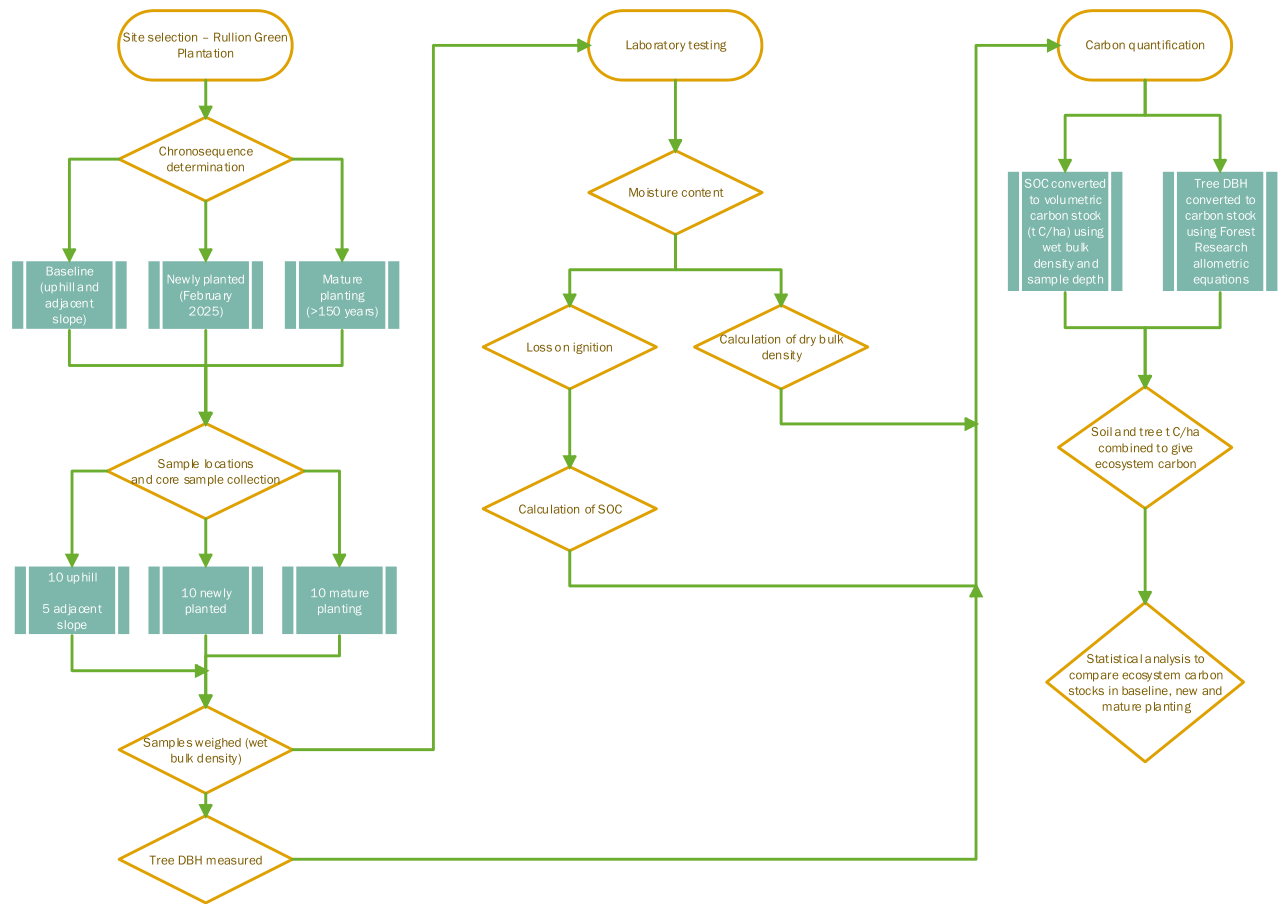
The methodology comprises four stages – site selection, field sampling across a chronosequence, laboratory analysis and carbon stock calculations. Field samples collected from a suitable sequestration scheme site will be assessed for SOC concentrations and tree carbon storage will be calculated. These two variables will then be extrapolated to determine storage of carbon in trees and soil per hectare and the figures combined to calculate storage in areas with no tree planting, with recent tree planting and mature tree planting. This will demonstrate the feasibility of the methodology for use at other carbon sequestration planting schemes to determine their effectiveness. A flow chart of the methodology is shown in Figure .
Figure 1.
Flow chart showing the steps of the methodology.
3.1. Study Area and Baseline Matching
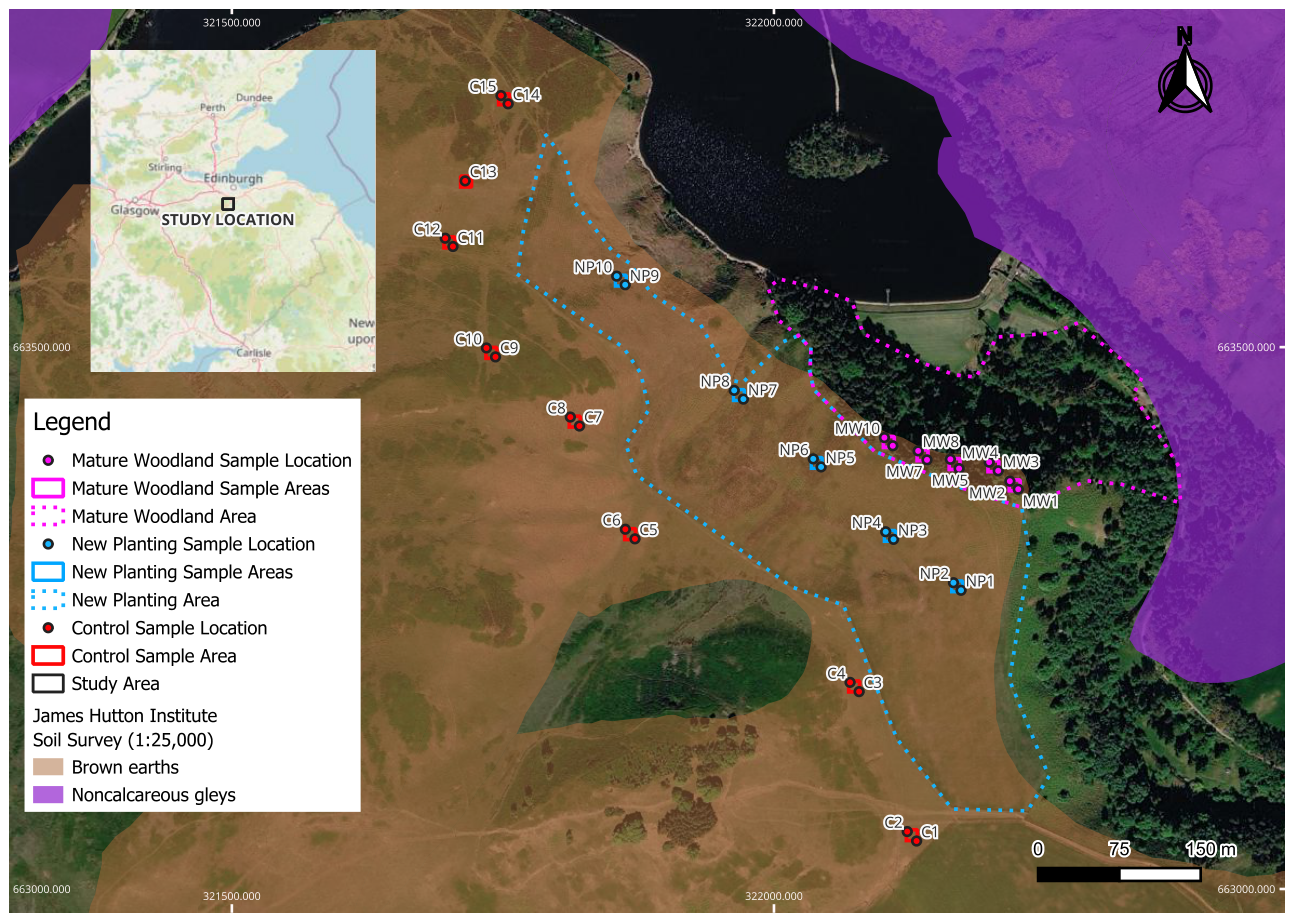
The chronosequence approach relies on the assumption that the only differing variable between comparative plots is time. Therefore, the soil across the study area must be as homogenous as possible. The Rullion Green site, located in the Pentland hills in southern Scotland and owned by the University of Edinburgh, was selected as the study area for this pilot application due to the presence of a newly planted tree scheme (established in early 2025), an adjacent unplanted control area, and a mature (>150-year-old) mixed woodland. The area is covered by brown earth soils derived from rhyolites, trachytes and allied rocks of the Bemersyde association as shown in Figure [22]. The soil unit extends south and west from the southwestern edge of the mature woodland and the eastern edge of the 2025 tree planting area. There is an area west of the 2025 planting area with no soil type shown in the survey which has been avoided in the sample locations. To ensure a valid space-for-time substitution, the selected sampling plots were matched based on similar soil parent material and slopes to ensure that variances in SOC are attributable to afforestation rather than pre-existing geological or topographical differences. Historically, the area was used as upland grassland before the planting of the mature woodland in the early 19th century [23].
Figure 2.
Image showing the spatial distribution of the 35 sample locations across the unplanted baseline, the newly planted (2025) scheme, and the mature woodland at the Rullion Green study area, underlain by the Soil Survey of Scotland’s 1:25,000 Soil Map [22]. Map data © 2026 OpenStreetMap contributors. Satellite imagery © 2026 Google, Airbus, CNES / Airbus, Getmapping plc, Maxar Technologies. Rather than relying on destructive sampling or trunk volume approximations, the Diameter at Breast Height (DBH) and tree height were recorded. Total above-ground and below-ground tree biomass carbon was calculated using standard EU allometric equations developed by Forest Research [27]. The calculations vary based on tree size and are shown in Table .
Figure 2.
Image showing the spatial distribution of the 35 sample locations across the unplanted baseline, the newly planted (2025) scheme, and the mature woodland at the Rullion Green study area, underlain by the Soil Survey of Scotland’s 1:25,000 Soil Map [22]. Map data © 2026 OpenStreetMap contributors. Satellite imagery © 2026 Google, Airbus, CNES / Airbus, Getmapping plc, Maxar Technologies. Rather than relying on destructive sampling or trunk volume approximations, the Diameter at Breast Height (DBH) and tree height were recorded. Total above-ground and below-ground tree biomass carbon was calculated using standard EU allometric equations developed by Forest Research [27]. The calculations vary based on tree size and are shown in Table .
3.2. Sampling Strategy
To map and quantify the changes in carbon storage across the chronosequence, high-density soil sampling is required, however at this stage to determine the viability of the method a lower sample density is proposed. For this proof-of-concept study, a total of 35 shallow topsoil samples were recovered in May 2026. The sampling locations were divided across four zones to capture the full temporal gradient of the ecosystem:
- ▪
- Baseline 1 (Uphill): 10 samples recovered from unplanted land situated uphill (south) of the new planting scheme to establish the pre-afforestation carbon baseline.
- ●
- Baseline 2 (Slope): 5 samples recovered from unplanted land extending along the slope adjacent to the northwest of the planting scheme to account for potential topographical carbon migration. Fewer samples were collected here due to the smaller length of the northern edge of the study area, meaning taking ten samples would lead to a significantly greater sampling density in this area, and because this area acts as an additional control area to support the data from the uphill baseline sampling.
- ●
- New Planting (February 2025): 10 samples recovered from within the boundaries of the recently established tree planting scheme to measure the immediate soil disturbance impacts of afforestation.
- ●
- Mature Woodland (>150 years): 10 samples recovered from the historic mixed woodland located downslope, representing the ecosystem carbon climax community for this chronosequence.
Sample coordinates were recorded using high-accuracy GPS and reprojected to the British National Grid (EPSG:27700) to allow for geospatial mapping. The spatial distribution of the sampling locations is presented in Figure 1.
3.3. Field and Laboratory Measurements
At each targeted sampling location, soil samples were taken using a hand sampling probe and the depth of the organic (Oh) horizon was recorded in situ. To determine the volumetric carbon stocks rather than only percentage concentrations, intact soil cores were recovered to a standardised section depth of 0.60m. This specific depth was chosen as previous literature indicates that the most significant SOC fluctuations following land-use change occur within the upper mineral and organic horizons [13]. Samples were then weighed to determine soil wet bulk density, a parameter required to convert carbon percentages into total carbon tonnage per hectare, followed by moisture content and loss on ignition (LOI) testing.
Bulk density testing was carried out in accordance with British Standard BS 1377-2:1990 [24]. Samples were collected in a sampler with diameter of 27mm and sample length of 150mm, giving a sample volume of 85,883mm2. Samples were weighed in the field. Moisture content was determined using gravimetric methods in accordance with BS15414-3:2011 following drying of samples at 105oC for 24 hours. Dry mass was then calculated using the moisture contents to allow the determination of dry bulk density without transporting intact cores [25].
Loss on ignition testing was conducted in accordance with BS 1377-3 for soil testing. Samples were oven-dried to determine dry weight before being transferred to a furnace and baked at 440oC. Samples were then cooled before reweighing. LOI values were converted to SOC using established conversion ratios suitable for Scottish soil types [26].
3.4. Whole-Ecosystem Carbon Quantification
To fulfill the objective of whole-ecosystem carbon accounting, the soil data was paired with above-ground biomass estimates. At each soil sampling node within the planted zones (the 2025 scheme and the mature woodland), biometric data for the nearest established trees were recorded.

Table 1.
allometric equations for tree carbon storage.
| Tree Species | Above Ground Biomass (kg) | Total Roots (kg) |
| Scots Pine |
(equation 338) |
(equation 456) |
| Oak |
( (equation 600) |
( (equation 598) |
Note – a, b,c and d are species specific parameters determined using Zianis et al. [28,29,30,31].
The amount of carbon per hectare (t C/ha) was calculated by determining the number of trees in a 10m x 10m area and multiplying it by the carbon stored in each of those trees. Carbon storage was determined based on Intergovernmental Panel on Climate Change (IPCC) guidance using the equation [28,29,30,31]:
The biomass carbon for the area was then extrapolated to determine tree carbon stocks per hectare, as recommended in guidance produced by the IPCC [30]. This approach ensures that the carbon sink represented by the growing timber is accurately weighed against the carbon source or sink represented by the soil.
Topsoil carbon stocks were calculated by applying a standard topsoil depth of 0.60m, the sampling depth, multiplied by the same 10 x 10m area used for the tree analysis and the dry bulk density from the two soil samples taken from that area [32].
3.5. Statistical Analysis
A comparative statistical analysis was conducted to contextualize the variations in SOC across the chronosequence. Prior to hypothesis testing, descriptive statistics were generated, and the distribution of the SOC data within the datasets was evaluated. Due to the anticipated log-normal, right-skewed distribution common in soil carbon data, non-parametric methods - specifically the Kruskal-Wallis H test and the Mann-Whitney U test - were used to assess the statistical differences between the unplanted, newly planted, and mature land uses.
4. Results
4.1. Quantifying Chronosequence Soil Carbon Concentrations
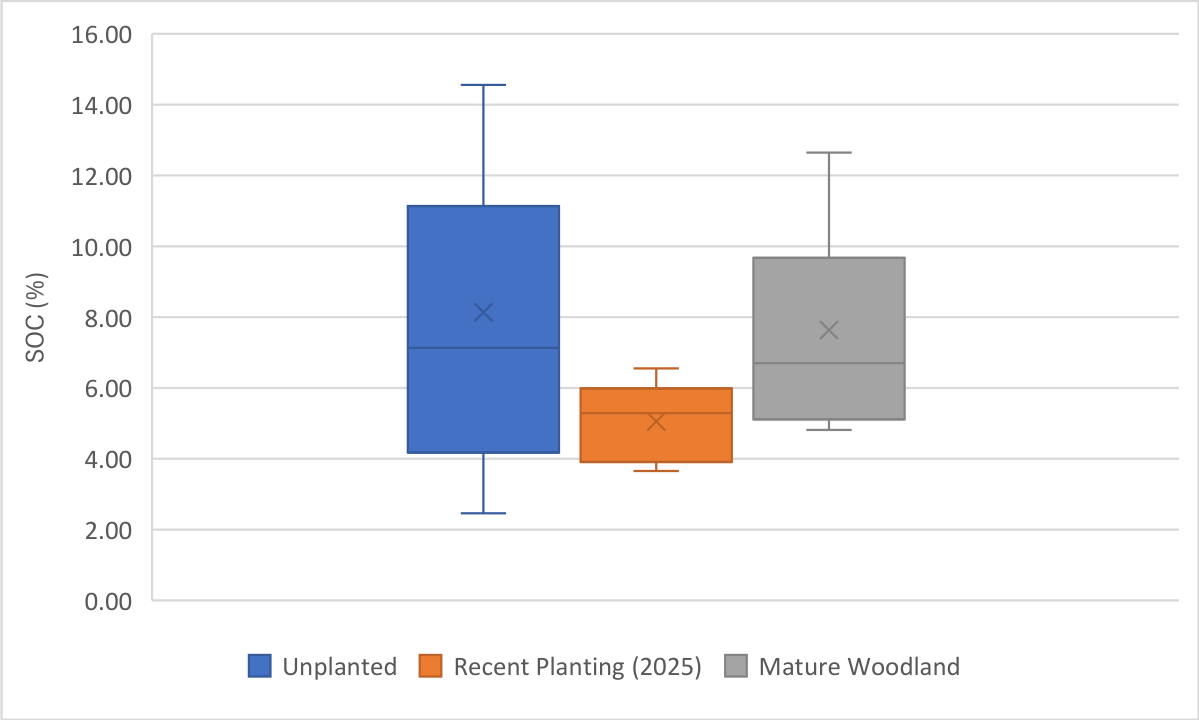
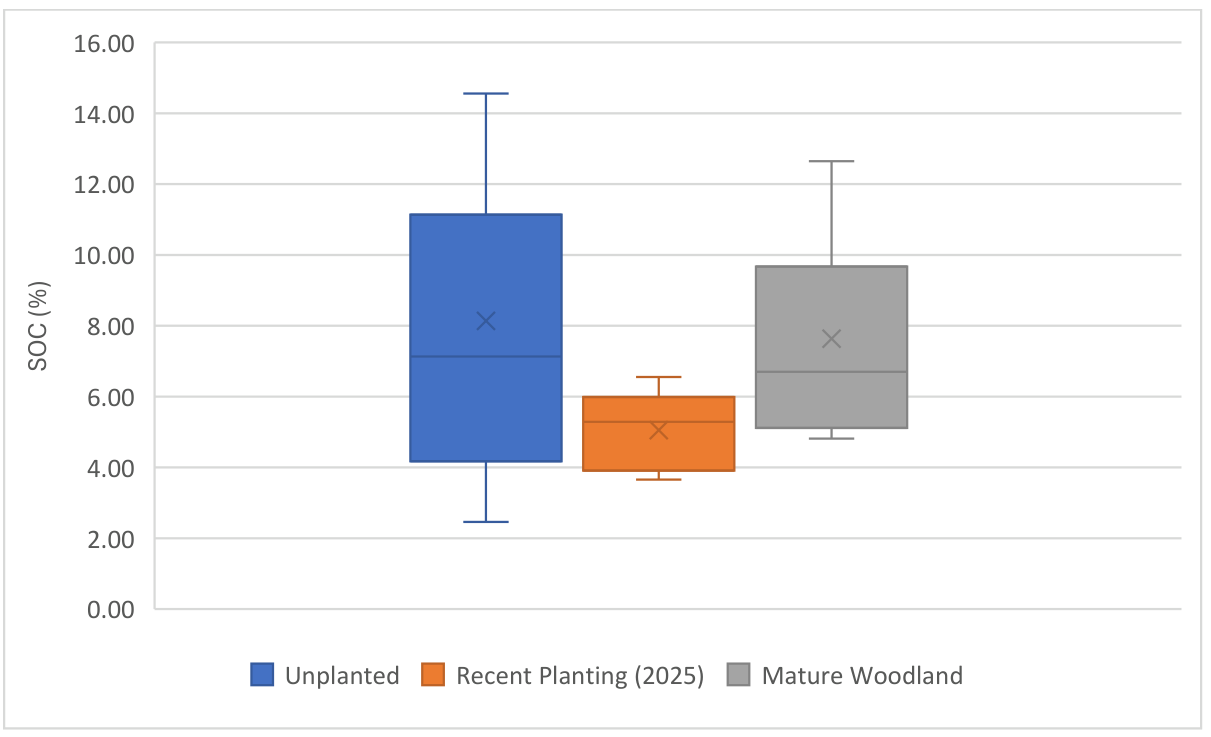
To determine soil carbon across the chronosequence, the laboratory analysis of the 35 shallow topsoil samples revealed variations in baseline carbon concentrations across the differing land uses within the Rullion Green chronosequence. As shown in Table , the unplanted baseline areas exhibited a combined median SOC concentration of 7.11-8.65% dependent on slope. The newly planted 2025 tree scheme recorded a median SOC of 5.06%. The mature mixed woodland demonstrated a higher median SOC of 7.64%.
Table 2.
SOC concentrations across the Rullion Green chronosequence.
| Land use / Age | Number of samples |
Median SOC (%) |
IQR (%) |
Median Dry Bulk Density (g/cm³) |
| Unplanted Baseline (Uphill) | 10 | 8.65 | 3.61 | 0.99 |
| Unplanted Baseline (Slope) | 5 | 7.11 | 7.42 | 1.01 |
| Recent Planting (2025) | 10 | 5.06 | 1.88 | 1.07 |
| Mature Woodland (>150 yr) | 10 | 7.64 | 3.77 | 1.08 |
To determine the relative shifts in the soil carbon sink across the timeline of afforestation, spatial comparative analysis was conducted. A Kruskal-Wallis H test identified a statistically significant difference in SOC concentrations across the broad chronosequence (p = 0.025). Further pairwise analysis using the Mann-Whitney U test confirmed that the SOC in the new 2025 tree planting scheme was lower than the unplanted baseline (p = 0.026). The trajectory of soil carbon storage across the four sampling zones is visualized in Figure
Figure 3.
Box plot detailing the distribution of Soil Organic Carbon (SOC) percentages across the chronosequence sampling zones at Rullion Green.
Figure 3.
Box plot detailing the distribution of Soil Organic Carbon (SOC) percentages across the chronosequence sampling zones at Rullion Green.
To accurately assess climate mitigation potential, SOC percentages were converted to volumetric carbon stocks (tonnes of carbon per hectare, t C/ha). By applying area specific soil bulk densities (Table ) to the standardised sampling depths, the total soil carbon pool was quantified for the unplanted baselines, the 2025 planting, and the mature woodland (Table ).
4.3. Tree Biomass and Carbon Storage
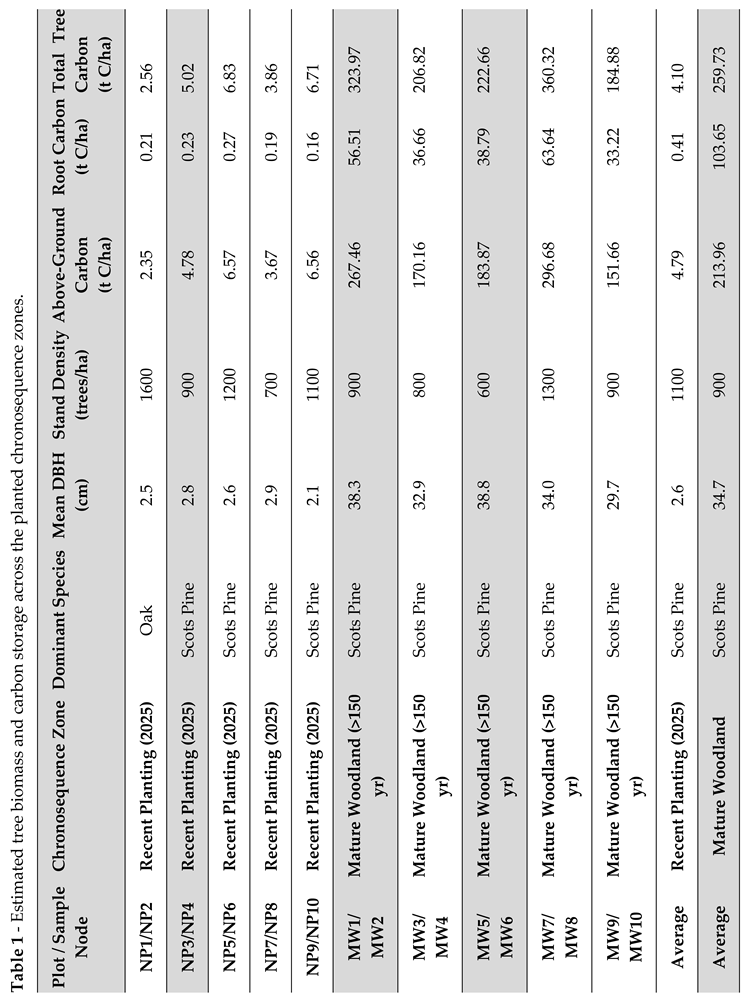
As detailed in Table 1, biometric data (DBH and height) from the planted zones were used to estimate both above-ground and below-ground (root) tree carbon. As expected, given the age difference between planting areas, there was a statistically significant difference in tree biomass between the carbon storage in the newly planted and mature planting areas (p = <0.001). Total tree carbon and carbon storage per hectare were also higher for the mature planting.
4.4. Net Ecosystem Carbon Changes
The soil carbon stocks were combined with the calculated tree biomass carbon to calculate whole ecosystem carbon storage. When combining these carbon pools, the data illustrates that the whole-ecosystem carbon pool in the 2025 planting zone does not show growth in ecosystem level carbon stocks (Table 1). The carbon stored in the young saplings (4.10 t C/ha) is not sufficient to offset the carbon loss in the soil compared to the unplanted baseline at this stage. In contrast, the mature woodland demonstrates a net ecosystem sink, where total carbon volumes are higher than the control area and supplemented by carbon sequestration in trees with an increase in carbon storage (+261.82 t C/ha) despite a lower SOC value due to higher bulk densities. Across all three areas, most of the ecosystem carbon remains locked in the soil rather than in the trees.
Table 4.
Whole-ecosystem carbon storage.
| Land use / Age |
Soil Carbon Pool (t C/ha) |
Total Tree Carbon (t C/ha) |
Total Ecosystem Carbon (t C/ha) | Net Change vs Baseline (t C/ha) |
| Unplanted Baseline (Uphill and Slope Combined) | 488.40 | N/A | 488.40 | N/A |
| Recent Planting (2025) | 327.89 | 4.10 | 331.99 | -156.41 |
| Mature Woodland (>150 yr) | 490.49 | 259.73 | 750.22 | +261.82 |
5. Discussion
5.1. Viability of the Use of Chronosequences to Assess Soil Carbon Changes in Carbon Sequestration Tree Planting Schemes
The pilot study at Rullion Green demonstrates the practical utility of the chronosequence methodology for auditing commercial carbon offsetting schemes. Current carbon offsetting mechanisms rely on predictive models derived from national averages, focusing almost exclusively on above-ground tree biomass accumulation. In this approach, site-specific soil carbon fluxes were neglected. By establishing a "space-for-time" substitution that controls slope, aspect, and soil parent material, this methodology provides a replicable framework that allows offsetting providers to verify their models against field data. The trajectory observed from the unplanted baseline, through the disturbed new planting, to the climax mature woodland shows that long-term sequestration occurs, but only when the entire ecosystem is considered. Without further evidence it is not possible to say how long it takes for the ecosystem to act as a carbon sink.
5.2. Net Ecosystem Carbon Storage Drops Following New Tree Planting at Rullion Green
The analysis of the Rullion Green data reveals that the soils in the newly established (2025) tree planting scheme exhibited lower SOC than the mature woodland and the unplanted baseline area. These findings align with the other academic studies regarding the afforestation of marginal, pasture, or grassland soils but the limited number of samples and single study location means the results cannot be extrapolated to sequestration planting schemes in general [8,15]. The mechanical disturbance associated with site preparation and tree planting often accelerates the mineralisation and decomposition of existing soil organic matter. This releases carbon dioxide into the atmosphere. Concurrently, very young trees possess limited root networks and produce minimal leaf litter, meaning they cannot immediately replace the carbon lost from the soil matrix.
The findings are consistent with the carbon debt phase described in previous afforestation studies [34]. During this initial decadal period, the whole carbon sequestration ecosystem is attempting to offset its own installation emissions. The Rullion Green data confirms that planting a tree does not instantly generate a net increase in ecosystem carbon. The carbon gains observed in the >150-year-old woodland demonstrate that tree planting is a potentially effective climate mitigation tool, but the temporal delay in soil carbon accumulation can only be acknowledged where tree planting schemes are left untouched after planting and no felling takes place.
5.3. Possible Implications for Commercial Carbon Offsetting and Policy
These findings present an opportunity for the commercial carbon offsetting industry to account for soil carbon when selling carbon credits, even where providers have not carried out baseline soil sampling prior to planting. It also provides a foundation for further research to fill the research gap identified by Environmental Standards Scotland and their finding that the failure to account for soil carbon in such schemes is a risk to the credibility of Scotland’s Net Zero targets and the health of soils in tree planting schemes [7]. If commercial providers sell carbon credits based purely on the rapid initial growth of tree biomass, while the underlying soil is actively losing carbon due to planting disturbance, there is a risk of over-crediting climate benefits if soil carbon losses are not incorporated into accounting approaches.
For nature focused offsetting organisations, adopting this whole-ecosystem methodology presents an opportunity to integrate soil carbon testing into their baseline assessments and use chronosequence data to calibrate their sequestration timelines. With this information they can provide transparency to their clients, allowing them to offset the correct amount of carbon.
5.4. Limitations and Validity of the Pilot Study
While the methodology provides a robust framework, the primary limitation of any chronosequence study is spatial variation [34]. Despite using controls for slope and parent material at Rullion Green, localised variations in topography, soil type or grazing intensity cannot be entirely eliminated. Finally, as a proof-of-concept, the sample size (n=35) is sufficient to demonstrate statistical trends locally but requires scaling across diverse environments to generate national offsetting adjustment factors. Higher density sampling and sample numbers will be required in future studies to accurately assess whole ecosystem carbon storage. Future studies should also sample the upper topsoil layers (0.00-0.25m depth) and deeper subsoil layers (>0.50m) as recent studies have found that carbon losses following tree planting in mature forests are five times greater from deep and mid soils than topsoils [35].
Validity within the study was maintained by controlling for soil parent material and slope across the chronosequence. The study area is covered entirely by brown earths to ensure variations in soil type do not influence the findings. The control area covered the area uphill from the planting but also on the adjacent slope since slope is potentially linked to SOC, although the SOC tends to remain within the landscape and so is unlikely to impact the outcome of this study [36].
6. Conclusions and Future Research
This study demonstrates the validity of a methodological framework using soil carbon data collected from samples gathered across a chronosequence in areas with reasonably homogenous soils for assessing whole-ecosystem carbon storage within commercial tree planting schemes. Using the chronosequence approach at the Rullion Green site, the pilot data shows that soils in newly established afforestation schemes have lower carbon content compared to the baseline and remain depleted when compared to mature climax woodlands. This is consistent with the presence of an initial carbon debt phase potentially associated with planting disturbance where losses from soil carbon are not offset by tree growth. For the corporate carbon sequestration industry, the continued reliance on above-ground biomass estimates without considering below-ground carbon fluxes may result in some schemes charging to offset less carbon than advertised. A combined soil and biomass auditing approach, as outlined in this framework, could be used to ensure investments in nature-based solutions deliver scientifically verified climate mitigation.
Future studies using the methodology could expand on the findings here by sampling shallower topsoil layers (0.00-0.25m depth) which are known to show changes following afforestation, albeit less dramatic than in the upper subsoil layers sampled here [13]. Future research will include using the methodology to sample further sites with different historic land uses and soil types to determine the impact of tree planting carbon sequestration schemes on soil carbon in a wider variety of settings. Should the methodology prove successful it could be adopted by scheme owners to assess ecosystem level sequestration to ensure their clients are purchasing the correct number of carbon credits.
Author Contributions
Conceptualization, methodology, software, analysis, visualisation, writing - original draft preparation, L.B.; methodology support, J.B-S.; validation, writing -review and editing I.S., L.K., N.M.E. and R.B. All authors have read and agreed to the published version of the manuscript.
Funding
This research received no external funding.
Data Availability Statement
The data presented in this study is available on request from the corresponding author.
Conflicts of Interest
Author L.B. is employed by Environmental Standards Scotland, whose 2024 report is cited within this study. This research was conducted entirely independently as part of an academic program at Edinburgh Napier University. Environmental Standards Scotland provided no funding, resources, or oversight for this work. The remaining authors declare no conflicts of interest.
References
- UNFCCC. Paris Agreement to the United Nations Framework Convention on Climate Change. Paris: United Nations Framework Convention on Climate Change; 2015.
- Scottish Government. Climate Change (Emissions Reduction Targets) (Scotland) Act 2019. Edinburgh: Scottish Government; 2019.
- Scottish Government. Public sector leadership on the global climate emergency: guidance. Edinburgh: Scottish Government; 2021.
- Climate Change Committee. Scotland's 2030 Climate Goals Are No Longer Credible. London: Climate Change Committee; 2024.
- Rodrigues CID, Brito LM, Nunes LJR. Soil Carbon Sequestration in the Context of Climate Change Mitigation: A Review. Soil Syst. 2023;7(64).
- Forestry and Land Scotland. Carbon Offset Projects: Forestry and Land Scotland; 2026 [updated 2026/05/03. Available from: https://forestryandland.gov.scot/business-and-services/carbon-offset-projects. Date Accessed:.
- Environmental Standards Scotland. The Risks to Scotland's Soils: A Scoping Report. Edinburgh: Environmental Standards Scotland; 2024.
- Friggens NL, Hester AJ, Mitchell RJ, Parker TC, Subke JA, Wookey PA. Tree planting in organic soils does not result in net carbon sequestration on decadal timescales. Global Change Biology. 2020;26(9):5178-88.
- Beckert MR, Smith P, Lilly A, Chapman SJ. Soil and Tree Biomass Carbon Sequestration Potential of Silvopastoral and Woodland-Pasture Systems in North East Scotland. Agroforestry Systems. 2015;90(3):371-83.
- Bradley L. Offshore Windfarms and Seafloor Integrity: Springer; 2025.
- Forest Research. Forestry and Climate Change. Alice Holt Lodge: Forest Research; 2020.
- Vanguelova EI, Crow P, Benham S, Pitman R, Forster J, Eaton EL. Impact of Sitka spruce afforestation on the carbon stocks of peaty gley soils—a chronosequence study in the north of England. Forestry: An International Journal of Forest Research. 2019;92(2):242-52.
- Mayer M, Prescott CE, Abaker WEA, Augusto L, Cécillon L, Ferreira GW. Influence of forest management activities on soil organic carbon stocks: A knowledge synthesis. Forest Ecology and Management. 2020;466(118127).
- Upson MA, Burgess PJ, Morison JI. Soil carbon changes after establishing woodland and agroforestry trees in a grazed pasture. Geoderma. 2016;283:10-20.
- Gregg R, Elias JL, Alonso I, Crosher IE, Muto P, Morecroft MD. Carbon storage and sequestration by habitat: a review of the evidence (second edition). York: Natural England; 2021.
- Chaudhuri S, McDonald LM, Pena-Yewtukhiw EM, Skousen J, Roy M. Chemically stabilized soil organic carbon fractions in a reclaimed minesoil chronosequence: implications for soil carbon sequestration. Environmental Earth Sciences. 2013;70(4):1689-98.
- Joly F-X, Cotrufo MF, Garnett MH, Johnson D, Lavallee JM, Mueller CW, et al. Temperate grassland conversion to conifer forest destabilises mineral soil carbon stocks. Journal of Environmental Management. 2025;374:124149.
- Cheng H, Chong H, Yuan M, Ren C, Wang J, Zhao F. Soil Microbial Life History Strategies Drive Microbial Carbon Use Efficiency Following Afforestation. Microorganisms. 2025;13(12):2870.
- Frouz J. Effects of Soil Development Time and Litter Quality on Soil Carbon Sequestration: Assessing Soil Carbon Saturation with a Field Transplant Experiment along a Post-mining Chronosequence. Land Degradation & Development. 2017;28(2):664-72.
- Kang Y, Assavapanuvat P, Osland MJ, Kaplan DA. Variation in Soil Organic Carbon Across a Latitudinal Chronosequence of Mangrove Poleward Expansion. Ecosystems. 2025;29(1):2.
- Piotrowski K, Kisiel M, Oktaba L. Agricultural Soil Legacies and Their Implications for Sustainable Afforestation: A Chronosequence Study. Sustainability. 2026;18(6):3120.
- Soil Survey of Scotland Staff. Soil maps of Scotland (partial coverage). Digital version 10 release. Aberdeen: James Hutton Institute; 1987.
- Ordnance Survey, cartographer Ordnance Survey of Scotland 1-inch to 1-mile, Sheet 32 [Scale ca. 1:63,360 . 1 inch to 1 mile.]. Southampton: Ordnance Survey; 1865.
- British Standards Institute. BS 1377-2:1990 Methods of test for soils for civil engineering purposes - Classification tests. 1990.
- British Standards Institute. Solid recovered fuels. Determination of moisture content using the oven dry method. Moisture in general analysis sample. 2011.
- Hoogsteen MJJ, Lantinga EA, Bakker EJ, Groot JCJ, Tittonell PA. Estimating soil organic carbon through loss on ignition: effects of ignition conditions and structural water loss. European Journal of Soil Science. 2015;66(2):320-8.
- Randle T, Matthews R, Jenkins T. Technical Specification for the Biomass Equations Developed for the 2011 Forecast. Forest Research; 2014.
- Forest Research. Measuring Forest Carbon. 2024.
- Hamilton GJ. Forest Mensuration Handbook. London: Her Majesty's Stationery Office; 1975.
- Intergovernmental Panel on Climate Change. 2006 IPCC Guidelines for National Greenhouse Gas Inventories, Volume 4: Agriculture, Forestry and Other Land Use. 2006.
- Levy PE, Hale SE, Nicoll BC. Biomass expansion factors and root:shoot ratios for coniferous tree species in Great Britain. Forestry: An International Journal of Forest Research. 2004;77(5):421-30.
- Bradley L, Khaddour L, Shyha I, El-Berishy NM, Boyko R. Hydrocarbon Contamination Artificially Inflates Soil Organic Carbon: Impacts on Risk Assessments of Contaminated Land in the UK. Preprints: Preprints; 2026.
- Chun Y, Kim I, Jeon E-C. Evaluating the carbon payback period of nature-based solutions: A life cycle assessment approach. Nature-Based Solutions. 2026;9:100310.
- Azevedo O. Long-Term Effects of Woodland Creation on Soil Carbon Stocks and Aggregate Distribution in Central Scotland. Soil Use and Management. 2026.
- Parker TC, Subke J-A. Uptake and Release—What Is Driving Change in the Net Carbon Budget in Forest Soils? Global Change Biology. 2026;32(2):e70729.
- Olson K, Gennadiyev A, Zhidkin A, Markelov M. Impacts of Land-Use Change, Slope, and Erosion on Soil Organic Carbon Retention and Storage. Soil Science. 2012;177:269-78.
Disclaimer/Publisher’s Note: The statements, opinions and data contained in all publications are solely those of the individual author(s) and contributor(s) and not of MDPI and/or the editor(s). MDPI and/or the editor(s) disclaim responsibility for any injury to people or property resulting from any ideas, methods, instructions or products referred to in the content. |
© 2026 by the authors. Licensee MDPI, Basel, Switzerland. This article is an open access article distributed under the terms and conditions of the Creative Commons Attribution (CC BY) license (http://creativecommons.org/licenses/by/4.0/).
Copyright: This open access article is published under a Creative Commons CC BY 4.0 license, which permit the free download, distribution, and reuse, provided that the author and preprint are cited in any reuse.