
Submitted:
25 August 2026
Posted:
26 August 2026
You are already at the latest version
Abstract
Background: Post-laryngectomy salivary leak and pharyngocutaneous fistula (PCF) are recognised complications that prolong hospitalisation, delay adjuvant treatment and, in severe cases, risk major vessel exposure; current management relies on conservative measures or systemic anticholinergic agents, which carry a substantial burden of unwanted effects. Case Series: We present four consecutive patients treated with a standardised regimen of botulinum toxin A (BoNT) injected into the parotid tail, parotid body and submandibular gland after failure of conservative management for post-laryngectomy salivary leak/PCF; all four achieved clinical and radiological resolution without significant local or systemic complications. Methods: We conducted a systematic review of the literature (PubMed, EMBASE, Cochrane, Google Scholar) in accordance with PRISMA 2020 guidelines, screening 1198 records (701 after deduplication) and identifying 13 eligible studies (>260 patients) evaluating BoNT for salivary leak/fistula across post-laryngectomy PCF and post-parotidectomy sialocele/fistula populations. Discussion: Across the case series and the wider literature, BoNT was consistently associated with rapid salivary suppression (up to ~95% reduction in one study), high fistula closure rates (54–100%), and accelerated healing, including a statistically significant reduction in healing time in one comparative study (18.5 vs. 26 days, p = 0.008), with adverse events rare and minor. Conclusions: BoNT injection is a low-risk, potentially high-yield adjunct for post-laryngectomy salivary leak and PCF, avoiding the systemic anticholinergic burden of alternative pharmacological treatments; multicentre studies with standardised dosing protocols are needed to establish its role in standard practice.
Keywords:
botulinum toxin
; pharyngocutaneous fistula
; salivary leak
; laryngectomy
; sialocele
; head and neck cancer
1. Introduction
Total laryngectomy (±pharyngectomy) is a treatment option for advanced laryngeal or hypopharyngeal cancers as either a primary surgical treatment, a salvage procedure following recurrence post chemoradiotherapy, or in a functional context to reduce aspiration after completion of organ preservation treatment.
Post-operative salivary leaks after laryngectomy are a recognised complication and can result in prolonged hospitalisation, delayed feeding, risk of wound breakdown potentially leading to pharyngo-cutaneous fistula (PCF), and delay to adjuvant treatments [1]. The most severe complication is major vessel blowout and death. The incidence of salivary leaks is highly variable, ranging anywhere between 5 and 60% [2,3,4,5,6]. A 2014 systematic review and meta-analysis reports an incidence of PCF of 14.3% in primary total laryngectomy, and 27.6% in salvage total laryngectomy [7].
There are many different variables identified in the literature that increase the risk of salivary leaks. These include medical factors such as previous radiotherapy (RT) (either previous radiation to the neck, salvage laryngectomy, or post-RT functional laryngectomy) [8], pharyngolaryngectomy (partial or total), concurrent neck dissection, positive margins, and tumour recurrence. Patient factors also play a significant role, including hypoalbuminaemia secondary to poor nutrition, gastro-oesophageal reflux disease (GORD), congestive heart failure and low haemoglobin, and other systemic co-morbidities (diabetes, liver disease, and hypothyroidism) [9]. Other significant contributing factors, such as wound infections, smoking, perioperative steroid use, and preoperative IMRT, also have a substantial impact on healing [10,11].
Management of PCF and salivary leaks tends to be conservative [12]. Antibiotic therapy, packing of the fistulous opening, nasogastric feeding, and optimisation of patient factors are used in combination to promote healing [13]. Salvage surgical repair (commonly with a vascularised flap) is reserved for patients with high-output fistulae, failure of conservative management, or exposure of major vessels [14]. Conservative management tends to result in resolution in 80% of patients; however, this requires prolonged hospital admission and observation by surgical teams. Optimising this time frame allows better mortality and morbidity outcomes, well-timed adjuvant treatment, and a prompter return to a normal diet [13].
A drug group used to aid medical management of PCF is anticholinergic drugs (AC). Salivary secretion is controlled by the autonomic nervous system, controlling the parotid, submandibular, sublingual, and minor salivary glands [15]. Acetylcholine is released from postganglionic neurons which bind to the muscarinic salivary gland receptors; this is the primary stimulus for salivary secretion. Systemic anticholinergic medications antagonise these receptors and induce hyposalivation [16]. Principally, this aims to reduce salivary output, reducing fistula output and allowing better healing. However, given the pharmacology of AC, unwanted interactions with multiple other drug groups can cause wide-reaching consequences impacting the central nervous system, heart, colon, urinary bladder, respiratory tract, and basal ganglia in the brain [17]. Therapeutic effects of systemic AC drugs depend on target-tissue muscarinic receptors; tissues expressing the same receptors will also be affected.
This study aimed to identify whether botulinum toxin A (BoNT) injected directly into the salivary glands, following a post-laryngectomy salivary leak, improves recovery time and reduces prolonged hospital stay while minimising systemic complications. The null hypothesis of this study is that BoNT has no impact on recovery time or length of hospital stay (LOS).
2. Case Series
The four cases below represent original, non-overlapping clinical data collected at our institution, reported in accordance with the CARE guidelines (Supplementary File: CARE checklist), and are distinct from the studies identified in the literature review presented in Section 3. The findings from the two are considered together only in the Discussion.
Patients were recruited from the Otolaryngology, Head and Neck Surgery Department at Morriston Hospital, Swansea.
The authors collected data from a single centre, retrospectively, in a consecutive case series of patients who underwent Botulinum Toxin A (BOTOX® (onabotulinumtoxinA), Allergan, Inc., an AbbVie company, 1 N Waukegan Rd., North Chicago, IL 60064, USA) salivary gland injections after development of salivary leak and pharyngocutaneous fistula post-laryngectomy (± pharyngectomy). Injections were offered to patients who had either clinical (confirmed by drain amylase levels) or radiological evidence of salivary leak/PCF (post water-soluble contrast swallow (CS)). Standardised water-soluble contrast swallows were organised between 7 and 14 days post-operatively. All patients remained nasogastric tube (NGT) or radiologically inserted gastrostomy (RIG) fed throughout the duration of the study until radiological evidence of resolution of PCF was confirmed. All patients were trialled on a period of conservative management (nil by mouth, enteral feeding, IV antibiotic therapy as per local microbiology guidance) prior to salivary gland injections. A standardised injection regimen was used, with documented verbal consent. Each patient was administered 100 International Units (IU) in 1 mL normal saline of botulinum toxin, divided equally into 6 parts (approximately 17 units per area) and injected into:
- Tail of the parotid;
- Body of the parotid (1 cm anterior to the tragus, 1 cm inferior from the zygomatic arch);
- Submandibular gland.
All patients were kept under observation in the department until clinical and radiological resolution of salivary leak/PCF. Immediate post-injection complications (bruising, pain, wrong injection site) were documented. Long-term symptoms (xerostomia, systemic side effects, facial nerve palsy) were identified via retrospective review of patient notes.
2.1. Patient A – 56F
Previous T3N0M0 laryngeal SCC (May 2017), treated with CRT after MDT discussion. Significant smoking history (30 cigarettes/day for 30 years previously, now 10/day). Previous history of radical cystectomy, total abdominal hysterectomy, and bilateral salpingo-oophorectomy for extensive bladder cancer. After chemoradiotherapy, the patient had ongoing airway issues and swallowing dysfunction. Concerns were raised regarding recurrence of supraglottic/laryngeal malignancy and were investigated with CT and MRI, with biopsies showing fungal infiltrate with no invasive malignancy. She then presented in extremis in October 2025 with stridor and airway compromise, requiring local anaesthetic tracheostomy and biopsies. All biopsies showed fungal infiltrates on the surface with no invasive malignancy. The patient underwent a functional laryngectomy, with histology clear of malignancy. She had an initial post-surgical water-soluble contrast swallow on day 12, which showed no leak. Due to complex patient factors, peristomal breakdown occurred, causing a frank PCF, which also led to aspiration pneumonia. The patient was then fed via nasogastric (NG) tube, and a salivary bypass tube was also inserted. Trialled on conservative management (as per Methods) for 23 days, with no resolution. A standard botulinum toxin regimen was given to the patient after verbal consent (as per Methods). The patient had resolution of leak symptoms and was able to be discharged from hospital 27 days after this. A repeat barium swallow 6 weeks post-discharge showed no leak.
2.2. Patient B – 65M
This patient presented initially with T4b left hypopharyngeal carcinoma, treated with radiotherapy, completed in April 2025. MRI and PET were suspicious of residual disease, confirmed with biopsy. The patient then underwent a salvage pharyngolaryngectomy and ALT free flap. As an inpatient, the patient suffered a segmental pulmonary embolism on day 8. An initial barium swallow (day 12) showed no leak. The patient was initially commenced on oral intake and managed this well. The patient was then noted to have stomal edge breakdown on day 15 post-op – commenced on oral antibiotics. Despite this, a large leak was identified on day 22 in the supraclavicular region. Packed with alginate dressing, strict nil-by-mouth and RIG feeding. A repeat water-soluble contrast swallow 3 weeks later still showed an ongoing leak. Standardised botulinum toxin was given at this point with verbal consent. The patient was noted to have significant improvement within a week of injection and was discharged with no leak 2 weeks after injection. Ongoing RIG feeding continued due to issues with propulsion of the food bolus past the free flap reconstruction.
2.3. Patient C – 67M
The patient presented with a T4a N1 right-sided hypopharyngeal carcinoma (poorly differentiated) and underwent a total pharyngolaryngectomy, bilateral neck dissections, with left ALT free flap reconstruction. A salivary bypass tube was inserted intraoperatively. The day 15 contrast swallow showed a large anterior leak pooling near the right side of the laryngectomy stoma. Return to theatre, the stoma was reopened, and a cavity was identified. This was washed out and a drain inserted. Endoscopic examination showed a healthy flap with a fistulous opening at the anastomotic site. This was packed, and intraoperative BoNT was injected (standard regimen). Strict nil-by-mouth and RIG feeding for the remainder of the hospital stay. The patient was shown to have decreased drain output within 2 weeks of BoNT and drain insertion, with the day 49 contrast swallow showing no leak.
2.4. Patient D – 79M
This patient presented to clinic with airway compromise and was immediately taken to theatre for panendoscopy, biopsy, and high tracheostomy. The patient had a right-sided hypopharyngeal tumour (T4a, N3bM0, poorly differentiated SCC). He underwent a pharyngolaryngectomy with left radial forearm free flap reconstruction. A persistent leak was identified, and this fluid was sent for amylase testing, identifying it as saliva (day 6). A contrast swallow was delayed due to clinical findings of leak, and BoNT treatment was given on day 8 (verbal consent, standardised regimen). The patient then underwent RIG insertion on day 16. The leak was monitored, and the patient had significant improvement in leak within 10–12 days of BoNT treatment. The patient remained clinically well, and a day 32 contrast swallow showed no evidence of salivary leak.
3. Literature Synthesis and Comparative Analysis
3.1. Methodology
This review of literature aims to address the following question: in patients with a post-laryngectomy salivary leak, pharyngocutaneous fistula, or post-parotidectomy sialocele/salivary fistula (Population), does administration of botulinum toxin A into the affected salivary glands (parotid, submandibular) (Intervention), compared with conservative management/systemic pharmacological therapy (Comparator), improve fistula/leak resolution, healing time and subsequently hospital admission time (LOS) (Outcomes)?
This review was not prospectively registered, and no formal review protocol was prepared in advance.
Inclusion criteria:
- Post-operative use of botulinum toxin following laryngectomy, pharyngolaryngectomy, or parotidectomy.
- Exclusion criteria:
- Use of a parotid surgical approach for a non-parotid procedure;
- Non-primary parotid surgery;
- Botulinum toxin use for non-surgical salivary gland conditions;
- Paediatric cases;
- Non-English language studies, or unpublished studies;
- Conference abstracts;
- Botulinum toxin used for aesthetic purposes.
Databases searched were PubMed, EMBASE/MEDLINE, and Cochrane CENTRAL, together with Google Scholar as a supplementary grey-literature source. The following search terms were used: laryngectomy, pharyngectomy, pharyngolaryngectomy, parotidectomy, “parotid surgery”, sialocele, “salivary fistula”, “salivary leak”, “parotid fistula”, “pharyngocutaneous fistula”, botox, “botulinum toxin”, “botulinum neurotoxin”, and onabotulinumtoxina. Full database-specific search strings are provided in Appendix B. A date filter of 2006–2026 (the last 20 years) was applied to all database searches; no other filters (e.g., language) were applied at the search stage, as language and publication-status restrictions were instead applied during eligibility screening (see exclusion criteria above). Google Scholar results were sorted by relevance and screened up to a pre-specified cutoff of the first 600 of 1950 total results, consistent with grey literature search methodology for systematic reviews [Haddaway et al., 2015].
Two independent reviewers (I.M., J.A.) screened titles and abstracts, then assessed all selected papers in full-text format. Data were independently extracted by the same two reviewers using a standardised extraction form capturing study design, population, intervention (BoNT dose, technique, injection site), comparator (where applicable), and outcomes; discrepancies were resolved by discussion between the two reviewers.
Methodological quality and risks of bias were assessed using the Cochrane Risk-of-Bias tool (RoB 2) for the included randomised controlled trial, the Newcastle-Ottawa Scale for retrospective and prospective observational studies, the JBI Critical Appraisal Checklists for case series and case reports, and AMSTAR-2 for the included systematic review. The single RCT [20] was deemed as having some concerns; the retrospective case-control study [27] was rated good quality (7/9, Newcastle-Ottawa); four further observational studies [22,23,26,30] were rated moderate quality, primarily due to the absence of a comparator group; and the remaining case reports/case series [19,21,24,25,28,29] carried the inherent high risk of bias due to their design, though were otherwise appropriately reported.
3.2. Results
Given substantial clinical and methodological heterogeneity across the included studies (spanning one RCT, prospective and retrospective observational studies, case series, case reports, and one prior systematic review), a meta-analysis was not undertaken. Findings were instead synthesised with a narrative synthesis, grouped by outcome (salivary flow suppression, fistula/sialocele closure, healing time and length of hospital stay (LOS), and safety/adverse events).
The literature search was performed across PubMed (n = 139), EMBASE/MEDLINE (n = 459), and Cochrane CENTRAL (n = 0), together with Google Scholar as a supplementary grey-literature source, screened by relevance ranking up to a pre-specified cutoff of the first 600 of 1950 total results [Haddaway et al., 2015]. This yielded 1198 records in total, of which 497 duplicates were removed, leaving 701 unique records. All 701 were screened by title and abstract, of which 659 were excluded as not meeting the inclusion criteria. The remaining 42 articles were independently assessed in full-text format; 29 were excluded because they did not specify botulinum toxin as a post-operative treatment modality. This left a total of 13 articles (Figure 1).
The included studies (RCT, prospective, retrospective, case series, and systematic review) covered more than 260 patients across the world undergoing this treatment modality. The large majority of evidence relates to post-parotidectomy surgery and sialoceles. Although the articles did not all document the same outcome measures, specific themes could be identified from the literature.
A condensed summary of the included studies is presented in Table 1; the complete study-level data are available in Appendix A, Table A1.
Rapid salivary suppression. Four articles (n = 158) identified a significant reduction in salivary flow. A prospective study identified a ~95% reduction in saliva; all other studies varied. The largest study describing salivary flow (retrospective study, 2004, n = 33) showed a 79% improvement in salivary flow. There was no objective measurement of salivary flow; results identified were subjective patient descriptions.
High closure rates. All articles demonstrated high closure rates associated with BoNT treatment. A 2019 systematic review describes 70–100% success rates in closure. The oldest paper (2000 prospective study, n = 4) identified a 100% closure rate, whilst the lowest rate of closure was 54% in a 2022 prospective study (n = 13).
Accelerated healing. All articles inferred accelerated healing rates. The largest study (2024 retrospective case control, n = 135) showed that BoNT treatment leads to faster healing compared with control (18.5 vs. 26 days, p = 0.008) when assessing improvements in PCF/OCF outcomes. A small case series assessing parotid sialocele following buccal squamous cell carcinoma (SCC) (n = 3) identified that all patients recovered with no delay to adjuvant radiotherapy. Similarly, in a 2021 case series (n = 5), it was identified that healing of parotid injury (including parotid duct injury) was accelerated by BoNT treatment (leak improved by day 3, full recovery in all patients). This was despite administration of BoNT at different times (3 post-op, 1 pre-op, and 1 intraoperative).
Safety profile. Across all patients studied (n > 250), there were no long-term adverse outcomes noted. One patient suffered a small peri-procedure adverse event (localised skin swelling), and one patient developed transient xerostomia. There was no significant systemic toxicity or facial nerve injury.
4. Discussion
Post-laryngectomy salivary leaks (and subsequent PCF) are a complex and difficult condition to treat. This is combined with significant comorbidities in the patient cohort (elderly, long-standing nutritional deficits, previous RT) that make treatment plans complex and multifactorial [31]. There is no single treatment modality best suited for this cohort of patients, with the best outcomes coming from conservative management [13]. This involves watchful waiting, strict enteral feeding, and antibiotic cover. Unfortunately, this requires prolonged hospital stays for patients, leading to increased healthcare costs, risk of hospital-acquired infections, and further deconditioning of the patient. Systemic pharmacological treatments such as anticholinergics are effective at reducing salivary flow, but can have significant unintended side effects. Given their mechanism of action (blocking postganglionic acetylcholine binding with muscarinic receptors in salivary glands), this can also affect other organ systems [17]. Anticholinergic burden is caused by the cumulative effect of multiple drug classes with anticholinergic properties, leading to increased risk of cognitive impairment, falls, delirium, and mortality in patients over 65. This can have both short- and long-term complications for the patient, requiring further medical intervention and hospital stays [32].
The above case series highlights the benefits of a standardised BoNT regimen for these patients. Avoiding systemic drug therapy and instead focusing on targeted, organ-specific treatment (namely the salivary glands) reduces the risk of anticholinergic burden and other medical issues. BoNT therapy is safe; there were no significant local or systemic complications secondary to administration. Small, 30G needles (in combination with insulin syringes) were able to deliver specifically dosed BoNT with minimal pain on administration [33]. Readily available landmarks (1 cm anteroinferior to the tragus, 1 cm beneath the ear lobule, and palpation of the submandibular gland) allowed for quick and easy administration to good effect. In this consecutive case series, all patients were trialled on prolonged conservative management of salivary leaks/PCF. This included strict nil-by-mouth, nasogastric/RIG feeding, and antibiotic therapy [13]. Despite this, there was no resolution of symptoms. After administration of BoNT, all patients had resolution of their pathology.
The above systematic review supports the conclusions of the case series. BoNT therapy as a treatment for PCF specifically returned few articles, indicating a scarcity of studies in the literature. Given the pathophysiology (and mechanism of action of BoNT), the authors decided to broaden the search terms to include post-parotidectomy sialoceles/fistulae. Across the articles that met the inclusion criteria, a number of themes emerged supporting the use of BoNT therapy.
A large number of patients described a reduction in salivary flow from the salivary glands addressed, with a prospective study identifying reductions of up to 95% [24]. Despite this, there were no reports of an increased incidence of intraoral infections prior to adjuvant radiation. For those papers which described fistulae, a high rate of closure was identified, with a systematic review showing a 70–80% closure rate [18,22]. Although this may have been in part due to prolonged conservative management, a retrospective case-controlled trial did indicate a statistically significant (p = 0.008) improvement in healing time (18.5 vs. 26 days) [27]. This not only reduces inpatient admission duration but also reduces the risk of hospital-acquired infections/complications in this complex and comorbid patient cohort, thereby reducing morbidity and healthcare costs. Across all patients, there were no significant, long-lasting complications from BoNT administration; of the >250 patients, only 1 suffered short-lived skin swelling, and 1 patient had transient xerostomia [20]. Neither condition affected patient morbidity or mortality and both were well tolerated.
There are, however, significant limitations to this systematic review. There were no unified dosing regimens, locations, or techniques across the studies described. The heterogeneity of this treatment methodology does not allow for assessment of a specific and optimal BoNT treatment protocol. Although over 250 patients were assessed in this systematic review, only 100 were part of a randomised controlled trial [20]. That trial itself looked at post-parotidectomy leaks; although an excellent dataset as a proof of concept for BoNT treatment, it is unclear how directly comparable this data is to salivary leaks in post-laryngectomy patients and PCF. In combination with limited RCT (Level 2) evidence, many of the other studies were small case series and case reports (Level 4) [21,25,28,29]. This significantly increases reporting bias in the dataset and can therefore obscure the efficacy/limitations of the treatment. Most of the studies also had limited long-term follow-up. Although not necessarily critical (as the treatment modality reduces immediate post-operative complications), this still does not identify any longer-term consequences of BoNT treatment, which would include long-term xerostomia, late-onset leaks/PCF, or delayed facial palsy/local neuromuscular blockade. Higher-level studies are required to provide better Level 1 or 2 evidence to inform practice.
The majority of the included evidence derives from case reports and small case series (Level 4 evidence), with only one randomised controlled trial (conducted in a post-parotidectomy, not post-laryngectomy, population, and with some methodological inconsistencies as assessed by AMSTAR-2). The consistency of direction of effect across study designs and the wider literature is reassuring, but the overall certainty of evidence for BoNT in this specific indication remains low. The aim of this review is to draw preliminary conclusions from the existing literature and our own case series to justify and inform a future multicentre trial with a strict, standardised protocol to formally assess the impact of BoNT on length of hospital stay (LOS) in this patient group, rather than to establish definitive practice-changing evidence at this stage. Given the low morbidity associated with BoNT injection, this intervention appears safe, and its addition to standardised practice may be considered by the reader.
5. Conclusions
BoNT administration for long-term, post-operative management in higher-risk laryngectomy and pharyngolaryngectomy patients is a low-risk, potentially high-yield treatment. Patients undergoing this treatment had no significant additional morbidity, and all symptoms resolved after treatment. It is unclear whether earlier treatment, or indeed prophylactic injections, would decrease the risk of leak formation. However, it is evident from both the case series and the systematic review that BoNT administration can reduce inpatient stays when leaks/PCF are clinically or radiologically identified.
Further, multicentre studies should be undertaken with strict protocols to assess whether this should be standardised practice in these procedures.
Supplementary Materials
The following supporting information can be downloaded: CARE checklist for the case series component of this manuscript (CARE_checklist_completed.docx).
Author Contributions
Conceptualization, I.M.; methodology, I.M. and J.A.; data collection, I.M. and J.A.; synthesis, I.M., J.A. and D.L.; writing—original draft preparation, I.M.; writing—review and editing, J.A. and D.L.; supervision, D.L. All authors have read and agreed to the published version of the manuscript.
Funding
This research received no external funding.
Institutional Review Board Statement
Ethical review and approval were waived for this study, as it comprised a retrospective review of a case series arising from standard clinical care (botulinum toxin injection was used as part of routine departmental management of salivary leak/pharyngocutaneous fistula, rather than as a prospective research intervention).
Informed Consent Statement
Informed consent was obtained from all subjects involved in the study (all patients gave informed verbal consent for botulinum toxin injection).
Data Availability Statement
No new data were generated.
Acknowledgments
Not applicable.
Conflicts of Interest
The authors declare no conflicts of interest.
Appendix A
Complete Dataset of Included Studies (Table A1).

Table A1.
Results of the literature review.
| Study | Design | Patients | Condition | Dose | Outcomes | Ref. |
| Maharaj 2019 | Systematic review | 47 (27 articles) | Parotid sialocele/fistula | 10–200 U | 70–100% success | [18] |
| Vargas 2000 | Prospective pilot | 4 | Post-parotidectomy sialocele | 30–50 U | 100% closure <1 mo; no recurrence | [19] |
| Sheykhveisi 2025 | RCT | 100 | Post-parotidectomy | Via surgery | Reduced drainage; fewer sialoceles | [20] |
| Jeong 2021 | Case series | 5 | Parotid duct injury | 30–40 U - 3 post, 1 pre, 1 intra | Leak ↓ by day 3; full healing | [21] |
| Ellies 2004 | Retrospective | 33 | Salivary disorders incl. fistulas | 20–65 U | 79% improvement | [22] |
| Steffen 2014 | Retrospective | 25 | H&N cancer salivary issues | NS | 4/6 fistulas improved | [23] |
| Schwalje 2019 | Prospective/retrospective | 2 | Parotid-cutaneous fistula | Intraductal infusion | ~95% reduction | [24] |
| Toong 2024 | Case report | 2 | PCF after laryngectomy | 20 US-guided, B/L SMG and parotid | Closure in 1–4 weeks | [25] |
| Marchese 2022 | Prospective | 13 | PCF post-salvage surgery | 40 U per parotid | 54% closure; major flow ↓ correlates with healing [mdpi.com] | [26] |
| Chettuvatti 2024 | Retrospective case-control | 135 (31 BTX) | PCF/OCF | 40–100 U (mean 59.2U) | Healing faster vs control (18.5 vs 26 days, p=0.008) | [27] |
| Melville 2016 | Case series | 3 | Parotid Sialocele | 50-70U | Complete recover in all patients, no delay in adjuvent RT | [28] |
| Ferri 2008 | Case report | 1 | Post laryngectomy pharyngocutaneous fistula | 50U | Improved in 4 days, BS confirmed in 7 days | [29] |
| Laskawi 2013 | Retrospective case series | 12 | Post-parotidectomy salivary fistula | NS (injected into residual parotid tissue) | 9/10 early-treated (<6 weeks) fistulas resolved with BoNT alone; 1 late-presenting permanent fistula (day 420) unsuccessful; no adverse effects | [30] |
Appendix B
Full database-specific search strategies (Table A2).
Table A2.
Full search strategies for each database/source searched, including filters applied and the number of records returned. Deduplication (1198 → 701 unique records) was performed automatically using Mendeley, followed by manual review of all flagged duplicate pairs.
Table A2.
Full search strategies for each database/source searched, including filters applied and the number of records returned. Deduplication (1198 → 701 unique records) was performed automatically using Mendeley, followed by manual review of all flagged duplicate pairs.
| Database | Search string | Filters | Records |
| PubMed | (laryngectomy[tiab] OR pharyngectomy[tiab] OR pharyngolaryngectomy[tiab] OR parotidectomy[tiab] OR "parotid surgery"[tiab] OR sialocele[tiab] OR "salivary fistula"[tiab] OR "salivary leak"[tiab] OR "parotid fistula"[tiab] OR "pharyngocutaneous fistula"[tiab]) AND (botox[tiab] OR "botulinum toxin"[tiab] OR "botulinum neurotoxin"[tiab] OR onabotulinumtoxina[tiab]) | Publication date 2006–2026; no other filters | 139 |
| EMBASE/MEDLINE (Ovid) | (laryngectomy.mp. or pharyngectomy.mp. or pharyngolaryngectomy.mp. or parotidectomy.mp. or "parotid surgery".mp. or sialocele.mp. or "salivary fistula".mp. or "salivary leak".mp. or "parotid fistula".mp. or "pharyngocutaneous fistula".mp.) and (botox.mp. or "botulinum toxin".mp. or "botulinum neurotoxin".mp. or exp Botulinum Toxin Type A/) | Publication date 2006–2026; no other filters | 459 |
| Cochrane CENTRAL | Same term set, Title/Abstract/Keyword field | Publication date 2006–2026; no other filters | 0 |
| Google Scholar | Flattened phrase version of the same term set, sorted by relevance | Screened to a pre-specified cutoff of the first 600 of 1950 total results, per Haddaway et al. (2015) | 600 |
References
- Goepfert, R.P.; Hutcheson, K.A.; Lewin, J.S.; Desai, N.G.; Zafereo, M.E.; Hessel, A.C.; Lewis, C.M.; Weber, R.S.; Gross, N.D. Complications, Hospital Length of Stay, and Readmission after Total Laryngectomy. Cancer 2017, 123, 1760–1767. [Google Scholar] [CrossRef] [PubMed]
- Bearelly, S.; Wang, S.J. Predictors of Salivary Fistulas in Patients Undergoing Salvage Total Laryngectomy. Int. Sch. Res. Not. 2014, 2014, 373825. [Google Scholar] [CrossRef] [PubMed]
- White, H.N.; Golden, B.; Sweeny, L.; Carroll, W.R.; Magnuson, J.S.; Rosenthal, E.L. Assessment and Incidence of Salivary Leak Following Laryngectomy. Laryngoscope 2012, 122, 1796–1799. [Google Scholar] [CrossRef] [PubMed]
- Walton, B.; Vellucci, J.; Patel, P.B.; Jennings, K.; McCammon, S.; Underbrink, M.P. Post-Laryngectomy Stricture and Pharyngocutaneous Fistula: Review of Techniques in Primary Pharyngeal Reconstruction in Laryngectomy. Clin. Otolaryngol. 2018, 43, 109–116. [Google Scholar] [CrossRef] [PubMed]
- Deniz, M.; Ciftci, Z.; Gultekin, E. Pharyngoesophageal Suturing Technique May Decrease the Incidence of Pharyngocutaneous Fistula Following Total Laryngectomy. Surg. Res. Pract. 2015, 2015, 1–5. [Google Scholar] [CrossRef] [PubMed]
- Dedivitis, R.A.; Aires, F.T.; Cernea, C.R.; Brandão, L.G. Pharyngocutaneous Fistula after Total Laryngectomy: Systematic Review of Risk Factors. Head Neck 2015, 37, 1691–1697. [Google Scholar] [CrossRef] [PubMed]
- Sayles, M.; Grant, D.G. Preventing Pharyngo-Cutaneous Fistula in Total Laryngectomy: A Systematic Review and Meta-Analysis. Laryngoscope 2014, 124, 1150–1163. [Google Scholar] [CrossRef] [PubMed]
- Huang, Z.; Zhong, H.; Cai, Y. Meta-Analysis of Risk Factors Associated with Pharyngocutaneous Fistulas Following Total Laryngectomy. Am. J. Transl. Res. 2023, 15, 2281. [Google Scholar] [CrossRef] [PubMed]
- Rao, K.N.; Pai, P.S.; Dange, P.; Kowalski, L.P.; Strojan, P.; Mäkitie, A.A.; Guntinas-Lichius, O.; Robbins, K.T.; Rodrigo, J.P.; Eisbruch, A.; et al. Survival Outcomes in T3 Laryngeal Cancers: Primary Total Laryngectomy vs. Concurrent Chemoradiation or Radiation Therapy—A Meta-Analysis. Biomedicines 2023, 11, 2128. [Google Scholar] [CrossRef] [PubMed]
- Pettersson, P.; Blomkvist, R.; Piersiala, K.; Marsk, E.; Elliot, A.; Palmgren, B.; Mercke, C.; Marklund, L.; Bark, R. Pharyngocutaneous Fistula after Total Laryngectomy: Prevalence and Risk Factors. PLoS ONE 2026, 21, e0348792. [Google Scholar] [CrossRef] [PubMed]
- Yuksel Aslier, N.G.; Dogan, E.; Aslier, M.; Ikiz, A.O. Pharyngocutaneous Fistula after Total Laryngectomy: Risk Factors with Emphasis on Previous Radiotherapy and Heavy Smoking. Turk. Otolarengoloji Ars. 2016, 54, 91–98. [Google Scholar] [CrossRef] [PubMed]
- Molteni, G.; Sacchetto, A.; Sacchetto, L.; Marchioni, D. Optimal Management of Post-Laryngectomy Pharyngo-Cutaneous Fistula. Open Access Surg. 2020, 13, 11–25. [Google Scholar] [CrossRef]
- Locatello, L.G.; Licci, G.; Maggiore, G.; Gallo, O. Non-Surgical Strategies for Assisting Closure of Pharyngocutaneous Fistula after Total Laryngectomy: A Systematic Review of the Literature. J. Clin. Med. 2021, 11, 100. [Google Scholar] [CrossRef] [PubMed]
- Piazza, C.; Montenegro, C.; Vander Poorten, V. Preventing and Managing Pharyngocutaneous Fistula after Total Laryngectomy – A Narrative Review. Front. Oncol. 2025, 15, 1597538. [Google Scholar] [CrossRef] [PubMed]
- Arany, S.; Kopycka-Kedzierawski, D.T.; Caprio, T.V.; Watson, G.E. Anticholinergic Medication: Related Dry Mouth and Effects on the Salivary Glands. Oral Surg. Oral Med. Oral Pathol. Oral Radiol. 2021, 132, 662. [Google Scholar] [CrossRef] [PubMed]
- Proctor, G.B.; Carpenter, G.H. Regulation of Salivary Gland Function by Autonomic Nerves. Auton. Neurosci. 2007, 133, 3–18. [Google Scholar] [CrossRef] [PubMed]
- López-Álvarez, J.; Sevilla-Llewellyn-Jones, J.; Agüera-Ortiz, L. Anticholinergic Drugs in Geriatric Psychopharmacology. Front. Neurosci. 2019, 13, 490247. [Google Scholar] [CrossRef] [PubMed]
- Maharaj, S.; Mungul, S.; Laher, A. Botulinum Toxin A Is an Effective Therapeutic Tool for the Management of Parotid Sialocele and Fistula: A Systematic Review. Laryngoscope Investig. Otolaryngol. 2020, 5, 37–45. [Google Scholar] [CrossRef] [PubMed]
- Vargas, H.; Galati, L.T.; Parnes, S.M. A Pilot Study Evaluating the Treatment of Postparotidectomy Sialoceles with Botulinum Toxin Type A. Arch. Otolaryngol. Head Neck Surg. 2000, 126, 421–424. [Google Scholar] [CrossRef] [PubMed]
- Sheykhveisi, M.; Khaauthori, E.; Mashhadi, L.; Esmaily, H.; Khazaeni, K. The Role of Botulinum Toxin for the Management of Post-Parotidectomy Sialocele: A Randomized Controlled Trial. Indian J. Otolaryngol. Head Neck Surg. 2025, 77, 1215–1219. [Google Scholar] [CrossRef] [PubMed]
- Jeong, Y.; Lee, S.Y.; Sung, K.Y. Adjuvant Role of Botulinum Toxin A in the Management of Wounds Accompanied by Parotid Gland or Duct Injuries. J. Wound Manag. Res. 2021, 17, 24–29. [Google Scholar] [CrossRef]
- Ellies, M.; Gottstein, U.; Rohrbach-Volland, S.; Arglebe, C.; Laskawi, R. Reduction of Salivary Flow with Botulinum Toxin: Extended Report on 33 Patients with Drooling, Salivary Fistulas, and Sialadenitis. Laryngoscope 2004, 114, 1856–1860. [Google Scholar] [CrossRef] [PubMed]
- Steffen, A.; Hasselbacher, K.; Heinrichs, S.; Wollenberg, B. Botulinum Toxin for Salivary Disorders in the Treatment of Head and Neck Cancer. Anticancer Res. 2014, 34, 6627–6632. [Google Scholar] [PubMed]
- Schwalje, A.T.; Hoffman, H.T. Intraductal Salivary Gland Infusion with Botulinum Toxin. Laryngoscope Investig. Otolaryngol. 2019, 4, 520. [Google Scholar] [CrossRef] [PubMed]
- Ghauth, S. Management of Pharyngocutaneous Fistula Post Total Laryngectomy during COVID-19 Pandemic Using Type A Botulinum Toxin (Botox A). Otolaryngol. Head Neck Surg. 2024, 10, 1–4. [Google Scholar] [CrossRef] [PubMed]
- Marchese, M.R.; Di Cesare, T.; De Corso, E.; Petracca, M.; Oliveto, G.; Almadori, G. Botulinum Neurotoxin A in the Treatment of Pharyngocutaneous Fistula after Salvage Surgery in Head and Neck Cancer Patients: Our Preliminary Results. Curr. Oncol. 2022, 29, 7099–7105. [Google Scholar] [CrossRef] [PubMed]
- Chettuvatti, K.; Panda, S.; Sood, R.; Konkimalla, A.; Thakar, A.; Mitra, S.; Kumar, A.; Palreddy, A.; Meena, S.K.; Singh, C.A.; et al. Intraglandular Botulinum Toxin in Postoperative Head and Neck Fistula: A Retrospective Analysis. Eur. Arch. Otorhinolaryngol. 2025, 282, 2635–2640. [Google Scholar] [CrossRef] [PubMed]
- Melville, J.C.; Stackowicz, D.J.; Jundt, J.S.; Shum, J.W. Use of Botox (OnabotulinumtoxinA) for the Treatment of Parotid Sialocele and Fistula After Extirpation of Buccal Squamous Cell Carcinoma With Immediate Reconstruction Using Microvascular Free Flap: A Report of 3 Cases. J. Oral Maxillofac. Surg. 2016, 74, 1678–1686. [Google Scholar] [CrossRef] [PubMed]
- Ferri, E.; Armato, E.; Fischetto, D.; Ianniello, F. The Role of Botulinum Toxin-A in the Treatment of Post-Laryngectomy Pharyngocutaneous Fistula. Internet J. Otorhinolaryngol. 2008, 8. [Google Scholar] [CrossRef]
- Laskawi, R.; Winterhoff, J.; Köhler, S.; Kottwitz, L.; Matthias, C. Botulinum Toxin Treatment of Salivary Fistulas Following Parotidectomy: Follow-Up Results. Oral Maxillofac. Surg. 2013, 17, 281–285. [Google Scholar] [CrossRef] [PubMed]
- Boukovalas, S.; Goepfert, R.P.; Smith, J.M.; Mecham, E.; Liu, J.; Zafereo, M.E.; Chang, E.I.; Hessel, A.C.; Hanasono, M.M.; Gross, N.D.; et al. Association between Postoperative Complications and Long-Term Oncologic Outcomes Following Total Laryngectomy: 10-Year Experience at MD Anderson Cancer Center. Cancer 2020, 126, 4905–4916. [Google Scholar] [CrossRef] [PubMed]
- Salahudeen, M.S.; Duffull, S.B.; Nishtala, P.S. Anticholinergic Burden Quantified by Anticholinergic Risk Scales and Adverse Outcomes in Older People: A Systematic Review. BMC Geriatr. 2015, 15, 31. [Google Scholar] [CrossRef] [PubMed]
- Price, K.M.; Williams, Z.Y.; Woodward, J.A. Needle Preference in Patients Receiving Cosmetic Botulinum Toxin Type A. Dermatol. Surg. 2010, 36, 109–112. [Google Scholar] [CrossRef] [PubMed]
Figure 1.
PRISMA (Preferred Reporting Items for Systematic Reviews and Meta-Analyses) 2020 flow diagram identifying the phases of identification, screening, eligibility, and included studies for this systematic review.
Figure 1.
PRISMA (Preferred Reporting Items for Systematic Reviews and Meta-Analyses) 2020 flow diagram identifying the phases of identification, screening, eligibility, and included studies for this systematic review.
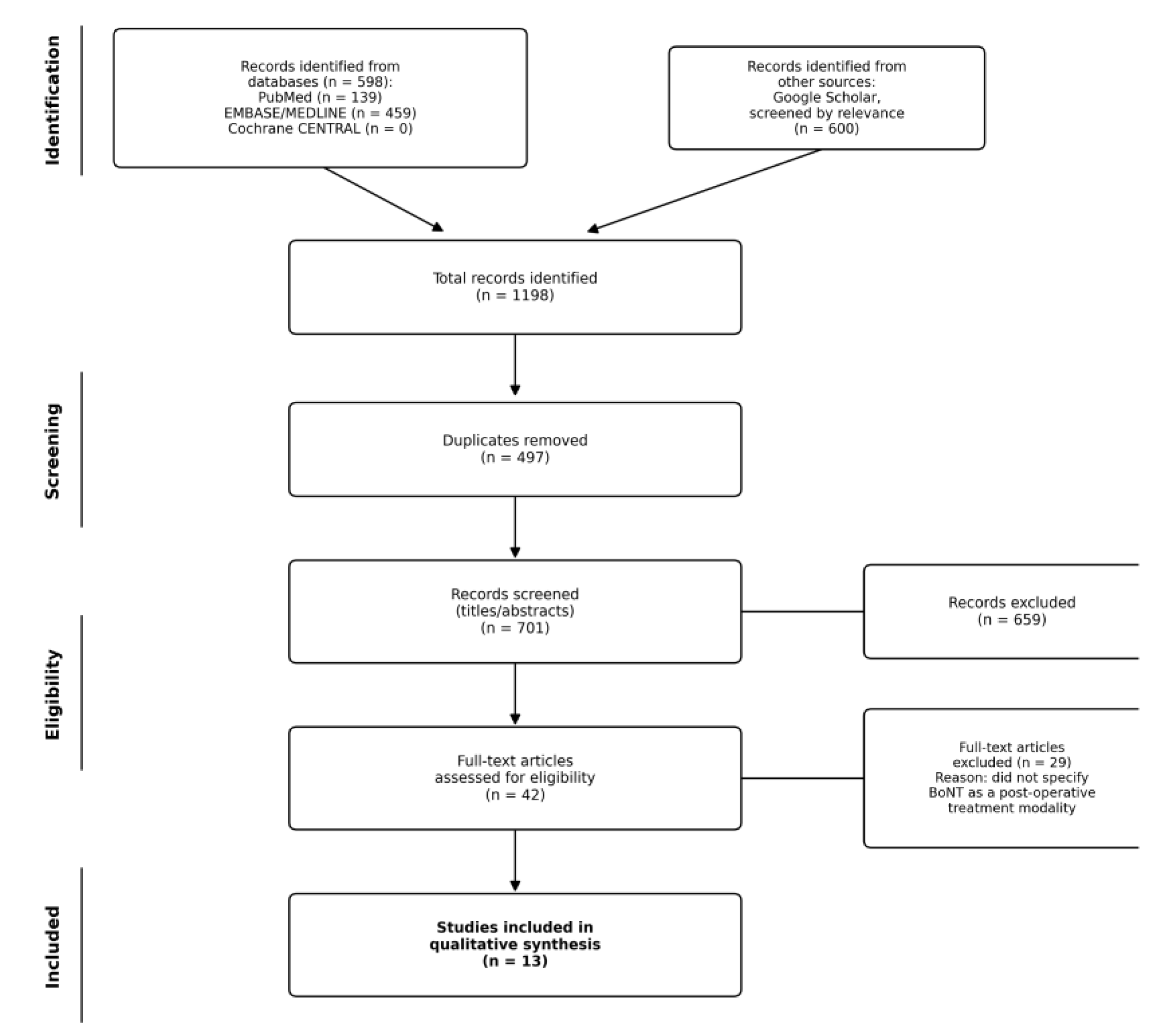
Table 1.
Results of the literature review – summary.
| Summary | |
| Total studies | 13 |
| Total patients | >260 |
| Study designs | 1 RCT, 3 prospective (incl. 1 prospective/retrospective), 4 retrospective, 2 case series, 2 case reports, 1 systematic review |
| Fistula/sialocele closure rates | 54–100% |
| Salivary flow suppression | Up to ~95% reduction (one prospective study) |
| Adverse events | Rare and minor (1 transient skin swelling, 1 transient xerostomia); no long-term morbidity |
Disclaimer/Publisher’s Note: The statements, opinions and data contained in all publications are solely those of the individual author(s) and contributor(s) and not of MDPI and/or the editor(s). MDPI and/or the editor(s) disclaim responsibility for any injury to people or property resulting from any ideas, methods, instructions or products referred to in the content. |
© 2026 by the authors. Licensee MDPI, Basel, Switzerland. This article is an open access article distributed under the terms and conditions of the Creative Commons Attribution (CC BY) license.
Copyright: This open access article is published under a Creative Commons CC BY 4.0 license, which permit the free download, distribution, and reuse, provided that the author and preprint are cited in any reuse.