

Submitted:
25 August 2026
Posted:
26 August 2026
You are already at the latest version
Abstract
Background: Physical inactivity contributes substantially to morbidity, disability and premature mortality in older adults. However, physical activity counselling in primary care does not necessarily translate into structured, individualized exercise prescription. PREFIS-AP evaluates a standardized Exercise Prescription Program embedded in routine primary care for adults aged ≥65 years. Methods: PREFIS-AP is a pragmatic, parallel-group randomized controlled trial including 210 participants allocated 1:1 to an individualized exercise prescription program or usual care. The primary outcome is change in functional exercise capacity measured by the Six-Minute Walk Test (6MWT). Secondary outcomes include physical activity, health-related quality of life, muscle strength and lower-limb function, anthropometric measures, rectus femoris morphology assessed by point-of-care ultrasound, medication burden and safety. Analyses will follow the intention-to-treat principle, estimating between-group effects adjusted for baseline values. Discussion: PREFIS-AP will evaluate a reproducible model for integrating structured exercise prescription into routine primary care. Key strengths include electronic health record integration, standardized decision algorithms, individualized multicomponent exercise, objective functional and ultrasound assessment, and intervention-fidelity procedures. Limitations include its single rural setting, participation of an exercise professional, lack of participant and clinician blinding, and 12-week follow-up. If effective, the model could support scalable implementation of exercise prescription in primary care.
Keywords:
primary care
; exercise prescription
; physical activity
; older adults
; physical fitness
; quality of life
; sarcopenia
; randomized controlled trial
1. Introduction
Population ageing is one of the major public health challenges of the twenty-first century. Although life expectancy continues to increase, additional years of life are frequently accompanied by multimorbidity, functional decline and disability, placing increasing pressure on health and social care systems. Preserving functional ability, mobility and independence has therefore become a central objective of the World Health Organization (WHO) healthy ageing framework [1]. Physical inactivity is an important modifiable determinant of unhealthy ageing and is associated with cardiovascular disease, type 2 diabetes, several cancers, disability and premature mortality [2,3].
Regular exercise improves cardiorespiratory fitness, muscle strength and power, balance, mobility and health-related quality of life, while reducing falls and functional decline. Progressive resistance training and multicomponent programs combining aerobic, resistance, balance and functional exercise are particularly relevant in older adults. Current international recommendations therefore support structured, individualized and monitored exercise as a core preventive and therapeutic strategy [3].
Despite this evidence, insufficient physical activity remains highly prevalent and important socioeconomic and geographical inequalities persist. Rural populations may face fewer opportunities and resources for structured physical activity, supporting the development of pragmatic interventions adapted to rural primary care [4].
Primary care is well placed to deliver such interventions because family physicians and nurses maintain longitudinal contact with older adults and routinely assess chronic disease, medication burden and functional status [5]. However, physical activity promotion is often limited to general counselling. Exercise prescription is a more specific clinical process: it translates assessment into an individualized program with defined frequency, intensity, time, type, volume and progression, together with monitoring and adaptation. Limited consultation time, insufficient training and lack of standardized decision-support tools remain important implementation barriers [4].
Several primary care interventions, including the Spanish PEPAF and EFICAR programs, have demonstrated the feasibility of moving beyond generic advice through individualized assessment, prescription and follow-up [6,7]. Nevertheless, substantial heterogeneity in intervention content, professional involvement, intensity, follow-up and fidelity limits reproducibility and translation into routine practice (5). Pragmatic randomized trials of standardized exercise prescription supported by electronic clinical decision tools remain uncommon, particularly among adults aged 65 years and older in rural settings [8].
Another limitation of previous research is the relatively limited assessment of objective muscular adaptations. Muscle ultrasound is a portable, non-invasive method for assessing muscle thickness and architecture, and rectus femoris ultrasound may provide complementary information on structural changes associated with exercise; however, acquisition protocols and thresholds remain heterogeneous [9,10].
The PREFIS-AP trial was designed to address these clinical and implementation gaps by combining standardized functional assessment, an individualized multicomponent prescription generated through an electronic-health-record decision-support module, structured follow-up, point-of-care muscle ultrasound and predefined fidelity procedures within routine rural primary care.
2. Objectives
Primary Objective
The primary objective is to determine whether a 12-week individualized multicomponent Exercise Prescription Program integrated into routine primary care improves functional exercise capacity, measured by change in Six-Minute Walk Test (6MWT) distance, compared with usual primary care in community-dwelling adults aged 65 years and older.
Secondary Objectives
Secondary objectives are to evaluate effects of intervention on physical activity, health-related quality of life, handgrip strength, lower-limb functional performance, anthropometric measures, rectus femoris muscle morphology, and medication burden.
Exploratory and Implementation Objectives
A complementary implementation objective is to assess the feasibility and reproducibility of integrating a standardized, algorithm-supported Exercise Prescription Program into routine primary care through the electronic health record.
3. Materials and Methods
3.1. Study Design
PREFIS-AP is a single-center, pragmatic, parallel-group randomized controlled trial with 1:1 allocation to an individualized Exercise Prescription Program or usual primary care. The protocol follows SPIRIT 2025 recommendations [11], and trial results will be reported in accordance with CONSORT guidance [12]. (Table S1). Registered at ClinicalTrials.gov, number NCT07394790.
The overall study pathway is summarized in Figure 1.
3.2. Study Setting
The study will be conducted in the Primary Care setting of the Salamanca Health Area (Castilla y León, Spain). Recruitment will take place in a rural Primary Care Centre belonging to the Regional Health Service. The zone serves 4,128 registered users, of whom 35.1% (approximately 1,449 people) are aged 65 years or older. The population is geographically dispersed across eight municipalities served by a central Primary Care Centre and peripheral local consulting facilities. The zone also includes five residential facilities for older adults, although the trial is restricted to community-dwelling participants.
The project will be coordinated by the Primary Care Research Unit of Salamanca (APISAL) and the Institute for Biomedical Research of Salamanca (IBSAL), institutions with extensive experience in clinical epidemiology, ageing research and exercise prescription.
The intervention will be integrated into routine Primary Care practice to maximize its external validity and facilitate future implementation within the Spanish National Health System.
3.3. Participants and Eligibility Criteria
Inclusion and Exclusion Criteria
Eligible participants must fulfil all the following criteria: age ≥65 years; community-dwelling; registered at the participating Primary Care Centre; able to walk independently, with or without walking aids; considered medically suitable for participation in a moderate-intensity multicomponent exercise program; willingness to participate and ability to provide written informed consent.
Participants will be excluded when exercise testing or training was considered unsafe according to current pre-participation and exercise-testing standards [13], including myocardial infarction within the previous 3 months; unstable angina; uncontrolled arrhythmia causing symptoms or hemodynamic compromise; symptomatic severe aortic stenosis; decompensated or uncontrolled heart failure; acute pulmonary embolism or acute deep-vein thrombosis; uncontrolled respiratory disease or acute respiratory failure; acute systemic illness likely to impair exercise capacity or worsen with exercise; established dementia, or an ongoing diagnostic process for suspected dementia, when reliable consent or study participation could not be ensured; severe psychiatric illness preventing cooperation with the intervention or assessments; any other clinical condition that, in the investigating family physician’s judgement, could compromise participant safety. Participants who routinely use a walking aid will be eligible and will use the same aid during the 6MWT and throughout study-related exercise. Previous participation in structured exercise or regular physical activity is not an exclusion criterion, consistent with the trial’s real-world effectiveness objective.
Potential participants will be invited by their family physician. Medical suitability will be determined through review of the electronic health record, medical history, current medication, relevant comorbidities, symptoms and functional status, together with a focused clinical examination when indicated. The family physician also will assess capacity to understand the study, appreciate its implications and provide informed consent.
3.4. Recruitment
Recruitment will be promoted across all consulting facilities in the Basic Health Zone to reduce discretionary selection and dependence on attendance at a single consultation. Potentially eligible adults will be informed by primary care professionals and will be invited consecutively when encountered in routine care. All interested individuals will receive verbal and written information describing study objectives, procedures, potential risks and expected benefits. Written informed consent will be obtained before any study-specific procedure, and baseline assessments were completed before randomization.
The underlying population included approximately 1,449 registered adults aged 65 years or older. During recruitment, at least 210 people will be formally invited and evaluated. Those who refuse to participate for personal reasons and those excluded after the eligibility assessment will be counted. Among the participants randomized (1:1) to the intervention and control groups.
3.5. Randomization and Allocation Concealment
After completion of the baseline assessment, participants will be randomly assigned in a 1:1 ratio to the intervention or control group using a computer-generated allocation sequence implemented in REDCap by an independent researcher. The investigator conducting the baseline assessment initiated the randomization procedure but had no ability to predict, alter or override the allocation. The allocation sequence remained concealed until the participant had been enrolled, and the baseline assessment completed; REDCap then revealed the assignment automatically, independently of participant characteristics.
The investigator responsible for baseline assessment will not be responsible for participant recruitment or delivery of the exercise intervention. Because of the behavioral nature of the intervention, participants and professionals delivering the program could not be blinded. Outcome assessment procedures will be standardized, and statistical analyses will be performed using coded treatment groups so that the analyst remains blinded to allocation during the primary analysis.
3.6. Study Assessments
All participants will undergo identical baseline and post-intervention assessments performed by two trained investigators following standardized operating procedures. Baseline evaluation will be completed before randomization, there will be one follow-up visit, 12 weeks after the procedure, where all the variables will be collected again. An independent investigator oversaw quality assurance. Whenever possible, the same equipment, procedures and testing environment were used at both time points. The assessment battery comprised sociodemographic and clinical characteristics, anthropometry and blood pressure, laboratory assessment, physical activity and health-related quality of life, physical performance, muscle strength and morphology. Table 1 summarizes the domains to be assessed, the instruments to be used, and the outcomes to be measured.
3.6.1. Sociodemographic and Clinical Assessment
Age, sex, marital status, educational attainment and occupational status will be recorded at inclusion. Medical history, chronic diseases and medication use will be obtained from the electronic health record and verified during the study visit.
3.6.2. Anthropometric and Clinical Examination
Body weight will be measured twice using a calibrated Seca 770 electronic scale (accuracy ±0.1 kg), and height using a Seca 222 stadiometer with the participant barefoot and standing upright. The mean of two measurements will be recorded. Body mass index will be calculated as kg/m². Waist circumference will be measured using a non-elastic tape according to SEEDO recommendations [14], and calf circumference at the point of maximum circumference.
Resting blood pressure was measured with an automated OMRON M10 device after at least 5 minutes seated rest. Three measurements were obtained and the mean of the last two used for analysis, following European recommendations [15].
3.6.3. Laboratory Assessment
Fasting venous blood and urine samples were collected in the morning using standardized pre-analytical procedures. Routine biochemical, hematological, renal, metabolic and inflammatory parameters and urine albumin-to-creatinine ratio were analyzed by the reference hospital laboratory using standardized procedures.
3.6.4. Physical Activity and Health-Related Quality of Life
Physical activity was assessed using the interviewer-administered Global Physical Activity Questionnaire (GPAQ), covering work, transport, recreational activity and sedentary behavior (18). Health-related quality of life was assessed using the validated Spanish SF-36, including its eight domains and physical and mental summary components [16,17,18].
3.6.5. Physical Performance
Functional exercise capacity will be assessed with the six-minute walk test (6MWT). Participants will be instructed to walk as far as possible for six minutes under standardized conditions, with standardized encouragement. Heart rate, oxygen saturation, blood pressure and perceived exertion using the Borg scale will be monitored as specified in the study operating procedure [19,20]. The 6MWT will be performed using the same standardized 20-m walkway at baseline and post-intervention. Although walkway length influences absolute 6MWT because of differences in the number of turns, available evidence supports the validity and reliability of the 20-m protocol when the same course length and testing procedures are consistently used for repeated assessments [21].
Upper-limb strength will be assessed bilaterally with an analogue JAMAR handgrip dynamometer using standardized positioning; the highest valid value will be retained. Lower-limb functional performance will be assessed with the 30-second Sit-to-Stand Test, recording the number of complete chair rises performed in 30 seconds [22,23].
3.6.6. Muscle Morphology
Calf circumference will be recorded as an anthropometric indicator of peripheral muscle quantity [24,25].
Rectus femoris morphology will be assessed by point-of-care ultrasound with the participant supine, lower limbs relaxed and the transducer positioned transversely at predefined anatomical landmarks along the line between the anterior superior iliac spine and superior pole of the patella. Measurements will be obtained at the midpoint and distal third using a standardized acquisition protocol [10]. Ultrasound measures will be treated as continuous morphological outcomes; It will not use to establish a study diagnosis of sarcopenia [26,27].
3.7. Sample Size Calculation
The sample size was calculated a priori using G*Power version 3.1 [28]. The calculation was based on the between-group difference in 6MWT, the primary outcome of the trial. A clinically meaningful between-group difference of 26 m and a standard deviation of 60 m were assumed, corresponding to a standardized effect size (Cohen’s d) of 0.433 [29].
For a two-sided independent-samples t test, with an α level of 0.05, 80% statistical power and a 1:1 allocation ratio, 85 evaluable participants per group (170 participants in total) were required. To account for an anticipated attrition rate of approximately 15-20%, the target sample size was increased to 105 participants per group, resulting in a total planned sample of 210 participants [30].
3.8. Intervention
Participants allocated to the intervention group received a 12-week individualized multicomponent Exercise Prescription Program integrated into routine primary care [3,31,32]. Prescriptions were generated using the exercise prescription module embedded in MEDORA®, the regional primary care electronic health record, through predefined clinical algorithms informed by baseline functional assessment [33]. The intervention is reported according to the TIDieR framework [34].
3.8.1. Exercise Components and Progression
Aerobic exercise included walking, cycling, swimming or comparable activities will be adapted to participant preference and functional capacity, with intensity guided by the Borg Rating of Perceived Exertion Scale [20]. Resistance exercise will be performed primarily with elastic bands and progressed by modifying resistance, repetitions, sets and recovery, with perceived exertion supported by the OMNI-RES scale [35]. Balance training will use progressively challenging static and dynamic tasks, and flexibility exercises targeted major muscle groups. Inspiratory muscle training will be prescribed only when clinically indicated. Frequency, intensity, time, type, volume and progression will be individualized within the Frequency; Intensity; Training Time; Training Type—Volume; Progression (FITT-VP) framework and modified according to tolerance, perceived exertion, functional response and safety [3].
3.8.2. Support and Intervention Fidelity
Participants will receive verbal and written instructions and a reinforcement contact approximately two weeks after program initiation to resolve questions and review progression. A qualified exercise professional will support correct performance and progression in the intervention arm. Reproducibility will be promoted through standardized investigator training, operating procedures, predefined algorithms within MEDORA®, standardized assessment materials, regular investigator meetings and prospective documentation of protocol deviations and exercise modifications. Although exercise prescriptions will be individualized, the prescribing process itself was standardized.
3.9. Control Group
Participants will be allocate to the control group received usual primary care, including routine clinical management and general lifestyle and physical activity advice consistent with current WHO recommendations [3].
They will not receive the individualized exercise prescription generated by the study module or the structured multicomponent program during the 12-week study period.
3.10. Outcome Measures
- -
- Primary outcome.
The primary outcome is change from baseline to 12 weeks in distance walked during the 6MWT (26 meters) [19] .
- -
- Secondary outcomes.
Secondary outcomes are changes in GPAQ-derived physical activity, SF-36 health-related quality of life, handgrip strength, 30-second Sit-to-Stand performance, anthropometric measures, rectus femoris ultrasound measures, and medication burden. Exploratory analyses will examine associations between structural muscle changes and functional outcomes.
3.11. Data Collection and Management
Data will be recorded in standardized electronic case report forms and stored in a secure electronic database with predefined range and consistency checks. Participants will be identified by unique study codes; the re-identification key will be stored separately with restricted access. Data quality will be reviewed periodically by the research team, and corrections will be traceable. The schedule of enrolment, interventions and assessments is summarized in Figure 2.
3.12. Statistical Analysis
Continuous variables will be summarized as mean (standard deviation) or median (interquartile range), as appropriate, and categorical variables as frequencies and percentages. Baseline characteristics will be described by randomized groups without significance testing as a criterion of successful randomization.
The primary analysis will follow the intention-to-treat principle. The primary treatment effect will be estimated by comparing 12-week 6MWT outcomes between groups using a regression model adjusted for baseline 6MWT distance and prespecified clinically relevant covariates. Effect estimates will be reported with 95% confidence intervals. Secondary continuous outcomes will be analyzed using analogous baseline-adjusted models; categorical outcomes will use appropriate generalized models. Missing outcome data will be explored and, when assumptions are considered plausible, multiple imputations will be used in sensitivity analyses. Prespecified subgroup or interaction analyses will be regarded as exploratory. Two-sided p<0.05 will be used for the primary hypothesis, while secondary analyses will be interpreted with emphasis on effect size, precision and multiplicity rather than isolated statistical significance.
3.13. Safety and Adverse Events
Safety monitoring will cover the intervention and assessment period from enrolment until completion of the 12-week follow-up. An adverse event is defined as any unfavorable medical occurrence during study participation, whether considered related to the intervention. An intervention-related adverse event is any event for which a reasonable temporal and clinical relationship with exercise testing or prescribed exercise could not be excluded. Events of specific interest included falls, musculoskeletal pain or injury, cardiovascular or respiratory exacerbation, syncope or presyncope, and any symptom requiring interruption of exercise.
A serious adverse event is defined as an event resulting in death, posing an immediate threat to life, requiring or prolonging hospital admission, causing persistent or clinically significant disability, or otherwise judged medically important. Exercise-related injury is defined as a musculoskeletal complaint or injury occurring during or following prescribed exercise that required modification, temporary interruption, medical assessment or treatment. For every event, investigators will document onset, severity, clinical course, action taken, outcome and causal attribution to study procedures.
Participants will be instructed to stop exercise and contact the study team if warning symptoms occur. Temporary suspension will be indicated for acute illness, clinically relevant pain or injury, new cardiovascular or respiratory symptoms, or any condition requiring reassessment. Permanent discontinuation of the exercise intervention could be decided by the investigating physician when continued participation will be considered unsafe, without withdrawing the participant from outcome follow-up whenever feasible. Urgent medical care was available through the Primary Care Centre’s usual emergency procedures, including resuscitation equipment, and events will be followed until resolution or stabilization.
Safety oversight will be performed by the physician principal investigator together with collaborating clinical investigators. Serious or unexpected events considered related to study procedures will be communicated promptly to the principal investigator and reported to the Research Ethics Committee in accordance with applicable requirements. A separate Data Monitoring Committee will not be constituted because the intervention is short, non-pharmacological and considered low risk, with direct medical oversight and predefined stopping procedures.
3.14. Ethics and Trial Registration
The study has been approved by the Research Ethics Committee of the Salamanca Health Area (approval number: Ref. CEIm: PI 2024 05 1615) and will be conducted in accordance with the Declaration of Helsinki [36], International Council for Harmonization Good Clinical Practice (ICH-GCP) principles [37], and applicable European and Spanish data-protection and biomedical-research legislation.
Written informed consent was obtained before any study-specific procedure. Substantive protocol amendments affecting participant safety, study conduct or scientific integrity require ethics approval and registry updating as appropriate.
3.15. Use of Artificial Intelligence-Assisted Technologies
During the preparation of this manuscript, the authors used artificial intelligence-assisted tools, including ChatGPT Plus (OpenAI), Consensus, Elicit, SciSpace, and Semantic Scholar, to support literature searches, explore relevant scientific evidence, generate and organize preliminary ideas, and assist in the preliminary design of figures. These tools were used solely as complementary aids and were not considered sources of scientific evidence in themselves. All retrieved information and references were critically reviewed and verified by the authors against the original scientific sources before inclusion in the manuscript. The scientific content, interpretation of the evidence, study design, methodological decisions, analysis, conclusions, and final wording of the manuscript were developed, reviewed, and approved by the authors, who take full responsibility for the integrity and accuracy of the work in accordance with their respective authorship contributions.
4. Discussion
The challenge is no longer demonstrating that exercise benefits older adults but identifying effective and reproducible strategies for incorporating exercise prescription into routine Primary Care. PREFIS-AP addresses this implementation gap by evaluating a standardized, yet individualized program embedded in the electronic health record rather than a conventional stand-alone community exercise program. The model combines objective functional assessment, algorithm-supported clinical decision-making and structured follow-up while preserving individualized care.
A major strength is the multimodal assessment of muscle health. Alongside validated measures of functional capacity, physical activity and health-related quality of life, the protocol incorporates point-of-care ultrasound of the rectus femoris as an objective continuous measure of muscle morphology [10].
Ultrasound is increasingly recognized as a promising tool for muscle assessment, but standardization remains incomplete; its inclusion may therefore help clarify the relationship between structural adaptations and functional response without treating ultrasound thresholds as a diagnostic endpoint [38].
The intervention has also been designed to maximize reproducibility. Exercise prescription follows current international recommendations and the FITT-VP framework [39], while standardized training, predefined algorithms, operating procedures and fidelity monitoring reduce avoidable variation between professionals [3]. Its delivery through existing primary care structures increases clinical relevance, although the additional support of an exercise professional in the intervention arm is an important departure from usual care and should be considered when judging scalability [5].
Several limitations should be acknowledged. Blinding of participants and treating healthcare professionals is not feasible because of the behavioral nature of the intervention; however, outcome assessors and statistical analysts will remain blinded to treatment allocation. In addition, recruitment is limited to a single rural primary care center, which may reduce generalizability. Nevertheless, the study population is representative of many rural communities, and the standardized intervention has been specifically designed to facilitate replication in other healthcare settings, including future multicenter studies involving urban populations. Finally, the 12-week follow-up does not allow assessment of the long-term sustainability of exercise adherence or treatment effects, highlighting the need for future longitudinal research.
Despite these limitations, prospective registration, SPIRIT-informed protocol reporting, standardized operating procedures, concealed electronic allocation, objective outcome measurement, predefined statistical analysis and systematic safety monitoring strengthen the transparency and internal validity of the study [11,12]. The explicit description of setting, intervention components and fidelity procedures should also facilitate external appraisal and replication.
If effective, PREFIS-AP could provide a scalable framework for moving from general physical activity counselling to structured exercise prescription in primary care. Beyond estimating clinical effectiveness, the trial may contribute to standardizing how exercise is assessed, prescribed, progressed and evaluated in everyday practice and inform subsequent multicenter studies in urban and other healthcare settings.
Supplementary Materials
The following supporting information can be downloaded at the website of this paper posted on Preprints.org, Table S1: PREFIS-AP randomized trial. CONSORT 20025 checklist.
Author Contributions
Conceptualization, VMGR; methodology, VMGR, LGO, CLS; resources, VMGR, NSG; data curation, CLS; formal analysis, CLS; investigation, EML, MCRM, RSH, SCI, MDM, NSG; writing—original draft preparation, VMGR, SAR; writing—review and editing, SAR, LGO, CLS; supervision, LGO; project administration, VMGR, NSG; funding acquisition, VMGR. All authors have read and agreed to the published version of the manuscript.
Funding
This study was funded by the Regional Health Management of Castilla y León (Gerencia Regional de Salud de Castilla y León) through the 2024 Call for Research Projects in Biomedicine, Health Management and Social and Health Care (grant GRS3051/C/2024).
Institutional Review Board Statement
The study was conducted in accordance with the Declaration of Helsinki and approved by the by the Research Ethics Committee of the Salamanca Health Area (Ref. CEIm: PI 2024 05 1615) for studies involving humans.
Informed Consent Statement
Informed consent was obtained from all subjects involved in the study.
Data Availability Statement
The datasets generated during the study will be deposited in Zenodo repository (IBSAL community)]. Anonymized data will be available through a controlled-access procedure to qualified researchers upon reasonable request, subject to approval of the corresponding data access committee/institution and compliance with applicable ethical and data protection requirements.
Acknowledgments
The authors would like to thank all participants who generously contributed their time to the PREFIS-AP trial. We gratefully acknowledge the Regional Centre for Sports Medicine of Castilla y León (CEREMEDE) for providing specific training to the research team during the preparatory phase of the study. We also thank the healthcare professionals and staff of the Villoria Primary Care Centre, they are key in recruiting participants, particularly the family physicians Alfonso Escribano Hernández, Maria Asunción Castillo Santos, Luis Angel Cornejo Hernández, Manuela Rodríguez Benito and David Vazquez Gómez, and the nurses Maria Alexia Peña Lopez, Maria Luisa Álvarez Giganto, Carlota Yagüe Santos and Cristina Cantero Díez. We are especially grateful to Saul Martín Paz, Exercise and Sports Technician, for his technical support and collaboration in the implementation of the Exercise Prescription Program for participants allocated to the intervention group. Finally, we acknowledge the municipalities of the Comarca de Las Villas, particularly Villoria Town Council, for their institutional support and for facilitating access to sports facilities to be used in the implementation of the program.
Conflicts of Interest
The authors declare no conflicts of interest.
Abbreviations
The following abbreviations are used in this manuscript:
| 6MWT | Six-Minute Walk Test. |
| APISAL | Primary Care Research Unit of Salamanca. |
| BMI | Body Mass Index. |
| FITT-VP | Frequency; Intensity; Training Time; Training Type—Volume; Progression. |
| GPAQ | Global Physical Activity Questionnaire. |
| IBSAL | Institute for Biomedical Research of Salamanca. |
| ICH-GCP | International Council for Harmonization Good Clinical Practice |
| PREFIS-AP | Prescription of Physical Exercise in Primary Care. |
| REDCap | Research Electronic Data Capture. |
| SEEDO | Spanish Society for the Study of Obesity. |
| SF-36 | 36-Item Short Form. |
| TIDieR | Template for Intervention Description and Replication. |
| WHO | World Health Organization |
References
- Dempsey, P.C.; Biddle, S.J.H.; Buman, M.P.; Chastin, S.; Ekelund, U.; Friedenreich, C.M.; Katzmarzyk, P.T.; Leitzmann, M.F.; Stamatakis, E.; van der Ploeg, H.P.; et al. New Global Guidelines on Sedentary Behaviour and Health for Adults: Broadening the Behavioural Targets. Int. J. Behav. Nutr. Phys. Act. 2020, 17, 151. [Google Scholar] [CrossRef] [PubMed]
- Lee, I.-M.; Shiroma, E.J.; Lobelo, F.; Puska, P.; Blair, S.N.; Katzmarzyk, P.T. Lancet Physical Activity Series Working Group Effect of Physical Inactivity on Major Non-Communicable Diseases Worldwide: An Analysis of Burden of Disease and Life Expectancy. Lancet 2012, 380, 219–229. [Google Scholar] [CrossRef] [PubMed]
- Izquierdo, M.; de Souto Barreto, P.; Arai, H.; Bischoff-Ferrari, H.A.; Cadore, E.L.; Cesari, M.; Chen, L.-K.; Coen, P.M.; Courneya, K.S.; Duque, G.; et al. Global Consensus on Optimal Exercise Recommendations for Enhancing Healthy Longevity in Older Adults (ICFSR). J. Nutr. Health Aging 2025, 29, 100401. [Google Scholar] [CrossRef] [PubMed]
- Sigvardsson, D.; MacLean, A.; Hoonk, A.; Ali, T.; Makenzius, M. Barriers and Implementation Strategies for Physical Activity on Prescription (PAP): Healthcare Personnel and Management Perspectives in Sweden—An Explanatory Sequential Study Design. BMC Prim. Care 2025, 26, 302. [Google Scholar] [CrossRef] [PubMed]
- Thornton, J.; Nagpal, T.; Reilly, K.; Stewart, M.; Petrella, R. The “Miracle Cure”: How Do Primary Care Physicians Prescribe Physical Activity with the Aim of Improving Clinical Outcomes of Chronic Disease? A Scoping Review. BMJ Open Sport Exerc Med. 2022, 8, e001373. [Google Scholar] [CrossRef] [PubMed]
- García-Ortiz, L.; Grandes, G.; Sánchez-Pérez, A.; Montoya, I.; Iglesias-Valiente, J.A.; Recio-Rodríguez, J.I.; Castaño-Sánchez, Y.; Gómez-Marcos, M.A. PEPAF group Effect on Cardiovascular Risk of an Intervention by Family Physicians to Promote Physical Exercise among Sedentary Individuals. Rev. Esp. Cardiol. 2010, 63, 1244–1252. [Google Scholar] [CrossRef] [PubMed]
- Gómez-Marcos, M.A.; Agudo-Conde, C.; Torcal, J.; Echevarria, P.; Domingo, M.; Arietaleanizbeascoa, M.; Sanz-Guinea, A.; de la Torre, M.M.; Ramírez, J.I.; García-Ortiz, L.; et al. Baseline characteristics and changes in treatment after a period of optimization of the patients included in the study EFICAR. Aten. Primaria 2016, 48, 166–174. [Google Scholar] [CrossRef] [PubMed]
- González-Rodríguez, V.M.; Martín-López, E.; Rodríguez-Martín, M.C.; Campos-Isidro, S.; Sánchez de Vega-Huidobro, R.; Arroyo-Romero, S. En Respuesta a «Planes de Prescripción de Actividad Física y Ejercicio En Atención Primaria En España». Castilla Y León. Atención Primaria 2026, 58, 103542. [Google Scholar] [CrossRef] [PubMed]
- Illamola Martin, L.; Rando-Matos, Y.; Sanllorente, A.; García Sala, C.; de Frutos Echaniz, E. Evaluación de La Masa Muscular Con Ecografía Para El Abordaje Precoz de Sarcopenia En Adultos Mayores Inactivos En Atención Primaria. Proyecto ECOSARC. Aten. Primaria 2025, 57, 103239. [Google Scholar] [CrossRef] [PubMed]
- Fu, H.; Wang, L.; Zhang, W.; Lu, J.; Yang, M. Diagnostic Test Accuracy of Ultrasound for Sarcopenia Diagnosis: A Systematic Review and Meta-Analysis. J. Cachexia Sarcopenia Muscle 2023, 14, 57–70. [Google Scholar] [CrossRef] [PubMed]
- Chan, A.-W.; Boutron, I.; Hopewell, S.; Moher, D.; Schulz, K.F.; Collins, G.S.; Tunn, R.; Aggarwal, R.; Berkwits, M.; Berlin, J.A.; et al. SPIRIT 2025 Statement: Updated Guideline for Protocols of Randomized Trials. Nat. Med. 2025, 31, 1784–1792. [Google Scholar] [CrossRef] [PubMed]
- Hopewell, S.; Chan, A.W.; Collins, G.S.; Hróbjartsson, A.; Moher, D.; Schulz, K.F.; et al. CONSORT 2025 Statement: updated guideline for reporting randomised trials. BMJ 2025, 388, e081123. [Google Scholar] [CrossRef] [PubMed]
- Haskell, W.L.; Lee, I.-M.; Pate, R.R.; Powell, K.E.; Blair, S.N.; Franklin, B.A.; Macera, C.A.; Heath, G.W.; Thompson, P.D.; Bauman, A. Physical Activity and Public Health: Updated Recommendation for Adults from the American College of Sports Medicine and the American Heart Association. Med. Sci. Sports Exerc 2007, 39, 1423–1434. [Google Scholar] [CrossRef] [PubMed]
- Salas-Salvadó, J.; Rubio, M.A.; Barbany, M.; Moreno, B. Consenso SEEDO 2007 para la evaluación del sobrepeso y la obesidad y el establecimiento de criterios de intervención terapéutica. Med. Clin. (Barc) 2007, 128, 184–196. [Google Scholar] [CrossRef] [PubMed]
- Williams, B.; Mancia, G.; Spiering, W.; Agabiti Rosei, E.; Azizi, M.; Burnier, M.; Clement, D.L.; Coca, A.; de Simone, G.; Dominiczak, A.; et al. 2018 ESC/ESH Guidelines for the Management of Arterial Hypertension. Eur. Heart J. 2018, 39, 3021–3104. [Google Scholar] [CrossRef] [PubMed]
- Ribeiro, M.; Fernandes, E.; Borges, M.; Pires, M.; Melo, X.; Pinto, F.J.; Abreu, A.; Pinto, R. Reliability and Validity of the Global Physical Activity Questionnaire for Portuguese Adults. Percept. Mot. Ski. 2024, 131, 1548–1570. [Google Scholar] [CrossRef] [PubMed]
- Vilagut, G.; Ferrer, M.; Rajmil, L.; Rebollo, P.; Permanyer-Miralda, G.; Quintana, J.M.; Santed, R.; Valderas, J.M.; Domingo-Salvany, A.; Alonso, J. El Cuestionario de Salud SF-36 Español: Una Década de Experiencia y Nuevos Desarrollos. Gac. Sanit. 2005, 19, 135–150. [Google Scholar] [CrossRef] [PubMed]
- Vilagut, G.; Valderas, J.M.; Ferrer, M.; Garin, O.; López-García, E.; Alonso, J. Interpretation of SF-36 and SF-12 questionnaires in Spain: physical and mental components. Med. Clin. (Barc) 2008, 130, 726–735. [Google Scholar] [CrossRef] [PubMed]
- Gochicoa-Rangel, L.; Mora-Romero, U.; Guerrero-Zúñiga, S.; Silva-Cerón, M.; Cid-Juárez, S.; Velázquez-Uncal, M.; Durán-Cuéllar, A.; Salas-Escamilla, I.; Mejía-Alfaro, R.; Torre-Bouscoulet, L. Prueba de caminata de 6 minutos: recomendaciones y procedimientos. Neumol. Y Cirugía De Tórax 2015, 74, 127–136. [Google Scholar] [CrossRef] [PubMed]
- Borg, G. Borg’s Perceived Exertion and Pain Scales; Borg’s perceived exertion and pain scales; Human Kinetics: Champaign, IL, US, 1998; p. viii, 104. ISBN 978-0-88011-623-7. [Google Scholar]
- Klein, S.R.; Gulart, A.A.; Venâncio, R.S.; Munari, A.B.; Gavenda, S.G.; Martins, A.C.B.; Mayer, A.F. Performance Difference on the Six-Minute Walk Test on Tracks of 20 and 30 Meters for Patients with Chronic Obstructive Pulmonary Disease: Validity and Reliability. Braz. J. Phys. Ther. 2021, 25, 40–47. [Google Scholar] [CrossRef] [PubMed]
- Cruz-Jentoft, A.J.; Bahat, G.; Bauer, J.; Boirie, Y.; Bruyère, O.; Cederholm, T.; Cooper, C.; Landi, F.; Rolland, Y.; Sayer, A.A.; et al. Sarcopenia: Revised European Consensus on Definition and Diagnosis. Age Ageing 2019, 48, 16–31. [Google Scholar] [CrossRef] [PubMed]
- Baltasar-Fernandez, I.; Alcazar, J.; Mañas, A.; Alegre, L.M.; Alfaro-Acha, A.; Rodriguez-Mañas, L.; Ara, I.; García-García, F.J.; Losa-Reyna, J. Relative Sit-to-Stand Power Cut-off Points and Their Association with Negatives Outcomes in Older Adults. Sci. Rep. 2021, 11, 19460. [Google Scholar] [CrossRef] [PubMed]
- López Lirola, E.M.; Iríbar Ibabe, M.C.; Peinado Herreros, J.M. La circunferencia de la pantorrilla como marcador rápido y fiable de desnutrición en el anciano que ingresa en el hospital. Relación con la edad y sexo del paciente. Nutr. Hosp. 2016, 33, 262. [Google Scholar] [CrossRef] [PubMed]
- Wei, J.-Y.; Shi, S.-T.; Sun, D.; Lyu, G.-Z. Effect of the Mini-Nutritional Assessment-Short Form in Elderly Burn Patients. J. Burn Care Res. 2022, 43, 126–132. [Google Scholar] [CrossRef] [PubMed]
- Sanz Paris, A. Ultrasound in the assessment of muscle mass. The GLIM (Global Leadership Initiative on Malnutrition) criteria called into question (I). Nutr. Hosp. 2023, 40, 5–9. [Google Scholar] [CrossRef] [PubMed]
- García-Almeida, J.M.; García-García, C.; Vegas-Aguilar, I.M.; Ballesteros Pomar, M.D.; Cornejo-Pareja, I.M.; Fernández Medina, B.; de Luis Román, D.A.; Bellido Guerrero, D.; Bretón Lesmes, I.; Tinahones Madueño, F.J. Nutritional Ultrasound®: Conceptualisation, Technical Considerations and Standardisation. Endocrinol. Diabetes Y Nutr. (English ed.) 2023, 70, 74–84. [Google Scholar] [CrossRef] [PubMed]
- Faul, F.; Erdfelder, E.; Lang, A.-G.; Buchner, A. G*Power 3: A Flexible Statistical Power Analysis Program for the Social, Behavioral, and Biomedical Sciences. Behav. Res. Methods 2007, 39, 175–191. [Google Scholar] [CrossRef] [PubMed]
- Brach, J.S.; Perera, S.; Gilmore, S.; VanSwearingen, J.M.; Brodine, D.; Nadkarni, N.K.; Ricci, E. Effectiveness of a Timing and Coordination Group Exercise Program to Improve Mobility in Community-Dwelling Older Adults: A Randomized Clinical Trial. JAMA Intern Med. 2017, 177, 1437–1444. [Google Scholar] [CrossRef] [PubMed]
- Kang, H. Sample Size Determination and Power Analysis Using the G*Power Software. J. Educ. Eval. Health Prof. 2021, 18, 17. [Google Scholar] [CrossRef] [PubMed]
- WHO Guidelines on Physical Activity and Sedentary Behaviour; WHO Guidelines Approved by the Guidelines Review Committee; World Health Organization: Geneva, 2020; ISBN 978-92-4-001512-8.
- Chen, I.-F.; Chen, J.; Lai, T.-F.; Liao, Y.; Park, J.-H.; Cheng, C.-F. Goal Setting for WHO Guideline Adherence: Accelerometer Steps/Day Translation of Moderate-to-Vigorous Physical Activity in Older Adults. Front Public Health 2025, 13, 1575209. [Google Scholar] [CrossRef] [PubMed]
- Prescripción de ejercicio físico en patología crónica. Available online: https://www.saludcastillayleon.es/MedicinaDeportiva/es/prescripcion (accessed on 16 November 2025).
- Hoffmann, T.C.; Glasziou, P.P.; Boutron, I.; Milne, R.; Perera, R.; Moher, D.; Altman, D.G.; Barbour, V.; Macdonald, H.; Johnston, M.; et al. Better Reporting of Interventions: Template for Intervention Description and Replication (TIDieR) Checklist and Guide. BMJ 2014, 348, g1687. [Google Scholar] [CrossRef] [PubMed]
- Colado, J.C.; Garcia-Masso, X.; Triplett, T.N.; Flandez, J.; Borreani, S.; Tella, V. Concurrent Validation of the OMNI-Resistance Exercise Scale of Perceived Exertion with Thera-Band Resistance Bands. J. Strength Cond. Res. 2012, 26, 3018–3024. [Google Scholar] [CrossRef] [PubMed]
- World Medical Association World Medical Association Declaration of Helsinki: Ethical Principles for Medical Research Involving Human Subjects. JAMA 2013, 310, 2191–2194. [CrossRef] [PubMed]
- ICH E6 Good Clinical Practice—Scientific Guideline | European Medicines Agency (EMA). Available online: https://www.ema.europa.eu/en/ich-e6-good-clinical-practice-scientific-guideline (accessed on 27 July 2026).
- de Luis Roman, D.; García Almeida, J.M.; Bellido Guerrero, D.; Guzmán Rolo, G.; Martín, A.; Primo Martín, D.; García-Delgado, Y.; Guirado-Peláez, P.; Palmas, F.; Tejera Pérez, C.; et al. Ultrasound Cut-Off Values for Rectus Femoris for Detecting Sarcopenia in Patients with Nutritional Risk. Nutrients 2024, 16, 1552. [Google Scholar] [CrossRef] [PubMed]
- Feng, H.; Wang, X. Comparative Performance of Four Large Language Models in Generating Evidence-Based Exercise Prescriptions Using FITT-VP Framework. Front Physiol. 2026, 17, 1846567. [Google Scholar] [CrossRef] [PubMed]
Figure 1.
Study flow diagram of the PREFIS-AP randomized controlled trial.
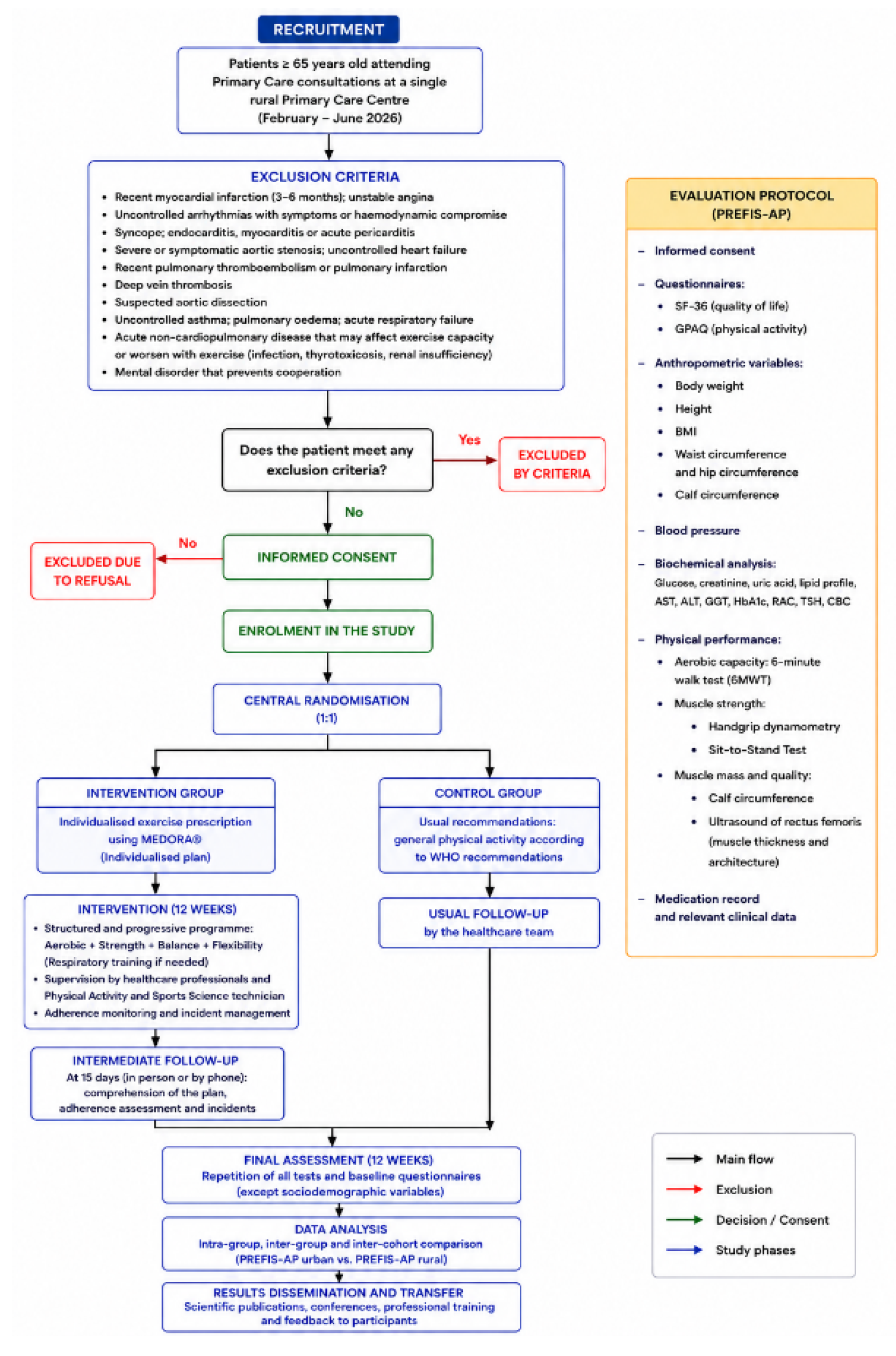
Figure 2.
SPIRIT 2025 schedule of enrolment, interventions and assessments for the PREFIS-AP randomized controlled trial.
Figure 2.
SPIRIT 2025 schedule of enrolment, interventions and assessments for the PREFIS-AP randomized controlled trial.
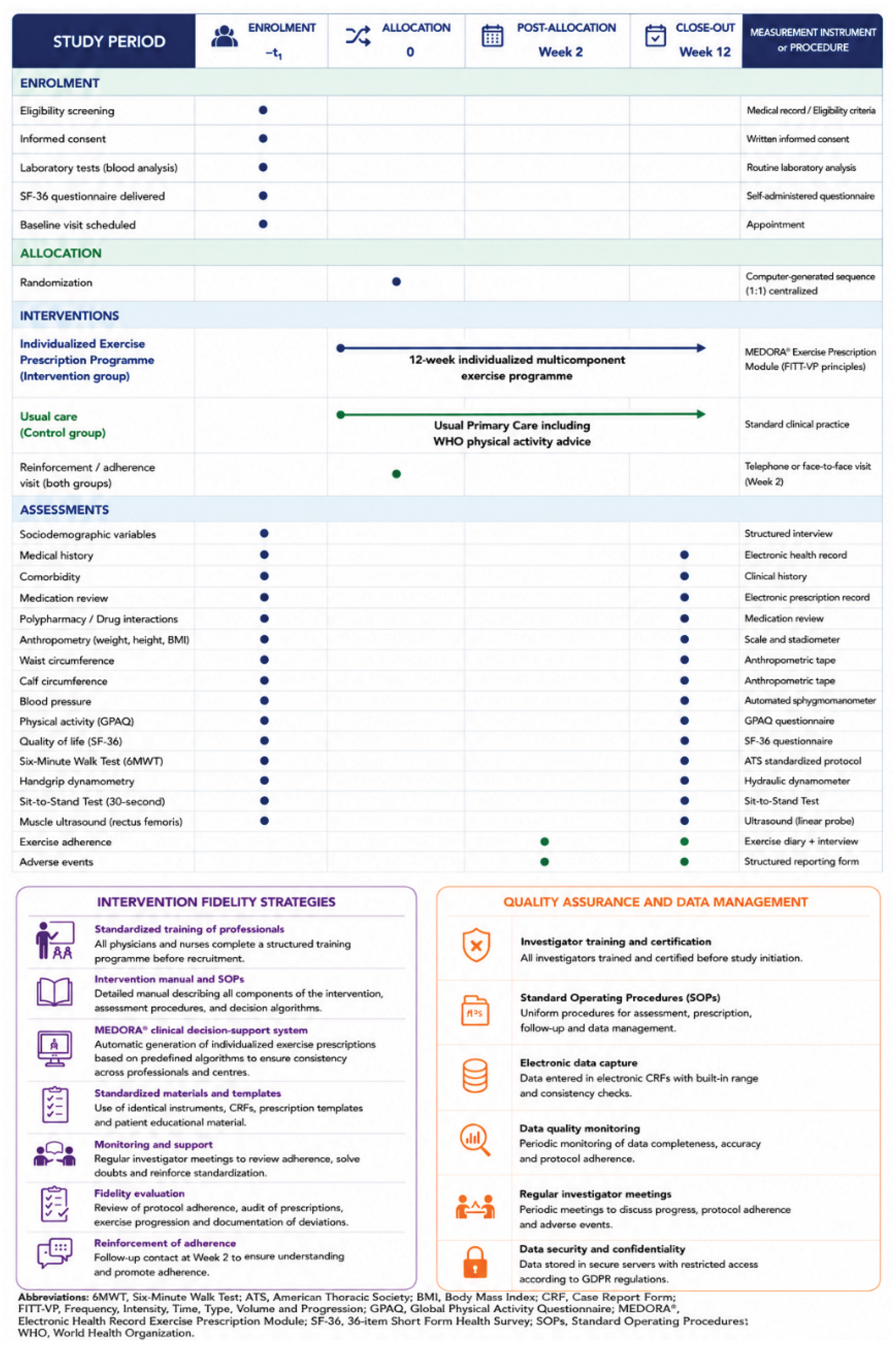

Table 1.
Summary of study assessments.
| Assessment domain | Instrument/method | Main outcome |
| Sociodemographic/clinical | Structured interview and electronic health record | Demographic and clinical characteristics |
| Anthropometry | Calibrated scale, stadiometer and measuring tape | BMI; waist and calf circumference |
| Blood pressure | Automated sphygmomanometer | Systolic and diastolic blood pressure |
| Laboratory | Blood and urine analyses | Metabolic, renal, hematological and inflammatory parameters |
| Physical activity | GPAQ | Physical activity and sedentary behavior |
| Quality of life | SF-36 | Domain and summary scores |
| Functional exercise capacity | 6MWT | Distance walked (m)—primary outcome |
| Upper-limb strength | JAMAR dynamometer | Handgrip strength (kg) |
| Lower-limb performance | 30-second Sit-to-Stand Test | Number of complete repetitions |
| Muscle morphology | Calf circumference and rectus femoris ultrasound | Circumference and ultrasound-derived muscle measures |
| Safety | Structured adverse-event reporting | Intervention-related adverse events |
Abbreviations: BMI: Body Mass Index; GPAQ: Global Physical Activity Questionnaire; SF-36: 36-Item Short Form; 6MWT: six-minute walk test.
Disclaimer/Publisher’s Note: The statements, opinions and data contained in all publications are solely those of the individual author(s) and contributor(s) and not of MDPI and/or the editor(s). MDPI and/or the editor(s) disclaim responsibility for any injury to people or property resulting from any ideas, methods, instructions or products referred to in the content. |
© 2026 by the authors. Licensee MDPI, Basel, Switzerland. This article is an open access article distributed under the terms and conditions of the Creative Commons Attribution (CC BY) license (http://creativecommons.org/licenses/by/4.0/).
Copyright: This open access article is published under a Creative Commons CC BY 4.0 license, which permit the free download, distribution, and reuse, provided that the author and preprint are cited in any reuse.