

Submitted:
25 August 2026
Posted:
26 August 2026
You are already at the latest version
Abstract
Introduction: Induction agents such as propofol, ketamine, midazolam, and etomidate are routinely used in procedural sedation. With a variety of anesthetics being delivered, it is important to be aware of adverse drug reactions (ADRs). One possible ADR is a severe type 1 hypersensitivity reaction in which patients may develop anaphylaxis or angioedema. This study utilized the TriNetX database to assess and compare the incidence of such reactions across these four intravenous anesthetic agents. Methods: A retrospective cohort study was conducted from adult patients who received one of the four agents. Incidence of anaphylaxis or angioedema was measured. A chi-square test assessed global differences among drugs, followed by pairwise post hoc comparisons assessing differences between the drugs. Results: 608 patients who experienced anaphylaxis or angioedema when given etomidate (3.48%), ketamine (3.04%), propofol (2.51%), and midazolam (2.43%); n=1,351, n=3,846, n=9,444, n=8,537, respectively. The chi-square test showed a significant difference among the four agents (χ² = 8.31, p = 0.04). Pairwise post hoc chi-square comparisons revealed significantly higher rates of hypersensitivity with etomidate compared to propofol and midazolam (p < 0.05). Conclusion: Etomidate was significantly associated with a higher incidence of anaphylaxis and angioedema compared to propofol and midazolam. These results prompt further investigation into standardized protocols to aid in diagnosis and management of perioperative hypersensitivity reactions. The development of risk stratification and management tools could enhance patient safety and improve anesthetic care, especially those at a heightened risk.
Keywords:
propofol
; midazolam
; ketamine
; etomidate
; angioedema
; anaphylaxis
; induction
1. Introduction
While anesthesia related mortality cases in surgery are extremely rare (0.4/100,000 cases) [1], studies have shown that anesthesia may be the major contributing factor in up to one-third of intraoperative complications [2]. Common anesthetics used in general sedation include but are not limited to propofol, etomidate, ketamine, and midazolam [3]. Each drug has a unique mechanism of action, benefits of use, as well as potential side effects.
Propofol exerts its effects through potentiating inhibitory GABA and the receptor and is commonly used for induction and maintenance of sedation [4]. Etomidate is an ultrashort acting hypnotic intravenous agent that works by interacting with GABA receptors and increasing affinity of the GABA neurotransmitter. It is typically used for rapid sequence intubation and when short-term anesthesia is warranted [5]. Ketamine is a noncompetitive NMDA and glutamate receptor antagonist that blocks HCN1 receptors and is typically used for brief medical procedures that do not need skeletal muscle relaxation [6]. Lastly, midazolam acts on glycine receptors and produces a muscle-relaxing effect. IV midazolam is used for anesthesia induction and in the management of acute seizures [7]. While uncommon, side effects seen from these drugs include vasodilation from propofol, adrenocortical suppression from etomidate, confusion from ketamine, and respiratory depression from midazolam [4,5,6,7]. With a variety of anesthesia drugs being administered to patients both intra-operatively and post-operatively [8], it is important to be aware of possible adverse drug reactions (ADRs) that may affect patients.
One ADR of note are severe hypersensitivity reactions, in which patients may develop anaphylaxis or angioneurotic edema. While hypersensitivity reactions to induction agents have been reported to be uncommon [9], their courses are serious and may be life-threatening. Current literature has estimated the incidence of hypersensitivity reactions to be between 1 in 10,000 and 1 in 20,000 in anesthetic procedures, with IgE mediated mechanisms occurring between 40-70% of cases [10]. The most common general anesthetics shown to induce such reactions are thiopental sodium and propofol [10,11], with etomidate generally considered to be one of the least common to induce a reaction [12].
While current research sheds light on the incidence of hypersensitivity reactions in certain drugs, there has yet to be a study that looks at a large population dataset to compare these incidences. Furthermore, research is still needed to determine the incidence of anaphylaxis and angioneurotic edema specifically in patients administered a common general anesthetic. Therefore, there is a need for further analysis in order to help guide physician decision making in choosing the safest anesthetic to administer. In this study, we identified and compared the incidence of anaphylactic shock or angioneurotic edema in patients given etomidate, ketamine, propofol, or midazolam in the TriNetX database, a network comprised of over 100 million deidentified patient medical records.
2. Methods
2.1. Study Design
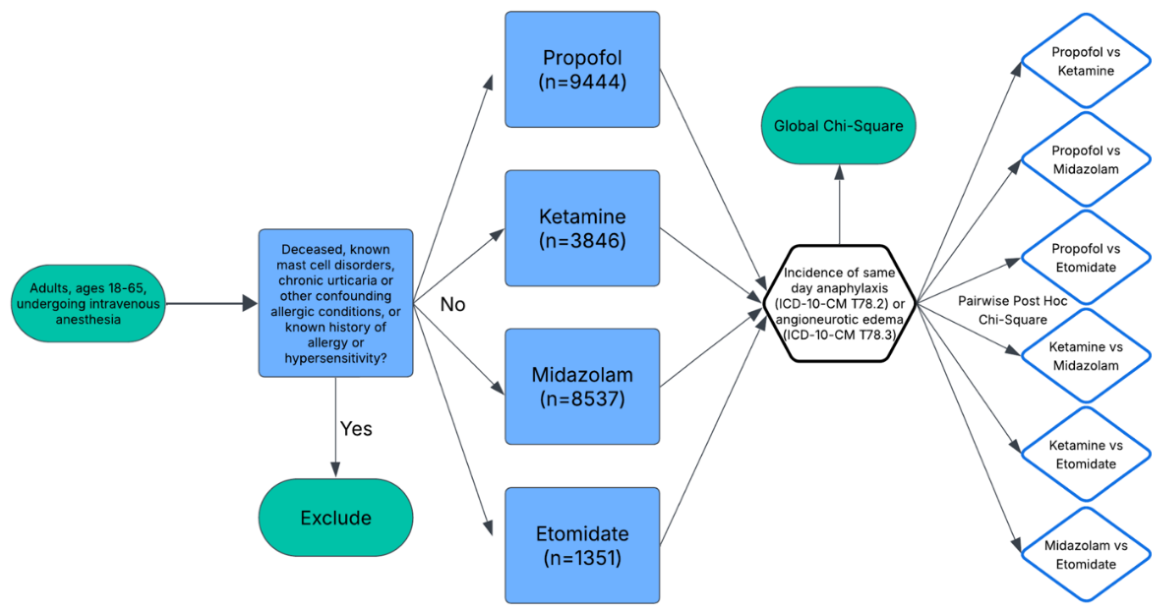
This retrospective cohort study used the TriNetX database to evaluate data from a total of 27,469 patients who met the inclusion and exclusion criteria and underwent a procedure using one of the four inducting agents. The four agents were separated into different cohorts, with the other three agents being present in the exclusion criteria. For example, a patient undergoing anesthesia with propofol will have the exclusion criteria of being given ketamine, etomidate, or midazolam. The study aimed to assess primary outcome of the incidence of same day anaphylaxis (ICD-10-CM T78.2) or angioneurotic shock (ICD-10-CM T78.3) in patients after the index event of anesthetic induction and comparison of these rates between the different drugs (see Figure 1).
2.2. Patient Population
The study population included patients 18-65 years old who received only one of four sedative agents and none of the other: propofol (n = 9,444), ketamine (n = 3,846), midazolam (n = 8,537), or etomidate (n = 1,351).
2.3. Inclusion and Exclusion Criteria
Inclusion criteria included age (18-65) and administration of propofol, ketamine, midazolam, or etomidate. Exclusion criteria included deceased individuals, known mast cell disorders (ICD-10-CM D89.4), chronic urticaria (ICD-10-CM L50.8), or other confounding allergic conditions, known history of allergy or hypersensitivity (ICD-10-CM Z91.0), and as mentioned earlier, the other three agents not being evaluated.
2.4. Statistical Analysis
To assess the incidence of the severe hypersensitivity response, we conducted both overall and pairwise statistical comparisons. We defined severe hypersensitivity responses as the occurrence of clinical diagnoses (anaphylaxis or angioedema) within the same day following administration of the agent. Incidence rates were then calculated for each group. We then used a chi-square test assessed global differences among drugs and any overall association. If statistically significant, pairwise post hoc chi-square tests were conducted to assess differences between the drugs. The significance threshold was set at p < 0.05 for both overall and pairwise comparisons.
2.5. About the TriNetX Database
The TriNetX US Collaborative database is a multicenter research network comprising over 60 healthcare organizations, collecting de-identified and aggregated patient data. The TriNetX database is continuously updated and includes data recorded in patients’ electronic health records (EHRs) from up to 20 years prior to the date of analysis (in our case 2005–2025). Patients who experienced the index event before this time frame were excluded. The dataset captures information on demographics, diagnoses, procedures, laboratory values, and prescribed medications. Diagnostic and procedural documentation within TriNetX is based on International Classification of Diseases (ICD) and Current Procedural Terminology (CPT) codes, with ICD-9 and ICD-10 entries mapped to ICD-10-Clinical Modification standards [13]. A qualified expert, in accordance with Health Insurance Portability and Accountability Act (HIPAA) Privacy Rule Section 164.514(b)(C), has certified the de-identification process of TriNetX data. This study was deemed exempt from Drexel University College of Medicine Institutional Review Board and aligns with the tenets of the Declaration of Helsinki.
3. Results
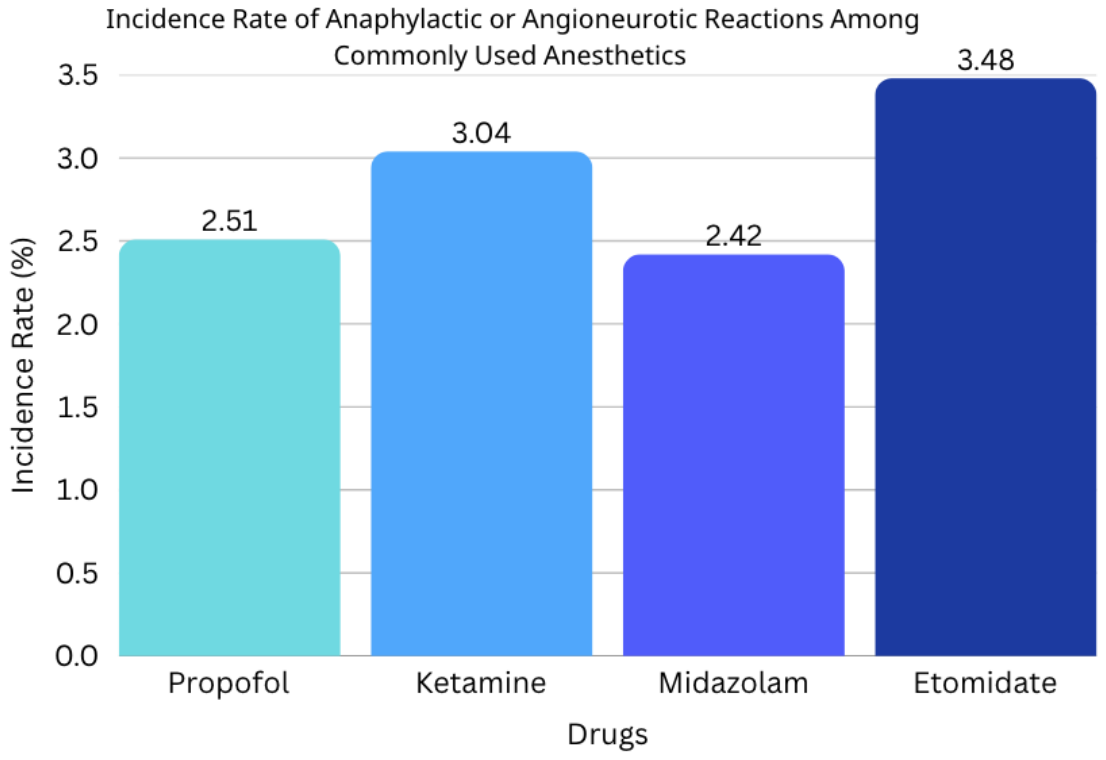
Among 22,178 patients over the past 20 years who met the inclusion and exclusion criteria, the incidence rates of hypersensitivity reactions were as follows (see Table 1): Etomidate - 3.48% (47/1351), Ketamine - 3.04% (117/3846), Midazolam - 2.43% (207/8537), and Propofol - 2.51% (237/9444). A total of 608 patients experienced anaphylaxis or angioneurotic edema following induction. The overall mean age of patients was 45 with 67.09% of patients being female, 32.87% male, and 0.08% unknown sex. Patient demographics were further stratified for each drug by average age at index, sex identification, race, and ethnicity (see Table 3).

Table 1.
Cohort Statistics. The table summarizes the number of patients who experienced anaphylaxis or angioneurotic edema (“Outcome”), total patients per group, incidence rates, and distribution metrics including mean, standard deviation, and median. “Median (1+ instances)” refers to the median reaction count among patients who experienced at least one reaction.
Table 1.
Cohort Statistics. The table summarizes the number of patients who experienced anaphylaxis or angioneurotic edema (“Outcome”), total patients per group, incidence rates, and distribution metrics including mean, standard deviation, and median. “Median (1+ instances)” refers to the median reaction count among patients who experienced at least one reaction.
| Drug | Outcome Yes | Total Patients | Incidence Rate (%) | Mean | Standard Deviation | Median | Median (1+ instances) |
| Propofol | 237 | 9444 | 2.51 | 0.025 | 0.156 | 0 | 1 |
| Ketamine | 117 | 3846 | 3.04 | 0.03 | 0.172 | 0 | 1 |
| Midazolam | 207 | 8537 | 2.42 | 0.024 | 0.154 | 0 | 1 |
| Etomidate | 47 | 1351 | 3.48 | 0.035 | 0.183 | 0 | 1 |
Table 2.
Pairwise Post Hoc Chi-Square Results. Statistical significance was determined using a threshold of p < 0.05. Etomidate demonstrated a significantly higher incidence of severe hypersensitivity reactions compared to propofol (p = 0.0464) and midazolam (p=0.029), while all other comparisons were statistically insignificant.
Table 2.
Pairwise Post Hoc Chi-Square Results. Statistical significance was determined using a threshold of p < 0.05. Etomidate demonstrated a significantly higher incidence of severe hypersensitivity reactions compared to propofol (p = 0.0464) and midazolam (p=0.029), while all other comparisons were statistically insignificant.
| Comparison | Chi² | p-value | Significant (p < 0.05) |
| Propofol vs Ketamine | 2.788 | 0.095 | no |
| Propofol vs Midazolam | 0.101 | 0.7507 | no |
| Propofol vs Etomidate | 3.965 | 0.0464 | yes |
| Ketamine vs Midazolam | 3.728 | 0.0535 | no |
| Ketamine vs Etomidate | 0.489 | 0.4842 | no |
| Midazolam vs Etomidate | 4.766 | 0.029 | yes |
Table 3.
Patient Demographics. This table displays the patients’ characteristics that were categorized by average age at index and sex. The groups were further stratified by race and ethnicity.
Table 3.
Patient Demographics. This table displays the patients’ characteristics that were categorized by average age at index and sex. The groups were further stratified by race and ethnicity.
| Drug | Average Age | Sex | Race | Ethnicity | |||
| Propofol | 40.5 | Female | 64.31% | White | 73.47% | Not Hispanic or Latino | 77.77% |
| Male | 35.67% | Black/African American | 12.85% | Hispanic or Latino | 8.57% | ||
| Unknown | 0.17% | Asian | 2.99% | Unknown | 13.66% | ||
| Native Hawaiian/Other Pacific Islander | 1.22% | ||||||
| American Indian or Alaska Native | 0.88% | ||||||
| Other Race | 5.00% | ||||||
| Unknown Race | 3.59% | ||||||
| Drug | Average Age | Sex | Race | Ethnicity | |||
| Ketamine | 40.5 | Female | 64.06% | White | 69.91% | Not Hispanic or Latino | 77.00% |
| Male | 35.94% | Black/African American | 14.98% | Hispanic or Latino | 10.58% | ||
| Asian | 2.96% | Unknown | 12.42% | ||||
| Native Hawaiian/Other Pacific Islander | 1.51% | ||||||
| American Indian or Alaska Native | 0.72% | ||||||
| Other Race | 6.37% | ||||||
| Unknown Race | 3.55% | ||||||
| Drug | Average Age | Sex | Race | Ethnicity | |||
| Midazolam | 39.9 | Female | 64.97% | White | 71.58% | Not Hispanic or Latino | 77.03% |
| Male | 34.98% | Black/African American | 14.39% | Hispanic or Latino | 8.52% | ||
| Unknown | 0.18% | Asian | 3.09% | Unknown | 14.45% | ||
| Native Hawaiian/Other Pacific Islander | 1.21% | ||||||
| American Indian or Alaska Native | 0.91% | ||||||
| Other Race | 4.90% | ||||||
| Unknown Race | 3.92% | ||||||
| Drug | Average Age | Sex | Race | Ethnicity | |||
| Etomidate | 54.4 | Female | 48.87% | White | 65.91% | Not Hispanic or Latino | 81.58% |
| Male | 51.00% | Black/African American | 19.92% | Hispanic or Latino | 8.27% | ||
| Unknown | 1.25% | Asian | 4.13% | Unknown | 10.15% | ||
| Native Hawaiian/Other Pacific Islander | 1.25% | ||||||
| American Indian or Alaska Native | 1.25% | ||||||
| Other Race | 3.88% | ||||||
| Unknown Race | 4.38% |
A global chi-square test revealed a statistically significant difference in adverse reaction rates across the four drug groups (χ² = 8.31, df = 3, p = 0.0400, p < 0.05). In post hoc pairwise comparisons, Etomidate demonstrated a significantly higher incidence of hypersensitivity reactions compared to both Propofol (χ² = 3.965, p = 0.0464) and Midazolam (χ² = 4.766, p = 0.0290); p < 0.05. No statistically significant differences were observed in the remaining pairwise comparisons (Propofol vs Ketamine, Propofol vs Midazolam, Ketamine vs Midazolam, or Ketamine vs Etomidate). These findings suggest that Etomidate may be associated with a greater risk of triggering severe hypersensitivity reactions relative to other commonly used induction agents (see Table 2).
Figure 2.
Incidence Rate of Anaphylactic or Angioneurotic Reactions Among Commonly Used Anesthetics. Etomidate demonstrated the highest rate of severe hypersensitivity reactions (3.48%), followed by ketamine (3.04%), propofol (2.51%), and midazolam (2.42%).
Figure 2.
Incidence Rate of Anaphylactic or Angioneurotic Reactions Among Commonly Used Anesthetics. Etomidate demonstrated the highest rate of severe hypersensitivity reactions (3.48%), followed by ketamine (3.04%), propofol (2.51%), and midazolam (2.42%).
4. Discussion
Current literature largely supports the safety of non-barbiturate hypnotics such as propofol, midazolam, ketamine, and etomidate for anesthesia induction. Most perioperative allergic reactions have been attributed to agents such as latex and neuromuscular blocking agents (NMBAs), with NMBAs being among the most implicated drug classes [10,14]. Barbiturates such as thiopental have also been linked with high allergenic potential [10,11]. Consequently, less attention has been directed toward evaluating adverse reactions to induction agents that are often assumed to have low allergenic potential.
In this study, we conducted a large cohort study using the TriNetX database to compare the incidence of severe type I hypersensitivity reactions (HSRs) following administration of propofol, ketamine, midazolam, or etomidate. Severe HSRs were defined as episodes of anaphylaxis or angioneurotic edema occurring within 24 hours of anesthetic induction. Our overall chi-square analysis revealed a statistically significant difference in the incidence of severe HSRs across the four agents (p < 0.05). Pairwise post hoc chi-square tests demonstrated that etomidate was associated with a significantly higher incidence of severe HSRs compared to both propofol and midazolam, while no significant differences were observed between propofol, midazolam, and ketamine.
While previous studies have demonstrated its relative safety compared to NMBAs and other perioperative drugs, our data suggests that etomidate may pose a higher risk of severe hypersensitivity compared to propofol and midazolam, both of which are commonly regarded as safe in this regard.
Propofol (2,6-diisopropylphenol) is widely considered a safe induction agent and typically does not cause adverse reactions. Because of its lipid vehicle containing soybean oil, egg lecithin, and glycerol, it was first thought that those with food allergies may have predisposed hypersensitivity. However, this was found to not be a significant factor and those with food allergies had adverse reactions at similar rates to those without food allergies10. For those with food allergies to the solvent it is delivered with egg. Instead, researchers believe that patients are having reactions to propofol’s alkyl phenols, which can act as antigenic epitopes. The incidence of propofol with type 1 hypersensitivity using the most recent propofol formulation was found to be 1 in 60,000 in one study. However, a group in France has found that propofol was the cause of 2.1% cases of intraoperative anaphylaxis [15].
Midazolam, a benzodiazepine, is widely considered safe but there is limited data on midazolam-specific data. A review of benzodiazepine allergy in 2016 found that anaphylactic reactions ranged from between 1 in 3,500 to 1 in 20,000 administrations [16].
Research linking ketamine to type I hypersensitivities is also limited. Studies have found that ketamine induces histamine release from skin and lung mast cells which could explain the prevalence of ketamine-induced reactions [17].
Etomidate use is limited to induction and is also considered a safe drug [8,12]. In addition, there is geographical variance in etomidate use since it is more commonly used in the United States than Europe [18]. Past literature does not examine population-level reactions to etomidate and there have been limited case reports. With the lack of quantitative and etomidate-specific data, our results suggest that further research is needed in the area to determine the prevalence of etomidate-induced reactions and possible mechanisms.
Previous literature also explores potential mechanisms, including both IgE-mediated and non-IgE-mediated pathways. Further research is needed to explore these immunologic mechanisms and whether predictive markers can be identified.
A key strength of this study is the focus on severe HSRs rather than milder, common reactions such as pruritus or urticaria. Severe reactions, though rare, are clinically significant and underrepresented in literature. The use of TriNetX’s database enabled us to study these low-incidence events across a large and diverse patient population. Additionally, the platform allowed for comparison across a range of clinical settings and geographic regions, enhancing the generalizability of our findings. The large sample size also allowed us to include less commonly used agents, such as etomidate.
Research has shown that risk factors such as age, asthma, and hypertension may increase the risk for anaphylactic reactions induced by various anesthetic drugs [19]. Additionally, it has also been shown that racial and ethnic minority populations are disproportionately affected by asthma and hypertension [20,21]. A study by Aggarwal et al published in the American Heart Association discussed how Black and Hispanic communities may be affected by SDoH such as lower rates of health insurance and socioeconomic inequality [22]. As a result, certain racial and ethnic groups may face a higher risk of developing adverse reactions to anesthetic drugs, although more research is needed on this direct association. Nonetheless, these findings stress the importance for physicians to consider all aspects of a patient’s history to be prepared to address any complications that may arise.
5. Conclusions
In summary, our study suggests that etomidate is associated with a higher incidence of severe type I hypersensitivity reactions compared to propofol and midazolam. More specifically, etomidate demonstrated the highest rate of severe hypersensitivity reactions (3.48%), followed by ketamine (3.04%), propofol (2.51%), and midazolam (2.42%).
5.1. Limitations
This study has several limitations. First, TriNetX data is observational and relies on ICD-10 and CPT coding, which may introduce errors due to inaccurate or incomplete documentation. Moreover, we could not access patient charts to verify timing or causality, limiting our ability to definitively attribute hypersensitivity reactions to specific agents. This is particularly relevant in the perioperative setting, where multiple medications are administered simultaneously, and surgical inflammation may mimic or mask allergic responses. Additionally, while cohort groups were balanced for race overall, the racial composition within each individual group varied, introducing potential demographic confounders that warrant further investigation. Our exclusion criteria also removed patients who had previous history of allergic reactions. While this may limit confounding variables, it also narrows our patient cohort and may have impacted the data. The last limitation we encountered was the lack of current research on the rates of allergic reactions to specific induction agents. The limited literature for hypersensitivity reaction rates in individual induction agents poses a challenge when directly comparing our database findings to prior clinical studies. Nevertheless, identifying the presence of such reactions in the scope of a large database establishes the groundwork for future clinical research, where confounding variables can be more tightly controlled and mechanisms further explored.
5.2. Key Takeaways
Our findings highlight the need for improved risk stratification and perioperative planning, especially for patients with a history of atopy or prior drug reactions. Diagnostic tools such as skin prick testing, allergen-specific IgE assays, and allergist consultation may be beneficial in these high-risk populations. Ultimately, development of standardized protocols for evaluating and managing anesthetic hypersensitivity risk could enhance patient safety and improve outcomes in perioperative care.
Author’s Contributions
NM: Conceptualization, data curation, formal analysis, investigation, methodology, writing – original draft, writing – review and editing, RA: writing – original draft, writing – review and editing, PS: writing – original draft, writing – review and editing, VJ: Project administration, validation, supervision.
References
- Gottschalk A, Van Aken H, Zenz M, Standl T. Is Anesthesia Dangerous? Deutsches Ärzteblatt International. 2011;108(27):469-474. [CrossRef]
- Fasting S, Gisvold SE. Serious intraoperative problems — a five-year review of 83,844 anesthetics. Canadian Journal of Anesthesia/Journal canadien d’anesthésie. 2002;49(6):545-553. [CrossRef]
- Aegis Anesthesia Associates. Common Medications Used In Anesthesia. www.aegisanesthesiapartners.com. https://www.aegisanesthesiapartners.com/common-medications-used-anesthesia/.
- Sahinovic MM, Struys MMRF, Absalom AR. Clinical pharmacokinetics and pharmacodynamics of propofol. Clinical Pharmacokinetics. 2018;57(12):1539-1558. [CrossRef]
- Williams LM, Boyd KL, Fitzgerald BM. Etomidate. PubMed. Published 2020. https://www.ncbi.nlm.nih.gov/books/NBK535364/.
- Rosenbaum SB, Palacios JL. Ketamine. Nih.gov. Published January 30, 2024. https://www.ncbi.nlm.nih.gov/books/NBK470357/.
- Lingamchetty TN, Hosseini SA, Saadabadi A. Midazolam. PubMed. Published 2023. https://www.ncbi.nlm.nih.gov/books/NBK537321/.
- Smith G, Goldman J. General Anesthesia for Surgeons. Nih.gov. Published 2023. https://www.ncbi.nlm.nih.gov/books/NBK493199/.
- Kosciuczuk U, Knapp P. What do we know about perioperative hypersensitivity reactions and what can we do to improve perioperative safety? Annals of Medicine. 2021;53(1):1772-1778. [CrossRef]
- Di Leo E, Delle Donne P, Calogiuri GF, Macchia L, Nettis E. Focus on the agents most frequently responsible for perioperative anaphylaxis. Clinical and Molecular Allergy. 2018;16(1). [CrossRef]
- Ebo DG, Fisher MM, Hagendorens MM, Bridts CH, Stevens WJ. Anaphylaxis during anaesthesia: diagnostic approach. Allergy. 2007;62(5):471-487. [CrossRef]
- Laguna J, Archilla J, Doña I, et al. Practical Guidelines for Perioperative Hypersensitivity Reactions. Journal of Investigational Allergology and Clinical Immunology. 2018;28(4):216-232. [CrossRef]
- Prebay, Z. J., Wahlstedt, J., Shakir, A., Wahlstedt, E., Chung, P. H., & Shah, M. S. (2025). A TriNetX Analysis of Hypertrophic Scarring Disorders, Genitourinary Strictures, and Urethroplasty Failure. Journal of Clinical Medicine, 14(2), 302. [CrossRef]
- Antunes, J., Kochuyt, A.-M., & Ceuppens, J. L. (2014). Perioperative allergic reactions: Experience in a Flemish referral centre. Allergologia et Immunopathologia, 42(4), 348–354. [CrossRef]
- Mali, S. (2012). Anaphylaxis during the perioperative period. Anesthesia Essays and Researches, 6(2), 124. [CrossRef]
- Haybarger, E., Young, A. S., & Giovannitti, J. A. (2016). Benzodiazepine Allergy With Anesthesia Administration: A Review of Current Literature. Anesthesia Progress, 63(3), 160–167. [CrossRef]
- Stellato, C., Casolaro, V., Ciccarelli, A., Mastronardi, P., Mazzarella, B., & Marone, G. (1991). GENERAL ANAESTHETICS INDUCE ONLY HISTAMINE RELEASE SELECTIVELY FROM HUMAN MAST CELLS. British Journal of Anaesthesia, 67(6), 751–758. [CrossRef]
- Philip, A. B., Brohan, J., & Goudra, B. (2025). The Role of GABA Receptors in Anesthesia and Sedation: An Updated Review. CNS Drugs, 39(1), 39–54. [CrossRef]
- Mirone, C., Preziosi, D., Mascheri, A., Micarelli, G., Farioli, L., Balossi, L. G., Scibilia, J., Schroeder, J., Losappio, L. M., Aversano, M. G., Stafylaraki, C., Nichelatti, M., & Pastorello, E. A. (2015). Identification of risk factors of severe hypersensitivity reactions in general anaesthesia. Clinical and Molecular Allergy : CMA, 13(1), 1^t1. [CrossRef]
- Perez, M. F., & Coutinho, M. T. (2021). An Overview of Health Disparities in Asthma. The Yale Journal of Biology and Medicine, 94(3), 497–507.
- Abrahamowicz, A. A., Ebinger, J., Whelton, S. P., Commodore-Mensah, Y., & Yang, E. (2023). Racial and Ethnic Disparities in Hypertension: Barriers and Opportunities to Improve Blood Pressure Control. Current Cardiology Reports, 25(1), 17–27. [CrossRef]
- Aggarwal, R., Chiu, N., Wadhera, R. K., Moran, A. E., Raber, I., Shen, C., Yeh, R. W., & Kazi, D. S. (2021). Racial/Ethnic Disparities in Hypertension Prevalence, Awareness, Treatment, and Control in the United States, 2013 to 2018. Hypertension, 78(6), 1719–1726. [CrossRef]
Figure 1.
Methods Flow Diagram for Hypersensitivity Reaction Analysis. Flowchart outlining the study design for analyzing hypersensitivity reactions associated with intravenous anesthetic induction agents in adult surgical patients.
Figure 1.
Methods Flow Diagram for Hypersensitivity Reaction Analysis. Flowchart outlining the study design for analyzing hypersensitivity reactions associated with intravenous anesthetic induction agents in adult surgical patients.
Disclaimer/Publisher’s Note: The statements, opinions and data contained in all publications are solely those of the individual author(s) and contributor(s) and not of MDPI and/or the editor(s). MDPI and/or the editor(s) disclaim responsibility for any injury to people or property resulting from any ideas, methods, instructions or products referred to in the content. |
© 2026 by the authors. Licensee MDPI, Basel, Switzerland. This article is an open access article distributed under the terms and conditions of the Creative Commons Attribution (CC BY) license (http://creativecommons.org/licenses/by/4.0/).
Copyright: This open access article is published under a Creative Commons CC BY 4.0 license, which permit the free download, distribution, and reuse, provided that the author and preprint are cited in any reuse.