

Submitted:
25 August 2026
Posted:
26 August 2026
You are already at the latest version
Abstract
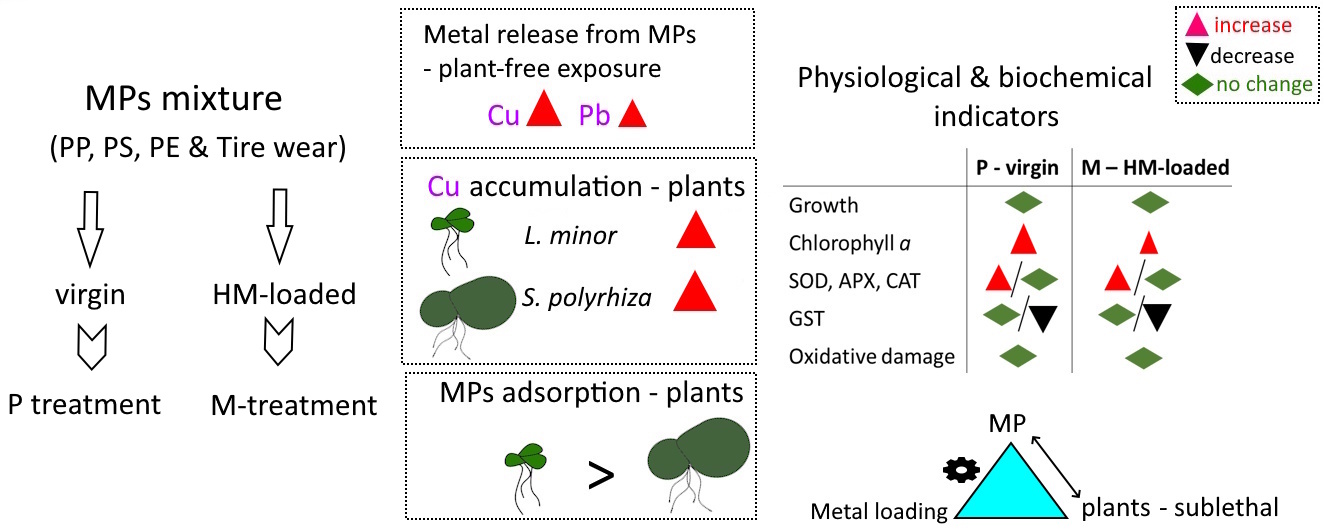
Microplastics (MP), including tire wear particles, are increasingly detected in aquatic environments where they may interact with co-occurring contaminants such as heavy metals (HM). However, the influence of metal loading on MP–plant interactions and subsequent biological responses remains poorly understood. This study investigated how heavy metal loading modifies the behavior of mixed MP and their effects on two aquatic macrophytes, Lemna minor L. and Spirodela polyrhiza (L.) Schleid. Mixtures of polyethylene, polypropylene, polystyrene, and tire rubber particles were tested in both virgin and HM-loaded forms, with the latter preincubated with Cu, Zn and Pb. Duckweed species were exposed to MP concentrations ranging from 20 to 10,000 particles/L for seven days. HM-loaded MP released Cu and Pb into the plant-free exposure medium, whereas Cu release was also detected from the nominally virgin MP mixture. Cu accumulation occurred in both duckweed species, indicating transfer of MP-associated metals to aquatic plants. MP adsorption increased with exposure concentration and was higher in L. minor than in S. polyrhiza, with polypropylene showing the strongest association with plant surfaces. Metal loading reduced MP adsorption at intermediate concentrations, indicating that adsorbed metals can influence MP–plant interactions in a polymer- and concentration-dependent manner. Although MP exposure did not significantly affect growth, chlorophyll a content and antioxidant/detoxification enzyme activities were altered, particularly in L. minor. Overall, the results demonstrate that heavy metal loading modifies microplastic behavior and influences metal availability and sublethal responses in aquatic plants.
Keywords:
microplastics
; metal release
; adsorption
; duckweeds
; oxidative indicators
1. Introduction
Plastic pollution has led to the widespread presence of microplastics (MPs) in aquatic ecosystems. Due to differences in polymer composition, size, morphology and environmental transformations, aquatic MP represent complex mixtures with variable biological interactions and toxicological potential [1]. Research on the ecotoxicological effects of MP has often focused on single polymer types and unrealistically high concentrations [2,3], whereas environmental MPs typically occur as heterogeneous mixtures. Therefore, mixed MP studies provide a more realistic assessment of their ecological effects.
In addition to conventional polymers [4] such as polyethylene (PE), polypropylene (PP) and polystyrene (PS), tire wear particles (R) represent an emerging and environmentally relevant component of aquatic MP mixtures. Unlike pristine polymer particles, tire particles contain complex rubber matrices and associated additives that may influence contaminant interactions and biological effects [5].
Environmental weathering, aging and fragmentation may promote the leaching of chemical additives incorporated into the polymer matrix during manufacturing [6]. Fragmentation increases surface area and the number of active sites, thereby enhancing the adsorption of contaminants such as heavy metals [1,7,8]. Thus, microplastics may influence contaminant bioavailability and exposure pathways, though their ecological effects depend on the species and contaminant involved [9].
As both aquatic contaminants and potential carriers of other contaminants, MPs may affect primary producers through direct particle exposure and the transfer of co-contaminants. Aquatic macrophytes represent important primary producers and potential entry points for contaminant transfer within aquatic food webs. Their large surface area, rapid growth and direct interaction with suspended particles make duckweeds suitable models for investigating particle adhesion, contaminant accumulation and early physiological responses to emerging pollutants. MP adhesion has been reported for several macrophyte species, including Lemna minor [7], Lemna minuta [10], Spirodela polyrhiza [11]and Cinclidotus aquaticus [12]. The documented adhesion of MP to L. minor and S. polyrhiza supports the use of these floating duckweed species for investigating direct MP exposure and exposure to MP-associated contaminants. In addition, these floating duckweed species are moderately tolerant to metal accumulation [13].
Regarding phytotoxicity, MPs have been reported to affect plant growth, photosynthesis, and cellular metabolism, with growth-related parameters being the most frequently assessed endpoints [14].
However, it remains unclear whether metal adsorption onto MP modifies particle–organism interactions, changes metal bioavailability, or alters the physiological responses induced by MP exposure. Particularly, the combined effects of realistic MP mixtures containing conventional polymers and tire-derived particles remain poorly characterized [15].
To address this knowledge gap, we investigated a mixed MP system composed of PE, PP, PS and tire rubber particles, both in their virgin form and after preincubation with Zn, Pb and Cu. These metals were selected based on their reported adsorption affinities for different MP polymers and waste tire rubber [16,17,18].
Therefore, this study investigated whether heavy metal loading modifies the exposure characteristics and biological effects of mixed MP in two duckweed species. Specifically, we aimed to: (1) characterize the release of Zn, Pb and Cu from virgin and metal-loaded MP; (2) determine metal accumulation and potential transfer to duckweed tissues at environmentally relevant and higher effect-oriented concentrations [5,19]; and (3) assess species-specific physiological and biochemical responses, including growth, photosynthetic pigments, antioxidant enzyme activities and oxidative damage markers.
2. Materials and Methods
2.1. Chemical Characterization of Microplastics and Rubber
Plastic pellets, namely polyethylene (PE), polystyrene (PS) and polypropylene (PP), were obtained from Europlast (Zagreb, Croatia). Original pellets (Φ 3-5 mm) were ground in liquid nitrogen and sieved to obtain the microplastic fraction up to 500 μm (90% of particles were in the range 100-500 μm). Particles were characterized by μRAMAN spectroscopy (HORIBA Jobin Yvon, France) (Figure S1). Recycled rubber granules (< 2 mm) obtained from Gumiimpex - GRP d.o.o. (Varaždin, Croatia) were sieved to get the microrubber (R) fraction up to 500 μm as previously described [12]. All particles were mixed in equal amounts and denoted as MP. The shape of individual polymer and rubber particles was evaluated using a light stereomicroscope Olympus BX-51 connected to a camera (Olympus DP70, Tokyo, Japan) at 100x magnification. Aside from PE particles, which were spherical, PP, PS, and R particles were irregularly shaped with sharp edges. The morphology of the particles is shown in Figure S2.
2.2. Plant Material and Experimental Design
For experiments, equal amounts of PE, PS, PP and R (1:1:1:1) microparticles were counted and weighed to achieve concentrations of 20, 100, 1000 and 10,000 particles/L, corresponding to 0.15, 0.74, 7.4 and 74 mg/L, respectively. To obtain heavy-metal-loaded (HM-loaded) MP, a portion of the particles was incubated in an aqueous solution containing 8 g/L of Cu, Pb, and Zn (CuSO₄ x 5H2O, Kemika, Croatia; Pb(NO₃)₂, Alkaloid, Macedonia; ZnSO₄ x 7H2O, Kemika, Croatia). MPs were incubated in a heavy metal mixture for seven days, as the adsorption equilibrium is typically reached within five days [9]. After incubation, HM-contaminated MPs were extracted from the solution by vacuum filtration (θ 47mm, 0.5 μm Nucleopore membrane filters, Whatman TM), rinsed three times with distilled water to remove unadsorbed Cu, Pb, and Zn, and finally added to experimental nutrient solutions.
There were three experimental nutrient solutions: 1) P treatment - Steinberg nutrient medium with virgin MP in their final concentrations of 20, 100, 1000 and 10,000 particles/L (concentrations marked as P1, P2, P3 and P4, respectively); 2) M treatment - Steinberg nutrient medium [20] with mixture of HM-contaminated MP in their final concentrations of 20, 100, 1000 and 10,000 particles/L (concentrations marked as M1, M2, M3 and M4, respectively), and 3) control (C) - Steinberg nutrient medium without either virgin or HM-contaminated MP. Experiments were performed using two duckweed species - L. minor and S. polyrhyza. Duckweeds from stock cultures (30 healthy plants of each species) were transferred to Erlenmeyer flasks containing Steinberg nutrient solutions. Duckweed toxicity tests were performed mostly following OECD [21] guidelines with slight modifications: the pH of a Steinberg nutrient solution was adjusted to 6.00, and plants were grown under fluorescent light with a 16 h photoperiod at 24 ± 2 °C. During the experiment, Erlenmeyer flasks were manually shaken (for 15 seconds twice a day for seven days).
2.3. Leaching Analyses
To evaluate the leaching of Cu, Pb, and Zn from HM-loaded MP into Steinberg nutrient medium, the highest concentrations of virgin (P4) and HM-loaded MP (M4) were incubated in the nutrient solution without plants for seven days. After seven days, aliquots of the nutrient solution were filtered into sterile Falcon tubes, acidified with 1% HNO3 (Carlo Erba Reagenti, Italy), and stored at 4 °C before ICP-AES analysis (Thermo Fisher iCAP6300 Duo). Measurements were performed in triplicate, and the results were expressed as μg/L.
2.4. Pb, Zn and Cu Analyses in Plant Material
Freeze-dried plant material was digested in teflon cuvettes using HNO3 and 30% H2O2 (Carlo Erba Reagenti, Italy), heated at 200 °C in a microwave digestion system (Anton Paar Multiwave 3000, Anton Paar GmbH, Graz, Austria; rotor XFS-100), and then analyzed by ICP-AES. The concentrations of Pb, Zn, and Cu were determined in plants exposed to the highest concentration of virgin (P4) and to all concentrations of HM-loaded MP (M1-4), using a Multi-element Standard Solution (CPAChem, Bulgaria) and Multielement standard solution III for ICP (Fluka/Sigma-Aldrich, Switzerland). Measurements were performed in triplicate, and the results were expressed as mg/kg on a dry weight (DW) basis.
2.5. Microparticle Detection and Small-Scale Adsorption Analyses by Optical Microscopy
To identify MP types and evaluate their adsorption onto the plant surfaces from the nutrient solution, ten randomly selected colonies (each consisting of two plants) were collected on day seven from each biological replicate (i.e., 30 colonies per treatment). The colonies were rinsed twice by immersing in dH2O and subsequently analyzed under a magnifying lens (40x). Adsorption capacity was expressed as the total number of adsorbed MPs per gram of fresh weight, as well as the number of adsorbed individual MP types (PP, PS, PE or R) on the same basis. During the analyses, both the type of adsorbed microparticle and the plant organ on which adsorption occurred were recorded.
2.6. Growth Rate Analyses
The growth of duckweeds was evaluated using frond number (FN) and fresh weight (FW) measured at the beginning (day 0) and at the end of the experiment (day 7). Based on the measured parameters, growth rates (GR) were calculated according to the following equation: GR = [ln x(t₂) − ln x(t₁)] / (t₂ − t₁), where x represents the observed parameter (FN or FW), t₂ refers to the end of exposure (day 7), and t₁ to the beginning of exposure (day 0).
For subsequent toxicity testing, plants were freeze-dried (Alpha 1-2, Christ).
2.7. Photosynthetic Pigments Analyses
Chlorophyll and carotenoid concentrations were determined according to Wellburn [22]. Briefly, freeze-dried tissue samples were immersed in liquid nitrogen and finely ground (IST 400, Croatia). After adding 80% acetone, the samples were homogenized, centrifuged, and the absorbance of the supernatant was measured at 663, 646, and 470 nm using a Multiskan Microplate Photometer (Thermo Scientific).
2.8. Oxidative Stress Analyses
Measured parameters were determined spectrophotometrically (Multiskan Microplate Photometer, Thermo Scientific) using the previously reported methods [23]. For the antioxidant enzyme activity assessment, freeze-dried plant tissue was immersed in liquid nitrogen, finely ground (IST 400, Croatia) and homogenized in 50 mmol/L K2HPO4/KH2PO4 buffer (pH 7.0) containing 0.1 mmol/L EDTA. The homogenates were centrifuged at 29,000 × g for 30 min at 4 °C (Sigma 3K18). Total soluble protein content was quantified using bovine serum albumin as a standard, with absorbance measured at 595 nm. Superoxide dismutase (SOD) activity was measured at 560 nm using nitroblue tetrazolium (Sigma-Aldrich). Catalase (CAT) activity was measured at 240 nm based on the decrease in H₂O₂ concentration. Ascorbate peroxidase (APX) activity was determined by monitoring ascorbate oxidation at 290 nm. Glutathione S-transferase (GST) activity was determined by measuring the glutathione-dependent increase in absorbance due to the conjugation of the CDNB substrate at 340 nm. The activities of all enzymes were expressed as units per milligram of protein (U/mg protein). Lipid peroxidation was determined by measuring malondialdehyde (MDA) content (nmol/g DW) at 532 nm using the thiobarbituric acid (TBA) assay. Protein carbonyl content was determined by measuring 2,4-dinitrophenylhydrazone formation at 370 nm and expressed as nmol/mg protein.
2.9. Statistical Analysis
All data are presented as mean values ± standard deviation. Two independent experiments were performed, each including three replicates per exposure concentration. Statistical analysis was performed using STATISTICA 14.0 (TIBCO, Inc., USA). Data normality was assessed using the Shapiro-Wilk’s test. When necessary, data were logarithmically transformed before statistical analysis. The effects of duckweed species, treatment, and their interaction on individual parameters were evaluated using two-way ANOVA. The statistical differences among the treatments were assessed by a one-way ANOVA followed by Tukey HSD test. In all the statistical analyses, the significance level was set at p < 0.05. Results marked with different letters indicate statistically significant differences among treatments.
3. Results
3.1. Metal Release from MP to Nutrient Media and Metal Concentrations in Plants
The results show the release (leaching) of metals from HM-loaded (M treatment) and virgin MP (P treatment) into the nutrient medium before plant cultivation (plant-free media), indicating metal release from the MP themselves (Table 1). The highest concentrations of Cu and Pb were determined in the nutrient medium with the highest concentration of HM-loaded MP (M4), compared to the control and the nutrient medium containing virgin MP (P4). A significantly higher concentration of Cu compared to the control was also measured in the nutrient medium containing virgin MP. No significant differences in Zn concentration were observed among nutrient media with or without MP (C, P4 and M4).
Nevertheless, Zn accumulated in significant amounts in L. minor under M4 treatment compared to the control and lower M treatment concentrations (Figure 1). Zn in L. minor also increased markedly under P4 treatment, showing a 47% increase compared to the control. Zn concentration in S. polyrhiza did not change significantly under any treatment compared to the control. However, the Zn concentration in S. polyrhiza exposed to the M4 treatment was significantly lower than that observed under the P4 treatment. Both duckweed species displayed a similar pattern of Cu accumulation, which increased under P4 treatment and was particularly elevated under M4 treatment compared to the control. The Cu concentration was two and four times higher under M4 treatment compared to P4 treatment for L. minor and S. polyrhiza, respectively (Figure 1). Regarding Pb, its concentration was below the detection limit (< 1.41 mg/kg) in both duckweed species.
3.2. Microparticle Adsorption to Duckweeds
The total number of adsorbed MPs (sum of all MP types), expressed per g FW (adsorption capacity), increased with increasing MP concentration, regardless of the treatment or duckweed species (Figure 2). No MP adsorption by duckweeds was detected in the control and at the lowest MP concentration.
L. minor exhibited a markedly higher MP adsorption capacity than S. polyrhiza after seven days. The adsorption of virgin MP by L. minor was several times higher than that of S. polyrhiza at 100 and 1,000 MP/L. Moreover, in the case of HM-contaminated MP (M treatment), the disparity in MP adsorption between the two duckweed species became even more pronounced at the respective concentrations. Unsurprisingly, the highest adsorption of virgin MP by duckweeds was observed at 10,000 MP/L (74 mg/L), reaching averages of 206 ± 93 and 100 ± 22 adsorbed MP in L. minor and S. polyrhiza, respectively. The average number of adsorbed HM-contaminated MP at the highest concentration was 154 ± 40 for L. minor and 85 ± 18 for S. polyrhiza. Total adsorption capacity of virgin MP to duckweeds, irrespective of the species, at 100 and 1000 MP /L (0.74 and 7.4 mg/L) was approximately two times higher than that of HM-contaminated MPs at the respective concentrations. However, the effect of treatment on MP adsorption by plants was less pronounced at 10,000 MP /L. With respect to MP type, L. minor (Figure 3) predominantly adsorbed PP and PS, particularly virgin MP, with a significant rise only at P3 treatment (100 MP/L). Similarly, S. polyrhiza showed the highest adsorption of PP compared to the other particle types present in the MP mixture, with slightly higher adsorption observed for virgin MP than for HM-loaded MP. The adsorption of virgin and HM-loaded PE and R particles by both duckweed species was similar. Regarding organ type, MP (particularly PP particles) were predominantly adsorbed onto the duckweed frond surface rather than the root (Figure S3).
3.3. Physiological and Oxidative Stress Parameters
For both parameters (FN or FW), the growth rate of L. minor in the control medium was approximately twofold higher than that of S. polyrhiza (Supplementary Table S1). Growth rates based on FN were 0.27 ± 0.012 and 0.15 ± 0.008 for L. minor and S. polyrhiza in control media, respectively. Regardless of concentration, exposure to virgin or HM-loaded MP mixture (P and M treatments) did not affect the growth rate of either duckweed species after seven-day exposure (Table S1).
Similar to growth, photosynthetic pigment levels were approximately threefold higher in L. minor than in S. polyrhiza cultivated in the control medium (Figure 4, Table S2). Chlorophyll a content in L. minor increased at P (42-70 % compared to C) and M (33-62 % compared to C) treatments (Figure 4), with significant effects observed at higher treatment concentrations. A similar trend was observed in S. polyrhiza, although the magnitude of chlorophyll a increase was lower (20–52 % under P treatments and 15–34% under M treatments compared with C). Chlorophyll b and total carotenoid contents in L. minor were not influenced by P and M treatments, whereas in S. polyrhiza these pigments showed patterns similar to those of chlorophyll a (Table S2).
Unlike HM-loaded MPs, the virgin MP mixture significantly stimulated SOD activity in L. minor compared to the control (Table 2). Neither P nor M treatments affected SOD activity in S. polyrhiza. Both P and M treatments induced APX activity in L. minor compared to the control; however, the increase was not statistically significant at P1 treatment (Table 2). In S. polyrhiza, APX activity did not differ significantly from the control, although levels were significantly higher under the M3 and M4 treatments compared to the P1 and M1 treatments. CAT activity in L. minor was induced only by the M treatment, irrespective of concentration, compared to the control (Table 2). In S. polyrhiza, CAT activity under both P and M treatments was comparable to that of the control.
GST activity in L. minor started to decline from P2 and M1 treatments, with a significant decrease observed only at M4 treatment (Table 2). In S. polyrhiza, GST activity decreased by 17-35% at P3 and P4 treatments and by 12-45% at M2-M4 treatments (Table 2). Indicators of lipid peroxidation (MDA) and protein oxidation (carbonyl content) were unaffected by either P or M treatments in both duckweed species (Table S3).
3.4. Effect of Duckweed Species and Treatments
Two-way analysis of variance (two-way ANOVA) was performed to evaluate the effects of duckweed species (L. minor and S. polyrhiza) and treatments with virgin or HM-contaminated MP mixture (P and M) on selected physiological and biochemical parameters, as well as on adsorption capacity (Table 3).
The analysis showed that all measured parameters were strongly affected by duckweed species (DS). Treatments (T) strongly influenced most of the measured parameters, except the growth rate based on FW, MDA and carbonyls. Almost all parameters were also found to be influenced by the interaction of duckweed species and treatments (DS × T), except growth rate based on FW, carotenoids, and carbonyl content. Notably, carotenoids were affected by both duckweed species and treatment, but showed no significant interaction between the two factors. Overall, the measured parameters showed different responses between the two duckweed species, regardless of treatment.
4. Discussion
The leaching analysis revealed significantly higher concentrations of Pb and Cu, compared to the control, in the nutrient media containing the highest concentration of HM-loaded MP (M4). These results suggest that the MP particles adsorbed metals, presumably in the form of metal complexes or cations [16], during a seven-day incubation in the HM solution and subsequently released them into the nutrient media. Among other factors, heavy metal concentration and MP properties (polarity, surface functional groups) appear to have the greatest influence on the MP adsorption capacities for heavy metals [24]. Godoy et al. [18] concluded that PP, PS, and especially PE used in their study had a negative charge and exhibited a high affinity for Pb and Cu. However, the extent of metal adsorption strongly depended on other MP properties, such as specific surface area, morphology, and porosity, as well as on pH value, the mineral composition of the aqueous solution and the presence of organic matter. Additionally, biofilm formation on MP surfaces was found to strongly influence metal adsorption by MPs [7].
We also observed a marked increase in Cu concentration in nutrient media containing virgin MP (P4). That result implies that the virgin MP contained Cu, either as an intentional additive or as a contaminant introduced during production. Metal-based compounds, including Cu, are commonly incorporated into plastic and rubber as stabilizers, catalysts, pigments, antimicrobial or cross-linking additives [6,25]. Regarding metal affinity, waste tire rubber showed effective adsorption of Zn and Pb, especially Cu, indicating its potential for wastewater treatment applications [17]. As metal release from individual MP types was not assessed in this study, it can only be hypothesized that rubber (R) particles within the MP mixture were the source of Cu leaching.
Cu accumulation in duckweeds under P4 and M4 treatments followed the pattern of Cu release from MPs in the corresponding plant-free treatments. Cu concentrations in plants were several-fold higher under M4 than under P4, indicating that Cu uptake by both duckweed species was driven by its availability in the nutrient medium. The strong accumulation of Cu released from either virgin or HM-contaminated MP observed in both duckweed species is consistent with previous findings. L. minor and S. polyrhiza exposed to considerably higher Cu concentrations (1.6-6.4 mg/L) have been reported to accumulate up to 1700 mg/kg DW of Cu [26]. Although Zn release from MP was not evident, L. minor accumulated considerable amounts of this micronutrient in both P4 and M4 treatments. Zn accumulation was over 20% higher in the M4 treatment than in the P4 treatment, although the difference was not statistically significant. Duckweeds are known to accumulate Zn efficiently, particularly under neutral pH conditions, temperatures above 21°C and reduced nutrient availability [27]. Neither duckweed species accumulated detectable amounts of Pb, even at the M4 treatment. Although Pb is a nonessential element for plants, L. minor has been shown to efficiently accumulate Pb, Cu and other metals from multi-metal industrial effluents [13]. Because metal uptake was found to depend on metal availability and to decrease with increasing nutrient and organic matter content, the lack of Pb accumulation observed here may reflect the relatively low Pb concentration in the nutrient medium compared with Cu and Zn, even under the M4 treatment.
Quantitative comparisons of plant MP adsorption are challenging due to the limited number of available studies [2], methodological differences in estimating adsorption capacity (e.g., per plant, surface area, fresh or dry weight), and variation in MP type, size and concentration among studies. In the present study, the highest adsorption of virgin MP was observed at 10,000 MP/L (74 mg/L), reaching approximately 200 MP/g FW in L. minor and 100 MP/g FW in S. polyrhiza. MP adsorption decreased markedly at environmentally relevant concentrations (20–1000 MP/L) and was undetectable at 20 MP/L. This is consistent with the results of Sfriso et al. [28], who reported that macrophyte species from the Adriatic Sea trapped up to 330 MP/g FW.
Comparing the effect of duckweed species, L. minor showed an overall higher adsorption capacity of MP than S. polyrhiza. The higher adsorption observed in L. minor may be explained by its higher surface-to-volume ratio and consequently greater surface area per unit biomass, resulting from its smaller frond size compared with S. polyrhiza. This is in agreement with a recently published study [29], which also indicates that morphological and chemical plant characteristics play an important role in providing available adsorption sites for MP. Both duckweed species have a glabrous, waxy cuticle with sporadic wax crystalloids on the adaxial frond surface, which creates a hydrophobic environment that likely contributes to MP adsorption [30,31]. The higher adsorption of MP to L. minor fronds may be partly explained by interspecific differences in epicuticular wax composition, which varies significantly among duckweed taxa [30]. Regarding MP type, both duckweed species showed the highest adsorption of PP particles, followed by R particles, while PE particles were the least adsorbed. The preferential adsorption of PP particles may be attributed to their irregular shape and high hydrophobicity [32]. PS particles, regardless of HM contamination, were more adsorbed by L. minor than by S. polyrhiza. This may be explained by the larger frond surface area and more textured micro-surface of L. minor, including pronounced venation ridges and papillae, which may enhance physical trapping of irregular, sharp-edged PS particles [31]. Although PE particles are also considered hydrophobic [32], their spherical shape reduces the effective hydrophobic contact area with the duckweed surface. Adsorption of R particles was lower than that of PP, likely due to negatively charged sulfonate and carboxylate groups derived from tire additives and vulcanization, which increase electrostatic repulsion from the negatively charged plant surface [5]. This is consistent with Rozman and Kalčikova [3], who reported weaker adhesion of tire particles to L. minor compared with irregular PE microbeads. However, both PE and R particles showed negligible adhesion at concentrations of 100 and 1000 particles/L. While limited evidence suggests that MP adsorption in aquatic plants is higher on roots than leaves [29], our results showed no organ-specific preference for PE and R particles, whereas PP and PS preferentially adhered to fronds. This likely reflects the affinity of hydrophobic, low-density PP and PS for the waxy frond surface, combined with buoyancy-driven contact with fronds. In the present study, preincubation of MP in a solution containing Cu²⁺, Zn²⁺, and Pb²⁺ significantly reduced their adsorption to both L. minor and S. polyrhiza at intermediate exposure concentrations, whereas no significant effect was observed at the highest concentration. Analysis of individual particle types suggested that this pattern was mainly driven by PP and PS particles in L. minor and PP particles in S. polyrhiza. However, differences between corresponding virgin and HM-loaded particles were not consistently significant for each particle type and exposure concentration. These findings suggest that the effect of HM loading on MP adsorption depends on exposure concentration, plant species and polymer type. The multiplication rate of L. minor in the control medium exceeded that of S. polyrhiza, suggesting that duckweed size may influence growth rate [33]. However, exposure to the MP mixture, regardless of concentration or treatment (P or M), did not affect the growth rate of either species after seven days. These findings are consistent with previous studies reporting no effects of various virgin or aged MP on duckweed growth and root development [2,10]. For example, S. polyrhiza exposed to spherical PP particles at concentrations up to 106 particles/mL for 5 days showed no inhibition of growth rate or root length [11]. In contrast, L. minor exposed to 100 mg/L PE fragments and tire wear particles for seven days exhibited reduced root length, while the specific growth rate remained unaffected [3]. Similarly, prolonged exposure of L. minor to irregular PE particles (100 mg/L) for 12 weeks did not affect the specific growth rate or root length during the final four weeks of exposure [34]. According to existing data, MP generally do not affect chlorophyll levels across different duckweed species [2,3,11,34].
In the present study, both duckweed species (especially L. minor) exhibited increased Cu uptake under P and M treatments, with significant accumulation observed at the highest exposure concentration. However, the accumulated Cu levels did not inhibit plant growth. Moreover, accumulated metals and/or plastic additives may reflect a stimulatory or adaptive response at the tested exposure conditions in the duckweeds, as reflected by elevated levels of photosynthetic pigments, especially chlorophyll a. A stimulatory effect of virgin MP was also observed on the chlorophyll b and carotenoid contents in S. polyrhiza. Although plastic additives (including metals) and small-sized MP particles at elevated concentrations can stimulate plant growth and enhance photosynthetic activity [35], similar effects were observed with low Cu concentrations, which may positively influence chlorophyll levels in duckweeds, as Cu functions as an essential micronutrient involved in electron-transfer processes during photosynthesis [36].
Changes in the activities of the assessed antioxidative and detoxifying enzymes reveal that MP and/or MP-derived leachates disrupted the redox balance in duckweed cells. Among the two plant species, L. minor exhibited a broader antioxidative response to the MP mixture than S. polyrhiza, as alterations in the activities of all measured antioxidative enzymes (SOD, APX and CAT) were detected in L. minor, whereas in S. polyrhiza only APX activity increased under M treatment. This difference may be attributed to the greater adsorption capacity of L. minor, resulting in more extensive contact with MP compared to S. polyrhiza. The induction of APX activity in response to both virgin and HM-preincubated MP mixtures in both species suggests a role in fine redox regulation, as APX, unlike CAT, is rapidly activated under low H2O2 concentrations [37]. Furthermore, the upregulation of SOD and CAT activities in L. minor exposed to P and M treatments, respectively, indicates H2O2 production occurring at different stages of exposure. SOD acts as the first line of defense by catalyzing the conversion of superoxide radicals into H2O2, whereas CAT efficiently scavenges excess H2O2 at higher concentrations. Consequently, HM-contaminated MP likely triggered an earlier increase in SOD activity, followed by a subsequent rise in CAT activity after seven days of exposure, whereas virgin MP and/or associated additives induced only SOD activity within the same exposure period. Moreover, GST, an enzyme involved in the detoxification of electrophilic compounds such as organic molecules and metals, exhibited a clear declining trend in response to both treatments in duckweeds, but especially under the M treatment. As GST utilizes glutathione as a reducing agent, the more pronounced alteration in its activity suggests a higher level of stress induced by HM-preincubated MP particles compared with virgin MPs [37].
Despite differences in antioxidative and detoxification responses between the two duckweed species, these mechanisms were sufficient to prevent oxidative damage, as no increase in lipid peroxidation or protein oxidation (assessed by MDA and carbonyl group content, respectively) was detected. This suggests that antioxidant defenses effectively maintained redox homeostasis under the applied treatments. Previous studies have reported no evidence of oxidative damage in L. minuta exposed to PS particles under chronic stress conditions [10], while combined exposure to PVC particles and Cd did not alter the antioxidative enzyme activities in Vallisneria natans (Lour.) after 14 days [38]. Consistent with our findings, low levels of MP and/or additive-induced stress have also been shown to stimulate the activity of antioxidant enzymes, including catalase or superoxide dismutase, in terrestrial plants [39].
Several limitations should be considered. The experiment was conducted under controlled laboratory conditions and focused on short-term exposure. Longer exposures, aging/weathering of MP and trophic transfer studies are required to determine whether the observed biochemical responses translate into population-level effects.
5. Conclusions
The enhanced leaching of Cu and Pb from HM-loaded MP indicates that MP may influence metal mobility and exposure pathways in freshwater ecosystems, although biological consequences depend on metal type, polymer characteristics and organism sensitivity. Both duckweed species accumulated Cu and adsorbed MP, with L. minor exhibiting greater adsorption efficiency than S. polyrhiza. These findings suggest that duckweeds can act as sinks for MP and associated contaminants, potentially influencing their retention and distribution in aquatic systems. However, MP adsorption to plant surfaces may represent a potential pathway for the transfer of MP and associated contaminants to higher trophic levels. HM loading reduced MP retention at intermediate exposure concentrations, with effects varying among polymer types. These findings demonstrate that contaminant loading can modify MP–plant interactions and emphasize the importance of evaluating environmentally relevant MP mixtures rather than pristine laboratory-generated particles alone. The higher MP retention observed in L. minor may have increased particle-associated exposure and contributed to the stronger biochemical responses detected in this species. Despite the absence of significant growth inhibition or oxidative damage during short-term exposure, alterations in antioxidative status indicate physiological responses to MP and/or their leached compounds. These findings suggest that mixed MP and associated contaminants can induce early biochemical adjustments before measurable adverse effects occur, highlighting the importance of longer-term studies to determine whether these responses translate into ecologically relevant consequences.
Supplementary Materials
The following supporting information can be downloaded at the website of this paper posted on Preprints.org, Figure S1: Representative Raman spectra of MPs; Figure S2: Morphology of the particles in the MPs mixture; Figure S3: Relative distribution of adsorbed MPs between leaves and roots of duckweeds exposed to virgin (P) or HM-loaded (M) MPs mixture. Table S1: Growth rate based on FW and FN in L. minor and S. polyrhiza under control (C), virgin MPs mixture (P), and HM-loaded MPs (M) treatments. Table S2: Chlorophyll b and carotenoid contents in L. minor and S. polyrhiza under control (C), virgin MPs mixture (P), and HM-loaded MPs (M) treatments. Table S3: Malondialdehyde (MDA; nmol/g DW) and carbonyl groups (C=O; nmol/mg protein) in duckweeds exposed to different concentrations of virgin (P) or HM-loaded (M) MP mixtures.
Author Contributions
Conceptualization, S.R.B., M.B and M.R; validation, S.R.B., M.B and V.R.; formal analysis, S.R.B., M.B, V.R., M.R., M.J. and E.K.; investigation, S.R.B., M.B, V.R., M.R., M.J. and E.K.; resources, S.R.B., V.R., and M.R.; writing—original draft preparation, S.R.B.; writing—review and editing, S.R.B., M.B, V.R., M.R., M.J. and E.K.; supervision, S.R.B, M.B and V.R.; project administration, S.R.B.; funding acquisition, S.R.B. All authors have read and agreed to the published version of the manuscript.
Funding
This research was partially supported by the Institutional Project No. 20286789 2025 of the University of Zagreb.
Data Availability Statement
The original contributions presented in this study are included in the article/supplementary material. Further inquiries can be directed to the corresponding author(s).
Acknowledgments
The authors would like to thank Dr. Lara Mikac for the help with the microparticle analysis (Raman spectroscopy).
Conflicts of Interest
The authors declare no conflicts of interest.
References
- Sarkar, B.; Dissanayake, P.D.; Bolan, N.S.; Dar, J.Y.; Kumar, M.; Haque, M.N.; Mukhopadhyay, R.; Ramanayaka, S.; Biswas, J.K.; Tsang, D.C.W.; Rinklebe, J.; Ok, Y.S. Challenges and opportunities in sustainable management of microplastics and nanoplastics in the environment. Environ. Res. 2022, 207, 112179. [Google Scholar] [CrossRef] [PubMed]
- Mateos-Cárdenas, A.; van Pelt, F.N.A.M.; O'Halloran, J.; Jansen, M.A.K. Adsorption, uptake and toxicity of micro- and nanoplastics: Effects on terrestrial plants and aquatic macrophytes. Environ. Pollut. 2021, 284, 117183. [Google Scholar] [CrossRef] [PubMed]
- Rozman, U.; Kalčíková, G. The response of duckweed Lemna minor to microplastics and its potential use as a bioindicator of microplastic pollution. Plants 2022, 11(21), 2953. [Google Scholar] [CrossRef] [PubMed]
- de Ruijter, V.N.; Hof, M.; Kotorou, P.; van Leeuwen, J.; van den Heuvel-Greve, M.J.; Roessink, I.; Koelmans, A.A. Microplastic effect tests should use a standard heterogeneous mixture: Multifarious impacts among 16 benthic invertebrate species detected under ecologically relevant test conditions. Environ. Sci. Technol. 2023, 57(48), 19430–19441. [Google Scholar] [CrossRef] [PubMed]
- Sun, W.; Wang, B.; Ouyang, W.; Liu, Z.; Zhang, H. Tire wear particles in aquatic environments: A systematic review of sources, detection, distribution, and toxicological impacts. Ecotoxicol. Environ. Saf. 2025, 305, 119236. [Google Scholar] [CrossRef] [PubMed]
- Gao, S.; Huang, G.; Han, D. Ecotoxicity of plastic leachates on aquatic plants: Multi-factor multi-effect meta-analysis. Water Res. 2025, 268, Part A, 122577. [Google Scholar] [CrossRef] [PubMed]
- Kalčíková, G.; Skalar, T.; Marolt, G.; Jemec Kokalj, A. An environmental concentration of aged microplastics with adsorbed silver significantly affects aquatic organisms. Water Res. 2020, 175, 115644. [Google Scholar] [CrossRef] [PubMed]
- Tenea, A.G.; Dinu, C.; Rus, P.A.; Ionescu, I.A.; Gheorghe, S.; Iancu, V.I.; Vasile, G.G.; Pascu, L.F.; Chiriac, F.L. Exploring adsorption dynamics of heavy metals onto varied commercial microplastic substrates: Isothermal models and kinetics analysis. Heliyon 2024, 10, e35364. [Google Scholar] [CrossRef] [PubMed]
- Tumwesigye, E.; Nnadozie, C.F.; Akamagwuna, F.C.; Noundou, X.S.; Nyakairu, G.W.; Odume, O.N. Microplastics as vectors of chemical contaminants and biological agents in freshwater ecosystems: Current knowledge status and future perspectives. Environ. Pollut. 2023, 330, 121829. [Google Scholar] [CrossRef] [PubMed]
- Ceschin, S.; Mariani, F.; Di Lernia, D.; Venditti, I.; Pelella, E.; Iannelli, M.A. Effects of microplastic contamination on the aquatic plant Lemna minuta (Least Duckweed). Plants 2023, 12, 207. [Google Scholar] [CrossRef] [PubMed]
- Dovidat, L.C.; Brinkmann, B.W.; Vijver, M.G.; Bosker, T. Plastic particles adsorb to the roots of freshwater vascular plant Spirodela polyrhiza but do not impair growth. Limnol. Oceanogr. Lett. 2020, 5, 37–45. [Google Scholar] [CrossRef]
- Grgić, I.; Cetinić, K.A.; Karačić, Z.; Previšić, A.; Rožman, M. Fate and effects of microplastics in combination with pharmaceuticals and endocrine disruptors in freshwaters: Insights from a microcosm experiment. Sci. Total Environ. 2023, 859 Pt 2, 160387. [Google Scholar] [CrossRef] [PubMed]
- Bokhari, S.H.; Ahmad, I.; Mahmood-Ul-Hassan, M.; Mohammad, A. Phytoremediation potential of Lemna minor L. for heavy metals. Int. J. Phytoremediation 2016, 18(1), 25–32. [Google Scholar] [CrossRef] [PubMed]
- Basu, A.G.; Paul, R.S.; Wang, F.; Roy, S. Impact of microplastics on aquatic flora: Recent status, mechanisms of their toxicity and bioremediation strategies. Chemosphere 2025, 370, 143983. [Google Scholar] [CrossRef] [PubMed]
- Castro-Castellon, A.T.; Horton, A.A.; Hughes, J.M.R.; Rampley, C.; Jeffers, E.S.; Bussi, G.; Whitehead, P. Ecotoxicity of microplastics to freshwater biota: Considering exposure and hazard across trophic levels. Sci. Total Environ. 2022, 816, 151638. [Google Scholar] [CrossRef] [PubMed]
- Brennecke, D.; Duarte, B.; Paiva, F.; Caçador, I.; Canning-Clode, J. Microplastics as vector for heavy metal contamination from the marine environment. Estuar. Coast. Shelf Sci. 2016, 178, 189–195. [Google Scholar] [CrossRef]
- Cherono, F.; Mburu, N.; Kakoi, B. Adsorption of lead, copper and zinc in a multi-metal aqueous solution by waste rubber tires for the design of single batch adsorber. Heliyon 2021, 7(11), e08254. [Google Scholar] [CrossRef] [PubMed]
- Godoy, V.; Blázquez, G.; Calero, M.; Quesada, L.; Martín-Lara, M.A. The potential of microplastics as carriers of metals. Environ. Pollut. 2019, 255 Pt 3, 113363. [Google Scholar] [CrossRef] [PubMed]
- Landebrit, L.; Sanchez, R.; Soccalingame, L.; Palazot, M.; Kedzierski, M.; Bruzeau, S.; Albignac, M.; Ludwig, W.; Ghiglione, J.F.; Ter Halle, A. Small microplastics have much higher mass concentrations than large microplastics at the surface of nine major European rivers. Environ. Sci. Pollut. Res. 2025, 32, 10050–10065. [Google Scholar] [CrossRef] [PubMed]
- Steinberg, R. Mineral requirement of Lemna minor. Plant Physiol. 1946, 21, 42–48. [Google Scholar] [CrossRef] [PubMed]
- OECD. 2006. Test No. 221: Lemna sp. Growth inhibition test, OECD guidelines for the testing of chemicals, Section 2. OECD Publishing: Paris. [Google Scholar] [CrossRef]
- Wellburn, A.R. The spectral determination of chlorophylls a and b, as well as total carotenoids, using various solvents with spectrophotometers of different resolution. J. Plant Physiol. 1994, 144, 307–313. [Google Scholar] [CrossRef]
- Radić, S.; Cvjetko, P.; Glavaš, K.; Roje, V.; Pevalek-Kozlina, B.; Pavlica, M. Oxidative stress and DNA damage in broad bean (Vicia faba L.) seedlings induced by thallium. Environ. Toxicol. Chem. 2009, 28, 189–196. [Google Scholar] [CrossRef] [PubMed]
- Zhu, G.; Yue, K.; Ni, X.; Yuan, C.; Wu, F. The types of microplastics, heavy metals, and adsorption environments control the microplastic adsorption capacity of heavy metals. Environ. Sci. Pollut. Res. 2023, 30, 80807–80816. [Google Scholar] [CrossRef] [PubMed]
- Smejda-Krzewicka, A.; Kobędza, P.; Strzelec, K.; Adamus-Włodarczyk, A. The use of copper oxides as cross-linking substances for chloroprene rubber and study of the vulcanizates properties. Part II. The effect of filler type on the properties of CR products. Materials 2021, 14(21), 6528. [Google Scholar] [CrossRef] [PubMed]
- Kanoun-Boulé, M.; Vicente, J.A.; Nabais, C.; Prasad, M.N.; Freitas, H. Ecophysiological tolerance of duckweeds exposed to copper. Aquat. Toxicol. 2009, 91(1), 1–9. [Google Scholar] [CrossRef] [PubMed]
- Lahive, E.; O’Callaghan, M.J.A.; Jansen, M.A.K.; O’Halloran, J. Uptake and partitioning of zinc in Lemnaceae. Ecotoxicology 2011, 20, 1992–2002. [Google Scholar] [CrossRef] [PubMed]
- Sfriso, A.A.; Tomio, Y.; Juhmani, A.-S.; Sfriso, A.; Munari, C.; Mistri, M. Macrophytes: A temporary sink for microplastics in transitional water systems. Water 2021, 13, 3032. [Google Scholar] [CrossRef]
- Wu, M.; Goh, Y.L.; Mowe, M.A.D.; Todd, P.A.; Yeo, D.C. The effects of microplastics size and type on entrapment by freshwater macrophytes under vertical and lateral deposition. J. Limnol. 2025, 84. [Google Scholar] [CrossRef]
- Borisjuk, N.; Peterson, A.A.; Lv, J.; Qu, G.; Luo, Q.; Shi, L.; Chen, G.; Kishchenko, O.; Zhou, Y.; Shi, J. Structural and biochemical properties of duckweed surface cuticle. Front. Chem. 2018, 6, 317. [Google Scholar] [CrossRef] [PubMed]
- Gupta, S.; Kulshreshtha, P.; Sharma, D.; Aggarwal, D.; Jiwani, G.; Sharma, G. Microstructure observations of Lemna aequinoctialis ecotype. J. Sci. Res. 2021, 65, 164–171. [Google Scholar] [CrossRef]
- Al Harraq, A.; Bharti, B. Microplastics through the Lens of Colloid Science. ACS Environ. 2021, 2(1), 3–10. [Google Scholar] [CrossRef]
- Strzałek, M.; Kufel, L. Light intensity drives different growth strategies in two duckweed species: Lemna minor L. and Spirodela polyrhiza (L.) Schleiden. PeerJ 2021, 9, e12698. [Google Scholar] [CrossRef] [PubMed]
- Rozman, U.; Jemec Kokalj, A.; Dolar, A.; Drobne, D.; Kalčíková, G. Long-term interactions between microplastics and floating macrophyte Lemna minor: The potential for phytoremediation of microplastics in the aquatic environment. Sci. Total Environ. 2022, 831, 154866. [Google Scholar] [CrossRef] [PubMed]
- Chen, Z.; Li, L.; Hao, L.; Hong, Y.; Wang, W. Hormesis-like growth and photosynthetic physiology of marine diatom Phaeodactylum tricornutum Bohlin exposed to polystyrene microplastics. Front. Environ. Sci. Eng. 2022, 16, 2. [Google Scholar] [CrossRef]
- Shi, H.; Duan, M.; Li, C.; Zhang, Q.; Liu, C.; Liang, S.; Guan, Y.; Kang, X.; Zhao, Z.; Xiao, G. The change of accumulation of heavy metal drive interspecific facilitation under copper and cold stress. Aquat. Toxicol. 2020, 225, 105550. [Google Scholar] [CrossRef] [PubMed]
- Hasanuzzaman, M.; Bhuyan, M.H.M.B.; Zulfiqar, F.; Raza, A.; Mohsin, S.M.; Mahmud, J.A.; Fujita, M.; Fotopoulos, V. Reactive oxygen species and antioxidant defense in plants under abiotic stress: Revisiting the crucial role of a universal defense regulator. Antioxidants 2020, 9, 681. [Google Scholar] [CrossRef] [PubMed]
- Wang, L.; Gao, Y.; Jiang, W.; Chen, J.; Chen, Y.; Zhang, X.; Wang, G. Microplastics with cadmium inhibit the growth of Vallisneria natans (Lour.) Hara rather than reduce cadmium toxicity. Chemosphere 2021, 266, 128979. [Google Scholar] [CrossRef] [PubMed]
- Yildiztugay, E.; Ozfidan-Konakci, C.; Arikan, B.; Alp, F.N.; Elbasan, F.; Zengin, G.; Cavusoglu, H.; Sakalak, H. The hormetic dose-risks of polymethylmethacrylate nanoplastics on chlorophyll a fluorescence transient, lipid composition and antioxidant system in Lactuca sativa. Environ. Pollut. 2022, 308. [Google Scholar] [CrossRef] [PubMed]
Figure 1.
Contents of Zn and Cu in duckweeds treated with virgin (P treatments) or HM-loaded (M treatments) MPs mixture. Error bars denote standard deviations. Different letters indicate significantly different values among treatments at p < 0.05.
Figure 1.
Contents of Zn and Cu in duckweeds treated with virgin (P treatments) or HM-loaded (M treatments) MPs mixture. Error bars denote standard deviations. Different letters indicate significantly different values among treatments at p < 0.05.
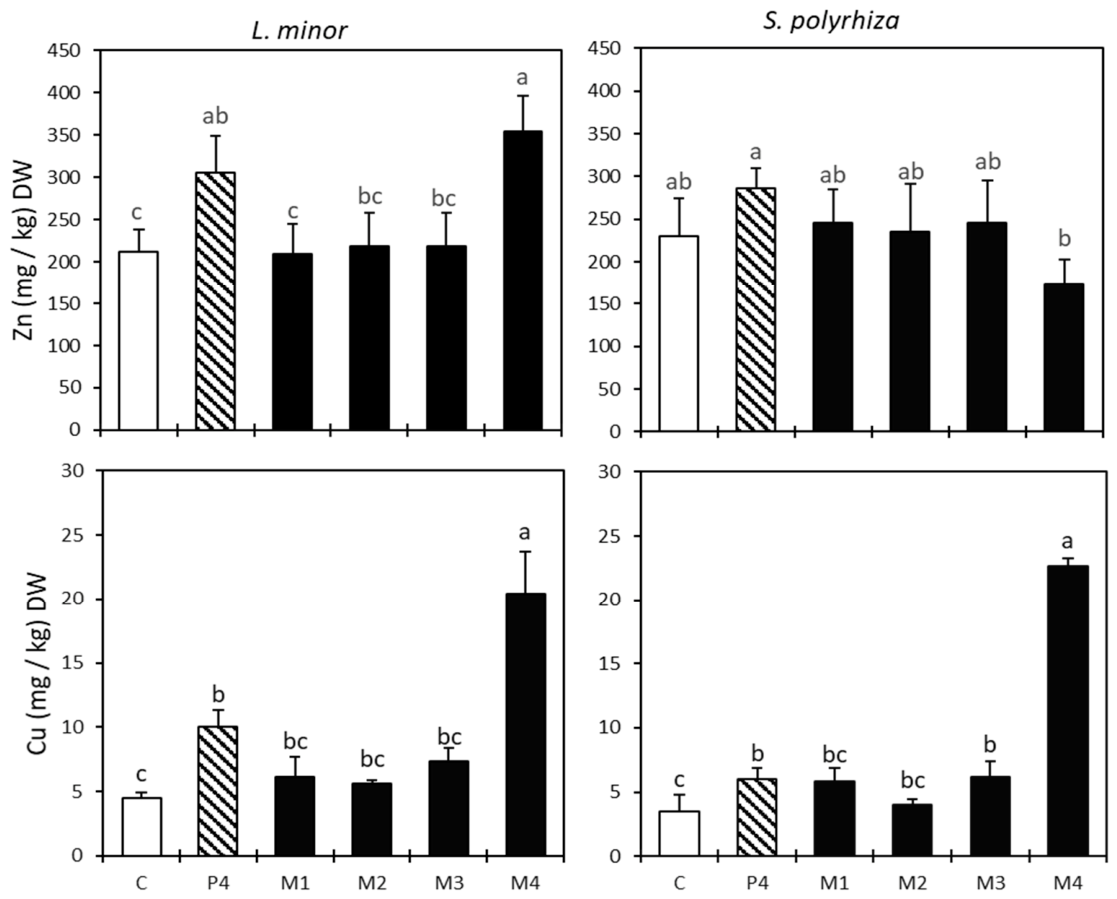
Figure 2.
Upper panel: Total number of adsorbed microparticles to duckweeds exposed to virgin (P) or HM-loaded (M) MPs mixture. Error bars denote standard deviations. Different letters indicate statistically significant differences among significantly different values treatments at p < 0.05. Lower panel: (A) PP particles adhered to L. minor, (B) R particles adhered to L. minor, (C) PS and R particles adhered to S. polyrhiza. Bar = 200 μm.
Figure 2.
Upper panel: Total number of adsorbed microparticles to duckweeds exposed to virgin (P) or HM-loaded (M) MPs mixture. Error bars denote standard deviations. Different letters indicate statistically significant differences among significantly different values treatments at p < 0.05. Lower panel: (A) PP particles adhered to L. minor, (B) R particles adhered to L. minor, (C) PS and R particles adhered to S. polyrhiza. Bar = 200 μm.
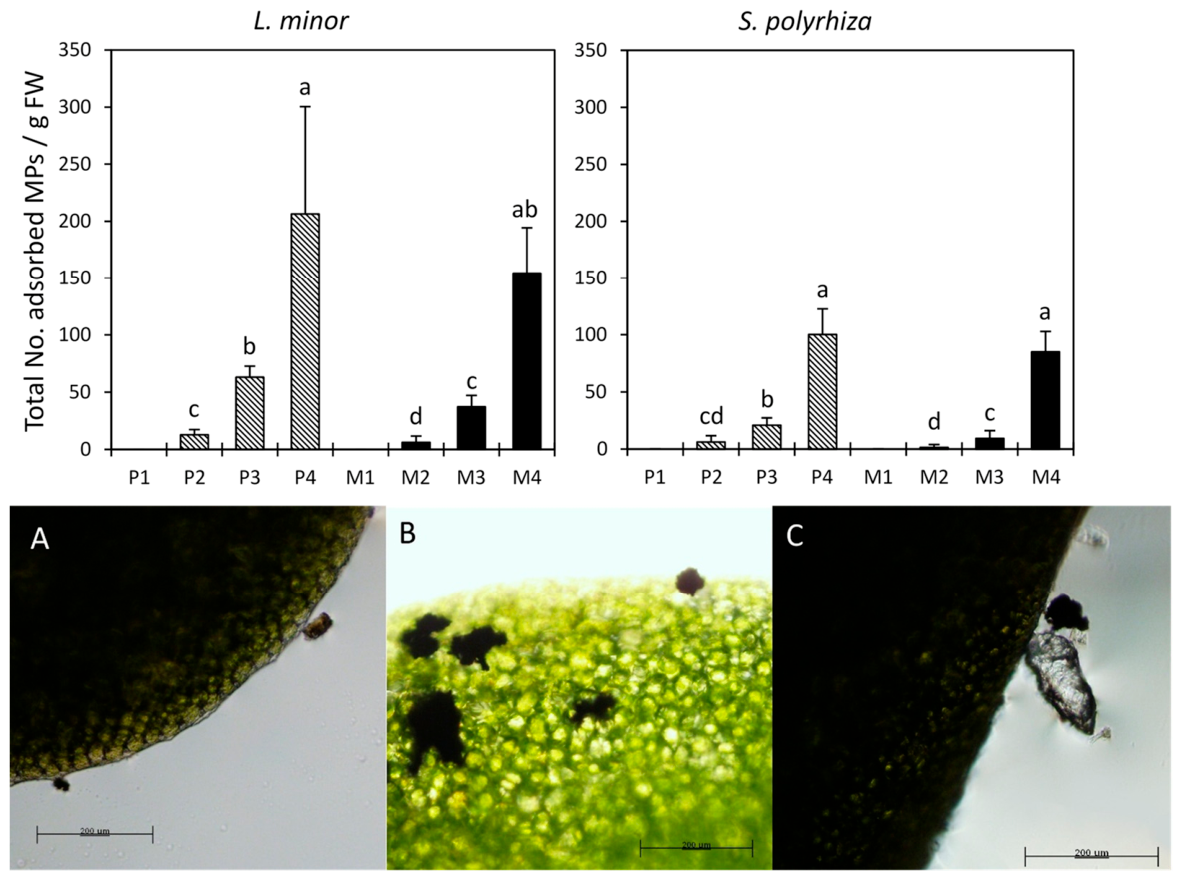
Figure 3.
Number of adsorbed MP particle types in duckweeds exposed to different concentrations of virgin (P treatments) or HM-loaded (M treatments) MP mixtures. Error bars denote standard deviations. Different letters indicate significant differences among treatments at p < 0.05.
Figure 3.
Number of adsorbed MP particle types in duckweeds exposed to different concentrations of virgin (P treatments) or HM-loaded (M treatments) MP mixtures. Error bars denote standard deviations. Different letters indicate significant differences among treatments at p < 0.05.
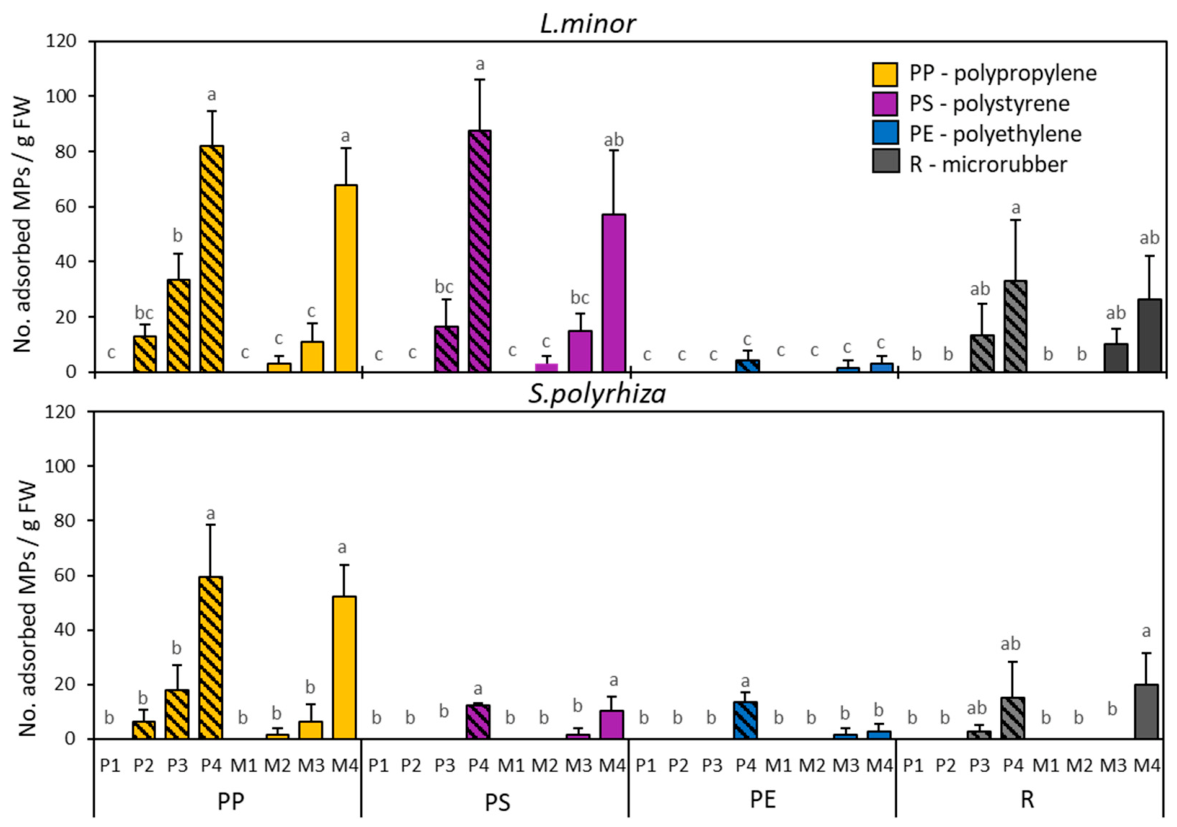
Figure 4.
Chlorophyll a level in duckweeds treated with different concentrations of virgin (P) or HM-loaded (M) MP mixtures. Error bars denote standard deviations. Different letters indicate significant differences among treatments at p < 0.05.
Figure 4.
Chlorophyll a level in duckweeds treated with different concentrations of virgin (P) or HM-loaded (M) MP mixtures. Error bars denote standard deviations. Different letters indicate significant differences among treatments at p < 0.05.
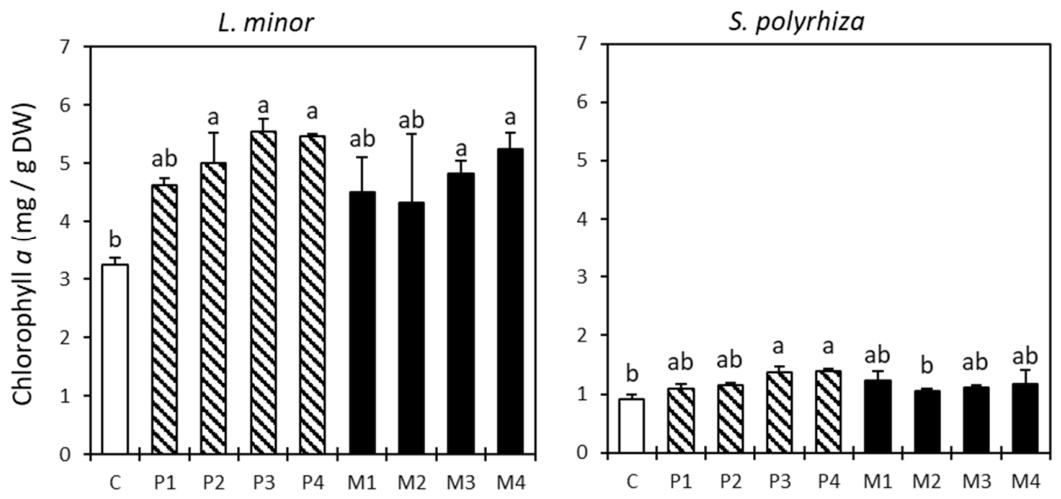

Table 1.
Concentrations of Cu, Pb and Zn in the plant-free control medium (C) and in plant-free. media containing the highest concentration of virgin (P4) and HM-loaded MPs (M4).
Table 1.
Concentrations of Cu, Pb and Zn in the plant-free control medium (C) and in plant-free. media containing the highest concentration of virgin (P4) and HM-loaded MPs (M4).
| Cu (μg/L) | Pb (μg/L) | Zn (μg/L) | |
| C | 0.74 ± 0.062 | 0.93 ± 0.257 | 68.12 ± 6.192 |
| P4 | 7.10 ± 0.429 * | 1.54 ± 0.261 | 75.75 ± 6.000 |
| M4 | 10.34 ± 0.670** | 3.61 ± 0.521 * | 71.40 ± 2.432 |
Values represent the mean of three replicates ± SD. *and ** indicate significant differences within a column at p < 0.05 and p < 0.01, respectively, compared to the control.
Table 2.
Superoxide dismutase (SOD; U/mg protein), ascorbate peroxidase (APX; U/mg protein), catalase (CAT; U/mg protein) and glutathione-S-transferase (GST; U/mg protein) activities in duckweeds exposed to different concentrations of virgin (P) or HM-loaded (M) MP mixtures.
Table 2.
Superoxide dismutase (SOD; U/mg protein), ascorbate peroxidase (APX; U/mg protein), catalase (CAT; U/mg protein) and glutathione-S-transferase (GST; U/mg protein) activities in duckweeds exposed to different concentrations of virgin (P) or HM-loaded (M) MP mixtures.
| L. minor | S. polyrhiza | |||||||
| Treatment | SOD | APX | CAT | GST | SOD | APX | CAT | GST |
| C | 50.9±6.98 b | 7.10±0.71 c | 0.08±0.006 b | 0.57±0.033 a | 34.6±2.99 a | 28.7±2.13 ab | 0.03±0.005 a | 2.0±0.18 a |
| P1 | 74.6±3.43 a | 8.67±0.99 bc | 0.11±0.014 ab | 0.59±0.010 a | 35.1±8.61 a | 27.1±2.01 b | 0.03±0.013 a | 2.2±0.30 a |
| P2 | 65.8±5.04 a | 13.6±0.80 a | 0.11±0.014 ab | 0.52±0.043 ab | 32.3±8.91 a | 30.0±1.36 ab | 0.03±0.002 a | 1.9±0.01 a |
| P3 | 68.7±9.99 a | 13.7±2.82 a | 0.09±0.011 b | 0.53±0.023 ab | 38.8±0.41 a | 29.7±1.49 ab | 0.04±0.005 a | 1.7±0.34 ab |
| P4 | 71.3±7.83 a | 14.6±0.69 a | 0.09±0.008 b | 0.51±0.075 ab | 45.6±1.90 a | 29.4±1.36 ab | 0.03±0.011 a | 1.3±0.21 bc |
| M1 | 47.0±4.21 b | 10.8±1.94 ab | 0.12±0.016 a | 0.54±0.114 ab | 32.9±1.09 a | 27.2±5.77 b | 0.03±0.007 a | 1.8±0.27 ab |
| M2 | 48.0±5.68 b | 12.7±1.01 a | 0.13±0.006 a | 0.49±0.007 ab | 33.6±7.16 a | 29.7±4.75 ab | 0.03±0.003 a | 1.4±0.27 bc |
| M3 | 53.2±3.20 b | 13.0±0.89 a | 0.13±0.009 a | 0.48±0.056 ab | 36.0±1.70 a | 36.9±2.93 a | 0.04±0.002 a | 1.3±0.14 bc |
| M4 | 52.7±4.45 b | 15.7±2.97 a | 0.13±0.005 a | 0.38±0.063 b | 31.6±5.91 a | 36.6±3.08 a | 0.03±0.004 a | 1.1±0.06 c |
Values represent means of six replicates ± SD. Different letters within each column indicate significant differences among treatments at p < 0.05.
Table 3.
Two-way ANOVA summary table showing the effects of duckweed species (DS), treatment (T), or interaction of duckweed species and treatment (DS × T) on adsorption capacity, physiological (growth rate, photosynthetic pigments) and biochemical (antioxidative enzymes, indicators of lipid peroxidation and protein oxidation) parameters in L. minor and S. polyrhiza.
Table 3.
Two-way ANOVA summary table showing the effects of duckweed species (DS), treatment (T), or interaction of duckweed species and treatment (DS × T) on adsorption capacity, physiological (growth rate, photosynthetic pigments) and biochemical (antioxidative enzymes, indicators of lipid peroxidation and protein oxidation) parameters in L. minor and S. polyrhiza.
| DS | T | DS x T | ||||
| F | p | F | p | F | p | |
| Growth rate - FN | 1621.05 | < 1x10⁶ | 2.34 | 0.038 | 3.51 | 0.0043 |
| Growth rate - FW | 707.46 | <0.000001 | 1.27 | 0.292 | 0.83 | 0.585 |
| Chlorophyll a | 1339.84 | <0.000001 | 8.26 | <0.00001 | 3.90 | 0.0021 |
| Chlorophyll b | 278.31 | <0.000001 | 3.54 | 0.0041 | 2.70 | 0.0196 |
| Carotenoids | 861.24 | <0.000001 | 2.37 | 0.037 | 1.13 | 0.367 |
| SOD | 224.49 | <0.000001 | 8.41 | <0.00001 | 3.99 | 0.0018 |
| APX | 722.86 | <0.000001 | 6.23 | <0.00001 | 2.24 | 0.0476 |
| CAT | 804.82 | <0.000001 | 5.81 | <0.00001 | 5.56 | 0.00013 |
| GST | 649.72 | <0.000001 | 10.05 | <0.00001 | 5.49 | 0.00015 |
| MDA | 162.31 | <0.000001 | 1.49 | 0.196 | 2.68 | 0.0202 |
| Carbonyls | 800.85 | <0.000001 | 0.80 | 0.606 | 0.47 | 0.870 |
| Adsorption | 17.09 | 0.0002 | 30.87 | <0.000001 | 3.31 | 0.0062 |
Duckweed species L. minor and S. polyrhiza were exposed to P and M treatments (in four concentrations), and C treatment. The F values are given, and results were considered significant at P < 0.05.
Disclaimer/Publisher’s Note: The statements, opinions and data contained in all publications are solely those of the individual author(s) and contributor(s) and not of MDPI and/or the editor(s). MDPI and/or the editor(s) disclaim responsibility for any injury to people or property resulting from any ideas, methods, instructions or products referred to in the content. |
© 2026 by the authors. Licensee MDPI, Basel, Switzerland. This article is an open access article distributed under the terms and conditions of the Creative Commons Attribution (CC BY) license (http://creativecommons.org/licenses/by/4.0/).
Copyright: This open access article is published under a Creative Commons CC BY 4.0 license, which permit the free download, distribution, and reuse, provided that the author and preprint are cited in any reuse.