
Submitted:
25 August 2026
Posted:
26 August 2026
You are already at the latest version
Abstract
Background: Inappropriate thyroid ultrasound (TUS) ordering by primary care providers (PCPs) is documented at academic centers but not in safety-net populations serving predominantly Hispanic patients. Objective: To quantify non-guideline TUS ordering, identify independent predictors, characterize indication-level concordance, and assess the association between guideline adherence and downstream diagnostic interventions. Design: Retrospective observational study (STROBE-compliant). Setting: Outpatient primary care clinics of a public safety-net hospital in Moreno Valley, California. Participants: 405 adults and children (age 7–86 years) who underwent PCP-ordered thyroid ultrasound between March 2023 and March 2024. Inpatient, specialist-ordered, and specialist-recommended TUS were excluded. Measurements: ATA guideline concordance (primary outcome) documented directed thyroid physical examination (PE), ICD-10 indication, and downstream outcomes (FNA, Bethesda cytology, thyroidectomy, pathology). Multivariable logistic regression, chi-square, and Fisher exact tests were used. Results: Of 405 orders, 178 (44.0%) were non-guideline. Patients were predominantly Hispanic (68.6%) and female (89.1%). Absence of directed PE independently predicted non-guideline ordering (OR, 4.67; 95% CI, 2.61–8.36; p< 0.001). Thyrotoxicosis/hyperthyroid and compressive-symptom indications had OR >38 versus nodule/follow-up. Biochemical indications had 95–100% non-guideline rates. Guideline-concordant TUS produced higher FNA rates (26.0% vs. 10.7%; p< 0.001) and 2.8-fold more Bethesda III–VI findings. Among 14 thyroidectomies, 71.4% occurred in patients without documented PE. Limitations: Single-center retrospective design; PE documentation may underestimate actual examination; causality cannot be established. Conclusion: Non-guideline TUS ordering is common in safety-net primary care, driven by biochemical indications and PE omission. Guideline-concordant TUS yields greater diagnostic value; targeted education and decision-support are needed.
Keywords:
thyroid ultrasound overuse
; guideline concordance
; safety-net primary care
; physical examination documentation
; diagnostic value
1. Introduction
Thyroid cancer incidence has risen substantially over the past three decades in the United States, yet disease-specific mortality has remained essentially unchanged, reflecting increased detection of indolent, subclinical disease rather than a true rise in clinically consequential cancer [1,2] A major driver of this incidence–mortality disconnect is the widespread use of thyroid ultrasound (TUS) and the detection of small, often incidental nodules in asymptomatic individuals [3,4,5]. Population-based surveys estimate that palpable thyroid nodules are present in approximately 5% of women and 1% of men, whereas ultrasound-detectable nodules occur in 19–67% of unselected adults; the overwhelming majority are benign and clinically insignificant [6].
To curb overdiagnosis and unnecessary diagnostic cascades, the ATA, the American College of Radiology, and Choosing Wisely have issued consistent recommendations that TUS be reserved for patients with a palpable nodule, a suspicious neck mass, or a clear structural concern, and explicitly not be used to evaluate isolated thyroid function test abnormalities [7,8]. Despite these recommendations, inappropriate TUS ordering by PCPs has been reported across multiple academic and integrated-delivery systems, with rates ranging from 10% to 46% in a recent systematic review [9,10]
No prior study has quantified this problem in a public safety-net setting serving a predominantly Hispanic population. Safety-net health systems face distinct pressures — short visit times, limited specialty access, and complex patient populations — that may amplify low-value imaging and the attendant risks of unnecessary FNA, overtreatment, and diagnostic thyroidectomy [10]. Whether patient demographic factors, clinical indication, or provider behavior drive non-guideline ordering in such settings is unknown.
We therefore conducted a retrospective observational study with four pre-specified aims: (1) to quantify the rate of non-guideline TUS ordering by PCPs in a safety-net primary care network; (2) to identify independent predictors of non-guideline ordering, including patient demographics, clinical indication, and PE documentation; (3) to characterize guideline concordance at the level of individual ordering indications; and (4) to assess the association between guideline concordance and downstream diagnostic outcomes, including FNA, Bethesda cytology, and thyroidectomy [11,12,13,14].
2. Methods
2.1. Study Design and Setting
We performed a retrospective observational cohort study, reported in accordance with the STROBE statement, of consecutive TUS studies ordered by PCPs at outpatient primary care clinics affiliated with RUHS Medical Center, a public safety-net hospital in Riverside County, California. The study period spanned March 1, 2023 through March 1, 2024. The institutional review board determined the study exempt as a retrospective chart review of de-identified data.
2.2. Participants
We queried the EPIC electronic health record for all TUS studies performed during the study period. An initial 651 studies were identified. We excluded inpatient TUS, TUS ordered by a specialist (endocrinology, otolaryngology, surgery, or radiology), TUS ordered by a PCP at the explicit recommendation of a specialist, and studies subsequently identified as parathyroid ultrasound mislabeled as thyroid. After exclusions, 405 PCP-ordered outpatient TUS studies in patients aged 7–86 years were retained for analysis.
2.3. Data Collection
Two reviewers independently abstracted patient age, sex, self-reported race/ethnicity, and the ordering ICD-10 indication from the ordering encounter. Documentation of a directed thyroid PE (palpation of the thyroid gland with description of size, consistency, nodularity, or lymphadenopathy) was extracted from the same encounter note. Downstream data included FNA performance and Bethesda cytology category [14], any subsequent thyroid surgery and surgical approach, and final surgical pathology. Disagreements were resolved by consensus with a third adjudicator.
2.4. Guideline Assessment
The 2015 ATA Management Guidelines served as the primary reference standard (Table 1) [7]. A TUS order was classified as non-guideline when the indication was not supported by ATA criteria, including isolated abnormal TSH without structural concern, pre-existing hypothyroidism on stable replacement, overt thyrotoxicosis, isolated neck pain, globus, or dysphagia without a structural abnormality on history or examination.
2.5. Statistical Analysis
All analyses were performed in Python 3.11 (scipy 1.13; statsmodels 0.14). Categorical variables are reported as frequencies and percentages; continuous variables as mean ± SD. Two-sided p<0.05 was considered statistically significant.
A multivariable logistic regression model with ATA non-adherence (yes/no) as the outcome was constructed with pre-specified covariates: age (continuous), sex, ethnicity (Hispanic [referent]), indication category (nodule/follow-up [referent], goiter/hypothyroid, thyrotoxicosis/hyperthyroid, compressive symptoms, other), and directed PE documentation. Odds ratios and 95% CIs were estimated by maximum-likelihood logistic regression (BFGS algorithm). Model fit was assessed by McFadden pseudo-R² and AIC. Downstream outcome comparisons used chi-square or Fisher exact test (when expected cell <5). Positive predictive value for Bethesda III–VI was compared by Fisher exact test.
3. Results
3.1. Study Population
A total of 405 PCP-ordered outpatient TUS studies were analyzed (Table 2). The mean patient age was 49.7 years (range, 7–86). Three hundred sixty-one patients (89.1%) were women. By self-reported ethnicity, 278 (68.6%) identified as Hispanic, 64 (15.8%) as non-Hispanic White, 31 (7.7%) as Black, 24 (5.9%) as Asian, and 8 (2.0%) as Other.
3.2. Ordering Indications
The eight most common ordering indications (Table 3, Figure 1) were nodule follow-up (n=82; 20.2%), incidentaloma (n=76; 18.8%), new nodule or neck mass (n=73; 18.0%), goiter (n=52; 12.8%), hyperthyroidism/thyrotoxicosis (n=36; 8.9%), dysphagia (n=22; 5.4%), hypothyroidism (n=20; 4.9%), and isolated neck pain (n=15; 3.7%).
3.3. Guideline Adherence, Physical Examination, and Multivariable Predictors
One hundred seventy-eight orders (44.0%) were classified as non-guideline and 227 (56.0%) as guideline concordant. A directed thyroid PE was not documented in 244 patients (60.2%). The multivariable logistic regression model achieved a McFadden pseudo-R² of 0.328. Summary statistics and regression results are presented in Table 4.
Absence of directed PE independently predicted non-guideline ordering (OR, 4.67; 95% CI, 2.61–8.36; p<0.001). Relative to nodule/follow-up, thyrotoxicosis/hyperthyroid carried an OR of 114.7 (95% CI, 14.8–886.7; p<0.001), compressive symptoms an OR of 38.3 (95% CI, 14.0–105.0; p<0.001), and goiter/hypothyroid an OR of 4.33 (95% CI, 2.26–8.30; p<0.001). Age, sex, and ethnicity were not independently associated with guideline status (all p>0.10).
3.4. Guideline Concordance by Indication
At the level of individual indication, non-guideline rates were near-universal for biochemical and functional indications (Table 5): 100% for isolated high TSH or subclinical hypothyroidism, 100% for pre-existing hypothyroidism on replacement, 100% for isolated globus, 95.2% for overt thyrotoxicosis (p<0.001 vs. overall 44.0%), 86.7% for isolated neck pain (p<0.001), and 86.4% for isolated dysphagia (p<0.001). Structural indications were predominantly guideline-concordant: new nodule/mass 94.4% (p<0.001), incidentaloma 72.4%, goiter 71.2%, and nodule follow-up 68.3%.
3.5. FNA and Surgery by Guideline Status and Physical Examination
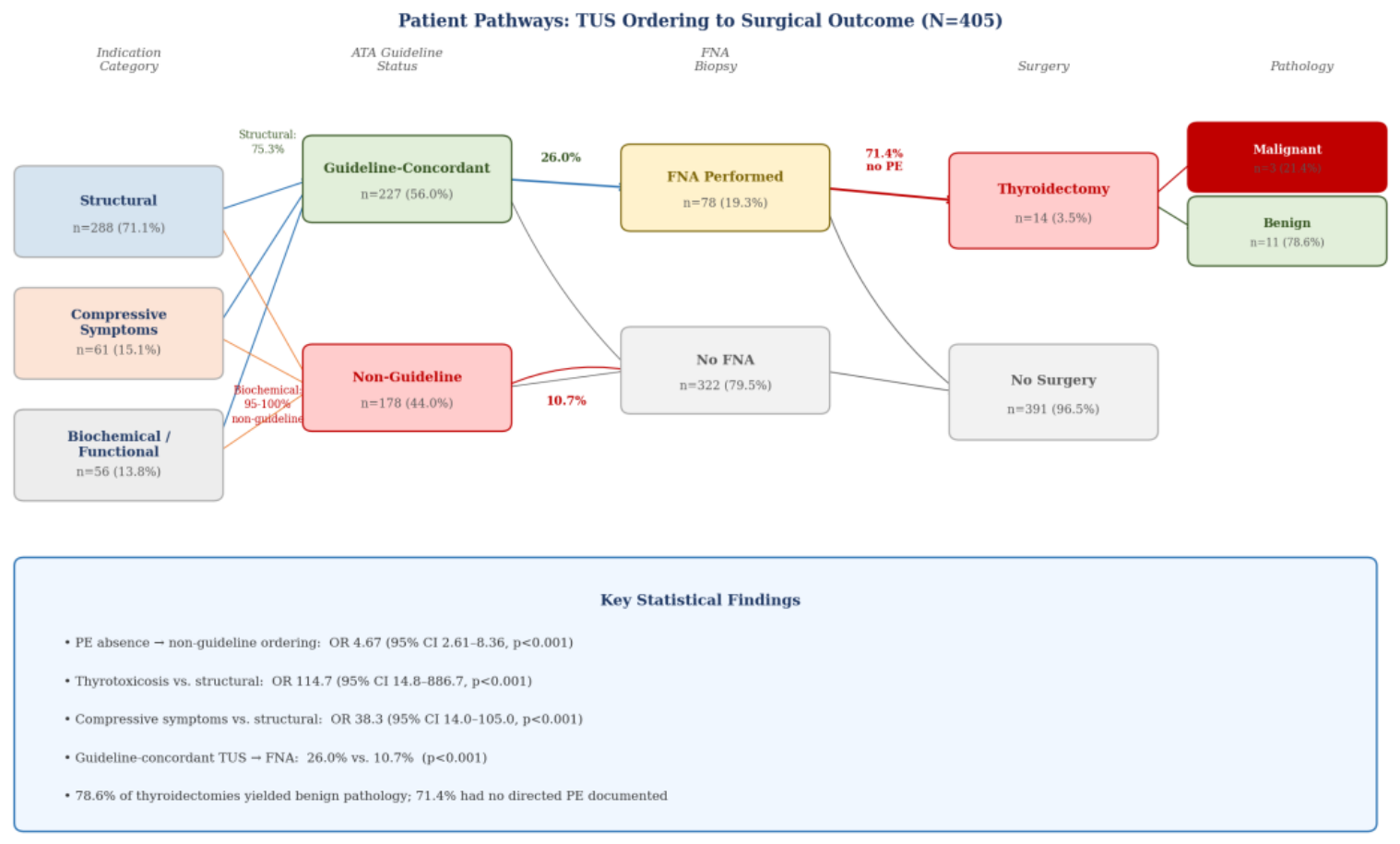
Of 405 patients, 78 (19.3%) underwent FNA (Table 6). The FNA rate was 26.0% (59/227) after guideline-concordant TUS versus 10.7% (19/178) after non-guideline TUS (p<0.001). The proportion with Bethesda III–VI cytology was similar between groups (42.4% vs. 47.4%; Fisher OR, 1.22; p=0.793), but the absolute number was 2.8-fold higher following guideline-concordant TUS (25 vs. 9). When stratified by PE documentation, FNA rates were 16.1% with PE versus 21.3% without (p=0.246), and surgery rates were 2.5% with PE versus 4.1% without (p=0.580). Although these bivariate associations did not reach significance, PE absence remained an independent multivariable predictor of non-guideline ordering (OR, 4.67; p<0.001), which mediates the downstream difference in diagnostic yield.
Fourteen patients (3.5%) underwent thyroidectomy. Ten (71.4%) had no directed PE documented at the original TUS order. Final pathology was benign in 11 of 14 cases (78.6%); three papillary thyroid carcinomas were identified, all following guideline-concordant TUS. In the majority of benign cases, the presenting complaint was not resolved by surgery. Individual thyroidectomy case details are provided in Supplementary Table S1.
Figure 2.
Sankey-style diagram of patient pathways from TUS ordering through downstream outcomes (N=405). Flows progress from indication category through ATA guideline concordance to FNA and surgical outcome. Key adjusted odds ratios and absolute rates are annotated at each transition. 78.6% of thyroidectomies revealed benign histopathology.
Figure 2.
Sankey-style diagram of patient pathways from TUS ordering through downstream outcomes (N=405). Flows progress from indication category through ATA guideline concordance to FNA and surgical outcome. Key adjusted odds ratios and absolute rates are annotated at each transition. 78.6% of thyroidectomies revealed benign histopathology.
4. Discussion
In this retrospective observational study of 405 PCP-ordered thyroid ultrasound studies at a public safety-net medical center, 44.0% of orders were non-guideline — consistent with the 10–46% range previously reported from well-resourced academic centers [4a]. To our knowledge, this is the first quantitative characterization of PCP TUS overuse in a predominantly Hispanic safety-net population, and the key novel finding is that omission of a directed thyroid physical examination was an independent, large-effect predictor of non-guideline ordering (OR, 4.67; p<0.001) after adjustment for age, sex, ethnicity, and indication.
At the level of individual ordering indication, non-guideline ordering was overwhelmingly driven by biochemical and functional complaints. Isolated TSH abnormalities, pre-existing hypothyroidism, and overt thyrotoxicosis were associated with 95–100% non-guideline rates, in direct contradiction to ATA and Choosing Wisely recommendations.5 Compressive symptom complaints also demonstrated high non-guideline rates, likely reflecting clinical uncertainty about whether these complaints originate from thyroid pathology. By contrast, structural indications were appropriately ordered in 68–94% of cases, demonstrating that PCPs correctly apply ATA criteria when the presenting scenario is overtly anatomic.
The finding that age, sex, and ethnicity were not associated with guideline status is important on two counts. First, it establishes that non-guideline ordering is a behavioral and systems-level phenomenon rather than a patient-demographic one. Second, it provides reassuring equity evidence: PCPs at this safety-net institution are not disproportionately ordering inappropriate imaging in any demographic subgroup. The solution therefore lies in provider education and system design rather than patient-level interventions.
Guideline-concordant TUS produced 2.4-fold more FNAs and 2.8-fold more absolute Bethesda III–VI findings, even though the relative PPV for high-risk cytology was similar between groups. This confirms that the ATA framework efficiently identifies true thyroid pathology: non-guideline TUS occasionally discovers significant cytology by chance, but at markedly lower absolute yield and at the cost of unnecessary imaging, cytology, and surgery in patients unlikely to benefit.
The thyroidectomy cascade is particularly illustrative of low-value care. Among the 14 patients who underwent surgery, 78.6% had benign final pathology and 71.4% had no documented PE at the original TUS order. In most benign cases the presenting complaint was not resolved by surgery, yet each patient was exposed to hypoparathyroidism risk, recurrent laryngeal nerve injury, and lifelong levothyroxine dependence. In a safety-net population subject to financial toxicity and constrained specialty access, the downstream consequences of an initially inappropriate TUS are disproportionately consequential.
Limitations
This study is limited by its single-center retrospective design at one safety-net health system; findings may not generalize to other settings. Documentation of a directed thyroid PE was abstracted from the ordering encounter note and may underestimate the true examination rate where examinations were performed but not recorded. The observational design precludes causal inference. ATA guidelines served as the primary comparator; other consensus documents have overlapping but not identical indications. The surgical subgroup (n=14) limits statistical power for surgery-related comparisons.
Figure 3.
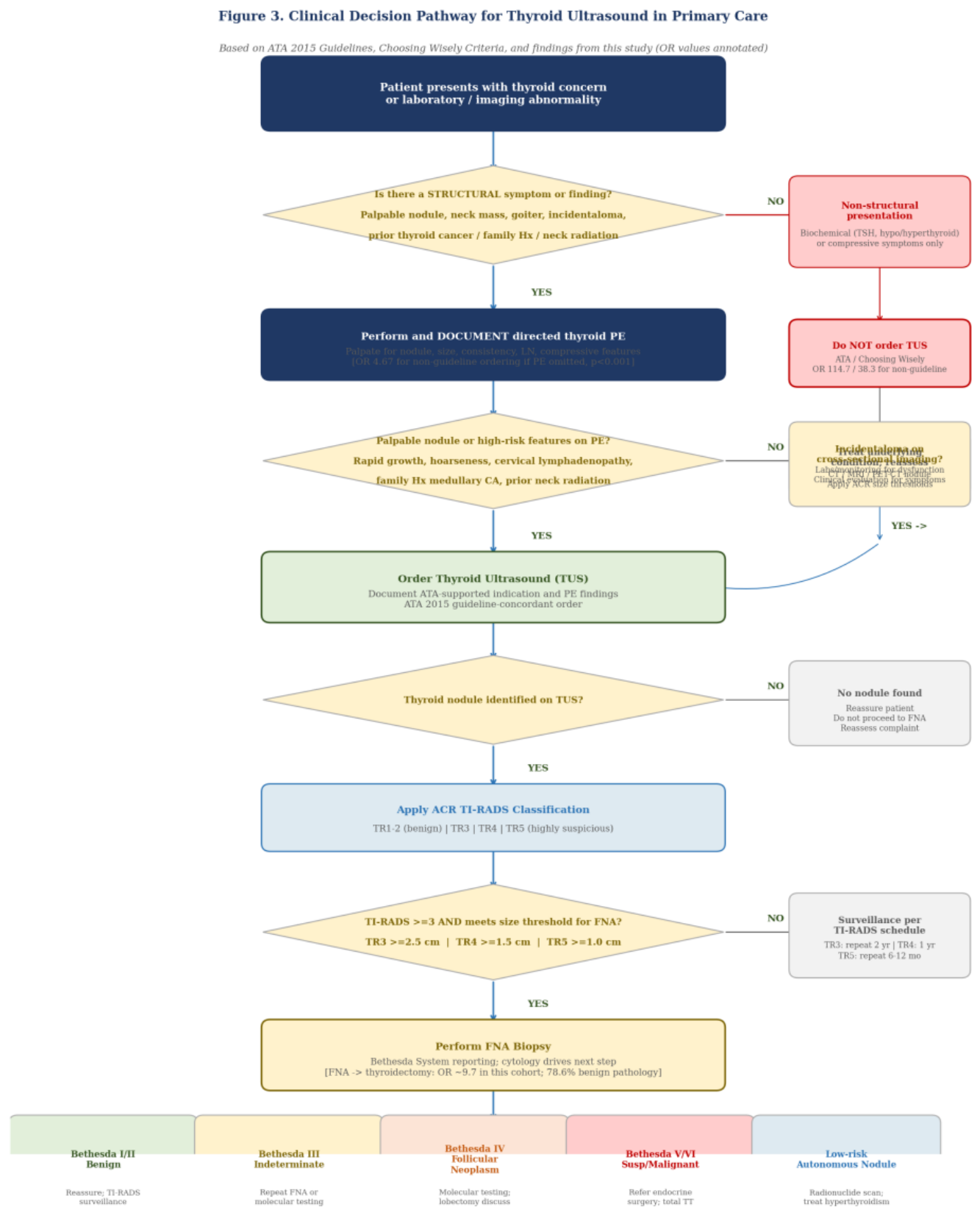
Proposed clinical decision pathway for thyroid ultrasound ordering in primary care. The pathway routes the presenting complaint through a mandatory directed thyroid examination, branching to guideline-concordant ordering or deferral. Decision nodes are annotated with ATA 2015 criteria, Choosing Wisely recommendations, and adjusted OR values from this study. TT = total thyroidectomy; FNA = fine-needle aspiration; TI-RADS = Thyroid Imaging Reporting and Data System.
Figure 3.
Proposed clinical decision pathway for thyroid ultrasound ordering in primary care. The pathway routes the presenting complaint through a mandatory directed thyroid examination, branching to guideline-concordant ordering or deferral. Decision nodes are annotated with ATA 2015 criteria, Choosing Wisely recommendations, and adjusted OR values from this study. TT = total thyroidectomy; FNA = fine-needle aspiration; TI-RADS = Thyroid Imaging Reporting and Data System.
5. Conclusions
In a safety-net primary care population, 44% of PCP-ordered thyroid ultrasounds were non-guideline. The independent predictors were indication category and absence of a directed physical examination — not patient age, sex, or ethnicity — establishing this as a modifiable systems and educational problem. Biochemical indications and compressive symptom complaints accounted for most inappropriate orders. Guideline-concordant TUS produced 2.4 times more FNAs and 2.8 times more Bethesda III–VI diagnoses, confirming the clinical value of appropriate utilization. Most thyroidectomies following non-guideline TUS revealed benign pathology and did not resolve the presenting complaint. Targeted PCP education, reinforcement of the directed thyroid examination as the gating step before imaging, and point-of-care clinical decision support are each needed to reduce diagnostic cascades and promote equitable specialty access in underserved populations.
Author Contributions
All listed authors participated in study design, data collection, analysis, interpretation, drafting, or critical revision, and have approved the final version. Corresponding author: Anthony Firek, MD.
Funding
This study received no external funding. None.
Institutional Review Board Statement
RUHS IRB determined this study exempt as retrospective chart review of de-identified records. Exempt — retrospective chart review of de-identified records (RUHS IRB).
Data Availability
De-identified data available upon reasonable written request to the corresponding author, subject to RUHS data-sharing policy.
Conflicts of Interest
The authors declare no competing financial or personal interests. None declared.
References
- R Lincango-Naranjo E, Solis-Pazmino P, Rodriguez-Villafuerte S, et al.: Triggers of thyroid cancer diagnosis: a systematic review and meta-analysis. Endocrine. 2021, 72:644-659. [CrossRef]
- Acosta GJ, Singh Ospina N, Brito JP: Overuse of thyroid ultrasound. Curr Opin Endocrinol Diabetes Obes. 2023, 30:225-230. [CrossRef]
- Haymart MR, Banerjee M, Reyes-Gastelum D, Caoili E, Norton EC: Thyroid ultrasound and the increase in diagnosis of low-risk thyroid cancer. J Clin Endocrinol Metab. 2019, 104:785-792. [CrossRef]
- Davies L, Welch HG: Current thyroid cancer trends in the United States. JAMA Otolaryngol Head Neck Surg. 2014, 140:317-322. [CrossRef]
- Lim H, Devesa SS, Sosa JA, Check D, Kitahara CM: Trends in thyroid cancer incidence and mortality in the United States, 1974-2013. JAMA. 2017, 317:1338-1348. [CrossRef]
- Edwards MK, Iniguez-Ariza NM, Ramirez-Moreno J, et al.: Inappropriate use of thyroid ultrasound: a systematic review and meta-analysis. Endocrine. 2021, 74:263-269. [CrossRef]
- Haugen BR, Alexander EK, Bible KC, et al.: 2015 American Thyroid Association Management Guidelines for Adult Patients with Thyroid Nodules and Differentiated Thyroid Cancer. Thyroid. 2016, 26:1-133. [CrossRef]
- Choosing Wisely. American Academy of Family Physicians: Do not routinely order thyroid ultrasound in patients with abnormal thyroid function tests if there is no palpable abnormality of the thyroid gland. ABIM Foundation. 2017.
- Vaccarella S, Dal Maso L, Laversanne M, et al.: The impact of diagnostic changes on the rise in thyroid cancer incidence. Thyroid. 2015, 25:1127-1136. [CrossRef]
- Bahl M: Incidental thyroid nodules: review of the literature and current practice recommendations. Semin Roentgenol. 2020, 55:207-215. [CrossRef]
- Durante C, Grani G, Lamartina L, Filetti S, Mandel SJ, Cooper DS: The diagnosis and management of thyroid nodules: a review. JAMA. 2018, 319:914-924. [CrossRef]
- Alexander LF, Patel NJ, Caserta MP, Robbin ML: Thyroid ultrasound: diffuse and nodular disease. Radiol Clin North Am. 2020, 58:1041-1057. [CrossRef]
- Tessler FN, Middleton WD, Grant EG, et al.: ACR Thyroid Imaging, Reporting and Data System (TI-RADS). J Am Coll Radiol. 2017, 14:587-595. [CrossRef]
- Singh Ospina N, Iniguez-Ariza NM, Castro MR: Thyroid nodules: diagnostic evaluation based on thyroid cancer risk assessment. BMJ. 2020, 368:6670. [CrossRef]
- Cibas ES, Ali SZ: The 2017 Bethesda System for Reporting Thyroid Cytopathology. Thyroid. 2017, 27:1341-1346. [CrossRef]
Figure 1.
Distribution of thyroid ultrasound ordering indications (N=405). Blue = structural; orange = compressive/symptom; gray = biochemical/functional. Nodule-related indications collectively represent 57.0% of all orders; biochemical/functional indications account for 15.5%.
Figure 1.
Distribution of thyroid ultrasound ordering indications (N=405). Blue = structural; orange = compressive/symptom; gray = biochemical/functional. Nodule-related indications collectively represent 57.0% of all orders; biochemical/functional indications account for 15.5%.
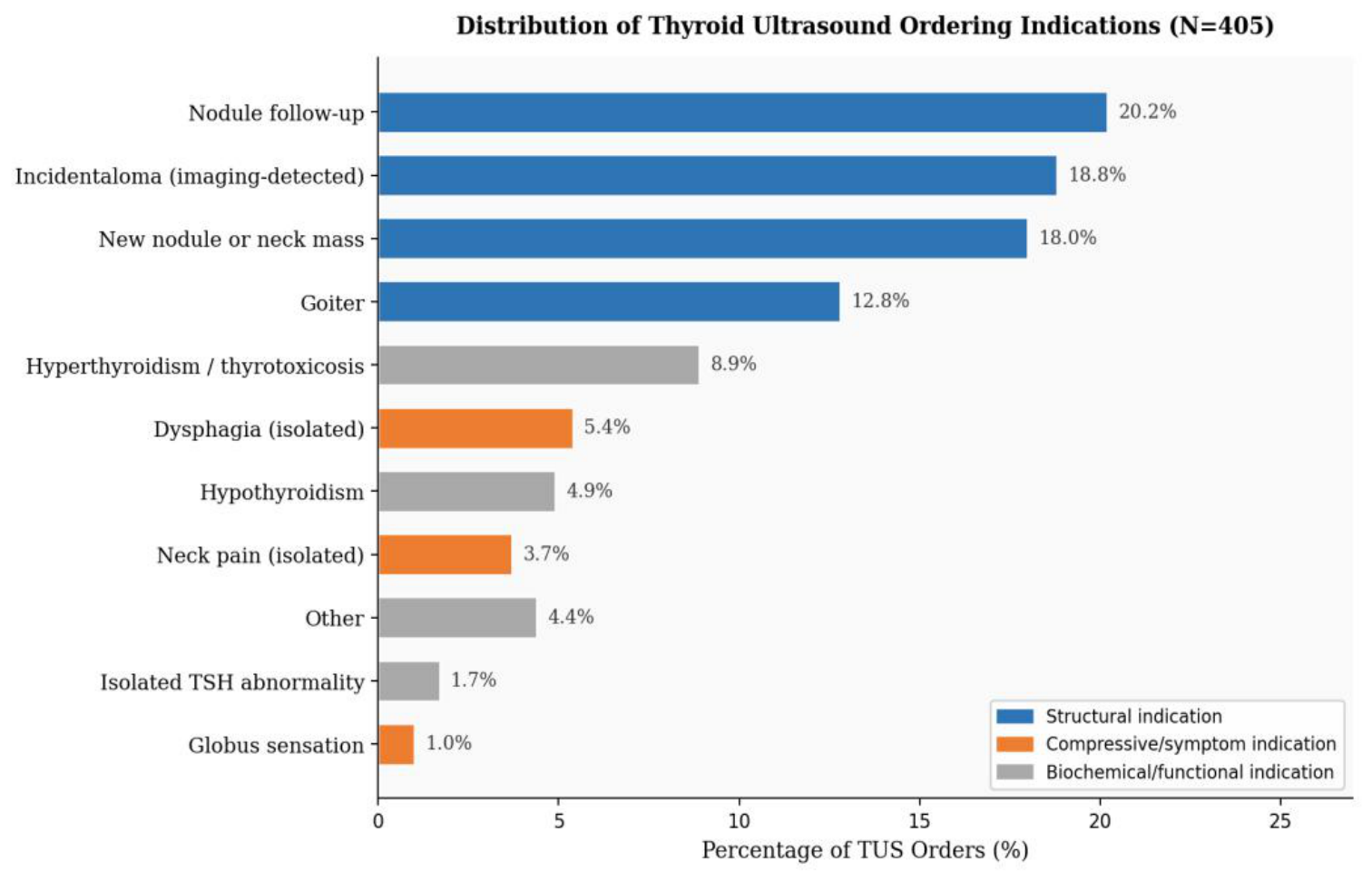

Table 1.
Summary of Guideline-Supported Indications for Thyroid Ultrasound (ATA 2015, ACR, and Choosing Wisely).
Table 1.
Summary of Guideline-Supported Indications for Thyroid Ultrasound (ATA 2015, ACR, and Choosing Wisely).
| Category | Guideline-Supported Indication |
|---|---|
| Structural — Palpable | Palpable thyroid nodule or suspicious neck mass on examination |
| Structural — Imaging | Thyroid nodule incidentally identified on CT, MRI, PET/CT, or carotid ultrasound |
| Structural — Goiter | Clinically apparent thyroid enlargement with concern for compressive effect |
| Cancer Surveillance | Known differentiated thyroid cancer or prior thyroidectomy for malignancy |
| Family / Risk Factors | Childhood neck radiation; family history of medullary or familial thyroid cancer |
| Nodule Follow-Up | Surveillance of a previously characterized thyroid nodule per ATA schedule |
| Not Supported | Isolated TSH abnormality; pre-existing hypothyroidism on stable replacement; overt thyrotoxicosis without palpable abnormality; isolated neck pain, globus, or dysphagia without structural finding |
ATA = American Thyroid Association; ACR = American College of Radiology; TSH = thyroid-stimulating hormone.
Table 2.
Baseline Sample Characteristics (N=405).
| Characteristic | Value |
|---|---|
| Age, mean ± SD (range), years | 49.7 ± 14.1 (7–86) |
| Female sex, n (%) | 361 (89.1) |
| Male sex, n (%) | 44 (10.9) |
| Hispanic, n (%) | 278 (68.6) |
| Non-Hispanic White, n (%) | 64 (15.8) |
| Black, n (%) | 31 (7.7) |
| Asian, n (%) | 24 (5.9) |
| Other / Unknown, n (%) | 8 (2.0) |
| Directed thyroid PE documented, n (%) | 161 (39.8) |
| Directed thyroid PE not documented, n (%) | 244 (60.2) |
SD = standard deviation; PE = physical examination.
Table 3.
Distribution of Ordering Indications (N=405).
| Indication | n | % |
|---|---|---|
| Nodule follow-up | 82 | 20.2% |
| Incidentaloma (imaging-detected) | 76 | 18.8% |
| New nodule or neck mass | 73 | 18.0% |
| Goiter | 52 | 12.8% |
| Hyperthyroidism / thyrotoxicosis | 36 | 8.9% |
| Dysphagia (isolated) | 22 | 5.4% |
| Hypothyroidism | 20 | 4.9% |
| Neck pain (isolated) | 15 | 3.7% |
| Other | 18 | 4.4% |
| Globus sensation | 4 | 1.0% |
| Isolated TSH abnormality | 7 | 1.7% |
Percentages are of N=405. TSH = thyroid-stimulating hormone.
Table 4.
Guideline Adherence, Physical Examination, Downstream Procedures, and Multivariable Predictors of Non-Guideline TUS Ordering (N=405).
Table 4.
Guideline Adherence, Physical Examination, Downstream Procedures, and Multivariable Predictors of Non-Guideline TUS Ordering (N=405).
| Panel A. Guideline Adherence, Physical Examination, and Downstream Procedures (N=405) | |||
|---|---|---|---|
| Parameter | n | % | Note |
| Guideline-concordant TUS orders | 227 | 56.0% | |
| Non-guideline TUS orders | 178 | 44.0% | Primary outcome |
| Directed PE documented | 161 | 39.8% | |
| Directed PE not documented | 244 | 60.2% | Key modifiable predictor |
| FNA performed | 78 | 19.3% | |
| Thyroidectomy performed | 14 | 3.5% | 78.6% benign pathology — see Supplementary Table S1 |
| Panel B. Multivariable Logistic Regression: Independent Predictors of Non-Guideline TUS Ordering | |||
| Covariate | Adjusted OR | 95% CI | p-value |
| Age (per year) | 1.02 | 0.99–1.04 | 0.78 |
| Male sex (vs. female) | 1.88 | 0.86–4.10 | 0.84 |
| White ethnicity (vs. Hispanic) | 0.91 | 0.44–1.86 | 0.80 |
| Black ethnicity (vs. Hispanic) | 0.86 | 0.34–2.21 | 0.76 |
| Asian ethnicity (vs. Hispanic) | 1.21 | 0.38–3.79 | 0.75 |
| Other ethnicity (vs. Hispanic) | 1.69 | 0.20–14.24 | 0.63 |
| Directed PE absent (vs. PE documented) | 4.67 | 2.61–8.36 | <0.001 |
| Goiter / hypothyroid (vs. nodule/follow-up) | 4.33 | 2.26–8.30 | <0.001 |
| Compressive symptoms (vs. nodule/follow-up) | 38.3 | 14.0–105.0 | <0.001 |
| Thyrotoxicosis / hyperthyroid (vs. nodule/follow-up) | 114.7 | 14.8–886.7 | <0.001 |
OR = odds ratio; CI = confidence interval; PE = directed thyroid physical examination; TUS = thyroid ultrasound; FNA = fine-needle aspiration. Reference categories: Hispanic ethnicity; nodule/follow-up indication. Model fit: McFadden pseudo-R² = 0.328. Shaded rows (Panel B) indicate p<0.001. OR/CI values verified against results text. See Supplementary Table S1 for individual thyroidectomy case details.
Table 5.
Guideline Concordance by Individual Ordering Indication.
| Indication | n | Non-Guideline, n (%) | Guideline, n (%) | p* |
|---|---|---|---|---|
| Structural indications | 283 | 4 (5.6%) | 68 (94.4%) | <0.001 |
| Patient complaint (compressive) | 76 | 21 (27.6%) | 55 (72.4%) | 0.017 |
| Laboratory abnormality (biochemical) | 52 | 15 (28.8%) | 37 (71.2%) | 0.019 |
| Post-surgery / nodule follow-up | 82 | 26 (31.7%) | 56 (68.3%) | 0.044 |
*Fisher exact test vs. overall non-guideline rate of 44.0%.
Table 6.
Fine-Needle Aspiration and Surgery, Stratified by Guideline Status and Physical Examination Documentation.
Table 6.
Fine-Needle Aspiration and Surgery, Stratified by Guideline Status and Physical Examination Documentation.
| Stratification | Numerator / Denominator | Rate (%) | p-value |
|---|---|---|---|
| By guideline status | |||
| FNA — Guideline-concordant TUS | 59 / 227 | 26.0% | <0.001 |
| FNA — Non-guideline TUS | 19 / 178 | 10.7% | |
| Bethesda III–VI — Guideline | 25 / 59 | 42.4% | 0.793 |
| Bethesda III–VI — Non-guideline | 9 / 19 | 47.4% | |
| By PE documentation status | |||
| FNA — With directed PE | 26 / 161 | 16.1% | 0.246 |
| FNA — Without directed PE | 52 / 244 | 21.3% | |
| Surgery — With directed PE | 4 / 161 | 2.5% | 0.580 |
| Surgery — Without directed PE | 10 / 244 | 4.1% | |
p-values by chi-square or Fisher exact test. FNA = fine-needle aspiration; TUS = thyroid ultrasound; PE = physical examination.
Disclaimer/Publisher’s Note: The statements, opinions and data contained in all publications are solely those of the individual author(s) and contributor(s) and not of MDPI and/or the editor(s). MDPI and/or the editor(s) disclaim responsibility for any injury to people or property resulting from any ideas, methods, instructions or products referred to in the content. |
© 2026 by the authors. Licensee MDPI, Basel, Switzerland. This article is an open access article distributed under the terms and conditions of the Creative Commons Attribution (CC BY) license (http://creativecommons.org/licenses/by/4.0/).
Copyright: This open access article is published under a Creative Commons CC BY 4.0 license, which permit the free download, distribution, and reuse, provided that the author and preprint are cited in any reuse.