

Submitted:
24 August 2026
Posted:
26 August 2026
You are already at the latest version
Abstract
Indonesia faces a persistent double burden of malnutrition in which undernutrition coexists with obesity, diabetes, hypertension, and other diet-related noncommunicable disease risks. This Viewpoint proposes NutriAgent+, a testable conceptual architecture for precision nutrition that combines multimodal wearable sensing, smartphone-derived behavioral context, contextual dietary data, bounded agentic artificial intelligence (AI), and a staged pathway toward national health-system interoperability. Rather than treating all wearable signals as equivalent, the framework specifies an evidence hierarchy spanning photoplethysmography and accelerometry, smartphone digital phenotyping, interstitial glucose sensing, experimental sweat and microneedle biomarkers, image- and log-based dietary capture grounded in Indonesian food-composition databases, and consented clinical context. The architecture separates sensing from interpretation, requires quality gating and uncertainty representation before AI reasoning, and constrains agent autonomy according to risk. A translational validation ladder is proposed from bench performance and analytical agreement through human-factors testing, model calibration, agent safety, prospective evaluation, interoperability, and controlled implementation. NutriAgent+ is presented as a research program rather than a clinically validated device. Its value therefore depends on demonstrating that each proposed input stream is measurable, physiologically or behaviorally interpretable, and useful for decisions before multimodal fusion or autonomous actions are attempted.
Keywords:
precision nutrition
; wearable biosensors
; digital phenotyping
; agentic artificial intelligence
; metabolic monitoring
; digital health
; SATUSEHAT
; Indonesia
1. Introduction
The double burden of malnutrition is a defining problem for health systems undergoing rapid nutritional and epidemiological transition. In the WHO South-East Asia Region, undernutrition remains common while childhood overweight, obesity, and early noncommunicable-disease burdens are rising, creating a double burden that requires integrated action [1]. Indonesia remains affected by both sides of this burden. The 2023 Indonesian Health Survey reported national stunting prevalence among children under five at 21.5% and documents substantial burdens of hypertension and diabetes [2].
National surveys and routine health information systems are essential for identifying population trends, targeting resources, and evaluating programs. Their strength, however, is different from the problem addressed by precision nutrition. Most population surveillance is intermittent and retrospective. Anthropometry, dietary recall, and periodic clinical measurements cannot continuously resolve short-term changes in glucose dynamics, autonomic state, activity, sleep, thermal exposure, or meal timing. The gap is not a failure of public-health surveillance. It is a mismatch between a population-level instrument and an individual-level question.
Precision nutrition has emerged from evidence that metabolic responses to the same meal can vary substantially between individuals. Zeevi and colleagues combined continuous glucose monitoring with dietary, anthropometric, activity, blood, and microbiome data to predict individualized postprandial glycemic responses [3]. Simultaneously worn CGM devices can show strong concordance in categorizing postprandial glycemic responses [4], yet responses to duplicate meals can be highly variable within the same person; in adults without diabetes, Hengist and colleagues concluded that CGM-based personalized dietary advice requires more reliable methods using aggregated repeated measurements [5]. Taken together, these studies support personalization while warning against converting a single meal response into an overly confident dietary rule.
Wearable sensing extends the concept beyond glucose. Flexible research platforms have demonstrated multiplexed sweat sensing for glucose, lactate, sodium, potassium, and skin temperature [6]. Reviews of wearable and mobile sensors for personalized nutrition describe substantial potential for combining biochemical, behavioral, and contextual data while emphasizing technical and translational challenges, including validation and physiological interpretation [7,8].
Against this background, NutriAgent+ is proposed as one innovative, future-oriented response to the interconnected challenges outlined above, bringing together continuous physiological sensing, dietary context, and adaptive digital support within a single conceptual framework. In this paper, NutriAgent+ is framed as a research architecture rather than a finished technology. Its components are therefore defined through explicit technological and clinical boundaries, testable assumptions, and staged evidence gates. The central question is not whether an AI-enabled wearable can already prevent metabolic disease, but how such a multimodal system could become scientifically and ethically defensible, and what evidence would need to accumulate before it could responsibly support real-world nutrition decisions.
2. From Population Surveillance to Individual Metabolic State
A useful conceptual distinction is between population risk surveillance and individual state estimation. Population surveillance asks how common a condition or behavior is, where it is concentrated, and how it changes over time. Individual state estimation asks whether a person's physiology is changing now, whether the change is meaningful relative to that person's baseline, and whether any action is justified. The first supports policy. The second may support timely behavior change, but only if the signals are valid and the recommendation logic is safe.
The appeal of continuous sensing can produce a category error: more data do not automatically create more knowledge. A wearable may generate hundreds of thousands of observations while still measuring an analyte with poor clinical specificity. Sweat measurements are especially sensitive to how sweat is induced, sampled, transported, and refreshed, and low or variable sweat flux can undermine temporal interpretation [9]. Sweat glucose should therefore not be treated as interchangeable with blood or interstitial glucose. Heart-rate variability may reflect autonomic state, but it is not a standalone nutrition biomarker. For NutriAgent+, the scientific unit of progress is not the number of sensors attached to the user. It is the number of signals that survive analytical validation and improve decisions beyond simpler alternatives.
Digital diet monitoring introduces a second source of uncertainty. Food images, manual logs, motion sensors, and smart utensils can reduce recall burden, but each modality has failure modes. Reviews describe recurring challenges in food recognition, portion estimation, adherence, and contextual interpretation [10]. A 2026 scoping review of sensor-based eating and drinking detection found rapid technical progress but continued feasibility constraints for real-world personalized nutrition [11]. A robust system should be able to say 'insufficient confidence' rather than transform uncertain inputs into precise-looking advice.
The same principle applies to AI. Agentic AI differs from conventional reactive models because it can pursue goals, plan steps, use tools, maintain state, and initiate actions. In healthcare, this creates possibilities for longitudinal coaching and workflow support, but the evidence remains early and predominantly exploratory. Recent reviews and evidence maps emphasize limited clinical validation and the need for auditability, human oversight, and explicit governance [12,13]. NutriAgent+ therefore treats autonomy as a variable to constrain, not a capability to maximize.
3. Design Principles
3.1. Sensing Is Not Interpretation
Raw signals must pass calibration, artifact rejection, range checks, sampling-quality checks, and missing-data assessment before they can contribute to any metabolic inference.
3.2. Personal Baselines Before Population Thresholds
Where appropriate, the system should model within-person trajectories and compare them with validated clinical thresholds rather than assume that a single population average is sufficient.
3.3. Uncertainty Must Be Visible
Every derived state and recommendation should carry confidence information. Low-confidence conditions should reduce agent autonomy and increase the probability of requesting more data or human review.
3.4. The agent Must Be Bounded by Risk
Low-risk wellness suggestions can be automated more readily than actions that resemble diagnosis, medication advice, disease labeling, or urgent triage. Higher-risk outputs require separate evidence, regulation, and clinician oversight.
3.5. Privacy Should Be Architectural
Data minimization, edge preprocessing, purpose limitation, explicit consent, revocation, provenance, and auditable access are design requirements rather than post hoc policy statements. These principles are consistent with international guidance that places human autonomy, safety, transparency, accountability, and equity at the center of AI for health [14].
3.6. National Interoperability Comes After Local Validity
SATUSEHAT integration is meaningful only after the device, data model, and decision logic are sufficiently validated. Interoperability cannot rescue an invalid biomarker or unsafe recommendation engine.
4. Proposed NutriAgent+ Architecture
Figure 1 summarizes the proposed architecture. The framework is intentionally modular so that components can fail, be removed, or be upgraded without invalidating the entire system. The architecture has four computational layers and three output pathways.
4.1. Evidence-Grounded Sensing and Data Layer
NutriAgent+ should not be built around the assumption that one "intelligent skin" sensor can directly read a complete metabolic state. A more defensible architecture treats the system as a federation of data streams with different biological meanings and different levels of technological maturity. The first design decision is therefore not how many sensors can be added, but which signal is necessary for a defined decision and what reference method can validate it. Mature wearable signals can be combined with experimental biochemical sensing only if their uncertainty and intended roles remain explicit.
4.1.1. Sweat and Epidermal Biochemical Sensing
Sweat is attractive because it can be sampled at the skin surface and flexible electrochemical or microfluidic platforms can measure multiple analytes in real time. For NutriAgent+, sodium, potassium, pH, sweat rate, and temperature are candidate sweat-state and hydration-context variables, not established whole-body hydration proxies. Flexible on-body systems have demonstrated simultaneous sodium, potassium, and pH measurement [20], while a scoping review of wearable hydration monitoring describes electrical, optical, thermal, microwave, and multimodal approaches but also emphasizes unresolved reliability, accuracy, and population-generalizability challenges [21]. However, sweat should not be treated as a transparent substitute for blood. Reviews in Nature Biotechnology and Analytica Chimica Acta emphasize that the physiological relevance of many sweat metabolites remains uncertain and can be altered by gland metabolism, contamination, sampling rate, and local skin conditions [18,19]. Sweat glucose or lactate can therefore remain research features, but should not drive clinical or nutritional decisions until analyte-specific relationships are validated.
4.1.2. Interstitial-Fluid Sensing and Continuous Glucose Monitoring
Interstitial fluid offers a different evidence pathway. Interstitial CGM provides a comparatively established minimally invasive source of postprandial glucose time series, but interpretation still depends on device behavior and repeated-meal variability [4,5]. Microneedle platforms extend this concept and have demonstrated continuous or simultaneous sensing of glucose with lactate or alcohol in interstitial fluid [22,23]. This makes interstitial sensing relevant to future NutriAgent+ prototypes, but microneedles should be described as minimally invasive rather than noninvasive. The clinical nutrition-intervention evidence cited here is population-specific: one randomized trial enrolled adults with prediabetes [31], whereas the recent scoping review and meta-analysis concern adults with type 2 diabetes [35,36]. NutriAgent+ should therefore not infer proven clinical benefit for metabolically healthy users; in early research, CGM is better treated as an optional comparator or context stream with prespecified reference procedures than as a universal consumer feature.
4.1.3. Cardiovascular, Movement, Sleep, and Thermal Context
A practical NutriAgent+ prototype can obtain much of its behavioral context from conventional wearables. In a 10-day free-living validation study, PPG-derived heart rate and heart-rate variability (HRV) showed reasonable agreement with ECG, with HRV error increasing during activity and better performance during sleep or rest [24]. Consumer wearable accuracy is heterogeneous across outcomes and devices [25]. NutriAgent+ should therefore validate raw or derived metrics for the intended use rather than accept a vendor dashboard as ground truth. Tri-axial accelerometers can estimate movement, sedentary time, and activity patterns; a scoping review identified 115 studies that validated accelerometer-analysis methods against direct observation [26]. For sleep, accelerometer-only wearables can support sleep-wake detection, whereas combining accelerometry with PPG is a common direction for multi-stage sleep classification; stage-level reliability still requires rigorous validation against polysomnography [27]. Skin temperature may add thermal context, but systematic-review evidence shows technique-dependent disagreement that can worsen with sweating and environmental heat [34].
Smartphone-derived digital phenotyping can add a low-cost behavioral context layer without requiring a new biochemical sensor. In a pilot cross-sectional study of 43 Indonesian medical students, Faradis and colleagues obtained steps, sleep duration, screen time, notifications, pickups, and dominant app category from anonymized Apple Health and Screen Time screenshots, showing that these smartphone-derived behavioral variables can be collected locally as exploratory context data [37]. Because the study was iPhone-only, screenshot-based, cross-sectional, lacked validated psychometric or clinical labels, and did not use continuous real-time acquisition, it supports feasibility of contextual data capture rather than validated prediction, diagnosis, or real-time early-warning performance [37].
4.1.4. Dietary Events and Food-Composition Data
Dietary input requires two distinct steps: identifying what was consumed and translating that observation into nutrient estimates. Digital dietary capture can use smartphone apps, food photography, barcode scanning, and linked nutrition databases to reduce the burden of diet logging [10]. NutriAgent+ can additionally record meal timestamps and user confirmation as explicit design inputs. However, AI-based image assessment still shows wide variation in food classification, portion estimation, energy, and nutrient error [28,29,30]. Sensor-based eating-event detection is another candidate input, but a 2026 scoping review found that none of the reviewed device systems met all prespecified real-world feasibility criteria [11]. NutriAgent+ should therefore use computer vision as a proposal generator rather than an unquestioned nutrient oracle. The recognized food and portion should be mapped to a curated composition source. For Indonesia, the Kementerian Kesehatan Tabel Komposisi Pangan Indonesia (TKPI) provides a national food-composition reference [32], while the Badan Pangan Nasional Tabel Komposisi Pangan Segar Indonesia provides laboratory-derived values for selected fresh commodities and makes the data downloadable [33]. Local recipes, branded products, cooking methods, and missing nutrients still require explicit uncertainty or manual correction.
4.1.5. Clinical, User-Entered, and Health-System Context
Sensor streams are not sufficient to define nutritional risk. With explicit consent, a research version may use age, sex, anthropometry, relevant diagnoses, medications, allergies, clinician-entered targets, and laboratory measurements such as HbA1c or fasting lipids when these data are available. These variables should be treated as provenance-bearing clinical context rather than inferred from wearable signals. Official SATUSEHAT documentation establishes HL7 FHIR-based data models and APIs and separate sandbox and production interoperability environments [16,17]. Any future NutriAgent+ exchange would still require explicit resource mapping, authorization, purpose limitation, consent, and governance before production data exchange.

Table 1.
Candidate NutriAgent+ input streams, data sources, intended roles, and evidence boundaries.
Table 1.
Candidate NutriAgent+ input streams, data sources, intended roles, and evidence boundaries.
| Input stream | Candidate source | Intended role in NutriAgent+ | Evidence boundary |
|---|---|---|---|
| Heart rate / HRV | Wrist or finger PPG; ECG as a research reference when needed | Autonomic and recovery context; personal resting-pattern deviations | HR is generally more robust than HRV. Free-living PPG validation shows larger HRV error during activity and better performance during sleep/rest; consumer-device accuracy also varies by outcome and device [24,25]. |
| Movement / activity | Tri-axial accelerometer or IMU | Activity, sedentary time, movement around meals, exercise context | Algorithms, wear location, and outcome definitions vary. Validate against direct observation or another prespecified criterion [26]. |
| Sleep context | Accelerometer + PPG, optionally temperature | Sleep timing, duration, and recovery context | Useful for sleep-wake and contextual estimation; multi-stage sleep classification needs multi-sensor validation and is not a substitute for polysomnography or clinical sleep diagnosis [27]. |
| Smartphone digital phenotyping | Consented smartphone-derived context such as Apple Health/Screen Time summaries or equivalent OS-level data sources | Mobility, sleep context, screen exposure, notification/pickup patterns, and behavioral context | An Indonesian pilot study provides a proof of concept that digital data can effectively represent user context, supporting the methodological feasibility of local smartphone-derived context capture; however, its cross-sectional, iPhone-only, screenshot-based design and absence of psychometric or clinical labels do not validate prediction, diagnosis, or continuous real-time monitoring [37] |
| Skin and environment | Contact skin-temperature sensor plus ambient temperature/humidity where available | Heat exposure, thermal context, artifact interpretation | Skin-temperature values depend on measurement technique and can diverge under sweating and environmental heat [34]. |
| Sweat chemistry | Microfluidic/electrochemical Na+, K+, pH and sweat-rate sensing; experimental lactate/glucose | Sweat-state and hydration context; exploratory biochemical phenotyping | Technical sensing feasibility is stronger than systemic physiological interpretability. Do not infer blood concentrations from sweat without analyte-specific validation [18,19]. |
| Interstitial fluid | Commercial CGM; research microneedles for glucose/lactate or other validated targets | Postprandial metabolic response and research calibration | Minimally invasive. CGM has clinical and nutrition-intervention evidence in defined populations, whereas multimarker microneedle sensing remains translational research [22,23,31,35,36]. |
| Meal capture | Smartphone camera, timestamped meal log, barcode, user confirmation | Detect eating events, identify foods, estimate portions | Image-based AI errors vary across foods, tasks, and evaluation datasets; current methods require validation against human assessment or other prespecified ground truth [10,28,29,30]. |
| Food composition | TKPI and Badan Pangan Nasional food-composition data; validated product labels when applicable | Convert identified food and portion into nutrient estimates | Use authoritative local reference data [32,33]. Because the Bapanas source covers selected fresh commodities, recipes, brands, preparation methods, and missing entries require additional handling. |
| Clinical baseline | Consented user/clinician data, validated laboratory results, later FHIR exchange with SATUSEHAT | Risk context, personalization constraints, clinician-approved targets | SATUSEHAT provides a FHIR-based interoperability pathway [16,17]. This does not validate wearable-derived diagnoses; NutriAgent+ mapping and authorization would remain use-case specific. |
This structure creates a useful evidence hierarchy. Tier 1 consists of validated primary physiological streams used for time-series estimation; Tier 2 contains behavioral and environmental context; Tier 3 contains reference knowledge such as food-composition and clinical data; and Tier 4 contains experimental biochemical streams whose physiological meaning is still being established. Multimodal fusion should not erase these distinctions. A low-confidence experimental analyte should never overrule a better-validated primary signal.
For a minimum viable research prototype, the most defensible stack is intentionally simpler than the full vision. PPG plus accelerometry can provide physiological and activity context. A consented smartphone-derived behavioral-context stream may be added using locally demonstrated variables such as steps, sleep duration, screen time, notifications, and pickups [37]; continuous acquisition, provenance, and privacy safeguards would need to be prospectively specified for NutriAgent+. The prototype can then combine timestamped meal logging with image assistance, nutrient retrieval from Indonesian food-composition sources, and optional CGM in a research subset. Sweat sensing can be added later as a separately validated module. This staged design makes it possible to test whether multimodal personalization adds value before the project depends on an experimental digital-skin platform.
Figure 2 provides a conceptual form-factor illustration of a longer-term modular NutriAgent+ wearable. It is intended to make the proposed sensing stack tangible, not to imply that all modules should be combined in the first prototype or that each component has reached the same level of validation.
4.2. Glucose as a Boundary Case
Glucose illustrates why modality-specific caution matters. If interstitial CGM is used, interpretation should account for device concordance [4], repeated-meal variability [5], and the population-specific nature of nutrition-intervention evidence from prediabetes and type 2 diabetes [31,35,36]. If sweat glucose is explored, it should be treated as a separate analytical and physiological measurement problem rather than a noninvasive substitute for blood or interstitial glucose [18,19]. The architecture allows either modality, but does not conflate them.
4.3. Edge Quality-Control Layer
Before data reach the agent, edge processing should perform signal-quality assessment. Minimum functions include timestamp synchronization, motion-artifact detection, calibration status, physiologically implausible value checks, missingness labeling, sensor-life tracking, and drift detection. The goal of edge processing is not merely privacy preservation. It is epistemic control: preventing a sophisticated model from reasoning confidently over defective inputs.
4.4. Personal State Model
The personal state model integrates validated sensor streams with context such as recent meals, sleep, physical activity, heat exposure, clinical baseline, and user-stated goals. Each feature should retain provenance, timestamp, sensor or source identity, and quality flags. Rather than generate a universal "metabolic score," the model should maintain interpretable features that can be audited, for example deviations from personal resting heart-rate or HRV patterns [24,25], repeated postprandial glucose responses [4,5], changes in sleep timing [27], smartphone-derived behavioral context [37], thermal context [34], or meal composition and timing anchored to image-assisted capture and Indonesian food-composition sources [28,29,30,32,33]. The choice of features must be justified prospectively rather than selected because they are easy to measure.
4.5. Bounded Agentic AI Layer
The agentic layer is designed for goal-directed support, such as helping a user reduce sugar-sweetened beverage frequency, improve meal timing consistency, or follow a clinician-approved nutrition plan. It may summarize trends, ask clarifying questions, propose low-risk actions, schedule reminders, and explain why a suggestion was generated. It should not independently diagnose diabetes, prescribe medication, override clinician advice, or infer disease from unvalidated surrogate biomarkers. A conservative posture is warranted because healthcare agents remain early in clinical translation [12,13].
4.6. User, Clinician, and Health-System Outputs
Three output pathways are proposed. First, the user interface provides low-risk, comprehensible feedback, ideally linking each suggestion to the observed pattern that triggered it. Second, the clinical pathway manages red flags and uncertainty, with defined thresholds for escalation, review, or cessation of automated advice. Third, an interoperability pathway permits authorized exchange of validated information with health systems. SATUSEHAT uses HL7 FHIR for data models and APIs and provides sandbox and production environments for interoperability [16,17]. This makes FHIR-aligned integration technically plausible, but the specific resource mapping, legal basis, consent model, provenance requirements, and clinical governance for nutrition-derived wearable data would still need formal definition.
5. What NutriAgent+ Should Not Claim Yet
A conceptual technology becomes more credible when it specifies the claims it cannot yet support. The following boundaries are central to the proposed research program:
- A sweat-based glucose signal should not be described as equivalent to blood glucose or a diagnostic test unless validated against appropriate reference methods for the intended use.
- Heart-rate variability, skin temperature, or activity changes should not be interpreted as specific nutritional deficiencies or metabolic diagnoses without independent validation.
- The AI agent should not issue autonomous disease diagnoses, medication changes, or emergency decisions on the basis of consumer-grade signals.
- Integration with SATUSEHAT should not imply that national deployment, reimbursement, or regulatory authorization has been obtained.
- Automatic food ordering or other external actions should require explicit opt-in, bounded permissions, and a reversible transaction model.
- High-frequency data collection should not be justified merely because storage is technically possible. Data should be collected only when a clear scientific or user benefit exists.
6. Translational Validation Ladder
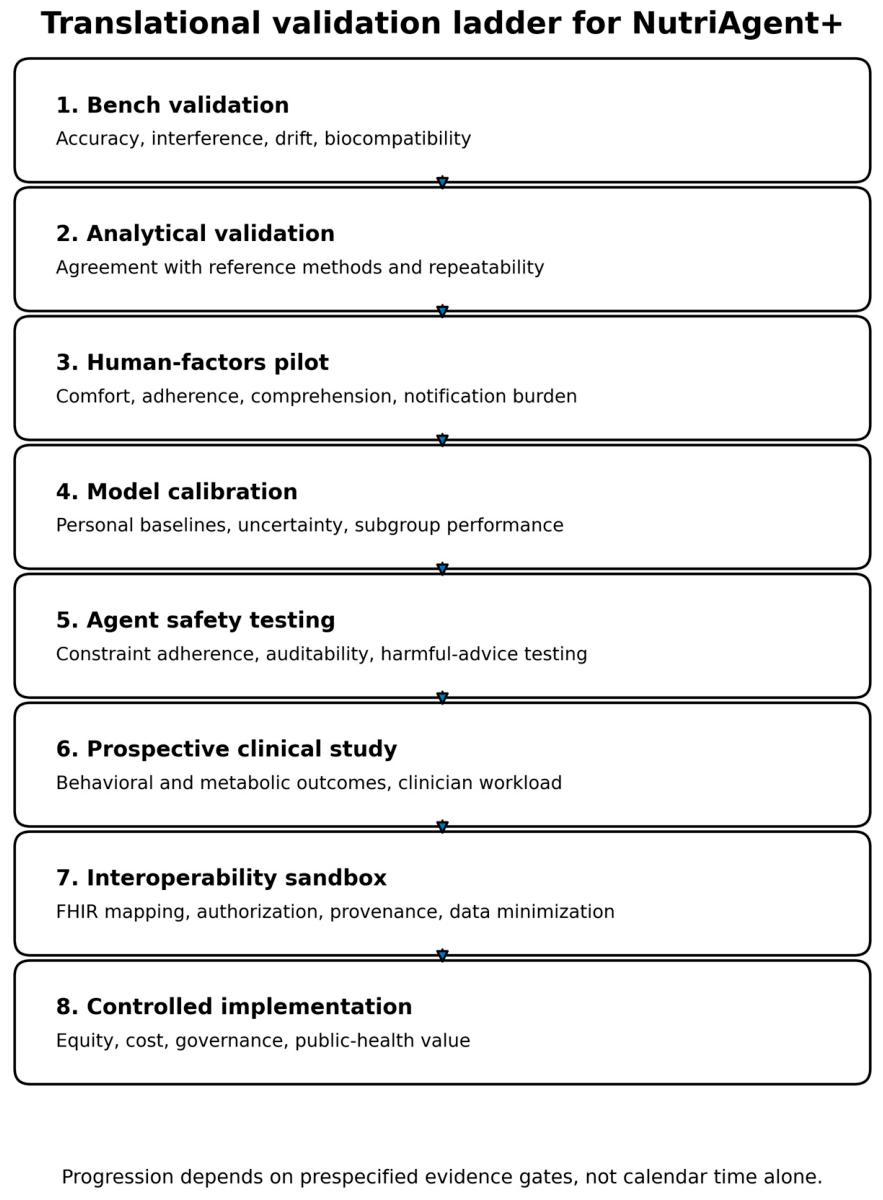
The original innovation proposal included a multi-year development roadmap. For a research manuscript, that roadmap is more useful when converted into evidence gates. Figure 3 proposes an eight-stage ladder in which each stage can stop the program if prespecified criteria are not met.
6.1. Stage-Specific Research Questions
Table 2.
Stage-specific questions and evidence gates for the proposed NutriAgent+ translational pathway.
Table 2.
Stage-specific questions and evidence gates for the proposed NutriAgent+ translational pathway.
| Stage | Core question | Example endpoints | Go/no-go logic |
|---|---|---|---|
| Bench validation | Does the sensor measure what it claims under controlled conditions? | Accuracy, precision, interference, drift, response time, stability | Stop if analytical performance is inadequate for intended use. |
| Analytical validation | Does the wearable output agree with an appropriate reference method? | Agreement, calibration error, repeatability, within-person variability | Proceed only for signals with interpretable and reproducible relationships. |
| Human-factors pilot | Can people use the system safely and comfortably? | Skin tolerance, wear time, comprehension, adherence, burden | Redesign if discomfort, misunderstanding, or alert fatigue is substantial. |
| Model calibration | Can the system estimate useful personal states without hidden subgroup failure? | Calibration, discrimination, uncertainty coverage, subgroup error | Require prespecified performance across relevant subgroups. |
| Agent safety | Does the agent obey behavioral and clinical constraints? | Unsafe recommendation rate, refusal behavior, auditability, override success | Prespecify zero-tolerance high-severity failure classes. |
| Prospective study | Does feedback improve meaningful outcomes? | Dietary behavior, validated metabolic outcomes, adherence, clinician workload | Require benefit beyond measurement alone and monitor unintended harms. |
| Interoperability sandbox | Can validated outputs be exchanged safely? | FHIR conformance, authorization, data minimization, provenance | No production connection until mapping and governance are approved. |
| Controlled implementation | Is the system useful, equitable, and sustainable? | Cost, access, subgroup uptake, retention, implementation outcomes | Scale only if benefit is not concentrated in already advantaged users. |
7. Safety, Governance, and Equity
The most important shift from the original proposal is that safety is treated as part of the architecture rather than an external ethics paragraph. Wearable data are noisy, high-dimensional, temporally dense, and often intimate. AI agents add another layer of risk because they can translate inference into action. The system therefore requires governance controls including data minimization, explicit consent, provenance, audit logs, transparent uncertainty, and the ability for users or clinicians to suspend automated functions. International AI-for-health guidance similarly emphasizes autonomy, safety, transparency, accountability, inclusiveness, and responsiveness [14].
Measurement error can also become an equity problem. If device performance differs by skin characteristics, climate, sweating patterns, device access, language, or patterns of smartphone use, a model may be well calibrated in the development cohort and systematically less reliable elsewhere. Recent work on AI-enabled precision nutrition argues that measurement error across wearables, dietary data, and multi-omics can propagate into biased recommendations and widen disparities [15]. Equity testing should therefore be planned before deployment, not added only after a harm signal emerges.
Notification burden is another safety issue. A system that detects every small physiological fluctuation may produce too many alerts, causing anxiety, disengagement, or overmedicalization of normal variation. The design objective should be decision value, not maximal sensitivity. In many circumstances, the safest output may be no recommendation at all.
Clinician oversight must also be proportional. Requiring a clinician to approve every low-risk suggestion defeats scalability, while removing clinicians from high-risk decisions is unsafe. The framework therefore separates wellness-level coaching from clinically consequential interpretation and uses escalation only when predefined thresholds or uncertainty conditions are met.
8. Research and Implementation Agenda for Indonesia
Indonesia provides a particularly relevant setting for this research because the health system must address undernutrition and diet-related noncommunicable disease simultaneously while digital-health infrastructure is expanding. The opportunity is not simply to import a consumer wearable and connect it to a national database. A locally meaningful program would need to validate sensor performance in tropical conditions, study dietary patterns not represented in many Western food datasets, support Indonesian-language explanations, and evaluate whether recommendations remain useful across different socioeconomic and geographic contexts.
A practical first study should be narrower than the full NutriAgent+ vision. Investigators could evaluate a wrist-worn PPG and accelerometer platform grounded in wearable-validation literature [24,25,26]. A smartphone-derived behavioral-context stream could use variables locally demonstrated by Faradis and colleagues [37], while continuous acquisition, provenance, consent, and privacy safeguards would be prospectively specified. The study could combine this with timestamped meal logging and food-image assistance [10,28,29,30], retrieve nutrient values from TKPI and Badan Pangan Nasional sources [32,33], and use optional CGM in a prespecified research subset whose population and interpretation are explicitly defined [31,35,36]. The study should ask whether the fused context predicts or explains prespecified outcomes better than meal logging alone, while quantifying missing data, signal quality, participant burden, and subgroup performance. This design creates a measurable baseline before adding novel sweat chemistry.
A second research stream could focus on the intelligent skin overlay as an analytical device independent of the AI agent. Sodium, potassium, pH, sweat rate, and temperature are reasonable first research candidates because the literature provides direct sensing precedents and places them within sweat-state or hydration-monitoring research, while also emphasizing context-dependent reliability and physiological interpretation [6,18,19,20,21]. Any proposed glucose, lactate, or other metabolite channel should be validated separately against an appropriate reference method in the relevant biofluid and should demonstrate an interpretable physiological relationship before being admitted to the agentic decision layer [18,19,22,23]. Separating device validation from decision-support validation prevents an AI model from masking weaknesses in the underlying biosensor.
A third stream should address interoperability. SATUSEHAT's use of HL7 FHIR provides a standardized exchange framework [16,17]. Wearable nutrition data would still require design decisions about resource selection, terminology, provenance, consent, and the distinction between patient-generated health data and clinically verified observations. Sandbox integration is therefore best considered an experimental endpoint after the measurement layer has stabilized.
8.1. Research-Standardization Layer: OHDSI/OMOP
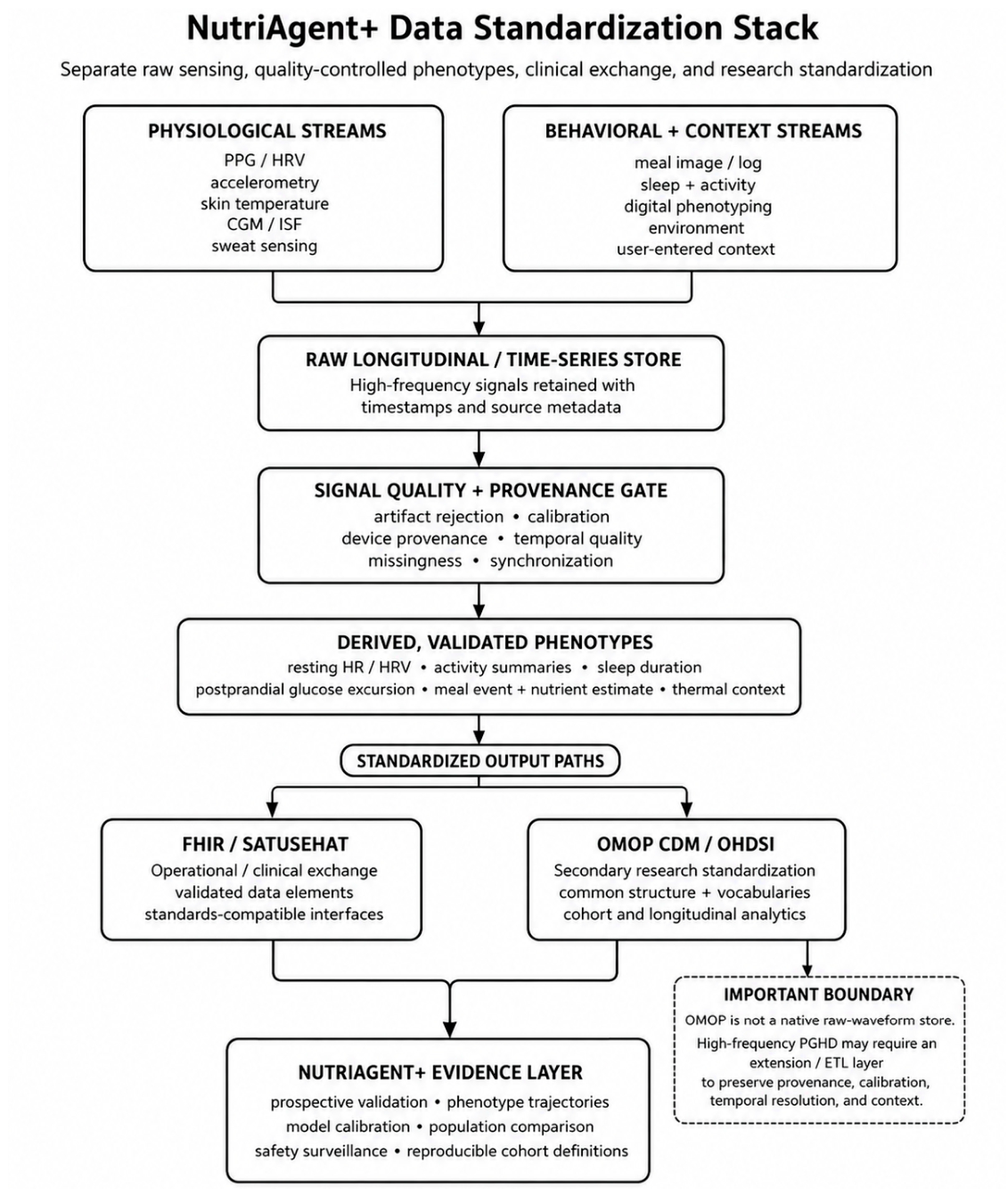
FHIR and OMOP serve complementary rather than interchangeable roles. For NutriAgent+, FHIR-based interfaces are most relevant to operational exchange of validated data elements with clinical or national health infrastructure, whereas the Observational Medical Outcomes Partnership Common Data Model (OMOP CDM) within the OHDSI ecosystem is better suited to harmonizing observational data for secondary research. OMOP CDM v5.4 provides standardized clinical, device, measurement, observation, vocabulary, metadata, and cohort structures that can support reproducible cohort-based analyses once source data have been transformed through a defined ETL process [38].
The main advantage for NutriAgent+ is that a research-standardization layer could convert selected, quality-gated derived phenotypes into a common structure instead of maintaining institution-specific variable definitions indefinitely. This would support clearer cohort definitions, cross-dataset comparison, data-quality assessment, and longitudinal evaluation of whether multimodal phenotypes predict clinically meaningful outcomes. However, standardization should occur after measurement validation and feature derivation; transforming a noisy or biologically ambiguous sensor output into OMOP does not make that output valid.
The principal limitation is that high-frequency patient-generated health data do not fit naturally into the core OMOP model. Recent work specifically addressing wearable and patient-reported PGHD notes gaps in native representation of device provenance, calibration parameters, temporal resolution, and contextual metadata, and therefore proposes an extension layer and dedicated ETL pathway rather than direct dumping of raw time-series data into the CDM [39]. For NutriAgent+, raw PPG waveforms, accelerometry, or dense sensor streams should therefore remain in an appropriate longitudinal time-series store, while only validated derived variables, their provenance, and research-relevant summaries are mapped into OMOP-compatible structures.
Figure 4.
NutriAgent+ data standardization stack. High-frequency physiological and behavioral streams remain in a longitudinal time-series store; quality control and provenance checks precede derivation of interpretable phenotypes. Validated data elements may then follow separate pathways for FHIR/SATUSEHAT-oriented operational exchange and OMOP/OHDSI-oriented secondary research. OMOP provides a standardized observational research structure, but high-frequency patient-generated health data may require an extension and ETL layer to preserve provenance, calibration, temporal resolution, and contextual metadata [38,39].
Figure 4.
NutriAgent+ data standardization stack. High-frequency physiological and behavioral streams remain in a longitudinal time-series store; quality control and provenance checks precede derivation of interpretable phenotypes. Validated data elements may then follow separate pathways for FHIR/SATUSEHAT-oriented operational exchange and OMOP/OHDSI-oriented secondary research. OMOP provides a standardized observational research structure, but high-frequency patient-generated health data may require an extension and ETL layer to preserve provenance, calibration, temporal resolution, and contextual metadata [38,39].
9. Limitations of the Concept
This paper is conceptual and does not report original experimental data, device prototypes, clinical outcomes, or prospective validation. Several proposed sensing modalities are at different technology-readiness levels, and the architecture should not be interpreted as evidence that all can be combined into a single accurate patch today.
The framework also does not establish that continuous monitoring is superior to simpler interventions. A digital system should justify its additional cost and complexity by improving outcomes, adherence, timing, or equity beyond established nutrition counseling and public-health measures. Precision tools should complement, not distract from, population interventions addressing food environments, pricing, marketing, and access.
Finally, agentic AI is evolving rapidly. Published healthcare evidence remains early, and recent reviews and evidence maps emphasize unresolved validation, governance, auditability, and oversight requirements [12,13]. For that reason, the enduring contribution of the framework is not a particular model architecture. It is the insistence on bounded autonomy, measurable uncertainty, staged validation, and an explicit separation between sensing, inference, recommendation, and health-system action.
The proposed data layer is intentionally heterogeneous. PPG, accelerometry, CGM, sweat chemistry, meal images, food-composition tables, and clinical records do not share the same sampling frequency, error model, biological specificity, or regulatory status. Treating them as interchangeable features would create false precision. The framework therefore requires modality-specific validation and source provenance before multimodal fusion, and it permits a data stream to be excluded when its uncertainty exceeds its expected decision value.
10. Conclusion
NutriAgent+ is best understood as a research program rather than a finished product. Its core hypothesis is that validated multimodal signals, interpreted relative to individual context and governed by a bounded AI agent, could support more timely and personalized nutrition decisions. The hypothesis is plausible, but plausibility is not validation. The path from concept to public-health infrastructure requires analytical accuracy, human-factors evidence, prospective benefit, fairness testing, safety constraints, and interoperability governance. Reframed this way, NutriAgent+ becomes a falsifiable and multidisciplinary agenda that can generate useful knowledge even if some sensors, algorithms, or deployment assumptions ultimately fail.
Author Contributions
Shahzada Fayzul Haq: conceptualization and writing - original draft. Jorgy Rahmat Syahhada: writing - original draft and manuscript organization. Ivanthaka Cyril Yudhia Shandy: literature identification and writing - review and editing. Qorry Amanda: supervision, conceptual design, and writing - review and editing.
Ethics Statement
Not applicable. This manuscript is a conceptual paper and reports no research involving human participants, animals, or identifiable patient data.
Data Availability
No new dataset was generated or analyzed for this conceptual manuscript.
Generative AI Assistance
Generative AI tools were used for language editing and structural refinement. All authors remain responsible for verifying the manuscript, citations, interpretations, and final submitted content.
References
- World Health Organization Regional Office for South-East Asia. The Double Burden of Malnutrition: Priority Actions on Ending Childhood Obesity. WHO Regional Office for South-East Asia. 2020; ISBN 978-92-9022-789-2.
- Badan Kebijakan Pembangunan Kesehatan. Survei Kesehatan Indonesia (SKI) dalam Angka. Badan Kebijakan Pembangunan Kesehatan. 2024.
- Zeevi, D.; Korem, T.; Zmora, N.; et al. Personalized nutrition by prediction of glycemic responses. Cell 2015, 163(5), 1079–1094. [Google Scholar] [CrossRef] [PubMed]
- Merino, J.; Linenberg, I.; Bermingham, K.M.; et al. Validity of continuous glucose monitoring for categorizing glycemic responses to diet: implications for use in personalized nutrition. Am. J. Clin. Nutr. 2022, 115(6), 1569–1576. [Google Scholar] [CrossRef]
- Hengist, A.; Ong, J.A.; McNeel, K.; Guo, J.; Hall, K.D. Imprecision nutrition? Intraindividual variability of glucose responses to duplicate presented meals in adults without diabetes. Am. J. Clin. Nutr. 2025, 121(1), 74–82. [Google Scholar] [CrossRef] [PubMed]
- Gao, W.; Emaminejad, S.; Nyein, H.Y.Y.; et al. Fully integrated wearable sensor arrays for multiplexed in situ perspiration analysis. Nature 2016, 529(7587), 509–514. [Google Scholar] [CrossRef] [PubMed]
- Sempionatto, J.R.; Ruiz-Valdepenas Montiel, V.; Vargas, E.; Teymourian, H.; Wang, J. Wearable and mobile sensors for personalized nutrition. ACS Sens. 2021, 6(5), 1745–1760. [Google Scholar] [CrossRef] [PubMed]
- Shi, Z.; Li, X.; Shuai, Y.; Lu, Y.; Liu, Q. The development of wearable technologies and their potential for measuring nutrient intake: towards precision nutrition. Nutr. Bull. 2022, 47(4), 388–406. [Google Scholar] [CrossRef] [PubMed]
- Shin, S.; Gao, W. Making sweat measurable: induction, sampling, and refreshment in wearable biofluid sensing. Adv. Sci. (Weinh) Published online. 2026, e75684. [CrossRef] [PubMed]
- Mortazavi, B.J.; Gutierrez-Osuna, R. A review of digital innovations for diet monitoring and precision nutrition. J. Diabetes Sci. Technol. 2023, 17(1), 217–223. [Google Scholar] [CrossRef] [PubMed]
- Wang, L.; Allman-Farinelli, M.; Hekler, E.; Rangan, A. A scoping review of sensor-based capture of eating and drinking occasions that could be used for enhancing personalized nutrition interventions in real time. Adv. Nutr. 2026, 17(2), 100575. [Google Scholar] [CrossRef] [PubMed]
- Collaco, B.G.; Haider, S.A.; Prabha, S.; et al. The role of agentic artificial intelligence in healthcare: a scoping review. npj Digit Med. 2026, 9, 345. [Google Scholar] [CrossRef] [PubMed]
- Xu, J.; Ko, J.M.; Kvedar, J.C. AI agents in clinical practice: an evidence map. npj Digit Med. 2026. [Google Scholar] [CrossRef] [PubMed]
- World Health Organization. Ethics and Governance of Artificial Intelligence for Health: WHO Guidance; World Health Organization, 2021; ISBN 978-92-4-002920-0. [Google Scholar]
- Mai, A.; Luan, Y.; Loy, S.L.; et al. Reducing bias and enhancing equity in AI-enabled precision nutrition: addressing measurement error across wearables, multiomics, and dietary data. Front Digit Health 2026, 8, 1805704. [Google Scholar] [CrossRef] [PubMed]
- SATUSEHAT Platform. FHIR. Ministry of Health Republic of Indonesia. Available online: https://satusehat.kemkes.go.id/platform/docs/id/fhir/ (accessed on 23 Aug 2026).
- SATUSEHAT Platform. Interoperabilitas. Ministry of Health Republic of Indonesia. Available online: https://satusehat.kemkes.go.id/platform/docs/id/api-catalogue/integrations/ (accessed on 23 Aug 2026).
- Davis, N.; Heikenfeld, J.; Milla, C.; Javey, A. The challenges and promise of sweat sensing. Nat. Biotechnol. 2024, 42(6), 860–871. [Google Scholar] [CrossRef] [PubMed]
- Cinca-Morros, S.; Garcia-Rey, S.; Alvarez-Herms, J.; Basabe-Desmonts, L.; Benito-Lopez, F. A physiological perspective of the relevance of sweat biomarkers and their detection by wearable microfluidic technology: a review. Anal. Chim. Acta 2024, 1327, 342988. [Google Scholar] [CrossRef] [PubMed]
- Rezvani Jalal, N.; Madrakian, T.; Ahmadi, M.; et al. Wireless wearable potentiometric sensor for simultaneous determination of pH, sodium and potassium in human sweat. Sci. Rep. 2024, 14(1), 11526. [Google Scholar] [CrossRef] [PubMed]
- Belabbaci, N.A.; Anaadumba, R.; Alam, M.A.U. Recent advancements in wearable hydration-monitoring technologies: scoping review of sensors, trends, and future directions. JMIR Mhealth Uhealth 2025, 13, e60569. [Google Scholar] [CrossRef] [PubMed]
- Kim, G.; Ahn, H.; Chaj Ulloa, J.; Gao, W. Microneedle sensors for dermal interstitial fluid analysis. Med-X 2024, 2, 15. [Google Scholar] [CrossRef] [PubMed]
- Tehrani, F.; Teymourian, H.; Wuerstle, B.; et al. An integrated wearable microneedle array for the continuous monitoring of multiple biomarkers in interstitial fluid. Nat. BioMed Eng. 2022, 6(11), 1214–1224. [Google Scholar] [CrossRef] [PubMed]
- Rehman, R.Z.U.; Chatterjee, M.; Manyakov, N.V.; et al. Assessment of physiological signals from photoplethysmography sensors compared to an electrocardiogram sensor: a validation study in daily life. Sensors 2024, 24(21), 6826. [Google Scholar] [CrossRef] [PubMed]
- Doherty, C.; Baldwin, M.; Keogh, A.; Caulfield, B.; Argent, R. Keeping pace with wearables: a living umbrella review of systematic reviews evaluating the accuracy of consumer wearable technologies in health measurement. Sports Med. 2024, 54(11), 2907–2926. [Google Scholar] [CrossRef] [PubMed]
- Letts, E.; Jakubowski, J.S.; King-Dowling, S.; Clevenger, K.A.; Kobsar, D.; Obeid, J. Accelerometer techniques for capturing human movement validated against direct observation: a scoping review. Physiol. Meas. 2024, 45(7), 07TR01. [Google Scholar] [CrossRef] [PubMed]
- Birrer, V.; Elgendi, M.; Lambercy, O.; Menon, C. Evaluating reliability in wearable devices for sleep staging. npj Digit Med. 2024, 7(1), 74. [Google Scholar] [CrossRef] [PubMed]
- Shonkoff, E.; Copeland Cara, K.; Pei, X.A.; et al. AI-based digital image dietary assessment methods compared to humans and ground truth: a systematic review. Ann. Med. 2023, 55(2), 2273497. [Google Scholar] [CrossRef] [PubMed]
- Chotwanvirat, P.; Prachansuwan, A.; Sridonpai, P.; Kriengsinyos, W. Advancements in using AI for dietary assessment based on food images: scoping review. J. Med. Internet Res. 2024, 26, e51432. [Google Scholar] [CrossRef] [PubMed]
- Cofre, S.; Sanchez, C.; Quezada-Figueroa, G.; Lopez-Cortes, X.A. Validity and accuracy of artificial intelligence-based dietary intake assessment methods: a systematic review. Br. J. Nutr. 2025, 133(9), 1241–1253. [Google Scholar] [CrossRef] [PubMed]
- Ben-Yacov, O.; Godneva, A.; Rein, M.; et al. Personalized postprandial glucose response-targeting diet versus Mediterranean diet for glycemic control in prediabetes. Diabetes Care 2021, 44(9), 1980–1991. [Google Scholar] [CrossRef] [PubMed]
- Kementerian Kesehatan Republik Indonesia. Tabel Komposisi Pangan Indonesia. Revisi Cetakan 1; Kementerian Kesehatan RI, 2020; ISBN 9786233010368. [Google Scholar]
- Badan Pangan Nasional. Tabel Komposisi Pangan Segar Indonesia. Available online: https://badanpangan.go.id/tabel-komposisi-pangan-segar-indonesia (accessed on 23 Aug 2026).
- Bach, A.J.E.; Stewart, I.B.; Minett, G.M.; Costello, J.T. Does the technique employed for skin temperature assessment alter outcomes? A systematic review. Physiol. Meas. 2015, 36(9), R27–R51. [Google Scholar] [CrossRef] [PubMed]
- Hoque, B.; Al-Mesaifri, A.; Suleiman, S.; Tariq, Z.U.A.; Househ, M. Continuous glucose monitoring and personalized nutrition in type 2 diabetes: a scoping review. Stud. Health Technol. Inform. 2026, 338, 281–285. [Google Scholar] [CrossRef] [PubMed]
- Bannuru, R.R.; Bellini, N.J.; Bergenstal, R.M.; et al. Continuous glucose monitoring to guide lifestyle choices with a focus on nutrition in the management of type 2 diabetes: a systematic review and meta-analysis. J. Diabetes Sci. Technol. Published online. 2025. [Google Scholar] [CrossRef] [PubMed]
- Faradis, M.I.; Dhiyaulhaq, D.; Riziq, H.; Amanda, Q. Feasibility of using passive digital phenotyping data from smartphones as emerging health sensors in medical students: a pilot exploratory study. Dian Med. J. 2026, 1(2), 1–15. [Google Scholar] [CrossRef]
- Observational Health Data Sciences and Informatics. OMOP Common Data Model v5.4. OHDSI. Available online: https://ohdsi.github.io/CommonDataModel/cdm54.html (accessed on 23 Aug 2026).
- Abedian, S.; Hussein, R. Proposed schema extensions and ETL pathways for integrating wearable and patient-reported PGHD into OMOP-CDM for secondary use. Stud. Health Technol. Inform. 2026, 336, 1885–1889. [Google Scholar] [CrossRef] [PubMed]
Figure 1.
Proposed NutriAgent+ architecture. The AI layer receives only quality-gated signals and operates within predefined safety boundaries. SATUSEHAT integration is a later-stage interface, not an assumption of immediate deployment.
Figure 1.
Proposed NutriAgent+ architecture. The AI layer receives only quality-gated signals and operates within predefined safety boundaries. SATUSEHAT integration is a later-stage interface, not an assumption of immediate deployment.
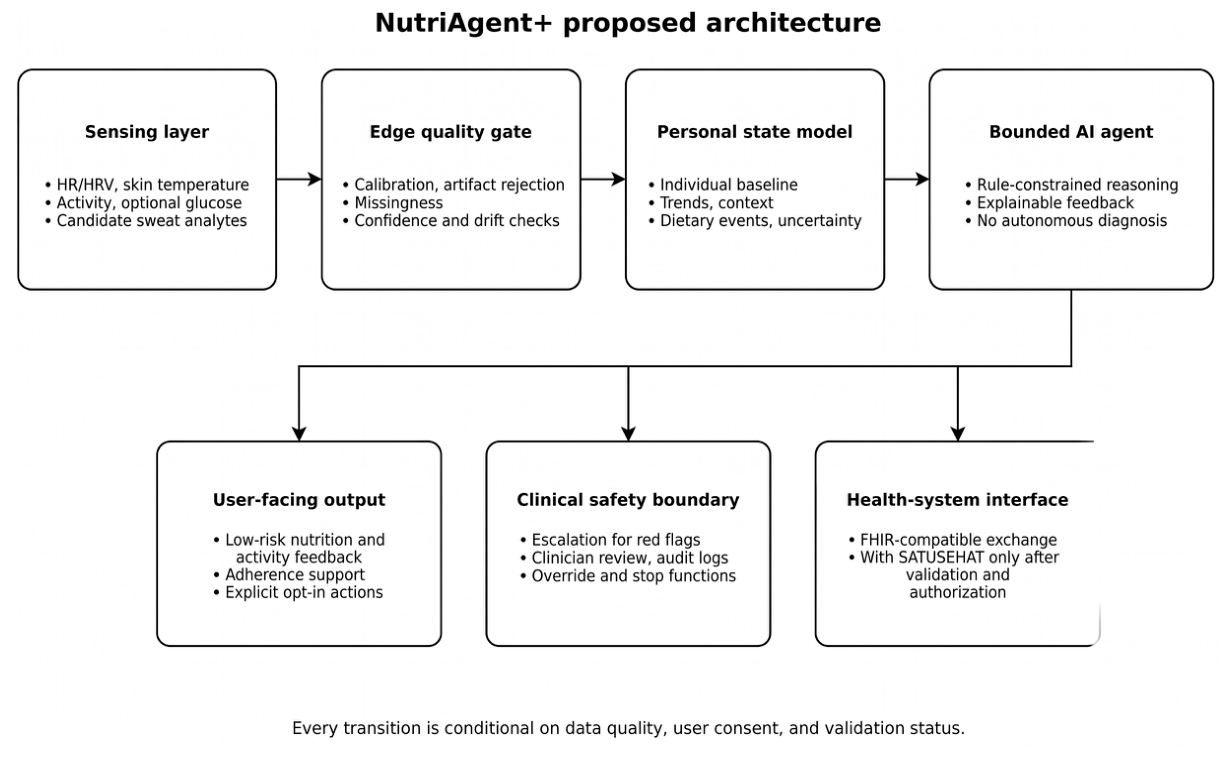
Figure 2.
Conceptual wearable form factor for NutriAgent+. The exploded schematic illustrates a possible modular patch containing optical PPG, skin-temperature sensing, sweat microfluidic/electrochemical sensing, an optional minimally invasive microneedle interstitial-fluid module, edge signal processing, and wireless communication. The illustration is conceptual and does not imply that all modules have been integrated or clinically validated.
Figure 2.
Conceptual wearable form factor for NutriAgent+. The exploded schematic illustrates a possible modular patch containing optical PPG, skin-temperature sensing, sweat microfluidic/electrochemical sensing, an optional minimally invasive microneedle interstitial-fluid module, edge signal processing, and wireless communication. The illustration is conceptual and does not imply that all modules have been integrated or clinically validated.
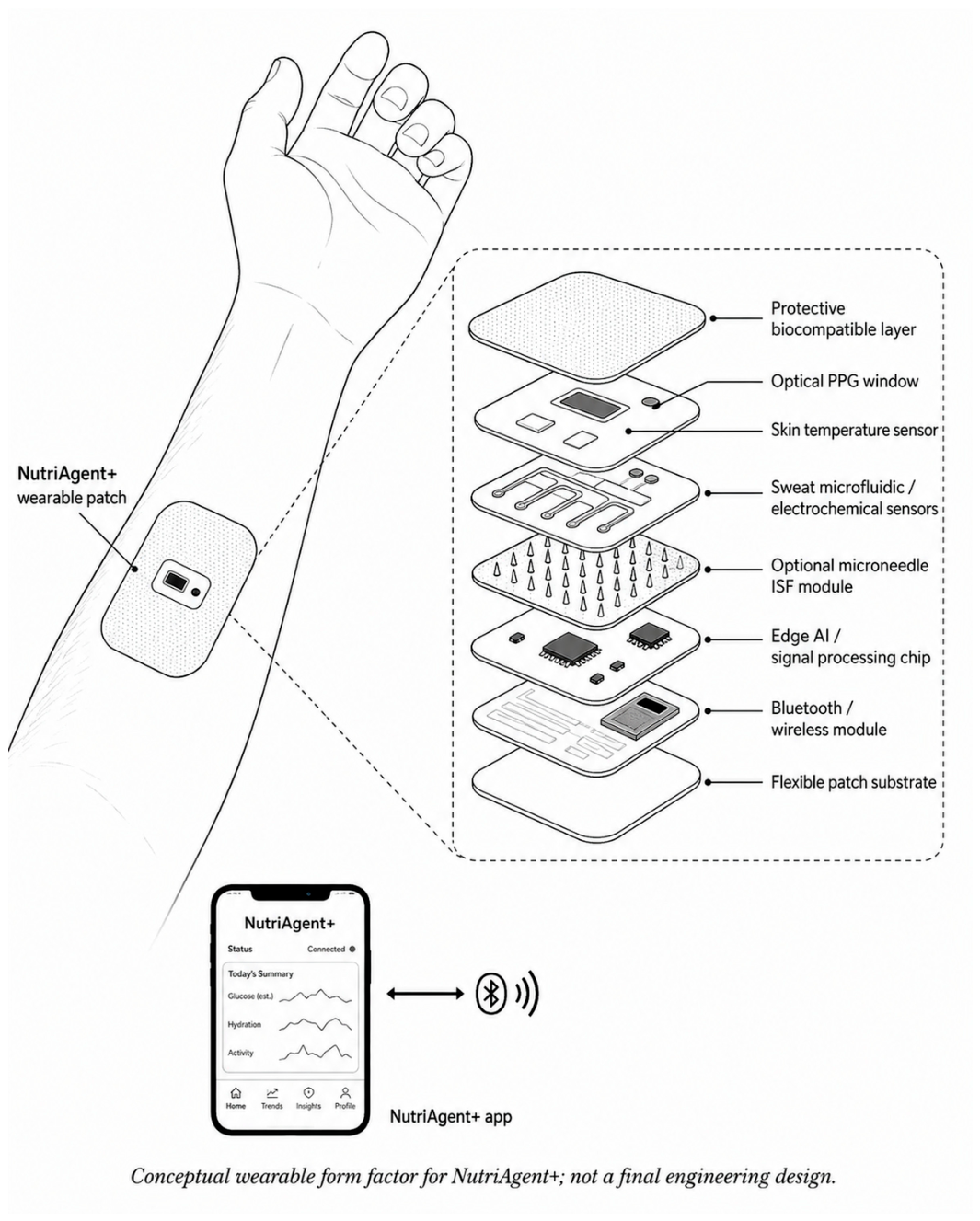
Figure 3.
Eight-stage translational validation ladder. Progression should depend on prespecified go/no-go criteria rather than calendar time alone.
Figure 3.
Eight-stage translational validation ladder. Progression should depend on prespecified go/no-go criteria rather than calendar time alone.
Disclaimer/Publisher’s Note: The statements, opinions and data contained in all publications are solely those of the individual author(s) and contributor(s) and not of MDPI and/or the editor(s). MDPI and/or the editor(s) disclaim responsibility for any injury to people or property resulting from any ideas, methods, instructions or products referred to in the content. |
© 2026 by the authors. Licensee MDPI, Basel, Switzerland. This article is an open access article distributed under the terms and conditions of the Creative Commons Attribution (CC BY) license (http://creativecommons.org/licenses/by/4.0/).
Copyright: This open access article is published under a Creative Commons CC BY 4.0 license, which permit the free download, distribution, and reuse, provided that the author and preprint are cited in any reuse.