

Submitted:
21 August 2026
Posted:
26 August 2026
You are already at the latest version
Abstract
The identification of emerging research trends from large bibliographic databases heavily relies on extracting textual information from publication titles and abstracts. However, robust computational workflows are required to efficiently process and synthesize these rapidly expanding textual spaces. To address this challenge, this study aims to develop and validate a structured text-mining pipeline, using global research on energy security and energy politics as a case study. The empirical analysis utilizes a corpus of 2,692 research and review articles published between 2022 and 2026 retrieved from the ScienceDirect database. The study demonstrates the feasibility of this integrated pipeline, which systematically combines text retrieval, Stanza-based syntactic noun phrase extraction, and the FP-Growth algorithm with VOSviewer mapping. Applied to the energy domain, the pipeline successfully unveiled critical structural shifts: while the thematic core remains highly persistent, peripheral research highlights a distinct movement away from abstract, high-level discussions toward more operational and solution-oriented perspectives. The empirical findings hold practical utility for streamlining information retrieval and supporting systematic literature reviews within specialized research domains. Future development of the method involves refining key-term ranking strategies and transitioning to higher-order community detection utilizing a hypergraph approach.
Keywords:
energy security
; ScienceDirect bibliometric data
; thematic drift
; Stanza–FP-Growth–VOSviewer framework
Introduction
The identification of current and emerging research topics within large bibliographic databases increasingly relies on the computational analysis of textual information contained in publication records. In this context, titles and abstracts are of paramount importance; they provide concise representations of scientific subject matter and are consistently available across vast datasets. Text-based bibliometric approaches complement traditional citation analyses by elucidating the specific vocabulary through which research problems, methodologies, objects, and applications are articulated. Consequently, isolating relevant vocabulary and candidate key terms from bibliographic metadata constitutes a critical component in analyzing research trends and thematic structures. The text-mining functionality within VOSviewer exemplifies an established methodology for integrating lexical information from titles and abstracts with bibliometric mapping and co-occurrence analysis [1]. However, recent scholarship emphasizes that the completeness and fidelity of bibliographic metadata vary considerably across data sources, including open scholarly databases. Comparative evaluations of OpenAlex and alternative bibliographic platforms reveal both substantial coverage and field-specific limitations in metadata integrity, suggesting that the choice of a specific metadata field can systematically skew the outcomes of large-scale bibliometric analyses [2,3,4].
Author-assigned keywords might superficially appear to be the most definitive source for mapping the vocabulary of a research domain, given their intent to signify author-validated concepts. Nevertheless, their utility for large-scale systematic analysis is constrained by both metadata scarcity and inherent selection biases. Within open bibliographic infrastructures, author-assigned keywords are frequently missing or inconsistently populated. Furthermore, automatically generated keywords provided by certain databases represent a fundamentally different category of metadata and must not be conflated with author-defined terms. Crucially, the lexical overlap between author keywords and the actual text of a publication is incomplete. In an empirical investigation of keyword selection, Lu et al. [5] demonstrated that, on average, only 31.0% of author keywords occurred in titles, 52.1% in abstracts, and 56.7% in the combined title-abstract field. Conversely, an average of 43.3% of author-assigned keywords did not appear in either field. The authors further demonstrated that keyword selection is governed not merely by manifest text content, but also by the authors’ prior and background knowledge. Consequently, author-assigned keywords cannot be treated as a direct or exhaustive proxy for the semantic content expressed in titles and abstracts [5,6].
These limitations justify the extraction of topic-related vocabulary directly from the primary textual content of bibliographic records. Titles and abstracts contain the exact terminology deployed by researchers to formulate questions, delineate methodological frameworks, identify objects of study, and characterize outcomes. Vocabulary derived from these fields is thus intrinsically linked to the textual narrative of the research, rather than to a supplementary metadata field subject to varying availability and subjective selection criteria. This distinction becomes acute when attempting to map the exact vocabulary representing a specific research topic across a comprehensive publication corpus. The resulting lexical representation not only complements author-assigned keywords but also uncovers critical terms omitted from keyword fields. While the availability and quality of titles and abstracts remain pertinent metadata variables in open databases, these fields generally represent the most stable and consistently populated descriptive elements within bibliographic records [2,3].
The linguistic configuration of the extracted units is equally critical to analytical precision. Individual words often lack the specificity required to identify distinct scientific concepts, as they frequently belong to general academic vocabulary shared across disparate domains. Conversely, multiword expressions—specifically noun phrases—provide superior conceptual specificity by appending modifiers to a head noun, thereby delimiting its semantic scope. Terminology research indicates that specialized scientific concepts are predominantly realized through noun-phrase structures composed of nouns and adjectives, with prepositional phrases appearing in a smaller, albeit significant, proportion of cases. Furthermore, multiword expressions constitute a substantial component of technical vocabulary, making them ideal candidates for automatic terminology recognition [7]. This is supported by advancements in biomedical information processing, which demonstrate the efficacy of hybrid linguistic and statistical approaches for extracting multiword terminology from scientific corpora [7]. These insights validate the use of noun phrases as the primary lexical units for representing specialized scientific content.
The distinct utility of noun phrases in scientific literature derives from their capacity to encode domain-specific concepts in a highly compact lexical form. Phrases such as neural network model, climate change adaptation, or natural language processing denote precise conceptual combinations that cannot be captured with equivalent fidelity by analyzing their constituent words in isolation. Consequently, noun phrases operate as intermediate lexical units bridging individual tokens and macro-level thematic structures. This structural relevance aligns with technical terminology frameworks, where syntactically organized multiword expressions form the core of specialized vocabularies, and with computational linguistics research utilizing noun-phrase candidates for concept identification [6,7]. Within a bibliometric framework, these phrases can be quantified, normalized, mapped across documents, and integrated into broader analyses of lexical distributions and thematic topologies.
Noun-phrase extraction is already embedded within prominent bibliometric text-mining workflows. For instance, VOSviewer implements a rule-based, shallow syntactic parser to identify noun phrases in titles and abstracts. This workflow executes sentence detection and part-of-speech (POS) tagging via Apache OpenNLP, subsequently extracting noun phrases from contiguous word sequences based on predefined POS heuristics. According to the VOSviewer technical documentation, a noun phrase is defined as terminating in a noun preceded chiefly by nouns or adjectives; in cases of overlapping strings, the longest matching sequence is selected, whereas complex constructions containing internal prepositions are omitted. While this procedure efficiently generates lexical units for term co-occurrence mapping, it models phrase architecture via sequential POS strings rather than hierarchical constituency representations [1]. The utility of phrase-based candidate generation is further evidenced by embedding-based keyphrase extraction frameworks such as EmbedRank, which generate candidate phrases and rank them based on semantic proximity to the global document vector [8,9]. These methodologies underscore the value of multiword units in text analytics, though their mention here does not imply a comparative performance evaluation within this study. For unsupervised keyphrase extraction from single documents, PatternRank [10] integrates part-of-speech tagging with pretrained language models. Its practical realization is provided by KeyphraseVectorizers, an open-source framework supporting both POS-based candidate generation and EmbedRank functionalities.
The present study focuses on leveraging noun phrases as the foundational lexical units for targeted research topic analysis. Accordingly, our extraction framework is engineered to preserve the syntactic integrity of complex multiword expressions, rather than isolating candidate terms based solely on localized POS sequences. This distinction is vital because scientific noun phrases regularly feature multiple nested modifiers and intricate nominal structures. A constituency-based representation yields hierarchical data regarding internal sentence architecture, enabling the precise identification of noun phrases as discrete syntactic constituents. This structural insight provides an objective basis for delineating phrase boundaries and preserving the internal relationships among sub-components. The extracted noun phrases subsequently serve as robust candidate lexical units for downstream thematic and vocabulary analysis.
Stanza1 provides the computational architecture for this extraction pipeline. As a neural natural language processing toolkit, Stanza integrates tokenization, POS tagging, lemmatization, and dependency parsing alongside constituency parsing for supported languages [11]. Its efficacy in processing highly specialized scientific prose is well-documented, particularly through the validation of its biomedical and clinical English model packages, which deliver robust neural syntactic parsing for domain-specific texts [12]. For our objectives, the constituency parser is uniquely valuable because it outputs the hierarchical syntactic matrices necessary to isolate complex noun-phrase constituents. This architecture ensures that candidate lexical units are defined strictly by syntactic boundaries while maintaining the scalability essential for processing extensive corpora of publication metadata.
A definitive methodological advantage of utilizing Stanza in this study is the invocation of its package=‘default_accurate’ configuration. This parameter deploys transformer-based constituency models, including BERT-backed architectures, optimized specifically for high-fidelity syntactic parsing. Benchmarks within the Stanza documentation indicate that these transformer-based models yield significantly higher parsing metrics than their base counterparts. Achieving this level of precision is critical when the resulting constituency trees dictate the boundaries of noun phrases intended for bibliometric modeling. Opting for the default_accurate pipeline thus strengthens the methodological foundation of the extraction process at the critical stage of candidate phrase demarcation. The implications of this choice are fundamentally methodological rather than merely technical: the fidelity of the constituency parse directly determines the reliability with which complex nominal expressions are isolated. Furthermore, this approach aligns with the established performance metrics of Stanza’s neural models in scientific and biomedical text analytics [11,12].
The resulting pipeline offers a systematic method for constructing topic-specific vocabularies directly from raw scientific text. Utilizing titles and abstracts as primary inputs, the framework extracts structurally validated noun phrases as candidate lexical units, which are subsequently normalized and aggregated across the corpus. This model fundamentally differs from author-keyword analysis; it is systematically derived from the manifest text and operates independently of the presence or integrity of keyword metadata fields. Concurrently, by leveraging noun phrases, this method preserves significantly more contextual and conceptual data than unigram-based vocabularies. This refined lexical representation effectively supports the identification of diagnostic terminology within a research domain, providing a rigorous empirical foundation for evaluating term frequencies, distributions, and macro-level thematic interactions.
The methodological rationale of this study rests upon three interconnected premises. First, author-assigned keywords cannot be assumed to provide a consistent or exhaustive representation of the specialized terminology embedded within scientific literature. Second, noun phrases offer compact, highly informative lexical units that uniquely capture specialized scientific concepts. Third, constituency-based extraction via Stanza, specifically reinforced by the default_accurate configuration, provides a rigorous syntactic framework for isolating these units from titles and abstracts. Ultimately, combining bibliographic text mining with syntactically informed noun-phrase extraction provides a reproducible, high-fidelity methodology for mapping research-specific vocabularies and characterizing the lexical evolution of scientific disciplines.
The objective of this study was to provide a proof of concept for a hybrid Stanza–FP-Growth–VOSviewer approach to tracking thematic drift within ScienceDirect bibliometric data (titles and abstracts) related to energy security.
This work extends the thematic tracking approach presented in [13] by adapting it to the analysis of Energy Security Indicators.
Materials and Methods
The study utilized metadata retrieved from ScienceDirect search results for articles containing the terms “energy security” or “energy politics” in title, abstract or author-specified keywords, restricted to full-length research articles and review articles published between 2022 and 2026. A total of 2,692 records were obtained, of which only one record lacked an entry in the “AB” (abstract) field. Publication metadata were exported from ScienceDirect in RIS format and imported into Zotero version 9.0.6. The records were subsequently exported from Zotero in CSV format to facilitate further analysis.
The title and abstract texts were concatenated into a single field for the subsequent extraction of noun phrases, which were treated in this study as an analogue of indexed keywords.
Noun phrase extraction was performed using Stanza, the official Python natural language processing library developed by the Stanford NLP Group. Text preprocessing was conducted using AnyAscii (Unicode-to-ASCII transliteration), version 0.3.3, compiled from the Rust source code. Following transliteration, the processed text was written to the output file in Unicode encoding. The use of AnyAscii minimized minor orthographic variations that could otherwise affect the extraction of noun phrases. For example, different Unicode representations of dashes and hyphens were normalized to the standard hyphen character, while alternative Unicode representations of letters were transliterated to their ASCII equivalents. Such minor character-level variations may affect the composition of the resulting noun-phrase sets.
Stanza version 1.14.0 served as the NLP framework for noun phrase extraction. Preliminary testing of version 1.12.2 revealed occasional problems in processing multiword terms. Version 1.14.0 was therefore selected as the latest available release as of 1 August 2026.
The principal parameters used for noun phrase extraction were specified as follows:
nlp = stanza.Pipeline(lang=“en”, package=“default_accurate”, processors=“tokenize,pos,constituency,lemma”, tokenize_no_ssplit=False)
Of particular importance was the use of constituency parsing, which is computationally slower but provides more accurate noun phrase identification. A further factor contributing to extraction quality was the use of the default_accurate package.
Following lemmatization, stop words were removed from the extracted noun phrases. The resulting stop-word list comprised 301 items. For each record, consisting of a title and abstract, only noun phrases that were not contained within longer noun phrases were retained. The analysis was restricted to noun phrases comprising two to five words. Single-word terms tend to be relatively general, whereas phrases longer than five words frequently represent combinations of two or more shorter and more frequently occurring noun phrases. The upper limit of five words was adopted with some margin to allow for the potential analysis of longer noun phrases. Although this aspect was beyond the scope of the present study, noun phrases comprising more than four words occurred only rarely in the analyzed corpus.
The co-occurrence of sets of noun phrases across records was analyzed using the fpgrowth utility developed by Christian Borgelt [14].
To achieve a more distinct structural separation, the LinLog/modularity method was preferred over VOSviewer’s2 default Association Strength layout and clustering. This shift adjusts the spatial distribution and modularity optimization, which led to a lower but more macro-level count of clusters in our final map [15].
The samples presented in the tables were generated using standard SQL.
For the literature review in the Introduction section and for the translation of the text into English, AI-based services were employed. The outputs obtained were manually verified and subsequently edited.
Results and Discussion
Main Characteristics of the Identified Noun Phrases in the Records
The distribution of the most frequently occurring noun phrases was examined separately for each year.
In 2022, the ten most frequent noun phrases were energy security (89 occurrences), climate change (21), sustainable development (13), national energy security (13), present study (13), sensitivity analysis (10), environmental sustainability (9), United States (9), renewable energy source (9), and greenhouse emission (8).
Several examples illustrate both the substantive value and the limitations of the extracted phrases. The four-word phrases analytic hierarchy process method and computable general equilibrium model represent meaningful technical concepts, corresponding to the Analytic Hierarchy Process (AHP), developed by Thomas Saaty, and a computable general equilibrium (CGE) model, respectively. In contrast, some extracted sequences appear to represent concatenations of two or more noun phrases rather than semantically coherent multiword terms. Examples include renewable energy energy efficiency and water energy infrastructure natural resource.
In 2023, the ten most frequent noun phrases were energy security (94), greenhouse emission (15), carbon emission (14), climate change (14), renewable energy source (14), national energy security (12), energy transition (10), CO2 emission (9), sustainable development (9), and global energy security (8).
The frequency distribution in 2024 was headed by energy security (157), followed by climate change (31), greenhouse emission (25), sustainable development (24), carbon emission (24), renewable energy source (18), energy transition (14), valuable insight (14), economic growth (14), and renewable energy (14).
In 2025, the ten most frequent noun phrases were energy security (232), climate change (46), sustainable development (30), carbon emission (28), renewable energy source (25), valuable insight (23), environmental impact (23), greenhouse emission (22), environmental sustainability (20), and economic growth (20). For comparison, energy policy, which was also included in the search query, occurred only six times.
In 2026, based on records available as of 31 July 2026, the ten most frequent noun phrases were energy security (189), climate change (28), sensitivity analysis (24), sustainable development (22), environmental sustainability (19), United States (18), national energy security (18), comparative analysis (15), greenhouse emission (15), and proposed framework (14).
A comparison of the most frequent noun phrases across the five-year period indicates a substantial degree of thematic continuity. In particular, energy security, climate change, sustainable development, and renewable energy source consistently constitute the core of the extracted thematic vocabulary. The 2024–2025 period is characterized by a greater presence of terms such as valuable insight and economic growth. In 2026, the extracted vocabulary indicates a shift toward more specific methodological and analytical formulations, including sensitivity analysis, comparative analysis, and proposed framework.
An examination of the more comprehensive set of noun phrases extracted using Stanza also revealed several limitations of the current extraction procedure. In particular, the results suggest that restricting candidate phrases to two to four words may provide a more reliable basis for subsequent analysis. In addition, the methodology should account explicitly for frequently occurring abbreviations and their expanded forms. For example, the corpus contained the extracted phrase geographic information system GIS, which illustrates the potential for redundant or structurally inconsistent representations of the same concept.
Comparison of Term Co-Occurrence Patterns Across 2022–2024 and 2025–2026
To identify broader trends in the publication topics represented by the extracted noun phrases, the data for 2022–2024 and 2025–2026 were subsequently compared.
The data presented in the tables below were generated as follows. The sets of noun phrases extracted using Stanza were aggregated into two groups corresponding to 2022–2024 (1,281 records) and 2025–2026 (1,410 records). The records were then converted to the input format required by the fpgrowth utility: the words within each noun phrase were joined with underscores, while spaces were used as delimiters between phrases. A minimum support threshold of 0.2% was applied to both groups. Only itemsets containing two terms were considered in the principal analysis.
The term energy_security was dominant both among two-term itemsets and among itemsets containing three or four terms. The latter results were not included in the article and were examined solely as a validation step. The primary objective was to determine which terms most frequently co-occurred with energy_security. Selected high-frequency itemsets were also retained, including originality_value → design_methodology_approach, in order to avoid selective manipulation of the results. The reported Score values correspond to those generated by the fpgrowth utility.
For the 2022–2024 group, 177 itemsets with a support of at least 0.2% were identified. For the 2025–2026 group, 313 itemsets met the same minimum-support threshold.
The resulting scores should be interpreted as relative measures, since the two groups contain different numbers of records and consequently differ in the number of identified itemsets.
For each period, the 35 itemsets with the highest Score values were selected for further comparison. These itemsets were examined both with respect to their occurrence exclusively in one of the two periods and with respect to the overlap between the periods. It should be emphasized that the results reflect the specific methodological constraints described above and are not intended to establish any normative or definitive basis for determining a “correct” selection of terms. The primary objective of this analysis was to demonstrate the feasibility of the proposed approach to noun phrase identification and co-occurrence analysis. A secondary objective was to illustrate selected aspects of the evolution of topics related to energy_security.
Table 1 presents the term combinations unique to the top 35 highest-scoring itemsets for 2022–2024, which were absent during the 2025–2026 period.
The terminology specific to the 2022-2024 and energy_security was primarily associated with broad themes related to economic_development, environmental_protection, sustainable_energy_source, technological_advancement, and the energy_sector. The presence of terms such as significant_challenge, novel_approach, and decision_maker further suggests a relatively broad and strategic framing of energy-security research.
Table 2 presents the term combinations unique to the top 35 highest-scoring itemsets for 2025–2026, which were absent during the 2022–2024 period.
The terminology specific to the 2025–2026 period exhibits a more pronounced analytical and application-oriented character. The occurrence of terms such as comparative_analysis, economic_analysis, empirical_analysis, empirical_evidence, and propose_model indicates a stronger representation of analytical and empirical approaches. At the same time, terms including renewable_energy_integration, hybrid_system, economic_viability, policy_implication, and actionable_insight suggest increased attention to the assessment of specific energy-system configurations, economic feasibility, and policy-relevant outcomes.
Table 3 was generated by performing an inner join on the Term1 field between the top 35 highest-scoring itemsets of each period.
The analysis of terms shared across both periods provides additional evidence of thematic continuity. Climate_change → energy_security remained the strongest association in both periods, although its score decreased from 3.354 to 3.050. Several other environmental and emissions-related associations also declined, including greenhouse_emission → energy_security (Diff = −0.553) and carbon_emission → energy_security (Diff = −0.369). These changes indicate that the relative strength of these associations was lower in the second period, while their continued presence confirms their persistent relevance within the thematic context of energy security.
Conversely, several shared associations became stronger in the second period. The largest increase was observed for carbon_emission → climate_change (Diff = +0.801), followed by environmental_impact → energy_security (Diff = +0.567), sustainable_development → energy_security (Diff = +0.383), energy_efficiency → energy_security (Diff = +0.305), and energy_transition → energy_security (Diff = +0.298). Smaller positive changes were observed for renewable_energy, technological_innovation, and climate_change_mitigation in relation to energy_security. In contrast, energy_equity and sensitivity_analysis remained largely stable across the two periods.
Overall, the results indicate a gradual reorientation rather than a complete thematic transformation. Climate change and environmental sustainability remained central to energy-security research; however, the increasing prominence of energy transition, energy efficiency, environmental impacts, and technological innovation suggests a movement toward more operational and solution-oriented perspectives.
Term Clustering Using VOSviewer
Since the multi-term itemsets (comprising three or more terms) identified via the FP-Growth algorithm predominantly consisted of combinations of a limited set of key terms, this section—consistent with the preceding analysis—focuses exclusively on pairwise term combinations. This constraint enabled the application of VOSviewer for term clustering and network visualization. Clustering was executed independently for the two target periods: 2022–2024 and 2025–2026.
The input data for VOSviewer were derived from the FP-Growth analysis following the exclusion of rare and overly lengthy terms. The initial noun phrase extraction yielded a substantial pool of candidate keywords, functionally analogous to Scopus indexed keywords. For instance, within the 2025–2026 dataset, the mean number of extracted noun phrases per record was 29. After evaluating several preprocessing strategies, the final procedure was structured as follows. To enhance the relevance of term co-occurrence relationships, a text corpus was filtered to include only terms where the joint occurrence of three terms exceeded a 0.2% support threshold. From this baseline, single-occurrence terms spanning four or more words were removed. This filtering mechanism effectively eliminated infrequent, structurally complex terms that contributed negligibly to the resulting term associations. Consequently, the mean number of terms per record was reduced from 29 to 19.7. The granular algorithmic implementation of this preprocessing step, however, lies beyond the scope of this study.
The summary structural metrics of the co-occurrence networks for both analyzed periods are comparative detailed in Table 4.
Consequently, the evolution of the text corpus is manifested not merely through the expansion of vocabulary (i.e., the emergence of new terms), but primarily through a profound intensification of the network’s topological cohesion. The density of inter-term relationships scales substantially faster than the network size itself. While the number of constituent terms (nodes) grew by 45.0% (from 247 to 358), the number of links surged by 120.9% (from 2,250 to 4,972). This non-linear, disproportionate growth demonstrates a structural consolidation of the network around a highly integrated and persistent thematic core.
This disproportionate growth between nodes and links mathematically underscores the transition of the research field from an early, fragmented conceptual framing toward a highly integrated, mature paradigm.
The term clustering results for the 2022–2024 period are illustrated in Figure 1. Setting the minimum cluster size (min terms in cluster) to 45 yielded two distinct clusters. The LinLog layout was utilized for both clustering and network visualization.
Items: 247 | Links: 2,250 | Total link strength: 3,046 | Clusters: 2
Cluster 1 (red; 155 terms): energy security (340), climate change (66), greenhouse emission (48), sustainable development (46), carbon emission (42), renewable energy source (41), environmental sustainability (27), present study (27), economic growth (26), and sensitivity analysis (25).
Cluster 2 (green; 92 terms): national energy security (33), energy transition (28), renewable energy (25), United States (22), policy implication (21), empirical result (16), decision maker (15), European Union (15), study findings (14), and developing countries (13).
The second cluster is characterized by a strong alignment of national energy security, United States, European Union, and developing countries with the broader category of policy implication, indicating a pronounced policy-oriented dimension within this cluster.
The term clustering results for the 2025–2026 period are illustrated in Figure 2. Setting the minimum cluster size (min terms in cluster) to 100 yielded two distinct clusters. The LinLog layout was utilized for both clustering and network visualization.
Items: 358 | Links: 4,972 | Total link strength: 6,397 | Clusters: 2
Cluster 1 (red; 229 terms): energy security (420), climate change (74), sustainable development (52), environmental sustainability (39), renewable energy source (38), carbon emission (37), greenhouse emission (37), United States (36), economic growth (32), and energy transition (32).
This cluster represents the thematic core persisting across both analyzed periods, with energy security, climate change, and sustainable development—alongside interconnected environmental and energy transition concepts—retaining their central position within the publication landscape.
Cluster 2 (green; 129 terms): sensitivity analysis (39), environmental impact (32), valuable insight (32), national energy security (31), CO2 emission (30), renewable energy (25), comprehensive review (21), proposed framework (20), comprehensive analysis (18), and economic analysis (18).
The second cluster exhibits a pronounced methodological and evaluative orientation, as evidenced by the prominence of sensitivity analysis, economic analysis, valuable insights, and proposed frameworks. The prevalence of these terms signals a paradigm shift toward rigorous analytical evaluation and framework-driven research within the broader thematic structure.
Across both observation windows, the red cluster consistently organizes around a sequence of tightly coupled concepts: energy security → climate change → sustainable development → emissions → renewable energy → environmental sustainability → economic growth.
Consequently, energy security functions as the primary thematic anchor. While its increased frequency is largely attributable to the expanding volume of publications in the second period, the relative hierarchy of the principal terms remains remarkably stable. This structural invariant provides compelling evidence of a persistent conceptual core governing the thematic architecture of the literature.
Conversely, the functional role of the green cluster undergoes a profound shift between the two periods.
In 2022–2024, the green cluster is predominantly defined by national energy security, energy transition, renewable energy, United States, policy implication, empirical result, decision maker, European Union, study findings, and developing countries. This configuration denotes a distinct geographic, policy-oriented, and governance dimension, establishing a conceptual trajectory that can be formalized as: national energy security → United States / European Union / developing countries → policy implication → decision maker.
In 2025–2026, however, the green cluster adopts a radically different configuration, incorporating sensitivity analysis, environmental impact, valuable insight, national energy security, CO2 emission, renewable energy, comprehensive review, proposed framework, comprehensive analysis, and economic analysis. This transition reflects an intensified orientation toward analytical, methodological, and framework-driven research, driven by the high centrality of evaluative terms such as sensitivity analysis, comprehensive analysis, economic analysis, valuable insights, and proposed frameworks.
This structural shift aligns seamlessly with the FP-Growth outcomes, which reveal increasingly robust linkages surrounding methodological design, originality, practical implications, and research limitations.
The VOSviewer and FP-Growth frameworks are thus complementary rather than contradictory, as the two methodologies address distinct dimensions of the dataset:
- FP-Growth identifies which specific term combinations recur concurrently across the corpus with statistically significant frequency.
- VOSviewer maps the macroscopic topology of the terminological space and tracks how its network architecture evolves over time.
Conclusion
This study has demonstrated the feasibility of an integrated text-mining pipeline for the systematic analysis of evolving publication topics. The developed workflow successfully combines automated text retrieval from titles and abstracts, linguistic preprocessing, and syntactic noun phrase extraction. By applying the FP-Growth algorithm alongside VOSviewer mapping, the approach effectively filters structural noise and captures both the temporal shifts in topic trends and the long-term persistence of the core thematic structure.
The empirical findings hold practical utility for domain experts, providing a structured framework to streamline information retrieval and support the development of systematic literature reviews within specialized research fields.
Future research will pursue two primary directions: (1) refining the algorithmic ranking of key terms prior to clustering; and (2) advancing from standard graph-based network analysis to higher-order community detection utilizing a hypergraph approach.
Funding
the work was funded by the Ministry of Science and Higher Education of the Russian Federation (State Assignment No. 125021302095-2).
References
- van Eck, N.J.; Waltman, L. Software survey: VOSviewer, a computer program for bibliometric mapping. Scientometrics 2010, 84(2), 523–538. [Google Scholar] [CrossRef] [PubMed]
- Delgado-Quirós, L.; Ortega, J.L. Completeness degree of publication metadata in eight free-access scholarly databases. Quant. Sci. Stud. 2024, 5(1), 31–49. [Google Scholar] [CrossRef]
- Alonso-Álvarez, P.; van Eck, N.J. Coverage and metadata completeness and accuracy of African research publications in OpenAlex: A comparative analysis. Quant. Sci. Stud. 2025, 6, 1336–1357. [Google Scholar] [CrossRef]
- Zhang, L.; Cao, Z.; Liu, J.; et al. Beyond openness: Inclusiveness and usability of Chinese scholarly data in OpenAlex. Scientometrics 2026, 131, 4131–4150. [Google Scholar] [CrossRef]
- Lu, W.; Liu, Z.; Huang, Y.; Bu, Y.; Li, X.; Cheng, Q. How do authors select keywords? A preliminary study of author keyword selection behavior. J. Inf. 2020, 14(4), 101066. [Google Scholar] [CrossRef]
- Fedorets, O.V.; Soloshenko, N.S. Author keywords and editorial terms in the abstract database: a statistical analysis of differences. Sci. Editor. Publ. (In Russ.). 2025, 10(2), 223–240. [Google Scholar] [CrossRef]
- Justeson, J.S.; Katz, S.M. Technical terminology: some linguistic properties and an algorithm for identification in text. Nat. Lang. Eng. 1995, 1(1), 9–27. [Google Scholar] [CrossRef]
- Simple Unsupervised Keyphrase Extraction using Sentence Embeddings. [CrossRef]
- Bennani-Smires, K.; Musat, C.; Hossmann, A.; Baeriswyl, M.; Jaggi, M. Simple unsupervised keyphrase extraction using sentence embeddings. In Proceedings of the 22nd Conference on Computational Natural Language Learning (CoNLL), 2018; pp. 221–229. [Google Scholar] [CrossRef]
- Schopf, T.; Klimek, S.; Matthes, F. PatternRank: Leveraging Pretrained Language Models and Part of Speech for Unsupervised Keyphrase Extraction. In Proceedings of the 14th International Joint Conference on Knowledge Discovery, Knowledge Engineering and Knowledge Management (IC3K 2022) - KDIR; ISBN 978-989-758-614-9; ISSN 2184-3228, 2022; SciTePress; pp. 243–248. [Google Scholar] [CrossRef]
- Qi, P.; Zhang, Y.; Zhang, Y.; Bolton, J.; Manning, C.D. Stanza: A Python natural language processing toolkit for many human languages. In Proceedings of the 58th Annual Meeting of the Association for Computational Linguistics: System Demonstrations, 2020; pp. 101–108. [Google Scholar] [CrossRef]
- Zhang, Y.; Zhang, Y.; Qi, P.; Manning, C.D.; Langlotz, C.P. Biomedical and clinical English model packages for the Stanza Python NLP library. J. Am. Med. Inf. Assoc. 2021, 28(9), 1892–1899. [Google Scholar] [CrossRef]
- Chigarev, B. A Hybrid Stanza–FP-Growth Approach to Terminological Pattern Recognition in Bibliometric Records on Energy Security Indicators 2026. [CrossRef]
- Borgelt, C. An implementation of the FP-growth algorithm. In Proceedings of the 1st International Workshop on Open Source Data Mining: Frequent Pattern Mining Implementations; ACM, 2005; pp. 1–5. [Google Scholar] [CrossRef]
- van Eck, N.J.; Waltman, L. Manual for VOSviewer version 1.6.21 [manual]; Centre for Science and Technology Studies, Leiden University: Leiden, 2026. [Google Scholar]
Figure 1.
VOSviewer network visualization of term clusters for the 2022–2024 period.
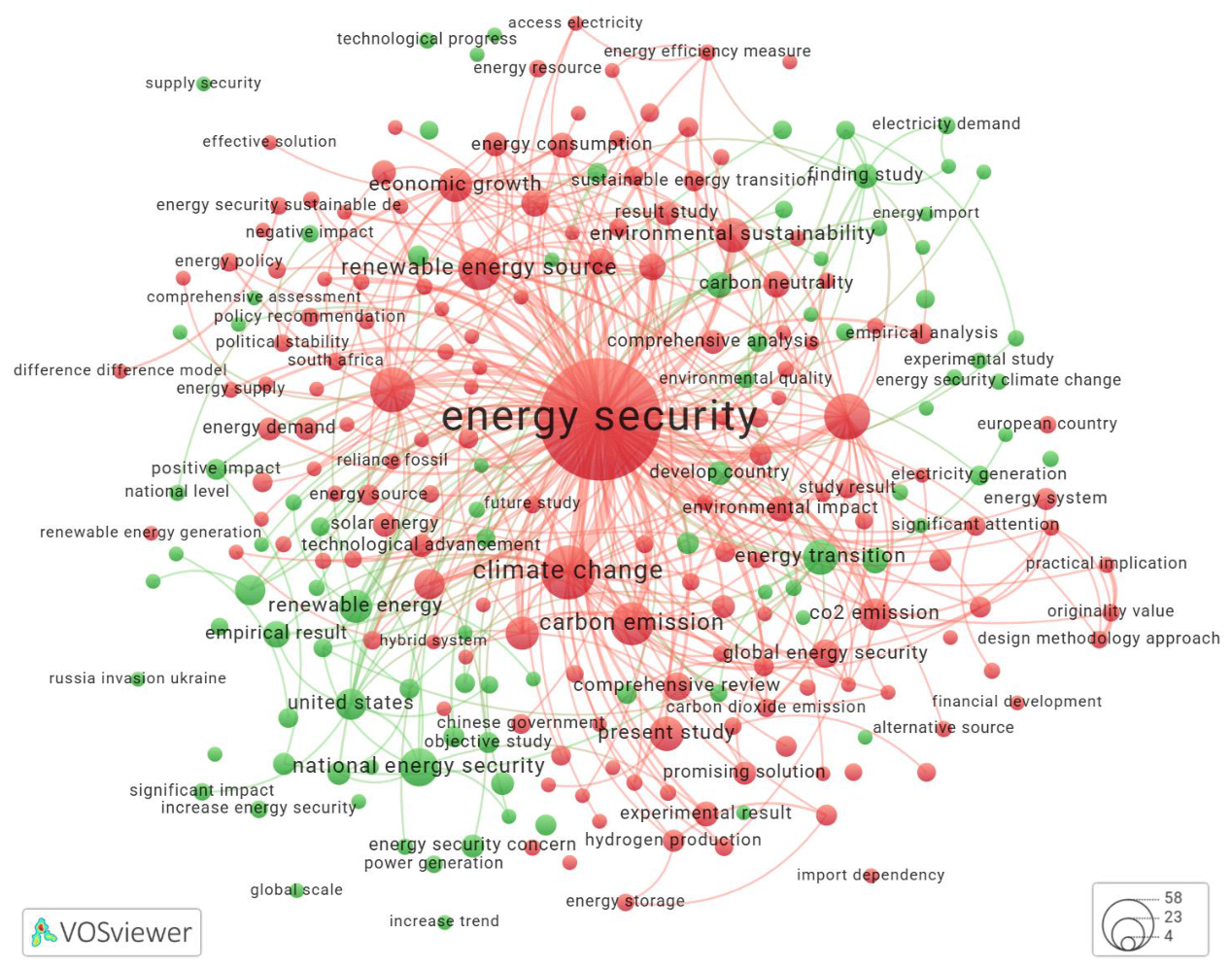
Figure 2.
VOSviewer network visualization of term clusters for the 2025–2026 period.
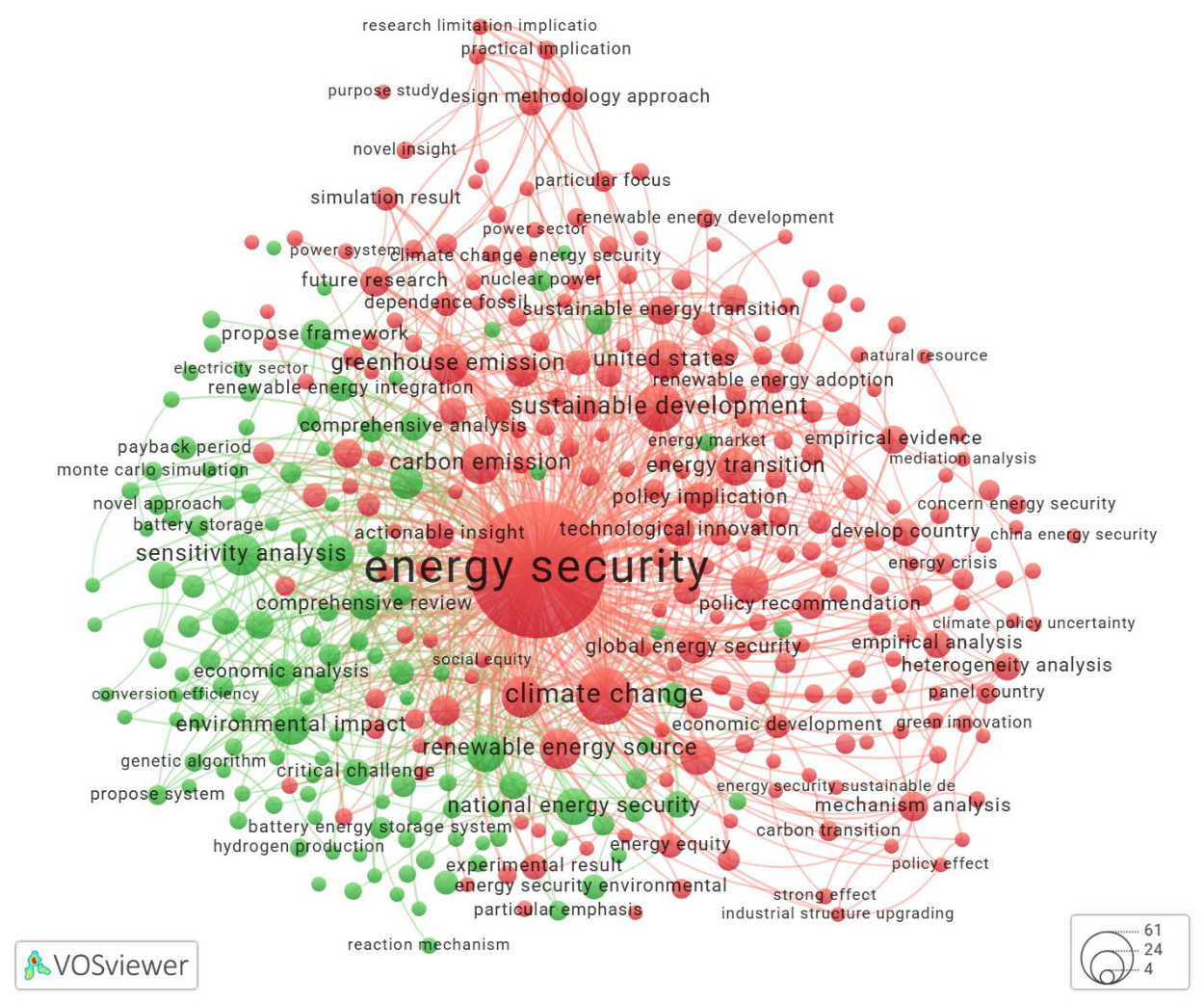

Table 1.
Term combinations exclusive to the top 35 highest-scoring itemsets for 2022–2024 relative to 2025–2026.
Table 1.
Term combinations exclusive to the top 35 highest-scoring itemsets for 2022–2024 relative to 2025–2026.
| Term1 | Term2 | Score |
| economic_development | energy_security | 0.780031 |
| energy_sector | energy_security | 0.702028 |
| design_methodology_approach | originality_value | 0.546022 |
| present_study | energy_security | 0.468019 |
| decision_maker | energy_security | 0.468019 |
| significant_challenge | energy_security | 0.468019 |
| novel_approach | energy_security | 0.390016 |
| technological_advancement | energy_security | 0.390016 |
| current_study | energy_security | 0.390016 |
| environmental_protection | energy_security | 0.390016 |
| value_product | energy_security | 0.390016 |
| sustainable_energy_source | energy_security | 0.390016 |
Table 2.
Term combinations exclusive to the top 35 highest-scoring itemsets for 2025–2026 relative to 2022–2024.
Table 2.
Term combinations exclusive to the top 35 highest-scoring itemsets for 2025–2026 relative to 2022–2024.
| Term1 | Term2 | Score |
| originality_value | design_methodology_approach | 0.921986 |
| comparative_analysis | energy_security | 0.567376 |
| propose_model | energy_security | 0.567376 |
| economic_analysis | energy_security | 0.567376 |
| policy_implication | energy_security | 0.496454 |
| empirical_analysis | energy_security | 0.496454 |
| economic_viability | energy_security | 0.496454 |
| energy_consumption | energy_security | 0.496454 |
| renewable_energy_integration | energy_security | 0.496454 |
| global_energy_demand | energy_security | 0.496454 |
| hybrid_system | energy_security | 0.496454 |
| empirical_evidence | energy_security | 0.425532 |
| actionable_insight | energy_security | 0.425532 |
Table 3.
Co-occurrence of terms within top-scoring itemsets across the 2022–2024 and 2025–2026 periods.
Table 3.
Co-occurrence of terms within top-scoring itemsets across the 2022–2024 and 2025–2026 periods.
| Term1→Term2 | Score | Score(2) | Diff |
| climate_change→energy_security | 3.35413 | 3.04965 | -0.30448 |
| greenhouse_emission→energy_security | 2.18409 | 1.63121 | -0.55288 |
| carbon_emission→energy_security | 1.71607 | 1.34752 | -0.36855 |
| environmental_sustainability→energy_security | 1.40406 | 1.34752 | -0.05654 |
| sustainable_development→energy_security | 1.24805 | 1.63121 | 0.38316 |
| sustainable_development→energy_security | 1.24805 | 0.425532 | -0.822518 |
| renewable_energy_source→energy_security | 1.17005 | 1.06383 | -0.10622 |
| economic_growth→energy_security | 0.858034 | 0.780142 | -0.077892 |
| environmental_impact→energy_security | 0.780031 | 1.34752 | 0.567489 |
| sensitivity_analysis→energy_security | 0.702028 | 0.70922 | 0.007192 |
| co2_emission→energy_security | 0.702028 | 0.851064 | 0.149036 |
| energy_transition→energy_security | 0.624025 | 0.921986 | 0.297961 |
| united_states→energy_security | 0.624025 | 0.780142 | 0.156117 |
| energy_equity→energy_security | 0.624025 | 0.638298 | 0.014273 |
| carbon_emission→climate_change | 0.546022 | 1.34752 | 0.801498 |
| energy_efficiency→energy_security | 0.546022 | 0.851064 | 0.305042 |
| valuable_insight→energy_security | 0.546022 | 0.638298 | 0.092276 |
| energy_equity→environmental_sustainability | 0.546022 | 0.638298 | 0.092276 |
| renewable_energy→energy_security | 0.468019 | 0.638298 | 0.170279 |
| technological_innovation→energy_security | 0.468019 | 0.567376 | 0.099357 |
| climate_change_mitigation→energy_security | 0.468019 | 0.567376 | 0.099357 |
| comprehensive_review→energy_security | 0.390016 | 0.496454 | 0.106438 |
| carbon_neutrality→energy_security | 0.390016 | 0.70922 | 0.319204 |
| future_research→energy_security | 0.390016 | 0.70922 | 0.319204 |
Table 4.
Comparative structural metrics of the VOSviewer term co-occurrence networks (2022–2024 vs. 2025–2026).
Table 4.
Comparative structural metrics of the VOSviewer term co-occurrence networks (2022–2024 vs. 2025–2026).
| Metric | 2022–2024 | 2025–2026 | Change |
| Items | 247 | 358 | +45.0% |
| Links | 2,250 | 4,972 | +120.9% |
| Total link strength | 3,046 | 6,397 | +110.0% |
| Clusters | 2 | 2 | unchanged |
| Largest cluster | 155 terms | 229 terms | +47.7% |
| Second cluster | 92 terms | 129 terms | +40.2% |
| 1 |
https://github.com/stanfordnlp/stanza — Stanza. Stanford NLP Python library for tokenization, sentence segmentation. |
| 2 |
https://www.vosviewer.com/ — VOSviewer a software for constructing and visualizing bibliometric networks |
Disclaimer/Publisher’s Note: The statements, opinions and data contained in all publications are solely those of the individual author(s) and contributor(s) and not of MDPI and/or the editor(s). MDPI and/or the editor(s) disclaim responsibility for any injury to people or property resulting from any ideas, methods, instructions or products referred to in the content. |
© 2026 by the author. Licensee MDPI, Basel, Switzerland. This article is an open access article distributed under the terms and conditions of the Creative Commons Attribution (CC BY) license.
Copyright: This open access article is published under a Creative Commons CC BY 4.0 license, which permit the free download, distribution, and reuse, provided that the author and preprint are cited in any reuse.