

Submitted:
03 September 2026
Posted:
07 September 2026
You are already at the latest version
Abstract
This article questions whether the predictive success of algorithmic descriptions warrants treating them as complete accounts of physical organisation. It distinguishes stability from organisation and argues that genuinely random fluctuations cannot, by themselves, explain the persistence of information-bearing structure whose coherence depends on information not already contained in the governing dynamics. Fluctuations treated as noise at one descriptive level may contain correlations or structure that become causally relevant at another. This possibility does not challenge established physical laws, but it questions the completeness of algorithmic explanation: predictive adequacy within a model should not be equated with the ontological completeness of the description. This framework is exemplified at the molecular scale, where Levinthal’s paradox and interfacial water dynamics suggest that protein folding relies on phase-correlated environmental fluctuations rather than isotropic stochastic search.
Keywords:
algorithmic explanation
; Levinthal's paradox
; interfacial water
; macromolecular folding
; dark information
; complexity
; emergence
; noise
; causal structure
; ontological completeness
; philosophy of science
Introduction
Can an empirically successful algorithmic description ever be known to be an ontologically complete description of reality? Perhaps not — because the very phenomena through which deeper structure becomes observable may be indistinguishable, within the description itself, from noise. We may be unable to observe the informational structures that sustain complex organisation not because they are absent, but because they are epistemically inaccessible from within an algorithmic account of reality: their effects appear as noise even when they carry the information required for stability, repair, and adaptive development.
Noise occupies a central place in contemporary scientific explanation. In simple systems, fluctuations can often be treated as stochastic perturbations superimposed on deterministic laws, and this approximation has proven remarkably effective [1]. Thermodynamic behaviour, molecular motion in gases, and many quantum phenomena can be modelled with high accuracy on this basis. The success of these approaches has encouraged a broader assumption: that randomness, together with deterministic laws and appropriate stochastic terms, may be sufficient to describe physical behaviour at every level of complexity — including the levels at which “algorithmic description” approaches what algorithmic information theory formalises as a compressible, rule-governed generative process. The argument developed here draws on this literature together with established discussions of emergence and levels of organisation [2,3,4,5,6] and of scientific representation and causal explanation [7,8,9].
Noise, Information, and Organisation
This assumption becomes less straightforward when applied to systems that maintain highly specific organisation over extended periods. Random fluctuations do not necessarily destroy stability, and in simple systems they may even support it — but stability is not the same as organisation. The persistence of complex, information-bearing structure raises a sharper question: can genuinely random fluctuations contribute constructively to organisation whose coherence depends on information not already contained in the system’s deterministic dynamics?
Noise is, indeed, well known to play a constructive, even necessary, role in many physical and biological processes. Small fluctuations can help a system escape hysteresis and settle into a new stable state; turbulence can, in certain regimes, enhance rather than impede flow and mixing; random thermal motion routinely triggers chemical reactions or lets a system cross an energy barrier it could not surmount deterministically; and mutation supplies the raw variability on which selection acts. In each case, however, noise contributes variability, transitions, or raw material — it does not by itself generate the specific, organised structure that exploits it. Hysteresis-breaking noise does not specify which stable state is functionally appropriate; mutation does not specify which variants will be favoured; a triggered reaction does not specify the pathway that makes it useful to the organism. That specifying work is done elsewhere — by selection, regulation, or some other organisation-supplying process — not by the randomness itself. The distinction argued for here follows from this: random fluctuations may enable or facilitate organisation, but enabling a process is not the same as explaining the organisation that results from it.
Biological systems make this distinction unavoidable. Organisms maintain structure, function, and adaptive coherence over timescales vastly exceeding those of their constituent processes, through regulation, redundancy, feedback, repair, and interaction with their environment. These mechanisms account for much of their stability within existing scientific frameworks. But their long-term persistence raises a deeper question: are the fluctuations treated as noise in conventional descriptions entirely devoid of structure at the level relevant to the organisation they influence? If their contribution is systematic rather than merely incidental, it cannot be attributed to randomness alone.
If a complex system can systematically exploit fluctuations that appear random at a lower descriptive level, then those fluctuations are not random with respect to the organisation that exploits them. What is classified as noise may contain correlations or dependencies that remain invisible to a particular model but become causally relevant to a sufficiently sensitive system [4,6,8]. The distinction between noise and signal may therefore be scale- and model-dependent: a fluctuation can be statistically negligible for one description while carrying information for another. What is random relative to one representation need not be structureless in an ontologically stronger sense.
This does not imply that biological organisation violates established physical laws. It suggests instead that calling a fluctuation “noise” may reflect the limitations of the model describing it. An algorithmic description can be predictively successful while leaving causally relevant structure implicit: its success establishes adequacy within a domain, not that all relevant organisation is captured in its variables and rules [7,8,9]. Predictive completeness within a model is therefore not equivalent to the ontological completeness of the description.
From this perspective, emergence may sometimes function less as a final explanation than as a marker of the level at which previously neglected structure becomes visible [2,3,4]. Calling a property emergent identifies a real pattern but does not by itself explain why that pattern is possible, stable, or causally effective. The open question is whether a more comprehensive algorithmic framework could ultimately supply this explanation, or whether some organisation depends on structure that cannot be fully captured in algorithmic terms.
A Broader Implication for Biological Organisation
This distinction between a description and the organisation it describes is especially relevant in biology. A relatively compact inherited specification can give rise to an extraordinarily complex, differentiated organism because it operates within a much richer generative physical process. Evolution may alter small portions of that specification while leaving the underlying generative architecture largely intact, yet produce substantial phenotypic differences. Developmental systems theory has argued along related lines that the resources shaping an organism’s development extend well beyond the genome, and that no single component should be singled out as carrying “the” developmental information [10]. The informational content of a genome, on this view, should not be too readily identified with the totality of information involved in constructing and maintaining the organism.
An analogy may help. A display system can produce vastly different images while varying only a small set of control parameters; the parameters constrain the resulting image but are not themselves its complete informational content. Likewise, a compact biological specification may constrain development without constituting a complete description of the process through which the organism emerges. The relevant question is therefore not how much information the genome contains, but whether the generative process acting on that information is itself completely represented by the algorithmic description.
This also changes how randomness should be interpreted. A fluctuation may be effectively random relative to a model while still possessing correlations relevant to a sufficiently sensitive physical system. If complex organisation systematically exploits such structure, then what is conventionally classified as noise may represent information lying outside the description’s variables rather than an absence of information. This possibility is difficult to distinguish empirically from ordinary model incompleteness, but it raises a real question: does the apparent randomness of some physical fluctuations reflect genuine ontological randomness, or merely the limited resolution of the framework describing them?
The argument does not establish that such a deeper source of organisation exists; it identifies a possible boundary condition for algorithmic explanation. If the generative physical process contains informational structure not represented in the algorithmic description, the effects of that structure may appear as randomness even when they are causally indispensable — and we may be unable to identify such structures directly, precisely because their effects are indistinguishable from noise within the descriptions through which we model physical reality.
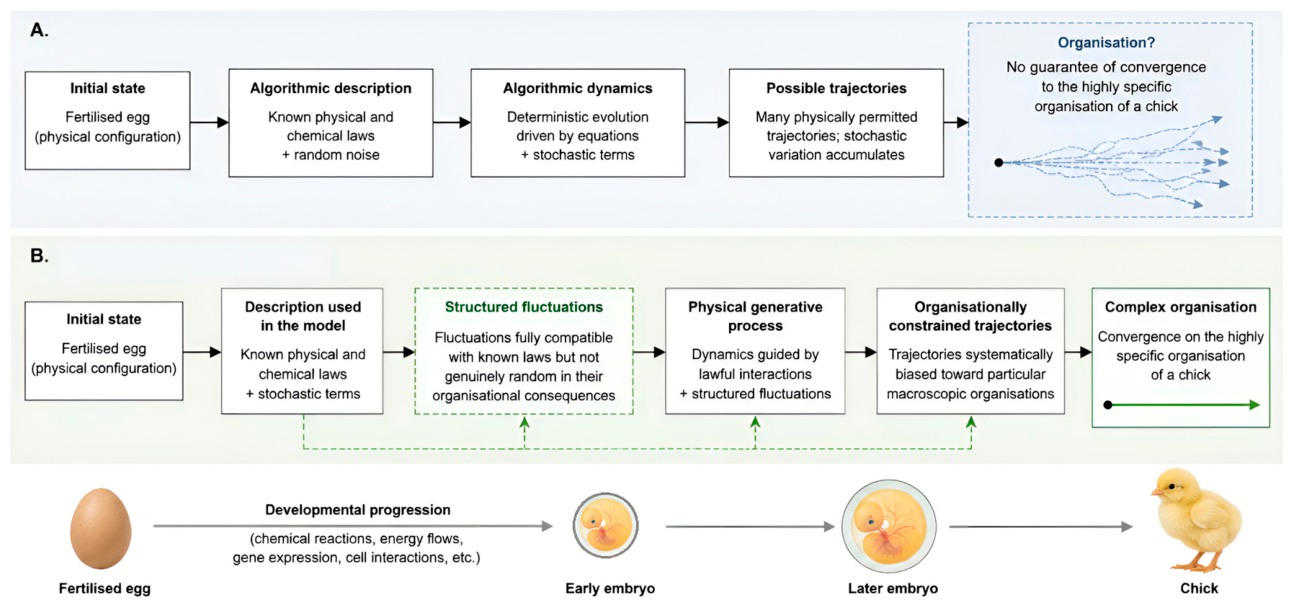
Consider the development of a fertilised egg. Within the conventional algorithmic picture, an exact simulation would reproduce the chemical reactions, energy flows, gene expression, molecular interactions, and stochastic thermal and quantum fluctuations occurring in the embryo. Yet if these fluctuations are treated as genuinely random, the simulation would not necessarily reproduce the highly specific organisation of a chick: it would generate trajectories permitted by the specified dynamics, with stochastic variation accumulating throughout. The claim that such a simulation would necessarily reproduce a chick already assumes that the algorithmic description is causally complete — precisely what is questioned here.
The hypothesis considered here is more specific: biological development may depend on fluctuations fully compatible with known physical laws but not genuinely random in their organisational consequences. Such structured fluctuations could influence the timing, coupling, or branching of microscopic processes in ways that systematically favour particular macroscopic organisations. A simulation incorporating only the known laws and genuinely random stochastic terms would then fail to reproduce the developmental trajectory — not because its equations are wrong, but because the relevant organisational information is absent from the model (Figure 1).
The resulting distinction is not between lawful and unlawful dynamics, but between lawful dynamics and algorithmically complete dynamics. This distinction may also clarify a difference between biological and artificial systems. Pseudorandom variation generated within an artificial algorithmic architecture can alter computational trajectories, but it does not by itself introduce organisational information beyond the generative framework specified by that architecture. Biological development, by contrast, may involve physical fluctuations whose organisational consequences are not fully represented in the algorithmic description. If so, what appears as noise from the model’s perspective may constitute a causally relevant source of organisation from the perspective of the physical system. What appears as noise within an algorithmic description may therefore function as a form of “dark information”: a causally relevant structure that remains epistemically inaccessible at the descriptive level of the model, yet systematically organises the physical trajectories of the system that is capable of exploiting it. This perspective also clarifies a long--standing unresolved conceptual distinction between machines and organisms. Artificial systems operate entirely within the informational framework explicitly specified by their architecture, whereas biological systems may exploit structured physical fluctuations that lie outside any algorithmic description of their organisation. In this sense, the organism is not merely a more complex machine: it is a system whose generative process is coupled to forms of “dark information” that remain epistemically inaccessible to the model, yet causally indispensable to the organisation it maintains.
Dark information is not mysterious; it is simply organisationally relevant physical structure that remains invisible to classical experimental averaging and to artificial systems, yet becomes causally effective for biological systems whose molecular architecture (DNA, proteins, enzymatic networks) is tuned to exploit such structured fluctuations.
Molecular Resonant Tuning: Water and Macromolecular Folding as Physical Exemplars
The limitations of a purely stochastic algorithmic description become especially transparent at the molecular level of biological systems. A prime example is the classic Levinthal paradox [11]: if an unfolded polypeptide chain were to search its conformational space via unbiased, random thermal fluctuations, the folding process into its unique functional state would require timescales exceeding the age of the universe. Yet, native proteins fold deterministically within microseconds to milliseconds.
Conventional models account for this rapid convergence by invoking conceptual frameworks such as energy landscapes or “folding funnels.” While mathematically descriptive, these models often function as semantic placeholders: they state that the system moves toward a global thermodynamic minimum, but they do not physically explain how the conformational dynamics avoid u-turns or trapping in local minima without an guiding mechanism.
We propose that this speed and fidelity stem from the fact that biological macromolecules do not operate within an isotropic, unstructured noise bath. Instead, the generative physical process relies on a coupled, non-linear system where environmental fluctuations are structured by the interface itself:
- The Interfacial Water Matrix: Interfacial (or biological) water directly adjacent to biomolecules does not behave like bulk solvent. Ultrafast spectroscopy reveals that the rotational and vibrational dynamics of hydrogen-bond networks in the hydration shell are significantly constrained, exhibiting relaxation times and coherent terahertz (THz) collective oscillations [12,13] that extend up to tens of Ångströms [14,15] from the protein surface.
- Resonant Phase Locking: Rather than serving as an unstructured heat bath that randomly collides with the polypeptide backbone, the hydration shell acts as a dynamic template. Collective THz vibrations of the water network [16,17] provide phase-correlated impulses. When a protein undergoes hydrophobic collapse, it does not execute a random walk; it undergoes a collective phase transition guided by the non-Gaussian spatio-temporal dynamics of the surrounding water matrix.
- Denaturation as Loss of Tuning: This mechanism is further supported by thermal denaturation. When an enzyme is heated beyond its critical threshold (typically 50-60 °C), its chemical composition and primary amino acid sequence remain completely unaltered. However, the exact spatial topology of the macromolecular lattice collapses. The denatured protein loses its capacity to selectively resonate with the structured fluctuations of the hydration environment, collapsing back into a system governed purely by uncoordinated, classical stochastic motion (Arrhenius kinetics).
If biological macromolecules function as tuned physical receivers—exploiting phase-locked, structured fluctuations [18,19] mediated by the interfacial water matrix—then the apparent randomness observed in lower-level models is not an intrinsic property of nature, but an artifact of abstracting the molecule from its physical environment. What is conventionally discarded as background noise in algorithmic models may, in fact, constitute the very physical carrier signal that renders rapid macromolecular organization deterministically possible.
From an ontological perspective, this implies that biological evolution does not presuppose any external creative agency: it unfolds within a physical environment whose structured fluctuations provide a continuous source of organisational bias [20]. What appears as mere noise in classical experiments may therefore constitute a form of “dark information” — an informational substrate that remains invisible to algorithmic descriptions yet becomes causally effective for systems whose molecular architecture is tuned to exploit it.
Conclusion
The conclusion is therefore modest but clear. Algorithmic descriptions remain indispensable, and the theories built upon them retain their empirical validity. However, the persistence of complex biological organization challenges the stronger assumption that a predictively successful algorithmic description must also be a complete description of causal reality.
What appears as random thermal noise in a lower-level algorithmic model may contain structured, phase-correlated information that becomes visible only to physical systems tuned to exploit it. As demonstrated by macromolecular folding and interfacial water dynamics, biological systems do not merely endure thermal fluctuations; they rely on the non-Gaussian spatio-temporal dynamics of their environment to navigate vast state spaces deterministically. Recognising this role of the interfacial hydration matrix does not overturn established physical laws. Instead, it acknowledges that algorithmic models—by abstracting biomolecules from their physical continuum—leave causally indispensable organizational structure unrepresented.
If biological organization depends on structured physical fluctuations lying outside the variables of the algorithmic description, then no increase in computational power or model complexity can guarantee convergence on the correct developmental or conformational trajectory. The limitation is therefore not merely computational or practical, but potentially principled.
Genuinely random fluctuations may influence, facilitate, or even stabilise processes within an organised system, but they do not by themselves explain the specific, information-bearing organisation that those processes maintain. Compatibility with physical law is necessary but not sufficient: the existence of a physical trajectory does not imply its purely algorithmic accessibility.
Funding
This research received no external funding.
Institutional Review Board Statement
Not applicable.
Informed Consent Statement
Not applicable.
Data Availability Statement
The original contributions presented in this study are included in the article. This manuscript presents a theoretical framework and does not report empirical data.
Acknowledgments
The author thanks colleagues for discussions that shaped this work. Some passages of this manuscript, including figures, were prepared or refined with the assistance of a large language model (LLM, namely Anthropic Claude Sonnet 5). The author takes full responsibility for the content and conclusions presented herein. Conflicts of Interest: The author declares no conflicts of interest.
References
- Shannon, C.E. A Mathematical Theory of Communication. Bell Syst. Tech. J. 1948, 27, 379–423, 623–656. [Google Scholar] [CrossRef]
- Bedau, M.A. Weak Emergence. Noûs 1997, 31, 375–399. [Google Scholar] [CrossRef]
- Batterman, R.W. The Devil in the Details: Asymptotic Reasoning in Explanation, Reduction, and Emergence; Oxford University Press: Oxford, UK, 2001. [Google Scholar] [CrossRef]
- Wimsatt, W.C. Re-Engineering Philosophy for Limited Beings: Piecewise Approximations to Reality; Harvard University Press: Cambridge, MA, USA, 2007. [Google Scholar]
- Emmeche, C.; Køppe, S.; Stjernfelt, F. Explaining Emergence: Towards an Ontology of Levels. J. Gen. Philos. Sci. 1997, 28, 83–117. [Google Scholar] [CrossRef]
- Brooks, D.S.; Eronen, M.I. The Significance of Levels of Organization for Scientific Research: A Heuristic Approach. Stud. Hist. Philos. Sci. Part C 2018, 68–69, 34–41. [Google Scholar] [CrossRef] [PubMed]
- Frigg, R.; Nguyen, J. The Turn of the Valve: Representing with Material Models. Eur. J. Philos. Sci. 2018, 8, 205–224. [Google Scholar] [CrossRef]
- Woodward, J. Making Things Happen: A Theory of Causal Explanation; Oxford University Press: Oxford, UK, 2003. [Google Scholar]
- Chaitin, G.J. Algorithmic Information Theory; Cambridge Tracts in Theoretical Computer Science: Cambridge, UK; Cambridge University Press, 1987. [Google Scholar] [CrossRef]
- Griffiths, P.E.; Gray, R.D. Developmental Systems and Evolutionary Explanation. J. Philos. 1994, 91, 277–304. [Google Scholar] [CrossRef]
- Levinthal, C. How to Fold Graciously. Mössbauer Spectroscopy in Biological Systems: Proceedings of a Meeting held at Allerton House, Monticello, Illinois; Debrunner, P., Tsibris, J.C.M., Münck, E., Eds.; University of Illinois Press: Urbana, IL, USA, 1969; pp. 22–24. [Google Scholar]
- Zewail, A.H. Femtochemistry: Atomic-Scale Dynamics of the Chemical Bond. J. Phys. Chem. A 2000, 104, 5660–5694. [Google Scholar] [CrossRef]
- Pal, S.K.; Peon, J.; Zewail, A.H. Biological Water at the Protein Surface: Dynamics in Native and Unfolded States. Proc. Natl. Acad. Sci. USA 2002, 99, 15297–15302. [Google Scholar] [CrossRef] [PubMed]
- Havenith, M.; Leitner, D.M. TeraHertz Spectroscopy of Biomolecules and Water Dynamics. Philos. Trans. R. Soc. Lond. B Biol. Sci. 2008, 363, 2801–2810. [Google Scholar] [CrossRef]
- Ebbinghaus, S.; Kim, S.J.; Heyden, M.; Yu, X.; Heugen, U.; Gruebele, M.; Leitner, D.M.; Havenith, M. An Extended Dynamical Hydration Shell Around Proteins. Proc. Natl. Acad. Sci. USA 2007, 104, 20749–20752. [Google Scholar] [CrossRef] [PubMed]
- Jungwirth, P.; Tobias, D.J. Specific Ion Effects at the Air/Water Interface. Chem. Rev. 2006, 106, 1259–1281. [Google Scholar] [CrossRef] [PubMed]
- Ball, P. Water as an Active Participant in Biochemical Processes. Chem. Rev. 2008, 108, 74–108. [Google Scholar] [CrossRef] [PubMed]
- Fröhlich, H. Long-Range Coherence and Energy Storage in Biological Systems. Int. J. Quantum Chem. 1968, 2, 641–649. [Google Scholar] [CrossRef]
- Del Giudice, E.; Doglia, S.; Milani, M.; Vitiello, G. Electromagnetic Field and Spontaneous Symmetry Breaking in Biological Matter. Nucl. Phys. B 1986, 275, 185–199. [Google Scholar] [CrossRef]
- Gammaitoni, L.; Hänggi, P.; Jung, P.; Marchesoni, F. Stochastic Resonance. Rev. Mod. Phys. 1998, 70, 223–287. [Google Scholar] [CrossRef]
Figure 1.
Two contrasting schematic representations of embryonic development. (A) The diagram illustrates that, contrary to conventional assumptions, a purely algorithmic description of development combined with genuinely stochastic noise does not uniquely determine a single developmental trajectory. Instead, it permits a wide range of physically allowed outcomes. This indeterminacy reflects the insufficiency of an algorithmic model in which fluctuations are treated solely as random perturbations rather than as potential carriers of organisationally relevant structure. (B) Biological development may depend on structured physical fluctuations that remain fully compatible with known laws but are not organisationally random. Such fluctuations could systematically bias microscopic processes toward particular macroscopic organisations. If these structures are not represented in the algorithmic description, their effects appear as noise within the model even when they are causally indispensable. The diagram illustrates how the generative physical process may be guided by informational structure lying outside the variables of the algorithmic framework.
Figure 1.
Two contrasting schematic representations of embryonic development. (A) The diagram illustrates that, contrary to conventional assumptions, a purely algorithmic description of development combined with genuinely stochastic noise does not uniquely determine a single developmental trajectory. Instead, it permits a wide range of physically allowed outcomes. This indeterminacy reflects the insufficiency of an algorithmic model in which fluctuations are treated solely as random perturbations rather than as potential carriers of organisationally relevant structure. (B) Biological development may depend on structured physical fluctuations that remain fully compatible with known laws but are not organisationally random. Such fluctuations could systematically bias microscopic processes toward particular macroscopic organisations. If these structures are not represented in the algorithmic description, their effects appear as noise within the model even when they are causally indispensable. The diagram illustrates how the generative physical process may be guided by informational structure lying outside the variables of the algorithmic framework.
Disclaimer/Publisher’s Note: The statements, opinions and data contained in all publications are solely those of the individual author(s) and contributor(s) and not of MDPI and/or the editor(s). MDPI and/or the editor(s) disclaim responsibility for any injury to people or property resulting from any ideas, methods, instructions or products referred to in the content. |
© 2026 by the authors. Licensee MDPI, Basel, Switzerland. This article is an open access article distributed under the terms and conditions of the Creative Commons Attribution (CC BY) license (http://creativecommons.org/licenses/by/4.0/).
Copyright: This open access article is published under a Creative Commons CC BY 4.0 license, which permit the free download, distribution, and reuse, provided that the author and preprint are cited in any reuse.