
Submitted:
25 August 2026
Posted:
25 August 2026
You are already at the latest version
Abstract
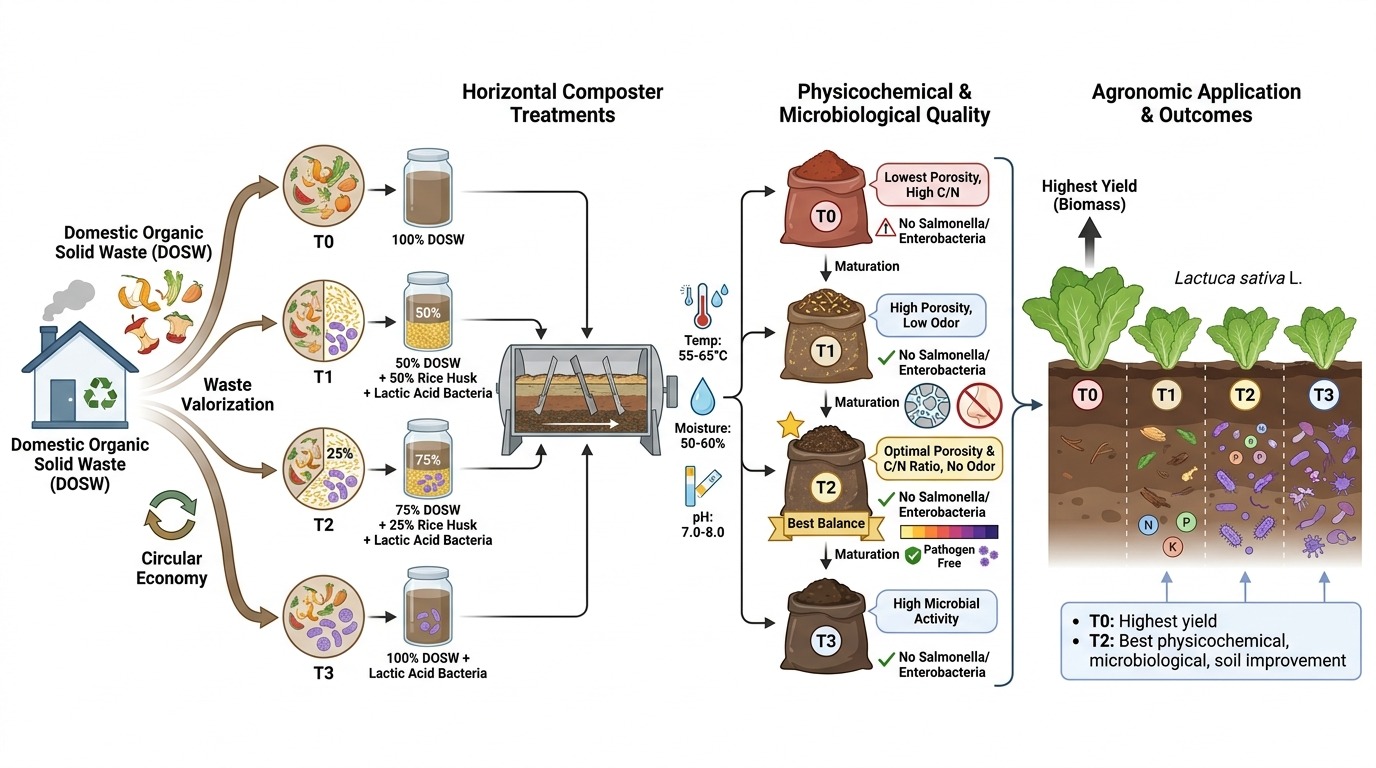
Improper management of domestic organic solid waste (DOSW) poses an environmental challenge, and composting offers a low-cost valorization alternative, though the effect of substrate composition and microbial inoculation on process performance remains unclear. This study evaluated the effect of substrate composition and lactic acid bacteria inoculation on the dynamics and physicochemical and microbiological quality of compost from DOSW via horizontal composting, and its agronomic performance in lettuce (Lactuca sativa L.). A completely randomized design with four treatments (T0: 100% DOSW; T1: 50% DOSW + 50% rice husk + bacteria; T2: 75% DOSW + 25% rice husk + bacteria; T3: 100% DOSW + bacteria) and three replicates ran 103 days, monitoring temperature, moisture, pH, color, and odor; final compost was characterized per NTC 5167 and evaluated for effects on lettuce growth and soil. No treatment reached a thermophilic phase, though rice husk improved porosity and reduced odor persistence. All composts were free of Salmonella spp. and enterobacteria, meeting safety criteria. T2 showed the best balance of stability, microbiological activity, and nutritional quality, while inoculation did not improve lettuce yield, with T0 yielding the highest biomass. Findings confirm horizontal composting of DOSW with structuring materials is a viable, safe, low-cost alternative.
Keywords:
composting
; organic solid waste
; rice husk
; lactic acid bacteria
; compost quality
; Lactuca sativa
; soil properties
Copyright: This open access article is published under a Creative Commons CC BY 4.0 license, which permit the free download, distribution, and reuse, provided that the author and preprint are cited in any reuse.