

Submitted:
25 August 2026
Posted:
25 August 2026
You are already at the latest version
Abstract
Background/Objectives: Major depressive disorder is a highly prevalent psychiatric condition associated with substantial functional impairment. Despite available phar-macological and psychotherapeutic interventions, a considerable proportion of indi-viduals do not achieve adequate symptom improvement, contributing to the persistent clinical burden of treatment-resistant depression (TRD). To expand therapeutic options for this population, our team developed a virtual reality–based therapy (VRT) inte-grating experiential and relational components. As part of VRT, participants engaged in dialogues with an avatar, animated in real time by the therapist, representing a person meaningfully associated with their depressive experiences. This pilot clinical trial examined the short-term efficacy of VRT compared with treatment as usual (TAU) in individuals with TRD. Methods: This two-arm, parallel-group trial compared VRT in 20 individuals with TRD with TAU in 10 individuals. The primary outcome was depressive symptom severity. Secondary outcomes included anxious symptom severity, self-esteem, quality of life, and functioning. Primary and secondary outcomes were analyzed using linear mixed models with maximum-likelihood estimation for missing data, with time-by-treatment interactions used to determine whether changes over time differed significantly between VRT and TAU. Results: Post-therapy, VRT produced large effects on depressive symptoms relative to TAU, as assessed by both self-reported (d = 2.61, p < 0.01) and clinician-rated scores (d = 2.10, p < 0.01). Large ef-fects favoring VRT were also observed for anxiety (d = 1.86, p < 0.01), self-esteem (d = 2.07, p < 0.01), quality of life (self-report: d = 2.37; clinician-rated: d = 2.21; both p < 0.01), and functioning (d = 1.27, p < 0.01). Conclusion: These preliminary findings suggest that VRT may represent a promising therapeutic approach for individuals with TRD. Larger controlled trials are warranted to confirm its efficacy and evaluate the durability of treatment effects over time.
Keywords:
treatment-resistant major depressive disorder
; virtual reality–assisted therapy
; relational therapy
1. Introduction
Depression is one of the most common mental disorders and a leading cause of disability worldwide [1,2,3]. Currently, more than 300 million people are living with depression, representing approximately 4.4% of the global population [4]. Notably, the prevalence of depression has increased by about 35% over the past eight decades [5]. Despite recommended first-line treatments, including antidepressant medication, psychotherapy, or their combination, a substantial proportion of individuals with depression fail to achieve an adequate treatment response or remission, representing a major clinical challenge [6,7,8]. Indeed, approximately 30–55% of individuals with depression continue to experience clinically significant symptoms despite two adequate antidepressant trials, and the response rates substantially decline after successive treatment failures [8,9,10,11]. Regarding psychotherapy, a meta-analysis of twelve studies showed a smaller significant effect (SMD = -0.49, CI = -0.63 to -0.34) compared with active and inactive controls [12]. Although repeated courses of psychotherapy improve outcomes, 35% of patients remain symptomatic after two, and 20% after three courses of psychotherapy [13]. These findings underscore that the effectiveness of psychotherapy remains limited among individuals with TRD [14]. Importantly, individuals with TRD experience poorer quality of life, greater functional and occupational impairment, and substantial productivity loss compared to individuals without resistance to treatment [15,16,17]. This condition is also associated with higher rates of psychiatric and medical comorbidities, greater healthcare utilization, more frequent hospitalization, and poorer therapeutic outcomes compared with individuals who respond to treatment [15,16,17,18,19]. Furthermore, TRD is associated with an increased risk of suicide and higher mortality rates [15,20,21]. Given the substantial burden and widespread impact of TRD on affected individuals, their entourage, and society, there is a critical need to develop more effective therapeutic approaches.
Over the past decade, virtual reality (VR) has emerged as a promising therapeutic tool for the treatment of several psychiatric disorders, including anxiety, post-traumatic stress disorder, psychotic disorders, and substance use disorders [22,23,24,25,26,27,28,29,30]. By recreating individualized situations that closely resemble real-life experiences, VR allows patients to rehearse adaptive responses while eliciting therapeutically relevant emotions associated with their symptoms [31,32]. Although virtual reality-assisted therapy (VRT) has not yet been specifically evaluated for TRD, several versions have been developed for depressive symptoms [33]. Most of these interventions rely on exposure to relaxing virtual environments to promote mindfulness, engagement in pleasant activities to facilitate behavioral activation, or viewing positive scenes to enhance positive affect [34,35,36,37,38,39,40,41,42,43,44]. Overall, these interventions have produced mixed results. A different approach evaluated a VR-based cognitive behavioral therapy (CBT) program incorporating emotion regulation, stress management, mindfulness, and interpersonal skills [45]. Compared with treatment as usual (TAU), the intervention did not produce significantly greater improvements in depressive symptoms or suicidality. Other VRT approaches incorporated a relational component. One such intervention involved participants alternating between delivering compassionate statements to an avatar representing their child self and experiencing those same statements from the child-self perspective after embodying the avatar. [46]. This intervention was associated with reduced depressive symptoms at one-month follow-up. Another VRT incorporated role-playing–based social interaction training using predefined workplace scenarios; however, the intervention lacked real-time conversational interactions and allowed limited personalization. Moreover, no significant effects on depressive symptoms were observed post-therapy [47]. More broadly, one possible explanation for the mixed findings is that existing VRT for depression is typically delivered as standalone programs and relies on limited interactions characterized by predefined situations, automated therapeutic content, and the absence of real-time dialogue with an avatar [42,45,47].
Thus, by recreating personally meaningful situations that participants encounter in their daily lives, VR can enable the activation and real-time exploration of dysfunctional thoughts, emotions, interpersonal patterns, and maladaptive schemas. In addition, it provides opportunities to identify, challenge, and modify these schemas, and to develop more adaptive emotional, cognitive, and behavioral responses. According to the interpersonal theory, depressive episodes emerge and recur within the context of an individual’s interpersonal relationships and social environment [48,49]. Interpersonal problem areas such as the death of a significant other (grief), antagonistic relationships (role disputes), significant life changes or losses (role transitions), and a lack of social support (interpersonal deficits) are considered negative life events that increase the risk for a depressive episode [50,51]. In addition, several intrapersonal issues have been associated with major depressive disorder, including maladaptive emotion regulation strategies, rumination, and psychological inflexibility [52,53]. Negative self-schemas, including self-criticism and low self-esteem, have also been implicated in the vulnerability to and maintenance of depression [54,55]. This personalized therapeutic approach may offer a novel strategy for treating TRD by integrating both interpersonal and intrapersonal dimensions.
It is in this context that VRT for TRD was developed. This immersive relational psychotherapy is centered on real-time dialogues with therapist-controlled avatars representing personally meaningful figures. During therapy, patients engage in real-time conversations with therapist-controlled avatars representing individuals who have played a significant role in the development or maintenance of their depressive symptoms. Through these therapeutic interactions, participants practice improving emotional regulation, stress management, behavioral activation, cognitive restructuring, adaptive coping strategies, self-compassion, and self-esteem. The overall aim of the intervention is to reduce depressive symptoms while enhancing psychosocial functioning. In an initial pilot study, participants showed large and statistically significant reductions in depressive symptom severity, as assessed by both self-reported (d=1.48, p<0.001) and clinician-rated measures (d=1.36, p<0.001) from baseline to the post-treatment assessment [56]. Large, significant improvements were also observed in anxious symptoms, self-esteem, quality of life, and functioning. Finally, the therapy was shown to be acceptable and feasible. Although preliminary findings were encouraging, the efficacy of VRT relative to standard care had not yet been evaluated. Accordingly, the present study aimed to compare VRT with a TAU control group for individuals with TRD on depressive symptoms, as well as anxious symptoms, suicidal ideation, self-esteem, quality of life, and functioning.
2. Materials and Methods
2.1. Design
This was a non-randomized, open-label, two-arm, parallel-group trial comparing VRT for treatment-resistant depression (TRD) with treatment as usual (TAU). The first 20 consecutive participants received VRT, while the next 10 eligible participants received TAU for six weeks. The lack of randomization resulted from the study’s sequential development: recruitment initially focused on evaluating VRT, and a TAU comparison group was subsequently introduced to enable between-group comparisons. After completing the six-week assessment, participants in the TAU group were offered the opportunity to receive VRT; however, they were not included in the present study. The study took place from August 2024 to July 2026.
Participants allocated to the VRT group underwent clinical assessments one week before therapy initiation (pre-therapy) and one week after the final therapy session (post-therapy). Throughout the study, they continued to receive their usual clinical care. Participants allocated to the TAU group underwent the same clinical assessments at baseline and six weeks later. During this period, they continued to receive treatment as usual, consisting of ongoing antidepressant pharmacotherapy and regular outpatient psychiatric follow-up. During the 6-week observation period, participants did not initiate psychotherapy, and stability in psychiatric medication was required for eligibility. This design allowed for the evaluation of VRT’s effectiveness against the natural course of symptoms under stable usual care.
2.2. Participants
Eligible participants were adults (≥18 years) with a DSM-5 diagnosis of major depressive disorder (MDD) who continued to experience clinically significant depressive symptoms despite at least two adequate pharmacological treatment trials (at a therapeutic dose for at least six weeks). To reduce potential confounding related to medication adjustments, participants were required to have maintained a stable psychotropic medication regimen for at least six weeks before enrollment. With participants’ permission, their treating physician or psychiatrist was contacted whenever possible to inform them of the study and confirm that no changes in psychiatric medication were anticipated during the study period. MDD diagnoses were confirmed using the Structured Clinical Interview for the Diagnostic and Statistical Manual of Mental Disorders, Fifth Edition (DSM-5) [57]. Exclusion criteria included a diagnosis of a psychotic or bipolar disorder, a neurological disorder, an active substance use disorder, or an unstable serious medical illness. For participants in the TAU group, in addition to the above eligibility criteria, participants needed to remain stable in ongoing treatment throughout the 6-week study period, continuing their usual care without initiating a new psychotherapy.
2.3. Ethical Considerations
The trial was conducted in accordance with the Declaration of Helsinki and was approved by the Research Ethics Committee of the Centre intégré universitaire de santé et de services sociaux de l’Est-de-l’Île-de-Montréal (CER-CEMTL; approval No. 2024-3661). Written informed consent was obtained from all participants prior to study participation. Participants received CAD $20 for each assessment completed.
2.4. Virtual Reality-Assisted Therapy for Treatment-Resistant Depression
Participants completed at least eight weekly psychotherapy sessions, with the total number of sessions individualized according to patients’ therapeutic needs and ranging from 8 to 14 sessions. The intervention was delivered by an experienced psychiatrist (AD) and an experienced psychologist, each with over ten years of clinical practice treating individuals with depression. The first session explored the participant’s history of depressive symptoms, adverse life experiences, maladaptive thinking patterns, and coping strategies. The second session continued this exploration and focused on creating the avatars. Depending on each participant’s clinical needs, avatars could represent a family member, a romantic partner involved in an unresolved interpersonal conflict, a deceased loved one in the context of unresolved grief, or maladaptive aspects of the self, such as self-critical, ruminative, demanding, disappointed, or guilt-inducing internal dialogue. These avatars represent individuals or internal self-representations that have contributed to the onset or maintenance of depressive symptoms. Throughout these interactions, participants develop skills in emotional regulation, stress management, behavioral activation, cognitive restructuring, adaptive coping, self-compassion, and self-esteem. Psychotherapy sessions number 3 to 8 comprised three successive phases:
Preparation phase. Before entering the VR immersion, the therapist and participant met face-to-face to review the previous week, discuss ongoing therapeutic progress, and set the session objectives. Together, they selected the therapeutic scenario, identified the avatar to be encountered, and chose the virtual environment (restaurant, apartment, or park).
Immersive phase. During the VR immersion, the therapist controlled the avatar in real time by modulating their voice and facial expressions (e.g., anger, sadness, joy, and fear). The avatar’s verbal and nonverbal behaviors were tailored to the participant’s subjective perception of the represented person, allowing the interaction to reflect the participant’s internal representation and emotional experience. Throughout the role-playing interactions, participants had opportunities to explore their depressive experiences, interpersonal relationships, and maladaptive self-processes while practicing new emotional, cognitive, and behavioral responses. A detailed description of the therapy, including examples of avatars, therapeutic themes, virtual environments, and the immersive setting, is available elsewhere [56].
Debriefing phase. Following the VR immersion, the therapist and participant discussed the experience, with particular attention to the emotions elicited during the session and their therapeutic significance.
2.5. Clinical Assessments
Clinical assessments were conducted in the VRT group one week before the initiation of therapy (pre-therapy) and one week after the final therapy session (post-therapy). Participants in the TAU group underwent the same assessments at two time points, six weeks apart (pre-post 6-week).
Baseline sociodemographic and clinical characteristics, including illness history, previous treatments for depression, and psychiatric comorbidities, were collected using a study-specific self-reported questionnaire. Experiences of child abuse and neglect were assessed retrospectively using the Childhood Trauma Questionnaire (CTQ) [58]. The diagnosis of schizophrenia or schizoaffective disorder (as per DSM-5 criteria) was confirmed using the Structured Clinical Interview for the Diagnostic and Statistical Manual of Mental Disorders, Fifth Edition [57].
The primary outcome was depressive symptom severity evaluated using both the clinician-rated Montgomery–Åsberg Depression Rating Scale (MADRS) [59] and the self-reported Patient Health Questionnaire-9 (PHQ-9) [60]. Supplementary Table S1 provides detailed descriptions of all outcome measures, including their psychometric properties, subscales, and established cut-off values when available. Secondary outcomes included anxious symptoms, suicidal ideation, self-esteem, quality of life, and functioning. Anxious symptoms were measured with the Generalized Anxiety Disorder-7 (GAD-7) [61], and self-esteem with the Rosenberg Self-Esteem Scale (RSES) [63]. Quality of life and psychosocial functioning were assessed using the self-reported Quality of Life Enjoyment and Satisfaction Questionnaire–Short Form (Q-LES-Q-SF) [64] and the clinician-rated Heinrichs’ Quality of Life Scale (QLS) [65]. Finally, functional impairment was evaluated with the World Health Organization Disability Assessment Schedule 2.0 (WHODAS 2.0) [66].
2.6. Statistical Analysis
Descriptive statistics for sample characteristics were summarized as means and standard deviations (SD) for continuous variables, and as frequencies and percentages for categorical variables.
Comparisons between the two groups for primary and secondary outcomes were assessed using linear mixed models with maximum-likelihood estimation for missing data. Both between-group (VRT and TAU) and within-group (time) comparisons were examined, and time-by-treatment interactions were used to assess whether there was a significant change from VRT to TAU over time. The statistical threshold for significance was set at p≤0.05. The following descriptions of the strength of reported Cohen’s d were used: small 0.2-0.49, medium 0.5-0.79, and large ≥0.8 [67]. All statistical analyses were performed using IBM’s Statistical Program for Social Sciences (SPSS) for Windows (Version 31.0) [68].
3. Results
3.1. Sample Characteristics
A total of 47 individuals were referred and assessed for eligibility from different areas of Montreal and surrounding cities. Of these, 39 participants met the inclusion criteria and were recruited (see Figure 1). The 20 participants who completed VRT attended a mean of 11.5 therapy sessions (SD = 4.6). The 10 participants who completed the TAU period underwent a mean interval of 39.9 days (SD = 3.0; range 35–42 days) between the baseline and post-TAU assessments. The attrition rate was 20.0% in the VRT group and 23.1% in the TAU group.
Participants had a mean age of 49 years and were predominantly Caucasian. Approximately half were in a romantic relationship and had children. Fewer than one-third were employed, and most had a college degree. The mean age at onset of depressive symptoms was 20.9 years in the VRT group and 26.5 years in the TAU group. The diagnosis of MDD was established approximately 10 years after the onset of the first depressive symptoms. Participants in the VRT group had a mean history of two suicide attempts, whereas no previous suicide attempts were reported in the TAU group. Participants in the VRT group had previously received a mean of 6.5 (SD=4.4) pharmacological treatments and 3.5 (SD = 2.3) courses of psychotherapy. In comparison, participants in the TAU group had received a mean of 3.9 (SD = 2.0) pharmacological treatments and 1.6 (SD = 1.0) courses of psychotherapy. In addition, two participants in each group underwent neurostimulation therapy (electroconvulsive therapy or transcranial magnetic stimulation). Overall, 75.9% of participants had at least one psychiatric comorbidity. Detailed sociodemographic and clinical characteristics by group are presented in Table 1.
3.2. Therapy Efficacy
As shown in Table 2, significant time-by-treatment interactions indicated greater improvements with VRT than TAU from baseline to post-assessment across several outcomes. For the primary outcome, VRT produced large effects on depressive symptoms relative to TAU, as measured by both the self-reported PHQ-9 (d = 2.61, p < 0.01) and the clinician-rated MADRS (d = 2.10, p < 0.01).
For the secondary outcomes, anxious symptoms were significantly reduced in the VRT group compared with TAU (d = 1.86, p < 0.01). Participants receiving VRT also demonstrated large improvements in self-esteem (d = 2.07, p < 0.01) and quality of life, as assessed by both self-reported (d = 2.37, p < 0.01) and clinician ratings (d = 2.21, p < 0.01). Functional impairment was also significantly reduced in VRT compared to TAU (d = 1.27, p < 0.01). Specifically, by functioning subscale, VRT showed significant improvements in cognition (d = 1.23, p < 0.01), self-care (d = 0.81, p = 0.05), and getting along with other people (d = 1.17, p < 0.01). However, no significant between-group differences were found for the mobility (d = 0.69, p = 0.10), life activities (d = 0.54, p = 0.21), or participation in society (d = 0.67, p = 0.10) subscales.
4. Discussion
This two-arm, parallel-group clinical trial aimed to assess the efficacy of VRT for TRD compared with TAU. The results demonstrated significantly greater improvements with VRT than with TAU in depressive symptoms, anxiety, self-esteem, quality of life, and functioning, with large between-group effect sizes across these outcomes.
Indeed, for the primary outcome, VRT produced large reductions in depressive symptom severity compared with TAU at the post-therapy/post-TAU assessment, as measured by both the self-reported PHQ-9 and clinician-rated MADRS. To our knowledge, although VRT has previously been investigated for depression, no study has evaluated a VRT intervention specifically adapted for individuals with TRD. However, several conventional psychotherapies have been evaluated for TRD, primarily in comparison with TAU and with outcomes assessed at post-treatment. Nevertheless, findings have been mixed across therapeutic approaches, with an overall small-to-moderate effect size (SMD = −0.49, CI = -0.63 - -0.34) [12]. Body-oriented psychological therapy, evaluated in 22 participants over 20 sessions, demonstrated large effects (SMD = -0.92, CI = -1.80 - -0.04) on depressive symptoms compared with TAU at post-treatment, although these effects were smaller than those observed with VRT in the present study (d = 2.10, p<0.01 for clinician-rated and d = 2.61, p<0.01 for self-reported depressive symptoms) [69,70]. Mindfulness-based cognitive therapy, evaluated in 96 participants over eight sessions, produced small improvements in depressive symptoms compared with TAU (SMD = -0.43, CI = -0.83 - -0.02) [71]. Moreover, long-term psychoanalytic psychotherapy, evaluated in 99 participants over 60 sessions, showed no significant benefit on clinician-rated depressive symptoms (SMD = -0.23, CI = -0.63 - 0.16) and small effects on self-reported symptoms (SMD = -0.42, CI = -0.82 - -0.02) [72]. Similarly, group compassion-focused therapy, evaluated in 16 participants over 12 sessions, demonstrated a large effect on self-reported depressive symptoms (SMD = -1.59, CI = -2.72 - - 0.46), but no significant effect on clinician-rated depressive symptoms (SMD = -0.74, CI = -1.76 - 0.28). Finally, other interventions did not demonstrate superiority over TAU for depressive symptoms at post-treatment, including 20 sessions of cognitive therapy in 12 participants (SMD = -0.52, CI = -1.67 - 0.63) [73], and 16 sessions of group-based interpersonal psychotherapy and occupational therapy in 64 participants (SMD = -0.29, CI = -0.82 - 0.25) [74].
Regarding secondary outcomes, VRT for TRD showed large effects on anxiety (d = 1.86, p < 0.01), quality of life (d = 2.21, p < 0.01), functioning (d = 1.27, p < 0.01), and self-esteem (d = 2.07, p < 0.01). In comparison with other psychotherapies, relatively few studies have examined quality of life and functioning, and the reported effects have generally been more modest than those observed for depressive symptoms. Mindfulness-based cognitive therapy produced small improvements in quality of life compared with TAU at post-treatment (SMD = 0.45, CI = 0.03 - 0.88) [71], whereas body-oriented psychological therapy showed no significant improvement (SMD = 0.28, CI = -0.57 - 1.12) [70]. Similarly, long-term psychoanalytic psychotherapy showed a small effect on functioning (SMD = 0.50, CI = 0.10 - 0.90) and no significant effect on quality of life at post-treatment (SMD = 0.32, CI = -0.07 - 0.72) (Fonagy et al., 2015). Evidence for anxiety and self-esteem outcomes is even more limited: cognitive therapy did not significantly reduce anxious symptoms (SMD = -0.21, CI = -1.34 - 0.93) [73], while body-oriented psychological therapy showed no significant improvement in self-esteem compared to TAU (SMD = 0.34, CI = -0.52 - 1.20) [70]. These differences from previous findings highlight the potential of VRT for TRD to target multiple domains beyond depressive symptom reduction alone, including anxiety and self-esteem, and to contribute to broader recovery through improvements in daily functioning and quality of life.
This study has several strengths. First, depressive symptoms were assessed using both self-reported and clinician-rated measures, providing complementary perspectives on treatment outcomes, as recommended in depression research [75]. Second, two therapists delivered VRT, reducing reliance on a single therapist to deliver the intervention. Third, the inclusion of participants with psychiatric comorbidities, as well as those presenting with acute suicidal ideation or current self-injurious behavior, enhances the clinical representativeness of the sample, as these characteristics are common in routine clinical practice and are associated with greater treatment complexity. Notably, several previous studies evaluating psychotherapies for TRD excluded participants with acute suicidal ideation or self-injurious behavior [69,70,74]. Thus, the present findings provide preliminary evidence for VRT in a clinically complex TRD population that may more closely reflect patients encountered in real-world settings. Finally, participants in the present study appeared to have a high degree of treatment resistance and a more extensive treatment history than those included in several previous TRD trials. In studies reporting the number of prior pharmacological treatment attempts, participants had received an average of 2.9–3.5 pharmacological trials [72,76]. In comparison, participants who received VRT in the present study had previously undergone an average of 6.5 pharmacological trials (SD = 4.4) and 3.5 psychotherapies (SD = 2.3), with some having also received ketamine, electroconvulsive therapy, and/or transcranial magnetic stimulation. Given that TRD is typically defined by non-response to at least two adequate antidepressant trials [8], this extensive treatment history suggests that our sample included individuals with particularly persistent and difficult-to-treat depression. The large effects observed despite this degree of prior treatment exposure are therefore encouraging and suggest that VRT may warrant further investigation as a therapeutic option for individuals who have not benefited from multiple previous treatment modalities.
Although VRT for TRD shows promising results, this pilot clinical trial had several limitations that should be acknowledged. The most important limitations included the lack of randomization, the absence of assessor blinding during clinical assessments, the small sample size, and the inactive comparison group. First, although the assessors were not blinded to treatment allocation, most outcomes were self-reported; however, depressive symptom severity and quality of life were also assessed using clinician-rated measures. Furthermore, participants completed self-reported measures of depressive symptoms and quality of life, and the comparable findings across clinician-rated and self-reported assessments provide reassurance regarding the robustness of the results. To address these limitations, a larger single-blind randomized controlled trial is needed to evaluate the efficacy of VRT for TRD compared with a standard psychotherapy routinely offered in clinical settings. Second, this study evaluated only short-term treatment outcomes. To examine the longer-term effectiveness of the intervention, at the time of writing these lines, evaluations were still being conducted 3, 6, and 12 months after treatment completion. Finally, some baseline clinical differences were observed between the two groups, including depressive symptom severity. One possible explanation is that participants who agreed to complete a six-week period without initiating or modifying treatment may have had less severe depressive symptoms at study entry. Consequently, selection bias cannot be excluded. In addition, the proportion of men and women differed between the two groups. However, previous studies have not consistently identified sex as a significant predictor of treatment response [77]. Future randomized controlled trials should ensure adequate randomization and consider stratifying randomization according to baseline depressive symptom severity to improve group comparability.
5. Conclusions
The present findings provide preliminary support for VRT as a potential therapeutic approach for individuals with TRD, with improvements observed not only in depressive and anxious symptoms but also in self-esteem, quality of life, and functioning. By integrating immersive and relational components, VRT provides an opportunity to actively engage with personally meaningful interpersonal and self-related experiences within the therapeutic setting, potentially extending therapeutic work beyond symptom reduction alone. The experiential nature of VR may also facilitate applying therapeutic learning to everyday situations, although the mechanisms underlying the observed clinical improvements remain to be established. Nevertheless, the magnitude and breadth of the observed effects support further investigation of VRT in TRD. A larger, assessor-blinded randomized controlled trial comparing VRT with an established psychotherapy is warranted to confirm its efficacy and determine its potential added therapeutic value.
Supplementary Materials
The following supporting information can be downloaded at Preprints.org, Table S1: Summary of the questionnaires for primary and secondary outcomes, including their psychometric properties, subscales, and cut-off scores (when available).
Author Contributions
SG, SP, KP, and AD contributed to study planning and design. SG performed the analysis and wrote the paper. All authors provided a critical revision of the paper.
Funding
This research was funded by the Research Center of the Montreal University Institute of Mental Health Project Fair Program – 2024 Call for Proposals and Lévesque Foundation.
Institutional Review Board Statement
The study was conducted in accordance with the Declaration of Helsinki, and approved by the Research Ethics Committee of the Centre intégré universitaire de santé et de services sociaux de l’Est-de-l’Île-de-Montréal (CER-CEMTL; approval No. 2024-3661, approved April 30, 2024).
Informed Consent Statement
Informed consent was obtained from all subjects involved in the study.
Data Availability Statement
The original contributions presented in this study are included in the article. Further inquiries can be directed to the corresponding author.
Acknowledgments
The authors would like to mention that, for the research, Alexandre Dumais holds a senior salary award from the Fonds de Recherche du Québec en Santé. Sabrina Giguère is funded by the Canadian Institutes of Health Research. Stéphane Potvin is the holder of the Eli Lilly Canada Chair on schizophrenia research.
Conflicts of Interest
The authors declare no conflicts of interest.
Abbreviations
The following abbreviations are used in this manuscript:
| TRD | Treatment-resistant depression |
| VRT | Virtual reality–based therapy |
| TAU | Treatment as usual |
| VR | Virtual reality |
References
- Gutiérrez-Rojas, L.; Porras-Segovia, A.; Dunne, H.; Andrade-González, N.; Cervilla, J.A. Prevalence and correlates of major depressive disorder: a systematic review. Braz. J. Psychiatry 2020, 42, 657–672. [Google Scholar] [CrossRef] [PubMed]
- Friedrich, M.J. Depression Is the Leading Cause of Disability Around the World. JAMA 2017, 317, 1517. [Google Scholar] [CrossRef] [PubMed]
- World Health Organization. World mental health report: Transforming mental health for all. 2022. [Google Scholar] [CrossRef] [PubMed]
- World Health Organization, Depression and other common mental disorders: global health estimates. 2017.
- Moreno-Agostino, D.; Wu, Y.-T.; Daskalopoulou, C.; Hasan, M.T.; Huisman, M.; Prina, M. Global trends in the prevalence and incidence of depression:a systematic review and meta-analysis. J. Affect. Disord. 2021, 281, 235–243. [Google Scholar] [CrossRef] [PubMed]
- American Psychological Association. APA Clinical Pratice Guideline for the Treatment of Depression Across Three Age Cohorts; Washington, DC, 2019. [Google Scholar]
- National Institute for Health and Care Excellence. Depression in adults: treatment and management. 2022. [Google Scholar]
- McIntyre, R.S.; Alsuwaidan, M.; Baune, B.T.; Berk, M.; Demyttenaere, K.; Goldberg, J.F.; Gorwood, P.; Ho, R.; Kasper, S.; Kennedy, S.H.; et al. Treatment-resistant depression: definition, prevalence, detection, management, and investigational interventions. World Psychiatry 2023, 22, 394–412. [Google Scholar] [CrossRef] [PubMed]
- Zhdanava, M.; Pilon, D.; Ghelerter, I.; Chow, W.; Joshi, K.; Lefebvre, P.; Sheehan, J.J. The Prevalence and National Burden of Treatment-Resistant Depression and Major Depressive Disorder in the United States. J. Clin. Psychiatry 2021, 82. [Google Scholar] [CrossRef] [PubMed]
- Li, C.-T. Overview of treatment-resistant depression. Prog. Brain Res. 2023, 278, 1–23. [Google Scholar] [CrossRef] [PubMed]
- Rush, A.J.; et al. Acute and longer-term outcomes in depressed outpatients requiring one or several treatment steps: a STAR* D report. Am. J. Psychiatry 2006, 163(11), 1905–1917. [Google Scholar] [CrossRef] [PubMed]
- Giguère, S.; Fortier, A.; Azrak, J.; Giguère, C.; Potvin, S.; Dumais, A. Effectiveness of Psychological Therapy for Treatment-Resistant Depression in Adults: A Systematic Review and Meta-Analysis. J. Pers. Med. 2025, 15, 338. [Google Scholar] [CrossRef] [PubMed]
- Cuijpers, P. From treatment resistance to sequential treatments of depression. World Psychiatry 2023, 22(3), 418. [Google Scholar] [CrossRef] [PubMed]
- Cuijpers, P.; Harrer, M.; Miguel, C.; Ciharova, M.; Karyotaki, E. Five decades of research on psychological treatments of depression: A historical and meta-analytic overview. Am. Psychol. 2025, 80, 297–310. [Google Scholar] [CrossRef] [PubMed]
- DiBernardo, A.; Lin, X.; Zhang, Q.; Xiang, J.; Lu, L.; Jamieson, C.; Benson, C.; Lee, K.; Bodén, R.; Brandt, L.; et al. Humanistic outcomes in treatment resistant depression: a secondary analysis of the STAR*D study. BMC Psychiatry 2018, 18, 352. [Google Scholar] [CrossRef] [PubMed]
- Pérez-Sola, V.; Roca, M.; Alonso, J.; Gabilondo, A.; Hernando, T.; Sicras-Mainar, A.; Sicras-Navarro, A.; Herrera, B.; Vieta, E. Economic impact of treatment-resistant depression: A retrospective observational study. J. Affect. Disord. 2021, 295, 578–586. [Google Scholar] [CrossRef] [PubMed]
- Johnston, K.M.; Powell, L.C.; Anderson, I.M.; Szabo, S.; Cline, S. The burden of treatment-resistant depression: A systematic review of the economic and quality of life literature. J. Affect. Disord. 2019, 242, 195–210. [Google Scholar] [CrossRef] [PubMed]
- Forthman, K.L.; Kuplicki, R.; Thompson, W.K.; Nemeroff, C.B.; Si, Y.; Fan, C.C.; Paulus, M.P. Treatment resistant depression: Socio-demographic characteristics, comorbidity and treatment patterns from the All of Us Research Program. J. Affect. Disord. 2025, 390, 119858–119858. [Google Scholar] [CrossRef] [PubMed]
- Lundberg, J.; Cars, T.; Lööv, S.; Söderling, J.; Sundström, J.; Tiihonen, J.; Leval, A.; Gannedahl, A.; Björkholm, C.; Själin, M.; et al. Association of Treatment-Resistant Depression With Patient Outcomes and Health Care Resource Utilization in a Population-Wide Study. JAMA Psychiatry 2023, 80, 167–175. [Google Scholar] [CrossRef] [PubMed]
- Kern, D.M.; Canuso, C.M.; Daly, E.; Johnson, J.C.; Fu, D.J.; Doherty, T.; Blauer-Peterson, C.; Cepeda, M.S. Suicide-specific mortality among patients with treatment-resistant major depressive disorder, major depressive disorder with prior suicidal ideation or suicide attempts, or major depressive disorder alone. Brain Behav. 2023, 13, e3171. [Google Scholar] [CrossRef] [PubMed]
- Reutfors, J.; Andersson, T.M.-L.; Tanskanen, A.; DiBernardo, A.; Li, G.; Brandt, L.; Brenner, P. Risk Factors for Suicide and Suicide Attempts Among Patients With Treatment-Resistant Depression: Nested Case-Control Study. Arch. Suicide Res. 2019, 25, 424–438. [Google Scholar] [CrossRef] [PubMed]
- Dellazizzo, L.; Potvin, S.; Phraxayavong, K.; Dumais, A. One-year randomized trial comparing virtual reality-assisted therapy to cognitive–behavioral therapy for patients with treatment-resistant schizophrenia. Schizophrenia 2021, 7, 1–11. [Google Scholar] [CrossRef] [PubMed]
- Giguere, S.; Beaudoin, M.; Dellazizzo, L.; Phraxayavong, K.; Potvin, S.; Dumais, A. Avatar Intervention in Virtual Reality for Cannabis Use Disorder in Individuals With Severe Mental Disorders: Results From a 1-Year, Single-Arm Clinical Trial. JMIR Ment. Health 2024, 11, e58499–e58499. [Google Scholar] [CrossRef] [PubMed]
- Carl, E.; Stein, A.T.; Levihn-Coon, A.; Pogue, J.R.; Rothbaum, B.; Emmelkamp, P.; Asmundson, G.J.; Carlbring, P.; Powers, M.B. Virtual reality exposure therapy for anxiety and related disorders: A meta-analysis of randomized controlled trials. J. Anxiety Disord. 2019, 61, 27–36. [Google Scholar] [CrossRef] [PubMed]
- Lan, L.; Sikov, J.; Lejeune, J.; Ji, C.; Brown, H.; Bullock, K.; Spencer, A.E. A Systematic Review of using Virtual and Augmented Reality for the Diagnosis and Treatment of Psychotic Disorders. Curr. Treat. Options Psychiatry 2023, 10, 87–107. [Google Scholar] [CrossRef] [PubMed]
- Dellazizzo, L.; Potvin, S.; Luigi, M.; Dumais, A. Evidence on Virtual Reality–Based Therapies for Psychiatric Disorders: Meta-Review of Meta-Analyses. J. Med. Internet Res. 2020, 22, e20889. [Google Scholar] [CrossRef] [PubMed]
- Heo, S.; Park, J.-H. Effects of Virtual Reality-Based Graded Exposure Therapy on PTSD Symptoms: A Systematic Review and Meta-Analysis. Int. J. Environ. Res. Public Heal. 2022, 19, 15911. [Google Scholar] [CrossRef] [PubMed]
- Zeka, F.; Clemmensen, L.; Valmaggia, L.; Veling, W.; Hjorthøj, C.; Glenthøj, L.B. The Effectiveness of Immersive Virtual Reality-Based Treatment for Mental Disorders: A Systematic Review With Meta-Analysis. Acta Psychiatr. Scand. 2024, 151, 210–230. [Google Scholar] [CrossRef] [PubMed]
- Glavak-Tkalić, R.; Šimunović, M.; Pavišić, K.P.; Razum, J.; Colombo, D. Virtual Reality in Prevention and Treatment of Substance-Related Disorders: A Systematic Review of Randomized Controlled Trials. Clin. Psychol. Psychother. 2025, 32, e70144. [Google Scholar] [CrossRef] [PubMed]
- Schroeder, D.; et al. Impact of virtual reality applications in the treatment of anxiety disorders: A systematic review and meta-analysis of randomized-controlled trials. J. Behav. Ther. Exp. Psychiatry 2023, 81, 101893. [Google Scholar] [CrossRef] [PubMed]
- Parsons, T.D. Virtual Reality for Enhanced Ecological Validity and Experimental Control in the Clinical, Affective and Social Neurosciences. Front. Hum. Neurosci. 2015, 9, 660. [Google Scholar] [CrossRef] [PubMed]
- Bell, I.H.; Nicholas, J.; Alvarez-Jimenez, M.; Thompson, A.; Valmaggia, L. Virtual reality as a clinical tool in mental health research and practice. Dialogues Clin. Neurosci. 2020, 22, 169–177. [Google Scholar] [CrossRef] [PubMed]
- Wiebe, A.; Kannen, K.; Selaskowski, B.; Mehren, A.; Thöne, A.-K.; Pramme, L.; Blumenthal, N.; Li, M.; Asché, L.; Jonas, S.; et al. Virtual reality in the diagnostic and therapy for mental disorders: A systematic review. Clin. Psychol. Rev. 2022, 98, 102213. [Google Scholar] [CrossRef] [PubMed]
- Szczepańska-Gieracha, J.; Cieślik, B.; Serweta, A.; Klajs, K. Virtual Therapeutic Garden: A Promising Method Supporting the Treatment of Depressive Symptoms in Late-Life: A Randomized Pilot Study. J. Clin. Med. 2021, 10, 1942. [Google Scholar] [CrossRef] [PubMed]
- Cieślik, B.; Juszko, K.; Kiper, P.; Szczepańska-Gieracha, J. Immersive virtual reality as support for the mental health of elderly women: a randomized controlled trial. Virtual Real. 2023, 27, 2227–2235. [Google Scholar] [CrossRef] [PubMed]
- Paul, M.; Bullock, K.; Bailenson, J. Virtual Reality Behavioral Activation for Adults With Major Depressive Disorder: Feasibility Randomized Controlled Trial. JMIR Ment. Heal. 2022, 9, e35526. [Google Scholar] [CrossRef] [PubMed]
- Fernandez-Alvarez, J.; Colombo, D.; Suso-Ribera, C.; Chirico, A.; Serino, S.; Di Lernia, D.; Palacios, A.G.; Riva, G.; Botella, C. Using virtual reality to target positive autobiographical memory in individuals with moderate-to-moderately severe depressive symptoms: A single case experimental design. Internet Interv. 2021, 25, 100407. [Google Scholar] [CrossRef] [PubMed]
- Hadjipanayi, C.; Michael-Grigoriou, D. Arousing a wide range of emotions within educational virtual reality simulation about major depressive disorder affects knowledge retention. Virtual Real. 2021, 26, 343–359. [Google Scholar] [CrossRef]
- Li, H.; Dong, W.; Wang, Z.; Chen, N.; Wu, J.; Wang, G.; Jiang, T. Effect of a Virtual Reality-Based Restorative Environment on the Emotional and Cognitive Recovery of Individuals with Mild-to-Moderate Anxiety and Depression. Int. J. Environ. Res. Public Heal. 2021, 18, 9053. [Google Scholar] [CrossRef] [PubMed]
- Suwanjatuporn, A.; Chintakovid, T. Using a Virtual Reality System to Improve Quality of Life of the Elderly People with Depression. 2019 IEEE International Conference on Consumer Electronics - Asia (ICCE-Asia); LOCATION OF CONFERENCE, ThailandDATE OF CONFERENCE; pp. 153–156.
- He, X.; Ren, Y.; Bian, Q.; Wang, Y.; Wang, X. Effects of virtual reality mindfulness interventions on depression and anxiety: a meta-analysis. Eur. J. Psychotraumatology 2026, 17, 2664277. [Google Scholar] [CrossRef] [PubMed]
- Paul, M.; Bullock, K.; Bailenson, J.; Burns, D. Examining the Efficacy of Extended Reality–Enhanced Behavioral Activation for Adults With Major Depressive Disorder: Randomized Controlled Trial. JMIR Ment. Heal. 2024, 11, e52326. [Google Scholar] [CrossRef] [PubMed]
- Chen, K.; Barnes-Horowitz, N.; Treanor, M.; Sun, M.; Young, K.S.; Craske, M.G. Virtual Reality Reward Training for Anhedonia: A Pilot Study. Front. Psychol. 2021, 11. [Google Scholar] [CrossRef] [PubMed]
- Cai, C.; Mei, Z.; Yang, Y.; Shi, Y.; Luo, S. Virtual reality-based exercise interventions for the treatment of depression: a systematic review and meta-analysis of randomized controlled trials. BMC Psychiatry 2026, 26. [Google Scholar] [CrossRef] [PubMed]
- Lee, M.; Jang, S.; Shin, H.K.; Choi, S.-W.; Kim, H.T.; Oh, J.; Kwon, J.H.; Choi, Y.; Kang, S.; Back, I.-S.; et al. Virtual Reality-Based Cognitive Behavior Therapy for Major Depressive Disorder: An Alternative to Pharmacotherapy for Reducing Suicidality. Yonsei Med. J. 2025, 66, 25–36. [Google Scholar] [CrossRef] [PubMed]
- Falconer, C.J.; Rovira, A.; King, J.A.; Gilbert, P.; Antley, A.; Fearon, P.; Ralph, N.; Slater, M.; Brewin, C.R. Embodying self-compassion within virtual reality and its effects on patients with depression. BJPsych Open 2016, 2, 74–80. [Google Scholar] [CrossRef] [PubMed]
- Holsteg, S.; Askeridis, J.M.; Krajewski, J.; Mildner, P.; Freitag, S.; Müller, T.; Schnieder, S.; Gieselmann, A.; Karger, A. Virtual reality roleplays for patients with depression: A user experience evaluation. Internet Interv. 2024, 35, 100713. [Google Scholar] [CrossRef] [PubMed]
- Sullivan, H.S. The interpersonal theory of psychiatry; New York (WW Norton), 1953. [Google Scholar]
- Sullivan, H.S. The interpersonal theory of psychiatry; Routledge, 2013. [Google Scholar]
- Chadda, R.K.; Rajhans, P.; Hans, G.; Kumar, V. Interpersonal Psychotherapy for Patients with Mental Disorders. Indian J. Psychiatry 2020, 62, 201–8212. [Google Scholar] [CrossRef] [PubMed]
- Weissman, M.M.; Markowitz, J.C.; Klerman, G. Comprehensive guide to interpersonal psychotherapy; Basic Books, 2008. [Google Scholar]
- Gilbert, K.E.; Tonge, N.A.; Thompson, R.J. Associations between depression, anxious arousal and manifestations of psychological inflexibility. J. Behav. Ther. Exp. Psychiatry 2019, 62, 88–96. [Google Scholar] [CrossRef] [PubMed]
- Visted, E.; Vøllestad, J.; Nielsen, M.B.; Schanche, E. Emotion Regulation in Current and Remitted Depression: A Systematic Review and Meta-Analysis. Front. Psychol. 2018, 9, 756. [Google Scholar] [CrossRef] [PubMed]
- Ehret, A.M.; Joormann, J.; Berking, M. Examining risk and resilience factors for depression: The role of self-criticism and self-compassion. Cogn. Emot. 2014, 29, 1496–1504. [Google Scholar] [CrossRef] [PubMed]
- Sowislo, J.F.; Orth, U. Does low self-esteem predict depression and anxiety? A meta-analysis of longitudinal studies. Psychol. Bull. 2013, 139, 213–240. [Google Scholar] [CrossRef] [PubMed]
- Giguère, S.; Potvin, S.; Fortier, A.; Phraxayavong, K.; Lespérance, F.; Do, A.; Bahremand, A.; Dumais, A. Virtual reality-based Avatar Therapy for treatment-resistant major depressive disorder: A pilot study. Psychiatry Res. 2026, 360, 117080. [Google Scholar] [CrossRef] [PubMed]
- Osório, F.L.; Loureiro, S.R.; Hallak, J.E.C.; Machado-De-Sousa, J.P.; Ushirohira, J.M.; Baes, C.V.W.; Apolinario, T.D.; Donadon, M.F.; Bolsoni, L.M.; Guimarães, T.; et al. Clinical validity and intrarater and test–retest reliability of the Structured Clinical Interview for DSM-5 – Clinician Version (SCID-5-CV). Psychiatry Clin. Neurosci. 2019, 73, 754–760. [Google Scholar] [CrossRef] [PubMed]
- Bernstein, D.P.; A Stein, J.; Newcomb, M.D.; Walker, E.; Pogge, D.; Ahluvalia, T.; Stokes, J.; Handelsman, L.; Medrano, M.; Desmond, D.; et al. Development and validation of a brief screening version of the Childhood Trauma Questionnaire. Child Abus. Negl. 2003, 27, 169–190. [Google Scholar] [CrossRef] [PubMed]
- Montgomery, S.A.; Åsberg, M. A New Depression Scale Designed to be Sensitive to Change. Br. J. Psychiatry 1979, 134, 382–389. [Google Scholar] [CrossRef] [PubMed]
- Kroenke, K.; Spitzer, R.L.; Williams, J.B. The PHQ-9: validity of a brief depression severity measure. J. Gen. Intern Med. 2001, 16(9), 606–13. [Google Scholar] [PubMed]
- Spitzer, R.L.; Kroenke, K.; Williams, J.B.W.; Löwe, B. A Brief Measure for Assessing Generalized Anxiety Disorder: The GAD-7: The GAD-7. Arch. Intern. Med. 2006, 166, 1092–1097. [Google Scholar] [CrossRef] [PubMed]
- Beck, A.T.; Kovacs, M.; Weissman, A. Assessment of suicidal intention: the Scale for Suicide Ideation. J. Consult. Clin. Psychol. 1979, 47(2), 343. [Google Scholar] [CrossRef] [PubMed]
- Sinclair, S.J.; Blais, M.A.; Gansler, D.A.; Sandberg, E.; Bistis, K.; LoCicero, A. Psychometric Properties of the Rosenberg Self-Esteem Scale: Overall and Across Demographic Groups Living Within the United States. Eval. Health Prof. 2010, 33, 56–80. [Google Scholar] [CrossRef] [PubMed]
- Endicott, J.; Nee, J.; Harrison, W.; Blumenthal, R. Quality of Life Enjoyment and Satisfaction Questionnaire: A new measure. Psychopharmacol. Bull. 1993, 29, 321–6. [Google Scholar] [PubMed]
- Heinrichs, D.W.; Hanlon, T.E.; Carpenter, W.T., Jr. The Quality of Life Scale: An Instrument for Rating the Schizophrenic Deficit Syndrome. Schizophr. Bull. 1984, 10, 388–398. [Google Scholar] [CrossRef] [PubMed]
- Federici, S.; Bracalenti, M.; Meloni, F.; Luciano, J.V. World Health Organization disability assessment schedule 2.0: An international systematic review. Disabil. Rehabil. 2016, 39, 2347–2380. [Google Scholar] [CrossRef] [PubMed]
- Fritz, C.O.; Morris, P.E.; Richler, J.J. Effect size estimates: Current use, calculations, and interpretation": Correction to Fritz et al. (2011). J. Exp. Psychol. Gen. 2012, 141, 30–30. [Google Scholar] [CrossRef]
- IBM Corp. IBM SPSS Statistics for Windows (version 31.0). 2021.
- Asano, K.; Tsuchiya, M.; Okamoto, Y.; Ohtani, T.; Sensui, T.; Masuyama, A.; Isato, A.; Shoji, M.; Shiraishi, T.; Shimizu, E.; et al. Benefits of group compassion-focused therapy for treatment-resistant depression: A pilot randomized controlled trial. Front. Psychol. 2022, 13, 903842. [Google Scholar] [CrossRef] [PubMed]
- Röhricht, F.; Papadopoulos, N.; Priebe, S. An exploratory randomized controlled trial of body psychotherapy for patients with chronic depression. J. Affect. Disord. 2013, 151, 85–91. [Google Scholar] [CrossRef] [PubMed]
- Cladder-Micus, M.B.; Speckens, A.E.; Vrijsen, J.N.; Donders, A.R.T.; Becker, E.S.; Spijker, J. Mindfulness-based cognitive therapy for patients with chronic, treatment-resistant depression: A pragmatic randomized controlled trial. Depress. Anxiety 2018, 35, 914–924. [Google Scholar] [CrossRef] [PubMed]
- Fonagy, P.; Rost, F.; Carlyle, J.; McPherson, S.; Thomas, R.; Fearon, R.P.; Goldberg, D.; Taylor, D. Pragmatic randomized controlled trial of long-term psychoanalytic psychotherapy for treatment-resistant depression: the Tavistock Adult Depression Study (TADS). World Psychiatry 2015, 14, 312–321. [Google Scholar] [CrossRef] [PubMed]
- Harpin, R.E.; Liberman, R.P.; Marks, I.; Stern, R.; Bohannon, W.E. Cognitive-Behavior Therapy for Chronically Depressed Patients A Controlled Pilot Study. J. Nerv. Ment. Dis. 1982, 170, 295–301. [Google Scholar] [CrossRef] [PubMed]
- Murray, G.; Michalak, E.E.; Axler, A.; Yaxley, D.; Hayashi, B.; Westrin, Å.; Ogrodniczuk, J.S.; Tam, E.M.; Yatham, L.N.; Lam, R.W. Relief of Chronic or Resistant Depression (Re-ChORD): A pragmatic, randomized, open-treatment trial of an integrative program intervention for chronic depression. J. Affect. Disord. 2010, 123, 243–248. [Google Scholar] [CrossRef] [PubMed]
- Cuijpers, P.; Li, J.; Hofmann, S.G.; Andersson, G. Self-reported versus clinician-rated symptoms of depression as outcome measures in psychotherapy research on depression: A meta-analysis. Clin. Psychol. Rev. 2010, 30, 768–778. [Google Scholar] [CrossRef] [PubMed]
- Eisendrath, S.J.; Gillung, E.; Delucchi, K.L.; Segal, Z.V.; Nelson, J.C.; McInnes, L.A.; Mathalon, D.H.; Feldman, M.D. A Randomized Controlled Trial of Mindfulness-Based Cognitive Therapy for Treatment-Resistant Depression. Psychother. Psychosom. 2016, 85, 99–110. [Google Scholar] [CrossRef] [PubMed]
- Cuijpers, P.; Weitz, E.; Twisk, J.; Kuehner, C.; Cristea, I.; David, D.; DeRubeis, R.J.; Dimidjian, S.; Dunlop, B.W.; Faramarzi, M.; et al. GENDER AS PREDICTOR AND MODERATOR OF OUTCOME IN COGNITIVE BEHAVIOR THERAPY AND PHARMACOTHERAPY FOR ADULT DEPRESSION: AN “INDIVIDUAL PATIENT DATA” META-ANALYSIS. Depress. Anxiety 2014, 31, 941–951. [Google Scholar] [CrossRef] [PubMed]
Figure 1.
CONSORT diagram of all participants who were assessed for eligibility, allocated to Virtual Reality-Assisted Therapy or Treatment as usual, and completed the post-assessment.
Figure 1.
CONSORT diagram of all participants who were assessed for eligibility, allocated to Virtual Reality-Assisted Therapy or Treatment as usual, and completed the post-assessment.
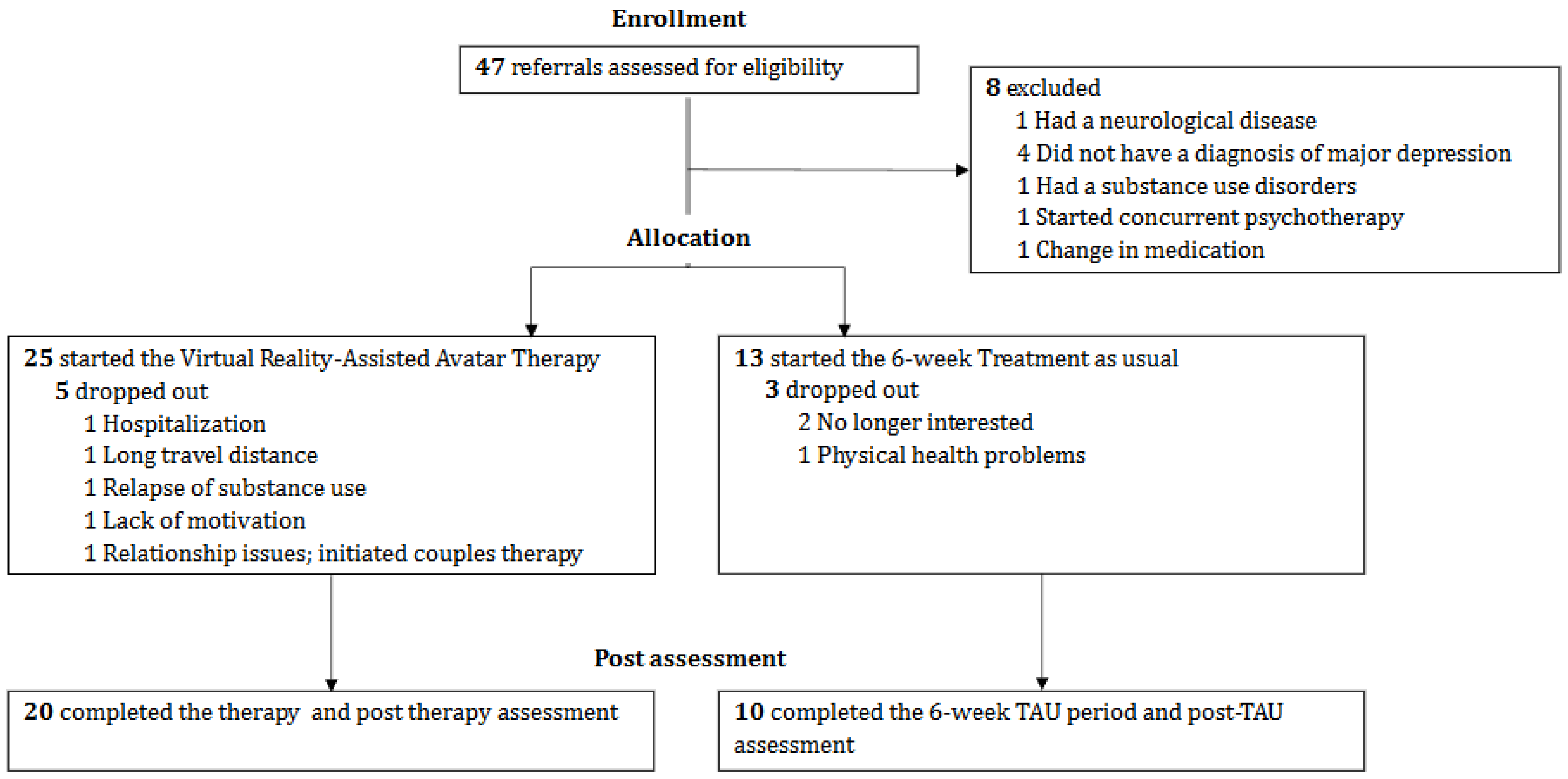

Table 1.
Baseline sociodemographic and clinical characteristics. n=30.
| VRT (n=20) | TAU (n=10) | |||
| mean/n | SD/% | mean/n | SD/% | |
| Age, years | 49.60 | 15.00 | 49.30 | 13.80 |
| Sex assigned at birth | ||||
| Male | 10.00 | 50.00 | 1.00 | 10.00 |
| Female | 10.00 | 50.00 | 9.00 | 90.00 |
| Ethnicity | ||||
| Caucasian | 16.00 | 80.00 | 9.00 | 90.00 |
| Autochtone | 1.00 | 5.00 | 0.00 | 0.00 |
| Latino-Américaine | 3.00 | 15.00 | 1.00 | 10.00 |
| In a romantic relationship | 9.00 | 45.00 | 4.00 | 40.00 |
| Has children | 8.00 | 40.00 | 7.00 | 70.00 |
| Currently employed | 7.00 | 35.00 | 2.00 | 20.00 |
| Education background | ||||
| High school | 3.00 | 15.00 | 3.00 | 30.00 |
| Vocational school | 2.00 | 10.00 | 2.00 | 20.00 |
| College | 10.00 | 50.00 | 2.00 | 20.00 |
| University degree | 5.00 | 25.00 | 3.00 | 30.00 |
| Illness history | ||||
| Age at depression onset (years) | 20.90 | 16.23 | 26.50 | 12.20 |
| Age at diagnosis (years) | 27.60 | 13.11 | 38.10 | 11.80 |
| Previous psychiatric hospitalizations | 0.65 | 0.93 | 0.10 | 0.30 |
| History of suicide attempt (mean by participant) | 2.10 | 4.86 | 0.00 | 0.00 |
| Previous treatment | ||||
| Pharmacotherapy (number of treatment) | 6.53 | 4.37 | 3.86 | 2.00 |
| Psychotherapy (number of treatment) | 3.45 | 2.26 | 1.60 | 1.00 |
| Electroconvulsive therapy and transcranial magnetic stimulation (number of individuals) | 2.00 | 10.00 | 2.00 | 20.00 |
| Comorbidity | ||||
| Avoidant personality disorders | 8.00 | 40.00 | 5.00 | 50.00 |
| Borderline personality disorders | 5.00 | 25.00 | 1.00 | 10.00 |
| Narcissistic personality disorder | 2.00 | 10.00 | 0.00 | 0.00 |
| Anxious disorders | 10.00 | 50.00 | 4.00 | 40.00 |
| Obsessive-compulsive disorder | 2.00 | 10.00 | 0.00 | 0.00 |
| Post-traumatic stress disorder | 2.00 | 10.00 | 0.00 | 0.00 |
| Attention-deficit disorder with or without hyperactivity | 3.00 | 15.00 | 2.00 | 20.00 |
VRT: Virtual Reality-Assisted Therapy, TAU: Treatment as usual, SD: standard deviation; %: percentage of participants.
Table 2.
Effects of Virtual reality-assisted Therapy for treatment-resistant major depressive disorder versus treatment as usual on depressive symptom severity and related clinical outcomes using linear mixed models. n = 30.
Table 2.
Effects of Virtual reality-assisted Therapy for treatment-resistant major depressive disorder versus treatment as usual on depressive symptom severity and related clinical outcomes using linear mixed models. n = 30.
| Treatment | Timepoint values |
Timepoint comparisons |
Time-by-treatment interaction |
||||
| Baseline |
Post-therapy / Post-TAU |
||||||
| mean | SD | mean | SD | p-value | Cohen’s d | p-value | |
| Depressive symptoms | |||||||
| PHQ-9 (0-27) | |||||||
| VRT | 18.30 | 4.51 | 8.25 | 4.76 | <0.01 | 2.61 | <0.01 |
| TAU | 13.50 | 4.79 | 14.90 | 4.43 | 0.34 | ||
| MADRS Total (0-60) | |||||||
| VRT | 30.94 | 7.75 | 15.57 | 8.21 | <0.01 | 2.10 | <0.01 |
| TAU | 25.50 | 9.92 | 25.40 | 6.72 | 0.97 | ||
| Anxious symptoms | |||||||
| GAD-7 (0-21) | |||||||
| VRT | 12.50 | 6.30 | 5.45 | 4.57 | <0.01 | 1.86 | <0.01 |
| TAU | 10.60 | 3.41 | 12.70 | 3.09 | 0.20 | ||
| Self-esteem | |||||||
| RSES (10-40) | |||||||
| VRT | 19.25 | 5.39 | 28.68 | 5.49 | <0.01 | 2.07 | <0.01 |
| TAU | 23.00 | 6.31 | 22.40 | 6.06 | 0.71 | ||
| Quality of life | |||||||
| QLS (0-114) | |||||||
| VRT | 44.30 | 17.28 | 39.88 | 20.96 | <0.01 | 2.21 | <0.01 |
| TAU | 50.42 | 18.20 | 50.63 | 18.92 | 0.96 | ||
| QLES-Q-SF (16-80) | |||||||
| VRT | 42.50 | 8.87 | 59.42 | 9.20 | <0.01 | 2.37 | <0.01 |
| TAU | 50.12 | 7.64 | 45.62 | 8.32 | 0.14 | ||
| Functional impairment | |||||||
| WHODAS Total (36-180) | |||||||
| VRT | 103.66 | 18.49 | 70.15 | 17.83 | <0.01 | 1.27 | <0.01 |
| TAU | 94.98 | 19.04 | 86.64 | 19.05 | 0.21 | ||
| WHODAS Cognition (6-30) | |||||||
| VRT | 16.65 | 4.34 | 11.05 | 3.80 | <0.01 | 1.23 | <0.01 |
| TAU | 14.40 | 2.76 | 13.70 | 3.95 | 0.60 | ||
| WHODAS Mobility (5-25) | |||||||
| VRT | 10.85 | 3.67 | 7.85 | 2.96 | <0.01 | 0.69 | 0.10 |
| TAU | 11.00 | 3.94 | 10.00 | 2.36 | 0.30 | ||
| WHODAS Self-care (4-20) | |||||||
| VRT | 8.65 | 3.10 | 5.05 | 1.47 | <0.01 | 0.81 | 0.05 |
| TAU | 8.30 | 2.67 | 6.90 | 2.13 | 0.12 | ||
| WHODAS Getting alone (5-25) | |||||||
| VRT | 14.86 | 3.89 | 9.93 | 3.06 | <0.01 | 1.17 | <0.01 |
| TAU | 13.20 | 4.16 | 12.5t0 | 3.60 | 0.56 | ||
| WHODAS Activities (8-40) | |||||||
| VRT | 26.11 | 5.44 | 17.00 | 5.29 | <0.01 | 0.54 | 0.21 |
| TAU | 18.67 | 5.69 | 15.33 | 1.53 | 0.39 | ||
| WHODAS Participation (8-40) | |||||||
| VRT | 26.20 | 5.49 | 19.48 | 5.86 | <0.01 | 0.67 | 0.10 |
| TAU | 24.50 | 4.79 | 21.80 | 4.29 | 0.18 | ||
Data are raw mean scores with standard deviation (SD). Linear mixed models with maximum-likelihood estimation were used. Cohen’s d are presented in absolute values. Significant differences (p-value <0.05) are shown in bold. VRT: Virtual Reality-assisted Therapy, TAU: Treatment as usual, MADRS: Montgomery–Åsberg Depression Rating Scale, PHQ-9: Patient Health Questionnaire-9, GAD-7: Generalized Anxiety Disorder-7, RSES: Rosenberg Self-Esteem Scale, QLS: Quality of Life Scale, QLES-Q-SF: Quality of Life Enjoyment and Satisfaction Questionnaire Short Form, WHODAS: World Health Organization Disability Assessment Schedule.
Disclaimer/Publisher’s Note: The statements, opinions and data contained in all publications are solely those of the individual author(s) and contributor(s) and not of MDPI and/or the editor(s). MDPI and/or the editor(s) disclaim responsibility for any injury to people or property resulting from any ideas, methods, instructions or products referred to in the content. |
© 2026 by the authors. Licensee MDPI, Basel, Switzerland. This article is an open access article distributed under the terms and conditions of the Creative Commons Attribution (CC BY) license (http://creativecommons.org/licenses/by/4.0/).
Copyright: This open access article is published under a Creative Commons CC BY 4.0 license, which permit the free download, distribution, and reuse, provided that the author and preprint are cited in any reuse.