
Submitted:
24 August 2026
Posted:
25 August 2026
You are already at the latest version
Abstract
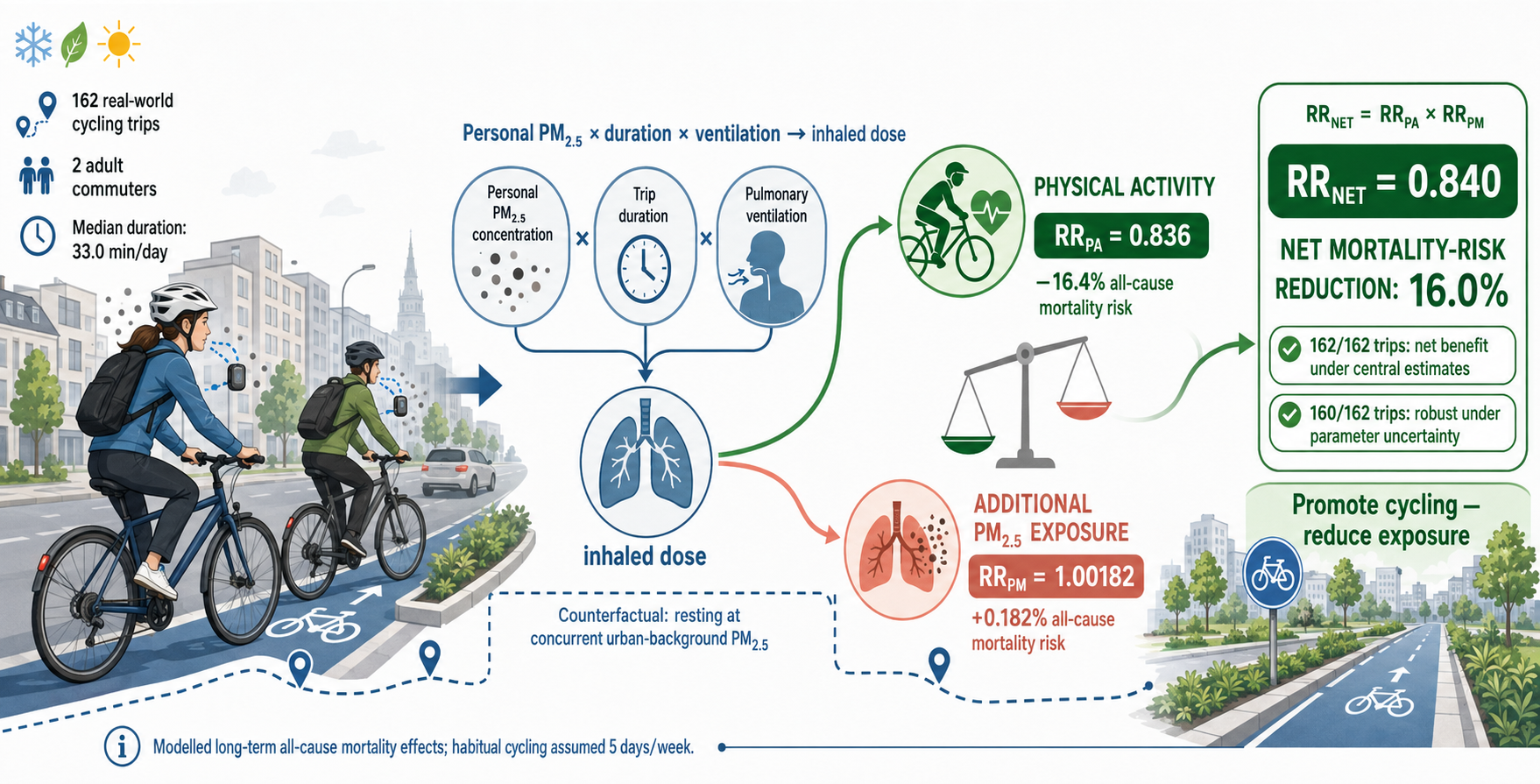
Urban cycling is promoted as a sustainable transport mode and a means of increasing daily physical activity, but increased inhalation of fine particulate matter (PM2.5) may offset its health benefits. This secondary, scenario-based analysis assessed the balance between physical-activity benefits and PM2.5-related risks under real-world conditions in Gliwice, Poland. Personal PM2.5 exposure was measured during 162 trips by two com-muters in heating and non-heating seasons using low-cost sensors. Each trip duration was treated as a hypothetical habitual pattern repeated five days per week. Inhaled doses were estimated using measured concentrations, trip duration, and cycling-specific ven-tilation rates. Median cycling duration was 33.0 min/day. Inhaled dose depended on personal exposure, cycling duration, and pulmonary ventilation rather than PM2.5 con-centration alone. The median physical-activity relative risk was 0.836, corresponding to a 16.4% reduction in all-cause mortality risk, whereas the median PM2.5-related relative risk was 1.00182, equivalent to a 0.182% increase. The combined median net relative risk was 0.840 (IQR: 0.815–0.879), indicating a 16.0% net risk reduction. All trips showed a net benefit under central assumptions, and benefits remained for 160 of 162 trips in sensitivity analysis. These findings support urban cycling promotion alongside measures to reduce cyclists’ exposure.
Keywords:
urban transport
; active commuting
; bicycle
; city center
; public health
; Poland
Copyright: This open access article is published under a Creative Commons CC BY 4.0 license, which permit the free download, distribution, and reuse, provided that the author and preprint are cited in any reuse.